The trial of three white men accused of hunting down and murdering Ahmaud Arbery after seeing him running from a house under construction in their South Georgia community began on Wednesday with the defense presenting a motion of acquittal on the malice murder charge. The charge, which Travis McMichael; his father, Gregory McMichael; and their neighbor, William “Roddie” Bryan—who recorded moments leading up to Arbery’s death—were indicted on requires proof of intent to kill. As part of an effort seeking a directed verdict and acquittal, the defense argued outside of the jury’s presence that no expressed malice has been proven in the shooting of Arbery.
The argument follows the prosecution resting its case on Tuesday’s eighth day of testimony, making way for the defense to begin presenting its case. All three defendants have pleaded not guilty to malice murder and felony murder charges as well as counts of aggravated assault, attempt to commit a felony, and false imprisonment.
Updates will be added as the trial continues. Jump below the fold for more information on the trial to date.
Bryan has had a media spotlight on him at several moments in the case, namely because of his attorney Kevin Gough’s advocacy work to get Black pastors banned from observing the trial in court. In a recent motion, Gough urged the court to consider on Tuesday, he said he was seeking to “prohibit activity that may intimidate jurors.” Gough defended another motion to reconsider the defense’s request for a speedy trial. In doing so, Bryan said—and CNN reported—on Tuesday that he was being held in a protective jail unit with restricted access to showers and outdoor recreation and that he was living in fear because of the coronavirus pandemic. The jury wasn’t present for Bryan’s claims, and they apparently did little to sway Judge Timothy Walmsley, who denied the motion.
Defense attorney Frank Hogue, who is representing Gregory McMichael, also tried to poke holes in other charges, saying they too should be tossed out. In one example, the attorney argued Arbery had a chance to flee via a route not blocked by the defendants’ trucks.
Prosecutor Linda Dunikoski said in response that the defense will argue that various elements of the case are Arbery’s fault. “But that’s not what the law is,” she said. She pointed to footage of Gregory McMichael saying he was going to shoot Arbery’s “f---ing head off.”
Dunikoski said that, concerning felony murder specifically, all four of the underlying felonies played a substantial part in causing the death. In countering the defense’s arguments, she articulated plans to address each count in the order the defense presented, starting with criminal attempt to commit false imprisonment. Dunikoski said Bryan and both McMichaels used pickup trucks to confine and detain Arbery and they did it “in concert with each other.”
“Greg McMichael said ‘he was trapped like a rat and he knew it,’” Dunikoski said. She was making the case that the quote is admission to trying to trap Arbery.
The prosecutor said all Arbery did was try to get away. “Here we’ve got the ultimate confinement,” Dunikoski said. “Judge, the ultimate confinement is death.”
Gough argued his client didn’t shoot anyone or attempt to shoot anyone, and has been lumped into indictments that don’t pertain to him. Gough said the state contends that the McMichaels, with Bryan aiding, was attempting to make a citizen’s arrest—which is not authorized under Georgia law—but it doesn’t establish malice or an attempt to aid and abet a shooting.
Gough asked the court to consider the unintended consequences. He asked if we are going to try to arrest every police officer present at the scene of a malice murder. “That can’t be the law, your honor,” Gough said. “Just like on the street with the police officers, suicide by cop is not reasonably foreseeable, nor is suicide by citizen’s arrest.”
Walmsley denied the defense's requests for directed verdict and acquittal. It's unclear at this point if defendants in the case will testify, and attorneys for Travis and Gregory McMichael asked the court not to ask their clients if they will testify.
The judge instead swore Travis in to make sure he understood his right to testify. Walmsley asked Travis his highest level of education, and he said 12th grade. Then, the judge informed Travis that he has the right to testify and if he did would be treated like any other witness. Walmsley did the same with Gregory, who said he had some college education, and Bryan, who said his highest level of education was 12th grade. Walmsley informed the defendants that if they decide not to testify, the court will instruct the jury not to hold the decision against the defendants.
Gough followed up with a familiar refrain, listing the people who he would like banned from the trial, including Rev. Jesse Jackson. Gough said he is again moving for a mistrial.
The judge denied the attorney’s request for a mistrial. So the jury was called in, and Gough was given the go ahead to begin his opening statement.
He started by showing footage of Bryan repairing his front porch, and the attorney said his client saw Arbery out of the corner of his eye with a truck following him. Gough said Arbery had the opportunity to yell help as he was approaching Bryan but that Arbery assumed the worst about Bryan.
The attorney pointed out that Bryan left his hammer on the front porch and grabbed his keys. Gough said Bryan had a rifle in the house on the day of the shooting but he didn’t get his rifle. He walked to his car with a cell phone and his keys, Gough said. Showing the jury moments from home surveillance video, Gough pointed out that Bryan’s truck is actually angled away from Arbery initially. Gough asked the jury to “honestly seek the truth.”
After the revisions, disappointing months like August looked a lot more like October, a month that was hailed as a labor market rebound. In hindsight, while a blockbuster June and July were even better than they looked, they didn’t lead to months of stagnation — they diminished somewhat, but still produced solid, steady growth that continued through October.
It’s like the data carries uncertainty, which can make estimation a challenge. Imagine that.
The US has raised potential objections to Nvidia’s controversial acquisition of the UK chip design company Arm from SoftBank, adding a fresh hurdle to a deal that has already stirred up serious opposition on the other side of the Atlantic.
News that American regulators shared European concerns came a day after the UK launched an in-depth investigation into the transaction on competition and national security grounds. The European Commission began its own extended review late last month.
Despite the mounting signs that regulators may try to block the deal, Nvidia said on Wednesday that it still believed “in the merits and benefits of the acquisition to Arm, its licensees and the industry.”
Enlarge / A demo version of the new thruster in operation. (credit: ThrustMe)
Most people are probably familiar with iodine through its role as a disinfectant. But if you stayed awake through high school chemistry, then you may have seen a demonstration where powdered iodine was heated. Because its melting and boiling points are very close together at atmospheric pressures, iodine will readily form a purple gas when heated. At lower pressures, it'll go directly from solid to gas, a process called sublimation.
That, as it turns out, could make it the perfect fuel for a form of highly efficient spacecraft propulsion hardware called ion thrusters. While it has been considered a promising candidate for a while, a commercial company called ThrustMe is now reporting that it has demonstrated an iodine-powered ion thruster in space for the first time.
Ion power
Rockets rely on chemical reactions to expel a large mass of material as quickly as possible, allowing them to generate enough thrust to lift something into space. But that isn't the most efficient way to generate thrust—we end up trading efficiency in order to get the rapid expulsion needed to overcome gravity. Once in space, that need for speed goes away; we can use more efficient means of expelling material, since a slower rate of acceleration is acceptable for shifting things between different orbits.
As much as 38 percent of the Internet’s domain name lookup servers are vulnerable to a new attack that allows hackers to send victims to maliciously spoofed addresses masquerading as legitimate domains, like bankofamerica.com or gmail.com.
The exploit, unveiled in research presented today, revives the DNS cache-poisoning attack that researcher Dan Kaminsky disclosed in 2008. He showed that, by masquerading as an authoritative DNS server and using it to flood a DNS resolver with fake lookup results for a trusted domain, an attacker could poison the resolver cache with the spoofed IP address. From then on, anyone relying on the same resolver would be diverted to the same imposter site.
A lack of entropy
The sleight of hand worked because DNS at the time relied on a transaction ID to prove the IP number returned came from an authoritative server rather than an imposter server attempting to send people to a malicious site. The transaction number had only 16 bits, which meant that there were only 65,536 possible transaction IDs.
I don't remember the last time I had a non-impossible burger...it's been a year or two at least at this point. Works great.
A customer eats a meat-free Rebel Whopper at a Burger King in Italy in 2019. | Camilla Cerea/Bloomberg via Getty Images
The environmental debate over meatless meat, explained.
Plant-based meat has gone mainstream. The Impossible Burger, which debuted at a single restaurant five years ago, is now on Burger King’s permanent menu. And McDonald’s is testing its McPlant burger, featuring a Beyond Meat patty, in select US locations. Both plant-based startups are now veterans in a product category that did $1.4 billion in sales and grew 27 percent in 2020.
Under the tagline “Eat Meat. Save the Planet,” Impossible Foods claims its soy-based burger uses 87 percent less water, takes 96 percent less land, and has 89 percent lower greenhouse gas emissions than a beef burger. Beyond Meat makes similar claims about its pea-based burgers.
This matters because animal agriculture contributes around 15 percent of global greenhouse emissions, and experts agree that without a major shift away from meat in our diets, we won’t be able to meet the global community’s climate targets. The promise of plant-based faux meats is that consumers will be able to keep enjoying the foods they love, but with a far lower climate footprint.
One recent whitepaper from an environmental NGO states that the above claims from faux meat companies “are unproven, and some clearly untrue.” A sustainability analyst quoted in the New York Times goes further, claiming that the companies’ secrecy about their production methods means that “We don’t feel we have sufficient information to say Beyond Meat is fundamentally different from JBS.” (JBS is the world’s largest meat producer).
Plant proteins, even if processed into imitation burgers, have smaller climate, water, and land impacts than conventional meats
But years of research on the environmental impact of food make one thing clear: Plant proteins, even if processed into imitation burgers, have smaller climate, water, and land impacts than conventional meats. Apart from environmental impact, reducing meat production would also reduce animal suffering and the risk of both animal-borne disease and antibiotic resistance. The criticisms against the new wave of meatless meat appear to be more rooted in broad opposition to food technology rather than a true environmental accounting — and they muddy the waters in the search forclimate solutions at a time when clarity is sorely needed.
The climate impact of animal meat versus plant-based meat, explained
Americans eat well over 200 pounds of meat each per year, and it’s accelerating us along a collision course with climate catastrophe. While many other countries eat far less meat, global appetites are catching up quickly, spurred especially by the growing affluence of the rising middle class in Asia and Latin America.
Fossil fuels do make up a far greater proportion of emissions in the US and globally, but even if we reduced energy emissions down to zero, demand for meat and dairy alone could make us exceed critical levels of global warming. That makes shifting diets away from meat a critical tool in preventing global temperatures from rising above 1.5°C or 2°C by 2100.
There are a number of reasons for meat’s outsized ecological footprint. The first is that cows belch out methane created from fermenting grassy food in their multi-chambered stomachs. With a billion and a half cows on the planet — raised for both beef and dairy — that adds up to about 9 percent of all global greenhouse gas emissions alone.
Although pigs and chickens, the two most farmed species on the planet, don’t belch methane, they still produce lots of manure — and that generates nitrous oxide, another potent greenhouse gas. They also need to eat fertilized crops, like corn and soy, which generate more emissions. And while all cattle graze on grass, most in the United States are eventually fattened for slaughter on feedlots where they too eat corn and soy.
Feeding all of these crops to animals is far less efficient than feeding them more directly to humans. For example, every 12 calories from corn and soy fed to a pig provides just one calorie of meat back. The proposition of plant-based meats is that they cut out the animal, allowing more efficient use of land and resources.
Different animal products have vastly different emissions. For instance, pigs and chickens emit far less than cows and sheep. But according to recent peer-reviewed research from the University of Oxford and Johns Hopkins University, which compiled several estimates, all of these animal foods (except some chicken) generate more emissions than plant-based meats. (Editor’s note: Jan Dutkiewicz, one of the authors of this article, was a co-author on the Johns Hopkins paper.)
This research consisted of meta-analyses of multiple life-cycle assessments, or LCAs, which measure the total environmental impact of a product. While some of the plant-based meat estimates were commissioned by the faux meat companies themselves, including Beyond and Impossible, others were not, and all used internationally agreed-upon LCA standards for accounting of every emission source throughout processing.
Even the lowest-emitting beef from dedicated beef herds (34 kg carbon dioxide equivalent, or CO2e) and lower-emitting beef from dairy cow herds (15 kg CO2e) came in far above the highest-emitting tofu (4 kg CO2e) and plant-based meat (7 kg).
Chicken and pork production emit far less CO2 equivalent than beef. And while there is some overlap (the lowest-emitting chicken [3.2 kg CO2e] and pork [6 kg CO2e] rival the emissions of the highest-emitting plant-based meat), the average emissions of tofu and plant-based meats are still lower than the average emissions of both chicken and pork.
Tim Ryan Williams/Vox
Of course, climate emissions aren’t the only environmental impacts from food. Producing animal-based food also requires large quantities of fresh water. For instance, one kilogram of pork requires 442 liters of water, versus 84 liters for one kilogram of plant-based meat. Similarly, producing beef, pork, and chicken requires far more land and causes much more pollution to waterways than plant-based alternatives.
How techno-skepticism muddles the environmental debate over plant-based meat
Despite the clear evidence that plant-based meats are generally better for the environment, criticism persists, and some of it is rooted in techno-skepticism — the attitude that because most plant-based meat is made using similar industrial farming and food-processing techniques as animal meat, it too is highly problematic.
It’s true that just like feed crops for farm animals, most faux meats are made with soy or wheat (or peas, in the case of Beyond Meat), and are grown as monoculture crops, meaning they’re grown in large fields that consist of just one mechanically farmed plant. Monoculture farming has long been criticized by environmental advocates for causing soil degradation and requiring a lot of pesticides, among other problems. A further extension of the criticism is that monocultured crops are usually the product of genetic modification, or GMOs.
While the safety of genetic modification itself has been well established, some of the intensive farming practices associated with growing certain GMO crops have come under fire from environmental NGOs and champions of organic farming. Plant-based meat companies take very different stances on using GMOs, with Impossible Foods embracing the technology and Beyond Meat going GMO-free.
Angela Weiss/AFP via Getty Images
Packages of Impossible Burger, Beyond Meat, and other plant-based meats sit on a shelf for sale in 2019 in New York City.
However, the vast majority of chicken and pork requires more crops in the form of animal feedthan what is contained in an equivalent serving of plant-based meat — and that’s almost always more monoculture GMO crops. Paradoxically, if you want to eat something meaty, a great way to reduce your monoculture (and GMO) intake is to eat faux meats.
To be sure, exclusively grass-fed beef doesn’t use any monocultured feed. But it’s sold at a premium price, and scaling up its production to meet current demand for beef would require multipletimes more land than is already used, making this a dead-end proposition (unless we also drastically reduce consumption).
Critics of plant-based meat have also pointed out that it tends to be highly processed. No doubt, most plant-based meats are not health foods, due to their high saturated fat and salt (though beef and pork, too, are high in saturated fat). But “processed foods” is a vague and often ill-defined term that encompasses everything from high-fructose corn syrup to whole-grain pasta to yogurt, and has little bearing on foods’ environmental impact. As Vox’s Kelsey Piper has written, the term “processed food” “can obscure more than it clarifies” when it comes to the debate over plant-based meat.
What “corporate sustainability” measurements get wrong about the environmental impact of food
The final major critique of plant-based meat revolves around transparency.
This critique is raised both by some food NGOs and by a niche group of professional ESG (environmental, social, governance) corporate analysts. These analysts are paid by conscientious investors to rank companies by the riskiness of their supply chains. This is an important and growing space, but corporate ESG analysis still has major problems and limitations.
Some corporate sustainability analysts have criticized plant-based companies like Impossible Foods and Beyond Meat for not precisely and continuously reporting climate impacts across their supply chains, like packaging, transporting, and processing. As noted earlier, when speaking to the New York Times for a recent article, one ESG analyst said that Beyond Meat and JBS are not “fundamentally different.”
One academic researcher called these products a “black box,” claiming that “much of what is in these products is undisclosed.” These kinds of statements are hyperbolic, akin to saying a gas-guzzling SUV and an electric car are similar because the companies that make them don’t reveal the emissions that come from producing the specific microchips they use.
It’s true that ingredient labels can’t tell us precisely where and under what conditions a given ingredient, like soybeans or coconut oil, was grown, and most meat and faux-meat companies don’t disclose emissions throughout their entire supply chain and manufacturing. These details aren’t trivial, and emissions across manufactured food production can likely stand to be improved.
But because corporate ESG is a niche space, its demands for transparency often revolve around details that investors want to see, including small tweaks and changes in production processes, while potentially missing the lion’s share of the real environmental impacts. When it comes to plant-based burgers, we already know most of the impacts and where they are coming from. According to FDA regulations, food companies must list all ingredients on product labels, meaning that much of the “black box” of plant-based protein can be unlocked simply by looking at the back of a package.
Labels on conventional meat also do not disclose all the inputs and processes that went into producing it. If you’re eating a Beyond Burger, you might not know exactly where its peas come from or how it was packaged, but you would know that peas were the most-used crop ingredient. If you’re eating canned pork from Hormel, the maker of Spam — which one sustainability analysis firm rated as much lower-risk than Beyond Meat when it comes to their reputational risks like harming workers or the environment — you nonetheless wouldn’t know what their pigs ate or, for that matter, how those pigs were treated.
The fact is that the overwhelming majority of the environmental impacts of our food are a result of what happens on farms, not in manufacturing or shipping. For example, a local, grass-fed burger is going to cause more emissions than, say, a pea-based burger or manufactured block of tofu trucked in from 1,000 miles away. With meat, most of the impact is from the cow belches, the feed crop production, the polluting manure, and the deforestation required to make way for ever-increasing production.
Tim Ryan Williams/Vox
As seen in the chart above, packaging and transport emissions across different kinds of meats and plant foods are pretty consistent, never going above 2 kg CO2e per kg of product.
However, the emissions for land use, farming, and feed range greatly among foods, from 0.7 kg CO2e for peas to more than 57 kg CO2e for beef.
Put differently, packaging, transport, and processing make up a large percentage of tofu’s emissions only because soy’s overall production emissions are already very low. In order for plant-based meats to even approach beef’senvironmental impact, they would need to have a manufacturing footprint at least10 times higher than that of tofu.
All of these criticisms may have more to do with techno-skepticism than scientific rigor. The discourse against technological “frankenfoods” is a longstanding one that contrasts bucolic images of “real food” and “real farms” with labs, factories, and smog. The real story isn’t so simple. And while many of the harms from food production are industrial in origin, we can also thank technology for major advances in food safety like pasteurization — and for the creation of faux meats that, while imperfect, give people a more sustainable alternative to animal-based meat.
None of this is to say that makers of plant-based meat alternatives can shirk transparency. Companies that are serious about making big sustainability claims should strive to win the public’s trust through greater transparency of their entire production chains, including not simply emissions but other impacts like labor practices and manufacturing waste. Nonetheless, we currently know enough to conclude that plant-based meats’ climate impacts are smaller than those of conventional meat, even if the precision of their monitoring could be improved.
Why other ethical impacts get left out of the equation
Beyond climate and pollution, there are a host of other impacts corporate sustainability evaluators and public interest groups should consider in their assessments, including animal-borne disease and animal welfare.
Nati Harnik/AP
Cattle eat at a Columbus, Nebraska, feedlot in June 2020.
Most meat eaten by Americans comes from concentrated animal feeding operations (CAFOs) where animals have scant legal protections. This barren legal landscape has led to a race to the bottom on animal welfare, resulting in animals bred to grow so fast that their vital organs can painfully lose function, or they can barely walk without pain. Animals’ natural behaviors are restricted by confining them in cages too small to turn around or spread their wings.
It’s unsurprising, then, that footage depicting neglect and mistreatment of pigs, chickens, and cows on industrial farms has caused reputationaldamage to the food companies that were unaware of or unconcerned about practices on the farms from which they source. For instance, the dairy company Fairlife faced protests and lawsuits after undercover footage apparently showed abuse at a farm from which it sourced milk.
Because of this reputational risk, the meat lobby has pushed states to pass “ag-gag” laws criminalizing private investigations and whistleblowing on animal farms, which have only worsened the pressing transparency issue across North American animal farms.
Another risk in factory farming (for which there’s no equivalent in plant-based food manufacturing) is pandemic risk. The confined conditions that create animal welfare problems on intensive farms also increase the risk of animal-borne diseases. Thousands of animals are kept in quarters close to each other and their waste, allowing pathogens ample opportunity to propagate and undergo mutations that can jump to workers and communities near production facilities.
Spillover of avian flu strains from chickens to humans is an ever-present possibility, which has seen sporadic outbreaks around the world, exacerbated by the closely confined and often unsanitary conditions in which billions of chickens live on meat and egg farms.
And diseases that don’t spread to humans are alsoa near-constant risk to the business of industrial farming and our food supply. The ongoingAfrican Swine Fever pandemic alone has claimed the lives of hundreds of millions of pigs, with preventative pigculling the only existing measure to control diseasespread, causing tens of billions of dollars in losses in Asia alone.
Antibiotic resistance is another potentially existential threat that can emerge on industrial animal farms. Antibiotics are a basic and critical tool in modern medicine and also our last line of defense against many diseases.
Already, 700,000 people die each year of antibiotic-resistant bacteria, including 35,000 in the United States. The World Health Organization has specifically called for the phaseout of farms’unnecessary antibiotic use to reduce this risk because we don’t have an alternative — an antibiotics 2.0 — if antibiotic resistance keeps increasing as it has.
Disease and animal mistreatment are directly relevant to sustainability and to companies’ material and reputational risks, but meat companies have generally sought to avoid addressing them as they would make their operations more costly and less efficient.
Sustainability firms and other industry watchdogs, meanwhile, have not quantified these impacts, with some exceptions. There are a few reasons for this, including that it’s difficult to put concrete numbers on risks of zoonotic disease outbreaks (which are sporadic and hard to predict), as well as animal welfare. If sustainability firms could track companies’ non-climate risks better, we may have very different conceptions regarding which have riskier production processes and which are more sustainable.
More broadly, there is a pressing need to widen the debate over food sustainability. Fish, for instance, may have lower greenhouse gas emissions, but overfishing is harming fragile ocean ecosystems. Replacing beef with chicken might reduce climate emissions, but chickens are raised in worse conditions, have more viral outbreaks, and are given more than three times the antibiotics that cattle are — and far more chickens would have to be killed to create the same amount of meat. If emissions, animal welfare, and disease risks were all considered, neither chicken nor beef looks all that good.
Narrow sustainability measurements and techno-skepticism have clouded the public conversation about plant-based meats. Claims that these products might not be much better for the environment than meat goes against extensive, peer-reviewed research.
This is not to say that Beyond and Impossible burgers are the optimal choice. Taking a broad view of sustainability that includes emissions, environmental impacts, animal welfare, and animal-borne disease risk mitigation, the clear winner is a diet based on whole plant foods — just vegetables, grains, fruits, and legumes.
Such a diet, widely recommended by environmental groups like the World Wildlife Fund, is likely best for individual and planetary health. But plant-based meats are designed to fill a role that just plants often can’t: easily appealing to meat-loving taste buds and dietary habits with little culinary finessing required. The additional environmental price paid for this convenience and pleasure still leaves faux meats far better for the planet (and animals) than conventional meats. The science there is clear.
Matthew Hayek is an assistant professor of environmental science in the department of Environmental Studies at New York University and Affiliated Faculty at the NYU Center for Data Science.
Jan Dutkiewicz is a policy fellow at the Animal Law and Policy Program at Harvard Law School and a postdoctoral researcher with the Swiss National Science Foundation.
It's an important marker in the conservative baby rage: they're fundamentally religious and only advocate for other interests to the extent they allow them to impose their religious law on non-adherents.
The podium backdrop at the Federalist Society’s 25th Anniversary gala in 2007. | Saul Loeb/AFP via Getty Images
America’s most powerful legal organization has lost faith in the market’s power to impose its values on the nation.
This conspiracy, Keller claimed, includes companies as varied as Facebook, Google, Amazon, Coca-Cola, Goldman Sachs, JPMorgan, Twitter, and Walmart, all of which have joined forces with “the swelling ranks of so-called ‘woke’ people, who are completely and unabashedly opposed to individual rights.”
“Defenders of freedom must face reality,” Keller insisted, before adding the nation’s top advocacy group for big business to his list of enemies. “The Chamber of Commerce is not our friend. The C-suite grandees who finance it are not our friends either. They were erstwhile allies of convenience — and they are now the enemies of a freedom-loving people.”
It’s the sort of conspiratorial thinking one might expect to hear on the Alex Jones Show, or perhaps from disciples of QAnon. But Mr. Keller’s audience was not an ordinary online crowd.
When someone speaks at the Federalist Society’s annual gathering, they speak directly to many of the most powerful people in the country, some of whom literally have the power to order the Society’s enemies to comply with its wishes.
And while those wishes aren’t clearly defined yet, the enemy increasingly is. Over the three-day span of the Federalist Society’s annual convention, attendees were warned of unprecedented threats to human flourishing, all driven by cultural leftists who have taken over public and private schools, universities, and even big business in order to impose their “woke” agenda on an unwilling public.
“Never before” in nearly half a century, “have we seen all levels of government so blatantly disregarding the Constitution and our civil rights laws, and at such a furious pace,” said Kimberly Hermann, a lawyer who sues public schools on behalf of conservative causes, at a panel denouncing “diversity, equity, and inclusion-based curricula.”
Vivek Ramaswamy, a young biotech executive and author of Woke, Inc.: Inside Corporate America’s Social Justice Scam, claimed that “the woke movement in the United States,” and corporations that appeal to it, undermine America’s geopolitical standing against China.
Adam Candeub, a professor at Michigan State University College of Law, complained about Facebook and Twitter’s controversial decision to suppress content about a dubiously sourced story about President Joe Biden’s son Hunter. Less convincingly, he complained about several big tech companies’ decision to temporarily block the conservative social media site Parler after January 6. As Amazon explained after it removed Parler from its web hosting service, it did so because the conservative social media site refused to pull down “content that threatens the public safety, such as by inciting and planning the rape, torture, and assassination of named public officials and private citizens.”
And yet, for Candeub, these incidents were proof that all conservatives are threatened and something needed to be done to rein in tech companies. “If trends continue,” Candeub told the Federalist Society audience, “you’ll be de-platformed.”
It’s a stunning rhetorical shift from a fanatically pro-free market organization that’s traditionally pushed a hands-off approach to business. Historically, the society has sought to undermine corporate regulation, and that has lionized decisions like Citizens United v. FEC (2010), which permits corporations to spend unlimited sums of money to influence elections. The Federalist Society’s conference typically features panels warning about “systematic regulatory overreach” against “regulated industries.”
But now the society appears to have lost confidence in the very free market system it spent decades celebrating.
In a market society, economists Milton and Rose Friedman wrote in 1979, “the consumer is protected from being exploited by one seller by the existence of another seller from whom he can buy and who is eager to sell to him.” In theory, if one company adopts “woke” branding that offends its customers, then the market will deliver those customers into the waiting arms of a competitor.
Alex Wong/Getty Images
Milton Friedman, recipient of the 1976 Nobel Prize for economic science, sits with his wife Rose at a White House event in May 2002.
Yet, rather than waiting for the hand of the market to deliver an invisible spanking to “woke” corporations, speaker after speaker at the Federalist Society’s convention called for a central planner to intervene. As it turns out, the society’s commitment to something as foundational as free market capitalism may be secondary to its desire to own the libs.
What exactly is the Federalist Society so mad about?
The conference featured an array of angry speakers raging against private sector leftism, but it was often hard to figure out what, exactly, they were so mad about. Though a mix of panels on “woke” corporations, universities, and secondary schools warned of a multi-institutional effort to impose this ideology on the nation, many speakers never explained what they think this ideology entails. Those that did often described a “woke” person in caricatured terms.
Newsweek opinion editor Josh Hammer defined the “enemy” — and he very pointedly used the word “enemy” — as “the Ibram X. Kendi woke ideology extremists who are trying to poison and rot the minds of our children into hating themselves and hating their country to boot.” Keller claimed that “woketarians” don’t just oppose “individual rights,” they also believe that “America’s founding was an immoral act” and that “the Bill of Rights is racist.”
Numerous speakers deployed the most potent weapon in the anti-woke advocate’s toolbox: the unrepresentative anecdote. Three speakers pointed to the same two incidents — the Hunter Biden article and the moves against Parler — as evidence that big tech is out of control. Speakers on three different panels complained about an incident where a Yale Law School student and Federalist Society member felt “intimidated” after a mid-level administrator pressured him to apologize for an email advertising a “Trap House” party where “Popeye’s chicken” and “basic bitch American-themed snacks” would be served.
Even when a speaker pointed to a specific incident that involved neither Yale nor Hunter Biden, moreover, they gave little reason to believe that any systemic problems exist.
Hermann, for example, alleged that a school district in Illinois separated white and non-white teachers and gave them “different teacher trainings.” She also complained about a children’s book likening white privilege to a deal with the Devil — a book that has allegedly been taught in maybe a dozen classrooms and recommended to students in a few more. Yet, when she tried to show that these incidents were part of a broader pattern, her best evidence was that “every single school district throughout this country is requiring teachers to take some sort of equity training.”
Ramaswamy, the Woke, Inc. author, even implied that laws banning discrimination on the basis of “race, sex, religion, and national origin” should be repealed. “Not many people are willing to revisit” the question of whether the law should protect classes such as these, Ramaswamy said, but “I am.”
Lisa Lake/Getty Images
Vivek Ramaswamy speaks at the Forbes Under 30 Summit at the Pennsylvania Convention Center in Philadelphia in October 2015.
The conference, in other words, featured an array of speakers who created a general sense that values like diversity and inclusion have gone too far — including several who seemed to reject the very idea that these values are worth championing at all. But it was often hard to pin down exactly what “wokism” is, or what the Federalist Society plans to do about it.
That said, many speakers brought up Milton Friedman, and specifically his views about the role of a corporation. Under the “Friedman Doctrine,” a corporate manager is the “agent of the individuals who own the corporation,” and thus must act in their interests — a duty that many speakers claimed was inconsistent with corporations playing politics. Ramaswamy, for example, warned against the “woke executive” who uses “his or her seat of corporate power, and the shareholder resources associated with it, to advance a particular agenda.”
It’s doubtful that the Federalist Society really wants to follow this argument to its logical conclusion. No speaker that I witnessed argued that corporations should be barred from lobbying law and policymakers. And the few speakers who mentioned Citizens United appeared to believe that it was correctly decided. For years, the Federalist Society elevated voices who believe that corporations should be free to spend money to elect Republicans or to lobby Congress to diminish the power of the EPA. And there is no reason to think that it will reverse course on these issues.
But so many speakers at this year’s conference appeared convinced that certain choices corporations have made present such a unique threat that the ordinary rules of free speech should not apply. The undergirding principle behind so many of these speeches was that corporate free speech — and corporations’ ability to shape their own companies’ values — does not extend to actions that promote whatever the Federalist Society means when it uses the word “woke.”
But even if we grant the premise that a corporation that promotes values like diversity is different in kind from a corporation that gives a million dollars to a Republican super PAC, it’s not even clear why corporate diversity initiatives and the like run counter to Friedman’s theory of the corporation. There’s a perfectly plausible argument that when corporate executives make a “woke” comment, decline to provide services to a website that promotes political violence, or run an ad campaign featuring BLM supporters, they’re just exercising good business judgment.
The capitalist case for “woke” corporations
The Society’s rage against “woke” corporations only makes sense if you imagine “wokeism” to exclude any real concept of social and economic justice. Amazon’s decision to block a single extremist website does nothing to allay the harsh working conditions in its warehouses. Corporate America is replete with companies that denounce a regressive bill in public then donate to conservative groups that help reelect these lawmakers in private.
As the Roosevelt Institute’s Kitty Richards told my colleague Emily Stewart, “We should be skeptical of individual companies and their CEOs and shareholders talking about corporate tax rates or specific provisions that seem benevolent,” because they are often “trying to shape policy in a way that will affect their bottom lines positively.”
But let’s take the arguments against “woke” capital offered by people like Keller and Ramaswamy at face value. Yes, corporations have always advocated for their own interests in the political arena, and this corporate speech often promotes the laissez-fairevalues that used to animate the Federalist Society. But there are, at the very least, anecdotal examples of big companies taking actions that enrage conservatives and delight liberals and Democrats.
The assumption underlying so many of the Federalist Society speakers’ remarks is that, when companies hold diversity trainings or deny server space to websites like Parler, they are advancing the political views of corporate executives at the expense of the company itself. In Keller’s words, “woke” capitalism is driven by CEOs who “like the psychic income they get from virtue signaling,” and who think that appealing to cultural leftists will appeal to “all of the people who go to cocktail parties that New York Times folks like to go to.”
Perhaps. But if companies as diverse as Google, Coca-Cola, JPMorgan, and Walmart are all engaged in the kind of “wokism” Keller despises, he should at least consider the possibility that they are doing so because it is good business.
The business case for “wokism” starts by looking at the political divide between younger and older voters. According to the Pew Research Center, President Joe Biden beat former President Donald Trump by 30 points among voters between the ages of 18 and 29. He won voters aged 30 to 49 by 11 points. Trump, meanwhile, won voters aged 50 and older.
This divide matters to corporate executives because young people wield a disproportionate influence over the market. As Ezra Klein has noted, advertisers are particularly interested in reaching the younger, Biden-supporting cohort of consumers because those younger consumers tend to have unsettled brand preferences. If you convince a young 30-something to buy a Ford truck, there’s a good chance they will drive Ford trucks for the rest of their lives.
This focus on young consumers has several implications. For one thing, it means that television studios will tend to produce content that appeals to the younger, more liberal audience that advertisers want to reach — thus causing America’s pop culture to embrace young people’s values. It also means that companies will try to market their products to people who share these values, even if such a campaign might alienate older consumers.
Justin Sullivan/Getty Images
A billboard featuring former San Francisco 49ers quaterback Colin Kaepernick is displayed on the roof of the Nike Store in San Francisco in September 2018.
Consider, for example, Nike’s decision to make Colin Kaepernick, the former NFL player and racial justice activist, the centerpiece of a 2018 ad campaign. This campaign mystified many older consumers — an SSRS poll from that year found that just 26 percent of adults over 65 agreed with Nike’s decision to feature Kaepernick.
But Nike also knew that two-thirds of the company’s customers are under 35, according to a report by CNN, and a plurality of this age cohort supported Nike’s decision to feature Kaepernick. The views of older voters didn’t matter to Nike. From a purely capitalist perspective, “woke” branding helped Nike sell shoes.
Young people also care a great deal about diverse workplaces. A 2018 survey by the consulting firm Deloitte, for example, found that millennial and Gen Z employees “working for employers perceived to have a diverse workforce are more likely to want to stay five or more years than those who say their companies are not diverse (69 percent to 27 percent).” The same survey found that younger workers are more likely to remain at a company with a diverse management team.
So companies that want to attract new consumers and recruit a talented workforce must appeal to younger individuals who largely reject the Federalist Society’s values. That may lead to a number of corporate policies that offend people like Keller or Ramaswamy. And it may mean that companies like Google or Amazon risk an uprising among their software engineers if those companies get in bed with a site like Parler. But it’s hardly evidence that corporate executives are engaged in a conspiracy to promote “wokism” at the expense of their shareholders.
Even if business leaders are wrong that appealing to young, left-leaning consumers is a good business plan, moreover, sanctioning these companies for doing so could require upending one of the most foundational principles of corporate law. Although corporate law typically does allow shareholders to sue the directors of a corporation if the shareholder believes that they are behaving counter to the corporation’s interests, corporate leaders benefit from something known as the “business judgment rule,” which ordinarily protects business-related decisions that are made in good faith.
The law, in other words, is built on the premise that companies should be free to experiment with business tactics that may annoy some individuals, and the proper remedy if a company makes bad business decisions is that it will lose consumers to its competitors. Let the market work, rather than turning businesses over to a central planner.
Never underestimate the Federalist Society’s ability to reshape the law
Although conservative rage against corporate “wokeness” was a centerpiece of the Federalist Society’s gathering, it’s unclear what exactly the various speakers plan to do about it. Several speakers offered policy proposals, but there was no consensus around a single idea.
Although several speakers expressed skepticism about efforts to foster racial diversity, some of them supported policies to promote what Northwestern law professor John McGinnis referred to as “intellectual diversity” — that is, policies encouraging institutions to hire political conservatives. That could mean affirmative action programs for conservatives, or something more akin to an anti-discrimination law protecting people with conservative views.
Several speakers at a panel on “Private Control Over Public Discussion” pointed to an opinion last April by Justice Clarence Thomas, which argued that social media websites should be treated as “common carriers” and subjected “to special regulations, including a general requirement to serve all comers” — a standard that would require Twitter and Facebook to restore former President Donald Trump’s accounts and that could potentially prevent these sites from refusing to link to disinformation or hate speech.
Charles Dharapak/AP
Supreme Court Justice Clarence Thomas addresses the Federalist Society in Washington in 2007.
Randy Barnett, a Georgetown law professor, offered a slightly different solution: Strip many social media companies of their ability to curate most of their own content, and require them to adhere to the same rules that apply to government censorship. Under this approach, Twitter or Facebook could still remove “fraud, incitement to imminent lawlessness, personal threats of violence, or other unlawful harassment, obscenity, or child pornography,” but would be unable to remove hate speech. Or speech that induces people to commit a crime such as invading the United States Capitol, so long as the crime is not “imminent.”
At least one speaker suggested that lawmakers should rely on sanctions and menace to cow “woke” institutions into compliance. Hammer, the Newsweek editor, insisted that conservatives need to “wield in state legislative chambers some degree of power to punish our enemies within the confines of the rule of law.”
In any event, the Society’s members appear to be in an early stage of brainstorming how to target “woke” institutions and remake them in a more conservative image. It’s not yet clear which specific policies will emerge from this process — or which ones will become law.
But that’s no reason for anyone who fears such an agenda to remain complacent.
At the Federalist Society’s 2015 convention, the speakers offered a similarly disjointed array of proposals to limit the power of federal agencies such as the Department of Labor or the Environmental Protection Agency. Though none of these proposals emerged as the Society’s consensus view in 2015, the Federalist Society’s views on agency power shaped the Trump White House’s decisions regarding who to appoint to the federal bench. By 2019, five members of the Supreme Court — a majority — had signed onto a doctrine known as nondelegation which could give the conservative Court a veto power over any regulation handed down by a federal agency.
And then, just this month, the Supreme Court announced it would hear a case that is likely to implement this nondelegation doctrine — and that could gut the EPA’s authority in the process.
When the Federalist Society identifies an enemy, in other words, it is very good at convincing its judges to target that same enemy. And those judges now control the Supreme Court.
I mean at least it's a nice throughline between RNC PR and Fox. Hand in glove.
In the run-up to the November elections a couple of weeks ago, right-wing operatives, news organizations, and politicians could not stop talking about the crisis of race and education and how American history is taught in our nation’s schools. The easily digestible catchphrase for it all was critical race theory, or CRT. Even though CRT was not, is not, and has never been taught in schools below the college or post-graduate level, the boogeyman of something with the term “critical” in it was a lot more catchy than the more descriptive articulation of what conservatives were whining about—race and stuff.
The best part of it all is that none of the coverage actually discussed American history and race, which might actually be something worth teaching children. In a remarkably unsurprising turn of events, not unlike the week where “caravans” of migrants were threatening to invade our southern borders, the mentions and acute terror of CRT being taught in mythic elementary schools has...vanished. In the end, CRT was and will always be a conservative talking point that provides cover for a lack of policy initiatives, while generating enough of the perception of a divide between working folks, of all ethnicities and beliefs, to rile up the media landscape and their base.
As the Washington Postputs it, “Fox News’ focus on the issue [CRT], frequent during the spring and summer, reemerged in October—and faded quickly after the elections in Virginia and New Jersey.”
The Post created an easy-to-read graph to visualize how ultra-right-wing propaganda works to lather up their potential voting base. One thing you will notice is that, by screaming as loudly and as uniformly as they do, the right-wing-o-sphere can create a rising tide of BS that pulls up traditional media mentions of the bogus stories, as well.
Meanwhile, when conservative Democrat Steve Sweeney was ousted from the New Jersey legislature in a major upset on election day, many people wondered what it meant for the Democratic Party that a conservative Democrat could lose to a nobody Republican, who seemed to have spent about $153 on his campaign. In fact, after winning the Republican nomination to run against Sweeney, in April, no local news outlet ever got around to researching anything about the GOP’s candidate. Instead, they talked about how teachers should best ignore race and our country’s history of racism.
The constant refrain from the right-wing in the country these days is to sow as much dissent and the perception of chaos, which gives voters anxiety that things are changing too fast. For every reactionary bigot who is terrified that their child or grandchild will be taught some strange version of history titled “White people are the devil,” the rest are primarily nervous that they don’t understand what exactly is happening and want things to remain closer to the same, even if that means growing inequality and an exacerbation of all of the things that are actually stressing their communities out.
This doesn’t mean that these make-em-up culture wars end, of course. It just means that the hyped-up tenor on right-wing media settles back down to a simmer. Fascists are gonna fascist, and those stories will continue to percolate along with immigrations stories and mask mandate and cynical vaccine requirement stories.
This will go on until the next election moment when, instead of talking about how to fix the economy and how to lower drug prices, and how to deal with our opioid epidemic, and how to foster more opportunities in our country for more Americans, Fox News, OAN and the like will begin screaming 24 hours a day about how everything is on fire. Everything will be elections are rigged but vote anyway. When you vote in your rigged election, only a racist bag of facial hair like J.D. Vance will be able to make you feel like you did before Ronald Reagan and the Republican Party sold off our country to the highest bidders.
But, as we have seen, the only thing that voting for the GOP gets you is a respite in covering a single culture-war artifact.
Enlarge / Bethesda's logo as carried by the publisher's growing roster of mascots. (credit: Sam Machkovech)
Since Microsoft purchased Bethesda Softworks (via parent company ZeniMax Media) last September, the question of Bethesda games on non-Xbox consoles has been on everyone's minds. This week, Microsoft put probably the final nail in that conversational coffin, with Xbox chief Phil Spencer confirming in an interview with British GQ magazine that the upcoming Elder Scrolls VI will be available only on Xbox consoles and the PC.
In a quote that doesn't seem likely to soothe many PlayStation owners, Spencer said the exclusivity is "not about punishing any other platform, like I fundamentally believe all of the platforms can continue to grow." Instead, Spencer was focused on "be[ing] able to bring the full complete package of what we have" with the company's games, meaning integration with Xbox Live, Game Pass, Xbox Cloud Gaming, etc. "And that would be true when I think about Elder Scrolls VI," he added. "That would be true when I think about any of our franchises."
An announcement 14 months in the making
The confirmation ends over a year of coyness and mealymouthed statements about the exclusivity of major Bethesda games. The ordeal started with a Bloomberg interview last September in which Spencer said future Bethesda titles would be considered for non-Xbox consoles "on a case-by-case basis." An in November, Xbox CFO Tim Stuart was saying publicly that Microsoft wanted Bethesda content to be "first or better or best" on Xbox rather than necessarily exclusive to the platform.
Intel is fixing a vulnerability that unauthorized people with physical access can exploit to install malicious firmware on the chip to defeat a variety of measures, including protections provided by Bitlocker, trusted platform modules, anti-copying restrictions, and others.
The vulnerability—present in Pentium, Celeron, and Atom CPUs on the Apollo Lake, Gemini Lake, and Gemini Lake Refresh platforms—allows skilled hackers with possession of an affected chip to run it in debug and testing modes used by firmware developers. Intel and other chipmakers go to great lengths to prevent such access by unauthorized people.
Once in developer mode, an attacker can extract the key used to encrypt data stored in the TPM enclave and, in the event TPM is being used to store a Bitlocker key, defeat that latter protection as well. An adversary could also bypass code-signing restrictions that prevent unauthorized firmware from running in the Intel Management Engine, a subsystem inside vulnerable CPUs, and from there permanently backdoor the chip.
As the battle against whether or not critical race theory should be taught in schools continues nationwide, some Republicans are also targeting the LGBTQ community. After attacking a Florida school board member for escorting a group of elementary school students on a field trip to a local LGBTQ-friendly restaurant, conservatives have taken to attacking LGBTQ books. Across the country, conservatives are demanding a ban on inclusive books that talk about the queer experience, not only in schools but also in public libraries.
In the most recent incident of conservative calls to ban, South Carolina Gov. Henry McMaster demanded his state’s Department of Education remove a book about gender identity from school shelves.
“We’re going to remove things that cause harm to our children or put obstacles in their path as they grow up,” McMaster told reporters Thursday.
McMaster wrongfully claimed the book is “obscene and pornographic” because it speaks of a journey to self-identity and includes illustrations of LGBTQ sexual experiences.
The book in question is the award-winning title, Gender Queer: A Memoir. On Wednesday, McMaster sent a letter to Department of Education Superintendent of Education Molly Spearman, demanding it be investigated alongside other similar books to “prevent” such books from becoming available in the state’s school libraries, NBC News reported.
“For sexually explicit materials of this nature to have ever been introduced or allowed in South Carolina’s schools, it is obvious that there is or was either a lack of, or a breakdown in, any existing oversight processes or the absence of appropriate screening standards,” McMaster wrote in the letter.
According to NBC News, LGBTQ advocates condemned McMaster’s calls to ban the book, noting it was a “political attack.”
“We need to be focused on issues that are actually impacting students right now — getting education back on track after the loss of learning from the pandemic, addressing young people’s health concerns, and ensuring that everyone feels safe and welcome in school,” Ivy Hill, community health program director for the Campaign for Southern Equality, said in a statement to NBC News.
McMaster’s efforts to ban books that address LGBTQ issues follow other government and school officials attempting to do the same, including Texas, Virginia, Ohio, and New Jersey.
According to NPR, in Texas, both Gov. Greg Abbott and Texas state Rep. Jeff Cason called on books to be investigated for “pornographic or obscene material.” But LGBTQ related books were not the only issue for these Texans; Matt Krause, another lawmaker in the state, also identified at least 850 that should be questioned, including books written by women, people of color, and LGBTQ authors.
Outside of banning in Virginia, some officials have even threatened to burn books that go against their backward views.
This specific book is part of the American Library Association’s (ALA) list of the country’s “most challenged books” and had appeared on multiple ban lists across state lines. The director of the ALA Office for Intellectual Freedom, Deborah Caldwell-Stone, told NBC News that while challenges against books with LGBTQ content have been historically “constant,” the association has seen a rapid increase in calls to ban books this year.
“I’ve worked at ALA for two decades now, and I’ve never seen this volume of challenges come in,” Caldwell-Stone said. “The impact will fall to those students who desperately want and need books that reflect their lives, that answer questions about their identity, about their experiences that they always desperately need and often feel that they can’t talk to adults about.”
“The library becomes that safe space where they can get accurate information about these topics that they can’t otherwise find,” she added.
Rowhammer exploits that allow unprivileged attackers to change or corrupt data stored in vulnerable memory chips are now possible on virtually all DDR4 modules due to a new approach that neuters defenses chip manufacturers added to make their wares more resistant to such attacks.
Rowhammer attacks work by accessing—or hammering—physical rows inside vulnerable chips millions of times per second in ways that cause bits in neighboring rows to flip, meaning 1s turn to 0s and vice versa. Researchers have shown the attacks can be used to give untrusted applications nearly unfettered system privileges, bypass security sandboxes designed to keep malicious code from accessing sensitive operating system resources, and root or infect Android devices, among other things.
All previous Rowhammer attacks have hammered rows with uniform patterns, such as single-sided, double-sided, or n-sided. In all three cases, these “aggressor” rows—meaning those that cause bitflips in nearby “victim” rows—are accessed the same number of times.
On Friday, Goldman Sachs economists put out a research note on the labor force participation rate: Why Isn’t Labor Force Participation Recovering?
Here are few excerpts from the note:
While the unemployment rate continues to fall quickly, labor force participation has made no progress since August 2020. ... Most of the 5.0mn persons who have exited the labor force since the start of the pandemic are over age 55 (3.4mn), largely reflecting early (1.5mn) and natural (1mn) retirements that likely won’t reverse. The outlook for prime-age persons who have exited the labor force (1.7mn) is more positive, since very few are discouraged and most still view their exits as temporary.
First, there are two important monthly surveys from the BLS. The participation rate (and unemployment rate) comes from the Current Population Survey (CPS: commonly called the household survey), a monthly survey of about 60,000 households.
The jobs number comes from Current Employment Statistics (CES: payroll survey), a sample of approximately 634,000 business establishments nationwide.
These are very different surveys: the CPS gives the total number of employed (and unemployed including the alternative measures), and the CES gives the total number of positions (excluding some categories like the self-employed, and a person working two jobs counts as two positions).
Currently the payroll survey shows there are 4.2 million fewer jobs than in February 2020 (pre-pandemic).
The household survey shows there are 2.99 million fewer people in the labor force than in February 2020. The 5 million number probably assumes some normal labor force growth, however, overall population growth has been dismal over the last 2 years (little immigration and large number of deaths). I'm not confident in Goldman's 5 million person estimate.
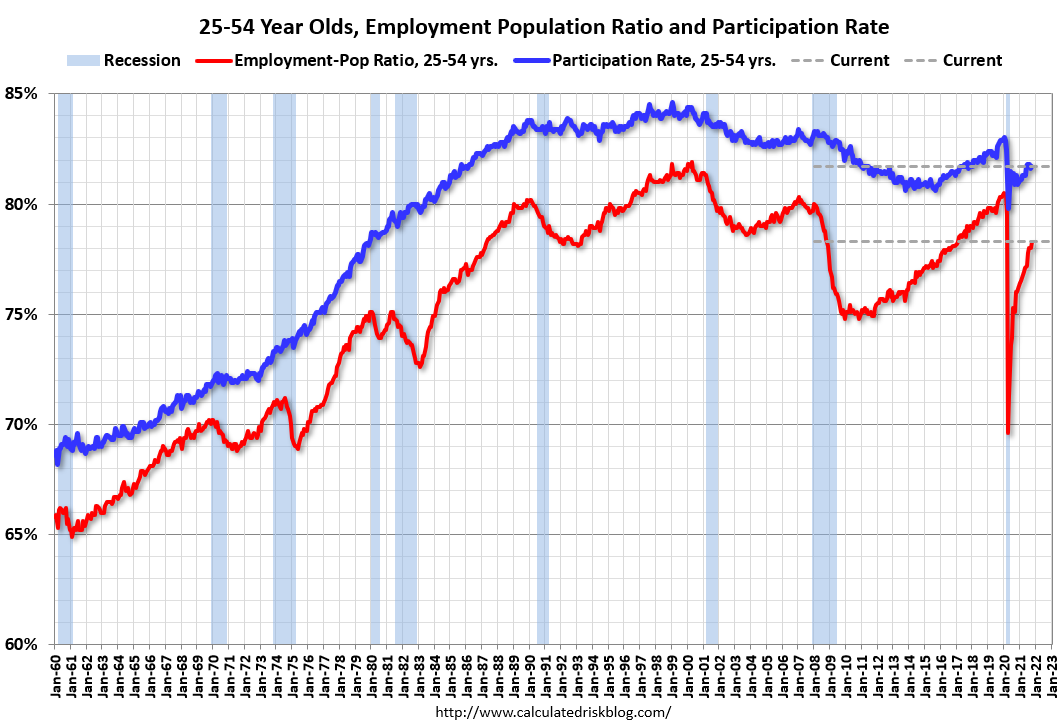
Here is a graph that shows the employment population ratio and the participation rate through the October 2021 employment report.
Click on graph for larger image.
The Labor Force Participation Rate was unchanged at 61.6% in October, from 61.6% in September. This is the percentage of the working age population in the labor force.
The Employment-Population ratio increased to 58.8% from 58.7% (black line).
Both are far below the pre-pandemic levels, however the overall participation rate was expected to decline due to demographics.
Since the overall participation rate has declined due to the pandemic and demographic (aging population, younger people staying in school) reasons, here is the employment-population ratio for the key working age group: 25 to 54 years old.
The 25 to 54 participation rate increased in October to 81.7% from 81.6% in September, and the 25 to 54 employment population ratio increased to 78.3% from 78.0% in September.
Both are still low and indicate that many prime workers have still not returned to the labor force.
In the note, Goldman argues "Most of the 5.0mn persons who have exited the labor force since the start of the pandemic are over age 55 (3.4mn), largely reflecting early (1.5mn) and natural (1mn) retirements that likely won’t reverse." There probably have been a large number of people retiring over the last 2 years, but I think more at least half of the people missing from the labor force are prime age.
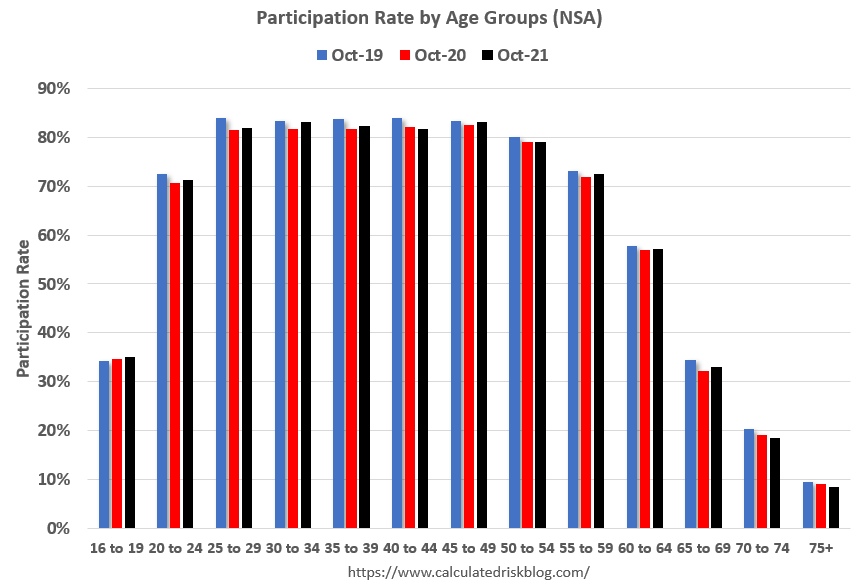
Here is a graph of the change in the participation rate by age cohort (October 2019, October 2020, and October 2021 NSA).
If more older people were retiring than expected, we'd see a decline from Blue (pre-pandemic) to Red (pandemic) to Black (October 2021). We do see this for the "70 to 74" and "75+" age groups. And this does suggest more retirements than expected in the 70+ age groups.
However the "55 to 59", "60 to 64" and "65 to 69" age groups are recovering similar to the prime age groups.
If we calculate the expected labor force by cohort, using the pre-pandemic participation rates, about 50% of the people missing from the labor force are in the prime working age (25 to 54). About 75% of the people missing are in the 20 to 65 age group.
This suggests to me that there is more slack in the labor market than Goldman estimates.
A child looking after livestock quenches his thirst from a water point in the desert near Dertu, in Kenya, on October 24. | Brian Inganga/AP
A new paper investigates the effects of chlorine treatment at water sources in some Kenyan villages. The findings were astounding.
Even in dire years like 2020 and 2021, when the pall of the pandemic and economic uncertainty still shadows much of everyday life, there are areas where things are trending in a positive direction. We’re making slow but steady progress toward ending global poverty, achieving carbon-neutral energy, and, most recently, vaccinating the world against Covid-19.
But maybe the most hopeful news I’ve read this year is a new white paper on water chlorination — a paper that suggests a simple water treatment solution could dramatically reduce child mortality in poor countries.
The economists behind the paper — Johannes Haushofer (who’s done some of my favoriterandomizeddevelopment studies), recent Nobel winner Michael Kremer, Ricardo Maertens, and Brandon Joel Tan — analyze a large-scale experiment called WASH Benefits, which randomly selected certain villages in rural Kenya to receive a variety of water, sanitation, and hygiene (WASH) programs, while other villages served as a control group.
The experiment tried a bunch of different WASH interventions, including more sanitary latrines, programs promoting hand-washing with soap, nutrition supplements for young children, and more.
One tactic in particular jumped out: adding a simple chlorine solution to drinking water.
The importance of clean water
This new paper focuses on the distribution of a chlorine solution placed in large dispensers (that look a bit like office water coolers) next to water sources like pumps and wells.
Water chlorination is standard in developed countries these days; America’s experience began in Jersey City, New Jersey, in 1908, at the instigation of a doctor named John L. Leal. Chlorine is a powerful disinfectant, and in the US context, doses of chlorinated solution safe for human consumption proved particularly powerful at killing the bacteria that caused typhoid fever in the water supply.
Other cities and states copied Leal’s advance, and typhoid deaths plummeted. In Massachusetts, for instance, a state for which good records exist, the death rate from typhoid fell by over 99 percent between 1905 and 1945, driven by cleaner water and increased vaccination.
It wasn’t just typhoid. Chlorination and other clean-water programs played a huge role in the fall in overall mortality and child mortality in the US over the 20th century. Economists David Cutler and Grant Miller estimate that the rollout of water filtration and chlorination systems throughout the US explains half the decline in overall mortality in major cities between 1900 and 1936, two-thirds of the decline in child mortality, and three-quarters of the decline in infant mortality.
The new study on chlorination in Kenya used data collected in 2018 on the deaths of all children in the target villages born after January 2008, and compared death rates in villages that got these chlorine dispensers four to six years earlier to those in villages that didn’t get them.
The results were astonishing: Mortality for children under 5 fell by 63 percent. The baseline death rate for children under 5 in the control villages was a horrific 2.23 percent — more than one in 50 children died before their fifth birthdays.
Providing chlorine cut that rate to 0.82 percent, or less than one in 100.
To be sure, that’s still far too high; in the US in 2019, the under-5 death rate was about 0.13 percent. But cutting child mortality by more than half is a huge achievement.
The programs in the study were specifically targeted to pregnant women, which might help explain why they saw such large effects on small children; changes in water quality starting in the womb can ripple out over the first few years of a child’s life, reducing rates of diarrhea and other conditions caused by waterborne illness that can prove life-threatening.
A cost-effective way to save lives
Here’s another important upshot from the study: The mortality reduction proved relatively cheap to achieve.
Using data from Evidence Action, an aid group whose program Dispensers for Safe Water distributes these chlorine dispensers in Uganda, Kenya, and Malawi, the researchers estimate that the program saves a life for about $1,941.
That’s an astonishingly low number, lower even than GiveWell’s estimates for some of its top charities, many of which it selects specifically because they can save lives at the lowest possible cost per life saved.
I don’t blame you if you think all this sounds a bit too good to be true. One of the authors, Haushofer, told me in an email he was “very happy about (and mildly shocked by) those results.”
The paper cites an as-yet unpublished meta-analysis by some of its authors that found prior experiments on water chlorination found it could reduce mortality by 25.4 percent — a lot, but not nearly as big as the headline estimate in this paper.
The authors speculate that the experiment in this paper may have been in an area with unusually high levels of water contamination and diarrhea, allowing chlorination to have a bigger effect.
More optimistically, it’s possible this experiment showed bigger effects because it tested this specific dispenser design, where chlorine is placed next to water sources, with an easy-to-use dispenser that releases a pre-measured dose. That might make villages more likely to use the chlorine, leading to bigger health improvements. If that’s true, then these results could scale.
As it stands, it’s just one study, and I’m eager to see more experimental work on this intervention. But it’s an important study, and one that makes Evidence Action’s Dispensers for Safe Water, and similar programs, seem like highly effective solutions worthy of support from both government aid groups and private donors.
A version of this story was initially published in the Future Perfect newsletter. Sign up here to subscribe!
Anything that gets rid of Lee is a huge net plus for the entire country. He's a real piece of shit.
Updated at 12:30 p.m. ET on November 13, 2021.
For many Utahns, the Trump rally was the breaking point. A few days before the 2020 election, Senator Mike Lee paced across a red, white, and blue stage in Goodyear, Arizona, microphone in hand, rhapsodizing about the president’s many virtues while he looked on. Lee’s talking points were mostly familiar. But then he arrived at a novel line of flattery, pitched to his coreligionists: He compared Trump to a figure from the Book of Mormon.
“To my Mormon friends, my Latter-day Saint friends, think of him as Captain Moroni,” Lee bellowed, pointing to the president. “He seeks not power, but to pull it down. He seeks not the praise of the world or the fake news, but he seeks the well-being and the peace of the American people.”
The backlash was swift. Members of the Church of Jesus Christ of Latter-day Saints aren’t used to seeing their sacred texts so brazenly politicized on the stump, and many members—including even some Donald Trump voters—regarded the invocation of a scriptural hero at a MAGA rally as blasphemous. Lee’s social-media feeds lit up with outraged constituents, the national media piled on, and the senator hastily backpedaled, apologizing to those he’d offended. But among an influential contingent of political, business, and religious leaders in Utah, the episode surfaced long-simmering frustrations with the senator.
First elected in the Tea Party wave of 2010, Lee has long rankled the local establishment in Utah, where he is viewed by many as a showboating obstructionist whose penchant for provocation routinely embarrasses his home state and its predominant religion. Lee’s MAGA makeover during the Trump presidency served only to exacerbate that perception. Now, as he prepares to run for reelection next year, Lee is bracing for a concerted, multifront campaign to unseat him. He seems to know that a third term isn’t guaranteed.
“I’m taking nothing for granted,” Lee told me in a phone interview last week. “I’m gearing up, I’m preparing in every way, and we’ll be ready for whatever comes our way.” This is the posture that incumbents are supposed to take in election years. There is nothing voters hate more, after all, than a politician who acts like he doesn’t need to court them. But Lee also sounded genuinely cautious when we spoke—like a man fearful of making any false moves.
Although Lee’s incumbency carries a degree of front--runner status, his approval rating sits at a meager 45 percent, according to a recent poll, and barely half of likely GOP primary voters say they’d vote for him again. In recent conversations with people around Utah, a range of politicians and operatives working to defeat Lee told me that he’s managed to coast through his first two terms, and insist that he isn’t invincible. “You have to remember,” said one political consultant, who requested anonymity to discuss strategy, “this guy hasn’t faced a serious challenger since he won the Republican nomination in June 2010.”
Lee has already attracted two well-funded primary opponents, as well as an independent, Evan McMullin—last seen running for president in 2016—who is framing his Senate candidacy explicitly as a bid to take down the incumbent. Opposition research is being assembled; lines of attack are being poll-tested. Two people familiar with the research told me that the “Captain Moroni” incident appears to be especially effective in swaying voters—but it’s not the only part of Lee’s record that his opponents plan to highlight in the coming months.
Lee’s relationship with Trump is likely to feature heavily in next year’s race. Although Utah is overwhelmingly conservative, its Mormon-infused politics are idiosyncratic. Trump, with his signature blend of nativism and xenophobia and his less-than-saintly personal life, has consistently underperformed in Utah. He finished last in the state’s 2016 GOP primary, and carried Utah in the general election with a paltry plurality of the vote. Lee loudly protested Trump’s nomination from the floor of the Republican National Convention that year, and sharply criticized him after the Access Hollywood tape was released. But by 2020, Lee had reversed himself completely, campaigning with Trump and defending the president’s role in inciting a riot at the Capitol on January 6. Trump, Lee reasoned after the attempted insurrection, deserved a “mulligan.” (Lee has said that his comment, made during an interview with Fox News, was intended to refer to Democratic politicians who had used incendiary rhetoric.)
To Lee’s critics, the pivot reeked of careerism. But he insists that his evolution was organic. Lee told me his opposition to Trump in 2016 was “related to friends of mine who ran for president and experiences they had in that race.” He also questioned the candidate’s conservative bona fides. But once Trump got to Washington, Lee says, the two men developed “a working relationship,” working together to pass a criminal-justice-reform bill that had long been a priority for the senator. “It’s easy to dislike somebody from afar,” Lee told me. “When you get to know them, sometimes you dislike them less.” He noted that many of his fellow Utahns had followed a similar trajectory: Trump won 58 percent of the vote in Utah last year.
But the fact that Lee flip-flopped on Trump isn’t the real source of establishment frustration in Utah—it’s how he’s helped to import MAGA-style politics to the state. Notably, Lee has picked several fights in recent years that appear to put him in conflict with his church. In 2019, when the Church endorsed the Fairness for All Act—a bill intended to balance LGBTQ rights and religious freedom—Lee deemed it hostile to the First Amendment and announced that he would “actively oppose it.” Last year, he waged a strange, weeks-long crusade on Facebook against a Church-owned local news outlet, which he accused of anti-Trump bias. And more recently, as Church leaders have pleaded with its members to get vaccinated against COVID-19, Lee has prioritized railing against vaccine mandates and introducing bills with names like the “Don’t Jab Me” Act.
The Church maintains a strict policy of electoral neutrality, and its senior leaders do not publicly support or oppose candidates. But the appearance of tension between Utah’s senior senator and the Church has been a subject of intense speculation in some quarters. At the very least, critics argue, Lee has demonstrated a willingness to gratuitously needle the Church to enhance his own stature in the national conservative firmament. These episodes also run against a strain of the state’s political culture, which prizes cooperation and comity and being a “team player.”
When I asked Lee about this line of criticism, he told me that his constituents expect him to defy establishment consensus sometimes. “I think it’s part of the job,” he said. “It’s certainly part of the job as I think it needs to be done.”
That claim to the principled-outsider mantle is what helped Lee defeat Senator Bob Bennett, Utah’s long-serving incumbent, in the 2010 Republican primary. This time around, Lee’s GOP challengers plan to use a similar playbook against him. Ally Isom, a former spokesperson for the Church, has pitched her candidacy as an antidote to Lee’s divisiveness. Becky Edwards, a moderate former state legislator, is arguing that Lee’s “strident approach” has prevented him from delivering for his constituents. Neither candidate has risen above single digits in early polling, but they have both proved to be able fundraisers.
If Lee does win the GOP nomination, he will still have to face McMullin in the general. A former CIA officer and Capitol Hill staffer, McMullin ran for president as an independent in 2016 under the “Never Trump” banner and wound up winning 21 percent of the vote in Utah. To beat Lee next year, McMullin told me, he will need to unite Democrats, independents, and Trump-averse Republicans. His platform will necessarily be a balancing act, mixing environmentalism with pledges to reduce the national debt. But when we spoke, he seemed most animated by loftier themes, such as protecting democratic norms. He repeatedly accused Lee of enabling Trump’s effort to subvert the 2020 election process. (Lee, unlike Utah’s other Republican senator, Mitt Romney, voted to acquit Trump for his role in the Capitol riot and opposed the formation of the January 6 commission.)
“I just think Mike Lee has lost his way in Washington,” he told me. “I like to believe he went there as a principled constitutional conservative, but if you aid and abet an effort to overturn the republic, you can no longer claim to be that.”
For McMullin to have any shot as an independent, Utah Democrats would have to coalesce behind him and decline to put forward a nominee of their own. While some prospective candidates have already emerged, Utah’s unique convention system could allow the party’s delegates to choose not to nominate anyone. McMullin, who has been laboring behind the scenes to win the support of the state Democratic Party, told me he still has work to do in building the “cross-party coalition” he envisions. But the effort got a big boost this week when Ben McAdams, a former congressman and one of Utah’s most prominent Democrats, endorsed McMullin and urged the party to support him.
“What I know is that a Democrat is not going to win the U.S. Senate race [in Utah] in 2022,” McAdams told me. “I also know that I’m not going to support every position that Evan takes. But I think it’s a critical time in our country, our politics are severely broken, and what have we got to lose by trying something new?”
For now, the credibility of McMullin’s campaign remains an open question in Utah. LaVarr Webb, a Republican lobbyist in the state, told me that the candidate would have to shake perceptions that he is a “professional Trump hater.” (McMullin turned up frequently on cable news during the Trump years to criticize the president and his party.) “Progressives in Salt Lake City like him, but he is mostly ignored in the rest of the state,” Webb said. McMullin will also likely face questions from both sides about how much he would diverge from Lee’s solidly conservative voting record. McMullin told me he would not caucus with either party if elected, and argued that maintaining his independence would allow him to wield more power on behalf of Utahns.
As for Lee, he wants voters to believe that he is not sweating. When I asked him about McMullin, he responded coolly. “If he wants to run for the United States Senate, it’s his prerogative to do so,” the senator said. “He’s a citizen of this country, a resident of Utah apparently, and constitutionally eligible to run for that position.”
The creator of EdgeDeflector said this week that the latest Insider build of Windows 11 now blocks all default browser workarounds. Thurrott reports: If this functionality makes its way to the finished product, it will mark a new, dark chapter for Microsoft, which told the media at the Windows 11 launch that it was aware that it had made changing app defaults pointlessly difficult, but that it had not done so maliciously and would fix it. This is the opposite of that claim. "Something changed between Windows 11 builds 22483 and 22494 (both Windows Insider Preview builds)," EdgeDeflector creator Daniel Aleksandersen writes in a new blog entry. "The build changelog ... omitted the headline news: you can no longer bypass Microsoft Edge using apps like EdgeDeflector."
Basically, EdgeDeflector, as well as third-party browsers like Mozilla Firefox and Brave, intercept OS-level URL requests that force you to use Microsoft Edge even when you have gone through the incredibly ponderous steps to make a non-Edge browser the default in Windows 11. But in the latest Insider Preview build, Microsoft is changing how these URL requests work. And it's no longer possible to intercept URL requests that force users to use Edge instead of their default browser. (In the Insider builds. This functionality will come to mainstream users in the coming months unless we can change Microsoft's collective mind.)
"You can't change the default protocol association through registry changes, OEM partner customizations, modifications to the Microsoft Edge package, interference with OpenWith.exe, or any other hackish workarounds," Aleksandersen explains. "Microsoft ... just silently ignores the UserChoice registry keys for the protocol in the registry and opens Microsoft Edge instead." It's even worse than that, really, he continues. "Windows will insist you use Microsoft Edge to a fault even if you brutalize your Windows installation and purge all traces of Microsoft Edge. Windows will open an empty UWP window and show an error message instead of letting you use your preferred web browser."
Texans will be paying for the effects of last February’s cold snap for decades to come, as the state’s oil and gas regulator approved a plan for natural gas utilities to recover $3.4 billion in debt they incurred during the storm.
The regulator, the Railroad Commission, is allowing utilities to issue bonds to cover the debt. As a result, ratepayers could see an increase in their bills for the next 30 years.
During the winter storm, natural gas prices spiked as cold temperatures drove demand up while also depressing supply. Much of Texas’ natural gas comes from fracking, which uses large amounts of water. To prevent the wellheads from freezing, many producers shut-in their wells in advance of the storm. The governor’s office knew of the looming shortages days before they happened, yet the preparations they made did little to alter the course of the disaster.
When it comes to basic rights and protections, we know that trans folks suffer when compared to cisgender people. Whether it’s about bathroom access, the chance to play sports, or accessing safe, gender-affirming medical care, trans people have fewer protections and rights than cisgender people. And it’s a difference that exists only on paper, either; trans people also report high rates of transphobic and discriminatory experiences while seeking medical help, even for reasons that have nothing to do with gender identity. We’ve celebrated some recent wins, lately, but unfortunately, sometimes those wins come with a step backward.
A recent example comes to us out of Oklahoma. Republican Governor Kevin Stitt directed the State Department of Health to cease issuing birth certificates with a nonbinary option, as reported by Tulsa World. Mind you, the agency has already agreed to issue inclusive birth certificates as part of a civil case settlement. But Stitt, apparently, isn’t willing to let nonbinary folks have even a little bit of dignity.
In Stitt’s executive order, which he issued on Monday, Nov. 8, he directs the agency to remove any references on its website to amending birth certificates that he feels are inconsistent with state law. He went on to encourage the state legislature (which returns next year) to pass a bill specifying that a nonbinary birth certificate option goes against state law.
And if you’re hoping to give the first-term governor the benefit of the doubt, he made his stance pretty clear. As reported by local outlet KFOR, Stitt said he believes God created people to be male or female “period” and that there is “no such thing as nonbinary sex.”
“I wholeheartedly condemn the OSDH court settlement that was entered into by rogue activists who acted without receiving proper approval or oversight,” he said in a statement issued after Lorelied’s victory.
As some background, Kit Vivien Lorelied, a nonbinary person who uses they/them pronouns, filed a lawsuit against the health department in the summer of 2020. The department had denied Lorelied’s request to have their name and sex updated on their birth certificate in 2019. The agency said it could change Lorelied’s name, but that a nonbinary sex option was not possible. In the end, the department issued Lorelied a correct birth certificate, with the nonbinary designation, in October of 2021.
Why is a birth certificate so important? Just think about all of the scenarios in which you need to show one. Job applications, housing applications, applying for a new or updated form of identification, like a passport or a driver’s license… The list goes on. Having an accurate legal document is so important on a literal level, not to mention the importance of validation and affirmation when it comes to emotional well-being and a sense of self. Inconsistencies can also “out” people, which can open folks up to discrimination and violence.
A number of states now allow people to have nonbinary identities reflected on official documents, and the U.S. State Department even recently announced it had issued its first nonbinary passport. Dozens of countries around the world also issue nonbinary passports.
ARONCZYK: People of color were disproportionately getting sick and dying from COVID. And at this point in time, Dr. Collins is overseeing the pharma companies that are in phase 3, that are recruiting tens of thousands of people to try out the shots. And he looks at who Moderna has been signing up.
COLLINS: They felt this enormous pressure to recruit quickly 'cause it's a public health crisis, and people are dying. And if you're trying to recruit quickly, you recruit the people who are most likely to say yes. And that tends to be white people, especially young, healthy white people.
ARONCZYK: Dr. Collins goes to Moderna's executive team, and he's like, what are you going to do about this? And he says that their response was less than satisfying.
COLLINS: I mean, it was hand-waving.
ARONCZYK: Right.
COLLINS: And this is where I got fairly directive.
(LAUGHTER)
COLLINS: And I made a little speech about, OK, if that's the strategy you're going to pursue, you may have a vaccine that turns out to be safe and effective for white people, but you will have failed, and we will not defend you.
HOROWITZ-GHAZI: So at this moment in the pandemic where it feels like every second matters, they pump the brakes. They don't want to go forward with the trials because, Dr. Collins says, if the people testing the vaccine don't represent the American public, the public won't trust the vaccine. Moderna then recruits more people of color.
ARONCZYK: So at this moment, you make this request to diversify the trials. What happens? Does it slow things down a little?
COLLINS: (Laughter) It, in fact, did have a modest effect of that sort.
ARONCZYK: But, Dr. Collins says, just by a week or two.
How many people died because Collins delayed Moderna's vaccine "just by a week or two?" I don't know, but how ever many it is, Dr. Collins bears responsibility for their deaths--a "request" from the director of NIH in this context is really a command. And this "modest effect" is certainly nothing to laugh about.
Let's be clear on several things: (1) There was (and is) no scientific reason to think that the Modern vaccine would act differently on people of different genetic backgrounds; (2) Even if there was reason to think it would, the categories the NIH requires researchers to use--African American, Asian American, Hispanic, Native American, and White--are extremely internally genetically diverse.* Asian Americans, for example, can be Austronesians, Caucasians, or East Asians, and there is much internal diversity within those subcategories. Hispanics can be any mixture of European, Indigenous, African, and Asian. And so on. There is no *scientific* reason to use these categories as proxies for genetic diversity; and (3) If Americans wouldn't "trust" a vaccine that didn't have "enough diversity," that's largely because government authorities like the NIH insist that vaccines aren't trustworthy unless they have been tested on a "diverse" population. If the NIH and other authorities consistently said that socially and legally constructed racial and ethnic categories are not scientific in nature and have no bearing on vaccine efficacy, then the public would be much more likely to believe it.
*When the federal government promulgated these categories, it warned that these "classifications should not be interpreted as being scientific or anthropological in nature." Yet NIH and FDA have adopted them anyway, for no good or even stated scientific reason. Directive No. 15, Race and Ethnic Standards for Federal Statistics and Administrative Reporting, 43 Fed. Reg. 19,260 (1978).
You would think someone working to convince a jury his client didn’t help form a white supremacist mob and murder a Black man would avoid trying to outright ban Black people from the trial. You would think the last person that attorney would try to ban would be a noted civil rights leader and minister like Al Sharpton. You would think that, but you’d be wrong. “We don’t want any more Black pastors in here,” attorney Kevin Gough actually said in court on Thursday. He spoke as if he were making some kind of compromise after granting himself the power to allow Sharpton’s presence.
Gough represents William “Roddie” Bryan, who—along with former cop Gregory McMichael and his son Travis—are accused of murdering Ahmaud Arbery on Feb. 23, 2020 after spotting him running near the site of a home under construction in Brunswick, Georgia. The case, in which a prosecutor is indicted for alleged misconduct, has prompted so much outrage in Georgia and beyond that although some 1,000 potential jurors were summoned, attorneys had a hard time seating 12 people who didn’t openly communicate a bias during voir dire. Only one of them is Black, and social media users have frequently spread a running-while-Black hashtag denoting the popular belief that Arbery was only targeted because he was a Black man. This is the context in which Gough felt it appropriate to target Sharpton.
“We don’t want any more black pastors coming in here.” Defense attorney for one of the men charged with murder in Ahmaud Arbery case objecting to Rev. Al Sharpton sitting in courtroom yesterday and says it’s intimidating. The same for @RevJJackson. @TheRevAl@NationalActionpic.twitter.com/t8FIF1Yp0r
"My understanding while I was cross-examining investigator (Stephan) Lowry yesterday is that the right Reverend Al Sharpton managed to find his way into the back of the courtroom. I'm guessing he was somehow there at the invitation of the victim's family in this case, and I have nothing personally against Mr. Sharpton. My concern is that it's one thing for the family to be present, it's another thing to ask for the lawyers to be present, but if we're going to start a precedent starting yesterday, where we're going to bring high-profile members of the African American community into the courtroom to sit with the family during the trial in the presence of the jury, I believe that's intimidating, and it’s an attempt to pressure—could be consciously or unconsciously—an attempt to pressure or influence the jury. To my knowledge, Reverend Al Sharpton has no church in Glynn County, never has.”
Gough went on to say that there are “only so many pastors” the Arbery family can have. “And in the fact that their pastor is Al Sharpton right now that's fine, but then that's it,” he added. “We don't want any more Black pastors coming in here or other, Jesse Jackson whoever was in here earlier this week sitting with the victim’s family trying to influence the jury in this case."
His voice oozed with so much privilege even the white judge appeared offended, and not for the first time. Judge Timothy Walmsley called another defense attorney in the case “rude” on Tuesday. In Gough’s instance, Walmsley offered these words: “I don’t hear a motion, and I will tell you this, I am not going to blanketly [sic] exclude members of the public from this courtroom.”
Sharpton responded in an interview with TMZ: “I think it is an arrogant display of insensitivity.”
The arrogant insensitivity of attorney Kevin Gough in asking a judge to bar me or any minister of the family’s choice underscores the disregard for the value of the human life lost & the grieving of a family in need of spiritual & community supporthttps://t.co/9jKKd8IuGh@TMZpic.twitter.com/WL4A4Ta87i
After what appear to be a series of fruitless and time-consuming negotiations, the attorney for former Chief of Staff Mark Meadows made it clear on Thursday that his client was not going to appear, or product documents for, the House Select Committee on Jan. 6. Responding to that committee, the attorney said that Meadows “remains under the instructions of former President Trump to respect longstanding principles of executive privilege. It now appears the courts will have to resolve this conflict.”
It now appears they’re going to get a chance to do so more quickly than Meadows might have anticipated. That’s because, despite the fact that a request to hold Steve Bannon in contempt is still awaiting an official decision from the Department of Justice after almost a month, the committee has now delivered Meadows an ultimatum and a deadline.
In a Thursday evening letter, Committee Chair Rep. Bennie Thompson informed Meadows’ attorney that his client must appear before the committee on Friday, Nov. 12 to provide testimony, answer questions, and turn over documents by 10 AM ET. If not, wrote Thompson, the committee will view his absence as “willful noncompliance” with the subpoena that Meadows was sent all the way back on Sept. 24, leaving the committee with no choice but to send another criminal referral across the street to the Department of Justice.
It’s a demand that should hold the serious threat of being placed in jail until compliance, or being sentenced to six months in prison. But whether that still holds true is an absolute mystery.
As far as existing court cases go, the ability of Congress to hold witnesses in contempt seems clear enough. The existing law, as defined by Supreme Court rulings on cases such as Watkins v. United States (1957) andEastland v. United States’ Servicemen Fund (1975) seems clear in showing that the “power of the Congress to conduct investigations is inherent in the legislative process" and that to conduct those investigations, Congress must be able to compel testimony and the production of documents.
Those defining cases show Congress operating with an intention that may seem downright scary today. Watkins involved the infamous House Committee on Un-American Activities attempting to force a labor organizer into providing the names of former members of the Communist Party. The committee lost that case, fortunately. Eastland featured the almost as sketchy Senate Subcommittee on Internal Security seeking records from a nonprofit organization that had published articles critical of the Vietnam War. The Senate subcommittee won the day.
Between them, these cases helped lay out the limits of Congressional authority. House or Senate committees can’t demand anything from anyone and start locking up people willy-nilly. However, that inherent investigative power means that Congress can hold people who refuse to testify in contempt as long as they can show the information requested is within the purview of the committee’s work.
It is "unquestionably the duty of all citizens to cooperate with the Congress in its efforts to obtain the facts needed for intelligent legislative action,” the Court wrote in the Watkins case. “It is their unremitting obligation to respond to subpoenas, to respect the dignity of the Congress and its committees and to testify fully with respect to matters within the province of proper investigation."
And still, the Court ruled against the committee on Watkins, because the goals of the committee itself were too vague and the demands placed on the witness violated his Fifth Amendment rights against self incrimination.
Both Watkins and Eastland were about defining the limits of Congressional powers to hold people in contempt, but the Court never expressed any doubt that those powers exist. In the case of both Bannon and Meadows, the questions they are being asked and the documents being demanded are directly aimed at their knowledge of events leading up to the Jan. 6 assault on the Capitol. The charter of the select committee is expressly:
To investigate and report upon the facts, circumstances, and causes relating to the January 6, 2021, domestic terrorist attack upon the United States Capitol Complex and relating to the interference with the peaceful transfer of power...
There seems to be no doubt that the documents and testimony being sought from Meadows, and from Bannon, fall within that definition.
As Thompson’s letter states in its opening paragraph:
The law requires that Mr. Meadows comply with the subpoena absent an applicable immunity or valid assertion of a Constitutionally based privilege. The attached letter from the White House Counsel’s Office, dated today, eviscerates any plausible claim of testimonial immunity or executive privilege, and compels compliance with the Select Committee’s subpoena.
Until this week, Meadows was reportedly “negotiating” with the committee, which had granted him what was described as a “short” period to work out limits on the documents and testimony he might provide. However, it became clear that Meadows was essentially doing what Trump himself has done so often: simply stalling for time and attempting to run down the clock. Unless there is some unexpected last-minute maneuver, expect a contempt citation for Meadows to also be raised in the committee and to follow the citation issued concerning Bannon to the House floor.
And then everyone can go back to waiting on the Department of Justice to do … whatever it’s doing.
Jesus fucking christ. The reaction to massive covid spread is to stop testing?
In a new excerpt from his upcoming book Betrayal: The Final Act of the Trump Show, ABC News Chief Washington Correspondent Jonathan Karl notes that Donald Trump’s Spinal Tap-esque Tulsa rally marked “the worst day of his entire campaign.” Which is weird, because for me it was easily the best. In fact, its only serious competition was the fleeting moment during the first presidential debate when Joe Biden finally told Didgeridoo Donnie to STFU. That was pretty cool, too.
But in the event schadenfreude was bursting from your pores like Trumpian flop sweat on that fateful day in June 2020, the latest excerpt from Karl’s book, published Thursday in Vanity Fair, will have you spritzing like Rep. Matt Gaetz at an Orlando Hot Topic.
There are several takeaways from the excerpt. For one thing, it was a bigger disaster than it even appeared, and it appeared like the Hindenburg crashing into the Exxon Valdez. Secondly, it revealed even greater depths of Trumpian depravity and disregard for others—which, granted, seems impossible, but bear with me.
As Karl relates, in April 2020, with his poll numbers plunging and his daily coronavirus briefings going off the rails, Trump decided he needed to get back into the rally game. And what he said to former New Jersey Gov. Chris Christie at the time was telling:
“He was just beside himself,” former New Jersey Governor Chris Christie, a close advisor to Trump whom he called frequently throughout the campaign for advice, told me. “All he could think about was the campaign. He didn’t talk much about anything else. COVID would come into it, but really his focus was on the campaign.”
Really? Trump was focused entirely on keeping the job he wasn’t remotely interested in doing? That tracks.
In May, Karl writes, Trump insisted that his campaign manager, Brad Parscale, put together a road map for resuming the pseudo-president’s popular rallies, even though large events in the country had essentially been shut down for weeks.
After struggling to find a venue that could accommodate a light MAGA culling, the campaign eventually settled on Tulsa, Oklahoma, because the city had a Republican mayor and was located in a state with a GOP governor. In other words, it was a COVID-friendly space. (In another major faux pas, this one perhaps unintentional, the campaign originally scheduled the rally for Juneteenth—June 19, which commemorates the end of slavery in the U.S.—but changed the date after receiving significant blowback. Add holding it in Tulsa, the site of a white-on-black massacre in 1921, and you’re really cooking with gas.)
The expectations for the rally were high, with Parscale tweeting in the week before the event was set to launch, “Just passed 800,000 tickets. Biggest data haul and rally signup of all time by 10x. Saturday is going to be amazing!” What they didn’t know was that lots of those tickets—no doubt the vast majority—were reserved by pranksters who were eager to see Trump’s dangerous, self-aggrandizing return to the limelight fail, big-league.
Karl notes that Trump was positively giddy in the days leading up to the rally, especially after Parscale notified him that they’d passed the 1 million ticket threshold. The dire warnings from Oklahoma’s public health officials that the rally would worsen the pandemic in their state naturally failed to penetrate Trump’s Macy’s parade balloon of an ego.
In fact, asked about the possibility that his rally could turn into a superspreader event, Trump had a characteristically sociopathic response: “As you probably have heard, and we’re getting exact numbers out, but we’re either close to or over one million people wanting to go. Nobody has ever heard of numbers like this. I think we’re going to have a great time.”
You know what happened next. On the way to the rally, Trump watched the news from Air Force One. But instead of footage of thronging crowds eager to see their fave disease vector, the teevee was talking about positive COVID-19 results among Trump’s campaign staff and the conspicuous lack of rally attendees.
“It it going to be full?” Trump eventually asked Parscale. “No, sir,” came the response. “It looks like Beirut in the eighties.”
The event caused problems for the Secret Service, as dozens of agents needed to quarantine after two agents who worked at the Tulsa rally tested positive. The consequences were more dire for one prominent Trump supporter. Herman Cain, a former Republican presidential candidate who the president’s team flew out to attend the rally, tested positive for COVID-19 days after the event. Cain, who was 74, was photographed inside the arena without a mask, sitting jam-packed with a group of other well-known Trump supporters who were also not wearing masks. Days after testing positive, Cain was hospitalized. A month later, on July 30, Cain died from complications of the coronavirus. The news devastated Trump campaign staff. Many felt like they were to blame for his death. “We killed Herman Cain,” one senior staffer told [ABC News reporter Will] Steakin not long after Cain’s death.
The night before the rally, several of Trump’s campaign staffers tested positive for COVID-19, and the administration was trying to contain the political—not the public health—fallout. According to two senior campaign officials Karl interviewed, after the eighth person close to the campaign tested positive, “word came down from the campaign leadership: STOP TESTING.”
And the lack of care and compassion Trump showed for his own people didn’t end there. According to Karl, campaign staffers who’d tested positive were told to drive rental cars back to Washington, D.C., even though they should have self-isolated for 10 days. “There was a car of three staffers who had tested positive that drove all the way from Tulsa, Oklahoma, to Washington, D.C.,” a senior adviser told Karl. “We called it a COVID-mobile.”
Oh, and in case you thought Trump couldn’t be any more of an insensate monster than he already is, take a gander at this anecdote:
There’s something else neither Trump nor his campaign ever disclosed. One of the campaign staffers who tested positive became severely ill. This employee of the Trump campaign, whose name I’ve been asked not to disclose, was unable to drive home like the others. Instead, this staffer was hospitalized in Tulsa for a week. This staffer had been worried about the dangers of working on the rally because of preexisting conditions that made the prospect of being infected especially dangerous, but the president had demanded an indoor rally despite the warnings of public health officials, and the staffer faithfully responded by helping to organize it. Now that the rally was over, the president was back in Washington complaining bitterly that more people had not shown up, while this campaign worker was stuck in Tulsa, lying in a hospital bed thinking his life was about to end.
Uh-huh. If that isn’t Trump in a nutshell, I don’t know what is. You sure wouldn’t want to be with Trump in a foxhole, now would you? Or any hole, for that matter.
Remember back in August 2020 when former unlawfully appointed acting Department of Homeland Security (DHS) Secretary Chad Wolf presided over a political stunt that used immigrants as human props as part of an effort to reelect the previous president? A number of the immigrants who were sworn in as U.S. citizens in that White House naturalization ceremony would later say they weren’t informed prior to the stunt that it would be broadcast as part of the Republican National Convention.
Plenty of experts at the time said it was a corrupt and illegal act. We didn’t need an official investigation to figure that out. It was right there in front of our eyes. But we do have one now.
Daily Kos’ Mark Sumner reported on Wednesday that the Office of Special Counsel has determined that at least 13 officials with the previous administration violated the Hatch Act, “illegally mixing campaign and government events.” Among those named is, unsurprisingly, Unlawful Chad. The Office of Special Counsel said in the report that the administration had been warned repeatedly that such an event would be unlawful. The stunt went on anyway.
“As late as 10 a.m.on the morning of the ceremony—just 45 minutes prior to the event—the DHS ethics official emailed DHS leadership, including the [DHS General Counsel] stating that Acting Secretary Wolf should not participate in the ceremony.” Unlawful Chad feigned ignorance in his written statement to the Office of Special Counsel, claiming he “did not know whether video of the ceremony was going to be made publicly available or that it would be used at the Republican National Convention.”
“Although the OSC could not prove that Wolf knew the ceremony would be part of the convention, it makes very clear that Wolf would have been hard-pressed not to know that,” notedThe Washington Post’s Philip Bump. The Office of Special Counsel does note that “circumstantial evidence strongly supports the conclusion that he knew, or should have known, of its intended use by the White House.”
Why are we giving crooks the benefit of the doubt anyway? This would not be the only time Unlawful Chad would corruptly use his (unlawfully appointed) office to campaign for the previous president, basically carrying out a tour in the final days leading into the 2020 election. In Arizona, he falsely claimed the inhumane and unlawful Reman in Mexico policy created “a safer and more orderly process along the Southwest border.” Human rights advocates have documented the policy, which resulted in over 1,500 instances of violence against asylum-seekers. In Texas, Unlawful Chad held a campaign event next to updated border wall. That was just five days before Election Day, Border Report said.
”Taken together, the report concludes that the violations demonstrate both a willingness by some in the Trump administration to leverage the power of the executive branch to promote President Trump's reelection and the limits of OSC's enforcement power,” the Office of Special Counsel said in a release. None of this even gets into how the previous administration used the U.S. Citizenship and Immigration Services (USCIS) ceremony for this political stunt after spending years decimating the office.
Following the previous president’s electoral defeat, USCIS was reportedly among the agencies forbidden from having any contact with President Joe Biden’s transition team. It would not be until Biden’s administration that USCIS would have a Senate-confirmed director for the first time in two years.
One other character found to have violated the Hatch Act is former aide and noted white supremacist Stephen Miller, who during a media appearance “mocked candidate Biden as being under the control of ‘23-year-old’ campaign staff.” It’s a scant mention in the report for someone who was the architect of some of our nation’s most inhumane immigration policies—and has never been held accountable for it. And likely will never be. “I think Stephen Miller should be behind bars,” Texas Rep. Veronica Escobar said earlier this year. Instead, there’s an active campaign to block any justice for separated families.
A 10-year-old Black girl with autism took her own life on Saturday after the child allegedly dealt with prolonged bullying by both students and teachers at a majority-white Utah school, her family told Deseret News. Isabella Faith Tichenor, who her family called "Izzy," was bullied for being Black and autistic at Foxboro Elementary School in North Salt Lake, the child's family attorney Tyler Ayres told the newspaper. Ayres said Isabella’s mother, Brittany Tichenor-Cox, reported the bullying “multiple times, and no action was taken.” He added that the child's siblings have been called the N-word this year. “The offending student was not disciplined in any way,” Ayres said.
The family said in a statement that Isabella was an “easy target” at the school, a preschool through sixth-grade campus with some 824 students—only 2% of whom are Black, according to data from the Utah State Board of Education. Isabella’s family said she was especially a target “after a teacher joined in mocking” the child. “As any parent would, we reported this abuse to her teachers, the school administration, and the district administration. Nothing. Nothing was done to protect Izzy,” the family said. “Children did not have their behavior corrected, so the torment of this child continued day after day.”
Tichenor-Cox told The Salt Lake Tribunethat, just after the school year started, she asked her daughter how school was going. Izzy told her she didn't think her teacher liked her. “She doesn’t say ‘hi’ to me. She says ‘hi’ to all the other kids,” the mother recounted her daughter saying. When Tichenor-Cox called the school, she said she didn't get a response.
In the next incident, Izzy’s teacher told the class that some students smelled bad. Tichenor-Cox said Izzy’s classmates used that comment to target Izzy, threatening her on the playground and telling her she stunk because of the color of her skin. Tichenor-Cox cried as she recounted her daughter taking air freshener to school as perfume. She again called the school district, and eventually got to talk to the teacher who said: “I’m not going to work it out for them. I let them work it out.”
The Davis School District said in a statement obtained by Deseret News that it is investigating bullying at the school. “We, like everyone, are devastated by the death of this child,” the district said.
“Our hearts go out to the family. Foxboro Elementary has worked extensively with the family and will continue to provide help to them and others impacted by this tragedy. We take all incidents and reports of bullying seriously.
”At this point, the incident we are aware of involved another student. The teacher and administration responded quickly and appropriately. As with all allegations of bullying, our investigation will continue.”
Foxboro Elementary School is part of the Davis School District, which was the subject of a federal probe revealing “serious and widespread racial harassment” by students and staff. The U.S. Department of Justice (DOJ) reviewed more than 200 incident files containing allegations of racial harassment and other discrimination, according to findings the DOJ released in September. “The Department’s investigation uncovered systemic failures in the District’s handling of complaints of racial student-on-student and staff-on-student harassment, discipline of Black students, and refusal to allow Black students to form student groups,” the DOJ wrote.
The agency reported that the district was "deliberately indifferent to known racial harassment," including white students repeatedly calling Black students the N-word. "We learned of incidents in which white students referred to Black students as dirty, asked why they did not wash their skin, and commented that their skin looked like feces,” the DOJ reported. “White students also called Asian-American students pejorative slurs, such as ‘yellow’ and ‘squinty’ and told them to ‘Go back to China.’”
Asian American students also account for 2% of the student population, while white students account for 70%. Hispanic students represent 17% of students.
The DOJ added in its report:
Our investigation found that the District responded to these incidents in a manner that was clearly unreasonable in light of known circumstances. The Department found that the District disregarded student witnesses who corroborated allegations and took no or minimal action to eliminate the hostile environment. For example, one school received a complaint that a teacher constantly ridiculed a Hispanic student and taunted him for working at a taco truck (though the student did not). An administrator interviewed other students who confirmed that the teacher “openly picks on certain students.” Yet, the administrator took no steps to remedy the hostile environment. Where there was a response to harassment or retaliation for reporting harassment, it was “minimalist,” Spencer, 2016 WL10592223 at *4, and staff remained in charge of educating or supervising the very students they degraded through racial harassment. In response to one incident, the District’s “investigation” was designed to vindicate its staff rather than identify and respond to harassment.
It is unclear if Isabella’s family is planning a lawsuit against the school. “We are investigating the school’s lack of response but cannot say more about it at this time,” Ayres said.
For YEARS, Davis School District intentionally ignored complaints of racial harassment. Sadly, 10 yr-old autistic student Isabella Faith Tichenor committed suicide after school admin. and the district did NOTHING to stop a teacher & students from bullying her! pic.twitter.com/ejRsBM8MsF
Brittany Tichenor-Cox, sobbing through a news conference covered Monday by Deseret News, said that she and other family members would stand up for children who, like Izzy, have been bullied. “Even though my baby is gone, I’m going to make sure that I stand for Izzy and I’m going to make sure for voices that can’t be heard like hers, that this will never happen again to any kid that is her age, teenager or adult," Tichenor-Cox said. “I don’t care who this is for. Nobody should have to go through that.”
GOP coming straight out for book burning. Impressive.
In Texas, a state legislator wants to “investigate” hundreds of books in school libraries. In Kansas, a school district is pulling dozens of books off the shelves of libraries and forming a committee to decide “if the books contained on this list meet our educational goals or not.” In Spotsylvania County, Virginia, two school board members are talking outright about burning books.
The Spotsylvania County School Board voted unanimously this week to remove “sexually explicit” material from school libraries, and to consider what else might be “objectionable” in school library collections. But two members of the board went above and beyond.
”I think we should throw those books in a fire,” said board member Rabih Abuismail. Kirk Twigg wants to “see the books before we burn them so we can identify within our community that we are eradicating this bad stuff.”
What books? Apparently whatever is determined to be sexually explicit. According to Abuismail, the presence of 33 Snowfish in the Riverbend High Schools’ digital app (which would, if nothing else, make it difficult to burn), means that the schools “would rather have our kids reading gay pornography than about Christ.”
The issue was first raised by a parent who said that she was initially alarmed at LGBTQIA material available to students, and on further investigation found a book she liked even less. That book is Adam Rapp’s 33 Snowfish, and I’m not going to lie, it sounds dark. It was also one of the Young Adult Library Services Association's top 10 books for young adults in 2004.
While this parent and these board members are definitely targeting LGBTQ content in particular, that’s not all that’s at risk when the book-burning, or the book-removal-from-libraries, starts. Remember that Glenn Youngkin’s winning gubernatorial campaign in the very same state of Virginia ran an ad taking aim at former Gov. Terry McAuliffe for vetoing a bill that would have allowed parents to reject “sexually explicit” reading assignments—and the book in question was Toni Morrison’s Pulitzer Prize-winning Beloved, generally considered to be one of the great U.S. novels of the 20th century.
The media consistently downplayed Youngkin’s appeals to racism—it’s no accident that the book in that ad was by a Black author—and now, just over a week after he prevailed, we’ve got members of a Virginia school board advocating for book-burning and the rest of the board going ahead with an extreme attack on the reading material available to high school students. LGBTQ books and books by authors of color is what’s disproportionately going to be removed from schools by this board, and in Kansas, and in Texas, and in who knows how many more states before the current Republican orgy of bigotry and censorship abates.

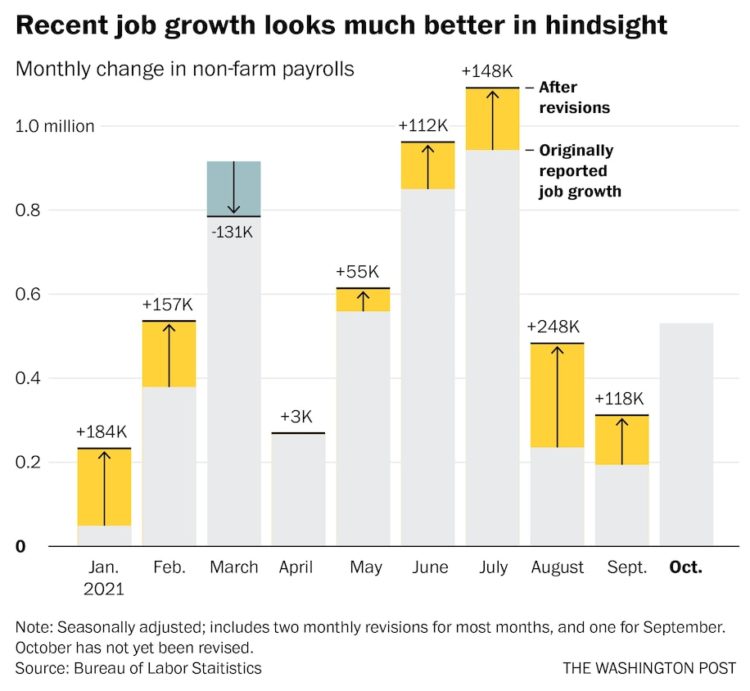




/cdn.vox-cdn.com/uploads/chorus_asset/file/23022225/orIvl_plant_based_meat_has_a_lower_carbon_footprint_br_than_most_animal_products__3_.png) Tim Ryan Williams/Vox
Tim Ryan Williams/Vox
/cdn.vox-cdn.com/uploads/chorus_asset/file/23023016/GettyImages_1183778274.jpg) Angela Weiss/AFP via Getty Images
Angela Weiss/AFP via Getty Images
/cdn.vox-cdn.com/uploads/chorus_asset/file/23022236/ozlp0_meat_s_carbon_footprint_is_almost_entirely_br_in_land_use_and_farming_nbsp___2_.png) Tim Ryan Williams/Vox
Tim Ryan Williams/Vox
/cdn.vox-cdn.com/uploads/chorus_asset/file/23023096/AP20163488185730.jpg) Nati Harnik/AP
Nati Harnik/AP

/cdn.vox-cdn.com/uploads/chorus_asset/file/23022261/GettyImages_1540893.jpg) Alex Wong/Getty Images
Alex Wong/Getty Images
/cdn.vox-cdn.com/uploads/chorus_asset/file/23022302/GettyImages_491459458.jpg) Lisa Lake/Getty Images
Lisa Lake/Getty Images
/cdn.vox-cdn.com/uploads/chorus_asset/file/23022175/GettyImages_1027286484.jpg) Justin Sullivan/Getty Images
Justin Sullivan/Getty Images
/cdn.vox-cdn.com/uploads/chorus_asset/file/23022168/AP19123708708239.jpg) Charles Dharapak/AP
Charles Dharapak/AP