A number of California prisons have been sterilizing female prisoners without their permission for nearly a decade. Hello Tuskegee experiment and Henrietta Lacks! What the fuck California?
The last time I saw my mother was seven years ago. My girlfriend Jaime and I had just bought our first home, a fixer-upper overlooking a greenbelt on a quiet street in Seattle. Instead of a housewarming party, Jaime wanted to have our moms over for lunch.
This group of kids from Michigan's Grosse Pointe Music Academy presumably went through a dozen weekly rehearsals for their rock band class, all culminating in this: Playing Weezer's "Undone (The Sweater Song)"—a song that, judging by their ages, they're familiar with from Rock Band—at their big debut gig.
Man. Right out of the gate they're killing it. This is fantastic.
Caity: The number one rule of the Bronx Zoo is that you must refer to all the animals you see there as being "from the block." Zebra from the block. Field mouse from the block.
Jamie’s previous work for The Toast can be found here.
1. A man betrays his oldest friend and then gets hit in the nuts with a tennis ball.
2. A woman falls into a cake. Bob Saget’s voiceover reveals her most closely guarded secrets.
3. A dog wearing a tutu dances on its hind legs to the tune of “Yakety Sax.” It has the face of your mother on the day that she left you.
4. A man repairing the roof of his house accidentally slips and falls into his backyard swimming pool. “Why are you filming this?” he says to the camera while thrashing in the grimy water. “Why would you film this instead of helping me?”
5. At her uncle’s birthday picnic, a laughing toddler sprays her brother with a hose. He falls backwards and into a sandbox, and ends up with his head stuck in a bucket. The video suddenly fast-forwards through the next twenty years and we see that he will always resent her.
6. A man’s pet parakeet bites him on the nose. He howls in pain. Then the parakeet begins to repeatedly squawk the name “David.” The man’s face turns pale. The bite doesn’t seem to bother him anymore.
7. Your mother is dialing the number for the taxi service. You’re running around the living room table. No one else was there. There wasn’t any camera. This video shouldn’t exist. You trip over the phone cord and cartwheel into a pile of stuffed animals. The studio audience roars with laughter. Your mother applies a bandage to your knee and says, “Sorry.” It’s the last thing she will say to you.
8. A teenage girl is performing her color guard routine at a pep rally. She throws the flag into the air and it lands perfectly inside of a classmate’s tuba. The people seated in the bleachers all hold up painted signs that spell out the words “You could have saved him.”
9. A man plays a prank on his wife. The prank is that he is emotionally inaccessible for six months. Then one day he jumps out of a linen closet, yelling, “Surprise! I actually still love you!” She falls into a cake.
10. The studio audience takes a vote. They decide that the funniest video is a sex tape you made with your girlfriend last year. They laugh at you lying in bed together post-orgasm. You hear yourself confess your deepest fears in Bob Saget’s voice: that she’ll never forgive you for what you did, that you’ll never be what she needs, that one day you will leave too. The audience laughs. Bob Saget makes a joke that you don’t hear because you’re crying. The end credits music swells.
GQ put die-hard soccer fan and notable FIFA slide tackler John Oliver to the test by giving the Last Week Tonight host a list of truly bizarre soccer players names and challenging him to pick out the fake ones. It was not an easy task, because soccer player names are, as you know, insane.
Juvenile monikers like Fabian Assmann and Dick Tickler have Oliver off balance throughout the segment, but the most interesting name on the list has to be Bongo Christ. If that isn’t a perfect pseudonym for Matthew McConaughey — especially after his recent career resurrection — I don’t know what is. Long live the McConaissance. Long live Bongo Christ.
Of course everyone remembers the near perfect film Back To The Future. But did you know the classic 1985 film has one of the best Easter eggs ever?
Universal Pictures
Near the beginning of the film, Marty is woken up by a phone call from Doc Brown, who wants to meet him at the mall to film an experiment (which is of course the time machine).
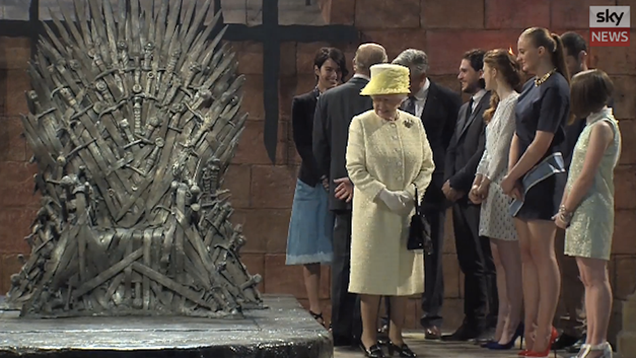
Game of Thrones has been criticized for its varied, seemingly random collection of British accents, but the lack of consistency across the different regions of Westeros and Essos just makes it easier for impressionist Steve Love to imitate a dozen characters from Season 4.
While we can’t offer any real solution for the giant hole in your Sunday night life left by the absence of new Game of Thrones episodes, we can offer you some temporary solace. Today, that takes the form of this totally radical remix of the theme song, 1986-style. That synth!
“What do you mean he abused her?” The question was shrill and innocuous.
The teacher, Mrs. Stern, looked incredibly uncomfortable. But hey, she had brought it up. “He got into the bed with her, and he abused her.” Mrs. Stern shrugged her shoulders at the ambiguity of it all, as if it was impossible to know what the passage was really saying. “Now let’s move on.”
I rolled my eyes from the back of the room. Seventh-grade Prophets class at Bais Yaakov, my school for Orthodox Jewish girls. We were studying Samuel II, wherein King David’s son Amnon rapes his half-sister Tamar, who is then violently avenged by her brother Absalom. But Mrs. Stern didn’t use the word “rape,” because sex itself was never acknowledge, much less discussed. I don’t know that many of my classmates would have even known what “rape” meant at the tender age of 12. These girls would eventually learn the facts of life from their mothers or rabbi’s wives in the weeks before they got married, soon after which they would be mothers themselves.
This is a weird account with which to begin this essay, I know, but it gives you a sense of the curricular world in which I experienced puberty – one in which sex and sexuality did not exist.
When I was about five years old, my parents got religion. We stopped driving on Friday nights and Saturdays and started keeping kosher. When I was six, we moved to another state and I started second grade at the local Modern Orthodox Jewish day school, which turned out to be a pit of evil little children who bullied me for my buck teeth and awkwardness. It got pretty bad and the administration refused to do anything about it, so my parents took me out of that hellhole and put me in Bais Yaakov.
I should pause and define some terms. Modern Orthodox – keep kosher and the Sabbath, but generally more religiously, if not politically, liberal. Engaged with the mainstream culture, for better or worse. Bais Yaakov was ultra-Orthodox, or “yeshivish” which meant a lot of things. Outwardly, it meant absolutely no pants, skirts strictly below the knees, shirts to the clavicle and sleeves to the elbow. This wasn’t a school dress code, this was the way Jewish girls were supposed to dress at all times. Other things – no TVs at home. No going to see movies. No secular music, limited selection of secular books. All women covered their hair, most with wigs. All men wore a uniform of white shirts and black pants. Bais Yaakov girls did not go to college, rather they studied for a year in a women’s seminary in Israel and then started dating for marriage. These external strictures marked, in theory, an inward placing of God and Torah at the center of one’s being.
Maybe it’s weird, but Bais Yaakov was a great social environment for me. I flourished with girls who were just as awkward and smart and into playing long and intricately detailed pretend games as I was. These girls were confident, unique, and incredibly creative. Boys – and the entire world of coed socializing, in fact – were completely absent from our lives.
Anyway, back to seventh grade. It was a strange year for me. I was Modern Orthodox at home and yeshivish at school, and trying to figure out what I believed in. One thing I knew for sure was that I was a feminist. I think I’d identified as a feminist ever since I had seen a Punky Brewster episode where she got a remote-control race car in the mail instead of a tea set, and proceeded to kick some serious ass at the track. Despite the heavy gender-role proscription of the yeshivish world, in my all-girls’ environment I knew that girls could do and be anything.
Seventh grade was also a year of rebellion. My non-observant aunt had given me a Discman (remember those?) and TLC’s “CrazySexyCool” for my bat mitzvah, and I brazenly brought the CD into school and sung the often-profane lyrics at recess. I experimented with colorful four-letter words and snuck The Mists of Avalon behind my Hebrew Bible. I think I was trying to get a rise out of the more sheltered girls in my class. One of whom, Devorah*, was the daughter of one of my teachers, Rabbi Goldstein.
It wasn’t long before my father (not my mother) got a call at work from Rabbi Goldstein. As our teacher of Jewish Law, the rabbi considered himself a guardian of sorts of our impressionable young female souls. A Meeting About DeDe was arranged for that very evening. My father, a feminist in his own right, had no idea what to expect.
“Mr. Jacobs,” said Rabbi Goldstein. “We’re very concerned about DeDe.”
“What’s the matter?” my father asked. I, meanwhile, was at that moment competing at the annual Battle of the Books, an uber-nerdy affair in which teams of middle-schoolers read assigned books and answered questions about them. My book was The Giver, and my team beat out 29 others to win that night. In short, I was definitely a Teen at Risk.
“Mr. Jacobs,” Rabbi Goldstein continued. “We hear that DeDe uses disgusting language. Like the s-word.”
“You mean…shit?” My dad asked. “Okay, I’ll tell her to stop cursing.”
“It’s more than that, Mr. Jacobs.” Rabbi Goldstein leaned forward. “We want DeDe to succeed at Bais Yaakov, but she has to be less close-minded.”
“Close-minded?”
“DeDe has told some of the other girls that she can’t believe they don’t plan on going to college. She is very focused on one particular way of life that does not necessarily fit our model of what a young woman should be. You see, when girls reach this age, they go in one of two directions. They can become,” he paused, “Worldly. Girls who struggle to find their place in the Torah world, and end up…. lost.”
Rabbi Goldstein let that word sink in. “Lost,” a catch-all euphemism for irreligious, promiscuous, substance abusing, whatever other evils one could possibly imagine. Unable to fit into place in the Orthodox community, drifting through life and winding up unmarried, childless, alone.
“The other way is to be a giggly girl.”
“Excuse me?”
“We prefer that, at this age, our students are giggly girls. They live in a tunnel, and aren’t concerned about what’s outside. They have friends, their families, and the Torah. They don’t need any distractions or worries. They are innocent, and happy.”
“Giggly girls.” My father, poor guy, was too stunned to say anything else.
I should point out that Devorah was the giggliest of girls. She’s the one who wanted to know exactly how Amnon had abused Tamar. Of course Mrs. Stern couldn’t tell her.
“Yes, Mr. Jacobs. I trust you’ll talk with DeDe about what we’ve discussed.”
Oh yes, he did. We had a long and frank discussion. We agreed that it was stupid to bring the TLC CD to school and that I should watch my language, especially around certain people. But there was no giggling proscribed.
The next day, on the blackboard, in my scrawl but attributed to Kathleen Hanna:
“I BELIEVE WITH MY WHOLEHEARTMINDBODY THAT GIRLS CONSTITUTE A REVOLUTIONARY SOUL FORCE THAT CAN AND WILL CHANGE THE WORLD FOR REAL.”
Joe Biden, who just returned from his whirlwind tour of fun sports grab-assing in Brazil , couldn't be happier about the arrival of summer. Today was the VEEP's annual Joe Biden's Big Day Out summer party, where journalists are invited to the Bidens' home to welcome summer and do a little kiddin' around. Biden was caught gritting his teeth, wanting badly to quote from his favorite action film, but thinking better of it.
We all know the story: Girl goes to an Ivy League college. Girl meets marijuana. Girl and marijuana fall in love. Girl smokes so much marijuana that she forgets the difference between astrology and astronomy, enrolls in an astronomy class and — still stoned — embarrasses herself in front of the entire lecture hall. It's almost as if Jenny Slate is the Ali MacGraw to weed's Ryan O'Neil!
It was the summer of 1909. I was on the south coast of Spain. I remember it well because the season was almost over. Peace was within reach, I felt. There had been a vote to end the war, and the English had told me to support it. But the vote needed to be unanimous to pass, and it failed. The Russian, the Italian, they thought the English voted against it and that I had been lied to. Why should I believe them? The English and I had worked together against all of them for years now. Of course they’d want to sow distrust between us. Now time was ticking. I desperately wanted peace. I wasn’t sure my country would survive another couple of years, with or without England’s help. There wouldn’t be another vote until after the fall.
“Will you support my army in Spain this fall?” I asked.
“Nah. That ain’t happenin’,” the Englishman replied. A wave of dread came over me. He intended to betray me.
“How could you do this to me? After everything I’ve done for you.”
“I guess I’m just a hard muthafucka like that.”
And with that he walked away, leaving me standing in the hallway, mouth agape. He rejoined the other players at the board, who all stared at me, fury in their eyes. We told you so.
For the past eight hours I had been in the basement of a dorm in Chapel Hill, North Carolina, playing a board game called Diplomacy along with six other men. Each of us was vying against 80 other people to be crowned the world champion of Diplomacy at the end of the weekend here at Dixiecon.23 One of those men, Brian Ecton, a high school math teacher from Prince George’s County, Maryland, with hair like Katt Williams and a mouth to match, approached me right at the start, sizing me up as a beginner and offering an alliance. He explained exactly how it would work and said we’d share a draw at the end. I had no reason not to agree.
For the next several hours each of the other players would take turns dragging me aside to explain to me how Brian was manipulating me, how he was going to betray me, how I should betray him first and work with them against Brian. I dismissed them all. After all, who’s to say they wouldn’t betray me as well? I was outmatched in this game. Safer to pick a player and stick with him come what may, I thought. But here I stood, on the verge of elimination, and the other players were pissed. According to them, I could have avoided this if I had listened to them hours ago.
“Don’t you realize that some of us traveled a very long distance to win this tournament?” a player from France said to me with disgust. “And because you won’t stab24 this guy, you’re going to die and bring all of us down with you.”
“Are you going to be paid for writing this story?” a Scottish player asked me. “Because I am losing three days’ wages to be here so that I can get screwed by you.”
I still don’t know whom I should have trusted, if anyone. All I know is that I felt stupid, stressed out, humiliated, and sad. I had several shouting matches with a few of these guys. Some of them got personal. And all I had to show for my loyalty to Brian Ecton and my righteous indignation toward the other players was nothing at all. I was physically exhausted and emotionally abused. I hated Brian, the other players all hated me, and I hated myself most of all. I had to purse my lips extra hard to fight the urge to cry.
Settlers of Catan, eat your goddamn heart out.
If you’ve ever heard of Diplomacy, chances are you know it as “the game that ruins friendships.” It’s also likely you’ve never finished an entire game. That’s because Diplomacy requires seven players and seven or eight hours to complete. Games played by postal mail, the way most played for the first 30 years of its existence, could take longer than a year to finish. Despite this, Diplomacy is one of the most popular strategic board games in history. Since its invention in 1954 by Harvard grad Allan B. Calhamer, Diplomacy has sold over 300,000 copies and was inducted into Games Magazine’s hall of fame alongside Monopoly, Clue, and Scrabble.
The game is incredibly simple. The game board is a map of 1914 Europe divided into 19 sea regions and 56 land regions, 34 of which contain what are known as “supply centers.” Each player plays as a major power (Austria-Hungary, Turkey, Italy, England, France, Russia, Germany) with three pieces on the board (four for Russia) known as “home supply centers.” Each piece can move one space at a time, and each piece has equal strength. When two pieces try to move to the same space, neither moves. If two pieces move to the same space but one of those pieces has “support” from a third piece, the piece with support will win the standoff and take the space. The goal is to control 18 supply centers, which rarely happens. What’s more common is for two or more players to agree to end the game in a draw. Aside from a few other special situations, that’s pretty much it for rules.
There are two things that make Diplomacy so unique and challenging. The first is that, unlike in most board games, players don’t take turns moving. Everyone writes down their moves and puts them in a box. The moves are then read aloud, every piece on the board moving simultaneously. The second is that prior to each move the players are given time to negotiate with each other, as a group or privately. The result is something like a cross between Risk, poker, and Survivor — with no dice or cards or cameras. There’s no element of luck. The only variable factor in the game is each player’s ability to convince others to do what they want. The core game mechanic, then, is negotiation. This is both what draws and repels people to Diplomacy in equal force; because when it comes to those negotiations, anything goes. And anything usually does.
The year was 1966. A 17-year-old boy named Edi Birsan was sitting in his room in Brooklyn staring at a letter he received in the mail. He scanned the same sentence over and over: I am not against a three-way draw and I will not take any more supply centers … On the table in front of him was a Diplomacy game board, showing a game at about the midway point.
Two years before, Edi’s mother had split. She and Edi’s stepfather’s marriage had been on the rocks for years. They’d fight, break up, get back together, lather, rinse, repeat. One day in 1964 she forged Edi’s signature on a bank slip and withdrew $5,000, the entirety of a savings account Edi had had since he was 9 years old, and eventually lit out for California. She stopped off in Tijuana for a Mexican divorce, and that was that.
By his own admission, Edi was introverted and repressed. A year after his mom took off, Edi was in therapy. His therapist saw in him a need to channel his bottled-up aggression, and to learn how to trust people again. She gave him a gift — a board game. I read in a magazine that this was Kennedy’s favorite game. They’d play it in the White House.25 She told him it would help him deal with betrayal.
Edi had a hard time rounding up seven people with whom to play the game. Eventually he discovered that most people played through the mail. He sent off a couple of dollars to subscribe to a magazine (or zine, as they were called) that collected and published the moves submitted by postal players in various games. In between issues Edi would correspond with the other players by mail, laying out his grand plans and coaxing people into alliances. He’d spend hours crafting the perfect letters to his fellow players, carefully choosing his words and taking care to describe how his strategy would benefit them both. He was usually good at it, too. And he prided himself on being a decent and trustworthy ally.
Now here he was, midway through a game he had played well for months. He and two other players stood to share a three-way draw. He read the sentence in the letter again. I am not against a three-way draw and I will not take any more supply centers …
Edi took out scissors and a pen from a drawer and set to work on the letter, painstakingly doctoring it. When he was finished he held up the letter proudly and read it to himself. I am against a three-way draw and I will take three more supply centers … He put the forgery in the mail to the third player. Then he waited.
Allan Calhamer invented the game in 1954 while he was still a law student at Harvard. He aimed to sell it to one of the major game companies, but they all passed. In 1959 he self-financed 500 sets and sold them all to toy stores around New York. The game was picked up in 1961 by a small game publisher called Games Research. But because of how difficult it was to organize seven people for an entire day to play a game, sales were less than brisk.26 It looked like Diplomacy wasn’t long for this world. Until the nerds saved it.
John Boardman was an editor of a number of amateur science fiction fanzines in 1963. In those days, pre–Star Trek, science fiction was still a highly niche subculture. Ever since the 1930s, fanzines were the primary way that sci-fi fans communicated and shared stories and ideas. John Boardman was also a fan of the game Diplomacy, but had a difficult time getting players together for a game. But he had an idea: He’d publish an ad in one of his sci-fi fanzines to see if anyone was interested in playing by mail. The response was encouraging. In May 1963, Boardman organized the first play-by-mail game of Diplomacy and the first Diplomacy zine, Graustark. Within four years there would be at least 32 more zines filled with postal Diplomacy games. Soon Games Research started promoting playing the game by mail by including the names and addresses of the zine editors with the game.
As Diplomacy grew in popularity across North America with play-by-mail games, some of the more hard-core players were curious about how they would fare against each other in a face-to-face game. What started out as a casual, informal gathering of top players in a backyard eventually grew to a yearly convention held on a college campus. They called it DipCon, and it became the definitive tournament for crowning the national Diplomacy champion.27
In 1976 the rights to the game were purchased by Avalon Hill, one of the largest publishers of strategy board games and war games in the world.28 The company had also started a gaming convention the year before in Baltimore called Origins. It invited the Diplomacy community to hold DipCon at Origins II, and the result was the largest Diplomacy tournament ever held in North America, with around 230 players.
With Avalon Hill’s support and reach, Diplomacy found an international audience and rapidly grew in popularity in Europe, particularly in the U.K. The game’s core community was still the editors and readers of the amateur zines, however. Through writings in those zines by new international players, the idea was floated that there should be a tournament in the U.K. In 1988, the first ever World DipCon was held in Birmingham, England, with the site rotating to a different country every year thereafter. Since 1988 the World DipCon has been held in 10 different countries. The winner of World DipCon is accepted around the world by the Diplomacy community as the official world champion.
David Hood, a North Carolina attorney, arrived at the 2014 World DipCon opening ceremony driving a yellow Cadillac and wearing a seersucker suit. He arrived with Mrs. North Carolina, a beauty queen in full tiara and sash, in tow.29
The organizer of Dixiecon, Hood had been a fixture in the Diplomacy hobby for many decades and was a two-time North American champion. Hood had been running Dixiecon since the 1980s, when he was a student at UNC.30
The gathering of amateur diplomats for the 2014 World DipCon was a fairly homogeneous group. Among the 87 players were only two women, two players under the age of 21, and four African Americans, including 2005 Dixiecon champion Brian Ecton.31 The players were as you’d probably expect from any international gathering of board gamers: bookish, unkempt, and slightly awkward. There were exceptions to these stereotypes, to be sure. If there was one thing that this particular group of nerds was not, it was nebbish.
“There is a definite amount of social awkwardness that goes along with any kind of gaming. You find the more social breed of gamer in Diplomacy,” said Siobhan Nolen, a hip, 28-year-old history grad student from Northern California and one of the two women entered in this year’s World DipCon. Her red hair was pulled back in a pony tail, revealing a Scrabble tile tattoo on the back of her neck. The daughter of a hard-core board-gamer who dragged her to conventions her entire life, Nolen is as expert in the culture of board-game nerds as anyone you’ll find. “This is a kind of alpha. It attracts very intelligent people. It attracts extroverted people. If you’re introverted and won’t put yourself out there, it won’t work out for you. It attracts people who like to talk. If you don’t like to talk, this game’s over pretty quickly for you.”
Nolen got hooked on Diplomacy when she was 13 years old. Her father had brought her to a gaming convention called Conquest. She was a bored adolescent wandering around the convention with her brother, not interested in playing any of the games. Then she came across six people sitting at a Diplomacy board, many of them not much older than she was. The oldest player, a man in his fifties, beckoned. “We need one more player.” Nolen looked at the board, the pieces, the players. On the face it looked like another boring war game like her dad played. “No way am I going to play that,” she replied. But Diplomacy was different from any game she had ever played. It wasn’t just tactics, just pushing pieces on a board. In fact, it was barely that. It had a human element. She found that in her very first game she was able to win against older, more experienced gamers just because she was good at convincing them to help her out. She was captivated by it. The older player asked her if she’d like to play again sometime and asked her for her email. His name was Edi Birsan.
The year was 1999. A 50-year-old Edi Birsan sat in front of his computer, the glow from the monitor the only light in the room. He stared at the email on the screen. I do not accept your terms …
Over the past 30 years Birsan had become something of a legend in the Diplomacy community. He helped grow the hobby through publishing his own play-by-mail zines in the 1970s, then by helping organize many of the larger DipCon events. He established a national organization to set rules and guidelines and he traveled to other countries to play in European Diplomacy events well before there was a World DipCon. He had even played with Allan B. Calhamer, the game’s inventor, and drubbed him.32
One thing that Birsan was sure of was that the game was better when played face-to-face. He much preferred the tournaments and house games he traveled to over the games played by mail. With the advent of the Internet, face-to-face Diplomacy had been dwarfed by the volume of people now playing the game over email. So much so that an email game had been organized to pit the top email players against the top face-to-face players. Birsan was one of those face-to-face players. And he wasn’t happy about the way this game had been going.
I do not accept your terms …
Birsan picked up the telephone and dialed 411. He asked for a number in Houston, wrote it down, and then hung up the receiver. He took a deep breath, then picked up the phone and dialed.
“Hello?”
“This is Edi Birsan.”
“What do you want?”
“I want to talk about this email you sent me.”
“No.”
“What do you mean ‘no’?”
“I can’t believe you called me on the phone! You can’t do that!”
“I’ve been doing this for 30 years!”
“I’ve been playing Diplomacy for over three years and I’ve never once received a phone call or even talked to another player.”
“Are you serious?”
“Don’t ever call me again.”
Click.
It was well past one o’clock in the morning in a suite on the second floor of our dorm when someone first suggested that we vote for a draw. My first match at Dixiecon had begun around 7 p.m. and there had been only one player eliminated from the game in six hours. Of the six of us remaining, one player, a former world champion named Chris Martin, was playing as Italy and down to a single unit, an army stuck somewhere in Austria. Without any other pieces to lend himself support, Martin was as good as eliminated — unless he had an ally to keep him in the game.
Martin, who has a PhD in dance, is a soft-spoken, fast-talking charmer whom other Diplomacy players call “the newbie whisperer” because of his affinity for allying with inexperienced players and getting them to do his bidding. He revels in this. Martin was knocking on death’s door when he convinced me, Siobhan Nolen, and a University of Arizona economics professor named Mark Stegeman to keep him alive. His reasoning? None of us was good enough at the game tactically to survive the alliance of the other two players, whether we stuck together or not.
He had a point, even if it was completely self-serving. The other two players on the board were Toby Harris, a top British player whose shaved head gave him a passing resemblance to Jason Statham and who was one of the favorites (along with Martin) to win the world championship; and Andy Bartalone, a Mack truck of a man with a booming voice and a penchant for booze and gambling — everyone affectionately called him “Buffalo.” Toby and Buffalo were not interested in any six-way draw. Their proposal? Kill Chris Martin and split it up five ways instead. More points for everyone!
“They won’t do that,” Martin whispered to us outside in the hall. “Once I’m gone they will cut one of you up next. Maybe all three. Right now we can work together and form a stalemate line that they can’t break, and we can force them to draw.”
Martin’s logic was sound. A stalemate line was an unbreakable formation that would force the game into a draw. The only way to break it would be to convince one of the players participating in it to betray the others. It was possible we could kill Martin and keep our stalemate line without him, but the three of us were unsure that we had the tactical skills to not make any mistakes. With Martin on our team, we were sure not to screw up. And, as Martin lied to us, eliminating him would net us only two points each.33
“This is ridiculous!” bellowed Buffalo. “Siobhan, can we talk to you in the hall?”
Nolen looked at us and shrugged, then followed Harris and Buffalo out to the hall. When they returned, we looked at Nolen for any sign that she had flipped on us. Everyone wrote their moves on small slips of paper and put them in a box. Then Martin pulled them out and read them aloud. Nolen didn’t break. The alliance held. Harris was livid.
“Can I talk to you for a moment?” he said to Martin. And the two best players walked out in the hall together, leaving the rest of us alone with Buffalo. The room fell silent, save for the sound of Buffalo’s heavy, labored breath. Stegeman would speak first.
“I don’t see why we continue to play. We’re just wasting time. We all want the draw. This guy wants the draw.” He motioned toward Buffalo.
“Excuse me?”
“Come on. You want the draw. You should, anyway. You don’t want to play until five in the morning.” Stegeman was insinuating that Buffalo should be happy with a six-way draw, perhaps that he was fortunate to even be in the mix. Buffalo blew his top.
“You want some?!” he yelled, loud enough to wake the entire dorm. “You don’t know me! Bring it. BRING. IT.” As he stormed out of the room, Buffalo shouted, “I’ll play all night. I don’t give a damn.”
Nolen and I looked at the older, affable Stegeman, she with irritation, me with fear. This was no longer fun. It was just tense and weird.
“To make a statement like that about someone you’ve never met before after we had been playing for six hours was pretty irritating,” Buffalo told me later. “I’ve invested six hours in this. I’m tied for the top but I’m going to have a terrible result because the rest of the board is unwilling to move.”
I saw this happen over and over again throughout the weekend. Players would get so angry because other players wouldn’t cooperate with them that they would take to shouting, browbeating, cursing, making insults. Often the anger was directed at players known as “alliance players,” or, more pejoratively, “care bears”: players who refuse to break alliances and will play only for draws.
“People laugh at me, they call me a care bear,” said Thomas Haver, a scientist from Columbus, Ohio. “If you’re a strong alliance player and it’s hard to break your alliances up, they say you’re a care bear.” The game is designed for cooperation, he argues. Every power starts out completely equal; every piece moves exactly the same. “By its very nature you need to cooperate, coordinate with someone else.”
Players like Brian Ecton disagree. “If you don’t play for the solo every time you sit down to play, you ain’t playing the game right.” The vast majority of the players I met at Dixiecon, American and European alike, agreed with Ecton. Alliances are meant to be broken. Draws are shameful. The only glory is in a solo victory, no matter how difficult it is or seldom it happens.34 “If everyone played for a draw, you’d just have seven-way draws all the time,” Ecton said. “I guess Dave Maletsky would like that.”
Dave Maletsky sat in the parking lot of the dorm in a beach chair he’d brought with him to the tournament. He’s a large man with glasses and a thin beard. He wore an enormous straw hat — nearly a sombrero — a yellow Hawaiian shirt, shorts, and sandals. He looked like he’d be just as comfortable at a Jimmy Buffett show as a Diplomacy tournament.
“I think my results speak for themselves,” he replied when I asked him about the accusation of being a care bear. Maletsky, a part-time nanny, has been involved in the world of Diplomacy for several years, even though he doesn’t really like the game that much. He tagged along with a friend to a Diplomacy event in Denver once just for the company, and made friends with many of the players he met. An avid gamer, Maletsky rarely misses a tournament and is very active in the hobby. He’s on a mission. “I feel by having a presence in the hobby I can make it better for future generations by working against toxic elements in the game.”
“The nature of the game is not for everyone,” said Maletsky. “It’s emotionally brutal at times. In order to succeed you have to work with someone all game, then trick them and lie to them and send their score spiraling down from where they thought it was going to be. And all of those negative consequences come from working with you, and that’s not pleasant.”
On this point, there is little disagreement. “Diplomacy is an incredibly uncomfortable game. Diplomacy is intense and uncomfortable and unsettling. There’s no two ways about it,” said Siobhan Nolen. “The game allows for absurdities in social interaction. You can do whatever you want and there are no consequences.”
Thomas Haver agreed. “If it’s just, ‘Hey, it’s just a game, no hard feelings,’ then it allows them to get away with things that are considered taboo. When people play the game, you get to see their real personality. That’s when they take off the mask.”
Toby Harris and Matt Shields
For some players, the aggressive nature of the game and the tension it can create is a point of pride. “You have to have a thick skin to play this game,” Buffalo said. “Bad things are going to happen.” Even the gentle newbie whisperer, Chris Martin, agrees. “You have to separate some wheat from chaff, and I don’t mean that in an elitist kind of way,” Martin said. “Every 10 people who like playing games, nine will not like playing Diplomacy.”
Maletsky’s solution? Shorter games, less emphasis on solo victories, more incentive for players to vote for draws early on. His system for scoring is unpopular among what he describes as “tournament sharks,” but he insists that it provides a better experience for new to midrange players. He said the goal should be to best simulate a “house game” of Diplomacy, where a group of friends sits down at home and opens the box and plays. To his mind, this is the way the game was intended to be played, not in tournaments where you keep score over several iterations. “Most people feel that the only true game you can have in a tournament is a binary result — one person wins and everyone else loses,” said Thomas Haver. “People enjoy the house games a lot better.”
Why water down the game for the weaker of heart? Because while tens of thousands play Diplomacy over email, the face-to-face game is struggling. That’s not just because of how much easier it is logistically to play over email. It’s also because the more emotionally traumatic elements of the game are intensified when you’re face-to-face with your opponent. And when the game is for points in a tournament with ego and a title on the line? “A lot of times players just lose their minds,” Maletsky said.
“There’s a guy here who last time we were together he was so mad he chucked a book at me,” said Haver. “When I saw that, I laughed, because ‘I win.’” For my part, I found it hard to laugh at rattling people to their emotional breaking point. As much as I was fascinated with this game, even the psychological elements of it, I was taken aback at how often players — even at the highest level — were pushed beyond their ability to think of it as just a game. Every single person I spoke with at Dixiecon told me the same thing, that to enjoy Diplomacy you need to leave all of that stuff on the board. After the 10th person told me, “We always go get a beer afterward,” I started to think it was less a practical maxim and more a personal mantra. It was a lot easier said than done.
“This hobby has a real problem with player retention,” said Maletsky. “It’s easy to get new players into the game, but it’s hard to get them to come back.” Fans of role-playing games enjoy the social aspect but dislike the tactical elements. Eurogamers are interested in Diplomacy’s unique game mechanics but dislike the fact that there is player elimination and direct conflict with opponents. But for most people, the problem is always the same: Diplomacy is just too intense.
Siobhan Nolen has tried to recruit other women to play the game, to no avail. “I don’t know that it caters itself to men, but it’s a very intimidating game.” Nolen once brought her best friend to an event. “Bless her heart she tried, but when we were finished she gave me a look and said, ‘Never again.’”
Chris Martin won’t even let his own 14-year-old son play the game. “He could play against high school students, junior high school students, and he would be fine. I wouldn’t discourage him from playing a friendly game, a house game.” But in a tournament? No way. “In a tournament situation, you encounter people who care a lot more about winning than [about] the emotional fragility of the person they’re sitting across from.”
One thing that struck me about this divide: Of the players who expressed the most discomfort with the cutthroat nature of the game, despite their skills and their reputations, none had ever won a world championship.
Another late night at Dixiecon, about three o’clock in the morning. It was so late, the nightly poker game had already wrapped up and most of the recreational drinking had moved to the bar across the street or into the dorm rooms. Thomas Haver was still playing Diplomacy, though. His game had been going for more than eight hours. He was playing as Russia, and his ally, a Canadian player named Chris Brand, was playing as Turkey. They had allied right from the start — an alliance known as “the juggernaut” in Diplomacy parlance — and had been pushing through the board all night. They eliminated Austria quickly, but the other players saw the juggernaut and moved quickly to work together to try to stop it.
In a situation like this, in which a two-person alliance is taking on the whole world, what is required of the two allies is complete trust. To build that kind of trust, you need to make sacrifices for the good of the alliance. You need to refuse to grow too strong to keep your ally from worrying you might betray them. You leave yourself as vulnerable to an attack from them as they are to you. If an ally asks you for something — even if it means an imbalance in the relationship, that they grow a little stronger than you — you give it to them to build the trust. If you make a deal that you’ll work together and share the victory, you have to mean it when you say it, and show it in your actions. Act as if a gain for your partner at your expense is a wash. This is care bear diplomacy. This is how Thomas Haver plays the game. And at that late hour in that Chapel Hill basement, it appeared to be working. Haver and Brand’s juggernaut was nearing the end of what would surely be a two-way victory for them both. There was just one more move to make.
And that’s when Thomas Haver saw it.
Brand likely saw it, too. He was too good a player to not see it. But at that point he had come too far. He couldn’t defend against it. He could only hope that Haver was as much a care bear as everybody said, and would keep his word that they’d go for the two-way.
But there was no denying it — Haver could solo this board on the next move.
He had never had a solo victory in a game before. He’d had opportunities, sure, but he turned them down in favor of keeping his word to his allies. I don’t want to hurt the other players just to get that win, he had always thought. Additionally, by always being a trustworthy ally who plays honorably, Haver had built up a reputation as someone who was good to work with in tournaments. “That’s why it was easy for people on my board to say, ‘He’s not going to stab his ally.’
“And that’s what allowed me to do it when I did.”
When the moves were read, Brand was crestfallen. Haver stabbed his partner and took enough supply centers from him and the other players to secure 18 units and the elusive solo victory. It was worth 270 points, enough to win him the tournament and the world championship.
“This is a guy I worked with for the entire game. The entire game. In most cases I would have stuck out with that. Because I legitimately felt bad about it then. And I feel bad about it now,” Haver said. “It’s going to bother me the entire drive home that I did him wrong.”
As Haver retired back to his dorm room for a couple of hours’ sleep before the next morning’s game, he ran into Brand in the hallway.
“If you want some revenge, I guess you can choke me now,” Haver joked. Brand was in no mood to kid. He wasn’t angry, just in a state of shock. Staring off into the distance, he mumbled, “I’m just trying to figure out what I could have done differently … ” He entered his dorm room and closed the door.
What likely rattled Brand wasn’t the complexity of his question, but the utter simplicity. What he should have done differently was to not trust Thomas Haver.
“To me, Diplomacy isn’t a game of deception and manipulation,” Edi Birsan told me on the final morning of Dixiecon. “It’s a game about trust.”
Today Edi Birsan still plays Diplomacy, and had entered this event, though he wasn’t really playing to win. He had won enough trophies over his lifetime. Besides, he had recently been elected to the city council of Concord, California, where he lived, so he was putting his diplomatic skills to some real-world use now.
I had sought out Birsan after struggling to keep my emotions in check over the course of nonstop rapid-fire lying, arguing, and humiliation for the past 24 hours. I needed to know from the man who everyone from Thomas Haver to Chris Martin told me was the greatest Diplomacy player alive — was I not cut out for this game? Is the only way to be good at Diplomacy to be good at lying and manipulating others? Birsan didn’t think so.
“What I love about the game is that no one can really play the game ‘right,’” Birsan said. “Otherwise, after 50 years, that would have been discovered long ago and the hobby would have died of boredom.”
After all the anger, the manipulation, the frayed nerves, and the hurt feelings, I was left feeling something wholly unlike boredom, but something also unlike fun. My opponents were right: I was too trusting, too unwilling to lie, too willing to settle for draws. I was not thick-skinned. I was not an alpha nerd. But I comforted myself with the thought that even though I wasn’t, neither were my pissed-off opponents. If they were, they’d have persuaded me to do what they wanted. My poor decisions were as much their fault as my own. This was the soft-bellied credo of a broken ego, but it was all I had left.
“There’s this stigma, if you will, attached to the game, that it’s about lying and betrayal,” Chris Martin said to me after Dixiecon. “When my son starts playing Diplomacy, and he will one day, what I want him to learn is the ability to present your argument to somebody, so that they see the merits of your case. The ability to take a setback, say, OK, that didn’t work out, but I’m gonna come back and I’ve got a new plan, we can still make this happen, still make this work together. And he will learn the opposite side to that moment of emotional betrayal, that when you look someone in the eye and you say you’re going to do something, then you do it, that is tremendously satisfying.”
One day I hope Chris Martin’s son and I can meet each other across the board, maybe at another World DipCon. When we do, I hope we can look each other in the eye, shake hands firmly, and keep our word to one another. We may not win the tournament, but we’ll know we aspired to play in a way that we can be proud of.
“Is there a ‘right way’ to live?” asked Birsan. “Not really. Diplomacy reflects life.”
Lucy Li, just 11 years old and still in sixth grade, teed off for her opening round at the U.S. Women's Open earlier this morning. Li is the youngest golfer to ever qualify for the tournament, and she is also cute as hell.
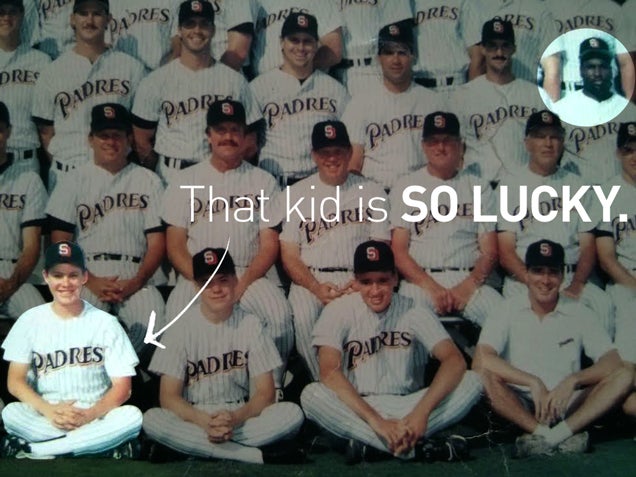
This is absolutely beautiful. When I was a kid and still cared about baseball, Tony Gwynn was one of my favorite players.
The baseball-card collection I had as a teen—145,000 cards in all when I last bothered to count, 800-count box after 800-count box, all of them occupying a dusty bookcase in my bedroom—was sold years ago. Some random stranger now owns that collection of 400 Tom Glavine rookie cards I bought on speculation at $.04 each. (I haven't checked Beckett recently, but I'm sure that investment has more than doubled.) The tiny handful of cards I kept each serve a purpose. Some remind me that people are idiots (Bill Ripken's "Fuck Face" card); some remind me that we all start somewhere (Ken Griffey Jr.'s San Bernardino Spirit card), and others remind me, as if I need reminding, that Tony Gwynn was one of the finest human beings I've ever met, and that the world is cheaper without him in it.
Users can submit captions to be put up for an entire month.
The Last Billboard is a project curated by Jon Rubin where anyone can submit a caption to be put on a billboard in Pittsburgh, PA (on the corner of Highland and Baum.)
For most people, and five Supreme Court justices, there is a straightforward answer to the question, "Can I lie on the federal form I must sign in order to legally purchase a firearm in the United States?" (NO.) For four other Supreme Court justices (just guess), this is a more complicated issue.
Justice Scalia becomes Terry Krankota a little bit more every day.
This morning the Supreme Court declined to hear a case about religious freedom brought by a Milwaukee school district that wanted to hold its graduation ceremonies in a church and got slapped down by the Seventh Circuit. Scalia dissented, indulging in a bit of the old "music criticism" along the way.
After the shooting at Reynolds High School in Oregon this week, CNN reported that 74 school shootings have happened since the Newtown tragedy in 2012. Now, the network has changed its mind — really, only 15 school shootings have happened since Newtown.






 Previously: Every Russian novel ever.


 When I was about five years old, my parents got religion. We stopped driving on Friday nights and Saturdays and started keeping kosher. When I was six, we moved to another state and I started second grade at the local Modern Orthodox Jewish day school, which turned out to be a pit of evil little children who bullied me for my buck teeth and awkwardness. It got pretty bad and the administration refused to do anything about it, so my parents took me out of that hellhole and put me in Bais Yaakov.