iokevins
Shared posts
27 May 23:16
Brian Kernighan's Advanced Programming Techniques Class at Princeton
Schultkl likes this
27 May 23:16


The Well-Stocked Home Pharmacy
by mark
It’s a great idea to put all your medical stuff into a kit of some sort, even if it never leaves your house. The worst place to store medicine supplies is in the bathroom, where most people keep them. It is moist and warm there, while what medical stuff wants is dry and cool. You also want to be able to grab supplies quickly and take them where they are needed. We put ours into plastic cases the size of shoe boxes, There’s one for bandages and first aid, and another for medicines. The lids seal tight, prolonging the shelf life of the contents. When there is a first-aid injury, we get the kit and have everything together on site.
In addition to first-aid supplies here are some medicines you might consider stocking:
- You should have an antibiotic ointment like Polysporin or a triple antibiotic.
- Diarrhea serves a useful function to remove bad things from the body, but sometimes you may need Imodium to control excessive and severe diarrhea. Take this on your travels.
- I like to have some hydrocortisone at home for itchy rashes and eczema.
- Afrin nasal spray for a decongestant. Because it is targeted to the nasal area, the medicine is more potent than oral decongestants so you get more bang for the side-effect buck. Don’t use it for more than 3 days, though.
- It’s a good idea to have an anti-fungal like Lotrimin or clotrimazole for athlete’s foot or infection of the skin.
- Another good thing to stock is Benadryl for allergies and allergic reactions.
- If you are traveling in exotic places (for you) ask your doctor to prescribe the antibiotic Cipro (ciprofloxacin) to take with you in case of emergency.
- The other thing we take in our traveling medical kit is probiotics and vitamin D. Since probiotic products vary enormously, current studies suggest that the two aspects the matters most are higher numbers of colony forming units and containing more than one strain. For probiotics, aim for products with 5 billion colony forming units.
27 May 23:16
The Matasano Crypto Challenges
by maciej@pinboard.in (Maciej Ceglowski)
I recently took some time to work through the Matasano crypto challenges, a set of 48 practical programming exercises that Thomas Ptacek and his team at Matasano Security have developed as a kind of teaching tool (and baited hook).
Much of what I know (or think I know) about security has come from reading tptacek's comments on Hacker News, so I was intrigued when I first saw him mention the security challenges a few months ago. At the same time, I worried that I'd be way out of my depth attempting them.
As a programmer, my core strengths have always been knowing how to apologize to users, and composing funny tweets. While I can hook up a web template to a database and make the squigglies come out right, I cannot efficiently sort something for you on a whiteboard, or tell you where to get a monad. From my vantage point, crypto looms as high as Mount Olympus.
To my delight, though, I was able to get through the entire sequence. It took diligence, coffee, and a lot of graph paper, but the problems were tractable. And having completed them, I've become convinced that anyone whose job it is to run a production website should try them, particularly if you have no experience with application security.
Since the challenges aren't really documented anywhere, I wanted to describe what they're like in the hopes of persuading busy people to take the plunge.
You get the challenges in batches of eight by emailing cryptopals at Matasano, and solve them at your own pace, in the programming language of your choice. Once you finish a set, you send in the solutions and Sean unlocks the next eight. (Curiously, after the third set, Gmail started rejecting my tarball as malware.)
Most of the challenges take the form of practical attacks against common vulnerabilities, many of which will be sadly familiar to you from your own web apps. To keep things fun and fair for everyone, they ask you not to post the questions or answers online. (I cleared this post with Thomas to make sure it was spoiler-free.)
The challenges start with some basic string manipulation tasks, but after that they are grouped by theme. In most cases, you first implement something, then break it in several enlightening ways. The constructions you use will be familiar to any web programmer, but this may be the first time you have ever taken off the lid and looked at the moving parts inside.
Here are the cryptographic topics covered:
- basic substitution and XOR
- pseudo-random number generators
- stream and block ciphers, and their modes of operation
- message authentication codes
- Diffie-Hellman key exchange
- RSA (public-key cryptography)
Going into the challenges, I worried that my math wouldn't be up to the task. My impression of Serious Crypto was that it required all kinds of group theory, abstract algebra, elliptic curves, vector spaces, and other scary stuff. But while this may be true, the math content for the practical challenges was much gentler:
- working in base 2 and base 16
- modular arithmetic
- discrete exponentiation
- Hamming distance (& friends)
- primality testing
- basic stats (standard deviation & variance)
While the math concepts weren't hard, getting a real feel for them took work (and this was the point of the exercise).
If you're an experienced programmer, the Matasano challenges are also a terrific excuse to try a new programming language. It's always much more fun to solve real problems than it is to write a Manager object that inherits from Employee.
Here are the language features I found myself using most:
- string manipulation (ranges, substrings)
- bitwise operators
- lookup hashes
- conversion between string and number formats
- big integer operations
- packing and unpacking binary data
- pattern matching
- url manipulation
- client/server interaction over a socket
Altogether it took me about three weeks to do the full cycle, working pretty intensively. Skilled programmers will find the going much faster, especially if you're comfortable with bit twiddling. Very few of the problems were downright hard, though some required several hours of work. I spent most of my time stepping through algorithms in pursuit of bugs, and in the process really got a feel for the moving parts in various cryptographic constructions.
I would compare the experience to having only ever read cookbooks and watched cooking shows, and then being asked to fry an egg. You know exactly what to do... in principle.
Some of the challenges have a payoff, in that you decrypt a short bit of secret text. This is incredibly fun. Seeing a cracked message come up on the screen after an evening of bug chasing reminded me of how it felt to be a kid in front of my Apple ][, finally getting it to beep or draw a circle or print DONGS all over the screen. Some of the later challenges even display the answer 'Hollywood style', where you get to see it decrypt one letter at a time in a cascade of print statements.
While the rules don't stipulate it, I think it's a good idea not to look at anyone's code if you try the challenges. The goal here is to convert message-board levels of understanding into actual knowledge, and the only way that works is if you bang your head on the task without seeing how anyone else has done it. Sean was really helpful in helping me navigate difficult spots, and the challenges are not set up to intentionally trick you. But you will need the kind of graph paper with the small squares.
What surprised me most:
How practical these attacks were. A lot of stuff that I knew was weak in principle (like re-using a nonce or using a timestamp as a 'random' seed) turns out to be crackable within seconds by an art major writing crappy Python.
There is no difference, from the attacker's point of view, between gross and tiny errors. Both of them are equally exploitable. In at least three challenges, the mere fact of getting distinguishable error messages was enough to recover the entire message.
Timing attacks are much more effective than I imagined.
Someone who can muck with your ciphertext is halfway to reading it, possibly with your secret key for dessert.
Some mistakes are incredibly non-obvious. I had no idea you had to super-carefully pad RSA, for example.
Even on a laptop, in 10 minutes you can do a terrifying amount of computation. It really is 2013.
This lesson is very hard to internalize. In the real world, if you build a bookshelf and forget to tighten one of the screws all the way, it does not burn down your house
I mentioned earlier that I thought every web programmer should try their hand at these. It is very illuminating to look at your own web app from the vantage point of an attacker actually writing code. At the very least, you will never be confused about cipher block modes again, or have to worry that someone will ask you to explain how a public key works in an interview. And there is a whole slew of dumb mistakes you will now avoid (replacing them with smarter mistakes that will become the subject matter of challenges 48-96).
The best part, from a web app developer's perspective, is that you never once write a SQL statement or HTML tag.
Here are some specific lessons from the challenges that I will apply to my own work:
Keep meaningful data out of tokens (like cookies) that I hand out to clients. Use random values keyed against a database, memory store, or wherever.
If I have to put data in tokens, include an integrity check, and pay a real crypto person to vet it.
I must never seed a PRNG with a timestamp. I used to do this with microsecond precision thinking I was being clever. Then I went ahead and wrote a script that guessed the seed value in just a few seconds, and now I will never do that again.
Use constant-time string comparisons when testing incoming data against some target value for authentication purposes. This is easy enough to do in most languages to make it cheap insurance.
Anything related to authentication should only fail in one way. I must not provide distinguishable errors to the user.
If possible, find a way to log the fact that someone is making a lot of weird queries against my site. For extra points, try not to make the logger itself hackable.
No third-party javascript. I hated it already, now I hate it more.
Cut off one of my fingers each time I re-use a nonce.
Having read this post, you can go to Hacker News and comment in Talmudic detail about what is right or wrong in the conclusions I drew. But a much better idea is to just email Sean and have a crack at the challenges yourself. You will have a good time!
One final observation. Crypto is like catnip for programmers. It is hard to keep us away from it, because it's challenging and fun to play with. And programmers respond very badly to the insinuation that they're not clever enough to do something. We see the F-16 just sitting there, keys in the ignition, no one watching, lights blinking, ladder extended. And some infosec nerd is telling us we're can't climb in there, even though we just want to taxi around a little and we've totally read the manual.
Doing these challenges is a great way to 'shake your sillies out', as Raffi might say, without hurting yourself or your users. You get to put on the flight suit, climb into the simulator, and crash that plane in every conceivable way.
I would like to sincerely thank Thomas and Sean and everyone at Matasano who worked on these challenges, and implore people in other technical fields to consider offering something similar. It's the most fun I've had programming in years!
Schultkl, Snipergirl likes this
27 May 23:16


Frida Kahlo’s Passionate Hand-Written Love Letters to Diego Rivera
by Maria Popova
“Only one mountain can know the core of another mountain.”
 Mexican painter and reconstructionist Frida Kahlo is among the most remarkable figures of contemporary culture. At a young age, she contracted polio, which left her right leg underdeveloped — an imperfection she’d later come to disguise with her famous colorful skirts. A decade later, as one of only thirty-five female students at Mexico’s prestigious Preparatoria school, she was in a serious traffic accident, which resulted in multiple body fractures and internal lesions inflicted by an iron rod that had pierced her stomach and uterus. It took her three months in full-body cast to recover and though she eventually willed her way to walking again, she spent the rest of her life battling frequent relapses of extreme pain and enduring frequent hospital visits, including more than thirty operations. As a way of occupying herself while bedridden, Kahlo made her first strides in painting — then went on to become one of the most influential painters in modern art.
Two years after the accident, in 1927, she met the painter Diego River, whose work she’d come to admire and who became her mentor. In 1929, despite the vocal protestations of Kahlo’s mother, Frida and Diego were wedded and one of art history’s most notoriously tumultuous marriages commenced. Both had multiple affairs, the most notable of which for bisexual Kahlo were with French singer, dancer, and actress Josephine Baker and Russian Marxist theorist Leon Trotsky. And yet her bond with Diego was one of transcendental passion and immense love.
Kahlo’s love letters to Rivera, found in The Diary of Frida Kahlo: An Intimate Self-Portrait (public library) and stretching across the twenty-seven-years span of their relationship, bespeak the profound and abiding connection the two shared, brimming with the seething cauldron of emotion with which all fully inhabited love is filled: elation, anguish, devotion, desire, longing, joy. In their breathless intensity, they soar in the same stratosphere of love letters as those exchanged between Georgia O’Keeffe and Alfred Stieglitz, Anaïs Nin and Henry Miller, and Virginia Woolf and Vita Sackville-West.
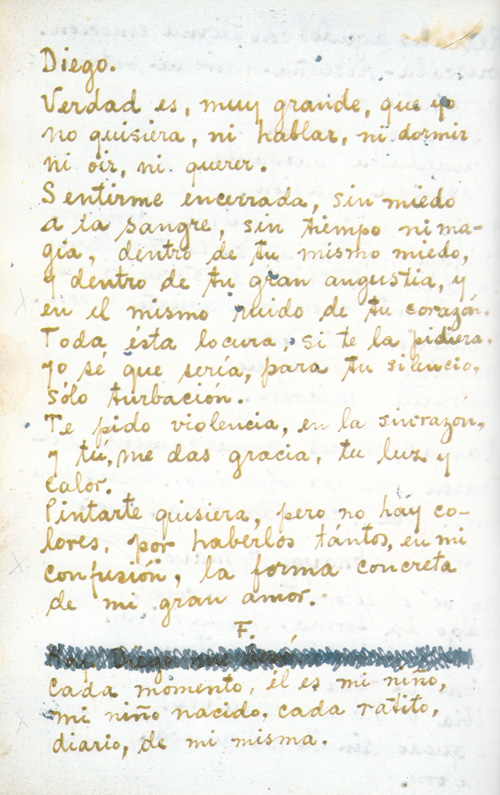
Diego.
Truth is, so great, that I wouldn’t like to speak, or sleep, or listen, or love. To feel myself trapped, with no fear of blood, outside time and magic, within your own fear, and your great anguish, and within the very beating of your heart. All this madness, if I asked it of you, I know, in your silence, there would be only confusion. I ask you for violence, in the nonsense, and you, you give me grace, your light and your warmth. I’d like to paint you, but there are no colors, because there are so many, in my confusion, the tangible form of my great love.F.
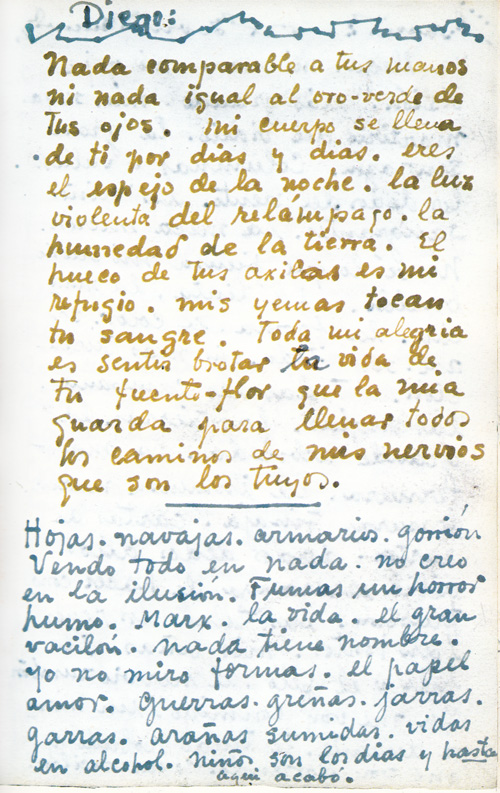
Diego:
Nothing compares to your hands, nothing like the green-gold of your eyes. My body is filled with you for days and days. you are the mirror of the night. the violent flash of lightning. the dampness of the earth. The hollow of your armpits is my shelter. my fingers touch your blood. All my joy is to feel life spring from your flower-fountain that mine keeps to fill all the paths of my nerves which are yours.
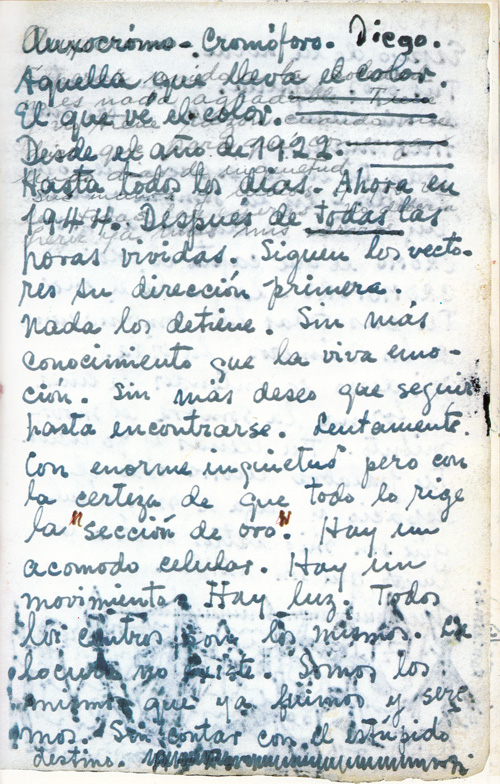
Auxochrome — Chromophore. Diego.
She who wears the color.
He who sees the color.
Since the year 1922.Until always and forever. Now in 1944. After all the hours lived through. The vectors continue in their original direction. Nothing stops them. With no more knowledge than live emotion. With no other wish than to go on until they meet. Slowly. With great unease, but with the certainty that all is guided by the “golden section.” There is cellular arrangement. There is movement. There is light. All centers are the same. Folly doesn’t exist. We are the same as we were and as we will be. Not counting on idiotic destiny.
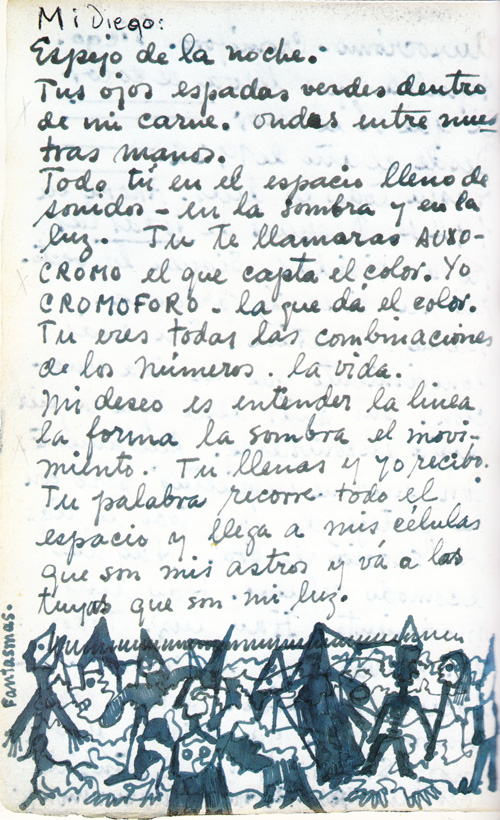
My Diego:
Mirror of the night
Your eyes green swords inside my flesh. waves between our hands.
All of you in a space full of sounds — in the shade and in the light. You were called AUXOCHROME the one who captures color. I CHROMOPHORE — the one who gives color.
You are all the combinations of numbers. life. My wish is to understand lines form shades movement. You fulfill and I receive. Your word travels the entirety of space and reaches my cells which are my stars then goes to yours which are my light.
Auxochrome — Chromophore
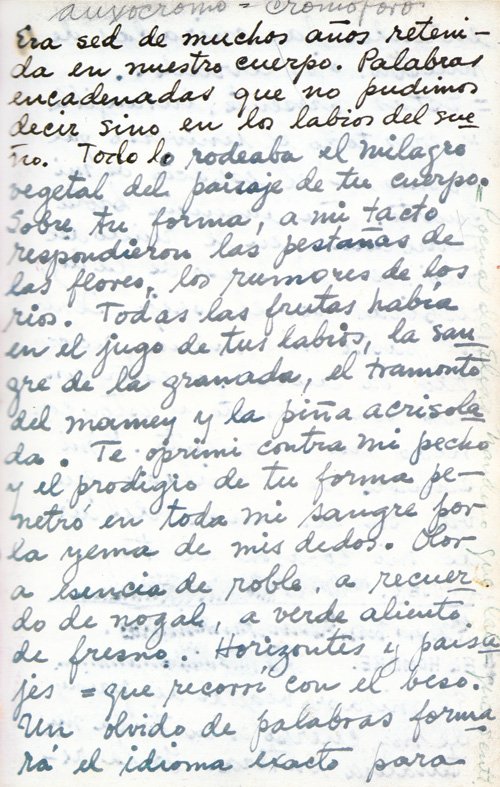
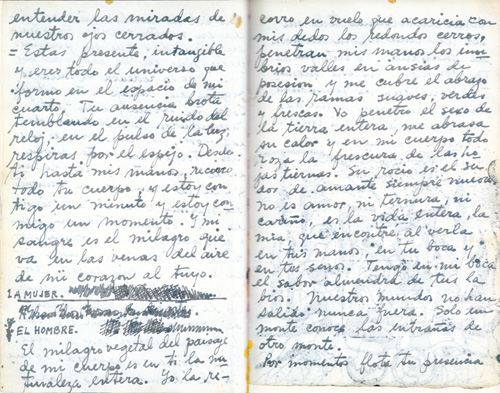
It was the thirst of many years restrained in our body. Chained words which we could not say except on the lips of dreams. Everything was surrounded by the green miracle of the landscape of your body. Upon your form, the lashes of the flowers responded to my touch, the murmur of streams. There was all manner of fruits in the juice of your lips, the blood of the pomegranate, the horizon of the mammee and the purified pineapple. I pressed you against my breast and the prodigy of your form penetrated all my blood through the tips of my fingers. Smell of oak essence, memories of walnut, green breath of ash tree. Horizon and landscapes = I traced them with a kiss. Oblivion of words will form the exact language for understanding the glances of our closed eyes. = You are here, intangible and you are all the universe which I shape into the space of my room. Your absence springs trembling in the ticking of the clock, in the pulse of light; you breathe through the mirror. From you to my hands, I caress your entire body, and I am with you for a minute and I am with myself for a moment. And my blood is the miracle which runs in the vessels of the air from my heart to yours.
The green miracle of the landscape of my body becomes in your the whole of nature. I fly through it to caress the rounded hills with my fingertips, my hands sink into the shadowy valleys in an urge to possess and I’m enveloped in the embrace of gentle branches, green and cool. I penetrate the sex of the whole earth, her heat chars me and my entire body is rubbed by the freshness of the tender leaves. Their dew is the sweat of an ever-new lover.
It’s not love, or tenderness, or affection, it’s life itself, my life, that I found what I saw it in your hands, in your month and in your breasts. I have the taste of almonds from your lips in my mouth. Our worlds have never gone outside. Only one mountain can know the core of another mountain.
Your presence floats for a moment or two as if wrapping my whole being in an anxious wait for the morning. I notice that I’m with you. At that instant still full of sensations, my hands are sunk in oranges, and my body feels surrounded by your arms.
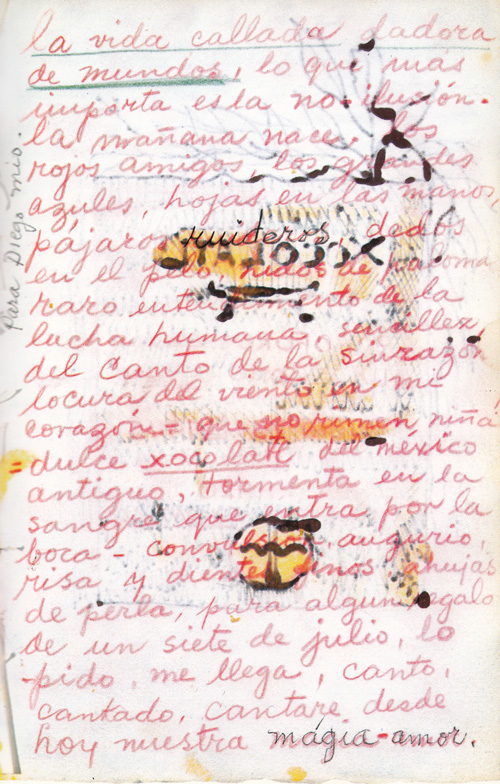
For my Diego
the silent life giver of worlds, what is most important is the nonillusion. morning breaks, the friendly reds, the big blues, hands full of leaves, noisy birds, fingers in the hair, pigeons’ nests a rare understanding of human struggle simplicity of the senseless song the folly of the wind in my heart = don’t let them rhyme girl = sweet xocolatl [chocolate] of ancient Mexico, storm in the blood that comes in through the mouth — convulsion, omen, laughter and sheer teeth needles of pearl, for some gift on a seventh of July, I ask for it, I get it, I sing, sang, I’ll sing from now on our magic — love.
Pair The Diary of Frida Kahlo: An Intimate Self-Portrait with more exquisite love letters by Edna St. Vincent Millay, Balzac, Rilke, and Eleanor Roosevelt.
Donating = Loving
Bringing you (ad-free) Brain Pickings takes hundreds of hours each month. If you find any joy and stimulation here, please consider becoming a Supporting Member with a recurring monthly donation of your choosing, between a cup of tea and a good dinner:
| ♥ $7 / month♥ $3 / month♥ $10 / month♥ $25 / month |

You can also become a one-time patron with a single donation in any amount:
 Brain Pickings has a free weekly newsletter. It comes out on Sundays and offers the week’s best articles. Here’s what to expect. Like? Sign up.
Brain Pickings takes 450+ hours a month to curate and edit across the different platforms, and remains banner-free. If it brings you any joy and inspiration, please consider a modest donation – it lets me know I'm doing something right.

27 May 23:15
Techmemes
by Gabriel Weinberg
I really needed some levity this morning, so we (at DuckDuckGo) matched some tech companies to memes.


If you think of other good ones, tweet them at me.


If you think of other good ones, tweet them at me.
27 May 23:15


The Stars Over Magma
Submitted by: Unknown (via Unreal Hawaii)
Tagged: magma , Hawaii , stars , lava , night , destination WIN! , g rated Share on Facebook
27 May 23:14
I welcome the idea that food is important: since about age fifteen I have tended to experiment with my own eating in an attempt to optimize nutrition. Far from seeking out the cheapest calories, I often put nutrition ahead of even tastiness, over the years shoveling things like raw brewers yeast, oddly colored concoctions from the blender, and raw vegetables galore into the belly. Some experiments have worked and some have failed, but these days, after sufficient reading and learning, I’m finally starting to get some things right.


The Amazing Waist-Slimming, Wallet-Fattening Nutrient
by Mr. Money Mustache
 Despite my insistence that the MMM family eats outlandishly well these days, I take a fair amount of flak from certain readers on the subject of food:
”Food is not something I take shortcuts on, and thus our food bill will always be higher than that of the MMM Family. Theymust are cheaping out on something we should all spend MORE on!”
Other people pick up a different vibe, saying
“Mr. Money Mustache, you seem to eat a good [Nutritious/Primal/Paleo] diet. How can you do this, and feed a family well on less than $1000 per day?”
I welcome the idea that food is important: since about age fifteen I have tended to experiment with my own eating in an attempt to optimize nutrition. Far from seeking out the cheapest calories, I often put nutrition ahead of even tastiness, over the years shoveling things like raw brewers yeast, oddly colored concoctions from the blender, and raw vegetables galore into the belly. Some experiments have worked and some have failed, but these days, after sufficient reading and learning, I’m finally starting to get some things right.
The biggest helpful shift for me has been the realization that “fat” (also known as “oil”) is not a taboo toxin that immediately sticks itself atop your nearest existing reserve of stored bodyfat if you accidentally ingest it. Quite the opposite, it is a pure and clean-burning fuel that your body will happily run on for great distances, much like an old Mercedes Diesel will burn unprocessed vegetable oil while creating only pleasant french-fry-scented tailpipe emissions. Fat is not fattening. Eating when you don’t yet need refueling is what makes you fat, and high-carbohydrate eating is what causes the craving to eat too often.
This change in dietary philosophy can be unintuitive to those who still eat according to the USDA’s grain-intensive food pyramid. At a recent breakfast at a friend’s house, someone noticed me cooking a pan of eggs for myself. I started by heating an obscene lake of olive oil, then added the eggs and grated on a thick layer of full-fat cheddar cheese and another of spicy curry powder. After this delicious smelling treat was sizzled properly, I served it onto a plate, added some almonds on the side, and sliced on an entire avocado over top to add even more Good Fat.
“Why are you adding so much fat to your breakfast?”, asked the friend.
“Because it adds more calories”, I replied.
“But don’t you want LESS calories rather than MORE?”
“No. If I eat fewer calories at breakfast, I’ll just need to eat again sooner in the day. A meal like this will keep me going until 2PM. But if I eat bread, juice, or other simple carbohydrates at breakfast, I’ll be hungry in just an hour or two.”
“This blows my mind.”
“Good! Maybe you should try it!”
The Triple M High Energy Breakfast Omelette:
2TBSP olive oil (240 calories, 27g fat, $0.36)
3 Eggs (21g protein, 240 calories, 18g fat, $0.60)
1/2 cup shredded cheese (14g protein, 18g fat, 225 calories, $0.31)
1/2 TSP Curry powder, pepper and garlic to taste (0 cals, $0.10)
Diced Mushrooms and Onions (optional) (10 cals, $0.25)
1 Avocado (1g protein, 27g fat, 300 calories, $1.00)
Fry the vegetables in the oil, then add the eggs and cheese. Sizzle and flip. Put on your plate, and slice on that Avo.
Total Power: 1015 calories, 90 grams fat, 36 grams protein, $2.62
Carbohydrates: almost none
Calories per Dollar: 387
Bicycle miles fueled at 18MPH: 17.2
Hours of outdoor work fueled at moderate intensity: 4-6
This is a big meal designed to start an active day. If you’re just planning on writing some software after breakfast, you might scale down the ingredients accordingly. But the principle remains the same: a low-carb meal like this works better than one with juice, toast, bagels and other sugar-spiking ingredients. And it’s still relatively inexpensive, because there is no meat.
But won’t it give me a heart attack?
Again, quite the opposite. The most recent research on fat shows that it is not an artery-clogger or an abdomen-thickener. The proponents of this type of diet encourage you to get your own blood tested before and after the switch in order to see for yourself. I only have my most recent blood test on file, but the numbers are excellent after almost a year of eating this way. A friend of mine with past blood cholesterol problems switched to a low-carb, high-fat diet and saw immediate and complete improvement in his own blood test results – completely the opposite of his doctor’s prediction but exactly in line with the high-fat/low-carb research. Mark’s Daily Apple will entertain you for days if you are looking for more stories and research citations on the topic.
But perhaps even more relevant to you and me, being assembled today at this Personal Finance blog, is that this nutrient is extremely cheap. It is easy and land-efficient to grow, easy to store and ship, and easy to use in the preparation of delicious food. You can find most of the best oils (and nuts) in organic top-of-the-line form at Costco in huge quantities at great prices.
So nowadays I seek out fat rather than avoiding it. Homogenized rather than skim milk. Heavy unsweetened whipping cream instead of ‘lite’. Butter and bacon, and using bacon grease for additional cooking. Coconut and olive oils, used in cooking with no restraint. Nuts of all sorts.
But the key to all of this fat, is that it must replace, rather than supplement, your refined carb intake. I think of slices of bread as “weight gain squares”. Beer is “liquid belly expander”. A plate of pasta is “Ultra Mass-Up 2000″. Pizza is no longer my favorite dinner treat. I’ll still indulge in these things occasionally, but only as a tool to gain weight after a heavy workout.. not as part of a lazy vacation. And drinking sweet things is totally out – no fruit juice or soda, pretty much ever. Go for water, milk, unsweetened coconut or almond milk instead.
And while fat does the heavy lifting for me, I still eat raw and cooked vegetables freely with every meal, and plenty of fruit too. This is not the Atkins Diet or anything overly restrictive. Just a general “avoid flour and sugar” philosophy is all it takes.
Another breakfast I’ve been eating recently when I need quick calories in a lighter package:
MMM’s 1000-calorie Coconut Cream Dessert-like Breakfast
2-4 TBSP Coconut Oil, melted into a bowl
2 TBSP almonds, ground in a blender
2 TBSP ground flax seeds
1 Banana, sliced
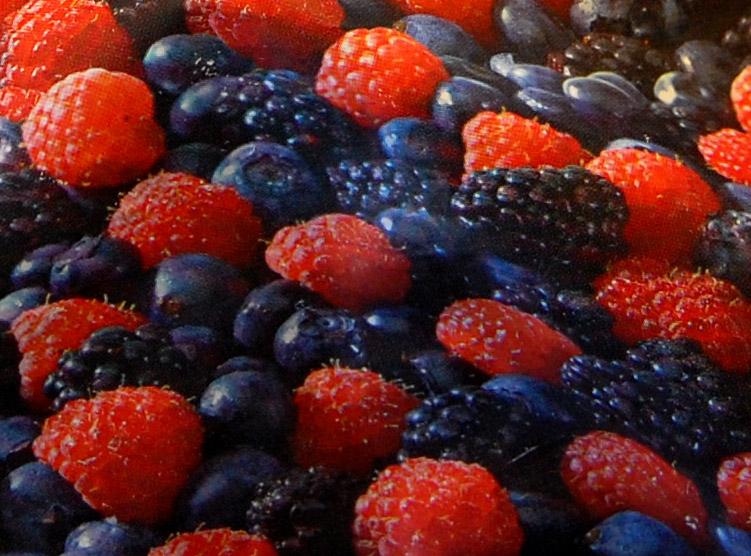
Optional: Mixed Berries (can be thawed from a big frozen bag)
1 huge pile of unsweetened whipped cream
Cinnamon on top
It’s delicious, and rich. All the power of 3-4 bowls of cereal, but much longer lasting energy!
Triple M Salad
1 Cucumber, diced (keep the skin on, it is good for you)
2 tomatoes, diced
1 red/orange/yellow pepper, diced
green onions, snipped up
1 cup cilantro (just cut a bunch in with scissors, straight from the bunch)
1 carrot, grated over top
… mix it all into a big bowl and pour this over top:
MMM’s 3-2-1 Spicy Balsamic Soy Vinagrette dressing
3 TBSP olive oil
2 TBSP balsamic vinegar
1 TBSP soy sauce
1 tsp pepper
1 tsp garlic
1 tsp honey or brown sugar
Shake this up and serve it over salads and many other things. Delicious and rich in calories. And of course, nearly free to make.
While the ideas above are only a few very simple examples*, I feel like a food revolution is happening here at the MMM household. Maybe it’s just our gradual growing-up, but we are now actually using cookbooks, improvising, and making good meals in a way I wish we would have started ten years ago. It’s a fine and luxurious ritual to sit down at a well-stocked table after a hard day of work, and I wish the same luxury upon you as well.
*Only slightly more complicated but amazing for dinner is “Fish Molee”. Now that I’ve mentioned it, I cannot deny you the joy of eating this amazing curry dish:
Fish Molee
Take 1/2 lb of any white fish (tilapia, cod, swai, etc)
Rub on 1/2 tsp turmeric and 1 tsp salt
Put 2 TBSP of coconut or olive oil into a big pan and start sizzling it
Dice in 1 onion
Grate in 3 garlic cloves
Grate in 1 tsp of ginger
Spoon in 1 TBSP of curry powder
Slice in 1 red pepper or other big chile pepper of your choice
Cook for 2 more minutes
Add about 14 ounces of coconut milk and cook for 5 more minutes, at a simmer
Add the seasoned fish and finish it up for 6-8 minutes
It’s relatively easy and it is good enough for a young man to impress a young lady on his first time having her over for dinner. A truly handy recipe.
Rebecca.iverson, Schultkl and -1 others like this
27 May 23:14


More Post-It Monsters
by Cory Doctorow


I picked up John Kenn Mortensen's More Post-It Monsters at a comic-show in London and it's terrific. Mortensen draws beautiful and grotesque line-art monsters on yellow sticky notes, and, as with the first collection of these, Sticky Monsters, More Post-It Monsters reproduces them with a minimum of text (apart from a brief and charming intro from China Mieville) and other distractions. It's just about 80 pages' worth of Gorey-esque illustrations that'll excite and reward your brain's monster-center.
John Kenn Mortensen: More Post-It Monsters


|
Cloudmonkey, Tatianagarciaa and one other like this
27 May 23:14
 Fans of Ambient/Space/Contemplative music will gather in San Rafael, California May 3-5 for a "Music From the Hearts of Space" 40th Anniversary live event, AMBIcon 2013.


AMBIcon 2013, ambient music festival, May 3-5 in San Rafael, CA
by Xeni Jardin
Fans of Ambient/Space/Contemplative music will gather in San Rafael, California May 3-5 for a "Music From the Hearts of Space" 40th Anniversary live event, AMBIcon 2013. "It's coming up in two weeks," says host Stephen Hill, "And if you've been considering attending, we have news: there are more ticketing options and lower prices! I hope to see you at AMBIcon 2013. It's going to be a historic and musically rewarding event, the first in true Surround Sound!"
Above, one of the musicians who will be performing: space music master Michael Stearns, from his 1981 classic electronic album "Planetary Unfolding."
|
|
Schultkl likes this
27 May 23:14

Food is good and all that but YOU REALLY FUCKING NEED WATER. I...
Food is good and all that but YOU REALLY FUCKING NEED WATER. I always drink one glass of water before each meal and another glass right after. Shit, that’s almost all the water you need in a day.
Feeling tired? Got a headache? Nauseous? Fuck those Rx commercials with their crazy ass side effects, drinking more water is the cheapest way to feel better. I drink mine straight but if you’re fancy as fuck then toss in some lemon, mint leaves, lime, cucumber, lemongrass. I don’t give a good goddamn, JUST DRINK IT.
Dj.topicality, Schultkl and 3 others like this
27 May 23:13
Adapteva shows off production Parallella mini 'supercomputer' boards
by Joe Pollicino

With its ambitious Parallella computing project funded on Kickstarter since last October, Adapteva's now showing off its first mass-production boards. These Raspberry Pi-esque devices are capable of supercomputer-like parallel computing performance thanks to power-sipping Epiphany multi-core accelerators. As proposed, both the $99 13GHz 16-core (26 gigaflops) and $199 45GHz 64-core accelerator (90 gigaflops) variants make an appearance in the pictures. The company is tweaking this initial batch of 10 to test various functionalities, with its current update noting that getting Linux to boot off the boards is the next step in testing. Final units are still slated to arrive on doorsteps during the summer, and hardware schematics will eventually be available as open source-info -- after all, the Parallella has always been pitched as an open undertaking. Those enthused by circuits and the boards they live on will find a path to more info at the source link.
Via: Tech2
Source: Adapteva (Kickstarter), Parallella.org
Philotas Kyriakidis, Schultkl and one other like this
27 May 23:13

thefatgrackle: invaderxan: This is a ring made from dinosaur...
This is a ring made from dinosaur bone, meteorite, and gold.
I feel like this ring probably has supernatural powers.
And even if it doesn’t, it’s quite a lovely thing.
Schultkl and -1 others like this

27 May 23:13

Ultralight Backpackin’ Tips
by mark
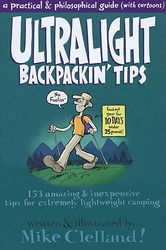
This is the best introduction to ultralight backpacking there is. Ultralight means you carry less than 25 pounds of gear, food and water for a 10 day trip, and maybe less than 5 pounds for a weekend trip! That’s liberating. If you obsessively reduce the mass of things (or leave them behind) by onefold then you can raise your enjoyment of hiking tenfold.
But most of the stuff in a backpack is carried to overcome a lack of knowledge. So whenever you take away weight you have to replace it with knowledge — knowledge that this book supplies.
This book assumes you are persuaded of this zen-like way. If you need to be persuaded that carry-weight is worth obsessing over, or you want the full course of every option available, and the evidence and reasons for each method, and how to make all the stuff yourself, then you’ll need Ray Jardines’ bible on the subject, the previously reviewed and now updated Beyond Backpacking/Trail Life.
But instead of a bible, this fantastic book by Mike Clelland will give you cartoons. Lot’s of them.
It’s jammed packed with dense, informative, easy to digest, and remarkably helpful advice, hints and instructions on how to accomplish and enjoy walking with very little stuff — and this knowledge is mostly compressed into witty cartoons. I am a big fan of Clelland’s other previously reviewed cartoon guides to snow travel and ordinary backpacking and I really like how amazingly effective his drawings are. Each one is worth thousands of words. It’s fun but not silly. Clelland grapples with the real-world details of, say, not taking a water filter or toilet paper (!!!) and his solutions are born of many seasons of experience. The whole book is authentic and reliable. It will very quickly have you out on the trail carrying a lot less than you once did. Even if you don’t get as extreme as he does, you can move in the right direction by substituting knowledge for stuff. I’ve been going super light for a long time and I learned tons of new tricks on almost every page.
-- KK
Ultralight Backpackin’ Tips
Mike Clelland
2011, 144 pages
$10
Available from Amazon
Sample Excerpts:
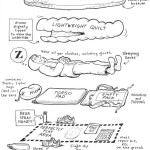
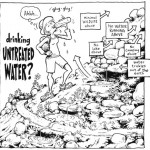
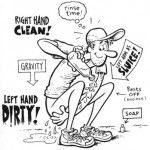
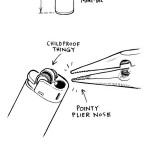
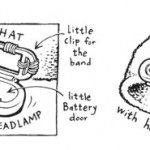
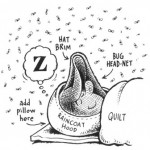
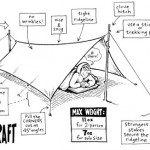
venkman, John.boddie and 3 others like this
27 May 23:13


Movie Trailer Parody of the Day: A Seriously Serious Indie Film Trailer
Check out this meta-parody movie trailer for Home Without, Marleqta, a seriously serious indie film co-directed by "two guys who just attended the SXSW film festival" and made for this week's Film Fight challenge "Worst. Trailer. Ever."
Submitted by: Unknown (via YouTube)
Schultkl likes this
27 May 23:13
Homemade Circuit Board Wrist Watch #WearableWednesday
by Becky Stern

Dangerous Prototypes board member matseng writes:
DaTajm is a wristwatch based on a PIC16F1824 powered by a single CR1216 lithium coin cell. I’m using a sandwich of three PCBs. The topmost pcb (0.8mm thick) have 12 leds and a resistive touchpad on the top side and all the other parts on the bottom. The middle pcb (1.6mm( is just a spacer for the battery. The bottom pcb have a contact for the positive pole of the battery and a soldered cable up to the top pcb.
Schultkl likes this
27 May 23:12

14 Ways to Acquire Knowledge: A Timeless Guide from 1936
by Maria Popova
“Write! Writing, to knowledge, is a certified check.”
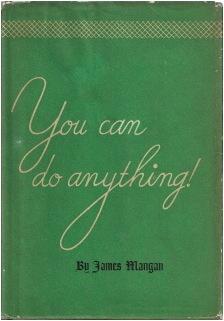 The quest for intellectual growth and self-improvement through education has occupied yesteryear’s luminaries like Bertrand Russell and modern-day thinkers like Sir Ken Robinson and Noam Chomsky. In 1936, at the zenith of the Great Depression, the prolific self-help guru and famous eccentric James T. Mangan published You Can Do Anything! (public library) — an enthusiastic and exclamation-heavy pep-manual for the art of living. Though Mangan was a positively kooky character — in 1948, he publicly claimed to own outer space and went on to found the micronation of Celestia — the book isn’t without merit.
Among its highlights is a section titled 14 Ways to Acquire Knowledge — a blueprint to intellectual growth, advocating for such previously discussed essentials as the importance of taking example from those who have succeeded and organizing the information we encounter, the power of curiosity, the osmosis between learning and teaching, the importance of critical thinking (because, as Christopher Hitchens pithily put it, “what can be asserted without evidence can be dismissed without evidence”), the benefits of writing things down, why you should let your opinions be fluid rather than rigid, the art of listening, the art of observation, and the very core of what it means to be human.

14 WAYS TO ACQUIRE KNOWLEDGE
- PRACTICE
Consider the knowledge you already have — the things you really know you can do. They are the things you have done over and over; practiced them so often that they became second nature. Every normal person knows how to walk and talk. But he could never have acquired this knowledge without practice. For the young child can’t do the things that are easy to older people without first doing them over and over and over.
[…]
Most of us quit on the first or second attempt. But the man who is really going to be educated, who intends to know, is going to stay with it until it is done. Practice!
- ASK
Any normal child, at about the age of three or four, reaches the asking period, the time when that quickly developing brain is most eager for knowledge. “When?” “Where?” “How?” “What?” and “Why?” begs the child — but all too often the reply is “Keep still!” “Leave me alone!” “Don’t be a pest!”
Those first bitter refusals to our honest questions of childhood all too often squelch our “Asking faculty.” We grow up to be men and women, still eager for knowledge, but afraid and ashamed to ask in order to get it.
[…]
Every person possessing knowledge is more than willing to communicate what he knows to any serious, sincere person who asks. The question never makes the asker seem foolish or childish — rather, to ask is to command the respect of the other person who in the act of helping you is drawn closer to you, likes you better and will go out of his way on any future occasion to share his knowledge with you.
Ask! When you ask, you have to be humble. You have to admit you don’t know! But what’s so terrible about that? Everybody knows that no man knows everything, and to ask is merely to let the other know that you are honest about things pertaining to knowledge.
- DESIRE
You never learn much until you really want to learn. A million people have said: “Gee, I wish I were musical!” “If I only could do that!” or “How I wish I had a good education!” But they were only talking words — they didn’t mean it.
[…]
Desire is the foundation of all learning and you can only climb up the ladder of knowledge by desiring to learn.
[…]
If you don’t desire to learn you’re either a num-skull [sic] or a “know-it-all.” And the world wants nothing to do with either type of individual.
- GET IT FROM YOURSELF
You may be surprised to hear that you already know a great deal! It’s all inside you — it’s all there — you couldn’t live as long as you have and not be full of knowledge.
[…]
Most of your knowledge, however — and this is the great difference between non-education and education — is not in shape to be used, you haven’t it on the tip of your tongue. It’s hidden, buried away down inside of you — and because you can’t see it, you think it isn’t there.
Knowledge is knowledge only when it takes a shape, when it can be put into words, or reduced to a principle — and it’s now up to you to go to work on your own gold mine, to refine the crude ore.
- WALK AROUND IT
Any time you see something new or very special, if the thing is resting on the ground, as your examination and inspection proceeds, you find that you eventually walk around it. You desire to know the thing better by looking at it from all angles.
[…]
To acquire knowledge walk around the thing studied. The thing is not only what you touch, what you see; it has many other sides, many other conditions, many other relations which you cannot know until you study it from all angles.
The narrow mind stays rooted in one spot; the broad mind is free, inquiring, unprejudiced; it seeks to learn “both sides of the story.”
Don’t screen off from your own consciousness the bigger side of your work. Don’t be afraid you’ll harm yourself if you have to change a preconceived opinion. Have a free, broad, open mind! Be fair to the thing studied as well as to yourself. When it comes up for your examination, walk around it! The short trip will bring long knowledge.
- EXPERIMENT
The world honors the man who is eager to plant new seeds of study today so he may harvest a fresh crop of knowledge tomorrow. The world is sick of the man who is always harking back to the past and thinks everything wroth knowing has already been learned. … Respect the past, take what it offers, but don’t live in it.
To learn, experiment! Try something new. See what happens. Lindbergh experimented when he flew the Atlantic. Pasteur experimented with bacteria and made cow’s milk safe for the human race. Franklin experimented with a kite and introduced electricity.
The greatest experiment is nearly always a solo. The individual, seeking to learn, tries something new but only tries it on himself. If he fails, he has hurt only himself. If he succeeds he has made a discovery many people can use. Experiment only with your own time, your own money, your own labor. That’s the honest, sincere type of experiment. It’s rich. The cheap experiment is to use other people’s money, other people’s destinies, other people’s bodies as if they were guinea pigs.
- TEACH
If you would have knowledge, knowledge sure and sound, teach. Teach your children, teach your associates, teach your friends. In the very act of teaching, you will learn far more than your best pupil.
[…]
Knowledge is relative; you possess it in degrees. You know more about reading, writing, and arithmetic than your young child. But teach that child at every opportunity; try to pass on to him all you know, and the very attempt will produce a great deal more knowledge inside your own brain.
- READ
From time immemorial it has been commonly understood that the best way to acquire knowledge was to read. That is not true. Reading is only one way to knowledge, and in the writer’s opinion, not the best way. But you can surely learn from reading if you read in the proper manner.
What you read is important, but not all important. How you read is the main consideration. For if you know how to read, there’s a world of education even in the newspapers, the magazines, on a single billboard or a stray advertising dodger.
The secret of good reading is this: read critically!
Somebody wrote that stuff you’re reading. It was a definite individual, working with a pen, pencil or typewriter — the writing came from his mind and his only. If you were face to face with him and listening instead of reading, you would be a great deal more critical than the average reader is. Listening, you would weigh his personality, you would form some judgment about his truthfulness, his ability. But reading, you drop all judgment, and swallow his words whole — just as if the act of printing the thing made it true!
[…]
If you must read in order to acquire knowledge, read critically. Believe nothing till it’s understood, till it’s clearly proven.
- WRITE
To know it — write it! If you’re writing to explain, you’re explaining it to yourself! If you’re writing to inspire, you’re inspiring yourself! If you’re writing to record, you’re recording it on your own memory. How often you have written something down in order to be sure you would have a record of it, only to find that you never needed the written record because you had learned it by heart!
[…]
The men of the best memories are those who make notes, who write things down. They just don’t write to remember, they write to learn. And because they DO learn by writing, they seldom need to consult their notes, they have brilliant, amazing memories. How different from the glib, slipshod individual who is too proud or too lazy to write, who trusts everything to memory, forgets so easily, and possesses so little real knowledge.
[…]
Write! Writing, to knowledge, is a certified check. You know what you know once you have written it down!
- LISTEN
You have a pair of ears — use them! When the other man talks, give him a chance. Pay attention. If you listen you may hear something useful to you. If you listen you may receive a warning that is worth following. If you listen, you may earn the respect of those whose respect you prize.
Pay attention to the person speaking. Contemplate the meaning of his words, the nature of his thoughts. Grasp and retain the truth.
Of all the ways to acquire knowledge, this way requires least effort on your part. You hardly have to do any work. You are bound to pick up information. It’s easy, it’s surefire.
- OBSERVE
Keep your eyes open. There are things happening, all around you, all the time. The scene of events is interesting, illuminating, full of news and meaning. It’s a great show — an impressive parade of things worth knowing. Admission is free — keep your eyes open.
[…]
There are only two kinds of experience: the experience of ourselves and the experience of others. Our own experience is slow, labored, costly, and often hard to bear. The experience of others is a ready-made set of directions on knowledge and life. Their experience is free; we need suffer none of their hardships; we may collect on all their good deeds. All we have to do is observe!
Observe! Especially the good man, the valorous deed. Observe the winner that you yourself may strive to follow that winning example and learn the scores of different means and devices that make success possible.
Observe! Observe the loser that you may escape his mistakes, avoid the pitfalls that dragged him down.
Observe the listless, indifferent, neutral people who do nothing, know nothing, are nothing. Observe them and then differ from them.
- PUT IN ORDER
Order is Heaven’s first law. And the only good knowledge is orderly knowledge! You must put your information and your thoughts in order before you can effectively handle your own knowledge. Otherwise you will jump around in conversation like a grasshopper, your arguments will be confused and distributed, your brain will be in a dizzy whirl all the time.
- DEFINE
A definition is a statement about a thing which includes everything the thing is and excludes everything it is not.
A definition of a chair must include every chair, whether it be kitchen chair, a high chair, a dentist’s chair, or the electric chair, It must exclude everything which isn’t a chair, even those things which come close, such as a stool, a bench, a sofa.
[…]
I am sorry to state that until you can so define chair or door (or a thousand other everyday familiar objects) you don’t really know what these things are. You have the ability to recognize them and describe them but you can’t tell what their nature is. Your knowledge is not exact.
- REASON
Animals have knowledge. But only men can reason. The better you can reason the farther you separate yourself from animals.
The process by which you reason is known as logic. Logic teaches you how to derive a previously unknown truth from the facts already at hand. Logic teaches you how to be sure whether what you think is true is really true.
[…]
Logic is the supreme avenue to intellectual truth. Don’t ever despair of possessing a logical mind. You don’t have to study it for years, read books and digest a mountain of data. All you have to remember is one word — compare.
Compare all points in a proposition. Note the similarity — that tells you something new. Note the difference — that tells you something new. Then take the new things you’ve found and check them against established laws or principles.
This is logic. This is reason. This is knowledge in its highest form.
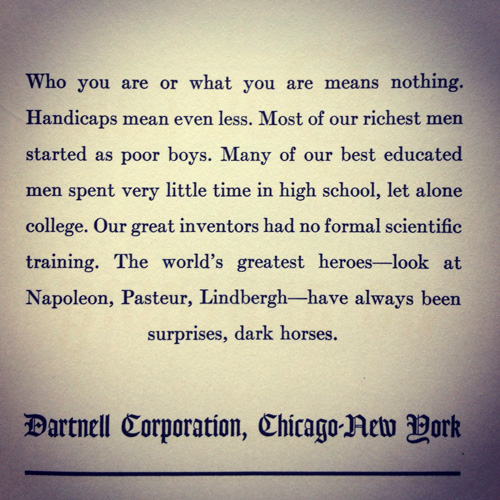
The rest of You Can Do Anything! goes on to explore such facets of success as the fundamentals of personal achievement, manual and mental production, the art of the deadline, selling by giving, mastering personal energy, the necessary elements of ambition, and more.
Donating = Loving
Bringing you (ad-free) Brain Pickings takes hundreds of hours each month. If you find any joy and stimulation here, please consider becoming a Supporting Member with a recurring monthly donation of your choosing, between a cup of tea and a good dinner:
| ♥ $7 / month♥ $3 / month♥ $10 / month♥ $25 / month |
You can also become a one-time patron with a single donation in any amount:
Brain Pickings has a free weekly newsletter. It comes out on Sundays and offers the week’s best articles. Here’s what to expect. Like? Sign up.
Brain Pickings takes 450+ hours a month to curate and edit across the different platforms, and remains banner-free. If it brings you any joy and inspiration, please consider a modest donation – it lets me know I'm doing something right.
Schultkl, Liz.crellin and -1 others like this
27 May 23:12


Same Colours
by Steve Napierski
If I was in a similar situation and I saw Bidoof sitting there, I would just keep on walking.
source: deviantART
Schultkl, Alvaro Freitas and -1 others like this
27 May 23:12


With Great Power Comes Plausible Deniability
Submitted by: Meqad
Tagged: roller coaster tycoon , rollercoasters , failbook , g rated Share on Facebook
27 May 23:12
Animated gif of the day: Completing 'Snake'
by noreply@blogger.com (biotv)
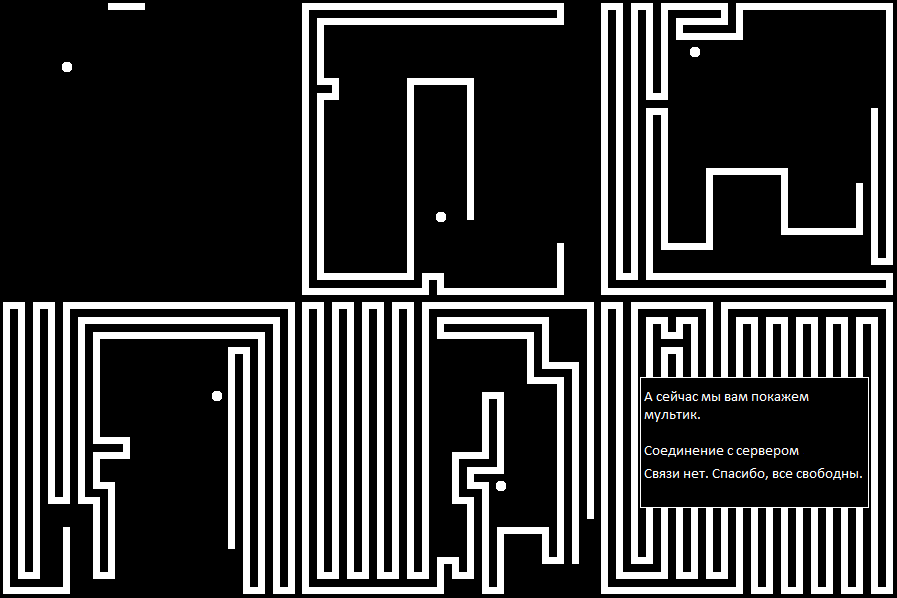
From a Russian message board: an animated gif of someone completing the classic arcade game Snake, that was available on the old Nokia phones.
According to one of the comments, the game took 13 minutes and 17 seconds to complete (here's the full, slow version) and the sped-up version (below) is 2 minutes and 6 seconds long.
via
According to one of the comments, the game took 13 minutes and 17 seconds to complete (here's the full, slow version) and the sped-up version (below) is 2 minutes and 6 seconds long.
via
Schultkl and -1 others like this

27 May 23:12


5 Free Microsoft Access Alternatives
by Sangeeta Kardam
Here, is a list of 5 free alternatives to Microsoft Access. Go ahead and check out these free Microsoft Access alternatives now!
5 Free Microsoft Access Alternatives was originally published at I Love Free Software
Schultkl and -1 others like this
27 May 23:12
Organovo 3D-prints a liver, probably has a room full of them somewhere #3dthursday
by Matt

Perhaps I was initially a bit of a victim of link-baiting, I found this article about the real-world Organovo organ bioprinter pretty hilarious, as well as sharing the breaking news about the “mini-livers.” From IDG, via New Scientist.
At this week’s annual Experimental Biology conference in Boston, California-based Organovo announced that it’s one step closer to 3D-printing a functional human liver for transplants.
In fact, the scientists over at Organovo already made a human liver in the lab that can perform most of the tasks that an in-body liver can perform. Unfortunately, it also happens to be the smallest human liver ever–only a millimeter deep and four millimeters across. As you can imagine, it’s not really big enough for your average human body.
The liver was “built” using a 3D printer loaded up with human cells. The printer assembles these cells the same way a normal 3D printer uses plastic, layering them into a final form. All told, Organovo’s mini-livers contain approximately 20 layers of cells, including some taken from blood vessels. The blood vessel cells are especially important, as they allow the mini-liver to take in nutrients and stay alive for a longer period of time.
Even though you can’t use these mini-livers for transplants, they do have a broad range of applications in the lab. Because Organovo’s livers function almost exactly like real human livers, they could help scientists test the effects of drugs on the human body. The mini-livers also produce the same compounds as a real liver, including cytochrome P450s, used by the body for drug metabolism and detoxification.
The next challenge for Organovo is to figure out how to print a larger support structure for blood vessels–essential if we’re ever going to get full-sized 3D-printed livers suitable for human transplant….
Still, not too long ago 3D printers were just assembling small plastic prototypes. Next it was guns, and now organs. Science seems destined to bring me to a future where I can indeed abuse my body as much as I want with no repercussions, and I can’t wait.


Every Thursday is #3dthursday here at Adafruit! The DIY 3D printing community has passion and dedication for making solid objects from digital models. Recently, we have noticed electronics projects integrated with 3D printed enclosures, brackets, and sculptures, so each Thursday we celebrate and highlight these bold pioneers!
Have you considered building a 3D project around an Arduino or other microcontroller? How about printing a bracket to mount your Raspberry Pi to the back of your HD monitor? And don’t forget the countless LED projects that are possible when you are modeling your projects in 3D!
The Adafruit Learning System has dozens of great tools to get you well on your way to creating incredible works of engineering, interactive art, and design with your 3D printer! If you’ve made a cool project that combines 3D printing and electronics, be sure to let us know, and we’ll feature it here!
Schultkl likes this
27 May 23:12
edroso: Thanks @terryteachout for finding this L. Bernstein intro to G. Gould - an *amazing* thing http://t.co/uD6lbsjKVr @cbc_archives
edroso: Thanks @terryteachout for finding this L. Bernstein intro to G. Gould - an *amazing* thing http://t.co/uD6lbsjKVr @cbc_archives
Schultkl likes this
27 May 23:11
It’s Just a Flesh Wound
by John Cole
Noshing on primanti brothers late night after a night on the town in Pittsburgh after a memorial service for an old advisor.
I really wish I could say that Pittsburgh was a party town, but, you know, after you have been to Austin and Madison and San Fran and NYC, you just sort of realize it ain’t.
On the upside, the Omni Westin William Penn has no dollar dispensers on their soda machines, which means that the entire hotel was treated with me stumbling around the reception desk asking for quarters while wearing a Steelers T, boxer shorts, and socks and flip flops.
That’s just how I roll these days. It’s 2 am, I’m 42 drunk and grossly indifferent to your delicate sensibilities, your fucking soda machines don’t take ones, and I have Primanti’s to eat. Deal with it bitches.
I will note that it dos make me deeply sad that so many of you will never experience the sheer joy of a 2 am Primanti brothers sandwich. Other than Drover’s Inn wings, there is nothing better.

Schultkl likes this
27 May 23:11


To-big-to-fail banks implicated in $500 trillion fraud: biggest price-rigging scandal in history
by Cory Doctorow
In Rolling Stone, the amazing Matt Taibbi documents a breaking price-rigging scandal involving the world's biggest banks. The $500 trillion conspiracy to game the interest-rate swaps victimizes every city, town, state and nation that uses bonds to raise money, diverting an unimaginable sum from tax coffers to the pockets of mega-rich bankers. If you've been staring around at the empty storefronts, closed libraries and schools, homeless and breadlines since 2008 and wondering "Where did all the money go?" then wonder no longer.
Though interest-rate swaps are not widely understood outside the finance world, the root concept actually isn't that hard. If you can imagine taking out a variable-rate mortgage and then paying a bank to make your loan payments fixed, you've got the basic idea of an interest-rate swap.
In practice, it might be a country like Greece or a regional government like Jefferson County, Alabama, that borrows money at a variable rate of interest, then later goes to a bank to "swap" that loan to a more predictable fixed rate. In its simplest form, the customer in a swap deal is usually paying a premium for the safety and security of fixed interest rates, while the firm selling the swap is usually betting that it knows more about future movements in interest rates than its customers.
Prices for interest-rate swaps are often based on ISDAfix, which, like Libor, is yet another of these privately calculated benchmarks. ISDAfix's U.S. dollar rates are published every day, at 11:30 a.m. and 3:30 p.m., after a gang of the same usual-suspect megabanks (Bank of America, RBS, Deutsche, JPMorgan Chase, Barclays, etc.) submits information about bids and offers for swaps.
And here's what we know so far: The CFTC has sent subpoenas to ICAP and to as many as 15 of those member banks, and plans to interview about a dozen ICAP employees from the company's office in Jersey City, New Jersey. Moreover, the International Swaps and Derivatives Association, or ISDA, which works together with ICAP (for U.S. dollar transactions) and Thomson Reuters to compute the ISDAfix benchmark, has hired the consulting firm Oliver Wyman to review the process by which ISDAfix is calculated. Oliver Wyman is the same company that the British Bankers' Association hired to review the Libor submission process after that scandal broke last year. The upshot of all of this is that it looks very much like ISDAfix could be Libor all over again.
"It's obviously reminiscent of the Libor manipulation issue," Darrell Duffie, a finance professor at Stanford University, told reporters. "People may have been naive that simply reporting these rates was enough to avoid manipulation."
And just like in Libor, the potential losers in an interest-rate-swap manipulation scandal would be the same sad-sack collection of cities, towns, companies and other nonbank entities that have no way of knowing if they're paying the real price for swaps or a price being manipulated by bank insiders for profit. Moreover, ISDAfix is not only used to calculate prices for interest-rate swaps, it's also used to set values for about $550 billion worth of bonds tied to commercial real estate, and also affects the payouts on some state-pension annuities.
So although it's not quite as widespread as Libor, ISDAfix is sufficiently power-jammed into the world financial infrastructure that any manipulation of the rate would be catastrophic – and a huge class of victims that could include everyone from state pensioners to big cities to wealthy investors in structured notes would have no idea they were being robbed.
Everything Is Rigged: The Biggest Price-Fixing Scandal Ever (Thanks, Elix!) 
|
|
Schultkl likes this