Shared posts

07 Jan 03:39

Canada Prepares To Force Cable Companies To Provide Cheaper, A La Carte TV

by Karl Bode
In March of last year, Canadian regulators announced they were combating high TV prices by trying something new: forcing the country's cable companies to offer "a la carte" (pick your own individual channels) TV. The CRTC's full ruling declared that by March 2016, all Canadian TV providers must provide a $25, discounted base bundle, letting users pick and choose individual channels beyond that. A la carte has long been a popular idea in both Canada and the States, where in the latter users receive on average 189 channels -- but usually only watch about 18 of them.

But while both Canada and the U.S. have long had an on-again, off-again love affair with the idea of a la carte TV, the pay TV industry has long argued the idea would damage the economics of pay television, eliminate jobs, kill off smaller niche channels while driving up prices and confusing customers. The problem is that niche channels are already dying; cable operators looking to battle tightening margins have dropped lower rated options like The Tennis Channel or The Weather Chanel. And prices, as you may have noticed, are skyrocketing at an unsustainable rate.

While U.S. regulators bought the industry's argument and backed off a la carte inquiries, Canadian regulators didn't, and their choice will be interesting to watch. It's effectively an attempt to force evolution on an industry caught in an unsustainable price-hike death spiral. And as the March deadline gets closer, Canadian cable and broadcast industry reps are begrudgingly admitting that the idea may lower rates for some Canadian TV viewers, but not if they enjoy sports:
"Clearly the most expensive [channels] will always be sports," says (Gary) Pelletier, president of the Canadian chapter of the Cable & Telecommunications Association for Marketing. "At the end of the day, for sports watchers, their cable bill will probably stay the same or increase, maybe.... In the case of someone who doesn't watch any sports at all, their bill will probably decrease."
In contrast, independent analysts have predicted that the average Canadian consumer will save anywhere from $5 to $21 per month. But Pelletier and the cable industry are quietly confident because they know that even if they lose money on tightened cable TV margins, they can always extract their pound of flesh by squeezing usage-capped Canadian broadband subscribers harder:
"While some consumers might be tempted to drastically reduce how much they pay for TV, Pelletier warns it could cost them in another way. Supplementing a slimmer cable package with a streaming service or two could increase data charges, Pelletier says. Plus, you may have to surrender any discounts you get from bundling cable with home phone, internet and/or wireless service. "If you cut your cable, then your internet is going to go up," predicts Pelletier."
And by "predict," Pelletier (whose organization is stocked with North American cable companies) means that's exactly what cable companies will do. In other words, your TV bill will be lower, but your broadband bill will be higher. And nothing really gets fixed if regulators don't address the lack of competition in the broadband space that lets usage caps (a glorified price hike) thrive in the first place. That's why this sort of thing could prove to be a regulatory slippery slope, when the easier path might have been to keep the focus on broadband competition -- and just wait for traditional cable service to slowly implode in the face of the cord cutting revolution.

Permalink | Comments | Email This Story


06 Jan 16:47

Judgment Day

It took a lot of booster rockets, but luckily Amazon had recently built thousands of them to bring Amazon Prime same-day delivery to the Moon colony.
05 Jan 23:48

Lumosity Must Pay $2 Million Because ‘Brain Training’ Is Not Real

by Tanya Basu

You’ve seen the claims: Play some mental games to improve your memory and cognitive sharpness, a “personal trainer for your brain, improving your performance with the science of neuroplasticity, but in a way that just feels like games.”

Lumosity is one of these “brain training” programs, and yet, according to...More »

05 Jan 23:46

This New Gadget Gives Cyclists Hands-Free Intel While They Ride

by Julian Spector
Image Garmin
Garmin

This week’s Consumer Electronics Show in Las Vegas has begun barraging newsfeeds with electric supercar concepts and wi-fi-enabled ceiling fans. Many of the gadgets on display focus on turning everyday objects into smarter, more digitally connected versions of themselves. One of them, Garmin’s Varia Vision, transforms a cyclist’s sunglasses into a livestream of useful—and potentially life-saving—information.

The lightweight apparatus clips onto the side of a pair of glasses, then beams data from other devices (such as a phone or computer) into the biker’s field of vision. For a hefty $400, Varia Vision will let the user see navigational instructions, performance stats, and incoming calls or texts without looking away from the road or using their hands to unlock a phone.

Of course, this still sucks up more attention than if the cyclist simply refrained from checking his or her phone while riding. Garmin even warns potential customers that “users should view data on the display at a glance only and should always focus on surroundings.” But the tool also has a particularly useful safety feature: it can team up with Garmin’s $200 radar system that detects vehicles approaching from up to 140 meters behind the bicycle. A cyclist can note and avoid traffic coming up from behind—all the more important if it’s a snazzy supercar with a silent electric motor.

Of course, there’s another technology that lets bicyclists see what’s coming up behind them. It’s called a mirror; you can get one on Amazon for less than $10. But for those cyclists with extra cash in their streamlined pockets, the Varia Vision offers greater security through technological sophistication. Maybe you won’t see a reckless driver, but your smart sunglasses will.

H/t The Next Web.


05 Jan 04:00

Photo


05 Jan 03:59

Homeland Security Admits It Seized A Hip Hop Blog For Five Years Despite No Evidence Of Infringement; RIAA Celebrates

by Mike Masnick
Last month, we were actually the first publication to report that Homeland Security had very quietly "returned" two domains that it had "seized" five years ago based entirely on totally bullshit claims from the RIAA. We focused our story on the search engine torrent-finder, but also mentioned that it appeared that DHS had returned OnSmash.com as well. As we had noted, back when the domain was first seized, OnSmash was a popular hip hop blog that many in the industry purposely sent their music to, because it was great for marketing and publicity. In fact, Kanye West had been known to promote OnSmash himself. That doesn't sound like a site "dedicated to infringement" as Homeland Security's ICE division claimed in the affidavit used to seize the website.

Four years ago, we were wondering whatever happened to OnSmash, as other sites that had gone to court over the seizures had had their domains returned -- and it was admitted that this was because the RIAA (which had told ICE about these websites) failed to provide any actual evidence. It appears the same thing happened with OnSmash, though it just took an extra four years to get the domain back, as OnSmash's operator, Kevin Hofman, chose not to take the riskier path that Dajaz1 took in going to court. But, the NY Times story about the return of OnSmash gets a quote from ICE admitting that they never had enough evidence:
When asked about the return of OnSmash and another site, Torrent-Finder.com, which was seized in the 2010 raid and also returned to its operator this fall, Matthew Bourke, a spokesman for the National Intellectual Property Rights Coordination Center of Immigration and Customs Enforcement, said that after working with the Justice Department, “it was determined there was not enough evidence to seize the websites.”
Think about that for a second. The US government shut down a blog for more than five years and only after giving it back now admits that it never had enough evidence to seize the website.

I'm gong to repeat that:

The US government shut down a blog for more than five years and only after giving it back now admits that it never had enough evidence to seize the website. Meanwhile, the RIAA, which told the agent in charge of the investigation that these sites were nothing more than dens of infringement, is so obnoxious as to now celebrate them being returned with some bullshit line about how they now "wish to be legitimate operators":
Jonathan Lamy, a spokesman for the recording industry association, said he welcomed the return of the sites, as long as they played by the rules. “If the managers of some of these sites now seek to have the domain name returned because they wish to become legitimate operators, that’s a success,” he said.
What a load of horseshit, Lamy. These sites didn't "now seek to have the domain name returned." They asked for it back almost immediately after they were seized on false pretenses based on false information provided by the RIAA. Perhaps, instead of some bullshit about these sites suddenly wanting to play by the rules, Lamy should walk down the hall to see his colleague Carlos Linares (who is still employed by the RIAA) and ask him what was up when he lied to federal investigators, helping to shut down a popular blog, violating the site's First Amendment rights?

This is from the affidavit used to seize OnSmash:
Now, Hofman is trying to rebuild the blog, having basically lost years of momentum due to the RIAA's lies.
Mr. Hofman, whose day job is managing digital accounts for musicians, has already restarted OnSmash, but he said he was aware of the challenges he would face. The site has lost most of its momentum, and blogs — once at the forefront of online music promotion — have largely been superseded by social media. He noted one advantage: By embedding links from sites like SoundCloud and YouTube, where artists and labels post songs directly, there is no more gray area concerning the source of the music.

“The plan now,” Mr. Hofman said, “is to do my best to pick up the pieces.”
Oh yeah, insult to injury: Homeland Security made him pay $7 to get the domain back.

I'm still amazed that these stories haven't gotten more attention. Again, if the federal government seized and shut down a print magazine people would be up in arms. But they do that for a bunch of online magazines and nobody seems to care? Again, they seized the domain based on false information and kept it for five years knowing that they didn't have enough evidence to have made the seizure in the first place.

And the guy who helped at the RIAA is still employed. Has anything happened to the ICE agent, Andrew Reynolds, who wrote the affidavit? How about the magistrate judge, Margaret Nagle, who apparently had no problem signing off on the seizures of internet blogs based on faulty evidence? Apparently, she recently retired and is now acting as a mediator. You know what might have been helpful? If someone had actually been able to mediate things back in 2010 before the RIAA, Homeland Security and Judge Nagle worked together to shut down an internet news website with no justification.

I've issued some FOIA requests to Homeland Security about both OnSmash and Torrent-Finder, and so far they've said that it would be "too burdensome" to search for any emails mentioning either site. I'm hopeful that more information will be exposed on what a colossal screwup this was.

Permalink | Comments | Email This Story


04 Jan 19:12

T-Mobile Is Flat Out Lying: It's Throttling Video Even Though It Says It's Not

by Mike Masnick
Big companies often have a way of tap dancing around the truth. It's rarely lying, because they will choose their words carefully, in a manner that clearly misleads or distorts, but is not necessarily outright lying. T-Mobile, however, appears to be flat out lying. We recently wrote about the charges from YouTube that T-Mobile was throttling YouTube videos as part of its Binge On program that zero rates video on mobile phones so it doesn't count against data caps. We noted the problems with this program when it launched, but YouTube's claims take it even further.

Again, the program supposedly "optimizes" video streams down to a lower resolution, with the promise that partner videos will not count against T-Mobile's data caps. However, YouTube pointed out that it is not a partner and its videos were being throttled, in clear violation of the clear "no throttling" rules from the FCC. T-Mobile took exception to my post about it and demanded corrections and clarifications, making a few different claims. After investigating the claims, I can say (1) that we will not be clarifying or correcting anything in the original post and (2) more importantly, it appears that T-Mobile is flat out lying in some of its claims. It's not dancing around the truth, it is claiming things that are simply untrue. This is the key claim that T-Mobile's PR person made to me:
Using the term “throttle” is misleading. We aren’t slowing down YouTube or any other site. In fact, because video is optimized for mobile devices, streaming from these sites should be just as fast, if not faster than before. A better phrase is “mobile optimized” or “lower resolution.”
This is clearly not true. While you can have a semantic debate about whether "throttling" is "optimizing," the facts with T-Mobile are pretty clear: it is NOT optimizing YouTube videos at all. It is 100% throttling them.

When Binge On first launched without YouTube as a partner, many people asked why, and T-Mobile's VP of Engineering, Grant Castle, explained that the reason was because it could not identify YouTube videos, since nearly all YouTube traffic is encrypted. Thus, T-Mobile admitted that it had no way to "optimize" YouTube videos:
T-Mobile says the problem is technical. The software it is using to deliver streaming video at lower-definition quality needs to be able to identify the incoming traffic as being video as opposed to, say, photographs or email. It can’t always do that with YouTube.

Most YouTube traffic uses a protocol called HTTPS, which T-Mobile can detect, but some portions may be using a less-used protocol called UDP that the wireless company has more difficulty reading, according to Grant Castle, vice president of engineering at T-Mobile. That means the carrier isn’t certain about the format of some streams coming from YouTube.

“YouTube is a little difficult,” said Mr. Castle.
Thus, the only thing that T-Mobile can do for many YouTube encrypted streams is not to "optimize" it at all, but to flat out throttle it down to speeds around 1.5 mbps. You can see this in the tests done by Dualsim.us and the following video.

Remember how T-Mobile in their message to me said that the "optimized" videos should show up "just as fast, if not faster than before." Yeah, that's bullshit. Watch the video below (I start the video about 5 minutes in -- the first five minutes mostly just show that the two phones are both on T-Mobile's unlimited network with similar speed connections -- at which point the video comparison is shown): As you can see, rather than "just as fast, if not faster than before," what you see for the throttled -- not "optimized" -- video is, instead, something much slower. That's because T-Mobile appears to downgrade the data flow from ~12 Mbps down to something like 1.4 or 1.5 Mbps.

That's absolutely 100% throttling. There is no "optimization" going on because T-Mobile cannot optimize those videos, since they're encrypted.

T-Mobile is lying. Flat out lying.

And... in a bit of perfect timing, just as I was completing this post, I see that EFF has published the results of its own technical tests of BingeOn, which also confirm that there is no "optimization" here -- and got T-Mobile to admit it was lying. It's purely throttling:
Our last finding is that T-Mobile’s video “optimization” doesn’t actually alter or enhance the video stream for delivery to a mobile device over a mobile network in any way. This means T-Mobile’s “optimization” consists entirely of throttling the video stream’s throughput down to 1.5Mbps. If the video is more than 480p and the server sending the video doesn’t have a way to reduce or adapt the bitrate of the video as it’s being streamed, the result is stuttering and uneven streaming—exactly the opposite of the experience T-Mobile claims their “optimization” will have.

Given the difference between what T-Mobile implies they do and what we found, we contacted them to get clarification. They confirmed that they don’t do any actual optimization of video streams other than reducing the bandwidth allocated to them (and relying on the provider to notice, and adapt the bitrate accordingly).
In fact, the EFF study compared a hash of the download to a version that was on the server and found the files were identical (i.e., no "optimization" -- just purely throttling). Again, this is the exact opposite of what T-Mobile's PR person told me in demanding a correction. T-Mobile is lying.

EFF also discovered that T-Mobile's earlier statement that it can't detect encrypted video is also misleading, as the company now claims it can:
The second major finding in our tests is that T-Mobile is throttling video downloads even when the filename and HTTP headers (specifically the Content-Type) indicate the file is not a video file. We asked T-Mobile if this means they are looking deeper than TCP and HTTP headers, and identifying video streams by inspecting the content of their customers’ communications, and they told us that they have solutions to detect video-specific protocols/patterns that do not involve the examination of actual content.
Finally, EFF realized that even if you're just downloading the video (i.e., not streaming, but downloading for later viewing), you STILL get throttled:
The first result of our test confirms that when Binge On is enabled, T-Mobile throttles all HTML5 video streams to around 1.5Mps, even when the phone is capable of downloading at higher speeds, and regardless of whether or not the video provider enrolled in Binge On. This is the case whether the video is being streamed or being downloaded—which means that T-Mobile is artificially reducing the download speeds of customers with Binge On enabled, even if they’re downloading the video to watch later. It also means that videos are being throttled even if they’re being watched or downloaded to another device via a tethered connection.
A separate claim in the email from T-Mobile is more of the "tap dancing around the truth" variety. And it's the claim that T-Mobile made it clear from the beginning that it would be doing this to non-partner videos as well. Here's what the T-Mobile rep said in the email to me:
This is how Binge On has always worked. We said it from the stage, in press materials, on the web, and in customer notifications last month, and media covered it last month, as well.
This is extremely misleading. Nearly everyone I've spoken to among people who follow these issues had no idea that the "throttling" (not optimization) applied to non-partner videos. I, as a T-Mobile customer, also never received any such notice (though the PR person then forwarded me the "notification" email, so I guess technically I have now received it). Either way, I went back to look at the press release and T-Mobile's own page about Binge-On to see about how clearly the company really revealed that it would also be throttling non-partner video. And the company was not at all clear about it.

In the press release (not surprisingly), T-Mobile focuses on all the Binge On partners. To realize that it's also throttling other videos you have to carefully parse some confusing text buried in the 8th paragraph of the press release, which most people won't even recognize. Here are paragraphs four through eight -- with the relevant mention bolded (without that, you might miss it):
With Binge On, video now streams free for viewers and subscribers of Crackle, Encore, ESPN, Fox Sports, Fox Sports Go, HBO Now, HBO Go, Hulu, MLB, Movieplex, NBC Sports, Netflix, Sling TV, Sling Box, SHOWTIME, STARZ, T-Mobile TV, Univision Deportes, Ustream, Vessel, Vevo, VUDU—with more streaming services on the way—without ever touching their 4G LTE data on Simple Choice plans with extra data. T-Mobile is also including Verizon’s Go90 and AT&T’s DirecTV streaming services in Binge On, so even the Duopoly’s video services stream without fear of overages.

Binge On is open to any streaming video provider who meets the technical requirements, which are available online at www.t-mobile.com/bingeon. And it’s completely free for video streaming providers to join.

“With Binge On, no one pays—not the customers, not the video streaming services—and everyone wins,” said Legere.

Powered by new technology built in to T-Mobile’s network, Binge On optimizes video for mobile screens, minimizing data consumption while still delivering DVD or better quality (e.g. 480p or better). That means more reliable streaming for services that stream free with Binge On, and for almost all other video, it means T-Mobile Simple Choice customers can watch up to three times more video from their data plan. And, as always, T-Mobile has put customers in total control with a switch to activate or deactivate Binge On for each line in their My T-Mobile account. Binge On is all about customer choice.
So basically all of the press release is talking about how Binge On is about "free" video from partners, and then in the second half of a sentence, buried in the middle of a paragraph (eight paragraphs into the press release) is a tidbit about how "for all other videos" the bandwidth is downgraded (what T-Mobile falsely calls "optimized"). That is the farthest thing from being clear about what is happening.

Similarly, on the website for Binge On itself, this is far from clear. Most of the page goes on and on and on about how "you can stream all you want for FREE without using your data." The clear implication is that video streaming doesn't count against a datacap. Lower down it has the following: What basically no one is going to realize is that the "Watch 3X more video" claim on the right is talking about non-partner video. They don't actually say that. In fact, given how so much of the focus is on how the video doesn't count against the data cap at all, the whole "3x more video" bit is actually kind of confusing, because they're both saying you can watch "as much video as you want" on the left, and then on the right, saying you can now watch 3x as much video. They are not being clear at all about this.

It's only if you go all the way to the bottom of the page and click to expand the first "question" about Binge On that it finally explains what this means: I mean, it's really, really buried. Here's a screenshot of the whole page, showing you where this information is buried (and, remember, this is showing it to you after I've clicked the little "+" button to show more). Most people will miss it entirely: So, yeah: T-Mobile is flat out lying in claiming that it "optimizes" YouTube, and it's being ridiculously misleading in arguing that it was abundantly clear about how Binge On would impact non-partner videos.

Now, the big question: will the FCC actually do anything about this?

Permalink | Comments | Email This Story


04 Jan 18:09

EFF Confirms: T-Mobile’s Binge On Optimization is Just Throttling, Applies Indiscriminately to All Video

by Jeremy Gillula

Back in November, T-Mobile announced a new service for its mobile customers called Binge On, in which video streams from certain websites don’t count against customers’ data caps.1 The service is theoretically open to all video providers without charge, so long as T-Mobile can recognize and then “optimize” the provider’s video streams to a bitrate equivalent to 480p. At first glance, this doesn’t sound too harmful—customers can watch more video without worrying about their caps, most will consider 480p to be adequate quality (especially on a small phone screen), and the harms of treating individual video providers differently are diminished when T-Mobile offers the program to any provider for free.

However, as Marvin Ammori wrote in Slate, there is another “feature” of Binge On that has many customers complaining. Ammori pointed out that T-Mobile is applying its “optimization” to all video, not just the video of providers who have asked T-Mobile to be zero-rated. T-Mobile claims it does this to provide a better experience for its customers, saying that

“T-Mobile utilizes streaming video optimization technology throughout its network to help customers stretch their high-speed data while streaming video”

and that Binge On helps “deliver a DVD quality (typically 480p or better) video experience with minimal buffering while streaming.”

Testing T-Mobile’s Binge On Optimization

We were curious what exactly this optimization technology involved, so we decided to test it out for ourselves. We posted a video on one of our servers and tried accessing it via a T-Mobile LTE connection using various methods and under various conditions.

(If you want to skip the technical details of our testing and jump directly to the results, click here.)

All of the tests were done with an account that had Binge On enabled, in the same physical location and at roughly the same time of day, using the same phone. We ensured the phone had a good 4G LTE connection at all times. For each test, we measured the throughput between our server and the phone for approximately five minutes at five second intervals. The four tests we performed were:

  • Streaming a video embedded in a webpage using HTML5 (“Streaming in Browser”),
  • Downloading a video file to the phone’s SD card (“Direct Download”),
  • Downloading a video file to the phone’s SD card, but with the filename and the HTTP response headers changed to indicate it was not a video file (“Direct Download, Non-Video File Extension”), and
  • Downloading a large non-video file for comparison (“Direct Non-Video Download”).

Each test was done over an HTTP connection, which allowed T-Mobile’s network to observe the content of the connection and perform “optimization” (labeled “Binge On” in the graph below), and over an HTTPS connection, which prevented T-Mobile’s network from observing the content of the connection, thus representing behavior without any sort of Binge-On-related optimization (“Normal”).

Our findings are summarized in the graph below, where we plot the mean throughput for each test, as well as one standard deviation. The units are megabits per second.

Test Results: No Optimization, and Everything Gets Throttled

The first result of our test confirms that when Binge On is enabled, T-Mobile throttles all HTML5 video streams to around 1.5Mps, even when the phone is capable of downloading at higher speeds, and regardless of whether or not the video provider enrolled in Binge On. This is the case whether the video is being streamed or being downloaded—which means that T-Mobile is artificially reducing the download speeds of customers with Binge On enabled, even if they’re downloading the video to watch later. It also means that videos are being throttled even if they’re being watched or downloaded to another device via a tethered connection.

The second major finding in our tests is that T-Mobile is throttling video downloads even when the filename and HTTP headers (specifically the Content-Type) indicate the file is not a video file. We asked T-Mobile if this means they are looking deeper than TCP and HTTP headers, and identifying video streams by inspecting the content of their customers’ communications, and they told us that they have solutions to detect video-specific protocols/patterns that do not involve the examination of actual content.

Our last finding is that T-Mobile’s video “optimization” doesn’t actually alter or enhance the video stream for delivery to a mobile device over a mobile network in any way. 2 This means T-Mobile’s “optimization” consists entirely of throttling the video stream’s throughput down to 1.5Mbps. If the video is more than 480p and the server sending the video doesn’t have a way to reduce or adapt the bitrate of the video as it’s being streamed, the result is stuttering and uneven streaming—exactly the opposite of the experience T-Mobile claims their “optimization” will have.

Given the difference between what T-Mobile implies they do and what we found, we contacted them to get clarification. They confirmed that they don’t do any actual optimization of video streams other than reducing the bandwidth allocated to them (and relying on the provider to notice, and adapt the bitrate accordingly).

T-Mobile has claimed that this practice isn't really "throttling," but we disagree. It's clearly not "optimization," since T-Mobile doesn't alter the actual content of the video streams in any way. Even the term "downgrading" is inaccurate, because that would mean video streams are simply being given a lower priority than other traffic. If that were true, then in the absence of higher priority traffic, videos should stream at the same throughput as any other content. But that's not the case: our tests show that video streams are capped at around 1.5Mbps, even when the LTE connection and the rest of T-Mobile's network can support higher throughput between the customer and the server.

In other words, our results show that T-Mobile is throttling video streams, plain and simple.

Dear T-Mobile: Stop Futzing With Your Customer’s Traffic

Setting aside for the moment the question of when zero-rating constitutes a violation of net neutrality in and of itself (more on that later), it’s pretty obvious that throttling all traffic based on application type definitely violates the principles of net neutrality. It also obviously violates the FCC’s Open Internet Order, which says that ISPs

“…shall not impair or degrade lawful Internet traffic on the basis of Internet content, application, or service…subject to reasonable network management”,

especially since throttling traffic independently of congestion (as T-Mobile is doing) makes it clear that this throttling is not being used for reasonable network management.

What should T-Mobile do instead? One option would be to stop throttling the video of providers who haven’t signed up to be zero-rated in Binge On, regardless of the status of the T-Mobile customer. This would address the complaints of video providers, since only edge providers who actually chose to be throttled would have their videos throttled.

But the best option would be to make Binge On opt-in (instead of opt-out), with clear disclosure that opting in will throttle all video traffic. Many of T-Mobile’s customers don’t realize that Binge On has this unfortunate side effect―especially since T-Mobile has buried the fact that Binge On throttles all video in their fine print. If T-Mobile were to be clear with its customers that enabling Binge On meant all of their video would be throttled, and then ask them whether or not they wanted to opt in, then they could obtain meaningful customer consent.

As an aside, it’s also obvious that T-Mobile is capable of recognizing video streams from providers who aren’t enrolled in Binge On. Given that, we don’t understand why they require providers to enroll in Binge On in order to get their videos zero-rated. If T-Mobile truly wants to be neutral, then all throttled videos should be exempt from customer data caps.  

Of course, this entire argument operates on the assumption that data caps are necessary on mobile networks, since zero-rating only makes sense when there’s a cap for data to be exempt from. And even if you accept that data caps are necessary, whether or not zero-rating is a neutral practice is a completely separate question. Either way, however, we don’t think exemptions from data caps should necessarily be heralded as pro-customer moves—but these are topics for a separate blog post.

The FCC Should Investigate

In the meantime, if T-Mobile doesn’t change its behavior then it’s up to the FCC to follow up. After all, the net neutrality rules aren’t just words on a piece of paper—they’re regulations meant to protect Internet users from precisely this sort of abuse of power by ISPs. We believe the FCC should regulate lightly, but our research suggests this is a significant consumer harm that runs afoul of well-established open internet principles. The FCC can and should step in and hold T-Mobile accountable.

  • 1. To be fair, T-Mobile’s plans don’t have traditional data caps—they just slow down to “2G” speeds once customers exceed a certain amount of data. With that said, a limit on data is still a limit on data—and we’ll call it a cap for the purposes of this post.
  • 2. We determined this by comparing the hash of a downloaded video file to the hash of the same file on the server; in all of our tests, the hash was identical.

Share this: Share on Twitter Share on Facebook Share on Google+ Share on Diaspora Join EFF
04 Jan 16:38

Germany Launches Its National 'Bike Autobahn' Cycle Network

by Feargus O'Sullivan
Image Kārlis Dambrāns / Flickr
Kārlis Dambrāns / Flickr

Germany was the first nation in the world to create a high-speed highway network for cars. Now it’s joining the vanguard of countries doing the same for bikes.

Last month, Germany opened its first stretch of “bike autobahn,” a cycle route that will eventually cover 100 kilometers (62 miles) between the northwestern cities of Duisburg and Hamm. The autobahn moniker (the German term is actually radschnellweg) may sound over the top given that so far just five kilometers of the route have been launched. But the plan’s ultimate scale and ambition is not to be denied.

The completed tracks are four meters (13 feet) wide, providing enough space for lanes set aside for overtaking. They’re fully segregated from cars (the Duisburg to Hamm route will run partly on disused railway tracks) and use bridges and overpasses to create a safer, smoother ride. While excellent cycle infrastructure like this is increasingly being constructed in Northern Europe’s cities, these highways should one day cover the whole country, ultimately joining up to form an alternative national network.

The scale of the plans is impressive, but how much real use is a bike autobahn? Germany is no Holland, where most major cities lie within two hours cycling time of each other and such links already exist. It’s a sizable territory with an area (222,000 square miles) roughly equivalent to that of Arizona and Nevada combined. In a country like Germany that loves fitness and nature, there may always be a coterie of enthusiasts prepared to pedal for hours. But for non-recreational journeys over long distances, cycle paths are unlikely to steal much business from other forms of transit.


Related Story

All the Ways Germany Is Less Car-Reliant Than the U.S.

In one chart.


The idea nonetheless has real potential for medium-length journeys, pushing the limits of frequent daily bike use out from the (now well-provided-for) inner city into the suburbs and wider regions. Munich is already planning a network like this one, which will stretch from the historic center out along 14 protected two-lane paths through the suburbs into the surrounding lake land. Germany’s fourth city, Cologne, has a smaller plan for a similar bike highway out into its western exurbs.

When it comes to extending this idea from metro areas to tracks between cities, the new Hamm-Duisburg route is ideal. It will pass through the most densely populated region of Germany, the Ruhr region, where a network of industrial cities lies scattered at only short distances from each other, interspersed with forest and farmland. When complete, the route will bring a string of cities into 30 minutes cycle distance of each other—almost 2 million people will live within a two-kilometer radius of the completed highway.

In such a thickly populated, polycentric urban area, the highway could easily become a viable commuter link, freeing up capacity on already busy roads and railways. Indeed, the link’s proposers predict (perhaps optimistically?) that the completed link would take 50,000 cars off the road daily.

The main sticking point is cost. The full cost of the new Ruhr highway will be €180 million, funding that is not yet in place for the whole route but which should ultimately come from a blend of municipal and provincial budgets. Elsewhere, not everyone is convinced the benefits of projects like this outweigh the expense. A Berlin bike autobahn plan, which would link the city center with the southwest area, is facing resistance from opponents who say that, as as a link primarily used in good weather, it would do little to relieve pressure on existing rail links.

In terms of their extent and the debates that surround them, Germany’s bike highways thus still remain in their infancy. That needn’t surprise us; when they were started in the 1920s, the country’s autobahns faced similar inertia and skepticism. With the first stretch of the Ruhr’s new link now open, bike highways nonetheless seem to have a tailwind behind them right now. Regions across the world looking to reduce pollution and relieve road pressure would do well to watch their genesis (and the pitfalls they face) closely.


31 Dec 02:22

New Chrome Extension Helps Women Stop Apologizing and Be More Direct in Emails

by Teresa Jusino

5489044388_3df57ec4f6_z

I know I do it all the time: “I’m just writing to say…” or “Sorry to bug you, but…” or “This would be the best way to handle it, I think.” Women have a tendency to pad their opinions with qualifiers designed to make them seem “less pushy,” but which also minimize what they have to say and take away their power. Now, a new Chrome extension has been designed to help fight this gendered tick.

It’s called the Just Not Sorry app, and it works by underlining self-minimizing or demeaning words or phrases in your emails like “I’m no expert,” or “actually.” If you hover your mouse over the underlined word, it will give an explanation as to why you might want to reconsider your word choice, usually in the form of an inspiring, explanatory quote from women like Tara Mohr (“‘Just’ demeans what you have to say. ‘Just’ shrinks your power.”) and Sylvia Ann Hewlett (“Using sorry frequently undermines your gravitas and makes you appear unfit for leadership.”).

The app was created by a woman named Tami Reiss, whose New Year’s resolution is to temper her own use of these minimizing words and phrases. What’s more, she hopes to get 10,000 other women to download the app and join her in making their communication more direct and less apologetic. Since Just Not Sorry launched on December 28th, 5,000 people have downloaded the extension, and 2,000 have signed the New Year’s resolution pledge.

Christina Cauterucci, who wrote a piece on Just Not Sorry over at Slate, brings up the excellent point in that too often women are told to control or change their behavior when that behavior is caused by a sexist society that trains women to not take up space or be “bossy,” and so the idea of the Chrome extension bothers her a bit, and she notes that the its explanatory quotes could be a little “less blame-y.” I can certainly see that. Obviously, gendered ticks like this are the product of centuries of programming, and we certainly shouldn’t ignore those root causes in feminist discussion.

However, Just Not Sorry is simply a tool, one that women can use if they decide they want to buck the programming and take matters into their own hands. That kind of control is certainly not a bad thing to want either. Because yes, we speak this way because we’ve been trained to — but that doesn’t mean that we shouldn’t attempt to remedy it once we realize how we’re perceived when we do.

Here’s to more women being forthright in their emails, rather than having them sound like this:

Will you be downloading Just Not Sorry?

(Image via Stefan/Flickr)

—Please make note of The Mary Sue’s general comment policy.—

Do you follow The Mary Sue on Twitter, Facebook, Tumblr, Pinterest, & Google +?

28 Dec 20:33

The Intricately Designed Wooden Train Set You Should Have Gotten for Christmas

by Aarian Marshall
(UGEARS)

This very beautiful and very complex wooden train set is not for the casual rail enthusiast. The person who really loves the new models by the Ukrainian company UGEARS must also love pistons, drawbars, valve gears—the works.

The company says the steam locomotive model is a faithful reproduction of a nineteenth-century train. Your miniature version comes with 480 laser-cut wooden pieces and very detailed instructions.

The whole thing is entirely glue-free; the delicate elements fit together like a puzzle. And the model runs on a real, wooden engine—powered by a rubber band, of course. The train can travel up to 16 feet on its plywood track.

The “UGEARS 460” model, locomotive with tender. (UGEARS)
Building the locomotive. (UGEARS)

The company offers at least eight other models, including a whirring, wooden business card holder, a tractor, and a tram.

The company says it will begin shipping the products in April 2016—a bit late for this holiday season. The real hardcore transit and engineering nerds shouldn’t mind.

The company’s tram model. (UGEARS)
How you put the darn thing together. (UGEARS)

Model steam locomotive with tender and rails, $78 from Kickstarter.


23 Dec 23:28

We read the news today, oh boy: It’s The Beatles, on Google Play Music

by Google Blogs
No need for fussing or fighting, my friend. Now you can live on a Yellow Submarine, march in Sgt. Pepper’s Lonely Hearts Band or go to Strawberry Fields Forever. Starting on December 24, all 13 of The Beatles’ iconic original albums, plus four essential Beatles collections, will be available to stream on Google Play Music—enough music to fill up eight days a week.

The best-selling band in history, with 20 number one Billboard Hot 100 hits, The Beatles continue to be one of the world’s most beloved bands decades after their last original album. So, what lyrics take a sad song and make it better? What albums get you through a hard day’s night? Come together, right now, to take a look at some of the top Beatles searches, according to Google Trends.
1. Abbey Road 2. Sgt. Pepper's Lonely Hearts Club Band 3. Help! 4. Let It Be 5. Magical Mystery Tour

1. Hey Jude 2. Yesterday 3. Come Together 4. Help! 5. Let It Be
Bonus: If you open up the Google app on your Android phone and say “Ok Google, play the Beatles,” There will be an answer. Let it stream.

In the words of Ed Sullivan: “Ladies and Gentlemen, The Beatles!”

Posted by Gwen Shen, Music Partnerships, Google Play

http://2.bp.blogspot.com/-lAaDf35rKZo/Vo8GMQnf3-I/AAAAAAAARrk/KDMg871KKHc/s1600/Beatles_2.png Gwen Shen Music Partnerships Google Play
21 Dec 19:37

FDA lifts lifetime ban on gay blood donors but major restrictions remain

holy family blood drive 11-8-13_17.jpg

(bn)

The nation's three-decade-old ban on blood donations from gay and bisexual men was formally lifted Monday, but major restrictions will continue to limit who can donate.

The Food and Drug Administration said it is replacing the lifetime ban with a new policy barring donations from men who have had sex with a man in the previous year. While the one-year-ban has been criticized by activists it matches policies in other countries, including Australia, Japan and the U.K.

Gay rights activists said the new policy is a "step in the right direction," but falls short.

"It continues to stigmatize gay and bisexual men," said David Stacy, of the Human Rights Campaign, the largest U.S. gay rights group. "It simply cannot be justified in light of current scientific research and updatedblood screening technology."

Monday's policy shift was first proposed in late 2014 and follows years of lobbying by medical groups and gayrights groups, who said the previous ban was outdated and perpetuated negative stereotypes.

Dr. Peter Marks of the FDA said the change is "backed by sound scientific evidence" and will "continue to protect our blood supply."

The FDA considered eliminating all restrictions on blood donations from gay and bisexual men, but concluded that would increase the transmission of HIV through the blood supply by 400 percent.

"An increase of that magnitude is not acceptable," Marks told reporters.

All U.S. blood donations are screened for HIV, the virus that causes AIDS. But there is a roughly 10-day window between initial infection and when the virus can be detected by current testing techniques. The American Red Cross estimates the risk of getting an HIV-positive blood donation is 1 in 1.5 million for all U.S. patients. About 15.7 million blood donations are collected in the U.S. each year.

The lifetime ban was put in place during the early years of the AIDS crisis and was intended to protect theblood supply from what was a then little-understood disease.

The FDA concluded that moving to a one-year abstinence requirement would not change the safety of U.S.blood donations, based primarily on data from Australia. That country has had a one-year rule for active gayand bisexual men for over 10 years.

FDA officials said there are no comparable data using shorter restriction periods.

"Right now there are really no large, major countries with shorter intervals than one year," Marks said during a teleconference.

On the current blood donor questionnaire, men are asked if they have ever had sex with another man since 1977-- the start of the AIDS epidemic in the U.S. Potential donors who answer positively are barred from donating blood. The new questionnaire, as outlined under FDA guidelines, would ask men if they have had sex with another man in the last 12 months.

The U.S. blood banking system also bars donations from people who have had sex with a prostitute or an intravenous drug user in the past 12 months.

The FDA sets national standards for the collection and shipment of all U.S. blood donations, which must be screened for transmissible diseases.

The push for a new policy gained momentum in 2006, when the Red Cross, the American Association of BloodBanks, and America's Blood Centers called the ban "medically and scientifically unwarranted." In 2013 the American Medical Association voted to oppose the policy.

The switch in policy could increase the U.S. blood supply by 2 percent to 4 percent by making 2 million additional men eligible to donate, according to previous research by UCLA's Williams Institute.

21 Dec 19:35

These Futuristic Roads Can De-Ice Themselves

by Tanvi Misra
Image Flickr/Paul Heaberlin
Flickr/Paul Heaberlin

To protect drivers and pedestrians from slippery roads and pavements, city governments in snow-hit regions around the U.S. will probably use salt, sand, and even cheese as topical de-icing agents.

According to a 2015 U.S. Geological Survey report, 43 percent of the annual salt production in the U.S., valued at $2.2 billion, was devoted for melting ice on roads. The city of Rochester, New York, for example, purchased 27,000 tons of salt for $46.80 per ton to prepare for this winter, according to NBC News, and it will spend $1 million to have it spread across the city. But other cities that are less familiar with extremely cold weather struggle to find ice-melting supplies in time for the snow.

A new solution in the works at Turkey’s Koc University might make the annual de-icing process less labor intensive, less harmful to the environment, and perhaps less expensive in the long-run. Researchers there are testing what’s essentially salt-infused asphalt by embedding potassium formate (a salt that dissolves in water and can lower its melting point) in bitumen, an ingredient of asphalt. The American Chemical Society explains more in a press release:  

The resulting material was just as sturdy as unmodified bitumen, and it significantly delayed ice formation in lab studies. The new composite released de-icing salt for two months in the lab, but the effects could last even longer when used on real roads, the researchers note. In that instance, the salt-polymer composite would be evenly embedded throughout the asphalt. Thus, as cars and trucks drive over and wear away the pavement, the salt could continually be released — potentially for years.

As someone who slips an average of five times per snowy day, self-melting pavements sound like the best Christmas gift imaginable.


21 Dec 19:33

A Video Game That Explores the Physics of Architecture

by Aarian Marshall
(William Chyr)

Chicago-based video game designer William Chyr has designed a world governed by a consistent bizarro-physics, where a player can walk up walls and ceilings and gravity is partially governed by colors.

The game, Manifold Garden, “is a metaphor for the last 400 years of physics,” Chyr explains. “You start learning about gravity, and you expand into learning about the shape of the universe.” Within the 20-odd hours it takes to to finish the game, you go from Newton to Leonard Susskind.

(William Chyr)

The sphere of Manifold Garden is made of Escher-like staircases, cities of lattice windows, and mysterious repeating structures. (“As complex as it seems, it’s all just boxes,” Chyr says.) Backed by the independent game funder Indie Fund, the developer has now been able to hire another part-time programmer, but this is mostly a full-time, solitary labor of love that’s taken Chyr three years to complete.

(William Chyr)

As the game’s puzzles increase in complexity, Chyr says, its architecture becomes more complex, too, with “more real-world references.” He cites architects Tadao Ando and Frank Lloyd Wright as influences, as well as Japanese gardens. Toward  the conclusion of the game, once players have had a chance to explore the rules, the visuals can get more arresting (and dizzying). “By the end, I can indulge,” Chyr says.

This is innovative stuff, but Chyr says he hopes anyone who knows how to operate a joystick or keyboard can enjoy his game. Manifold Garden hits a PC or Playstation 4 near you sometime in 2016.


21 Dec 19:30

12-Year-Old Sikh Boy Arrested In Texas After Bringing a Power Bag To School

by Soulskill
AaronW writes: A 12-year-old Sikh boy in Dallas, Texas was accused by another student of bringing a bomb to school. Apparently he had a powerbag; a backpack with a built-in phone charger. Rather than send him to the principal's office or ask for an explanation, the teacher instead called the police, who promptly arrested him and threw him into a juvenile detention center for three days. The school promptly suspended Armaan, and the police released him after three days but required that he wear an ankle bracelet. Verifiable details are scant, for this case — probably because the whole thing seems to revolve around some 12-year-old kids talking to each other. Armaan's story is that another student said his bag looked like it had a bomb in it, and that he would report it. Believing it to be a joke, Armaan laughed. The police say he "admitted" to joking about a bomb, and they insist their actions were justified. A school district spokesman says the family was notified, but the parents say they had to dial 911 to find somebody who could tell them where their son was being held.

Share on Google+

Read more of this story at Slashdot.

21 Dec 19:28

Tom Brady and the New England Patriots Are Legitimizing a Medical Scam Artist

by Jesse Singal
New England Patriots v Dallas Cowboys

If there were ever a time for the National Football League to carefully understand and respect the boundary between legitimate medicine and quackery, that time would be now: The League has come under heated criticism for how it handles concussions, and there's growing evidence that the frequent blows to the...More »

20 Dec 18:27

Spicy

by Bill Amend

ft151220spicy

17 Dec 15:35

Finally, an App That Gives You Directions Like a Human Would

by Linda Poon
Image Blackzheep/Shutterstock.com
Blackzheep/Shutterstock.com

I’ve felt embarrassed more than a few times standing at the corner of an intersection and spinning around like a lost puppy. In my hands is my trusty smartphone, with Google Maps opened and a voice telling me to head north. I start walking in what I think is the right direction—only to find out from the arrow on my phone that I should be walking another way.

It’s a common frustration among people trying to translate on-screen instructions into movements. As my colleague Vicky Gan recently reported, we humans tend to navigate using landmarks—“go past the coffee shop and turn right at the bank”—instead of cardinal directions. So when our phones tell us to head south or northwest in an unfamiliar territory, it can make us even more lost than we already are.

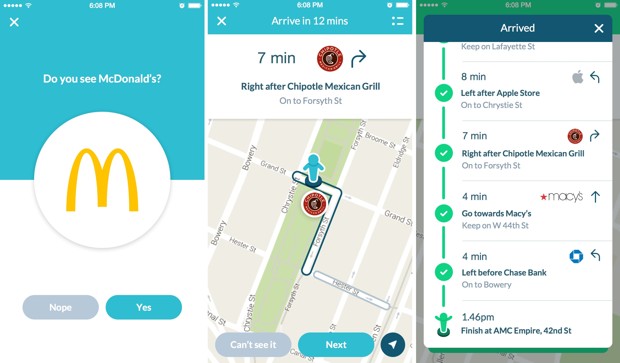
Now, there’s an app that gives you direction just as a real human being would. Called Walc, the app uses a large database to point out nearby landmarks—like a restaurant, park, or a museum—and gives you turn-by-turn directions. If you don’t spot the shop its points out, you can hit the “Can’t See” button and the app will show you another landmark. The app also tells you which streets to turn on to, just as Google Maps does.

Courtesy of Walc

There’s also a “Pocket” mode that will guide you using voice commands. So rather than staring at a screen, use your eyes to seek out the McDonald’s or Starbucks that’s along the path.

The whole mission, says Walc founder and CEO Allison McGuire, is to create a more walkable world. “I discovered that driving directions and technology [were] becoming increasingly sophisticated, but it wasn’t the same case for walkers,” she tells CityLab. Yet when she surveyed hundreds of people about the idea of a walking navigation app, she found that—if given the right tools—people preferred to walk from place to place.

McGuire and her team are working to add even more features in the near future.* She says that the program is constantly learning from users’ behavior. “Walc often measures shortcuts that you take based on the direction,” she says. “So we might tell you to make a right at this block but we see that people are constantly cutting across the park. Why is that?”

Eventually, the app will be able customize the best routes based on user preferences. “So if you like Sephora versus Modell’s Sporting Goods, we would show you a different route,” McGuire says. “What we want to do is give you the quickest visual cue that we possibly can and get you walking in the right direction.”

Top Image: Blackzheep / Shutterstock.com

*CORRECTION: An earlier version of this post incorrectly said the app is still in beta mode. The app is public and available for download.


15 Dec 23:44

A London Tube Map Made Out of 1,563 Chocolates

by Feargus O'Sullivan

The iconic London Tube map has developed a fair bit over the years, and now there’s a version of it that comes entirely in chocolate.

Well, it does on video at least, thanks to the staff at Londonist. As a charming Christmas party trick, the city magazine put together a giant London subway plan, and filmed themselves doing so. Instead of ink, however, they’ve fashioned the lines out of Quality Street, a cheap chocolate assortment (Americans: think Hershey’s Kisses but with more variety) that in the U.K. is heavily associated with Christmas.

As you’ll see from the video, it’s a remarkably accurate version of the map, where the bright-colored wrappers of the 1,563 chocolates they used mostly correspond to the colors of the Tube network. The Overground—often known now as the “Ginger Line” thanks to its color—has been fashioned out of orange creams, while the Metropolitan Line was recreated with appropriately purple-colored hazelnut caramels.

The result is a loving recreation that takes something familiar and manages to make it more appealing. After all, if the Emirates Air Line—the under-used East London cable car across the Thames—were really made out of orange-flavored chocolate, it might actually get a few more visitors. Check out some pictures of the project below (all images courtesy of Londonist).


10 Dec 21:38

Cookie Science: The Real Differences Between Brown and White Sugars

by Bravetart

Sugar. It's an integral ingredient in just about every cookie recipe, but don't make the mistake of thinking its job is simply to make them sweet. Oh no—sugar does way more than that, and understanding its real power is the key to becoming a true cookie master. Read More
10 Dec 21:29

Justice Antonin Scalia Pretty Much Suggested Black Students Should Go to “Slower-Track Schools”

by Jessica Lachenal

chief justice antonin scalia

Today saw the opening arguments of a Supreme Court case over whether the University of Texas’ two acceptance programs are constitutional. As of right now, they employ two programs: the “Top Ten Percent” program, where they accept top 10% of class, regardless of race, and the “holistic” program, which takes things like race and other factors into account.

It was during these arguments that Justice Antonin Scalia voiced what is perhaps the most boneheaded opinion about black students. He specifically said:

There are those who contend that it does not benefit African Americans to get them into the University of Texas where they do not do well, as opposed to having them go to a less-advanced school, a slower-track school where they do well.

One of the briefs pointed out that most of the black scientists in this country don’t come from schools like the University of Texas. They come from lesser schools where they do not feel that they’re being pushed ahead in classes that are too fast for them.

Just look at the language. Phrases like “less-advanced, slower track school,” and “lesser schools” belie the Justice’s opinion. It’s pretty clear that he believes black students are too slow for most colleges. He’s essentially judging all black students as one, as if they were a monolith.

Surely he’s aware that if they were to rule the University of Texas’ program unconstitutional, it would call into question many similar programs, effectively shutting out opportunities for black students.

The last thing Scalia needs is to have his opinion validated. It’s the kind of ridiculous, nonsensical language you expect to hear from your racist uncle at the dinner table, not a Chief Justice of the Supreme Court.

In the past, Scalia has also voiced some pretty awful opinions. According to the New York Times, when discussing the court’s decision to protect gay rights with students from Georgetown University, he said, “The Supreme Court’s decisions protecting gay rights were not rooted in the Constitution, and their logic could as easily apply to child molesters.”

Again: that is some out of touch, racist (now add homophobic) uncle dinner table talk.

To cap off his… uh, comments from today, he said, “I’m just not impressed by the fact the University of Texas may have fewer [blacks]. Maybe it ought to have fewer. I don’t think it stands to reason that it’s a good thing for the University of Texas to admit as many blacks as possible.”

I just… cannot even with this.

(via Mother Jones, image via Flickr/Stephen Masker)

10 Dec 21:28

This Japanese Town Shows How 'Zero Waste' Is Done

by Linda Poon

At the waste collection center in Kamikatsu, Japan, there are separate bins for different types of paper products: Newspapers, magazines, cartons, flyers. Then there are separate ones for cans: Aluminum, spray, steel. There are even individual bins for plastic bottles and caps. But that’s only a handful of the 34 categories that Kamikatsu residents have to sort their trash into, according to a short documentary by Seeker Stories.

It may seem like an overkill, but the small Japanese town, with a population of just over 1,700, is on a mission to become the country’s first ‘zero-waste’ community by 2020. And, they’re almost there. According to the video, Kamikatsu already recycles about 80 percent of its trash, with the last 20 percent going into a landfill. That progress is 12 years in the making. In 2003, Kamikatsu declared its zero-waste ambition after the town gave up the practice of dumping trash into an open fire for fear of endangering both the environment and the population.

There are no garbage trucks, so each resident has to wash, sort, and bring their trash to the recycling center—which residents admit took some time getting used to. A worker oversees the sorting process at the center, making sure trash goes into the right bins. Some used items are taken to businesses to be resold or repurposed into clothing, toys, and accessories.

While Kamikatsu has gotten international attention for its ambitious goal, it isn’t the only town that’s making progress, says Neil Seldman, cofounder and president of Institute for Local Self Reliance. “Berkeley, California, which is several hundred thousand people, is close to 80 percent; San Francisco reports 70 percent; and there are several cities in the U.S. that are over 70 percent,” he tells CityLab. “In Italy, they do it similarly to [Kamikatsu] where they have many different separations and drop off.” For the most part, he adds, the efforts are led by grassroot organizations.


Related Story

You're Probably Recycling Wrong

An expert explains how to do it smarter, and why some materials muck up the sorting process.


The U.S. only has about a 34 percent recycling rate, according to the latest estimates from the Environmental Protection agencies. Washington, D.C., where CityLab is based, only has about a 16 percent rate. Seldman blames that low rate largely on the fact that 60 percent of the waste market is controlled by two companies—Allied and Waste Management, Inc.—which profit from landfills.

The other thing he blames it on: politics. “You've got the Republicans who don't think the oceans are rising, and they don't care,” he says. “And with the exception of Bernie Sanders, the other two Democratic [presidential] candidates are stats quo candidates.”

Japan, on the other hand, has buckled down on recycling. Businesses are required by law to recycle, and the country’s sorting systems are among the most extensive in the world. In Japan’s second-largest city of Yokohama, with a population of 3.7 million, citizens are given a 27-page manual on how to sort more than 500 different items.

“If you get used to it, it becomes normal,” a Kamikatsu resident says in the video. “Now I don’t think about it. It’s become natural to separate the trash correctly.”


10 Dec 21:23

Are you having a bad day?

by Matthew Inman
Are you having a bad day?

Where the heck is Matt?

View
08 Dec 13:52

Plant life cycle shows a breathing Earth

by Nathan Yau

NASA mapped the annual cycle of all plant life on the planet in this animated map.

Satellite instruments reveal the yearly cycle of plant life on the land and in the water. On land, the images represent the density of plant growth, while in the oceans they show the chlorophyll concentration from tiny, plant-like organisms called phytoplankton. From December to February, during the northern hemisphere winter, plant life in the higher latitudes is minimal and receives little sunlight.

See also John Nelson's breathing earth that used satellite imagery.

Tags: environment, NASA

08 Dec 13:47

Photo


07 Dec 22:02

Spain Wants to End TV Dubbing to Improve English Proficiency

by Feargus O'Sullivan
Image Screenshot via YouTube
Jennifer Lawrence appears on the Spanish show "El Hormiguero" in late November to promote her latest movie. (Screenshot via YouTube)

If Spanish politicians have their way, Jennifer Lawrence might one day no longer speak the language.

In a sense, at least. Last week, the actress was all over the Spanish-language press after commenting on the Conan O’Brien show how bizarrely different her characters sounded when dubbed for the Spanish market. Now the dubbing industry itself is under attack from Spain’s Popular Party, which wants to banish dubbed programs from Spanish television schedules and replace them with subtitled content instead. The idea, launched by Spain’s ruling Popular Party as part of its new education plan, is intended to get the nation’s English up to scratch.


Taken as a whole, Spain’s English is at present reasonably good but not excellent. The 2015 EF English Proficiency Index gives Spanish adults a moderate proficiency rating of 56.8 out of 100, which isn’t terrible but places the country far behind fellow EU members such as Sweden and Poland. If Spanish viewers hear more foreign languages in their original form as part of their daily cultural diet, Spain’s education minister reasons, this level of proficiency can only rise. Indeed, subtitles could actually help people further, by allowing them to compare foreign language words with Spanish equivalents.

The long-standing popularity of dubbing has partly historical roots in Spain, where under Franco’s dictatorship all languages other than Castillian were banned. This move was aimed primarily at quashing such languages as Catalan and Basque, but nonetheless meant foreign language films usually needed dubbed dialogue to pass the censors.

Spanish dubbers of Orange Is the New Black had to be quite creative in finding equivalents to U.S. prison slang.

The phenomenon is by no means confined to Spain, however. Europe as a whole is divided between dubbers and subtitlers. The Netherlands, Scandinavia, Portugal, and the Balkans subtitle everything meant for adults, while France, Italy, Spain and the German-speaking countries still tend to dub. This divide can even run across countries; French-speaking Belgians typically listen to dialogue in their own language, while Belgian Dutch-speakers read off subtitles.

The divide arguably has more to do with economics than education. Many nations in the subtitle-loving group have high levels of English comprehension, but their choice to stick with the original language seems to be mainly based on costs. The countries in this group are simply much smaller. Spreading the expense of hiring and recording actors is easy enough for Europe’s 95 million strong German-language market, but less so among, say, five million Norwegians.

Other countries, notably Poland and Russia, use voiceovers as a cheaper alternative. In a method now increasingly being replaced by conventional dubbing, these countries often have a couple of actors reading all the lines, over an original soundtrack that remains still audible beneath. This is cheap but intrusive; it feels strangely as if the speaking actors are peeping toms hiding in a cupboard somewhere on set.

Done carefully, however, proper dubbing can be a real, intricate art. Spanish dubbers of Orange Is the New Black, for example, had to be quite creative in finding equivalents to U.S. prison slang. As script advisor Beatriz Garcia Mayor team told Spain’s Hoy Cinema magazine (the “weapon” in question below is presumably a shiv):

“It’s one thing to know the characters, but what Castillian word would you use to describe the liquor the prisoners make, or the weapons they create?”

Issues like this are less important for subtitles. Designed to be read at speed, they habitually strip dialogue down to its barest form, keeping things lucid but leaving nuances un-translated.

Rising English proficiency is now making original version content more popular across Europe, where subtitled films are starting a long slow march out of the art houses and into the multiplexes. Many English-speaking people illegally stream or download American films and TV to watch—with or without subtitles—rather than wait for the version in their own language. (Hard figures in this area are understandably lacking.)

This is probably no bad thing, suggesting as it does a steady creep of better English skills. It does nonetheless seem a very small pity that, one day, people may no longer be able to watch Hollywood actors wisecracking in fluent Czech.


05 Dec 00:42

Why Even Experts Fall for Art Forgery

by Jacoba Urist

The average person might be fooled by a fake Monet made of acrylic paint and mixed with K-Y Jelly, but wouldn’t an art aficionado know better? And yet the infamous British artist John Myatt was able to sell more than 200 forgeries of famous 19th- and 20th-century painters between...More »

05 Dec 00:38

What Do You See When You Look at This Reese's Holiday Candy? — Food News

by Ariel Knutson
Matthew

"Reese's responded with an #AllTreesAreBeautiful hashtag to encourage acceptance of the candies."

It seems like Reese's Peanut Butter Cups come out with a new chocolate-peanut butter treat for every holiday. We know (and love) the pumpkins, and now we're heading into the tree-themed candies. The only problem is that these new candies don't exactly look like trees. What do you see when you look at these blobs of candy?

READ MORE »

05 Dec 00:33

Furious, Dive-Bombing Squirrels Injured 8 in the Bay Area

by John Metcalfe
Image Woody Pope/Shutterstock.com
Woody Pope/Shutterstock.com

Picture strolling down the sidewalk when something hits your back like a hairy softball and starts furiously gnawing your flesh. That unsettling experience could be yours if you visit Novato, California, where eight people have been mauled by squirrels (or perhaps “squirrel”) in the past two-and-a-half weeks.

The Marin County government and Marin Humane Society are warning residents to be on the lookout for angry squirrels in Novato, a city about 25 miles north of San Francisco. “The attacks have sent several people to the hospital. Squirrel teeth are sharp!” emails Lisa Bloch, a humane-society spokeswoman.

This week, her organization put out a media alert full of astonishing rodent-rampage reports. It reads, in part:

The attacks are described as a squirrel suddenly running up to the victims, crawling up their bodies, and biting them in various areas (hands, legs, arms, head). There have also been reported instances in which squirrels have jumped out of trees and attacked the victims. …

While officials cannot say with certainty whether the attacks are all from the same squirrel, it is the most likely scenario. Officials suspect the squirrel was hand-raised and therefore lost its natural fear of humans. Residents should never feed wildlife. Intentional feeding or knowingly providing food to wild animals in Marin County is prohibited.

The attacks have all taken place in the vicinity of Sutro Avenue and Vineyard Road, which looks like a fine place for squirrels to mount ambushes:

Google Maps

The humane society says that rabies in squirrels is rare, but people who got bit are nevertheless receiving anti-rabies drugs “as a precaution.”

Top image: Woody Pope/Shutterstock.com. H/t SFGate