Shared posts

08 Mar 01:37

Pope Francis Says Catholic Church Could Support Same-Sex Civil Unions

by Paul Constant


CNN says:

Pope Francis reaffirmed the Catholic Church's opposition to gay marriage on Wednesday, but suggested in a newspaper interview that it could support some types of civil unions.

The Pope reiterated the church's longstanding teaching that "marriage is between a man and a woman." However, he said, "We have to look at different cases and evaluate them in their variety."

Am I being overly hopeful, or is this huge news? In the past, civil unions have seemed to represent the first tentative step toward acceptance for gay marriage opponents. Catholic bishops have supported civil unions, but this marks the first time a Pope has ever expressed support for the idea. Civil unions are separate-but-equal bullshit, but for the Catholic Church, this seems like a big step in the right direction if Francis actually holds true to his word.

[ Subscribe to the comments on this story ]

08 Mar 01:32

Mozilla Is Investigating Why Dell Is Charging To Install Firefox

by samzenpus
An anonymous reader writes "Dell is charging customers £16.25 ($27.18) to install Firefox on a newly purchased computer. We contacted Mozilla to find out more. The company told us it is investigating the issue and denied it has any such a deal in place. 'There is no agreement between Dell and Mozilla which allows Dell or anyone else to charge for installing Firefox using that brand name,' Mozilla's Vice President and General Counsel Denelle Dixon-Thayer told TNW. 'Our trademark policy makes clear that this is not permitted and we are investigating this specific report.' Dell has responded by saying that this practice is okay because the company is charging for the service and not the product."

Share on Google+

Read more of this story at Slashdot.


07 Mar 17:06

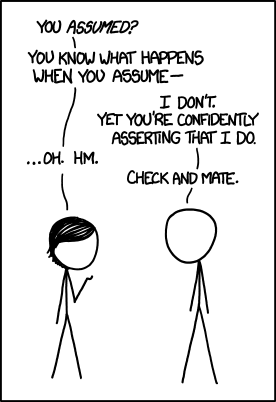
When You Assume

You know what happens when you assert--you make an ass out of the emergency response team.
06 Mar 20:09

Keurig Insists Coffee DRM Brings 'Interactive-Enabled Benefits' And Is For Your Own Safety

by Karl Bode
As we recently discussed, Keurig is busy making plans to embed new technology in their new "Keurig 2.0" line of coffee makers that will reject unsanctioned (read: less expensive, competing) coffee pods. The technology would also presumably prevent the use of manual re-usable filters, which are usually found for between five and fifteen bucks online. Keurig's CEO announced the plans to reject "unlicensed pods" last fall, but somehow nobody seemed to really notice the effort until an annoyed competitor pointed it out in a lawsuit (pdf).

Needless to say, Keurig users and the general public weren't particularly enamored of Keurig's plans to lock down their brewing options, with countless users taking to Twitter to complain. The company didn't seem prepared to handle the media reaction to their plans for java-based "DRM." Nor did they seem prepared to give anybody a straight answer, even though their own CEO already confirmed the pod-blocking functionality. As such, Keurig simply started insisting to anyone that asked that the new technology delivered "interactive-enabled benefits":As you might be able to tell, it appears the company is unwilling to directly acknowledge the fact that they're locking out competitors' less expensive pods. More creative attempts to get Keurig to explain these advanced interactive benefits also proved fruitless:After a few days and clearly a few meetings, Keurig released a public statement that attempted to flesh out their non-answer. While still refusing to admit something their own CEO already acknowledged, Keurig decided to push the mystery added benefits angle a little harder, even going so far as to claim that blocking you from getting cheaper competing product is about your safety:
"To make brewing a carafe possible, and to continue to deliver everything Keurig lovers already enjoy – high-quality beverages, simplicity, and variety – our new Keurig 2.0 system will feature specially designed interactive technology allowing the brewer to read information about the inserted Keurig pack. With this interactive capability, Keurig 2.0 brewers will “know” the optimal settings for the inserted Keurig pack, for a perfect beverage every time, whether a single cup or a carafe. It’s critical for performance and safety reasons that our new system includes this technology. For those of you who currently own our K-Cup or Vue systems today, we are so happy to have you as part of our family. Rest assured that your brewers will still function as they always have and that your favorite beverages will still be available."
In other words, we must be able to lock competitors' pods (and manual refill units) out of the market to keep you safe from the dangers of potentially lower costs and dreaded coffee-related injury. It's also impossible for us to embed this obnoxious technology in older units, so those will continue to function as you prefer them to -- without us interfering in your purchase options. Sure, you're losing purchase options and will have to pay more for coffee, but isn't the security of knowing your family is safe from the dangers of coffee-related hazards worth it?

Permalink | Comments | Email This Story


05 Mar 02:41

Nintendo Kills Online Functionality For Wii, DS Titles, Highlighting Need For Greater User Control Over Content They Supposedly Own

by Karl Bode
Whether it's music or games, we've seen countless examples of how the content you think you own can either be taken away from you entirely -- or can suddenly be greatly limited, often with little to no warning. The latest example of that is courtesy of Nintendo, which is informing users that the online components of a long list of titles for the Nintendo Wii, DS and DSi will no longer work after May 20 of this year. From Mario Kart Wii to Animal Crossing: Wild World, many of these titles will suddenly find themselves with a gaping hole where core gameplay mechanics used to be. Nintendo is telling these users that they appreciate user support of legacy systems, even if Nintendo won't support them themselves:
"We at Nintendo sincerely thank our fans for their continued support of our company’s legacy systems. Your enthusiasm for games made for these systems speaks to their longevity, and the passion of Nintendo fans."
Except if you really cared about fan enthusiasm for legacy titles, why not empower them to hack together solutions to help keep at least some core multiplayer functions in place? Because that would keep them from buying your latest hardware, even if they're perfectly happy playing older games. People have a right to worry that this phenomenon is accelerating as the newer generation of consoles become more tied to the Internet and the cloud than ever before:
"Nintendo's decision to stop running Wii and DS servers feels like the leading edge of a big expansion of this problem, though, as the first full console generation with tightly integrated online play starts to get phased out. I give the Xbox 360 and PS3 two or three more years at most before Sony and Microsoft decide it's not worth supporting servers for the aging hardware anymore. Looking ahead even further, there will probably come a day when Titanfall is no longer playable on the Xbox One because Microsoft thinks it's no longer worthwhile to support it (in that case, the game won't even have a single-player mode to fall back on)."
PC users for years have hammered together online solutions for this problem (albeit not always glamorously), and it doesn't seem like it would be a particularly taxing thing for Microsoft, Sony and Nintendo to throw a little support in the general direction of core fans, making them more likely to buy your products in the future. The alternative is a path where titles keep going up in price, while the shelf-life on their full functionality continues to decrease. Now you'll excuse me if I take one last, teary-eyed lap around Moo Moo Meadows in Mario Kart Wii -- alone.

Permalink | Comments | Email This Story


05 Mar 02:40

Australian Man Banned From Filing Lawsuits After Filing 50 In 10 Years

by Tim Cushing

How many lawsuits can a person pursue before the legal system decides to cut them off? In Australia, 50 lawsuits gets you eighty-sixed, as one Sydney man found out. (well, I'd say the "hard way," but he genuinely seemed to enjoy availing himself of this particular service.)

[A]fter 50 cases in just 10 years, a science teacher has been banned from taking anyone else to court after Justice Michael Adams ruled he was a vexatious litigant who has used the judicial system to "harass, annoy or achieve another wrongful purpose".

Mr Rahman, a Bangladeshi immigrant, is the 12th person to be put on the State's vexatious litigant register, meaning he cannot start legal proceedings without first seeking the courts' consent.
Rahman isn't completely forbidden from filing lawsuits. He just has to get permission first, something that will likely be very difficult considering his misuse of the court system over the last decade, misuse that includes filing lawsuits to re-litigate already determined decisions. He also sued his own legal team, resulting in him paying them even more than he previously owed.
You'd think Rahman would quit while he's behind (he's in danger of losing his two homes and has spent over a half-million dollars fighting his legal battles), but he's not giving up yet.

A defiant Mr Rahman said: "This is a crime against humanity, I will take them to the International Criminal Court if I have to."
Techdirt reader Jess sent this story in with a note inquiring about Techdirt's take on this -- whether it was a good/bad idea or simply amusing. Here's mine.

My first thought was about patent trolls, some of the most "vexatious" of litigants. However, patent trolls really don't want to end up in court. Most are only in court (and only in East Texas) because their settlement letters failed to result in free money. While some trolls would hit this 50-lawsuit limit quickly, a vast majority wouldn't.

Copyright trolls, on the other hand, are more and more frequently being viewed as "vexatious" by judges handling their mass lawsuits. Again, these trolls only end up in court when the settlement letters fail. Also, they've mostly been allowed to "bundle" their defendants, which makes it even harder for these litigants to hit the 50-suit cutoff. If they were forced to file separately for each Doe, these lawsuits would likely vanish. There's simply not enough of a payoff suing one-to-one.

But, despite all of the above, I can't really see a hard limit on lawsuits being an effective deterrent. Here in the US, this sort of thing would run afoul of protected civil liberties. The system itself can usually work this sort of thing out. Vexatious litigants tend not to stay unknown for very long.

The underlying problem is those stuck at the other end of vexatious lawsuits. Even the most meritless lawsuit costs real money to defend against. Completely uninvolved taxpayers also foot the bill for vexatious legal activity. So, it can be a real problem, but one that an arbitrary cutoff is unlikely to fix without doing corresponding damage to non-vexatious litigants who find themselves tangled in the legal system more frequently than they'd prefer.

And as for the patent/copyright trolls, chances are they'd just create more shell companies to route around any filing limits (although this scheme may be on its way to extinction), which makes this even more likely to just end up hurting non-trolls and non-vexatious litigants. There's no easy fix but the solution probably lies somewhere between the self-regulation performed by judges (who will have a grasp on which litigants are "vexatious") and legislation targeting the activities of professional "vexations litigants." The common man who sues too much falls between these cracks, but it's better to bear the occasional burden than to risk locking those with legitimate lawsuits out of the process.

Permalink | Comments | Email This Story


04 Mar 12:47

Choosing Secure Passwords

by schneier

As insecure as passwords generally are, they're not going away anytime soon. Every year you have more and more passwords to deal with, and every year they get easier and easier to break. You need a strategy.

The best way to explain how to choose a good password is to explain how they're broken. The general attack model is what's known as an offline password-guessing attack. In this scenario, the attacker gets a file of encrypted passwords from somewhere people want to authenticate to. His goal is to turn that encrypted file into unencrypted passwords he can use to authenticate himself. He does this by guessing passwords, and then seeing if they're correct. He can try guesses as fast as his computer will process them -- and he can parallelize the attack -- and gets immediate confirmation if he guesses correctly. Yes, there are ways to foil this attack, and that's why we can still have four-digit PINs on ATM cards, but it's the correct model for breaking passwords.

There are commercial programs that do password cracking, sold primarily to police departments. There are also hacker tools that do the same thing. And they're really good.

The efficiency of password cracking depends on two largely independent things: power and efficiency.

Power is simply computing power. As computers have become faster, they're able to test more passwords per second; one program advertises eight million per second. These crackers might run for days, on many machines simultaneously. For a high-profile police case, they might run for months.

Efficiency is the ability to guess passwords cleverly. It doesn't make sense to run through every eight-letter combination from "aaaaaaaa" to "zzzzzzzz" in order. That's 200 billion possible passwords, most of them very unlikely. Password crackers try the most common passwords first.

A typical password consists of a root plus an appendage. The root isn't necessarily a dictionary word, but it's usually something pronounceable. An appendage is either a suffix (90% of the time) or a prefix (10% of the time). One cracking program I saw started with a dictionary of about 1,000 common passwords, things like "letmein," "temp," "123456," and so on. Then it tested them each with about 100 common suffix appendages: "1," "4u," "69," "abc," "!," and so on. It recovered about a quarter of all passwords with just these 100,000 combinations.

Crackers use different dictionaries: English words, names, foreign words, phonetic patterns and so on for roots; two digits, dates, single symbols and so on for appendages. They run the dictionaries with various capitalizations and common substitutions: "$" for "s", "@" for "a," "1" for "l" and so on. This guessing strategy quickly breaks about two-thirds of all passwords.

Modern password crackers combine different words from their dictionaries:

What was remarkable about all three cracking sessions were the types of plains that got revealed. They included passcodes such as "k1araj0hns0n," "Sh1a-labe0uf," "Apr!l221973," "Qbesancon321," "DG091101%," "@Yourmom69," "ilovetofunot," "windermere2313," "tmdmmj17," and "BandGeek2014." Also included in the list: "all of the lights" (yes, spaces are allowed on many sites), "i hate hackers," "allineedislove," "ilovemySister31," "iloveyousomuch," "Philippians4:13," "Philippians4:6-7," and "qeadzcwrsfxv1331." "gonefishing1125" was another password Steube saw appear on his computer screen. Seconds after it was cracked, he noted, "You won't ever find it using brute force."

This is why the oft-cited XKCD scheme for generating passwords -- string together individual words like "correcthorsebatterystaple" -- is no longer good advice. The password crackers are on to this trick.

The attacker will feed any personal information he has access to about the password creator into the password crackers. A good password cracker will test names and addresses from the address book, meaningful dates, and any other personal information it has. Postal codes are common appendages. If it can, the guesser will index the target hard drive and create a dictionary that includes every printable string, including deleted files. If you ever saved an e-mail with your password, or kept it in an obscure file somewhere, or if your program ever stored it in memory, this process will grab it. And it will speed the process of recovering your password.

Last year, Ars Technica gave three experts a 16,000-entry encrypted password file, and asked them to break as many as possible. The winner got 90% of them, the loser 62% -- in a few hours. It's the same sort of thing we saw in 2012, 2007, and earlier. If there's any new news, it's that this kind of thing is getting easier faster than people think.

Pretty much anything that can be remembered can be cracked.

There's still one scheme that works. Back in 2008, I described the "Schneier scheme":

So if you want your password to be hard to guess, you should choose something that this process will miss. My advice is to take a sentence and turn it into a password. Something like "This little piggy went to market" might become "tlpWENT2m". That nine-character password won't be in anyone's dictionary. Of course, don't use this one, because I've written about it. Choose your own sentence -- something personal.

Here are some examples:

  • WIw7,mstmsritt... = When I was seven, my sister threw my stuffed rabbit in the toilet.

  • Wow...doestcst = Wow, does that couch smell terrible.

  • Ltime@go-inag~faaa! = Long time ago in a galaxy not far away at all.

  • uTVM,TPw55:utvm,tpwstillsecure = Until this very moment, these passwords were still secure.

You get the idea. Combine a personally memorable sentence with some personally memorable tricks to modify that sentence into a password to create a lengthy password. Of course, the site has to accept all of those non-alpha-numeric characters and an arbitrarily long password. Otherwise, it's much harder.

Even better is to use random unmemorable alphanumeric passwords (with symbols, if the site will allow them), and a password manager like Password Safe to create and store them. Password Safe includes a random password generation function. Tell it how many characters you want -- twelve is my default -- and it'll give you passwords like y.)v_|.7)7Bl, B3h4_[%}kgv), and QG6,FN4nFAm_. The program supports cut and paste, so you're not actually typing those characters very much. I'm recommending Password Safe for Windows because I wrote the first version, know the person currently in charge of the code, and trust its security. There are ports of Password Safe to other OSs, but I had nothing to do with those. There are also other password managers out there, if you want to shop around.

There's more to passwords than simply choosing a good one:

  1. Never reuse a password you care about. Even if you choose a secure password, the site it's for could leak it because of its own incompetence. You don't want someone who gets your password for one application or site to be able to use it for another.
  2. Don't bother updating your password regularly. Sites that require 90-day -- or whatever -- password upgrades do more harm than good. Unless you think your password might be compromised, don't change it.
  3. Beware the "secret question." You don't want a backup system for when you forget your password to be easier to break than your password. Really, it's smart to use a password manager. Or to write your passwords down on a piece of paper and secure that piece of paper.
  4. One more piece of advice: if a site offers two-factor authentication, seriously consider using it. It's almost certainly a security improvement.

This essay previously appeared on BoingBoing.

03 Mar 15:04

Keurig Will Use DRM In New Coffee Maker To Lock Out Refill Market

by Karl Bode
The single coffee cup craze has been rolling now for several years in both the United States and Canada, with Keurig, Tassimo, and Nespresso all battling it out to lock down the market. In order to protect their dominant market share, Keurig makers Green Mountain Coffee Roasters has been on a bit of an aggressive tear of late. As with computer printers, getting the device in the home is simply a gateway to where the real money is: refills. But Keurig has faced the "problem" in recent years of third-party pod refills that often retail for 5-25% less than what Keurig charges. As people look to cut costs, there has also been a growing market for reusable pods that generally run anywhere from five to fifteen dollars.

Keurig's solution to this problem? In a lawsuit (pdf) filed against Keurig by TreeHouse Foods, they claim Keurig has been busy striking exclusionary agreements with suppliers and distributors to lock competing products out of the market. What's more, TreeHouse points out that Keurig is now developing a new version of their coffee maker that will incorporate the java-bean equivalent of DRM -- so that only Keurig's own coffee pods can be used in it:
"Green Mountain has announced a new anticompetitive plan to maintain its monopoly by redesigning its brewers to lock out competitors’ products. Such lock-out technology cannot be justified based on any purported consumer benefit, and Green Mountain itself has admitted that the lock-out technology is not essential for the new brewers’ function. Like its exclusionary agreements, this lock-out technology is intended to serve anticompetitive and unlawful ends."
The plan was confirmed by Keurig's CEO who stated on a recent earnings call that the new maker indeed won't work with "unlicensed" pods as part of an effort to deliver "game-changing performance." "Keurig 2.0" is expected to launch this fall. French Press and pour-over manufacturers like Chemex have plenty of time to get their thank you notes to Keurig in the mail ahead of time as users are hopefully nudged toward the realization they could be drinking much better coffee anyway.

Permalink | Comments | Email This Story


01 Mar 15:24

March 01, 2014


01 Mar 07:28

February 28, 2014


Oh my GOD February is over.
01 Mar 07:22

Dash-Cam Revelations In NJ Show Again The Importance Of Video As Evidence In Police Abuse

by Timothy Geigner

Several weeks ago, Tim Cushing wrote about a case in New Jersey featuring an officer accused of abusing a cyclist who failed to engage his dash-cam during the incident. As noted in the piece, the value of having optional tape of any incident occurring between an officer and the public should be obvious. On the one hand, the public is already under a great deal of public surveillance, which can often times be used as evidence in any criminal proceedings. Tape featuring law enforcement action is valuable both ways, first in holding our public servants to account should they fail to behave appropriately and second to exonerate them if they are accused of wrong-doing.

In this latest story, also in New Jersey, we see an example of the former. Marcus Jeter was met by police at the home he shares with his girlfriend after a domestic violence call made to police. Once there, police reportedly spoke to Jeter, who says he left amicably after briefly talking to officers. It's worth noting that no charges were ever filed for that domestic incident. What happened next, however, is another matter entirely. Jeter was pulled over by officers shortly after leaving the site of his home.

The New Jersey DJ, 30, was arrested in a 2012 traffic stop and charged with eluding police, resisting arrest and assault. Prosecutors insisted that Jeter do prison time.
The plea deal offered to Jeter was five years of prison time, for resisting arrest and assaulting police officers. Those were the charges levied in the officers' report. Those charges, as would later be determined by an active police dash-cam, were utter bullshit.
The video, which prosecutors say they never saw before filing the initial charges, shows Jeter holding his hands above his head.

"The next thing I know, one of them busts the [car] door and there is glass all over my face," he told ABC News station WABC-TV about the arrest. "As soon as they opened the door, one officer reached in and punched me in my face. As he's trying to take off my seat belt, I'm thinking, 'Something is going to go wrong.'" Jeter says the cops continued hitting him, telling him not to resist arrest.
Oops. As it turns out, there wasn't any resisting of arrest and the only assault occurring was when the officers beat the hell out of Jeter. On top of that, the officers in question elected to omit surely-unimportant details of the arrest from their reports, such as when one of them careened over a median into Jeter's vehicle, which was also shown in the dash-cam footage. On top of that, police had their weapons drawn almost immediately, despite the fact that Jeter had pulled over to the shoulder as requested and remained in his vehicle, terrified.

Thanks to Jeter's attorney filing a request for records, which included the footage, the charges against Jeter were dropped and charges were instead filed against the officers. Those charges include aggravated assault, conspiracy, and official misconduct.

Now, we can and should respect law enforcement, but that respect doesn't come without the public's right to verify our public officials are behaving honestly and judiciously. Let there be no argument: the public has a right to the footage of officers in action.

Permalink | Comments | Email This Story


25 Feb 15:35

February 25, 2014

22 Feb 22:07

February 21, 2014


GaymerX2 is kickstarterizing!


This is the first time I've ever shared billing with a pro wrestler.
17 Feb 20:12

Frequency

Frequency Frequency Frequency Frequency Frequency
17 Feb 20:11

02/16/2014

by billamend

02/16/2014

15 Feb 03:31

Make a DIY Heart-Shaped Cookie Cutter

by Faith Durand
Pin_it_button

Have a last-minute hankering for something heart-shaped this Valentine's Day? Even if you don't have the right kind of cookie cutter, heart-shaped treats can be yours with this smart tip from Heidi at Food Doodle.

READ MORE »

14 Feb 05:46

Man Bravely Saves His Xbox From Burning House

by Timothy Geigner

Look, for all you critics out there, I admit it: I love video games. They're my primary source of entertainment, since I long ago discarded regular television viewing, most music, and most movies. My entertainment quota is filled by literature and video games. But even my love for video games pales in comparison to this smitten hero from Kansas, who bravely walked out of his burning home with his most prized possession in tow: his Xbox.

“Hold onto what matters most” are words of wisdom that most people strive to live by, perhaps none more so than an Olathe, Kansas man who on Friday morning risked a fiery death by charging into his burning house to save a beloved Xbox. (The exact model is unknown.) Thankfully, both console and human survived, the latter suffering from smoke inhalation.
I carry your controller with me, I carry it in my heart. I am never without it, anywhere I go you go, my dear console, and whatever is done by only me is your doing, my console. I fear no fate, for your games are my fate, and I want no world, for my Xbox is my true world, and it's you, whatever Grand Theft Auto has always meant, and whatever a Mortal Kombat will always sing is you.

Or, you know, something like that...is what I imagine this guy wrote to his inanimate gaming console. Whatever, my point is this: you can love your console, love your games, and love the experience of playing them. But there must be something else in the place you call home that you'd rather save than the saves on your Xbox. Especially if there's even the slightest chance that same Xbox is the one trying to kill you with the fire of Doom-driven hell-demons.
In a strange twist, the disaster was blamed on an electrical junction box, which makes us wonder if the Xbox wasn’t partly to blame. Was it a suicidal act, or simple betrayal? Difficult to say, as is the matter of where exactly he plans to plug the device in now.
In the afterlife, dear reader, if fate has bothered to read its Shakespeare, I fear this gentleman will meet no Juliet more fair then the electronic daughter of Bill Gates.


Permalink | Comments | Email This Story


13 Feb 18:30

February 13, 2014


Stacy Farina had the best graph at BAHFest 2013!


Don't forget to watch the question session afterward!
13 Feb 04:16

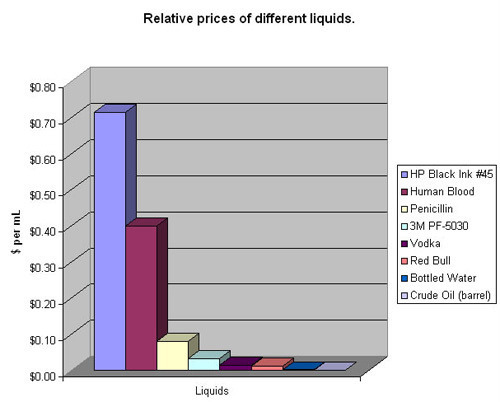
Capitalism is weird


Capitalism is weird

10 Feb 14:33

Update

I have a bunch of things open right now.
10 Feb 14:33

February 09, 2014


Sorry for the late update.
10 Feb 14:32

02/09/2014

by billamend

02/09/2014

08 Feb 07:10

Mobile Marketing

We're firing you, but the online headline-writing division wants to hire you.
08 Feb 05:29

Weird true facts that sound false

by Cory Doctorow

A great and endlessly entertaining Reddit thread asks for weird facts that sound made up, but aren't, like "The Ottoman Empire still existed the last time the Cubs won the World Series" and "When you get a kidney transplant, they usually just leave your original kidneys in your body and put the 3rd kidney in your pelvis." And:

The United States in World War 2 created a bomb that used bats. The bats would be carrying small incendiary charges and would be released from the bomb in mid air, causing them to fly and scatter to different buildings in the area. The charges would then detonate and set all the buildings on fire. It was tested and proven to be very effective.

Russia is bigger than Pluto. (Surface area of Pluto: 16.7x10^6 km^2; Surface area of Russia: 17.1x10^6 km^2)

If you melted down the Eiffel Tower, the pool of iron would be less than 3 inches deep (in a square area the same dimensions as the tower base).

John Tyler, who became president in 1841, has 2 living grandchildren.

Mammoths were alive when the Great Pyramid was being built.

If an atom was the size of our solar system, a neutrino would be the size of a golfball, to scale.

Humans share 50% of their DNA with... bananas.

What's the most bullshit-sounding-but-true fact you know? : AskReddit (via Kottke)


06 Feb 18:28

A Simple Game That Can Teach You About Design

by Steve Marinconz

A Simple Game That Can Teach You About Design

I never really understood complimentary colors, which makes sense, because I did horribly on that section of Color. It's an incredibly simple game that will drive you mad trying to get a perfect score.

Read more...

30 Jan 14:42

Official: Lenovo buys Motorola from Google for $2.91 billion

by Chris Chavez

Motorola a Lenovo Company

According to sources from Reuters and China Daily, Google is preparing to sell off Motorola’s phone business to none other than Lenovo. A deal that is reported to be worth $3 billion, this would give Lenovo a much better chance at breaking into the lucrative mobile market in the US, an area Lenovo simply can’t compete.

If it sounds like Lenovo could be getting themselves a deal, it’s because they are. Feels like it was only yesterday Google bought Motorola for $12.5 billion and even though it appears they’ve done a good job at turning things around for the struggling manufacturer, business is business.

Google Lenovo shake

UPDATE: Annnnnnnd… it’s official. Motorola CEO Dennis Woodside revealed the news via the company blog, saying with Lenovo now at the helm, Motorola will now be in a better position to attack the global smartphone market. As for Google, they were able to keep the vast majority of patents they acquired from Motorola, with Lenovo also receiving a good 2,000 patents in addition to the Motorola brand and trademarks for a cool $2.91 billion. Everyone wins?

[The Verge]

30 Jan 14:40

Crowdsourcing A List Of How Disney Uses The Public Domain

by Mike Masnick
We've written plenty of times about the importance of the public domain around here, and one of the biggest beneficiaries of the public domain has been Disney, a company which has regularly mined the public domain for the stories it then recreates and copyrights. Of course, somewhat depressingly, Disney also has been one of the most extreme players in keeping anything new out of the public domain, as pointed out by Tom Bell's excellent "mickey mouse curve" showing how Disney has sought to push out the term of copyrights every time Mickey Mouse gets near the public domain. All this despite the fact that Mickey Mouse was almost certainly was an infringing work when it was created, copying multiple sources that were still covered by copyright. Oh, and also there's evidence that Disney screwed up its early copyright registrations on Mickey Mouse, suggesting that it really already is in the public domain, even if Disney will never admit that.

Either way, as we get closer to the next attempt to extend copyright terms in the US (and you know it's coming), Derek Khanna has decided to crowdsource a list of all of the public domain works that Disney has relied on over the years. He's also looking for revenue figures on all of those works, in an attempt to show just how much Disney has profited off of the public domain (and hopefully to shut up those who argue that when a work falls into the public domain, it suddenly loses its value). As Khanna notes:
While Disney took and reused from the public domain, none of the works created by Disney, including derivative works based upon public domain works, have entered the public domain for others to build upon. And if current policy is extended — they never will.

MPAA/RIAA/Disney lobby Congress and inform the public that copyright should last forever because it’s their “property” and that it’s never ok to use or build upon their property without paying. Under the content industry’s vernacular, if taking and remixing other people’s work without paying for it is always stealing then the Disney Corporation is responsible for one of the greatest thefts in world history.


If you can, please help and contribute to the list of public domain works that Disney has relied upon.

Permalink | Comments | Email This Story


30 Jan 14:39

About 69 percent of U.S.-sold olive oil adulterated

by Rob Beschizza
The New York Times published a fantastic slideshow detailing how the product is, more or less, bullshit. A splendidly revealing tl;dr: Italy is the world's largest importer of olive oil.


29 Jan 13:47

The Easiest, Cheapest Way To Make a Pour Spout For a Mason Jar

by Cambria Bold
Pin_it_button

You know that small metal spout on the top of a box of Morton Salt? After you read today's tip, you may never look at it the same way again. Why? Because that salt spout is about to become something infinitely more clever...

READ MORE »

29 Jan 13:45

Ordinary Food Makes For Beautiful Additions to Creative Sketches

by Ariel Knutson
Pin_it_button

How many times have you looked at some random food item, like popcorn, and seen a face or some familiar image in the kernel? Artist Victor Nunes has taken these small, daily findings and fleshed them out with beautiful drawings.

READ MORE »