Shared posts

09 Jan 15:45

"The Brain That Wouldn't Die" and more newly uploaded B-movies at archive.org

by Mark Frauenfelder

Among the 3,842 free feature length films at Archive.org are these newly uploaded B-movies:

Forced Landing (1941): "The action takes place in a Pacific island country, where everyone speaks English, with an assortment of accents. One of the main characters, played by J Carrol Nash, has the appearance of a Mexican bandit, with a Chico Marx speaking style."


The Brain That Wouldn't Die (1962): "After being decapitated in a car crash, 'Jan in the Pan' needs a new body, and deranged surgeon/fiancee Herb Evers begins stalking strippers with the hope of performing a full-body transplant and eventually getting the best of both worlds. Naturally, things do not go quite as planned."

The Wild And Wicked (AKA Flesh Merchant) (1956): "In this 1950s exploito film, sweet young thing Joy Reynolds visits 'fashion model' sister Lisa Rack in Hollywood, but soon joins her sister in the sordid worlds of nude modeling and prostitution."

Sunset Murder Case (1938): "Sally Rand stars as a nightclub performer whose police detective father is murdered. She determines to use her wiles to identify the killer, and see him brought to justice."

The King Murder (1932): "Fairly closely based on the real-life murder of New York showgirl Dorothy 'Dot' King in March 1923. Like the character of Miriam King in the movie, the real Dot King was both a perpetrator and a victim of blackmail, and was having simultaneous affairs with at least two rich married men."


09 Jan 15:08

Cthulhoid My Little Pony toy mashup

by Cory Doctorow


Little Maddie is Big Shot Toyworks's first character in a new toy line called "Friendship is Maddness." (via Laughing Squid)


09 Jan 14:48

The Edwardian fabulist who stole from the British Museum and got a whole species declared erroneously extinct

by Maggie Koerth-Baker

Meet Richard Meinertzhagen, a fascinating and disturbing character from the golden age of Edwardian science. I first learned about him last weekend, reading the Extinction Countdown blog. Meinertzhagen was single-handedly responsible for convincing a couple generations of scientists that the Indian forest owlet was extinct when it actually was not. How?

Turns out, Meinertzhagen had a habit of stealing taxonomic specimens from museums, altering them, and then resubmitting them to different museums as his own discovery, complete with fabricated information about where and when he found the animal. His forest owlet, for example, was an 1884 specimen swiped from the British Museum of Natural History sometime after 1925. He later repackaged the bird as his own specimen, collected in 1914. The problem: Meinertzhagen claimed to have found the forest owlet in an Indian state where the owlets don't live. Later researchers, upon not finding any owlets in that state, concluded the birds must be extinct. This assumption wasn't disproven until 1997. But that's not even the weirdest stuff in Meinertzhagen's biography ...

Also a member of the British military, Meinertzhagen managed to get himself falsely credited with the creation of the "Haversack ruse" — when the British allowed a small bag with fake battle plans to fall into the hands of the Ottoman Empire. He also claimed to have rescued one of the Russian Grand Duchesses from death at the hands of the Bolsheviks and to have insulted and then almost-but-not-quite assassinated Hitler. That's some of the stuff he made up about himself. His true biography includes the murder of a personal assistant that he covered up as a death from plague. Seriously. This guy's story is nuts.


20 Dec 18:40

This American Dictionary Is Full of Words You've Never Heard Before

by John McWhorter
It’s finally finished. Since 1965, linguists, lexicographers, and wordsmiths have been waiting for the editors of the Dictionary of American Regional English (DARE), charting under-the-radar regional language nationwide, to reach the end of the alphabet. They gifted us with the fifth and
19 Dec 13:36

One Small Step for Privacy, One Giant Leap Against Surveillance

by Jillian C. York and Katitza Rodriguez

Today, the 193 members of the United Nations General Assembly unanimously approved a UN privacy resolution entitled "The right to privacy in the digital age."  The resolution, which was introduced by Brazil and Germany and sponsored by more than 50 member states, is aimed at upholding the right to privacy for everyone at a time when the United States and the United Kingdom have been conducting sweeping mass surveillance on billions of innocent individuals around the world from domestic soil.

The resolution reaffirms a core principle of international human rights law: Individuals should not be denied human rights simply because they live in another country from the one that is surveilling them.  We hope the resolution will make it harder for the US and its Five Eyes allies to justify their mass surveillance activities by claiming that their human rights obligations stop at their own borders.

The Resolution:

Requests the United Nations High Commissioner for Human Rights to submit a report to the General Assembly on the protection of the right to privacy, including in the context of domestic and extraterritorial surveillance and/or interception of digital communications and collection of personal data, including on a mass scale.

In short, this request opens the opportunity for further work on the issue by the United Nations on the protection of privacy across borders.  Fortunately, EFF and several other NGOs and legal scholars around the world have already developed a set of robust principles, called the 13 International Principles for the Application of Human Rights to Communications Surveillance—or more commonly, the “Necessary and Proportionate Principles.”

The Principles look beyond the current set of revelations to take a broad look at how modern communications surveillance technologies can be addressed consistently with human rights and the rule of law. The Principles can be used by states around the world to push for stronger legal protections at the United Nations and other international bodies as well as at home.

The Principles make clear that:

  • Critical Internet infrastructure must be protected: No law should impose security holes in our technology in order to facilitate surveillance. Dumbing down the security of hundreds of millions innocent people who rely on secure technologies in order to ensure surveillance capabilities against the very few bad guys is both overbroad and short-sighted. The assumption underlying such efforts—that no communication can be truly secure—is inherently dangerous, leaving people at the mercy of good guys and bad guys alike. It must be rejected.

  • Monitoring equals surveillance: Much of the expansive state surveillance revealed in the past year depends on confusion over whether actual "surveillance" has occurred and thus whether human rights obligations apply. Some have suggested that if information is merely collected and kept but not looked at by humans, no privacy invasion has occurred. Others argue that computers analyzing all communications in real-time for key words and other selectors is not "surveillance" for purposes of triggering legal protections. These differences in interpretation can mean the difference between targeted and mass surveillance of communications. Definitions matter. States should not be able to bypass privacy protections on the basis of arbitrary definitions.

  • We must protect metadata: It’s time to move beyond the fallacy that information about communications is not as privacy invasive as communications themselves. Information about communications, also called metadata or non-content, can include the location of your cell phone, clickstream data, and search logs, and is just as invasive as reading your email or listening to your phone calls—if not more so. What is important is not the kind of data is collected, but its effect on the privacy of the individual. Thus, the law must require high standards for government access. Our metadata needs to be treated with the same level of privacy as our content.

  • Privacy must be protected across borders: Privacy protections must be consistent across borders at home and abroad. Governments should not bypass national privacy protections by relying on secretive informal data sharing agreements with foreign states or private international companies. Individuals should not be denied privacy rights simply because they live in another country from the one that is surveilling them. Where data is flowing across borders, the law of the jurisdiction with the greatest privacy protections should apply.

  • We must restore proportionality: Authorities must have prior authorization by an independent and impartial judicial entity in order to determine that a certain act of surveillance has a sufficiently high likelihood to provide evidence that will address a serious harm. Any decisions about surveillance must weigh the benefits against the costs of violating an individual's privacy and freedom of expression. Respect for due process also requires that any interference with fundamental rights must be properly enumerated in law that is consistently practiced and available to the public. A judge must ensure that freedoms are respected and limitations are appropriately applied.

You can read more about the crucial issues we are fighting for behind the Principles here. They have so far been endorsed by:

  • Thousands of concerned citizens worldwide.

  • More than 330 organizations supporting human rights, access to knowledge, the environment, women rights, free expression, and a free press. Sign the Principles on behalf of your organization here.

  • More than 46 experts, academics, security researchers, political parties and elected officials from more than 17 countries. Sign the Principles as an expert or elected official by sending an email to rights (at) eff (dot) org.

Tell the world leaders: end mass surveillance at home and abroad. Sign the 13 Principles now Join the movement and tweet #privacyisaright.


Share this: Share on Twitter Share on Facebook Share on Google+ Share on Diaspora  ||  Join EFF
18 Dec 20:23

New CC licenses: tighter, shorter, more readable, more global

by Cory Doctorow

Creative Commons has released version 4.0 of its sharing-friendly, easy-to-use copyright licenses. The new licenses represent a significant improvement over earlier versions. They work in over 60 jurisdictions out of the box, without having to choose different versions depending on which country you're in; they're more clearly worded; they eliminate confusion over jurisdiction-specific rights like the European database right and moral rights. They clarify how license users are meant to attribute the works they use; provide for anonymity in license use; and give license users a 30 day window to correct violations, making enforcement simpler. Amazingly, they're also shorter than the previous licenses, and easier to read, to boot.

30-day window to correct license violations

All CC licenses terminate when a licensee breaks their terms, but under 4.0, a licensee’s rights are reinstated automatically if she corrects a breach within 30 days of discovering it. The cure period in version 4.0 resembles similar provisions in a some other public licenses and better reflects how licensors and licensees resolve compliance issues in practice. It also assures users that provided they act promptly, they can continue using the CC-licensed work without worry that they may have lost their rights permanently.

Increased readability

The 4.0 license suite is decidedly easier to read and understand than prior versions, not to mention much shorter and better organized. The simplified license structure and use of plain language whenever possible increases the likelihood that licensors and reusers will understand their rights and obligations. This improves enforceability of the licenses and reduces confusion and disagreement about how the licenses operate.

Clarity about adaptations

The BY and BY-NC 4.0 licenses are clearer about how adaptations are to be licensed, a source of confusion for some under the earlier versions of those licenses. These licenses now clarify that you can apply any license to your contributions you want so long as your license doesn’t prevent users of the remix from complying with the original license. While this is how 3.0 and earlier versions are understood, the 4.0 licenses make it abundantly clear and will help remixers in understanding their licensing obligations.

What’s New in 4.0


18 Dec 20:10

How the TPP will gut environmental protection

by Cory Doctorow


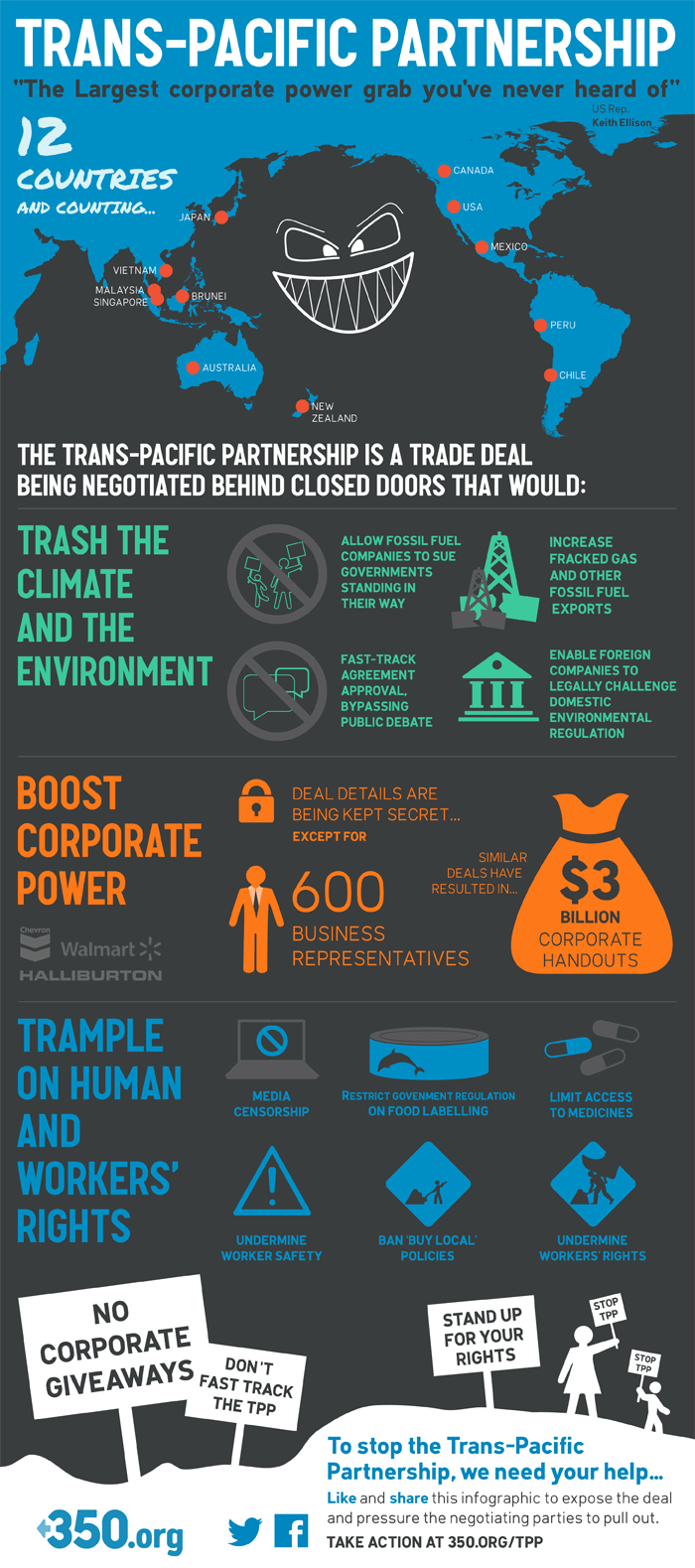
I've posted a bunch about the Trans-Pacific Partnership, a shadowy, secretive trade deal that will have a disastrous effect on the Internet, privacy and free speech, thanks to the brutal copyright provisions the US Trade Rep has crammed into it. But that's not the whole story.

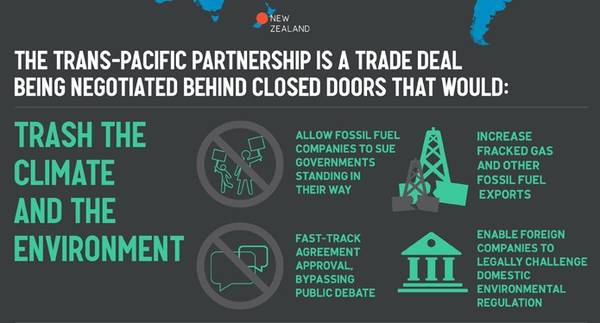
Michael sez, "You might be interested to know the TPP looks terrible for environmental protection too, due to a proposed mechanism called 'investor-state arbitration'. Basically this'd allow investors to sue countries for passing legislation detrimental to the financial interests of those investors. Yep, think environmental protections, workers' rights laws and any other kind of public protection that might reduce a profit margin.

The international climate change group 350.org is starting a new campaign against the TPP on these grounds; there's a petition and links to further information at the link. The more fronts we expose and fight this thing on the better: the TPP will reduce the power of civil society in all kinds of ways and we shouldn't let it happen.

Say no to corporate power grabs - reject the Trans-Pacific Partnership

(Thanks, Michael!)


18 Dec 18:49

France's new surveillance law creates a police state

by Cory Doctorow

Jeremie from La Quadrature du Net writes, "France just turned into a surveillance state, adopting a sneaky surveillance framework in article 13 of its Defense Bill (Loi de programmation militaire). It drastically extends the exceptional regime of extra-judicial surveillance against terrorism, for broad motives, including for the purpose of 'preserving scientific and economic interests of France' which could enable total.surveillance of political activists, journalists, corporate watchdogs, etc."

Administrative agents from the ministries of interior, defense and.economy can now target hosters and Internet service provider and 'information and documents processed and stored' by them, which means virtually anything (including potentially the content of communications) -- without judicial oversight. Such minformation can be collected 'in realtime, including by soliciting the network' terms broad enough to allow plugging in listening devices on operators' networks, à la PRISM...

We strongly suspect that the purpose of this provision is to cover up what is already illegally being done... in any case this is a totally unacceptable shift towards totalitarian surveillance state in France, an untolerable breach of the separation of powers and an enabler for catastrophic violations of fundamental rights on a massive scale... :(

Only a challenge to the Constitutional Court could help at this stage.

Will French Parliamentarians Consent to a Democratorship? (Thanks, Jeremie!)


18 Dec 18:14

CopyrightX: Harvard's ground-breaking MOOC on copyright law

by Cory Doctorow


Nathaniel writes, "Copyright X -- AKA 'The MOOC the New Yorker actually liked' -- is tooling up for a second run at it, expanding on its unusual, hybrid format. This year, in addition to the real-world classes attended by 100 Harvard Law students and online sections for 500 students -- taking the M out of MOOC -- the course is adding more 'satellites' and integrating them more with the other two course communities. The satellites are, for the most part, meat-space classes in about 10 locales around the world, each taught by an expert in copyright law. Apply here."

CopyrightX (Thanks, Nathaniel!)


12 Dec 20:58

A Temperate Nation

by Erin Allen

Today marks the 80th anniversary of the end of Prohibition. On Dec. 5, 1933, the United States repealed the nationwide prohibition on alcoholic beverages, by ratifying the 21st Amendment to the U.S. Constitution. And, while the masses may have raised their glasses, there were certainly those among them not happy with the decision. Temperance activists championed Prohibition because they felt alcohol was a social ill.

05640rKansas became the first state to outlaw alcohol, in its constitution, in 1881. Enter Carrie Nation – talk about someone you’d want on your team in a bar brawl. Nation was a hatchet-wielding, 6-foot tall, 175-pound weapon of mass destruction who left the dust and rubble of early 20th-century saloons in her wake. A staunch supporter of the temperance movement, Nation was arrested some 30 times for her position against alcohol. Talk about an axe to grind!

On Dec. 27, 1900, Nation brought her campaign to Wichita, Kan., where she smashed the bar at the Carey Hotel. This first public demonstration kicked off her harangue on hooch, which continued for 10 years. But her public protests didn’t stop there … Nation stood on her soapbox against foreign goods, corsets, tobacco, fraternal orders and, most importantly, short skirts. According to the Kansas State Historical Society, as her anti-alcohol activities became widely known, many barrooms adopted the slogan “All Nations Welcome But Carrie.”

Nation died in 1911, before Prohibition became a national law with the enactment of the 18th Amendment in January 1920. A story on her death in the Lincoln County Leader, Sept. 1, 1911, carried a sub-headline that read “Saloon Smashing Made Her Famous – She Realized a Fortune Hatchets.” (Apparently she made a good deal of money selling souvenir hatchets.)

“During her career Mrs. Nation
wrecked hundreds of saloons, using a 
hatchet, which became as well known
 as she. She was absolutely with out
fear, invading saloons, demolishing 
mirrors and furniture and assailing 
bartenders and proprietors without re
gard for her own safety. She had 
many narrow escapes from injury and
 was roughly handled on several occasions.”

12 Dec 20:24

The World’s Largest Monastery Library is in Austria and it’s Beautiful

by twistedsifter

admont abbey monastery library austria (3)


Admont Abbey is a Benedictine monastery located on the Enns River in the town of Admont, Austria. It is the oldest remaining monastery in Styria and contains the largest monastic library in the world. The abbey is known for its Baroque architecture, art, and manuscripts. [Source]

While the abbey itself was completed in 1074 the library (late Baroque) was not completed until 1776. It was commissioned by Abbot Matthäus Offner (reigned 1751-1779) and built by the Graz Master Builder Josef Hueber (1715-1787).

The library is divided into three sections and has an overall length of 70 m (230 ft), a width of 14 m (46 ft) and 11 m (36 ft) in height (12.7 m in the central cupola). Adorning the ceilings are seven frescoes by Bartolomeo Altomonte who was 80-years-old at the time and completed the frescoes over the summer months of 1775 and 1776. The frescoes depict the steps in ‘man’s exploration of thinking and speaking from the sciences to Divine Revelation in the central cupola’. [Source]

The sculptures in the library were made by master Baroque sculptor Josef Stammel. Particularly famous is The Four Last Things, a group of four oversized presentations of Death, the Last Judgement, Heaven and Hell.

Lastly, the library collection comprises some 200,000 volumes. The most valuable treasures are the more than 1,400 manuscripts (the earliest from the 8th century) and the 530 incunabula (early printed books before 1500).

A visual treat for lovers of art, architecture, history and books, the Admont Abbey’s library & museum is open from March 24 – Dec. 31 daily from 10 am to 5 pm. Out of season visits are avilable on request. Please visit www.stiftadmont.at for more.


1.

admont abbey monastery library austria (7)


2.

admont abbey monastery library austria (4)


3.

admont abbey monastery library austria (1)


4.

admont abbey monastery library austria (10)


5.

admont abbey monastery library austria (11)


6.

admont abbey monastery library austria (6)


7.

admont abbey monastery library austria (5)


8.

admont abbey monastery library austria (8)


9.

admont abbey monastery library austria (9)


10.

admont abbey monastery library austria (12)


11.

admont abbey monastery library austria (13)


12.

admont abbey monastery library austria (2)


If you enjoyed this post, the Sifter
highly recommends:


university club library new york The Worlds Largest Monastery Library is in Austria and its Beautiful


wieliczka salt mine krakow poland 17 The Worlds Largest Monastery Library is in Austria and its Beautiful


4787488699 9f1e558049 b The Worlds Largest Monastery Library is in Austria and its Beautiful


12 Dec 19:57

sosuperawesome: Mouses Houses by Maggie Rudy on Tumblr


sosuperawesome:

Mouses Houses by Maggie Rudy on Tumblr

26 Nov 19:06

Because is a new, Internet-driven preposition, because grammar

by Cory Doctorow

The English language has a new preposition, driven by Internet conventions: "Because." It's not clear where this originates, but I like the theory that's it's a contraction of "$SOMETHING is $MESSED_UP, because, hey, politics!"

However it originated, though, the usage of "because-noun" (and of "because-adjective" and "because-gerund") is one of those distinctly of-the-Internet, by-the-Internet movements of language. It conveys focus (linguist Gretchen McCulloch: "It means something like 'I'm so busy being totally absorbed by X that I don’t need to explain further, and you should know about this because it's a completely valid incredibly important thing to be doing'"). It conveys brevity (Carey: "It has a snappy, jocular feel, with a syntactic jolt that allows long explanations to be forgone").

But it also conveys a certain universality. When I say, for example, "The talks broke down because politics," I'm not just describing a circumstance. I'm also describing a category. I'm making grand and yet ironized claims, announcing a situation and commenting on that situation at the same time. I'm offering an explanation and rolling my eyes—and I'm able to do it with one little word. Because variety. Because Internet. Because language. 

English Has a New Preposition, Because Internet [Megan Garber/The Atlantic]

(via Making Light)


26 Nov 18:37

Penguins chasing a butterfly

by Rob Beschizza

[Video Link via Arbroath]


26 Nov 15:36

BroGhost Cover 1/3 by Kelly Johnson Website - Blog


BroGhost Cover 1/3

by Kelly Johnson

Website - Blog

21 Nov 14:50

137. RICHARD FEYNMAN: The beauty of a flower

by Gav

137. RICHARD FEYNMAN: The beauty of a flower

Yay, another quote from everyone’s favourite Nobel Prize-winning, Quantum Mechanics-pioneering, bongo-playing genius (Here are my previous two: A more interesting outlook and The universe in a glass). It’s hard not to get energised by Feynman’s joyful explanation of science. He manages to capture the wonder of everyday scientific phenomenon we all take for granted, like the beauty of a flower or this awesome explanation of light.

Feynman took up art as a hobby when he was in his 40s and the friend who he mentions in this quote was Armenian artist Jirayr Zorthian. Every alternate Sunday for eight years, the two friends would attempt to teach the other their chosen field of expertise – Feynman would explain physics and Zorthian, art. Here’s a short clip explaining their relationship, including Feynman saying the quote used in the comic, plus Zorthian’s counter argument (warning: his remarks at the end might be offensive to some). And here’s a great article about Feynman the artist with more of his sketches at Brain Pickings. I also found this very cool animated video of the quote.

- I recently read Chris Ware’s incredible comic masterpiece Building Stories, which influenced this piece. Here’s a fantastic article about Ware if you’re unfamiliar with him.
- Check out my second limited edition Zen Pencils T-shirt. Only available until December 1 and shipping in time for Christmas.
- Thanks to Erika for submitting this quote.

15 Nov 20:12

US looking to extend copyright to life plus 95 years

by Heidi MacDonald

201311151334.jpg
Oh WikiLeaks, the gift that keeps on giving. Yet another fascinating finding from the papers is the proposed Trans Pacific Partnership agreement, which covers copyright law. The US has been negotiating it in secret, and several of the provisions are very noteworthy. Among them, a continued emphasis on SOPA and PIPA type legislation–both very restrictive anti=piracy laws that Big Media wants which were nonetheless rejected as being too ambiguously restrictive. and open to abuse in. You can read more in the above link on various provisions but here’s a standout:

Only the United States and Australia oppose a provision limiting Internet Service Provider liability (QQ.I.1); U.S. copyright holders would like ISPs to be held liable for hosting infringing content. The United States also proposes extending copyright to life plus 95 years for corporate-owned copyrights. Hollywood consistently presses for longer copyright terms and it is doing so here.


So there you go–Mickey Mouse and Superman would be safe under this change (Mickey Mouse debuted in 1928 an would alreayd be in the public domain if the Bono Act hadn’t passed.) The TPP proposal is said to be a “wish list for Hollywood” and while you can argue both sides of it, it is indeed noteworthy. Hopefully Jeff Trexler and Nat Gertler will be along in the comments to expand on my rudimentary knowledge here.

14 Nov 19:40

Animated history of the English language

by Maggie Koerth-Baker

If you've got 10 minutes, you can learn the history of English — including some interesting background on where specific words and phrases came from. (If you don't have 10 minutes, you can also watch the whole thing one chapter at a time in less-than-two-minute segments.) Interesting note: The equal importance of both The King James Bible and early scientific publications/societies to the formation of English as we speak it today.

Video Link


14 Nov 19:37

Google wins decade-long book-scanning lawsuit

by Rob Beschizza

Google's seemingly-interminable legal fight over its book-scanning project is over, for now: a judge ruled that the effort is fair use, tossing a lawsuit first filed by the Author's Guild and others nearly a decade ago.

U.S. Circuit Judge Denny Chin in Manhattan accepted Google's argument that its scanning of more than 20 million books, and making "snippets" of text available online, constituted "fair use" under U.S. copyright law. The decision, if it survives an expected appeal, would let Google continue expanding the library, which it said helps readers find books they might not otherwise locate."This is a big win for Google, and it blesses other search results that Google displays, such as news or images," said James Grimmelmann, a University of Maryland intellectual property law professor who has followed the case.

Google had proposed a $125m settlement in 2008. Its adversaries now receive an animated GIF of Gene Wilder from Charlie and the Chocolate Factory.


14 Nov 18:45

TPP Leak Confirms the Worst: US Negotiators Still Trying to Trade Away Internet Freedoms

by Maira Sutton and Maira Sutton and Parker Higgins

After years of secret trade negotiations over the future of intellectual property rights (and limits on those rights), the public gets a chance to looks at the results. For those of us who care about free speech and a balanced intellectual property system that encourages innovation, creativity, and access to knowledge, it’s not a pretty picture.

Today Wikileaks published a complete draft of the Trans-Pacific Partnership (TPP) agreement’s chapter on “intellectual property rights.” The leaked text, from August 2013, confirms long-standing suspicions about the harm the agreement could do to users’ rights and a free and open Internet. From locking in excessive copyright term limits to further entrenching failed policies that give legal teeth to Digital Rights Management (DRM) tools, the TPP text we’ve seen today reflects a terrible but unsurprising truth: an agreement negotiated in near-total secrecy, including corporations but excluding the public, comes out as an anti-user wish list of industry-friendly policies.

Despite the Obama administration’s top U.S. negotiators’ fast approaching their self-imposed 2013 deadline to complete the agreement, today’s leak is the public’s first look at the sprawling text since a February 2011 leak [pdf] of the same chapter and a July 2012 leak of an individual section. And even as the public has been completely shut out, the U.S. Trade Representative has lobbied for wider latitude to negotiate and for “fast-track authority” to bypass Congressional review.

The document Wikileaks has published contains nearly 100 pages of bracketed text—meaning it includes annotated sections that are proposed and opposed by the negotiating countries. The text is not final, but the story it tells so far is unmistakable: United States negotiators (with occasional help from others) repeatedly pushing for restrictive policies, and facing only limited opposition, coming from countries like Chile, Canada, New Zealand, and Malaysia.

Copyright Terms

The leaked chapter features proposals for setting a new “floor” for copyright duration, ranging from the already problematic U.S. term of life of the author plus 70 years to an incredible life of the author plus 100 years, proposed by Mexico. Such bloated term lengths benefit only a vanishingly small portion of available works, and impoverish the public domain of our collective history. The U.S. is also pushing for countries to embrace terms lengths of 95 years for corporate and 120 years for unpublished works.

Extending term lengths in the U.S. was already a bad idea. The U.S. Trade Rep shouldn’t be compounding it by forcing other countries to follow suit. Countries around the world that have shorter term lengths than the U.S. celebrate the arrival each year of new works into the public domain, and the economic activity that can accompany them. Since the 1998 passage of the Sonny Bono Copyright Term Extension Act, however, the U.S. will see no new published works enter the public domain until 2019. The proposal in TPP would export that sort of restriction to all the countries that join it.

These expansive terms have also exacerbated the widely recognized problem of “orphan works” also known as “hostage works.” These are works where the rightsholder can’t be identified or located and, therefore, folks are afraid to use them, publish them online, etc, lest the rightsholder appear at last and file a lawsuit. As a result, millions of works effectively disappear from the cultural commons until their copyright terms at long last expire. Earlier this year, the U.S. Register of Copyrights advised a reduction or limitation in term length as a possible solution. Crystallizing U.S. term lengths in international agreements would frustrate efforts to enact such reasonable policies. This is a classic example of policy laundering, whereby corporate interests use secretive international forums to trump the democratic process at the national level.

Fair Use and Fair Dealing

Although the addition of the “3-step test” for fair use provisions was hailed by the U.S. Trade Representative as a major step forward for users’ rights in trade agreements, its original intention has been subverted. It now may serve as a ceiling on rights, and not a floor.

The agreement claims not to confine copyright limitations and exceptions further than earlier deals, such as the Berne Convention, but early analysis from groups like Knowledge Ecology International (KEI) suggests that’s not the case. Functionally, TPP as drafted creates a tightly circumscribed space in which countries can grant rights like fair use and fair dealing to its citizens.

Given the important role that flexibility in copyright has played in enabling innovation and free speech, it’s a terrible idea to restrict that flexibility in a trade agreement.

Intermediary liability

The newly leaked text reveals substantial disagreement over the language on copyright liability for Internet Service Providers (ISPs) and other online platforms. The February 2011 leak contained extensive language that would have imposed regulatory requirements to police users’ activities online and paved the way for systems like three-strikes take down policies and ISPs filtering and blocking access to websites that allegedly infringe or facilitate copyright infringement.

Even though the text appears to be very much in flux, it’s clear from the leaked chapter that Canada is pushing back hard against U.S. pressure to adopt draconian copyright enforcement measures. A majority of countries appear to be proposing language that would give them some flexibility to limit the liability of ISPs, so they can develop enforcement frameworks that best suit their national laws and priorities. That flexibility is essential to staving off copyright enforcement laws that in practice would violate users’ free speech and privacy. And yet the U.S., backed by Australia, opposes this language.

Anti-Circumvention

The leaked draft includes controversial language calling for laws prohibiting the circumvention of “technological protection measures,” also known as DRM. The U.S. has had such a law in place for over 15 years, and it’s been a disaster for free speech and competition, chilling the legitimate speech of innovators, filmmakers, security researchers, and many others. In fact, it’s so bad that President Obama and many in Congress have said it must be reformed. Just as much of the U.S. public is realizing our anti-circumvention law was a mistake in the first place, we’re not only trying to export it but also potentially impeding our own ability to fix it.

Despite numerous heroic proposals for fixes, most notably from Canada and Chile, the articles as drafted include many such dangerous provisions. Though the text remains unsettled, the current proposal calls for criminal liability for violations of these anti-circumvention provisions, except for when conducted by a non-profit.

Worse, because of the broad language, this criminal liability could apply to people circumventing these restrictions even where the underlying work is not covered by copyright.

Temporary Copies

The strict regulation of temporary copies reflected in the February 2011 leak was a startling throwback to an outmoded and dangerous idea: that copyright should apply even to ephemeral copies. The implications are staggering. Computers and networks create, in the normal course of operation, temporary and ephemeral copies. Regulations on these sorts of copies, as described in the earlier leak, would interfere with basic technical operations and give rightsholders an opportunity to sit on an essential chokepoint of the Internet.

Fortunately, negotiators may have recognized the fundamental folly of this proposal. Although the U.S. has yet to support any reasonable text on this topic, the draft leaked today included a proposed clarification that temporary copies may be exempted from copyright restrictions. Language from Chile, New Zealand, and Malaysia proposes that countries may make these exemptions for:

temporary acts of reproduction which are transient or incidental and an integral and essential part of a technological process and whose sole purpose is to enable (a) a lawful transmission in a network between third parties by an intermediary; or (b) a lawful use of a work; and which have no independent economic significance.

Similar language appears in a footnote proposed by a larger group of countries that does not include the U.S., and which negotiators have noted faces “no substantive objection to the concept” but which is not yet finalized.

Patents

The leaked draft reveals that the US is pushing hard for provisions expanding the reach of patent law and limiting ways in which a patent may be revoked. These proposals are meeting widespread opposition from the other participants. For example, the U.S. proposes—and nearly every other nation opposes—that patents be made available for inventions that are “plants and animals.”

The U.S. also proposes language that would prohibit denying “a patent solely on the basis that the product did not result in enhanced efficacy of the known product.” Again, nearly every other nation opposes the U.S. on this issue. And a good thing too. Setting the bar to patentability too low locks up innovation. Advocates for access to medicine argue that it allows pharmaceutical companies delay generic entry through “evergreening.” In other technology areas, the U.S. is seeing the terrible consequences of a flood of low-quality software patents, many of which are for minor improvements on existing technology. There’s no reason for an international treaty to export the problems of the U.S. patent regime.

Conclusion

The latest TPP leak confirms our longstanding fears about these negotiations. The USTR is pushing for regulations that would, for the most part, put the desires of major content and patent owners over the needs of the public. No wonder the negotiators want to keep the process secret. There are marginal improvements since February 2011, but they are not enough. Real and substantially balanced proposals will not happen unless and until negotiators can be held accountable to the public for the proposals they are making.

Rest assured: if they can't be challenged now, they will surely be challenged later. Internet users have proven that they will not stand for backroom deals that put their freedoms at risk.


Share this: Share on Twitter Share on Facebook Share on Google+ Share on Diaspora  ||  Join EFF
14 Nov 18:39

DRM in Cars Will Drive Consumers Crazy

by Parker Higgins

Forget extra cupholders or power windows: the new Renault Zoe comes with a "feature" that absolutely nobody wants. Instead of selling consumers a complete car that they can use, repair, and upgrade as they see fit, Renault has opted to lock purchasers into a rental contract with a battery manufacturer and enforce that contract with digital rights management (DRM) restrictions that can remotely prevent the battery from charging at all.

We've long joined makers and tinkerers in warning that, as software becomes a part of more and more everyday devices, DRM and the legal restrictions on circumventing it will create hurdles to standard repairs and even operation. In the U.S., a car manufacturer who had wrapped its onboard software in technical restrictions could argue that attempts to get around those are in violation of the Digital Millennium Copyright Act (DMCA)—specifically section 1201, the notorious "anti-circumvention" provisions. These provisions make it illegal for users to circumvent DRM or help others do so, even if the purpose is perfectly legal otherwise.  Similar laws exist around the world, and are even written into some international trade agreements—including, according to a recently leaked draft, the Trans-Pacific Partnership Agreement.

Since the DMCA became law in 1998, Section 1201 has resulted in countless unintended consequences. It has chilled innovation, stifled the speech of legitimate security researchers, and interfered with consumer rights. Section 1201 came under particular fire this year because it may prevent consumers from unlocking their own phones to use with different carriers. After a broadly popular petition raised the issue, the White House acknowledged that the restriction is out of line with common sense.

The problem extends beyond inconvenience. In plenty of cases, DRM has led to users losing altogether the ability to watch, listen to, read, or play media that can't be "authenticated." Video games with online components now routinely reach an end-of-life period where the company providing the authentication decides it's no longer worth it to operate the servers. That raises the frightening possibility of a company like Renault deciding that it's not cost-effective anymore to verify new batteries—and leaving car owners high and dry.

And these are all just the problems with the DRM running as expected. Unfortunately, the intentional restrictions created by DRM can also create security vulnerabilities that can be exploited by other bad actors. The most prominent example may be the "rootkit" that Sony included on music CDs and which led in some cases to further malware infection. The stakes may be even higher when it comes to cars. Security researchers uncovering security problems in cars already face restrictions on publishing; that stands to get worse as DRM enters the picture.

As our friends at iFixit say, if you can't fix it, you don't own it. Users need the right to repair the things they buy, and that is incompatible with blanket restrictions on circumventing DRM.

Copyright maximalists like to point to the 1201 safety valve—a rulemaking procedure to identify narrow exemptions. But the process happens every three years in the Copyright Office, and it's pretty dysfunctional: the exemptions require extensive work, must be justified from scratch each time, and have no established appeal process. Permission to "jailbreak" cars can't even be considered until 2015, and even if it is granted, consumers may be wary to invest in a new car if their right to repair it could be revoked three years later.

There's a better way, but it requires legislation. Representative Zoe Lofgren and a group of bipartisan sponsors have proposed the Unlocking Technology Act, to limit the anti-circumvention provisions to cases where there is actual infringement. That's a common sense change that is long overdue.

More fundamentally, though, users must push back on the creeping imposition of DRM in more and more places. As EFF Fellow and former staff member Cory Doctorow has noted, computers are increasingly devices that we depend on for our own health and safety. It's critically important, then, that consumers actually own our stuff. Stay tuned: We’ll be pushing hard on this issue on many fronts in the coming year, and we’ll need your help.


Share this: Share on Twitter Share on Facebook Share on Google+ Share on Diaspora  ||  Join EFF
08 Nov 17:55

America should have two time-zones

by Cory Doctorow


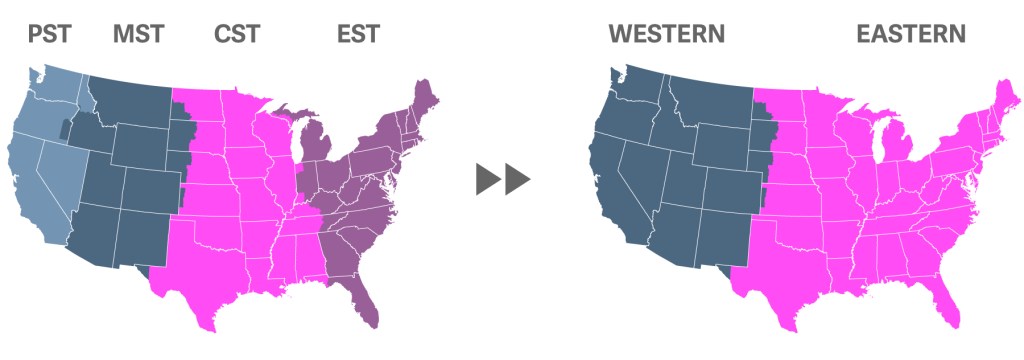
Allison Schrager proposes that America should end Daylight Savings and consolidate its timezones into just two -- the Eastern zone goes back, Central/Mountain do nothing, and Pacific goes forward. She makes a persuasive argument that the nation already conducts its business on coastal time, and cites the safety and coordination costs of losing sleep, de-synchronizing with the rest of the world, and generally suffering from confusion and disorientation from a system designed in 1883.

It sounds radical, but it really isn’t. The purpose of uniform time measures is coordination. How we measure time has always evolved with the needs of commerce. According to Time and Date, a Norwegian Newsletter dedicated to time zone information, America started using four time zones in 1883. Before that, each city had its own time standard based on its calculation of apparent solar time (when the sun is directly over-head at noon) using sundials. That led to more than 300 different American time zones. This made operations very difficult for the telegraph and burgeoning railroad industry. Railroads operated with 100 different time zones before America moved to four, which was consistent with Britain’s push for a global time standard. The following year, at the International Meridian Conference, it was decided that the entire world could coordinate time keeping based on the British Prime Meridian (except for France, which claimed the Prime Median ran through Paris until 1911). There are now 24 (or 25, depending on your existential view of the international date line) time zones, each taking about 15 degrees of longitude.

Now the world has evolved further—we are even more integrated and mobile, suggesting we’d benefit from fewer, more stable time zones. Why stick with a system designed for commerce in 1883? In reality, America already functions on fewer than four time zones. I spent the last three years commuting between New York and Austin, living on both Eastern and Central time. I found that in Austin, everyone did things at the same times they do them in New York, despite the difference in time zone. People got to work at 8 am instead of 9 am, restaurants were packed at 6 pm instead of 7 pm, and even the TV schedule was an hour earlier. But for the last three years I lived in a state of constant confusion, I rarely knew the time and was perpetually an hour late or early. And for what purpose? If everyone functions an hour earlier anyway, in part to coordinate with other parts of the country, the different time zones lose meaning and are reduced to an arbitrary inconvenience. Research based on time use surveys found American’s schedules are determined by television more than daylight. That suggests in effect, Americans already live on two time zones.

Daylight Saving Time Is Terrible: Here's a Simple Plan to Fix It [Allison Schrager/The Atlantic]

(via /.)


08 Nov 15:35

Western Black Rhinoceros declared extinct

by Xeni Jardin
Leettaschmidt

This upsets me deeply. I'm kind of surprised.


African black rhinoceros (CNN)

In an updated list of threatened species released today by the International Union for Conservation of Nature and Natural Resources, The Western Black Rhinoceros has been declared extinct. The black rhino subspecies was last seen in western Africa in 2006.

The IUCN warns that other rhinos could follow saying Africa's northern white rhino is "teetering on the brink of extinction" while Asia's Javan rhino is "making its last stand" due to continued poaching and lack of conservation.
[CNN]


07 Nov 12:31

This 240-year-old Machine is an Ancestor to the Modern Computer

by twistedsifter

pierre jaquet-droz the writer automaton ancestor of modern computer (2)


An automaton (plural: automata or automatons) is a self-operating machine or robot. Seen above is the Writer, an automaton built in the 1770s by world-renowned Swiss watchmaker, Pierre Jaquet-Droz (1721-1790).

Made from nearly 6000 parts, the Writer is a self-operating, programmable machine, capable of writing letters and words with a quill pen. The 240-year-old machine is said to be a distant ancestor of the modern-day, programmable computer.

From the BBC programme Mechanical Marvels: Clockwork Dreams (which can be viewed in its entirety here), Professor Simon Schaffer explains this remarkable creation by Pierre Jaquet-Droz in the must-see video below.


pierre jaquet-droz the writer automaton ancestor of modern computer (6)


pierre jaquet-droz the writer automaton ancestor of modern computer (8)


According to Aerial Adams of A Blog to Watch, The Writer inspired the principle ‘character’ in the Martin Scorsese movie Hugo. The machine works by using a crank to wind up the mainsprings. From there, The Writer comes to life. To achieve ‘life-likeness’, the head and eyes move, following its own hand movements as it writes. The Writer even dips its quill into an ink bottle between words.
 
At the core of The Writer is a large stack of 40 cams with three cam followers that read their shaped edges and translate them into movements of the boy’s arm. Controlling the cams is a large wheel or ‘system disk’, made up of letters that could be removed, replaced and reordered (i.e., programmable). The Writer is able to write any custom text up to 40 letters long, spread over four lines.


pierre jaquet-droz the writer automaton ancestor of modern computer (5)


pierre jaquet-droz the writer automaton ancestor of modern computer (7)


pierre jaquet-droz the writer automaton ancestor of modern computer (9)


The Writer is one of three complex automata created by Jaquet-Droz between 1767 and 1774. In conjunction with the Lady Musician and the Draftman, the three were toured across the courts of Europe; visiting Paris, Brussels, London, Kazan (Russia), Madrid, Austria, Germany and Denmark. In 1906, the Neuchâtel Society of History and Archaeology acquired them for 75,000 gold francs and bestowed them to the Neuchâtel Museum of Art and History, where they have become masterpieces. They can be admired in action on the first Sunday of every month at 2p.m., 3p.m. and 4p.m. or by pre-arrangement for groups (see here for more info).


pierre jaquet-droz the writer automaton ancestor of modern computer (1)


pierre jaquet-droz the writer automaton ancestor of modern computer (3)


Sources

- A Blog to Watch: Jaquet Droz “The Writer” Automata: Awesome Antique Android
- history-computer.com: Pierre Jaquet-Droz
- Ville de Neuchatel: Automata
- Neuchâtel Museum of Art and History
- Colossal: This Programmable 6,000-Part Drawing Boy Automata is Arguably the First Computer and It Was Built 240 Years Ago
- Wikipedia: Jaquet-Droz automata
- Wikipedia: Pierre Jaquet-Droz


If you enjoyed this post, the Sifter
highly recommends:


fore edge painting fanning animated gif This 240 year old Machine is an Ancestor to the Modern Computer


lost city of heracleion egypt franck goddio 4 This 240 year old Machine is an Ancestor to the Modern Computer


rare photos statue of liberty under construction 1883 9 This 240 year old Machine is an Ancestor to the Modern Computer


30 Oct 18:48

Saucisses pour tout le monde.

by MAUMONT


30 Oct 17:41

Five lessons learned from zombies

by Stephanie Lo

DavidHunterYT
From global folklore to contemporary characters in horror films and television shows, zombies have a long history of cultural relevance that continues to be a major topic of conversation today. TED-Ed takes a look at five lessons that zombies have taught us.
DavidHunterYT
1. If there was a zombie apocalypse, where would you go and how would you know where to go? David Hunter explains how geography skills can show us the way in this TED-Ed Lesson.
CarlZimmerTEDYouthYT
2. Sometimes, reality is stranger (or, in this case, scarier) than fiction. Carl Zimmer‘s narrative of the jewel wasp’s relationship with a cockroach and the real zombie-like response of the cockroach leaves little to the imagination.
BradVoytekTimVerstynenPart1YT
3. What is happening in a zombie’s brain to make them move so erratically? Tim Verstynen and Bradley Voytek figure out how brain functions lead to irregular body movements.
BradVoytekTimVerstynenPart2YT
4. Are zombies really angry? Or do zombies just have a bad reputation? In the second video of this two-part series, Tim Verstynen and Bradley Voytek recommend observing zombies to see how different brain stimulations cause varying behaviors.
HelenSwordYT
5. How can nominalizations muddle strong writing? Helen Sword warns against  ”zombie nouns” in order to write concise prose.

30 Oct 14:37

Online Anonymity Is Not Only for Trolls and Political Dissidents

by Dave Maass

David Plotz: People have a misguided belief in it, but, in general, the fact that anonymity is increasingly hard to get—Facebook doesn't permit it, most commenting on a lot of sites doesn't permit it—there's a loss when you don't have anonymity.

Emily Bazelon: Oh god, I am so not with you on this one. There is a loss if you're, like, a political dissident in Syria. If you are in this country, almost all of the time, there is a net gain for not having anonymous comments. We so err on the side of 'Oh, free speech, everywhere, everywhere, let people defame each other and not have any accountability for it.' And I think in free societies, that is generally a big mistake. And yes, you can make small exceptions for people who truly feel at risk, like victims of domestic violence are an example, but most of the time it is much healthier discourse when people have to own up to what they are saying.

 - Slate's Political Gabfest, Oct. 25, 2013

During last week's episode of Slate's Political Gabfest, a weekly podcast I normally adore, senior editor Emily Bazelon mocked the concept of online anonymity. Our society would be better off if everyone was forced to put their name to their words, she said, generalizing that online anonymous users are poisoning civil discourse with their largely vile and defamatory comments. She deemed only one class of user legitimately deserving of anonymity: "people who directly fear violence."

In this view of the Internet, everyone else's anonymity is worth sacrificing to silence the trolls.

It's easy to understand why some in the press have this perspective. If you work in online media, the bulk of your interactions involve news stories, which seem to draw the ugliest forms of discourse. If you're a public figure, you're faced with haters on Twitter who are obsessed with enumerating all the ways you suck. They're even worse in the comments on YouTube. A website, such as Slate, certainly has the right to determine the culture of its online community, and I don't have a position whether such sites, across the spectrum, should or should not allow anonymous comments, or even allow comments at all. I do, however, dispute this narrow vision of the Internet.

So, I spent the weekend brainstorming and jotting down all the kinds of people who would lose out if anonymity no longer existed in any form on the Internet.

Anonymity is important to:

  • the people who run some of the funniest parody Twitter accounts, such as @FeministHulk (SMASH THE PATRIARCHY!) or @BPGlobalPr during the Deepwater Horizon aftermath. San Francisco would not be better off if we knew who was behind @KarltheFog, the most charming personification of a major city's climate phenomenon.
  • the young LGBTQ youth seeking advice online about coming out to their parents.
  • the marijuana grower who needs to ask questions on an online message board about lamps and fertilizer or complying with state law, without publicly admitting to committing a federal offense.
  • the medical patient seeking advice from other patients in coping with a chronic disease, whether it's alopecia, irritable bowel syndrome, cancer or a sexually transmitted infection.
  • the online dater, who wants to meet new people but only reveal her identities after she's determined that potential dates are not creeps.
  • the business that wants no-pulled-punches feedback from its customers.
  • the World of Warcraft player, or any other MMOG gamer, who only wants to engage with other players in character.
  • artists. Anonymity is integral to the work of The Yes Men, Banksy and Keizer.
  • the low-income neighborhood resident who wants to comment on an article about gang violence in her community, without incurring retribution in the form of spray paint and broken windows.
  • the boyfriend who doesn’t want his girlfriend to know he’s posing questions on a forum about how to pick out a wedding ring and propose. On the other end: Anonymity is important to anyone seeking advice about divorce attorneys online.
  • the youth from an orthodox religion who secretly posts reviews on hip hop albums or R-rated movies.
  • the young, pregnant woman who is seeking out advice on reproductive health services.
  • the person seeking mental health support from an online community. There's a reason that support groups so often end their names with “Anonymous.”
  • the job seeker, in pursuit of cover letter and resume advice in a business blogger's comments, who doesn't want his current employer to know he is looking for work.
  • many people's sexual lives, whether they're discussing online erotica or arranging kink meet-ups.
  • Political Gabfest listeners. Each week, the hosts encourage listeners to post comments. Of the 262 largely positive customer reviews on iTunes, only a handful see value in using their real names.

Anonymity is important to anyone who doesn't want every facet of their online life tied to a Google search of their name. It is important to anyone who is repulsed by the idea of an unrelenting data broker logging everything she has ever said, or shown interest in, in a permanent marketing profile. And more.

Bazelon describes anonymous comments as "generally a big mistake" for free societies. I disagree and point to Common Sense by Thomas Paine, originally published under the anonymous byline, “an Englishman.” (Perhaps that could be Gabfest's next Audible recommendation.)

To suggest anonymity should be forbidden because of troll-noise is just as bad as suggesting a ban on protesting because the only demonstrators you have ever encountered are from the Westboro Baptist Church—the trolls of the picket world. People who say otherwise need to widen their experience and understanding of the online world. The online spaces we know and love would be doomed without anonymity, even if the security of that anonymity is far from absolute or impenetrable. The ability to explore other identities, to communicate incognito, to seek out communities and advice without revealing your identity is not only a net positive, but crucial to preserving a free and open Internet.

Related Issues: 

Share this: Share on Twitter Share on Facebook Share on Google+ Share on Diaspora  ||  Join EFF
30 Oct 14:18

Texas judge blocks abortion law

Leettaschmidt

checks and balances at its best!

A Texas judge says abortion restrictions passed by the state's legislators are unconstitutional, allowing a reprieve for clinics expecting to close on Tuesday.
28 Oct 17:54

Cartoon about net neutrality and Verizon

by Cory Doctorow


Alan sez, "Using a simple (if wordy) graphic, Common Cause has teamed up with Symbolia to produce a Creative Commons-licensed description of how Verizon's lawsuits and lobbying threaten net neutrality."

Big Deal Big Money (Thanks, Alan)


24 Oct 17:45

"Straightforward Tale Princess" by alice hj

by sarahcross

Snow White's Greed


Rapunzel's Pain


Patience Little Mermaid


Ripped Wings of Thumbelina


Curiosity of Beauty


The Cinderella Shoe Collection

"Straightforward Tale Princess" by alice hj