Shared posts

26 Mar 03:41

The “Signalgate” Memes Have Entered the Chat

by Isa Farfan

Minutes before the United States launched a deadly missile campaign in Yemen that reportedly killed 53 people and wounded 89, including multiple children, on March 15, the Atlantic’s Editor-in-Chief Jeffrey Goldberg was sitting in his car in a grocery store parking lot waiting for the attack. 

The story is now well-known and well-memed: Days before the missile barrage, Goldberg was added to a Signal group chat called “Houthi PC small group” after President Donald Trump’s national security advisor, Michael Waltz, invited him to connect on the encrypted message application. The editor was included in the discussion inadvertently, a spokesperson for the National Security Council acknowledged to the Atlantic.

The incident has set off a meme trend lampooning screenshots of messages from the group chat, published by the Atlantic, in which top government officials discuss a deadly assault with flagrant disregard for civilian casualties and seemingly no knowledge of the journalist in the room.

The Daily Show posted several mock conversations to their X account in what many users quipped as unsurprisingly funny for the mainstream comedy show. (screenshot via X)

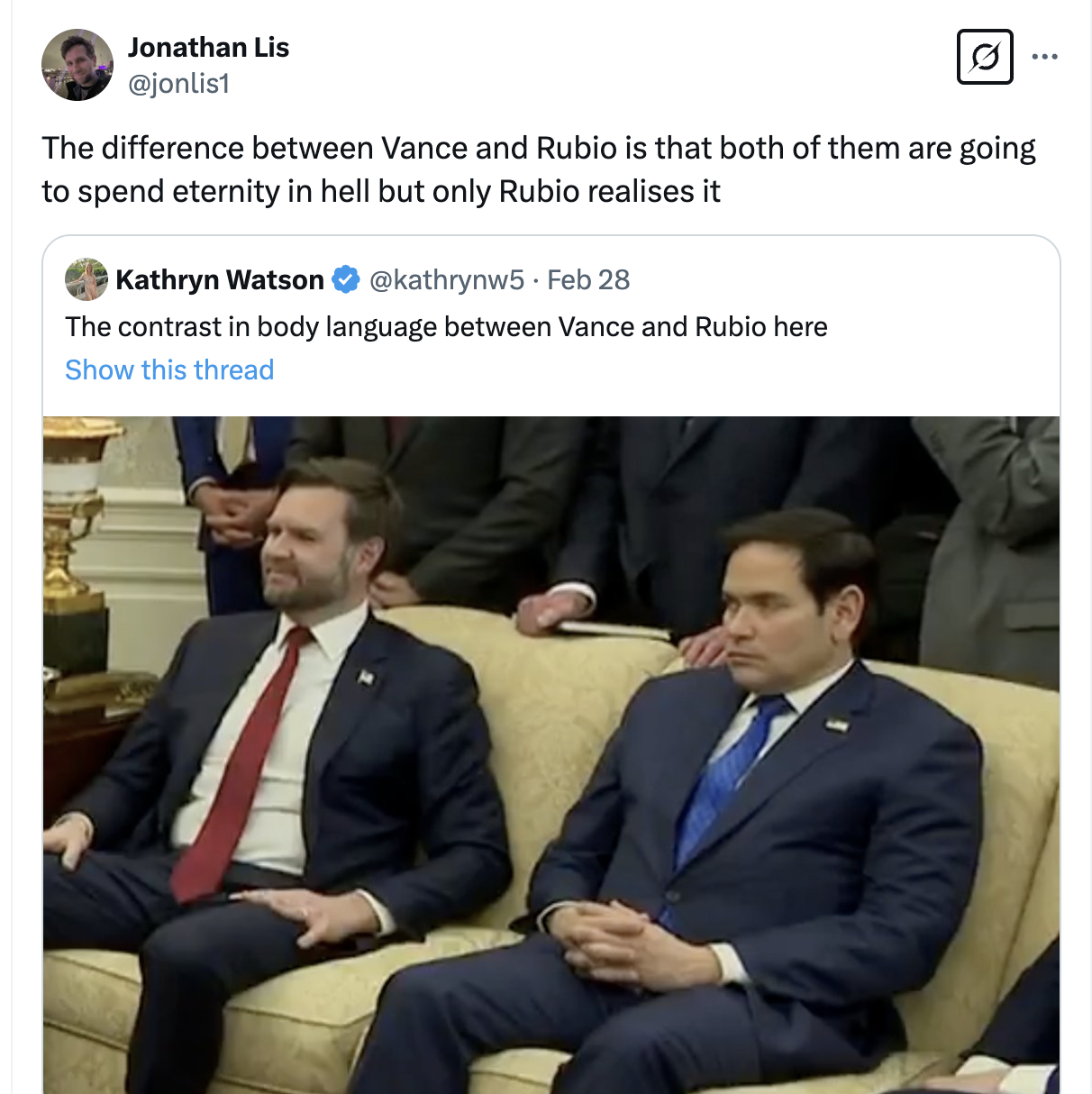
Though Signal has not been approved by the US government for sharing classified communication, the platform is frequently used by social movement organizers and journalists because of its end-to-end encryption. The incident, which has already been dubbed “Signalgate,” points to a serious breach of national security as members of Trump’s inner circle —  including Secretary of Defense Pete Hegseth, Vice President JD Vance, CIA Director John Ratcliffe, White House Deputy Chief of Staff for Policy Stephen Miller, Secretary of State Marco Rubio, and Director of National Security Tulsi Gabbard — shared details about specific targets and weapons and also named an active intelligence officer.

Another one from Jerry Chen (screenshot via Bluesky)

In a first-person narrative published yesterday, March 24, Goldberg recounted how he happened to join the group chat and the information discussed therein, though he said he omitted information that could “conceivably have been used to harm American military and intelligence personnel, particularly in the broader Middle East.” 

Goldberg, a national security reporter who also served in the Israeli military as a prison guard during the First Intifada, left the group chat once he believed it to be authentic. Some said that move ran counter to the motivations of a decorated beat reporter, testing what the American public believes a journalist can and should do. It’s probable that his decision was informed by journalism ethics such as minimizing harm and identifying oneself as a reporter, but it was also likely an attempt to thwart espionage charges. (The Nixon administration attempted to prosecute Pentagon Papers reporter Neil Sheehan under the Espionage Act.)

How I feel at every party. (screenshot via Bluesky)

Other internet users brought back this month’s bloated portraits of Vice President Vance to make light of the situation. One user pointed out that Hegseth was the only person in the “Houthi PC small group” chat who had a Signal profile photo.

Several iterations of a bright-yellow Big Bird from Sesame Street sitting among suited individuals at a conference table are also circulating, connoting the absurdity of inviting a journalist into a government group chat discussing military campaigns. 

Goldberg described in his article that he was uncertain about whether or not the chat was real. (screenshot via Bluesky)

And for once, the Daily Show was funny, imagining a text chain in which JD Vance’s profile photo grows larger and larger as the conversation progresses. 

Former New York Times reporter and Washington Post commentator Taylor Lorenz, now an independent journalist, posted a series of memes pointing to the fact that Goldberg did nothing immediately after receiving intel on the imminent attacks. 

The rounded JD Vance returns. (screenshot via Instagram)

The White House has said it was conducting a series of “precision strikes” against the Houthis, an Iran-backed armed political group in Yemen, in retaliation for attacks on ships in the Red Sea. The Houthis have claimed they are acting in solidarity with Palestinians by targeting ships linked to Israel, the US, or the United Kingdom, though the group has reportedly attacked other ships. 

Hilary Duff’s character types “LOL” into a now obsolete flip phone in A Cinderella Story (2004) (screenshot via Instagram)

Since Goldberg published his article, President Trump has defended Waltz, who added Goldberg to the chat, in a phone interview with NBC News, calling him a “good man.” The group chat members claim that no classified information was shared. 

The leaked (or whatever you want to call it) Signal group chat screenshots provide a template for memers to fill in with their own humor aimed at the Trump administration — or perhaps more acutely, for the public to understand the unseriousness with which the nation’s warmakers treat the use of lethal weapons and force. 

Bartenders are heroes. (screenshot via X)
Same thing. (screenshot via Bluesky)
I ask this in all my group chats and you should too! (screenshot via Bluesky)
Michael Waltz sent these emojis to the groupchat after the attack. (screenshot via Bluesky)
Social media users mocked Hegseth’s alleged alcohol abuse. (screenshot via Bluesky)
I have FOMO too about not being added to the group chat. (screenshot via X)
Goldberg received advance notice of the military campaign. (screenshot via Instagram)
I thought the emojis were an added by a mememaker, but it turns out, they were not. (screenshot via Instagram)
Many have been here before. (screenshot vis Bluesky)
It’s a tale as old as Mean Girls (2004). (screenshot via TikTok)
Goldberg’s departure from the Signal chat would have notified other users. (screenshot via Bluesky)

07 Mar 02:49

We Are More Fucked Than We Know in the USA

by Unknown

If you burn down your house, you can rebuild it. It sucks and you'll have lost a bunch of meaningful things and useless shit that you'll miss, but, ultimately, you'll have a new house and that's a way to heal after the trauma of the event. But if you're living in a relatively small town, if you spend years dicking over every contractor in town, if you were a prick at city hall when you wanted a permit to put in a new porch, if you cheat at poker with house painters and plumbers, if you fuck the wife of owner of the only paving company in town and brag about it at the bar, if you just generally have created a situation where everyone thinks you're the asshole and can't muster a single dry rat turd of sympathy for you when your house burns down, well, you're fucked. Live in your ashes, motherfucker, or get the fuck out.

What we're seeing with the Trump administration is not just the dismantling of agencies and organizations that make the government function, although that's a big fucking deal. No, we're seeing nothing less than the defeat of the United States from a domestic enemy who lied his way into the presidency and is waging a bureaucratic war against the American people. Trump and Musk are tearing up the social contract that legitimizes the existence of government and turning it into an arm of an ideology that hates the masses, hates anything that hinders the authority of the executive, and hates anyone who doesn't grovel before them and their fucked up views of the world.

They're breaking shit, and we're not going to be able to put it back together because we'll have no one to help us do it.

The Oval Office meeting between Ukrainian President Volodymyr Zelensky and our goddamn president and creepy vice-president before the media was a national fucking embarrassment, for sure. It was victim-blaming on a scale that would have given pause to even the most craven propagandist, with the fat, slurring, demented president of the United States, egged on by his sociopath VP, berating the genuinely heroic leader of a country that had been holding up under attack from a far larger and better-equipped military. Zelensky was patient beyond any reasonable standard as he attempted to bring some facts to pierce the thick, empty skull of a harrumphing Trump. If Zelensky had said, "Get this little bitch JD Vance out of my face," no one would have blamed him. Well, no one with a brain and a soul. 

The effect of this meeting was to take the United States out of its place as a leader in the world. We are now on our way to becoming like Russia: a nuclear-armed corrupt shithole that is despised and feared and despised even more because of the fear of our crazy motherfuckers doing crazy shit. No nation will ever trust the United States on any long-term basis because why the hell would they? If we're so pathetic that we can't put the leader of a coup behind bars and bring his entire irrational movement to heel, if our courts and our Congress are beholden to the evil dickstain in the White House, under threats from the richest supervillain in history, if we might elect another Trump-like garbage sack even after chasing him from office (if that should happen), if every deal, every treaty, every alliance, every humanitarian outreach, even, is subject to the whims of the leadership, with no permanence and ready to be tossed aside when oligarchs with totalitarian ambitions trick enough rubes to vote for them, then I'd advise every sane country to run as fucking far away from us as you can. America is a whore that sucks Vladimir Putin's dick now like a Hoover on deep pile. That is our purpose on the world stage. Get away before we drag you down into the gutter on our scabby knees with us.

Meanwhile, tweaking savage weirdo Elon Musk is gleefully tearing apart the federal workforce, a workforce, by the way, that has not kept up with the population of the country. Musk's Department of Masturbatory Cruelty is firing every federal employee on probationary status (which is up to two years for some positions) either at the start of their careers or after being promoted, firing more employees and gutting agencies, and then salting the earth so that any department or office or agency torched by DOGE can't come back. Putting aside the gutting stories of people losing jobs, losing health insurance, losing housing, and more and putting aside the sheer waste of funding that DOGE is leaving behind, with half-done projects canceled and employees trained and paid to move now fired, the government is going to be bereft of expertise in shit that matters, like at NOAA or the IRS or the NIH or, fuck, everywhere, even at the Social Security Administration.

Look at this article on some of those whose jobs in the Interior Department were murdered by Musk and his DOGE shits. They fired the guy whose job was to take care of the rescue sled dogs at Denali National Park in Alaska (they didn't change the name of the park, so suck it, MAGA freaks). They fired a soil specialist in Oregon who worked with timber companies on the best way to manage the old growth forests. They fired the people who make sure that waste and fraud don't happen in the Land and Water Conservation Fund. That's one tiny fraction of the massive loss of people we really need in our government to make sure everything doesn't turn into a dystopian wasteland, although that's probably the plan.

Where the fuck is the labor movement on this? Why aren't workers all over the country shutting shit down in solidarity with federal workers? Why are we letting them get away with degrading people who did nothing wrong but work, some of them their whole lives, for the United States? We fucking owe them our rage. This is a goddamn workers' rights issue, and union leaders have issued statements and then done dick after. That's how fucking scared everyone is now. And don't get me started on the fecklessness of all but a handful of Democrats. Give me the fucking movement to follow. 

Our international standing shattered. Our government shattered. And the people we need fighting for us and leading us failing everywhere. We are fucked because we have lost shit that we will never get back. 

And it sucks. It fucking sucks. Because if we have elections again (and that's not a glib aside - it's a very real possibility that democracy is done in the United States except in a few states that have elections for old time's sake) and Democrats win back the presidency and the Congress, the clean-up is going to be nearly impossible and just getting back to zero, to where things were torn apart, is going to take a massive, time-consuming effort, just in time for Republicans to once again convince the inattentive yahoos to elect another wrecking ball and it all falls apart again. Why do I predict that? Because that's what the fuck has happened since Bill Clinton cleaned up the mess left by Ronald Reagan and George Bush, Sr., and then you assholes elected George W. Bush to fuck it all up again. Then Obama saves our asses. Then Trump nearly kills us. Then Biden saves our asses again. And now Trump is back to finish the job.

None of this makes sense in any kind of rational way. Not the actions by the administration and not the range of reactions from Republicans, especially. Honestly, at this point, I'll believe any reason people come up with for what Trump/Musk are doing. You tell me that it's Trump's vengeance on a nation that betrayed him by not re-electing him in 2020, and I'll say that that sucks, but it makes sense. You can tell me that Trump's softening up the country for an invasion by Russia or that Russia has threatened to kill any Republicans who get in the way of Trump destroying the U.S. or that Musk's incel brigade has hacked into everyone's wifi and knows what porn they're into and they're using that to blackmail people, I'd be convinced. Or you could say that this is all a massive robbery by Musk so that he can either go to Mars or become the eternally-alive transhuman that he and all the ultra-rich nutzoids think they need to be before the Earth devours itself (helped along by their greed), and I'll say that at least we fucking know what we're fighting. You can tell me it's all just so that Stephen Miller can masturbate to climax to the images of all the Africans who will die because USAID is gone, and I'll say that's crazy but it's something.  I've been calling all of them "evil," and I stand by that. But chaotic evil is the worst fucking kind. We're the bad guys now. 

I want to end this on an optimistic note. But words are getting more and more useless. We are seeing the beginnings of something, some embers of a potential backlash in the town halls where the constituents of Republican House members and senators are giving hell to their elected officials. Take advantage of that energy, Democrats. Get people out there. Make Republicans run the fuck out of office. Or make them change parties or go independent and join the Democrats to turn the House and maybe the Senate back to the people who might actually use the power that a co-equal branch of government is supposed to have. And, for fuck's sake, talk about all the people dying because of Republican actions. I mean, there are measles outbreaks around the country and it's killing children. Make that the beginning of the end for these vile fucks.

Christ, put AOC, Jasmine Crockett, Jamie Raskin, and a few others in charge. It's time to shoot tradition and decorum in the head to clear things out for the fight we should be deeply engaged in already. 

07 Mar 00:00

ACLU Sues NEA for Enforcing Trump’s Anti-Trans Mandate

by Isa Farfan

The American Civil Liberties Union (ACLU) is suing the National Endowment for the Arts (NEA) for requiring grant applicants to abstain from using federal funds to “promote gender ideology” in what may be the first major legal challenge to controversial policy changes the agency has enacted since President Donald Trump took office. 

In a lawsuit filed this morning, March 6, the the national and Rhode Island chapters of ACLU asked a federal judge for the United States District Court of Rhode Island to order the NEA to stop enforcing Trump’s “gender ideology” executive order, which only recognizes two immutable biological sexes in the federal government.

The NEA updated its Legal Requirements and Assurance of Compliance website last month to include a requirement that grant applicants agree to not use federal funds to “promote gender ideology.”

ACLU Senior Staff Attorney Vera Eidelman, who is leading the lawsuit, argues that the NEA’s enforcement of the gender ideology mandate violates First Amendment protections and administrative procedure law. The suit also alleges that the definition of “gender ideology” as set by the Trump administration is unconstitutionally vague and “will chill protected speech by causing individuals to steer clear of the prohibited zone,” Eidelman said in a phone call with Hyperallergic.

“It imposes a viewpoint-based prohibition on grant recipients,” Eidelman explained. “It’s basically a bar on anyone getting NEA funds, or even being eligible for NEA funds, because they express a message that the government doesn’t like and that is very much contrary to what the First Amendment allows.” 

The suit represents four arts organizations — Rhode Island Latino Arts (RILA), the Theatre Communications Group and National Queer Theater in New York, and The Theater Offensive in Massachusetts — that allege they cannot apply for the NEA’s Grants for Arts Projects out of fear that their projects will be found to “promote gender ideology.” All four of the organizations, the lawsuit said, have promoted art that “affirms the lived experiences of transgender and nonbinary people.

Hyperallergic has contacted the NEA and the plaintiffs in the case for comment.

A similar NEA compliance requirement barring diversity, equity, and inclusion (DEI) initiatives, also implemented in the wake of Trump’s mandates, has been suspended after a federal judge issued a preliminary injunction last month.

According to the ACLU’s lawsuit, RILA, an interdisciplinary art center in the town of Central Falls, planned to apply for NEA funding for either a theater production of Faust, for which the organization had considered casting a nonbinary actor, or a storytelling series that has previously included transgender and nonbinary performers.

But the NEA’s compliance requirement forced RILA to walk back their initial proposal to avoid being barred from the program, instead submitting an application for an alternative project, the suit argues.

“All of our projects are designed to welcome and celebrate a diverse array of identities and experiences, especially those of recent immigrants and those from the Latinx and LGBTQ+ communities,” Marta V. Martínez, executive director of Rhode Island Latino Arts, said in a statement via the ACLU. “That is the principle RILA was founded on, and we can’t be bullied into compromising our values.” 

Eidelman is asking the court to act before the NEA’s March 24 deadline for the Grants for Arts Projects programs for the fiscal year 2026.

“If these kinds of restrictions are imposed and are allowed to stand, then agencies that are supposed to be about encouraging, promoting and making speech by private actors possible — whether that’s artists, researchers, academics, scientists — become mouthpieces for this administration and change public conversation to only reflect ideas that the government likes,” Eidelman told Hyperallergic.

Thursday’s lawsuit echoes a ’90s legal battle surrounding the “NEA Four,” a group of mostly LGBTQ+ identifying artists whose NEA grants were pulled after Congress passed a clause that allowed it to consider “decency and respect for the diverse beliefs and values of the American public.” The artists argued that the withdrawal of their grants violated first amendment in NEA v. Finley at the Supreme Court, where justices ruled in favor of the NEA.

Though the “decency” clause was deemed constitutional, the lawsuit filed today claims that the Supreme Court said it “would confront a different case” if the NEA denied grant applications expressing “disfavored viewpoints.”

While the NEA has told Hyperallergic that because executive orders are “full force and effect” because it is a federal agency, Eidelman said that the NEA is overstepping. “The fact that an executive order pushed them to do this doesn’t create the authority to do it,” she said.

Eidelman told Hyperallergic that when Congress created the NEA in 1965, it was intended to only fund private art based on its “artistic excellence and artistic merit.” Enforcing compliance with the “gender ideology” mandate, Eidelman claimed, does not align with the agency’s intended processes. 

“Gender ideology,” per President Trump’s executive order, is defined in part as “the false claim that males can identify as and thus become women and vice versa, and requiring all institutions of society to regard this false claim as true.”

The compliance requirement, the lawsuit said, does not clarify whether transgender, queer, or nonbinary individuals can participate in NEA programs, or if organizations can affirm those identities more generally.

“We have a right to clarity in our laws, we have a right to know what we might be crossing the line, and we also have a right to clarity in the guidelines that are motivating enforcers,” Eidelman said. 

06 Mar 23:59

Cheeto Shaped Like Pokémon Sells for $87K at Auction

by Rhea Nayyar

A Cheeto puff in the shape of an ordinary Pokémon became legendary after fetching a whopping $87,840 at a digital auction last Sunday, March 2. Aptly dubbed “Cheetozard,” the special cheese puff resembles the staple Pokémon called Charizard — a winged, fire-breathing dragon with a flame-tipped tail and a matching temper.

The sale was orchestrated through Goldin, a collectibles marketplace that specializes in sports trading cards and pop culture memorabilia. Bids for Cheetozard began on February 10, starting with a humble $250 and quickly eclipsing four- and then five-figure offers before hammering at $72,000, with the buyer’s premium hiking the final price to nearly $90,000.

A spokesperson confirmed that this was the highest sale price for a food object in Goldin’s auction history.

“Goldin specializes in rare and one-of-a-kind collectibles, and the Cheetozard is exactly this,” said Dave Amerman, head of consignment at Goldin, in a statement to Hyperallergic.

“Part of what makes this item so fun and unique is that it bridges two fandoms — Pokémon, and Cheetos,” Amerman continued. “We had people from all over the world visit our marketplace to watch this auction, demonstrating the global interest and collector desire for this item.”

Some of the search results for “rare collectible Cheetos” (screenshot Hyperallergic via eBay)

Oddly familiar Cheeto shapes have long captivated humanity since the snack hit the shelves. At one point, Cheetos’s parent company Frito-Lay offered special prizes for consumers who discovered rare and recognizable shapes in their snack bags as a marketing tactic.

There’s even a niche market for them carved out on eBay, though most offerings are of the phallic, firearm, and biblical varieties. All of that is to say that beauty really is in the eye of the beholder.

What can we say, other than “it’s not easy being cheesy.”

06 Mar 23:58

Erik Visits an American Grave, Part 1,831

by Erik Loomis

This is the grave of Robert Frost.

Born in 1874 in San Francisco, Frost grew up pretty well off. His father was a newspaperman who edited the San Francisco Evening Bulletin. But he died of tuberculosis when his young son was 11 and left the family with almost nothing due to present financial circumstances. After that, his mother moved with the children to Lawrence, Massachusetts, where his grandfather, a mill owner lived. He briefly attended Dartmouth but didn’t really stick there. He came home, taught a bit, worked various odd jobs, and wrote poetry, which was really the only thing he cared about. He started selling a few poems, got married, and went back to college at Harvard for a couple of years, though he never graduated. As his grandfather was aging, he bought his beloved grandson a farm up in Derry, New Hampshire. That was the life Frost wanted–write in the morning, work outside in the afternoon.

The farm wasn’t particularly successful, though Frost enjoyed it. He started publishing his poetry more too. He had to support himself by something else than farming, so in 1906 he started teaching at a private academy and then at the New Hampshire Normal School, which is today Plymouth State University. In 1912, he was ready for a change. He and his family decided to move to England. They lived in a small town outside of London and Frost moved toward more consistent publication. He published his first book of poetry, A Boy’s Will, in 1913 and it came out in an American edition in 1915.

Shortly after that American edition was published, with World War I making things in England pretty not great, Frost and his family returned to the United States. He bought himself another farm, near Franconia, New Hampshire. He lived there in the summer until 1938. During the winters, he frequently taught literature at Amherst College and you can see his home in that town today, as you can the homes of the other rather large number of writers who have lived in that town. The main thing he tried to teach–and you can easily see this in his own writing–was to pay attention to how people actually spoke and to use plain language to get your point across.

Frost wasn’t just a poet. He was probably the most honored poet in twentieth century American history who did the rarest thing possible–he became popular. Only Walt Whitman and Sylvia Plath can really come close to Frost’s impact on the general public and of course most of Plath’s impact was after her death. T.S. Eliot too I suppose. Frost kept publishing his poetry at a pretty prodigious pace and he won his first Pulitzer Prize for 1923’s New Hampshire. That included such poems as “Stopping by Woods on a Snowy Evening,” Nothing Gold Can Stay,” and “Fire and Ice.” Let’s reprint “Stopping by Woods on a Snowy Evening,” a good example of his best work:

Whose woods these are I think I know.
His house is in the village though;
He will not see me stopping here
To watch his woods fill up with snow.

My little horse must think it queer
To stop without a farmhouse near
Between the woods and frozen lake
The darkest evening of the year.

He gives his harness bells a shake
To ask if there is some mistake.
The only other sound’s the sweep
Of easy wind and downy flake.

The woods are lovely, dark and deep,
But I have promises to keep,
And miles to go before I sleep,
And miles to go before I sleep

1930’s Collected Poems won Frost another Pulitzer, though it was a bigger collection of his first five poetry books, including New Hampshire. He won his third Pulitzer for 1936’s A Further Range and his fourth and final for A Witness Tree, published in 1942.

By the 40s, Frost was spending his winters in Miami, not Amherst, which made sense for an aging man. But he was committed to teaching still and from 1921 to 1962, he spent part of every summer teaching at the Bread Loaf School of English at Middlebury College, where it had a small campus on top of a mountain in Ripton, Vermont. For a man deeply committed to New England and its ways of life, this was a good gig. He aslo taught at the University of Michigan for awhile in the 1920s; of course, the weird Henry Ford Museum in Dearborn bought his house and moved it there to fit with its larger theme of oddball nostalgia for rural America by the man who did more than any other single American to create the 20th century. He also had a house in Shaftsbury, Vermont, which is today owned by Bennington College.

Still, things sure weren’t easy for Frost. Severe mental illness was a very real thing in his family. His mother was severely depressive and so was Frost. He had a sister who died in a mental institution and his daughter also spent many years in an institution. In fact, only two of his six children would outlive him, though one of the deaths was as an infant.

In 1961, John F. Kennedy asked Frost to read a poem for his inauguration. He wrote a new poem for it. But the sun was so bright that he couldn’t see the text (to be fair, he was 86 years old on top of it being a sunny day) so he just started citing his 1941 poem “The Gift Outright” instead. Although he was very old, he was actually really involved in the Kennedy administration in some interesting ways. For example, in 1962, Stewart Udall, who was Secretary of the Interior at the time, went to Moscow to meet with Khrushchev to further relations between the U.S. and Soviet Union. Udall invited Frost along. Sure!

Frost was obviously thus active until the very end, which came in early 1963. He got sick and died quickly, in a Boston hospital, at the age of 88.

Robert Frost is buried in Old Bennington Cemetery, Bennington, Vermont.

Let’s read another Frost poem: This is “Birches”

When I see birches bend to left and right

Across the lines of straighter darker trees,

I like to think some boy’s been swinging them.

But swinging doesn’t bend them down to stay

As ice-storms do. Often you must have seen them

Loaded with ice a sunny winter morning

After a rain. They click upon themselves

As the breeze rises, and turn many-colored

As the stir cracks and crazes their enamel.

Soon the sun’s warmth makes them shed crystal shells

Shattering and avalanching on the snow-crust—

Such heaps of broken glass to sweep away

You’d think the inner dome of heaven had fallen.

They are dragged to the withered bracken by the load,

And they seem not to break; though once they are bowed

So low for long, they never right themselves:

You may see their trunks arching in the woods

Years afterwards, trailing their leaves on the ground

Like girls on hands and knees that throw their hair

Before them over their heads to dry in the sun.

But I was going to say when Truth broke in

With all her matter-of-fact about the ice-storm

I should prefer to have some boy bend them

As he went out and in to fetch the cows—

Some boy too far from town to learn baseball,

Whose only play was what he found himself,

Summer or winter, and could play alone.

One by one he subdued his father’s trees

By riding them down over and over again

Until he took the stiffness out of them,

And not one but hung limp, not one was left

For him to conquer. He learned all there was

To learn about not launching out too soon

And so not carrying the tree away

Clear to the ground. He always kept his poise

To the top branches, climbing carefully

With the same pains you use to fill a cup

Up to the brim, and even above the brim.

Then he flung outward, feet first, with a swish,

Kicking his way down through the air to the ground.

So was I once myself a swinger of birches.

And so I dream of going back to be.

It’s when I’m weary of considerations,

And life is too much like a pathless wood

Where your face burns and tickles with the cobwebs

Broken across it, and one eye is weeping

From a twig’s having lashed across it open.

I’d like to get away from earth awhile

And then come back to it and begin over.

May no fate willfully misunderstand me

And half grant what I wish and snatch me away

Not to return. Earth’s the right place for love:

I don’t know where it’s likely to go better.

I’d like to go by climbing a birch tree,

And climb black branches up a snow-white trunk

Toward heaven, till the tree could bear no more,

But dipped its top and set me down again.

That would be good both going and coming back.

One could do worse than be a swinger of birches.

In the Library of America, Frost’s volume comes in at 81. If you would like this series to visit other LOA authors, you can donate to cover the required expenses here. John Dos Passos, whose USA trilogy is Volume 85, is in Kinsale, Virginia, and John Steinbeck, who has many volumes including The Grapes of Wrath and Other Writings, 1936-41 as Volume 86, is in Salinas, California. Previous posts in this series are archived here and here.

The post Erik Visits an American Grave, Part 1,831 appeared first on Lawyers, Guns & Money.

04 Mar 08:37

A return to the original impeachable sin

by Scott Lemieux

Trump has unilaterally cut off military aid to Ukraine, including materiel that is already en route:

President Donald Trump on Monday directed a “pause” to U.S. assistance to Ukraine as he seeks to pressure Ukrainian President Volodymyr Zelenskyy to engage in negotiations to end the war with Russia.

The move comes just days after a disastrous Oval Office meeting in which Trump and Vice President JD Vance tore into Zelenskyy for what they perceived as insufficient gratitude for the more than $180 billion in military aid the U.S. has sent to Kyiv since Russia invaded three years ago.

A White House official said Trump is focused on reaching a peace deal and wants Zelenskyy “committed” to that goal. The official added that the U.S. was “pausing and reviewing” its aid to “ensure that it is contributing to a solution.” The official spoke on condition of anonymity to discuss the assistance.

The order will remain in effect until Trump determines that Ukraine has demonstrated a commitment to peace negotiations with Russia, the official said.

Trump/Vance want Ukraine to surrender on Russia’s terms because they support Putin and his imperial ambitions. There’s nothing more complicated than that. The return on investment from Russia’s ratfucking of the 2016 elections has been massive for them, and disastrous for both the United States and Europe.

The post A return to the original impeachable sin appeared first on Lawyers, Guns & Money.

04 Mar 03:42

And as the planes crashed down [because we gutted the FAA] he thought “well, isn’t that nice”

by Scott Lemieux

JD Vance transcends the Alanis definition of “irony” and achieves pure own-goal status:

Most money for US aid to Ukraine went to US manufacturers. It is literally American industry, and part of the funding was for expanding US industrial capacity. It's next level lying. Lies wrapped in lies, stacked in a pile of BS. Reality inverting lies. Piss-on-my-leg-and-tell-me-it's-raining lying.

[image or embed]

— Nicholas Grossman (@nicholasgrossman.bsky.social) March 2, 2025 at 11:22 AM

Yes, the US mostly sent Ukraine older equipment the Pentagon had wanted to replace, then paid US manufactures for new, more advanced equipment. Rarely does foreign policy deliver such a good cost-benefit ratio. That's why, to oppose this moral and strategic move, Trump-Vance-Musk-MAGA have to lie.

[image or embed]

— Nicholas Grossman (@nicholasgrossman.bsky.social) March 2, 2025 at 11:29 AM

A US-partnered democracy using weapons the US built to stop the Russian military to fight off Russian invasion is, in fact, the Vance objection. He wants Russian aggression to succeed. But he knows that sounds bad—in this environment, that’s really saying something—so he lies. Lying is all he’s got.

[image or embed]

— Nicholas Grossman (@nicholasgrossman.bsky.social) March 2, 2025 at 11:37 AM

It’s a bitter irony that reactionaries who make gestures about wanting to restore the American manufacturing base are falsely claiming that the minor outlays required to fund Ukraine’s self defense are unsustainable because it’s more important for them for Daddy Putin’s imperialist ambitions to succeed. It’s almost as if they don’t care about the material well-being of their non-wealthy constituents at all.

The post And as the planes crashed down [because we gutted the FAA] he thought “well, isn’t that nice” appeared first on Lawyers, Guns & Money.

04 Mar 03:41

Breaking news: Formerly vegan leopards unexpectedly turn carnivorous

by Paul Campos

Peter Schiff, who publicly endorsed [checks notes] Donald Trump for president, is shocked and appalled that Donald Trump, of all people, is running a crypto pump and dump:

More leopards with rumbly tummies:

The top spokesperson at the Health and Human Services Department has abruptly quit after clashing with Secretary Robert F. Kennedy Jr. and his close aides over their management of the agency amid a growing measles outbreak, two people familiar with the matter told POLITICO.

Thomas Corry announced on Monday that he had resigned “effective immediately,” just two weeks after joining the department as its assistant secretary for public affairs.

“I want to announce to my friends and colleagues that last Friday I announced my resignation effective immediately,” he wrote in a post to his LinkedIn page. “To my colleagues at HHS, I wish you the best and great success.”

The sudden departure was prompted by growing disagreement with Kennedy and his principal deputy chief of staff, Stefanie Spear, over their management of the health department, said the two people, who were granted anonymity to speak candidly.

Corry had also grown uneasy with Kennedy’s muted response to the intensifying outbreak of measles in Texas, the people said. The outbreak has infected at least 146 people and resulted in the nation’s first death from the disease in a decade.

A longtime vaccine skeptic, Kennedy, during a Cabinet meeting last week, said measles outbreaks are “not unusual.” However, measles was declared eliminated in the U.S. in 2000, according to the Centers for Disease Control and Prevention. Kennedy has since emphasized that HHS is aiding Texas health officials with their measles response, but declined so far to explicitly call for people to get vaccinated.

Note that Corry isn’t a career civil servant in a tough spot: he’s someone who VOLUNTEERED to work for RFK Jr. at HHS! RFK then does exactly what he said he was going to do, over and over again, and this guy is even more shocked than Peter Schiff, professional crypto skeptic and Trump endorser.

P.T. Barnum couldn’t have imagined the “investment opportunities” in America 2025.

The post Breaking news: Formerly vegan leopards unexpectedly turn carnivorous appeared first on Lawyers, Guns & Money.

04 Mar 02:31

Bubbled

by Nicholas Gurewitch

The post Bubbled appeared first on The Perry Bible Fellowship.

02 Mar 11:38

Photo


02 Mar 11:37

Saturday Morning Breakfast Cereal - Right

by Zach Weinersmith


Click here to go see the bonus panel!

Hovertext:
That Bell Inequality joke is comedy gold, whether you like it or not.


Today's News:
02 Mar 11:36

Sigur Rós NBA Halftime Show Leads to Scoreless Third Quarter

by Courtney Hill

LOS ANGELES — A halftime performance by Icelandic post-rock band Sigur Rós led to an unheard of scoreless third quarter between the Golden State Warriors and the Los Angeles Lakers, disoriented attendees reported.

“In 40 years of broadcasting I’ve never seen a halftime show kill the momentum of a basketball game quite like that,” legendary Lakers commentator Stu Lantz said of the ambient rock trio’s haunting performance. “By the time the last echo loop gave way to the start of the third quarter the once enthusiastic arena had become a frigid black void of eternal isolation. For the next twelve minutes, 20,000 lost souls looked on in silence as players wandered the court in a daze with seemingly no interest in playing the game at all. Ball movement was listless- even by regular season standards- with Steph Curry putting up the sole field goal attempt which arced well short of the rim. As time expired, Warriors power forward Draymond Green led a prayer in Old Norse for which he received a second technical and was promptly ejected from the game without protest.”

Veteran superstar LeBron James offered a player’s perspective on the effect Sigur Rós had on the atmosphere coming out of the locker room.

“Athletes feed off the energy of the crowd so we were immediately lulled into introspective oblivion,” James recalled with his head gently backlit by a halo of glowing frost. “As the superficial veil of ego disappeared, so did any concern for the game. Suddenly a half-court no-look ally-oop windmill dunk felt like a garish defilement of a quieter humility, so instead we took turns holding the mother orb whispering to her our most guarded secrets. Eventually we reentered our bodies and really lit it up in the 4th.”

Halftime coordinator, Stephanie Gill, offered some insight into what makes a successful show.

“The aim is to keep the crowd excited without upstaging the game itself,” Gill commented while in a tense bidding war over the lady who rides the giant unicycle and kicks bowls onto her head. “Obviously Sigur Rós took people on a deeper journey of the mind than perhaps a human cannonball would have, but I think the combination of collective rebirth and Dippin’ Dots made for an overall positive experience. Trust me, I’ve seen worse; Sufjan Stevens once opened the Stanley Cup and they had to push the whole series back a week so the competitive spirit could recover.”

At press time, Sigur Rós was spotted giving Joanna Newsom some pointers for her upcoming appearance at UFC 313.

The post Sigur Rós NBA Halftime Show Leads to Scoreless Third Quarter appeared first on The Hard Times.

02 Mar 11:34

Citibank collaborating with Trump administration’s attempt to use knowingly baseless criminal charges to illegally claw back already disbursed funds

by Scott Lemieux

It’s always instructive who is willing to go along with the flagrantly illegal actions of the Trump administration’s political employees and who isn’t:

FBI agents this week questioned Environmental Protection Agency employees regarding a Biden administration grant program for climate and clean-energy projects, escalating a criminal probe that already caused one veteran prosecutor to resign, according to two people familiar with the matter.

The move came after the Justice Department in recent weeks took unusual steps to advance the investigation, having a Trump-appointed U.S. attorney submit a warrant request when career prosecutors were unwilling and seeking prosecutors in other offices who would agree to participate in the case, people familiar with the matter said, speaking on the condition of anonymity to disclose internal deliberations about an ongoing criminal investigation.

At issue are $20 billion in grants under the Greenhouse Gas Reduction Fund, a program established in Joe Biden’s signature 2022 climate law. The fund seeks to leverage public and private dollars to invest in clean-energy technologies such as solar panels, heat pumps and more, including through community lenders in low-income areas. The Trump-appointed EPA administrator has alleged publicly that the money was awarded with little oversight and said the agency would try to claw back the money from Citibank, which was tasked with disbursing the funds.

The administration ran into its first roadblock in that effort last week, when a senior career prosecutor in the U.S. attorney’s office in D.C. resigned rather than carry out the administration’s demand to freeze the funds over possible wire fraud. But the investigation did not end there, according to people familiar with the matter.

Interim U.S. attorney Ed Martin then personally submitted a seizure warrant application without any other prosecutors in his office that was rejected by a U.S. magistrate judge in D.C., who found that the request and accompanying FBI agent affidavit failed to establish a reasonable belief that a crime occurred, three of the people said.

Meanwhile, acting deputy attorney general Emil Bove’s office approached at least one other U.S. attorney’s office in the southeastern United States to launch a grand jury investigation and seek a court-ordered bank freeze, but prosecutors in the office again refused the warrant request,two of the people said. It is not clear if more evidence has since been obtained or if a warrant was granted elsewhere. But at least three groups that had been awarded money said their accounts have been frozen, and the bankwon’t tell them why.

Martin and Bove are being lawless thugs because that’s the job they were hired to do. Citibank collaborating with them as prosecutors and magistrates actually try to uphold the law is incredibly reprehensible behavior.

The post Citibank collaborating with Trump administration’s attempt to use knowingly baseless criminal charges to illegally claw back already disbursed funds appeared first on Lawyers, Guns & Money.

06 Feb 06:48

“One day the sadness will end.

cronenburger:

“One day the sadness will end.

But I don’t think today’s the day.”

David Lynch

21 Nov 03:28

A Brief History of Underwear in Art 

by Rhea Nayyar

Did you know that one Icelandic witchcraft ritual dating back to the 16th century involved the careful de-gloving of skin off the bottom half of human corpses for the living to wear as a pair of magical breeches called nábrók? Or that tight-laced corsets were historically blamed for tuberculosis, epilepsy, and ugly children? These tidbits of fashion history are among hundreds woven seamlessly into British writer Nina Edwards’s newest book, The Virtues of Underwear: Modesty, Flamboyance, and Filth (2024).

Published by Reaktion Books, Edwards’s 253-page text on the origins and evolution of underwear is supplemented by 89 historical illustrations and photos — 24 of which are printed in color on glossy pages — pertaining to the cultural, social, gendered, and economic import of these “unmentionables.” Drawing from fastidious research, Edwards braids innumerable insights into contextual narrative in an approachable yet non-linear manner. The result is a meandering yet engaging story that manages to maintain an entertaining grip on even the most TikTok-addled attention span.

Robert Dighton, “A Fashionable Lady in Dress & Undress” (1807), etching (image courtesy Lewis Walpole Library, Yale University, Farmington, Connecticut)

Serving as a sweeping introduction into the world of underwear, Edwards’s text is organized into eight chapters examining the purpose and origins, social and economic connotations, material history, marketing, and maintenance of primarily Western intimate apparel — from corsets and codpieces, lingerie, swim, and athletic wear to infant nappies and menstrual hygiene garments. She underscores early in the book that “a problem for the clothing historian is that it tends to be only the least worn, most formal, sometimes least loved clothing that is preserved for the future,” which inevitably leaves gaps in undergarment history.

“The material examples we have tend to be clothing that wasn’t worn very much, and so we have very little clothing; unless it was caught in an Ice Age like Ötzi in the Alps, it just doesn’t exist,” Edwards said in an interview with the New Books in Women’s History podcast. “If it was more or less worn out by the wearer, it then might be reused as rags or for other purposes, it wouldn’t have been saved.”

Thankfully, evidence of underwear’s social and material evolution has been preserved through documentarian photography, which Edwards features heavily throughout the book. She references and includes a color photo of the pale blue, knit silk shirt worn by England’s King Charles I for his execution on January 30, 1649 — a garment he requested to keep from shivering in the cold and thus appearing scared to meet his fate — as well as a black-and-white photo of a preserved Inuit naatsit, or thong lined with seal fur, from the 19th century.

Paintings, prints, sculptures, and illustrations abound throughout the book’s pages as vital resources for understanding the long arc of humanity’s relationship with underwear — including a range of Ancient Roman mosaics, illuminations from Medieval manuscripts, Renaissance and Rococo paintings, and 21st-century billboard advertisements among a swath of etched prints and collections photos. Juxtaposing 19th-century Japanese woodblock prints with a photo of the Cardrona Bra Fence in New Zealand and more, Edwards stitches together militance and modesty, class and cleanliness, sexuality and spirituality, couture crinoline and cancer awareness campaigns, and the exchange of sheep’s wool for Spandex for ease and comfort in a rapid-fire overview of people and their intimate wear — both ever-changing.

“Amid what I’ve tried to provide — what reliable history I can — I’ve also made a number of surmises and suggestions, and a few examples from my own experiences,” Edwards told New Books in Women’s History. “I hope readers will question those examples with their own, and perhaps add to it and make it a richer picture because I do think it’s an area where an enormous amount of subjective knowledge needs to be brought in.”

Minoan snake goddess figurine from the palace of Knossos, Crete, with exposed breasts and a corset-like belt, c. 1600 BCE, at the Heraklion Archaeological Museum on Crete (photo public domain by C messier)
1837 woodblock print of a Samurai warrior putting on a fundoshi (loincloth), from Murai Masahiro, Tanki Yoriaku: Hi Ko Ben (The Illustrated Essential Horseman: How to Put on Armour Unassisted) (1735) (image courtesy the National Institute of Japanese Literature, Tokyo)
Honoré-Victorin Daumier, “The usefulness of a crinoline when cheating the customs” (1857), lithograph from Actualités, in Le Charivari (image courtesy the Art Institute of Chicago)
Lingerie model in bra and girdle, demonstrating sophistication with a cigarette, 1949, photographed by Stanley Kubrick (image courtesy Library of Congress, Prints and Photographs Division)
Follower of Lucas Cranach the Elder, “The Crucifixion” (c. 1575), oil on panel (image courtesy the Minneapolis Institute of Art)
21 Nov 03:27

Banana Artwork Sells for $6.2 Million

by Valentina Di Liscia
Maurizio Cattelan, “Comedian” (2019) was offered at Sotheby’s with an estimate of $1–1.5 million. (image courtesy Sotheby’s)

Back-to-back typhoons are ripping through villages, humanitarian crises are raging, and New York City is so dry it’s burning — but tonight, November 20, in the cocooned bubble of a Sotheby’s salesroom on the Upper East Side, a banana has just sold for $6.2 million.

This was not just any banana, of course, but rather one selected for artist Maurizio Cattelan’s “Comedian” (2019), his notoriously sparse artwork featuring the yellow fruit duct-taped to a white wall. But much like our hopes and dreams, this banana will eventually rot, and it will have to be switched out with a fresh one (“the banana and duct tape can be replaced as needed,” a Sotheby’s representative explained). And at that point, it really will just be any banana — with its soft and mushy interior, its inevitable patch of brown spots, and its loaded legacy of colonialism and exploitation.

Dutifully, I inquired about a press ticket to attend the sale and witness the pageantry in the flesh. A Sotheby’s spokesperson politely declined due to “capacity constraints,” and as a consolation, she offered to deliver a bottle of Sotheby’s signature champagne to enjoy as I “experience the auction from the comfort of home.” The mental image of me popping the cork of my auction house-branded bubbly from my couch on a Wednesday night while streaming the sale on my aging MacBook was so hilariously anticlimactic that I briefly considered live blogging it à la Drunk History.

Left: “Comedian” at Perrotin’s booth at Art Basel in 2019; middle and right: two non-sanctioned bananas my stepdad says he saw at the fair (photos by and courtesy Bruno Lopez)

In the end, though, I decided the thing just wasn’t going to be that exciting, and I was mostly right. Lot 10, Cattelan’s “Comedian” came up around 7:26pm, smack dab between one of Richard Prince’s Nurse paintings and a 1970s Suzanne Jackson canvas so painfully beautiful it added insult to injury. Following auctioneer Oliver Barker’s nervous introduction (“Not quite sure what to expect here”), a rhythmic volley ensued between several bidders on the phones, a paddle in the room, and an ambitious online bidder. Six minutes later, the hammer finally plopped down at $5.2 million ($6,240,000, with the house’s fees) thanks to a phone bidder with Jen Hua, head of Sotheby’s China. The buyer, it was announced in an email blast shortly thereafter, was Chinese collector Justin Sun, owner of BitCurrent and founder of the crypto platform Tron. It’s not surprising considering that this was the only lot in the sale eligible for payment in cryptocurrencies and that two coins inspired by Cattelan’s work — the Solana-based “Banana Tape Wall” ($BTW) and a token called $BAN started by a Sotheby’s employee — are in thousands of digital “wallets.” That information, and the fact that Sun once paid nearly as much for a chance to have lunch with Warren Buffet, should tell you all you need to know about the bro energy surrounding this auction.

Sun said in the email blast that he plans to “personally eat the banana” in the coming days as “part of this unique artistic experience.”

“Comedian” made its debut at Art Basel Miami Beach in 2019, where Perrotin Gallery reportedly sold three editions of the work for between $120,000 and $150,000 each; one of these was later donated to the Guggenheim Museum in New York. The edition that went under the hammer tonight was the second in the series, which also includes two artist’s proofs. A provenance section under the lot description on Sotheby’s website notes that the work changed hands three times: first when it was initially purchased by a private collector at the fair, then when it was acquired by the international gallery White Cube, and once more when it was bought by its most recent owner before this sale. That’s right: Over a period of five years, three buyers paid what I can only assume were mounting prices for the rights to tape a banana to a wall and call it Art, and each of them ultimately decided that they didn’t want it. (White Cube has not yet responded to a request for comment.)

See, that’s the thing with you bananas — you think everyone is in love with you but actually, everyone hates you.

But every banana has its day, and the PR machine has mostly successfully albeit shamelessly couched “Comedian” in a lineage of irreverent conceptualism that Sotheby’s catalog essay traces back to Édouard Manet’s “Olympia” (1863) and Marcel Duchamp’s “Fountain” (1917). The work “sits firmly at the head of an art historical hall of infamy alongside the renegade minds who made controversy, jest, and ideological rupture part of the fabric of contemporary art,” the essay reads, seemingly using as many words as possible without a hint of perceptible irony. One might instead offer commentary here on the banana’s status as one of the world’s most significant crops, as a symbol of United Fruit Company’s disastrous policies in Central America, and as an enduring representation of ongoing labor violations, as explored in projects like Blanca Serrano and Juanita Solano’s 2022 digital exhibition La Fiebre del Banano / Banana Craze.

But what if “Comedian” is what we all deep down know it to be — a solipsistic statement, an overpriced fruit, bad art that doesn’t even rise to the satisfying punch of a gimmick? Much like poorly executed art-world satire that secretly relishes in what it purports to critique, Cattelan’s piece isn’t holding up a mirror to anything. Sun, tonight top’s bidder, didn’t acquire “a part of history,” as he said in a statement — he bought a banana and a roll of tape.

18 Nov 03:08

Don’t reinforce bogus pseudo-statistical arguments about how “the American people” won’t elect a woman president

by Paul Campos

There’s a comment subthread in Rob’s post about potential 2028 presidential candidates, regarding the argument that American voters won’t elect a woman president so stop nominating them.

This is a bad argument, both in the sense that it has no actual statistical support, and in that it inadvertently reinforces sexist beliefs by parroting them.

As for the statistical support, an N = 2 is obviously very close to meaningless, but in addition to that:

(1) Hillary Clinton’s vote margin over Donald Trump in 2016 was larger than Trump’s margin over Harris is going to end up being in 2024. Clinton lost because of the perversities of the Electoral College plus 12 million but her emails stories.

(2) Harris actually did better, as the candidate of the incumbent party, than the incumbent party did in any other developed nation that had a national election this year.

(3) The implied counterfactual that Joe Biden would have done better in 2024 than Harris because he’s a man seems wildly implausible. Biden’s polling performance was consistently far worse than Harris’s; to assume he would have done better in the election itself simply because he’s not a woman is straight-up question begging.

(4) Women candidates in general do not appear to suffer any electoral penalty for being women. You can argue that the presidency is different, but the evidence for that assertion consists of two trials that in and of themselves don’t really provide any evidence for that belief. It’s like asserting that flipping a coin twice and having it land on heads both times means that the coin will never come up tails ever again no matter what.

(5) It’s striking that I don’t recall a single comment on LGM prior to the election itself that Harris was going to lose, or even was likely to lose, because “the American people” (this mythical creature doesn’t exist but that’s a topic for another post) won’t elect a woman president. But now this is apparently so obvious that it doesn’t need any actual argument to support it.

(6) Repeating sexist arguments reinforces their supposed validity. Don’t do that.

The post Don’t reinforce bogus pseudo-statistical arguments about how “the American people” won’t elect a woman president appeared first on Lawyers, Guns & Money.

18 Nov 03:08

Van Gogh’s “Irises” Were Never Supposed to Be Blue

by Isa Farfan

A painting conservator and a chemist at the Getty Center in Los Angeles may have cracked a mystery contained in the pigment of one of Vincent van Gogh’s most famous works, produced during a fraught moment at the end of his life.

The flowers in van Gogh’s “Irises” (1889), which was the most expensive painting sold at auction at the time when it fetched $53.9 million at Sotheby’s in 1987, were never supposed to be blue, they concluded. 

The Dutch painter was living in a psychiatric institution in Saint-Rémy-de-Provence in southern France after he severed his own left ear. Van Gogh had long suffered from hallucinations and depression, which have been retrospectively attributed to a number of theorized ailments including epilepsy, bipolar disorder, and psychosis. While a patient at the clinic, he was permitted to paint, completing 150 works during his one-year stay, including outdoors, where he captured scenes of the psychiatric facility’s garden, which still exists today.

Irises at the psychiatric hospital in Saint-Rémy-de-Provence (photo courtesy Devi Ormond)

Getty Museum Associate Paintings Conservator Devi Ormond and Getty Conservation Institute Research Chemist Catherine Patterson’s investigative journey into “Irises” was sparked by a letter van Gogh addressed to his brother Theo during his stay in which the artist said he was painting violet flowers.

In an interview with Hyperallergic, Ormond and Patterson said that while they had known about the letter for “many years,” confirming that the flowers had once been a hue of purple required removing the popular work from public display. When the pandemic hit, Patterson was finally able to undertake a technical analysis of the painting. 

Digital color reconstruction of the original painting (right)

What the research team discovered, Ormond and Patterson said, was that van Gogh achieved a violet color by mixing blue with a red pigment called “Geranium Lake,” which is particularly sensitive to light and fades under chronic exposure.

“That’s why, currently, the irises appear blue, because that red component has faded,” Ormond explained. 

From a chemical perspective, Patterson said, the red paint contained bromine, which broke down over time but remained in the paint. Patterson used a non-invasive technique called macro X-ray fluorescence (MAXRF) to identify bromine in the painting.

Side-by-side comparison of original “Irises” and a digital color reconstruction at the Getty

The pair curated an exhibition, Ultra-Violet: New Light on Van Gogh’s Irises, now on view at the Getty Center through January 19. The show presents their research and includes a reconstructed purple representation of the famous work. “A painting we thought we knew so well has suddenly become quite unfamiliar,” reads the exhibition text.

Ormond and Patterson said that the show gives visitors a chance to experience the painting in its intended hue.

“We’ve noticed, in the gallery, that people say [the purple] makes the image feel more three-dimensional,” Patterson said. “They can really feel that it looks like a real patch of flowers in a way they didn’t even realize.”

XRF image of the painting

The fact that van Gogh painted the flowers in violet instead of blue makes sense, Ormond said, given the artist’s conception of color theory. Van Gogh paired opposite hues on the color wheel with one another, first testing pairings with yarn to avoid wasting paint. Purple and green are “opposite-ish” on the color wheel, Ormond noted, whereas blue and green are neighbors and do not enhance one another to the same extent. The curators also visited the still-standing Saint-Rémy-de-Provence hospital, observing violet irises in the gardens. 

Beyond a mere scientific discovery, Ormond and Patterson say their investigation into the painting shed light on an early instance of therapeutic artmaking. The clinic’s current director has implemented an art therapy program in the present-day facility, Patterson said.

An image taken during a 2021 MAXRF scanning of Vincent van Gogh’s “Irises”

“There’s an echo of what van Gogh experienced,” Patterson said. “The specialness of the treatment he was allowed to receive that at least provided him solace, if not a cure … and the tradition continues in that very special space today.”

Patterson said the project has reminded her of why she chose her profession.

“It makes you remember why it matters to connect with these artists: They were people with histories and lives and continue to affect the lives of people today,” Patterson said.

Getty Conservation Institute chemist Catherine Patterson looking at the painting through a microscope in 2020
18 Nov 03:07

Vandals Deface Mural Made for Tulsa Race Massacre Centennial

by Maya Pontone

Oklahoma authorities have requested the public’s help in identifying an individual who vandalized a mural tracing the history of Tulsa’s Greenwood district at the end of last month, causing thousands of dollars in damage. 

The “History in the Making” (2021) vinyl mural, made by Oklahoma-based artist Skip Hill in collaboration with Tulsa graffiti artist Chris “Sker” Rogers, depicts residents of the city’s historic “Black Wall Street,” which was targeted by Klan-led White mobs during one of the country’s worst racial terror attacks, the 1921 Tulsa Race Massacre. The riots resulted in the deaths of an estimated 300 Black residents and the razing of more than 1,200 homes, businesses, and community centers.

On Tuesday, November 12, the city’s police department posted screenshots from surveillance footage on Facebook that showed a person wearing a dark hoodie and an orange backpack peeling off the public artwork from the brick wall. The incident initially occurred shortly after midnight on October 27, leaving the work shredded with a long, horizontal gash. The police department has urged the public to contact the city’s crime stoppers unit with any information about the case.

Made by Oklahoma artists Skip Hill and Chris “Sker” Rogers, the mural was commissioned for the centennial of the 1921 Tulsa Race Massacre. (© Sharon Mollerus, photo via Flickr)

“More than anything else, I feel just a really strong sense of grief for the loss to the community,” Hill told local reporters after the incident.

Created for the centennial of the 1921 massacre, the public artwork is a colorful homage to Greenwood’s vibrant history and resilient community, who rebuilt the devastated district after the attacks in spite of racist zoning laws and no financial assistance from insurance companies

The work features community members including educators, World War I veterans, and transportation entrepreneurs such as Simon Berry, who is shown standing next to his open-cockpit biplane. Commissioned by the Black-owned banking platform Greenwood, the mural is located on the side of a business strip at 111 North Greenwood Avenue and is a popular stop for visitors during local tours of the neighborhood.

Hill told reporters that he plans to restore the mural.

“What hurts me is when I think about the kids who would stand in front of it as their mom or dad take a picture of them,” the artist said.

18 Nov 03:06

Turkey’s Queer Art Community Walks a Thin Line

by Jennifer Hattam

ISTANBUL — When curator Alper Turan and his collaborators from queer and feminist groups around Turkey discuss plans for their upcoming Istanbul exhibition, they have more to consider than which artists to include and how to hang the works.

“To be honest, half of our energy is going towards how we can create some safe space — not just for the organizations involved, the artists, and ourselves, but also for the audience,” Turan told Hyperallergic. “We’re talking about which neighborhood will be safe for them to come to. That is new for me.”

Since Turkey’s government cracked down on Istanbul’s once-vibrant Pride March a decade ago, the country’s LGBTQ+ community has become increasingly embattled. Homophobic rhetoric was a mainstay of President Recep Tayyip Erdoğan’s re-election campaign last year. Last month, police raided a private party and arrested participants at an LGBTQ+ bar. The streaming site Mubi recently canceled its annual Istanbul film festival after government officials banned a planned screening of the new movie Queer, starring Daniel Craig as a gay expat in Mexico.

“Hearing these constant threats, this constant news about the government talking about what evil beings we are, really affects our mental state,” Berlin- and Istanbul-based curator Melih Aydemir told Hyperallergic. Until recently, though, the art world had felt relatively insulated from risk. 

Left to right: Furkan Öztekin (photo by Emirhan Tuğrul), Şafak Şule Kemancı, Alper Turan, and Ozan Ünlükoç portrait (all courtesy the subjects pictured)

But a government ban on a trans rights exhibition at Depo in Beyoğlu this summer, coming in the wake of anti-LGBTQ+ protests at a separate art show last year, has rattled artists and cultural workers in Turkey, leaving them trying to walk an increasingly thin line between creative resistance and self-censorship.

“On the one hand, queer artists in Turkey are having a period of blossoming,” said Istanbul-based artist Şafak Şule Kemancı, whose effervescent work often combines lush floral motifs with erotic scenes. As a member of the Sınır/Sız (Border/Less) collective, which organizes exhibitions of underrepresented LGBTQ+ artists, “it’s actually been hard lately to find queer artists who aren’t already working with galleries, which is amazing,” Kemancı told Hyperallergic. They added, however, that the political situation makes it risky to associate art events directly with Pride Month or with overtly LGBTQ+ language.

Exhibiting queer artists in galleries while detaching the work from a political context risks becoming a form of pinkwashing or exoticization, according to Ozan Ünlükoç, another member of the Sınır/Sız team who is also the administrative and visual coordinator at the online contemporary art publication Argonotlar. Ünlükoç is curating an exhibition set to open in early 2025 that focuses on self-censorship in the artistic process.

“Self-censorship can also be a way to create a feeling of safety in a very insecure environment,” Ünlükoç told Hyperallergic. “This oppressive regime even affects the inner world of artists, so I think we need to question what we don’t say and why.”

Şafak Şule Kemancı, “Untitled” (2020), polymer clay, 7 9/10 x 5 9/10 inches (20 x 15 cm) (image courtesy the artist and Depo)

One of the artists who will be featured in Ünlükoç’s upcoming exhibition is Furkan Öztekin, who often employs collage and abstraction in his works on paper to explore themes like belonging and loss. For a Sınır/Sız-curated exhibition last year, titled Resurgence in Fragments, Öztekin exhibited ink-on-paper drawings of everyday objects including a fan, a whistle, an umbrella, and a megaphone, all rendered in black and white to reflect the public suppression of symbols associated with LGBTQ+ protests.

“These political threats and restrictions drive us to find alternative forms of resistance,” Öztekin told Hyperallergic. “If colors are banned, we propose black-and-white exhibitions; if forms are restricted, we create shows with amorphous shapes.”

After an earlier wave of political attacks directed at the rainbow flag, Turan curated an exhibition, A Finger for An Eye at the Poşe Artist Run Space, in which he similarly invited artists to create works without colors or human forms. “I was inviting them to use some abstraction so that there would be no detectable, targetable queer body in this space,” he said. “My idea was also to find an alternative to the visibility politics adopted from the West and ask, are they really working, are they really creating safe environments?”

Installation view of A Crack We Spout Through with work by Leman Sevda Darıcıoğlu, Ndayé Kouagou, and Elif Saydam, curated by Melih Aydemir (photo by Zeynep Fırat, courtesy the artists and Sanatorium)

While the gallery still feels like a relatively safe space in Istanbul, it is also often a cloistered one. “I ask myself a lot, ‘Are we doing these shows for these same 100 people that go to all the exhibitions?’” Aydemir told Hyperallergic. An exhibition he curated at Sanatorium gallery this year, A Crack We Sprout Through, grappled with how queer identities intersect with the diasporic experience, how symbols such as the rainbow flag have been politically co-opted, and which groups are included – and not included – within LGBTQ+ solidarity. The public programming for the exhibition included a poetry performance by a queer Palestinian writer and a DJing workshop for queer youth.

Queer artists are also disproportionately affected by the growing unemployment, poverty, and precarity that is being experienced throughout Turkey, according to Aylime Aslı Demir, director of the Ankara Queer Art Program and coordinator of academic and cultural programs at Kaos GL, Turkey’s oldest LGBTQ+ association. 

“Events in the field of culture and arts are always the first things to be canceled because they are seen as ‘luxuries,’” Demir told Hyperallergic. “But who can afford not to work in this country? Not many LGBTI+ artists, who do not have support from their families.”

Installation view of A Finger for an Eye at Protocinema at Poşe, Istanbul in 2021, with works by Baha Görkem Yalım, Cansu Yıldıran, Dorian Sarı, and Istanbul Queer Art Collective (photo courtesy Zeynep Fırat)

Independent initiatives like Sınır/Sız and the Ankara Queer Art Program, which offers two-month residencies, aim to give artists space to create more freely but face some of the same challenges themselves. “Due to Turkey’s extreme economic collapse and the soaring rents in Istanbul, we couldn’t continue maintaining our physical gallery,” said photographer Elçin Acun, who co-founded the feminist and queer project KOLİ Art Space. “We aim to sustain our existence without a fixed space.”

Online platforms are also increasingly important venues for artist talks, panels, and even exhibitions due to restrictions on LGBTQ+ themed physical gatherings and a reluctance by many art-world institutions – even purportedly progressive ones – to show work that might be seen as too political. Meanwhile the economic struggles and political repression have led many artists and cultural workers to seek opportunities elsewhere. Like Aydemir, Turan is currently living abroad, as a PhD student at the University of Toronto, though both expressed feeling a responsibility to keep organizing exhibitions in Turkey. 

“I don’t see any point in self-pity. This is how things are at the moment, not just in Turkey but around the world, and we will keep fighting,” said Kemancı. “It’s like an old saying in Turkish that I love a lot: No matter how many tricks the hunter knows, the bear knows just as many ways to get away.”

18 Nov 03:06

A Photographer’s Unflinching Hymn to Her Aging Body

by Sarah Rose Sharp

Photographer Rosalind Fox Solomon was not afforded the opportunity to come into her own as an artist until her early 50s. For this reason, the visual component of A Woman I Once Knew — a decades-long archive of unflinching self-portraits from an artist heralded for her portraits of others — begins only in Solomon’s midlife. But the text of the book, written by Solomon herself, traces her life to its origins. With a remarkable economy of language, the volume lays out a nonagenarian life story containing an entire range of human experience, accompanied by images that strikingly and unapologetically highlight the aging female form.

Solomon was initially thwarted from her earliest inclinations toward reflection and self-expression by generational expectations: She was born in 1930 to a family of traditional aspirations in Highland Park, Illinois. After jettisoning her passion for reading and writing and marrying a Southern man nine years her senior who stringently limited the axis of her career outside their family; after bearing two children by C-section and balancing their upbringing with political volunteering and local activism; after the shifting fortunes of her family and the dissolution of her husband’s career, a decline in his health, and the final collapse of their marriage — only then, at the age of 53, did Solomon undertake to forge her way as an artist in the world.

Solomon demonstrates the reality of her body with unwavering clarity.
Though Solomon is a serious character, aspects of her sense of humor are evident in some of her self-portraits.

And into the world she went — to the Peruvian Andes mountains, to Kolkata, India, to parts of Zimbabwe. In the late 1980s, she produced the groundbreaking series Portraits in the Time of AIDS, one of the first to turn its lens on the burgeoning epidemic while the political spin cycle was still firmly in denial. Vogue subsequently assigned her to photograph Women with AIDS, featuring sex workers in Honduras, with her editor emphasizing that the images “must be upbeat.”

Throughout the text, Fox Solomon cites the international network of contacts and handlers that helped her access some of the world’s most niche and dangerous milieus. Sometimes we see glimpses of these friends and professional contacts alongside her in candid images, but the majority are of the artist alone, often nude, generally serious.

In a section on visiting religious shrines across India, Fox Solomon writes, “My feet were a mess/Bunions pushed against hammer toes/Fungus spread/Warts burrowed into my soles.”

None of the images in A Woman I Once Knew are captioned or dated, though they follow a roughly chronological progression through Solomon’s latter decades. Close-up captures of her body feature heavily, sometimes with interventions like masking tape or household props, often focusing on physical attributes that women are trained to conceal: hairy genitals, sagging breasts, a soft abdomen bearing the scars of multiple surgeries, feet disfigured by hammertoes and rotting nails. If Solomon made a name for herself through her willingness to turn an unfailing eye on the reality of her subjects, this book bears witness to the fact that she does not hesitate to afford herself the same treatment.

In 2019, the International Center of Photography awarded Fox Solomon a Lifetime Achievement award, and she has also received a National Endowment for the Arts Fellowship, a Lucie Achievement in Portraiture, and a Guggenheim Fellowship. Nonetheless, her text chronicles self-sabotage, psychosis, and the health struggles that most people encounter, in one form or another, as they move through their aging process, even with success and self-actualization through art. A Woman I Once Knew is a rare portrait of an artist who considers every aspect of her life and herself fair game and worthy of attention, right down to her bunions. As we collectively struggle against social and political forces that seek to constrain the way women move in the world and the choices we have — including agency over our own bodies — it is powerful to witness Solomon’s determination to capture and consider herself, no less important than all her other life’s work.

Solomon is a fighter.
In this series of images, Solomon interacts with home shopping network footage, alternately goofy, coquettish, and mock-spokeswoman.
A nude photoshoot at the beach. None of the images in A Woman I Once Knew are captioned or dated, but they appear to follow a roughly chronological progression through Solomon’s latter decades.

A Woman I Once Knew (2024) by Rosalind Fox Solomon is published by MACK and is available online and through independent booksellers.

18 Nov 03:05

Totally not fascist, please stop being hysterical

by Paul Campos

Trump calls for an investigation into Ann Selzer

Aaron Rupar (@atrupar.com) 2024-11-17T22:01:50.791Z

I hope it really is a coincidence that Selzer, who from everything I’ve heard is one of the most respected people in the business, is moving on to other ventures that won’t make her a target of the Maximum Leader.

The degree of conciliation and/or obedience in advance coming from top Democratic politicians since the election — I’m going to have a little post about our own very special governor here in Colorado in the next day or so — has been disgusting, and this right here illustrates why.

The post Totally not fascist, please stop being hysterical appeared first on Lawyers, Guns & Money.

16 Nov 13:39

11/01/2024

by Jennie Breeden

You pay to get out.

I went back and forth with her about how I had replaced the lightbulbs when they blew, why do I need to buy all new ones? She said they weren’t the same dim yellow ones as when we moved in. So I had to replace all of them. The contract said “leave it like it was when we moved in”.

16 Nov 13:38

gaycism:

16 Nov 13:37

myrandomstuffpage: depsidase: Holy shit, ...

myrandomstuffpage:

depsidase:

Holy shit, that might just be the most accurate description of the USA I’ve ever heard.

16 Nov 13:36

I referred to something as a “real Darmok and Jalad at Tanagra moment” in conversation with someone…

thekinglemingle:

I referred to something as a “real Darmok and Jalad at Tanagra moment” in conversation with someone who has never seen TNG, and let me tell you, that was a real Darmok and Jalad at Tanagra moment

16 Nov 13:36

British Comic Artist Petitions USPTO To Cancel ‘Super Hero’ Trademark Held By DC, Marvel

by Dark Helmet

It should come as no shock to anyone when I say that DC Comics and Marvel both behave in a very aggressive manner when it comes to all things intellectual property. These two companies have engaged in all kinds of draconian behavior when it comes to everything from copyright to trademark. But one thing that somehow escaped my attention all the years I’ve been writing for Techdirt is that those two companies also jointly hold a trademark, granted by the USPTO, for the term “Super Hero,” as well as several variants. You can visit that Wikipedia link to get some of the backstory as to how this all came to be, but, suffice it to say, that the term “super hero,” at this point in history, is obviously generic. Hell, it refers to an entire genre of movies, if nothing else.

Well, one comic artist in London is attempting to challenge that trademark with the USPTO, seeking to have it and its variants canceled entirely.

Scott Richold’s Superbabies Ltd told a USPTO tribunal, opens new tab that “Super Hero” is a generic term that is not entitled to trademark protection, according to a copy of the petition provided by Superbabies’ law firm Reichman Jorgensen Lehman & Feldberg.

Representatives for DC and Marvel did not immediately respond to requests for comment.

“By challenging these trademarks, we seek to ensure that superheroes remain a source of inspiration for all, rather than a trademarked commodity controlled by two corporate giants,” Superbabies’ attorney Adam Adler said in a statement.

Now, this is all coming about because DC Comics accused Superbabies Ltd. of trademark infringement when it caught whiff of the company’s own attempt to trademark its comic book name. But the idea that the term “Superbabies” or “Super Hero” could be monopolized for any market at all via trademark law is, at this point, absurd. And yet both DC and Marvel have wielded their trademarks many times in the past.

“DC and Marvel claim that no one can use the term Super Hero (or superhero, super-hero, or any other version of the term) without their permission,” the petition said. “DC and Marvel are wrong. Trademark law does not permit companies to claim ownership over an entire genre.”

I would argue that the term wasn’t particularly unique as an identifier back when it was first granted over 100 years ago and certainly isn’t now. When you hear the term, you might think of certain super heroes from either Marvel or DC. Or you might think about the many, many super hero characters out there that are not owned by those companies. The point is that the term is ubiquitous at this point.

Will the USPTO give serious consideration to canceling DC and Marvel’s joint trademark? I’m not sure, but it certainly should.

16 Nov 13:35

blatantly-pseudonymous: programmerhumour: Loading in third...


blatantly-pseudonymous:

programmerhumour:

Loading in third perspective

…that explains a lot.

29 Oct 03:01

New Dwyane Wade Statue Looks Like Anyone Except Dwyane Wade

by Rhea Nayyar
It’s like a set of comedy and tragedy masks … (meme via @JoelRushNBA on X, all screenshots Rhea Nayyar/Hyperallergic)

An unveiling ceremony for a new statue honoring retired Miami Heat basketball player Dwyane Wade went viral over the weekend. Installed outside of the Kaseya Center on Biscayne Boulevard, where the team plays home games, the bronze statue had the internet in stitches for taking Wade’s appearance as a mere suggestion, with some critics calling the work “Wayne Dade” and “Dwyane Wade from Temu,” among other choice observations.

On the other hand, many claimed that the statue did bear an objective likeness … to Laurence Fishburne as Morpheus in The Matrix (1999), as well as Kelsey Grammer as Frasier Crane from Frasier (1993–2004).

T-minus one hour till the unveiling ceremony, behind the scenes … (via @MikeBeauvais on X)

The statue was a joint effort by Omri Amrany and Oscar León of Studio Rotblatt Amrany, an Illinois-based sculpture atelier with myriad bronze homages of historical and cultural icons across sports, politics, and more under its belt. Amrany and León appear to be taking the criticisms on the chin — the former explained to Front Office Sports that he wants to be “an artist that creates an in-your-face response and you cannot expect all of human society will have a positive reaction.”

For comparison: Dwyane Wade in October 2024 (photo by Carmen Mandato/Getty Images)

Wade himself, either out of genuine kindness or sheer stoicism, took the unveiling in stride, calling the sculpture “beautiful” and “one of the best statues that’s been created.” Some fans, however, have latched onto a particular sound bite during which Wade turns back at the statue and rhetorically muses “Who is that guy?” when talking about how crazy it was to have his career memorialized in such a manner.

There were some other hyper-specific comparisons thrown into the ring as well:

The way that both of these would deeply upset five-year-old me … (via @nairnsy27 on X)
New YMCA dance just dropped! (via @MikeBeauvais on X)

Some compared Amrany and León’s most recent output to the Cristiano Ronaldo bust fiasco of 2017, when the international soccer star was rendered with a bizarre smirk, asymmetrical eyes, and an uncomfortable stiffness made even more disconcerting with the elongated tree trunk of a neck.

I fear it all began with the “Monkey Jesus” fresco restoration of 2012. (via @NBAMemes on X)

As additional context, the specific pose referenced in the Wade statue immortalizes the MVP’s reaction to scoring the tie-breaker shot during a game against the Chicago Bulls on March 9, 2009, when he jumped onto the scorer’s table and shouted “This is my house!” to the Miami crowd in the stands after sealing the deal. Wade considered that a career-defining moment and noted that he was glad to have it immortalized during the unveiling ceremony.

“[Wade] knew exactly what he wanted,” Amrany told Front Office Sports, noting that Wade had requested that he and León immortalize the double-overtime win for the commission.

“Dwyane is part of the next generation who is getting the tribute,” Amrany continued to the sports magazine, explaining that Wade was present for the unveiling of Studio Rotblatt Amrany’s Michael Jordan statue in Chicago when he was a child. “I would like to see another 11-year-old kid with his father inspired by this statue and, 20 or 30 years from now, will have his own statue unveiled.”

Meanwhile, some have taken the liberty to Photoshop the statue’s face onto photos capturing Wade’s important moments on and off the court:

Mama a Wayne Dade behind you!
Agony or ecstasy? (via @hmfeigen on X)
“No, baby, this is OUR house now.” (via @PalmerDesigns_ on X)

And while there’s plenty to laugh at, we’re reminded that this is only the beginning of our future in a world where arts and culture funding is the first matter on the chopping block — especially in Florida

Ouch! Right in the DeSantis … (via @adam_la2karis on X)
29 Oct 03:01

Sexually Graphic Frescoes Discovered in Pompeii, Again

by Isa Farfan

Archaeologists at Pompeii have unearthed a small home featuring at least four frescoes in the Insula dei casti Amanti or House of Chaste Lovers complex, the park announced last week. 

Contradicting the name of the site at which the works were discovered, these Fourth Style frescoes, associated with the period between 62–79 CE, aren’t exactly chaste. Perhaps unsurprisingly given the explicit content of much previously excavated art at the ash-preserved Ancient Roman city, the works on the walls of the house are both erotic and mythic in nature. For its size, the park said in a statement, the small house contains a “high level of wall decorations,” some of which are sexually graphic. 

The small house was discovered as part of an ongoing excavation of the northeast section of the complex, named after a painting of a subtle kiss between a man and a woman. 

While some of the frescoes found in the dwelling were damaged during early 19th-century excavations, the archaeological park said, one of the paintings was particularly well preserved and inspired its provisional name: House of Phaedra. It depicts Euripides’s tragedy based on the Greek myth of Hippolytus, in which the Cretan princess Phaedra falls in love with the divinity, who rejects her, leading Phaedra to kill herself and leave a note accusing the god of raping her. As the story goes, Hippolytus’s father, the King of Athens Theseus, invokes Poseidon to punish his son. 

In the House of Phaedra fresco, the princess is pictured partially nude and sitting in a chair, head bowed, while a bronze-colored and nude Hippolytus (whose large phallus is partially covered by cracks in the surface) projects a wide-eyed stare at Phaedra. An older man, possibly meant to be Theseus, grabs his arm.

A scene depicting the myth of Hippolytus and the Phaedra

The most graphic work in the recent round of discoveries is an artistic depiction of copulation between a satyr, the hypersexual and wine-loving mythological creature, and a nymph. Obscured by damage from an earlier excavation, another fresco shows a man and a woman believed to represent Venus and Adonis. A fourth damaged fresco may portray the Judgement of Paris, a mythical contest between the most beautiful Greek goddesses. 

Relying heavily on Greek mythology, the paintings encapsulate a Roman Empire not dominated by Christianity, frozen in time by the eruption of Vesuvius in 79 CE, about two centuries before Christianity became the empire’s official religion.

Architecturally, the home is notable in that it does not contain an atrium with a basin to collect rainwater, as was typical of Pompeian houses. In a recent academic journal article, Pompeii archaeologists linked the absence of atriums after six centuries of popularity to societal changes in the years leading up to the volcano’s eruption. 

An altar that functioned up until the eruption was also discovered at the excavation site.

Aside from the frescoes, the House of Phaedra was also found to contain an altar decorated with a painted flying bird of prey towering above two snakes. According to Pompeii’s archaeologists, the altar once held a last offering which included burned essences, a fig leaf, and a red marble figure of a deity.

Archeological Park of Pompeii Director Gabriel Zuchtriegel said in a statement that the excavation is “an example of public archaeology,” referencing the fact that the house was uncovered and restored “under the eyes of visitors” at a site viewable to the public.