Shared posts

18 Apr 07:04

California’s New Slang

by Renée Reizman

SANTA BARBARA, California — Is it possible to define California’s aesthetic language? As a home to almost 40 million people, its artistic chatter takes on thousands of different tones. There’s the tongue-and-cheek wordplay from canonical greats like John Baldessari, odes to peace by the artsy nun Sister Corita Kent, and carefully reproduced graffiti by Afonso Gonzalez Jr., whose artistic sensibilities were in turn influenced by his father’s career as a sign painter.

Instead of narrowing down California to just one language, curator Alex Lukas makes room for many dialects in his exhibition Public Texts: A Californian Visual Language, which is currently on view at the Art, Design & Architecture Museum at the University of California, Santa Barbara. The exhibition shows how artists use text and image to play up different aspects of Californian culture. 

One way Southern California is represented is through airbrushed lettering, typically associated with lowriders and auto shops, which Ozzie Juarez captures in “Paradise” (2024). The word pops off behind an expertly rendered painting of a horse, which has been applied to an oxidized gate and adorned with rolls of barbed wire. Northern California is captured through the display of various issues of the Black Panther Newspaper (1967–80), in which Emory Douglas illustrated political cartoons and visualized acts of protests through solid colors, thick black lines, and halftones.

Eve Fowler, “This Always Comes to That” (2011–12), letterpress poster, edition of 100, printed at Colby Poster Printing Company

The historical works show that California has been a silkscreen and sign-painting hotspot since the mid-20th century. There’s a vitrine dedicated to the Colby Poster Company, which advertised bachata dance nights and underground raves on fluorescent gradient backgrounds. Lukas juxtaposes these pieces with contemporary works that adopt these techniques. Eve Fowler’s “This Always comes to That” (2011–12), for instance, pops off a red, yellow, and green Colby gradient. 

California’s language is also mundane. In “Injured?: I” (2024), Gonzalez Jr. uses oil paint to reproduce the phone numbers and portraits of the spokespeople from Los Angeles’s ubiquitous insurance billboards. Glen Rubsamen turns to strip malls, depicting a glowing “Food 4 Less” sign among a smoggy sky in “Sorry, Wrong Number” (2023). Streaks of orange vibrate just underneath the surface, giving the painting a smoldering effect.

Left: Glen Rubsamen, “Sorry, Wrong Number” (2023), acrylic on panel; right: Glen Rubsamen, “Un-Scheduled Departure” (2023), acrylic on panel

Public Texts is not just a showcase of 2D works, however. It demonstrates that sculpture can also be a text-based medium through Georgina Treviño’s piece, “Siéntese Señora” (2024). She reworks the titular phrase into the tight, pointed angles of a blackletter font in a sculpture that recalls both a bench and a nameplate necklace, a common fashion accessory in Chicana culture. The legs form chains, which curl along a white plinth, eventually connecting through a clasp.

As the exhibition progresses, the size of its works grows. In the second gallery, Ana Teresa Fernández’s work “SHHH” (2023), made up of hundreds of small acrylic mirrors, casts reflections like a disco ball. Whereas the exhibition began nearly empty, this part of the show includes a collection of risograph buttons and shelving that holds skewed texts on bright orange paper. These are class projects that students at the college made using the exhibition as inspiration. Their inclusion is a clever way of tying in a new generation into the show’s thesis — and a foreshadowing of an emergent new slang in art and language. 

Installation view of Ana Teresa Fernández, “SHH” (2023), plywood and acrylic
Alfonso Gonzalez Jr., “Injured?: I” (2024), oil, enamel, latex, gel medium, dirt canvas
John Baldessari, “I Will Not Make Any More Boring Art” (1971), lithograph on paper, edition of 50, published by the Nova Scotia College of Art and Design, Halifax
Installation view of Public Texts: A Californian Visual Language
Installation view of Georgina Treviño, “Siéntese Señora” (2024), stainless steel

Public Texts: A Californian Visual Language continues at the Art, Design & Architecture Museum at the University of California, Santa Barbara (552 University Road, Santa Barbara, California) through April 27. The exhibition was curated by Alex Lukas.

18 Apr 07:03

Make food poisoning great again

by Scott Lemieux

The Republican vision of a state that will not provide basic protections for its residents but might send them to torture camps without due process is being swiftly realized:

The Food and Drug Administration is drawing up plans that would end most of its routine food safety inspections work, multiple federal health officials tell CBS News, and effectively outsource this oversight to state and local authorities.

The plans have not been finalized and might need congressional action to fully fund, the officials said, who were not authorized to speak publicly. 

There is, however, an elegant solution when this leads to inevitable outbreaks — just pretend they didn’t happen.

The post Make food poisoning great again appeared first on Lawyers, Guns & Money.

18 Apr 07:03

Today In “I Literally F*cking Wrote This”

by John Scalzi

You know who thought up a subscription-based defense model in his book Starter Villain? FUCKING ME THAT’S WHO. That smug fascist owes me a percentage. I won’t get it, of course and if I did get it I would donate that shit to all the “woke” things he hates so fast it would make his brain swim.

Incidentally, national defense as an outsourced subscription is a horrible fucking idea, even when it’s not run by a billionaire dweeb strung out on ketamine and self-loathing. But the current administration is not what you would call smart, so.

This is not a great timeline, y’all.

(click on the headline to go to the actual story)

— JS

18 Apr 07:03

The midterms are 19 months away, you can oppose authoritarianism now

by Scott Lemieux

For the latest reminder of why nominating Governor French Laundry is a terrible idea, check out this gibberish:

To the limitd extent that this could be said to have any meaning at all, the thrust is clearly an amoral plea in the manner of Chris Cillizza to just live-and-let-live on the “disappearing people into torture prisons with no due process” thing, although he occasionally remembers that he’s seeking the Democratic nomination so he doesn’t want to be quite that blunt about it.

It’s far from obvious to me that Trump’s detention of Abrego Garcia and defiance of court orders are in fact good politics or that it’s bad politics to call it out — public opinion tends to be thermostatic precisely because people in power tend to overreach. But it’s also beside the point. I agree that when your crafting messages to appeal to persuadable voters during an election campaign, “Trump ruin economy” is better politics than “Trump threat to democracy,” like it or not. But we’re not currently in the midst of an election campaign! If Trump establishes that you can send US residents to a brutal foreign prison with no due process and no recourse to the law, it’s game over for constitutional democracy. If a Reganite judge can denounce Trump’s actions clearly and forcefully, it should be an easy call for Democratic politicians. There will be plenty of time to remind voters that Trump wrecked the economy and took away your healthcare to pay for upper-class tax cuts when the time comes, and hell you can even remind voters that Trump’s regressive tax increases come from the same authoritarian place as his disappearances.

And either way at least don’t sound like you’re reading from a malfunctioning teleprompter that’s feeding you various consultant cliches in random order.

The post The midterms are 19 months away, you can oppose authoritarianism now appeared first on Lawyers, Guns & Money.

18 Apr 07:02

The Roads Both Taken

When you worry that you're missing out on something by not making both choices simultaneously by quantum superposition, that's called phomo.
18 Apr 07:01

depsidase:

18 Apr 07:01

Performative feminism is a most annoying aspect of our times.

liberalsarecool:

Performative feminism is a most annoying aspect of our times.

15 Apr 07:37

Morning Meme-A-Thon

by admin


15 Apr 06:56

Lucky duckies

by Scott Lemieux

Wow, some very savvy investing here, and I wonder what could have compelled her to buy right then?

Representative Marjorie Taylor Greene, Republican of Georgia, disclosed on Monday that she had purchased between tens and hundreds of thousands of dollars worth of stock on April 8 and 9, the day before and the day of President Trump’s announcement that he was pausing a sweeping set of global tariffs, a pivot that sent the stock market soaring out of a sizable slump.

Ms. Greene bought between about $21,000 and $315,000 in stocks on those days. The day before Mr. Trump’s move, she also dumped between $50,000 and $100,000 in Treasury bills, according to required public disclosures made to the House.

The report came as Democrats in Congress have demanded investigations of whether the president’s whipsawing moves on trade might have been aimed at manipulating the market and giving his allies a lucrative opportunity for insider trading.

Hey, if you aren’t inside you are outside, pal.

The post Lucky duckies appeared first on Lawyers, Guns & Money.

15 Apr 06:55

The Story of Surrealism Isn’t Whole Without Gala Dalí

by Hall W. Rockefeller

In his 1922 painting “Rendez-vous of Friends,” now a staple of 20th-century art history textbooks, Max Ernst depicted the Surrealist circle and its influences with only one woman in its midst: Gala Dalí, known then as Gala Éluard. Her inclusion is an indication of how fundamental she is to the history of the period. Despite being relegated by dismissively misogynistic language (Tim McGirk named his 1989 biography of her Wicked Lady), she is a historical lynchpin, a fundamental connector. 

In Surreal: The Extraordinary Life of Gala Dalí, author Michèle Gerber Klein doesn’t argue for her place in history but merely presents the facts, leaving us no choice but to conclude how absurd it is that Gala’s name is not as well known as that of her husband of nearly five decades, Salvador Dalí, something the artist himself would likely have never considered. He credited her publicly at every juncture and even signed some of his canvases, like “Dream Caused by the Flight of a Bee Around a Pomegranate a Second Before Awakening” (1944), with both their names. 

Photo by Man Ray of Gala playing with a squirrel around 1925 (© Succession Paul Éluard)

Gala’s centrality earned her the moniker “the Mother of Surrealism,” as she witnessed the movement practically from its inception. Though she spent her early years in Russia, a bout of tuberculosis as a teenager brought her to a sanatorium in Switzerland, where she fell in love with the young French writer Paul Éluard. They soon married and moved to France, where Paul became fast friends with André Breton and the burgeoning Surrealist circle. She left her husband and daughter after falling in love with Salvador Dalí in 1929 during a trip to Spain, quickly becoming a driving force behind marketing and selling his work. Her influence on other artists and writers most closely associated with the movement was immense: Éluard wrote pages of poetry about her, André Breton modeled the main character in his 1928 novel Nadja after her, René Char dedicated a book to her, and Yves Tanguy was a witness at her second wedding. 

However, the book’s title contradicts the character that Gerber Klein diligently constructs. She describes Gala as a woman whose intelligence, elegance, and shrewd strength were noted by almost all who met her. While Salvador is characterized as eccentric, embodying Surrealism by showing up variously dressed in capes, adorned with his own canvases, and even in a diver’s suit, it is Gala who chooses what he wears and who appears at his side impeccably dressed, most often in a Chanel suit. (She was buried in Dior.) In the eyes of an acquaintance, she was “hard,” a “soldier,” while another called her “intrepid,” Salvador’s “rock.” “Surreal” seems an ill-fitting label for the figure who represented the “de facto commercial side of Dalí’s practice” and frames the book as if it were a story of Gala as a muse rather than an agent, manager, and marketer. 

Happily, it is only Gerber Klein’s title that hews to her subject as muse. The bulk of the biography focuses on Gala as an instigator, giving her the credit she’s owed. What is missing is why she had this incredible drive. Was it rooted in her upbringing in Russia, growing up reading Tolstoy and Dostoevsky? Or the early loss of her father, and her mother’s subsequent relationship with another man that taught her that her own survival depended on her husband’s? The smallest insight comes at the end of the book, and it is all too familiar: “She would, she confided, have liked to be a man because then she could have ‘accomplished great things.’” Her friend Michel Pastore wrote in an essay that perhaps she gave the men in her life “the destiny she wanted for herself.” 

Despite our best efforts, our subconscious desires will out. For Gala, they manifested not in spindly legged elephants and dripping clocks but as canny marketing campaigns, global recognition in the media, and an undeniable place in art history. 

Gala asked Philippe Halsman to photograph her and Salvador in 1942. The original Toronto Star caption to the photo, taken in their suite at the St. Regis Hotel in New York, reads: “On his wife’s forehead, Salvador Dali paints the head of Medusa, one of the three snaky-haired Gorgon sisters whose glance turned into stone everything on which it rested. Mrs. Dali looks serious, as well she might, at the thought of carrying wherever she goes a threat like that.” (image via Getty Images, courtesy Harper)

Surreal: The Extraordinary Life of Gala Dalí (2025) by Michèle Gerber Klein is published by Harper and is available online and through independent booksellers.

15 Apr 06:54

Katy Perry’s Supernatural, Extraterrestrial, Very Memeable Trip to Space

by Isa Farfan

Katy Perry’s extraterrestrial pursuits should come as no surprise to those of us who may or may not have been diehard fans of the pop star when “E.T.” (featuring the artist formerly known as Kanye West) reached Earth in 2011. 

Foreshadowing her minutes-long Blue Origin voyage into space this morning, April 14, Perry’s over-a-decade-old music video for “E.T.” imagined the musician floating in space, coated in thick white foundation and a helical headdress. 

This morning, however, Perry wore a form-fitted blue jumpsuit, matching five other high-profile space tourists, including television host Gayle King, Jeff Bezos’s fiancé Lauren Sánchez, rocket scientist Aisha Bowe, and activist Amanda Nguyen. Unfolding over a comically brief 11 minutes in a Tic-Tac mint-shaped vessel owned by Bezos’s company Blue Origin (remember those memes?), Perry’s real-life journey to space flopped in the public eye as hard as her seventh studio album 143 (2024). 

I mean, this isn’t rocket science. (screenshot via X)
Katy was on aux. (screenshot via X)

Memers and opinion columnists unleashed a torrent of humorous criticism at Perry almost instantly after the team’s landing. Perry, more than the others, seems to represent a burgeoning billionaire-funded interstellar tourism movement that abandons the 20th-century pretense of research and innovation and instead openly embraces the whims and wants of the rich and famous. 

But in a press conference nearly four times longer than the trip, the women defended the journey as a heart-opening experience and advocated, albeit abstractly, for the care of planet Earth. 

This is real footage, I confirmed. (screenshot via Bluesky)

The spectacle comes days after the Guardian obtained documents revealing the Trump administration’s plans to gut funding for the National Aeronautics and Space Administration (NASA), specifically targeting climate science-related projects. 

Blue Origin declined to disclose to CNN just how much the space journey cost, but said that some in the group of all-female passengers paid for their seats, and others were offered a free ride.

After kissing the ground upon landing, Perry told reporters that she sang Louis Armstrong’s “What a Wonderful World” at zero gravity, which memers joked explained the brevity of the journey. As expected, Perry confirmed she would write a song about the experience, which no one asked for.

Except she is still on the mat. (screenshot via X)

Perry also took the sans-gravity opportunity to announce the setlist for her upcoming global “Lifetimes” tour. That PR stunt also flopped when fans realized that the list she held up on a tiny paper butterfly was illegible.

When she landed, Perry said she’d wanted to “model courage and worthiness and fearlessness,” and in an earlier interview with the Associated Press last week, the internet cringed as the pop star said she had been excited to “learn more about STEM and just the math about what it takes to accomplish this type of thing.”  

We were expecting a little more. (screenshot via X)

Not only were the passengers of Blue Origin’s flight celebrities, but on the ground, Oprah Winfrey and a selection of the Kardashians commemorated the flight. Oprah looked up to the sky from the launch site with a saccharine gaze, hands to her face; as some users online pointed out, the possibility of a new Oprah meme may just be the best thing to come out of this whole thing. 

ORPAH! It isn’t that deep! (screenshot via X)

As Guardian opinion writer Zoe Williams put it, “It’s framed as a feminist statement, and I guess we’re supposed to rejoice that space is no longer pale, male and stale.”

“But something about the randomness of the guest list, coupled with the fact that they all have such nice hair, just … I don’t know … gives an impression of the gender that’s a bit incomplete,” Williams wrote.

Hillary! What are you doing in space? (screenshot via X)

Katy Perry’s decision to pop into space seems to have stemmed more from a desire to secure the “highest highs” than an obligation to save the world. Some self-awareness would have been good. Perhaps she took her own lyrics a little too seriously:

’Cause, baby, you’re a firework …
Make ’em go, “Oh, oh, oh”
As you shoot across the sky …

Man, I thought she was going to be there for at least a couple hours. (screenshot via Bluesky)
And I belong to all three categories. (screenshot via Bluesky)
… (screenshot via Bluesky)
And let’s hope it’s longer than her incoming song. (screenshot via X)
Baby, you’re a firework! (screenshot via X)
The outfits were pretty good, though. (screenshot via X)
A simple observation. (screenshot via X)
I wish they’d hired this stylist for today’s launch. (screenshot via Bluesky)
Get me her publicist! (screenshot via X)
Okay, Jessie J. (screenshot via X)

15 Apr 00:39

Has Baby Name Polarization Changed Over Time? (Spoiler: Maybe recently…)

by Tristan Bridges

In a recent post, I looked at baby names from 2023 to explore whether naming practices in the U.S. reflect partisan polarization – scholars who study this call it “nominal polarization.” Using Social Security Administration data and a partisan-leaning index based on state-level election results, I showed that some names are were common in Republican-voting states and others in Democratic-voting states in 2023 (using 2024 state-level election results).

That analysis made me wonder if it’s possible to examine by seeing whether babies names are more (or less) polarized/ing than they used to be. Has nominal polarization changed over time? Was the 2023 snapshot part of a broader shift—or just a blip?

To try to consider this, I created a set of histograms showing the distribution of names by their partisan lean each year from 1973 to 2023. The x-axis is the log₂ ratio of name usage in Republican- vs. Democratic-leaning states (using the most recent, in the past, presidential election state-level results). The y-axis counts how many names fall into each partisan bin. I made one of these in the previous post for 2023 (using 2024 election data). Here, I used 2020 election data for that year and graphed data from half a century from 1973-2023 (comparing naming practices to the most recent previous state-level presidential election results) – click to enlarge and see with more detail.


A few things stand out (to me anyway). (1) Most names remain clustered near the middle, with moderate leanings in either direction. That means that those names are equally common in states that voted red vs. blue in the most recent presidential election to the year in question. (2) There’s no sharp trend toward more polarization—if anything, the distribution shape has been fairly stable over five decades. The years when Reagan won almost every state in the election also sort of ruin this as meaningful (because I used state-level results to establish nominal partisanship). (3) Something that actually has changed is the number of unique names, which has grown over time. I’ve written before on the fact that “popular” names today are a whole lot less popular than they used to be. But this shows something else: nominal diversity is increasing. Put another way, there are more names than there used to be. That fact alone might make nominal !partisanship more common (at least how I’m measuring it) – not necessarily because culture is divided on naming practices, but simply because babies are named more creatively (or simply more diversely) today.

It’s also possible that looking at it annually just produces a lot of noise. So, I also grouped names into four-year presidential election cycles. Below looks at nominal diversity and partisanship in election cycles to see if there was a clearer picture. So, below, “1972” is using the state voting patterns to establish partisanship for 1973-1976 baby naming practices, “1976” using baby names from 1977-1980, etc. it helped me consider larger chunks of time (with more names in the bins).


Again, the sort of interesting fact is the consistency (emphasis on the “sort of”). The bulk of names still center around neutral or moderate partisan lean (leaning left). There’s some expansion in the tails (especially in recent years and especially for red names), but the underlying distribution hasn’t dramatically shifted (just a lot more names recently). Even during moments of heightened national polarization (e.g., 2008, 2016), naming polarization appears relatively steady. If anything, there is more nominal partisanship here among blue states in general. And also, it could be that red states might be starting to exhibit more nominal partisanship, catching up with the left in the most recent cycle (again, measured in the way I’m measuring nominal partisanship).

But, so far we’re only looking at numbers of names and how common (or not) a given name is in red vs. blue states. But, it might simply be that the names that are super polarized are also super uncommon. Not very many people name their kid “Grizzly,” but it might look extremely polarized because the only people who did happened to live in red states. But is that even meaningful? I don’t know. So, I tried to do the same thing I did last time and visualize the names themselves looking at both how popular and how partisan they are. Below is 51 years (1973-2023) of names by their popularity and partisanship annually (measured by their presence/absence in states that voted red or blue in the presidential election more recently prior to each year). Note: in election years, I used prior election data because… November.


The easiest pattern to see on these figures is that the most popular names tend to be politically moderate. Of course, this is partially a product of how “moderate” names are identified in this analysis. These are names that are equally common in red and blue states, which sort of gives them a leg up on being popular. So, it could be that people who vote Republican in both red and blue states select a small collection of names to indicate their politics. That wouldn’t show up here and might even appear “moderate” on my figures. Note: I included the names that are only in either red and/or blue states. Those appear as the diagonal lines of data on these figures – detached from the swarms of data.

Extreme nominal partisanship is much more common among rare(r) names. And that relationship has not really changed all that much since the 1980s. In other words, polarized naming remains mostly on the cultural fringe. Popular names like Emma, Liam, or Noah tend to cross partisan lines, while names like Ryker or Neveah may tilt more decisively red or blue (respectively)—but are far less common.

But, it’s also true that the scatterplots look thicker as we move down this figure (particularly from the 1990s to the 2020s), which could suggest that nominal polarization might be happening more frequently (emphasis on the “could suggest”). Below is the same figure, but reducing noise by combining years within the same election cycles.


Here, the 2020 election cycle appears to be the widest distribution – suggesting a potential trend toward more nominal polarization during those years (2021-2023 for the baby names data). I blew it up a bit at the bottom to be able to see it in a bit more detail. But, even at the same scale it was visibly wider and more dispersed. So, maybe this visualization is unfair and exaggerates my point. But, it’s interesting if nothing else.

Across these figures, the consistent shape of these data across the years is amazing. (Similarly, Philip Cohen once showed that the best predictor of how many people will pick a specific name one year is probably how many people picked that name last year – I’ll link the post if I’m able to find it. It’s an amazing example of a kind of social coordination we are simply not aware of, but produce collectively.) Even as the U.S. has grown more politically divided, naming patterns remain relatively stable, except at the fringes of popularity. While polarized naming exists, it tends to show up in less common names, and its overall intensity hasn’t sharply increased over the last 50 years. But, it’s possible.

This doesn’t mean names aren’t political (or aren’t perceived to be indicators of politics)—but if they are, their politics may be more subtle, regional, or subcultural than the stark red-blue map suggests. So, like last time, maybe all of this is really just geographic sorting that might “look like” political sorting from this perspective. This aside, I’m also interested in the fact that people could perceive partisanship to be connected with certain names (even if it were simply a mechanism associated with geographic sorting).

I’m not done with this idea yet. I still want to maybe follow a couple names that might have become more polarized over time to look at that. And I know I know that I need to be looking at the rates of names as well. This is still just leftovers from what I wanted to show in the first post. While I realize I have not actually demonstrated nominal partisanship, my goal here is a little more modest. Mostly I’m interested to see whether it’s possibly happening, and to think through one way we might try to measure its existence. Another possibility (with the data we have) is to examine whether nominal polarization (to whatever extent it exists) is equally pervasive among the naming practices associated with girls and boys.

15 Apr 00:39

The Tariff Lesson of the 19th Century

by Erik Loomis

As I’ve said many times now, to understand the New Gilded Age personified by Trump, it’s far, far more useful to study 19th and early 20th century America than it is to freak out with Nazi comparisons. It’s not that the latter lack all value, but the goals here are so obviously a world of Plessy, Lochner, Comstock, and the Chinese Exclusion Act. And yet, thanks to our over-obsession about World War II, which I mostly blame on Boomers contemplating how they failed their parents, which was the whole point of the Greatest Generation nonsense, we are so wanting to just talk Nazis all the time.

Well, the historian Scott Nelson has an excellent essay on the relationships between onerous tariffs and horrible economic depressions that plagued the 19th century. Maybe tariff battles aren’t as sexy as Nazis but they are more useful to understand when our idiot president is obsessed with recreating the McKinley years.

As a former British colony, the United States has always been particularly vulnerable to tariff wars. For centuries, Britain molded its colonies’ trade to the motherland’s purpose. The colonies of New York, Maryland, and South Carolina were expected to provide flour and rice for the slave-powered tobacco and sugar plantations in Virginia and the Caribbean. Britain prohibited the colonies from manufacturing their own textiles, iron, and paper. The increasing limitations Britain imposed on the colonies’ international trade finally led to the American Revolution. From its start, the Articles of Confederation and then the Constitution sought to limit executive action that would sharply or rapidly change international trade. Revenue bills were lodged in the House, the Senate was required to approve them, and the executive remained limited to the power of the veto.

America’s first depression had its origin in 1816 when Britain—having just won a world war against Napoleon—dumped vast quantities of woolen fabric originally contracted to clothe European soldiers and sailors. It was Britain’s first Army-Navy surplus sale. American merchants and wool manufacturers balked at the sudden arrival of cheap woolen fabric and urged Congress to pass, in March 1817, the Navigation Acts, which blocked British ships and their cheap goods. Britain retaliated in May with orders-in-council that effectively blocked U.S. ships from delivering grain to Britain’s Caribbean colonies. U.S. farmers lost the Caribbean markets they had dominated for more than a century. By December 1818, U.S. wheat prices dropped 50 percent, and farmers could no longer pay the mortgages on their land owed to the U.S. Land Office. Farmers’ debts to country stores went unpaid, and so did country stores’ debts to furnishing merchants in U.S. cities.

The Panic of 1819 had begun, and the trade restrictions continued to distort markets. Over time, New York rescued itself by smuggling wheat across the Great Lakes to Canada, where Toronto and Montreal millers turned it into bonded British flour for sale in the Caribbean. Virginia, Georgia, and South Carolina only prospered by shifting from wheat and rice to slave-based cotton production. Within a decade, the Anglo-American trade war had made the cost of feeding Caribbean plantations so high that slaveholders there pressed the mother country to abolish slavery—but not before reimbursing them for their slaves. International trade restrictions first passed in 1817 stifled U.S. grain exports, which further entrenched cotton production—and with it, slavery—in the U.S. South.

Hasty executive action in international trade by President Andrew Jackson started the next American depression. Since the depression of 1819, long, snaking credit chains had funded the expansion of cotton plantations in the U.S. South. The Second Bank of the United States, together with seven British banks called the Seven Sisters, borrowed from British investors and issued bills of exchange that provided credit to smaller, regional U.S. banks, which then gave short-term loans to slave traders in the Upper South, who bought enslaved people in Virginia and South Carolina and sold them to cotton plantations in Georgia, Mississippi, and Louisiana. Because interest rates were set by the Bank of England, a small increase in the rate in London could make it impossible for slaveholders to buy land or slaves in New Orleans.

Jackson, persuaded that the Second Bank and the Seven Sisters were plotting against him, passed a series of executive orders in 1834 and 1836 designed to break the slaveholders’ dependence on British credit. One order removed deposits from the Second Bank of the United States, transferring them to a series of favored banks connected to Jackson’s political allies. Another order prohibited farmers from borrowing from banks to pay their mortgages to the U.S. Land Office, forcing them to use gold, the currency at the time. This benefited Southern slaveholders with gold mines in northern Georgia and western North Carolina (this was before gold was discovered in California), but the sudden demand for gold greatly exceeded supply.

The Bank of England, seeing its own gold disappearing into the United States, raised the bank rate and briefly cut the Seven Sisters off from international exchange. Thus began the depression of 1837. Southern planters absconded from their debts, abandoned plantations, and carried their slaves to the independent Republic of Texas where they were safe from creditors. Stores folded. Manufacturers failed. Within five years, seven states failed to pay bonds they had issued internationally.

There’s so many fun examples of American policy failure!

The post The Tariff Lesson of the 19th Century appeared first on Lawyers, Guns & Money.

15 Apr 00:38

Toledo Art Museum Workers Move to Unionize

by Rhea Nayyar

Staff members at the Toledo Museum of Art (TMA) in Ohio are unionizing after 86% of workers voted in favor on Wednesday, April 9. The effort comes amid the museum’s ongoing, multi-year collection reinstallation effort and in light of the challenging political climate and its consequences for the arts and culture sector.

Organizing under the American Federation of State, County and Municipal Employees (AFSCME), some 100 workers will form the new union, which emerged after TMA’s glass technicians came together under Teamsters in 2007. The new unit will include staff from the visitor services, glass studio, research, education, curatorial, and library departments, among other eligible sectors, and is expected to grow upon selecting a representative.

In an interview with Hyperallergic, union organizers Skye Sloane, a team leader for visitor services, and Chuchen Song, a specialist at the museum’s glass studio, underscored that they began mobilizing during the reinstallation project, which is set to impact every part of the museum.

“ It’s a significant change to the institution that we all love, and we wanted to band together and feel sure and secure in our jobs, benefits, and wages, before the project is completed,” Sloane said.

“ Some specific concerns are in enshrining benefits into a contract that can be edited over time,” he continued. “We’re grateful to have a director who’s really willing to work with us and has made a lot of positive changes since he’s been at the museum, but in order to keep those changes for a long time, we need to put them in a contract.”

Sloane also added that he’s hopeful about the possibility of an increased minimum wage, noting that he works with 15 part-time visitor service employees who make $15 an hour with no health insurance.

“ I personally am very proud that our professional sector voted unanimously to be included with the non-professional sector, which really shows to me that our colleagues with advanced degrees can see the common, shared struggle of part-time, front-facing employees and be willing to help them,” Sloane said.

Song, who has worked at the museum since 2021 and became a full-time staff member in 2023, said that she loves her job and the community within the museum, but she also believes that her coworkers “need to unite together and look after each other,” especially in tumultuous times.

In a statement to Hyperallergic, Jennifer McCary, the museum’s chief culture and brand experience officer, said that TMA “respect[s] the democratic process and remain committed to fostering a supportive and collaborative work environment for all employees.”

The news comes as organizations around the country face the loss of hundreds of thousands of dollars in funding from the Institute of Museum and Library Services (IMLS) and the National Endowment of the Humanities (NEH), two federal agencies that abruptly terminated grants in the wake of Trump and DOGE’s takeover. A TMA spokesperson told Hyperallergic that the museum has not been “majorly impacted” by the IMLS and NEH dismantlement.

“We can’t control what comes down [from the Trump administration], but we can control what we can do together as a union,” said Namita Waghray, the spokesperson for AFSCME Ohio Council 8, under which TMA is organizing.

15 Apr 00:38

Reading Georgia O’Keeffe Along Lines of Class and Race

by Nancy Zastudil

Forget, if you can, what you think you know about Georgia O’Keeffe. Remember that American art in the 1950s was more than just Abstract Expressionism. And consider that Abiquiú, New Mexico, has identities and histories of its own. 

With his book Georgia O’Keeffe: The Late Work, Randall C. Griffin contributes to the more than 150 monographs and biographies that have been written about the famed artist, setting his sights on her lesser-known post-war career. The book distinguishes itself by focusing on the works O’Keeffe created from the mid-1940s to the early ʼ80s (she died in 1986 at age 98) through the lenses of biography, gender, class, race, and modernity, relative to the New York School.

Though I’ve always been skeptical of O’Keeffe’s allure, my interest in the book was piqued by the author’s readings of the artist’s work along lines of class and race. Griffin, a professor of Art History at Southern Methodist University, shows that O’Keeffe was determined to create a place of her own in the village of Abiquiú, established as Tewa Pueblo land centuries ago, and interprets her series of over 20 abstract, geometric patio paintings as a “negotiation of identity” and a way to “defin[e] herself in opposition to her neighbors.” 

Cover of Georgia O’Keeffe: The Late Work by Randall C. Griffin (Yale University Press, 2025)

The most reductive of the series is “My Last Door” (1952–54), with its nonnaturalistic palette of black, white, and gray. The door remains inaccessible, and the walls insurmountable. Griffin’s primary and secondary research — including a consideration of the villagers’ vantage points from both outside O’Keeffe’s courtyard walls and within them as house staff — informs his account of whiteness at work in these paintings, which he proposes can be “seen in part as acts of erasure and possession.” This reading is supported by O’Keeffe’s own claim: “That wall with a door in it was something I had to have.” 

Griffin’s footnotes provide helpful insights, such as those of Napoleón Garcia, a member of the Genízaro Abiquiú community who worked on and off for O’Keeffe for years. Notably, he notes that she was “indifferent to the plight of the poor,” which Griffin describes as “the most damning account of her.” However, he includes counterpoints as well, such as accounts of the affluent O’Keeffe’s substantial donations to the community for an elementary school, a gymnasium, and residential water for cleaning and drinking.

In the chapters that follow, Griffin addresses O’Keeffe’s road paintings and other views from the large picture windows she installed in her house, such as “Winter Road I” (1963). He details how her paintings of rivers and canyons reveal influences from her international travels and hint at her environmental concerns, and suggests that her clouds and sky paintings were informed by Zen Buddhism and her own mortality and loss. In the final chapter, O’Keeffe’s loss of her central vision due to macular degeneration led her deeper into formal abstraction — tactile pots, bronze sculptures, paintings of rocks — and, eventually, to hiring studio assistants to make her paintings. Her fascination with repeatedly painting the Washington Monument in a series generally referred to as From A Day with Juan (1976–77) is still lost on me, though Griffin convincingly humanizes the artist and her conceptual and formal pursuits in his assessment.

I am in no way an expert on O’Keeffe. Some of the same things that drew her to create a life for herself in New Mexico, however, also attracted me: light, space, land. But after reading Georgia O’Keeffe: The Late Work, I am convinced that the voids in her work speak volumes.

Georgia O’Keeffe, “Winter Road I” (1963), oil on canvas (© Board of Trustees, National Gallery of Art, Washington)

Georgia O’Keeffe: The Late Work (2025) by Randall C. Griffin is published by Yale University Press and is available online and through independent booksellers.

15 Apr 00:37

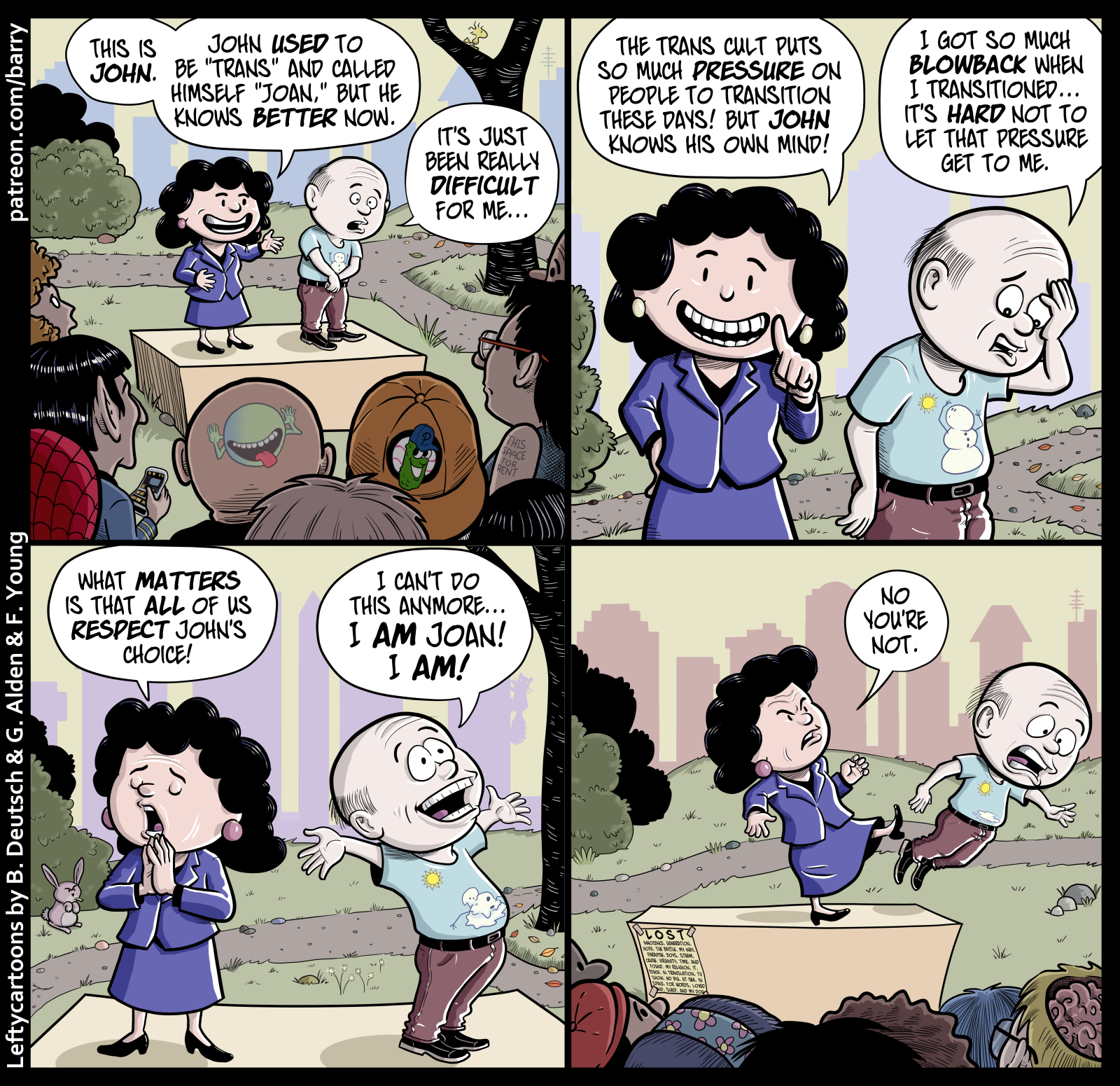
Cartoon: Respecting the Decision

by Ampersand


This cartoon was co-written by me and Grace, drawn by me, and colored by Frank Young.


Check out the timelapse drawing video for this cartoon! This one is fun because it includes Frank Young’s coloring process.


In 2019, Elisa Shupe, who at the time was detransitioning, was courted by the right-wing Christian group Family Policy Alliance. Spencer MacNaughton and Hope Pisoni report:

With an all-expenses-paid visit that included lodging at the five-star Ritz Carlton hotel, Shupe says she and her spouse received “rock star treatment” from Family Policy Alliance (FPA), the conservative Christian lobbying group hosting the event, who invited her to speak about her detransition.

Shupe, “attributes her decision to detransition… to a lack of family acceptance and her struggle with borderline personality disorder” – became a mouthpiece for the FPA’s anti-trans views and a witness they’d trot out to support anti-trans legislation. She became, in effect, an anti-trans activist – and her hands were held at every stage by anti-trans professionals who told her where to go and what to say.

Multiple of Shupe’s op-eds were written in collaboration with ADF. In one email, Roger Brooks, a senior counsel with the group, asked her to write an op-ed in support of the group’s lawsuit to overturn New York City’s ban on conversion therapy for gay and trans people. In the email, he offered points to raise in the proposed story, including that she was “horribly lied to and cheated” by doctors facilitating her transition. He also offered her writing support from ADF employees “familiar with the length and style that appeals to op-ed page editors.” Alliance Defending Freedom did not respond to a request for comment.

Shupe says that Bob Sullivan, an attorney who frequently liaised with ADF and planned to represent her in a medical malpractice lawsuit, helped craft her persona as a victim. In one email advising her on a potential autobiography, he said her story “could be modified to make it a quick-hitting intro into [her] nightmare of gender dysphoria.” He also discussed how they should strategically time the possible autobiography’s release “according to any litigation we pursue.”

(Sullivan says this was taken out of context.)

Unsurprisingly, Shupe was no longer welcome when she decided to transition after all.

Shupe faced a difficult journey after leaving this right-wing ecosystem. She says she has been harassed by her former right-wing allies and has had difficulty receiving medical care because of doctors’ fear of a media storm. …

MacKinnon says the weaponization of detransitioner stories by the far-right not only hurts trans people, but also detransitioners, making it harder for both groups to find the care that they need.

It is inevitable that people will detransition – no medical treatment has a 100% satisfaction rate. But 94% of trans people report being more satisfied with their life after transitioning.

People who detransition should have the help they need, and be treated with compassion. But they should not be taken as a reason to deny trans people medical and other help.

It’s also important to know that detransitioners aren’t a group mass-mind with a single story and motivation. People can detransition for a wide variety of reasons, including a lack of support and resources. From Transvitae:

Detransitioning is a nuanced and deeply personal process. While some individuals detransition because they were misdiagnosed or because they realize they are not transgender, many others do so due to external factors—social rejection, lack of access to proper medical care, family pressure, or discrimination. And, crucially, many who detransition do not regret transitioning but rather regret the circumstances that forced them to stop.

However, as I have witnessed in my work within the community, the Republicans and right-wing organizations hosting these events are not interested in this complexity. They have cherry-picked a small group of detransitioners—many of whom are professional activists funded by anti-LGBTQ+ groups—to push a narrative that gender-affirming care is dangerous, unnecessary, and should be banned for everyone.

People who transition – including the small minority who go on to detransition – need support and access to care. But what conservatives offer detransitioners is extremely conditional support that’s entirely dependent on willingness to be used as tools against trans people.


TRANSCRIPT OF CARTOON

This cartoon has four panels, all showing two people standing on a mini stage in a public park. A small crowd is watching them. The first speaker is a grinning woman in a business suit. The second speaker, “John,” is bald with short hair on the sides, wearing a t-shirt and slacks. John looks nervous and unhappy.

PANEL 1

WOMAN: This is John. John used to be “trans” and called himself “Joan,” but he knows better now.

JOHN: It’s just been really difficult for me…

PANEL 2

WOMAN: The trans cult puts so much pressure on people to transition these days! But John knows his own mind!

JOHN: I got so much blowback when I transitioned… It’s hard not to let that pressure get to me.

PANEL 3

The woman keeps talking with a pious expression. “John” – now Joan – is suddenly very happy, spreading her arms wide in a gesture of acceptance.

WOMAN: What matters is that all of us respect John’s choice.

JOAN: I can’t do this anymore… I am Joan! I am!

PANEL 4

The woman, looking angry, kicks a surprised Joan off the platform.

WOMAN: No, you’re not.

CHICKEN FAT WATCH

“Chicken fat” is what an earlier generation of cartoonists called extras we’d now call “Easter eggs.”

PANEL 1 – Woodstock from “Peanuts” is perched on a tree.

People watching in the audience include Little Orphan Annie, Mr. Spock, and Spider-Man. A bald person has the planet sticking its tongue out from “Hitchhiker’s Guide to the Galaxy” tattooed on their head. Someone else is wearing a cap for the Portland Pickles (a real minor league baseball team with a pickle for a mascot). A woman has “this space for rent” tattooed on her shoulder.

PANEL 3 – An evil bunny, smoking a cig, is in the background. Way in the background, a gigantic squirrel is climbing the side of a skyscraper.

PANEL 4 – Someone in the audience is missing the top of their head, and we can see their brain (a call-out to an earlier cartoon by Grace and I).

A flyer taped to the stage says “LOST!” in big letters. Below that, in lettering that’s almost too small to be read, it says “innocence, generation, hope, the battle, my way, paradise, boys, steam, cause, virginity, my religion, and found, time, it, touch, in translation, tv show, no big, at sea, in space, for words, loved and, sleep, and my dog.”

T SHIRT IN ALL FOUR PANELS: In panel one, Joan’s t-shirt shows a snowman. In panel 2, the snowman has turned to look at the sun. In panel 3, the snowman is melting. In panel 4, the shirt just shows the sun and some puddles.


Respecting The Decision | Patreon

15 Apr 00:35

baronfulmen:

15 Apr 00:35

You are the head of the agency. Where does the buck stop?

liberalsarecool:

You are the head of the agency. Where does the buck stop?

“I don’t know” is not a valid excuse when it’s your literal job to know. Total incompetence.

The DEI dog whistle is classic as unqualified RFK can’t figure out his own job description.

12 Apr 12:01

segamascott:

12 Apr 12:01

unashamedly-enthusiastic: punchholesinthesky:

12 Apr 12:00

this is an incredible map

tgirl-thucydides:

this is an incredible map

12 Apr 12:00

The Superhero

by admin

12 Apr 11:57

yesterdaysprint: The San Francisco Examiner, March 27, 1942


yesterdaysprint:

The San Francisco Examiner, March 27, 1942

12 Apr 11:57

Gifted and Talented

by admin

12 Apr 11:56

Pat Bagley

12 Apr 11:55

i keep thinking all the mars rovers are the size of a medium dog but i am wrong every single time

icantwritegood:

rslashrats:

rslashrats:

i keep thinking all the mars rovers are the size of a medium dog but i am wrong every single time

12 Apr 11:49

All of this is correct. No notes.

victusinveritas:

All of this is correct. No notes.

12 Apr 11:49

I am obsessed with this botched restoration of a 19th century statue of saint anthony

dyingdotorg:

taken-for-pomegranted:

momo-de-avis:

I am obsessed with this botched restoration of a 19th century statue of saint anthony

Look at how yassified he is

St Cunthony of Servington

@apocrypals

26 Mar 03:36

Liberation Day Delay

by Shakezula
Freight ships at a port.

Turns out punitive tariffs are a lot harder than they sound. Especially when targeted countries can and do say “No. Fuck you.

A White House official told CNN that no final decision have been made, and tariffs on various sectors and industries may or may not be announced April 2.

Reciprocal tariffs will go into effect – perhaps as soon as April – but they will be limited to a dozen or so countries, Bloomberg and the Journal reported. The countries that first face the reciprocal tariffs will perhaps be the 15% of nations that Treasury Secretary Scott Bessent, speaking on Fox Business last week, labeled “the Dirty 15” – countries that he says persistently treat the United States unfairly in their trading practices.

Unfairly in this case means expecting payment in a timely fashion. And what’s with not sending Glump stacks of cash as tribute?

Those trading partners could include Australia, Brazil, Canada, China, the European Union, India, Japan, South Korea, Mexico, Russia and Vietnam, according to the Journal.

You know they aren’t going to do anything to Russia. And I doubt being called PATHETIC free-loaders who need to pay for some bomb dropping theatrics will make EU nations feel cooperative.

You can read summaries of U.S. imports and exports to other nations here. At least until someone decides the mention of all those African, Central and South American and Asian nations is too diverse. Tl;Dr: more comes in than goes out.

Although tariffs on those partners could cover the majority of goods coming into the United States, the more targeted approach nevertheless represents a significant pullback from some of the harshest tariffs Trump had promised.

However, Trump signaled that if tariffs on various products are delayed, they won’t be delayed for very long.

“We need steel, we need pharmaceuticals, we need aluminum, we need a lot of these things that we sort of don’t make anymore, and yet we’re equipped to do it all,”

We are not so equipped. We never were so equipped and Republicans have spent decades making sure we’re even less equipped. However, it was inevitable that the Republicans would produce a president so dense that he appears to believe that U.S. industry circa The Goode Olde Dayes will return if dudes who look like Marlboro men on the verge of a HGH overdose throw knife switches in some abandoned factories. To say nothing of the multi-front War on Knowledge that further reduces our ability to do shit.

At any rate. Look for more gibberish in the not long future.

Trump said Monday at the conclusion of a Cabinet meeting. “So we’ll be announcing some of these things in the very near future – not the long future. The very near future.”

I’m sure someone, somewhere thinks this mumbling and fumbling is sign of Dumps genius rather than more signs that drug abuse and the early stages of dementia just don’t mix.

The post Liberation Day Delay appeared first on Lawyers, Guns & Money.

26 Mar 03:35

The cover up is even dumber than the crime

by Scott Lemieux

It’s hilarious that this is the cover story they’re going with:

absolute insanity as Mike Waltz suggests Jeffrey Goldberg somehow deliberately hacked his way into the Signal group

[image or embed]

— Aaron Rupar (@atrupar.com) March 25, 2025 at 4:10 PM

“We didn’t invite him in voluntarily, he just hacked it the app we’re using illegally on our private phones.” Uh, OK then!

Trump is only president today because the political press determined that Hillary Clinton not wanting to use two BlackBerries was a scandal of roughly Watergate-level importance.

The post The cover up is even dumber than the crime appeared first on Lawyers, Guns & Money.