

Plants in temperate climates tend to have leaves with serrated margins, i.e. they have jagged edges; plants in warmer and more humid climates tend to have what are known in botanical jargon as entire margins, that is, smooth and unserrated. The difference is illustrated in the photographs.More at the link (and source credit for the graph). That article didn't address the question of "why." I found some related discussion in a Smithsonian article about fossilized leaves:
Rather than there being a sharp cut-off between the temperate and tropical styles of leaves, there is a continuous relationship between the climate and the mix of leaf types found in it: that is, as the climate gets a little hotter and wetter, the proportion of entire margins increases a little. This means that looking at a single leaf doesn't tell us that we are looking at a temperate or tropical climate; butlooking at a whole lot of species will allow us to do something a whole lot better than simply dividing climates into tropical or temperate: we can actually estimate the average annual temperature.
We can establish by observation that the ratio of temperate to tropical leaf styles is a surprisingly good indicator of average annual temperature, as illustrated by the graph [right], showing the relationship between floras and temperature in the forests of East Asia.
Scientists are still trying to understand the exact basis for this relationship, but they think it’s because plants in colder climates need to get a jump-start on converting sunlight to energy (photosynthesis) in the spring. Having more teeth enables more water to move out of the leaves, increasing the flow of sap and ramping up photosynthesis. This is important if you need to start photosynthesizing lots of food quickly, say because you only have a brief growing season before the cold comes. If you’re in a warm climate though, jagged edges do more harm than good: losing water can be dangerous to the leaf and to the whole plant, especially when it’s hot. This set of tradeoffs makes one leaf shape more favorable (and thus more predominant) at certain temperatures.
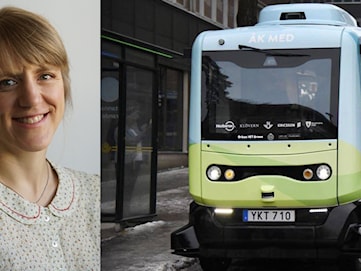
Anna Pernestål Brenden, forskare på Kungliga Tekniska Högskolan, har varit med och testat fram bussar utan förare.
Lyssna: Snart kan du åka buss utan förare.
Skulle du våga åka med en buss som kör av sig själv?
Snart kan du göra det i Järfälla - utanför Stockholm.
Där ska bussar som inte har någon förare snart börja köra i trafiken.
Så vi här i Sverige blir först i Europa med såna här bussar,
utan förare som kör i trafiken.
Bussarna kommer att åka ganska sakta, och elva passagerare kan åka med.
Anna Pernestål Brenden är forskare på Kungliga Tekniska Högskolan och har varit med att testa bussarna.
Hon berättar hur de fungerar:
– Bussarna har ingen ratt och ingen gaspedal, utan de kör helt själva med hjälp av datorer som finns ombord. Och för att hitta rätt har bussarna kört den sträcka som de ska köra redan och lärt sig.
– Till att börja med så kommer bussarna att stanna vid hållplatser som man har programmerat in. Men längre fram i testet planerar vi att testa hur det fungerar att man kan stanna bussen till exempel genom att använda en app i telefonen.
– En anledning till att bussarna är bättre är ju att de blir ytterligare säkrare än när det är en människa som kör, eftersom en dator aldrig är trött eller okoncentrerad, utan hela tiden är uppmärksam på vad som händer runt omkring den.

Despite LEGO bricks being bricks, sometimes building realistic walls is the hardest thing to do. Isaac Synder‘s latest Castle-themed creation does exactly that, employing a parts-intensive and fiddly technique to create a lovely brick texture with well-defined lines between the stonework. It creates the effect of weathered masonry, and adds real texture and character to the building. I also like the formal square base, and think the angle chosen for the photography coupled with the colour scheme make this look like something from one of the classic isometric realtime strategy games like Age Of Empires or The Settlers. Great stuff.

Even better, the building has an interior — a textile shop complete with rolls of fabric on display…

The post Modern methods for ancient masonry appeared first on The Brothers Brick.
.png)
Hovertext:
Thanks to my patreon geeks for correcting an earlier version of this comic!

This image shows a portion of 67P/C-G as viewed by Rosetta on 22 September 2014, only one and a half months after the spacecraft had made its rendezvous with the comet. At the time, the spacecraft was 28.2 km from the comet centre (around 26.2 km from the surface). Amateur astronomer Jacint Roger Perez, from Spain, selected and processed this view by combining three images taken in different wavelengths by the OSIRIS narrow-angle camera on Rosetta.More at the ESA website.
Seen in the centre and left of the frame is Seth, one of the geological regions on the larger of the two comet lobes, which declines towards the smoother Hapi region on the comet’s ‘neck’ that connects the two lobes. The landscape in the background reveals hints of the Babi and Aker regions, both located on the large lobe of 67P/C-G. For a wider image of this region in the overall context of the comet see here.
The sharp profile in the lower part of the image shows the Aswan cliff, a 134 m-high scarp separating the Seth and Hapi regions. Observations performed by Rosetta not long before the comet’s perihelion, which took place on 13 August 2015, revealed that a chunk of this cliff had collapsed – a consequence of increased activity as the comet drew closer to the Sun along its orbit.
If you’re a fan of Hayao Miyazaki films, then this LEGO creation inspired by the 2001 release Spirited Away by Chris Xenyo will be instantly recognizable. These little fuzzy-looking critters, known as soot sprites, or Susuwatari are formed from soot, and they can lift things much heavier than themselves. Without a job to keep them busy, they sometimes revert back to soot.

Even though the model is fairly simple, the attention to detail, from the spiny look (made from black levers) to the thin and spindly arms and legs (made from flexible tubing) is very accurate to its on-screen inspiration. Even the background which includes the tiny tunnels where the Susuwatari makes their homes, and the wooden platform that borders their path to the furnace, make this scene jump straight out of the movie.
The post LEGO soot sprite from Spirited Away will warm your heart appeared first on The Brothers Brick.
From 1972 through 1994, Ford marketed the Granada (not to be confused with the U.S. Granada, which is a different vehicle) as a an executive car for the British market. Mateusz Waldowski built this slick LEGO version of a 1977 Granada MK1 station wagon, and it looks well-suited for any minifigure family vacation. In terms of accuracy, Mateusz has done a great job of capturing the overall shape of the vehicle. The grille is spot-on, and the five-wide half-stud offset technique used for the upper half of the vehicle helps emulate the subtle slant of the window pillars.

Mateusz put a lot of effort into detailing his station wagon, and the end result is enjoyable. It sports windshield wipers, a top-mounted luggage rack, clever door handles, and even custom chrome trim (represented by strips of silver decals). Another enjoyable feature is the tilt to the front wheels, which helps create the impression of steering. I almost want to take this adorable wagon on an overnight camping trip!

The post Straight out of the ’70s, this classic wagon is “groovy.” appeared first on The Brothers Brick.

First proposed by the American physicist Gerard O’Neill in the 70s, an O’Neill Cylinder is a large tube, pressurised with an atmosphere, and spinning to create artificial gravity. The hull features alternating strips of “land” and transparent windows, allowing sunlight to be reflected inside from large mirrors. The cylinder has become an iconic design, familiar from a raft of TV, movie, and videogame depictions of mankind’s future. Ralf Langer has built a beautiful LEGO version of an O’Neill-based space colony, using microscale to ensure his space settlement features fields and trees, flowing rivers, and towering cities. The rings supporting the curved land panels have technical-looking greebles, and the entire creation looks much bigger than it really is. This is epic LEGO sci-fi, depicting a future I’d love to see.

The post Our future lies amidst the stars, in a LEGO O’Neill Cylinder appeared first on The Brothers Brick.

Hovertext:
Somehow, unintentionally, it turned into AI week at SMBC.


Read more of this story at Slashdot.

Hovertext:
Emails about the inaccuracy of the spidurkey's body type will be met with pointedly lengthy sighs.

Hovertext:
And in this nihilistic hellscape we inhabit, I have ordered double-pineapple on my pizza.
LEGO has announced it is going green with the re-release of an old fan-favorite set currently owned by very few: the 10268 Vestas Wind Turbine. The original set (numbered 4999) was released a decade ago as a limited production run for Vestas, a sustainable energy company, and never saw wider availability. That changes on Black Friday.

Following in the path of the last year’s re-released 10256 Taj Mahal, LEGO is “opening the vault” once again with a slightly updated rendition of the Creator Expert Vestas Wind Turbine. The set comes with 826 pieces (11 more than the first version), three minifigures, a dog, and Power Functions motor and lights, as well as the first spruce tree element made from plants available in a retail set.
The set is slightly more than three feet tall (one meter) and will retail at $199.99 USD from LEGO (coming in at $249.99 CA and £159.99 UK respectively). It will be available for purchase by everyone starting Friday, November 23 (also known as Black Friday).


The set is a near-identical replica of its first rendition, including the rotating white wind turbine with aircraft warning lights, a red cottage with working porch light, green wooded hills in the back, and a Vestas service van.

Tim Brooks, Vice President of Environmental Responsibility for LEGO, told TBB that the company is “striving to make a positive impact on the environment and is committed to climate action and to use sustainable materials in products and packaging.” The Creator Expert Vestas Wind Turbine is literally bringing that ambition to life by celebrating renewable energy and including plant-based elements.


The service van is a straightforward rendition, evoking nostalgia of simpler times with boxy vehicles. Most notably, all the Vestas logos in the entire set are printed this time around, rather than created with stickers like the first version.
 The set comes with two Vestas servicemen (this time sporting blue safety helmets instead of red) with printed torsos (rather than stickers), and a smiling woman with even more plants printed on her torso. A dog is also included.


Like the first version, the wind turbine set comes with a Power Function medium motor, battery box, lights and two new extension cords. All the cables are expertly hidden in the final build.


Looking at elements of note, the set comes with a green “BURP” (Big Ugly Rock Piece), which many builders will be excited about since that piece has only ever been available in the previous version of the set and currently retails for around $10 each on the secondary market. The set also includes a 32×32 green baseplate, only recently available in 10255 Assembly Square.

In real life, Vestas has installed more than 65,000 wind turbines in around 80 countries, dwarfing the initial limited run of the LEGO version. Morten Dyrholm, Vestas Group Senior Vice President, told TBB that the original LEGO model “was specially created for Vestas to promote wind energy to a small audience” but that the company is excited for the broad re-launch of the set to “tell the story of how wind energy has gone from niche to mainstream.”

The Brothers Brick will have a full review of the Creator Expert 10268 Vestas Wind Turbine in the coming weeks. In the meantime, you can read the full product press release and see the complete photo gallery below.
10268 Vestas® Wind Turbine
Ages 12+. 826 pieces
US $199.99 – CA $249.99 – DE 179.99€ – UK £159.99 – FR 179.99€ – DK 1499DKK
Build and discover the iconic Vestas® Wind Turbine!
Celebrate green energy innovation with the LEGO® Creator Expert 10268 Vestas® Wind Turbine. Developed in partnership with Vestas, this detailed, motorized LEGO model captures the elegance and graceful movement of a traditional wind turbine and features a new-for-January 2019 spruce tree, manufactured from sustainably sourced plant-based plastic. At approximately 39” (1m) high, the structure towers above a wooded hill and a house with furnished patio, mailbox, flowers and a white picket fence. Turn the nacelle left or right and switch on the included Power Functions motor to rotate the adjustable wind turbine blades and illuminate the cottage’s porch light. This collectible model has been designed to provide a challenging and rewarding building experience with a touch of nostalgia and makes a great display piece for the home or office. This big LEGO set also includes a Vestas service vehicle and 3 minifigures: 2 Vestas service technicians kitted out with safety helmets and a woman, plus a dog figure.
Available directly from LEGO Stores & shop.LEGO.com starting on the 23rd of November 2018.


The post LEGO opens vault to re-release 10268 Vestas Wind Turbine on Black Friday [News] appeared first on The Brothers Brick.
As the month of September draws closer to an end, so too, the month-long annual epic that is SHIPtember. The challenge of building a spacecraft that measures at least 100 studs in any direction (AKA a SHIP) in a single month is no easy accomplishment. One of the most critical aspects of a good SHIP is its structural frame, requiring careful crafting to keep the vessel from falling apart under its own weight without looking too bulky or boxy. This ship by Chris Perron is a great example of this balance, combining form with industrial function. Another hallmark of the SHIPtember shipyard comes from making use of parts not typically thought of as spaceship parts, like the trapezoidal orange dump truck ends so expertly used by Chris to form the hexagonal sections along the fuselage. Another great detail are the flat gold flanges in front formed by angled tiles.

The post One Stellar LEGO SHIP appeared first on The Brothers Brick.

Hovertext:
Statistically, if all humanity became family, we'd be substantially more likely to commit homicide against each other.
Norins is quick to cite sources and studies supporting his claim, among them a 2010 study published in the Journal of Neurosurgery showing that neurosurgeons die from Alzheimer's at a nearly 2 1/2 times higher rate than the general population.
Another study from that same year, published in The Journal of the American Geriatric Society, found that people whose spouses have dementia are at a 1.6 times greater risk for the condition themselves.
Contagion does come to mind. And Norins isn't alone in his thinking. In 2016, 32 researchers from universities around the world signed an editorial in the Journal of Alzheimer's Disease calling for "further research on the role of infectious agents in [Alzheimer's] causation." Based on much of the same evidence Norins encountered, the authors concluded that clinical trials with antimicrobial drugs in Alzheimer's are now justified...
Tanzi believes that in many cases of Alzheimer's, microbes are probably the initial seed that sets off a toxic tumble of molecular dominoes. Early in the disease amyloid protein builds up to fight infection, yet too much of the protein begins to impair function of neurons in the brain. The excess amyloid then causes another protein, called tau, to form tangles, which further harm brain cells.
But as Tanzi explains, the ultimate neurological insult in Alzheimer's is the body's reaction to this neurotoxic mess. All the excess protein revs up the immune system, causing inflammation — and it's this inflammation that does the most damage to the Alzheimer's-afflicted brain...
Remember when we thought ulcers were caused by stress?" Ulcers, we now know, are caused by a germ.

On my iPhone 5, I noticed it “chirped” that it was plugged in while already plugged in. After narrowing down the possible maneuver to cause this to happen, I noticed that my Lightning cable had a bit of play in it, but only going to the right. If pushed right, it would stop charging, pushed back it would resume charging...I had asked the Apple tech about using compressed air at home, as I do with the keyboard, but she suggested a brush tends to work better. My search also revealed that "dust plugs" are available.
In the past with my iPods and iPhones, there was a bit of lint build up, but it often fell out. It seems with the Lightning Connector, plugging a cable in smashes the lint even deeper in the phone and I had some nasty buildup. I’ve used compressed air before, but it didn’t seem to really remove much. I used an unbent small paperclip to carefully scrape the inside of the port, avoiding the actual pins (do this at your own risk), and was amazed the amount of things that I was able to pull out.

The first time I made breakfast burritos the way I like them — that is, the eggs softly scrambled and never dry, busy with vegetables, and nothing terrifying like hot, wet lettuce inside, second only to eating them in front seat of your car in an Austin parking lot on a chilly morning, a Topo Chico in the cup holder (i.e. maybe not exactly the way I like them, but real life requires compromises, or so you adults keep telling me) — I felt woundingly betrayed. It seemed like every cooking website on the internet made them seem so simple, but there I was with separate skillet-fuls of bacon and greens and mixed vegetables and eggs, and then more bowls than I could count for assembly. We were going to have them for an “easy” breakfast-for-dinner that night; dinner was spectacularly late and everyone was hangry and ate my 90 minutes of prep in less than 5, further insult to injury. Never again, I vowed, never.

Miguel Anxo Fernández Lores has been mayor of the Galician city since 1999. His philosophy is simple: owning a car doesn’t give you the right to occupy the public space.Details at The Guardian.
“How can it be that the elderly or children aren’t able to use the street because of cars?” asks César Mosquera, the city’s head of infrastructures. “How can it be that private property – the car – occupies the public space?”
Lores became mayor after 12 years in opposition, and within a month had pedestrianised all 300,000 sq m of the medieval centre, paving the streets with granite flagstones. “The historical centre was dead,” he says. “There were a lot of drugs, it was full of cars – it was a marginal zone. It was a city in decline, polluted, and there were a lot of traffic accidents. It was stagnant. Most people who had a chance to leave did so. At first we thought of improving traffic conditions but couldn’t come up with a workable plan. Instead we decided to take back the public space for the residents and to do this we decided to get rid of cars.”
They stopped cars crossing the city and got rid of street parking, as people looking for a place to park is what causes the most congestion. They closed all surface car parks in the city centre and opened underground ones and others on the periphery, with 1,686 free places. They got rid of traffic lights in favour of roundabouts, extended the car-free zone from the old city to the 18th-century area, and used traffic calming in the outer zones to bring the speed limit down to 30km/h.