Shared posts

22 Jul 18:22

Hard Case

by submission

Author : Bob Newbell

The passport control agent looks at me and sighs. “Another one,” he says succinctly. His use of “one” rather than the epithet “shellhead” probably has little to do with concern that I might be offended. The woman in front of me got a “Have a nice day” from the man. I get a jerked thumb over his left shoulder to indicate I can proceed.

I’ve gotten used to it. I received a similar reception at Bradbury Station. It wasn’t always like this. Ten years ago, right after I got shelled, the reaction I and the small number of people who had undergone the procedure got tended to be more curiosity than jealously and bigotry.

“Can you feel anything?” a skinny twentysomething on the RFS Valentina Tereshkova had asked me nine years earlier.

“Yes,” I’d told the young Russian. “There are sensors that feed into transducers that connect to my nerve endings. Everything feels a bit different from what skin feels. But, yes, I still have sensation.”

“So, you can feel everywhere? And, uh, everything…works?”

I’d smiled. “Everything works,” I’d said.

Shelling was novelty back then. The first patients who underwent the procedure had nanocomposite plates glued to their skin. In addition to being impractical and dysfunctional, they looked like early sci fi movie robots. Astronautical physicians soon realized that replacing the skin itself with a microtessellated armor was the only viable solution. It can flex and distend as well as human skin and it solved an important problem: cancer.

In the 2160s, significant numbers of people started migrating beyond Earth orbit to the Moon and Mars and the Lagrange V station. Outside of the protection of Earth’s geomagnetic field, solar and cosmic radiation caused cancer rates among space travelers to be seven to ten times that of their terrestrial peers. Trying to protect off-world settlements and ships with massive shielding or high-powered EM fields proved to be expensive and difficult. It was noted that travelers who spent more time in their spacesuits tended to have lower cancer rates. But suits are cumbersome. A more intimate solution was required.

“What have you done to yourself?!” my mother had said to me when I first saw her after my shelling. My uniformly gray skin with its subtle sheen made me some kind of a freak in her eyes.

“My job keeps me in space most of the time,” I’d explained. “If you can’t go outside the Van Allen Belt for any length of time you can’t advance your career.” After that afternoon, we didn’t talk again for nearly three years. And even to this day, things aren’t like they used to be between us.

“Welcome to Amazonis Planitia!” says a cheerful voice that snaps me out of my reverie. The voice comes from a smiling black man who extends his hand as he walks up to me. But the man’s coloration is not that of a person representing the darker hued races of the human species. I see my reflection in his ebony shell as he pumps my hand. His features and accent are Chinese.

“Dr. Cheng? Sorry if I was a bit distracted. I got a somewhat chilly reception upon arriving here.”

“From the 软壳,” he says. The term he uses sounds roughly like “ruan ke”. He notes my confusion. “The ‘soft shells’,” he reiterates. “An impolite term, perhaps, but one that is catching on.”

“Guess they don’t like us too much.”

“They don’t like what we represent: a higher level of commitment to be out here. Our resolve is more than skin deep.”

Discuss the Future: The 365 Tomorrows Forums
The 365 Tomorrows Free Podcast: Voices of Tomorrow
This is your future: Submit your stories to 365 Tomorrows

19 Jul 15:00

Behold Ragnarök

by Jae Miles

Author : Jae Miles, Staff Writer

There is an unacknowledged transcript of the end of Twentieth Fleet. It surfaced a few years after the event that removed a small star system at the far edge of the Milky Way from existence in a flash of glorious colours and strange radiation.
We suspect that the lost system contained the origin planet of Homo sapiens, our predecessors, but as data transfer is notorious for inherent corruption, we cannot state with certainty from the records we have left.
Why exactly this transcript remains unacknowledged is a puzzling thing, because it hints at a starfaring race of immense antiquity and divergent technologies.
But I am not here to draw conclusions. I am here to disseminate the transcript so greater minds than mine can do that.

The last transmission of the Assault Cruiser Hyperdyne, as transcribed by the deadfall recording array in the quadrant monitoring station at Upervant:

“It looked like a short-handled sledgehammer!”
“Did it go through the Hyperdyne’s stellar drive before or after the enormous lupine entity appeared and ate your escorts?”
“After. The being named Azbragh who appeared did apologise – he had been aiming at the lupine entity, which he named a ‘Fenreer’. He set off after it when I told him our ship was doomed anyway.”
“That was when you long range sensors detected the silver missile with prismatic drive emissions?”
“No, that was when we saw a giant metallic serpent wrapping itself around a rainbow-hued freespace edifice of some kind.”
“Really? Very well. You moved to investigate, I presume?”
“No sir, we did not. There were too many freespace entities of types similar and dissimilar to Azbragh appearing and engaging in pitched battle with unknown energy technologies and primitive melee weapons.”
“In your opinion, were they similar to any previously encountered group, or even historical reports like those about the Olympus Theocracy?”
“I would agree a similarity between accounts of the Theocracy’s Guardforms and the Fenreer, sir. Apart from that, these beings seemed to be completely novel alien forms.”
“And this Azbragh being returned to warn you?”
“Yes. He looked to be badly wounded on his second visit.”
“And as you completed the withdrawal, the entire planetary system collapsed in upon itself?”
“Yes. There were some odd visual effects, like a great tree of lightning connecting the planets and such, but there were no adverse gravitational effects, which we expected from proximity to what we assumed to be a nascent black hole.”
“Your current status?”
“We appear to have suffered some unquantifiable irradiation, sir. Hallucinations and deliria are getting worse. I regretfully recommend that you write the Twentieth off and place this sector under ban.”

It is recorded that the Hyperdyne was lost to a ‘catastrophic stellar drive malfunction’; the aberrant drive field emitted by that moment inducing a detrimental resonance effect with the rest of Fleet Twenty’s stellar drives, causing them to detonate in a freakish chain reaction. No record of the Twentieth Fleet’s actual co-ordinates when this catastrophe occurred is available.

Discuss the Future: The 365 Tomorrows Forums
The 365 Tomorrows Free Podcast: Voices of Tomorrow
This is your future: Submit your stories to 365 Tomorrows

18 Jul 20:58

Along It Came

by submission

Author : Jake Teeny

When the first signs of alien life came, no one, of course, believed them. It took nearly every scientist from nearly every science to confirm that it was true:

Another form of life, on a planet other than our own was speaking to us.

Certainly there were doubters, as there are regardless of unanimity. But for the majority who believed that it was true, myriads of emotions shifted through them.

Rejoice. We are not alone!

Our God would not allow…

What does this mean for my children’s children?

The top analysts in cryptography from all across the world assembled to decipher the message, and with quiet breath, the world waited.

Every pundit with a camera had his or her most rational prediction. Water cooler chitchat. Late night whispers.

And then, one day, it happened.

At first, we only knew that there was some kind of disagreement between the code-breakers. A division. Seventy-two hours of heated debate.

But on a solemn day in late September, the lead analyst on the team held a press conference:
A warning. The message we had intercepted was a warning.

The extraterrestrial language had proved much more complex than ever possibly conceived. But as they augmented their understanding, an onyx message emerged:
They came for us. They’ll come for you.

The words that set fire to the globe as terror—seized—the world.

But after the shock, quick came denial. Surely they’d just read it wrong. Science’s made mistakes before. But as more of the alien tongue was unraveled, the certainty only cemented:
They came for us. They’ll come for you.

Within months, there wasn’t a news station talking about the amassing of weaponry. And as the ballooning power of nations was made aware, a subtle tension of wild destruction ensued.

One snap of a twig, and the world could crumble.

But humanity’s most superordinate category is human, and together, peace passed between brothers and sisters. The world.

It was one.

In unity, we waited. And waited. The communion between people did not falter, but the fear, admittedly, became less acute. And we waited. And waited. And waited. It seemed pointless to have all the weaponry divided, when we only had one foe. And we waited. In a single, world-shared bunker, all of humans’ capabilities for violence were harbored. And we waited. And waited.

And waited.

There came a time, when people tell stories of how there had once been a thing such as passports and wars. For left with only that single message from the aliens, we inevitably began to think, Well, now what?

To this day, there is speculation as to whether the intercepted message was the most elaborate scheme in human history. Fabricate a binding enemy, unite the disparate clans. And to this day, the scientists heartily deny it.

All the data’s there. Go and have a look right for yourself.

But even if you question, even if you doubt, the world’s a better place no matter how it turned out.

Discuss the Future: The 365 Tomorrows Forums
The 365 Tomorrows Free Podcast: Voices of Tomorrow
This is your future: Submit your stories to 365 Tomorrows

12 Jul 15:04

Spying on the Internet is Orders of Magnitude More Invasive Than Phone Metadata

by Micah Lee

When you pick up the phone, who you’re calling is none of the government’s business. The NSA’s domestic surveillance of phone metadata was the first program to be disclosed based on documents from whistleblower Edward Snowden, and Americans have been furious about it ever since. The courts ruled it illegal, and Congress let the section of the Patriot Act that justified it expire (though the program lives on in a different form as part of the USA Freedom Act).

Yet XKEYSCORE, the secret program that converts all the data it can see into searchable events like web pages loaded, files downloaded, forms submitted, emails and attachments sent, porn videos watched, TV shows streamed, and advertisements loaded, demonstrates how Internet traffic can be even more sensitive than phone calls. And unlike the Patriot Act’s phone metadata program, Congress has failed to limit the scope of programs like XKEYSCORE, which is presumably still operating at full speed. Maybe Verizon stopped giving phone metadata to the NSA, but if a Verizon engineer uploads a spreadsheet full of this metadata without proper encryption, the NSA may well get it anyway by spying directly on the cables that the spreadsheet travels over.

The outrage over bulk collection of our phone metadata makes sense: Metadata is private. Americans call suicide prevention hotlines, HIV testing services, phone sex services, advocacy groups for gun rights and for abortion rights, and the people they’re having affairs with. We use the phone to schedule job interviews without letting our current employer know, and to manage long-distance relationships. Most of us, at one point or another, have spent long hours on the phone discussing the most intimate details about our lives. There isn’t an American alive today who didn’t grow up with at least some access to a telephone, so Americans understand this well.

But Americans don’t understand the Internet yet. Bulk collection of phone metadata is, without a doubt, a violation of your privacy, but bulk surveillance of Internet traffic is orders of magnitude more invasive. People also use the Internet in all the ways they use phones — often inadvertently sharing even more intimate details through online searches. In fact, the phone network itself is starting to go over the Internet, without customers even noticing.

XKEYSCORE, as well as NSA’s programs that tap the Internet directly and feed data into it, have some legal problems: They violate First Amendment rights to freedom of association; they violate the Wiretap Act. But the biggest and most obvious concerns are with the Fourth Amendment.

The Fourth Amendment to the U.S. Constitution is short and concise:

The right of the people to be secure in their persons, houses, papers, and effects, against unreasonable searches and seizures, shall not be violated, and no Warrants shall issue, but upon probable cause, supported by Oath or affirmation, and particularly describing the place to be searched, and the persons or things to be seized.

It means that Americans have a right to privacy. If government agents want to search you or seize your data, they must have a warrant. The warrant can only be issued if they have probable cause, and the warrant must be specific. It can’t say, “We want to seize everyone’s Internet traffic to see what’s in it.” Instead, it must say something like, “We want to seize a specific incriminating document from a specific suspect.”

But this is exactly what’s happening:

The government is indiscriminately seizing Internet traffic to see what’s in it, without probable cause. The ostensible justification is that, while tens of millions of Americans may be swept up in this dragnet, the real targets are foreigners. In a legal document called USSID 18, the NSA sets out policies and procedures that purportedly prevent unreasonable searches of data from U.S. persons.

But it doesn’t prevent, or even claim to prevent, unreasonable seizures.

Kurt Opsahl, general counsel of the Electronic Frontier Foundation, explains: “We have a fundamental disagreement with the government about whether [data] acquisition is a problem. Acquisition is a seizure and has to be compliant with the Fourth Amendment.”

If you read USSID 18 carefully, you’ll see that it appears to limit, with many exceptions, the government’s ability to intentionally collect data concerning U.S. persons. But the Department of Defense, under which the NSA operates, defines “collection” differently than most of us do. It doesn’t consider seized data as “collected” until it’s been queried by a human.

If you email your mom, there’s a good chance the NSA will intercept the message as it travels through a fiberoptic cable, such as the ones that make up the backbone of the Internet, eventually making its way to an XKEYSCORE field site. You can thwart this with encryption: either by encrypting your email (hopefully someday all parents will know how to use encrypted email), or by using email servers that automatically encrypt with each other. In the absence of such encryption, XKEYSCORE will process the email, fingerprint it and tag it, and then it will sit in a database waiting to be queried. According to the Department of Defense, this email hasn’t been “collected” until an analyst runs a query and the email appears on the screen in front of them.

When NSA seizes, in bulk, data belonging to U.S. citizens or residents, data that inevitably includes information from innocent people that the government does not have probable cause to investigate, the agency has already committed an unconstitutional “unreasonable seizure,” even if analysts never query the data about innocent U.S. persons.

The NSA has legal justifications for all their surveillance: Section 215 of the Patriot Act, now expired, was used to justify bulk collection of phone and email metadata. Section 702 of the Foreign Intelligence Surveillance Act (FISA) is currently used to justify so-called “upstream” collection, tapping the physical infrastructure that the Internet uses to route traffic across the country and around the world in order to import into systems like XKEYSCORE. Executive Order 12333, approved by President Reagan, outlines vague rules, which are littered with exceptions and loopholes, that the executive branch made for itself to follow regarding spying on Americans, which includes USSID 18.

But these laws and regulations ignore the uncomfortable truth that the Fourth Amendment requires surveillance of Americans to be targeted; it cannot be done in bulk. Americans are fighting to end bulk surveillance in dozens of lawsuits, including Jewel v. NSA, which relies on whistleblower-obtained evidence that NSA tapped the fiber optic cables that carry Internet traffic in AT&T’s Folsom Street building in San Francisco. It’s easy for the government to stall cases like this, or get them dismissed, by insisting that talking about it at all puts our national security at risk.

And, of course, let’s not forget the 6.8 billion people on Earth who are not in the United States. Article 12 of the U.N. Declaration of Human Rights states:

No one shall be subjected to arbitrary interference with his privacy, family, home or correspondence, nor to attacks upon his honour and reputation. Everyone has the right to the protection of the law against such interference or attacks.

The NSA has very few restrictions on spying on non-Americans (it must be for “foreign intelligence” or “counterintelligence” purposes, and not other purposes), despite XKEYSCORE and the bulk collection programs that feed it being an “arbitrary interference” with the privacy of such persons. NSA doesn’t even have restrictions on spying on allies, such as Germany and France.

Facebook feeds everywhere are decorated with baby pictures. When those babies are grown up and getting elected to Congress, maybe then Americans will understand how the Internet works, and that bulk surveillance of phone metadata is just a tiny sliver of the enormous “collect it all” bulk surveillance pie.

Photo: Getty

The post Spying on the Internet is Orders of Magnitude More Invasive Than Phone Metadata appeared first on The Intercept.
09 Jul 15:53

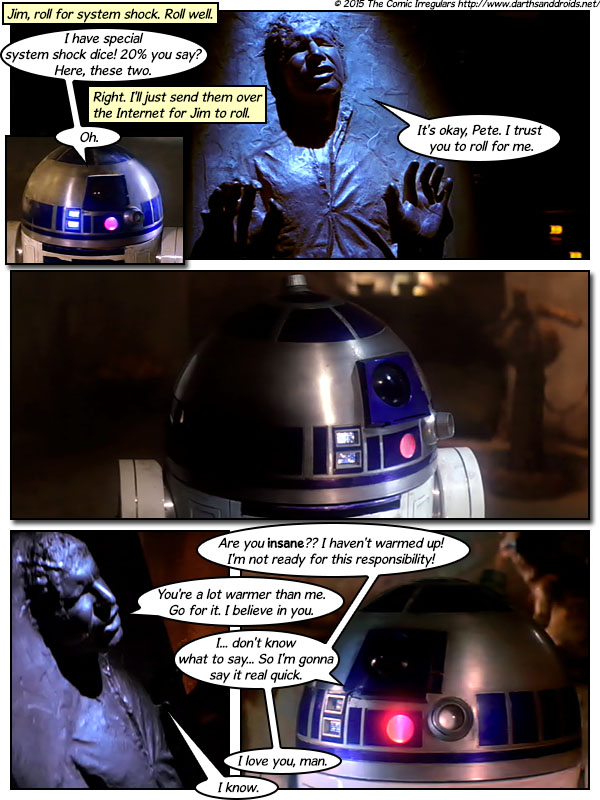
Episode 1220: Shock and Roll

Episode 1220: Shock and Roll

Normally roleplayers wouldn't let anyone else make a dice roll for them, doubly so a critical roll such as this. But extreme circumstances sometimes dictate equally extreme measures.

09 Jul 14:34

MeFi: Inside JFK's amazing, abandoned TWA terminal

by SpookyFish
A pristine time capsule from 1962. Stunning pictures and video from this classic terminal, designed by famed Finnish architect Eero Saarinen. [via]

JetBlue has been working with the Port Authority with the intent to turn it into a boutique hotel.
09 Jul 03:18

Ultimate guided meditation video

by Rob Beschizza

[unable to retrieve full-text content]

Join with your inner stillness, where those fucks can't get under your skin with all their horseshit.

waves

08 Jul 23:02

Today’s Civilian Victims in Yemen Will be Ignored Because U.S. and its Allies Are Responsible

by Glenn Greenwald

In Fayoush, Yemen this morning, just outside of Aden, “a massive airstrike” hit a marketplace and killed at least 45 civilians, wounding another 50. Officials told the AP that “bodies were strewn about following the strike.” The bombing was carried out by what is typically referred to as a “Saudi-led coalition”; it is rarely mentioned in Western media reports that the U.S. is providing very substantial support to this “Saudi-led” war in Yemen, now in its fifth month, which has repeatedly, recklessly killed Yemeni civilians.

Because these deaths of innocents are at the hands of the U.S. government and its despotic allies, it is very predictable how they will be covered in the U.S. None of the victims will be profiled in American media; it’ll be very surprising if any of their names are even mentioned. No major American television outlet will interview their grieving families. Americans will never learn about their extinguished life aspirations, or the children turned into orphans, or the parents who will now bury their infants. There will be no #FayoushStrong Twitter hashtags trending in the U.S. It’ll be like it never happened: blissful ignorance.

This is the pattern that repeats itself over and over. Just see the stone-cold media silence when President Obama, weeks after winning the Nobel Peace Prize, ordered a cruise missile strike in Yemen, complete with cluster bombs, which ended the lives of 35 women and children, none of whose humanity was acknowledged in virtually any Western media reports.

All of that stands in the starkest contrast to the intense victim focus whenever an American or Westerner is killed by an individual Muslim. Indeed, Americans just spent the last week inundated with melodramatic “warnings” from the U.S. government — mindlessly amplified as always by their media — that they faced serious terror on their most sacred day from ISIS monsters: a “threat” that, as usual, proved to be nonexistent.

This media imbalance is a vital propaganda tool. In U.S. media land, Americans are always the victims of violence and terrorism, always menaced and threatened by violent Muslim savages, always targeted for no reason whatsoever other than primitive Islamic barbarism. That mythology is sustained by literally disappearing America’s own victims, pretending they don’t exist, denying their importance through the casual invocation of clichés we’ve been trained to spout (collateral damage) and, most importantly of all, never humanizing them under any circumstances.

This is how the American self-perception as perpetual victim of terrorism, but never its perpetrator, is sustained. It’s also what fuels the belief that They are propagandized but We aren’t. While these deaths will be concealed from the American public, people in that part of the world will hear much about them: just as Americans heard almost nothing about the Al Jazeera journalist imprisoned for years in Guantanamo with no charges, Sami al-Hajj, while he was a cause celebre in the Muslim world, leading Americans to believe that only the Bad Countries, but never Us, imprison journalists. From this latest Yemen bombing and so many like it, the resulting differences in worldviews and perspectives isn’t be because “they” are propagandized, but because “we” are.

Photo: House destroyed by Saudi-led airstrike in Saana, July 3; Hani Mohammed/AP

The post Today’s Civilian Victims in Yemen Will be Ignored Because U.S. and its Allies Are Responsible appeared first on The Intercept.

08 Jul 22:55

FBI Director Says Scientists Are Wrong, Pitches Imaginary Solution to Encryption Dilemma

by Jenna McLaughlin

Testifying before two Senate committees on Wednesday about the threat he says strong encryption presents to law enforcement, FBI Director James Comey didn’t so much propose a solution as wish for one.

Comey said he needs some way to read and listen to any communication for which he’s gotten a court order. Modern end-to-end encryption — increasingly common following the revelations of mass surveillance by NSA whistleblower Edward Snowden — doesn’t allow for that. Only the parties on either end can do the decoding.

Comey’s problem is the nearly universal agreement among cryptographers, technologists and security experts that there is no way to give the government access to encrypted communications without poking an exploitable hole that would put confidential data, as well as entities like banks and power grids, at risk.

But while speaking at Senate Judiciary and Senate Intelligence Committee hearings on Wednesday, Comey repeatedly refused to accept that as reality.

“A whole lot of good people have said it’s too hard … maybe that’s so,” he said to the Intelligence Committee. “But my reaction to that is: I’m not sure they’ve really tried.”

In a comment worthy of climate denialists, Comey told one senator: “Maybe the scientists are right. Ennnh, I’m not willing to give up on that yet.”

He described his inability to make a realistic proposal as the act of a humble public servant. “We’re trying to show humility to say we don’t know what would be best.”

Comey said American technologists are so brilliant that they surely could come up with a solution if properly incentivized.

Julian Sanchez, a senior fellow at the Cato Institute, was incredulous about Comey’s insistence that experts are wrong: “How does his head not explode from cognitive dissonance when he repeats he has no tech expertise, then insists everyone who does is wrong?” he tweeted during the hearing.

Prior to the committee hearings, a group of the world’s foremost cryptographers and scientists wrote a paper including complex technical analysis concluding that mandated backdoor keys for the government would only be dangerous for national security. This is the first time the group has gotten back together since 1997, the previous instance in which the FBI asked for a technical backdoor into communications.

But no experts were invited to testify, a fact that several intelligence committee members brought up, demanding a second hearing to hear from them.

Comey got little pushback from the panel, despite his lack of any formal plan and his denial of science. Sen. Martin Heinrich, D-N.M., thanked him for his display of “humility” in not presenting a solution, while Committee Chairman Richard Burr, R-N.C., said “I think you deserve a lot of credit for your restraint.”

Comey at one point briefly considered the possibility of a world not like the one he imagined, then concluded: “If that’s the case, then I think we’re stuck.”

(This post is from our blog: Unofficial Sources.)

Photo: Getty

The post FBI Director Says Scientists Are Wrong, Pitches Imaginary Solution to Encryption Dilemma appeared first on The Intercept.

08 Jul 22:44

One-Minute Time Machine

by Brad
823

In this cleverly crafted sci-fi comedy short film about a woman, a man and his quirky one-minute time machine, James gets all too trigger-happy with rewinding back in time while trying to swoon a beautiful woman at a park, all the while unaware of the gruesome consequences of his actions.

08 Jul 19:08

Rep. John Sarbanes and a Campaign Finance Reform Plan That Might Actually Work

by Jon Schwarz

For most people, I think, the unremitting news about how the richest 0.01 percent own American politics is like a doctor who tells you you have a terrible disease — and when you ask what the treatment is, says I have absolutely no idea.

Then the doctor starts calling you up first thing every morning at 8 a.m. to say I just want to remind you that you have a terrible disease. Around the 10th call you stop answering the phone, no matter how awful you feel.

That’s especially so ever since the Supreme Court declared even the flimsy restrictions on money in politics put in place since the 1970s to be unconstitutional. If our only hope is to amend the Constitution — which requires first a two-thirds vote in both the House and Senate and then approval from three-fourths of the 50 state legislatures — then it feels like we’re doomed.

But what if there were a way to approach this hellish problem from the opposite direction? If we’re forbidden by the Supreme Court from limiting money coming from the 0.01 percent, what about amplifying money from the bottom 99.99 percent?

That’s the basis for the Government by the People Act, introduced last year by Rep. John Sarbanes, a Democrat from Maryland’s 3rd District. (If the name sounds familiar, that’s probably because his father, Paul, was a five-term senator from Maryland.)

Sarbanes has quietly garnered 160 co-sponsors for the bill and support from House Minority Leader Nancy Pelosi, and a companion bill in the Senate introduced by Dick Durbin (D–Ill.) has 19 co-sponsors.

The bill has three main parts:

  •  Everyone gets $25 to donate to candidates

All voters receive $25 per year to give to political campaigns, provided in the form of a refundable tax credit equal to half of donations up to $50. (For instance, if you donate $30 to a candidate, you get $15 of that back; to get the full $25 you have to donate $50.)

  • 6 to 1 matching funds (at least) for small donors 

Donations up to $150 to qualifying House and Senate candidates are matched 6 to 1 with public money. In other words, if your next door neighbor is running for Congress and you give her $50, she’ll get another $300, making $350 total.

And donations are matched 9 to 1 for candidates who completely renounce big money and take only donations of $150 or less. So if your neighbor is willing to do that, your $50 donation would turn into $500 total for her. (Moreover, if you use your $25 tax credit, that $500 she received would only cost you $25 total.)

  • Help for candidates facing an onslaught of SuperPAC money, dark money, etc.

Candidates would be eligible for enhanced matching funds in the last 60 days before an election, with incentives so they would only access the funds if it’s a particularly high-cost race.

• • •

I recently spoke with Rep. Sarbanes in depth about the Government by the People Act. In the first part of the interview he explains the rationale for his bill, how it would change politicians’ behavior and how similar systems are already having an impact on a state and local level. In part two Sarbanes describes how he markets this idea, why it could not just change campaign financing but plausibly diminish the impact of big-money lobbying, and how it would keep incumbents like himself on their toes.

(This post is from our blog: Unofficial Sources.)

Photo: Timothy Jacobsen/AP

The post Rep. John Sarbanes and a Campaign Finance Reform Plan That Might Actually Work appeared first on The Intercept.

08 Jul 15:30

(706): He dared you to draw a map...

(706): He dared you to draw a map of the USA on your wall in mustard. You drew something that vaguely resembled a velociraptor eating Oklahoma, got embarrassed because you forgot how to spell America, then hid out in the coat closet until everybody left.
08 Jul 14:50

Computer scientists on the excruciating stupidity of banning crypto

by Cory Doctorow

A paper from some of the most important names in crypto/security history scorchingly condemns plans by the US and UK governments to ban "strong" (e.g. "working") crypto.

Twenty years ago, law enforcement organizations lobbied to require data and communication services to engineer their products to guarantee law enforcement access to all data. After lengthy debate and vigorous predictions of enforcement channels “going dark,” these attempts to regulate the emerging Internet were abandoned. In the intervening years, innovation on the Internet flourished, and law enforcement agencies found new and more effective means of accessing vastly larger quantities of data. Today we are again hearing calls for regulation to mandate the provision of exceptional access mechanisms. In this report, a group of computer scientists and security experts, many of whom participated in a 1997 study of these same topics, has convened to explore the likely effects of imposing extraordinary access mandates.

We have found that the damage that could be caused by law enforcement exceptional access requirements would be even greater today than it would have been 20 years ago. In the wake of the growing economic and social cost of the fundamental insecurity of today’s Internet environment, any proposals that alter the security dynamics online should be approached with caution. Exceptional access would force Internet system developers to reverse “forward secrecy” design practices that seek to minimize the impact on user privacy when systems are breached. The complexity of today’s Internet environment, with millions of apps and globally connected services, means that new law enforcement requirements are likely to introduce unanticipated, hard to detect security flaws. Beyond these and other technical vulnerabilities, the prospect of globally deployed exceptional access systems raises difficult problems about how such an environment would be governed and how to ensure that such systems would respect human rights and the rule of law.

Keys Under Doormats: Mandating insecurity by requiring government access to all data and communications [Harold Abelson, Ross Anderson, Steven M. Bellovin, Josh Benaloh, Matthew Blaze, Whitfield Diffie, John Gilmore, Matthew Green, Peter G. Neumann, Susan Landau, Ronald L. Rivest, Jeffrey I. Schiller, Bruce Schneier, Michael Specter, and Daniel J. Weitzner/MIT]

Security Experts Oppose Government Access to Encrypted Communication [Nicole Perlroth/NYT]

(via /.)

This entry passed through the Full-Text RSS service - if this is your content and you're reading it on someone else's site, please read the FAQ at fivefilters.org/content-only/faq.php#publishers.

07 Jul 18:08

Seven Ways to Chop an Onion

by Ari Spool
D6a

So many of these onion-chopping methods seem so obvious after you learn about them. Stop being ignorant of all the special ways to dice an onion!

07 Jul 16:11

Kpop Dance Move Is So Attack on Titan

by Brian Ashcraft

Kpop Dance Move Is So Attack on Titan

The Korean pop group Sistar has a smash hit on their hands with “Shake It.” The YouTube video has racked up over five million views. Congrats on that! Ditto for the Attack on Titan comparisons. Wait. What?

As folks online in South Korea recently pointed out (via the Entasia Forums), one of the group’s dance moves looks like a Titan running in the anime Attack on Titan. Here, compare for yourself:

Advertisement

Running through villages, devouring humans, singing pop songs. You know, the usual.

Top GIF via starshipTV

To contact the author of this post, write to bashcraftATkotaku.com or find him on Twitter@Brian_Ashcraft.


Kotaku East is your slice of Asian internet culture, bringing you the latest talking points from Japan, Korea, China and beyond. Tune in every morning from 4am to 8am.

This entry passed through the Full-Text RSS service - if this is your content and you're reading it on someone else's site, please read the FAQ at fivefilters.org/content-only/faq.php#publishers.

07 Jul 15:22

Episode 1219: Hanless

Episode 1219: Hanless

Act before you think! The motto of at least one fabulous roleplaying game.*

* Okay, it's Toon, but still, advice that many players seem to take to heart, no matter what system they're playing.

07 Jul 15:05

Amazon Is Data Mining Reviewers’ Personal Relationships

by Chris Morran

In spite of her assertions to the contrary, Amazon insists that Imy is a personal friend of an author whose book she tried to review, but the site won't disclose how it came to this conclusion.

In spite of her assertions to the contrary, Amazon insists that Imy is a personal friend of an author whose book she tried to review, but the site won’t disclose how it came to this conclusion.

Any Amazon customer is likely aware that the e-tail giant knows a lot about them. That’s how it personalizes product suggestions and customizes the marketing e-mails it sends. But some Amazon users are now finding out that the site knows — or at least it thinks it knows — who your friends are, and is restricting their reviews accordingly.

Blogger Imy Santiago writes of a particularly odd experience with Amazon that resulted after she tried to review an e-book she’d recently read.

“Your review could not be posted to the website in its current form,” stated an automated message from Amazon, saying her review had violated the site’s review guidelines, but without saying where she’d gone wrong.

After another failed attempt to post the review — also denied without giving a specific explanation — Imy wrote to Amazon hoping to get some more details on why her write-up was being blocked.

“We cannot post your Customer Review… to the Amazon website because your account activity indicates that you know the author,” explained the response from the company. “Customer Reviews are meant to give customers unbiased product feedback from fellow shoppers. Because our goal is to provide Customer Reviews that help customers make informed purchase decisions, any reviews that could be viewed as advertising, promotional, or misleading will not be posted.”

According to Imy, Amazon is making an “erroneous and quite presumptuous assessment” in asserting that she knows the author of the book she’s trying to review.

In her appeal to Amazon, she concedes that the independent publishing community is a small one and that she may have had social media interactions with the author, but “knowing of an author online, and personally knowing an author in real life are two different things. By your definition it would mean that bloggers such as myself are being barred from reviewing books they legitimately purchased, which in turn contravenes with the notion that reviews for a verified purchase are highly encouraged.”

Imy says it is “unfair to the authors whose work I love, to be punished for a claim that simply cannot stand. I don’t know any authors on a personal level.”

Her appeal fell on deaf ears, as the response from Amazon simply restated, “We removed your Customer Reviews because you know the author personally.”

As to how the company came to this conclusion, we’ll never know.

“Due to the proprietary nature of our business, we do not provide detailed information on how we determine that accounts are related,” concludes the denial of Imy’s appeal. “We cannot share any further information about our decision and we may not reply to further emails about this issue.”

We’ve written to Amazon for comment on this story and will update if we hear anything back.

07 Jul 00:58

Senate advances secret plan forcing Internet services to report terror activity

by David Kravets

The Senate Intelligence Committee secretly voted on June 24 in favor of legislation requiring e-mail providers and social media sites to report suspected terrorist activities.

The legislation, approved 15-0 in a closed-door hearing, remains "classified." The relevant text is contained in the 2016 intelligence authorization, a committee aide told Ars by telephone early Monday. Its veil of secrecy would be lifted in the coming days as the package heads to the Senate floor, the aide added.

Read 5 remaining paragraphs | Comments

07 Jul 00:56

Massive leak reveals Hacking Team’s most private moments in messy detail

by Dan Goodin

Privacy and human rights advocates are having a field day picking through a massive leak purporting to show spyware developer Hacking Team's most candid moments, including documents that appear to contradict the company's carefully scripted PR campaign.

"Imagine this: a leak on WikiLeaks showing YOU explaining the evilest technology on earth! :-)," Hacking Team CEO David Vincenzetti wrote in a June 8 e-mail to company employees including Walter Furlan, whose LinkedIn profile lists him as the international sales engineer of the spyware developer. "You would be demonized by our dearest friends the activists, and normal people would point their fingers at you."

Other documents suggested the US FBI was among the customers paying for software that allowed targets to be surreptitiously surveilled as they used computers or smartphones. According to one spreadsheet first reported by Wired, the FBI paid Hacking Team more than $773,226.64 since 2011 for services related to the Hacking Team product known as "Remote Control Service," which is also marketed under the name "Galileo." One spreadsheet column listed simply as "Exploit" is marked "yes" for a sale in 2012, an indication Hacking Group may have bundled some sort of attack code that remotely hijacked targets' computers or phones. Previously, the FBI has been known to have wielded a Firefox exploit to decloak child pornography suspects using Tor.

Read 5 remaining paragraphs | Comments

06 Jul 17:00

All 40 of the FBI & DHS's post-9/11 terror attack warnings fizzled

by Cory Doctorow


And yet, the press keeps on reporting these "reliable intelligence-based" reports of impending attacks on the "homeland" as though you should believe them.

Salted with the FBI's warnings are triumphant announcements of terrorists who were interrupted mid-plot, who inevitably turn out to be some mix of not-actually-terrorists or gormless-nuts-without-a-hope who've been entrapped by FBI provocateurs. The most recent example is the "50 ISIS arrests" leading up to July 4.

Actual attacks -- the Times Square Bomber, the underwear bomber, the shoe bomber, the Boston Marathon bombers -- occurred with no warning.

The problem is three fold:

1. The FBI has all the incentive in the world to issue warnings and no incentive whatsoever to not issue warnings. Issuing warnings has no downside, while not doing so is all downside.

2. The FBI, like all agencies of the government, does not operate in a political vacuum. Emphasizing the “ISIS threat” at home necessarily helps prop up the broader war effort the FBI’s boss, the president of the United States, must sell to a war-weary public. The incentive is to therefore highlight the smallest threats. This was a feature that did not go unnoticed during the Bush years, but has since fallen out of fashion.

3. It has no actual utility. What does it mean to be “more vigilant”? It’s a vague call to alertness that officials, aside from “beefing up security” by local police, never quite explain what it means. If the FBI wanted to tell local police departments to up their security of the 4th of July weekend, surely they could do so quietly, without the chair of the House Committee on Homeland Security having to go on all major networks talking over b-roll of ISIS in apocalyptic terms.

Zero for 40 at Predicting Attacks: Why Do Media Still Take FBI Terror Warnings Seriously? [Adam Johnson/FAIR]

(via Wil Wheaton)

This entry passed through the Full-Text RSS service - if this is your content and you're reading it on someone else's site, please read the FAQ at fivefilters.org/content-only/faq.php#publishers.

06 Jul 04:16

Who Doesn't Like Pickles

school,burger,idiots,funny

Submitted by: Unknown

Tagged: school , burger , idiots , funny
05 Jul 14:11

Not a bug

by Cory Doctorow


[source]

This entry passed through the Full-Text RSS service - if this is your content and you're reading it on someone else's site, please read the FAQ at fivefilters.org/content-only/faq.php#publishers.

04 Jul 23:45

Sucked Dry

by submission

Author : Kevin L

Zaizo sipped on his beer as the ship’s proximity sensor started beeping loudly. His drone, MAX, inquired “You really think this is a good idea? That Kavryan dreadnought in front of us has enough firepower to take out half a planet. Getting rid of a parasite ship like us would be like swatting a fly.”

“Relax, MAX. You know the upgraded cloak can fool any of their sensors.”

“Any of their known sensors.”

“Well, the way I see it, in about 5 minutes we’re either going to be atomized specks of dust floating in space or we’ll be about 2 million credits richer. The Zyrians will pay at least that much for these schematics if it’ll turn the tide of the war.”

Zaizo watched as the parasite ship’s proboscis found a particular panel on the massive hull of the dreadnought. He watched the screens flicker through data until the upload bar showed “Complete.”

“Well MAX, looks like you’re going to be able to buy yourself a new body and I’ll be able to get myself to a beach planet! MAX beeped a few tones of relief and joy. Zaizo slapped the drone on its back and took a swig from his beer.

Suddenly the lights and screens all went off in the cramped cabin. Zaizo dropped his can in the darkness. “What the hell, MAX?!”

“Looks like that virus worked perfectly, MEL. Check to see if we got all the schematic data.”

“100% uploaded on our server, Captain. Good thing our new cloak can fool any sensors.” Myra undocked the Ripley’s proboscis from the larger parasite ship in front of her and set a course towards the Zyrian zone. It was a dog-eat-dog universe, but she would finally have enough money for her and her drones to retire. She started flipping through the brochure for a condo on a beach planet as her parasite ship sped away.

Discuss the Future: The 365 Tomorrows Forums
The 365 Tomorrows Free Podcast: Voices of Tomorrow
This is your future: Submit your stories to 365 Tomorrows

04 Jul 22:44

Celebrate the 4th of July with Video Gaming's Finest Fireworks!

by Stephen Totilo
Bewarethewumpus

For the Minecraft example, I would have offered this:

https://www.youtube.com/watch?v=hxHyso8m6l4

There's more going on than fireworks, but they're a helluva lot better than the video in the post.

Celebrate the 4th of July with Video Gaming's Finest Fireworks!

The evening sky is overrated. Don’t go there for awesome fireworks. Look at these clips of video gaming’s best fireworks. We’ve got to start with Mario.

Fantavision, the PlayStation 2’s fireworks-gaming classic.

Advertisement


Final Fantasy XIII: Fireworks Edition


Boom Boom Rocket (Like DDR but with fireworks)


Uh.. Disney Fireworks, anyone?


Big Bang Mini, an obscure one on the Nintendo DS.


Left 4 Dead? This seems wrong.


Assassin’s Creed II. Just the last bit of this clip.


Gran Turismo 5. Go figure.


Colonization (I love the name of this video: “Colonization Gameplay (SPOILER) - Video 18: INDEPENDENCE (End sequence)“ ... it’s like, spoiler: The British Empire loses!


Minecraft, of course.


Batman: Arkham Asylum. I forgot this game had any. Thanks, Giant Bomb, for your awesome fireworks-in-games list. I had to peek to remember this one.


Peggle. Well, Peggle hacked.

Animal Crossing.

Forza Horizon 2

Majora’s Mask, of course.

This entry passed through the Full-Text RSS service - if this is your content and you're reading it on someone else's site, please read the FAQ at fivefilters.org/content-only/faq.php#publishers.

04 Jul 15:23

Fabled CD-playing, SNES-compatible “Play Station” prototype found in a box

by Mark Walton

At the 1991 Consumer Electronics Show in Chicago, Nintendo of America's then-chairman Howard Lincoln took the stage to reveal some unexpected news: the company was partnering with European electronics firm Philips to make a CD-ROM-based games console. While the announcement took everyone in the audience by surprise, Sony engineer Ken Kutaragi was the most shocked of all. Just the night before, he and several Sony executives had been demonstrating a product developed in partnership with Nintendo. It was to be the world's first hybrid console, featuring an SNES cartridge slot and a CD drive, with both formats available to game developers. That product, called "Play Station" (with a space), would never see the light of day.

Industry lore suggests that only 200 of the Play Station consoles were ever produced, and hardly anyone has actually seen one of the fabled consoles in the flesh. However, pictures of the legendary original Play Station surfaced on reddit yesterday (retrieved via Nintendo Life thanks to the current furore over on the site), showing the hybrid console in all its grey and yellowed-plastic glory.

The reddit user claims that the console was discovered in a box of items given to him from a friend of his father who used to work at Nintendo. The pictures show that the Play Station featured an SNES cartridge slot on top (technically a Super Famicom slot, because it's a Japanese model), complete with a small LCD display and buttons that appear to be used for controlling playback of audio CDs. The rear of the Play Station shows a variety of audio and video outputs, while the familiar SNES controller bears Sony branding.

Read 6 remaining paragraphs | Comments

04 Jul 03:51

EFF's new certificate authority publishes an all-zero, pre-release transparency report

by Cory Doctorow


EFF, Mozilla and pals are launching Let's Encrypt, an all-free certificate authority, in September -- but they've released a transparency report months in advance.

Transparency reports document the number of law-enforcement requests a service has received, including the number of secret, gag-ordered, illegal-to-mention National Security Letters. These reports serve as "warrant canaries" -- it's not illegal to say that you haven't received an NSL, and it's not illegal not to mention whether you've gotten an NSL. But if this month's transparency report says "No NSLs received" and next month's transparency report has no information at all about NSLs, then careful observers can conclude that one or more NSLs have turned up on the service's doorstep.

While I'm on the subject, here's a status report on our effort to go all-HTTPS here on Boing Boing: our admin Ken has been assembling the hardware needed for it, and we've been going through all the WordPress plugins we use to find the ones that serve unencrypted content, patching them, and feeding them back into their developers' main branch. The trap we want to avoid is getting stuck with custom code in our plugins that stop us from updating from the main branch, which could leave us with a bunch of unpatchable code that leaves you vulnerable to drive-by malware, which is an even greater risk than serving unencrypted pages. But watch this space -- it's important to us, too.

This is actually pretty important for a variety of reasons. First, it clearly acts as something of a warrant canary. And by posting this now, before launch and before there's even been a chance for the government to request information, Let's Encrypt is actually able to say "0." That may seem like a strange thing to say but, with other companies, the government has told them that they're not allowed to claim "0," but can only give ranges -- such as 0 to 999 if they separate out the specific government requests, or 0 to 249 if they lump together different kinds of government orders. Twitter has been fighting back against these kinds of rules, and others have argued that revealing an accurate number should be protected speech under the First Amendment.

Let's Encrypt is, smartly, getting this first report out there -- with all the zeroes -- before the government can swoop in and insist that it has to only display ranges. In other words, this is getting in before any gag order can stop this kind of thing. Smart move. It's also nice to see them break down all of the different possible types of orders, rather than lumping them into more general buckets. That's an important step that it would be nice to see others follow as well.

[Mike Masnick/Techdirt]

ISRG Legal Transparency Report, January 2015 - June 2015 [Josh Aas/Let's Encrypt]

This entry passed through the Full-Text RSS service - if this is your content and you're reading it on someone else's site, please read the FAQ at fivefilters.org/content-only/faq.php#publishers.

04 Jul 03:48

Relax, Sarah Palin just solved California's drought crisis

by Mark Frauenfelder
palin-is-not-a-narcissist

People smart enough to pay $99.99 a year to subscribe to the Sarah Palin Channel learned that their winking maverick hero has solved the California drought crisis.

“You might ask, though, why don’t they just fix the infrastructure problem, why don’t they just build more reservoirs and plants? After all, California is a coastal state. It’s got a whole ocean right there, water all around ya.”

Why didn't Jerry Brown's college-boy scienticians think of it first? Because they are all a bunch of atheists and global warming propagandists! Image: Shutterstock

(Thanks. Matthew!)

This entry passed through the Full-Text RSS service - if this is your content and you're reading it on someone else's site, please read the FAQ at fivefilters.org/content-only/faq.php#publishers.

04 Jul 03:47

Latest Steam Hit Is NotGTAV, Which Is Not GTA V

by Luke Plunkett

Latest Steam Hit Is NotGTAV, Which Is Not GTA V

For the past day or so, the top-selling “popular new release title” on Steam has been a simple 74-cent game called NotGTAV, from which all proceeds go to charity. The PC is a strange and wonderful place.

Having been out on phones for a little while, the game was released on Steam on July 2, and has been blowing up ever since. It’s funny, it’s simple, and best of all, it’s got a good cause beneath all the piss-taking.

Advertisement

Latest Steam Hit Is NotGTAV, Which Is Not GTA V

From the developers:

This game is a parody.

It is definitely, positively and (hopefully) legally, not the game Grand Theft Auto Five.

Sure, it’s called NotGTAV, but those letters stand for Great Traffic Adventure and the V is silent. Like the one in “lawsuit” (which, you’ll notice, is also invisible).

This short tour of the glories of the UK’s M4 corridor is easy to play, hard to master, addictive, very funny, and cheap.

100% of the profits from this game go to young people’s charity Peer Productions. Without Peer Productions the NotGames team would never have met. By buying this game you can help us pay something back.

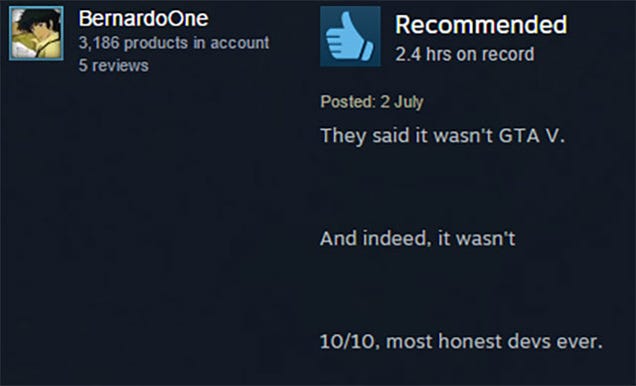
The game plays more like Snake than Grand Theft Auto (actually, it plays exactly like Snake), which helps in avoiding the lawvsuits. Given the name and the nature of NotGTAV, reviews are glowing:

Latest Steam Hit Is NotGTAV, Which Is Not GTA V

Latest Steam Hit Is NotGTAV, Which Is Not GTA V

You can grab it here.

Latest Steam Hit Is NotGTAV, Which Is Not GTA V

This entry passed through the Full-Text RSS service - if this is your content and you're reading it on someone else's site, please read the FAQ at fivefilters.org/content-only/faq.php#publishers.

03 Jul 16:56

Photo


03 Jul 14:45

My latest comic collection is available on my site and Amazon....

Bewarethewumpus

Also, there is a small strategic advantage in not allowing your opponent to track the cards in your hand.


My latest comic collection is available on my site and Amazon. Please check it out!