HAWTHORNE, CALIF.—At tonight's Tesla Semi event we got a lot more than a vague truck design. After a short presentation of the Semi's intended specs, one of the trucks backed onto the stage and a new red Roadster rolled out.
"The foundation of the whole company was the Roadster," Musk told the crowd of employees. "People kept asking 'When are you gonna make a new roadster?'"
We've grown accustomed to seeing Boston Dynamics' impressive line-up of robots strutting about in periodic video updates, each more terrifying than the last. But, every once in a while, the company unleashes a clip so awesome you can't help but watch...
After his administration reversed an Obama-era policy banning the import of elephant trophies into the US, the president tweeted he had put the decision "on hold."
WASHINGTON—In response to radio personality Leeann Tweeden’s allegations of being inappropriately groped by Al Franken during a 2006 U.S.O. tour, Democratic Party leaders issued calls Thursday for a convincing amount of condemnation for the Minnesota senator. “I urge my fellow Democrats to renounce Senator Franken’s…
Love the idea... maybe v2 will be a bit less chunky. Also... make this work on my next phone so I never have to charge it. Kthxbye.
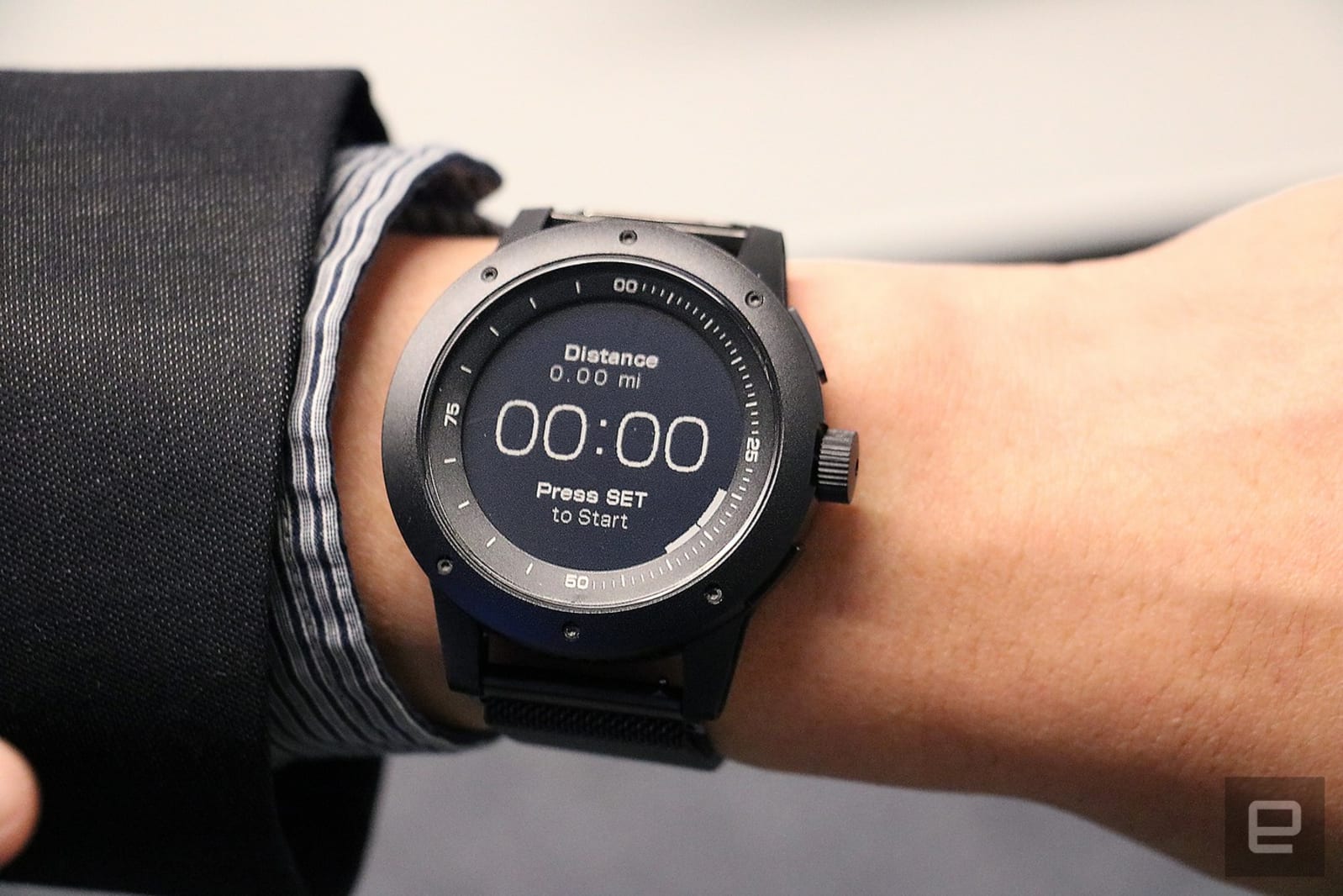
There is no battery indicator on the PowerWatch (I mean, it doesn't really need one since it should never run out of juice). A so-called Power Meter around the watch face indicates how much energy I'm generating at any given time, filling up when I produce more. The numbers "00," "25," "50" and "75" sit at the 12, 3, 6 and 9 o'clock positions in the watch's bezel, but they don't actually mean anything, which is not only redundant but very confusing. According to Tham, that's just part of the design. Because its functions are pretty basic and its LCD screen is relatively low-powered, it doesn't take too much electricity to keep the watch running.
The bigger the temperature difference between your skin's surface and the surrounding air, the more energy the watch can produce. I noticed that the Power Meter showed two notches while I was sitting in my office, but it jumped up to about 10 units after my brisk walk home one cold evening. That increased output is due to the bigger temperature differential as well as the fact that I was moving about more, causing my body to generate more heat.
I removed the watch at 10PM, and it stayed on all the way till I picked it up again at noon the next day. Tham said the PowerWatch will keep running for up to 12 months if you don't wear it, and a PowerSave mode kicks in to conserve energy by killing non-timekeeping functions. This didn't happen when I took the watch off, though. But perhaps that's because the PowerWatch was still able to convert energy because there was a temperature difference between the surface I placed it on and the surrounding air, which Tham said can happen.
The PowerWatch can not only tell the time, set alarms and timers but also track your activity and sleep. For now, you have to press a button before you go to bed, but a software update will enable auto sleep-tracking. It also measures your calories burned differently than competing devices, which use your height, weight and daily activity to get a rough estimate. The PowerWatch uses the amount of energy you produce based on your body heat, along with your physical measurements to make a better-educated guess, making for a more accurate deduction because a calorie is defined as a unit of heat energy anyway.
The stopwatch is sort of strange. Two or three seconds after you start it, the watch just displays the word "Running" instead of the elapsed time. In fact, navigating the PowerWatch's rudimentary black-and-white OS isn't very intuitive. Because there isn't a touchscreen, you'll have to press the Mode button on the top right of the case to toggle through functions like Daily Activity, Running Mode, Stop Watch and Watch Settings. To go into any of these, you have to pause for about a second after landing on it. So to launch Running Mode, you have to press the Mode button twice, quickly enough that you don't accidentally enter Daily Activity, then hold still.
The silver version of the PowerWatch feels chunky on my relatively slender wrist. It's also the cheapest of the trio available, at $199. Tham's unit -- the $229 black model -- looks more elegant, thanks in part to the $20 22mm Milanese band he paired with it. Finally, the more-advanced PowerWatch X costs $279, displays incoming alerts from your phone and has a better water-resistance rating of 20 atmospheres (up to 200 meters) compared to the 5 atmospheres (50 meters) on the regular watches.
Ultimately, the PowerWatch is too basic and hefty for me to keep wearing it, especially when I need to fit into the tighter sleeves of my winter coat. But I'm still intrigued by the PowerWatch's ability to survive sans charger, and honestly, I hope Matrix can take this technology mainstream. I never want to charge a device ever again.
So I'm trying very hard not to be too optimistic, but damn if this doesn't kinda look like the beginning of the possibility for some real change...
A new thing that happened: We interrupt your regularly scheduled horrifying dystopia for a day in which good things happened. Remember what that feels like? As mentioned yesterday, it was election day in a bunch of states today. Highlights far:
A thing that's still happening: The head of the Internal Revenue Service resigned, citing congressional cuts to his agency's budget that would prevent him from adequately performing his duties. Also, Texas Representative Ted Poe announced that he will not be seeking re-election in 2018, making him the third Republican rep from Texas to do so in a week, following payday lending darling Jeb Hensarling and climate change denialist Lamar Smith.
A thing to think about and do: What happened today is not a reason to rest on your laurels, but rather a reminder of how much influence you can exert at the local level, and how much voting rights matter. Uncontested seats are a scourge in state elections - 56% of legislative races in 2015 were uncontested. 45 is president; don't think for a second that you can't run for office and win. Also, campaign for voting rights! After the Virginia state legislature struck down an executive order that Virginia governor Terry McAuliffe signed to re-enfranchise felons who had completed parole, he personally signed voting rights restorations for 168,000 people. Thousands of people who voted in VA today had thought that they would never be able to vote again.
Facebook is experimenting with a new way to prevent the posting of so-called revenge porn that involves a highly questionable requirement. Potential victims must send nude pictures of themselves through the social network's official messenger so the images can be viewed, in full, unedited form, by an employee of the social network.
A Facebook spokeswoman said the employee would be a member of the company's community operations team who has been trained to review such photos. If the employee determines the image violates site policies, it will be digitally fingerprinted to prevent it from being published on Facebook and Facebook-owned Instagram. An article posted by the Australian Broadcasting Corporation said the service is still being tested with help from Australian government officials. To use it, potential victims will first complete this online form and then send the images to themselves over Facebook Messenger.
The Facebook spokeswoman said she was unable to confirm details published earlier by The Daily Beast that said Facebook would continue to store blurred versions of the images for an unspecified amount of time after the hash was taken. The Facebook spokeswoman agreed to describe the new program on the condition the discussion be kept on background, an arrangement that prevents this post from naming or directly quoting the representative.
Invoking bible stories to justify sexual assault and child molestation is just... wow. Burn him on a cross or something, I guess?
Judge Roy Moore, the Republican candidate for Alabama's upcoming special Senate election, denies allegations that he romantically pursued teenagers as young as 14 when he was in his 30s. Even if the allegations are true, one statewide elected official in Alabama said it's "much ado about nothing."
“There is nothing to see here,” Alabama State Auditor Jim Ziegler told the Washington Examiner. “The allegations are that a man in his early 30s dated teenage girls. Even the Washington Post report says that he never had sexual intercourse with any of the girls and never attempted sexual intercourse.”
After interviews with more than 30 people, the Washington Post reported Thursday that Moore engaged in sexual contact with a 14-year-old girl when he was 32 years old and a powerful attorney in a small Alabama town.
The young girl, Leigh Corfman, said Moore touched her over her bra and underpants, guiding her hand to his shorts. “I wanted it over with — I wanted out,” she recalled. “Please just get this over with. Whatever this is, just get it over.”
Ziegler seemed unconcerned about that allegation and told the WashingtonExaminer that any political concern would be mitigated by three things. Moore never had “sexual intercourse” with the girl. Their relationship “happened almost 40 years ago.” And finally, “Roy Moore fell in love with one of the younger women.”
Moore began dating his wife Kayla around this time, according to Ziegler. “He dated her. He married her, and they’ve been married about 35 years. They’re blessed with a wonderful marriage and his wife Kayla is 14 years younger than Moore.”
Asked whether or not the report would upend Moore’s campaign, Ziegler predicted that Alabama voters would be angrier at the Washington Post for “desperately trying to get something negative” than Moore for his dalliances with teenage girls decades ago.
“He’s clean as a hound’s tooth,” Ziegler claimed, before relying on Scripture to defend Moore.
“Take the Bible. Zachariah and Elizabeth for instance. Zachariah was extremely old to marry Elizabeth and they became the parents of John the Baptist,” Ziegler said choosing his words carefully before invoking Christ. “Also take Joseph and Mary. Mary was a teenager and Joseph was an adult carpenter. They became parents of Jesus.”
“There’s just nothing immoral or illegal here,” Ziegler concluded. “Maybe just a little bit unusual.”
My favorite is the black jump-kicking one. Or the very last one: the drunken master
Armed with an Olympus digital camera and a bag full of cat toys, Japanese photographer Hiroyuki Hisakata ventures off to an island populated by stray cats to photograph his feline friends. Hisakata’s specialty? Playing with them and capturing them in dynamic martial arts poses that have earned them the nickname Ninja Cats.
Although he’s based in Kyushu, Hisakata keeps his locations top secret. He often shoots in the evening, and with his bag full of toys, plays with the cats while shooting them with his camera. The results are humorous and playful, and have been compiled into two different photobooks: one featuring adult cats and the other featuring kittens.
Like almost everything these days, Hisakata does have critics, who call his activities abusive. But when playing and shooting the stray cats the photographer takes every precaution to prevent injury. In an interview he talks about some of his techniques and methods, noting that if the cats are getting too excited he’ll call off the shoot and wait for them to calm down.
Hisakata is on Twitter where he posts pictures of the stray ninja cats.
We know that both TV channels and streaming services are getting in on eSports, but if there's one game that can break through to the mainstream it's (arguably) Rocket League. RC cars playing soccer in a gravity-defying stadium -- what's not to like?...
“The revolutions and changes which have left the earth as we now find it, are not confined to the overthrow of the ancient layers” - Georges Cuvier, 1831.
Our planet Earth has extinguished large portions of its inhabitants several times since the dawn of animals. And if science tells us anything, it will surely try to kill us all again. Working in the 19th century, paleontology pioneer Georges Cuvier saw dramatic turnovers of life in the fossil record and likened them to the French Revolution, then still fresh in his memory.
Today, we refer to such events as “mass extinctions,” incidents in which many species of animals and plants died out in a geological instant. They are so profound and have such global reach that geological time itself is sliced up into periods—Permian, Triassic, Cretaceous—that are often defined by these mass extinctions.
No, you weren't hallucinating -- the President's personal Twitter account was unplugged earlier this evening. It disappeared, and then reappeared without warning or reason, however now Twitter is offering an explanation. The account was "inadvertentl...
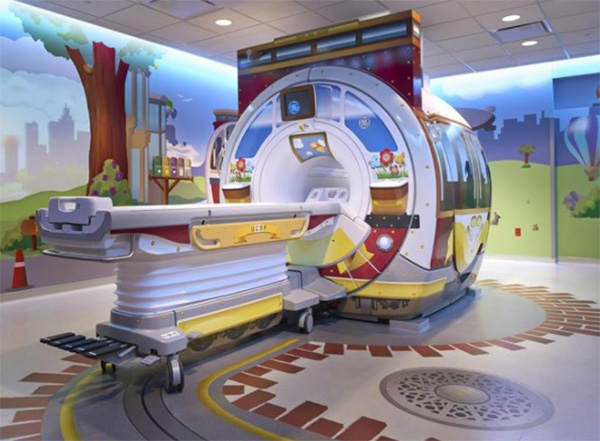
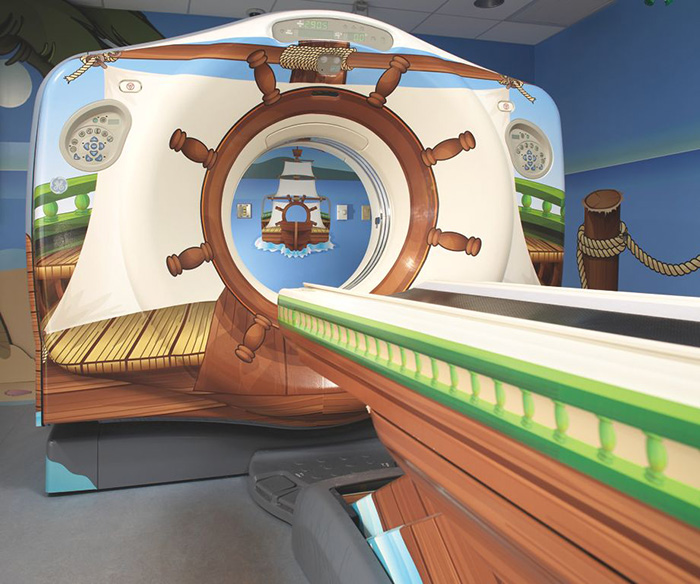
Industrial designers have turned imaging departments at 27 children's hospitals into miniature theme parks.
GE Healthcare
GE Healthcare industrial designers Erik Kemper and Doug Dietz helped develop the idea of transforming the often-frightening process of MRI and CT scans into an adventure for children.
The sight of a terrified little girl about to have an MRI scan gave Dietz a different perspective on his work.
"I had just finished designing a big MR scanner," Dietz, the creator of the MR Adventure Discovery Series explained during a TED talk.
"A young patient was coming into the MR room to be scanned. I see this young family coming down the hallway and I can tell as they get closer that the little girl is weeping. As they get even closer to me, I notice the father leans down and just goes 'remember we talked about this, you can be brave.'
As they walked into the MR suite, Dietz had the chance to see the room through the girl's eyes for the first time.
"Everything was kind of like, beige" he said, describing what he calls 'crime scene' stickers (which tell patients where to go), and the exclamation mark warning sign on the door. "The room itself is kind of dark and has those flickering fluorescent lights" and adds "that machine that I had designed basically looked like a brick with a hole in it."
Dietz explained that MRIs made a terrible noise, and the little girl started to cry.
"The parents are looking at each other and they don't have to say a word, because they don't know how they're going to get their child through this," he explained. Understanding that the environment where the scanning was done simply didn't work for younger children was a wakeup call. It was also a new challenge.
GE Healthcare
The idea that eventually emerged from a mix of brainstorming and research was to transform a frightening medical test into a voyage on a spaceship, a visit to a pirate island and other adventures.
Imaging departments became elaborate sets. Technicians became amateur actors with scripts. And children were given starring roles.
"Children would cling to their mom's leg and start crying, and you would have to pry them off," said Kathleen Kapsin, radiology director of Children's Hospital of Pittsburgh. "Now they walk in and they are excited."
GE Healthcare
GE's Adventure Series illustrates the way human-centered design can lead to breakthrough innovations.
New opportunities for innovation open up when you start the creative problem-solving process with empathy toward your target audience. While competitors focused on the never-ending battle surrounding technical specifications (like scanning speed, resolution, etc.), Dietz found a whole new way to improve the lives of patients and their families.
Please consider making a donation to SunnySkyz.com and help our mission to make the world a better place.
We're building an artificial intelligence-powered dystopia, one click at a time, says techno-sociologist Zeynep Tufekci. In an eye-opening talk, she details how the same algorithms companies like Facebook, Google and Amazon use to get you to click on ads are also used to organize your access to political and social information. And the machines aren't even the real threat. What we need to understand is how the powerful might use AI to control us — and what we can do in response.
Zeynep Tufekci · Techno-sociologist
Techno-sociologist Zeynep Tufekci asks big questions about our societies and our lives, as both algorithms and digital connectivity spread.
Techno-sociologist Zeynep Tufekci asks big questions about our societies and our lives, as both algorithms and digital connectivity spread.
Federal lawmakers on Wednesday released samples of 3,000 Facebook ads purchased by Russian operatives during the 2016 presidential campaign. The ads conveyed the wide range of influence Russian-linked groups tried to enact on Americans – but one set of ads in particular hit close to home.
Last year, two Russian Facebook pages organized dueling rallies in front of the Islamic Da’wah Center of Houston, according to information released by U.S. Sen. Richard Burr, a North Carolina Republican.
Heart of Texas, a Russian-controlled Facebook group that promoted Texas secession, leaned into an image of the state as a land of guns and barbecue and amassed hundreds of thousands of followers. One of their ads on Facebook announced a noon rally on May 21, 2016 to “Stop Islamification of Texas.”
A separate Russian-sponsored group, United Muslims of America, advertised a “Save Islamic Knowledge” rally for the same place and time.
The Texas Tribune thanks its sponsors. Become one.
On that day, protesters organized by the two groups showed up on Travis Street in downtown Houston, a scene that appeared on its face to be a protest and a counterprotest. Interactions between the two groups eventually escalated into confrontation and verbal attacks.
Burr, the committee's chairman, unveiled the ads at a hearing Wednesday morning and said Russians managed to pit Texans against each other for the bargain price of $200.
"You commented yesterday that your company's goal is bringing people together. In this case, people were brought together to foment conflict, and Facebook enabled that event to happen," Burr said to Facebook general counsel Colin Stretch.
"I would say that Facebook has failed their goal," Burr added. "From a computer in St. Petersburg, Russia, these operators can create and promote events anywhere in the United States in attempt to tear apart our society."
Stretch told the Senate Intelligence Committee that ads such as these were most likely directed at different audiences.
Both the U.S. House and U.S. Senate Intelligence committees met with representatives from Google, Facebook and Twitter at the Capitol Wednesday.
The Texas Tribune thanks its sponsors. Become one.
In a press conference following the House hearing, the top Democrat on the committee, Adam Schiff of California, said lawmakers hope to make all of the Russian-bought Facebook ads available to the public in the next few weeks.
“People really need to see just how cynical this campaign really was and how this operation directed by a former KGB operative who is now the president of Russia was designed to tap into these really provocative and divisive issues here in the United States,” Schiff said.
Going forward, Schiff said Congress will consider new regulations of political advertisements. He said the question is how they will adapt these oversight measures to social media platforms.
U.S. Rep. Mike Conaway, R-Midland, is currently leading the House Intelligence Committee's investigation into election meddling by Russia.
Read related Tribune coverage:
Texans in Congress reacted cautiously as they processed Monday's indictments in the investigation into whether Trump campaign officials colluded with Russian intelligence. [Full story]
In September, the U.S. Department of Homeland Security included Texas among a list of states targeted by Russian government hackers. A top Texas official has since said the state doesn't belong on that list, [Full story]
U.S. Rep. Mike Conaway, who currently leads the House Intelligence Committee's investigation into Russia election-meddling, told the Tribune he is interested in chairing that powerful committee in the future. [Full story]
This Arthur B. McDonald. He just won a Nobel Prize. He is almost definitely smarter than you.
McDonald, a professor emeritus at Queen's University in Ontario, split the 2015 Nobel Prize in Physics with Takaaki Kajita of the University of Tokyo.
His area of research is neutrinos — itty bitty little subatomic particles that are part of what makes our universe.
Queen's University
He did that work using a lab buried 2,000 metres underground that basically looks like a super villain's secret lair.
What we're saying here is McDonald is a highly impressive human. So you'd think that when he got the call from the Nobel Prize committee it would be very proper and scientific and mention quarks a few times.
"I had a discussion with Lars Bergstrom (a Swedish physicist) about hockey, and the fact that it would be nice if Mats Sundin still played for the Maple Leafs," he told the Citizen.
On June 14, 2014, the State Council of China published an ominous-sounding document called "Planning Outline for the Construction of a Social Credit System". In the way of Chinese policy documents, it was a lengthy and rather dry affair, but it contained a radical idea. What if there was a national trust score that rated the kind of citizen you were?
Imagine a world where many of your daily activities were constantly monitored and evaluated: what you buy at the shops and online; where you are at any given time; who your friends are and how you interact with them; how many hours you spend watching content or playing video games; and what bills and taxes you pay (or not). It's not hard to picture, because most of that already happens, thanks to all those data-collecting behemoths like Google, Facebook and Instagram or health-tracking apps such as Fitbit. But now imagine a system where all these behaviours are rated as either positive or negative and distilled into a single number, according to rules set by the government. That would create your Citizen Score and it would tell everyone whether or not you were trustworthy. Plus, your rating would be publicly ranked against that of the entire population and used to determine your eligibility for a mortgage or a job, where your children can go to school - or even just your chances of getting a date.
A futuristic vision of Big Brother out of control? No, it's already getting underway in China, where the government is developing the Social Credit System (SCS) to rate the trustworthiness of its 1.3 billion citizens. The Chinese government is pitching the system as a desirable way to measure and enhance "trust" nationwide and to build a culture of "sincerity". As the policy states, "It will forge a public opinion environment where keeping trust is glorious. It will strengthen sincerity in government affairs, commercial sincerity, social sincerity and the construction of judicial credibility."
Others are less sanguine about its wider purpose. "It is very ambitious in both depth and scope, including scrutinising individual behaviour and what books people are reading. It's Amazon's consumer tracking with an Orwellian political twist," is how Johan Lagerkvist, a Chinese internet specialist at the Swedish Institute of International Affairs, described the social credit system. Rogier Creemers, a post-doctoral scholar specialising in Chinese law and governance at the Van Vollenhoven Institute at Leiden University, who published a comprehensive translation of the plan, compared it to "Yelp reviews with the nanny state watching over your shoulder".
For now, technically, participating in China's Citizen Scores is voluntary. But by 2020 it will be mandatory. The behaviour of every single citizen and legal person (which includes every company or other entity)in China will be rated and ranked, whether they like it or not.
Kevin Hong
Prior to its national roll-out in 2020, the Chinese government is taking a watch-and-learn approach. In this marriage between communist oversight and capitalist can-do, the government has given a licence to eight private companies to come up with systems and algorithms for social credit scores. Predictably, data giants currently run two of the best-known projects.
The first is with China Rapid Finance, a partner of the social-network behemoth Tencent and developer of the messaging app WeChat with more than 850 million active users. The other, Sesame Credit, is run by the Ant Financial Services Group (AFSG), an affiliate company of Alibaba. Ant Financial sells insurance products and provides loans to small- to medium-sized businesses. However, the real star of Ant is AliPay, its payments arm that people use not only to buy things online, but also for restaurants, taxis, school fees, cinema tickets and even to transfer money to each other.
Sesame Credit has also teamed up with other data-generating platforms, such as Didi Chuxing, the ride-hailing company that was Uber's main competitor in China before it acquired the American company's Chinese operations in 2016, and Baihe, the country's largest online matchmaking service. It's not hard to see how that all adds up to gargantuan amounts of big data that Sesame Credit can tap into to assess how people behave and rate them accordingly.
So just how are people rated? Individuals on Sesame Credit are measured by a score ranging between 350 and 950 points. Alibaba does not divulge the "complex algorithm" it uses to calculate the number but they do reveal the five factors taken into account. The first is credit history. For example, does the citizen pay their electricity or phone bill on time? Next is fulfilment capacity, which it defines in its guidelines as "a user's ability to fulfil his/her contract obligations". The third factor is personal characteristics, verifying personal information such as someone's mobile phone number and address. But the fourth category, behaviour and preference, is where it gets interesting.
Under this system, something as innocuous as a person's shopping habits become a measure of character. Alibaba admits it judges people by the types of products they buy. "Someone who plays video games for ten hours a day, for example, would be considered an idle person," says Li Yingyun, Sesame's Technology Director. "Someone who frequently buys diapers would be considered as probably a parent, who on balance is more likely to have a sense of responsibility." So the system not only investigates behaviour - it shapes it. It "nudges" citizens away from purchases and behaviours the government does not like.
Friends matter, too. The fifth category is interpersonal relationships. What does their choice of online friends and their interactions say about the person being assessed? Sharing what Sesame Credit refers to as "positive energy" online, nice messages about the government or how well the country's economy is doing, will make your score go up.
Alibaba is adamant that, currently, anything negative posted on social media does not affect scores (we don't know if this is true or not because the algorithm is secret). But you can see how this might play out when the government's own citizen score system officially launches in 2020. Even though there is no suggestion yet that any of the eight private companies involved in the ongoing pilot scheme will be ultimately responsible for running the government's own system, it's hard to believe that the government will not want to extract the maximum amount of data for its SCS, from the pilots. If that happens, and continues as the new normal under the government's own SCS it will result in private platforms acting essentially as spy agencies for the government. They may have no choice.
Posting dissenting political opinions or links mentioning Tiananmen Square has never been wise in China, but now it could directly hurt a citizen's rating. But here's the real kicker: a person's own score will also be affected by what their online friends say and do, beyond their own contact with them. If someone they are connected to online posts a negative comment, their own score will also be dragged down.
So why have millions of people already signed up to what amounts to a trial run for a publicly endorsed government surveillance system? There may be darker, unstated reasons - fear of reprisals, for instance, for those who don't put their hand up - but there is also a lure, in the form of rewards and "special privileges" for those citizens who prove themselves to be "trustworthy" on Sesame Credit.
If their score reaches 600, they can take out a Just Spend loan of up to 5,000 yuan (around £565) to use to shop online, as long as it's on an Alibaba site. Reach 650 points, they may rent a car without leaving a deposit. They are also entitled to faster check-in at hotels and use of the VIP check-in at Beijing Capital International Airport. Those with more than 666 points can get a cash loan of up to 50,000 yuan (£5,700), obviously from Ant Financial Services. Get above 700 and they can apply for Singapore travel without supporting documents such as an employee letter. And at 750, they get fast-tracked application to a coveted pan-European Schengen visa. "I think the best way to understand the system is as a sort of bastard love child of a loyalty scheme," says Creemers.
Higher scores have already become a status symbol, with almost 100,000 people bragging about their scores on Weibo (the Chinese equivalent of Twitter) within months of launch. A citizen's score can even affect their odds of getting a date, or a marriage partner, because the higher their Sesame rating, the more prominent their dating profile is on Baihe.
Sesame Credit already offers tips to help individuals improve their ranking, including warning about the downsides of friending someone who has a low score. This might lead to the rise of score advisers, who will share tips on how to gain points, or reputation consultants willing to offer expert advice on how to strategically improve a ranking or get off the trust-breaking blacklist.
Indeed, Sesame Credit is basically a big data gamified version of the Communist Party's surveillance methods; the disquieting dang'an. The regime kept a dossier on every individual that tracked political and personal transgressions. A citizen's dang'an followed them for life, from schools to jobs. People started reporting on friends and even family members, raising suspicion and lowering social trust in China. The same thing will happen with digital dossiers. People will have an incentive to say to their friends and family, "Don't post that. I don't want you to hurt your score but I also don't want you to hurt mine."
We're also bound to see the birth of reputation black markets selling under-the-counter ways to boost trustworthiness. In the same way that Facebook Likes and Twitter followers can be bought, individuals will pay to manipulate their score. What about keeping the system secure? Hackers (some even state-backed) could change or steal the digitally stored information.
"People with low ratings will have slower internet speeds; restricted access to restaurants and the removal of the right to travel" Rachel Botsman, author of ‘Who Can You Trust?’
The new system reflects a cunning paradigm shift. As we've noted, instead of trying to enforce stability or conformity with a big stick and a good dose of top-down fear, the government is attempting to make obedience feel like gaming. It is a method of social control dressed up in some points-reward system. It's gamified obedience.
In a trendy neighbourhood in downtown Beijing, the BBC news services hit the streets in October 2015 to ask people about their Sesame Credit ratings. Most spoke about the upsides. But then, who would publicly criticise the system? Ding, your score might go down. Alarmingly, few people understood that a bad score could hurt them in the future. Even more concerning was how many people had no idea that they were being rated.
Currently, Sesame Credit does not directly penalise people for being "untrustworthy" - it's more effective to lock people in with treats for good behaviour. But Hu Tao, Sesame Credit's chief manager, warns people that the system is designed so that "untrustworthy people can't rent a car, can't borrow money or even can't find a job". She has even disclosed that Sesame Credit has approached China's Education Bureau about sharing a list of its students who cheated on national examinations, in order to make them pay into the future for their dishonesty.
Penalties are set to change dramatically when the government system becomes mandatory in 2020. Indeed, on September 25, 2016, the State Council General Office updated its policy entitled "Warning and Punishment Mechanisms for Persons Subject to Enforcement for Trust-Breaking". The overriding principle is simple: "If trust is broken in one place, restrictions are imposed everywhere," the policy document states.
For instance, people with low ratings will have slower internet speeds; restricted access to restaurants, nightclubs or golf courses; and the removal of the right to travel freely abroad with, I quote, "restrictive control on consumption within holiday areas or travel businesses". Scores will influence a person's rental applications, their ability to get insurance or a loan and even social-security benefits. Citizens with low scores will not be hired by certain employers and will be forbidden from obtaining some jobs, including in the civil service, journalism and legal fields, where of course you must be deemed trustworthy. Low-rating citizens will also be restricted when it comes to enrolling themselves or their children in high-paying private schools. I am not fabricating this list of punishments. It's the reality Chinese citizens will face. As the government document states, the social credit system will "allow the trustworthy to roam everywhere under heaven while making it hard for the discredited to take a single step".
According to Luciano Floridi, a professor of philosophy and ethics of information at the University of Oxford and the director of research at the Oxford Internet Institute, there have been three critical "de-centering shifts" that have altered our view in self-understanding: Copernicus's model of the Earth orbiting the Sun; Darwin's theory of natural selection; and Freud's claim that our daily actions are controlled by the unconscious mind.
Floridi believes we are now entering the fourth shift, as what we do online and offline merge into an onlife. He asserts that, as our society increasingly becomes an infosphere, a mixture of physical and virtual experiences, we are acquiring an onlife personality - different from who we innately are in the "real world" alone. We see this writ large on Facebook, where people present an edited or idealised portrait of their lives. Think about your Uber experiences. Are you just a little bit nicer to the driver because you know you will be rated? But Uber ratings are nothing compared to Peeple, an app launched in March 2016, which is like a Yelp for humans. It allows you to assign ratings and reviews to everyone you know - your spouse, neighbour, boss and even your ex. A profile displays a "Peeple Number", a score based on all the feedback and recommendations you receive. Worryingly, once your name is in the Peeple system, it's there for good. You can't opt out.
Peeple has forbidden certain bad behaviours including mentioning private health conditions, making profanities or being sexist (however you objectively assess that). But there are few rules on how people are graded or standards about transparency.
China's trust system might be voluntary as yet, but it's already having consequences. In February 2017, the country's Supreme People's Court announced that 6.15 million of its citizens had been banned from taking flights over the past four years for social misdeeds. The ban is being pointed to as a step toward blacklisting in the SCS. "We have signed a memorandum… [with over] 44 government departments in order to limit 'discredited' people on multiple levels," says Meng Xiang, head of the executive department of the Supreme Court. Another 1.65 million blacklisted people cannot take trains.
Where these systems really descend into nightmarish territory is that the trust algorithms used are unfairly reductive. They don't take into account context. For instance, one person might miss paying a bill or a fine because they were in hospital; another may simply be a freeloader. And therein lies the challenge facing all of us in the digital world, and not just the Chinese. If life-determining algorithms are here to stay, we need to figure out how they can embrace the nuances, inconsistencies and contradictions inherent in human beings and how they can reflect real life.
Kevin Hong
You could see China's so-called trust plan as Orwell's 1984 meets Pavlov's dogs. Act like a good citizen, be rewarded and be made to think you're having fun. It's worth remembering, however, that personal scoring systems have been present in the west for decades.
More than 70 years ago, two men called Bill Fair and Earl Isaac invented credit scores. Today, companies use FICO scores to determine many financial decisions, including the interest rate on our mortgage or whether we should be given a loan.
For the majority of Chinese people, they have never had credit scores and so they can't get credit. "Many people don't own houses, cars or credit cards in China, so that kind of information isn't available to measure," explains Wen Quan, an influential blogger who writes about technology and finance. "The central bank has the financial data from 800 million people, but only 320 million have a traditional credit history." According to the Chinese Ministry of Commerce, the annual economic loss caused by lack of credit information is more than 600 billion yuan (£68bn).
China's lack of a national credit system is why the government is adamant that Citizen Scores are long overdue and badly needed to fix what they refer to as a "trust deficit". In a poorly regulated market, the sale of counterfeit and substandard products is a massive problem. According to the Organization for Economic Co-operation and Development (OECD), 63 per cent of all fake goods, from watches to handbags to baby food, originate from China. "The level of micro corruption is enormous," Creemers says. "So if this particular scheme results in more effective oversight and accountability, it will likely be warmly welcomed."
The government also argues that the system is a way to bring in those people left out of traditional credit systems, such as students and low-income households. Professor Wang Shuqin from the Office of Philosophy and Social Science at Capital Normal University in China recently won the bid to help the government develop the system that she refers to as "China's Social Faithful System". Without such a mechanism, doing business in China is risky, she stresses, as about half of the signed contracts are not kept. "Given the speed of the digital economy it's crucial that people can quickly verify each other's credit worthiness," she says. "The behaviour of the majority is determined by their world of thoughts. A person who believes in socialist core values is behaving more decently." She regards the "moral standards" the system assesses, as well as financial data, as a bonus.
Indeed, the State Council's aim is to raise the "honest mentality and credit levels of the entire society" in order to improve "the overall competitiveness of the country". Is it possible that the SCS is in fact a more desirably transparent approach to surveillance in a country that has a long history of watching its citizens? "As a Chinese person, knowing that everything I do online is being tracked, would I rather be aware of the details of what is being monitored and use this information to teach myself how to abide by the rules?" says Rasul Majid, a Chinese blogger based in Shanghai who writes about behavioural design and gaming psychology. "Or would I rather live in ignorance and hope/wish/dream that personal privacy still exists and that our ruling bodies respect us enough not to take advantage?" Put simply, Majid thinks the system gives him a tiny bit more control over his data.
Kevin Hong
When I tell westerners about the Social Credit System in China, their responses are fervent and visceral. Yet we already rate restaurants, movies, books and even doctors. Facebook, meanwhile, is now capable of identifying you in pictures without seeing your face; it only needs your clothes, hair and body type to tag you in an image with 83 per cent accuracy.
In 2015, the OECD published a study revealing that in the US there are at least 24.9 connected devices per 100 inhabitants. All kinds of companies scrutinise the "big data" emitted from these devices to understand our lives and desires, and to predict our actions in ways that we couldn't even predict ourselves.
Governments around the world are already in the business of monitoring and rating. In the US, the National Security Agency (NSA) is not the only official digital eye following the movements of its citizens. In 2015, the US Transportation Security Administration proposed the idea of expanding the PreCheck background checks to include social-media records, location data and purchase history. The idea was scrapped after heavy criticism, but that doesn't mean it's dead. We already live in a world of predictive algorithms that determine if we are a threat, a risk, a good citizen and even if we are trustworthy. We're getting closer to the Chinese system - the expansion of credit scoring into life scoring - even if we don't know we are.
So are we heading for a future where we will all be branded online and data-mined? It's certainly trending that way. Barring some kind of mass citizen revolt to wrench back privacy, we are entering an age where an individual's actions will be judged by standards they can't control and where that judgement can't be erased. The consequences are not only troubling; they're permanent. Forget the right to delete or to be forgotten, to be young and foolish.
While it might be too late to stop this new era, we do have choices and rights we can exert now. For one thing, we need to be able rate the raters. In his book The Inevitable, Kevin Kelly describes a future where the watchers and the watched will transparently track each other. "Our central choice now is whether this surveillance is a secret, one-way panopticon - or a mutual, transparent kind of 'coveillance' that involves watching the watchers," he writes.
Our trust should start with individuals within government (or whoever is controlling the system). We need trustworthy mechanisms to make sure ratings and data are used responsibly and with our permission. To trust the system, we need to reduce the unknowns. That means taking steps to reduce the opacity of the algorithms. The argument against mandatory disclosures is that if you know what happens under the hood, the system could become rigged or hacked. But if humans are being reduced to a rating that could significantly impact their lives, there must be transparency in how the scoring works.
In China, certain citizens, such as government officials, will likely be deemed above the system. What will be the public reaction when their unfavourable actions don't affect their score? We could see a Panama Papers 3.0 for reputation fraud.
It is still too early to know how a culture of constant monitoring plus rating will turn out. What will happen when these systems, charting the social, moral and financial history of an entire population, come into full force? How much further will privacy and freedom of speech (long under siege in China) be eroded? Who will decide which way the system goes? These are questions we all need to consider, and soon. Today China, tomorrow a place near you. The real questions about the future of trust are not technological or economic; they are ethical.
If we are not vigilant, distributed trust could become networked shame. Life will become an endless popularity contest, with us all vying for the highest rating that only a few can attain.
This is an extract from Who Can You Trust? How Technology Brought Us Together and Why It Might Drive Us Apart (Penguin Portfolio) by Rachel Botsman, published on October 4. Since this piece was written, The People's Bank of China delayed the licences to the eight companies conducting social credit pilots. The government's plans to launch the Social Credit System in 2020 remain unchanged
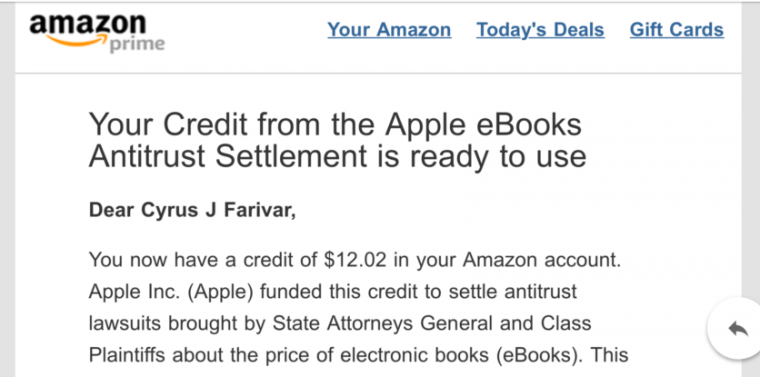
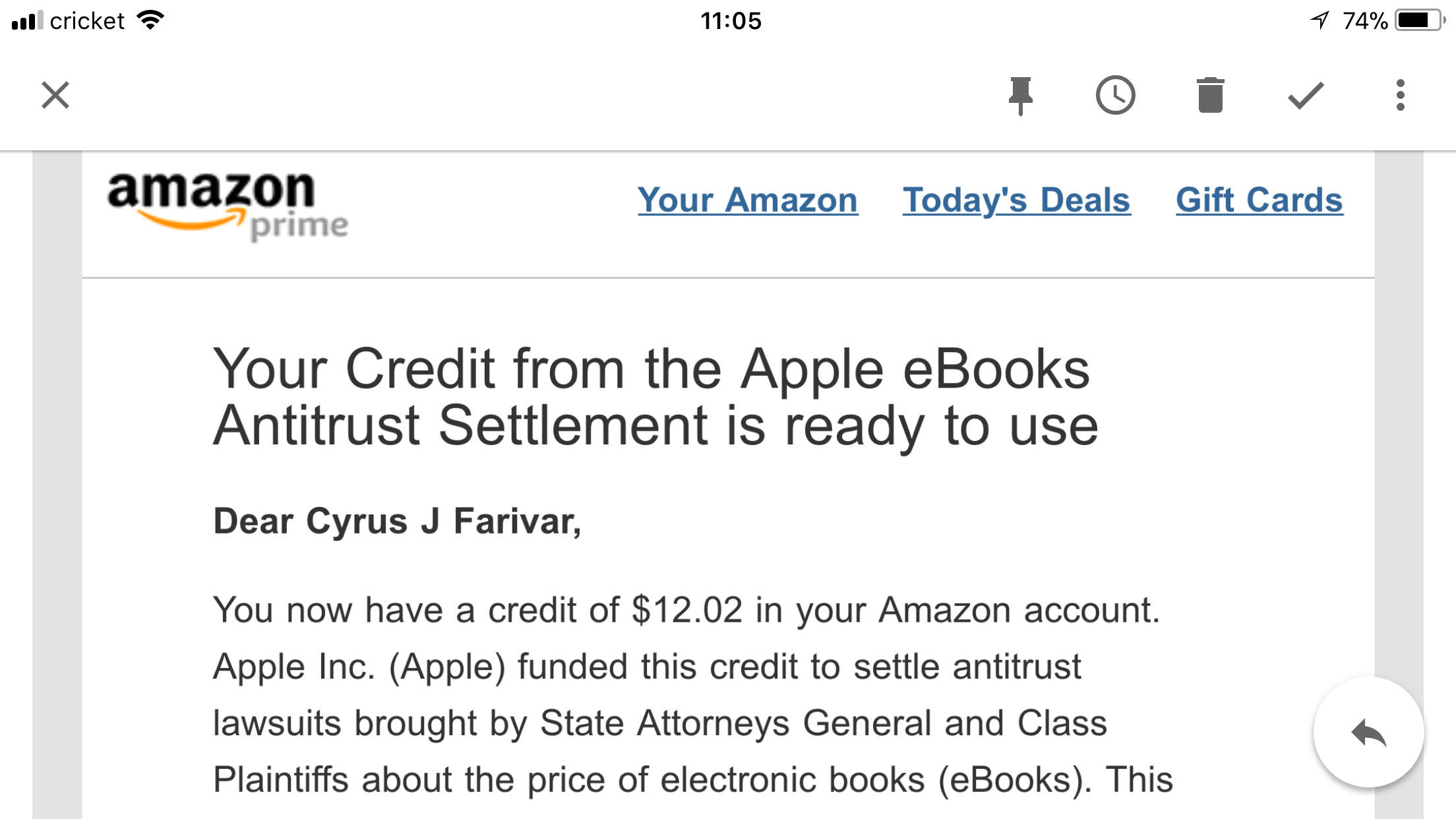
In 2014, Amazon paid out based on settlements with book publishers—including Harper Collins and Simon & Schuster—which allegedly conspired with Apple to fix e-book prices in 2012.
As Ars reported previously, the case began way back in 2012, when Apple and five publishers (Penguin, HarperCollins, Hachette, Simon & Schuster, and Macmillan) were sued by the Department of Justice and 33 states’ attorney general offices for conspiring to offer e-books at a higher price than Amazon’s loss-leading $9.99. The publishers all eventually settled for a total of $166 million to states and consumers, but Apple held out and eventually lost a judgement in Manhattan district court.
Drinking isn’t really known for being beneficial to people’s communication skills. (A quick look through your most recent drunk text conversation will tell you that.) However, recent research suggests having a buzz could actually help you speak better...provided you aren’t trying to speak in your native tongue. According to a new study, drinking a beer can improve how well we speak another language. Before you get ahead of yourself, that doesn’t mean you can down a few pints of Guinness and suddenly speak Irish. This is science; not straight up witchcraft.
The study was conducted by researchers from three different universities in Europe who wanted to learn about the effects of light alcohol consumption on foreign language skills. The study’s participants consisted of 50 native German speakers who had recently started learning Dutch. Each participant was provided a drink and then had a conversation with a stranger in Dutch. Some participants received about a pint of beer with a 5 percent alcohol content. (Researchers also accounted for individual’s body weight in their alcoholic drink percentages.) The other participants drank a nonalcoholic beverage. Then, two native Dutch speakers rated the speaking skills of all of the participants, unaware of which participants had drunk alcohol and which had not.
The results? People who sipped on an alcoholic drink scored “significantly better” than those who had nonalcoholic drinks. In particular, the native Dutch speakers rated the pronunciation skills higher for those who had been drinking a beer.
However, self-perception didn’t appear to be affected by having a beer. When participants were asked to rate their own speaking abilities, scores didn’t fluctuate significantly whether a participant had had an alcoholic drink or not.
What makes you speak another language better when you’re a bit buzzed? The researchers aren’t completely sure. “Given that executive functions are important when speaking a second (non-native) language, one might expect that alcohol would impair the ability to speak a second language,” said a press release for the study. “On the other hand, alcohol increases self-confidence and reduces social anxiety, both of which might be expected to improve language ability when interacting with another person.” So, a little bit of liquid courage might have been helpful in this scenario.
Researchers, understandably, want to emphasize the importance of moderation and the minimal amount of alcohol that lead to their study’s results. “It is important to point out that participants in this study consumed a low dose of alcohol,” Fritz Renner, one of the study’s researchers, said in a release. “Higher levels of alcohol consumption might not have beneficial effects on the pronunciation of a foreign language.” Another one of the study’s researchers, Dr. Jessica Werthmann, reiterated this point:
“We need to be cautious about the implications of these results until we know more about what causes the observed results. One possible mechanism could be the anxiety-reducing effect of alcohol. But more research is needed to test this.”
The effects of alcohol have been widely researched. (Note to future study authors: I will gladly get a little tipsy in the name of science so hmu.) Whether or not alcohol is “good” or “bad” seems to depend on what specific effects you’re looking at. One recent study suggests that beer may be more effective than some pain-killers. But, again, researchers were quick to caution people about self-medicating with a Miller Lite.
The ways alcohol can be detrimental to your health likely come as little surprise to anyone with a liver. The moral of most every scientific study that suggests beer could be beneficial: only when imbibing in moderation. Having a beer while traveling abroad may make it easier to strike up a conversation with a stranger, but there’s definitely no need to, like, get drunk to do your daily DuoLingo exercises.
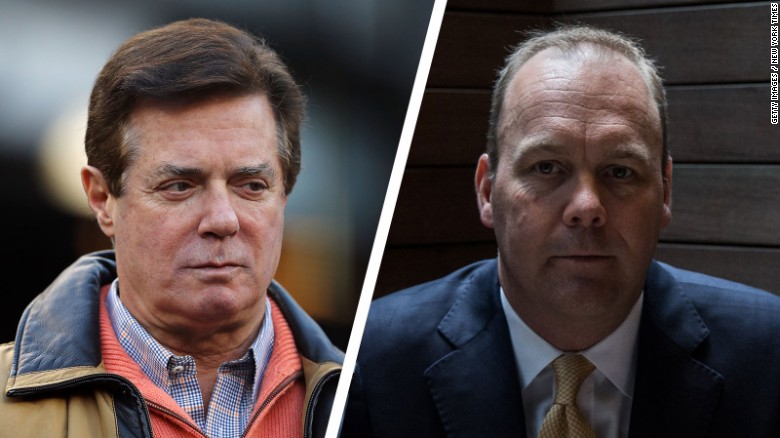
By taking one or more people into custody, a prospect first reported by CNN Friday, Justice Department special counsel Robert Mueller ushers in a perilous time for the White House, reflecting the gravity of the investigation into Russia's interference in the 2016 election and alleged collusion by Trump's associates.
The special counsel announced that Manafort and Gates have been indicted by a federal grand jury. The 12-count indictment is on "conspiracy against the United States, conspiracy to launder money, unregistered agent of a foreign principal, false and misleading FARA statements, false statements, and seven counts of failure to file reports of foreign bank and financial accounts."
Mueller's decision to examine Manafort's past business relationships with Russia and possible tax arrangements offer a signal how he interprets his understanding of the nature of his mandate, which could have implications for how he proceeds in his investigations into others in Trump's circle.
Just the idea that someone who was once close to Trump has been charged with a federal crime -- even if as yet it's unrelated to the 2016 campaign -- brings political problems of its own.
Trump and his team deny any wrongdoing, and so far there is no conclusive evidence from Mueller's closely held investigation or several congressional probes of nefarious links with the Russians.
At minimum, news of charges will complicate the White House's argument that the Russia drama is nothing but a drummed up Democratic plot born of despair at Hillary Clinton's shocking loss last November, and be a distraction from the Republican tax reform effort this week.
First step
More significantly, the charges could be the first step in a series of actions by the special counsel that strike at the heart of Trump's inner political and family circle, and could even put his presidency in jeopardy.
But the immediate political fallout of whatever unfolds in the coming days depends on who is initially targeted by Mueller, their proximity to Trump, and how the President reacts to this threshold being crossed.
"The Dems are using this terrible (and bad for our country) Witch Hunt for evil politics, but the R's ... are now fighting back like never before," Trump tweeted Sunday. "There is so much GUILT by Democrats/Clinton, and now the facts are pouring out. DO SOMETHING!"
The special counsel has taken up several strands of inquiry, including into the business affairs of Manafort, claims that members of the President's campaign team -- such as former national security adviser Michael Flynn -- transgressed in their alleged contacts with Russian officials and whether the President's dismissal of FBI Director James Comey amounted to obstruction of justice.
Sending a message to Mueller?
Trump's Sunday venting posed an important question that may be answered this week: Will Trump be able to direct his anger in a way that does not put him in deeper legal and political jeopardy or anger the special counsel?
On many occasions throughout the Russia episode, Trump's conduct has appeared to expose him to deeper risk, for example over the Comey firing that led to Mueller's appointment. The President's political vulnerability is becoming more acute as well -- an NBC/Wall Street Journal poll Sunday put his approval rating at 38% -- the lowest point of his presidency.
Ty Cobb, the President's top counsel, sought to make clear that Trump's Twitter eruption Sunday was not an attempt to antagonize Mueller.
"Contrary to what many have suggested, the President's comments today are unrelated to the activities of the special counsel, with whom he continues to cooperate," Cobb told CNN's Jeff Zeleny.
But given the timing of the Twitter response on a weekend dominated by CNN's reporting of impending arrests, Cobb's explanation was open to question.
The President's anger appeared to represent a clear attempt to shape the political battlefield after a week in which the White House and allies sought to muddy the narrative on the Russia investigation.
There is still rampant speculation in Washington that Trump could seek to dismiss Mueller, a move that could trigger a constitutional crisis and put Republican leaders in Congress in a dicey political position.
The Wall Street Journal editorial board and some conservative columnists are calling on Mueller to resign, saying his history with the FBI makes it impossible for him to fairly investigate the bureau's involvement in the Russia drama.
Should the first charges be focused away from the President, such as regarding business dealings unrelated to Trump, he could also use the moment to declare victory and say it's time to wrap up an investigation that couldn't find any collusion between Russia and the presidential campaign.
Impact on agenda
Signs Mueller is moving forward could also deepen divisions within the Republican Party, after several senators accused Trump of debasing the nation, at a time when unity is imperative for the tax reform push.
Questions about the investigation are also likely to pursue Trump on the most important foreign trip of his presidency so far when he goes to Asia later this week, with a nuclear showdown with North Korea reaching a boiling point.
Preet Bharara, former US Attorney for the southern district of New York, said Sunday that Trump's reaction to Monday's expected drama will be crucial.
"I would look for a couple of things, one, whether or not Donald Trump has some reaction and talks in a way that could be used against him in the future, because Bob Mueller would do that," Bharara said on CNN's "State of the Union."
"And the second thing I would look at is to see if the President of the United States is sending some kind of message to the potential defendant or other witnesses."
Going after Clinton
The White House is torching a familiar foe, Clinton, highlighting a sale of a uranium firm to Russian investors while she was secretary of state.
It also seized on a Washington Post report that the Clinton campaign and the Democratic National Committee hired a law firm that engaged opposition research firm Fusion GPS that compiled a dossier including salacious allegations about Trump's alleged links to Russia.
Trump claims this shows that Clinton -- and not the President -- should be investigated for colluding with Russia to influence the election.
Such a view, however, ignores the conclusion of US intelligence agencies that Russia developed a plot to interfere in the election in 2016, and over time developed a preference for Trump.

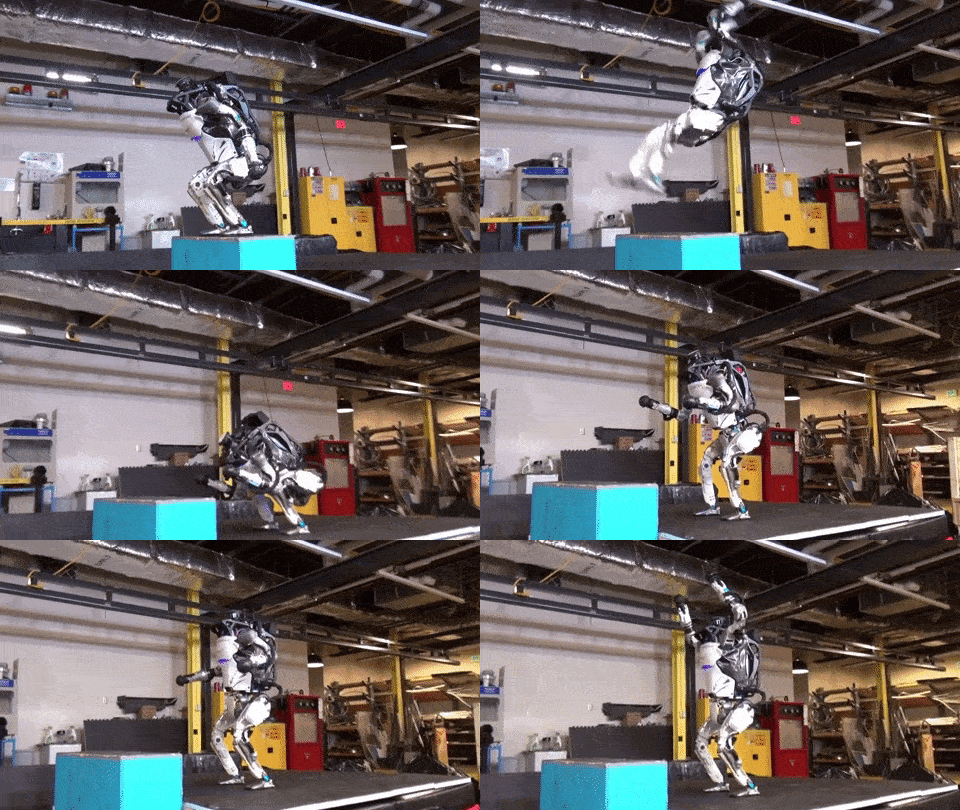 We've grown accustomed to seeing Boston Dynamics' impressive line-up of robots strutting about in periodic video updates, each more terrifying than the last. But, every once in a while, the company unleashes a clip so awesome you can't help but watch...


.png)
.png)





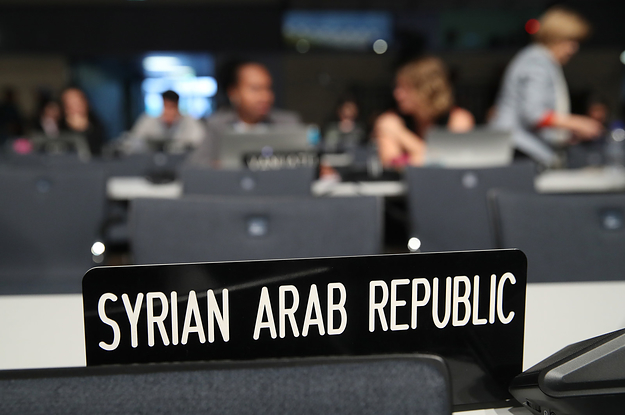
 We know that both TV channels and streaming services are getting in on eSports, but if there's one game that can break through to the mainstream it's (arguably) Rocket League. RC cars playing soccer in a gravity-defying stadium -- what's not to like?...
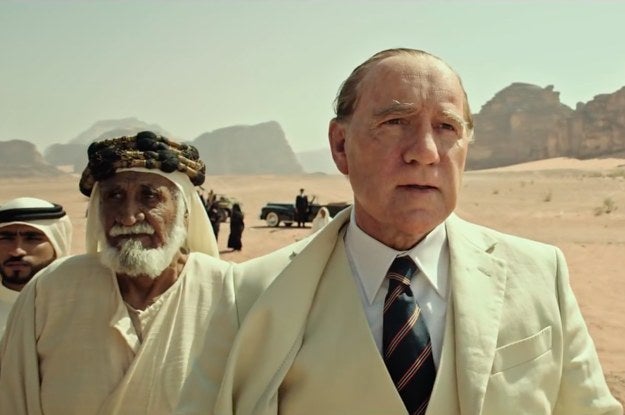

 No, you weren't hallucinating -- the President's personal Twitter account was unplugged earlier this evening. It disappeared, and then reappeared without warning or reason, however now Twitter is offering an explanation. The account was "inadvertentl...