This is Part 3 of a four-part series on Elon Musk’s companies. For an explanation of why this series is happening and how Musk is involved, start with Part 1.
Pre-Post Note: I started working on this post ten weeks ago. When I started, I never intended for it to become such an ordeal. But like the Tesla post, I decided as I researched that this was A) a supremely important topic that will only become more important in the years to come, and B) something most people don’t know nearly enough about. My weeks of research and discussions with Musk and others built me an in-depth, tree-trunk understanding of what’s happening in what I’m calling The Story of Humans and Space—one that has totally reframed my mental picture of the future (yet again). And as I planned out what to include in the post, I wanted to make sure every Wait But Why reader ended up with the same foundation moving forward—because with everything that’s coming, we’re gonna need it. So like the Tesla post, this post became a full situation. Even the progress updates leading up to its publication became a full situation.
Thanks for your patience. I know you’d prefer this not to be a site that updates every two months, and I would too. The Tesla and SpaceX posts were special cases, and you can expect a return to more normal-length WBW posts now that they’re done.
About the post itself: There are three main parts. Part 1 provides the context and background, Part 2 explores the “Why” part of colonizing Mars, and Part 3 digs into the “How.” To make reading this post as accessible as possible, it’s broken into five pages, each about the length of a normal WBW post, and you can jump to any part of the post easily by clicking the links in the Table of Contents below. We’re also trying two new things, both coming in the next couple days:
1) PDF and ebook options: We made a fancy PDF of this post for printing and offline viewing (see a preview here), and an ebook containing the whole four-part Elon Musk series:


There are two versions of the PDF: Normal and G-Rated. The G-Rated version is totally clean and appropriate for all ages. The PDF cost covers both versions.
2) An audio version. You can find an unabridged audio version of the post, read by me, as well as a discussion about the post between Andrew and me here.
___________
Contents
Part 1: The Story of Humans and Space
Part 3: How to Colonize Mars
→ Phase 1: Figure out how to put things into space
→ Phase 2: Revolutionize the cost of space travel
→ Phase 3: Colonize Mars
2365 AD, Ganymede
One more day until departure. It was so surreal to picture actually being there that she still didn’t really believe it would happen. All those things she had always heard about—buildings that were constructed hundreds of years before the first human set foot on Ganymede; animals the size of a house; oceans the size of her whole world; tropical beaches; the famous blue sky; the giant sun that’s so close it can burn your skin; and the weirdest part—no Jupiter hovering overhead. Having seen it all in so many movies, she felt like she was going to visit a legendary movie set. It was too much to think about all at once. For now, she just had to focus on making sure she had everything she needed and saying goodbye to everyone—it would be a long time before she would see them again…
___________
Part 1: The Story of Humans and Space
About six million years ago, a very important female great ape had two children. One of her children would go on to become the common ancestor of all chimpanzees. The other would give birth to a line that would one day include the entire human race. While the descendants of her first child would end up being pretty normal and monkey-ish, as time passed, strange things began to happen with the lineage of the other.11 ← click these
We’re not quite sure why, but over the next six million years, our ancestral line started to do something no creatures on Earth had ever done before—they woke up.
It happened slowly and gradually through the thousands of generations the same way your brain slowly comes to in the first few seconds after you rouse from sleep. But as the clarity increased, our ancestors started to look around and, for the very first time, wonder.
Emerging from a 3.6-billion-year dream, life on Earth had its first questions.
What is this big room we’re in, and who put us here? What is that bright yellow circle on the ceiling and where does it go every night? Where does the ocean end and what happens when you get there? Where are all the dead people now that they’re not here anymore?
We had discovered our species’ great mystery novel—Where Are We?—and we wanted to learn how to read it.
As the light of human consciousness grew brighter and brighter, we began to arrive at answers that seemed to make sense. Maybe we were on top of a floating disk, and maybe that disk was on top of a huge turtle. Maybe the pinpricks of light above us at night are a glimpse into what lies beyond this big room—and maybe that’s where we go when we die. Maybe if we can find the place where the ceiling meets the floor, we can poke our heads through and see all the super fun stuff on the other side.2

Around 10,000 years ago, isolated tribes of humans began to merge together and form the first cities. In larger communities, people were able to talk to each other about this mystery novel we had found, comparing notes across tribes and through the generations. As the techniques for learning became more sophisticated and the clues piled up, new discoveries surfaced.
The world was apparently a ball, not a disk. Which meant that the ceiling was actually a larger sphere surrounding us. The sizes of the other objects floating out there in the sphere with us, and the distances between them, were vaster than we had ever imagined. And then, something upsetting:
The sun wasn’t revolving around us. We were revolving around the sun.
This was a super unwarm, unfuzzy discovery. Why the hell weren’t we in the center of things? What did that mean?
Where are we?
The sphere was already unpleasantly big—if we weren’t in the center of it, were we just on a random ball inside of it, kind of for no apparent reason? Could this really be what was happening?

Scary.
Then things got worse.
It seemed that the pinpricks of light on the edge of the sphere weren’t what we thought they were—they were other suns like ours. And they were out there floating just like our sun—which means we weren’t inside of a sphere at all. Not only was our planet not the center of things, even our sun was just a random dude out there, in the middle of nowhere, surrounded by nothingness.

Scary.
Our sun turned out to be a little piece of something much bigger. A beautiful, vast cloud of billions of suns. The everything of everything.

At least we had that. Until we realized that it wasn’t everything, it was this:

Darkness.
The better our tools and understanding became, the more we could zoom out, and the more we zoomed out, the more things sucked. We were deciphering the pages of Where Are We? at our own peril, and we had deciphered our way right into the knowledge that we’re unbelievably alone, living on a lonely island inside a lonely island inside a lonely island, buried in layers of isolation, with no one to talk to.
That’s our situation.
In the most recent 1% of our species’ short existence, we have become the first life on Earth to know about the Situation—and we’ve been having a collective existential crisis ever since.
You really can’t blame us. Imagine not realizing that the universe is a thing and then realizing the universe is a thing. It’s a lot to take in.
Most of us handle it by living in a pleasant delusion, pretending that the only place we live is in an endless land of colors and warmth. We’re like this guy, who’s doing everything he possibly can to ignore the Situation:3

And our best friend for this activity? The clear blue sky. The blue sky seems like it was invented to help humans pretend the Situation doesn’t exist, serving as the perfect whimsical backdrop to shield us from reality.
Then nighttime happens, and there’s the Situation, staring us right in the face.

Oh yeah…
This la-di-da → oh yeah… → la-di-da → oh yeah… merry-go-round of psychosis was, for most of recent history, the extent of our relationship with the Situation.
But in the last 60 years, that relationship has vaulted to a whole new level. During World War II, missile technology leapt forward,2 and for the first time, a new, mind-blowing concept was possible—
Space travel.
For thousands of years, The Story of Humans and Space had been the story of staring out and wondering. The possibility of people leaving our Earth island and venturing out into space burst open the human spirit of adventure.
I imagine a similar feeling in the people of the 15th century, during the Age of Discovery, when we were working our way through the world map chapter of Where Are We? and the notion of cross-ocean voyages dazzled people’s imaginations. If you asked a child in 1495 what they wanted to be when they grew up, “an ocean explorer” would probably have been a common response.
In 1970, if you asked a child the same question, the answer would be, “an astronaut”—i.e. a Situation explorer.
WWII advanced the possibility of human space travel, but it was in late 1957, when the Soviets launched the first man-made object into orbit, the adorable Sputnik 1, that space travel became the defining quest of the world’s great powers.
At the time, the Cold War was in full throttle, and the US and Soviets had their measuring sticks out for an internationally-televised penis-measuring contest. With the successful launch of Sputnik, the Soviet penis bolted out by a few centimeters, horrifying the Americans.

To the Soviets, putting a satellite into space before the US was proof that Soviet technology was superior to American technology, which in turn was put forward as proof, for all the world to see, that communism was a system superior to capitalism.
Eight months later, NASA was born.
The Space Race had begun, and NASA’s first order of business would be to get a man into space, and then a man into full orbit, preferably both before the Soviets. The US was not to be shown up again.
In 1959, NASA launched Project Mercury to carry out the mission. They were on the verge of success when in April of 1961, the Soviets launched Yuri Gagarin into a full orbit around the Earth, making the first human in space and in orbit a Soviet.

It was time for drastic measures. John F. Kennedy’s advisors told him that the Soviets had too big a lead for the US to beat them at any near-term achievements—but that the prospect of a manned moon landing was far enough in the future that the US had a fighting chance to get there first. So Kennedy gave his famous “we choose to go to the moon, not because it is easy, but because it is hahhd” speech, and directed an outrageous amount of funding at the mission ($20 billion, or $205 billion in today’s dollars).
The result was Project Apollo. Apollo’s mission was to land an American on the moon—and to do it first. The Soviets answered with Soyuz, their own moon program, and the race was on.
As the early phases of Apollo started coming together, Project Mercury finally hit its stride. Just a month after Yuri Gagarin became the first man in space, American astronaut Alan Shepard became the second man in space, completing a little arc that didn’t put him in full orbit but allowed him to give space a high-five at the top of the arc. A few months later, in February of 1962, John Glenn became the first American to orbit the Earth.
The next seven years saw 22 US and Soviet manned launches as the superpowers honed their skills and technology. By late 1968, the furiously-sprinting US had more total launches under their belt (17) than the Soviets (10), and together, the two nations had mastered what we call Low Earth Orbit (LEO).

But LEO hadn’t really excited anyone since the early ’60s. Both powers had their sights firmly set on the moon. The Apollo program was making quick leaps, and in December of 1968, the US became the first nation to soar outside of LEO. Apollo 8 made it all the way to the moon’s orbit and circled around 10 times before returning home safely. The crew, which included James Lovell (who a few months later played the role of Tom Hanks on the Apollo 13 mission), shattered the human altitude record and became the first people to see the moon up close, the first to see the “dark” side of the moon, and the first to see the Earth as a whole planet, snapping this iconic photo:4

Upon return, the crew became America’s most celebrated heroes—which I hope they enjoyed for eight months. Three Apollo missions later, in July of 1969, Apollo 11 made Americans Neil Armstrong3 and Buzz Aldrin the first humans on the moon, and Armstrong took this famous photo of Aldrin looking all puffy:5

It’s hard to fully emphasize what a big deal this was. Ever since life on Earth began 3.6 billion years ago, no earthly creature had set foot on any celestial body other than the Earth. Suddenly, there are Armstrong and Aldrin, bouncing around another sphere, looking up in the sky where the moon is supposed to be and seeing the Earth instead. Insane.
Project Apollo proved to be a smashing success. Not only did Apollo get a man on the moon before the Soviets, the program sent 10 more men to the moon over the next 3.5 years on five other Apollo missions. There were six successful moon trips in seven tries, with the famous exception being Apollo 13, which was safely aborted after an explosion in the oxygen tank.4
The Soviet Soyuz program kept running into technical problems, and it never ended up putting someone on the moon.
The final Apollo moonwalk took place in late 1972. In only one decade, we had conquered nearby space, and progress was accelerating. If at that time you had asked any American, or any other human, what the coming decades of space travel would bring, they’d have made big, bold predictions. Many more people on the moon, a permanent moon base, people on Mars, and beyond.
So you can only imagine how surprised they’d be if you told them in 1972, after just watching 12 humans walk on the moon, that 43 years later, in the impossibly futuristic-sounding year 2015, the number of people to set foot on the moon would still be 12. Or that after leaving Low Earth Orbit in the dust years earlier and using it now as our pre-moon trip parking lot, 2015 would roll around and LEO would be the farthest out humans would ever go.
1972 people would be blown away by our smart phones and our internet, but they’d be just as shocked that we gave up on pushing our boundaries in space.
So what happened? After such a wildly exciting decade of human space adventure, why did we just stop?
Well, like we found in the Tesla post, “Why did we stop?” is the wrong question. Instead, we should ask:
Why were we ever adventurous about sending humans into space in the first place?
Space travel is unbelievably expensive. National budgets are incredibly tight. The fact is, it’s kind of surprising that a nation ever ponied up a sizable chunk of its budget for the sake of adventure and inspiration and pushing our boundaries.
And that’s actually because no nation did blow their budget for the sake of adventure and inspiration and pushing our boundaries—two nations blew their budgets because of a penis–length contest. In the face of international embarrassment at a time when everyone was trying to figure out whose economic system was better, the US government agreed to drop the usual rules for a few years to pour whatever resources were necessary on the problem to make sure they won that argument—

And once they won it, the contest was over and so were the special rules. And the US went back to spending money like a normal person.6

Instead of continuing to push the limits at all costs, the US and the Soviets got a grip, put their pants back on, shook hands, and started working together like adults on far more practical projects, like setting up a joint space station in LEO.
In the four decades since then, the Story of Humans and Space has again become confined to Earth, where we find ourselves with two primary reasons to interact with space (Note: the next whole chunk of the post is a slight diversion for an overview on satellites, space probes, and space telescopes. If that doesn’t excite you, I won’t be hurt if you skip down to the International Space Station section):
1) Support for Earth Industries
The first and primary reason humans have interacted with space since the Apollo program isn’t about human interest in space. It’s about using space for practical purposes in support of industries on Earth—mostly in the form of satellites. The bulk of today’s rocket launches into space are simply putting things into LEO whose purpose is to look back down at Earth, not to the great expanses in the other direction.
Here’s a little satellite overview:
Satellites Blue Box
We don’t think about them that often, but above us are hundreds of flying robots that play a large part in our lives on Earth. In 1957, lonely Sputnik circled the Earth by itself, but today, the worlds of communication, weather forecasting, television, navigation, and aerial photography all rely heavily on satellites, as do many national militaries and government intelligence agencies.
The total market for satellite manufacturing, the launches that carry them to space, and related equipment and services has ballooned from $60 billion in 2004 to over $200 billion in 2015. Satellite industry revenue today makes up only 4% of the global telecommunications industry but accounts for over 60% of space industry revenue.7
Here’s how the world’s satellites break down by role (in 2013):8

Of the 1,265 active satellites in orbit at the beginning of 2015, the US owns by far the largest number at 528—over 40% of the total—but over 50 countries own at least one orbiting satellite.
As for where all of these satellites are, most of them fall into two distinct “layers” of space:
About two-thirds of active satellites are in Low Earth Orbit. LEO starts up at 99 miles (160 km) above the Earth, the lowest altitude at which an object can orbit without atmospheric drag messing things up. The top of LEO is 1,240 miles (2,000 km) up. Typically, the lowest satellites are at around 220 miles (350 km) up or higher.
Most of the rest (about one-third) of the satellites are much farther out, in a place called geostationary orbit (GEO). It’s right at 22,236 miles (35,786 km) above the Earth, and it’s called geostationary because something orbiting in it rotates at the exact speed that the Earth turns, making its position in the sky stationary relative to a point on the Earth. It’ll seem to be motionless to an observer on the ground.9

GEO is ideal for something like a TV satellite because a dish on the Earth can aim at the same fixed spot all the time.
A small percentage of other satellites are in medium Earth orbit (MEO), which is everything in between LEO and GEO. One notable resident of MEO is the GPS system that most Americans, and people from many other countries, use every day. I never realized that the entire GPS system, a US Department of Defense project that went live in 1995, only uses 32 satellites total. And until 2012, the number was only 24—six orbits, each with four satellites. But you can see in the GIF below that even with 24, a given point on the Earth can be seen by at least six of the satellites at any given time, and usually it’s nine or higher (in the GIF, the blue dot on the Earth is a hypothetical person on the ground, and whichever satellites can see him at a given time are blue, with the green lines showing their line of sight to the person):10

This is why your phone’s map can still show your location even when you’re somewhere with no cellular service—because it has nothing to do with cellular service. The system is also set up to be redundant—only four satellites need to simultaneously see you in order for the system to pinpoint your location. GPS satellites have an orbital period of about 12 hours, making two full rotations of the Earth each day.5
You can see satellite locations using Google Earth (here’s a cool video of Google Earth showing the satellites).
Space Debris Bluer Box
There’s a big problem happening in the world of satellites. In addition to the 1,265 active satellites up in orbit, there are thousands more inactive satellites, as well as a bunch of spent rockets from previous missions. And once in a while, one of them explodes, or two of them collide, creating a ton of tiny fragments called space debris. The number of objects in space has risen quickly over recent decades, as a GIF6 made by the ESA shows (with exaggerated-sized objects relative to the Earth’s size):11

The majority of satellites and debris are bunched around the Earth in LEO, and the outer ring of objects is what’s located in GEO.
Earth space agencies track about 17,000 objects in space, only 7% of which are active satellites. Here’s a map showing every known object in space today.12

But the crazy thing is they only track the large objects, and that’s what we’re seeing in that image. Estimates for the number of smaller debris objects (1 – 10 cm) range from 150,000 to 500,000, and there are over a million total pieces of debris larger than 2 mm.13
The issue is that at the incredible speeds at which space objects move (most LEO objects zip along at over 17,000 mph), a collision with even a tiny object can cause devastating damage to an active satellite or spacecraft. An object of only 1 cm at those speeds will cause the same damage in a collision as a small hand grenade.714
Over a third of all space debris originated from just two events: China’s 2007 anti-satellite test, when China shat on the world’s face by intentionally blowing up one of its own satellites, creating 3,000 new pieces of debris large enough to be trackable, and a 2009 collision between two satellites that exploded into 2,000 debris chunks.15 Each collision increases the amount of debris, which in turn increases the likelihood of more collisions, and there’s danger of a domino effect situation, which scientists call the Kessler Syndrome. A bunch of parties are proposing ways to mitigate the amount of debris in LEO—everything from harpooning the debris to laser blasting it to intercepting it with a cloud of gas.
Here’s a chart that sums up each nation’s “space footprint,” showing the quantity of active satellites, inactive satellites, and space debris caused by each country:16

There are a few other space activities in the “Support for Earth Industries” category of human/space interaction—like space mining, space burial, and space tourism—but at least for now, satellites account for almost the entire category.
2) Looking and Learning
The second reason humans have interacted with space in the last four decades proves that while we may have stopped sending people into The Situation, we never lost our hunger to learn about what’s out there. As society moved on from space and turned its attention elsewhere, astronomers have kept busy at work deciphering their way through page after page of the old mystery novel, Where Are We?
Astronomers learn best with their eyes, and a side effect of the Space Race was the development of far better technology for seeing what’s out there. There are two high-tech ways modern astronomers see things:
Looking and Learning Tool #1: Sending probes around the Solar System
Basically, scientists fire a fancy robot toward some distant planet, moon, or asteroid, and the robot spends months or years flying through space, bored, until it finally arrives. Then, depending on the plan, it either just flies by the object, taking some pictures on the way, orbits the object to get more detailed information, or lands on the object for a full inspection. Everything it learns, it sends back to us, and one day, when its job is done, we either kill the probe by crashing it into the object or let it just fly out into deep space to be depressed.
I often use myself as a litmus test for what the public probably knows about or doesn’t know about. As I’ve mentioned before on this blog, I’ve been seriously dating astronomy ever since I was three years old—so if I don’t know something going on in the world of space, I assume that most people don’t. And when it comes to space probes, I’ve felt pretty disoriented. Are there 200 of them flying around out there? 50? 9? Why are they out there, who sent them, and what are they doing? All I’d know is that sometimes there would be a random story about some probe sending back stunning pictures—I’d open the cnn.com gallery, click through them, be thrilled for a second, send the link to the three friends of mine who are also dating astronomy, and then try to close the page but instead see some trashy CNN clickbait headline on the side of the page, click that, and ruin my life for the next three hateful hours. That’s my relationship with humanity’s space probes.
But in researching this post, I quickly realized there’s not that much to know, and it doesn’t take too big an effort to get fully oriented. Here are what I consider the eight key space robots to know about right now:17
1) New Horizons (Pluto, NASA)

New Horizons goes first because its big moment just happened. Launched in 2006 on a decade-long trip to Pluto (sped up on its way by a Jupiter fly-by in 2007 that gravity-zinged it to a much faster speed), New Horizons finally reached Pluto on July 14th, 2015. It didn’t land on Pluto, but it flew very near to it and showed us Pluto for the first time:818

Next, New Horizons will be on its way further outwards into the Kuiper belt to send back images of comets and dwarf planets. You can track New Horizons’ location here.
Awkwardly, Pluto was still a planet when New Horizons launched, and everyone spent the years following Pluto’s demotion avoiding making eye contact with the New Horizons team. While I agree with the common sentiment that it’s sad that Pluto’s sad about its demotion,9 the truth is, Pluto should probably appreciate that it got away with 76 illegitimate years as a planet celebrity, pulling in a ton of Kuiper belt ass in the process, given that fellow Kuiper belt dwarf planet Eris spent that whole time living its life in total obscurity, only discovered in 2005.
2) Curiosity (Mars, NASA)

Curiosity is a now-famous rover. A car-sized lovable lander robot dropped down on Mars’s surface in 2012, Curiosity is studying a bunch of things inside a large crater, with its primary objective being to figure out if there’s ever been life on Mars. The last two Mars rovers, Opportunity and Spirit, landed in 2004 with a planned mission of 90 days. Both lasted way past their expiry date, and Opportunity is still active. Such a good boy.
There are a bunch of other probes orbiting around Mars as well, but Curiosity is the main event there.
In my research, I came across this video from an IMAX movie about getting the rover Spirit from Earth to the surface of Mars and thought it was the coolest video ever. Until I found this video about getting Curiosity on Mars, which was even cooler.
3) Juno (Jupiter, NASA)

Juno left Earth in 2011, made a big loop and came back to Earth in 2013 to get a gravity zing (during which it captured a cool video of the moon circling the Earth), and is now on its way to Jupiter, where it’ll arrive in July of 2016.19

Once it arrives, Juno will orbit Jupiter, taking pictures and using sensors to try to figure out what’s going on in there underneath all the succulent-looking cloud tops. It’ll die by falling into Jupiter, hopefully snapping and relaying some quick photos of what it looks like inside Jupiter’s atmosphere before burning up so that someone can make a virtual reality video that lets you descend into Jupiter’s surface.
4) Cassini (Saturn, NASA / European Space Agency / Italian Space Agency collaboration)

Launched in 1997, Cassini set off towards Saturn, the only planet in the Solar System who decided it was okay to wear a tutu. Reaching Saturn in 2004, Cassini became the first probe in history to orbit the planet, sending back some jaw-dropping pictures, like this one:20

And this one:

And this close-up of the rings:

And this absurdly cool picture of Saturn with the sun behind it:

In 2005, Cassini dropped its attached lander, the upsettingly-named Huygens, down onto the largest of Saturn’s moons, Titan. Here’s a real image of the surface of Titan, taken by Huygens (it’s creepily fascinating seeing the actual surface of something as far away and mysterious as a Saturn moon):21

5 and 6) Voyager 1 and 2 (Jupiter, Saturn, Uranus, Neptune; NASA)

Launched in 1977, the two Voyager probes were the first probes to collect images of the four outer giants of the Solar System. Voyager 2 is still the only probe to visit Uranus and Neptune, taking these eerie photos of the two, respectively:22

The cool thing about the Voyagers is that even though their original missions are now long over, they’re still zooming outward. They’re both ridiculously far away now and going super fast. Voyager 1 is the faster of the two, going 38,000 mph (61,000 km/h)—so fast that it would cross the Atlantic Ocean in five minutes—and it’s the farthest man-made object from Earth, currently 131 AU10 away from Earth. It was also the first man-made object to leave the Solar System. At this rate, Voyager 1 will reach Proxima Centauri, the closest star to us, in about 73,000 years.
Another cool thing about the Voyagers is that before they launched, a NASA committee, led by Carl Sagan, loaded them each up with a time capsule, full of symbols, sounds, and images of Earth (and symbol instructions about how to play and view the media), so the probes can one day tell aliens what our deal is. Probably a waste of everyone’s time, but who knows.
7) Rosetta (comet, ESA)

Launched in 2004, Rosetta got a lot of attention last year when it reached comet 67P in August 2014 and successfully dropped its little lander, Philae, onto the comet a couple months later. Comet 67P turned out to kind of just be a big rock (2.7 mi/4.3 km long), but the images taken by Rosetta were cool:

8) Dawn (Vesta and Ceres, NASA)

Dawn can’t believe it made the cut on this list. The reason I included it is that I’m not sure people realize that there are huge, almost planet-size objects in the asteroid belt. The asteroid belt, a huge ring of millions of asteroids, including over 750,000 that are at least 1 km in diameter,23 lies between the orbits of Mars and Jupiter (not to be confused with the much larger Kuiper belt that surrounds the outer Solar System). Among the many asteroids in the asteroid belt is Ceres, a dwarf planet 27% the diameter of the moon that makes up one-third of the asteroid belt’s total mass, and Vesta, the second largest object in the belt after Ceres and the brightest belt object in our night sky.11 I didn’t really know Ceres and Vesta were things. Anyway, Dawn, which was launched in 2007, spent nine months orbiting Vesta in 2011 before heading off to Ceres, where it arrived in March 2015 (making it the first probe to orbit two different bodies).
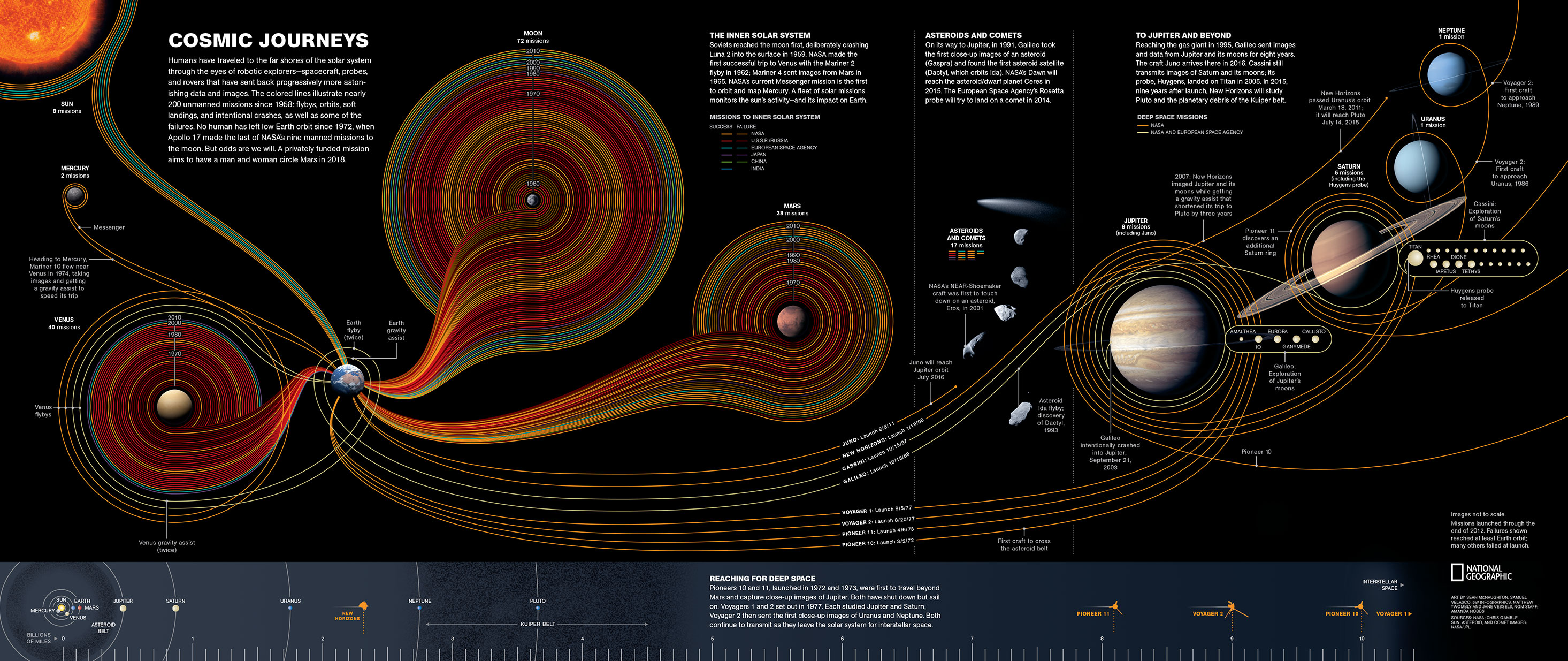
There’s another handful of probes out there as well. Like Messenger, which orbited Mercury for seven years until intentionally crashing into it in April 2015; Akatsuki, a Japanese probe that was supposed to start orbiting Venus in 2010 but botched it, and will try again this year; a bunch of probes uneventfully circling the moon, including China’s Chang’e 3, which dropped the first lander on the moon since 1976; and a group of others taking measurements from the sun. Here’s an exhaustive list of all past and present probes, and an awesome National Geographic visualization that sums it all up (click the graphic for a larger view):24
Looking and Learning Tool #2: Telescopes
Telescopes have been around since the early 17th century, and as they got more and more powerful over the next 400 years, they became humanity’s primary tool for turning the pages of Where Are We?
But there came a point when ground telescopes ran into a limit on what they’d be able to see, no matter how advanced they became. You know when you look at a light through a glass of water and the light is all bendy and silly? That’s what’s happening when stars twinkle, except instead of water, we’re looking at them through the Earth’s atmosphere. The atmosphere doesn’t distort light as much as water does, but stars and galaxies are tiny pinpricks of light in our sky, so any level of blur is a big problem—it’s like being underwater in a swimming pool and looking upwards, trying to examine a bunch of birds flying in the sky above.
In the 1960s, humans gained the ability to put telescopes in space, where they’d show us the first crystal-clear view of the stars in history. In 1990, NASA launched the first truly badass space telescope, the Hubble.1225

The 13-ton, school bus-length Hubble Space Telescope’s 7.9 foot (2.4 m) lens is accurate enough to shine a laser beam on a dime 200 miles away and powerful enough to see a pair of fireflies in Tokyo from your home in Boston (if the Earth were flat). And in its position in orbit 340 miles above Earth, where there’s no atmosphere or light pollution in the way, the Hubble is on what NASA calls “the ultimate mountaintop.”26 All of this gives the Hubble an unprecedented view of the universe, allowing it to spend the last 25 years sending us the most astounding photographs of things I can’t really believe are real. Like this epic galaxy:27

Or these two galaxies, which are in the slow process of merging:

Or the inconceivably huge Pillars of Creation (the left finger is so big, at four light years from top to bottom, that if you started at the knuckle and flew in an airplane upwards, it would take 4.5 million years to get to the fingertip):

Or the time Hubble aimed its lens at a tiny, seemingly empty square of the sky (seen here next to the moon to show the size of the square):

And found thousands of galaxies:

What Hubble and other space telescopes13 have shown us has revealed worlds of new information about where we are and how we got here, expanding our knowledge about everything from dark energy to the origin and age and size of the universe to the number of planets out there like ours that might have life on them.
For over 40 years now, those two objectives—supporting Earth industries and continuing to learn and discover—have been the extent of our relationship with space.
And because those two goals are both best accomplished by machine space travelers, the most recent chapter of The Story of Humans and Space has been all about space faring machines, with the human role taking place on or very near Earth, controlling things with joysticks.
The only reason any humans have gone to space since Apollo 17 returned to Earth in 1972 is that sometimes, the machines aren’t yet advanced enough to do a certain task, so we need to send a human up to do it instead. Of the roughly 550 people who have ever been in space, over 400 of them have gone there in the post-Space Race era. But since Apollo, the reasons have been practical—scientists and technicians going to space to do a job. That’s why each and every manned mission of the past four decades has kept within the thin blanket of space surrounding the Earth—Low Earth Orbit.
The International Space Station
Today, the purpose of almost every manned space mission is to take astronauts to and from the International Space Station (ISS). 28

The ISS is an international collaboration among 16 countries, started in 1998 and constructed over the span of a decade. The space station orbits the Earth in the lowest strip of LEO at an altitude of between 205 and 255 miles (330–410 km14), about the distance across Iceland—close enough to the ground that you can easily see it at night with your naked eye.15 And it’s bigger than people realize, weighing as much as 320 cars and spanning the full length of an American football field:29

What the Hell Does Anyone Do in the ISS? Blue Box
As I began working on this post, I realized I didn’t really know what the ISS was for or what anyone did while they were there. Every time I see a video of what goes on inside the space station, it’s just some adult floating around having playtime.
Conveniently, there’s such a thing as an ISS conference, and it happened to take place last month, in Boston. So I went. The conference was run by the Center for the Advancement of Science in Space (CASIS), which manages the US portion of the ISS. Here’s what I learned at the conference:
- The ISS is a science laboratory. It’s kind of like other labs, except with the party trick that it’s soaring through space, so it’s the one lab where you can test things in zero gravity (it’s not actually zero gravity—it’s microgravity—something I’ll explain later in the post).
- What most ISS experiments have in common is that they’re there for the gravity situation, but beyond that, they span a wide range of purposes—everything from learning about osteoporosis as astronauts’ bones atrophy (because they don’t have to fight against gravity), to testing how equipment holds up in space, to analyzing how fluids behave and interact without the influence of any other forces, to using the change in gravity to trick bacteria into revealing which genes make them immune to certain medicines.
- Astronauts in the ISS have a tight and controlled schedule during the week. At all times, they’re either sleeping (8.5 hours), eating (1.5 hours for breakfast/dinner, 1 hour for lunch) exercising (mandatory 2.5 hours a day), or working on experiments (9 hours a day)—I took this photo of the current schedule of the three astronauts on the ISS.16 Weekends are off, which could not possibly sound more fun—you get to spend the whole time floating around and looking out the window.
- I’m not the only one who badly wants to play on the ISS—there’s a furiously competitive process to be selected by NASA to go. Thousands apply, 100 are picked for a final round interview and physical examination, and only one or two end up getting the nod. On rare occasion, a private company or individual can buy a spot on the station for a few days, but it costs around $60 million.
If you want to get a better feel for what it’s like to live on the ISS, here’s a video tour of the space station by a floaty astronaut.
So far, 216 people have gotten to play on the ISS, from 15 countries:30

How Stuff Gets to Space
We’ve gone over what’s in space, but how does all that stuff get to space? Have you ever asked yourself how something like the GPS satellite gets up there in the first place? The answer is that there are nine countries that have the ability to launch something into orbit: Russia, the US, France, Japan, China, India, Israel, Iran and, um, North Korea—along with one non-national entity, the European Space Agency (ESA). If a satellite goes up into space, it’s because someone paid one of those ten entities to bring it there atop a massive, expensive rocket (or because a country is putting one up there for its own uses).
As for launching humans into space, only three countries in history have done it—Russia, the US, and China (who is a fast-growing newcomer to the space industry). Since the 60s, Russia has used its Soyuz rockets to launch people into space, and the US, after wrapping up the Apollo program in 1972, regained the ability to put people in orbit in 1981 with the Space Shuttle program.31

Over the next 30 years, the US launched 135 Space Shuttles into LEO, with 133 successes. The two exceptions are fairly traumatizing parts of American history—Challenger in 1986 and Columbia in 2003.
The Space Shuttle Program retired in 2011. Today, only two countries can launch a human into orbit—Russia and China. With no capability themselves, the US—the country that once triumphantly put a man on the moon while the world watched—now has to launch their astronauts on Russian rockets, at Russia’s whim.
___________
So what are we to make of The Story of Humans and Space? It’s a bit of an odd tale. In 1970, the story looked like this:

So the assumption about where the story was headed was this:

But now it’s 2015, and it turns out that this is what was happening:

When I look at what’s going on with humans and space today, I should think it’s incredible. Just 58 years after the Soviets put the first man-made object into orbit, we now have a swarm of high-tech equipment soaring around our planet, giving humans magical capabilities in vision and communication. There’s a team of flying robot messengers spread out through the Solar System, reporting back to us with their findings. There’s a huge flying telescope high above Earth, showing us exactly what the observable universe looks like. There’s a football field-sized science lab 250 miles above our heads with people in it.
Everything I just said is amazing.
And if only The Story of Humans and Space looked like this—

—I would be marveling at the things we’re currently doing out in The Situation.
But unfortunately, the 60s happened. So instead, it’s like this:


A good magic show follows a simple rule—make the act get better as it goes along. If you can’t continue to stay a step ahead of the increasingly-jaded crowd, they’ll quickly tune you out.
In some areas, the Humans and Space magic show has continued steadily upward. In our quest for knowledge and understanding, for example, we continue to outdo ourselves, learning significantly more about the universe every decade. The human spirit of discovery is alive and well, having thrived in space in the years since Apollo.
But as fascinated as we are by discovery—as much as we yearn to know all the secrets hidden in the pages of Where Are We?—when it comes to filling us with true excitement and inspiration and getting our adrenaline pumping, discovery doesn’t hold a candle to adventure. Probes and telescopes may fill us with wonder and light up our curiosity, but nothing gets us in our animal core like watching our species go where no man has gone before. And in that arena, the last four decades have left us feeling empty. After watching people land on the moon, following manned missions to and from the ISS is, as Ross Andersen said, “about as thrilling as watching Columbus sail to Ibiza.”
And that’s why, in today’s world, The Story of Humans and Space has drifted off the front page of our consciousness. The topic that should drop all of us to our knees has become a geeky sideshow. Ask 10 well-educated people you know about what’s going on with Solar System probes or the ISS or NASA or SpaceX and most won’t be able to tell you very much. Some won’t even know that people ever go to space anymore. People don’t know because people don’t care. Because of the way it played out, The Story of Humans and Space feels like a disappointment. And looking at the world around us today, it’s intuitive to predict that future chapters of the space story will continue to putter along as they do today:

Many people don’t think this is a bad thing. “Why spend exorbitant amounts of money sending people to the far reaches of space when we have so many problems right here on Earth?” they ask. Massachusetts Congressman Barney Frank, who spent three decades playing a key role in US budget decision-making, calls ambitious manned space travel “at best a luxury that the country ought not to be indulging in” and “a complete and total waste of money” and “pure boondoggle.”32 And the dramatic slashes to NASA’s budget since the Space Race ended suggest that Frank isn’t the only US politician to hold this view.
Upon first assessment, Frank is being perfectly rational—after all, in the face of concerns like healthcare, national security, education, and poverty, should we really make room for an “adventure budget”? And in that light, the graph projection above for The Future of Humans and Space seems all the more likely to continue on its current course.
I’ve spent the last couple months reading, talking, and thinking almost non-stop about what the coming chapters of this story will look like—and my assumptions about the future have now changed dramatically.
I think we’re all in for a big surprise.
For those new to Wait But Why, blue circle footnotes (like this one) are good to click on—they’re for fun facts, extra thoughts, extraneous quotes from my conversations with Musk, and further explanation.↩
It was actually the Germans who had the world’s early lead in rocket technology, but when they lost the war, the Americans, Soviets, and British pillaged Germany’s rocket engineers, with each successfully recruiting a number of them. The US was probably the biggest winner, snagging Wernher von Braun, who would ultimately lead them to their moon landing rocket, the Saturn V.↩


 A University of Cambridge team of researchers has created a "mother robot" capable of giving birth to -- or more correctly, building its own -- baby cube-bots. The team conducted five rounds of experiments, wherein it assembled 10 pint-sized machin...








 You know who hates drones -- I mean besides homeowners, fishermen, chimpanzees and the San Bernardino Fire Department? Eagles, that's who. When Melbourne Aerial Video recently sent one of its quadcopters over a wooded area to capture footage, a Wed...


.jpg)


.jpg)