what if
Kevin Whitewho knew sleepy hollow was a real place?
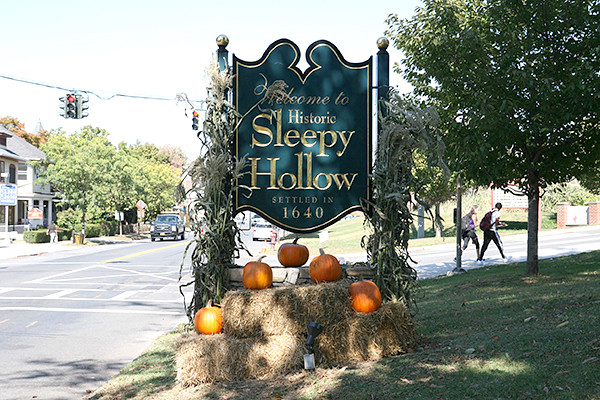
Last week, I was heading home from a day of scouting in Westchester when I found myself passing through Sleepy Hollow. Suddenly, it felt like autumn had officially arrived.
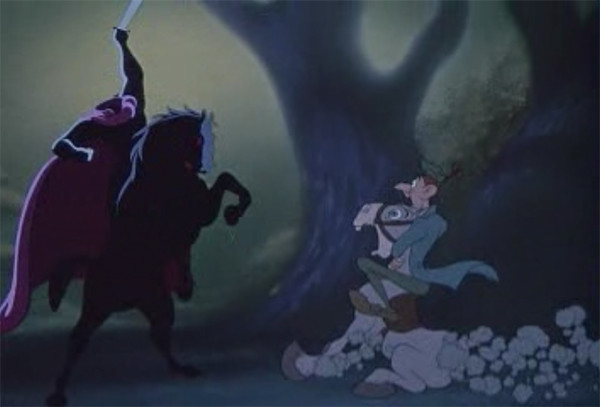
As a kid, there was nothing I loved more around Halloween than revisiting The Legend of Sleepy Hollow – both Washington Irving’s tale, for which I had a beautifully illustrated children’s book, and the wonderful Disney animated version.
I ended up rereading the story later that night, and was surprised to find that Irving is pretty specific about the route Ichabod Crane takes while fleeing from the Headless Horseman. I decided to take a trip back to Sleepy Hollow to try and recreate Ichabod’s fateful race myself.

In the story, Ichabod’s night of terror begins quite cheerfully at a party taking place in the home of Baltus Van Tassel, a wealthy Dutch farmer whose daughter Katrina Ichabod is attempting to woo. And so my trek began at the corner of Hamilton Place and Route 9 in Tarrytown…
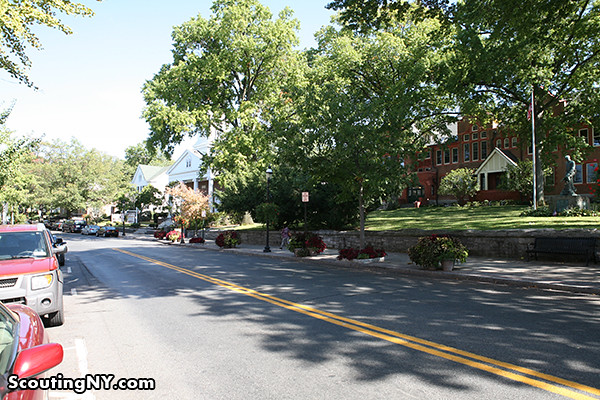
It was at this site that the real Baltus Van Tassel once had a farm, which was later purchased by the Mott family and turned into a tavern/hostelry sometime before the Revolutionary War.

Photo from Louis Glacer’s Process (1882), reprinted in Jonathan Kruk’s
Legends and Lore of Sleepy Hollow and the Hudson Valley
The house managed to survive until the late 1800s, when it was finally torn down to make way for the town’s new high school. According to this report from 1899, the original front door to the Van Tassel house used to reside in the school’s library. Very curious where it eventually wound up.
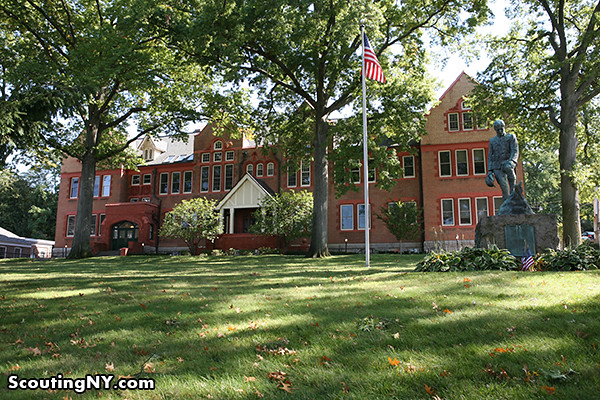
After a night of ghost stories, Ichabod finally gives up on Katrina and departs for Sleepy Hollow…
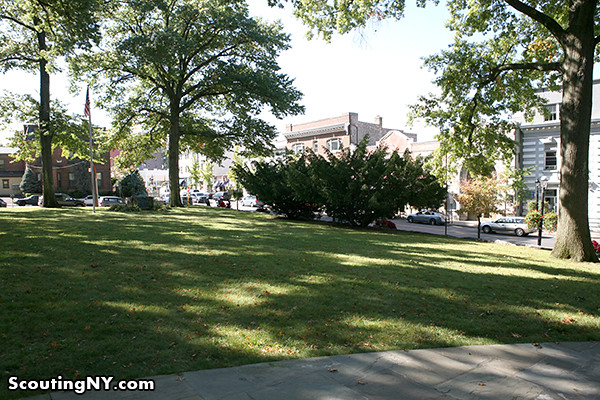
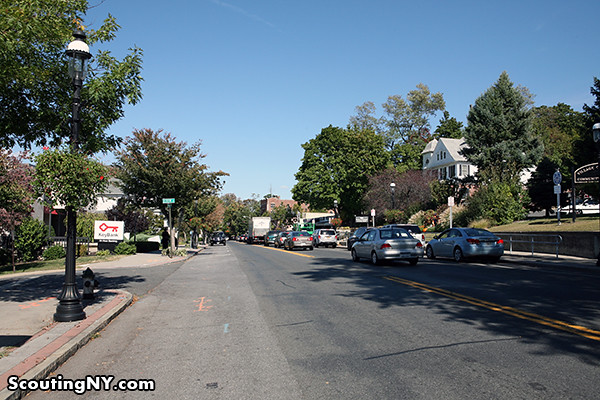
…climbing atop his broken-down steed Gunpowder and heading north along the Old Albany Post Road, then the main thoroughfare connecting New York City to Albany (today, Route 9).
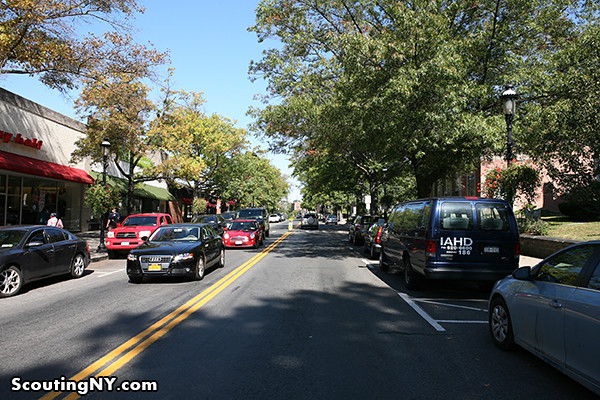
“It was the very witching time of night that Ichabod, heavy-hearted and crest-fallen, pursued his travel homewards, along the sides of the lofty hills which rise above Tarry Town, and which he had traversed so cheerily in the afternoon.”
“Far below him, the Tappan Zee spread its dusky and indistinct waste of waters, with here and there the tall mast of a sloop, riding quietly at anchor under the land. In the dead hush of midnight, he could even hear the barking of the watch dog from the opposite shore of the Hudson…”

As Ichabod continues down the road, he begins to dread an approaching spot, said to be haunted: “An enormous tulip-tree, which towered like a giant above all the other trees… Its limbs were gnarled and fantastic, large enough to form trunks for ordinary trees, twisting down almost to the earth, and rising again into the air. It was connected with the tragical story of the unfortunate André…”
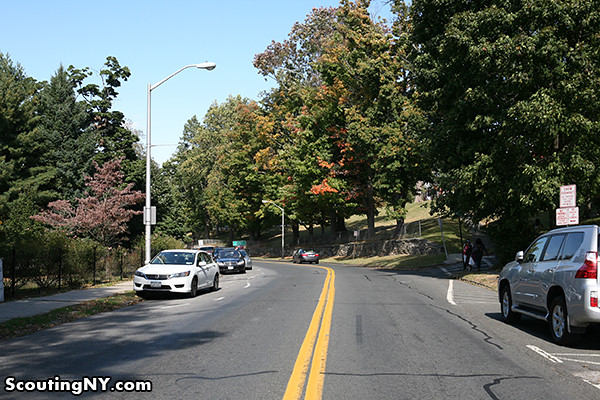
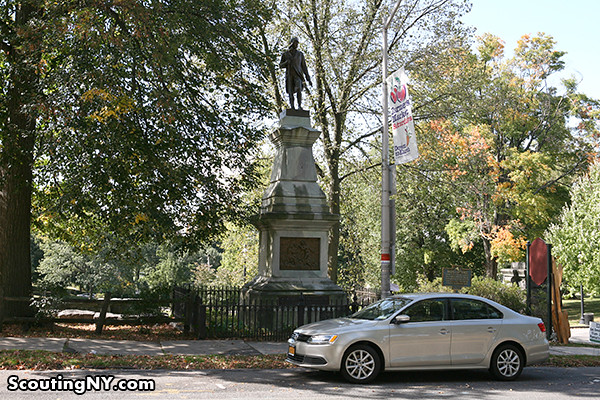
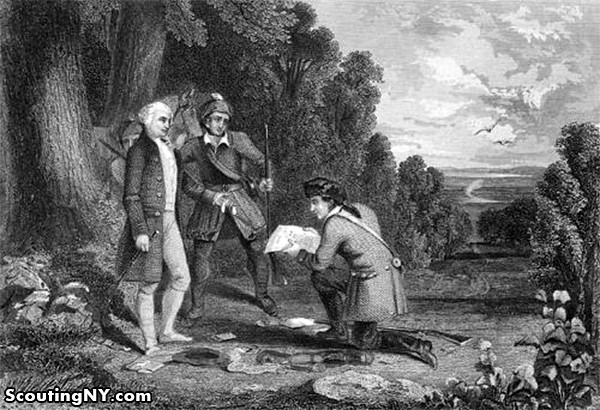
The André in question refers to British Army officer John André, who was hanged as a spy for assisting Benedict Arnold in his attempt to surrender the fort at West Point to the British. André was captured near a particularly notable tree by three American militiamen, today marked by a monument (the tree was struck by lightning and destroyed in 1801).
Below, a print depicting André’s capture and the once rural terrain:
As Ichabod continues on, “about two hundred yards from the tree, a small brook crossed the road, and ran into a marshy and thickly-wooded glen, known by the name of Wiley’s swamp. A few rough logs, laid side by side, served for a bridge…”
Today, Wiley’s Swamp is long gone, replaced by the nicely manicured Patriots Park.
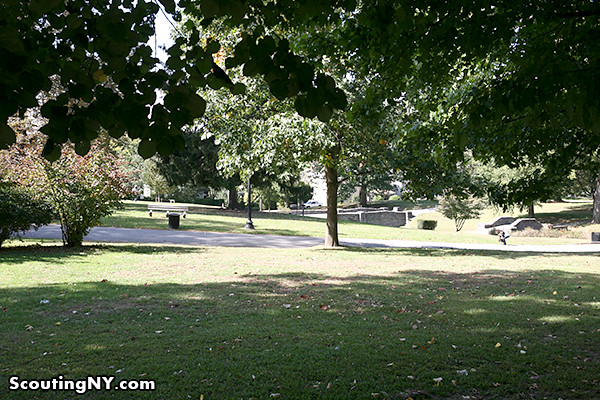
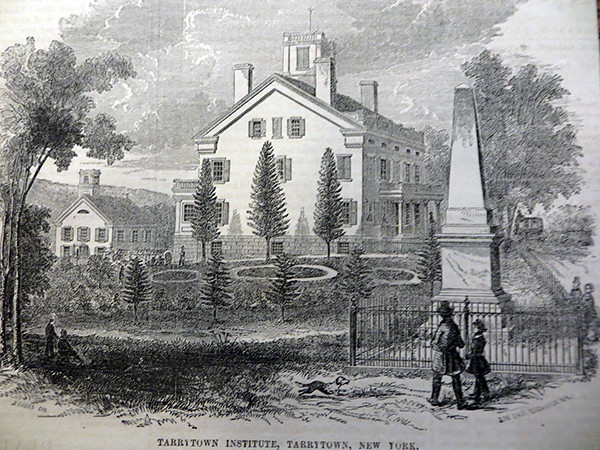
Prior to becoming a park, the former swamp was home to various developments dating to the 1800s, including an all-girls boarding school attended by Lauren Bacall. Below, the land in 1854, with the André monument in the foreground:
However, the stream Ichabod crosses is very much still in existence, today known as André Brook…
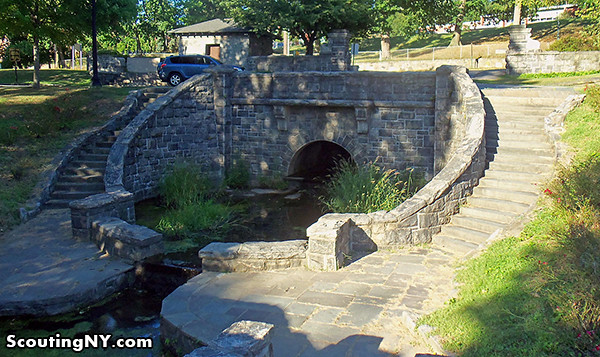
…and it is at this very spot that he first encounters the Headless Horseman: “A plashy tramp by the side of the bridge caught the sensitive ear of Ichabod. In the dark shadow of the grove, on the margin of the brook, he beheld something huge, misshapen, black and towering. It stirred not, but seemed gathered up in the gloom, like some gigantic monster ready to spring upon the traveler…
“On mounting a rising ground…Ichabod was horror-struck, on perceiving that he was headless!—but his horror was still more increased, on observing that the head, which should have rested on his shoulders, was carried before him on the pommel of the saddle…He rained a shower of kicks and blows upon Gunpowder…Away then they dashed…”
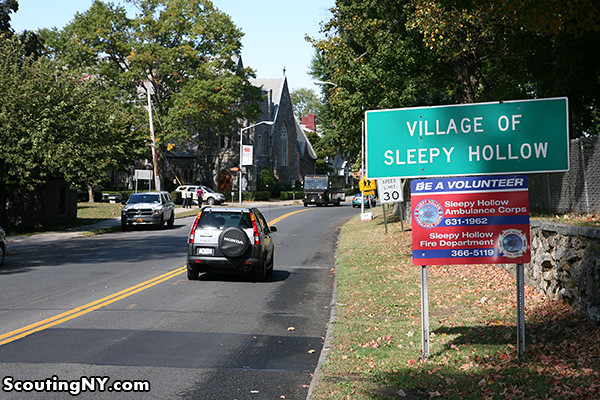
Racing onward, Ichabod “had now reached the road which turns off to Sleepy Hollow; but Gunpowder, who seemed possessed with a demon…made an opposite turn, and plunged headlong down hill to the left.”
The “road to Sleepy Hollow” described above is today Bedford Road, branching off to the east. But Gunpowder mistakenly goes left…
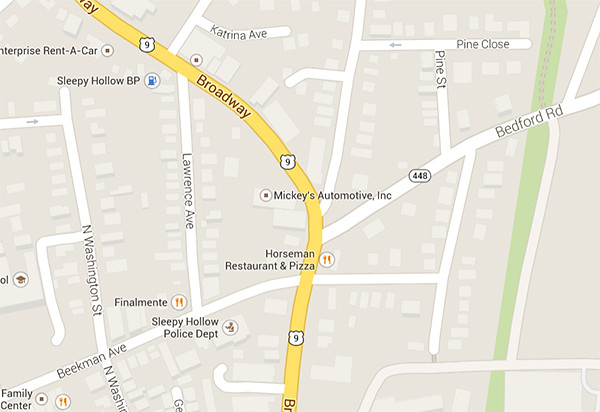
…plunging down the very steep drop in Route 9:

At the base of the hill, “an opening in the trees now cheered [Ichabod] with the hopes that the church bridge was at hand. ‘If I can but reach that bridge,’ thought Ichabod, ‘I am safe.'”
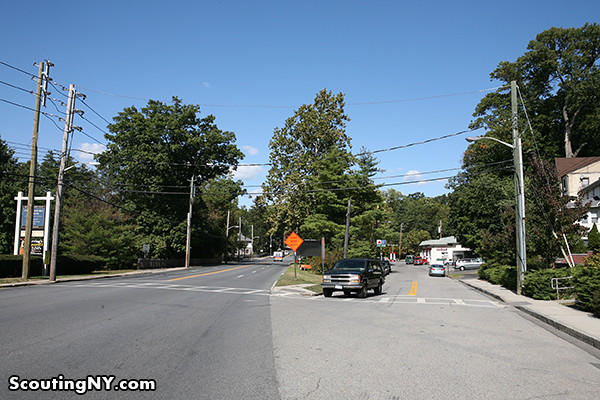
“He saw the walls of the church dimly glaring under the trees beyond…”

…Passing on the left the “mill-pond” where Ichabod would court the local “country damsels…”
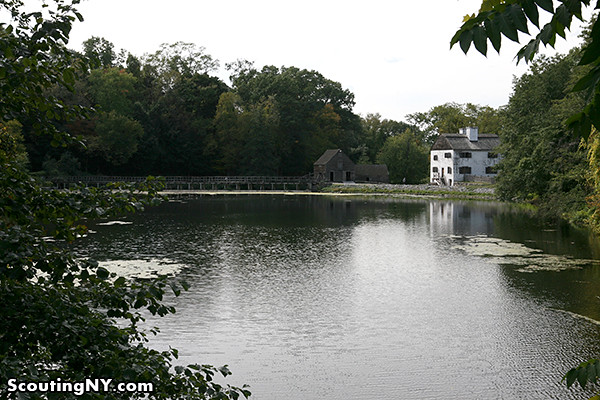
“Another convulsive kick in the ribs, and old Gunpowder sprang upon the bridge…and now Ichabod cast a look behind to see if his pursuer should vanish, according to rule, in a flash of fire and brimstone. Just then he saw the goblin rising in his stirrups, and in the very act of hurling his head at him. Ichabod endeavored to dodge the horrible missile, but too late. It encountered his cranium with a tremendous crash—he was tumbled headlong into the dust, and Gunpowder, the black steed, and the goblin rider, passed by like a whirlwind.”
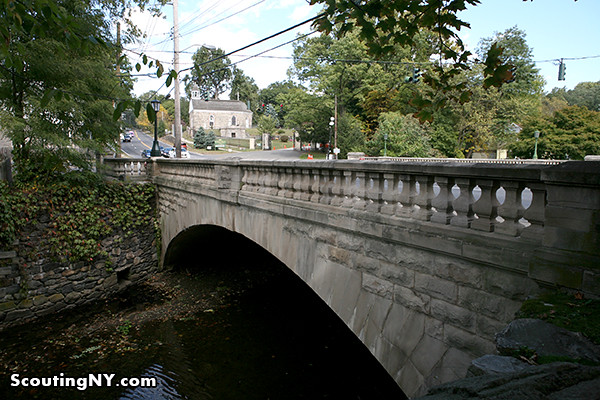
Today, the “Headless Horseman Bridge” is a multi-lane stretch of Route 9 crossing the Pocantico River, built in 1912 by William Rockefeller. Despite popular belief, there was never a covered bridge at anytime here. Instead, the original bridge was, according to the NY Times, “a wooden structure, devoid of ornamentation or architectural embellishment, which gradually fell into decay.”
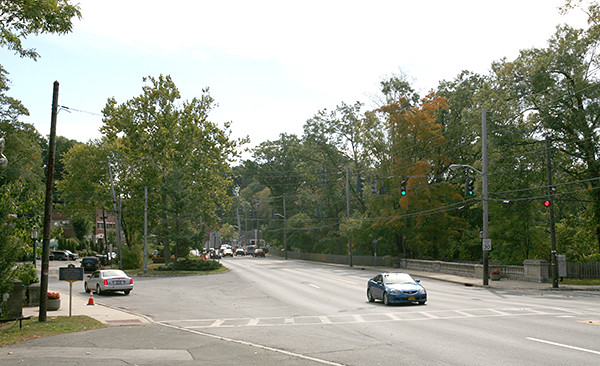
But where exactly was the original bridge? Irving adds an interesting postscript to the story, stating that “the bridge became more than ever an object of superstitious awe, and that may be the reason why the road has been altered of late years, so as to approach the church by the border of the mill-pond.”
In other words, the Old Albany Post Road once passed to the east of the church, through what is now the Sleepy Hollow Cemetery. Curiously, there is still a road in existence known as Old Broadway running parallel to Route 9, and I’d love to know if this is the original route Irving refers to.
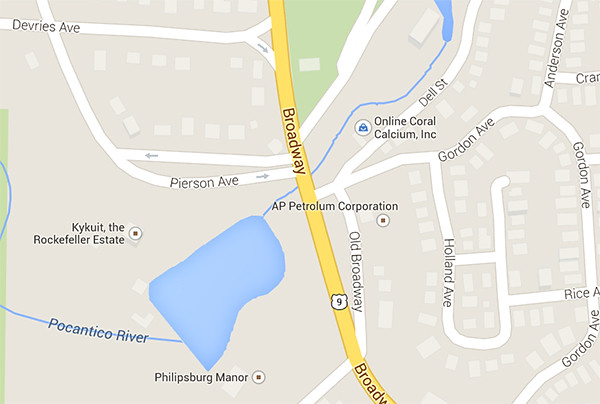
Approaching the church (visible through the trees beside the Citgo sign) via Old Broadway would make sense if the road were to then turn to the right of the church.

Unfortunately, the original location of the Sleepy Hollow Bridge crossing the legend-shrouded Pocantico River has been forever lost to time.
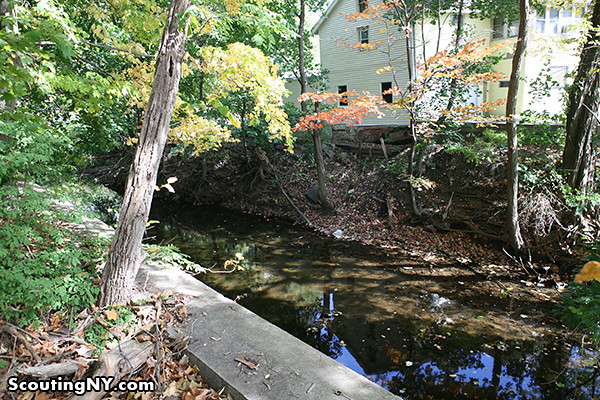
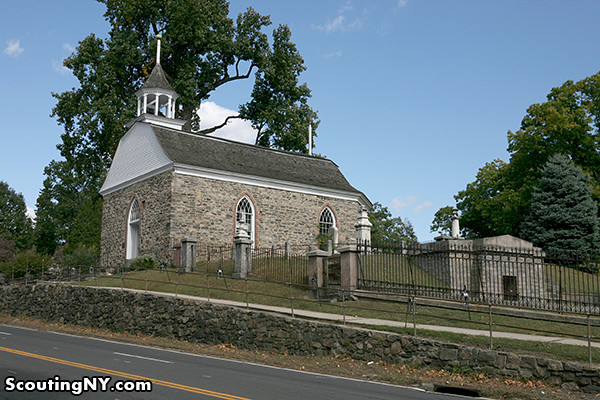
Finally, though Ichabod never reached it, I decided to end my journey at the historic Old Dutch Church.
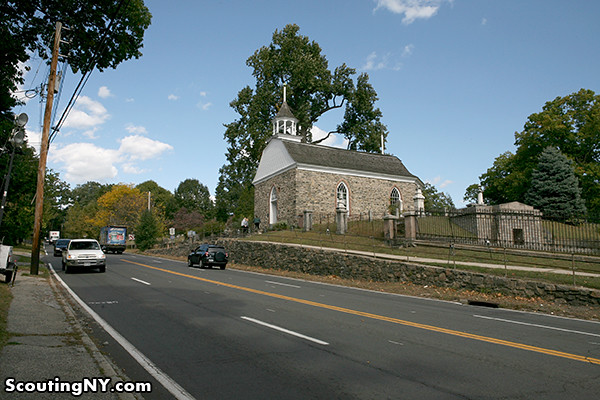
As I made my way to the entrance, I noticed an ancient mile marker dating to 1798, citing the distance to New York City:

The second oldest church in New York, the Old Dutch Church of Sleepy Hollow was built circa 1697 by Frederick Philipse I.
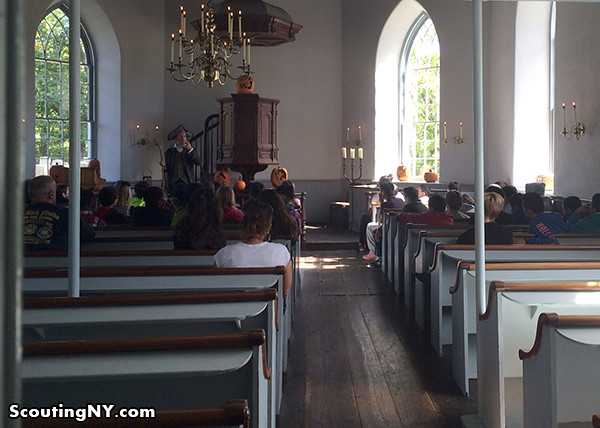
The interior is charmingly simple:
Interestingly enough, the churchyard cemetery predates the church. When Philipse arrived in 1683, he found a small cemetery consisting of 50 burials had already been started by nearby settlers and decided to build his church beside it.
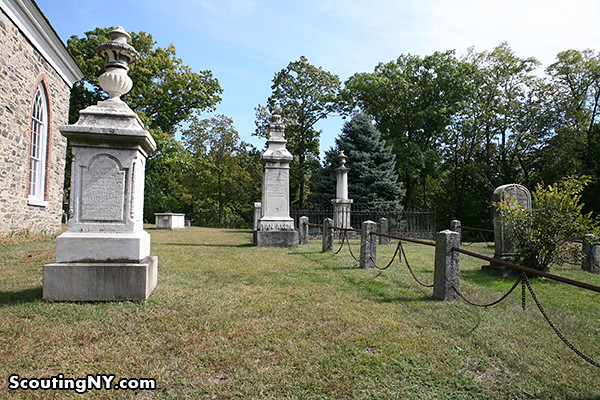
There are two graves of note relating to The Legend of Sleepy Hollow…
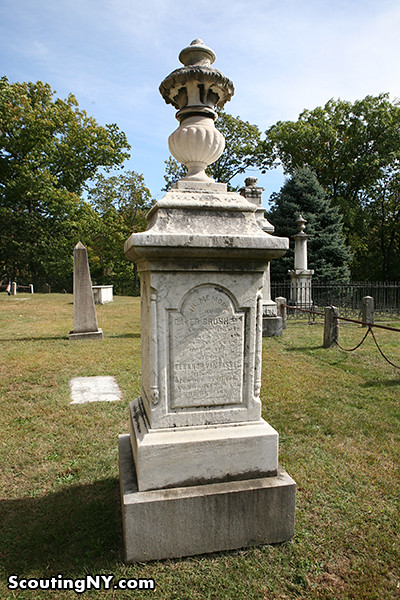
First, that of Eleanor Van Tassel, believed to be the inspiration for Ichabod’s love interest Katrina…

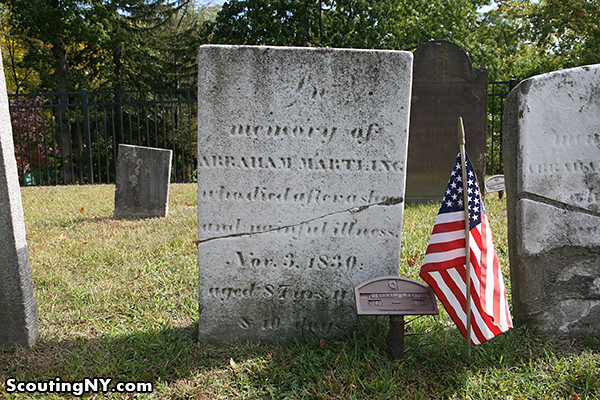
…and nearby, Abraham Martling, the town’s blacksmith and thought to have been the inspiration for Abraham “Bram Bones” Van Brunt, Ichabod’s rival (if you’re looking for Ichabod Crane, he’s in Staten Island):
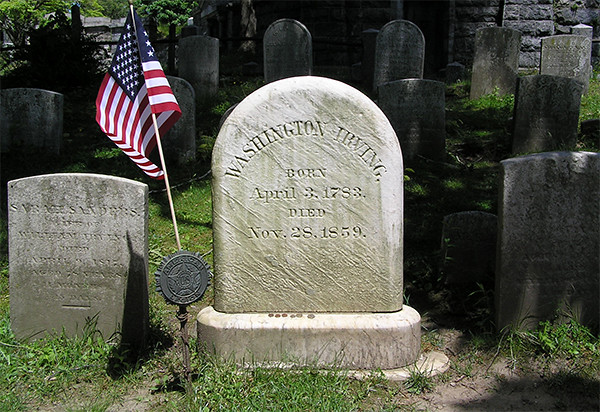
Last but not least, no trip visit to the Sleepy Hollow cemetery would be complete without a stop at the grave of the man himself:
I was thrilled to discover that Irving grounded his most famous tale in the actual geography of Tarrytown and Sleepy Hollow, and it’s a testament to his abilities that he was able to make a simple wooden bridge as famous as that one in Brooklyn.
If you’ve never been, Sleepy Hollow is definitely worth a trip – just be sure to keep an eye out for any shorter-than-average horseback riders…
-SCOUT
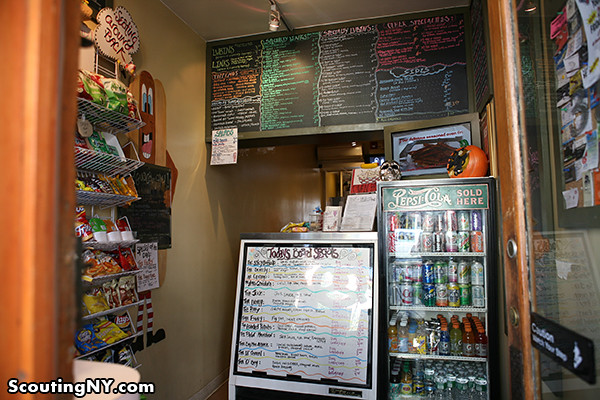
PS – If you happen to be in Tarrytown, I highly recommend a stop at the Lubins-n-Links hot dog shop. The BLT dog with chipotle mayo is amazing.
Kevin WhiteNO!!!
Buffalo, NY’s BreadHive Worker Cooperative Bakery is a place you’d expect to find all sorts of wonderful—and maybe even strange—artisanal breads. But did anyone really expect Flamin’ Hot Cheetos bagels? BreadHive’s Allison Ewing told Buffalo.com the origin story, which involved a…
The post Are Flamin’ Hot Cheetos What Bagels Were Missing? appeared first on First We Feast.

Photograph by Mark Duffy, National Geographic Your Shot
Sunlit storm clouds near Saskatchewan, Canadas QuAppelle Valley capped a day of storm chasing for Your Shot member Mark Duffy. The day for the most part was fairly flat, except for one developing thunderhead, so I started heading toward the back of this cloud formation, he writes. I went through the QuAppelle Valley from the north at Marquis and ended up at sunset at Tuxford. The sun shone through at the horizon and created a beautiful stormy sunset. I thought the shapes and color of the granary and Quonset were an interesting anchor for the shot.
This photo was submitted to Your Shot. Check out the new and improved website, where you can share photos, take part in assignments, lend your voice to stories, and connect with fellow photographers from around the globe.
Kevin WhiteAnyone interested in doing a soup swap as the weather gets colder? Beats eating the same leftovers for days on end...
Concept goes like this:
-everyone makes a batch of soup that will freeze well.
-Put soup into 1 Qt containers and freeze
-Bring frozen soup to event to swap with others
-Everyone leaves with an assortment of frozen soups for delish and easy winter time meals
A blog called well + GOOD brings word of two Angelenos who have created the term “Souping”—and a cleanse business based on it, called Soupure. Soupure makes “a range of all-natural hot and cold organic soups, tonics, and waters developed to nourish, restore and heal.”…
The post Is ‘Souping’ The New Juicing? appeared first on First We Feast.




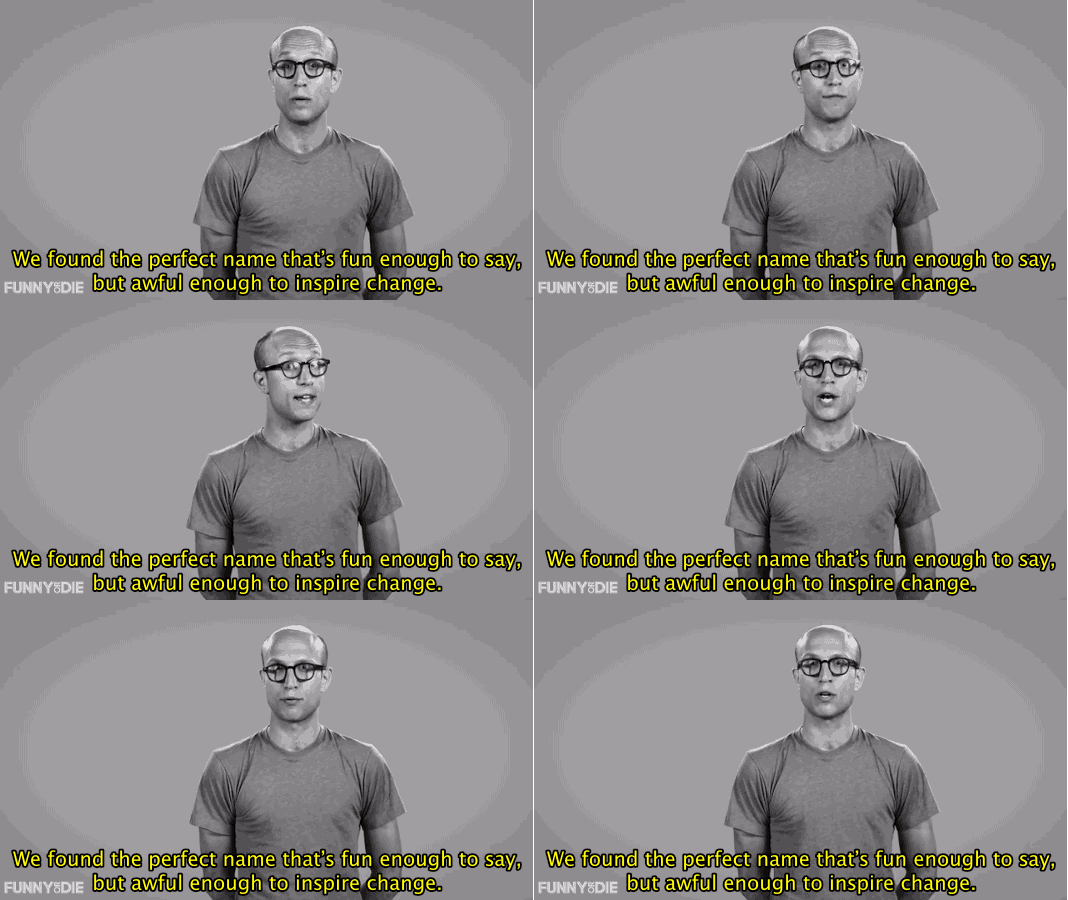
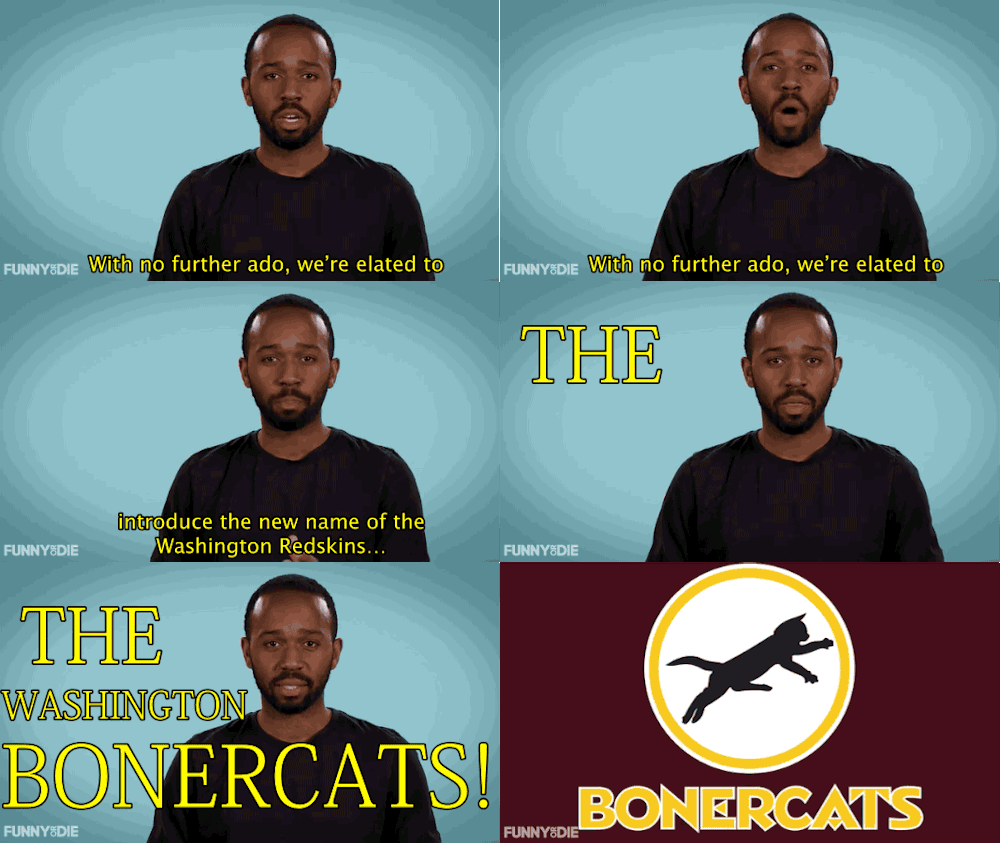



I just reblog this every time I see it.
100% support.
WOOOOOOOOOOOOOOO GO BONERCATS!


Biography
More poems by this author

Biography
More poems by this author
Kevin WhiteNO!
If you love the taste of beer but can’t afford to spend your day wasted, you’ll be pleased to know an Italian company has invented a non-alcoholic spread that is 40% beer. It’s called Birra Spalmabile (or spreadable beer) and although it’s…
The post Beer On Toast Is Your New Favorite Breakfast appeared first on First We Feast.
Kevin Whitemoving photos on the click thru
The World Health Organization estimates that the Ebola virus has killed more than 3,400 people in West African countries and infected twice as many since the recent outbreak began. The World Bank estimates the economic impact of Ebola will exceed $32 billion by the end of next year. This collection of images shows the effects of the epidemic over the the last month in Africa.--By Lloyd Young

Photograph by Florian Goppold, National Geographic Your Shot
I was sitting in a small bar watching the kids playing soccer in the sunset, writes Your Shot member Florian Goppold, whose trip through Brazil took him for a few days to Salvador da Bahia. It was one of these great moments on the Praia do Farol da Barra. I was fascinatedthe waves were high and the sea was roaring. The setting sun produced amazing colors.Goppold waited for the right moment to capture the silhouettes of the soccer players with the lighthouse in the background. It was my golden goal, he writes.
Goppolds picture recently appeared in Your Shots Daily Dozen.
This photo was submitted to Your Shot. Check out the new and improved website, where you can share photos, take part in assignments, lend your voice to stories, and connect with fellow photographers from around the globe.
Did you love Chupa Chups as a kid? We sure did. After learning that world-famous surrealist artist Salvador Dalí designed the Chupa Chups logo, we love the lollipops even more. BBC writes, It seems that Dalí made several contributions to the food…
The post Salvador Dalí Designed the Chupa Chups Lollipops Logo appeared first on First We Feast.
Kevin WhiteRE: Icarus
"His wings didn't melt because he flew too close to the Sun, they melted because he spent too much time there."
When I was about 8 years old, shoveling snow on a freezing day in Colorado, I wished that I could be instantly transported to the surface of the Sun, just for a nanosecond, then instantly transported back. I figured this would be long enough to warm me up but not long enough to harm me. What would actually happen?
AJ, Kansas City
Believe it or not, this wouldn't even warm you.
The temperature of the surface of the Sun is about 5,800 K,[1]Or °C. When temperatures start having many digits in them, it doesn't really matter. give or take. If you stayed there for a while, you'd be cooked to a cinder, but a nanosecond is not very long—it's enough time for light to travel almost exactly a foot.[2]A light-nanosecond is 11.8 inches (0.29981 meters), which is annoyingly close to a foot. I think it would be nice to redefine the foot as exactly 1 light nanosecond. Because we don't have enough unit confusion in the world already.
This raises some obvious questions, like "Do we redefine the mile to keep it at 5,280 feet?" and "Do we redefine the inch?" and "Wait, why are we doing this?" But I figure other people can sort that out. I'm just the idea guy here.

I'm going to assume you're facing toward the Sun. In general, you should avoid looking directly at the Sun, but it's hard to avoid when it takes up a full 180 degrees of your view.

In that nanosecond, about a microjoule of energy would enter your eye.
A microjoule of light is not a lot. If you stare at a computer monitor with your eyes closed, then open them and shut them quickly, your eye will take in about as much light from the screen during your reverse blink[3]Is there a word for that? There should be a word for that. as it would during a nanosecond on the Sun's surface.
During the nanosecond on the Sun, photons from the Sun would flood into your eye and strike your retinal cells. Then, at the end of the nanosecond, you'd jump back home. At this point, the retinal cells wouldn't even have begun responding. Over the next few million nanoseconds (milliseconds) the retinal cells—having absorbed a bunch of light energy—would get into gear and start signaling your brain that something had happened.

You would spend one nanosecond on the Sun, but it would take 30,000,000 nanoseconds for your brain to notice. From your point of view, all you would see was a flash. The flash would seem to last much longer than your time on the Sun, only fading as your retinal cells quieted down.
The energy absorbed by your skin would be minor—about 10-5 joules per cm2 of exposed skin. For comparison, according to the IEEE P1584 standard (as quoted on ArcAdvisor.com), holding your finger in the blue flame of a butane lighter for one second delivers about 5 joules per cm2 to the skin, which is roughly the threshold for receiving a second-degree burn. The heat during your Sun visit would be five orders of magnitude weaker. Other than the dim flash in your eyes, you wouldn't even notice.
But what if you got the coordinates wrong?
The Sun's surface is relatively cool. It's hotter than, like, Phoenix,[citation needed] but compared to the interior, it's downright chilly. The surface is a few thousand degrees, but the interior is a few million degrees.[4]The corona, the thin gas high above the surface, is also several million degrees, and no one knows why. What if you spent a nanosecond there?

The Stefan-Boltzmann law lets us calculate how much heat you'd be exposed to while inside the Sun.[5]There's also direct pressure from the heavy particles, protons and stuff, bouncing around, but the radiation turns out to be the dominant component.
I'm going to hijack this note to ask another question: How does this transporter work, anyway?
When you teleport somewhere, presumably it does gets rid of the matter that was in the way, so you don't end up combining yourself with whatever was there. A simple solution is to have the teleporters swap matter between the two locations. Kirk gets teleported down to the planet, a Kirk-sized chunk of air gets teleported up to the Enterprise.
So what would happen if an AJ-shaped chunk of Sun-interior gets teleported to snowy Colorado, then we just left it there?
The protons inside the Sun bounce around at speeds of about 350 km/s (about half of the Sun's escape velocity at that depth, for weird and deep reasons.) Freed from their crushingly hot neighborhood, the whole collection of protons would burst outward, pouring light and heat energy into their surroundings. The energy released would be somewhere between a large bomb and a small nuclear weapon. It's not good. You would exceed the IEEE P1584B standard for second-degree burns after one femtosecond in the Sun.[6]Although it wouldn't be a second-degree burn until many picoseconds later, since the definition of a second-degree burn is one which damages some of the underlying layers of tissue—and in the first few femtoseconds, light wouldn't have time to reach the underlying tissue. A nanosecond—the time you're spending there—is 1,000,000 femtoseconds. This does not end well for you.
There's some good news: Deep in the Sun, the photons carrying energy around have very short wavelengths—they're mostly a mix of what we'd consider hard and soft X-rays.[7]<what_if_book_reference>I wonder if there are more soft or hard x-ray photons in the universe.</what_if_book_reference> This means they penetrate your body to various depths, heating your internal organs and also ionizing your DNA, causing irreversible damage before they even start burning you. Looking back, I notice that I started this paragraph with "there's some good news." I don't know why I did that.

In Greek legend, Icarus flew too close to the Sun, and the heat melted his wings and he fell to his death. But "melting" is a phase change which is a function of temperature, a measure of internal energy, which is the integral of incident power flux over time. His wings didn't melt because he flew too close to the Sun, they melted because he spent too much time there.
Visit briefly, in little hops, and you can go anywhere.

Meet the wireless vegetable called ‘Carrot.’ Intentionally drawing on every Apple gadget commercial ever, this satirical “Introducing ‘Carrot’” commercial first appeared on Vimeo yesterday complete with its own web site. Watch the commercial to learn how to swipe the carrot, share it with…
The post The Wireless ‘Carrot’ Will Disrupt Everything You Think You Know About Technology appeared first on First We Feast.