David Chang and Peter Meehan’s quarterly food journal, Lucky Peach, has gone digital. The essays, photography, art, and recipes you’ve come to love in the print issues are now available online. Don’t know what to make for dinner tonight? How about Momofuku ramen 2.0?…
The Natural World is a monthly post that showcases photography depicting animals (sometimes in man-made habitats) and environments across the planet.
--
By Leanne Burden Seidel A Bryde's whale and seagulls feast on anchovies in the Gulf of Thailand, Sept 9. An estimated population of 30 to 35 Bryde's whales are commonly seen along the upper Gulf of Thailand coastlines, between March and October. The Bryde's whale is listed in the Convention on International Trade in Endangered Species of Wild Fauna and Flora (CITES) which prohibits international trade of any parts of the animal.
(Rungroj Yongrit/EPA)
Lava from the Kilauea volcano has stalled but Hawaiian authorities say there is still an active threat. There are now active breakouts behind the leading edge, causing a widening of the flow. Lava has been pouring from the volcano since June 27th. So far it has crossed one road, toppled trees and burned a shed and vegetation, but has not yet touched any homes.
--
By Thea Breite An active lava lake is inside a crater at the summit of the Kilauea volcano in Pahoa, Hawai on Sept. 17, 2014.
(U.S. Geological Survey/AP)
For this edition of our look at daily life we share images from France, China, Cuba, Pakistan, United States and other countries from around the world.
--
By Lloyd Young A man portraying Santa Claus moves between cars while greeting passengers during a Polar Express holiday train ride to the "North Pole" on the Maine Narrow Gauge Railroad on Dec. 19 in Portland. The Polar Express is the largest annual fundraiser for the railroad's museum.
(Robert F. Bukaty/Associated Press)
Photograph by Johan Brouwer, National Geographic Your Shot
Rain and fog nearly spoiled Your Shot member Johan Brouwers plan to photograph lava dunes during sunset near Stokksnes in southeastern Iceland. I was looking for other opportunities to make the most out of the moment, Brouwer writes. I saw this great reflection of lava dunes in the water, and suddenly the fog disappeared partly, which gave the whole scene a mystical appearance.
To get this shot, taken below Vestrahorn mountain, Brouwer focused on the reflections with his camera on a tripod, protecting it against the wind and rain. The wind stopped very briefly, and I was able to take the picture. A few seconds later the fog came back and the wind and rain continued.
Brouwers picture recently appeared in Your Shots Daily Dozen.
This photo was submitted to Your Shot. Check out the new and improved website, where you can share photos, take part in assignments, lend your voice to stories, and connect with fellow photographers from around the globe.
The bald eagle is an opportunist, says photographer Klaus Nigge, whose images of bald eagles in Alaskas Aleutian Islands appear in the January 2015 issue of National Geographic. Hes a scavenger. Even if food is stinky and old, hell take it. Here, eagles still await a free meal near the home of a woman who used to feed them roadkill and fish scraps.
See more photos from the January 2015 feature story "First Bird."
Hear photographer Klaus Nigge speak about photographing bald eagles on Proof.
Photograph by Gordon Campbell, National Geographic Your Shot
Shooting at Hog Island Bay on the eastern shore of Virginia, Your Shot member Gordon Campbell is inspired by the natural textures, patterns, and colors of the areas salt marshes, as well as what he calls the seemingly random nature of the "veins" running through them. The scenery, he writes, is in a state of constant change, depending in part on the tides, the season, and the time of day.
Campbell photographs while flying an open cockpit aircraft. Im always looking for the unique combinations of pattern and light, he writes. When I find an interesting area, I can change angles relative to the sun and fly higher or lower, sometimes just feet above the marsh grasses. The tidal wetlands shown here play a very important part in the ecosystem and are home to a large variety of wetland flora.
This photo was submitted to Your Shot. Check out the new and improved website, where you can share photos, take part in assignments, lend your voice to stories, and connect with fellow photographers from around the globe.
Photograph by Gabor Dvornik, National Geographic Your Shot
This little lake is a part of my life, writes Your Shot member Gabor Dvornik, who lives half a mile from its location on a natural reserve in Szdliget, Hungary. I shoot here nearly every month, sometimes every week. It has a very special air in every season, but to have a nice, misty day is rare, as wind is always present due to the nearby Duna River.
Seeing the fog during a last glance outside the night before, Dvornik slept only three hours to make it to the lake for a dream shoot. It was utterly ghostly and very moody out there, he writes. I felt like I was in a fantasy tale, in an enchanted land. I was so euphoric that I made around 500 captures and walked around the lake two to three times.
This photo was submitted to Your Shot. Check out the new and improved website, where you can share photos, take part in assignments, lend your voice to stories, and connect with fellow photographers from around the globe.
A group of Wakhi women return from a daily excursion across Pakistans Hunza riverbed to gather fodder and wood for their cooking fires. Photographer Matthieu Paley has been traveling the world in search of our ancestral ties to the food we eat.
See more photos from Matthieu Paley's culinary explorations in Pakistan and around the world on Proof.
Photograph by Melanie Huff, National Geographic Your Shot
I came across this sea shell and noticed the delicate patterns when I held it up to the light, writes Your Shot member Melanie Huff, who made this photograph in Humble, Texas. I quickly decided that it would make a unique abstract, so I took it home and placed a lamp behind it and snapped a few shots."
Huff's picture recently appeared in Your Shot's Daily Dozen.
This photo was submitted to Your Shot. Check out the new and improved website, where you can share photos, take part in assignments, lend your voice to stories, and connect with fellow photographers from around the globe.
Photograph by Noushad PT, National Geographic Your Shot
While on a stroll with friends one morning in a village near the Nilambur forest in Kerala, India, Your Shot member Noushad PT noticed the sun streaming through the coconut trees, creating a reflection in the flooded paddy. I found an opportunity for a perfect black-and-white composition, he writes. I added a human element, prioritized the reflection, created symmetry, kept the sky asideand captured it.
Noushad PT's picture recently appeared in Your Shot's Daily Dozen.
This photo was submitted to Your Shot. Check out the new and improved website, where you can share photos, take part in assignments, lend your voice to stories, and connect with fellow photographers from around the globe.
Photograph by Horst Bierau, National Geographic Your Shot
This photo was taken on a chilly morning in the Austrian Alps during our ski holiday, writes Your Shot member Horst Bierau. I was about to clear the car of the freshly fallen snow from the night before and head off to the slopes when I noticed the tiny ice crystals on the cars windowpane. The dark inside of the car cabin provided the perfect background for this motif.
Bieraus picture recently appeared in the Your Shot assignment Macro.
This photo was submitted to Your Shot. Check out the new and improved website, where you can share photos, take part in assignments, lend your voice to stories, and connect with fellow photographers from around the globe.
Survive the cold months with these useful feeding techniques! This comic is a collaboration between me and the amazing Maris Wicks. Original is on my site here.
AUSTIN, Texas — Beer miles are won and lost in the “party zone.” When participants in the world’s most athletic binge-drinking event cross into it, they stop running, hastily down a minimum 5 percent ABV beer and then take off again. The zone is only 10 meters long.
The best male beer-milers spend somewhere between 4 and 6 seconds in their first stop in the party zone; the best women stay for about 11 seconds. By their fourth time through — the beer mile requires four laps of running, four beers of chugging — the competitors slow. With shaky legs and winded lungs, these same men average about 14 seconds and the women about 31 seconds.1
But things are different at the Beer Mile World Championships, which were held here for the first time in early December. The champions drank their final beers almost twice as fast as the average elite runner in the competition — 7 seconds and 21 seconds for the male and female winners, respectively. In a race with the motto: “Chug, Run, Repeat,” the fiercest competitors guzzle through the party zone as fast as Olympic triathletes put on their post-swim socks.
Members of the Women’s Elite race chug beers at the starting line of the Flotrack Beer Mile World Championships in Austin
Kirby Lee for Flocasts
Since its rather hazy inception at Burlington Central High School in Burlington, Ontario, in 1989, people from all over the world have attempted the beer mile: a four-lap, four-beer testament to just how insane elite runners really are. As the beer mile migrated south from Canada, the event gained traction on college campuses in the United States as an unofficial tradition to celebrate the end of track season, when young runners were in peak physical shape and seeking reprieve from a notoriously regimented sport.
Seanna Robinson, the former women’s beer mile world record-holder, went to Queen’s University in Kingston, Ontario, when the beer mile rules were still being ironed out. The competition still operates on the “Kingston Rules,” which outline the penalty lap that is incurred if a runner vomits before finishing. “The naked run, the Timbits challenge and the beer mile were just some of the many things we did that played at running and celebrating,” Robinson said. When Robinson started running beer miles at Queen’s University, women were only required to drink three beers, skipping the first. She argued for the beer mile to be the same for men and women.
At around the same time Robinson was pioneering for four-beer gender equality, and setting her longstanding record, Patrick Butler — at the time a member of the Wesleyan University track team — purchased the domain BeerMile.com. He’d seen the Kingston Rules online and wanted to adopt them in the U.S., as well as to create a place to aggregate and keep track of “official” beer mile results from all over the world. That was in 1998, and there were 452 beer miles logged on the site that year. Now there are about 40,000 total races — 4,439 of them coming this year (as of Dec. 3).
Butler knows the database isn’t complete — he estimates that less than 10 percent of beer mile results are actually submitted to the site. But it’s prominent enough that some competitors want out. “I probably get five or six emails a week from people saying, ‘Can you take my name off of your site? I’m trying to get a job,’” said Butler, who maintains the database himself as a passion project.
Nick Symmonds, an Olympic middle-distance runner, isn’t concerned about being associated with the beer mile. If anything, he’s a proponent of the sport. “Most people don’t know what a 1:42.9 in the 800 means — which is what I did at the Olympics — but they understand what a 5:19 beer mile is,” he told me in Austin. Symmonds runs professionally for Brooks and definitely does not need to run beer miles in his spare time — for the prize money or the notoriety — but he schlepped to Austin from Seattle to create continued interest in track and field. When asked why he came to the World Championships, he said, “There’s a chance they’ll continue to watch us in two years [at the 2016 Olympics].”
Canadian Corey Gallagher heads down the straight away trailed closely by Australian Jack Colreavy at the Flotrack Beer Mile World Championships in Austin
Josh Baker for Flocasts
“Who’s got the legs, lungs and stomach to hold it all down?”
The bald announcer was trying to get the crowd going before the races began. The event was meant to be held at Yellow Jacket Stadium, a proper 1,600-meter indoor running track. But last-minute concerns from the track’s owners about the imminent binge-drinking forced the race to move to a motor-racing track on the outskirts of Austin. Beneath an empty grandstand with seating for thousands, what would be the homestretch of a Formula 1 race had been transformed into a makeshift track — an oblong oval marked off by orange construction cones. The turns were too tight and the straightaways too long, but for an event that is as much about drinking as it is running, it was good enough.
On the final straightaway loomed the party zone, straddled by two tables with beer lined up in rows of four. Each of the 117 participants got to choose his or her own beer, and the best runners could drink the night’s special “Beer Mile Brew.” Hops & Grain, a local Austin brewery and event sponsor, brewed the German-style blonde ale to contain only 2.2 volumes of CO2, down from a typical 2.6 volumes. Chuggability is critical in a beer mile.
The women were up first, adjusting track shorts-wedgies with one hand and holding their first beers with the other as they waited to start. When the gun fired, the group of twelve toned, lean women cracked open their cans. While drinking, they waddled like drunk penguins from the back of the party zone to the front, then took off running. In the crowd, some people were sporting shirts reading, “You just got beat by a mother of six.” They were the friends and family of Chris Kimbrough, a 45-year-old Austin local, who broke the women’s world record in October on her first attempt with a time of 6:28.6.
At the World Championships, though, Kimbrough was struggling; by the third beer she was doing that pre-vomit shiver that a body does when it wants to stop — and it would take her 32.3 seconds to finish beer No. 4. She stood no chance against Elizabeth Herndon, a 29-year-old professor and marathoner who came out of beer mile obscurity (and Ohio) to down her fourth beer, a New Belgium Fat Tire, in just 21.4 seconds. Herndon smashed the world record with a time of 6:17.8. Kimbrough placed fourth.
Just minutes after organizers rinsed away the liquid vomit from the women’s race, 10 tank-top wearing men lined up at the same starting line for the elite men’s final. One guy was wearing jorts.
James Nielsen, the highly contentious current world record-holder with a time of 4:57.0, was not among them. Nielsen said he “physically could not make it that week.” Others interpreted his absence as a clear indicator that he couldn’t defend his world record because it wasn’t legitimate.
In a video he posted to YouTube, Nielsen downs his second beer in less than four seconds — a feat that other beer milers say is physically impossible. Symmonds and fan-favorite Corey Gallagher were both vying to break the elusive sub-five minute beer mile, if only to put Nielsen in his place.
Bud Light Platinums featured heavily in the men’s elite race, and when the starting gun fired, iridescent blue bottles tilted skyward. Gallagher, wearing a single glove on his beer-chugging hand, downed the first in an astonishing 6.1 seconds, but coasted through lap one in 67 seconds (6 seconds slower than his final lap), allowing the guy in jorts to take the lead. But no one could drink like Gallagher. It didn’t take him longer than 10 seconds to finish any one beer, and with the final lap in sight he demolished his fourth beer faster than his previous two — in just 7.3 seconds. He rounded the last turn well ahead of the pack, the crowd screaming as he looked on pace to break 5 minutes. But he crashed through the finishing tape without breaking the threshold: 5.00.23.
“This is the world record, James Nielsen is a cheat and a fake,” Gallagher declared post-race, swigging a replenishment drink from his silver plastic trophy.
Nielsen vehemently denies all accusations of cheating. “I think people can drink beers even faster than me,” he said when reached by phone. “I am definitely not the human limit on how fast a beer can be drank out of a can — I’ve seen faster.”
Athletes competing in the open heat of the Flotrack Beer Mile World Championship crack open their first beers at Circuit of the Americas in Austin
Kirby Lee for Flocasts
“This thing has been going on for 30 years with thousands of results and no one’s really paid attention, and then all of a sudden it’s on national news and people are noticing,” Nielsen said. The video of his world record-setting mile has been viewed 1.35 million times.
Some of the participants at the World Championships admitted to running the beer mile in part to dispel the myth that elite runners are some strange breed of nutrition-obsessed freaks. “People think we hang out in a cabin eating chia seeds,” said 42-year-old Luis Armenteros, who placed third in the men’s sub-elite division with a time of 6:03.2. “I can’t drink everyone under the table, but I can drink a lot.”
“There is the perception that elite runners are machines whose bodies are temples, but we have our vices,” said Jack Colreavy, a 25-year-old runner who traveled from Sydney, Australia, to race in the elite men’s group, but who was unable to finish. “And mine is drinking beer.”
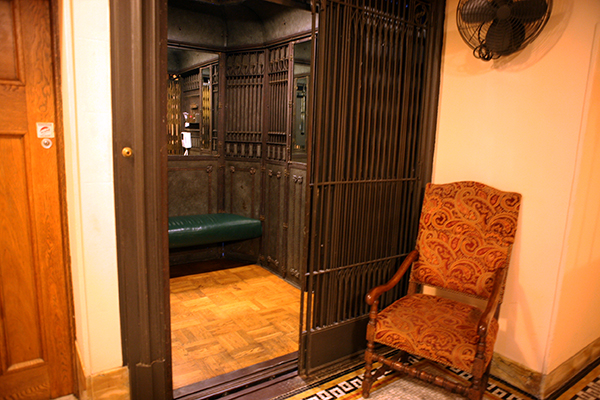
A few days ago, I was in the lobby of a Manhattan apartment building waiting to speak with the doorman when I happened to notice an old elevator in the corner. I stuck my head in to take a look…
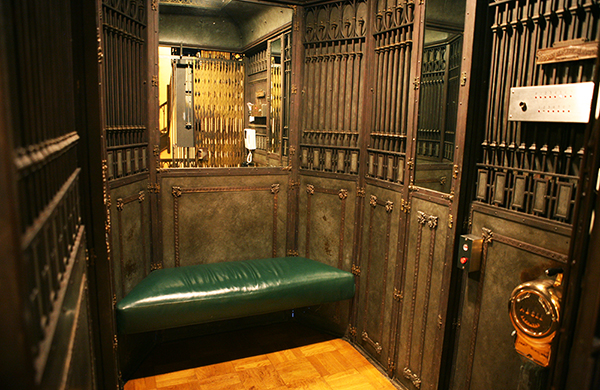
This is hands-down the most beautiful elevator I’ve ever come across in NYC.
From the ornamentation to the green leather seat – and it’s still manually operated:
According to the manufacturer’s plaque, this was built by the A. B. See Elevator Company, and I’m assuming dates to the early 1900s.
I’ve seen a lot of New York’s elevators in my scouting travels, and while I’ve come across some pretty impressive examples, this has them all beat. If you know of another you’d consider to be even better, please tell me, because I’d love to see it.
I figured all the good gills already had a buoy in their life. Whale I was dolphinitely wrong. No squidding! Let minnow, I'd turtley like to hook up sometime. Or maybe you're koi and need time to mullet over? I hope to be herring from you soon!
@none & @Robyn ... Chef from when we did James Beard House earlier this past summer
“I’m not going to lie: Sometimes I would like to wake up on a Sunday and decide where to get brunch,” says Vivian Howard, star of the PBS show A Chef’s Life. Instead of queuing up for eggs Benedict, Howard—who also runs…
Argument — much like karaoke and online shopping — is at its best when done with friends and a drink. And so, here’s “Bar Fights With Walt,” a column devoted to solving the only questions that truly matter: the dumb arguments about life and pop culture developed and hashed out in barroom rants. We’ll use data and research to take these arguments to their logical statistical conclusion. If you’d like to submit a question or conundrum, corner the author at one of his typical haunts and pick a fight.
I’m writing this in a windowless room and have a headache that can only be described as tumultuous. I’ve tried to remedy the situation with a bacon, egg and cheese sandwich. I am eating extra-strength ibuprofen caplets like they’re M&M’s. The previous night was the FiveThirtyEight holiday party, the antecedent to the unauthorized FiveThirtyEight after-party at One Star. So, it’s the perfect moment to tackle our next bar fight:
How many Americans are hungover at work on any given day?
I’ve thought about this relatively often, because my career path — from the restaurant business to journalism — has been dominated by occupations where some people roll into work with shades and water bottles.
There’s a bit of data on this. One survey found that half of respondents reported they have been hungover at work. But this was conducted by a company that sells a hangover cure, so I’m skeptical. And when I say I’m skeptical, I mean that I consider this number to be entirely untrustworthy, as it was probably derived to get headlines and sell a brand of aspirin and caffeine tablets.
To find out how often people go to work hungover, I asked SurveyMonkey Audience to run a poll of 1,000 respondents on Dec. 11. Of the 1,000 respondents, 571 said they worked full time. The survey asked how many times per month respondents estimated they go into work with a hangover. Of those 571 full-timers, 74 percent said they never go into work hungover, and 20 percent said they go in hungover less than once per month.
For the most part, Americans are arriving at work unencumbered.
We’ve got to be careful about drawing conclusions from the remaining group of people — the 6 percent I refer to as “champs” — because the sample size is very small. We’ll only use those people to get a ballpark estimate, and take that estimate with a grain of salt.
That big caveat aside, that group’s breakdown makes sense: 2 percent of respondents said they go to work hungover once per month, 1.3 percent twice, 0.9 percent three and four times, and so on with decreasing frequency.
The Bureau of Labor Statistics says there are 119.4 million Americans employed full time. If we suppose the rates we observed in the sample are roughly consistent across the full-time working population, that means 23,665,080 people go in hungover less than once per month, 2,340,240 go in hungover once per month, 1,492,500 twice per month and so on. Let’s assume that the people who reported going to work hungover “less than once per month” did so four times per year.
The average American worker did 1,758 hours of work in 2011. If we break that down into eight-hour shifts, that’s about 220 work days per year, or about 18.3 per month. So, we can estimate a person who said he was hungover once per month is hungover on 5.5 percent of the days worked.
If we do this for each frequency group, we can estimate the probability a person from each group is hungover on a given day. We can multiply those probabilities by our estimates for the number of people in each group. When we add them up, the estimated number of hungover workers on a given day is 1,946,677 people — roughly 2 million. That’s 1.6 percent of the full-time workforce. (I’d imagine that number is lower at the beginning of the week and higher at the end.)
So, this holiday season, if you find yourself punching in desiccated and bleary-eyed after a night of wassailing, take pride that you’re in the 1.6 percent.
John Salminen’s watercolors of urban scenes are rich with beautifully finessed textures, nuanced value relationships and subtle juxtaposition of high chroma passages against more muted colors.
He has a particularly appealing technique of leaving sparkling highlights within broader textural areas of treetops and foliage, together with a sensitivity to the effects of light in a variety of seasons, times of day and atmospheric conditions.
I particularly enjoy the way he pulls a sense of changing light from within shadowed areas, creating the feeling that light pervades the painting, playing hide and seek in the darker passages.
Salminen is widely recognized, with numerous awards and mentions in prominent publications.
Note that the gallery on his website has multiple pages, linked from numbers at the bottom of the page.
There is a more recent video, A Designed Approach to Abstraction, also from CCP Videos, though it seems a departure from his signature style (trailer on Vimeo).
Salminen also teaches workshops at various locations in the U.S. and Canada.
This past June, The Kentucky For Kentucky company came out with gold-plated Kentucky Fried Chicken bone necklaces. Before that, the website was offering fried chicken-scented KFC candles. Kentucky for Kentucky—whose mission is to “engage and inform the world by promoting Kentucky people, places, and products (and to…
Argument — much like karaoke and online shopping — is at its best when done with friends and a drink. And so, here’s “Bar Fights With Walt,” a column devoted to solving the only questions that truly matter: the dumb arguments about life and pop culture developed and hashed out in barroom rants. We’ll use data and research to take these arguments to their logical statistical conclusion. If you’d like to submit a question or conundrum, corner the author at one of his typical haunts and pick a fight.
This weekend, tens of thousands of people dressed as Santa Claus will descend on New York City for a roving bar crawl known as SantaCon. The argument I’ve had over the past several days — be it with folks at One Star or roommates at home — has to do with what our world might look like if those Santas spent their time more productively.
What could be accomplished if the roughly 25,000 Santas that participate in SantaCon NYC acted like real Santas?
To understand why we’re asking this question, you need to know a little bit about what’s going to happen to New York on Dec. 13. The city has a couple of alcohol-focused celebrations each year — St. Patrick’s Day and New Year’s Eve, for example — but SantaCon is a different breed of bacchanal.
New York isn’t known for Helen Lovejoy types, and yet many residents consider SantaCon an annual abomination. Yahoo technology editor Jason O. Gilbert wrote the definitive takedown of 2013’s event in The New York Times: “SantaCons of years past have been distinguished bysexism, drunkenness, xenophobia, homophobia and enough incidents of public vomiting and urination to fill an infinite dunk tank,” Gilbert wrote. There are videos of a Kringle-on-Kringle fistfight from 2013. Gawker wrote about one St. Nick participating in a public sex act in the vestibule of a Duane Reade pharmacy. When people start complaining about public urination and street vomit in New York City, one feels a line has been crossed.
But what if all those drunken Santas weren’t defacing the city? What could they accomplish in lieu of drinking a quart of Jagermeister apiece and humping the New York Public Library lions?
First, let’s estimate a number of participants. In an email, SantaCon organizers referred me to their Facebook page for an estimate of their attendees — 30,400 in 2012 and 19,300 in 2013, with more than 11,000 already RSVPed for this year’s event — but plenty of St. Nicks participate without RSVPing. Let’s average the years we do have to figure roughly 25,000 attendees.
The Columbia Encyclopedia says there are about 1,100 enclosed malls in 2014 in the United States. If each SantaCon attendee worked one day at a mall, they could staff every mall in the country from Dec. 2 through Christmas Eve.
How about delivering presents? In an edition of his What If? blog exploring how long it would take someone to walk every street in New York City, Randall Munroe estimated that the city had around 15,000 USPS employees (I did some sanity checks on Munroe’s estimate, and it seems sane).
So 25,000 Santas could almost certainly visit New York City’s 8.4 million residents. And if you consider that in 2012 only 45 percent of family households had children under 18 in them, delivering presents to every kid in New York becomes an easily achievable goal.
Instead, the streets will be packed with drunk St. Nick’s drinking for charity. In an email, the organizers said, “Please remind people in your article this is a charitable, creative, costumed event. SantaCon does not promote or condone bad behavior amongst it participants.” Indeed, last year SantaCon raised $60,000 for charity, roughly $1.97 per Facebook attendee.
“I see that number and think it’s impressive,” said Gilbert. “And then I think, why can’t they do that and not throw up on my porch?”
Metta World Peace is a professional basketball player, but he is also a Renaissance man. Metta has a workout music video, briefly appeared in the Nickelodeon game show Figure it Out, and released a rap album featuring P. Diddy and Mike Jones—on top…




 facebook
 reddit