Russian Sledges
Shared posts
スマホ、タブレット、PC用オリジナル壁紙4 'sheeeeep'

The Truth about the Big Hair of the 1770s: Part One
Even people who don't know anything about 18th c. women's fashion know about the hair. Towering hair styles, wigs filled with maggots, clouds of powder making everyone sneeze - EVERYONE knows that!
They may know it, but that version isn't quite right. Negative myths about past-fashion like maggot-filled wigs and rib-breaking corsets are so easy to accept because they're self-congratulatory. We're so much wiser now in 2014, aren't we?
The truth about the elaborate hair styles of the 1770s is actually more interesting than the myths, and makes more sense, too. Yes, it's an extreme style, first worn at the French Court before traveling to England. It's a status-fashion, too. The complexity of the styles showed that the wearer had both the leisure-time to devote to her hair, and most often the wealth to employ a professional hairdresser or accomplished lady's maid to achieve it. The height framed the face, and balanced out the full skirts of the period, creating a proportion that was much admired at the time. (Anyone who believes modern fashion is beyond extremes like this need only recall the huge power-shoulders popular in women's clothing of the 1980s.)
The Duchess of Beaufort, above left, is going for the height of formal hair, with a very large hair style given a dusting of pale powder; her natural brunette color is just showing through the powder.
Big hair was considered stylish for less formal wear, too. Mrs. Vere, upper right, is simply dressed. Her hair is not powdered, and while it's free of ribbons and hats, it is still piled and pinned to a towering height.
Nor were the tall hairstyles limited to the upper classes. From contemporary prints and paintings, it's clear that women who aspired to fashion - maidservants, actresses, milliners, and mantua-makers, as well as the mistresses of wealthy gentlemen - also copied the taller styles. The bar maid, middle left, crowns her hair with an elaborate cap, the better to beguile her customers.
What astonishes me is that these styles were, for the most part, not wigs, but the wearer's own hair. Nearly all Georgian gentlemen cropped their hair short and wore wigs, but few women did. Women did not cut their hair, but let it grow as long as possible. This hair was augmented with pads and rollers (more about these in Part Two), and if necessary enhanced with false curls and switches. Further embellishment came in the form of plumes, caps, hats, swags of ribbon and strands of faux pearls.
Of course, the caricaturists had a field day. The extreme hair styles were exaggerated even more, like the lady, bottom right, who is wearing an entire flower garden (including a folly) in her hair. You'll find another print here, and here. Not only could such prints make fun of the tall styles, but they also mocked the vanity of women and the foolishness of French fashions: a triple-win for the caricaturists.
But how did those women in the 1770s make their hair do this? Thanks to some of my good friends (including mantua-maker's apprentice Sarah Woodyard, bottom left) from Colonial Williamsburg, I have the answers, plus more photographs, in Part Two here.
Top left: Detail, Duchess of Beaufort, by Thomas Gainsborough, 1778, The Hermitage, St. Petersburg.
Top right: Detail, Mrs. Vere, by Nathaniel Dance, 1770s, private collection.
Middle left: Detail, The Pretty Bar Maid, 1778, printed by Carington Bowles. Walpole Library, Yale University.
Middle right: Detail, The Flower Garden, printed by Matthias Darly, 1777. Walpole Library, Yale University.
Bottom left: Photograph courtesy of the Margaret Hunter Shop, Colonial Williamsburg.
Which witch?
Russian Sledgesvoice h autoshare
#teamvoicedh
By Anatoly Liberman
To some people which and witch are homophones. Others, who differentiate between w and wh, distinguish them. This rather insignificant phenomenon is tackled in all books on English pronunciation and occasionally rises to the surface of “political discourse.” In the thirties of the past century, an irritated correspondent wrote to the editor about “the abuse of such forms as what, when, which, wheel, and others”: “Dictionaries in vain lay down the law that the h should be heard in such words. If heard at all it will probably come from the lips of Scotsmen, as they do give full value to the h. In this way the difference of a nationality can, as a rule, be detected. Long ago I had to be present at King’s College when the prizes were given away. A Mr. Wheeler was a winner of the Elocution prize; but he was called out as Mr. Weeler by, save the mark, the Professor of Elocution himself.” We’ll save the mark and go on.
In Old English, many words began with hl-, hn-, hr-, and hw-. In the beginning, the letter h stood for ch, as in Scots loch or gh as in the family name McLaughlin. Later it was weakened to h and lost. The same change occurred in the other Germanic languages, except Icelandic and, if I am not mistaken, Faroese. Sounds seldom disappear without a trace. Thus, when h was shed, it devoiced the consonant after it. In Icelandic, voiceless l, n, and r can easily be heard, but elsewhere they merged with l, n, and r in other positions. Only hw developed differently. It either stayed in some form or devoiced w.
It has never been explained why consonants tend to disappear before l, n, r, and w. A classic example of this process, not related to the subject being discussed here, is the fate of kn- and gn-, as in knock and gnaw. One can of course say that such groups are rare and inconvenient for pronunciation. But such an explanation is illusory, because it presents the result of the change as its cause. Outside English, kn- and gn- cause speakers no trouble. Besides, the loss of k- and g- happened at a certain time. Why did it “suddenly” become inconvenient to articulate the groups that had not bothered the previous generations? We will accept the history of hw as we find it and leave it to others to account for the change.
The reverse spelling (wh- for hw-) goes back to Middle English and can only confuse those who believe that modern spelling is a good guide to etymology. The letter writer, whose displeasure with dictionaries we have just witnessed, made no mistake. The speakers of London, where in the late Middle Ages the Modern English norm was being forged, lost h before w and accepted voiced w (this happened as early as the end of the fourteenth century), while northern England, Scotland, Ireland, and, to some extent, American English have either hw or voiceless w.
Yet some authorities who taught as late as the first half of the eighteenth century insisted on the necessity to enunciate h before w. They may have trusted the written image of the words in question. In 1654 and the subsequent decades, such opinions could no longer be heard. After voiced w had won the victory in southern speech, the “true” (historical) pronunciation was often recommended as correct and returned to solemn recitation and sometimes even to everyday speech. Such cases are not too rare. Consider the pronunciation often and fore-head, which owe their existence to modern spelling. Some people believe that the more “letters” they pronounce, the more educated they will sound. “Ofen” and “forid,” rhyming with soften and horrid, strike them as slipshod.
It is instructive to look at some Modern English words beginning with wh-. Quite a few, including when, where, what, and why, did once have hw- at the beginning. As a result, southerners have homophones like which ~ witch, when ~ wen, whither ~ wither, whale ~ wail, and so forth. (Shakespeare could not know that woe and wail are related, but his ear and instinct made him write the unforgettable alliterating line in Sonnet 30: “And with old woes new wail my dear time’s waste.”)
The pernicious habit of writing wh, sometimes for no obvious reason, resulted in the creation of several unetymological spellings. Whore, from Old English hore (a common Germanic noun), is akin to Latin carus “dear” (Italian caro, etc.). The Old English for whole was hal (with a long vowel). According to the OED, the spelling with wh-, corresponding to a widespread dialectal pronunciation with w, appeared in the sixteenth century. But why should this dialectal pronunciation have prevailed to such an extent that the spelling of an old and very common word was affected? Home also has a dialectal variant whoam, but, luckily, we still stay at home, rather than at whome. Equally puzzling is whelk (from weolc); here the influence of welk “pimple” has been pressed into service. Whig traces, though in a circuitous way, to a verb meaning “to drive”. Its wh- has no justification in history. Naturally, whim was bound to cause trouble, the more so as its earliest attested meaning is “pun”; no record of whim predates the seventeenth century. Then there is whiffler “an attendant armed with a weapon to keep the way clear for a procession,” from wifle “javelin” (Od Engl. wifel).
The consonant group hw- must always have made people think of blowing and light sweeping motions. Whistle, whisper, and whisk are rather obvious sound-imitating words (which does not mean that whisky ~ whiskey, from Gaelic, should have wh-; whisker, however, is derived for whisk, and its original sense was “brush”). Whir and whirl seem to belong with other onomatopoeic formations. Whew, an exclamation of astonishment, is an onomatopoeia pure and simple. Wheedle is late and has an obscure history.
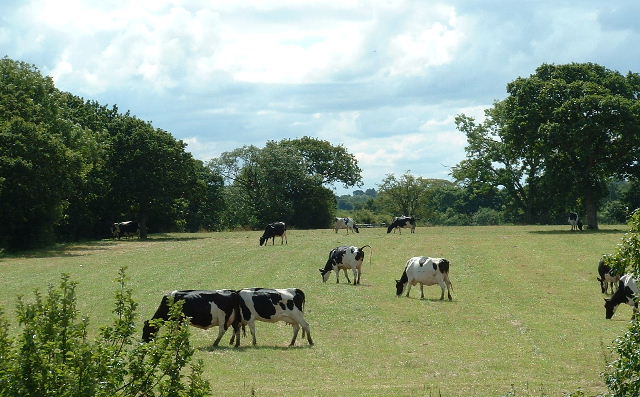
Inglewhite, Lancashire. (Cowfield. Grazing south of Langley Lane. Photo by Chris Shaw. CC BY-SA 2.0 via Wikimedia Commons.)
By way of conclusion, I may mention several thw- words in which thw- once alternated with hw-. Today we remember only the verb thwart, but the adjective thwart “obstinate, perverse” also existed, and over-hwart has been attested. Another archaic word thwite “to cut” is a cognate of whittle. Thwack and whack used to alternate, and thwack is a synonym of dialectal thack. Apparently, thw- too had a sound-imitative value. In the place name Inglewhite (Lancashire), the second element was thwaite “meadow.” The last name Applewhite goes back to the place name Applethwaite in Cumberland. The change of thwaite to white is a product of folk etymology.
All this is very interesting, except that wh- is often an unnecessary embellishment. For the benefit of those who like learned words I may say that this group is sometimes otiose.

Anatoly Liberman is the author of Word Origins And How We Know Them as well as An Analytic Dictionary of English Etymology: An Introduction. His column on word origins, The Oxford Etymologist, appears on the OUPblog each Wednesday. Send your etymology question to him care of blog@oup.com; he’ll do his best to avoid responding with “origin unknown.” Subscribe to Anatoly Liberman’s weekly etymology articles via email or RSS.
Subscribe to the OUPblog via email or RSS.
Subscribe to only language articles on the OUPblog via email or RSS.
The post Which witch? appeared first on OUPblog.
ISIS Forces Mannequins To Don the Niqab
Russian Sledgesvia overbey
Who says extremist religious sects can't adopt to modernity?
It's actually not technically a niqab (which covers the whole face) because the theological reasoning is different. But, according to the Associated Press, the ISIS rulers of northern Iraqi city of Mosul have ordered shop owners in the city to cover the faces of the mannequins in their showrooms.

Rather than meant to protect female modesty the coverings are apparently an effort to enforce strict interpretations of Sharia law that forbid statues or other representations of the human form.
Read More →Amazon.com Is Selling the One Ring as the Lord's Prayer Ring

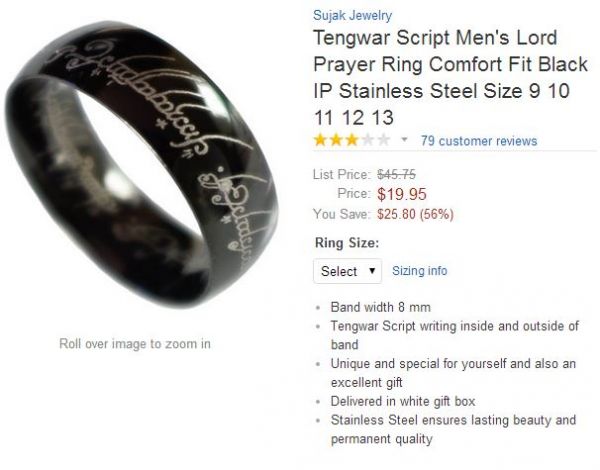
Until recently, this Amazon.com listing described this ring as being inscribed with the Lord's Prayer in Arabic. It is not not Arabic, but Elvish. It may have be an Elvish translation of the words from the Gospel of Matthew for all I know. Alas, I must confess my ingorance of that language.
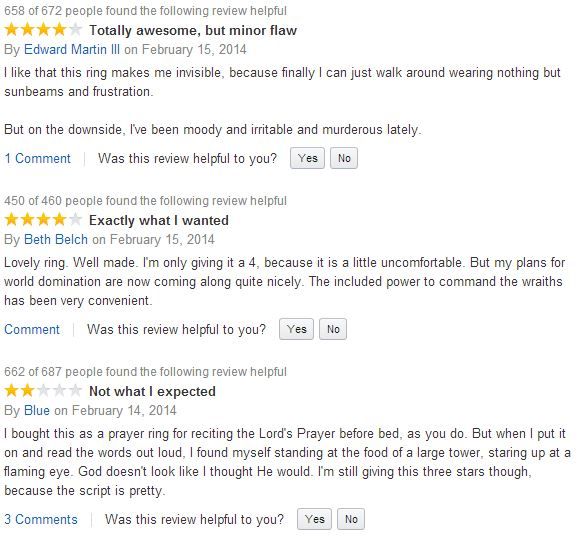
But the customer reviews indicate that it is most likely the One Ring from The Lord of the Rings:

-via Fashionably Geek
1958. Toshirô Mifune.
Russian Sledgesvia multitask suicide

1958.
Toshirô Mifune.
Ingesting pure caffeine powder maybe not as great an idea as it seems, says FDA
Russian Sledgesvia multitask suicide
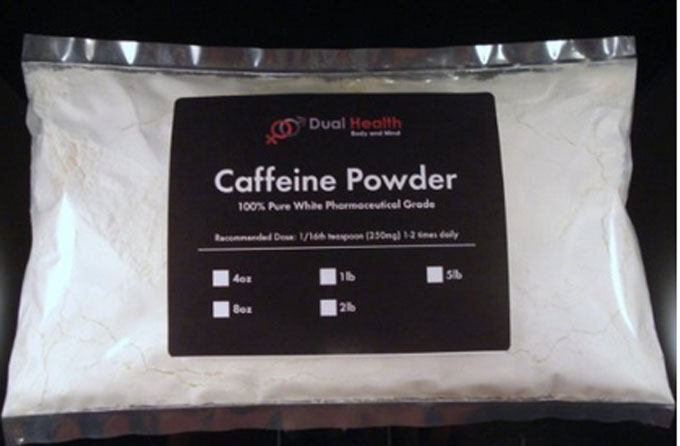
The US Food and Drug Administration has issued a warning to consumers that ingesting pure powdered caffeine sold in bulk online is not a great idea. Read the rest
Long after shipping accident, Lego never stops washing up on a beach in England
Russian Sledgesvia multitask suicide
Tipping Stereotypes
A reader proves exceptional to the rule on lesbian tippers:
I’m sure this will resonate with any member of a group perceived as being bad tippers, but my partner and I – and most of our lesbian friends – strenuously overtip. (All current or former attorneys, and most former servers.) It’s not just to make up for the cheapness of our cohort, but SF is an expensive town in which to eke a living serving drinks.
(BTW, any mention of San Francisco’s Lexington? All lesbian, all of the time.)
Another veers from the thread:
I promise you that lousy tipping isn’t a lesbian thing; it’s a woman thing.
I waited tables for several years in a half-dozen restaurants (none catering to a gay clientele). If four guys walked in for lunch, at least two would fight for the check and the “winner” would tip 15-25%, guaranteed. With four women, it’s separate checks and you’d get stiffed by at least two of them, also guaranteed.
(By the way, keep up the great work, Team Dish … my $4.20/month is the best bargain in my life.)
Another reader:
I had to laugh when reading this thread. I waited tables for a good chunk of my twenties and ran across two stereotypes: one about women and the other about African-Americans. I was told by a black fellow waiter that “black folks don’t tip.” On that one I discovered that in general, they just expected more for their money. If I had a table of African-Americans and I took good care of them, I would be tipped very well. In fact my best, most insanely generous tips came from them.
I can’t say the same about white women. All of my waiting horror stories had to do with them. Horrible tippers, generally a pain to deal with. The exception there was if the woman had waited tables, but otherwise I would go way out of my way to avoid a table of women. (And for the record, I’m a white woman.)
Update from a reader:
As opposed as I am to stereotyping in general, I can’t disagree with your other readers on white women. I waited tables at various – mostly upscale – restaurants in three states during the bulk of my twenties. The worst experience I ever had was a table of ten white women at a fancy restaurant in Richmond, maybe ten or twelve years ago.
They hit all the marks – separate checks, high-maintenance, etc. But the worst was that they wouldn’t leave. We closed at 10pm, and after working my usual double-shift I was very ready to get off my feet. I was one of the first people cut, but obviously I can’t leave while a table is still sitting. If they had already paid, I perhaps could have bribed the closing busser to wrap things up but I’m not leaving when my biggest table of the night hasn’t closed their check out. After finishing my sidework – and helping several others with theirs – I eventually took to leaning on the wall next to the kitchen entrance, about ten feet from the table, maintaining a thin veneer of patience while they chatted away. As it closed in on midnight, they finally decided to leave brusquely after expressing visible irritation with the time it took me to run ten different checks.
I think I walked away with five percent. Complete waste of a shift. People who have never had that sort of experience just. don’t. get it.
Another:
For a couple of years in the ’90s, when I was in high school and college, I delivered pizzas for a regional chain in the South. For the first year, I worked for the store in the “nice” section of town, where most of the clientele were middle- and upper-middle-class. The tip money was ok, I guess. I was 17 years old at the time, and had no experience by which to judge. The following year, I was transferred to the store on the other side of town, which was solidly working-class. Being young and prejudiced and coming from a middle-class family myself, I was disappointed and expected to see a big decline in my tip income.
I couldn’t have been more wrong. The working-class folks were much more generous tippers than the middle class and well-off pizza buyers I had become used to. My nightly income increased by around 50% or more. Not only that, but they tended to be more welcoming than the wealthier clientele. On the nice part of town, people would greet you on their doorstep, quickly make the transaction, and then return indoors, locking the door behind them. The working-class people would often be waiting for you on the porch, relaxing and drinking a beer. The experience reversed my class prejudices and has stuck with me for all of my adult life.
And another:
What’s the difference between a Canadian and a canoe?
Canoes tip.Regards,
A Canadian
One more:
I am a white woman and am attending a professional conference in a major North American city. I should be in bed right now because of the 8 AM annual business meeting (yes, on a Saturday!) but just read all the posts criticizing my gender and race for tipping. I just came back from dinner with two women friends. Let me tell you how it went:
1. We did ask for separate checks. Do you know why? Because it is a fucking business dinner, and we all work for different employers, and this is going on our individual expense accounts so we need it to be on our individual credit cards.
2. Each of us on our individual checks tipped 20%. Do you know why? LIKE THE WAITERS, WE WORK FOR A LIVING.
Your commenter who mentioned “high maintenance” non-tippers has a point. Years ago, I was an employee of an upscale store. I worked for commission, not tips, so I tried to provide the best customer service I could so they’d buy more. That being said, I could always predict how a customer was going to treat me by just taking a few moments to observe her. If it was a Birkin bag and it was 2:00 in the afternoon, she was probably going to be horrible. If it was a Hugo Boss suit at 7:00 in the evening, she was probably going to be lovely.
Maybe these waiters could use 30 seconds of observation to try to do the same. If you’re pouring wine and they’re comparing yoga studios and one-upping each other on how great their Hampton rental is, you might prepare to get stiffed. If you’re pouring wine and they’re comparing budget processes and one-upping each other on how awful their management committee is, you might prepare not to get stiffed. As noted above, we ALSO work for a living and we ALSO have clients and customers and we know that excellent service is (pun intended) table stakes. Our customers expect it from us, and we expect it from waitstaff. And when we get it, we recognize it.
And when waitstaff treats us like crap?
We still tip 20%. Because, again, we also work for a living. And frankly, the awful service might not be the waiter’s fault, but the kitchen’s (although that is rare and you can usually tell). However, be it your fault or the sous chef’s, we will tell everyone we know in real life (and everyone we don’t know on OpenTable) that the restaurant has awful service and to definitely go someplace else. As businesswomen we understand that revenue is something, but reputation is EVERYTHING. So congratulations – you have our tip; you just lose the future ones from the customers we are now ensuring you don’t get. And businesswomen can provide or negate a heck of a lot more restaurant business than people think. Trust me.
Hey Now, Hey Now Now: Brighton Music Hall announces new monthly goth night Corrosion
Brighton Music Hall is getting its goth on. The Allston live music venue has announced a new goth and industrial night called Corrosion, and it launches Saturday, September 6. After the opening night, the dance party will repeat on the first Saturday of the month starting in November. The first Saturday in November just so […]
The post Hey Now, Hey Now Now: Brighton Music Hall announces new monthly goth night Corrosion appeared first on Vanyaland.
Amanda Cohen on Why Tipping Is a Devil's Bargain - Dispatches from Dirt Candy - Eater National
I Was Hidden on This Guy’s Hard Drive for Over 6 Years
Russian Sledgesvia firehose
years of my commute through harvard yard are thoroughly documented on the hard drives of asia
![]()
It’s been estimated that as many as 880 billion photos will be taken by the close of this year. I’m not quite sure how that statistic could ever be properly calculated, but I think it’s safe to say that with the rise of the digital medium, human beings are taking a s**tload more pictures than ever before.
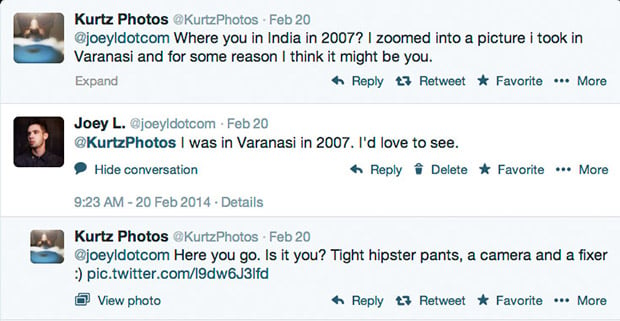
With all those photos being taken, chances are you and I have at one point accidentally wandered into someone else’s frame. It’s likely, however, that you’ll never really know you’ve photo-bombed someones shot. That’s why I was surprised by a Twitter message that I received out of the blue from a photographer I’ve never met.
Here’s what I received from photographer Anthony Kurtz:
![]()
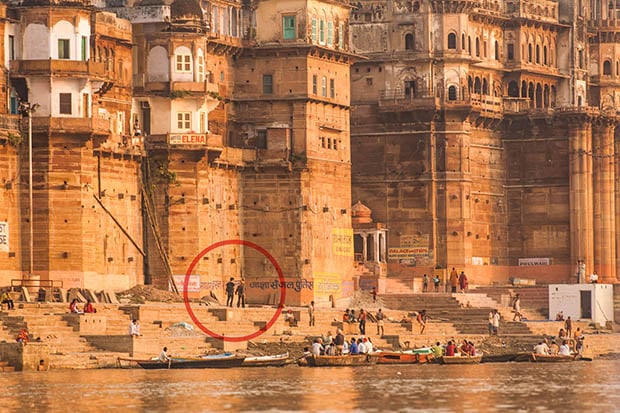
Varanasi, India is an epicenter for pilgrimages for people of many walks of life. Locals from all over the subcontinent make religious journeys to the ancient city; monks of a variety of religious beliefs seek refuge in the many temples along the Ganges River; and not to mention: photographers, travelers and tourists flock to the region to seek inspiration in what I consider one of the most photogenic places on Earth.
Looking at the photo from the tiny Twitter preview, it seemed like it could be me but how could I be certain? I’m not quite sure how Anthony recognized me, as we are only are aware of each other via social media. I asked him to send me the high-resolution version of the photo, and asked if he had any others taken in the batch. He then sent the following:
![]()
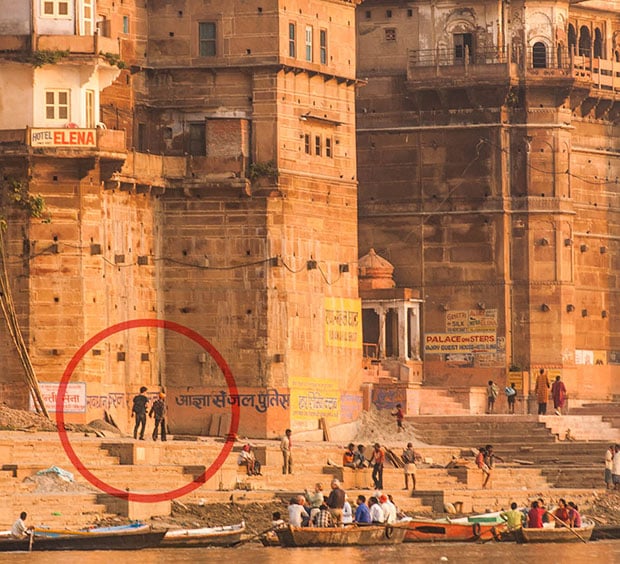
Here’s a closer view:
![]()
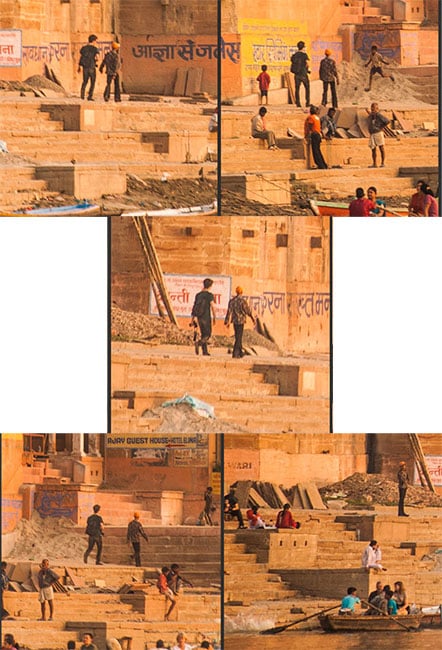
Here’s a closer view of several of Kurtz’s exposures:
![]()
After zooming in to the photo I discovered that without question it was me. Looking at Anthony’s image EXIF data, I saw the image was taken on October 18th, 2007. I am 24 years old now, so I was 17 in the photo. I also noticed in one of the photographs, it appears I am taking a photo of something. So, I looked through my own images captured that day, and found the exact exposure I had taken within seconds of his:
Here I am squatting and taking a photograph of two women overlooking the Ganges River:
![]()
Here’s the actual photograph I was taking at the same time Anthony’s exposure was made:
![]()
And the big kicker: in the background of my picture there are the boats of people photographing from the river. Which one is Anthony?
When something like this happens, it’s hard not to evoke the tired cliché that the world is an incredibly small place. The world is shrinking even further with our growing level of interconnectedness on the Internet and social media, and this occurrence is an example of that.
I’m sure people have always been on paths that quietly and unknowingly intersect. Now, with people sharing their passions and experiences more than ever, we can be sure that we’ll meet yet again — or sometime in the future — whether we know it or not.
About the author: Joey L. is a Canadian commercial photographer, director and published author based in Brooklyn, New York. See more of him through his blog, portfolio and video tutorials. He can also be found on Facebook, Twitter, and Instagram. This article originally appeared here.
About Anthony Kurtz: Anthony Kurtz is a German-American commercial and fine-art photographer based in Berlin, Germany. You can find his work on his website or by following him on Facebook and Twitter.
When food has an offensive name
Russian Sledgesvia multitask suicide
didn't sanford berman launch a campaign re: the lcsh heading "kaffirs" in, like, the 70s?
The "kaffir" in "Kaffir lime" is actually a racial slur. At National Geographic, Maryn McKenna struggles with how to deal with foods that have offensive names.
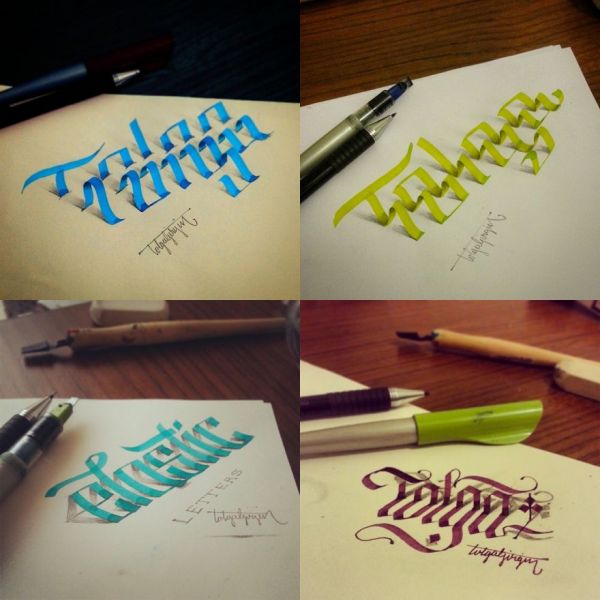
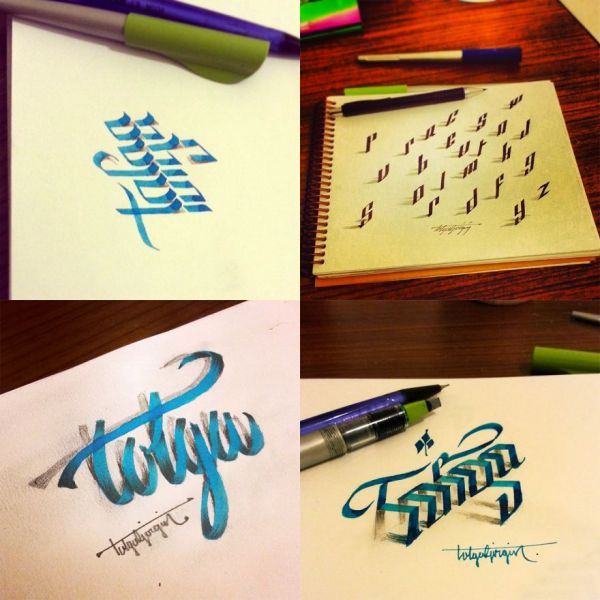
Read the restCalligraffiti in 3-D by Tolga Girgin

Tolga Girgin works as an electrical engineer at a company in his home town of Eskişehir, Turkey. But Girgin also has a way with "calligraffiti," an art form that blends traditional calligraphy with graffiti art, pioneered and named by Dutch artist Niels Shoe Meulman.
On Instagram and Behance, Girgin presents numerous examples of the work pictured here. Fairly conventional calligraphy lettering seems to leap off the page in quite a modern way. Visit Girgin's Behance and Instragram sites to see more or request a commissioned piece. Via Colossal.
Images Credit: Tolga Girgin
The death of diversity
Russian Sledgesvia multitask suicide

Job security on Capitol Hill
GIVEN that members of the US House of Representatives must face voters every two years, you'd expect them to have a lot less job security than European monarchs. In fact, it is the other way around. One reason for the shocking lack of turnover of congressmen is gerrymandering: when they get the chance, both parties redraw electoral maps to favour themselves. But there is more to it than this. Conservatives and liberals have been gradually segregating themselves, with the former moving to spacious suburbs with lively churches and the latter crowding into cities where they can walk to the shops to buy tofu. Since 1998, the number of solidly Republican or Democratic districts has steadily risen while the number of swing districts has roughly halved. Split districts—where voters back one party for Congress and the other for the White House—have all but disappeared. In 1996 there were 110, a quarter of the total. By 2012 there were only 26. Read the full article Continue reading
Gender Reveal Confetti Push Pop - anthropologie.com
Russian SledgesI am going to destroy pretty much everything
Video
Russian Sledgesvia otters ("hi ThOR, I was in a thing (as Chinese Tramp Stamp Douche)")
Cool Sherlock-Inspired Dresses Promise to Burn the Heart Out of Us
Russian Sledgesnah

If you think sporting a deerstalker is amateur hour for Sherlock Holmes-inspired fashion, then you should check out the new line of leggings and dresses from Gold Bubble, inspired by the BBC’s Sherlock. We’re chuffed to see that the designers got rather creative, pulling specific elements, quotes, and imagery unique to Steven Moffat’s series. (Not Elementary, sorry. Maybe they’ll tackle that later?)
We love the “Deduction” dress over on the right here (it also comes as leggings and a poncho). Click the photo to enlarge.
[Check out more of the dresses]
oldbookillustrations: Yet Hallblithe speaketh with the...
Russian Sledgesvia firehose
kelmscott autoreshare

Yet Hallblithe speaketh with the king.
Walter Crane, from The Story of the Glittering Plain, by William Morris, Hammersmith, Kelmscott Press, 1894.
(Source: archive.org)
Heavy Metal Drinking Games
Russian Sledgesvia multitask suicide
Bury Your Dead: Drink any time there’s a breakdown.
Deicide: Drink any time they use either the word “Satan” or the word “god.”
Cannibal Corpse: Drink any time they use the word “blood.”
Cannabis Corpse: Drink any time there’s a reference to weed, toke after every drink.
Hatebreed: Drink any time the lyrics are about overcoming hardship.
Pathology: Drink any time you can’t understand the lyrics.
System of a Down: Drink any time you can understand the lyrics, but still have no idea what the song is actually about.
Brujeria: Drink any time the lyrics aren’t in English.
Kvelertak: Drink any time the lyrics aren’t in English.
Emmure: Drink any time the lyrics aren’t in English.
S.O.D.: Drink any time Billy Milano is pissed about lyrics that aren’t in English.
Slayer: Drink any time a guitar solo completely lacks structure.
Jesu: Drink any time Justin Broadrick sounds sad.
Alice in Chains: Drink any time Layne Staley YARLS (can also be played with Tantric, Creed, Stone Temple Pilots, etc.)
Living Colour: Drink any time you hear an instrument being played by an African-American.
Rob Zombie: Drink any time he screams “Yeah!”
Steel Panther: Drink any time there is a reference to sex and/or drugs.
Gojira: Drink any time you hear a Morbid Angel riff.
Anything Involving Zakk Wylde: Drink any time you hear a guitar squeal.
Origin: Drink any time you hear sweep picking.
Fear Factory: Drink any time it’s entirely possible you’re listening to “Replica.”
Marilyn Manson: Drink any time he uses a pun.
The Sword: Drink any time it sounds like Black Sabbath.
Slipknot: Drink any time you can’t tell whether or not the percussionists who aren’t Joey Jordison are actually playing or not.
Sleep: Drink any time you’re not sure whether or not the song has begun yet.
Guns N’ Roses’ “November Rain”: Drink any time you hear this drum fill.
Faith No More: Drink any time you can’t tell if they lyrics are meant to be serious or not.
Arsis: Drink any time you can’t accurately name the line-up that recorded the song to which you are currently listening.
Graf Orlock: Drink every time there’s a sample from a movie or lyrics referencing/quoting a movie.
Portal: Drink any time it sounds like you’re listening to a scratched record or CD that is stuck on one particular part of a song.
Body Count: Drink any time Ice-T says the name of the song to which you are currently listening.
Bon Jovi: You’ve already had enough to drink, go sleep it off.
Malevolent Creation: Doesn’t matter what rules you play by, so long as your drink prominently features chocolate milk as one of its ingredients.
Metallica: Drink any time you hear a wah pedal.
Megadeth: Drink any time Dave Mustaine still isn’t in Metallica.
Anthrax Live: Drink any time Frank Bello looks out at the crowd and opens his mouth real wide.
Mötley Crüe Live: Drink every time Vince Neil gets winded and/or mumbles only a portion of the lyrics.
MetalSucks: Drink any time you see a tyop.
Do not read this if your name is Matt Pike.
The post Heavy Metal Drinking Games appeared first on MetalSucks.
Quiz: Do You Like Your Job?
Russian Sledgesdid nobody tell me that katie perry (the real one) writes for the toast now? or did I just forget?
Katherine Perry’s last self-help quiz for The Toast can be found here.
Do you like your job?
- It’s fine
- Not really.
- No.
- Yesssss!
Do you dig your occupation?
- It’s fine.
- Not really.
- No.
- Yesssssss!
Do you fancy your position?
- No.
- No.
- Shut up.
- Shut up.
Do you take a shine to your métier?
- Eh.
- Meh.
- Mmmmmrrrrrrrrrrrrhhhhhhhhh.
- !!!!
Do you groove on the task to which you are appointed?
- I neither enjoy nor disenjoy it.
- Nay.
- I pray thee, understand the negatron that issues from my lips!
- Aye, ‘tis as sweet as a kiss from a babe.
Do you cherish your line of work?
- Faintly.
- Nope.
- Ix-nay.
- Indeed!
Do you relish your vocation?
- Moderately.
- Thumbs down.
- Two thumbs down.
- Thumbs up!
Do you hanker to put your nose to the grindstone?
- Eh.
- Meh.
- Mmmmmrrrrrrrrrrrrhhhhhhhhh.
- !!!!
Do you have scoliosis?
- Not sure.
- Maybe.
- Possibly.
- Not sure?
Restless legs?
- Not sure.
- Like, the syndrome?
- Maybe?
- I sure do, ‘cause I gotta DANCE to celebrate my awesome J-O-B!!!!
***
Results:
Mostly A’s: You are probably indifferent to your job.
Mostly B’s: You probably complain about needing a haircut for weeks before actually getting one. Also, get a new job.
Mostly C’s: You hate your job.
Mostly D’s: Your job SUX, drone! Just kidding. You like your job!
Read more Quiz: Do You Like Your Job? at The Toast.
How to sew Myrtle in a woven fabric
Russian Sledgesgonna do this

If there’s one thing I like best about Myrtle, it’s that it is one of those rare patterns that can be sewn in either knit or a woven fabric.
The reason for this is the ease and drapey fit. Myrtle is designed so that shaping comes from the comfortable and stretchy elastic waistband, rather than the tight fit of the fabric.
While the pattern instructions that come with Myrtle are for knit fabric, switching to a woven is super easy. In this post, I’ll summarize the few changes you’ll need to make if you’re using a woven fabric.
And to make things super clear, you can download a free complete extra set of instructions for woven fabrics. This walks you through every step in the process, but assumes you’re using a woven fabric rather than knit.
(If you buy the digital version of Myrtle, you’ll get this automatically with your download as a bonus.)
Woven fabrics you can use
Myrtle works well in fabrics that have a bit of drape to them. You want the neckline in particular to hang well, rather than stand away from your body too much.
You have a wide array of fabrics to choose from. Here are a few that I think would be particularly lovely:
- rayon challis
- silk or rayon crepe
- lightweight linen
- light chambray
- seersucker
- wool crepe
- cotton lawn (choose one that’s not too stiff)
For this sample, I used a vintage silk crepe. For the blue and white sample we showed yesterday, we used a light silk twill.
If you have a dressform, try draping some fabric on the form to see how it hangs. It’s very easy to replicate the look of the cowl with some quick draping, and you’ll instantly have a good idea of what the dress will look like.
Extra supplies you’ll need
There are just a few extra things we’d recommend for making Myrtle in a woven fabric:
- 1 yard of 1/4 inch double fold bias tape. This is for finishing the back armholes and back neckline. While these curves can just be turned and hemmed in a knit fabric, wovens are not as flexible and should be finished with bias tape as a facing instead.
- Universal needles. You don’t need a ballpoint needle if you aren’t sewing knits, so grab a universal needle. Be sure to match the needle size to your fabric.
- Fusible interfacing. This is just for interfacing the shoulder tabs if you are making them, so a small scrap will do.
Stitching and finishing

The most obvious way this pattern is different in a woven is that you don’t need to use a stretch stitch. You can do all the seaming and topstitching with a straight stitch.
Since you won’t be sewing this with a serger in a woven, you will need to finish all of the raw edges after sewing each seam. And of course, you’ll need to press them as well. Stitch, finish, press, just like you do with most woven garments.
Here, I stitched with a straight stitch, then finished the edge with a serger.
Finishing the back openings
For knit fabrics, the back armhole and back neck are finished by simply turning and hemming. Unlike wovens, you can hem curves this way with knits if the curve isn’t too severe.
For wovens, you’re better off using bias tape. You can either make your own bias tape from the self fabric, or use pre-made. Since it will be on the inside of your garment, a pre-made bias tape will often be just fine.

When the pattern instructs you to finish these areas, begin by pinning the bias tape along the edge, right sides together with edges aligned.

Stitch along the first fold line.

Fold the bias tape to the inside of the garment, folding the bias tape in half to enclose the raw edges.

Edgestitch the bias tape in place. Notice that the folded bias tape is acting as a facing, not a binding. It’s turned all the way to the inside rather than wrapping around the edge.
Use this same technique on both the back neckline and back armholes.
Another cool thing about this pattern is the way the front bodice is self lined, so you don’t have to bind anything in a complete circle. This makes binding much, much faster and less fiddly.
Shoulder tabs

If you’re making the shoulder tabs for this dress, we recommend using a bit of fusible interfacing to give them more stability.

After you sew the tabs with right sides together, clip the corners. Turn right side out, press, and edgestitch around all the edges to help the tabs stay flat.
Hemming
There’s no need to use the twin needle technique or a coverstitch to hem a woven fabric.

Instead, you can sew a simple turned hem by turning 1/4 inch and pressing, then turning again 3/8″, pressing, and edgestitching in place.
Better yet, sew a blind hem. A blind hem will give you a very neat finish. It’s my personal fave.
Click here to download the complete instructions
You may also like:
![]() Video: Installing an elastic waistband on Myrtle |
![]() Introducting Myrtle, a knit dress with a fun twist! |
![]() Bias tape bows |
Drink's John Gertsen Heads West - Boston Restaurant News and Events @ BostonChefs.com
Russian Sledgesquietly losing my shit over here
Portland Museum of Art hires New Peggy L. Osher Director of Learning and Interpretation
Russian Sledgesjenn!
Google Is Designing The Font Of The Future
Russian Sledgesvia overbey ("I am sure that being Google, all their æsthetic decisions about particular details of the font will be driven entirely by whether or not they stimulate more clicks on ads in A/B testing.")
Google+ kills off “real names” policy
Russian Sledgesvia firehose
TOO FUCKING LATE ASSHOLES
Google has decided to reverse its long-standing policy requiring users to use their real names to make profiles on the service as of Tuesday, according to a post shared on the official account. The move comes after Google+ head Vic Gundotra suddenly departed in April, marking the beginning of a shift for the service.
"When we launched Google+ over three years ago, we had a lot of restrictions on what name you could use on your profile," the post begins. As time went on, that rule softened to allow "established" pseudonyms and let YouTube users to bring their usernames over from the service.
Google+ has been criticized not only for preventing users from protecting their real identities, but causing confusion among them. In January, one transgender woman tried to send a text message to a colleague but sent a Hangout from her Google+ profile instead, outing her.
Read 1 remaining paragraphs | Comments
Flowers And The Things That Fuck Them
Russian Sledgesvia rosalind
Evolutionary Biology, CU Boulder
Empress Elisabeth of Austria - Wikipedia, the free encyclopedia
Russian Sledgesveal or strawberries


Anatoly Liberman is the author of