Russian Sledges
Shared posts
Alex Jones: Boston explosion a government conspiracy - Salon.com
Rear Window-Like Editorial by Peter Lindbergh for Vogue April 2013

American Vogue delivers an editorial that is inspired by Hitchcock’s Rear Window
Rear Window-Like Editorial by Peter Lindbergh for Vogue April 2013 is a post by Jeff Carvalho on Selectism.
ridingwithstrangers: Architectural Density in Hong Kong With...






Architectural Density in Hong Kong
With seven million people, Hong Kong is the 4th most densely populated places in the world. However, plain numbers never tell the full story. In his ‘Architecture of Density’ photo series, German photographer Michael Wolf explores the jaw-dropping urban landscapes of Hong Kong. He rids his photographs of any context, removing any sky or horizon line from the frame and flattening the space until it becomes a relentless abstraction of urban expansion, with no escape for the viewer’s eye. Infinite and haunting.
Editor’s Note: Co-signed.

Richard Nixon and Robocop
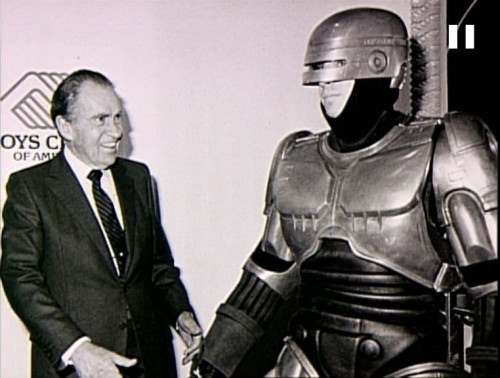
Richard Nixon and Robocop
Rita Hayworth, Orson Welles and Marlene Dietrich
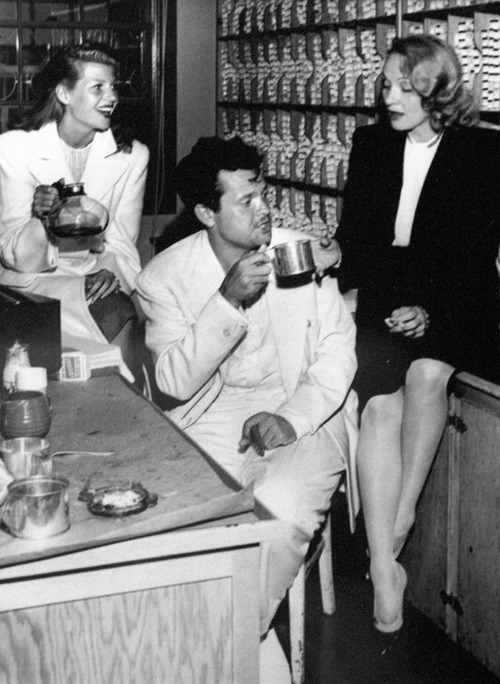
Rita Hayworth, Orson Welles and Marlene Dietrich
Mass. gov: No unexploded bombs at Boston Marathon

    
|
Trucker cleared in Northampton cyclist's death
Russian SledgesI went to school with meg, who was the smith rare book room curator's protégé

|
|
FBI seeks images in Boston Marathon bomb inquiry

|
|
MFA admission will...
The Accidents of Youth (1819)
Russian Sledges"the sad effects of climbing trees"
The Masked Merriment of Mardi Gras
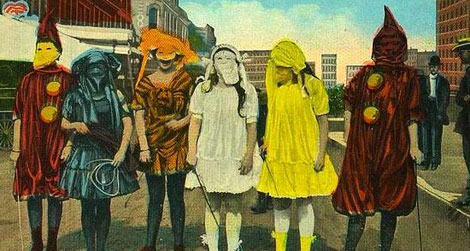
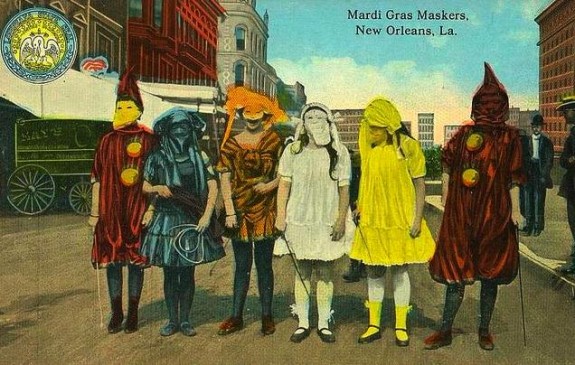
Vintage Mardi Gras postcard, date unknown.
Shrove Tuesday is a day to be remembered by strangers in New Orleans, for that is the day for fun, frolic, and comic masquerading. All of the mischief of the city is alive and wide awake in active operation. Men and boys, women and girls, bond and free, white and black, yellow and brown, exert themselves to invent and appear in grotesque, quizzical, diabolic, horrible, strange masks, and disguises. Human bodies are seen with heads of beasts and birds, beasts and birds with human heads; demi-beasts, demi-fishes, snakes’ heads and bodies with arms of apes; man-bats from the moon; mermaids; satyrs, beggars, monks, and robbers parade and march on foot, on horseback, in wagons, carts, coaches, cars, &c., in rich confusion, up and down the streets, wildly shouting, singing, laughing, drumming, fiddling, fifeing, and all throwing flour broadcast as they wend their reckless way.
– James R. Creecy, Scenes in the South, and Other Miscellaneous Pieces, 1860
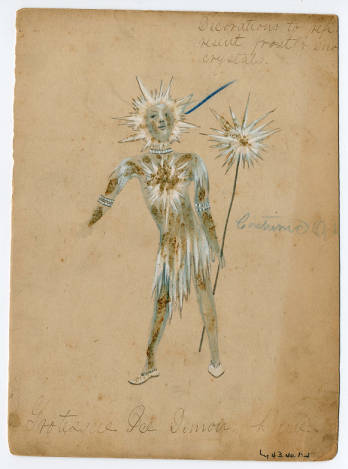
Costume Institute Fashion Plates, Metropolitan Museum of Art Libraries, Mardi Gras 1, Part 028, date unknown.
Drunken revelry. Beaded necklaces. Doubloon throws. Zulu coconuts. Today is Mardi Gras (Fat Tuesday), the culmination of weeks of Carnival celebrations that end on Ash Wednesday, the first day of Lent. It is a time when hundreds of thousands of tourists stream into New Orleans and treat the city like one huge frat party. Many local New Orleanians will avoid the French Quarter ,just as New Yorkers stay away from Times Square on New Year’s Eve. Yet, like New Year’s in New York City, Mardi Gras is an institution.
Mardi Gras made landfall in the United States back in the 17th century when the French explorer Pierre Le Moyne d’Iberville set up camp 60 miles from New Orleans on the day that the holiday was being celebrated in France. He called the location Point du Mardi Gras. But, Mardi Gras and the accompanying masked balls associated with the holiday were outlawed when the Spanish governor took control of the area in 1766 as well as when it came under U.S. rule in 1803. But by 1823, the Creole population convinced the governor to permit masked balls. By 1827, wearing a mask in the street was legalized in New Orleans. (They’re now only legal to wear on Mardi Gras Day.) When the first official “krewe,” or elite social club, was established in 1857, the Mardi Gras parades that they organized became formalized annual occasions, which meant that parade participants donned masks and colorful regalia with greater frequency.
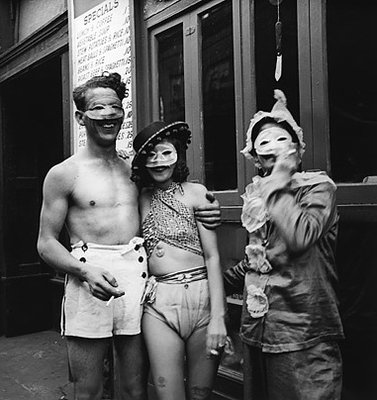
Mardi Gras, 1920s.
Taking cues from masquerade balls that made their way through Europe as early as the Middle Ages and Venetian carnival celebrations, the now-familiar face covers we see on Shove Tuesday (as Fat Tuesday is also known) mimic variations that have been around for centuries. The Bauta (full-faced mask shaped for ease of eating and drinking), Columbina (half mask), and Medico della Peste? (the beak-like steampunk-esque mask that is familiar to anyone who’s attended the interactive, immersive theatrical performance Sleep No More), but thankfully not the Moretta (a terrifying blank-faced mask held in place by biting a button inside the mask, thus inhibiting speech), all frequently associated with the Venice Carnival, are on grand display during the festivities (and legally to boot, as the law prohibiting mask-wearing, which is in effect throughout the year, is suspended on Mardi Gras Day in New Orleans). Today, the feathered, sequined, glittering disguises use the now-universal Mardi Gras colors originally established by the krewe of the Rex parade in 1872: purple symbolizing justice, green for faith and gold for power.
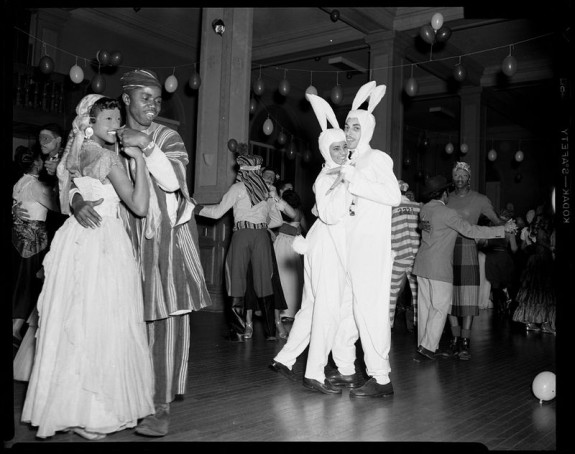
Scurlock Studio, Omega Mardi Gras, Washington, D.C., n.d. (c. 1940), National Museum of American History.
A mask is a funny thing. Slide one over your face and, with its exaggerated expression, the mask immediately transforms you into someone else (say, Richard Nixon) while also making you expressionless under a frozen guise. It’s also the manifestation of one’s id. According to Jean Chevalier and Alain Gheerbrant, “in Robert Laffont’s A Dictionary of Symbols masks do not hide the persona, but reveal and liberate the lower tendencies of the true personality of the one who wears the mask.” Think Tom Cruise as doctor-by-day, sexual escapader-by-night in Eyes Wide Shut. Mardi Gras masks provide the freedom to hide behind, or embrace, the creature of our choosing, real or made-up—even, in James R Creecy’s words, “manbats from the moon.”
But not everyone celebrating Mardi Gras will follow the mask tradition. Tomorrow on Facebook you might see “Frat” Tuesday photos of girls exposing themselves wearing only beads and dudes drinking ’til they’ve vomited. Sadly, these revelers will wish they’d chosen to disguise themselves with “heads of beasts and birds” before taking those photos.
phantomofthecity: salvadorolliesout: kolkolkola: has anyone even noticed how hot the dude on the...
Russian Sledgesneeds animated gifs
has anyone even noticed how hot the dude on the ten dollar bill is
I mean look at this fucker
you mean alexander goddamn hamilton??
hell yeah he was a studRAVISH ME LIKE YOUR TREASURY
jesus christ founding father more like founding hottie CAN I GET AN AMEN
okay its official
we are swooning over alexander hamilton
we need to get off of this website


All y’all need FuckYeahHistoryCrushes -stonybnatural
Elizabeth Taylor and James Dean, 1955
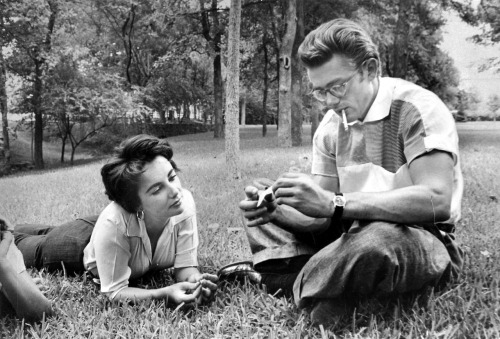
Elizabeth Taylor and James Dean, 1955
Historical Map: Washington, DC Metro Map, 1977 As you know,...

Historical Map: Washington, DC Metro Map, 1977
As you know, I’ve had a lot to say about recent iterations of the Washington, DC Metro Map (Rush+ map review, draft Silver Line map review), but how about a look at where it all began?
This is a Metro map from March, 1977 – about a year after the system first started carrying passengers. At first glance, it looks very similar to today’s modern map… but then you realise that the only section that’s actually in service is the Red Line between Dupont Circle and Rhode Island Avenue, denoted by black outlines around the station circles, rather than the plain white circles used for future stations.
The uncanny resemblance to today’s map comes about because the whole system shown here – up to and including the opening of the Green Line segment to Branch Avenue in 2001 – was planned for right from the start of the project. If you look closely, there are actually quite a few differences: the Blue and Yellow Lines south of Pentagon are reversed from today’s configuration, and a number of station names have changed from these initial plans. Bigger visual differences include the lack of the kink in the Yellow/Green line around Columbia Heights and a much greater sense of visual clarity: short station names (note that it’s only “U Street” here!) and no secondary information like cross streets, hospitals or timetable/routing callout boxes give the map room to breathe. While not quite the mimimalist classic that Massimo Vignelli’s New York Subway map is, this version of the map is definitely far more deserving of the “iconic” tag than its modern descendants.
Our rating: An unadulterated look at the far superior original concept. Four stars.

(Source: Subchat.com thread about the map: the thread originally dates the map to March 27, 1976, but later revises it to March 17, 1977 because of the stations that are shown as being open – Dupont Circle and Gallery Place stations opened after the rest of the Phase I Red Line stations)
Lenticular Street Art by Roa
Russian Sledgesattn: multitasksuicide's dad


Back in 2009 artist Roa (previously here and here) painted this amazing lenticular street artwork on Curtain Road in London. Depending on the angle of viewing the art shifts between the fuzzy exterior of a rabbit to an illustrated interior of its circulatory system, a trick he used late last year here in Chicago to pretty gruesome effect. You can see much more of Roa’s work over on Flickr which seems to be updated most frequently. (via twisted sifter)
Meet The Kid In The Jackie Robinson Photo (Which Was Staged)
Why almost everything we think we know about the iconic photo from Robinson’s first game is wrong.
Keith Olbermann | MLB.com | Apr 2013 [Full Story]


Otter Examines a Seashell Via Devon Photographic Now for some...

Otter Examines a Seashell
Now for some very important otter news: Buzzfeed Animals is hosting an Animals March Madness tournament, and otters are up against red pandas in the final four. If you’d like to vote, check here later today for their voting post. Go otters! [Thanks to Chaucea for the heads-up!]


McCaul isn't helping
Rep. Michael McCaul (R-Texas), who recently took over as the chairman of the House Homeland Security Committee, told a national television audience yesterday that a "person of interest" in the Boston Marathon bombings "is in custody." That was incorrect, and law enforcement officials went out of their way last night to explain there is no one in custody.
Shortly before his appearance, McCaul held a brief press conference on Capitol Hill, telling reporters, "We've been quite fortunate that this type of attack has not happened before in the U.S." This, too, is incorrect.
Rachel spent some time last night detailing the series of bombings we've seen on U.S. soil over the last 20 years, including the 1993 attack on the World Trade Center, the Unabomber in 1994, the Oklahoma City bombing in 1995, the pipe bombs at the Olympics in Atlanta in 1996, the bomb at an Alabama abortion clinic in 1998, the arson attack at a Syracuse temple in 2000, the 18 pipe bombs planted in mailboxes in five states in 2002, the 2008 bomb planted in front of a military recruiting center in Times Square, the bomb at a San Diego courthouse also in 2008, the fire bombs targeting researchers in 2008 at UC Santa Cruz, and in 2011, there was an attempted bombing of an MLK parade in Spokane.
And that's just the last 20 years. If we go back further, let's not forget the series of anarchist bombings in 1919 and 1920, including the wagon bomb that killed 38 people on Wall Street, which were terribly deadly.
The tragic truth is this type of attack has happened before in the U.S., and it's not helpful for the chairman of the House Homeland Security Committee to argue otherwise.
No need to thank me. I love seeing people embrace their inner geek, especialy people of the female persuasion, because the vast majority seem to be ashamed of doing it. Anyway you're awesome and we should be Tumblr friends :)
Russian Sledgeswhen asked if I am a "nerd" or a "geek" or whatever -- this is pretty standard small talk in bars within walking distance of kendall square -- I tend to say "why bother?"
I was gonna answer this ask privately, but my answer kind of spiraled a bit and I want to talk about something.
((This isn’t aimed at you I promise, but this made me think of something that’s been bugging me since my post went viral.))
Yes, geek girls are an untapped and unappreciated group. But we’re not ashamed of coming out of the geek closet; we’re afraid to.
I wasn’t the one who put my post up on other sites (like Imgur and 9GAG). That was done by other people who thought it was funny and wanted to share it. And yet I still managed to get messages calling me an attention whore or about how it probably wasn’t even my sword or to go use it to make them a sandwich. Some people even commented that it wasn’t funny and I only got as big as I did because I was hot.
I never expected for my post to blow up like it did and even still I wouldn’t have spammed the internet with it myself.
I made it to make people laugh. I didn’t make it for attention. Hell I only had around 100 followers when I made that post. If you liked my post because it genuinely made you laugh, thank you. That was why I made it.
I certainly can’t speak for the experiences of other female geeks out there, but this was mine.
BPD
Russian Sledgesmap

