Shared posts

03 Oct 22:14

Just Stay Home

by Patrick Maguire

For the sake of humanity, some adult humans should not be allowed out, period.  If they were allowed out, on a limited basis, their “house arrest” should preclude them from interacting with anyone who serves the public. They just don’t get it.

I received these pictures from an employee at a restaurant that is widely regarded as one of the best restaurants in America. (It’s in the Southeast.) I’ve confirmed the employment of the sender, and the restaurant, but agreed not to disclose the identity of either. The pictures represent both sides of a card handed to a server by a guest last weekend, during a very busy dinner service. Side 1:

It’s one thing to ask for a few modifications, but really? If you want to pick and choose exactly what you want, go to a buffet, or go to a supermarket. Side 2:

No, this was not a joke. This diner actually sent a note to the kitchen requesting that they default to his dietary philosophies!! I can hear the kitchen crew now, “Hold everything. We’re going Forks Over Knives for table 32…”

The restaurant took the hospitality high road, and served the persnickety patron a vegan entre of local produce. (I’ve requested information from the server about the interaction with the guest and his dining companions, and how they tipped.) I do know that the demanding douchebag did not thank the chefs in the open kitchen for accommodating him.

The perky, Thanks for working with me!” does not offset how obnoxious this note is. The entitlement epidemic is alive and well. I’m surprised the diner didn’t specify ideal lighting luminosity, room temperature & humidity, and hand the maître d’ a playlist…

Love to hear your reaction, and your stories in the comments.


03 Oct 22:11

Like Your Racist Aunt, Hobby Lobby Loves Crafts, Isn't Wild About Jews

by Erin Gloria Ryan

Like Your Racist Aunt, Hobby Lobby Loves Crafts, Isn't Wild About Jews

We already know that ric-rac n' hot glue purveyor Hobby Lobby is totally not down with its female employees using birth control because Jesus Is Watching You Fuck. But here's another reason to not buy your crafting supplies there: they're also not wild about Jews. Hobby Lobby: basically, your anti-Semitic, sanctimonious, holiday-ruining aunt.

Read more...


03 Oct 18:13

Feds: Silk Road boss paid $80,000 for snitch’s torture and murder

by Dan Goodin
Russian Sledges

"Dread Pirate Roberts—the online moniker prosecutors say Ulbricht used as leader of Silk Road—first asked that the suspected employee be beaten and forced to return the stolen Bitcoins"

via overbey

The kingpin of the Silk Road drug empire paid $80,000 to commission the torture and murder of an employee suspected of cheating customers in a deal gone bad, federal prosecutors alleged.

Ross William Ulbricht ordered the hit against an employee who took delivery of a kilogram of cocaine valued at $27,000, according to a superseding indictment filed in federal court in Maryland. Shortly after receipt, the employee came under suspicion of stealing from other Silk Road members after he was arrested by law enforcement authorities, prosecutors said. Communicating with an undercover law enforcement agent posing as a drug smuggler, Dread Pirate Roberts—the online moniker prosecutors say Ulbricht used as leader of Silk Road—first asked that the suspected employee be beaten and forced to return the stolen Bitcoins. Soon, the indictment alleged, the kingpin changed his mind.

"Can you change the order to execute rather than torture?" Ulbricht allegedly asked in January. The employee—who prosecutors said had access to private messages sent by all Silk Road users including its boss—"was on the inside for a while, and now that he's been arrested, I'm afraid he'll give up info." Dread Pirate Roberts, who agreed to pay $40,000 in advance and another $40,000 when the hit was completed, added he had "never killed before, but it is the right move in this case," the indictment added.

Read 5 remaining paragraphs | Comments


03 Oct 15:43

Fort Lauderdale, Florida Is The U.S. City With The Highest Concentration Of Gay Couples

by russiansledges
Russian Sledges

#villeashell

6. Somerville, Massachusetts: 2 percent of households are same-sex partners.
03 Oct 11:08

Watch Amtrak's Trains Move Along Their Routes in Real Time

by Eric Jaffe
Russian Sledges

via saucie

This week Amtrak released "Track a Train" — an interactive, Google-powered, real-time-ish status map of its 300-plus daily trips. America's passenger rail provider says it created the feature because checking train status is the second most-popular action on its website, after buying tickets. Now travelers and train enthusiasts alike can see how slow fast a particular Amtrak train is moving at any given time.

Requisite snark aside, the service looks both polished and useful. (You can find it in the lower-left corner of Amtrak's main site.) The base map gives a national overview of Amtrak's service at the moment. Active trains are indicated by a blue arrow pointing in the direction they're traveling. Stations are shown as smaller white dots. A purple circle enclosing a number shows how many trains are in high-traffic areas and lets users zoom in with one click.

A status window for each individual train gives the train number, direction, origin, final destination, and speed. There's also a status flag: green indicates on-time trains; amber, late trains. One check this morning found a gray flag to indicate a route with a service disruption. The most handy feature is a scrollable history that gives the local times every arrival a train has made (or will make) on that route.

Yes, that is an Acela moving at 134 miles per hour — just a glimpse of what Amtrak trains are capable of doing when proper track configuration allows.

There are plenty of basic Google Maps features, too, including a traditional zoom feature, a search window that auto-fills for stations or route names, and a satellite viewing option. (You can't zoom in close enough to see the actual track, however, perhaps for security reasons.) There's even a nifty national "reset" button that takes you take back to the base screen that the original Google Maps would be wise to steal.

So there it is: not groundbreaking, of course, but functional, clean, and customer friendly. Amtrak's management is always being criticized for its shortcomings. That's the way it should be for a taxpayer-subsidized service, and indeed sometimes the flaws are glaring (as in the case of its inefficient food service). But Amtrak's innovations deserve some credit, too.

At times it's even been ahead of the technological curve. Amtrak has taken the lead implementing positive train control safety upgrades, and it was using mobile ticketing well before transit agencies started doing the same in major U.S. cities (if anything, it made the shift too quickly, confusing some older customers). Its WiFi service is a mess, of course, but private-sector in-flight Internet providers haven't exactly perfected that system, either.

Anyone interested in learning more about the "Track a Train" system might turn to a Q&A that Amtrak conducted (if you will) with Google Maps product manager Dylan Lorimer. It's mostly vanilla stuff, but one of Lorimer's answers is entertaining:

As you know, our trains go to a lot of places. If you could go to any of our 500 destinations, where would you go?

Remember that train robbery scene from Breaking Bad (season 5, episode 5), where they steal the supply of methylamine? Maybe there? Just kidding. For sure, I’d take the Empire Builder through Glacier National Park! I can’t wait to do that one day.

Two things. One, he's so obviously not just kidding. Two, let's just hope he doesn't hop that Empire Builder during a government shutdown. If he does, though, at least he'll be able to see whether or not he'll arrive at that closed park on-time.


02 Oct 20:47

Kernis Resigns from Minnesota Orchestra

by Aaron Jay Kernis
The following letter of resignation by Aaron Jay Kernis, the director of the Composer Institute at the Minnesota Orchestra, was submitted earlier today to President Michael Henson, the board of directors, as well as the musicians and staff of the Minnesota Orchestra.
02 Oct 20:35

Apps!

We’d like to take a minute to thank the community of applications developers that have assisted in improving the user experience and accessibility of The Old Reader.  Please take a moment to browse the list and let us know if there is anything we’re missing.  New apps are still being added and developed specifically for The Old Reader and we’re thrilled to say that other prominent applications have us on the shortlist to be supported soon.

Along these same lines, please know that all of your feedback and voting at UserVoice is appreciated and something we take very seriously.  Our first priority has been to transition The Old Reader and improve the architecture and performance.  As many of you have noted, we’ve made huge strides in that area.  In the near future, we plan to communicate more around specific features and begin making functional improvements.

Thanks for using The Old Reader!

02 Oct 19:48

Ostentatious breeches, gods’ braggadocio, and ars poetica

by Alice

By Anatoly Liberman


As promised, I am returning to the English verb brag and the Old Scandinavian god Bragi (see the previous post). If compared with boast, brag would seem to be more suggestive of bluster and hot air. Yet both may have been specimens of Middle English slang or expressive formations; hence perhaps the obscurity of their origin. The OED gives a summary of the attempts to trace brag to its source. Since the time the first volume of the great dictionary appeared (1884) the situation has not become significantly clearer. The latest publication on the subject (2002), in which the author argues for the Scandinavian derivation of brag, also left several stones unturned.

When Skeat began publishing his dictionary (1882), he quite naturally felt more confident than three decades later. Study of etymology teaches its practitioners caution and humility: the older and the more experienced they become, the less positive they feel about many things (but then such is the way of all scholarly flesh). In the first edition of his dictionary, Skeat insisted that brag was a Celtic word because its putative etymon has been recorded in all (he stressed: all) the Celtic languages. However, he soon gave up his idea. Perhaps, after all, the Celtic verbs were borrowed from English. But this conclusion also has an element of uncertainty. Brag is not such a common word as to be taken over by the speakers of other, even neighboring, countries with unreserved enthusiasm. To be sure, it may have enjoyed greater popularity in the Middle Ages (there is no way of knowing).

Despite the pessimistic tenor of the introduction, it will be wrong to say that absolutely no progress has been made since researchers began pondering the fortunes of brag. French has (had) the noun bragues ~ braies “trousers,” from Latin braca ~ braces, possibly a borrowing in that language. In France, breeches were part of the aristocratic apparel. The lower classes that took part in the French Revolution were called sans-culottes (“without trousers”) for exactly that reason: they wore no “breeches.” According to the French hypothesis of the origin of brag, bragging takes us back to ostentatious clothes. But all the relevant French words were attested centuries later than Engl. brag, so that the connection should be rejected as improbable.

Bragi_and_Iðunn_by_FrølichMost likely, brag is a Germanic word. If we disregard as unpromising its comparison with Old Engl. brogne “branch, bough” (this comparison has once been made), we will end up with Old Icelandic braga “shine; glimmer,” bragr “chieftain,” bragr “the art of poetry,” and Bragi, the name of the god of poetry and of the first skald. As usual, semantic bridges are comparatively easy to draw. Poetry was closely connected with its patrons (kings and chieftains), “shine” and “king” form an obvious union, and words for emitting light occasionally also mean “to produce a loud sound” (from a historical point of view, such is, for example, German hell “bright”). Bragging is loud; ostentation and sheen also go together. All this is edifying, but none of the words listed above has any direct connection with boasting. For that reason, Old Engl. (ge)bræc “noise” caught the fancy of many etymologists (ge- is a prefix, æ has the value of a in Modern Eng. brag). Boasting and making a lot of noise go together quite well, but final -c in -bræc (which has the value of Modern Engl. k) and final -g in brag don’t. In Modern English, words ending in -g (tug, leg, rag, drag; bog, bag, fig) are rarely native. But words signifying emotions and those which reached the Standard from the language of “rogues,” such as prig and smug, need not have been borrowings. Therefore, it is at least possible that brag is an expressive variant of brac-, but this is, of course, guesswork.

Perhaps more can be said about br-, a combination that is habitually associated with noise. Classic examples are Engl. break and Swedish bryta “to break.”(Old Icelandic had brjóta; Old Engl. gebryttan dropped out of the language, but its cognate brittle “breakable, fragile” survived.) Old Engl. breahtm meant “noise; cry; revelry” and “brightness.”  Pr- may play a similar role. In German prahlen “to boast,” pr- goes back to br-, but in the Dutch verb pronken “to parade, strut” pr- may be original. At first blush, brag belongs with such br- words. Especially important is Middle High German brogen “boast,” which looks almost like a doublet of Engl. brag (first noted in this context by L. W. van Helten).

Here Franciscus Junius the younger (1591-1677), another Dutch scholar, should be mentioned. In 1743 Edward Lye published his etymological dictionary of English, a work of considerable value even today. Junius compared brag with Old Engl. bregan “to frighten.” The two cannot be connected directly, because bregan had long e, which is incompatible with short a in brag. But, related to bregan, the noun broga (also with a long root vowel) “fright, terror; prodigy” has been recorded, and an Old English verb bragan is not unthinkable (short a and long o alternated according to a regular rule). Bragan, assuming that it is not a ghost word, would have yielded Modern Engl. braw (compare draw from dragen), and I suspect that Engl. brawl (of unknown origin!) is a continuation of this unattested braw with the pseudo-suffix -l, on analogy of bawl, maul, and the like. Old Engl. bragan, which I conjured up to boost my argument, may have had an expressive doublet braggan, and such a form would have become Modern Engl. brag in the same way in which stacga and frocga (cg = gg) became stag and frog. But the more unknowns we add to an etymological equation, the harder it is to justify the result. In any case, the Low German or even native origin of brag seems more probable than its borrowing from Scandinavian. I’ll leave out of account a good deal of etymological bric-à-brac and return to Icelandic bragr and others.

The history of those words is, if possible, even more obscure than that of Engl. brag and its half-invisible kin. The sense “poem” (and, consequently, “the god of poetry”) does not accord too well with bragging or showing off, especially if the semantic nucleus of brag was “making a noise.” The art of poetry was associated with “finding” the best words (so in Old Icelandic and Old English, and such is the meaning of the terms troubadour and trouvère, both of them “finders”), “stitching songs together” (such were the Greek rhapsodes), and producers of merriment or inspiration. Poets, even in a state of ecstasy are not braggarts. They may be called the greatest mullahs (so in Kazakhstan, where an akyn is the winner of a contest of singers), but the reference is hardly ever to boastful shouting. The function of some poets was to mock and deride. The Old English scops at one time supposedly performed such a function. A similar interpretation of Old Icelandic skáld “skald” (“scolder?”) has been offered, but it is problematic. Given the evidence at our disposal, we cannot be sure that the senses “chieftain, prince” in Icelandic have anything to do with “poetry.” We also lack good arguments for connecting the god’s name (divine names are called theonyms) with the secular proper name Bragi. For all such reasons, I would prefer to separate Bragi from Engl. brag. Other researchers have different opinions. And this is exactly the reason why in the entry brag we will always read: “Origin unknown.” Nothing to boast of.

Anatoly Liberman is the author of Word Origins And How We Know Them as well as An Analytic Dictionary of English Etymology: An Introduction. His column on word origins, The Oxford Etymologist, appears on the OUPblog each Wednesday. Send your etymology question to him care of blog@oup.com; he’ll do his best to avoid responding with “origin unknown.” Subscribe to Anatoly Liberman’s weekly etymology posts via email or RSS.

Subscribe to the OUPblog via email or RSS.
Subscribe to only language articles on the OUPblog via email or RSS.
Image credit: The skaldic god Bragi holds a harp and sings while his wife Iðunn holds a bowl of apples in the background. Lorenz Frølich. Published in Gjellerup, Karl (1895). Den ældre Eddas Gudesange. Public domain via Wikimedia Commons.

The post Ostentatious breeches, gods’ braggadocio, and ars poetica appeared first on OUPblog.

02 Oct 18:53

Getting Schooled On Sikhism

by Andrew Sullivan

Most Americans know very little about the Sikh religion:

The study, titled “Turban Myths,” found that 70 percent of Americans misidentify turban-wearers, with 48 percent identifying men in turbans as Muslim despite the fact that most turbaned men in the U.S. are actually Sikh. More than one-third of Americans associate turban wearers with Osama bin Laden, more than with other named Muslim or Sikh alternatives and more than with no one in particular. And at least one in five people surveyed said that they would become angry or apprehensive if they encountered a stranger wearing a turban.

Although Sikhs have lived in the U.S. since the 19th century, the study also found that Americans still know relatively little about the community. According to the survey, 70 percent of Americans cannot identify a Sikh, and 79 percent cannot identify India as the religion’s country of origin. In fact, nearly half of Americans believe that Sikhism is actually a sect of Islam.

Fortunately, Captain America is here to help.


02 Oct 18:27

America was not shut down properly. Would you like to start...

Russian Sledges

via firehose


America was not shut down properly. Would you like to start America in safe mode, with free healthcare and without guns? (Recommended)

02 Oct 18:26

http://isthefederalgovernmentdown.com/

by gguillotte
Russian Sledges

via firehose

YES
02 Oct 12:52

Face of The Day

by Andrew Sullivan

The Conservative Party Annual Conference

Delegates listen to speeches in the Main Hall of Manchester Central on the third day, and penultimate day, of the Conservative Party Conference on October 1, 2013 in Manchester, England. On the same day that America’s Republicans shut down the entire government to deny millions of uninsured people access to basic healthcare insurance, David Cameron unveiled a new Government pilot scheme for General Practitioner surgeries to open from 8am until 8pm seven days, backed by 50 million GBP of funding. By Oli Scarff/Getty Images.


02 Oct 11:14

CERN Launches Line Mode Browser Emulator

by Soulskill
Russian Sledges

via firehose

itwbennett writes "As part of the project to preserve the world's first website and all of the accompanying technology, CERN last week launched a line mode browser emulator. To make the browser experience authentic, the developers recreated how terminals would draw one character at a time by covering the page in black and then revealing each character by erasing a character-sized rectangle from that cover, one-by-one, line-by-line. They also recreated the sound of typing on older keyboards, specifically an IBM RS/6000 keyboard, by using HTML5 audio elements."

Share on Google+

Read more of this story at Slashdot.


02 Oct 00:49

David Bowie's top 100 books

by Rob Beschizza

The Age of American Unreason, Susan Jacoby, 2008
The Brief Wondrous Life of Oscar Wao, Junot Diaz, 2007
The Coast of Utopia (trilogy), Tom Stoppard, 2007
Teenage: The Creation of Youth 1875-1945, Jon Savage, 2007
Fingersmith, Sarah Waters, 2002
The Trial of Henry Kissinger, Christopher Hitchens, 2001
Mr. Wilson’s Cabinet of Wonder, Lawrence Weschler, 1997

And there's more! [Open Culture]


02 Oct 00:48

Lessons learned from a flat-rate service-charge, no-tip restaurant

by Cory Doctorow

Jay Porter owned a San Diego restaurant called The Linkery where tipping was not allowed; instead, a flat 18 percent service-charge is added to each bill, and that charge is divided among the servers, bus-people, and kitchen-staff. In a six-part series, Porter sets out the case for his experiment and reports on the result, covering the bad gender dynamics, motivation and microeconomics, and a comparison with a tip-friendly restaurant he also owns. It's a compelling tale about economic fairness versus locked-in dysfunctional conventions. He summarized his findings in an easily digested article for Slate.

Probably the most common reaction to our service-charge-no-tips policy, from people outside the service industry, was along the lines of, if there’s no tipping, then how will the servers be motivated to do a good job?

When you step back and think about this for a second, it’s actually kind of hilarious. The person asking this question would have a full-time job as a software developer, or lawyer, or journalist, or doctor, always working to a pay rate that was negotiated ahead of time. We would never suggest that a code jockey or surgeon would be motivated to do better work by the thought that their clients, if pleased with the service, might toss in a few extra dollars.

And yet, we restaurant-goers (and I include myself in this, in the days before I worked in restaurants) are not hesitant to suggest that, unlike all other working Americans, restaurant servers are a class of simpletons who require a drip of money every few minutes to keep them on task. By perpetuating the idea that servers, and servers alone, won’t perform without the threat of pay withheld, we dehumanize our neighbors and peers who work taking care of us. I think this helps us not feel bad when we sometimes treat them badly. It’s the Stanford Prison Experiment meets Yelp.

Meanwhile, restaurant workers know what’s up. People who worked in the restaurant industry wouldn’t ask us this question — what will motivate servers to do a good job? Because, inside the restaurant, we know that while the customers think their tips allow them to control the server, in fact the control is illusory. The story of the server being motivated by the customer’s power to tip, is instead a fiction created to make the customer feel important.

This was one of the first things I learned as a restauranteur.

Observations From A Tipless Restaurant: Part 1, , part 3, part 4, part 5, part 6

What Happens When You Abolish Tipping [Jay Porter/Slate]

(via Kottke)


02 Oct 00:45

Listen to a story told in a 6000-year-old extinct language

by Maggie Koerth-Baker
Russian Sledges

via multitask suicide

attn overbey: #youthwithoutyouth beat

English — along with a whole host of languages spoken in Europe, India, and the Middle East — can be traced back to an ancient language that scholars call Proto Indo-European. Now, for all intents and purposes, Proto Indo-European is an imaginary language. Sort of. It's not like Klingon or anything. It is reasonable to believe it once existed. But nobody every wrote it down so we don't know exactly what "it" really was. Instead, what we know is that there are hundreds of languages that share similarities in syntax and vocabulary, suggesting that they all evolved from a common ancestor.

Of course, that very quickly leads to attempts to reconstruct what said ancestral language might have sounded like. In the track above, you can listen to University of Kentucky linguist Andrew Byrd recite a fable in reconstructed Proto Indo-European. Archaeology magazine helpfully provides a translation:

A sheep that had no wool saw horses, one of them pulling a heavy wagon, one carrying a big load, and one carrying a man quickly. The sheep said to the horses: "My heart pains me, seeing a man driving horses." The horses said: "Listen, sheep, our hearts pain us when we see this: a man, the master, makes the wool of the sheep into a warm garment for himself. And the sheep has no wool." Having heard this, the sheep fled into the plain.

Obvious, right? So how does one produce a scholarly mashup of English, Hindi, Urdu, and more, while accounting for six millennia of invention, sharing, and remixing?

There are a couple of different techniques. In the comparative method, researchers take two or more languages and start lining up their features side by side. What sounds do they share? What words sound similar? What rules do they have in common? Then you use what you know about the history of those languages to look at which ones descended from others, and to weed out words that were borrowed completely from unrelated languages thanks to trade or travel. Following the lines of descent, you can get an idea of the sounds and alphabets that the parent language originally had to work with.

The other technique, internal reconstruction, basically takes a single language and starts trying to work it backwards in time through itself. How did English distinguish itself from older Germanic languages and how has it changed since AD 500.

When you put information that you gather from both these techniques together, you can start to get a handle on what some really ancient, never-heard-by-anyone-living languages might have sounded like.

'

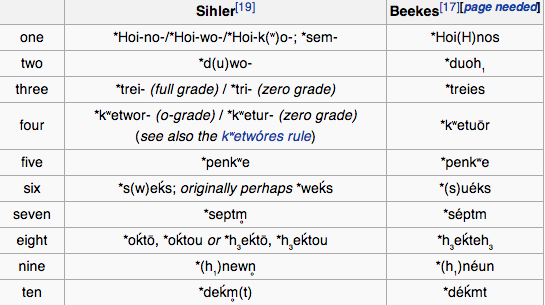
For instance, Wikipedia has a chart showing two different versions of the Proto Indo-European numbers. If you speak one of the languages descended from Proto Indo-European, these will likely look or sound familiar.


02 Oct 00:42

1385109_10151658332128231_1531051420_n.jpg (720×960)

by russiansledges
Russian Sledges

this afternoon in harvard square

"JESUSCARE IS FREE"
02 Oct 00:20

Doctor Who: David Tennant pokes fun at 'lazy' Peter Capaldi | Media Monkey

by Monkey

Former Doctor reflects on show ahead of 50th birthday special

Who are you calling lazy? Former Doctor Who star David Tennant has enjoyed some mild fun at the expense of the next man to take on the role, Peter Capaldi, reports the Sun. The former Thick of It star, you may remember, will get to use his Scottish accent, unlike Tennant, who put on an English accent with the help of his sonic voicebox. "I just think it's lazy," said Tennant at a Doctor Who event in London ahead of the show's 50th birthday show (in which DT will appear). Tennant said it wasn't easy leaving the show in 2009. "Part of me would have stayed doing it forever. But it's one of those things where you just have to take a deep breath and think: 'If I don't leave this show now, people will resent me still being there in 25 years.'" After all, there's no turning back time. Or is there?


theguardian.com © 2013 Guardian News and Media Limited or its affiliated companies. All rights reserved. | Use of this content is subject to our Terms & Conditions | More Feeds

02 Oct 00:19

wrote-miss-ibis: pleasetrysomethingelse: BREAKING: America...


wrote-miss-ibis:

pleasetrysomethingelse:

BREAKING: America shuts down

The subtitle though

02 Oct 00:18

Photographer Niki Feijen's eerie images of the abandoned farm houses | Mail Online

by russiansledges
Russian Sledges

ruin porn: rural edition

Images reveal furniture and clothes that remain in decaying homes where owners have long since departed
01 Oct 22:31

Asteroid 4942 Munroe

by xkcd
Russian Sledges

via firehose

Whoa. There’s an asteroid named after me!

Amazing xkcd readers Lewis Hulbert and Jordan Zhu noticed that the International Astronomical Union—the organization in charge of official astronomical naming—was taking suggestions for what to name small Solar System objects. They submitted my name for asteroid (4942) 1987 DU6, and it was subsequently renamed 4942 Munroe.

I’m really touched. I spent all weekend telling everyone who wanted to listen (and probably some who didn’t) about the asteroid.

The first thing I did was try to figure out whether 4942 Munroe was big enough to pose a threat to Earth. I was excited to learn that, based on its albedo (brightness), it’s probably about 6-10 kilometers in diameter. That’s comparable in size to the one that killed the dinosaurs—definitely big enough to cause a mass extinction!

I texted Phil Plait to let him know that 4942 Munroe is four or five times the diameter of 165347 Philplait.

Unfortunately Fortunately, it’s in a fairly stable circular orbit between Mars and Jupiter, so it’s unlikely to hit the Earth any time soon.

4942 Munroe (!!!) is large enough that it would have noticeable gravity, although not much. If you were walking on the surface and you tripped and fell, it’d take you a minute to hit the ground. You could get into orbit around it by traveling at jogging speed, and might even escape its gravity entirely with a good jump.

Thank you so much. This is the coolest thing.

01 Oct 22:11

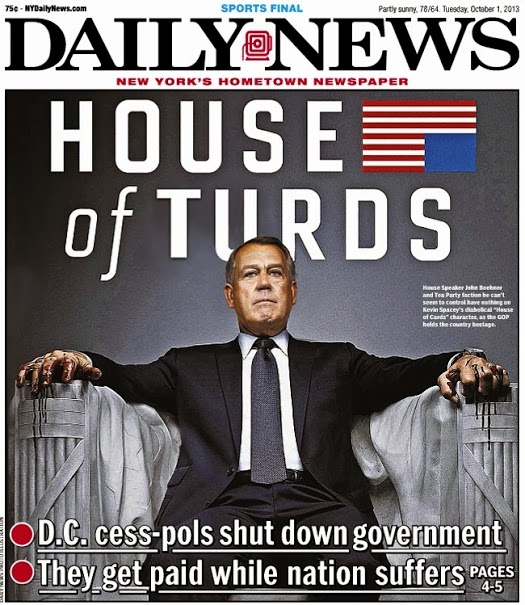
NY Daily News cover on US government shutdown is the front page art to beat

by Xeni Jardin
Russian Sledges

via multitask suicide

The New York Daily News. [slow clap]


01 Oct 22:09

'UnskewedPolls' Founder: Barack Obama Is 'Actually' Gay

by Igor Bobic

The conservative activist who gained fame during the 2012 election for "unskewing" polls favorable to Barack Obama explained this weekend his newest revelation: the president is "actually" gay.
Dean Chambers, founder of UnSkewedPolls.com wrote in the Examiner that Newsweek got it wrong when it ran a cover praising Obama for his evolution on gay marriage last year. Obama was not "basically" the nation's first gay president for his progressive stance on the issue, but actually so.

"I do believe that Barack Obama is in fact our first gay president," he wrote. "But I believe this for entirely different reasons. I believe the man actually is gay. Don't tell me his marriage to Michelle and having two children disproves that he's gay."

In the article, Chambers cites various conspiracy theories claiming to show Barack Obama's closeted life in Chicago as a state senator. He takes it even a step further, however, in defending Obama's Christian faith by arguing that people of Muslim faith "are known to stone someone for being gay."

"Would you be a Muslim if it put you as risk for being killed because of your lifestyle choices?" he asks.

h/t Political Wire

01 Oct 22:08

California City Requires All New Homes Have Electric Vehicle Charging Stations

by Chris Morran

(afagen)

(afagen)

Electric vehicles like the Chevy Volt or Nissan Leaf may be the future of automobiles (personally, I’m holding out for someone to create the Mr. Fusion), but one city in California’s Silicon Valley is betting on EVs by requiring that all newly built homes come equipped with EV charging stations.

Last week, the City Council for Palo Alto, CA — home to Stanford University and a number of tech companies, including luxury EV maker Tesla — unanimously adopted a new policy mandating charging stations on new homes.

“We have electric-vehicle owners who aren’t able to drive their vehicles to Palo Alto because they can’t charge up when they get to work,” one Council member said to Palo Alto Online (via TheVerge)about the need for more places to plug in.

Mayor Greg Scharff says this is all about encouraging consumers to switch away from gasoline-powered cars and to EVs.

“It’s incumbent for us to find out what are the obstacles to owning electric vehicles and to get rid of those obstacles,” Scharff explained.

The question is whether this sort of initiative will actually make any difference to consumers. Just because a private home has a charging station doesn’t mean that the owner of the house will buy or use an EV, or that the owner will allow EV users to charge up. This is why the Council is also considering adding charging station requirements for new commercial construction like hotels.
Ultimately, two things need to happen before there is widespread adoption of EVs: driving distances on a single charge that are comparable to what gas-powered cars achieve on a single tank, and the ability to plug in, not to a special charging station, but to any standard outdoor outlet.

When drivers can make the same trips they make today, without having to make a mad scramble for a charging station in an unknown location, two of the largest objections to EV ownership will have been removed.

All this talk of electric vehicles replacing gas guzzlers has me humming Rush’s “Red Barchetta”…


01 Oct 21:38

Batfleck Casting Goes Too Far, Ruins Trivial Pursuit

Russian Sledges

via firehose

I didn't have any specific reason to feel anything more emotional than neutrality on Ben Affleck being cast as Batman before. But now... now. Summon the armies of the Pink Wedge.
01 Oct 21:38

Zombie Cribbage, An Undead Version of the Classic Card Game

by Justin Page
Russian Sledges

via firehose

Zombie Cribbage

The Zombie Cribbage card game is an undead version of the classic Cribbage game created in the 17th century. This brainy game is available to purchase online from Firebox.

The game comes complete with a zombified deck of playing cards (yes it’s a word) and instead of your standard bland cribbage board and pins you’ve got an open cobbled street and a rabble of gormless staggering zombies (you know, to remind you of precisely what’s going on outside).

Zombie Cribbage

Zombie Cribbage

Zombie Cribbage

images via Firebox

01 Oct 21:25

It's Just a Diet Thing

by David Kurtz
Russian Sledges

via overbey ("A shake for breakfast, a shake for lunch, and a sensible dinner of hungry children and crumbling infrastructure.")

FoxNews.com prefers to refer to it as a government "slimdown."

01 Oct 19:37

Adobe fonts for Indian languages

by Paul D. Hunt
Russian Sledges

via overbey

It is with great personal pride and relish that I announce the release of two new Adobe font families for Indian languages. Adobe Tamil and Adobe Gujarati were both released over the weekend, bringing the number of Indian writing systems supported by the Adobe Type Library to a total of four. Each of these families consists of two styles: a regular and a bold. The designs have been completed with print work in mind, as traditional publishing is still very much a vibrant industry within India. These new type families follow the release of two other Adobe type families for Indian languages, Adobe Devanagari and Adobe Gurmukhi, which have already been available for some time. All of these families are currently available for purchase in the Adobe Type Store.

Adobe Devanagari typeface sample

Adobe Devanagari was the first of Adobe’s Indian font families, and was designed for Adobe by the team at Tiro Typeworks beginning in 2005. The design was conceived by Tim Holloway and Fiona Ross, Tim being the principal designer of the artwork in collaboration with Fiona and supported by John Hudson. The construction of the letters is based on traditional penmanship but possesses less stroke contrast than many Devanagari types, in order to maintain strong, legible forms at smaller sizes. To achieve a dynamic, fluid style the design features a rounded treatment of distinguishing terminals and stroke reversals, open counters that also aid legibility at smaller sizes, and delicately flaring strokes. Together, these details reveal an original hand and provide a contemporary approach that is clean, clear and comfortable to read whether in short or long passages of text. This new approach to a traditional script is intended to counter the dominance of rigid, staccato-like effects of straight verticals and horizontals in earlier types and many existing fonts. The family consists of regular, bold, italic, and bold italic styles. The font supports modern Hindi and Marathi languages, and also contains some features to enable basic setting of Sanskrit. The fonts were released with Creative Suite 6 in the spring of 2012.

Adobe Gurmukhi typeface sample

Also in 2012, I was tasked with initiating a program to develop an extended set of fonts for Indian languages. Adobe has been continually improving enablement for Indian languages in our creative applications since Creative Suite 6. The Creative Cloud versions of InDesign, Photoshop, Illustrator, Dreamweaver, Flash, and Acrobat all support the top 10 languages of India. We on the type development team have made it part of our mission to provide high-quality typographic families to showcase these new language capabilities. We decided we would first focus on designs optimized for print to support our desktop publishing applications. Therefore, I reasoned that it would be prudent to develop a set of design-compatible fonts that would pair well with the existing Adobe Devanagari typeface. In approaching this objective, I have attempted to guide designers with whom we have worked to try to harmonize important parameters such as apparent size and color and to try to match style and design details as much as is appropriate.

The first project to follow after Devanagari was Adobe Gurmukhi, which I designed collaboratively with Vaibhav Singh in 2012. Professor Christopher Shackle and John Hudson consulted on the design. The concept for this family was to follow the design principles of the Devanagari and to develop a type style for text setting based on Gurmukhi broad-nibbed calligraphy. This treatment is a departure from the more popular monoline type styles that are in circulation today. The rationale behind this approach was to reintroduce some of the attractiveness of modulated letterforms to Punjabi text typography while retaining letter shapes familiar and legible to today’s readers. The design features some more cursive letter constructions than are the norm, but I have attempted to draw these in a way that they do not draw attention to themselves.

Adobe Tamil typeface sample

Adobe Tamil was designed by Fernando Mello. Fiona Ross and Rathna Ramanathan consulted on the design. In contrast to the broad-nib pen construction pattern evident in the Devanagari and Gurmukhi, Tamil letter shapes are based on the effects of a pointed pen. Despite this difference in ductus model, the design harmonizes well in terms of a contemporary approach to styling. A defining feature of this particular design is the upright stance of the Tamil letters. Whereas many available Tamil fonts are sloped in style, Adobe Tamil follows what is typical in penmanship. The default text shaping favors the simplified, modern orthography, however, the fonts also include stylistic sets that can be used to emulate more traditional writing.

Adobe Gujarati typeface sample

Adobe Gujarati was designed by David Březina of Rosetta Type. Fiona Ross consulted on the design and valuable feedback was provided by Kalapi Gajjar-Bordawekar and Hitesh Malaviya. As with the Gurmukhi, the brief for the Gujarati was to follow the design language established by Adobe Devanagari. In fact, the Gujarati and Devanagari writing systems resemble each other in many ways with the notable feature of Gujarati being that it lacks the headline that is such a prominent component of Devanagari.

The current versions of all of these fonts have been produced in-house by Adobe’s type development team using the Adobe Font Development Kit for OpenType. I completed the main portion of OpenType feature development for the Gurmukhi, Tamil, and Gujarati. Miguel Sousa provided scripting assistance and aided in mastering of the final font files. Miguel also produced the latest versions of Adobe Devanagari to add better support for Marathi typographic preferences.

With these most recent type releases, the Adobe Type Library now has basic coverage for five of the top 10 languages currently used within India. Typefaces for additional writing systems and more type styles for some of the scripts listed above are also currently under development. Our end goal is to be able to offer a full range of type options for all of the Indian languages our applications support, and with today’s milestone release, we are well on our way.

01 Oct 17:39

Live blog: Cal explosion sends 1 to hospital, clears campus

by Emilie Raguso
Russian Sledges

via overbey, who is unexploded

Explosion in Berkeley, California

Emergency personnel respond to an explosion and fire on the University of California in Berkeley, California, on Monday, Sept. 30, 2013. The explosion apparently occurred in an electrical generator. Photo: David Yee

[Editor's Note: Monday afternoon, a power outage and subsequent explosion rocked the UC Berkeley campus and sent one student to the hospital. Scroll down to view Berkeleyside's live blog of updates throughout the night. See a chronological version of events here.]

Update, 11:59 p.m. During UC Berkeley’s evacuation Monday due to a power outage and the explosion that followed, members of Cal’s amateur radio club remained nearby to help spread the word about the developing situation to emergency workers and ham radio operators throughout the area.

Jack Burris (amateur radio call-sign “K6JEB”) works as an IT manager for UC Berkeley’s social sciences Data Lab and is president of the radio club. He said he and another club member, Joel Martin (call-sign “KQ1N”), had attended the 9 p.m. university press conference and broadcast it on their radios to other ham operators, who had fanned out to area fire departments after receiving an informal alert about the emergency.(...)

Read the rest of Live blog: Cal explosion sends 1 to hospital, clears campus (1,526 words)


By emilie. | Permalink | 10 comments |
Post tags: Berkeley crime, Campus safety, Copper wire theft, Dan Mogulof, Explosion at Cal, UC Berkeley, UC Berkeley crime, vandalism

01 Oct 11:03

Squeezed In

by Troy Turner
Russian Sledges

via snorkmaiden

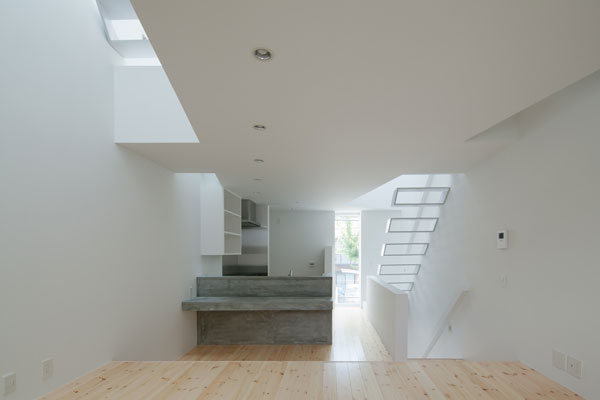
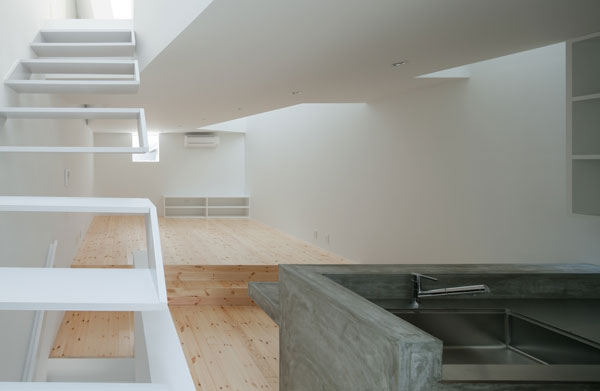
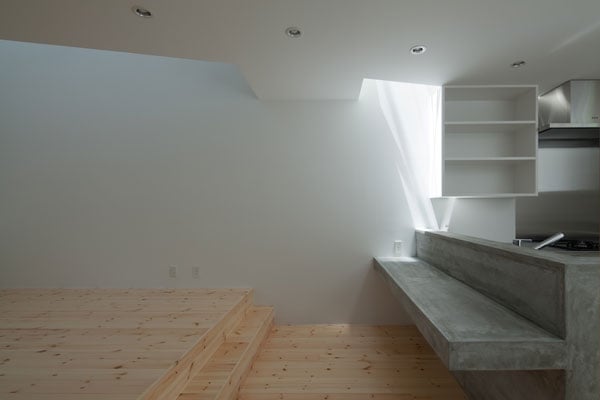
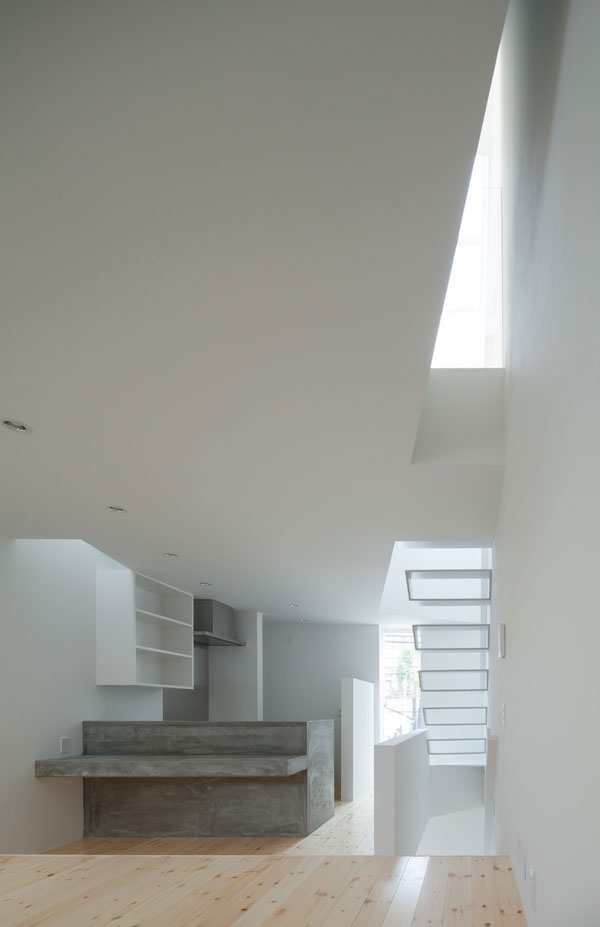
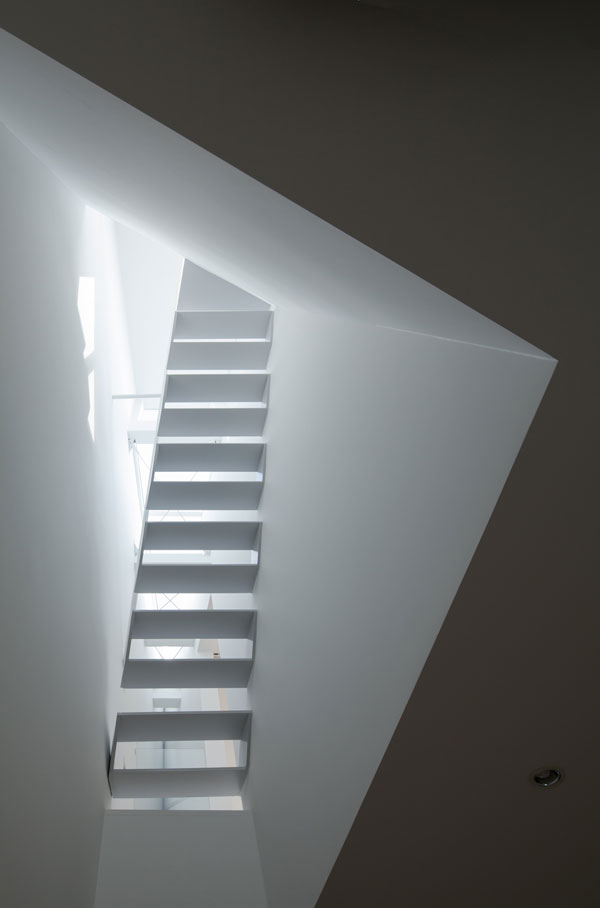
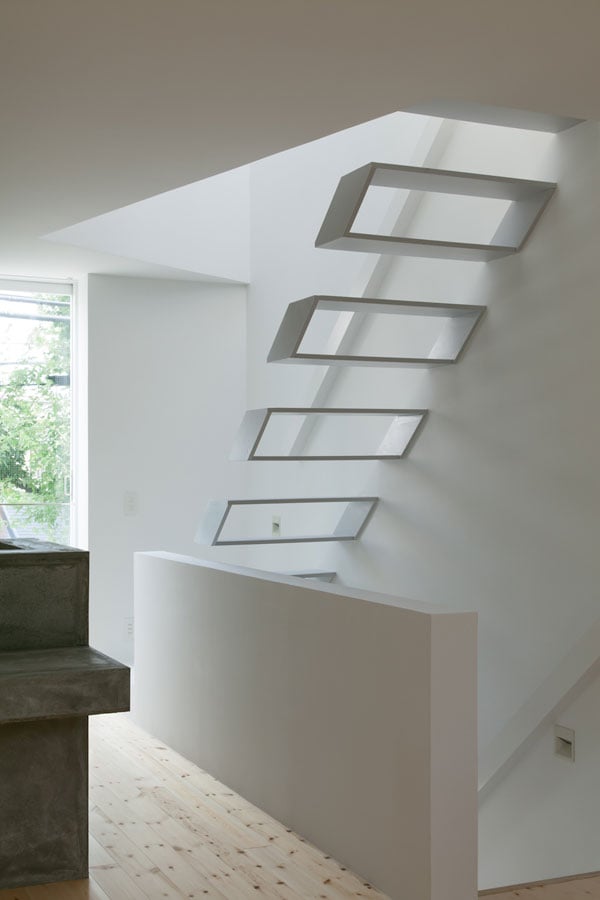
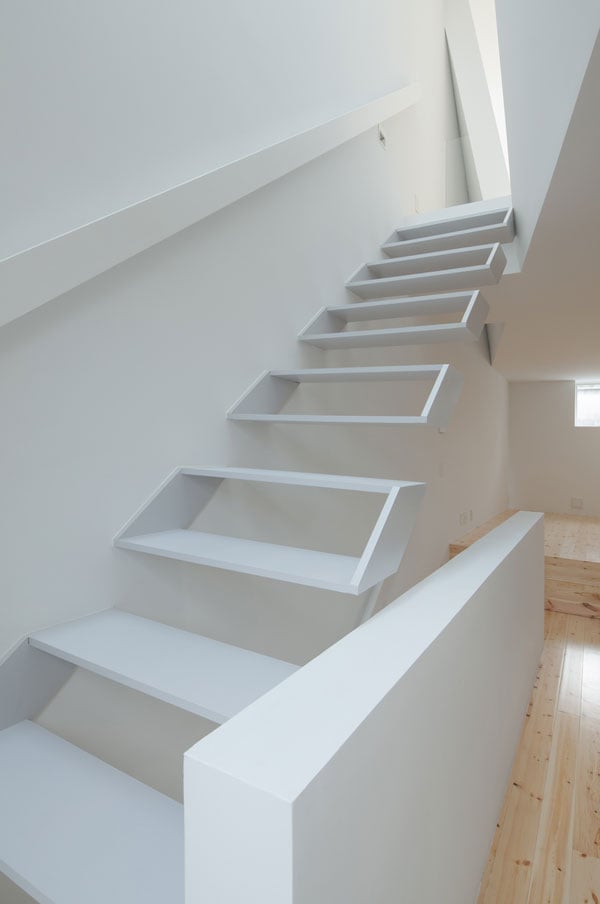
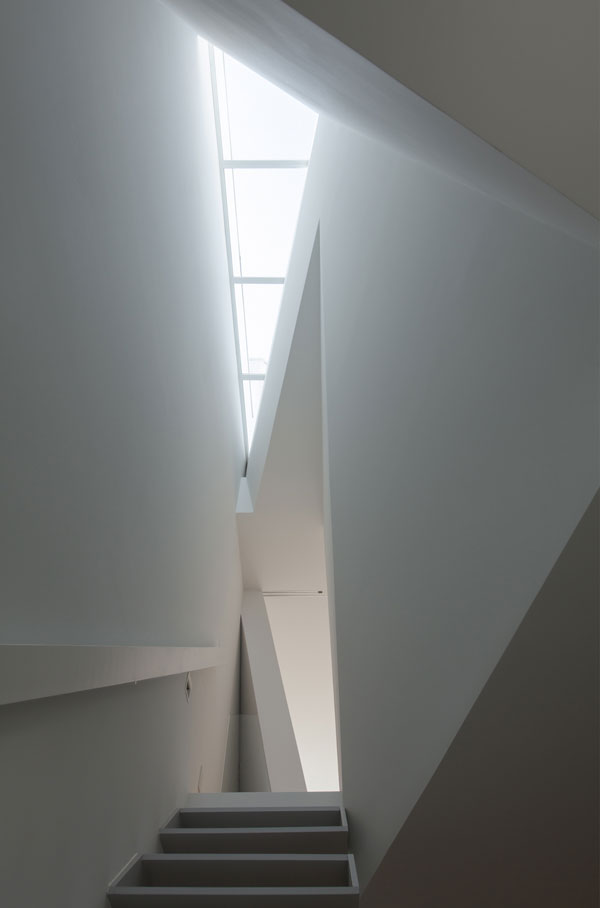
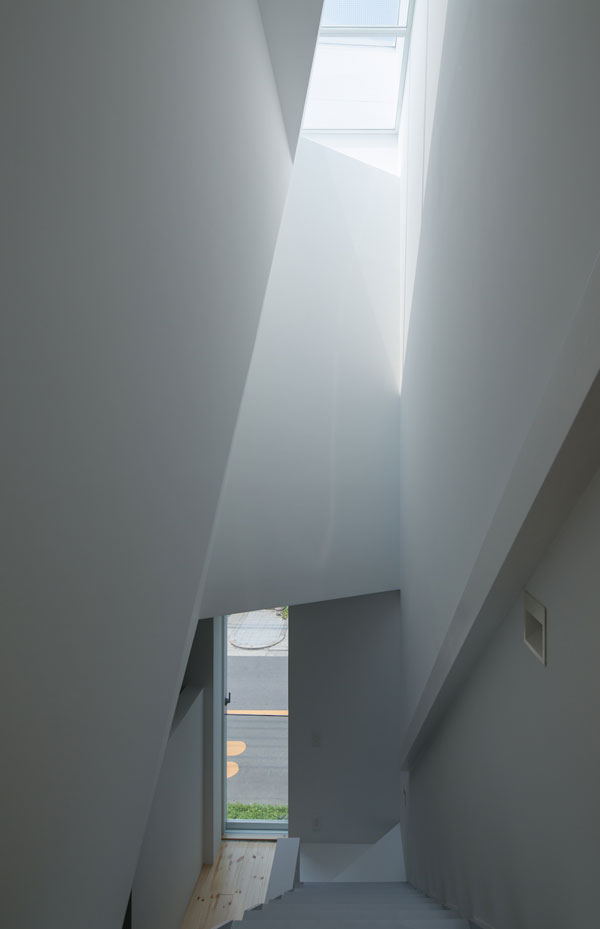
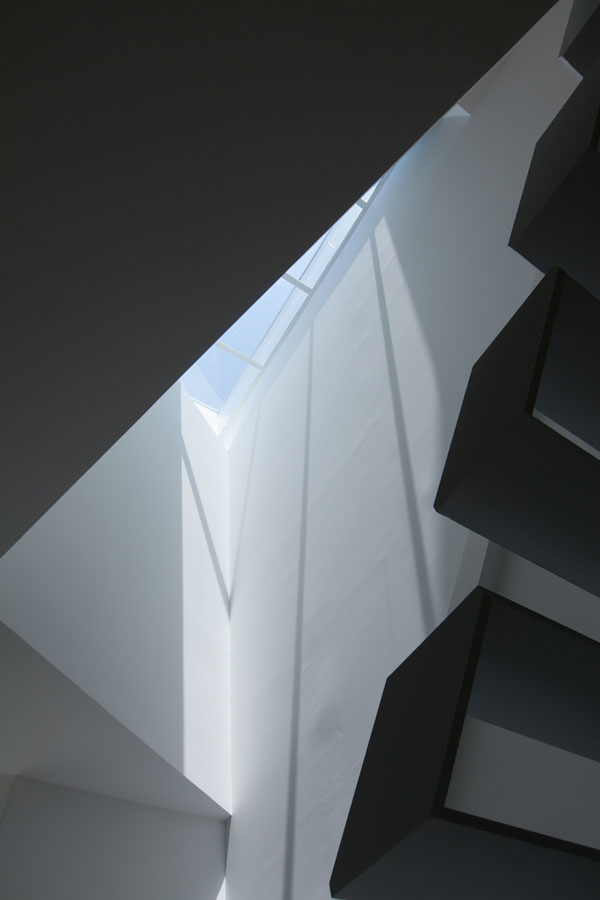
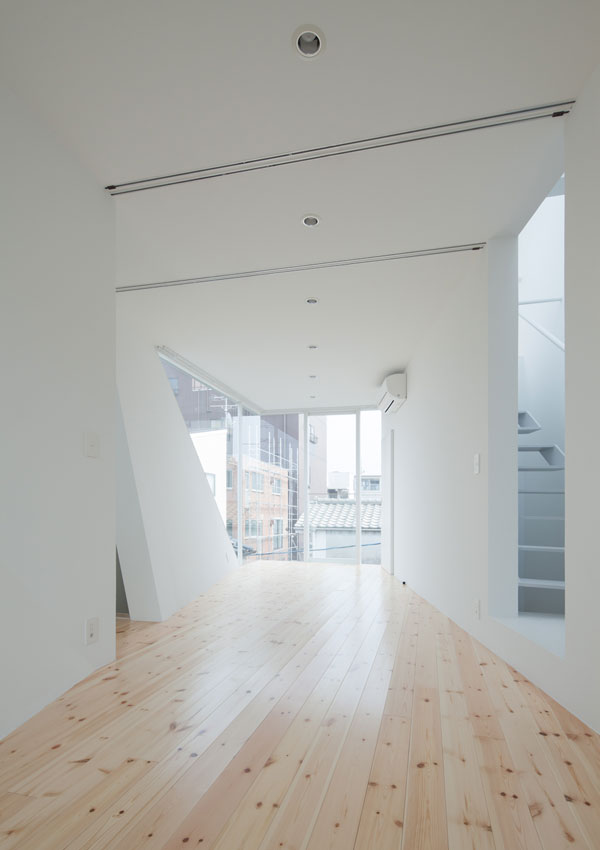
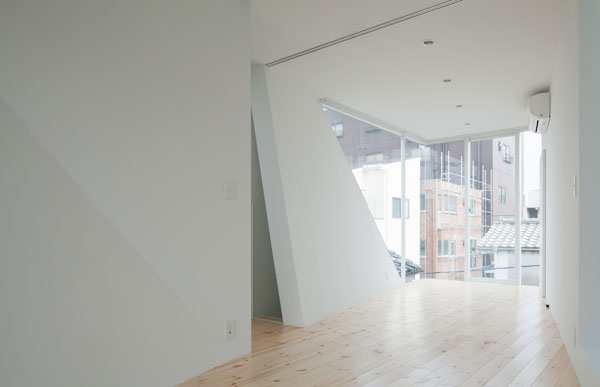
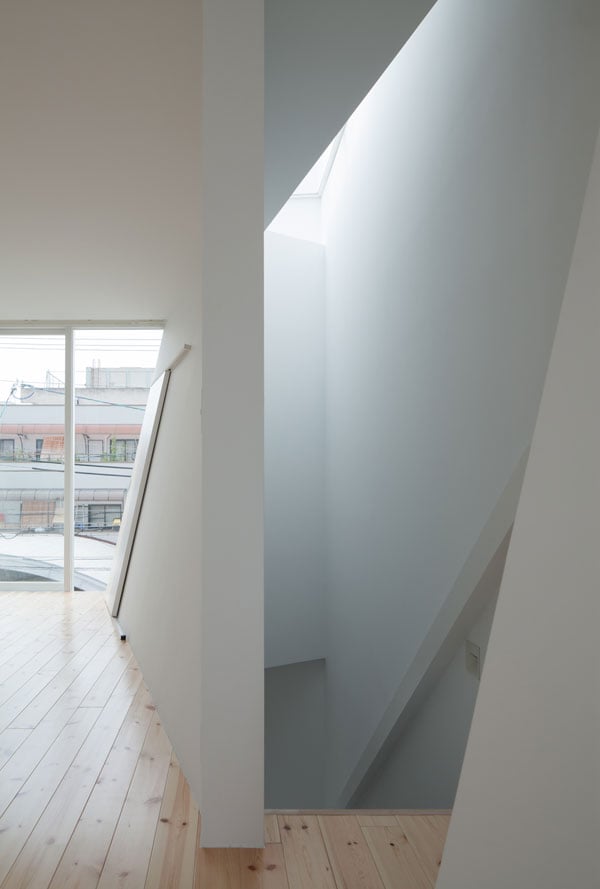
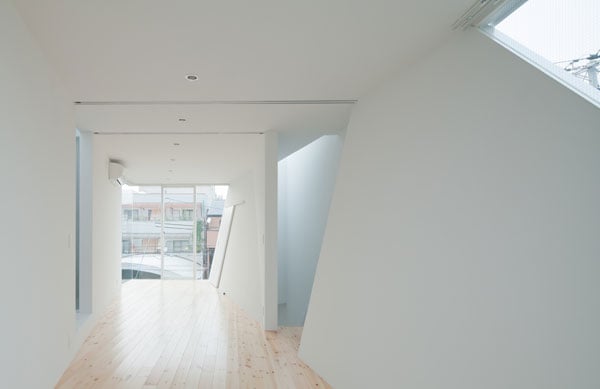
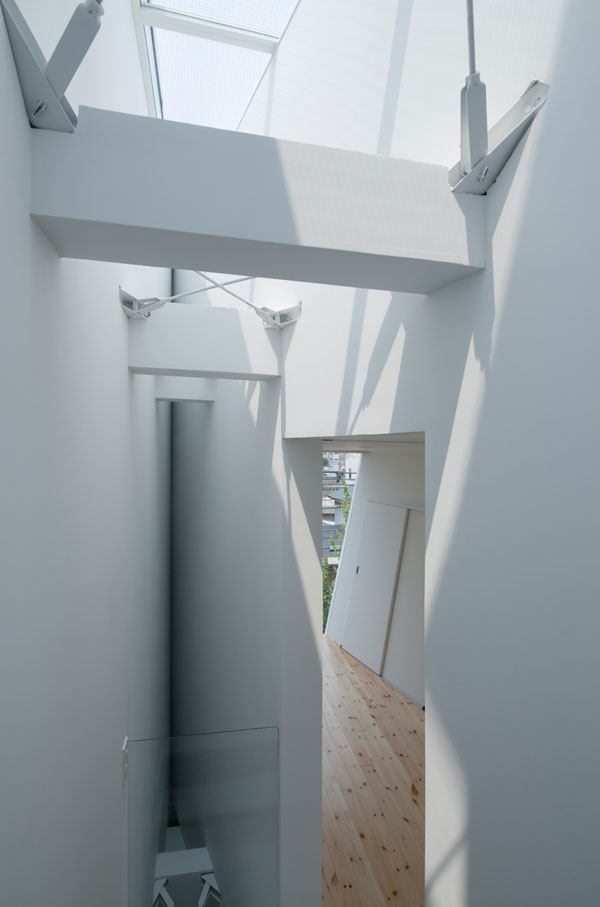
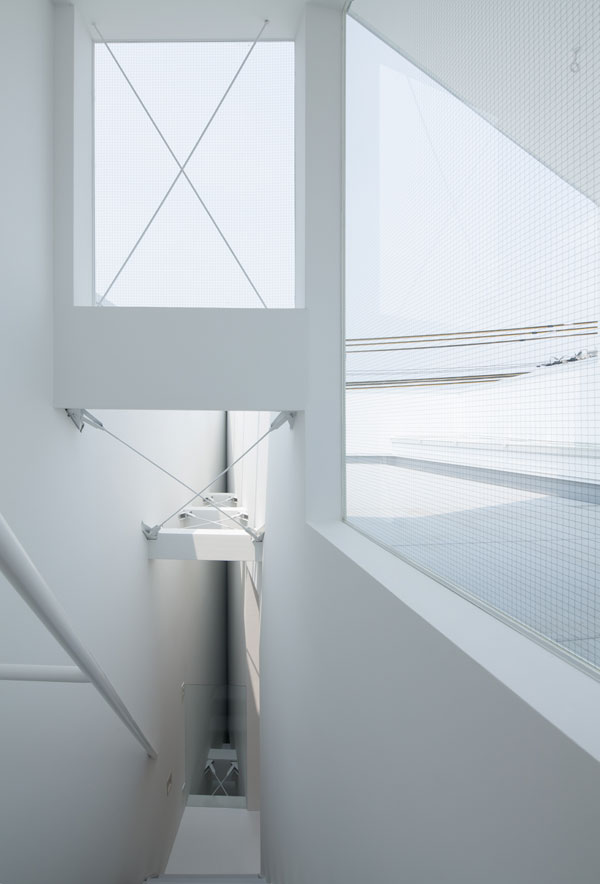
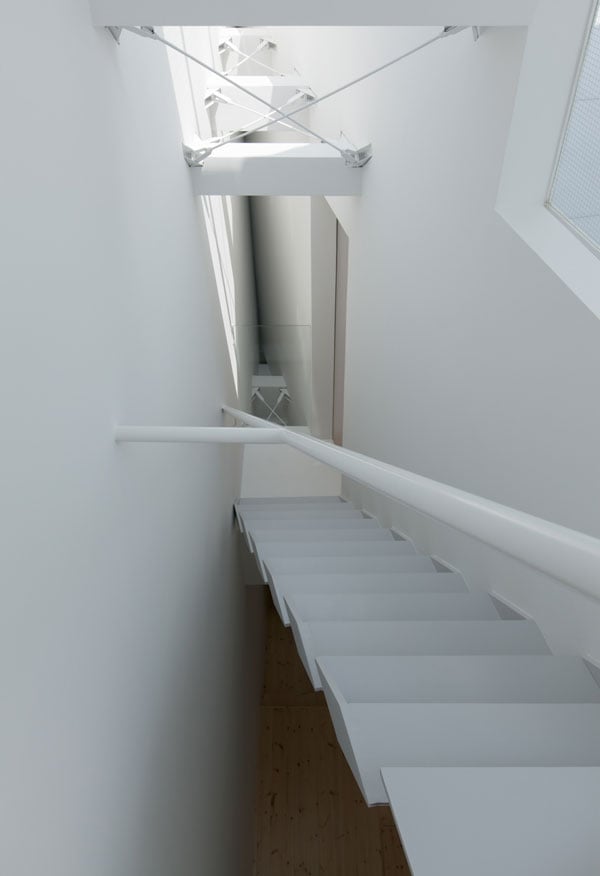
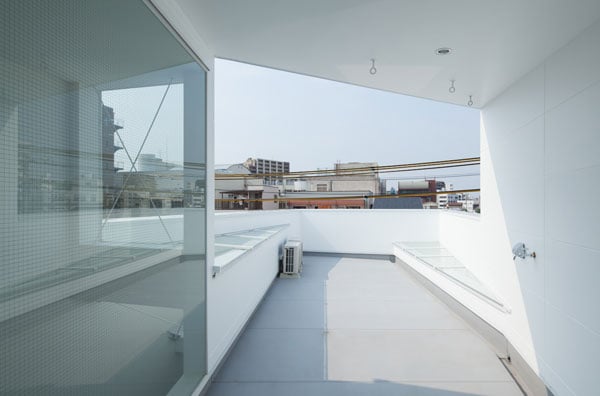
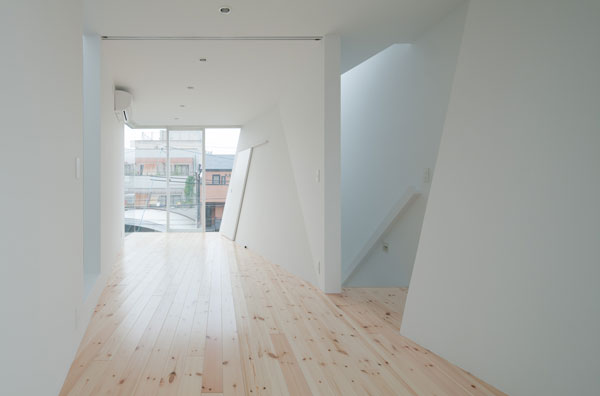
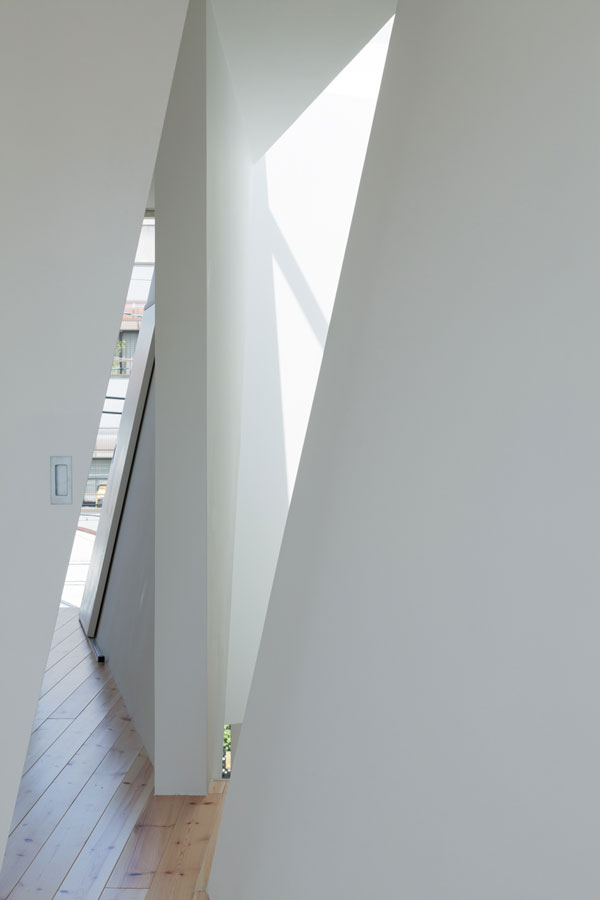
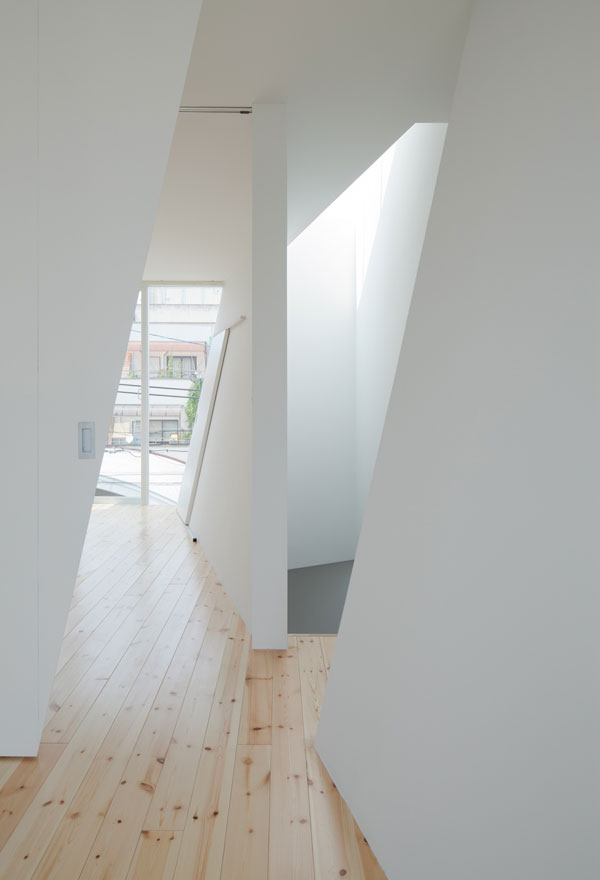
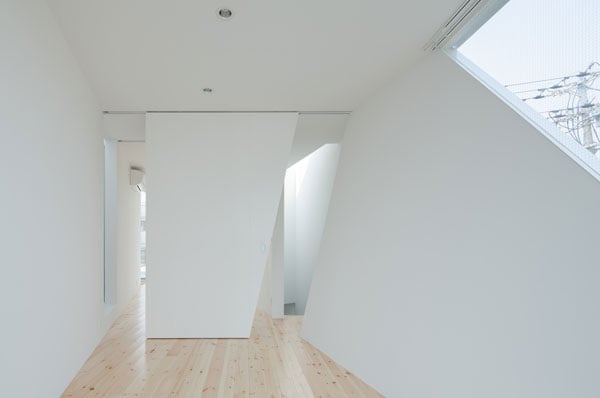
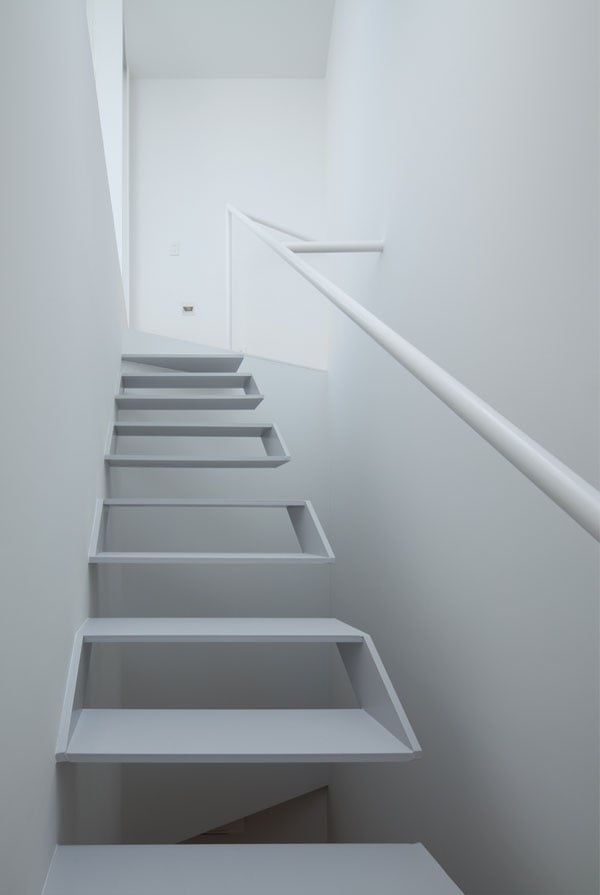
Kenji Ido’s Tamatsu House in Osaka, Japan is wedged in an urban, mixed-used area of small factories and office buildings that coexist in lines of very vertical structures! A major problem with this type of close-construction is the sparse amount of natural light able to enter the house, thereby making an already small space seem smaller. To counteract this issue, a clever mixture of skylights and inclined walls break up both the space and incoming light. So effectively, in fact, that you’d have almost no idea the entire house is a mere 1000 square feet!

Designer: Kenji Ido

-
Yanko Design
Timeless Designs - Explore wonderful concepts from around the world!
Shop CKIE - We are more than just concepts. See what's hot at the CKIE store by Yanko Design!
(Squeezed In was originally posted on Yanko Design)

Related posts:

  1. Freshly Squeezed And Straight Into The Glass