Cargo plasma ship
By Pawel Turalski
View this on ArtStationPawel Turalski on ArtStation


Panorama from Apollo 11 showing Neil Armstrong at the LM Eagle, with the US flag and Solar Wind Experiment at left. (NASA)
Everyone knows that Apollo 11 commander Neil A. Armstrong was the first human to set foot on the Moon (and if you didn’t know, that occurred on July 20, 1969 – yes, it really happened). It was a momentous, history-making event that many (like myself) consider one of the most impressive achievements of humankind. But oddly enough, even with high-resolution Hasselblad film cameras there on location, there are very few photos showing Armstrong himself on the surface of the Moon. In fact the one above, a panorama captured by fellow Apollo 11 astronaut Buzz Aldrin, really is the best image in existence of Neil on the Moon.
So…why is that?
Don’t put on your aluminum foil conspiracy hats just yet. As it turns out, of the two-man moonwalking team Neil Armstrong was just the one taking most of the photos.
Read more: This Day in Space History: One Small Step
Even the famous photograph that for decades has epitomized the Apollo 11 moonwalk is of Buzz, not Neil. Neil took the photo, and he can be seen reflected oh-so-tiny in the center of Buzz’s visor.

Buzz Aldrin photographed by Neil Armstrong (NASA)
Because their amount of time on the lunar surface was limited – and it’s NASA – every moment of the two astronauts’ two-and-a-half-hour EVA was meticulously plotted out. It simply wasn’t Buzz’s job to take the portraits.
“Armstrong and Aldrin only walked on the moon for about two-and-a-half hours that night in 1969. Most of the time, Armstrong carried the primary camera. Aldrin carried a camera but was assigned to shoot specific, technical things. The result: Lots of pictures of Aldrin. But hardly any of Neil.”
– Charles Apple, The American Copy Editor’s Society (source)
The video below, made from color footage captured by a 35mm film camera mounted to the LM, shows Armstrong collecting samples near the LM. Although not individually high-quality photos like the sort taken by the medium-format Hasselblads, you can make out his face in his helmet for a brief moment as he had his glare visor raised.
If you want to see lots more photos from the Apollo 11 and other Apollo missions, I suggest checking out the Project Apollo Image Archive here. Happy Moon Day, and don’t forget to give a wink for Neil!
Source: NASA on the Commons, Flickr


Canadian artist Guillaume Lachapelle explores the infinite in this series of mysterious 3D printed dioramas titled Visions. Sitting atop pedestals in a darkened gallery, the eerie “rooms” rely on lights and mirrors to create the illusion of vast spaces that seem to reflect into much larger open spaces. These pieces were on view last year as part of a solo show at Art Mur in Québec, and you can see more of them up close over on Artsy.
hey guys, we can copy the coding for deviantART and steal the entire website because they said so
if it’s not physical, it’s not theftplease look i actually spent time on this: http://devartpls.tumblr.com/
Oh my fucking god


Video documentation of installation by Ryoji Ikeda currently shown at the ZKM Center for Art and Media in Germany:
The »Infosphere« exhibition starts with a presentation by composer and artist Ryoji Ikeda in Atrium 1 + 2 of the ZKM. His large-scale projections relating to architecture and sound worlds, are a totally immersive experience for the visitors. With »the planck universe [micro]« and »the planck universe [macro]«, the ZKM presents a series of new works, inspired by the artist’s encounters with scientists at CERN, the European Organization for Nuclear Research. CERN has the world’s largest particle physics research institute. Ikeda’s new synesthetic works are based on principles of particle physics and cosmology. Inspired by supersymmetry, they visualize a theory of particle physics – the different scales and dimensions of the universe.


“C_env_1001″
“C_env_1003″
“C_env_1004″
“C_env_019″Art by Scribble Pad Studios (artstation || website || all WBB posts)

Super cute idea via My Modern Met.
If you’re a cat owner, then you’ve probably seen a “catloaf” before. It’s when your furry friend tucks their paws underneath their body and looks like a loaf of bread that just came out of the oven. Yorkshire baker Lou Lou P’s Delights created an adorable homage to this pose with her edible catloaf. Using an ordinary bread recipe, she molded and formed the dough into a easily-recognizable cat body, down to the little ears on its head. Lou Lou then drew a sleepy expression on the face of the loaf, which adds even more cuteness to this creation.
what is the x files even about? every screen shot I see of it mainly involves the red headed woman looking like she can’t believe this guy.
simple and effective ways to deal with stress include AAAAAAAAAAAAAAAAAAAAAAAAAAAAAAAAAAAAHHHH!!!!! AHHHHH!!!!!!!! AAAAAAAAAAAAAAHAAAAAAAAAAAAAAAAAAAAAAAAAAAAAAAAAAAAAAAHHHHHHHHHHHHHHHH!!!!!!!!!!!!!!!!!!!!!!!!!!
Bunker.jordanWant.


Pascal Flammer designed this Swiss house with ground level windows, to make it seem as if the nature outside flows continuously into the home.


Two-handed Sword
A two-handed sword with a straight double-edged blade, secured to haft by three rivets. The long columnar unguarded handle is divided by heavy brass rings and terminating in a large flattened knob.
Source: Copyright © 2015 Royal Collection Trust/Her Majesty Queen Elizabeth II


Something pleasant for a Sunday - computer artist Glenn Marshall put together his own music video for a Radiohead track featuring particle graphics, created with Python and Cinema4D:
Particle animation created entirely with code and algorithms, inspired by Newtonian physics, optical illusions and the human form.


Computer graphic research from the USC Institute of Creative Technology is a method to produce highly realistic human skin with ultra-fine detail:
Simulating the appearance of human skin is important for rendering realistic digital human characters for simulation, education, and entertainment applications. Skin exhibits great variation in color, surface roughness, and translucency over different parts of the body, between different individuals, and when it’s transformed by articulation and deformation. But as variable as skin can be, human perception is remarkably attuned to the subtleties of skin appearance, as attested to by the vast array of makeup products designed to enhance and embellish it.
Advances in measuring and simulating the scattering of light beneath the surface of the skin have made it possible to render convincingly realistic human characters whose skin appear to be fleshy and organic. Today’s high-resolution facial scanning techniques (e.g. record facial geometry, surface coloration, and surface mesostructure details at the level of skin pores and fine creases to a resolution of up to a tenth of a millimeter. By recording a sequence of such scans or performing blendshape animation using scans of different high-res expressions, the effects of dynamic mesostructure - pore stretching and skin furrowing - can be recorded and reproduced on a digital character.


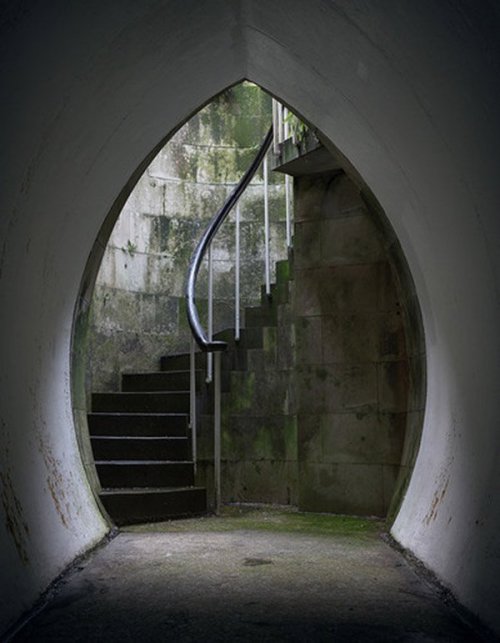

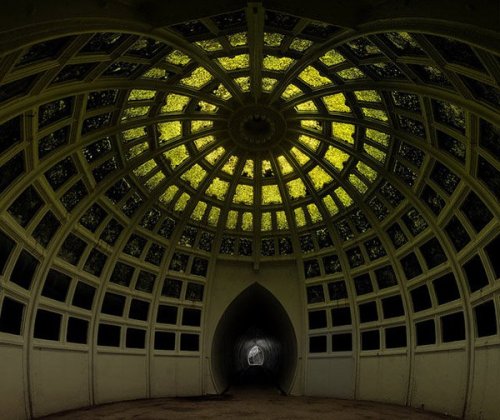
A secret ballroom lies under this lake, with a statue of Neptune above it. It was built in the late 1800s by Whitaker Wright, a businessman. The roof of the ballroom is paned in translucent glass to let light filter through from the water above. Now owned by entrepreneur Gary Steele, it lies empty. (Source)