Shared posts

22 Jul 19:33

NASA Delivers a Brand-New Blue Marble Pic

by Jason Major
2015's newest

2015’s newest “blue marble” image, captured from a million miles away via the NOAA’s DSCOVR satellite.

It’s over halfway through 2015 and perhaps it’s high time for an all-new, updated, knock-your-socks-off “blue marble” photo of our beautiful planet Earth. And so earlier this week NASA delivered just that, courtesy of the high-definition EPIC camera (yes, that’s a real acronym) aboard the DSCOVR spacecraft positioned nearly a million miles away toward the Sun. The image above was captured on July 6, 2015, using the camera’s visible-light channels… it’s how Earth would appear to our eyes were we there (with the help of a telephoto lens, that is.)

And it really is a “blue marble” image, of the kind previously only captured by departing (or approaching) planetary exploration spacecraft or from inside Moon-bound Apollo capsules (see below)… you simply can’t get a shot like this from low-Earth orbit!

“This is the first true blue marble photo since 1972.”
– John Grunsfeld, NASA, July 24, 2015

Unlike other recent Earth images, like the ones made from Suomi NPP satellite data, the EPIC image is a full-globe picture. It’s taken from far enough away that the entire planet fits in the frame(s), and since DSCOVR remains between Earth and the Sun (at L1, for those interested) Earth will always be fully-lit in EPIC images – which, beginning in September, will be captured on a daily basis.

Imagine… blue marbles, served fresh daily! That’s what DSCOVR will soon provide (along with valuable early-warning data on approaching CMEs and solar storms.)

Read more about this image and the DSCOVR mission on my Universe Today article here.

Image credit: NASA/NOAA/GSFC

The famous

The famous “Blue Marble” image of Earth from Apollo 17, captured Dec. 7, 1972 from a distance of 28,000 miles (NASA)

UPDATE 7/29/15: Here’s another view from DSCOVR on July 6, showing Europe, Africa, and the Middle East:

DSCOVR image of Earth from July 6, 2015. (NASA/NOAA)

DSCOVR image of Earth from July 6, 2015. (NASA/NOAA)


Tagged: blue marble, DSCOVR, Earth, EPIC, globe, NASA, News, planet, space
22 Jul 19:28

Improvised Medicine

by mark

Improvised Medicine is essential reading for any medical professional, from EMT to surgeon, who may ever run out of medical supplies. Whether the cause is poverty or isolation, disaster or war, this book provides improvisations and work-arounds.

In thirty-seven chapters, Iserson covers all fields of medicine, including dentistry and psychological care. Topics range from triage to sanitation, from infectious diseases to documenting deaths. Each chapter has several pages of references, citing sources from medical journals to POW memoirs. These could be very useful in persuading medical colleagues to take the procedures and substitutions seriously. The book is also well-indexed.

Among topics covered:

  • Reusing disposable medical supplies
  • Using expired medications or street drugs
  • Rehydration formulas
  • Improvising lab tests
  • Making IV equipment
  • Direct blood transfusion from person-to-person
  • Making a blood warmer
  • Using a razor blade as a scalpel
  • Preparing a helicopter landing zone
  • Preparing your patients for evacuation on aircraft or pack animals
  • Adapting adult-size medical supplies to care for children or infants
  • Making hospital beds and rehab equipment from normal household items
  • Adapting a ventilator to work for multiple patients at the same time
  • Why you may not want to bury the dead immediately.

This book will not teach you how to do surgery. If you know how, it will show you how to work without the equipment, drugs, lab support or electricity you would normally expect to have. While not intended for non-professionals, if you have Where There is No Doctor on your bookshelf, you might want this book next to it.

For a trade paperback, this book is expensive ($57). A Kindle edition is available for $45. However, if you are out of IV tubing, you may not have any way to recharge the battery.

-- Walter Noiseux

Improvised Medicine: Providing Care in Extreme Environments
Kenneth V. Iserson
2011, 578 pages
$57

Available from Amazon

Sample Excerpts:

im1

im2

im3

im4

22 Jul 19:28

Photo


22 Jul 19:27

cementicium: 局部 (Shenzhen, China) by 田貝三路


cementicium:

局部 (Shenzhen, China) by 田貝三路

22 Jul 19:26

New molecular transistor can control single electrons

by Dario Borghino
Bunker.jordan

This is insane

Researchers have built a molecule-sized transistor that can reportedly control the flow of single electrons, paving the way for the next generation of nanomaterials and miniaturized electronics

Researchers from Germany, Japan and the United States have managed to create a tiny, reliable transistor assembled from a single molecule and a dozen additional atoms. The transistor reportedly operates so precisely that it can control the flow of single electrons, paving the way for the next generation of nanomaterials and miniaturized electronics.

.. Continue Reading New molecular transistor can control single electrons

Section: Electronics

Tags: Related Articles:
22 Jul 19:24

This Tree Created by Artist Sam Van Aken Grows 40 Different Kinds of Fruit

by Christopher Jobson

In 2008, while locating specimens to create a multi-colored blossom tree for an art project, artist and Syracuse University art professor Sam Van Aken had the opportunity to acquire a 3-acre orchard from the New York State Agricultural Experiment Station. Fascinated by the practice of grafting trees since a young age, Aken began to graft buds from the 250 heritage varieties found on the orchard onto a single stock tree.

To create the Frankenstein-esque tree, Aken worked with stone fruits (fruits with pits) like peaches, plums, apricots, almonds, and nectarines. Over the course of five years he successfully grafted dozens of plants onto the same tree, and with that, the Tree of 40 Fruit project was born. Because of their similarities, all 40 fruits bud, bloom and fruit in near perfect unison.

Aken has since grafted at least 16 different “Trees of 40 Fruit” which are planted across the U.S. in places like Newton, Massachusetts; Pound Ridge, New York; Short Hills, New Jersey; Bentonville, Arkansas; and San Jose, California. Each tree is specific to its environment, using both local and antique varieties.

National Geographic recently met up with Aken to interview the artist about how he makes each tree. You can hear him talk about the project in the video above. (via Digg)

trees-4

trees-6

limbs

trees-5

trees-3

trees-1

trees-2

22 Jul 19:23

An Abandoned Indonesian Church Shaped Like a Massive Clucking Chicken

by Kate Sierzputowski
via uzone.id

via uzone.id

Towering above the trees in a densely forested area of Indonesia lies a giant chicken. The gigantic structure has the body, tail, and head of the bird, even holding open its beak in what appears to be mid-squawk. Although the very old bird is quickly decaying, Gereja Ayam (as the locals call it) attracts hundreds of photographers and travelers to its location in Magelang, Central Java each year who are looking to explore the bird’s bizarre interior.

The building was originally built as a prayer house by 67-year-old Daniel Alamsjah after he received a divine message from God. Although he intended the building to resemble a dove, the locals care more that it looks like a chicken, nicknaming it “Chicken Church.” In addition to a prayer house, Alamsjah also used the building as a rehabilitation center, treating disabled children, drug addicts, and others. Alamsjah was forced to shut the center’s doors fifteen years ago after steep construction costs.

Currently five of the eight pillars holding up the building are crumbling while graffiti covers the inside walls. No longer a place for therapy, the building still serves as a place for worship and travel and according to locals—a private spot for many young couples to hide away from parents or prying eyes. (via Hyperallergic and Daily Mail)

chicken-head

22 Jul 19:23

"Horn-cams" could protect rhinos from poachers

by Ben Coxworth

A rhino sporting one of the RAPID Cameras

It wasn't long ago that we heard about an effort to create synthetic rhino horn, the low price of which could be used to put suppliers of real horn out of business. Now, however, the Protect project is aiming at catching poachers in the act. Amongst other things, it would involve putting video cameras in the horns of living rhinos.

.. Continue Reading "Horn-cams" could protect rhinos from poachers

Section: Environment

Tags: Related Articles:
22 Jul 19:21

A Smoldering Bouquet of Roses Photographed by Ars Thanea

by Christopher Jobson

burnt-1

burnt-2

burnt-3

As part of a reference photoshoot for an illustration project by Warsaw-based creative studio Ars Thanea, a bouquet of roses was set on fire and photographed as they smoldered in the dark. The glow of the dying embers is strangely evocative, it would be amazing to see an entire series of different flowers photographed like this. You can see the final illustration and how they caught the images over on Behance. (via Boing Boing)

22 Jul 19:21

New Japanese hotel has robot staff and no room keys

by Stu Robarts

Robots are deployed at the front desk to help guests check-in and out

A new hotel that is staffed with robots has opened in Japan. The Henn-na Hotel (which translates as "Strange Hotel"), is part of the Huis Ten Bosch theme park complex in Sasebo, Nagasaki Prefecture. Guests can also access their rooms via face-recognition, and are able to control room amenities via tablets.

.. Continue Reading New Japanese hotel has robot staff and no room keys

Section: Robotics

Tags: Related Articles:
22 Jul 19:20

Age-related macular degeneration patient receives bionic eye transplant

by Chris Wood
22 Jul 17:58

and a wee saturn. 


and a wee saturn. 

22 Jul 17:58

Photo


22 Jul 17:22

Photo


22 Jul 17:21

Racheal and The Owl by McTicktock

Bunker.jordan

I would get this etched on my laptop

22 Jul 17:06

rubyetc: pigeons I saw today


rubyetc:

pigeons I saw today

22 Jul 16:43

phantomdoodler: mypillowforte: jlingasd: block-de-notas: cosa...

22 Jul 16:42

rubyetc: what in the even?


rubyetc:

what in the even?

22 Jul 16:41

cypulchre: Beacon by Fenris31

22 Jul 16:40

Night Rain by MeganeRid

22 Jul 16:40

Photo


22 Jul 16:40

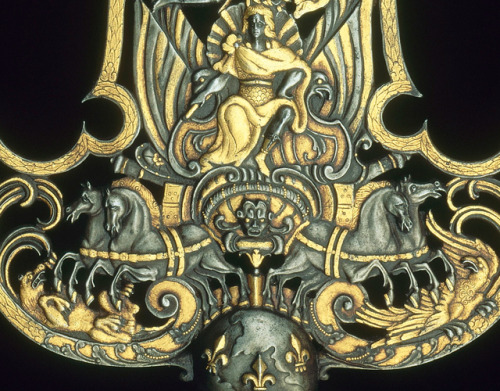
Partisan of the Gardes ‘De La Manche’Dated:...


Partisan of the Gardes ‘De La Manche’

  • Dated: 1679
  • Maker: Jean Bérain
  • Culture: French
  • Medium & Technique: iron, wood, textile/wrought, chased, engraved, gilded
  • Measurements: height 2.58m; width 0.10m

The marriage by proxy of Charles II of Spain and Mademoiselle d’Orléans, niece of Louis XIV, was celebrated on 31 August 1679 in Fontainebleau. This was a chance for the King of France to welcome representatives from Europe’s leading figures and sign treaties with Sweden and Denmark, following the Dutch War. On this occasion, the Gardes de la Manche (King’s guards) were given new partisans, whose decoration expressed the royal ideology and world view of the King of France.

The Gardes de la Manche (literally “guards of the sleeve”) were the closest guards to the King, so close they touched his sleeve. In 1679, they were given new tabards and weapons. The Herculean symbolism, inherited from Henry IV, was replaced in their decorations by the solar symbolism adopted by Louis XIV circa 1662.

Indeed, the iron of the partisans represents the world (a globe) above which flies a chariot driven by Mars, the god of war (the King). This chariot, drawn by four horses, crushes the eagle (the Holy Empire) and the lion (often associated with England but representing Spain in this context). The King is crowned with the victor’s laurels by an allegory of Renown, under the radiant sun surrounded by the motto NEC PLURIBUS IMPAR.

Jean Bérain (1640-1711) was entrusted with making these weapons. In 1675, he began designing the costumes and decorations for the events - carrousels, funerals as well as parties and operas - held at the Court of France.

Source: Copyright © 2015 Musée de l'Armée, Dist. RMN-Grand Palais/Photo: Pascal Segrette

22 Jul 16:30

majestic


majestic

22 Jul 16:28

dustrial-inc: OMNI

Bunker.jordan

love this cover


dustrial-inc:

OMNI

22 Jul 16:27

Photo


22 Jul 16:05

dutchster: my sleep schedule says “party animal” but my lifestyle says “reclusive maniac”

dutchster:

my sleep schedule says “party animal” but my lifestyle says “reclusive maniac”

22 Jul 16:04

70sscifiart: Vincent Di Fate


70sscifiart:

Vincent Di Fate

22 Jul 14:52

Photo


22 Jul 14:48

me irl


me irl

22 Jul 08:37

Men who harass women online are quite literally losers, new study finds

by adafruit

Adafruit 0151

Men who harass women online are quite literally losers, new study finds – The Washington Post.

Here’s a research finding that should surprise no one: The men most likely to harass women online … are the men most likely to have their own problems.

That bit of validation comes courtesy Michael Kasumovic and Jeffrey Kuznekoff, researchers at the University of New South Wales and Miami University, respectively. For their latest study, published in the journal PLOS One last week, the duo watched how men treated women during 163 plays of the video game Halo 3.

As they watched the games play out and tracked the comments that players made to each other, the researchers observed that — no matter their skill level, or how the game went — men tended to be pretty cordial to each other. Male players who were good at the game also tended to pay compliments to other male and female players.

Some male players, however — the ones who were less-skilled at the game, and performing worse relative their peers — made frequent, nasty comments to the female gamers. In other words, sexist dudes are literally losers.

Read more and full study.