Shared posts

25 May 15:14

That Postmoderny Show

by LP

“Saint’s Day”: Eric is disappointed when none of his friends will help him celebrate his Saint’s Day. They point out that the whole idea of a Saint’s Day is pretty stupid, and that at any rate, he is not Catholic. He vows to develop an affectation that will make the gang think he is interesting, although he does not phrase it that way, because when he says it out loud it sounds bad.

“Kitty in Trouble”: Kitty’s alcoholism reaches a new low when she vomits down her new frock at her own birthday party. Although her children are embarrassed by her, her husband seethingly resents her and her friends have all abandoned her, no one says anything, because she’s had a hard life.

“The President Comes to Town”: When President Ford comes to visit Point Place, Red is unable to articulate the rage he feels at having been laid off after decades of service at the plant. His anger grows when he senses that he is the victim of selfish, top-driven economic policies, but lacks the education to put his resentment into a framework of coherent language.

“Rock ‘n’ Roll Show”: The gang sneaks out of town in Red’s new Corvette to see a band play in a nearby town. The band’s future history provokes in viewers a sense of wry irony, but the gang, of course, are oblivious to of this. The leader of the band appears as himself, his aging, weather-lined, sunken face providing an upsetting shock to those who tune in to see him desperately conjuring his younger days of as-yet-unsquandered pontential. No one sleeps well after this episode.

“The Promise Ring”: Jokes are made at the expense of Fez’s foreign origins, Jackie’s selfishness and stupidity, and Laurie’s promiscuity and hair color, but the implied wink that tells us they are in on it makes it okay. Meanwhile, viewers are left wondering why Donna, who is supposed to be a brilliant writer, can’t seem to string two sentences together, and why Eric, who is supposed to be kind and caring, often comes across as a sexist Neanderthal.

“Pseudoreference”: Actors, music, and cultural touchstones appear with very little connection to the plot of the show, and we are expected to laugh at them, even though they aren’t funny. It’s supposed to amuse us simply by virtue of our being able to remember it, I suppose, but that answers nothing. Is comedy nothing more than a function of recognition? Where is the class conflict from which All in the Family drew so much of its effectiveness? Why does Bob speak in a New York accent when he is supposed to live in eastern Wisconsin? Kelso, not surprisingly, finds the whole thing terribly confusing; surprisingly, so does the audience.

“Shady Lane”: Forgetting the show is on altogether, the viewer spends a half an hour playing with his young son and listening to a Pavement record. Reflecting on the fact that someday, his son will find Pavement as distant and whimsical as he finds the Starland Vocal Band, he finally remembers that That ’70s Show is on, but doesn’t care that he missed it and, in less than two seconds, is considering an upcoming business trip to San Bernardino.

“Donna’s Choice”: The writer of this episode, who is going through a particularly ugly divorce which he is unable to refrain from discussing with the other staff members, pens an episode in which the female lead comes across rather shamefully like the thankless, greedy cartoon harpy he imagines his wife to be. Several of the other writers and producers exchange uncomfortable glances during the pitch meeting, but it’s a good plot, so they greenlight it and tone down the misogyny in rewrite.

“The Stash”: A group of students at the University of Maryland gather in the commons to watch this episode. They pretend they’re watching it to make fun of it, but like most of their friends, they feel uneasy and slightly afraid when there isn’t a television on, so they’ll basically watch anything. They exchange knowing sneers whenever marijuana is referenced, and each of them thinks of himself as being like Hyde. One of them will later serve several years of a sentence for dealing drugs, but the rest of them will have all forgotten his name and will only call him ‘the black guy we used to hang out with’.

“Tea Party”: After nine seasons, the show finally comes to an end with an oddly bleak, disjointed episode. It seems to want to suggest a political and cultural sea change, and a few attentive viewers (although they would never admit to being such) detect the presence of an unfashionably subversive political tone, but before anything can be written or said about it, there is a terrible catastrophe in the news and every forgets all about it. Its director secretly resents all the people who died that day because they kept him from being lauded for the beautiful thing he tried to give the world, but he cannot say anything.

24 May 21:16

Why the Liberal Democrats should pay their interns

by Jonathan Calder
It's time for the Liberal Democrats to pay their interns, say a list of Liberal Youth types in an open letter to the party's president, Tim Farron, published on Liberal Democrat Voice.

And they are right.

I have reached an age where I am remarkably relaxed about young people not being paid. But, as the letter says:
This is about minimising barriers, one of which is affordability. Some of us have worked in the past as unpaid interns; we know that sometimes people are happy to work for free, or feel they have to in order break into a profession. This doesn’t make it right, and it is not an option for many people.
This is a much better argument than the one Jo Swinson used when writing about unpaid interns in the public relations industry earlier this month. To her it was a question of ending exploitation.

But as Simon Titley pointed out on Liberator's blog:
The problem with interns in the PR industry is less the exploitation of interns than the exploitation of the PR industry. 
Most PR interns come from wealthy families and are privately educated. Their parents subsidise them by providing housing and income. Anyone without that sort of support would find it difficult to survive unpaid anywhere, let alone in central London where the PR industry is concentrated. 
This is the main reason why the PR industry (especially the big agencies) is dominated by the products of public schools, and young people from more modest backgrounds find it so difficult to break in. (Interestingly, the people from more modest backgrounds who do break into PR tend to do so later in life at a more senior level, having first done a proper job). 
The main benefit of tackling the problem of interns will therefore not be to end ‘exploitation’. It will be to force the PR industry to conduct entry-level recruitment more on the basis of merit than privilege.
In a way it is a bit unfair to pick on the poor old Liberal Democrats when this is a society-wide problem. But the party does need to tackle it before we go the way of the PR industry.

Or perhaps we have. I remember taking part in one of the phone conferences with Lib Dem ministers' special advisers that the party sometimes usefully organises. On putting the phone down my chief impression was how upper class everyone had sounded - and I am usually the last person to worry about things like that.

If we don't change things soon, Nick Clegg will soon be the least posh person in his own office.
24 May 20:08

Marco Polo

by Iain Coleman

We shall all die of thirst.

A body lies in the desert sands. A desiccated corpse, stretched out in the vast, baking emptiness. A lost traveller, found by chance. Found too late.

The body has scant clothing and few possessions. Everything that was not essential long since discarded in the exhausting struggle against the desert heat. Only one precious object remains – a water bottle.

It’s still half full.

This is more common than you might think. People often die of thirst in the desert long before they run out of water. This is because they make the mistake of rationing their water supply. It seems like common sense: you only have so much water, and you want it to last as long as possible. But if you’re sweating water out and not replacing it, you will get more and more dehydrated, and eventually die.

Water isn’t like food. If you ration out your food, you’ll feel hungry, sure, but you can keep going for a very long time while taking in fewer calories than you are expending. Your body just starts using up its reserves, extracting energy from stored fat to make up the difference. You lose weight, but you stay alive. Even when all the fat is gone, your body will keep going by cannibalising its own muscle tissue. In the end, of course, you will die if you don’t get enough food, but if you carefully eke out your remaining supplies you can put that day a long way off.

When it comes to water, you have much less room for manoeuvre. Your body temperature must be kept within a fairly narrow band, within about half a degree of 37 °C. If it gets much higher than this, you begin to suffer heat exhaustion and eventually, if it gets past 40 °C, heatstroke. At this point, you either get emergency medical treatment to cool you down rapidly, or you die. (Getting too cold can be just as dangerous, but we won’t deal with that here.)

There are three main ways a body can lose heat: radiation, convection and evaporation. Of these, there’s not much your body can do about the first two. The rate at which a body radiates heat is (to a good approximation) simply a function of its surface temperature and surface area, and there’s not a lot you can do to change those. Convection is a little more hopeful. This is when your body transfers heat to the air next to the skin, and as the air moves the heat is carried away. A good breeze will help with this, if you can find one, or a fan – although fanning yourself will generate more heat than it carries off. When you’re in the desert, your best bet to maximise convection is to wear loose clothing and hope for the best.

That leaves evaporation. Your body emits droplets of water from the skin, and as these evaporate they carry away heat. Crucially, this is something your body is able to control directly, increasing the rate of water emission in response to heat, so as to keep its core temperature within that narrow band of safety.

In other words, when it’s boiling hot, you sweat buckets.

This brings us to the crucial point. You need to sweat a certain amount to prevent heatstroke, and if you deprive your body of water you deprive it of the means to regulate its temperature. There is no sweat reserve that your body can use in an emergency, as it uses up fat reserves when food is scarce. If you sweat out more water than you drink, you will die pretty quickly. And before you die you’ll suffer the early symptoms of heatstroke, including confusion and disorientation, making it all the harder for you to correct this mistake in time.

So you shouldn’t ration your water, but when you’re out in the desert and you use up your water you’re going to die anyway, so what should you do? Apart from “be somewhere else”, which in fairness is the obvious solution.

The answer is to reduce your body’s need to sweat. That way, you can keep going longer with less water, because your body isn’t using so much to keep its temperature down.

The single simplest way to do this is to rest and sleep during the hot day, in as much shade as you can find or contrive, and do your travelling in the cooler periods of early morning, late evening and night. Keeping your mouth closed as much as possible will help you to retain moisture – one traditional trick is to suck on a small, smooth round pebble. It also helps if you can avoid eating: digestion requires water, and you need to save as much of your water as possible for sweating.

You should certainly avoid the temptation to drink your own urine. Your body will just use up even more water trying to flush out all the excess salts you’ve just consumed. That’s not to say your piss is useless, however. If you can save it up until you are ready to rest for the day, then pee into some small depression and rest on top of it, the damp ground will help to keep you a little cooler.

We don’t see these techniques in use when Marco Polo is dragging our time travellers through the Gobi Desert, and in some ways that’s just as well. The sight of the Doctor settling down for the day in a bed of his own piss might have been educational, but it is unlikely to have been welcomed. Instead, our intrepid heroes manage to survive by extracting water from their surroundings using the phenomenon of condensation.

There is a way you can do this in the real world. It’s called a condensation trap, and it works like this. Dig a decent-sized hole, about a metre across, deep enough that it goes down into damp ground. You can even pee into the hole for extra moisture. Pop a cup down at the bottom of the hole, somewhere near the middle, and cover the hole with a clear plastic sheet. Make sure the sheet is weighted down with stones all around its circumference so as to seal the hole, and place a rock on top of the sheet above the cup. Then wait.

As the sun heats the damp earth, water will evaporate, then condense on the underside of the plastic sheet. It will drip down from the low point created by the rock, and be caught in the cup. At the end of the day, uncover the hole and have a good drink.

It’s a sound enough theory, and popular in survivalist circles, but unfortunately it’s not all it’s cracked up to be. It generates water, sure, but you’ll be doing well to get more than 100 ml or so out of it – and you’ll sweat out more than that digging the damn thing in the first place.

Still, this seems to have provided the inspiration for the Doctor’s life-saving discovery of condensation in the Tardis. And it also gives us some indication of why that doesn’t seem to make a whole lot of sense. For a start, you need a source of moisture, and it’s not clear where that is coming from in the Tardis. (Viewers of later series might suggest the Tardis swimming pool, but if the Tardis has a swimming pool at this point then why not just drink directly from that?) Secondly, how do you collect this condensation from the Tardis walls? Mop it up with J-cloths and wring it out into a pint mug? All suggestions gratefully accepted.

So if you must head out into the desert, plan ahead to avoid having to resort to these desperate measures. Take enough water for your daily consumption, and enough transport to carry it all. And avoid travelling with sinister villains if you can at all help it. That never goes well.


24 May 14:19

The real lessons from the 2010 coalition negotiations

by Mark Thompson

I've just finished reading Andrew Adonis’s 5 Days in May: The Coalition and Beyond and it has given me food for thought both about how the 2010 coalition negotiations proceeded and what lessons we might learn for any potential future coalition discussions.

Having already read David Laws’s 22 Days in May and Rob Wilson’s 5 Days to Power and having watched various radio and TV programmes about the 2010 negotiations, I already had a reasonable idea about how they went. But it was interesting to get a Labour perspective on the talks.

The fairly settled view from Lib Dems is that Labour were unprepared for discussions and some members of their negotiating team and parliamentary party seemed to be mentally ready for opposition, rather than seriously trying to make the necessary compromises to stay in power.

One figure, however, in all the accounts that I have seen, heard and read, who clearly did want to try and make the negotiations work was Gordon Brown. There is no doubt in my mind that he really did want to see a Lab-Lib coalition. Unfortunately, because he had not properly prepared the ground for any such discussions, having been so used both as Chancellor and PM to working majorities, he was destined to fail. The passion with which Brown tried to make the discussions with the Lib Dems work comes across in Adonis’s book as almost tragic, but given how much we already know about what a tribalist was, he cuts a contradictory figure, desperately trying to convince Nick Clegg of how a radical Labour-Lib Dem coalition could deliver.

A telling vignette from 5 Days in May is how Peter Mandelson, Ed Miliband and Ed Balls all discussed with Adonis how they had never come across Andrew Stunell before and did not know who he was. He had been Lib Dem MP for Hazel Grove since 1997 and a frontbench spokesperson for almost all of that time. This demonstrates a shocking level of engagement by Labour with the party that they were supposedly attempting, in good faith, to form a government with.

An important theme from the Adonis book is that of how the question of 'the numbers' seemed to be eminently solvable in the view of Brown and some other senior Labour people. Despite the fact that Labour only had 258 seats and the Lib Dems 57 (so a total of 315 vs the Tories' 306, with a majority requiring 326) Brown was convinced that most of the minor parties would fall into line. I’m not sure if I would describe this as wishful thinking or self-delusion but the idea that a 'rainbow coalition' or even a minority coalition that took the votes of the SNP, Plaid Cymru, Caroline Lucas, the SDLP and the DUP all pretty much for granted would have been plain sailing, and was somehow an obvious and equal choice to the stability of a solid working majority with the Conservatives, is optimistic in the extreme.

It also suggested to me a level of arrogance, perhaps fostered by 13 years in government, within senior Labour ranks that the minor parties would come to heel. The Lib Dems were doing the responsible thing in not assuming that all these smaller parties would stay in line and instead considering that any deal with Labour would be on the basis of a minority government which would have been very difficult to control. This was not least because a number of Labour MPs spent the five days of the coalition negotiations making it clear that there were things they would not agree to or vote for. So far from Brown being sure of being able to deliver his 258 MPs, it was far more likely that the total would regularly fall short of that depending on which issue the vote was on.

A good example of this is how during the first formal discussion with the Labour team, Adonis highlighted how Labour was open to a proportional representation option being on the AV ballot paper. But I know from my own personal discussions at the time that Labour MP Tom Harris would never have voted for a bill that included a PR option in the referendum. He told me categorically. It was also clear to me that he was not alone in this respect and there were a number of Labour MPs who would also have defied party whips to defeat this. Labour was negotiating on something it would never have been able to deliver on.

So what lessons can we draw from the various accounts of the 2010 coalition negotiations? I would say the most important thing is preparation. Both the Lib Dems and the Conservatives wargamed a number of scenarios before the 2010 election. They approached coalition negotiations professionally and with the clear purpose of forming a stable government that could last for a whole parliament. Contrast this with Labour, which didn't even start seriously planning for coalition until after the result was announced. And it made a big difference. The Lib Dems did not take Labour as seriously as the Conservatives as potential partners, not for ideological reasons (as Adonis seems convinced of), but primarily because the reds had not done the basic groundwork. So the key lesson from 2010 for Labour is to be open to the possibility that there will be a hung parliament in 2015, long before it actually happens, and to plan, war-game and prepare in advance for this outcome. Even just making sure the basics, such as having enough backchannel communication between key players. Happily, there are signs that Ed Miliband gets this now and is preparing the ground for just such an eventuality.

Another important factor is to be realistic about what can be achieved. Brown's offer of PR on the AV referendum ballot simply could not have been delivered by him in the circumstances he found himself in. Indeed the numbers made any alliance at all very tricky. If the maths makes things difficult, parties should be open about this. That is the only way that good faith can be maintained.

The final lesson to draw for now is more related to how the current coalition has played out. The Lib Dems have been reasonably disciplined in keeping their troops in line and ensuring that most items from the coalition agreement have gone through, even when, as in the case of tuition fees, they have gone directly against what the party wanted. Whatever you may think of the individual policies, this has been done in the name of coalition cohesion. By contrast, the Conservative backbenches have been much more restive and have forced defeats on measures such as Lords reform in defiance of their party leadership.

The various processes that the Lib Dems had (and have) in place to facilitate buy-in from the parliamentary and wider membership were seen by both Labour and Conservatives in 2010 as somewhat eccentric. Indeed, one of the reasons Brown found it so hard to get hold of Clegg on several occasions during the five days is because the Lib Dem leader was in one meeting or another keeping colleagues closely informed of what was happening and consulting them. But it is hard to argue that the legitimacy those processes conferred on the coalition from a Lib Dem perspective is anything other than a very good thing. I was one of the party members who voted in the special conference convened towards the end of May 2010 and it certainly gave me a feeling of ownership which has been sorely tested over the last three years. It is not a panacea and we enter a grey area when measures that were never in the coalition agreement are legislated on, sometimes to the chagrin of myself and my fellow party members. But a complete lack of any such process within the Conservative Party has led to a widespread feeling amongs its members, both in parliament and more widely, of a lack of legitimacy in the current coalition.

There was no modern precedent on which the parties could draw three years ago and they were, to an extent, flying blind. But in 2015, should such discussions become necessary, that will not be the case. All parties should learn the lessons from those five heady days in May 2010.


This piece was first published online in The New Statesman.


We discussed the Adonis book and the lessons for future negotiations on this week's House of Comments Podcast which guest starred Hopi Sen.

24 May 14:13

#939; A Knight is Technically an Aristocrat

by David Malki !

'Of course, sir. I'll have some muggers brought round.'

24 May 14:09

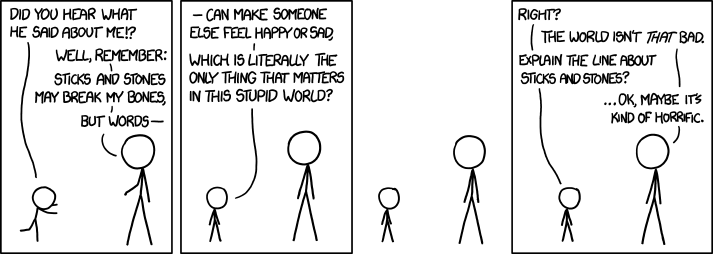
Sticks and Stones

Sticks and stones may break my bones, but words can make me think I deserved it.
24 May 13:06

Just because you murder someone, it doesn't mean your views are worth hearing

by Jonathan Calder
The front page of today's Guardian is the worst I have ever seen on any newspaper. Why the Guardian wants to turn itself into a propaganda sheet for a murderer, I cannot imagine.

When you are over the anger, two possible explanations suggest themselves.

One is that this is an example of the sort of self-hatred that Western liberals can fall prey to and that Christopher Hitchens used to complain. Hurt us because we deserve it, the paper thinks its readers will say.

The other is that we tend to assume that their must be something remarkable about someone who commits such a grotesque crime and that his view must therefore be listening to.

That is a fallacy, as Munira Mirza showed when writing of the videos the 'martyrdom videos' the 7/7 bombers left behind them:
What we see in these videos are not soldiers in a war, but self-righteous young men who believe that their own moral certainty absolves them of the need to explain themselves properly. 
Nobody elected Khan or Tanweer. As far as we know, they did not have relations with anyone in Palestine, Bosnia or Chechnya. Indeed, these two men did not even bother to ask their family, friends or neighbours what they thought. 
At the local mosque near where three of the bombers grew up, one of the committee members, Muhboob Hussein, reacted with anger to 7/7: ‘This is not Islam, this is not jihad, these people are not Muslim. This man [Khan] never came to our mosque....’ 
Obviously, Khan or Tanweer did not show much interest in trying to win people over to their worldview - they thought that ‘democratically elected governments’ had less claim to act on behalf of people than they did.
And we saw just the same contempt for democratic government from the idiot presented on the front page of today's Guardian.

When I blogged about Mirza's article at the time, someone left a comment reminding me of a prophetic piece by Ian Buruma that began:
Does masturbation lead to suicide bombing? One would think not. There is no more direct link to suicide bombing than there is to blindness or schizophrenia. But there may be a connection between sexual inadequacy or frustration and the pull towards violent extremism.
Almost as depressing as the Guardian front page was the discussion of the Woolwich murder on Newsnight yesterday evening. One participant, the impressive Maajid Nawaz, spoke of the need for a Western narrative to challenge the world-view of Islamism. But you only had to look at the people with him to see there was little chance we would hear it last night.

There was John Reid who, as a Communist while the Soviet Union was the greatest tyranny on this planet, never bought into the Western narrative in the first place and is now employed by the security industry - though Newsnight never reminds of us during his frequent appearances. And there was Alex Carlile, a Liberal Democrat who long ago threw in his lot with the most repressive elements of Labourism.

And, sure enough, both Reid and Carlile told us that the most important thing is that we give the state more power to inspect the affairs of law-abiding citizens and weaken the safeguards for those it accuses of crime.

If that is the first reaction of those we are supposed to regard as statesmen, then you can see how weak the West's belief in its own values has become.
24 May 12:17

The language of alienation

by Charlie Stross

I just stubbed my toe on a linguistic thread on reddit (as one does): what sentence can you come up with that would be completely incomprehensible (without a detailed explanation) ten years ago?

Some examples, culled from reddit, to get you started:

hang2er: "I can't get a 4G signal here, I'll skype you on my droid as soon as I hit a hotspot, I need a coffee anyway."

Retinence: "The headline, 'Galaxy Nexus: Android Ice Cream Sandwich guinea pig.'"

(But tech is easy ...)

YesRocketScience: "She started out pure Kate Middleton but then she went all Amanda Bynes on me."

Anon: "Check your cis privilege!"

(That would probably be comprehensible, but only to a much narrower audience -- certainly not mainstream in places like reddit)

My reason for being interested in this phenomenon should be obvious: flip it upside-down and you've got incomprehensible phrases to decode from ten years into the future. Or leave it where it was and stretch the horizon out and you've got incomprehensible phrases from twenty or thirty years ago. ("Hello, I'm on the train!" -- how much sense would that make in 1983? Much less "FAA proposes to relax ban on tablets, laptops, and smartphones during takeoff and landing"?)

Most of the ten-year sentences focus on the ephemera of technology and, to a lesser extent of pop culture (Beeeeeeber!). (Yes, pop culture is more durable today than tech.) Politics probably cuts in as an agent of temporal disorientation somewhere in the 10-20 year range: feed someone in 1993 a line like "Department of Homeland Security proposes relaxing ban on toenail clippers" and they'd surely have grounds to worry about their future. Cultural drift is ... well, the state of play of gay marriage today, wrt. the gay rights situation 20 years ago, is close to unrecognizable. The major political and social shift over the recognition and suppression of rape culture seems to be going the same way (and a good thing too). But SF authors have been using finely-crafted soundbites from the future to alienate their readers from their assumptions for a long time: "the Pope realized it was going to be one of those days when she realized she'd forgotten to take her Pill the night before."

But, anyway: can you come up with some examples of sentences that would be incomprehensible (without explanation) to a denizen of 2003 that don't revolve around ephemeral tech or pop culture churn? And can you provide and deconstruct some sentences from 2023 that, if we had sufficient foresight, we ought to be able to understand and interpolate a context for?


TECHNICAL NOTE: Following Monday's system crash, the comments some of you posted on Monday can't be restored. Turns out that my save of them wasn't as HTML, which might be salvageable, but as some Cthulhu-esque horror of half-assed UTF-8 with hard line breaks and random bits of MarkDown. It was a royal pain in the arse just extracting the text of the blog entry itself: I'm not up to doing the same to 84 comments. Sorry, folks, but this thread is therefore rebooted from scratch.


23 May 18:56

Broadway vs. community theater: Why pastors and presidents are not CEOs

by Fred Clark

John Fea shares some highlights from a Barna Group survey on the reading habits of pastors.

Here’s the finding that struck me as most distressing: “One-third of pastors are reading business books.”

Ugh.

I appreciate that the job of a local church pastor is in some ways analogous to that of an executive, but that doesn’t mean that a local church is in any way analogous to a “business.” If all those pastors reading “business books” — a depressingly vapid genre for which Sturgeon’s Law understates the ratio — are getting the idea that their churches should be more “business-like,” then I fear for their congregations, their ministries, their parishes.*

One way of describing the difference between a local church and a business is by looking at the difference between a Broadway production and community theater.

Consider a Broadway production reviving an old classic like Carousel. At the very same time, far enough away that the rights are still available, a small community theater prepares its production of the very same play. Both productions share some of the same goals. They both want to tell this story as best they can within the constraints of their respective budgets and talent pools (both of which are far more constraining for the community theater). They both want to make their audiences laugh, cry, yearn and ache. They both want to sell tickets.

But Broadway is a business. Like any business, it wants to hire the best possible people for every role. So the Broadway production holds auditions in which some of the world’s best actors, singers and dancers compete to land a part in the show.

Casting doesn’t work like that at the community theater. Broadway starts with a list of roles to be filled, then selects only the very best people it can find to fill them. Community theater starts with the community — with everybody — and then tries to figure out how best to employ them, how best to manage the assembled ensemble so that everyone is able to participate and to contribute to the common goal.

Think of Mr. Fish in John Irving’s A Prayer for Owen Meany. Mr. Fish isn’t a great actor, but he’s a faithful member of the Gravesend Players and every year Dan Needham, the patient director of the local community theater, finds a role that he hopes will make the best use of Mr. Fish and his talents.

That’s the real magic of community theater. Sure, I can laugh along with Shakespeare at the amateur follies of Nick Bottom, Peter Quince, Francis Flute and Starveling, Snout and Snug in their deliriously awful “craftsmen’s play” in A Midsummer Night’s Dream. But let’s not sneer at them. Here you have a weaver, a carpenter, a bellows-mender, tailor, tinker and joiner working without pay. Why? Because this is something we humans do — we tell stories, we act them out. We’ve done this for as long as humans can remember anything humans have done. And if I were running a community theater, I’d be happy to have them — Quince and Starveling especially, because every theater needs a good tailor and a good carpenter. (I do wonder if Shakespeare ran into any trouble with his set-builders and costumers after they absorbed his mockery of the “craftsmen” in Dream.)

The challenge, and the beauty, of community theater is figuring out how to allow and enable all of these folks to make their best contribution to the production at hand. Mr. Fish might surprise us all and be better than expected if we cast him as “Mr. Snow” in Carousel. Starveling, Snout and Snug might fit in best as townspeople in the big “Clambake” scene.

The point is that the task for a community theater is the opposite of the task for Broadway. Broadway wants to find and to hire only the very best possible people for every role. Community theater wants to get the best possible contribution from every person in the community.

A local church should be more like community theater than like Broadway.

And so should the entire country. This is why I cringe whenever I hear someone suggest that we need a “CEO president.”

No. No we do not. A CEO is completely unqualified to be president. A CEO is someone who has spent years preparing for how not to be president.

Think of the matter of full employment. Full employment for a CEO means finding and hiring only the very best people for every position in your company. That’s easy. That’s like trying to find good dancers on Broadway.

But what about all those people who are not “the very best”? The CEO doesn’t care. The CEO doesn’t have to care.

A president does. For a president, “full employment” means that everyone who is capable of working is able to find work. That doesn’t just mean the most talented, best-educated, most capable people, but everyone – the incompetent, the perpetually confused, the easily distracted, the socially maladept, the clumsy, the dim, the schlemiels and schlimazels and every other variety of bungler and screw-up. They need work too. They need to be allowed and enabled to participate and to contribute. And just like in community theater, the challenge is to help them find the right role that will make the best of whatever abilities they have.

If you’re in charge of a business, then you simply fire the bunglers and the screw-ups, the Snouts and the Starvelings. Or you never hire them in the first place. What becomes of them after they’re fired, or if no one ever hires them? Not your problem. Not your concern.

But if you’re in charge of a country, or if you’re in charge of a local church, then it is your concern. You can’t just restrict yourself to the winners of the audition, to “the best and the brightest.” Your job is to make sure that everyone is allowed, encouraged, enabled and empowered to contribute to the best of their ability — whatever their ability may be. Everyone is your concern. Everyone is your problem.

No, wait, not your “problem.” That’s the wrong word. That’s CEO-speak. People are not problems — that’s a lie told by “business books.” Everyone is your community. Everyone is your neighbor.

Click here to view the embedded video.

- – - – - – - – - – - -

* “Parish” is an archaic term referring to the long defunct notion that a local church carried certain obligations based on its geography and not on brand-affinity, ethnic and economic demographics, and partisan political identity. The automobile abolished the parish more than a generation ago. Any church with a parking lot does not have a parish.

23 May 18:54

One-Shot vs. Iterated Prisoner's Dilemma

by schneier

This post by Aleatha Parker-Wood is very applicable to the things I wrote in Liars & Outliers:

A lot of fundamental social problems can be modeled as a disconnection between people who believe (correctly or incorrectly) that they are playing a non-iterated game (in the game theory sense of the word), and people who believe that (correctly or incorrectly) that they are playing an iterated game.

For instance, mechanisms such as reputation mechanisms, ostracism, shaming, etc., are all predicated on the idea that the person you're shaming will reappear and have further interactions with the group. Legal punishment is only useful if you can catch the person, and if the cost of the punishment is more than the benefit of the crime.

If it is possible to act as if the game you are playing is a one-shot game (for instance, you have a very large population to hide in, you don't need to ever interact with people again, or you can be anonymous), your optimal strategies are going to be different than if you will have to play the game many times, and live with the legal or social consequences of your actions. If you can make enough money as CEO to retire immediately, you may choose to do so, even if you're so terrible at running the company that no one will ever hire you again.

Social cohesion can be thought of as a manifestation of how "iterated" people feel their interactions are, how likely they are to interact with the same people again and again and have to deal with long term consequences of locally optimal choices, or whether they feel they can "opt out" of consequences of interacting with some set of people in a poor way.

23 May 18:48

Amazon Jumps Into the Fanfic Business

by Jim C. Hines

Amazon announced Kindle Worlds today, describing it as “the first commercial publishing platform that will enable any writer to create fan fiction based on a range of original stories and characters and earn royalties for doing so.”

I didn’t know this was coming, but I’m not surprised, exactly. Amazon has been a very successful business, and if they see a potentially profitable area they can branch out into, they’re gonna do it.

I found out about this through Chuck Wendig’s post here, wherein he talks about the press release and proceeds to fragment his own brain into tiny, shiny pieces.

I’m still digesting and processing this, and I suspect some of it will boil down to having to wait to see how it all plays out. But some of my initial reactions are…

  • This isn’t a free-for-all. Amazon has licensed these rights from the rights-holders, and it’s for a specific and limited list of properties.
    • But wait, if they’ve licensed the rights, is it really fanfiction or is it an open call for licensed tie-in work?
  • They’ve got a no porn rule. Fair enough. If anyone’s going to write 50 Shades of Blue: A Goblin’s Erotic Awakening, I think it should be me.
  • My understanding of the fanfiction community is that there’s a strong value on not profiting from your work. This seems like a potential culture war between Amazon and the community they’re trying to court.
    • That said, no community is perfectly homogenous, and as a writer, I have nothing against getting paid for your work, so long as it’s done legally, which this would be.
    • Also, as someone who isn’t a part of that community, I could be TOTALLY AND EMBARRASSINGLY WRONG ABOUT THIS PIECE.
  • Who decides whether to license a work, the publisher or the author? Can DAW license Libriomancer fanfic without my approval? Can I do it without theirs?
  • Amazon takes all rights to your fanfiction story. Which isn’t entirely unreasonable in a work-for-hire situation, but will make a lot of folks uncomfortable.
  • Why would people pay for fanfiction when so much is available online for free?
    • Then again, why would people pay for licensed tie-in work when so much fanfiction is available online for free…
  • Should prolific fanfic writers look into getting agents? I’m not sure the benefit of an agent in this situation, but I also cringe at the idea of writers who aren’t very, very business-savvy signing contracts without someone else looking it over.
  • Does this mean fanfic could now qualify for SFWA membership?
    • Waiting for various heads to explode at that question…
  • Finally, Amazon is not pro-author, nor are they pro-reader. They’re pro-Amazon. (This doesn’t make them any worse or better than most businesses, by the way.) When Amazon’s interests overlap with those of readers or writers, great. But don’t lose sight of their bottom line, because I guarantee that’s what they’re watching.

I’m sure there will be many, many discussions and arguments about this, and I have no idea how it will all play out or whether or not it will work. But I do think it’s a fascinating step in the ongoing evolution of the industry.

23 May 18:40

Opinion: Could Nigel Farage’s success lead to cross-party support for proportional electoral reform?

by Alan Wager

The pain has almost ceased, yet it is clear many in the Liberal Democrats feel it is an opportunity lost for a political generation. Mark Pack’s five point plan for the next Liberal Democrat manifesto was clear in its advocacy of wholesale local election reform- a change to the way we elect our MPs to Westminster is no longer on the table. Yet if the political landscape on the right has shifted to the extent many believe, the opportunity may come sooner than expected.

Nigel Farage has become many things to many people: a crusader reliant on a crude anti-establishment message, while advocating a regressive status quo on all things from marriage to the amount the wealthiest pay in taxes. The one thing he could never be accused of is progressive politics that enhances public belief in the body politic.

Yet on the first nationwide plebiscite conducted since 1975 (the one he probably tries his best to forget) Farage advanced a message of optimism- aimed at engaging ‘the new generation’. Were the AV referendum conducted today, his clear popularity could be put to great use by the ‘Yes’ campaign that was, like it or not, largely fought on personal popularity rather than constitutional principle.

Imagine a modern politician better placed to communicate the simple idea of three people wanting to go to the Dog and Duck, the Kings Head and the Red Lion- while two, albeit probably members of a ‘metropolitan cabal’, force everybody to get Frappiccinos.

The paradoxes are clear, with areas such as Castle Point- which saw the highest AV rejection rate of an council district in the UK, some 79.71%- being a constituency nominally ‘won’ by Ukip this month. Yet as Professor Tim Bale has pointed out, the balance of power has shifted as a result of Ukip, and proportional representation would now to advantageous for the Conservative party.

In countries across Europe and particularly Scandanavia, operating under proportional systems has consolidated the right- despite the cross-national surge in populist parties fragmenting their traditional vote. Either in coalition or through legislative support, parties such as Italy’s Northern League and the Netherland’s PPV have maintained the comparable ‘centre-right’ governments of Silvio Burlusconi and Mark Rutte in office. In contrast, a result of the voting system in the UK, shifts towards such parties here are more likely to result in governments of the centre and centre-left.

Clearly, there exists a difficulty in persuading swathes of Conservatives to countenance electoral reform. However, it perhaps remains politically plausible that a referendum offering a genuine form of proportionality could be discussed in 2015 on the grounds that, more than ever, the electorate would havd been ignored by an outdated system. What better way to take a positive from the success of a party so bereft of substance and ideas than to support their one truly liberal, democratic policy.

* The author is an active Liberal Democrat and Alliance Party of NI member, and has done work experience at Lewes and South Belfast for both. He is shortly starting a PhD at Queen Mary looking into coalition and inter-party politics in Britain.

23 May 15:07

Sensor Scan: Lost in Space

by noreply@blogger.com (Josh Marsfelder)

Lost in Space
If we're going to try to piece together the climate Star Trek was entering in the mid-1960s and the way it might have first been received, it would be beneficial to spend some time talking about its closest contemporary TV cousin. Star Trek was but one of many science fiction shows on the air during this period, but the one it's most frequently compared with is Lost in Space. There are a number of very good reasons for this: One, the two shows ran nearly concurrently, with their premiers and finales less than a year apart and two, both were voyaging starship shows loosely based around going to a new place every week and stumbling into adventure. Also, from a mid-1960s US perspective, Lost in Space would have been seen as “the other big space show” as while there were quite a few shows built in the adventure sci-fi model a great deal of them were German or British productions and would remain unknown to US audiences for decades.

The flipside of this is that for a long time Star Trek fans had a history of speaking derisively about Lost in Space, typically holding it up as the chief representative of an older, sillier, and campier method of doing TV sci-fi that Star Trek's emphasis on Hard Science thankfully swept away. And superficially at least the two shows do in fact seem strikingly different: While the Enterprise crew is often, and rather erroneously in my opinion, referred to as a family, the crew of the Jupiter 2 literally is one: Expedition commander Dr. John Robinson bundled his wife and children up into a flying saucer and departed an overpopulated Earth in an attempt to colonize a planet in the Alpha Centauri system. This leads into the next point of contrast: While the Enterprise's mission is supposedly to Seek Out New Life And New Civilizations (though recall we haven't actually heard those words spoken yet), the Robinsons want basically the exact opposite: To find a habitable planet, settle down and start life anew.

It should be rather obvious by now that the premise of Lost in Space is lifted pretty much wholesale from the novel The Swiss Family Robinson, just updated for the Space Age. Indeed it's not even the first work to do The Swiss Family Robinson In Space: That would be the Gold Key comic series The Space Family Robinson. The ramifications of this are interesting though; having just sort of panned “The Cage” for not being Vaka Rangi and for serving as proof positive Star Trek isn't quite what it's remembered as or thought of as being about, it's tempting to say Lost in Space is much closer to that concept and call it a show ahead of its time. Here we have a family setting out on a voyage purely for migratory and population concerns looking to find a new home for themselves. This would, on the surface at least, seem like a straightforward translation of Polynesian navigation philosophy to the Space Age. So why am I following Star Trek and not Lost in Space on this blog?

Well, to be perfectly blunt Lost in Space isn't Vaka Rangi either. Not even close. Sure, Star Trek isn't, at least not yet, but the thing is Star Trek does eventually get there I argue, and the story of how it does is equally paradoxical, multi-layered and fascinating. Despite its surface level pretensions, Lost in Space never does. The reason why turns out to be rather simple: It's flagrantly, almost painfully, of its time. It's straightforwardly a bit of Cold War Space Age futurism where humans move into space as is their natural right. The fact Earth is overpopulated gets glossed over both in the pilot and in the first episode: There's no real concern expressed about the devastating effect unchecked Westernist-style population growth had on our planet or fear it will happen again; it's just the setup for the Robinsons to get into space and do cool space things.

Most damning, however, is the fact the expedition is framed in explicit nationalistic terms: Powerful countries are all jockeying to be the first to populate space, and the United States wants to be the first with the Jupiter 2 mission. Dr. Smith, the cowardly villain comic relief character played by Jonathan Harris, is introduced in both the pilot and the first episode as a foreign enemy agent trying to sabotage the endeavour who inadvertently stowed aboard and the predominant story arc of the first season involves his various attempts prevent the US from achieving dominance in space. As beloved a pop culture icon as Harris made Smith, however, he's still written as overtly a villainous character: We're meant to both cheer and laugh at his bumbling attempts to submarine our rugged, competent US leads and go “oh look, the evil foreign man is so silly and afraid he even cowers behind adorable and plucky little Will Robinson”. Lost in Space is no Space Age tale of navigators and explorers, it's blatantly and unarguably a pro-colonialist fairy tale for the Cold War-era US neo-imperialist set. Despite the clunky flirtations with militarism in “The Cage” and elsewhere in the original Star Trek, even Gene Roddenberry never managed something quite at this level of jingoistic empire building.

The most interesting thing from my perspective about Lost in Space and its interactions with Star Trek and Star Trek fandom actually comes about as a consequence of ratings and timeslot competition. In its latter two years, Lost in Space ran opposite the Adam West and Burt Ward Batman TV show and, like most things that ran opposite Batman, was hurriedly re-tooled into a campy monster-of-the-week adventure series and in particular played up Dr. Smith's flamboyance. This displeased many fans of the show, who had up until that point praised it for the more Hard Sci-Fi approach that defined its first season. This was fascinating for me to read, because in Star Trek fandom, at least the Star Trek fandom I grew up in, Lost in Space was *always* derided for being cheap and silly and the sort of thing we needed Star Trek to come along and deep-six when really it would seem the two shows are actually closer than some might want to admit. See, the thing about Star Trek is that it's frequently praised for being innovative in the wrong areas. What's special about Star Trek is not its utopian idealism, of which there is actually vanishingly little of as originally conceived, and nor is it being beholden to either Hard Science or Hard Sci-Fi. No, what makes Star Trek unique is its ability to blend elements from Pulp Sci-Fi, Golden Age Sci-Fi and philosophical fiction and, once it comes back next year, a gloriously camp aesthetic.

It's this wholehearted embrace of camp that's one of the things that will allow Star Trek to last for over 40 years and put it into the position to transcend its origins, but I'll hold off on discussing that in too much detail until we meet the person most directly responsible for bringing camp to Trek (and you get no points for guessing who that is). Yes Star Trek technically failed and burned out after three years, and honestly as far as I'm concerned it burned out after one episode. But what's important here is that it was brought back-Not in quite the same form, it must be said, because there is still the sense that every Star Trek after “The Cage” is a reinterpretation of the original concept. Star Trek as we know it really isn't one cohesive thing, despite what the most outspoken Star Trek fans would have you believe, it's actually a diffuse group of loosely connected concepts and ideas that people have tried to nail down into a single constructed fantasy world with varying degrees of success. But Star Trek gets a second pilot, a TV series, an animated series, a film series and a subsequent reimagining on TV. Something about that idea stuck with people enough to keep digging it up decade after decade, year after year. But why does Star Trek get so lucky? Lost in Space only got three seasons too and Jonathan Harris loved to camp it up, and all that show got for its troubles was an embarrassingly abortive 90s action sci-fi film reboot starring Matt LeBlanc and Gary Oldman.

I think the answer lies once again in the fact Lost in Space was simply too much of the mid-1960s, and the hegemonic mid-1960s to boot. Despite the problematic connotations I've observed already, and some more that will crop up as the series proper begins, Star Trek is simply nowhere near as blatantly colonialist and neo-imperialist as Lost in Space is, or, if I'm honest, the majority of science fiction from this period. Somehow, some way, Star Trek was able to transcend this and survive its troubled birth with approximate success. Lost in Space couldn't do that, and it was never going to be able to: It can never be Vaka Rangi because firstly true navigators were never imperialists and secondly the Ancient Polynesians were not homesteaders of the sea motivated purely by population statistics, either. They were sailors, poets, philosophers, astronomers, musicians and spiritualists. This is the soul of a traveller. Lost in Space doesn't understand this. Star Trek does. Granted, Star Trek doesn't get it either, but the series is on its way towards figuring that out and it eventually will.

Even though I admit the show in the 1960s is far from my favourite take on the concept and it's tough to tease out even throughout its best years I'm confidant it does, otherwise I wouldn't be making it the centrepiece of Vaka Rangi. Also, given the position it has in pop culture it would seem, at first glance at least, that I'm not the only one who feels this way: Star Trek is still held up to this day as the Ur example of science fiction as not just utopian futurism, but also the embodiment of pure idealism and hope themselves. Even people otherwise aware of the New Frontier Liberalist, neo-imperialist and heteronormative undertones much of the franchise has, and I'm not denying they're there, still feverishly cling to Star Trek as a beacon of light in a dark and confusing world. So why does Star Trek work? Why does Star Trek endure? The answer to that is complex and many faceted, and really the best way to find out is to take a careful look at it with renewed curiosity and a fresh perspective. So let's begin again, then.
23 May 10:35

Sigh.

by septicisle
Let's get something straight.  The murder in Woolwich this afternoon was not a terrorist attack.  If it was, then there are somewhere in the region of 500 terrorist incidents a year in this country, more if you include assaults that are intended to kill but fail to do so.  It doesn't matter that reports suggest a serving soldier is the victim, although that is yet to be confirmed, that the killers shouted "allahu akbar" as they were attacking him, or that they gave justifications to camera afterwards which more than imply this was an assault influenced by jihadist ideology, first and foremost this was a murder and it will be treated as any other until the men are convicted.

Treating it as a terrorist attack and not simply as a serious crime is precisely what these two men wanted.  I have no qualms about describing attacks that aim to kill on a wide scale as terrorist, as the Boston bombings clearly were once what had happened became clear, or the previous failed attacks in this country were, however inept.  This was something quite different.  Neither of the men were interested in killing or even attacking anyone else, as they could have done had they so wished.  All they seemingly wanted to do after they were finished was to be filmed, photographed, and then once the police arrived, hopefully killed and presumably "martyred", although suicide by cop would be a far better description of their intentions.

Nor was everyone who witnessed what happened panicked or terrified. Some stopped to remonstrate with the men; others tried to resuscitate their victim while they looked on. Some will undoubtedly be deeply affected by what they saw, and if it does turn out to be a soldier who was murdered, it almost certainly will cause concern that this might not be a one-off, or it might inspire copycats. What it most certainly won't achieve is any change in government policy, if that was the aim. If the hundreds of deaths in Afghanistan haven't made our politicians think twice about our deployment there, then this certainly won't.

The fear among some in the aftermath of 9/11 was that it could have been just the first of a wave of spectacular attacks against the West. While there have been a number of attempts made since, several of which have been successful and killed large numbers of people, there has been no repeat of the events of that day. Instead, what jihadists have increasingly been reduced to is primitive measures that match their primitive ideology: crude pressure cooker bombs, or attacks such as the one today. Where once groups of men conspired, now the threat, such as it is, often comes from so-called "lone wolves". More difficult to prevent, but the threat from one or two is less in the terms of damage they can do than that of a larger, better organised cell.

If anything, more fear and worry will have been caused through the truly unnecessary screening by ITV of the footage of one of the men holding two large knives in his blood soaked hands, pretentiously and contemptibly justifying his crime, than through hearing of the act itself.  In what other circumstances would a broadcaster consider it justifiable to show the immediate, graphic aftermath of an "ordinary" murder?  It's irresponsible enough when broadcasters have in the past screened videos shot by spree killers justifying themselves, let alone when the person in this instance has the blood of his victim on his hands as he does so.  Yes, it's almost certain that the person who sent in the video to ITV would have uploaded it somewhere online himself had ITV chosen not to use it or just used the audio, but that isn't anything approaching a justification.

Equally ridiculous has been the language used by politicians who ought to know better.  No, this was not an attack on everyone in the UK, as Theresa May said; this was targeted, not indiscriminate, even if the target turns out not to be a soldier although that remains the assumption.  The army doesn't represent us as a whole any more than our politicians do.  We also really don't need the "blitz spirit" rhetoric that comes so easily, as was hurled from David Cameron's mouth.  Yes, we have had incidents similar to this before, the vast majority of which were far more serious than this one, but no, our "indomitable British spirit" has nothing to do with the fact that we'll carry on with our lives as normal.

Besides, we don't seem to have any problem with actual acts of terrorism when they're carried out by those we've allied ourselves with.  For all the talk from William Hague and the Foreign Office about "strengthening moderates" and "saving lives" in Syria, we don't have the slightest idea whatsoever about how the aid we've supplied the rebels with is being used, while it's clear that we would dearly love to be arming them (and quite probably are through back channels) at the first possible opportunity.  It's not just the likes of the al-Nusra front that have committed atrocities and carried out car bombings, as was brought home by the gruesome footage posted online last week, the vast majority of the rebels are Islamists, some of whom who are just as eager as the regime to carry out sectarian attacks.  At the same time as we denounce and fight against jihadists at home and most places abroad, we effectively enable them in the places where it suits us, not caring about the possibility of blow back in its most literal sense.

What we desperately don't need is another round of what's happened in the aftermath of attacks previously, especially when this shouldn't be treated as a terrorist incident in the first place.  These men represented only themselves, not a community, not a religion, nothing.  It was just them.  There will obviously be reviews to see whether they were known to police or the security services, but this was the sort of attack that could be carried out with next to no planning, almost on the spur of the moment.  If there isn't any evidence of more to come, then the threat level shouldn't be raised only to be then lowered again within a week.  We also don't need any new measures or laws, not the "snoopers' charter", not an extension to detention without charge, not more armed police.  Nor do we need hysteria, which even the Graun seems to have fallen into.  Let's prosecute these men to the full extent of the law, ensure the murdered man's family and friends are taken care of, and not treat this as anything other than a despicable crime.

And pigs might fly.
23 May 10:29

The Most Beautiful Fraud: Mr. Arkadin

by LP

Orson Welles’ Mr. Arkadin (also known as Confidential ReportDossier Secret, and a handful of other names) is one of the most difficult to assess items in the great man’s filmography, which is one reason I’ve resisted seeing it for so long.  While the general consensus seems to be that it’s a noble failure, a lesser crime drama scuttled by production difficulties and the kind of studio meddling that made the butchering of The Magnificent Ambersons look downright halal, some critics scorn it as an abysmal failure that shouldn’t have been made in the first place, while others — most notably Shinji Aoyama, director of Eureka and Desert Moon — cite it as one of Welles’ hidden treasures, a great work on the highest level regardless of its mutant pedigree.

It’s likely that more people know the muddled history of Mr. Arkadin than have actually seen the film, which partly accounts for its curious reputation.  Made during Welles’ first overseas exile, it fell out of his hands when he missed a deadline and his biggest financial backer seized the print, making his own highly questionable edits.  Welles never got control of the thing again, and went to his grave thinking that it was, even more than Ambersons, his greatest disappointment; but, after a nearly uncountable number of revisions, re-releases and restorations, a ‘definitive’ version was released under the Criterion umbrella, put together based on Welles’ own notes, existing footage, and close readings of the source material.  This version, guided by the likes of Peter Bogdanovich and Jonathan Rosenbaum, was lovingly crafted by people very much in synch with Welles’ aesthetic, but it will still have to forever bear the asterisk, not only because Welles was long dead by the time it was assembled, but because Mr. Arkadin was never much of a unified vision to begin with.

For one thing, it was based on not one, but four different stories, and was originally meant to star Harry Lime, Welles’ character from The Third Man.  Audiences really went for his roguish anti-hero persona, and Lime (despite the handicap of having died in the film) went on to become a popular fixture in pulp stories, radio shows, and other media; Mr. Arkadin was based on an amalgam of these — to be precise, three radio programs written by Welles and a novel by a hired ghostwriter.  Some of the worst elements of the restored film betray these origins:  its overcomplicated plot comes straight from the pulps, its muddled storyline shows the thumbprints of multiple narratives melted into a single storyline, and its dreadful amount of exposition, delivered in voiceover by the overburdened Robert Arden as the insufficiently hard-boiled Guy Van Stratten, comes straight out of old-time radio conventions.  Welles was fresh off his early Shakespeare adaptations, which saw him engaging in some of the most gorgeous and undervalued direction of his career, but he was also desperate for a hit, and soaked in the kind of exotic crime drama that had not only served him well in the past (and would pay off handsomely, albeit with an equal amount of agonizing studio interference, in the future with Touch of Evil), so it’s understandable that he tried to make something of the morally shady radio plays that had paid his bills for a while in the States.  But the sow’s ears of cheap, quick radio shows didn’t so easily turn out into the silk purses he had learned to love during his sojourn abroad.

At almost every turn, the commercial and the artistic instincts of Welles bash against one another.  Of course, the restored version is still vastly handicapped by poor editing, missing footage, and the shortcuts that went into releasing a film that was not yet ready for release:  sound synch is often terrible, stock footage sticks out like a sore thumb, makeup and costume are inconsistent and show off a need for post-production work that was never done, and the overall mess of a plot could have been hammered into a much tighter construction if it had been left in the hands of someone who cared more about it.  But even beyond that, Mr. Arkadin is a hugely transitional film; even if Welles had kept control of it at every stage, it might have been as masterful as Touch of Evil, but it wouldn’t have been as coherent.  Its director was too torn between the high and the low to give them the marriage he clearly wanted.  (You can see why Rosenbaum and Bogdanovich, two men who have fought the same battle in their own work time and time again, would be so drawn to the prospect of reviving this film from obscurity.)

Although the plot — framed oddly in time, manically paced, and careening from one European capital to the next as quickly as one twist leads to another — falls apart under the least scrutiny, there is ample evidence that it should have been a much greater film than it is.  From the stark opening shot of a dead body on the beach (immediately subverted, both intentionally by a totally bogus piece of narration by Welles that’s as genuine as the Coen Brothers’ assurance that Fargo was based on a true story and unintentionally by some rickety stock footage of a private plane in flight) to the magnetic end credits played out over Paul Misraki’s magnificent score, Van Stratten’s search for the truth about enigmatic billionaire Gregory Arkadin flashes with potential that never quite pays off.  But waiting for it to do so is one of the greatest pleasures I’ve had watching a movie in ages; if nothing else, Arkadin is proof of the adage that it’s more enjoyable to watch a great artist fuck up than it is to see a mediocre one succeed.

Welles was clearly in love with Europe, and it may be that he selected the overstuffed number of stories to serve as the basis of his strip just because it gave him the chance to shoot against the backdrop of so many beautiful locations.  The set pieces and scenery in Mr. Arkadin are alone enough to justify watching it, and certain scenes — a mournful brass band playing a woozy version of “Silent Night”, a static shot of old artillery and new construction equipment (old Europe and new) covered in snow, a parade of penitents that looks disturbingly like a Klan rally — will stay with the viewer for ages.  Cinematographer Jean Bourgoin does a terrific job, and in those moments where the lovely film work isn’t subverted by the awkward storytelling — in other words, when it’s clear that Welles himself had a hand in the editing – Mr. Arkadin does a worthy job of showing a huge story filled with astonishing spectacle played out against a very small scale.  (He uses the very effective trick, more than once, of pulling back the camera into darkness so that all the action is framed into a tiny illuminated corner of the frame, until it again bursts out into some grand backdrop.)

Although his films usually feature unimpeachable acting, his stint in Europe — and, I would guess, his time working with Carol Reed — taught him a thing or two about casting as well. Mr. Arkadin is populated with the most amazing collection of lowlifes, frauds, hustlers, scrounging criminals, freaks, and dead-faced hoboes you’ll see outside of the German New Wave of the 1970s; his incredible cast (including compelling turns by Katina Paxinou, Suzanne Flon, Mischa Auer, Akim Tamiroff, and even Michael Redgrave) looks like nothing so much as the grotesqueries and cast-offs of Fassbinder or mid-period Herzog. Their ability to convey drunkenness, addiction, vertigo and all-around disorientation, both personally and in the greater world, is one of the recurring themes of the film, and you can also see plentiful evidence of what would develop into Welles’ later obsessions with identity, fraud, and fakery.

Too incoherent and jumbled to make a solid and unified whole, but far too impressive and full of wonderful moments to be written off as a patchwork, Mr. Arkadin is maybe, by its very inconsistency and inchoate nature, a perfect example of who Welles was as a filmmaker: overflowing with great ideas and no way to contain them, single-mindedly focused on brilliance but forever hobbled by the commercial demands of his occupation, and able to take odds and sods of recycled familiarity and fuse them with something stunningly new. It clearly isn’t a great film, but it’s just as clearly a film by a great filmmaker.

23 May 10:24

The Business Rusch: Word of Mouth

by Kristine Kathryn Rusch

Business Rusch logo webWriters always panic. They finish a book and expect the world to fall at their feet. At the same time, they worry that no one will notice. And, because all writers who are writing today were raised in the traditional publishing model, they believe that if no one discovers their book now, this minute, if no one hears of them the day of the book’s release, then that book is a failure forever and ever, amen.

So panicked writers behave badly. They promote stupidly. They alienate the very people whom they want to read their books. Tweeting Buy My Book! Buy My Book! twenty-five times per day. Demanding that friends and family “like” said book on Facebook.

The advent of social media hasn’t made this problem worse, although it has made the problem obvious. Used to be, back in the dark ages, readers would only run into these writers at conventions. At SF conventions, these writers would beg to be on panels, hold up copies of their newly released book, and refer to the damn thing every time someone asked a question, even if the question had nothing to do with the book’s topic. Somehow they’d shoehorn in the name of their book into any conversation. They were just like Howard Wolowitz on The Big Bang Theory after he got back from the International Space Station:

Click here to view the embedded video.

And they were (and are) just as annoying. Only now that behavior has gone viral. Worse, writers are haranguing their readers. Enough so that Brenna Clarke Gray on Book Riot damn near started a riot of her own among writers by posting a blog titled, “Readers Don’t Owe Writers Sh*t.” She says that as a reader she promises writers one thing: She will not steal their books. But, she adds, she won’t “(a) not use the library, (b) not buy used books, (c) not borrow books from friends.”

I know that there’s been a lot of pushback from writers and booksellers about readers who do the above. I think that’s beyond stupid. Used books, libraries, borrowed books are all ways to add to discoverability, to begin word of mouth.

But Gray continued:

I don’t (a) owe a tweet, (b) owe a blog review, (c) owe a word of mouth review. I am not betraying bookish culture if I (a) buy from Amazon or Chapters or Barnes and Noble, (b) wait to buy the paperback, (c) don’t buy at all. None of the above things are unethical or amoral or indicative of my deep failings as a reader or blogger or member of the bookish community.

 The fact that she had to say these things, and say them so vociferously, is a sad commentary on what writers think they have to do to get noticed. My friends who do all this crap, you are getting noticed. Just not in the right way.

Gray writes this as a reader and a blogger. The situation is infinitely worse for independent booksellers.  That same week that Gray’s screed went viral so did, of all things, a letter to The New York Times, published in response to an article on self-publishing. You can just hear the frustration in the correspondent’s tone.

The correspondent is Marion Abbott who owns Mrs. Dalloway’s Literary and Garden Arts in Berkeley, California. Abbott writes:

We see this every day in our independent bookstore: writers dropping off unsolicited work in the hope that we will stock books that have had little or no editing, and few reviews or distribution beyond Amazon (always a nonstarter).

With rare exceptions, it is unrealistic to expect busy booksellers, who conduct business with hundreds of established vendors already, to take them on: reading, evaluating and setting up separate vendors for each title.

For us, it’s a bookkeeping nightmare yielding very little return.

Abbott’s complaint, and the bookkeeping nightmare at the core of it, is why Dean and I started Ella Distribution last year. Self-published writers and tiny, tiny presses would have had one place to go so that booksellers could order from there. But changes in the way that major distributors like Ingrams and Baker & Taylor made our little venture irrelevant. We shut it down in April. I explain those changes and the reasons we disbanded Ella in last week’s blog.

If you didn’t read last week’s post, please go back and do so now. I’m not going to reiterate the points made there in this blog or in the comments section.

I will, however, repeat a salient point in last week’s blog. The only way these big distributors will stock your book now is if they believe your book is worth stocking. If you have that, then the small bookstores like Abbott’s can order your self-published book.

But how do you catch a small bookseller’s attention without dumping unwanted crap on the bookseller or turning into Howard Wolowitz?

After all, more than 3 million books were published last year, and those were only the books that Bowker, which runs the ISBN system, could count. I’m sure more books than that were published in 2012.

Many writers, who want their books to get noticed, go with traditional publishers. Traditional publishers do very little work with their midlist titles to get those books noticed. Until earlier this year, traditionally published titles went into a different system at Ingrams and Baker & Taylor than self-published books.  Baker & Taylor brought those walls down hard earlier this  year (see my blog) and now Ingrams is ramping up the competition with its announcement of Ingram Spark.

That distribution wall between traditional publishers and self-publishers is in the process of collapsing entirely.

So bookstores can order any book they want; the key is to make them want that book—without pissing them off.

How do you do that?

Oh, dear. Here we go again.

On April 6, 2011, I published a post called “Promotion,” and unlike most of what I’ve blogged about in publishing since then, that post still holds true. Every bit of it. The more promotion you do, from bookmarks to visiting booksellers to tweeting constantly, the more you will piss people off.

The best way to promote your work is to develop a fan base.

How can you do that with just one book?

You can’t. It’s a rare writer who hits on the first novel, and usually that’s a fluke tied into something going on the culture. You can’t control the culture. You can’t control book buyers. But you can control what you do.

Write good stories. Write great stories. Practice, practice, practice. Publish what you write. Readers will find good books, and they will tell their friends.

In that post, I quoted from a study of more than 9,000 avid readers by Verso Advertising of Book Buying behavior in 2010. According to this study, people buy books because:

1. Author reputation (52%)

2. Personal recommendation (49%)

3. Price (45%)

4. Book Reviews (37%)

5. Cover/Blurb (22%)

6. Advertising (including online) 14%

Note, of course, that people buy books for more than one reason. They could buy books because of reviews and because of author reputation. That’s why the numbers add up to more than 100%.

That study was published in 2011. I wanted to see if it had been updated. Verso hasn’t yet published one in 2013, but 2012’s was on the site. It was compiled from 2,200 avid readers in late 2011. It said that people buy books because:

1. Personal recommendations (49.2%)

2. Bookstore staff recommendations (30.8%)

3. Advertising (24.4%)

4. Search Engine (21.6%)

5. Book Reviews (18.9%)

6. Online Algorithm (16.0%)

7.  Library visit (15. 5%)

8. Blogs (12.1%)

9. Social Networks (11.8%)

I’m not sure if “author reputation” is missing here because of the way the question was phrased. I suspect that it wasn’t a choice. The header on this particular section is “Principal Ways of Learning About New Titles” or “Discoverability,” that buzzword in publishing at the moment. Slide_13

Let’s take this at its word, though. Let’s talk about ways of discovering “new titles” even by favorite authors. I just picked up five Meg Cabot books that I hadn’t realized existed because I’d lost track over the past two years. How did I find those books? Search engine.

Search engine isn’t even on the 2010 list, nor is algorithm. That just tells you how much book buying has changed and gone online in the past three years.

I want you to notice something else: With the exceptions of “search engine” “algorithm” and “advertising,” everything else on that list is word-of-mouth.

You can’t control word of mouth. You can start it only by telling your fans, Facebook friends, and the readers of your blog that a new book is out. Repeatedly hammer that point and you turn into Wolowitz. Instead, write the next book and let the first one take care of itself.

That’s true whether you’re an indie writer or a traditionally published writer. I don’t care how much  your traditional publisher nags you to promote, promote, promote. Ignore them. Write the next book and if they don’t buy it (or you choose not to sell it to them) publish it yourself.

Let’s assume you’ve written a good novel. In fact, let’s assume you’ve written several good novels. No distributor has picked up those books and no one is buying the e-copies. Word of mouth hasn’t even started yet. There’s no hope it ever will because no one outside of your family has read a copy, despite the book’s availability.

What’s wrong?

Oh, so many things.

Back in the early days of self-publishing, a great story hidden in a book with a low price and crap cover could sell. Honestly, that’s how Amanda Hocking’s books sold. That woman can tell a story, but her covers were bad and interiors worse. And she was one of the few people writing good urban fantasy in the early days of Kindle. Readers who spent 99 cents got a good story, so they let other readers know.

And Amazon was developing its ebook algorithm so that readers who bought books similar to Hocking’s got automated recommendations from Amazon to buy her books.

Nowadays? Unless you’re a reader trolling the 99 cent book ghetto, the bargain bin as it’s called in brick-and-mortar parlance, you’re not going to discover anyone who wrote a book with a great story and a crap cover.

A good cover isn’t just a good piece of art. It’s the right art with the right branding. It’s making sure you have the correct fonts, knowing where to put information, and keeping an eye on genre.

It’s a lot of work to design a good cover, and it’s not just about hiring an artist or someone who knows font. A great cover doesn’t just make the reader pick the book up; it also tells the reader at a glance what genre the book is in.

Cozy mysteries look different from traditional mysteries. Thrillers use different word placement than contemporary romances. If your book isn’t properly branded, then you’re hurting sales.

It’s the same with cover copy. The cover copy has to be active. It has to tell the reader what the book is about without discussing a plot. It has to generate excitement in something that we call when we teach “Movie Phone Voice.” If you don’t know what I mean, then check out “Five Guys in a Limo.” Imagine these guys reading your cover copy. Yeah, it looks ridiculous to you on the page, but that’s what readers expect. So do it.

Click here to view the embedded video.

These aren’t things you can learn quickly. You need to go to bookstores, study the shelves, see what the traditional publishers are doing. You need to read cover copy and more cover copy and try and try and try.

I’d be remiss if I didn’t tell you that we’re offering online classes in both cover and interior design (interior design is as important as cover design) run by Dean and WMG Publishing’s Allyson Longueira. Dean has designed books for several companies, and Allyson has a design pedigree that goes back years. These classes are hands-on, and will force you to do homework.

Dean also teaches a pitches and blurbs course that includes cover copy.

The next thing you have to do right is price. In the comment section last week, a number of people stated that they didn’t want to charge too much because they were new.

Sorry, folks. That’s day job think. Beginners get paid less than long-established people. Nope. A beginning writer, even in traditional publishing, can outearn a long-established pro on a first book. If traditional publishing believed that beginners had to work their way up to “real writer,” then traditional publishing would have run out of bestsellers years ago.

Price your books commensurate with other books of the same type. Trade papers should be priced the same as traditional publishers’ trade papers. You can charge less for hardcovers and ebooks because traditional publishers have inflated those prices.

If you don’t, if you underprice your print book, it won’t matter how much word of mouth you generate, no major distributor will take you on. They have to make some money on the sale, and they get a percentage of the cover price, just like bookstores do. If your cover price is too low, they don’t want you in their catalog or in their store. It’s that simple.

The other way to generate word of mouth? Availability. If you want people to talk about your book, make it easy to find. Yeah, you might not have your book in every brick-and-mortar bookstore, but make sure it’s in all the places that sell e-books from iBookstore to Kobo to Kindle. So you don’t make much on Barnes & Noble. Who cares? Honestly, the person who cares is the reader with the Nook who tried to order your book and couldn’t.

That reader will report to the person who recommended your book and say, “It’s not on Nook.” So the next time that person recommends your book (if, indeed, there is a next time after that), the person will say, “It’s good, but I don’t think it’s on Nook.” That means the reader with the Kobo device will think, Oh, it’s probably not on Kobo either, and won’t even bother to look for it.

Word of mouth fizzled before it even started.

Should you send review copies to book bloggers or review sites or take out ads in RT Book Reviews? No. Not unless you have a lot of books already available. Don’t spend any money on advertising or waste the time of book bloggers (like Gray above) unless you have many things that will appeal to all different kinds of readers.

There are lots of programs that you can buy into as a publisher. You can get up front placement in a chain bookstore if you have enough money. You can buy ads in Publishers Weekly. But it all means nothing if you don’t write a good book. It means nothing if you wrote a good book and have a cover that screams romance when you’ve written a thriller.

You want to be successful? You want to be in the same catalogs as traditional publishers? You want to be taken seriously?

Then stop haranguing bookstore owners and book bloggers and your friends, and learn how to write a good book, how to design a good cover, how to make the interior of your book readable, how to price your book so that it will sell, and how to write cover copy.

Write another book. Publish it with the correct materials, and repeat several times.

Then, maybe then, you can approach bookstores. By then, you might have learned the proper ways of doing so. And no, I’m not telling you what they are in this very general blog. Why? Because too many of you will skip the steps I just mentioned and go straight to the bookstore promotion. Then you’ll tell the bookstore owners that I said you should do this, and they’ll be mad at me.

If you ask in the comments, I still won’t tell you. Because I’m not doing that to my friends at the bookstores.

Nor am I going to tell you how to get the attention of reviewers and book bloggers except to say this: write a good book. Generate good word of mouth, and the book bloggers will ask you for a free copy. For gods sake, you cheap bastard, give it to them when they ask. And don’t be mad if they give you a bad review. They’re entitled to their opinions, just like those people who review on Goodreads and Amazon.

Don’t read that stuff. Just write the next book.

Improve with every single thing you write.

Keep learning until the day you die. Seriously.

Let the readers find you. If you’re quiet and don’t bug them, and if they love your work, they’ll do the promotion for you, even to bookstores. That reader who walks into his favorite independent bookseller’s shop? The reader who asks for your book by name? He has a lot more credibility (particularly if he’s a regular customer) than you ever will with your bookmarks and your free copies and your posters.

Cultivate your readers by writing good books.

Realize that your readers owe you nothing. They don’t owe you good reviews or likes. They aren’t required to buy your next book.

You have to convince them to do that by writing a book so beloved that they want another just like it.

If you can’t do that, then no amount of haranguing and advertising will ever make your books sell.

That’s true whether you’re traditionally published or not.

I don’t distribute this blog through traditional channels. It’s published here and I encourage you to share with your friends. I put this up for free so that you can have the information, but I do need to have these words pay at least a little bit toward my writing income.

So, if you’ve learned something or are getting something from this blog, please leave a tip on the way out. Thanks!

Click Here to Go To PayPal.

“The Business Rusch: Word of Mouth” copyright © 2013 by Kristine Kathryn Rusch.


Send to Kindle
23 May 10:12

Scientists Find Vitamin C Kills Drug-Resistant Tuberculosis

by Soulskill
AndyKrish writes "A BBC story reports that scientists at Albert Einstein College of Medicine at Yeshiva University found Vitamin C kills drug resistant tuberculosis (abstract). Though results are preliminary — the lead investigator of the study said, 'We have only been able to demonstrate this in a test tube, and we don't know if it will work in humans and in animals' — this is an exciting development in the fight against drug-resistant TB."

Share on Google+

Read more of this story at Slashdot.


23 May 10:11

Tesla Motors Repays $465M Government Loan 9 Years Early

by Soulskill
Tesla Motors announced today it has completely repaid the $465 million loan from the U.S. Department of Energy the company received in 2010. The funds were generated by Tesla through a recent sale of their stock, worth close to a billion dollars. The stock price had risen sharply after the company reported its first profitable quarter (and the stock still sits roughly 50% higher than before their earnings release). Today's payment of $451.8 million finished off both the loan's principal and its interest, nine years before the final payment was due. Tesla CEO Elon Musk said, 'I would like to thank the Department of Energy and the members of Congress and their staffs that worked hard to create the ATVM program, and particularly the American taxpayer from whom these funds originate. I hope we did you proud.'

Share on Google+

Read more of this story at Slashdot.


23 May 10:07

Physicists Create Quantum Link Between Photons That Don't Exist At the Same Time

by samzenpus
sciencehabit writes "Physicists have long known that quantum mechanics allows for a subtle connection between quantum particles called entanglement, in which measuring one particle can instantly set the otherwise uncertain condition, or 'state,' of another particle—even if it's light years away. Now, experimenters in Israel have shown that they can entangle two photons that don't even exist at the same time. Anton Zeilinger, a physicist at the University of Vienna, says that the experiment demonstrates just how slippery the concepts of quantum mechanics are. 'It's really neat because it shows more or less that quantum events are outside our everyday notions of space and time.'"

Share on Google+

Read more of this story at Slashdot.


23 May 09:56

Another Unlucky Day for the Unluckiest man in British politics

by noreply@blogger.com (Alun Wyburn-Powell)


Today is the anniversary of one of the unluckiest days for the politician dubbed ‘the unluckiest man in British politics’ – Charles Frederick Gurney Masterman.
 
Masterman contested a by-election in Dulwich as the Liberal candidate in 1903, but lost. In the 1906 Liberal landslide he was elected for West Ham North and was re-elected in January 1910. But in the next election in December 1910, his election was declared void.

Masterman was returned to parliament at another by-election in 1911, this time at Bethnal Green South West. In 1914 he was appointed to the Cabinet. This may not sound too unlucky, but under the rules at the time, newly-appointed ministers had to resign their seat and re-contest it. Masterman lost the resulting by-election in February 1914. He tried again in a by-election at Ipswich on this day in 1914, but again failed and had to resign from the cabinet.

Masterman eventually returned to the House of Commons in the 1923 general election, as MP for Manchester Rusholme, but he again lost his seat in the 1924 general election.

After this his health declined rapidly, hastened by drug and alcohol abuse. He died in 1927.

So 23 May 1914 stands as one of the unluckiest days in the career of the very talented, but very unlucky Charles Masterman. His son, the historian Neville Masterman, was more fortunate and is still alive at the age of 100.
23 May 09:37

“Is the coalition government doing enough to encourage social mobility?”

by Stephen Tall

social-mobilityThat was the question I was asked to answer for a new magazine, The New Idealist (available online here). Here’s what I said…

Social mobility: it’s a phrase much-beloved by politicians from all three parties. Who, after all, can possibly disagree with the fine sentiments of Nick Clegg in his social mobility strategy paper, Opening Doors, Breaking Barriers (April 2011)?

In Britain today, life chances are narrowed for too many by the circumstances of their birth: the home they’re born into, the neighbourhood they grow up in or the jobs their parents do. Patterns of inequality are imprinted from one generation to the next. The true test of fairness is the distribution of opportunities. That is why improving social mobility is the principal goal of the Coalition Government’s social policy.

Let me ask you another question, though: when did you last hear anyone unconnected with the Westminster Village — an ‘ordinary voter’ — talk about social mobility? It doesn’t even rate a mention in Ipsos MORI’s polls tracking the issues of concern: unsurprisingly, the economy comes top.

This chasm between how the Government talks about the principal goal of its social policy and the concerns of the public is in itself a problem. But perhaps more telling is the way all parties are happy to engage with social mobility as a smokescreen for the debate that still matters more: how is inequality best tackled?

Before we address that question, though, let’s be clear about our definitions. The extent to which you’re able to do better than your parents were — what’s termed absolute social mobility — may simply be a function of economic growth or technological change. How likely it is you’ll be able to move up (or down) the social or income ladder compared to others is what’s known as relative social mobility. The political focus is on the latter measure, as Nick Clegg’s white paper makes clear:

For any given level of skill and ambition, regardless of an individual’s background, everyone should have an equal chance of getting the job they want or reaching a higher income bracket.

In other words, the Coalition’s priority is delivering equality of opportunity. The drive has been, therefore, to improve the education of the poorest in society. The reason why is not surprising. A five year-old child living in poverty today is already the equivalent of eight months behind their better-off peers in terms of cognitive development. And this gap between children from rich and poor backgrounds increases throughout their time at school.

One of the Lib Dems’ top priorities at the 2010 general election was the introduction of what’s known as the ‘pupil premium’, significant new funding targeted at low-income pupils. Implemented by the Coalition, it will be worth up to £1,300 for each eligible child by 2015. The aim is clear: to reduce the attainment gap and enable everyone to get on in life.

But equality of opportunity cannot stop at 18. The Coalition’s higher education reforms in England, though undoubtedly controversial and politically costly to the Lib Dems, mean the poorest 30% of university graduates will pay back less overall than under Labour’s fees system while the richest will pay more. Potential students seem to have noticed: application rates from disadvantaged areas hit their highest level ever in 2013.

Vince Cable has also emphasised the critical importance of adult education citing his own family experiences:

My mother’s escape from domestic drudgery and isolation occurred at adult education college when she was 40. Our family was fortunate to have these opportunities and want the present generation to have the same.

And beyond formal education, apprenticeships have been expanded, with almost half-a-million created in 2010-11, two-thirds more than in Labour’s last year in office.

In its own terms, then — delivering equality of opportunity — the Coalition is doing a lot. The big question is whether improvements to the education system will be enough to advance relative social mobility, the Coalition’s stated aim.

The evidence suggests not. As Oxford professor John Goldthorpe has highlighted, relative social mobility remained broadly static for most of the twentieth-century despite all the changes thrown at the education system. And in his neutrally scholarly way he had laid down a serious gauntlet to politicians of all stripes:

… [if] the creation of a more fluid and open society is a serious goal, then politicians will need to move out of the relative comfort zone of educational policy and accept that measures will be required, of a kind sure to be strongly contested, that seek to reduce inequalities of condition.

This, at last, gets to the heart of the issue: inequality.

There has long been a tension between the liberal goal of equalising opportunities and the social democratic goal of equalising outcomes. The Coalition has explicitly prioritised the former, both through its education and training measures and by preferring to incentivise work through cutting taxes for the low-paid rather than increasing benefits for low-income groups. These policies may well deliver on promoting absolute social mobility, stimulating economic growth and ensuring the next generation can live a better life than their parents.

By themselves, however, they are unlikely to deliver the relative social mobility Nick Clegg promises: your background will still continue to exert an unfair influence on what you’re able to do in life. To paraphrase the deputy prime minister: “Patterns of inequality will continue to be imprinted from one generation to the next.”

The Coalition Government’s focus on education — in particular the education of the poorest — is to its credit. But if it wants to encourage relative social mobility it is going to have to tackle an issue it prefers to skirt around: delivering a more equal society. There really is no alternative.

* Stephen Tall is Co-Editor of Liberal Democrat Voice, a Research Associate for the liberal think-tank CentreForum, and also writes at his own site, The Collected Stephen Tall.

23 May 09:34

Who do you love? 29a: William Hartnell

A thing to love about William Hartnell: He was the creator of one of the most important characteristics of the Doctor: the Doctor has fun.

There are a lot of candidates for the story where the Doctor becomes the Doctor: The Daleks, obviously; The Sensorites, where the Doctor takes the initiative in solving the problem; The Edge of Destruction, where they try to reconfigure him from being essentially grumpy to essentially sympathetic. I'd like to add for your consideration The Romans, where the Doctor is so confident that he's the leading man that he sails blithely through the whole confection without a care in the world. The Romans isn't just where the Doctor becomes the Doctor; it's where the Doctor becomes Tom Baker (although Tom would never have let himself be the butt of quite so many of the jokes). There was never again a story exactly like The Romans, but this is where they land the formula.

And Hartnell does more with the character too, so much more. He panics while maintaining his dignity; he says goodbye to Susan; he sneaks into the delegates' conference in the Dalek Master Plan and stands up to Bret Vyon; he falls gravely ill, several times; he feels genuine affection for Cameca and yet knows he's taking advantage of her; he does that strange stiff-legged shuffle as the War Machine approaches, not confidently advancing on it, not calmly holding his ground like a standard action hero, but certainly not retreating; he debates tactics and morality with Mr Wearp; he gets a hidden knife to spring out of the darkness and tell the truth. The fact that the writers were still finding their way with the character means that Hartnell has more opportunities to do more things, and creates a more rounded character, than any of his successors. For a time when I was deep in Seasons 2 and 3, any time I watched any other classic or new Doctor Who my enjoyment was shadowed by a nagging feeling that however good the lead actor's performance was, he simply wasn't. the. Doctor. Go deep enough into Hartnell, and you come out never quite able to shake the thought that there's only one real Doctor. One.

22 May 23:03

A Fiction Doctor Exercise: Writing in Cafes!

by noreply@blogger.com (Paul Magrs)


Some writers go off to remote areas. Some wander into the wilderness. They go up mountains or seek silence amongst the trees or in the desert. All that is fine and dandy. It sounds amazing, actually. Communing with nature. Having epiphanies all over the place. Meeting with the sublime. Like Wordsworth and all those Romantic Poets did. Yeah, terrific, if that’s your thing. And I’ve had my moments with nature too, over the years.


However, my preference is to be among people.


Books – my books, and the books I love – are filled with people and their chatter and clatter; their emotions and adventures. So, what I like to do is wander the streets and spend time eavesdropping. I visit different shops and public buildings. I love galleries and museums (mostly for the echoes. Voices – even whispers – carry so well in those temples to culture.) I love going into Charity Shops and perusing the bookstands. Yes, for the bargains, obviously – but also for the craic. You can hear some startling things when you listen to the people who volunteer to work in Charity Shops.


Above all though, I love cafes. It’s all about sitting still and relaxing. It’s about having a nice cuppa and taking stock. Slowing your breathing. Keeping calm and still even with the streaming mass of humanity bustling around you. It’s finding a way to slow down time to a pace that suits you.


Maybe that’s the guilt thing. And maybe that’s the purest enjoyment in this writing life.


The thought – even the illusion that – in those moments of writing we have learned to master time.


No longer are we surfing through it – keeping ahead of our deadlines and all the things we have to do. No longer are we drowning in it and waving feebly as we realize that we can’t keep up. And no longer do we feel we’re being left in its scummy wake. For those moments of sitting with our notebooks and writing the good stuff – we are moving time at our own pace. We are controlling the flow of time in our own world.


It’s a powerful and heady feeling. A very addictive feeling.


What I love to do is start off my writing in these café situations by tuning into the conversations around me. I take careful notice of who’s around me. I see what kinds of characters are sitting all around me. I try not to make assumptions about who they are, what they are like, or what kind of lives they lead.


What I really want is for them to surprise me somehow.


I tune myself in like an old fashioned radio. Remember them? With the dial and the numbers and the Short Wave and Medium Wave bands? And the way the white noise used to whistle and scream out of the speakers. Voices in all kinds of languages would whisper tinnily and surge forward and then fall back as the dial went round. You’d search for the voices and it was like spinning a globe around. An invisible world of sound would be rolling under your fingertips.


It’s the same when you start eavesdropping on a crowded room. All these lives and all this energy can be overwhelming at first, and it’s tricky to pick out strands of actual conversations. This takes practice. It’s like being a pickpocket. Remember Fagin and the Artful Dodger teaching Oliver Twist the various ways in which to lift the goods from unsuspecting victims? This is a bit like that. Don’t let people realise you’re lollygagging. Don’t stare at them. Don’t look too conspicuous as you scribble down their every utterance.


And, for me, it’s not about catching every utterance anyway. I just want a few snippets. A few leading, intriguing sentences or fragments. That’s all I need. I’m not trying to rob everyone of their life stories. I just want – in these journal afternoons – a bit of local colour and flavour. I just want to sketch in a few crisp details. I want the sense of the language as it is actually spoken, clogging and colouring the air.


*


Do this. Go out this afternoon. Or if you can’t, at your earliest opportunity.


Don’t set yourself targets. Don’t put any pressure on yourself with goals or pre-conceived ideas about what you might write. Life is full enough of those kinds of deadlines.


Just award yourself an afternoon out – with your notebook.


Wander and wander. Absorb all the details you can. Look at the tops of buildings, not just ground level. Have a look at the faces of people as they talk to each other. Have a look at what people are buying, and the way they stand and walk. Look at the statues and the public art. Look at the wording of signs. Pay attention to colour. Tease out the smells that surge around you as you move through the city. Could you draw a map of your walk and tell direction just by the aromas you encounter?


After a bit, find a perch. Find a corner in a café or a bar. Get your notebook out straight away, and your pens. Have them ready right from the start, so you won’t feel self-conscious later on. Also, you’re not sitting here waiting for inspiration to strike.


God, I loathe that phrase. ‘Waiting for inspiration to strike’ sounds like the worst kind of writing. People who’ve never written creatively assume that’s how writing works. How all art works. We drift around waiting for lightning. For god or a muse or some such rubbish. Nope. We just get on with it. We start making marks on a page without even thinking about it too much. If we’ve got any sense, that's what we do.


Just write anything. Any overheard fragment. Or anything that’s floating up from your own mind. Just don’t sit there with a blank page. Don’t save yourself up to write stuff that you deem is great. If you wait for the quality stuff to just drift along you run the risk of writing nothing at all. Of sitting there crossly and impatient, waiting to be a genius.


Hmf. Much better just getting on with it.


Have a listen. Tune in. Ravel up a few thoughts, a few lines of dialogue. Something that draws your attention.


Learn to follow your interest. Learn to trust your attention.


And see where it leads. Free associate. What do these opening remarks lead to? What do they suggest? Perhaps, if someone’s talking about their upcoming holiday and their dread of flying – this could trigger a memory of your own. Write it down. Where does it lead? To an old friend you’ve not thought about for years? Who were they? What were they like? What became of them in the end? Where were you living then?


What you’re trying to do is to follow the dance of your own mind as it moves from subject to subject. You’re trying to follow it with your pen. You can’t help it moving like this. It will do this dance, whether you’re actually listening or not.


The point of this exercise is, in many ways, getting you to tune into other people. But you’ll find that, in the end, you’re really tuning into your own mind.


And the point is also to gather up some great material. And to surprise yourself with what it consists of.


I promise that, if you give yourself up to this practice and do it as often as you can manage, you will AMAZE yourself with some of the stuff you will write.


WHERE DID THAT COME FROM? You’ll ask. And, when you read back through your journals – which will be chockablock with scribble and coffee stains by then – you’ll be able to see exactly where the material came from.


So. Off you go.


Have a LOVELY afternoon.


And I think I’ll do the same.


22 May 21:52

German IT Firm Seeks Autistic Workers

by Soulskill
Aguazul2 writes "The German software giant SAP has announced it plans to recruit hundreds of people with autism within the next few years. The project has already started in India and Ireland where a total of 11 people with autism are employed by the company. The program to take on software testers, programmers and data management workers will spread across Germany, Canada and the U.S. this year. People with autism have a neural development disorder that often undermines their ability to communicate and interact socially [...] but in the world of computers the tendencies they often display such as an obsession for detail and an ability to analyze long sets of data very accurately can translate into highly useful and marketable skills."

Share on Google+

Read more of this story at Slashdot.


22 May 16:51

Amazon’s Kindle Worlds: Instant Thoughts

by John Scalzi

The Twitters are abuzz today about Amazon’s new “Kindle Worlds” program, in which people are allowed to write and then sell through Amazon their fan fiction for certain properties owned by Alloy Entertainment, including Vampire Diaries and Pretty Little Liars, with more licenses expected soon. I’ve had a quick look at the program on Amazon’s site, and I have a couple of immediate thoughts on it. Be aware that these thoughts are very preliminary, i.e., I reserve the right to have possibly contradictory thoughts about the program later, when I think (and read) about it more. Also note that these are my personal thoughts and do not reflect the positions or policies of SFWA, of which I am (still but not for much longer) president.

1. The main knock on fan fiction from the rights-holders point of view — i.e., people are using their characters and situations in ways that probably violate copyright — is apparently not at all a problem here, since Alloy Entertainment is on board for allowing people to write what they want (within specific guidelines — more on that in a bit). Since that’s the case, there’s probably a technical argument here about whether this is precisely “fan fiction” or if it’s actually media tie-in writing done with intentionally low bars to participation (the true answer, I suspect, is that it’s both). Either way, if Alloy Entertainment’s on board, everything’s on the level, so why not.

2. So, on one hand it offers people who write fan fiction a chance to get paid for their writing in a way that doesn’t make the rightsholders angry, which is nice for the fan ficcers. On the other hand, as a writer, there are a number of things about the deal Amazon/Alloy are offering that raise red flags for me. Number one among these is this bit:

“We will also give the World Licensor a license to use your new elements and incorporate them into other works without further compensation to you.”

i.e., that really cool creative idea you put in your story, or that awesome new character you made? If Alloy Entertainment likes it, they can take it and use it for their own purposes without paying you — which is to say they make money off your idea, lots of money, even, and all you get is the knowledge they liked your idea.

Essentially, this means that all the work in the Kindle Worlds arena is a work for hire that Alloy (and whomever else signs on) can mine with impunity. This is a very good deal for Alloy, et al — they’re getting story ideas! Free! — and less of a good deal for the actual writers themselves. I mean, the official media tie-in writers and script writers are doing work for hire, too, but they get advances and\or at least WGA minimum scale for their work.

Another red flag:

“Amazon Publishing will acquire all rights to your new stories, including global publication rights, for the term of copyright.”

Which is to say, once Amazon has it, they have the right to do anything they want with it, including possibly using it in anthologies or selling it other languages, etc, without paying the author anything else for it, ever. Again, an excellent deal for Amazon; a less than excellent deal for the actual writer.

Note that on its page Amazon makes a show of saying that the writer owns the copyright on the original things that are copyrightable, but inasmuch as Amazon also acquires all rights for the length of the copyright and Alloy is given the right to exploit the new elements without further compensation, this show about you keeping your copyright appears to be just that: show.

The argument here could be, well, you know, people who were writing fan fiction weren’t getting paid or had rights to these characters and worlds anyway, so only getting paid for their work once is still better than what they would have gotten before. And that’s not an entirely bad argument on one level. But on another level, there’s a difference between writing fan fiction because you love the world and the characters on a personal level, and Amazon and Alloy actively exploiting that love for their corporate gain and throwing you a few coins for your trouble. So this should be an interesting argument for people to have in the real world.

3. If this sort of thing takes off, I’m interested to see what effect it will have on the media tie-in market, and on the professional writers who work in it. Obviously it has the potential to greatly shift how things are done. If you are a corporate rights holder, for example, would you bother with seeking out pro writers any more, and paying them advances and royalties and all of that business? Or would you just open up the gates to paid fan fiction, which you don’t have to pay anything for and yet still have total control over the commercial exploitation thereof? Again, this is interesting stuff to consider, and if I were a pro writer who primarily worked in media tie-in markets, I would have some real concerns.

4. This won’t spell the end of unauthorized fan fic, and I’m very sure of that. For one thing, the Kindle Worlds program says it won’t accept “pornography” which means all that slash out there will still be on the outside of the program (Edit: to note not all slash is porn, although I wonder if Amazon won’t simply default it as such); likewise crossover fan fic, so those “Vampire Diaries meet Dr Who” stories will be left out in the cold. And besides that, there will be people who a) have no interest in making money and/or b) don’t write well enough to be accepted into the Kindle Worlds program (there does seem that there will be some attempt at quality control, or at least, someone has to go through the stuff to make sure there’s nothing that’s contractually forbidden). So if this was an attempt to squash fan fic through other means, it’s doomed to failure. But I don’t suspect that’s the point.

5. Speaking as a writer, I wouldn’t do something like this; I don’t generally like writing in other people’s worlds in any event (and when I do, I go public domain — see Fuzzy Nation) and I don’t like the terms that are on offer here. And of course I have my own things to write. Likewise, I would caution anyone looking at this to be aware that overall this is not anywhere close to what I would call a good deal. Finally, on a philosophical level, I suspect this is yet another attempt in a series of long-term attempts to fundamentally change the landscape for purchasing and controlling the work of writers in such a manner that ultimately limits how writers are compensated for their work, which ultimately is not to the benefit of the writer. This will have far-reaching consequences that none of us really understand yet.

The thing that can be said for it is that it’s a better deal than you would otherwise get for writing fan fiction, i.e., no deal at all and possibly having to deal with a cranky rightsholder angry that you kids are playing in their yard. Is that enough for you? That’s on you to decide.


22 May 13:32

A victory for equality: 3 pieces of news about the same sex marriage bill

by Caron Lindsay

I thought it might be useful to do a quick catch-up on various aspects of the parliamentary debate on same sex marriage which took place on Monday and Tuesday.

How did Liberal Democrat MPs vote on the Third Reading?

There were no huge surprises – and given that 11 had voted on an amendment, which was defeated, to give registrars an opt out from marrying same sex couples on religious grounds, the fact that only 4 actually voted against the Third Reading was better than some had expected. Simon Hughes and Tim Farron were two high profile abstainers. They clearly struggled with the issue. Simon’s speech in the debate on Monday night showed his inner conflict:

 First, I have struggled with the issue of sexuality since I was a teenager, like my hon. Friend the Member for Bristol West (Stephen Williams). I remember that at school it was not an easy issue in the slightest. Everybody knew that there were gay people at school, but it was never taught or spoken about formally. Secondly, I am chair of the board of governors of a Church of England primary school. Thirdly, I am a trustee of a Church of England secondary school. We have excellent teachers who do their jobs very well, but I have to say that there is still some nervousness.

It  is a valid point that kids in a similar position at school today might, because of legislation like this, have an easier time of it. Some people in the party will undoubtedly and understandably feel let down and angry by their choice.  I will take comfort from the fact that they didn’t obstruct the bill, nor did they put it in any danger of not being passed. I’m not going to stop liking them or working with them just because of this vote. Life is too short for that. I am a particular admirer of Sarah Teather’s passionate commitment to improving support for those in the immigration system. Votes on this issue do not cancel out good work in other areas.

As I said yesterday, I think it’s also important to note that all Liberal Democrats MPs have been nothing but respectful in their public comments on this matter. There has been much to cause offence coming from the Tory benches, but not from ours.

So, the summary:

Against

As before, Alan Beith, Gordon Birtwistle, John Pugh and Sarah Teather

Absentions

Simon Hughes, Tim Farron

Unclear

David Ward hadn’t voted on anything all week so may not have been in Parliament. Sir Robert Smith was there on Monday, but it’s unclear whether he abstained or was absent last night. (Update: he was absent, travelling back to Scotland).

In favour

The remaining 43. We can add to them 5 MPs who were not there for various good reasons and who had otherwise expressed support. Bob Russell, who was telling, had also told the Coalition for Equal marriage he was in favour. So, 49 of our 57 are unequivocally in support of the Bill.

Lynne Featherstone emails party members

Today we took a huge step forward for equality as MPs voted overwhelmingly to support equal marriage. I am proud that we, as Liberal Democrats, began this in Government and tonight were supported across the House. We all played our part, and you can be confident that we wouldn’t be where we are now without our party in the Coalition Government.

I know many of you have been following the debate closely and adding your voice to the campaign. Thank you.

But our LGBT+ friends and family can’t go to the register office just yet.  The next stage is the House of Lords.

For now though, with the Bill safely through the House of Commons, let’s take a moment to reflect on this victory for equality and celebrate those who made this possible. Make sure you tell all your friends on Twitter.

Best wishes,

Lynne Featherstone MP

One of those occasions that I as a Scottish member doesn’t really mind getting an email that doesn’t apply to Scotland.

I think we should also acknowledge the input of LGBT+ Liberal Democrats in this, from bringing the motion on equal marriage to Conference, to engaging with our MPs and informing them in the run up to this debate. It’s taken many dedicated, patient and painstaking hours of work and we wouldn’t be here without them either.

The best speech of the debate

Julian Huppert was the Liberal Democrat star of the debate for me, over the whole two days and for more than the looks of horror and bemusement when offensive comments were made by Tory MPs. He supported amendments allowing humanist celebrants to conduct marriages and in support of transgender people. Sadly, these were not put to the vote because of Government objections, but he explains very well the legal anomalies and real hurt experienced by transgender people:

One problem that many transgender people face is when their marriage is stolen from them. A number of people are in a perfectly stable and loving married couple, one of whom wishes to transition. I know a number of people in that category. As it happens, the ones I know have been male to female transitions, but that is not uniquely so at all. Under the current law, for somebody to transition, they have to end the marriage. We, the state, say to people who still love each other, “You must get a divorce and break your marriage.” They were allowed a civil partnership when those were introduced, but they still have to go through that process, which is quite an upsetting thing to do.

I would recommend you watch the whole thing here from about 16:27 in. Julian illustrates very well  and very practically the problems that trans people face on a daily basis. These issues need resolving and it’s important that people become more aware of them.

* Caron Lindsay is Co-Editor of Liberal Democrat Voice and blogs at Caron's Musings

22 May 12:09

Nick Clegg and Paddy Ashdown win the argument on Afghan interpreters

by NewsHound

The BBC reports:

Up to 600 Afghan interpreters who worked alongside British troops are to be given the right to live in the UK, government sources have confirmed.

The plan marks a climbdown from ministers who had decided they should not get the same UK resettlement rights as interpreters in the Iraq conflict.

Afghan interpreters who worked on the front line for a year or more will initially be offered a five-year visa.

This is something, as we reported 3 weeks ago, that Nick Clegg and Paddy Ashdown have been arguing for.

Earlier this week, Paddy Ashdown said that it was Downing Street that was blocking UK visas for the interpreters. Now it seems that arguments from Nick Clegg, Paddy and other Liberal Democrats have won the day.

* Newshound: bringing you the best Lib Dem commentary published in print or online.

22 May 12:08

The real message from Nick Clegg this morning – the now loveless marriage has got another 23 months to go

by Mike Smithson

If the coalition is to end prematurely then it won’t be because the LDs quit. Clegg response.goo.gl/FRdUp twitter.com/MSmithsonPB/st…

— Mike Smithson (@MSmithsonPB) May 22, 2013

Tories are being told: There’ll be no supply & confidence

In a speech this morning Nick Clegg’s making it very clear that his party will not quit the coalition ahead of the general election.

So the blues factions who would like to see the arrangement ending prior to 2015 have got a problem. For Clegg is clearly not going to provide a supply and confidence arrangement should the Tories break the deal unilaterally.

As I have suggested before this means that the only way that the blues can get rid of the yellows is by risking an early general election. I don’t think that while Labour is ahead in the polls that that is going to happen.

The one alternative scenario I can envisage is Cameron being ditched as CON leader and his replacement, Hammond perhaps, getting a polling honeymoon.

If there was a change at the top then I think that that is likely. Whenever the Conservatives have booted out a leader they’ve had a boost in the polls.

The now loveless marriage has got another 23 months to go.

Mike Smithson

For the latest polling and political betting news

Follow @MSmithsonPB

Yes

22 May 11:30

Do Developers Need Free Perks To Thrive?

by timothy
jammag writes "Free sodas, candy and energy bars can be surprisingly important to developers, says longtime coder Eric Spiegel. They need the perks, not to mention the caffeine boost. More important, free sodas from management are like the canary in the coal mine. If they get cut, then layoffs might be next. 'The sodas are just the wake-up call. If the culture changes to be focused more on cost-cutting than on innovation and creativity, then would you still want to work here? I wouldn't.' Are free perks really that important?"

Share on Google+

Read more of this story at Slashdot.


22 May 11:27

The Politics of an Upturned Swan

by noreply@blogger.com (Alun Wyburn-Powell)
Many good performers or organisations are likened to a swan – the visible parts serenely gliding along, while underneath there is a frantic thrashing of flailing legs. British politics at the moment is like a swan turned upside down. The country is actually relatively becalmed, but there is rather a lot of frantic thrashing going on in public.

The economy is growing slowly - not booming or collapsing. The stock market has finally regained a level it last saw years ago. There is no imminent election, no leadership campaign, no House of Lords reform and no rearrangement of the constituencies. No MPs have defected from one party to another during this parliament. Only two seats have changed hands at by-elections – one won and one lost by the Labour Party. The coalition is now into its fourth year. The major parties all agree, more or less, on education, HS2, green issues and the deficit. Crime is falling.

UKIP achieved an opinion poll rating of 22%, but this is less than half the level achieved by the SDP in 1981 and two-thirds of the level the Lib Dems reached in 2010. Europe is an optional obsession – nothing HAS to change and even if it does, it will not even start to happen for another four years. Only 7% of voters say that same-sex marriage will affect how they vote - and they are split with just over half of the 7% being in favour.

A stranger to British politics would ask what all the fuss is about. The same three major parties have shared the role of government for the last century - although at the moment it must look as though we have a Con-LibDem government and a Conservative opposition.