Shared posts

22 May 11:21

Surveillance and the Internet of Things

by schneier

The Internet has turned into a massive surveillance tool. We're constantly monitored on the Internet by hundreds of companies -- both familiar and unfamiliar. Everything we do there is recorded, collected, and collated -- sometimes by corporations wanting to sell us stuff and sometimes by governments wanting to keep an eye on us.

Ephemeral conversation is over. Wholesale surveillance is the norm. Maintaining privacy from these powerful entities is basically impossible, and any illusion of privacy we maintain is based either on ignorance or on our unwillingness to accept what's really going on.

It's about to get worse, though. Companies such as Google may know more about your personal interests than your spouse, but so far it's been limited by the fact that these companies only see computer data. And even though your computer habits are increasingly being linked to your offline behavior, it's still only behavior that involves computers.

The Internet of Things refers to a world where much more than our computers and cell phones is Internet-enabled. Soon there will be Internet-connected modules on our cars and home appliances. Internet-enabled medical devices will collect real-time health data about us. There'll be Internet-connected tags on our clothing. In its extreme, everything can be connected to the Internet. It's really just a matter of time, as these self-powered wireless-enabled computers become smaller and cheaper.

Lots has been written about the "Internet of Things" and how it will change society for the better. It's true that it will make a lot of wonderful things possible, but the "Internet of Things" will also allow for an even greater amount of surveillance than there is today. The Internet of Things gives the governments and corporations that follow our every move something they don't yet have: eyes and ears.

Soon everything we do, both online and offline, will be recorded and stored forever. The only question remaining is who will have access to all of this information, and under what rules.

We're seeing an initial glimmer of this from how location sensors on your mobile phone are being used to track you. Of course your cell provider needs to know where you are; it can't route your phone calls to your phone otherwise. But most of us broadcast our location information to many other companies whose apps we've installed on our phone. Google Maps certainly, but also a surprising number of app vendors who collect that information. It can be used to determine where you live, where you work, and who you spend time with.

Another early adopter was Nike, whose Nike+ shoes communicate with your iPod or iPhone and track your exercising. More generally, medical devices are starting to be Internet-enabled, collecting and reporting a variety of health data. Wiring appliances to the Internet is one of the pillars of the smart electric grid. Yes, there are huge potential savings associated with the smart grid, but it will also allow power companies - and anyone they decide to sell the data to -- to monitor how people move about their house and how they spend their time.

Drones are another "thing" moving onto the Internet. As their price continues to drop and their capabilities increase, they will become a very powerful surveillance tool. Their cameras are powerful enough to see faces clearly, and there are enough tagged photographs on the Internet to identify many of us. We're not yet up to a real-time Google Earth equivalent, but it's not more than a few years away. And drones are just a specific application of CCTV cameras, which have been monitoring us for years, and will increasingly be networked.

Google's Internet-enabled glasses -- Google Glass -- are another major step down this path of surveillance. Their ability to record both audio and video will bring ubiquitous surveillance to the next level. Once they're common, you might never know when you're being recorded in both audio and video. You might as well assume that everything you do and say will be recorded and saved forever.

In the near term, at least, the sheer volume of data will limit the sorts of conclusions that can be drawn. The invasiveness of these technologies depends on asking the right questions. For example, if a private investigator is watching you in the physical world, she or he might observe odd behavior and investigate further based on that. Such serendipitous observations are harder to achieve when you're filtering databases based on pre-programmed queries. In other words, it's easier to ask questions about what you purchased and where you were than to ask what you did with your purchases and why you went where you did. These analytical limitations also mean that companies like Google and Facebook will benefit more from the Internet of Things than individuals -- not only because they have access to more data, but also because they have more sophisticated query technology. And as technology continues to improve, the ability to automatically analyze this massive data stream will improve.

In the longer term, the Internet of Things means ubiquitous surveillance. If an object "knows" you have purchased it, and communicates via either Wi-Fi or the mobile network, then whoever or whatever it is communicating with will know where you are. Your car will know who is in it, who is driving, and what traffic laws that driver is following or ignoring. No need to show ID; your identity will already be known. Store clerks could know your name, address, and income level as soon as you walk through the door. Billboards will tailor ads to you, and record how you respond to them. Fast food restaurants will know what you usually order, and exactly how to entice you to order more. Lots of companies will know whom you spend your days -- and nights -- with. Facebook will know about any new relationship status before you bother to change it on your profile. And all of this information will all be saved, correlated, and studied. Even now, it feels a lot like science fiction.

Will you know any of this? Will your friends? It depends. Lots of these devices have, and will have, privacy settings. But these settings are remarkable not in how much privacy they afford, but in how much they deny. Access will likely be similar to your browsing habits, your files stored on Dropbox, your searches on Google, and your text messages from your phone. All of your data is saved by those companies -- and many others -- correlated, and then bought and sold without your knowledge or consent. You'd think that your privacy settings would keep random strangers from learning everything about you, but it only keeps random strangers who don't pay for the privilege -- or don't work for the government and have the ability to demand the data. Power is what matters here: you'll be able to keep the powerless from invading your privacy, but you'll have no ability to prevent the powerful from doing it again and again.

This essay originally appeared on the Guardian.

22 May 11:00

The Problem with Humanist Weddings

by The Heresiarch
This afternoon, an amendment to the Marriage (Same Sex Couples) bill was debated which would have allowed humanist celebrants to officiate at wedding ceremonies in England and Wales, as they already do in Scotland. The move, restricted to well-established charitable organisations embodying humanist principles (of which the British Humanist Association is the main but perhaps not the only example) attracted widespread support on all sides of the House. But it was withdrawn following government objections, some of which had a last-minute flavour. In particular, the Attorney General, Dominic Grieve, maintained that by singling out humanists for special favour in this way the amendment would fall foul of equality legislation.

This line of reasoning surprised many humanists, especially as it was apparently on ministerial advice that the BHA's clause restricted the opportunity to conduct weddings to humanist groups. I debated this with them on Twitter earlier today. I suggested that sponsoring an amendment that would benefit only them looked like privilege-seeking and wanting to join an exclusive club. What about pagans or spiritualists, whose designated representatives are in fact permitted to conduct legally valid weddings in Scotland? They shot back that they had originally called for all "belief groups" to be allowed the same right, but that the government said that this would create too many difficulties. In particular, it would allegedly have interfered with the Bill's carefully-balanced "quadruple lock" requiring religous organisations to opt in to same-sex marriage - which is, after all, what the bill is supposedly all about. Fair enough, although one might have hoped that the BHA would stick to its principles rather than accept a squalid compromise that was in no-one's interest but its own.

As I said, the amendment attracted a lot of support in the Commons. Conservative MP Crispin Blunt thought that it was "glaringly obvious" that humanist weddings should be allowed. Many of the MPs who spoke in its favour, on the other hand, were keen to dispel fears that the move would open the floodgates to pagan weddings, Spiritualist weddings, or even Jedi weddings. Quite why pagan weddings should be characterised as such a danger while the prospect of humanist weddings was genuinely welcomed and (leaving aside the supposed difficulties) uncontroversial isn't clear. Perhaps it's because Humanism is now respectable. Even the Bishop of Chester, the House was told, supports the idea of humanist weddings; whereas most right-thinking people still think of pagans as a bit weird, at best eccentrics with bad hair and silly robes, at worst partial to nude orgies and the odd bit of cat sacrifice. Perhaps it's because there are lots of humanist MPs but (as far as I know) no pagan ones.

My own instinct is the other way round. If you believe in religious freedom, as we all do, then there's an obvious need to allow pagans to celebrate legally valid marriages on the same basis as more conventional religious groups. Pagans have their gods and goddesses to evoke, a sacramental conception of marriage (in pagan theology, if I have this right, the union of the sexes embodies the procreative spirit of the cosmos which is the primary object of pagan worship) and distinctive rituals, such as "handfasting" and jumping over a broomstick. A humanist wedding, on the other hand, is very much what you make it.

I don't doubt that there is enthusiasm among some for Humanist weddings; nor do I doubt that Humanist weddings in Scotland are very popular and conducted with aplomb. But I do question whether the need is quite so pressing as Humanist leaders seem to think. Civil ceremonies, which are available in a multitude of fine locations, already offer couples considerable flexibility of form and content, provided only that the prescribed words are said by an official registrar. People can choose their own songs and readings. And civil ceremonies already embody, in their very essence, what must be the underlying principle of humanist weddings as such, which is that it is possible to conduct such rites of passage without any reference to God. Indeed, the rules strictly forbid any mention of religion, and registrars can be notoriously severe and jobsworthy in their adherence to secular principles, to the extent of banning such popular tunes as Robbie Williams' Angels.

When I put these points to BHA Chief Executive Andrew Copson the other day, he replied that Humanist content is now equally disallowed, because recent equality legislation expands the category of "religion" to include "religion and belief". He also stated that some registrars had now developed an eagle eye for anything that smacked of Humanist content and exerted themselves to ban it. Now, I'm always ready to believe tales of sour-faced activism on the part of petty officials; it's what many of these sad people seem to thrive on. But it also strikes me as an over-reading of a law that specifically refers to a ban on religious content in secular wedding ceremonies, and does so for the good reason that if you want religious content in your wedding, you can do it in a church (or synagogue, or gurdwara, or whatever you happen to be). The law is anxious not to mix up the sacred with the secular. And Humanism is not a religion. Let me say that again. Humanism. Is. Not. A. Religion. It is a belief system, a philosophical approach to life but so is vegetarianism. So is Environmentalism. Idiot registrars who think that Humanistic messages should be banned as being "religious" should be argued with, not indulged by the British Humanist Association.

Unless the BHA does believe that Humanism is a religion, of course.

Unlike Humanist funerals, which do answer to a particular need, Humanist weddings strike me as inessential. I should stress that I don't have any objection to them. But then I don't have an objection to any other group conducting weddings either. Why shouldn't Freemasons or Jedi Knights depute officials to conduct weddings? Why shouldn't you, so you desire, be married by an Elvis impersonator, or by a Paris Hilton lookalike, or by Mr Spock? Why not have Socialist weddings, in which the parties promise to have all things in common, or Conservative weddings in which wives promise to obey and husbands to be economically productive? Why, for that matter, shouldn't Virgin or Tesco employ wedding celebrants and offer package deals? I'm quite serious. If you want to open up marriage, in a modern world in which free citizens will often have their own wishes on how to celebrate one of the most significant moments of their lives, then open it up. Don't privilege one particular quasi-religion, give it special legal status as a marriage registrar, because not believing in religion is so personally important to some people that an entirely secular wedding just won't do.

Humanism is not a religion. It is a set of beliefs, coherent enough but varying from individual to individual (as true humanism should) that can provide a basis for life, including married life. But having a humanist wedding is not part of the core belief of Humanism. (Having a secular wedding might be, but they can already have that.) I don't think I'm splitting hairs. I have great respect for individual humanists and for Humanism as a philosophical system but I am uneasy about the way that, partly because of the way modern equality and identity politics has developed, it is increasingly treated, an acts, like a pseudo-religion. There may be a somewhat indistinct line between religion and non-religion, but Humanism is on the non-religious side of it. And that is where it should stay.

How does this apply to marriage? To answer this question, we have to ask another one: why do religions conduct marriages at all? What business do churches, synagogues, mosques, Hindu temples and the like have in conducting legal formalities? Some people would of course rather that they didn't, and that there was a strict distinction between civil registration and religious (or humanist) ceremonies, as there is in many other countries. But that's not my point. My point is this: religions concern themselves with marriage because traditionally religions assert the right to regulate the sex lives of their adherents. That's what religions do. They maintain that sex before marriage is wrong, that adultery is sinful, that children should be born inside marriage, that God cares about this stuff. It is because religion has claimed this prerogative that people are married in church rather than at the local tiddlywinks club (a facetious point raised by Dominic Grieve).

Does Humanism, even in its latest, quasi-religious incarnation, claim stewardship of humanists' sex lives? Of course not. Sexual ethics will feature in most humanist philosophies, but Humanism doesn't exalt the state of legal marriage as the ideal to which humanists should conform. I know many humanists who are into polyamory and the like. On what basis, then, do Humanists wish to marry people, a power they would presumably deny to Tiddlywink clubs if not to pagans? At most, on the somewhat naive basis that Humanism is a replacement for religion, and marrying people is what religions do, so Humanism should do as well. In its push for Humanist weddings, the British Humanist Association, not for the first time, seems to be suffering from a big case of religion-envy.


© 2013 Heresy Corner, all rights reserved.
22 May 10:55

Labour are to blame for UKIP.

Labour are to blame for UKIP.
22 May 10:50

The day that hell was abolished in Britain.

The day that hell was abolished in Britain.
22 May 10:21

Day 4521: DOCTOR WHO: The Hurt Doctor

by Millennium Dome
Saturday:

A History of the Time Lord, as recounted by Lawrence Miles, Kate Orman & John Blum, Paul Cornell and Kate Orman again:


"Once Upon A Time, the Doctor died, and because he was a time traveller, perhaps the most travelled time traveller ever, his body, or rather his "biodata", the "time DNA" of his journey through eternity, was a source of incredible energy, a fountainhead of information, a weapon of unspeakable power. And, by a quirk of fate, the Doctor crossed his own timeline to discover his body and fight his enemies to stop them taking advantage of it...

"Once Upon Another Time, the Doctor nearly died when he was in San Francisco, and this little death left a scar on the surface of the Universe. And the Doctor was travelling with a perfect companion, too perfect a companion, who was everything he wanted in a friend and assistant, and was impossible. And one day they came to San Francisco again and in order to save the Doctor's life, his companion jumped into the scar and was rewritten...

"And Once Upon A Time Again, Ace died on the Moon – having mistakenly believed it to be Norfolk – and found herself inside the Doctor's mind where she met with versions of his earlier selves who dwelt there now that they were passed...

"And Once Upon One Final Time, the Doctor, living in fear and dread that one day he should fall and become the dark future self he had witnessed, the Valeyard, denied a part of his own past, a part of his own memories, a part of his own self, and walled up his earlier incarnation in a Room with No Doors, and in doing so became the thing he feared, for although he was Time's Champion, he had become ruthless and calculating and without the passion for life that had made him that earlier self, and so he set his foot upon the path that led to the Valeyard, and healing came only with sacrifice and opening the Room with No Doors, and only in realising there are not three Doctors or Five Doctors or Seven or Eleven, that he is and always was and always will be the One Doctor."

"Alien Bodies"; "Unnatural History"; "Timewyrm: Revelation"; "The Room With No Doors" (and most of the rest of the New Adventures).

(And I'm not even going to mention that a certain blogger might once have suggested that the Doctor's name was such a big secret because it was used to lock away the Medusa Cascade...)

Why is it that when Mark Gatiss copies the tropes of Universal or Hammer Horror, of ITC drama or The Avengers, or borrows from Conan Doyle or even Who's own long history we call it "pastiche" and applaud in delight, and when Steven Moffat does this it feels like stealing?

That's not to say that it's not done exceeding well, pleasing both to fans who get the references and to the public who are impressed by the spectacle. And although it's almost all lifted from, particularly, Miles's "Alien Bodies", Moffat has a gift for translating those ideas to the screen and even adding a thing or two of his own – I'm thinking specifically the dying TARDIS grown to enormous size as the internal dimensions leak out (which Marie did in "Alien Bodies", if less grandly) and the bits of his relationship with River (even if she is herself stolen from the Time Traveller's Wife).

For once Moffat delivered on the promises made, with a real "reveal" of the Doctor's secret. Typical of Moffat, it was a smoke-and-mirrors reveal of a different secret to the one he was leading you to expect: not the Doctor's name, but a Doctor you never knew about, and because that Doctor didn't live up to the name of "The Doctor". (He even takes the trouble to foreshadow this twist with the wordplay double-meaning of "The Doctor has a secret he will take to the grave, and it is discovered".)

And it is a genuinely satisfying answer to the puzzle of the Impossible Girl, and this time around it appears to have been worked out properly in advance, i.e. knowing what the answer will be and fitting the questions together to frame it, rather than trying to stick a "solution" that she never needed onto River Song, or frankly closing your eyes and saying really hard "I do believe in fairies" to unkill the Doctor in "The Big Bang".

(Although... does this retroactively mean that "The Snowmen" is a paradoxical alteration of the Doctor's past by the Intelligence as Dr Simeon going back and creating the events that lead to it adopting the guise of Dr Simeon? Worse, is the present day Clara a paradoxical echo of herself?!)

There are hugely moving moments along the way: Madam Vastra's tears for Jenny; the Doctor's tears for himself; the fate of River Song; or of the TARDIS, with her dying console room dressed as the "Logopolis" cloisters too; most of all the clips and look-a-like extras of the earlier ten Doctors. Whoever it was doing Colin (...could it be Sylv in the wig again?), they get the walk exactly right, just the pace and arrogance; the one doing Tom is ever so very nearly on the money too, with just about the right sort of bounce to the run and swish to the scarf. And of course the colourised Hartnell is a delight, no matter how imperfectly the colour is done. (Least said about the poorly rotoscoped-in second Doctor the better, though.) The clips used ("Dragonfire" aside) appear to be from stories set on Gallifrey – "Invasion of Time", "Arc of Infinity" and "The Five Doctors". Is that significant? There's also probably some sort of gag to be made about mining "The Five Doctors" for past-Doctor footage; sadly no one clipped the clip from Shada and photoshopped Clara onto the Clare bridge in Cambridge.

It's actually quite a thin story, though: in danger of being, like the Great Intelligence's Richard E Grant-shaped avatar, fruity on the outside and hollow on the inside. The Paternoster Gang are lured into a trap by some, excuse me, "intelligence" about the Doctor from a condemned murderer, and then kidnapped to Trenzalore (and how? and when did the Intelligence obtain Time Travel? or Space Travel for that matter? Isn't it still stuck on the Astral Plane?), and the Doctor comes to get them. Cue intriguing explanations of what the tomb is, and what's inside, and why it's a really bad thing that the Intelligence does next. But ultimately it comes down to the Intelligence stepping into a special effect, and then Clara stepping into a special effect which we're told cancels the Intelligence out, and finally the Doctor going in after her, and rescuing her from a BAFTA anniversary montage.

Where was the real sense of threat? Yes, we see the stars winking out (again) – surely more of a reference to Moffat's own "He's saved every planet in the Universe at least twice" speech in "Curse of the Fatal Death" than to Russell's season four "The Darkness is Coming" arc – but even if we hadn't seen that before (twice, nod to "The Big Bang" as well) it's still a distant and anaemic threat of disaster. And other than that, we get the Doctor writhing on the floor going "arrgh arrgh". Which, to be fair, does happen quite often as well. (Perhaps if his regenerations had unpeeled and he'd vanished in a poof, it might have been different... Though it would have denied him the agonised "no, don'ts" as Clara contemplates sacrificing herself for him. And it might have been nice to have an idea of how she changed from the girl who needed double-daring to go ghost hunting in "Hide" to being the sort of companion who'll die literally in a ditch for him.)

I could probably have done with at least one more story this season with the Great Intelligence getting its plans for universal domination thwarted, and – since it was the one I didn't particularly like – I'd have stuck it in where "Journey to the Centre of the TARDIS" was. It seemed pretty phlegmatic about its set-back in "The Bells of St John", rather than the vengeful/suicidal character expressed here; I'd have liked something more to get from there to here, to set this up as a real grudge match – Buffy structured its seasons that way, with a "Big Bad" introduced at the start, getting a major plan beaten in the middle and then their apocalypse gambit for the finale. Also, where did those "whispermen" come from? And do the "whispermen" and the "Silence" have anything to do with one another?

Richard E Grant's lugubrious performance as the Intelligence was not given the screen time that it richly deserved (and along with the sort-of Eccleston looky-likey and that reveal at the end, was this the episode with the three Ninth Doctors?)

However, the Eleventh Doctor is really coming into his own, with Matt Smith out-Tennanting Tennant (and in a good way) in the moment where he learns he has no choice but to travel to Trenzalore. Implicitly mirroring the end of "The End of Time" where the tenth Doctor throws a stroppy fit when death and destiny come to stare him in the face, here the eleventh weeps for himself but faces the inevitable with a determination to do his duty.

Meanwhile, Alex Kingston gave us a more subdued River Song than before, a post-mortem River who seems ready to drift away, if only she could say goodbye to the Doctor, if only he wold let her. Does it seem that Moffat is resiling from his earlier "nobody dies" ending to the Library story when he has the Doctor tell River's (data) ghost that she's only an echo? It seems like the right moment and the right way to let River go, although not without some regrets; I had wanted to see her develop her relationship with at least one other Doctor, not least because her remarks to Ten in the Library implied she was familiar with several faces, and that she really ought to be able to sort out the order if she only actually knows two of him.

Is Trenzalore, ruined and burnt, actually Gallifrey? (And in which case, is Moffat robbing Craig Hinton's "The Crystal Bucephalus" too?)

Does this episode fulfil the prophecy of Trenzalore as imparted by Dorium at the end of the previous season? Maybe. Arriving on the planet by falling from orbit might count as "the Fall of the Eleventh". We might not have guessed that the "Fields of Trenzalore" would be lava fields. And River's silent answer to the Great Intelligence's question might satisfy "Silence must fall when the question is asked". But how does the Doctor manage to get out of "When no living soul can lie or fail to answer"? And why were the Silence so damn keen to shut him up before he could get there and (not) answer?

The fact is, the battle, the tomb and above all the Doctor's remains all prove that the Doctor must return here again.

And Moffat's been setting up the mystery of the Doctor's name for a long, long time, ever since "The Girl in the Fireplace". It could have been just a bit of chicanery to add some deeper-seeming mystery, but he's kept on coming back to it. This may be all the explanation we get. He has, after all, got form for stumbling on the dismount. But it seems to me that there is still more of this story to tell, and that he's probably keeping it for when he, or Matt, choose to call it a day.

So is he planning on doing "Curse of the Fatal Death" with live ammo? That is to say, using up all of the Doctor's remaining incarnations and outright killing him?

Let's start by asking which Doctor that John Hurt is playing, then? The dialogue and the costume (Eccleston's leather jacket over McGann's waistcoat) surely point to Hurt playing the Time Lord who fought in the Time War, although you can make a case for him being a future incarnation, with Clara claiming to have seen all the Doctor's eleven faces and the – unexpected and pleasing to my fan heart – namecheck for the Valeyard. There's also the possibility that he might be a pre-Hartnell incarnation.

And perhaps without intending it, Moffat has opened this possibility up, solving the contradiction of the "Morbius Doctors", those eight mysterious faces (also known as "the production team") that appear during the mind-bending contest in "The Brain of Morbius" between the eponymous once-President and our hero. How can there be "pre-Hartnell" incarnations? And is this not flatly contradicted by the (faux) Hartnell incarnation's own statements: "So there are five of me now," and "The original, you might say," in "The Five Doctors" (themselves engineered by Nathan-Turner to "correct" the earlier "error" of the Hinchcliffe production team). Well, now it's clear that they could be earlier incarnations of the Time Lord who later calls himself "The Doctor" but he doesn't acknowledge them as among his proper selves as they had not yet chosen that name.

Having said that, the accusation against Hurt's incarnation was that he broke the promise implicit in choosing the name of "The Doctor" not that he'd never made the promise yet. Still, the possibility that the "first" Doctor was fleeing Gallifrey because he'd just regenerated after doing something truly terrible must exist. (In fact, I used to toy with the idea that the Valeyard in the future was doing what he was doing because he was the only incarnation to remember what the pre-first Doctor had done in the past and was trying to put it all right.)

Wherever he goes, though, Moffat has now managed to use up twelve of the Doctor's supposedly thirteen lives. And answering the question of "What happens after thirteen" is very likely something that appeals to him. Having mentioned the Valeyard (and "the Storm" and "the Beast") the possibility of a "dark" incarnation as the literal "final enemy" might be one that appeals to the adaptor of "Sherlock", or another possibility that was raised was that the Doctor actually burned up a regeneration in "Journey's End" (an example of, consequences, the things Russell usually got right but failed so terribly on there, ironically to be fixed by Moffat who never has any?), meaning David Tennant was actually the eleventh and twelfth Doctors, and Matt is the thirteenth and potentially last.

I've raised before the possibility that the Doctor was infected by Dalek nanogenes during "Asylum of the Daleks", and on top of that the way that the Doctor killed Solomon (as referred to by the Great Intelligence this week) and his behaviour in Mercy. Season 7b seems to take this even further, with each episode this half-season alluding to the idea of "The Doctor as Monster". Literally in the case of "The Crimson Horror", where Ada calls him "Monster" while Matt Smith does the "Frankenstein thing" with the arms (actually from "Ghost of Frankenstein", even though the Monster and blind person is from the original "Frankenstein"). But in "The Rings of Akhaten" we drew parallels between the Doctor as Grandfather and the Mummy that was called "Grandfather"; in "Cold War" the Doctor is reflected in Skaldak, the Ice Warrior who lost his world and his granddaughter; in "Hide" the Doctor himself says "Every lonely monster needs a companion"; in "Journey to the Centre of the TARDIS" Clara says he's scaring her more than anything in the Ship, and he's destined to become a time zombie; while in "Nightmare in Silver" the Doctor is literally being turned into the monster in the form of the Cyber-Planner.

None of this gets paid off. Yet. But could still be taken as an indication that Moffat (a) knows what he's doing after all and (b) is aiming for Matt to go all Dark Side on us before the end.

And if the question "What happens after thirteen" appeals to Moffat, then the answer "We get a woman Doctor" – see "Curse of the Fatal Death" – is also one that doubtless appeals to him.

Whether that means calling in "the Doctor's daughter" or handing the TARDIS keys over to River Snog, or to Clara or creating a new female character (or letting his successor do so... as if!), I would not be at all surprised if that was his game plan.

The 2013 series has done a lot to redeem Moffat's reputation from the unsatisfactory and unfinished arc of 2010 and the morally-bankrupt convolvulations of 2011. Although episodes, particularly early on, have suffered from perhaps too few redrafts, a "that'll do" attitude, and perhaps the forty-five minute format being just too short for a one-off movie of the week every week, more thought seems to have been given to the series as a whole piece, with it feeling more unified and with an arc that was actually answered, and a Doctor who was a little less likely to commit whoops genocide. (Even if he does then permit the blowing up a planet-full of Cybermen!)

Next Time... Rose wakes up and finds the Tenth Doctor taking a shower and... what? What? WHAT?

PS:

Obviously, his name is actually Doctor Whotraveleswithsusanianandbarbaravickistevenkatarinasaraoliverdodobenandpollyjamievictoriazoedrelizabethshawalistairjojograntsarahjaneharryleelaknineknineagainromanasharonadricnyssategansirjustinturloughkamelionperierimemfrobisherevelynhenrygordonandgeorgegrantmelaniedorothycalledacebennysurprisesummerfieldrozandchrisdrelizabethkleincharleyluciesamfitzcompassionanjitrixizzyfeykrotondestriirosejackjackiemickeymarthadonnawilfamyroryriversongandclaraoswinandlovesthemallalungbarrow. The Second.


(Hat-tip Andrew Hickey via Facebook for the graphic.)
22 May 09:49

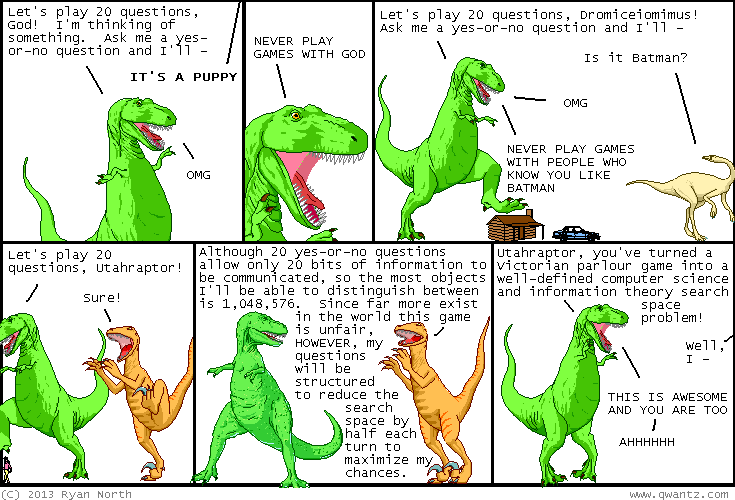
okay okay but let's see if your 20 questions computer can guess "a puppy version of batman"

archive - contact - sexy exciting merchandise - cute - search - about
← previous May 21st, 2013 next

May 21st, 2013: If you want the amazing T-Rex's Summer Vacation design on a tote bag or a hoodie, now is your last chance! TIME IS RUNNING OUT, Y'ALL:

One year ago today: well i for one am giving up boo-berry muffins

– Ryan

22 May 09:02

I tried. Really I did.

Almost half a decade ago, when I turned 40, vin_petrol gave me a gift at the last of my three birthday parties.

It was a book. A book called THE BOOK OF THE NEW SUN Volume 1 Shadow and Claw by Gene Wolfe, in the Fantasy Masterworks series. You can, if you have ever met me (or probably even if you haven't), imagine how delighted I was to receive this item. Vin knew what my reaction would be, but said I shouldn't judge a book by the lumbering role player in a cloak and oddly-shaped codpiece on its cover, because it was his favourite book, and if I only gave it a chance, I would appreciate it as great literature, despite its genre.

When everyone was banging on about Game of Thrones (which just sounds like a spam email euphemism for coprophilia to me), and saying how good the telly series was, I wondered if the book Vin gave me was the book it was based on. So I dug it out and read it.

As soon as I mentioned on FB that I was reading it, Vin and steer started arguing over whether it was a fantasy novel or a sci fi novel. I think genre is irrelevent; it's just a terribly bad novel.

It is fantasy, not sci fi. It was written in the seventies and set a million years in the future, in a dystopian world that is loosely like the dark ages. Great sci fi is fascinating for what it reveals about the present in the way it depicts the future, but the future in this novel is just a tired mishmash of the past. This means the writer can use all sorts of ideas and features of the past and indulge himself in some terrible schoolboy Latin, but without any of the coherence or accuracy of a half decent historical novel.

Vin and Steer both claim it is beautifully written. It is very heavily influenced by Lord of The Rings, with the same strangulated, portentous leadenness of language. It has the same sort of 'can you guess where this came from, ooh aren't I well-read and isn't this book really, properly, intellectually serious' preoccupation with nomenclature. There is no sense of pace or urgency even in the bits that are supposed to be pacy and urgent. They are just as turgid and long-winded as the rest. It claims to be Volume 1, but it is actually two books. I'm afraid only made it through the first.

Gene Wolfe's - I bet that wasn't the name his parents gave him, by the way, I bet he was called Brian Evadne Spengler III - hero is an orphan, a torturer, has a sort of gothwish cloak of near invisibility and considerable sexual appeal and stamina. Most of the women he meets are remarkable for their near total lack of clothes and huge norks, described variously as 'two halved melons topped with cherries' or 'creamy amplitude'- I kid you not. He writes about women as if he has never spoken to one, let alone seen one naked (the blurb said he studied mechanical engineering at university).

I worked out it was't the Sport of Lavatories book pretty quickly, when I recognised the name of the author of that on the back of Book of the New etc attached to the quote 'One of the greatest science fantasy epics of all time'. It's put me right off reading anything by him, so I think my foray into 'science fantasy' is over. Unless, of course, anyone can recommend me anything of the calibre of Gormenghast.
22 May 08:50

Who do you love? 29: The Tenth Planet

Many things to love about The Tenth Planet:

  • The Cybermen. They are eerie undead, unaffected by snow, standing still in the blizzard. They will never again feel so much like people with something removed.
  • The Cybermen's voices. Their heads loll to one side, their mouths fall open, and this strange sound emerges; all the words are normal, but the intonation is from outer space, the madness of someone trying to remember what it felt like to be alive. If they were to remake this, they should keep it exactly the same except that the Cybermen who aren't speaking should smile or frown in the background for no logical reason whatsoever.
  • The Cybermen kill the Doctor. This is quite plain in the reconstruction, although for some reason it isn't brought out in the book. They bring him and Polly to their spaceship and drain him, and it kills him. Sadly, unlike The Smugglers which was so unambitious in concept that it could focus on selling the action, The Tenth Planet knows where it wants to go but isn't sure it's allowed. With a bit more thematic clarity (and, yes, foreknowledge that Hartnell would have to take the third week off) this could have been so much more effective.
  • The TARDIS goes mad! The TARDIS is screaming as the Doctor comes back to it to die. It's not clear if he and it are friends yet, or if it's just sensing the crisis. This is a great call-back to The Edge of Destruction: the Ship as a presence, not a machine.
  • Bases, Antarctica, air vents, Americans, Geneva, Ben, Polly.
  • And goodbye to William Hartnell, stubbornly not explaining things to the end.
22 May 08:35

Mad swivel-eyed loons? I’ll take that back...

by noreply@blogger.com (Simon Titley)
In a post the other day, I questioned the use of the term ‘mad swivel-eyed loons’ to malign Conservative party members.

As if to disprove my point, Norman Tebbit has been interviewed in this week’s Big Issue on the topic of gay marriage and his eyes seem to be rotating through 360 degrees:
“The government discussed it for twenty minutes on the morning of its announcement,” former Conservative Party chairman Lord Tebbit told The Big Issue. “They’d done no work on it beforehand. I said to a minister I know: have you thought this through? Because you’re doing the law of succession, too.
“When we have a queen who is a lesbian and she marries another lady and then decides she would like to have a child and someone donates sperm and she gives birth to a child, is that child heir to the throne?
“It’s like one of my colleagues said: we’ve got to make these same sex marriages available to all.
“It would lift my worries about inheritance tax because maybe I’d be allowed to marry my son. Why not? Why shouldn’t a mother marry her daughter? Why shouldn’t two elderly sisters living together marry each other?”
Swivel-eyed, maybe, but not a ‘loon’. There is not a full moon till next Saturday.
22 May 08:35

Time, Born Again

by Sean Carroll

Lee Smolin has a new book out, Time Reborn: From the Crisis in Physics to the Future of the Universe. His previous subtitle lamented “the fall of a science,” while this one warns of a crisis in physics, so you know things must be pretty dire out there.

I’m not going to do a full-fledged review of the book, which gives Lee’s argument for why “time” needs to be something more than just a label on spacetime or a parameter in an evolution equation, but a distinct fundamental piece of reality with respect to which the laws of physics and space of states can change. (Sabine Hossenfelder does offer a review.) There are also suggestions as to how this paradigm-changing viewpoint gives us new ways to talk about economics and social problems.

Over at Edge, John Brockman has posted an interview with Lee, and is accumulating responses from various interested parties. I did contribute a few words to that, which I’m reproducing here.


Time and the Universe

Cosmology and fundamental physics find themselves in an unusual position. There are, as in any area of science, some looming issues of unquestioned importance: how to reconcile quantum mechanics and gravity, and the nature of dark matter and dark energy, to name two obvious ones. But the reality is that particle physicists, gravitational physicists, and cosmologists all have basic theories that work extraordinarily well in the regimes to which we have direct access. As a result, it is very hard to make progress; we know our theories are not absolutely final, but without direct experimental contradictions to them it’s hard to know how to do better.

What we have, instead, are problems of naturalness and fine-tuning. Dark energy is no mystery at all, if we are simply willing to accept a cosmological constant that is 120 orders of magnitude smaller than its natural value. We take fine-tunings to be clues that something deeper is going on, and try to make progress on that basis. Sadly, these are subtle clues indeed.

“Time” is something that physicists understand quite well. Quantum gravity remains mysterious, of course, so it’s possible that the true status of time in the fundamental ontology of the world is something that remains to be discovered. But as far as how time works at the level of observable reality, we’re in good shape. Relativity has taught us how to deal with time that is non-universal, and it turns out that’s not such a big deal. The arrow of time—the manifold differences between the past and future – is also well-understood, as long as one swallows one giant fine-tuning: the extreme low entropy of the early universe. Given that posit, we know of nothing in physics or cosmology or biology or psychology that doesn’t fit into our basic understanding of time.

But the early universe is a real puzzle. Is it puzzling enough, as Smolin suggests, to demand a radical re-thinking of how we conceive of time? He summarizes his view by saying “time is real,” but by “time” he really means “the arrow of time” or “an intrinsic directedness of physical evolution,” and by “real” he really means “fundamental rather than emergent.” (Opposing “real” to “emergent” is an extremely unfortunate vocabulary choice, but so be it.)

This is contrary to everything we think we understand about physics, everything we think we have learned about the operation of the universe, and every experiment and observation we have ever performed. But it could be true! It’s always a good idea to push against the boundaries, try something different, and see what happens.

I have two worries. One is that Smolin seems to be pushing hard against a door that is standing wide open. With the (undeniably important) exceptions of the initial-conditions problem and quantum gravity, our understanding of time is quite good. But he doesn’t cast his work as an attempt to (merely) understand the early universe, but as a dramatic response to a crisis in physics. It comes across as a bit of overkill.

The other worry is the frequent appearance of statements like “it seems to me a necessary hypothesis.” Smolin seems quite content to draw sweeping conclusions from essentially philosophical arguments, which is not how science traditionally works. There are no necessary hypotheses; there are only those that work, and those that fail. Maybe laws change with time, maybe they don’t. Maybe time is fundamental, maybe it’s emergent. Maybe the universe is eternal, maybe it had a beginning. We’ll make progress by considering all the hypotheses, and working hard to bring them into confrontation with the data. Use philosophical considerations all you want to inspire you to come up with new and better ideas; but it’s reality that ultimately judges them.

Share

22 May 08:33

#477 Ad Nuntium

by noreply@blogger.com (treelobsters)
22 May 08:33

Some Of Us Have Been Waiting For Today For A Very Long Time... But It Isn't Over Yet

by noreply@blogger.com (Jae Kay)
I've been arguing, I hesitate to say fighting, for marriage equality for a very long time. Way back in 2005 I was rather distressed at the introduction of civil partnerships, and in 2007 decided that sitting around moaning about it wasn't going to get anywhere so I began writing to MPs and blogging on the various efforts to convince people that marriage equality was something worth fighting for.

We are not there yet. But today was one major milestone in the journey. The Government's Same-Sex Marriage Bill passed through its third reading in the House of Commons by 366 votes to 161. It was weirdly anti-climatic as, despite the House of Commons being our elected part of our legislature, the Bill is only halfway to being law. But it is a chance to take a moment and think how far we've come from the days when people like Ed Miliband seemed a little shocked to even be asked if they supported marriage equality

That is due, in no small part, thanks to hard-working MPs like Lynne Featherstone, Nick Herbert and Julian Huppert. And thanks to campaigns like the Coalition for Equal Marriage. These are the people who put marriage equality on the agenda. And I feel we owe them a great deal of gratitude. 

The Same-Sex Marriage Bill remains deeply flawed, lacking pension rights and transgender rights supporting amendments. And the fight in the Lords is likely to be tough. 

If you can help by writing letters or emails to peers, or even donating some money so more can be posted, then please let me know. We've won this battle, and some!, but the fight for our freedom continues. 
22 May 08:32

Star Trek Is...: The Cage

by noreply@blogger.com (Josh Marsfelder)


Rare Playmates Cage-era "Innerspace" toy prototype.
“The Cage” occupies a strange space within Star Trek lore: As a pilot created by Gene Roddenberry and those closest to him to demonstrate to NBC what they envisioned Star Trek to be all about, but one that never actually aired on television, it is at once the progenitor of the entire franchise and also the only part of it impossible to reconcile with the rest of the series' canon. “The Cage” is a very strange specimen indeed then: It's not quite Star Trek, at least not the Star Trek that fans would come to recognise and love years later, but, by virtue of it being a pilot designed to embody the show's core values and themes made before executive compromises changed the tone of the series, it is in many ways the purest Star Trek of all.

The one individual irreducibly linked to “The Cage”, what it is and what it does, far more so than in anything else bearing the Star Trek name, is Gene Roddenberry. Over the years mainline fandom has all but deified Roddenberry, and people tend to hold him up as a figurehead for everything they want Star Trek to embody and strive for (particularly so in the years immediately following his death in 1991 and the cancellation of Enterprise in 2005). This is also not helped by muddy and at times completely contradictory historical accounts of key moments in Star Trek history and Roddenberry's own biographical details perpetuated by what can frankly best be described as rampant hearsay and cult of personality. As a result, it can be hard to actually get a solid critical handle on who Roddenberry was, what the extent of his contribution to Star Trek was and what exactly he wanted it to be.

“The Cage” then really is the best place to talk about Roddenberry and his influence on Star Trek, because no matter what Star Trek is going to become over the next several decades it will never again be as closely tied to Roddenberry's personal conception of it as it is here. There are several reasons for this, the most immediately obvious one being its aforementioned status as a pilot, but also the fact that even as of the early Original Series Gene Roddenberry had a lot of help and input in shaping the direction of Star Trek that he didn't have as much of here. The fact he was willing to entertain and genuinely listen to everyone's ideas for, and criticisms of, his project is telling, but so is the fact their influence has been all but effaced from the history of the franchise to the point Roddenberry is, implicitly at least, held up as the source of every single good idea the series ever had, which is simply and flatly not true. But there is a reason Majel Barrett called “The Cage” her favourite episode and “Pure Star Trek”, and anyone who is seriously interested in the history of the franchise and Gene Roddenberry's “vision”, whatever that may turn out to be, really ought to study it.

Firstly, some things we do know about Gene Roddenberry: He was not a futurist. Nor was he a scientist, engineer or prophet. He was, however, a retired Air Force Pilot and LAPD officer who had done some freelance work for television before pitching the concept of Star Trek to Desilu Studios in 1964. What's the most immediately interesting about these early documents is that far from describing some long-winded space opera myth arc that sings the praises of Hard Science, Roddenberry is actually pitching Star Trek as as a combination of Flash Gordon and Buck Rogers, the absolute pulpiest of the pulp science fiction works. In private, Roddenberry is alleged to have claimed to be basing the show on Gulliver's Travels, and that he intended each episode to be structured around both an action adventure story and a morality play. Roddenberry did want his show to be believable though, so he brought in physicist Harvey P. Lynn to serve as his technical advisor, which also invites comparisons to Foundation-style Golden Age science fiction. So we can pretty safely say that even this early, Roddenberry is not thinking of Star Trek as either “A Wagon Train to the stars” or Horatio Hornblower in space.

The other person indelibly linked with “The Cage” and prototypical Star Trek is Majel Barrett herself. There isn't as much fandom lore or as many legends surrounding Barrett as there are Roddenberry, although there are several. Firstly though the most important thing to note about Barrett is that she and Gene Roddenberry had a very complex and nuanced relationship that isn't really adequately summarized by simply saying “they were married”. At the risk of turning Vaka Rangi into the celebrity gossip papers, this really is something we need to square away right now because it actually holds ramifications for formative decisions made about what Star Trek is and where it goes. Here's the thing: The primary reason Number One exists (and by association the character Spock will become) and the reason she's played by Majel Barrett is straightforwardly because of her relationship with Roddenberry. This isn't to suggest something so crass as the only reason Barrett was cast was because she was sleeping with Roddenberry, but rather to posit that Number One was probably written with Barrett in mind.

I get the feeling Barrett was not only Roddenberry's romantic partner, but a kind of inspirational muse to him as well. Number One is the first character described in the original pitch to Desilu and supposedly the first one created for all of Star Trek. She's explicitly written to be the most coolly competent character on the show and as the Enterprise's “most experienced officer” she is implicitly connected to the soul of the ship at a very deep level thanks to western naval tradition. What's also interesting, however, is that her femininity is consistently a matter for debate both in the treatment and what made it to air. Captain Pike is visibly uncomfortable with having women on the bridge other than Number One (as seen by his dismissive attitude towards Yeoman Colt) and in the script a big deal is made out of the fact Number One is icy and logical even going so far as to state “From time to time we'll wonder just how much female exists under that icy facade.” In other words, Number One is special because she's a woman who has acclimated to rational, male culture.

As much praise as Star Trek gets for its progressive attitudes towards gender roles, this isn't especially satisfying from a feminist perspective and it's clear Roddenberry wasn't entirely sure how far to go in this direction, but the fact Number One exists at all is a decisive move that will leave a big impression on people as a part of the series' developing lore and mythology. Barrett was important enough to Roddenberry that he restructured his entire television pulp science fiction throwback project to accommodate her, a project that he was even now becoming increasingly possessive of and attempting to turn into his masterpiece (often, sadly, at the expense of everyone else who contributed to its success). Number One just being on the bridge was a bold statement that cemented Star Trek's commitment to egalitarianism, if only in the pop consciousness and not on actual television. And that's solely due to Majel Barrett.

I'm spending so much time picking over biographical details about Gene Roddenberry, Majel Barrett and Number One because, well, they're really the most interesting things about “The Cage”, doubly so in terms of what we know the future holds. As an actual episode of television “The Cage” is surprisingly underwhelming, especially as the first, most definitive incarnation of Star Trek. That said, the ethics and general structure of this episode do prove revealing in sussing out Roddeberry's basic intent in regards to Star Trek, so I'm going to dedicate the remainder of this post to that instead of summarising or analysing the plot, which every Trekker knows by heart at this point. It's essentially Plato's allegory of the cave retold in pulp sci-fi terms (with one big twist I'll get to), which is noteworthy insofar as it was uncommon, though not unheard of, to get that kind of distilled philosophical fiction on television in 1964, and there's also the really galling laddish humour of the Talosians' “Adam and Eve” scheme and the crew's reaction to it, but that's about the extent of what's actually edifying to talk about in regards to the plot.

What's more revealing is what “The Cage” shows us about what Gene Roddenberry initially pictured the world of Star Trek to be like. You'll notice this episode bears no mention of a utopian United Federation of Planets with a mission to Seek Out New Life And New Civilizations and Boldy Go Where No Man Has Gone Before. I'll save you the trouble of checking the original pitch and treatment because you won't find it there either. In fact at this point there's little to no discussion about what, actually, the Enterprise does at all. All we get is a line about how Pike is recovering from a battle at Rigel VII and that the ship and its crew are en route to deliver some medical supplies when they picked up the manufactured distress signal. Frankly, at this point there's no reason to suspect the Enterprise is anything other than a battlecruiser working for some futuristic military organisation or law-keeping task force.

Because that's exactly what it is.

It doesn't take a Talosian to put the pieces together here. The Enterprise isn't going out to make friendly contact with undiscovered cultures or mapping uncharted star clusters, it's running errands back and forth between Earth colonies and occasionally sparring with enemy hostiles in disputed territories. It's a glorified patrol boat. Now I also hasten to add I don't think Roddenberry meant this as a bit of neo-imperial US chest thumping: There's nothing in anything he said or that was written about him to lend any sort of credence to that accusation. It is true Star Trek, especially in its 60s incarnations, does develop a very problematic and tangled connection to imperialism, but that develops generatively as the show morphs and evolves over its first three years. Equally though Star Trek wasn't meant as some kind of idealized, post-scarcity fairy tale either. Those connotations are indeed all part of the series and do come later, but they don't spring from Roddenberry, at least not at first.

What I think is a more fitting explanation for Star Trek is that Roddenberry was a fighter pilot-There's a unique kind of camaraderie amongst and bond between US Air Force pilots, and it would be silly to suggest this didn't have a big influence on Roddenberry's writing. No, what probably happened was that Roddenberry had this idea he really liked to do Gulliver's Travels in space and decided to set it on a ship that was part of the Space Air Force because that's the environment he knew. Also, he thought it'd be a good idea to let women into the Space Air Force too because he liked women and was inspired by his loverXmuse and figured that would be a sensible thing to do. It's pro-military only in the sense that doing a story about the Space Air Force is going to tautologically be that way by default simply by virtue of being about such a concept in the first place, not because Roddenberry had some imperialistic agenda to push. However, we didn't excuse this with Asimov and we shouldn't excuse it here either: Combine this with the elements Star Trek inherits from both pulp sci-fi (its action adventure trappings and general setting) and Golden Age sci-fi (the attempt to make the science somewhat realistic) and you wind up with a concept that is fundamentally, if not entirely intentionally, militaristic.

More support for this reading can be found in the Enterprise’s oft-celebrated multiracial crew. Like the addition of Number One and Yeoman Colt, this is frequently cited as proof that Star Trek was far and away the most progressive thing on TV in 1964. If you believe Gene Roddenberry, this was his idea and a favourite story of his to tell in later years on the convention circuit was how he had to fight Desilu and NBC tooth and claw to keep the Enterprise diverse because they wanted a “suitable”, i.e. white, cast. This popular claim is contested, however, by Bob Justman and Herb Solow (two Desilu executives and production associates who helped Roddenberry create Star Trek and who became producers themselves once the series proper began) in their 1997 book Inside Star Trek, which became an invaluable source for debunking myths and lore the franchise had accumulated up to that point and *especially* during the notoriously insular and self-congratulatory mid-90s fandom. According to Solow and Justman, NBC in fact requested that Roddenberry make the Enterprise crew multi-ethnic as they encouraged diversity in all of their TV shows. Once again like the addition of female characters, I believe this was at least partially Roddenberry's idea: There is a line in one of the very early treatment scripts where the captain, then named Robert April, chews out a crewmember for firing on friendly life-forms because they “looked hostile” and dismisses him in disgrace. However, it's very clear the idea is not *entirely* Roddenberry's, nor is it even unique to Star Trek, and to cast Roddenberry as some prodigy ahead of his time fighting valiantly for Diversity against the oppressive forces of Old and Evil is not only an oversimplification, it's a fallacy.

But the most damning evidence that Star Trek isn't a grand utopian ideal at this point is the episode's resolution: It's rather fascinating, and more than a little alarming for someone used to later Star Trek, to see how Pike escapes the Talosian zoo: He overwhelms the zookeepers with “primitive, hateful” thoughts which their telepathic powers cannot pierce, thus shattering their ability to maintain their illusions. It's hard to imagine even Captain Kirk resorting to this kind of action and seems completely at odds with Star Trek's supposed utopianism: There's no rousing speech about how humanity has moved beyond such things or how more evolved species have no need of such thoughts-It really is merely the bit of plot detail Pike needs to escape his predicament and it's not treated as anything more substantial than that. Furthermore, while we do get a token rumination on the nature of humanity at the end, it's couched more in terms of our lovable stubbornness, strong will and our unwillingness to be fenced in, not on how evolved we've become or our potential for greatness.

And that's really the takeaway here: “The Cage” isn't some super-cerebral musing on a idealized future with no war, poverty or bigotry: It's a square-jawed, manly pulp adventure story for the mid-1960s. It's maybe more intellectually-minded and has more of a diverse cast then other shows of its time, but it's by no means the most intelligent or interesting thing on the air right now either (we'll touch on one of those later on). I don't think it's bad enough to warrant NBC rejecting it on its own merits, though the pacing is tedious and the plot is thinner than it'd like you to think it is, but it's equally easy to see why the Star Trek team went back to the drawing board. When next we see them, the show will have changed significantly. Not all of the changes will be for the better, but one thing that's clear is that for Star Trek to work it's going to *have* to change. It's not Vaka Rangi yet, but if I'm honest it won't be completely Vaka Rangi for decades. More pressingly, the show as it exists now isn't the strange phenomenon that will last for over 45 years, but it *is* Star Trek and it's Star Trek the way Gene Roddenberry first wanted it. This is very important to keep in mind, as the spectre of “The Cage” will always haunt Star Trek from here to eternity, and for better or for worse.
22 May 07:57

The Terrible Consequences of Yahoo's Tumblr Buyout

by Lauren O'Neal

Yahoo! buys tumblr. for $1.1 billion.

• Yahoo! drops a vowel to promote cross-brand synergy, becomes Yaho!.

• All Yaho! employees now required to work from home, in the middle of the night, when they're about to go to bed after they read this one last thing.

• Both private-messaging features offered by tumblr. (now called "Tumblr?" for punctuational synergy) include a Sent folder. Users reel in confusion: "I can see both sides of the conversation? I don't understand. Which part did I say?"

• Yaho!'s women's section, Shine (now "Shne"), now just GIF after GIF of Joseph Gordon-Levitt.

• All Tumblr? asks sent directly to Yaho! Answers. "We think an enriched user base is the most seamless way to monetize questions like 'I think your really cool but yuo dont follow em back but thats ok XD' and 'check ur human privelege, it's not my job to fucking educate u,'" says rep.

• Tumblr? Storyboard ("Tumblr? Stryboard") exclusively features headlines like "'Hot' women that aren't: one guy's take" and "What exactly is a 'Latino'?"

• Average age of Yaho! and Tumblr? users evens out to about 30. "Can I still Google my email?" an elder woman asks her 10-year-old grandson as he posts nude selfies.

• In accordance with company policy, Yaho! deletes all the porn from Tumblr?. Tumblr? ceases to exist, and all of these consequences disappear.

Lauren O'Neal is a creative-writing MFA student in San Francisco. Her writing has appeared in publications like Slate, The Rumpus, and Corium Magazine. You can follow her on Twitter here.

Photo via.

---

See more posts by Lauren O'Neal

16 comments

21 May 17:57

Liberal Mondays 3: John Stuart Mill and Harriet Taylor #LibDemValues

by Alex Wilcock

Today’s Liberal Monday celebrates the 207th birthday of Liberal philosopher and politician John Stuart Mill. With Harriet Taylor, he wrote arguably Liberalism’s most influential text of all: On Liberty, the book that created the Harm Principle, from which I’ve picked two key quotations. For many Liberal Democrats, this crystallises the party’s essential belief, and I’ve already touched on it in both previous Liberal Mondays in freedom from conformity and from other restraints… But, though you can see On Liberty’s influence right through to today’s Equal Marriage bill, it still challenges Lib Dems – has it really influenced our policies enough?
“The only freedom which deserves the name, is that of pursuing our own good in our own way, so long as we do not attempt to deprive others of theirs, or impede their efforts to obtain it.”

“The only purpose for which power can be rightfully exercised over any member of a civilised community, against his will, is to prevent harm to others. His own good, either physical or moral, is not a sufficient warrant.”
This principle is so widely known and debated that this time I won’t analyse it at length. However, even if not every Liberal reads On Liberty once a year (as former Leader Jo Grimond suggested), and if you only read those two points from it, in campaigning Lib Dem style I’d suggest three things to remember – and one thing to think about.


Three Things To Remember
  • Between them, these two statements for me sum up the heart of On Liberty, and start off modern Liberalism. I treasure the first, because it’s a positive statement that’s a simple principle to understand but with enormous consequences. It’s greatly influenced a great many Liberals and me, too, not least in my own What the Lib Dems Stand For.
  • And I always remember the second, because this time it expresses the same rallying cry as a warning: ordering people about ‘For your own good’ is the most superficially tempting, the most difficult to stand against and the most widely practised by every government of all threats to liberty. It’s greatly influenced the Lib Dems, not least in the Preamble that sets our party’s creed uniquely as “No-one shall be enslaved by poverty, ignorance or conformity.”
  • Though John Stuart Mill wrote a great many books and essays, this is his most famous, his most lasting and still his most controversial (or influential). And he wrote it with his friend and later wife Harriet Taylor, who never gets the credit – except every time Mr Mill himself talked about who wrote it. So when you think about “Mill’s Harm Principle,” remember that it’s not just about the Great Victorian Man. His publishers may not have given Ms Taylor credit, but you can. So try to ignore the Victorian language that only says “he”; unlike many politicians of the age, Mr Mill was an early advocate of equality.

One Thing To Think About

But for all that the Liberal Democrats think of ourselves as inspired by On Liberty – it’s even the book handed down to each Party President on their election – how much do we practise what it preaches?

I sometimes feel a strange kinship with Evelyn Waugh’s lament that:
“The Conservative Party have never put the clock back a single second.”
How many laws have the Liberal Democrats put back? And how many have we acquiesced in or cheer-led? After Labour’s smothering record more than 4,000 new laws when in power, we proposed a Great Repeal Bill, or Freedom Bill; we formed a Coalition with the Conservatives in part on a promise of enacting that Bill, with principles of freedom and personal responsibility. And yet when it came down to it, it was watered down in government to a Small Repeal Bill, or a Freedom That Won’t Frighten the Daily Mail Bill – putting authoritarianism back only a few seconds, and then it starts ticking forward again. That’s the trouble with legislation by shopping list rather than principle: it’s too easy to say you’ll take just the more difficult things out of the cart, and find you’ve got very little left in it.

I’m not even talking about the more egregious government-by-securocrat proposals that rang enough danger signals for Liberal Democrats to block – or ostentatiously fail to – such as the Snooper’s Charter or Secret Courts. It’s more the insidious danger of legislation and regulation in favour of nice things, because nice people could only ever want nice things, and so no right-thinking person could ever want nasty things, whether the wrong type of food or the wrong type of fun… And yet, if it’s so self-evident that everyone must agree, how come government needs to enforce it? Because people should be able to make their own choices, even if they’re not for their own good. Freedom means taking responsibility. And sometimes that means even insisting people have the freedom to do things that the Daily Mail does like and the Guardian doesn’t – let alone things that both scream against. Because making crimes of personal actions that other people or press puritans merely disagree means creating criminals to punish where there aren’t actually any victims. And to a Liberal, shouldn’t a “Victimless crime” be no crime at all?

So here’s something to think about, if the Liberal Democrats really are a party influenced by John Stuart Mill and Harriet Taylor. Of course we should look at the little things – removing some enforced conformities, resisting the temptation to ban things we don’t think are very nice but which are actually none of our business. Applying our Harm Principle consistently would be a revelation. But we shouldn’t get stuck in only reacting to every individual problem or proposal that comes our way. If we’re really a party of On Liberty-based Liberalism, how about thinking about where we’d actually start? How would we put that principle into practice? What if we get into government again – is it enough just to blunt the edges of government-as-it-always-is-by-authoritarian-inertia? Isn’t it time to start planning for something better? Even if it means challenging the whole legal system (and a potential coalition partner) to go back to first principles?

When are we going to stand up for freedom and personal responsibility by showing some responsibility ourselves – and freeing ourselves from the conformity of politicians who always take the safe route and order everyone else to do the same?

21 May 11:21

The Critic Inside Me

by LP

I’d finished my scone and was having a second cup of Turkish coffee when I saw him. The No. 73 Express bus from the University District had come in a few minutes before, and he was peering in one end of the café window, the end nearest the anarchist bookstore, wiping his hands on his Huggy Bear t-shirt and blinking against the light. He saw me watching him, and his trucker cap faded back into the shadows. But I knew he was still there. I knew he was waiting. The hipsters always size me up for an easy mark.

I lit my pipe and slid off the thrift store chair. The waitress, a new girl from Bothell, watched as I gathered my bag. “Why, you don’t even carry a notebook!” she said, as though she was giving me a piece of news.

“No,” I smiled. “No notebook, no sketch pad, nothing like that. Why should I?”

“But you’re a teacher — a tenured professor, I mean. What if you think of something while you’re sitting there?”

“I don’t have many ideas these days, ma’am,” I said. “Anyway, a good idea is a good idea, even if you don’t write it down right away. If you don’t remember it then, you’ll remember it later. I trust my gut.”

She shook her head, wide-eyed with awe, and I lurched up to the counter. The manager shoved back my BECU card and laid a fresh pack of G.L. Pease Cumberland coarse cut on top of it. He thanked me again for taking his nephew in hand.

“He’s a different boy now, Lou,” he said, kind of running his words together like guys who drink too much espresso do. “Stays in nights; actually goes to school. And he always talks about you — what a good teacher is Professor Lou Ford.”

“I didn’t do anything,” I said. “Just talked to him. Showed him a little interest. Anyone else in the literature department could have done as much.”

“Only you,” he said. “Because you are smart, you make him smart too.” He was all ready to sign off after that, but I wasn’t. I leaned a sueded elbow on the counter, hoisted my Italian messenger bag over my shoulder, and took a long slow drag on the Meerschaum. I liked the guy, as much as I like anybody I suppose, but he was too good to let go. Friendly, polite, online MBA from a state collegel: guys like that are my meat.

“Well, I tell you,” I drawled. “I tell you the way I look at it, discerning signifieds systematically for each lexia does not aim at establishing the truth of the text — its profound, strategic structure — but its plurality, however parsimonious.”

“Umm,” he said, twitching. “I guess you’re right, Lou.”

“I was thinking the other day, Max; and all of a sudden I had the doggonedest thought. It came to me out of a clear sky: It is generally held, by its promoters and detractors alike, that semiotics is not a form of historical thought, though it is acknowledged that, through the distinction between diachrony and synchrony, it provides conceptual and operational room for history. Just like that: It is generally held, by its promoters and detractors alike, that semiotics is not a form of historical thought, though it is acknowledged that, through the distinction between diachrony and synchrony, it provides conceptual and operational room for history.”

The courteous smile on his face was starting to crack. I could hear his Skechers squeak on the wooden floor as he squirmed. If there’s anything worse than a snob, it’s a windy snob. But how can you brush off a nice friendly fellow who’d let you into his Overview of Modernist Literature Class if you asked him, even if you didn’t have the prerequisites?

“I reckon that I should have been one of those Frankfurt School fellas or something like that,” I said. “Even when I’m asleep, I’m working out theoretical paradoxes. Take the fact that the rejection of the signifier takes the form of the rejection of writing. Now, a lot of people will tell you that this goes to show you that philosophy defines itself as a discipline unaffected by the machinations of words and their contingent relationships. But it’s not like that, Max. The problem isn’t just the relation of speech and writing in philosophical discourse, but also the claim that competing philosophies are versions of logocentrism.”

He cleared his throat and muttered something about needing to sign off for a shipment of cup sleeves, but I pretended like I didn’t hear him.

“Another thing about the signifier is how its exteriority is that of the exteriority of writing in general, but without that exteriority, the very idea of the sign falls into decay. But maybe it’s better that way. Since our entire world and language would collapse with it, and since its evidence and value keep, to a certain point of derivation, an indestructible solidity, it would be silly to conclude from its placement within an epoch that it is necessary to dispose of the sign, the term and the notion. At least that’s the way I figure it. I mean, hell, the production or interpretation of signs, the text in general as fabric of signs, they allow themselves to be confined within secondariness. When you think about it, they’re preceded by a truth, or a meaning already constituted by and within the element of the logos.”

“Lou…” He was begging now.

“Well,” I said, “I guess I’d better shove off. I’ve got quite a bit of getting around to do, and I don’t want to rush. After all, any fictional theme is, by definition, a challenge to the single signified because it is a polyvalent signified, a blasting of selfhood. The critical distance which arationality produces allows us to be self-conscious in a dissident and ironic fashion about the society in which we live, in my opinion. It’s like I always say: the tribunal whose idiom is that genre of discourse which is cognition asks of the one who claims an obligation: which is the authority that obligates you?”

I was draggin’ him in by the ankles, but I couldn’t hold back. Striking at people that way was almost as good as the other, the real way. The way I’d fought to forget — and had almost forgot — until I got tenure.

I was thinking about my lesson plan when I stepped out into the cool Seattle night and saw the hipster waiting for me.

21 May 09:34

Ukip at 22%. Calm down, Dear. It’s an Opinion Poll

by noreply@blogger.com (Alun Wyburn-Powell)
Ukip’s opinion poll rating has reached 22% in the latest survey published today. How exciting is that? What does this mean?

It means that (give or take 3%) the equivalent of 22% of people told the pollsters that they would vote for Ukip, if there was an election tomorrow. Unfortunately for Ukip, the party cannot cash this in, as there is no election tomorrow.

But, are the figures believable? Opinion polls do pretty much do what they say on the tin. We can trust the pollsters accurately to have reported what people told them. In the same way, we can trust the 2001 Census to have accurately reported that 390,000 people said that their religion was Jedi.

Even allowing for a few people jumping on bandwagons or having a laugh, this does sound like a pretty impressive poll rating for a new party. That is, until you see that in December 1981 the newly-formed SDP managed to clock up an opinion poll rating of 50.5% in a Gallup poll – and they were up against Margaret Thatcher as Conservative leader.

So how well did the SDP do at turning this opinion poll rating into seats in parliament? The party was led by the Gang of Four, all respected former cabinet ministers - Roy Jenkins, David Owen, Shirley Williams and Bill Rodgers - who had a well thought-out set of policies. The SDP agreed a comprehensive national electoral pact with the Liberals and it managed to attract 29 sitting MPs who defected into the party (28 from Labour and one Conservative). Roy Jenkins and Shirley Williams fought by-elections and won.

When the next election arrived in 1983, the SDP won six seats – holding five of the 30 seats it was defending and winning one new one.

In the end the SDP split. Most of its members joined with the Liberals, to form the Liberal Democrats, who incidentally had an opinion poll rating of 34%, just before the last election in 2010.

So how excited should we be? That is entirely up to you, depending on your point of view. I should declare my personal interest. I was one of the 50.5%, who got quite excited in 1981. Personally, I will get excited again when we see a poll rating of 51% or more, as then we will be in record-breaking territory.

I also have to declare a schoolboy rivalry. My old school (St Dunstan's in Catford) just never managed to turn out a consistent product, having produced Labour MP Chuka Umunna, Conservative peer Michael Grade and me. Whereas, our rivals down the road at Dulwich College managed to produce Nigel Farage AND Bob Monkhouse.
21 May 09:25

11 Liberal Democrat MPs vote for registrars to be exempt from marrying same sex couples

by Caron Lindsay

The Marriage (Same Sex Couples) Bill has made fairly easy progress through the Commons tonight. After a Government/Labour compromise on a review for extending civil partnerships to opposite sex couples, and the heavy defeat or withdrawal of amendments, including “son of Section 28″, it looks as though many of the barriers to this Bill’s passage have been removed.

There is still a further day of debate tomorrow, though, and further amendments to be debated.

One of the amendments discussed today, defeated by 340 votes to 150 in favour, was to allow registrars to exempt themselves from marrying same sex couples. Eleven Liberal Democrat MPs voted in favour of this. They were:

Norman Baker

Alan Beith

Gordon Birtwistle

Paul Burstow

Tim Farron

Andrew George

Duncan Hames

Simon Hughes

John Pugh

Sarah Teather

Steve Webb

A few early comments from members. Firstly Fernando North:

I am remembering their names as I will remind them at election time why I will not help reelect them. #ThisIsPersonal. This may be a matter of conscience for the MPs involved but for me it is intensively personal. Their conscience is denying my happiness in defiance of the Harm Principle-that most sacred of Liberal Principles.

Roger Reeves’ husband Andrew died almost two years ago. As London Campaigns Officer, he helped get Sarah Teather elected. Roger said tonight:

I am absolutely shocked by this. A marriage is to one you love. No matter what sex they are.

Geoffrey Payne, a regular commenter on this site said:

 I am surprised and disappointed that there are so many. I wonder if any abstained as well. I can’t see any of them joining the Tories on other issues they are usually good. Good being a relative term compared to their colleagues. They all supported secret courts of course.

Miranda Roberts said:

Surely we believe that all council employees should provide services to all residents without regard to gender, race, age etc? Horrible to see Lib Dems saying that sexuality should be used as grounds to deny people access to a government service.

Stephen Glenn added:

Imagine if council housing officers denied same-sex couples social housing?

Or a DWP clerk refused to let a gay person sign on? Which seeing as I’ve applied to a fair number of LGBT bodies while looking for work would have been known (guessed).

These are public servants and in some places especially the rural ones there may only be one registrar for miles around or on the island. If that person objects people are denied the fully legal service.

There are two sides to every story, though.  Mike Bird said:

We all seemed to agree that religious organisations shouldn’t be forced to conduct same-sex marriages, so it seems odd to see a lot of anger at Tim and others for allowing people in the public sector to make the same decisions. I don’t see why people who’ve ended up in different lines of work should have different religious freedoms unless it’s absolutely necessary.

Chris Wiggin, also in support said:

If you want MPs to vote a certain way then they should be whipped. Decision not to whip should be questioned, not the MPs themselves who were told they could vote as they wish. There was criticism last week of the decision not to whip, as there was at the previous vote.

We don’t want to do too much of the counting of the poultry while still sitting on the eggs, but it does look like we’ll have something to celebrate tomorrow, given the large majorities against the “anti” amendments tonight. There will, however, be considerable disappointment amongst many activists that eleven of our MPs voted for this amendment. In their defence, they will no doubt argue that the people seeking the service wouldn’t be denied it as another alternative would be found. Whether they could guarantee that in rural areas, though, I’m not so sure.

* Caron Lindsay is Co-Editor of Liberal Democrat Voice and blogs at Caron's Musings

21 May 09:24

Opinion polls yadda yadda. OR “Does Nate Silver mean nothing to you? Did he write in vain?”

by Stephen Tall

Two new polls last night: the daily YouGov tracker and the first post-local elections poll from Survation. The spread is interesting:

    Labour: 35% (Survation 39% (YouGov)
    Conservatives: 24% (S), 31% (YG)
    Lib Dems: 11% (S), 10% (YG)
    Ukip: 22% (S), 14% (YG)

As Anthony Wells points out, Survation asks whether people will vote Ukip (most other firms just ask about the main three parties and ‘Others’) so usually gets the highest Ukip poll numbers. This latest survey is in line with the bounce other firms have shown and which the perceived winner of an election often records.

Unsurprisingly, it’s Survation’s poll which has attracted most interest because it shows a gap if just 2% between the Tories and Ukip. Cue cries of ‘Tory meltdown!, ‘Cameron in crisis!’ and every other journalistic cliche.

At the risk of precipitating on the parade of those who love nothing better than to indulge in over-excited hyper-speculation, can I make the following point. Or rather can I ask the following question: Does Nate Silver mean nothing to you? Did he write in vain?

nate-silver-flickrOne of the very simple — I mean it: really simple — points he made in the run-up to the last US presidential election was that national poll ratings are not the best way of judging who was most likely to emerge the winner. Throughout that election campaign journalists and commentators (who are paid to understand this stuff and enlighten the public) termed the contest a ‘dead-heat’ on the basis that national polls showed a consistent but narrow Obama lead that was within the margin of error. Yet Nate Silver’s analysis of individual state polls showed Obama with an unwaveringly firm hold on the US electoral college.

Nate’s confident prediction was acclaimed here in the UK. Yet the lessons for us here are now routinely ignored. Just as the US decides its President through an electoral college, we decide our government through electing constituency MPs. The only way to work out who’s actually most likely to form the next government is to undertake more regional polling and then to extrapolate from that the likely number of MPs for each party, while also weighting for other facts such as incumbency boosts (which disproportionately aid the Lib Dems and first-term MPs). But, as I wrote last November:

The blunt reality is that the news media craves excitement more than it hungers for truth. It is much cheaper and easier to commission a monthly survey and then inflate the results way beyond what the data should allow. We’ve all seen the kinds of headlines newspapers revel in — ‘Poll blow to Tories as support plunges 1%’, ‘Labour to win 100+ majority says latest exclusive poll’ — and yet journalists continue to write them even though they know deep down how flimsy the evidence is.

I’ve read lots of adulation of Nate Silver in the British media in the past 24 hours. I wonder if any of those journalists who’ve penned those articles have thought, even for a moment: I wish I had the confidence to write about polls with the same kind of rigour he does. I’m not holding my breath.

(I’m glad I didn’t hold my breath.)

The reality is that first-past-the-post entrenches the status quo. If the Survation poll were actually to be reflected at a general election, then Ukip would (at least according to Electoral Calculus’s predictor) gain one MP in return for their 22% of the vote. Shades of the Liberal/SDP Alliance in 1983. Labour would win a majority of 122. (And for those who half-wish for such an outcome to show up the bankruptcy of our electoral system, let’s remember: the same prophesies were made in the 1980s, and 30 years later we’re still nowhere nearer to winning that argument.)

The easiest thing to write about the next election is that “it’s completely unpredictable”. That’s only half-true, though. For sure, we don’t know if the Ukip-mania will last for another two years; and if it does quite how that will play out in relation to the Tory/Labour/Lib Dem votes. That is unpredictable. But we can be sure that Ukip won’t storm the House of Commons. The Ukip phenomenon is interesting in all sorts of ways. But as for the next House of Commons, Plaid Cymru is more significant than Ukip will be.

* Stephen Tall is Co-Editor of Liberal Democrat Voice, a Research Associate for the liberal think-tank CentreForum, and also writes at his own site, The Collected Stephen Tall.

20 May 13:20

Henry David Thorough

by Michael Leddy
I just picked up Walden — and couldn’t wait to put it down. Henry David Thorough is thoroughly crabby. He dislikes furniture. He dislikes houses. He dislikes railroads. He dislikes coffee, tea, and wine. He would certainly dislike this brief, breezy commentary on his work. Like I said, crabby.

Reading Walden, I realize that what I most dislike in E. B. White’s writing — the language of man and men — comes straight from Thorough: “If a man,” “When men,” “A man must.” The maleness is less a problem for me than the everybodyness: Yes, we all think and feel as you say we do. You are thoroughly correct.

You’re reading a post from Michael Leddy’s blog Orange Crate Art. This work is licensed under a Creative Commons 3.0 License.
20 May 10:18

You Were Expecting Someone Else 21 (The Monsters Inside)

by noreply@blogger.com (Philip Sandifer)
The Monsters Inside is one of the first three books in what is unofficially called the New Series Adventures, although even that name seems, in hindsight, ever so slightly wrong. The name derives from the two other BBC Books lines that existed in 2005, the Eighth Doctor Adventures and the Past Doctor Adventures, the former of which we covered from January through April, and the latter of which we looked at alongside each of the past doctors. And the name picks up on this, implying as it does that the New Series Adventures are going to exist alongside the other two lines.

In hindsight this is rubbish. Neither the Eighth Doctor Adventures nor the Past Doctor Adventures were going to survive the year. We knew that about the Eighth Doctor Adventures, actually, but as of May, when this came out alongisde The Clockwise Man and Winner Takes All to launch the New Series Adventures, the theory was that the Past Doctor Adventures were going to keep running indefinitely, with the Eighth Doctor range being folded into it. Indeed, in May the Eighth Doctor Range hadn’t actually quite wrapped yet, with The Gallifrey Chronicles coming out the next month, alongside Eccleston’s regeneration.

All of which is to say that while to the mainstream Doctor Who was a titanic hit that was coming back for a second season and was set to be one of the BBC’s crown jewels, to fans May of 2005 was a bewildering period in which there were in fact three incumbent Doctors, the Paul McGann era having yet to resolve, the Eccleston era ongoing, and the Tennant era announced. And the question of what the auxiliary merchandise for the series would be like was still very much an open one.

Because there were, in fact, a lot of ways the merchandise could go. It could, of course, target fans. That was what Doctor Who merchandise had been doing since the 1980s, after all. That’s why the Doctor Who Cookbook and $125 Doctor Who stained glass windows made for selling in America as pledge awards for PBS existed - because adult fans could be trusted to buy this crap. And certainly this type of merchandise still exists, as apparently there are people who want to spend fifty pounds for a box set of the Pandorica chair and a River Song action figure. Or, for that matter, thirty pounds for a Winston Churchill action figure bundled with a Dalek with tea tray accessory. (And that’s just the new series. You can also, these days, spend thirty-five quid for action figures of Peri and Sil from Vengeance on Varos)

A reasonable person might have expected this to be how all of the new series merchandise would work: high end collectors items for the undiscerning Doctor Who fan with an excess of disposable income. This was basically how the novels had worked in the wilderness years, with Virgin and then BBC Books pumping out two books every month in what was actually the biggest flood of new Doctor Who material in the series’ history, especially once Big Finish got in on the act with audios.

And then there was the second tradition - that of, basically, all of the merchandise prior to the 1980s. This merchandise mostly fell into two camps: expensive stuff you got at Christmas or for your birthday, and deliciously cheap stuff you could buy with your pocket money. Implicit in this is that the target audience for the merchandise was primarily kids.

We haven’t actually talked about Doctor Who as a kids show much since the Hinchcliffe era, where the interplay of quite dark horror and childhood television watching formed a major part of our analysis. There’s an entire rhetoric of thought about Doctor Who being for children that’s difficult to grapple with. On the one hand it’s unmistakably the case that Doctor Who is a children’s show, both in structure and, when it’s a healthy and popular show, in terms of a large portion of its actual material audience. On the other, a large portion of its audience isn’t children, and since we’re all here it probably wouldn’t do well for us to slag ourselves off as idiots who are making too much of a kids’ show.

It is often difficult to reconstruct childhood engagement with Doctor Who. It is something we tend to understand only years later, after the children have grown up and channeled their memories of Doctor Who into something else - often, as it happens, more Doctor Who. And childhood memories of Doctor Who can often be misleading: the Troughton era, for instance, is remembered for its monsters and not the parts that, to a modern eye, are far more memorable. But we can still reconstruct certain facts. And one of the most basic facts about childhood engagement with Doctor Who is, historically, the Target novelizations.

Again, those interested in seeing those books covered in more detail can consult past entries, particularly those on The Smugglers, Invasion of the Dinosaurs, and Battlefield, all of which dealt heavily with the novelized versions of those stories. But the short form is this: starting in 1964 with David Whitaker’s novelization of The Daleks, and properly getting underway with Doctor Who and the Auton Invasion and Doctor Who and the Cave Monsters, published together at the start of 1974 in a manner not entirely unlike the triple release of The Clockwise Men, The Monsters Inside, and Winner Takes All, one of the most important forms of Doctor Who merchandise - indeed, by most sane accounts the most important - was a series of short books adapting television stories to prose.

The reasons for their importance was varied, but had much to do with the fact that they had a sort of breathlessly functional prose provided by Terrance Dicks and that before the invention of the VCR the novelizations were the only way to re-experience a story after transmission. And, perhaps more importantly, with the fact that they were quite cheap. The result was that children grew up on these books, and in several cases the books are actually better remembered than the stories they adapt.

So when it came time to design tie-in books for the new series there really was a choice. On the one hand was the still-existent fan-centric model of merchandise, whereby the books would be aimed at particularly obsessive adult fans. On the other was the older for-kids tradition of inexpensive books. But each had their problems. The BBC Books line had been in serious trouble even before the new series was announced due to the fact that they were overproducing underwhelming material and hemorrhaging readers as a result. But the novelization model was equally underwhelming in the age of the DVD set and the dawning age of streaming video. A key part of why the novelizations worked was that the stories they adapted were impossible to experience in any other way. In 2005, that was clearly not going to be the case. (One of the injunctions repeatedly given by Davies to everyone on the series was that no matter how well the series did, they should at least aim to have something they’ll be proud to own the DVD set of - a concept that’s baffling to try to apply to any previous era of Doctor Who.)

And so what we got was… a rather strange midpoint. The New Series Adventures are, from their very name, aimed at adult fans. Their pricing and format pushes in that direction as well - unlike the Eighth Doctor and Past Doctor Adventures they’re hardcovers running about twice the price. These are not books aimed at being picked up by kids with their pocket money. On the other hand, they’re shorter than the other two lines - only about 250 pages - and consciously written at a younger audience (remembering that, to start at least, the BBC Books line was meant to be aimed at a younger audience than the Virgin one - though it’s tough to argue seriously that that mandate held to the end of the line). So what we have are kids books that are sold to adult audiences.

The content is no saner. On the one hand The Monsters Inside is a bit of a continuity parade, sneaking in references to the Kraals, Ice Warriors, and Meeps. On the other, it has bland pseudo-Dicksian paragraphs introducing the Doctor and the TARDIS (“TARDIS stood for ‘Time and Relative Dimension in Space’. This was supposed to explain how you could disguise a massive control room inside a poky police box and travel anywhere and any time in the universe, but it left Rose little the wiser.”) and summing up the events of Rose, apparently on the off-chance that anybody who accidentally spent seven quid on a Doctor Who book without knowing what Doctor Who was. On the third hand are rather actively disturbing moments like one of the prison guards referring to Rose as the Doctor’s “bit of human skirt.”

And, of course, there’s the writers. Five of the first six books came from mainstays of the BBC Books line: Justin Richards, Stephen Cole, Jacqueline Rayner, and Steve Lyons. (We’ll deal with the sixth in just over a week.) The line was still overseen by Justin Richards, who had overseen the disastrously stupid amnesia plot line that marred the latter years of the Eighth Doctor Adventures. The Monsters Inside comes from Stephen Cole, writer of the equally disastrously stupid The Ancestor Cell. It’s not that the BBC Books lines were unmitigated disasters - actually there are some really good books out of them. But they weren’t straightforward successes either.

It would, of course, also be a mistake to suggest that the New Series Adventures were completely beholden to the past. The Monsters Inside is a Slitheen story, drawing primarily from within the existing continuity of the new series, such as it was. And, as we noted, the books are almost ludicrously deferential to the possibility that someone might be entering Doctor Who through anything other than the massively popular television series. The result is a book that feels as though it’s lacking in audience.

Which is in many ways secondary to the fact that it’s lacking in point. There’s a vague sense that this might be a book about prison abuses (another piece of evidence in the increasingly convoluted question of who this book exists for), but if so only in the most superficial of ways. Mainly it’s trying to be thrilling, which is a not entirely absurd goal, but which pales so starkly in comparison to what the television series has been doing for the past eight weeks that it seems almost bizarre to do this and call it Doctor Who. And this is tough to escape - even the covers, frankly, feel like lazy attempts to look like generic and harmless tie-in merchandise. It's next to impossible to imagine a good K-KLAK coming out of this line.

Which is the problem this approach faces, at the end of the day. The Target novelizations were not great works of literature, but they were still basically A-list Doctor Who. Yes, some years the A-list included The Monster of Pleadon or The Android Invasion, but they were the proper Doctor Who stories recounted deftly. This, on the other hand, is the skippable Doctor Who in a world where Doctor Who is omnipresent already. If anything the thing they correspond with best are the old World Distributors annuals. But even those existed for a period where the audience was starved of Doctor Who at all, not just starved for a new episode.

These are at best for kids starved for new Doctor Who. Obsessives who simply cannot wait for a new episode of Doctor Who. And, more to the point, who have adopted Doctor Who as the thing they’ll ask their parents for. They are tools for people to commit themselves early to a phase of Doctor Who fandom, and ideally for a lifetime of it. In this regard there’s something ever so slightly unsettling about them, especially inasmuch as The Monsters Inside is actually referenced in Boomtown, giving it a curiously “official” feel that feels ever so slightly cynical. It’s a sense that Doctor Who’s main purpose is to make a lot of money. Its method in doing that might be “make good television,” and if so, it’s a rather lovely method, but it also feels ever so slightly like a Rupert Murdoch clone wearing the Reithian public service mission of the BBC as a skinsuit.

And yet there’s a possibility here. These books may be a small part of Doctor Who and a not very good one, but those have existed at every single turn of Doctor Who, including the fan-driven memorabilia era of the 1980s, and have had their odd influences on the program. Gareth Roberts nicks imagery from the Patrick Troughton Polystyle comics. Grant Morrison name-checks the Fish-Men of Kandelinga. Frobisher appears in a Rob Shearman audio, then a Rob Shearman audio gets adapted for television. The Monsters Inside includes a reference to the Meeps, from early Doctor Who Magazine comics. The Pestacons was mistaken as an important story worth novelizing. Russell T Davies worked kronkburgers into The Long Game. Odd things recur, such that we might, when some 2042 television producer finally caves to pressure to bring back the Slitheen for the Christmas special even though they only appeared in two stories nearly forty years ago, we might just get an off-handed reference to their sibling family the Blathereen.

In other words, whatever the motivation here, this is the sort of thing that has existed any time Doctor Who has been in a generally healthy state. Its quality is almost beside the point, as is the clarity of its purpose. When Doctor Who is doing well, it generates strange auxiliary merchandise. That, at least, is happening.
20 May 09:41

THE TIME WAR - THE CASE AGAINST

by noreply@blogger.com (Scots Red Mist)
20 May 09:20

So here's what was going on at the end of 'The Name Of The Doctor', for the confused.

by cavalorn@yahoo.co.uk


There are several things we've known since Doctor Who made its triumphant return in 2005. We know that the Ninth Doctor is traumatised, haunted by what he did to end the Time War. He caused the catastrophe that wiped out Time Lords and Daleks alike:

'They all burned...I saw it happen. I made it happen.'

We also know that Rose was a big part of helping him rediscover his better nature and believe in himself again.

The events of the Time War have never been shown on screen. They've only ever been referred to in grandiose terms that suggest they CANNOT be shown, because they're too mind-wrangling: Davros flying into the jaws of the Nightmare Child, the Could-Have-Been King with his army of Meanwhiles and Never-Weres, and so on.

Now, given that the Christopher Eccleston Doctor seems to be freshly regenerated at the start of 'Rose', fans have tended to assume that he looked like Paul McGann, the Eighth Doctor, while he was committing the terrible deed of wiping out his people and the Daleks all at once. It's a natural assumption.

But we've never seen the McGann Doctor regenerate into the Eccleston Doctor. And that's the gap into which the John Hurt character fits. This is the Doctor's secret; while he was massacring the Daleks and his own people, he had John Hurt's face. And for all that he justifies his deeds - 'What I did, I did without choice, in the name of peace and sanity' - he is still anathema, the skeleton in the Doctor's closet. He is the black sheep in a family of one.

So is John Hurt playing the 'real' Ninth Doctor? No. He's playing the ninth incarnation of the Time Lord known as the Doctor, but he doesn't get to call himself the Doctor, because his actions make him unworthy of that title in the eyes of his other incarnations.

Let's say, for the sake of argument, that the Doctor's real name is Ernie Witherspoon, which it isn't, but it'll do. Ernie Witherspoon runs away from Gallifrey in a stolen TARDIS. He adopts 'The Doctor' as his assumed identity; it's a mission statement, an ideal to live up to, 'a promise that you make'. All of Ernie Witherspoon's incarnations except one have lived up to that mission statement. John Hurt is still Ernie Witherspoon, but he's no Doctor.

The source of the confusion is the rather silly title that popped up. 'Introducing John Hurt as The Doctor'. This is the BBC confirming that yes, the John Hurt incarnation is playing the same character as Matt Smith and David Tennant and so on. But he's not The Doctor, because he has no right to call himself that. Not after what he did.

So how do we know John Hurt is playing the incarnation between McGann and Eccleston? Well, because it's been leaked, for one thing. But we also know because Clara found a huge book on the History of the Time War. Now, the Time War only has one survivor, so the book - if it's a complete history - can only have one possible author.

Clara finds a reference to Ernie Witherspoon in the book. The only reason the Doctor would use his real name instead of his proud title of Doctor is if he was talking about the version of himself who defaulted to being Ernie Witherspoon because he had no right to use the title. In other words, the version played by John Hurt.

It's a very clever twist for Moffat to throw in, because it doesn't actually retcon anything. We've always known that the Doctor is ashamed of what he did during the Time War. But we haven't known that all those shameful actions were committed by a hitherto unseen incarnation.

And from a certain point of view, it makes Eccleston's Doctor all the more profound. Because he wasn't just recovering from the Time War, he was deciding to be the Doctor again. The Eccleston incarnation was a chance to resume that title and the moral stance that goes with it, and you can clearly see in episodes like 'Dalek' how horrified he might be that he can't live up to it.

In the end, Eccleston's Doctor proves himself worthy of the title. Faced with the terrible dilemma of wiping out the Daleks and the population of Earth along with them, or taking no action, he chooses to do nothing:

'WHAT ARE YOU, DOCTOR? COWARD OR KILLER?'
'Coward, any day.'

Hurt would have chosen the path of the killer. And that's why the other incarnations deny him the 'Doctor' identity.
20 May 08:33

The spectacular -evil- greed of Tony Blair

by noreply@blogger.com (Cicero)


I was previously unaware of his interest in the land of the Eagle. So -it seems- was he, until somebody offered him money

After I was approached to advise the Albanian government 10 years ago, I met with Prime Minister Berisha several times and also the then President Mosiu. I tried to give the government the benefit of my experience and my knowledge as an investment banker active in the region. With over twenty years being involved in the region I was also able to open up connections to other countries- like Estonia- who could advise and help. I developed a detailed knowledge of the relative merits of dams on the rivers Shkumbini and Drin, and the impact of one road route from Tirana to Elbasan versus another. I helped create links that supported the low tax policies which did so much to stimulate investment. I can understand the history, the economics and the politics that drive Albanian society. I know about Edith Durham, Zog, and the Congress of Prizren.

Blair, so far as I know, is driven not by personal interest, but by personal greed.

For the work I did, I was not paid a penny and neither did I ask to be paid.

So why did I do this?

Simply put, the extremely poor population of Albania needed help. I could help and so I did. I would not have taken the bread from the mouth of Albanian children- even if far too many Albanian officials would and did.

Tony Blair has no such scruples. He will take  a multi-million Pound contract to "advise" the Socialist party in Tirana. 

Edi Rama, the Socialist leader, is implicated in massive corruption, this clearly does not bother the former British Prime Minister.

It bothers me.

Personally, I hope Blair rots in hell. 
20 May 08:30

UKIP’s new councillors: the revelations continue...

by noreply@blogger.com (Simon Titley)
More sordid details of UKIP councillors have come to light.

Following the resignation of “race-ranter” Eric Kitson from Worcestershire County Council, today’s Sunday Mirror has unearthed more racist rants on Facebook.

The Mirror reports several nasty outbursts but pride of place must go to Chris Pain, UKIP leader of the opposition on Lincolnshire County Council and the party’s East Midlands regional chairman. He wrote:
“Have you noticed that if you ­rearrange the letters in ‘illegal ­immigrants’, and add just a few more letters, it spells, ‘Go home you free-loading, benefit-grabbing, resource-sucking, baby-making, non-English-speaking ********* and take those other hairy-faced, sandal-wearing, bomb-making, camel-riding, goat-********, raghead ******** with you.’”
Councillor Pain came up with a predictable excuse:
Mr Pain said the comments on his Facebook pages were “not my original posts or writings”, claiming his ­account had been hacked.
What Councillor Pain cannot deny is a report in the Lincolnshire Echo that his group made a unanimous decision to refuse to sign an anti-racism declaration.

The UKIP group took this decision in a week when, just a few miles from the county council offices, there were commemorations at RAF Scampton to mark the sacrifices of the Dambusters who died fighting the Nazis. It is probably safe to assume that Councillor Pain failed to notice the irony.

Postscript: Three UKIP councillors in Lincolnshire are now being investigated by the police.
20 May 08:30

A Timely Plug for My Doctor Who

by noreply@blogger.com (Paul Magrs)


Wasn't the finale to this season's Doctor Who great?

Best episode this year so far, I thought.

(Mild

spoilers

ahoy)

If you want to hear *another* story about the Doctor's mind being preserved as a four dimensional atlas of everywhere in time and space that he's ever visited - please do check this out. It's 'Sepulchre', the climactic part of my 'Demon Quest' series produced by Audiogo in 2010, and starring Tom Baker, Susan Jameson and Richard Franklin. In fact - why not go and find this whole series of audio adventures?

I'm still so proud of my stories I wrote for the Fourth Doctor and his Nest Cottage companions. Sometimes I feel they might have been a little bypassed in all the hoo-ha over the TV and also Big Finish's own marvellous audio series with Tom Baker.

However, I simply can't resist using the occasion of the obviously accidental echo in last night's TV episode to give my story 'Sepulchre' a big plug on my blog!

These stories were an outrageous slice of cosmic melodrama on cd and download. Here's a chunk of a scene to whet your appetite...


SCENE 10: INT. UNDERGROUND CAVERN (cont’d)                                                                       

MRS WIBBSEY (HORNET VOICE)            It begins!


NARRATION 32                                                                                   

MIKE (NARRATING)            In the sudden darkness around and above us appeared dancing pin pricks of light. Between them, finely etched lines curved through the air like the flight paths of glowing insects. Shining dust motes danced and revolved. The patterns were infinitely complex and vast in number… what were we looking at?


SCENE 11: INT. PLANETARIUM                                                                                   

DEMON            The Atlas of All Time is forming all around us.


MRS WIBBSEY (HORNET VOICE)            This is what we dreamed of. A multi-dimensional map of everywhere… everywhen!


NARRATION 33                                                                                   

MIKE (NARRATING)            It was like standing in an animated planetarium, one that illustrated a universe in which nothing was ever simple or still. I watched worlds collide, empires fall, great star battles flare up and whisper away. I was rooted to the spot, awed by the beauty and the strangeness of it all. It was everything the Doctor had ever seen or touched or experienced… in one vast magic lantern show. Meanwhile, the man himself was writhing in agony.


SCENE 11: INT. PLANETARIUM (cont’d)                                                                                   

DEMON            All of time and space simultaneously present. And he said he had no secrets.


MIKE            Please stop. You’re killing him. You’re ransacking his mind and destroying him.


MRS WIBBSEY (HORNET VOICE)            He will be remembered. Look at his legacy.


20 May 07:47

Some thoughts on DC's 25 most essential graphic novels list

by Caleb
If there were a thought bubble over Batman's head in that image, I imagine it would read, "Nice hoodie, Clark."

Part of me thinks I probably should have looked into getting my hands on one of those DC Entertainment Essential Graphic Novels and Chronology 2013 things, as it seems like the publication would make for a great source of blog-post subject matter (Another part of me thinks it better that I don't have one laying around the house, as everyone but me would likely get bored with EDILW becoming a daily analysis of the DCEEGNnC2013).

Tom Bondurant talked a bit about Wonder Woman's short-shrifting in the book last week, which prompted me to think about the most accessible and introductory Wonder Woman stories, and this week The Beat started a relatively interesting discussion of the publisher's top 25 "essential" graphic novels, a list that, intentionally or not, reveals a bit about the publisher, how they see themselves, how they want others to see them and where, in general, they're at right now.

I started to join that discussion, until I remembered I had my own blog, and that it probably makes for a better place for me to babble about comics than the comments section of someone else's blog. Before I commence with the babbling, though, here's that list:

WATCHMEN

BATMAN: The Dark Knight Returns

THE SANDMAN Vol. 1: Preludes and Nocturnes

BATMAN: Year One

V FOR VENDETTA

SAGA OF THE SWAMP THING: Book One

FABLES Vol. 1: Legends in Exile

BATMAN: The Killing Joke (the Deluxe Edition)

Y: THE LAST MAN Vol. 1: Unmanned

ALL STAR SUPERMAN

KINGDOM COME

BATMAN: The Long Halloween

THE LEAGUE OF EXTRAORDINARY GENTLEMEN: Vol.1

BATMAN: Earth One

GREEN LANTERN: Rebirth

AMERICAN VAMPIRE Vol. 1

BLACKEST NIGHT

FINAL CRISIS

JLA Vol. 1

IDENTITY CRISIS

BATMAN: Hush

JOKER

THE FLASH: Rebirth

SUPERMAN: Earth One Vol. 1

PLANETARY Vol. 1: All over the World and Other Stories


What I found most interesting—and genuinely surprising—about that list is that in 2013, the year after DC burned down the bridge between themselves and Alan Moore (granted, after he has repeatedly stated his lack of interest in walking back across it) with their risible Before Watchmen project and after DC's company people said some deferential, defensive and slightly ignorant things about Moore and Watchmen (and some of the creators, like J. Michael Straczynski and Darwyn Cooke said some extremely broad, ignorant and depressing things about Moore, Watchmen and the natural state of the comics industry), Alan Moore is the most essential creative force at DC Entertainment (at least in terms of their graphic novel program, as they themselves see it).

A full 40% of that list are books written by Alan Moore. Several are based on characters and concepts he created out of whole cloth with his artist collaborators (Watchmen, V For Vendetta), another features public domain characters he re-created in unique ways (LOEG), another features a pre-existing DC character he so thoroughly re-invented that decades later his version is still the dominant one (Swamp Thing) and another features pre-existing DC characters (Killing Joke). (And if you want to get cute, you could also make an argument that Alex Ross and Mark Waid's Kingdom Come was at least heavily inspired by Moore's Twilight pitch, and the Geoff Johns-written Blackest Night and Green Lantern run in general owes quite a debt to minor work Moore did on the Green Lantern franchise long ago).

That Moore's work is so prominent in that list is remarkable not only of the apparent mutual enmity between he and the company, but also because of how much Moore dwarfs the other writers whose work appears on that list. Geoff Johns, DC's Chief Creative Officer and long-time most popular writer, has four titles on the list (and if one wants to evaluate comics based on the amount of creation that went in to them, it's probably well worth noting that Johns' books are all dependent on pre-existing characters).

Grant Morrison, DC's next most popular writer, has three books on the list (and, again, DC chose only Morrison-scripted stories of their superheroes). Frank Miller and Jeph Loeb have two books apiece, and all of the other writers represented—Brian Azzarello, Neil Gaiman, Warren Ellis, Brad Meltzer, Scott Snyder, J. Michael Straczynski, Brian K. Vaughan, Mark Waid, Bill Willingham have one book a piece.

DC's essential graphic novels, as DC sees it, are clearly writer-driven, rather than artist driven. While there are a couple of writers with more than one book on that list, there is only one artist who has more than one book on the list. Ethan Van Sciver is apparently DC's most essential artist, based on the fact that both his Flash: Rebirth and Green Lantern: Rebirth appear on the list.

All the other artists, for all their talent and popularity and influence over DC and comics in general, have one book apiece, even DC's current co-publisher Jim Lee.
Lee's Superman: For Tomorrow, All-Star Batman and Robin, The Boy Wonder and Justice League Vol. 1: Origin are actually rather odd omissions. The former two have bad reputations, and the latter is just awful, but still, they are all Jim Lee-drawn books, and thus popular books.

The All-Star book features a holy trinity of graphic novel sales generators—Frank Miller, Jim Lee and Batman—and the Justice League book is the publisher's flagship one, and the keystone of their current "New 52" publishing strategy.
Looking at the list, it seems apparent that it is mostly a list of what DC regards as its best-sellers, and the books they plan to keep in print and continue to push above other books. I think it's telling that so many of their recent original graphic novels make the list—Joker, the two Earth One books—and the only ones that don't make the list are easily excusable for having Batman in them (Batman: Noel, The Judas Coin and Batman: Death By Design). That may be the only reason the Grant Morrison-written Arkham Asylum original graphic novel, which has proven so influential, particularly in the video game adaptations of DC Comics, isn't on the list (That, or simply because it's so dated compared to the more time-less Batman trades on this list).

Is it worth noting that there are no "New 52" books on the list at all, and that the dominant source of DC's most "essential" graphic novels are set in the Crisis On Infinite Earths to Flashpoint continuity that the publisher recently discarded?

Of that list of 25 books, 12 of them are set in the old, post-Crisis DCU continuity, and an additional two are alternate future storylines that departed from specific points in that continuity (The Dark Knight Returns is set in a future after the death of Jason Todd in the "A Death in the Family" storyline; Kingdom Come includes a Flashback to the 1990s Daily Planet newsroom, when post-"Reign of the Supermen" Superman and Clark Kent had long hair; I of course am counting Sandman and Swamp Thing books as DC books, as they were both set in the DCU, quite heavily in these particular volumes).

There are two "Earth One" branded books (I'm not sure if it's been made clear whether those two books are set on the same world, or if "Earth One" is merely the way DC is branding the line of books), one from the All-Star line (of which there only ever ended up being two books anyway) and the remaining books all occur in their own "universes."

The emphasis on the old DCU continuity is somewhat curious in that DC has rather loudly trumpeted the irrelevance of these books: JLA, Identity Crisis, Final Crisis, the two Rebirths, these are books that are now well outside of DC continuity, featuring characters who never even existed and relationships that have been wiped out. Some of them apparently still "count", but only in altered, non-existent versions (I'm thinking of Blackest Night for example, and I suppose the jury is still out on Batman: Year One and Long Halloween, which the upcoming "Zero Year" storyline may or may not overwrite).

Of everything on the list, then, I find the Flash: Rebirth collection to be the most curious inclusion. That is, after all, the story of how the dead Flash II Barry Allen, who gave his life during the war against The Anti-Monitor in Crisis On Infinite Earths, came back to life, reclaiming the mantle of the main flash from his own successor, Flash III Wally West.

As of right now, there's only ever been one Flash in the New 52 DCU, with Flash I Barry Allen his entire generation of super-heroes now re-relegated to an alternate Earth and West apparently never having existed. Like GL: Rebirth, it was and is a very complicated—but fun, and well-crafted!—continuity patch of a story. But that continuity doesn't exist anymore, so who cares? Why is DC pushing that book instead of, I don't know, Preacher or Astro City or 100 Bullets or Superman: For Tomorrow or one of those Paul Dini/Alex Ross Justice League books or Starman or Wednesday Comics or anything featuring Wonder Woman or anything at all from The New 52...?

It may or may not be worth noting that much of this list includes some very old comics, which, in one light, doesn't speak well of DC's success in publishing great comics in recent years, but, in another, could simply be reflective of the list being comprised of best- or simply better-sellers.

But Watchmen, Dark Knight, Sandman, Swamp Thing, V For Vendetta, Killing Joke, Year One—these are comics from the 1980s. Kingdom Come, Long Halloween, Planetary, LOEG, JLA—'90s comics.

The rest of the list is of more recent vintage, so it's maybe half-classics, half-stuff from the current Dan DiDio era of DC Comics. Do keep in mind, however, that the most recent books on the list are among the absolute worst books DC has published—the two Earth Ones (but are probably there simply because DC plans to publish more of them, and because they were specifically commissioned as continuity-lite, outreach/gateway books).

Let's see...what else, what else...
Is it worth pointing out that none of the books are written by a woman, and, in fact, there's only one female artist who has work on that list—Y: The Last Man's Pia Guerra—although Lynn Varley's Dark Knight colors and Karen Berger's editing of some of the best books on that list are a good reminder that this list isn't quite as male as it may appear simply by looking at the writers, pencil artists and inkers (Any suggestions for something written or drawn by a woman that DC has done that belongs on this list? The down side of not hiring many women to write or draw for you means that few classic or essential comics have been generated by them in the past. The few women in DC's employ at the moment—Christie Marx, Gail Simone, Nicola Scott—are just working on continuity-heavy, unexceptional work).

Oh, and I was also struck by how...adult this list is. There's little to nothing in the list that is truly "all-ages" (JLA, I suppose; Kingdom Come, the Loeb-written Batman comics, All-Star Superman).

Most of it is probably teen appropriate, but these are certainly among the more adult of DC's backlist, including foundational adult-comics imprint titles like Swamp Thing and Sandman, sophisticated titles like those two and Planetary (I think you have to be an adult just to have read and watched enough popular culture to "get" that book's many allusions), Fables and Y.

The Geoff Johns stuff is, naturally, super-gory, especially Blackest Night, which is all about heart-eating zombies. American Vampire is a horror comic, like Sandman and Swamp Thing were at their outset. Watchmen, Killing Joke, LOEG, Joker and Identity Crisis have on-panel rape scenes; Final Crisis has repeated references made to rape (here's one).

If this can be looked at as a document of where DC needs to go as a publisher, then I'd say a) hire more women, b) give Wonder Woman a classic, Year One-like story (maybe Morrison's in-the-works Earth One will fulfill that gap), c) make more all-ages or at least less rapey and/or ultra-violent comics, d) either do away with The New 52 or start making those comics good enough to replace all the "old" DCU stuff on this list and e) either have Johns step up his game or get Morrison to stick around or find the next Alan Moore to start cranking out classics to replace some of the less-essential Moore on the list so DC don't look like such yutzes when they want to slag off Moore either in words or deeds despite being so dependent on his bibliography.

********************

Hey, if this is a subject you're at all interested in, be sure to check out the very thorough review of DC's DCEEGNnC2013 at Collected Editions.
20 May 07:42

An explanation of the Liberal Democrat position on a European referendum

by Jonathan Calder
On looking through past posts on this blog I find that I provided just such an explanation as long ago as 2007 when Ming Campbell was still leader of the Liberal Democrats:
I have been asked – all polite and requesty – by Ming the Merciflold to explain to you our new polytito on the European Unibode. 
Though confdentimost, conference, if there’s a mercifold one in that marriage, it’s Elspeth. Indeedy-ho! 
Now historibold, which is of the oldest, we have the European wars. Schlesswig versy Holstein. Alsace versy Lorraine. And all huffalo dowder until the Congress of Viennit with the replay at Villy Park next Tuesday. 
In 1945 there is a new thorcus. All the natiomost of Europe join together in a peacy. 
And from this we have the joy of the Eurovision song contest. All boom and bangit with Sandy Shore, Cliff Richibold – there’s a falolloper – and the Bucksy Fizz. 
This, of course, is the home of the Norveige nul points – and sulky up the fijord ever since. 
Fundamold to this new Europe is the swap and trade it. At first we have it all back and forward across the borders with “please have your passy portit open for inspection”. 
And this is of a great waste of time, with estimate have it and 20 billion Euro a year – and that’s without the countit and the declimly point in the wrong place! 
Unfortumost – all shame and sobit – the Britly people are not keen and soldy. What they ask of the Britly passport? What of the pound and perch and of the Queen and reignit herself? 
Hear their cryimost: give me bendy bananas or death and end it! 
For this Ming has a new thorcus – ingenimost though it is. We have the referendium. 
A refererndium – moreover and extramost – not on the Constitutioner but on the whole goddam Euroimost shooting match. 
In or out, matey? That’s the question. We can’t shakeabout any longer, despite the poply song with the knees up and bunting. 
So how is run and work it, this referendium? All puzzlibod, I hear you. 
Here in Britly we have a tradition of the firsty past the post. Or as we say, the cross and stuffit. 
We Libby Dems have a prefer of the PR. And not only that, but the single and transfer it in the multimember too. 
Here we have the long ballot and the placey of the one with the favourite and two and threep – and add 07 if you want Brian to stay in the kitchy, indeedy ho! 
With the referendium the words on the bally paper – the precise and askit of the question – becomes of the importimost. 
And conference I can reveal to you – alone and exclusimost – the verbatim and word for word of it. 
And I quotey:
“Have you stopped beaty of the wife and stay in Europe. Or do you want to lose your job and employit with the folly of a no?” 
If we don’t mention of the bendy banana we’ll be home and squeakit with that one.
20 May 07:40

Supervising Superman

by evanier

Larry Tye (Hi, Larry!) writes an interesting essay about the origins and enduring popularity of Superman. I might take issue with one thing he says in it…

If [Superman] thrived in the hands of a couple of Jewish kids from the ghetto, he should flourish backed by the muscle of Time Warner, one of the world’s biggest media cartels, which would be mad to let its billion-dollar franchise languish.

No matter what the Supreme Court says, corporations are not people and they certainly are not creators. A couple of Jewish kids from the ghetto or some writer who acts as their successor can have a clever, incisive vision for what constitutes a good story. A corporation can, at best, employ a human being to provide that…and the property will only be as good or valuable (in a non-monetary sense as well as a monetary one) as the sensitivity and creativity of that person.

The problem that occurs far too often with corporate-owned characters is not that the company designates the wrong person to be in charge but that they designate no one. No one who wishes to endure and rise up in that company wants to lose whatever control he or she can manage to have over an important company asset so they do not cede this power. Bloody battles are fought within the halls of Time Warner over who controls Superman, who controls Batman, who controls Bugs Bunny, etc.

I had this friend named Greg Burson who was one of the people (the best, I thought) who did the voice of Bugs after Mel Blanc died. Every time a different division there needed the voice of Bugs for a cartoon or a commercial or a toy or something, Greg had to go in and audition. Why did he have to keep auditioning when there were plenty of examples of him doing Bugs for major Time Warner projects? For that matter, why wasn’t one person the new voice of Bugs? Why were there about eight who all were called in to audition?

superman03

Because the guy in charge of each Bugs project wanted to be in charge of Bugs. He wanted control of Bugs and you can’t be in control if you’re just going along with what was decided by the guy in the office down the hall who also wanted control of Bugs. Greg swore to me that one time, he lost a Bugs job and the guy told him, "You were the best but I’m trying to convince them that I know Bugs better than this other executive…and he’s the one who chose you in the first place." It’s like that with Superman, too. Everybody in the firm thinks they know what’s best for Superman and that there is great career advancement to be had in asserting that.

The classic, universally-understood concept of Superman will endure forever. Whether the current Superman comic books or movies or TV shows or videogames deliver that depends on whether they’re written by and/or managed by someone who understands that concept. On a movie or TV show, it’s more or less understood that there has to be one person — or at best, an in-sync team — who is the ultimate arbiter of what’s right and wrong for the project; someone who has both the contractual and moral authority to say, "No, our hero wouldn’t do that."

It’s bad enough when that one person is wrong. It’s even worse when that one person is fifteen different people. They can be deadlier than Kryptonite — the green kind, not the others.

20 May 07:38

That’s Not FUNNY!

by LP

Hey, folks! Good to see you! And I mean that. Not that I’ve ever seen you before, I just mean that simply that my being able to see you at all is indicative of the fact that I haven’t gone blind. Unless this is some kind of elaborate internal hallucination, but if that’s the case, perception being a process of thought, maybe I’m just as well off, am I right? Right, folks?

Okay. Well, first things first. I’m from Chicago, the Windy City. And they call it that not because it’s that windy — in fact, Minneapolis is the windiest metropolitan area in the continental United States — but rather because our politicians are said to be so windy! That is, not that they are some sort of meteorological wizards, or wind gods from some long-dead pagan faith, but that the force of their constant talk and high-minded promises is “windy”, in a metaphorical sense. Anyway, I just flew in from the Windy City — you remember, we just talked about that — and boy, are my arms tired! You see, I’m going to be here for several weeks, and I overpacked, so my bag was very heavy. I keep meaning to get one of those bags that’s on wheels but I just haven’t gotten around to it yet. I’m a real procrastinator, you might say. In fact, that’s exactly it.

Anyway, so, as I say, I just got here, and one thing I’ve always noticed about Los Angeles is all the pretty girls. Now, don’t get me wrong, ladies — I’m a married man. But, hey! I can still look. I’m married, not dead! Because, you see, if I were dead, neither my eyes nor my sex organs would function at all, or at least not anywhere near the level of efficiency and control that would be ideal. And I love my wife! I do! She’s a great lady, but I have to say — well, I don’t want to call her fat. Not only is it inaccurate, but it promotes an unfair double standard of beauty for women in our society. But I will say this: when she sits around the house, she really sits around the house! She’s got Epstein-Barr. It’s very sad.

But, hey, enough about me! You folks didn’t pay eight bucks to hear me complain about my personal problems. At least, I’m assuming you didn’t. Maybe I’m wrong. Maybe you did.  I don’t know, you tell me. I’m a big believer in giving people what they want, so if you did pay eight bucks to hear me complain about my personal problems…well, how about this: can I get a show of hands? Who paid…who’s here for the personal problems? No? What, that’s about three of you. Now how about comedy? Who wanted to hear some comedy? Okay, that’s….fifteen, seventeen…eighteen. Looks like eighteen. I’m gonna have to call majority rules here. People who paid to hear me complain about my personal problems, I’m afraid you were just outvoted. It’s nothing personal. I’ll refund your money out of my own pocket, if I have to.

Now, for some comedy! I don’t know if you folks are big news readers. Not the kind on TV; I mean, like, if you read the news a lot. Anyway, there was something in the local paper — well, actually, I can’t lie to you. It was Highlights for Children. But they do a great job with pre-adult journalism, in my opinion. Anyway, it seems this moron threw a clock out of the window, because he wanted to see time fly! You see, the poor guy had a fundamental misunderstanding of the use of language; he took what was clearly meant to be a rhetorical device, and he, or the madness to which he was sadly in thrall, turned it into a literal command. Perhaps he was autistic, or had aphasia some other condition which muddled with his affect and language comprehension abilities. And what is the cost of our society’s tragic misunderstanding of mental illness? A perfectly functional clock, and quite possibly a window as well. And, to be honest, the act of labeling a very sick man a “moron” doesn’t really sit right with me. Frankly, I would expect Highlights for Children to be more sensitive.

Folks, I travel a lot of clubs and do a lot of comedy shows. Not many as I would like, it’s true, for reasons I cannot quite fathom. But anyway, I heard a young comic the other day mention that the neighborhood where he grew up was so tough that the milkman drove a HMV. Why this got a laugh is, to be honest, beyond me. Urban crime and the decay of our inner cities is no laughing matter, and any nostalgic joy one might encounter at hearing of places where the delighfully antique practice of home milk delivery is still maintained is immediately driven away at the thoughts of what horrors might await the poor dairy worker were his armored vehicle to prove insufficient to keep away gangs of lactose-starved predators. Hearing the audience laugh at this tragic cry for help left me feeling more confused and upset than at any time since I first started on the circuit and was perplexed by an audience’s reaction to my relatively straightforward explanation of why a chicken I had seen earlier in the day crossed the road.

Look, thanks for coming out tonight, everybody. You’ve been a great audience, in the sense of sitting there and listening to me speak. Please come back and see me; I’ll be here all week. What? Oh. Sorry about that. Apparently, I won’t.