Shared posts

17 Jun 19:36

Lesser-Known Connoisseurs

by Juan

2015-06-17

Hello. How are you? These days, I’ve been drawing the first pages of a project that has lived in my notebook for a while now. I want to produce a book with a cohesive structure and premise, even if it’s divided in smaller stories, which seems to be the case of that story. Meanwhile I’ll try to keep updating occasionally with the usual weird stuff like this one comic here, I hope it amuses you.

Check my guest comic on Surviving the World, it includes half written sentences too, due to different reasons though.

17 Jun 01:03

[SFM] Duck.exe has stopped working

Tertiarymatt

This video also features birb.

I was gonna do a christmas special but I accidentally made this video. http://tinyurl.com/mv5rmqy = 6d696e692073636176656e6765722068756e74
11 Jun 03:18

Death - ...For The Whole World To See (Full Album)

Tertiarymatt

Probably most of you have heard this, but if not, well, now you can. Also, the documentary about them, "A Band Called Death" is tremendous.

2009 (recorded 1974) | Drag City http://deathfromdetroit.com/ Proto-punk Keep On Knocking: 00:00 Rock-N-Roll Victim: 02:50 Let The World Turn: 05:31 You're A...
09 Jun 12:17

What Happened in McKinney

Tertiarymatt

My buddy Dan wrote this.

There’s an undeniable history in this country of police treating black people, especially young black people, like they must be controlled. As a result, many black people, especially young black people, feel that when the police show up, they’re in danger. The police are there to protect and serve somebody, but there’s no reason for a black teenager in a planned suburban enclave like McKinney’s Craig Ranch to believe that that somebody is him.

This video shot in McKinney over the weekend went internationallyviral. You’re forgiven if you find it too brutal to sit through.

The facts are still difficult to pin down, but before the video began, police were called to the pool party. Witnesses say that some white adults at the pool had made racist comments—telling the black teens to “get used to the bars” outside of the pool, or to “go back to their Section 8 housing.” (The average home price in Craig Ranch is $450,000.)

Those comments apparently led to a confrontation. Tatyana Rhodes, a 19-year-old girl who was one of the hosts of the party, says that she was struck by an older white woman after she confronted her about racial slurs. (A witness interviewed by the Huffington Post corroborates Rhodes’ account.) There’s a video of Rhodes and the other woman grappling. As a security guard approaches, the other woman walks away from the scene. 

When @Keef_Cakez beat that ass pic.twitter.com/EhB5mY2aus

— Miles(K-Bandz) (@k1dmars) June 6, 2015

Shortly after the fight, police arrived. There’s no video of their arrival, but from where the video does start, it’s easy to infer that some of the teenagers started to run away. The video opens with an officer tumbling into a barrel roll, like he’s in an action movie, before beginning the process of grabbing teens, throwing them to the ground, putting knees to their bwagoacks, handcuffing them, and—finally—pulling his gun.

The teenagers, who are mostly dressed in bathing suits, are all unarmed. The officer swears at the black kids in the video. The boy holding the camera, who is white, moves around freely. At one point, a black teenage boy who is being ordered to stay on the ground asks if he can retrieve his bag, and the officer says that he cannot. The boy with the camera volunteers to get it for him. Meanwhile, a black girl who tells the officer that she needs to find her glasses gets grabbed by the officer. Moments later, he throws her to the ground, and grabs her by the hair. When two boys approach the scene, he pulls out his gun. When the girl screams about his gun, he grabs her by the back of the head, shouts, “On your face,” and slams her, face-first, into the grass. He places his knee on her back, and when the boy with the camera says, “You pulled your gun on her,” the officer insists, “No, I didn’t.” The girl he’s pinning down cries, “I’m not fighting you.” 

It’s unclear exactly what happened at the pool and why the police got involved. And while, yes, some of the black kids at the scene may have scattered when they saw the police, at least one officer behaved in a way that justifies such a reaction, pulling a gun on unarmed teens. When a black teenager in America in 2015 sees a police officer pull a gun, he or she should understand the stakes. The names Tamir Rice, Michael Brown, Tanisha Anderson, Eric Garner, and Rekia Boyd are constant reminders. Escaping the officer in the video seems like essential self-preservation. 

The officer has been identified by media as Corporal Eric CaseboltAccording to Gawker, someone who appears to be Casebolt had a YouTube playlist on his public profile called “Police Training,”  that features videos of police officers using violent force against the citizens they’re tasked with protecting and serving. On Saturday, that same YouTube user added the video of Casebolt at the pool party to the list. 

(Rod Aydelotte/Waco Tribune-Herald via AP)

Let’s take a moment now to contrast the scene in McKinney with the scene, three weeks earlier, in Waco. At the time of the shooting at the Waco Twin Peaks restaurant between several gangs of mostly-white bikers—which left nine dead and another dozen in the hospital—I wrote that “the mere fact that a massive shoot-out in a strip mall could end with police and bikers on peaceful terms does look like special treatment.” 

The bikers in Waco had a gunfight in broad daylight that killed nine people. The kids in McKinney were allegedly swimming in a pool that they may not all have had permission to be in. One of those encounters involved bikers sitting around in the parking lot on their cell phones. The other involved a girl thrown around, slammed face-first into the ground, held with a knee at her back for saying that she couldn’t leave until she found her glasses. And, of course, the ones who were at the scene of a lethal gunfight were white, and the ones who were beaten by a police officer who seemingly considers videos of police officers kicking suspects in the face to be “police training” were black. 

In these situations, it’s always easy to talk about bad eggs. Casebolt has been placed on leave pending an investigation, after all, which suggests this might just be a situation in which one bad apple overreacted.

But let’s talk about the rest of the eggs. In the video, you can see two other officers. One of them is polite to the (white) kid with the camera, when he attempts to return a flashlight that Casebolt dropped during his tumble-and-roll maneuver. And when Casebolt pulls his gun, the two officers approach Casebolt momentarily, before following his order to chase the boys Casebolt pulled his gun on. There may be bad cops and good cops, but they all serve alongside one another, and when one of the bad ones slams a teenage girl in a bathing suit face-first into the ground repeatedly and draws his gun on a bunch of unarmed kids in a rage, the potentially good cops don’t appear to intervene.

It’s also been shown, repeatedly, that the police force often supports its bad eggs. In January, a Victoria police officer was fired after video showed him beating and tasing an elderly man who committed the non-offense of driving a car with dealer plates without an inspection sticker (cars with dealer plates aren’t required to have them). In April, that officer—Nathanial Robinson—was hired by the nearby Beeville Police Department, where he is once more armed with a gun and the authority to use force on people he suspects of wrongdoing. Ryan Cunningham, who was fired from his job with the Jasper Police Department after being captured on video assaulting a pregnant woman in custody, was hired by the Jasper County Sheriff’s Office shortly thereafter. Whatever the end result of the investigation into Casebolt, it seems likely that if he wants to continue adding clips to his “police training” highlight reel, he’ll have the opportunity. 

It would be easy to place all of the blame here at bad-egg Casebolt’s feet. It’d also be easy to say that this is just another example of the eternal culture-war dispute over the role of police and race. Someone will find a Facebook post from one of the kids in the video in which he talks about smoking weed, or we’ll learn that the young woman in the fight with the white woman had a disciplinary record at school, or some other post-facto obfuscation will arise to shift the narrative for those who want it shifted. There’s a counter-narrative that exists that says that a DJ was holding an illegal party at the pool and advertised it with a $15-a-head cover charge on Twitter. (No such tweets exist, though Tatyana Rhodes—who is a resident of the community—did share an invite to a free pool party at the location via social media. It garnered three “likes.”) 

No matter how the narrative shifts, pulling a gun on unarmed teens is inexcusable. And doing so over the question of who is allowed in a pool is even more troublesome.

According to the girl who hosted the party and her mother (both of whom were residents), most of the kids were from Craig Ranch. Others who didn’t live in the area were reportedly using guest passes; others, it has been said, were jumping the fence to get in.

In other words, some white adults likely saw a group of black children in their neighborhood pool, determined that they didn’t belong, and decided to call the police. The teens may have been loud—teenagers often are—and they may have made some of the people who saw them uncomfortable. But they were kids at a swimming pool, and the day ended for many of them in handcuffs, reportedly after weathering racial slurs from grown-ups.

As the Atlantic also noted, the setting of this disturbing incident—a community pool—recalls the long history of blacks not being allowed in public swimming pools. In the sixties, white people were known to pour acid into the water to get them out. They defended their actions, arguing that the black people in those pools were being unruly, too. When the police would be called, they would cuff, swear at, and threaten the black swimmers. Details are still emerging, but what happened in McKinney still serves as a reminder for many Texans, and the rest of America, that the past isn’t dead. As Faulker said, it’s not even past.

08 Jun 20:50

The Mary Sue Interview: Kate Beaton On Step Aside, Pops, Her Fantastically Feminist Follow-Up To Hark! A Vagrant

08 Jun 20:49

Every so often I make a batch of tiny watercolor paintings -...


Every so often I make a batch of tiny watercolor paintings - just 2.5″x3.5″ - to take to a convention. In honor of being a guest at this year’s Special Edition: NYC, I painted up a bunch of my favorite female characters from comics, animation, and film!

L to R, top to bottom:

Imperator Furiosa (Mad Max: Fury Road), Garnet (Steven Universe), Frohawk take on Storm (X-Men);

Catwoman (DCU), Kate Bishop (Hawkeye), Jubilee (X-Men);

Agent Peggy Carter (MCU), Ms. Marvel, Captain Marvel!

I will have all these tiny but fierce ladies with me at my table H-04 in Artist Alley. I’ll also be on panels as well, including CREATING COMICS: THE REAL STORIES with badasses like Annie Wu, Kate Leth, and Becky Cloonan at 2:30 on Saturday. See ya there!

08 Jun 19:42

Tactical Advantage

by Ian

Tactical Advantage

08 Jun 18:00

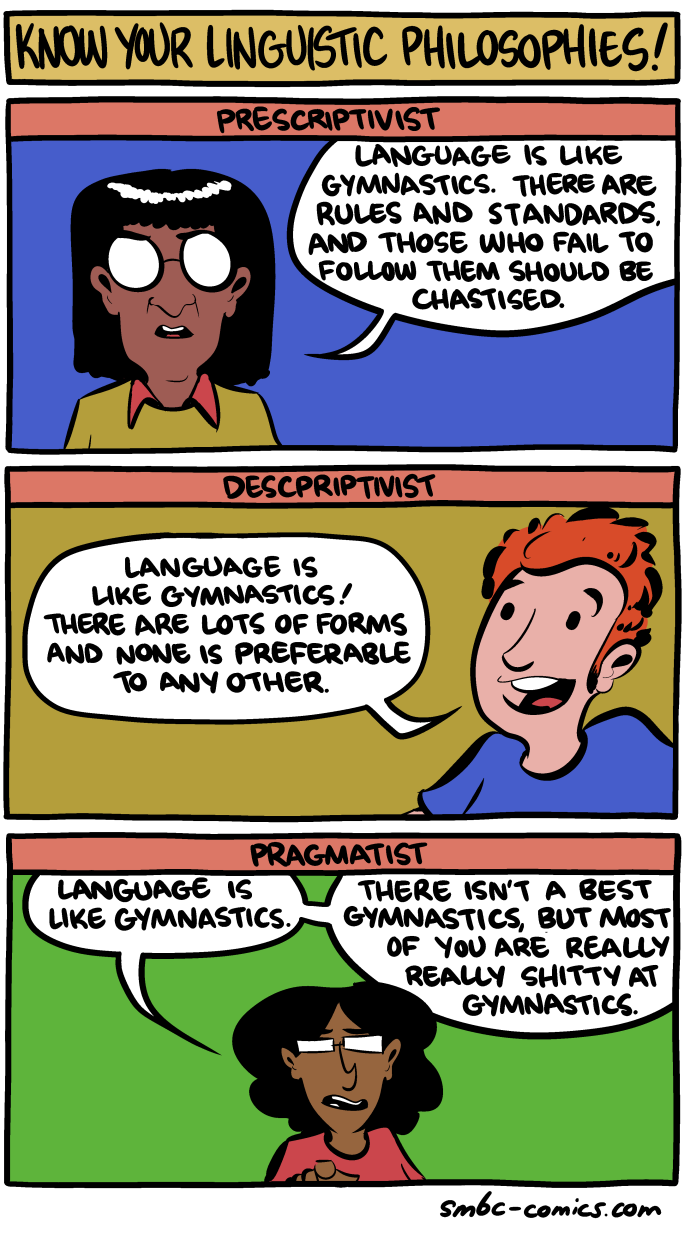
Saturday Morning Breakfast Cereal - Know Your Linguistic Philosophies

by admin@smbc-comics.com
Tertiarymatt

As in many things, here I am a pragmatist.

Hovertext: Language is a social construct that you REALLY suck at.


New comic!
Today's News:

BAHFest Submissions are still open! 

07 Jun 07:24

Introductions

My name is Sand. Technically my ghost says my name is Cassandra. But only he calls me that. I call myself Sand, and so that is my name. 

I call my ghost Archimedes, after an ancient human we read about in a rotting old book we found not long after he found me. Some warlock told me that Archimedes was the first human to use Light as a weapon. The book didn’t say anything about that. It mostly talked about him inventing simple machines and once running through the street naked. So I have my doubts. Either way, I reckon it’s a pretty good name. 

I asked Arc (he says if my name is Sand, his name is Arc) how he knew my name is Cassandra. He says it just is, and he just knows it, same as how he just knew where to find me, and that he could bring me back. Typical ghost stuff, and not very satisfying, even for a hunter. Of course, I’m a hunter that doesn’t know what she’s hunting. So I probably shouldn’t complain. The warlock I know best–an Awoken named Desdemona–says that ghosts are partly just channels or conduits. That the Traveller can just drop things into Arc’s glowing little brain. And mine too, maybe. It can be hard to tell where one of us ends and the other begins. So sometimes they just know things, because the Traveller knows them. And no one can even guess at what the Traveller might know. Or what it’s forgotten. 

I’m having Arc store these notes in the archive, as a kind of record. Not everything in it will be worth much. Maybe none of it will be. But it feels important to do, regardless. We’ve lost so much knowledge that we took for granted, and you can never tell when some seemingly useless thing discovered by someone like me turns out to be important. Or so I tell myself. 

Technically, I live in the Tower, like most Guardians. And I love the City, our Last City, with the luminous Traveller hanging overhead. But I live in the Tower in the same way that my name is Cassandra. 

My real home is out here, on the edges of the Light, with wild things of this world and others. I live out in the wilds because exploring is what I was made for, so far as I can tell. The City is beautiful, and full of life, and most of my fellow humans. But I’m not really one of them anymore. I’m something else, something called up from beyond death by a power that none us really understand. The people in the City, I think they’re more than a little bit afraid of us, the way we channel the power of the Light in marvelous and terrible ways. How we can brush off death. 

I can’t say that I blame them. 

03 Jun 20:03

I'm a black ex-cop, and this is the real truth about race and policing

Tertiarymatt

Solid piece.

On any given day, in any police department in the nation, 15 percent of officers will do the right thing no matter what is happening. Fifteen percent of officers will abuse their authority at every opportunity. The remaining 70 percent could go either way depending on whom they are working with.

That's a theory from my friend K.L. Williams, who has trained thousands of officers around the country in use of force. Based on what I experienced as a black man serving in the St. Louis Police Department for five years, I agree with him. I worked with men and women who became cops for all the right reasons — they really wanted to help make their communities better. And I worked with people like the president of my police academy class, who sent out an email after President Obama won the 2008 election that included the statement, "I can't believe I live in a country full of ni**er lovers!!!!!!!!" He patrolled the streets in St. Louis in a number of black communities with the authority to act under the color of law.

That remaining 70 percent of officers are highly susceptible to the culture in a given department. In the absence of any real effort to challenge department cultures, they become part of the problem. If their command ranks are racist or allow institutional racism to persist, or if a number of officers in their department are racist, they may end up doing terrible things.

It is not only white officers who abuse their authority. The effect of institutional racism is such that no matter what color the officer abusing the citizen is, in the vast majority of those cases of abuse that citizen will be black or brown. That is what is allowed.

And no matter what an officer has done to a black person, that officer can always cover himself in the running narrative of heroism, risk, and sacrifice that is available to a uniformed police officer by virtue of simply reporting for duty. Cleveland police officer Michael Brelo was recently acquitted of all charges against him in the shooting deaths of Timothy Russell and Malissa Williams, both black and unarmed. Thirteen Cleveland police officers fired 137 shots at them. Brelo, having reloaded at some point during the shooting, fired 49 of the 137 shots. He took his final 15 shots at them after all the other officers stopped firing (122 shots at that point) and, "fearing for his life," he jumped onto the hood of the car and shot 15 times through the windshield.

About that 15 percent of officers who regularly abuse their power: they exert an outsize influence

Not only was this excessive, it was tactically asinine if Brelo believed they were armed and firing. But they weren't armed, and they weren't firing. Judge John O'Donnell acquitted Brelo under the rationale that because he couldn't determine which shots actually killed Russell and Williams, no one is guilty. Let's be clear: this is part of what the Department of Justice means when it describes a "pattern of unconstitutional policing and excessive force."

Nevertheless, many Americans believe that police officers are generally good, noble heroes. A Gallup poll from last year asked Americans to rate the honesty and ethical standards of people in various fields: police officers ranked in the top five, just above members of the clergy. The profession — the endeavor — is noble. But this myth about the general goodness of cops obscures the truth of what needs to be done to fix the system. It makes it look like all we need to do is hire good people, rather than fix the entire system. Institutional racism runs throughout our criminal justice system. Its presence in police culture, though often flatly denied by the many police apologists that appear in the media now, has been central to the breakdown in police-community relationships for decades in spite of good people doing police work.

Here's what I wish Americans understood about the men and women who serve in their police departments — and what needs to be done to make the system better for everyone.

1) There are officers who willfully violate the human rights of the people in the communities they serve

As a new officer with the St. Louis in the mid-1990s, I responded to a call for an "officer in need of aid." I was partnered that day with a white female officer. When we got to the scene, it turned out that the officer was fine, and the aid call was canceled. He'd been in a foot pursuit chasing a suspect in an armed robbery and lost him.

The officer I was with asked him if he'd seen where the suspect went. The officer picked a house on the block we were on, and we went to it and knocked on the door. A young man about 18 years old answered the door, partially opening it and peering out at my partner and me. He was standing on crutches. My partner accused him of harboring a suspect. He denied it. He said that this was his family's home and he was home alone.

My partner then forced the door the rest of the way open, grabbed him by his throat, and snatched him out of the house onto the front porch. She took him to the ledge of the porch and, still holding him by the throat, punched him hard in the face and then in the groin. My partner that day snatched an 18-year-old kid off crutches and assaulted him, simply for stating the fact that he was home alone.

I got the officer off of him. But because an aid call had gone out, several other officers had arrived on the scene. One of those officers, who was black, ascended the stairs and asked what was going on. My partner pointed to the young man, still lying on the porch, and said, "That son of a bitch just assaulted me." The black officer then went up to the young man and told him to "get the fuck up, I'm taking you in for assaulting an officer." The young man looked up at the officer and said, "Man ... you see I can't go." His crutches lay not far from him.

The officer picked him up, cuffed him, and slammed him into the house, where he was able to prop himself up by leaning against it. The officer then told him again to get moving to the police car on the street because he was under arrest. The young man told him one last time, in a pleading tone that was somehow angry at the same time, "You see I can't go!" The officer reached down and grabbed both the young man's ankles and yanked up. This caused the young man to strike his head on the porch. The officer then dragged him to the police car. We then searched the house. No one was in it.

These kinds of scenes play themselves out everyday all over our country in black and brown communities. Beyond the many unarmed blacks killed by police, including recently Freddie Gray in Baltimore, other police abuses that don't result in death foment resentment, distrust, and malice toward police in black and brown communities all over the country. Long before Darren Wilson shot and killed unarmed Michael Brown last August, there was a poisonous relationship between the Ferguson, Missouri, department and the community it claimed to serve. For example, in 2009 Henry Davis was stopped unlawfully in Ferguson, taken to the police station, and brutally beaten while in handcuffs. He was then charged for bleeding on the officers' uniforms after they beat him.

2) The bad officers corrupt the departments they work for

About that 15 percent of officers who regularly abuse their power: a major problem is they exert an outsize influence on department culture and find support for their actions from ranking officers and police unions. Chicago is a prime example of this: the city has created a reparations fund for the hundreds of victims who were tortured by former Chicago Police Commander Jon Burge and officers under his command from the 1970s to the early ‘90s.

The victims were electrically shocked, suffocated, and beaten into false confessions that resulted in many of them being convicted and serving time for crimes they didn't commit.  One man, Darrell Cannon, spent 24 years in prison for a crime he confessed to but didn't commit. He confessed when officers repeatedly appeared to load a shotgun and after doing so each time put it in his mouth and pulled the trigger. Other men received electric shocks until they confessed.

Like this video? Subscribe to Vox on YouTube.

The torture was systematic, and the culture that allowed for it is systemic. I call your attention to the words "and officers under his command." Police departments are generally a functioning closed community where people know who is doing what. How many officers  "under the command" of Commander Burge do you think didn't know what was being done to these men? How many do you think were uncomfortable with the knowledge? Ultimately, though, they were okay with it. And Burge got four years in prison, and now receives his full taxpayer-funded pension.

3) The mainstream media helps sustain the narrative of heroism that even corrupt officers take refuge in

This is critical to understanding why police-community relations in black and brown communities across the country are as bad as they are. In this interview with Fox News, former New York City Police Commissioner Howard Safir never acknowledges the lived experience of thousands and thousands of blacks in New York, Baltimore, Ferguson, or anywhere in the country. In fact, he seems to be completely unaware of it. This allows him to leave viewers with the impression that the recent protests against police brutality are baseless, and that allegations of racism are "totally wrong — just not true." The reality of police abuse is not limited to a number of "very small incidents" that have impacted black people nationwide, but generations of experienced and witnessed abuse.

The media is complicit in this myth-making: notice that the interviewer does not challenge Safir. She doesn't point out, for example, the over $1 billion in settlements the NYPD has paid out over the last decade and a half for the misconduct of its officers. She doesn't reference the numerous accounts of actual black or Hispanic NYPD officers who have been profiled and even assaulted without cause when they were out of uniform by white NYPD officers.

No matter what an officer has done to a black person, that officer can always cover himself in the running narrative of heroism

Instead she leads him with her questions to reference the heroism, selflessness, risk, and sacrifice that are a part of the endeavor that is law enforcement, but very clearly not always characteristic of police work in black and brown communities. The staging for this interview — US flag waving, somber-faced officers — is wash, rinse, and repeat with our national media.

When you take a job as a police officer, you do so voluntarily. You understand the risks associated with the work. But because you signed on to do a dangerous job does not mean you are then allowed to violate the human rights, civil rights, and civil liberties of the people you serve. It's the opposite. You should protect those rights, and when you don't you should be held accountable. That simple statement will be received by police apologists as "anti-cop."  It is not.

4) Cameras provide the most objective record of police-citizen encounters available

When Walter Scott was killed by officer Michael Slager in South Carolina earlier this year, the initial police report put Scott in the wrong. It stated that Scott had gone for Slager's Taser, and Slager was in fear for his life. If not for the video recording that later surfaced, the report would have likely been taken by many at face value. Instead we see that Slager shot Scott repeatedly and planted the Taser next to his body after the fact.

Like this video? Subscribe to Vox on YouTube.

Every officer in the country should be wearing a body camera that remains activated throughout any interaction they have with the public while on duty. There is no reasonable expectation of privacy for officers when they are on duty and in service to the public. Citizens must also have the right to record police officers as they carry out their public service, provided that they are at a safe distance, based on the circumstances, and not interfering. Witnessing an interaction does not by itself constitute interference.

5) There are officers around the country who want to address institutional racism

The National Coalition of Law Enforcement Officers for Justice, Reform and Accountability is a new coalition of current and former law enforcement officers from around the nation. Its mission is to fight institutional racism in our criminal justice system and police culture, and to push for accountability for police officers that abuse their power.

Many of its members are already well-established advocates for criminal justice reform in their communities. It's people like former Sergeant De Lacy Davis of New Jersey, who has worked to change police culture for years. It's people like former LAPD Captain John Mutz, who is white, and who is committed to working to build a system where everyone is equally valued. His colleagues from the LAPD —former Sergeant Cheryl Dorsey, now a frequent CNN contributor (providing some much-needed perspective), and former officer Alex Salazar, who worked LAPD's Rampart unit — are a part of this effort. Several  NYPD  officers, many of whom are founding members of 100 Blacks in Law Enforcement Who Care, the gold standard for black municipal police organizations, are a part of this group. Vernon Wells, Noel Leader, Julian Harper, and Cliff Hollingsworth, to name a few, are serious men with a serious record of standing up for their communities against police abuse. There's also Rochelle Bilal, a former sergeant out of Philadelphia, Sam Costales out of New Mexico, former Federal Marshal Matthew Fogg, and many others.

These men and women are ready to reach out to the thousands of officers around the country who have been looking for a national law enforcement organization that works to remake police culture. The first priority is accountability — punishment — for officers who willfully abuse the rights and bodies of those they are sworn to serve. Training means absolutely nothing if officers don't adhere to it and are not held accountable when they don't. It is key to any meaningful reform.

Police abuse in black and brown communities is generations old. It is nothing new.

Racism is woven into the fabric of our nation.  At no time in our history has there been a national consensus that everyone should be equally valued in all areas of life. We are rooted in racism in spite of the better efforts of Americans of all races to change that.

Because of this legacy of racism, police abuse in black and brown communities is generations old. It is nothing new. It has become more visible to mainstream America largely because of the proliferation of personal recording devices, cellphone cameras, video recorders — they're everywhere. We need police officers.  We also need them to be held accountable to the communities they serve.

02 Jun 11:00

kGoal

by Matthew Nolan
Tertiarymatt

NSFW, obvs, but features vagina-themed pokemon jokes.

Oh my gooooosh, I am completely in love with this doo-daddy. Matt doesn’t get it, though. Before I even tried it and then afterwards when I was raving about it, he kept pooh-poohing it because he just. didn’t. understand. why it was necessary. But I think that’s because he can see his penis and its responsiveness so he doesn’t appreciate what it’s like to have no idea if your genitals are doing what you’re trying to make them do. (Also he thinks $150 is way too much money for what it does. Which, yeah, that’s pretty steep. Can’t argue with that.)

And it turns out I have a super strong vagina! I had no idea! I consistently get a 10 out of 10 on the strength test :D :D :D Laaaaaaaaaaaaaadies? I know it’s probably bad form to brag about it, BUT OH MY GOSH my self-confidence honestly had a hilariously large boost upon learning this! Grrrr, yeah! I’m packin’ a Cuntnan the Vagarian here! (Matt didn’t understand this joke. It’s a not very good play on the name Conan the Barbarian. Except now it’s about my mighty vagina.)

On another vagina-related note, you all remember my friend Tracy Puhl from my review of the Moon Cup, right? That’s right, she’s the owner of GladRags, my favorite reusable menstrual product company! So she totes knows a thing or two about the vagaroo.

kGoals from our Friends (With Benefits)

Stockroom ALSO has a 15% discount for you, just add ‘OHJOY’ at checkout!AND Early To Bed has a 10% discount too! Just add ‘OHJOY’ at checkout!

Hey hey and today is the final day to pre-order Oh Joy Sex Toy, Volume TWO!
01 Jun 17:27

Elitism Stickers!

Tertiarymatt

tempted

elitismstickers800_1024x1024

Happy sexy stickers day. I just invented that holiday when I listed these lovely music elitism stickers.

01 Jun 08:12

Morphine - The Night (Full Album)

Tertiarymatt

Hearing Mark Sandman always makes me want to play the bass.

00:00 1) The Night 04:48 2) So Many Ways 08:50 3) Souvenir 13:30 4) Top Floor, Bottom Buzzer 19:14 5) Like A Mirror 24:40 6) Good Woman Is Hard To Find 28:54...
01 Jun 06:47

If I had one hundred dollars to spend on whiskey….

by Jason Pyle
Tertiarymatt

Decent, if rather conservative, suggestions.

A few weeks ago I was asked a question by a twitter follower (@GQuiz) and Sour Mash Manifesto visitor. He wanted to know “if I had $100 to spend, what whiskey(s) would I buy?” Bill over at Modern Thirst thought it would be a good idea to pose the same question to a number of other whiskey enthusiasts, bloggers, and writers in order to get their take as well. The responses are on his website, but below you can find mine.

Over the years I’ve been asked a thousand times to provide a “best” list of whiskey. I’d love to, but that’s just hard. If a whiskey lover can tell you exactly what her favorite whiskey is then I’d say she hasn’t sipped enough whiskey. I sure as hell couldn’t give you a top 10 or 20, much less a top 5. Every whiskey has a personality to fit a certain mood. It’s not much different than having a diverse mix of friends – you enjoy spending time with all of them for different reasons. Even a seemingly innocent question such as the one above becomes very hard when you consider all of the options.

First let me provide some context. There were few rules applied to this question – it could be approached from any possible angle (and I did!). The first constraint I placed on my response was to make certain I only considered American Whiskey. If you’ve visited this website enough I’m sure you know that Made in the U.S.A products are my area of focus. After that, anything goes!

I’ve attacked this question in too may ways. For example, right now I’m sipping a delicious barrel strength Booker’s Bourbon. It’s a delicious whiskey – never fails! If I allow recency bias to go crazy this Booker’s ($55) and Elijah Craig Single Barrel ($35) (for good measure) would wrap this thing up quick (I just cheated but you might want to write those down). Find me on a Tuesday with a hankering for a fabulous American Craft Single Malt, and the St. George Spirits Single Malt 14th release ($80 and a truly incredible pour) along with a handle of Evan Williams Black Label might get the nod (cheated again, but check these out). Get the point? This is a complex scenario. I needed order. I needed a compass to guide me.

The classics are classics for a reason. Can you find better? Perhaps, but you’ll be splitting hairs. The versatility that the classics bring to the table are simply too good to ignore. So, with that, the way I answered this question is I marched into my dining room, which holds hundreds and hundreds of bottles of whiskey, and I looked for the ones I purchased most. What do I buy? Regardless of what I think on a random day, I buy certain whiskeys consistently. And that I suppose is the best endorsement I can give.

If I had $100.00 to spend on whiskey, this is what I’d purchase?

Four Roses Single BarrelFour Roses Single Barrel ($35): If you love whiskey, please do yourself a favor and type “Jim Rutledge” in the search box on the top right of this website. Feel free to read the background on Four Roses and watch the videos I did with Jim, the Master Distiller, a number of years ago. Four Roses is easily a top 3 distillery in the U.S, maybe the best, but that’s subjective. The way the distillery works with recipes, yeast strains, and aging philosophy is completely different from everyone else. The distillery’s single barrel is the flagship of the lineup – fruity, well structured, bold and vibrant, but extremely well balanced. I have a bottle or two of the Single Barrel on hand at all times. It’s a requirement. Typically I’ll drink it neat or with a cube of ice, but don’t hesitate to make a bourbon-forward cocktail. It’s not against the law with such a good whiskey, and rest assured it will certainly stand up and be accounted for.

Rittenhouse Rye Bottled In BondRittenhouse Rye Whiskey ($25): Personally, no home bar is complete without a quality bottle of rye whiskey. Rittenhouse happens to be a bit more versatile than most others. It’s not quite as green and herbal as other popular rye whiskeys, and the value proposition is on point. If you are new to rye whiskey – start here. If you are well acquainted with rye whiskey – stay here. Rittenhouse Rye always delivers.

W.L. Weller 12 YearW.L. Weller 12 year ($30): Forget all of the “it’s the same stuff as Pappy” bull crap. That’s no reason to by it. Buy Weller 12 because it’s an excellent pour of whiskey on its own merit. It’s rich, sweet, but with a healthy oak backbone. Wheated bourbon north of the 10 year mark just becomes special, and Weller 12 exemplifies that. I drink it neat, in an old fashioned, a mint julep, and on ice in the heat of the summer – versatile and delicious. Availability is tighter than the others, but unlike a lot of the limited releases, Weller 12 shows up couple times a year. Talk to your local shop, request a bottle and let me know what you think. I typically by 3-4 bottles a year at my local retailer to make sure I have enough on hand.

Edited Note: While I’ve got a little money left over with the above list, I also took into account price variances depending on area. The above prices are an average for what I see, but Four Roses Single Barrel can push that $40 range at times, and Rittenhouse can move $2-3 north. So the above are ballparks.

There you have it. It may not be sexy, it may not be unique, but it’s what I buy. That is as good a recommendation as I can give. Share with us what you would buy if you had $100 to spend. Just as importantly – tell us why.

Cheers and drink your whiskey!

-Jason

01 Jun 06:43

Threnody

Tertiarymatt

...i feel oddly certain this has happened.

http://oglaf.com/threnody/

29 May 17:13

I’m tired of hijab.

When I was 19, I stood on stage and talked about being propositioned by a university professor. I said he was a dirty old man and repeated some of the choice phrases women hear every day in the streets of Egypt.

When I left the theater later that evening, I overheard two men:

“Isn’t she ashamed of herself for saying such dirty words when she’s veiled?!”
Photo Credit: Egypt Today (This is me, fyi)

Fast forward five years. I sat on a panel next to the president of Catalonia, speaking to more than 800 people from over 40 countries. And yet later on that day a man raised his hand after my presentation and said:

“You know, we’re doing you a favor.
We’re helping you take that symbol of oppression off your head.”

I’m tired of being the token “omg-look-such-an-articulate-awesome-non-stereotypical hijabi!”
I’m tired of hijab taking up so much space in my life.
I’m tired of speaking about it.
I’m tired of explaining it.
I’m tired of defending it.
I’m tired of being treated differently.
I’m tired of having to prove I’m normal.
I’m tired of being thought stupid and backwards.
I’m tired of the judgments — from both sides.
I’m tired of the opportunities denied.
I’m tired of expectations.
I’m tired of hijab.

It’s been a long, hard slog. I’ve been veiled for 15 years. I spent years writing about it, justifying it, hating it, loving it, ignoring it, defending it.

I did theater. Spoken word. I represented. I wrote angry critiques of the representation of Muslim women in media. I didn’t let other people speak for this Muslim woman. I spoke for myself. I wrote award-winning editorials like this one. Whoot whoot.

(If you’re interested, the project I loved most is crowdfunding here.)

But then I was done.

I was over having to constantly justify my choices.
I was over preaching to the choir.
I was over having to prove something.

I realized being thought of as “amazing” was actually insulting.
Because the assumption was that being veiled meant I was stupid and very non-amazing.

Hijab is so personal.

And yet it’s so public.

I’ve been told I had to take it off if I wanted to anchor a show.
I’ve been told “I wish I could shoot you.”
I’ve been refused entry into several venues.
I’ve been called a “dirty Arab,” an “ignorant Muslim,” a “stupid whore.”
I’ve been asked to sit at the back of a lecture hall.
I was just spat at in Paris last month.

You get the picture.

Being a hijabi is tough. It really is. There are days I wish for nothing more than to take it off. Days when I just want to be like everyone else. I don’t want to stick out like a sore thumb. I don’t want to be different.

It’s just covered hair to you. That is all. No more, no less.

The fascination with it is crazy.
Behind the veil.
Beneath the veil.
Unveiling the Muslim woman.

*ooooooooh insert Aladdin music here.*

Let it be. You don’t have to understand why I wear it.

There’s so much more to write.

But I’m already over this post.

28 May 04:43

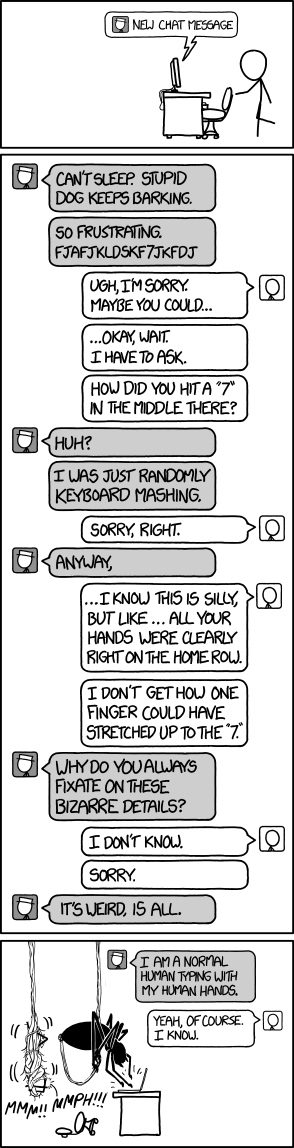
Keyboard Mash

Tertiarymatt

This is the best XKCD in kind of a long time, I think.

WHY DON'T YOU COME HANG OUT INSIDE MY HOUSE. WE CAN COOK BREAD AND CHAT ABOUT OUR INTERNAL SKELETONS.
26 May 05:19

Database interfaces

Tertiarymatt

R nerdery follows.

There are many different databases. The most familiar are row-column SQL databases like MySQL, SQLite, or PostgreSQL. Another type of database is the key-value store, which as a concept is very simple: you save a value specified by a key, and you can retrieve a value by its key. One more type is the document database, which instead of storing rows and columns, stores blobs of text or even binary files. The key-value and document types fall under the NoSQL umbrella. As there are mature R clients for many SQL databases, and dplyr is a great generic interface to SQL backends (see dplyr vignettes for an intro), we won't delve into SQL clients here.

What is the difference between SQL and NoSQL (key-value, document)? A diagram may be helpful:

diagram

NoSQL is often interpreted as Not only SQL - meaning a database that is called a NoSQL database may contain some notion of row-column storage, but other details diverge from traditional SQL databases. See Wikipedia for more information.

If you aren't already using databases, why care about databases? We'll answer this through a number of use cases:

  • Use case 1: Let's say you are producing a lot of data in your lab - millions of rows of data. Storing all this data in .xls or .csv files would definitely get cumbersome. If the data is traditional row-column spreadsheet data, a SQL database is perfect, perhaps PostgreSQL. Putting your data in a database allows the data to scale up easily while maintaining speedy data access, many tables can be linked together if needed, and more. Of course if your data will always fit in memory of the machine you're working on, a database may be too much complexity.
  • Use case 2: You already have data in a database, whether SQL or NoSQL. Of course it makes sense to interface with the database from R instead of e.g., exporting files from the database, then into R.
  • Use case 3: A data provider gives dumps of data that you need for your research/work problem. You download the data and it's hundreds of .csv files. It sure would be nice to be able to efficiently search this data. Simple searches like return all records with variable X < 10 are ideal for a SQL database. If instead the files are blobs of XML, JSON, or something else non-tabular, a document database is ideal.
  • Use case 4: You need to perform more complicated searches than SQL can support. Some NoSQL databases have very powerful search engines, e.g., Elasticsearch.
  • Use case 5: Sometimes you just need to cache stuff. Caching is a good use case for key-value stores. Let's say you are requesting data from a database online, and you want to make a derivative data thing from the original data, but you don't want to lose the original data. Simply storing the original data on disk in files is easy and does the job. Sometimes though, you may need something more structured. Redis and etcd are two key-value stores we make clients for and can make caching easy. Another use for caching is to avoid repeating time-consuming queries or queries that may cost money.
  • Use case 6: Indexable serialization. Related to the previous discussion of caching, this is caching, but better. That is, instead of dumping an R object to a cache, then retrieving the entire object later, NoSQL DB's make it easy to serialize an R object, and retrieve only what you need. See Rich FitzJohn's storr for an example of this.

rOpenSci has an increasing suite of database tools:

  • elastic (document database) (on CRAN)
  • sofa (document database)
  • solr (document database) (on CRAN)
  • etseed (key-value store)
  • rrlite (key-value store)
  • rerddap (SQL database as a service, open source) (on CRAN)
  • ckanr (SQL database as a service, open source)
  • nodbi (DBI, but for NoSQL DB's)

Some of these packages (e.g., rrlite, nodbi) can be thought of as infrastructure, just like clients for PostgreSQL or SQLite, for which other R packages can be created - or that can be used to interface with a database. Other packages (e.g., ckanr) are more likely to be useful to end users for retrieving data for a project.

If you're wondering what database to use:

  • You may want a SQL database if: you have tabular data, and the schema is not going to change
  • You may want a NoSQL key-value database if: you want to shove objects into something, and then retrieve later by a key
  • You may want a NoSQL document database if:
    • you need to store unstructured blobs, even including binary attachments
    • you need a richer query interface than a SQL database can provide

SQL databases have many advantages - one important advantage is that SQL syntax is widely used, and there are probably clients in every concievable language for interacting with SQL databases. However, NoSQL can be a better fit in many cases, overriding this SQL syntax familiarity.

There is another type of NoSQL database, the graph database, including Neo4j and Titan. We didn't talk much about them here, but they can be useful when you have naturally graph like data. A science project using a graph database is Open Tree of Life. There is an R client for Neo4J: RNeo4j.

Let us know if you have any feedback on these packages, and/or if you think there's anything else we should be thinking about making in this space. Now on to some examples of rOpenSci packages.

Get devtools

We'll need devtools to install some of these packages, as not all are on CRAN. If you are on Windows, see these notes.

install.packages("devtools")

elastic

elastic - Interact with Elasticsearch.

install.packages("elastic")
library("elastic")

elastic is a powerful document database with a built in query engine. It speaks JSON, has a nice HTTP API, which we use to communicate with elastic from R. What's great about elastic over e.g., Solr is that you don't have to worry about specifying a schema for your data. You can simply put data in, and then query on that data. You can specify configuration settings.

Example

In a quick example, here's going from a data.frame in R, putting data into elastic, then querying on that data.

library("ggplot2")
invisible(connect())
res <- docs_bulk(diamonds, "diam")

About 54K records in Elasticsearch for the dataset.

count("diam")
#> [1] 53940

We don't have time to go through hardly any of the diverse and powerful Elasticsearch query interface, so as an example, let's plot the price of diamonds in $300 buckets using the Elasticsearch aggregations search API

aggs <- '{
    "aggs": {
        "pricebuckets" : {
           "histogram" : {
               "field" : "price",
               "interval" : 300
           }
        }
    }
}'
res <- Search("diam", body = aggs, size = 0)
df <- do.call("rbind.data.frame", res$aggregations$pricebuckets$buckets)
ggplot(df, aes(key, doc_count)) + 
  geom_bar(stat = "identity") + 
  theme_grey(base_size = 20) + 
  labs(x = "Price", y = "Count")
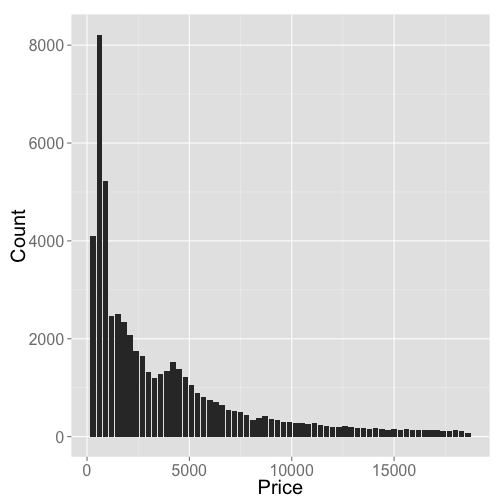
plot of chunk unnamed-chunk-7

We have a package in developmented called elasticdsl that follows the lead of the Python client elasticsearch-dsl-py to allow native R based ways to specify queries. The package focuses on querying for data, whereas other operations will remain in the lower level elastic client.

sofa

sofa - Interact with CouchDB.

devtools::install_github("ropensci/sofa")
library("sofa")

Example

Connect to your running CouchDB instance:

?cushion

Create a database

db_create(dbname = 'sofadb')

Create a document in that database

doc_create('{"name":"sofa","beer":"IPA"}', dbname = "sofadb", docid = "a_beer")

Get the document

doc_get(dbname = "sofadb", docid = "a_beer")

There's a similar interface to inserting data within R directly into CouchDB, just as with Elasticsearch above. There's lots more to do in sofa, including adding ability to do map-reduce.

solr

solr - A client for interacting with Solr.

solr focuses on reading data from Solr engines. We are working on adding functionality for working with more Solr features, including writing documents. Adding support for writing to solr is a bit trickier than reading data, since writing data requires specifying a schema.

install.packages("solr")
library("solr")

Example

A quick example using a remote Solr server the Public Library of Science search engine.

solr_search(q = '*:*', fl = c('id', 'journal', 'publication_date'), base = 'http://api.plos.org/search', verbose = FALSE)
#>                                                     id  journal
#> 1                   10.1371/journal.pone.0123754/title PLOS ONE
#> 2                10.1371/journal.pone.0123754/abstract PLOS ONE
#> 3              10.1371/journal.pone.0123754/references PLOS ONE
#> 4                    10.1371/journal.pone.0123754/body PLOS ONE
#> 5            10.1371/journal.pone.0123754/introduction PLOS ONE
#> 6  10.1371/journal.pone.0123754/results_and_discussion PLOS ONE
#> 7   10.1371/journal.pone.0123754/materials_and_methods PLOS ONE
#> 8             10.1371/journal.pone.0123754/conclusions PLOS ONE
#> 9                         10.1371/journal.pone.0031384 PLoS ONE
#> 10                  10.1371/journal.pone.0031384/title PLoS ONE
#>        publication_date
#> 1  2015-05-04T00:00:00Z
#> 2  2015-05-04T00:00:00Z
#> 3  2015-05-04T00:00:00Z
#> 4  2015-05-04T00:00:00Z
#> 5  2015-05-04T00:00:00Z
#> 6  2015-05-04T00:00:00Z
#> 7  2015-05-04T00:00:00Z
#> 8  2015-05-04T00:00:00Z
#> 9  2012-02-14T00:00:00Z
#> 10 2012-02-14T00:00:00Z

solr is quite useful in R since it is a common search engine that is often exposed as is, so that you can pop this solr R client into your script or package and (hopefully) not have to worry about how to query the Solr service.

etseed

etseed is an R client for the etcd key-value store, developed by the folks at coreos, written in Go.

This package is still in early days, and isn't exactly the fastest option in the bunch here - but upcoming changes (including allowing bulk writing and retrieval) in etcd should help.

devtools::install_github("ropensci/etseed")
library("etseed")

A note before we go through an example. etcd has a particular way of specifying keys, in that you have to prefix a key by a forward slash, like /foobar instead of foobar.

Example

Save a value to a key

create(key = "/mykey", value = "this is awesome")
#> $action
#> [1] "set"
#> 
#> $node
#> $node$key
#> [1] "/mykey"
#> 
#> $node$value
#> [1] "this is awesome"
#> 
#> $node$modifiedIndex
#> [1] 1299
#> 
#> $node$createdIndex
#> [1] 1299
#> 
#> 
#> $prevNode
#> $prevNode$key
#> [1] "/mykey"
#> 
#> $prevNode$value
#> [1] "this is awesome"
#> 
#> $prevNode$modifiedIndex
#> [1] 1298
#> 
#> $prevNode$createdIndex
#> [1] 1298

Fetch the value given a key

key(key = "/mykey")
#> $action
#> [1] "get"
#> 
#> $node
#> $node$key
#> [1] "/mykey"
#> 
#> $node$value
#> [1] "this is awesome"
#> 
#> $node$modifiedIndex
#> [1] 1299
#> 
#> $node$createdIndex
#> [1] 1299

rrlite

rrlite - An R client for the Redis C library rlite

devtools::install_github("ropensci/rrlite")
library("rrlite")

This package may be more interesting than other R Redis clients because there is no need to start up a server since rlite is a serverless engine.

Example

Here, we initialize, then put 20 values into rlite, assigned to the key foo, then retrieve the values by the same key.

r <- RedisAPI::rdb(rrlite::hirlite)
r$set("foo", runif(20))
r$get("foo")
#>  [1] 0.51670270 0.08039860 0.34762872 0.30276370 0.15985876 0.66062207
#>  [7] 0.26802708 0.97451274 0.94458185 0.04604044 0.93153133 0.91241321
#> [13] 0.64395377 0.12517230 0.31826622 0.34425757 0.79364064 0.91926051
#> [19] 0.47487029 0.11644076

This is a good candidate for using within other R packages for more sophisticated caching than simply writing to disk, and is especially easy since users aren't required to spin up a server as with normal Redis, or other DB's like CouchDB, MongoDB, etc.

rerddap

rerddap - A general purpose R client for any ERDDAP server.

ERDDAP servers

install.packages("rerddap")
library("rerddap")

ERDDAP is a server built on top of OPenDAP. NOAA serve many differen datasets through ERDDAP servers. Through ERDDAP, you can get gridded data (see griddap()), which lets you query from gridded datasets (see griddap()), or tablular datasets (see tabledap()). ERDDAP is open source, so anyone can use it to serve data.

rerddap by default grabs NetCDF files, a binary compressed file type that should be faster to download, and take up less disk space, than other formats (e.g., csv). However, this means that you need a client library for NetCDF files - but not to worry, we use ncdf by default (for which there are CRAN binaries for all platforms), but you can choose to use ncdf4 (binaries only for some platforms).

Example

In this example, we search for gridded datasets

ed_search(query = 'size', which = "grid")
#> 6 results, showing first 20 
#>                                                                                                   title          dataset_id
#> 11                                                      NOAA Global Coral Bleaching Monitoring Products            NOAA_DHW
#> 13 USGS COAWST Forecast, US East Coast and Gulf of Mexico (Experimental) [time][s_rho][eta_rho][xi_rho] whoi_7dd7_db97_4bbe
#> 14  USGS COAWST Forecast, US East Coast and Gulf of Mexico (Experimental) [time][Nbed][eta_rho][xi_rho] whoi_a4fb_2c9c_16a7
#> 15        USGS COAWST Forecast, US East Coast and Gulf of Mexico (Experimental) [time][eta_rho][xi_rho] whoi_ed12_89ce_9592
#> 16            USGS COAWST Forecast, US East Coast and Gulf of Mexico (Experimental) [time][eta_u][xi_u] whoi_61c3_0b5d_cd61
#> 17            USGS COAWST Forecast, US East Coast and Gulf of Mexico (Experimental) [time][eta_v][xi_v] whoi_62d0_9d64_c8ff

Get more information on a single dataset of interest

info('noaa_esrl_027d_0fb5_5d38')
#> <ERDDAP info> noaa_esrl_027d_0fb5_5d38 
#>  Dimensions (range):  
#>      time: (1850-01-01T00:00:00Z, 2014-05-01T00:00:00Z) 
#>      latitude: (87.5, -87.5) 
#>      longitude: (-177.5, 177.5) 
#>  Variables:  
#>      air: 
#>          Range: -20.9, 19.5 
#>          Units: degC

Then fetch the dataset

griddap('noaa_esrl_027d_0fb5_5d38',
        time = c('2012-07-01', '2012-09-01'),
        latitude = c(21, 19),
        longitude = c(-80, -76)
)
#> <ERDDAP griddap> noaa_esrl_027d_0fb5_5d38
#>    Path: [~/.rerddap/3d23f817218694a622895e78417d291f.nc]
#>    Last updated: [2015-05-14 11:02:25]
#>    File size:    [0 mb]
#>    Dimensions (dims/vars):   [3 X 1]
#>    Dim names: time, latitude, longitude
#>    Variable names: CRUTEM3: Surface Air Temperature Monthly Anomaly
#>    data.frame (rows/columns):   [6 X 4]
#>                   time latitude longitude       air
#> 1 2012-07-01T00:00:00Z     22.5     -77.5        NA
#> 2 2012-07-01T00:00:00Z     22.5     -77.5 0.2500000
#> 3 2012-08-01T00:00:00Z     22.5     -77.5        NA
#> 4 2012-08-01T00:00:00Z     17.5     -77.5 0.2666667
#> 5 2012-09-01T00:00:00Z     17.5     -77.5        NA
#> 6 2012-09-01T00:00:00Z     17.5     -77.5 0.1000000

There are many different ERDDAP servers, see the function servers() for help.

More information on ERDDAP: http://upwell.pfeg.noaa.gov/erddap/information.html

ckanr

ckanr - A general purpose R client for any CKAN server.

CKAN is similar to ERDDAP in being an open source system to store and provide data via web services (and web interface, but we don't need that here). CKAN bills itself as an open-source data portal platform.

devtools::install_github("ropensci/ckanr")
library("ckanr")

Example

Examples use the CKAN server at http://data.techno-science.ca

Show changes in a CKAN server

changes(limit = 10, as = "table")[, 1:2]
#>                                 user_id                  timestamp
#> 1  27778230-2e90-4818-9f00-bbf778c8fa09 2015-03-30T15:06:55.500589
#> 2  27778230-2e90-4818-9f00-bbf778c8fa09 2015-01-09T23:33:14.303237
#> 3  27778230-2e90-4818-9f00-bbf778c8fa09 2015-01-09T23:31:49.537792
#> 4  b50449ea-1dcc-4d52-b620-fc95bf56034b 2014-11-06T18:58:08.001743
#> 5  b50449ea-1dcc-4d52-b620-fc95bf56034b 2014-11-06T18:55:55.059527
#> 6  27778230-2e90-4818-9f00-bbf778c8fa09 2014-11-05T23:17:46.422404
#> 7  27778230-2e90-4818-9f00-bbf778c8fa09 2014-11-05T23:17:05.134909
#> 8  27778230-2e90-4818-9f00-bbf778c8fa09 2014-11-05T23:12:44.074493
#> 9  27778230-2e90-4818-9f00-bbf778c8fa09 2014-11-05T23:11:41.536040
#> 10 27778230-2e90-4818-9f00-bbf778c8fa09 2014-11-05T21:54:39.496994

Search for data packages

package_search(q = '*:*', rows = 2, as = "table")$results[, 1:7]
#>                      license_title maintainer relationships_as_object private maintainer_email         revision_timestamp
#> 1 Open Government Licence - Canada                               NULL   FALSE                  2014-10-28T21:18:27.068320
#> 2 Open Government Licence - Canada                               NULL   FALSE                  2014-10-28T21:18:58.958555
#>                                     id
#> 1 f4406699-3e11-4856-be48-b55da98b3c14
#> 2 0a801729-aa94-4d76-a5e0-7b487303f4e5

More information on CKAN: http://docs.ckan.org/en/latest/contents.html

nodbi

nodbi - Like the DBI package, but for document and key-value databases.

nodbi has five backends at the moment:

  • Redis
  • etcd
  • MongoDB
  • CouchDB
  • Elasticsearch

nodbi is in early development, so expect changes - but that also means it's a good time to give your input. What use cases you can think of for this package? What database do you think should be added as a backend?

devtools::install_github("ropensci/nodbi")
library("nodbi")

Example

We'll use MongoDB to store some data, then pull it back out. First, start up your mongo server, then intialize the connection

mongod
(src <- src_mongo())
#> MongoDB 3.0.2 (uptime: 230s)
#> URL: Scotts-MBP/test

Insert data

library("ggplot2")
diamonds$cut <- as.character(diamonds$cut)
diamonds$color <- as.character(diamonds$color)
diamonds$clarity <- as.character(diamonds$clarity)
docdb_create(src, key = "diam", value = diamonds)

Pull data back out

res <- docdb_get(src, "diam")
head(res)
#>   carat       cut color clarity depth table price    x    y    z
#> 1  0.23     Ideal     E     SI2  61.5    55   326 3.95 3.98 2.43
#> 2  0.21   Premium     E     SI1  59.8    61   326 3.89 3.84 2.31
#> 3  0.23      Good     E     VS1  56.9    65   327 4.05 4.07 2.31
#> 4  0.29   Premium     I     VS2  62.4    58   334 4.20 4.23 2.63
#> 5  0.31      Good     J     SI2  63.3    58   335 4.34 4.35 2.75
#> 6  0.24 Very Good     J    VVS2  62.8    57   336 3.94 3.96 2.48

Data is identical:

identical(diamonds, res)
#> [1] TRUE
26 May 00:01

SteamVR's "Lighthouse" for Virtual Reality and Beyond

by Joey Fameli
Tertiarymatt

Being used by the Void?

25 May 23:48

Tested In-Depth: PCIe Solid State Storage

by Joey Fameli
Tertiarymatt

Well, this is pretty absurdly fast.

25 May 22:56

Neonicotinoids: euphoria then death for bees

by Rusty
Tertiarymatt

No surprises here. These neoniotnoid seed coatings are so dumb. They add almost no value for farmers, almost certainly damage the soil fungal community, and their systemic expression is injurious to bees of all stripes, and probably lots of other non-harmful insects as well.

Two papers published in the journal Nature earlier this week are causing quite a stir in the bee world. The first, “Seed coating with a neonicotinoid insecticide negatively affects wild bees” by Rundlof et al. is unique in that the authors were able to perform controlled field experiments. This is often difficult to do because […]
25 May 22:54

Let’s save the right bees

by Rusty
Tertiarymatt

ALL THE POLLINATORS

It’s about time that someone clearly and succinctly wrote about the “bee problem.” And someone finally did. Gwen Pearson, known for years as the Bug Girl, has a story in yesterday’s Wired that says it all, “You’re Worrying about the Wrong Bees.” I’ve been a fan of Gwen and her writing for a long time, […]
25 May 22:52

Taranov split in photos

by Rusty
Tertiarymatt

It's really crazy that this process works as well as it does.

Since I’ve written many posts about Taranov splits, I’m not going to belabor the whys and hows. Still, I’m always amazed that it works so well. For me, it is the best way to split into non-compatible equipment. In this case, I was splitting a top-bar hive into a Langstroth. I had thought this hive […]
25 May 22:49

Pollinators on the night shift

by Rusty
Tertiarymatt

We need all the pollinators.

Nocturnal pollination is something I seldom think about, but this fascinating article by Paul Manning at Poky Ecology describes a host of nighttime pollinators in lowbush blueberry. Really, I had no idea how busy a berry bush in the dark could be. In a series of experiments, researchers found that as much as one-third of […]
25 May 22:46

What do you smoke?

by Rusty
Tertiarymatt

Some considerations here I'd never thought about.

Five years ago I wrote a post about what beekeepers burn in their smokers. Earlier today, Bill Reynolds of Minnesota added a comment to that post, recommending adding a handful of green grass to a fast-burning smoker to cool down the smoke and avoid singeing wings. Good point. When I re-read my post, I was […]
25 May 22:44

Silver prices affect the price of all film products

by Bob Crowley
Tertiarymatt

As someone who has used silver in multiple ways, I miss the days of $7/oz

Here is a historical chart of the price of silver that shows the more recent spike in prices, and then the collapse.  Although plastics and sensitizing dyes can be as costly as the silver used, all film is subject to price spikes when and if the price of silver spikes. As you can see, it did that. Like oil, the price of the final product is quick to rise, and very slow to fall.


25 May 22:16

All work and no updates makes Scott a dull boy. All work and no updates makes Scott a dull boy. All work and no updates makes Scott a dull boy.


25 May 22:12

Buddhism and Politics

by Brad
Tertiarymatt

What bugs me is when it appears that liberal, left-leaning Buddhists are trying to mix Buddhism with their political agenda in precisely the same way people like Pat Robertson mix Christianity with their conservative political agenda. This just makes us all look bad to everyone except lefty types who already agree with whatever cause is being espoused. Nobody is going to be convinced to change their views on militarism or global warming because they saw a photo of a bunch of weirdos in costumes they associate with cult members holding a banner outside of the White House. It’s an exercise in vanity, which can only serve to help entrench people’s previously established views.

It’s never as easy as you would like. To say Buddhists should not be involved in politics is obviously silly. But to say that all Buddhists should share a certain specific set of political views is also ridiculous.

A few years ago I was giving a talk at the Houston Zen Center. Gaelyn Godwin, who runs the center, took me aside before the talk and said, “We have a lot of conservatives in our group. So if you say anything political, it’s best not to assume the audience here is liberal.”

I had not intended to talk about politics at all. But maybe she’d seen this sort of thing before with visiting speakers. A lot of Buddhist centers in America have a very strong left-leaning political bias. I often see stuff for liberal causes tacked up to bulletin boards at the Buddhist centers I visit and it always bugs me. But maybe not for the reasons some of you would assume.

I find it amusing that, after my post I Wish I Could Agree, I’m seeing myself labeled as a “conservative Buddhist.” I’m really not. I’m fairly apolitical. But when it comes to most issues I tend to side with the more liberal, left-leaning views.

Zero Defex EP

Zero Defex EP

I am, after all, a member of the hardcore band Zero Defex, who have songs that address topics like the dangers of nuclear proliferation (Drop the A-Bomb On Me ), global warming (Armageddon), fracking (National Sacrifice Zone), unregulated capitalism (Competition), the horrors of war in general (This Means War, War Zone), and the hazards of dobermans sticking their noses up your butt when you’re trying to heat up a bagel (Swine Hunt Doggen). One of our songs was even used in the Ralph Nader presidential campaign a few years ago. No. I am definitely not a “conservative Buddhist.”

But I am concerned whenever I see any mixing of religion and politics. When I was a youngster I was aghast at seeing Christianity mixed with conservative politics, with the implication that Jesus himself wanted you to vote Republican. If we respond to that with the equivalent of, “No! Buddha wants you to vote Democrat!” I don’t see how that’s any better.

I understand when Buddhists are concerned with issues like militarism and global climate change. These are urgent matters that affect all of us. It’s just that it rankles me to see people representing themselves as the “leaders” of Buddhism and presenting their views as if they are the consensus views of all Buddhists.

I can’t count how many times I’ve had to explain that there is more than one form of Buddhism to people who seem surprised at this revelation. Or how many times I’ve had to tell someone that not every Buddhist considers the Dalai Lama to be their commander and spokesman. Or how many times I’ve had to explain that all Buddhists do not have a unified political agenda. Then something comes along like the meeting at the White House that I wrote about in my blog post and I have to start explaining it all over again.

Which is fine. I like explaining things.

What bugs me is when it appears that liberal, left-leaning Buddhists are trying to mix Buddhism with their political agenda in precisely the same way people like Pat Robertson mix Christianity with their conservative political agenda. This just makes us all look bad to everyone except lefty types who already agree with whatever cause is being espoused. Nobody is going to be convinced to change their views on militarism or global warming because they saw a photo of a bunch of weirdos in costumes they associate with cult members holding a banner outside of the White House. It’s an exercise in vanity, which can only serve to help entrench people’s previously established views.

This is not the same as saying Buddhists should never be involved in politics. If you’re a Buddhist and you want to get mixed up in that circus, be my guest. I don’t really care. Just please don’t represent yourselves as the leaders of Buddhism and your specific views as the correct ones for Buddhists to hold.

For my own part, I try to keep my political views out of what I do in my capacity as a teacher of Buddhism. I don’t want my politics to be seen as somehow “Buddhist.” It’s very easy to send a mixed up message.

For example, I’m a vegetarian. I really believe in vegetarianism. I think it’s a great thing and I’d like to see more people become vegetarians. I believe it’s an important issue in terms of personal health, environment, and ethics.

Yet I am very aware that a lot of people who don’t know much about Buddhism tend to believe that all Buddhists are vegetarians and that Buddhism requires its adherents to abstain from eating meat. This is not true. My friend Gesshin wrote a really good blog piece recently about this. In a nutshell, lots of Buddhists eat meat, and the historical Buddha never required his followers to be strict vegetarians.

Because I see the dangers of confusing people on this issue and making them think that Buddha will send them to Buddhist Hell for eating at McDonald’s (I think he should but he won’t), I tend to avoid making too many overt statements about my vegetarianism. And when I do talk about it, I always make sure I explain that vegetarianism is a personal choice, not something mandated by my Buddhist practice.

(Interestingly, I found that in Japan — where they should know better — I could simply say “I’m a Buddhist” and people would quickly accept my vegetarianism without any further need for discussion.)

I feel that Buddhists with strong political convictions would do better to approach their political convictions the same way. In America, Europe and the rest of the West, Buddhism is very often seen as going hand-in-hand with leftist political views. As is the case with vegetarianism, lots of folks who know little about Buddhism tend to assume Buddhists will have a leftist political bias.

Those people on the Interwebs who referred to me as a “conservative Buddhist” obviously knew that there was a general feeling that it was unusual to be a conservative and a Buddhist at the same time. Actually, it’s not that weird. Just like there are millions of liberal Christians, there are also millions of conservative Buddhists.

I think it’s unfair to take advantage of misunderstandings about Buddhism and its relation to politics in order to advance a specific agenda.

I don’t like it when religion gets mixed up in politics even when it’s a religion I follow and a political agenda I tend (mostly but not always) to agree with.

UPCOMING EVENTS

July 8-12, 2015 Vancouver, BC Canada 5-DAY RETREAT at HOLLYHOCK RETREAT CENTER

August 14-16, 2015 Munich, Germany 3 DAY ZEN RETREAT

August 19, 2015 Munich, Germany LECTURE

August 24-29, 2015 Felsentor, Switzerland 5-DAY RETREAT AT STIFTUNG FELSENTOR 

August 30-September 4, 2015 Holzkirchen, Germany 5-DAY RETREAT AT BENEDIKTUSHOF MONASTERY

September 4, 2015 Hamburg, Germany LECTURE

September 6, 2015 Hamburg, Germany ZEN DAY

September 10-13, 2015 Finland 4-DAY RETREAT

September 16-19, 20015 Hebden Bridge, England 4-DAY RETREAT

September 26-27, 2015 Glastonbury, England 2-DAY RETREAT

November 6-8, 2015 Mt. Baldy, CA 3-DAY RETREAT

ONGOING EVENTS

Every Monday at 8pm there’s zazen at Silverlake Yoga Studio 2 located at 2810 Glendale Boulevard, Los Angeles, CA 90039. All are welcome!

Every Saturday at 9:30 there’s zazen at the Veteran’s Memorial Complex located at 4117 Overland Blvd., Culver City, CA 90230. All are welcome!

Plenty more info is available on the Dogen Sangha Los Angeles website, dsla.info

* * *

Your donations will not be sent to the Democratic campaign. They’ll be sent to my landlord. Thank you very much!


25 May 20:54

Fufanu - Full Peformance (Live on KEXP)

Tertiarymatt

A little Bauhaus, a little Joy Division, some post-rock.

http://KEXP.ORG presents Fufanu performing live at Toppstöðin power station in Reykjavik during Iceland Airwaves. Recorded November 3, 2014. Songs: Now Wire ...
25 May 20:50

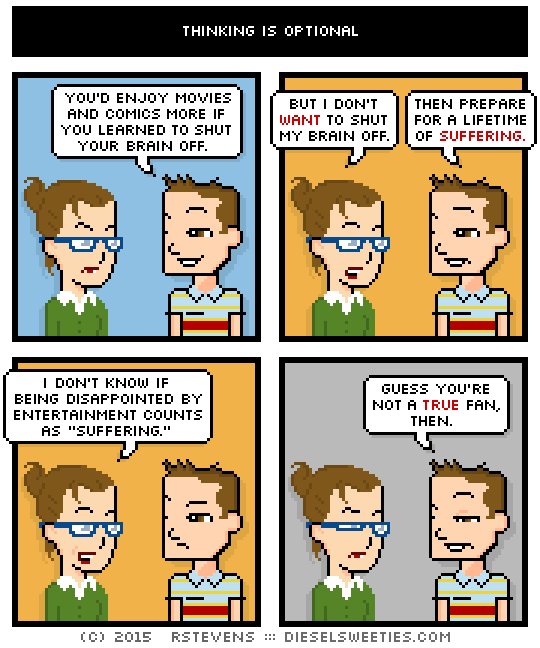
Thinking is Optional

Tertiarymatt

I've arrived in a "divided brain" state. One part of my brain falls totally for all the stupid things in the movie, and gets emotional, while simultaneously the other part picks them apart, and shouts obscenities.

sleep is dumb

Tonight’s comic is about shutting your brain off.