Shared posts

06 Apr 00:28

Mixed news everyone: update, help search, report and pics.

Tertiarymatt

Boy that's a big increase in users.

Mixed news everyone!

1. First and the most important: thank you everybody for your donations. We now have enough to secure our servers for the next two months or so. You can donate using Flattr or using bitcoins: 1JMYDeTaJHvfL6stbvwNdbY8zVqWfEnucU.

2. We’ve got an incredible amount of emails during last three weeks. There’ve been several days when all three of us were busy mostly dealing with user requests. If you believe that The Old Reader is missing something (and it surely is), please go to our Uservoice page, browse the issues (most likely, someone has already created your suggestion), and vote for the ones you like. Also you can see what’s already planned there. And please, check our Status page or subscribe to our Twitter account — we are updating these two on current issues.

We only have that much time during the day to spare on this project, and we would prefer to spend it making The Old Reader more reliable or implementing new features, not removing duplicate feature requests or explaining how to create a folder.

We are focused on making everything work for the vast number of users and feeds, for now this is our top priority.

image(image by ProlificPen)

3. We could really use some help on the Ruby on Rails front. If you have experience engineering medium-size websites, and you’d like to become a part of our small team, please, drop us a line to hello@theoldreader.com. If you have any other suggestions about how you can help us, feel free to email us as well. Or just spread the word, that’d be much appreciated.

We can’t pay you a huge pile of money, but we still have something interesting to offer.

4. Cool graphs, no?
cool graphs

03 Apr 02:13

The Future Sound of Puget

by noreply@blogger.com (M.S. Patterson)
Tertiarymatt

Trying to actually use my blog. #selfshare

As I mentioned the other day on my plus account, last Thursday we held a small conference on the Future of Puget Sound. The guest panelists were Amy Snover and Howard Frumkin from the University of Washington, the chief analyst technical fellow at Boeing, Bob Peterson, and Diana Gale of the Puget Sound Leadership Council (though she is also a lecturer at the Evans School of Public Affairs at UW).  Larry Susskind closed out the day with a keynote on collaborative decision-making methods.

Marina opened up the day by presenting a short talk on how deeply uncertainty is intertwined with our decision making processes, and how we may be going about the question of how to deal with it the wrong way.  Her argument is pretty simple, at its core:  We cannot pretend that we can dismiss uncertainty and reach an 'optimum' solution; rather we need to explore and embrace the uncertainty that is a part of our knowledge processes and try to find solutions that are robust and adaptive.

One of the tools for tackling this problem is scenario analysis, and Michal gave a brief (but very informative) presentation on the Snohomish Basin 2060 Scenarios as an introduction to this way of analyzing uncertainty.  The thing that makes scenario development interesting is how it combines quantitative technical knowledge derived from research, qualitative and quantitative local knowledge, a fistful of models, and synthesizes them into a series of digestible, diverging narratives.  The importance of narrative in presenting information to the public cannot be underestimated, as I have said before.

This was followed by a discussion from the panelists, who each gave a short statement about dealing with uncertainty in decision making, and then took questions.  Each of the panelists had a very distinct view of the world, but all tended to mention a point that I've heard before:  genuine dialog between participants in decision-making processes is key.  All of them tended to emphasize this for different reasons.


Howie Frumkin pointed out that working on the large problems we face means having to engage in a lot of interdisciplinary work, where dialog between different participants is incredibly critical to actually getting anything done. Amy Snover drilled down into the idea that all of our work dealing with climate change is necessarily iterative and temporary (and therefore must be dynamic and responsive), and needs to be informed honestly by society in terms of what success means, what action is needed, and what we actually have the capacity to do.  Bob Peterson unexpectedly (for me, anyway) brought a modelers approach to the discussion, and talked about how models are as much (possibly more) tools for learning, exploration and provoking dialog as they are for the purpose of making accurate predictions.   Diana Gale commented most directly on the Puget Sound, and highlighted the intensively collaborative nature of the goal of rehabilitating the Sound, with 165 jurisidictions on the Sound alone.

Each also had interesting insights on how they related to uncertainty in their work.  Frumkin pointed out that doctors have to be able to tolerate a very high degree of uncertainty, and how different that might be from how other professionals approach their work.  Mz. Snover tended more to focus on the issue of sorting out what we know with some certainty from what we don't, and how important it is to try to keep the public informed on that.  Bob Peterson had probably the most humble take on this issue.  He pointed out that all certainty is ultimately contingent and just a best guess, and that we almost always ask the wrong questions about uncertainty by trying to find what is "right" (what is most likely) rather than what is most robust.  Mz. Gale approached the issue in a way that I am familiar with from conservation biology and environmental management:  you deal with the uncertain outcomes of your policies by monitoring you system, evaluating the outcomes, and adjusting your course of action.

The Q&A portion of the panel discussion was interesting, but diverse and doesn't lend itself well to summary, so I'll just hit a few highlights.   One emerging theme was the need to destroy the Academic Silo, and get people in diverse fields talking to each other.  I personally am a product of this desire, and tool to further it, so it's always satisfying to hear this theme come up.  At the end there was also some stress put on the need to do more applied science, which is also always nice to hear for those of us interested in doing work that is immediately applicable to the problems of practitioners.

The toughest question posed was about the limited power of dialog, and how it can fail badly when there is a deep conflict of values.  This is a perennial problem, and was a key question at SXSW Eco when I was there. Larry Susskind intended to address this very issue, but it was pointed out that sometimes while it's frustrating to not talk about what is causing climate change, we can still manage to do work to mitigate it.  The Northwest as a whole seems to be far less divided on this issue than many other places in the country, fortunately.

I'm not going to dig too deep into Larry Susskind's presentation on consensus building, collaborative decision-making and management.  As he said himself after the fact, all of the material is in his books and on the web.  The basic outline is that a convening body (like a legislature) hires a neutral mediator to gather a comprehensive groups of stakeholders (including the convener) to address a certain problem.  These stakeholders inform who will be at the table, the timetable, etc, and ultimately hammer out an agreement that satisfies more or less everyone.  This agreement (which can be quite flexible and loaded with trigger clauses, etc) goes to the convener as a package to be approved and acted on, or not.

He's a charismatic speaker, and he presents a very strong case for using the consensus building process to arrive at functional win-win(ish) solutions to tough problems.  I wanted to ask him a question at the end, but we ran out of time, so I will instead put it here.

The main problem with his model strikes me as this:  it requires the convener of the process to be a) powerful (in the sense of being able to act authoritatively, often with force of law), b) genuinely motivated, c) trustworthy, and d) willing to give away much of the power to develop a solution.

These do not strike me as trivial problems.  Susskind himself lambasted various government projects which claimed to be employing collaborative methods for being deceptive and unwilling to cede any power.  This approach also rests on existing relationships of power, and cannot do much to disrupt them.  The hands on the levers never really change, though they may appear to do so.  Stakeholders can invest a tremendous amount of time and effort, reach an agreement, and have their work thrown away if it is not satisfactory to the people with the actual power to act.

Overall, the conference was a good time, and quite interesting, even if I have heard many of the sentiments that emerged several times before.

(Bonus points to anyone who gets the joke in the title of this post!)
02 Apr 19:20

Spoiling All His Fun

by Christopher Wright
Tertiarymatt

True.

Help Desk, by Christopher B. Wright
01 Apr 19:43

anthropology and student debt

by Ryan
Tertiarymatt

“How can the government justify charging students nearly 7 percent while it charges the banks nothing (Draut 2011)?”

Student debt is everywhere.  It seems like everyone is going into debt.  It’s unstoppable, endless, ubiquitous.  We’re all in debt.  We’re all drowning in numbers and compound interest.  All from an attempt at “getting ahead” and going to school.  Ya, something’s not right about all this.  You know this.  More and more seem to fall into the debt trap each day.  This includes a lot of anthropology students–graduate and undergraduate.  I am pretty sure none of you out there started studying anthropology in order to get trapped in debt.  I sure didn’t.  Did you?  I doubt it.

So what happened?

The subject of student debt sort of ebbs and flows.  Sometimes it comes up more than others.  I was hearing about it a lot when all the Occupy Wall Street stuff was going on last year, and when this book, and this one, were published.  That was about the time that I first heard about the project on student debt.  Lately though I haven’t heard too much about this issue…but it’s not like it has gone away.  It’s still here.  And we’re all still in debt (well, not all of us, but far too many).

This past week a few different people sent me some different links about student debt.  One was this short video of Suze Orman talking about some of the traps of student loans.  She makes good point.  It turns out there’s really good money in handing out loans with 6 or more percent interest to students who need to find a way to pay for their college educations.  Imagine that.  Student debt is a moneymaker.  It’s also a major economic bubble, kind of like the housing market a few years back.  We all know it, and I think a lot of us are just wondering when the crash is going to take place.*  I don’t see how it can last much longer without some major collapse of some sort.  Lots of people are, for a lack of a better way of putting it, “underwater” when it comes to their education and student loan debt.  Maybe that’s when more people will really sit down and look at this seriously.  But another point that Orman raises is the fact that student loan cannot be discharged in bankruptcy: you’re stuck with it.

Someone also sent me this quote by Noam Chomsky:

Students who acquire large debts putting themselves through school are unlikely to think about changing society, Chomsky suggested. “When you trap people in a system of debt they can’t afford the time to think.” Tuition fee increases are a “disciplinary technique,” and, by the time students graduate, they are not only loaded with debt, but have also internalized the “disciplinarian culture.” This makes them efficient components of the consumer economy.

That one has been passed around quite a lot.  Love him or hate him, Chomsky has a point.  This is something to really think about: what are the actual effects of all these loans, of this avalanche of debt that slides over so many of us?  When students get overburdened with debt, how does this affect their decisions and actions once they graduate?  What happens to goals and ideals and future plans when graduates are really only able to think about getting out of debt?  What’s the point, really, of studying anthropology or [enter your field of study here] when, after you graduate, all you have time for is finding some job, any job, to pay your debts?  I ask this question all the time.  It completely defeats the purpose of studying a field like anthropology only to end up hamstrung by excessive debt and unable to put that knowledge to use.

In a certain sense, a strong belief in the possibilities of anthropology–despite actual experiences and practices in academia–is what keeps people pushing forward.  I think people are willing to go into debt, in part, because they still hold out hope, a belief in the possibilities of anthropology.  This idealism is what draws in undergraduate students and keeps graduate students from dropping out.  Student loans are like life rafts for many of these people–and I am one of them.  And, like that old Talking Heads song, sometimes I ask myself, well, how did I get here?

It’s good when people send me links, notes, and bits of news that get me thinking.  Now I am thinking, once again, about student debt–and what this means for anthropology.  Or, more specifically, how anthropology might be marshaled in order to really take this student debt thing apart and do something about it.  I suppose we could all just sit back and lament the current state of academia…or we could do something else entirely.  I am leaning toward the “let’s do something” option.  On that note, here’s the conclusion from Brian McKenna’s piece on Counterpunch about student debt back in 2011:

Anthropologists must reflect hard on Henry Giroux’s challenge to “take back higher education.”  The discipline cannot fall into the neoliberal trap, laid out by Florida Governor Richard Scott, of justifying anthropology in terms of its value in market terms. Indeed, too many jobs serve the very pernicious social order that is driving the public sphere and social state into ruin.

And yet, a job is life.

Clearly then, many questions are left unanswered about the job/loan dialectic for de Jesus and platoons of other anthropology students across the country. And for us all. I asked a recent undergraduate anthropology class of 32 students and found that about 70% expected debts over $20,000. This included two students anticipating debts over $30,000 and one over $40,000. We do not have a good accounting of the total debt load within anthropology. We need it.

We must fight to release students and professors (how many are still in deep debt?) from this  burden. Tamara Draut, author of Strapped: Why America’s 20- and 30- Somethings Can’t Get Ahead (Draut 2006) asks, “How can the government justify charging students nearly 7 percent while it charges the banks nothing (Draut 2011)?”

Universities were once viewed as laboratories for free inquiry and debate. Today they are under siege from privatizers, ideologues, anxious college administrators…and the banks.

It’s time to return universities to faculty. And it’s time to provide our youth with a fresh start in life, unburdened by debt peonage to Wall Street.

Read the rest here.  Then ask yourself: Did you get into anthropology to get bludgeoned by debt?  Ya, me neither.  So now what?  Well, I think we might be able to marshal this anthropology thing to find some answers.  But more about that later.  For now, comments and stories welcome.


*One good thing: I am pretty sure nobody will be able to board up my mind and foreclose my education.  Not yet.


01 Apr 16:45

Selections from Hand-Eye Supply's Spring Quarterly 2013

Tertiarymatt

I've thought about getting a hori-hori for years. Any thoughts?

hori.jpg

Last Thursday we debuted our Spring Quarterly 2013 Catalog for Hand-Eye Supply, featuring tools and workwear we've selected for their fine use in Spring landscaping and gardening excursions. Starring Lauren Hall-Behrens, the landscape designer at Lilyvilla Gardens and a series of video gifs, we're excited to get started grooming our greenery. Here are a few highlights from the catalog that are new to us in the store, we thought we'd share them with you.

ernest-wright-son-general-cutting-out-scissors-7.gif

Using only the best quality stainless and high-carbon steel blanks hot forged by hand, each component of Sheffield made Ernest Wright & Son scissors is individually tempered, hardened and oil quenched. This gives the blade its needed hardness and prepares it for grinding, while the loop or "bow" is left softer for later fine adjustment. The blades are hand-ground and polished, before being assembled by official "putter-togetherers"—a position highly respected within the company for the level of skill and experience required. While Lauren likes to use them for shaping up her shrubbery, they make a brilliant pair of all around scissors, and properly cared for could last a lifetime.

Ernest Wright & Son "General Cutting Out Scissors"
Available at Core77's Hand-Eye Supply - $45.00

stainless-steel-serrated-edge-hori-hori.gif

Give it a chance and this cool and calculating object could put half of your garden tools out of work. The ultimate dirt-fighter, Hori Hori knives have been employed by savvy gardeners and gatherers for generations. Japanese in origin, Hori Hori is an onomonopia meaning "dig dig", calling on the sound of dirty work getting done.

Nisaku Stainless Steel Hori Hori Knife
Available at Core77's Hand-Eye Supply - $35.00

(more...)


01 Apr 15:18

Ken Krout's How-To Video on DIY Injection Molding

Tertiarymatt

Impressive bit of dedication here.

ken-krout-injection-molding.jpg

When American manufacturing jobs move overseas, the factory workers and machines don't go with them. Which means there are now a lot of very powerful machines popping up on eBay and Craigslist, for far less than the original owners paid for them. Likewise, the people originally trained to use these machines still walk among us, their heads filled with no-longer-tapped knowledge.

That's why Pennsylvania-based Ken Krout, a one-man manufacturing shop of miniature figurines and structures for gaming enthusiasts, was able to set up an injection molding shop in what looks to be his basement. Krout picked up a used Arburg press built in 1973 for the bargain price of $500—basically the value of the machine to a scrap metal dealer. He then muscled the 2,800-pound beast into his shop with an engine lift and figured out how to hack together enough attendant machinery to injection mold his own parts.

While Krout uses self-made molds milled from aluminum bar stock on a pair of CNC mills, he solicited a little help to get the press running. "I had a guy come out and explain [the functions of the buttons on the press], and I wrote on there with a Sharpie what they do," Krout explains. "There are so many people with knowledge and skills that are out of work because of all the outsourcing... they'd be more than happy to share the knowledge with you."

In this video Krout explains, in pretty good detail, what he needed to get up and running and how he did it all "in about a year." I love this guy's can-do attitude.

(more...)


01 Apr 01:55

Monogamous heterosexual marriage is just one of many ways humans can live. Sorry.

by Rex

If you haven’t seen the link making its way through social media, I highly recommend Rosemary Joyce’s piece Ask An Anthropologist about Marriage. It’s an excellent anthropological analysis of the empirical claims made in the oral argument over proposition 8 in the US Supreme Court. In addition, it does a good job of linking back to earlier public statements by anthropologists about this issue.

Joyce is exactly right when she writes that

 Stable societies have been based on many different kinds of social relations that provide for the birth, care, and education of children, as well as the many other activities that marriage covers in modern US society: joint property ownership, joint medical and end of life care, joint taxation, none of which– contrary to the somewhat bizarre, reductive view of marriage argued before the Supreme Court– are about “procreation”

She also cites the AAA’s public statement that

The results of more than a century of anthropological research on households, kinship relationships, and families, across cultures and through time, provide no support whatsoever for the view that either civilization or viable social orders depend upon marriage as an exclusively heterosexual institution. Rather, anthropological research supports the conclusion that a vast array of family types, including families built upon same-sex partnerships, can contribute to stable and humane societies.

There may be many good reasons based on one’s personal opinion, religion, or what have you that gay marriage is wrong and should be outlawed. But the claim that monogamous heterosexual marriage is written into our biological constitution is plainly false. Anthropologists have shown this again and again. On one end of the spectrum, the postmodernists challenge the idea that the body can ground gender identity at all. On the other end of the spectrum, you have hard-core sociobiologists who have shown that our species is so successful because pretty much anyone will raise pretty much any child – you can just pop them out of one relationship and into another. It’s because they are so damn cute — Sarah Hrdy calls babies “sensory traps” designed to make you be all snuggly with them. A study in 1971 by Barry and Paxson using HRAF and a ridiculously scientific methodology found that in a controlled sample 186 societies, 54% of infants were not raised primarily by their mother. By the time they’re out of the larval baby stage, that number increased to 80%.

What is human nature when it comes to raising kids? The old anthropological lesson applies here as well: there is no one form of marriage or family that is natural to humans. There are a wide variety of possible forms, and we have not finished experimenting with new forms yet. It’s that simple.


01 Apr 01:55

RTFM

by Kerim
Tertiarymatt

I am inclined to say that we need this for "trade schools" and so forth as well.

ikea instructions

If you’ve spent any time perusing web forums you’ve encountered the phrase “RTFM” which stands for “Read the fucking manual.” This invariably offends the initial poster who, rightfully (IMHO), points out that if the documentation was clearer they never would have taken the time to register for a web forum and post their question in the first place. The problem with most documentation is that it only makes sense if you already know the answer. People who write documentation have a hard time putting themselves in the mindset of the people for whom the documentation is actually written.

This is not a trivial insight. I once attended a seminar by Penny Eckert who described a working class high school girl in Detroit. The girl was very bright and everyone thought she should attend college, but when asked about it she told Penny: “Everyone says I should go to college, but I don’t know how to go to college.” (Or something like that, this was years ago and my memory is notoriously fuzzy on the details.)

I thought of this again while reading this NY Times Op-Ed on the difficulty elite colleges have “recruiting the talented rural poor.” The author, Claire Watkins, points out that the military do a much better job. What’s the difference?

But the most important thing the military did was walk kids and their families through the enlistment process.

In Eckert’s seminar she pointed out that middle class students have an entire community of practice surrounding college admissions. They talk about the best schools with their parents, they discuss SAT exams with their classmates, they visit schools and have friends in college who share their experiences, etc. Poorer students frequently lack any of this.

Sure, they could RTFM and learn about this on their own from books, websites, etc. They’re the “talented” students, right? But the reality is that much of this only makes sense if you already have been socialized into the process. If you are on the outside looking in it can be difficult to know where to even start. The military understands this. Why don’t Ivy League colleges? Or is it perhaps a form of willful ignorance, a way of maintaining the myth that schools offer equal opportunity while continuing to reproduce privilege?

It is also something college professors might wish to keep in mind. How many times have you scolded students for not reading the syllabus more carefully? I often find that no matter how many times I explain something, my students are more likely to trust what their classmates say about the syllabus than what I’ve told them. (I can’t say for sure, but I suspect this latter problem might be particularly evident in Taiwan where senior students are referred to as elder brothers and sisters.) In such cases it isn’t enough to simply explain the syllabus once, but also to make students feel comfortable asking seemingly “stupid” questions about the syllabus throughout the year. I admit I’m not as good about this as I should be, but I try not to be the teacher who tells students to RTFS…

UPDATE: From another NY Times piece: “The results are now in, and they suggest that basic information can substantially increase the number of low-income students who apply to, attend and graduate from top colleges.”


31 Mar 23:55

'Check Out This CNC Machine. His Name is Yoshi'

Tertiarymatt

I am, frankly, a pretty terrible carpenter, but I find these intricate joins totally alluring.

Japanese-joinery.jpg

Up above is The Art of Japanese Joinery, a book I jealously guarded for years because it could only be found at Kinokuniya; nowadays you can get it on Amazon. Inside are photos of the fiendishly complicated joints that traditional Japanese carpenters used to cut using pull saws (like this one on Hand-Eye Supply) and the like, constructing both houses and enormous temples completely free of metal fasteners. And the joints were strong enough to withstand earthquakes.

It's hard to believe the book is from 1977, as everything in it looks like it was cut by a CNC machine rather than guys named Yoshi and Taka who drink Ki-Rin on the weekends. Nowadays, of course, the Japanese traditional carpenter is being supplanted by CNC machinery, but at least they're still used during the assembly and final finishing phases of house construction. Doobybrain dug up this video from '11 showing a Japanese CNC shop preparing lumber for house construction, followed by footage of the builders putting it up:

A buddy of mine who works in construction has disabused me of my builder envy; there is nothing fun, he has pointed out, about straddling a header and trying to wrestle a Glulam beam into place with guys named Bobby and Tommy who drink Miller on the weekends. But seeing the guys in this video snap each precisely-cut piece into place looks... satisfying, no?

(more...)


29 Mar 18:34

Soaring Bee Deaths in 2012 Sound Alarm on Malady

by By MICHAEL WINES
Tertiarymatt

A good chunk of the research on neonicotinoids is actually pretty damning of their effect on bees. When you take bee behavior into account, it's much worse. They're likely not the sole cause, as honeybees are fairly embattled with parasites and diseases too, but I suspect they are weakening hives and putting the nail in the coffin.

A mysterious ailment appears to have expanded drastically in the past year, wiping out as many as half of the hives needed to pollinate much of America’s produce.

27 Mar 20:19

Issue Nine: First Do No Harm

by Christopher Wright
Tertiarymatt

Nine of Issues of Curveball to read!

Curveball, by Christopher B. Wright

Story: Christopher Wright
Cover: Garth Graham
Logo: Garth Graham

27 Mar 06:37

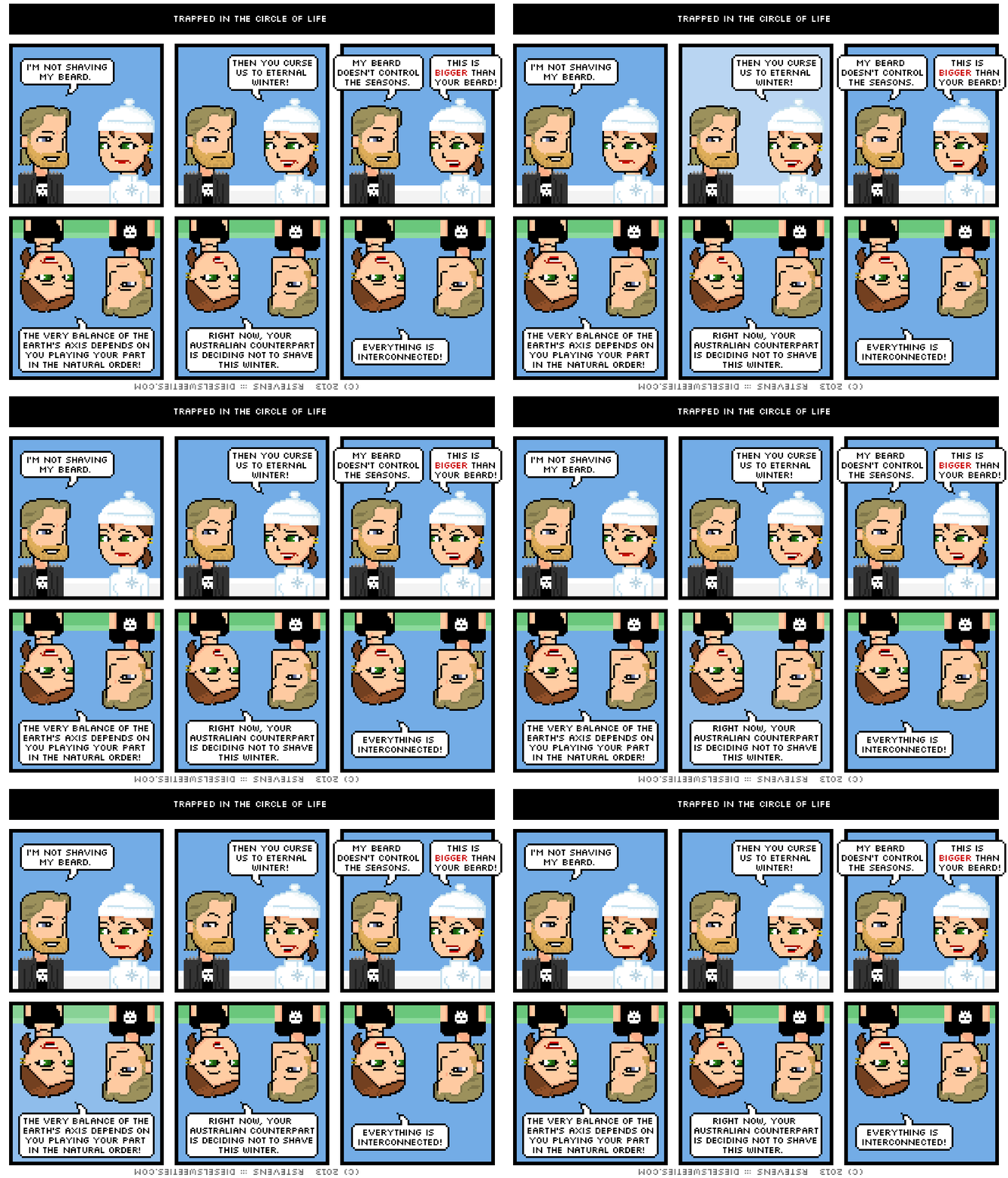
Trapped In the Circle of Life

Tertiarymatt

If you've haven't read the Dirk Gently books, I strongly recommend that you do so.

meep!

That’s what happens when you loop 15 seconds of music all day after having just read Dirk Gently for the first time.

26 Mar 06:36

Gifted

Tertiarymatt

SUPREME

http://oglaf.com/gifted/

26 Mar 00:48

The Tooth, the Whole Tooth

Tertiarymatt

Teef. Dollas. Songs.

So, I’m trying a new thing where I’m trying to pay some fairly exorbitant medical bills...
25 Mar 15:45

Here's 52 Issues of a 19th-Century British Craft Magazine, Courtesy of a Brooklyn Tool Company

Tertiarymatt

I know some people who might enjoy this....

work-magazine-01.jpg

Want to build a wheeled, revolving bookcase designed in 1890? Yeah you do

Tools for Working Wood is the name of a Brooklyn-based company that sells, well, guess. And in addition to their retail arm, they've got a website featuring articles on craft along with some very interesting information for makers—from 1889. The company somehow got their hands on several volumes of Work: An Illustrated Magazine of Practice and Theory for All Workmen, Professional and Amateur, a 19th-Century British magazine aimed at craftspeople. And the team at TWW has decided to scan every issue they've got, releasing new updates each Friday and making them freely downloadable.

work-magazine-04.jpg

While the information listed in Work is over 120 years old—TWW goes so far as to include the disclaimer "[some of the articles] describe materials and methods that would not be considered safe or advisable today"—I've totally fallen down the rabbit hole. Advertisements for tools of the day, like this crazy-ass hand-powered table saw...

work-magazine-02.jpg

...share space with articles on how to build a workbench that folds into the wall, or breaking news like the then-new production method of metal spinning, or why you should make your own "callipers" rather than buy a set, and an "Our Guide to Good Things" section where they review tools and materials of the day.

work-magazine-03.jpg

One surprise is their letters section, called "Shop: A Corner for Those who Want to Talk It," whereby craftspeople of every stripe—metalworkers, furniture builders, watchmakers, toolmakers, and even people toying around with these newfangled things called cameras and electricity—sound off with tips, techniques and criticisms. Which brings me to a second surprise: Trolls existed even in the Victorian era. One reader writes in to criticize an article from a previous issue, opening with "I would point out that the description you give of the process is evidently far from correct, nor have I any idea as to what is intended...."

(more...)


25 Mar 12:12

Argument recap: Justices look for ways to rein in open-ended preemption

by Deepak Gupta
Tertiarymatt

Man, it would really sting to lose a case before the SCOTUS this badly.

Not long into Wednesday’s argument in Dan’s City Used Cars v. Pelkey, it became apparent that Justices from across the ideological spectrum were deeply skeptical about the consequences of the petitioner’s broad preemption theory. As the argument developed, the Court seemed to be struggling not with deciding which side would win, but with how to write an opinion that would define clear limits on an open-ended statutory preemption regime—limits that, several Justices acknowledged, the Court’s previous opinions had utterly failed to provide.

At least in part, the Justices’ questions seemed driven by their reactions to the unsavory facts. As I explained in a previous post, the preemption question arises in the case of Robert Pelkey, a New Hampshire man whose car was towed away from his home by a used car dealer who refused to give it back and instead traded it away to a customer. When Pelkey sued under state consumer-protection and negligence law, alleging violations of a state law regulating the storage of abandoned vehicles, the dealer invoked the Federal Aviation Administration Authorization Act (FAAAA), a transportation deregulation law from the 1990s that preempts state laws “related to a price, route, or service of any motor carrier … with respect to the transportation of property.”

All three advocates, including the representative of the Solicitor General’s office, were appearing before the Court for the first time. Andre Bouffard, arguing for Dan’s City Used Cars, went first. Over the course of his argument, he received a barrage of pointedly skeptical questions, loaded with very difficult hypotheticals, from seven of the eight Justices who regularly ask questions. (Justices Kennedy asked no questions of either side.)

Justice Ginsburg started things off, wanting to know whether the state law at issue (governing storage of abandoned vehicles) would apply to any garage that stores a car. Bouffard answered that the case is really about the consumer protection law and tort law, but this led Justice Breyer to ask “What’s your point?” Why, he wondered, would that help Dan’s City? That would make the claim even less related to transportation deregulation. And it would mean that “all the abandoned motor vehicle laws and all the snow emergency towing and everything else that I see every day would be preempted a fortiori.” However, Bouffard doubled down on his line of argument, again stressing that what’s preempted here is the state’s general consumer protection law, which is “predicated on the State of New Hampshire’s policy protecting consumers.” Justice Scalia, echoing Justice Breyer, observed: “It seems to me you are running in the wrong direction. To the extent you say the case doesn’t involve New Hampshire’s towing law but involves just its general consumer protection law, it’s – it’s even further distant from being preempted.”

As is often the case, Justice Alito had prepared a deadly hypothetical: “Suppose there was a towing company that lawfully towed cars, but its practice was to hold the car for 24 hours and if it wasn’t picked up they would immediately sell it for parts. Your argument would be that’s preempted by the Federal statute?” Bouffard said that this case, unlike Justice Alito’s hypo, involves a “payment dispute” and that Pelkey had an opportunity to pay and get his car back. This led to Justice Ginsburg to pounce on the facts: “When?” When did he have an opportunity to get his car back?

In an extended colloquy with Bouffard, Justice Sotomayor pressed the point that any dispute over payment was a dispute over storage of the car, not transportation, and the federal law only preempts laws “with respect to” transportation. Justice Scalia picked up the thread, explaining that, in his view, storage in transit might be covered, but not storage after transportation is complete. He wondered whether, under Bouffard’s theory, the federal law would preempt state law in a scenario in which a company picks something up “and leaves it in its warehouse for 3 years.”

Chief Justice Roberts was also interested in testing how far storage extends. “Let’s say you park your tow trucks on somebody else’s parking lot, and you don’t pay the rent,” he hypothesized. “So they sell your tow truck. Is your claim against your landlord preempted?” The Chief followed this up with a hypo about a negligence suit arising from a tow truck accident, suggesting that Bouffard’s reading would preempt such garden-variety claims.

At a certain point in Bouffard’s argument, the Justices seemed to go into Conference. They appeared to give up on testing Bouffard’s position and instead wondered among themselves how to impose limits on this unwieldy preemption regime. Justice Scalia suggested adopting a reading from a dissent of his, under which “with respect to the transportation of property” would be read to preclude preemption of generally applicable laws that make no special reference to transportation. Justice Breyer chimed in to say that there is some support for that theory in the majority opinion, that the statute’s savings clause indicates an intent to preserve traditional state prerogatives, that the presumption against preemption should be the starting point of the analysis, and that this case involves a traditional area of state regulation. These words had to be particularly encouraging to the respondent coming from Justice Breyer, who (as discussed in my previous post) has a special interest in this area of the law.

By the time Brian Shaughnessy and Assistant to the Solicitor General Lewis Yelin got up to argue against preemption, it appeared as if they had already won and that the Justices were principally concerned with a question Justice Sotomayor asked directly: “How do we draw the line, that line that you just asked us to draw between direct and indirect? How do we articulate that line?” Later, Justice Scalia observed that, given the statute’s indeterminacy, “I think maybe — maybe we have to make it up, what the limitation” is, and asked Shaughnessy what limitation he proposed. He said that the “with respect to the transportation of property” qualifier provided the most obvious limitation, as did the Court’s distinction between indirect and direct effects.

Arguing for the government, Assistant to the Solicitor General Lewis Yelin emphasized that, when it enacted the FAAAA, Congress was seeking to deregulate the trucking industry to eliminate interference with “market forces and consumer choice,” neither of which “operate[s] on the sale of nonconsensually towed cars.”

Again in search of a limiting principle, Justice Breyer asked Yelin whether he would want the Court to expand upon its previous statements that state laws are not preempted when the effects are “too tenuous, remote or peripheral,” a formulation Breyer describes as “singularly unhelpful,” or whether the Court should adopt Yelin’s suggestion that there is no preemption where, as here, the state “is regulating something that never was, could not be, and is not part of a regulated or deregulated market.” Yelin’s answer was that the two are not mutually exclusive, and that “when a State law does not have a significant effect on Congress’s deregulatory and preemptive objectives, it is by definition going to be too tenuously connected to the motor carrier services.”

In rebuttal, Bouffard noted that a concern expressed by Justice Breyer earlier in the argument—that his theory would preempt all sorts of local ordinances governing towing of parked cars—was answered by the statute’s savings clause for actions taken under the state’s safety regulatory authority. Both Justice Ginsburg and Justice Kagan interrupted during the rebuttal to point out that Dan’s City was trying to have it both ways—wanting to invoke state-law process to sell the car and take the money, but not wanting to live up to the consequences of violating state law. But, Kagan says, “you have to take the bitter with the sweet.”

Ultimately, this does not seem to be a case in which the Justices are divided over what to do. Rather, the Justices seemed remarkably united in their quest for some sound limiting principles in a very indeterminate area of preemption jurisprudence. I therefore feel safe in repeating my prediction that Pelkey will prevail and further predicting that the decision will be unanimous, possibly with Justice Breyer authoring the opinion. Much harder to predict is whether the Court will be able to articulate a useful limiting principle, and whether the Court will decide the case (1) based merely on an interpretation of the word “transportation,” (2) by attempting to ensure that any preemption is moored in federal deregulatory purposes, as Justice Breyer suggested, or (3) by precluding preemption of generally applicable laws with no special reference or application to transportation, as Justice Scalia suggested. The first approach might be useful in some cases, but the second and third approaches could provide much-needed guidance to the lower courts across the full spectrum of consumer, labor, and other disputes that involve the airline and trucking industries.

In association with Bloomberg Law

25 Mar 09:13

What is this thing you call “nerd”?

by kerimfriedman
Tertiarymatt

That final definition of "nerd" is kind of awesome.

kirk teaches alien about love

What is this thing you call “love”?

Aliens, especially relatively humanoid ones who coexist with humans, also express curiosity of this strange human custom: why would humans put so much emphasis on a single word that appears to serve no useful function? Universally attractive aliens seem to be vulnerable for instantly falling for human men and needing to be taught in matters of kissing.

nerd!

What is this thing you call “nerd”? (David Brooks)

Li argues that Westerners emphasize the Aha moment of sudden insight, while Chinese are more likely to emphasize the arduous accumulation of understanding. American high school students tease nerds, while there is no such concept in the Chinese vocabulary. Western schools want students to be proud of their achievements, while the Chinese emphasize that humility enables self-examination. Western students often work harder after you praise them, while Asian students sometimes work harder after you criticize them.

What is this thing you call “X”? (Geoff Pullum)

whenever someone says that the X people have no word for Y in their language you should put your hand on your wallet — to make sure it’s still there. The people who witter on about who has a word for what hardly ever even know the languages they are talking about, and in the vast majority of cases (check out some of the cases on this list) their claim is false.

Is there really a word for “nerd” in Chinese? (Victor Mair)

To sum up, even those informants who said that shūdāizi (“bookworm”) is the closest you can get to “nerd” in Chinese recognize that it is very different from the latter word in English. Many young people, especially in Hong Kong and also in Taiwan, simply use the English word “nerd”; the English word is also increasingly used on the Mainland. A graduate student from the Mainland states: “I’ve never heard a translation for ‘nerd’. If someone in China says it, the word must be in English.” Another graduate student from the Mainland declares: “When we talk about a geek in Chinese, we only say ‘geek’, using the English word. No Chinese word can deliver the exact meaning.”

A generous reading of Brooks might see him as saying something analogous to what Mair is saying, but Brooks and Mair are actually deploying very different notions of culture. For Brooks culture is monolithic and static, for Mair culture is heterogeneous and malleable. What is particularly problematic about Brooks is his conflation of China, the country, with the Chinese language. Not only there are many Chinese speakers living in the U.S. who have to deal every day with American stereotypes of Asian students as “nerds” but there Chinese speaking countries outside of China, like Taiwan, with very different education systems.

Which isn’t to say that “shūdāizi” means the same thing in Taiwan that “nerd” does in the U.S. It doesn’t. In fact, every time I teach the anthropology of education to my students here in Taiwan I find myself spending a lot of time trying to explain the U.S. concept of “jocks” and “nerds” so that my students can better understand the American texts. If anything, the Mair piece suggests to me that “nerd” is used more in China than it is in Taiwan.

It is important to keep in mind the very different histories of Confucianism in China and Taiwan. During the post-war period Taiwan’s KMT government, run by recent immigrants from China, sought local legitimacy by promoting Confucian values. In China, on the other hand, the revolution sought to overthrow Confucianism. It is only recently that China has once again sought the mantel of Confucianism, even promoting soft-power through international “Confucius Institutes.” Educational culture in the two countries is very much shaped by the political-economic history of educational institutions and can’t be easily reduced to what Brooks refers to all-too-readily as “Chinese culture.”

Moreover, as Mark Liberman points out in his latest post on the topic, even in the US the term “nerds” is much more complex than Brooks makes it out to be. Liberman sites Mary Bucholtz’ excellent work on nerd girls to highlight the complex dynamics by which the term “nerd” is shaped through local meanings:

I propose that nerds in US high schools are not socially isolated misfits, but competent members of a distinctive and oppositionally defined community of practice.

He ends with a call for more ethnographically informed discussions of the topic. Narf!


25 Mar 08:55

The Universal laws behind growth patterns, or what Tetris can teach us about coffee stains

by aatish

The morning after a big snowstorm swept through the US northeast, I sat in my car, ready to brave hazardous road conditions and drive to the local coffee shop. My home in New Jersey was outside of the storm’s central path, so instead of piles of snow, we were greeted with a delightful wintry mix of sleet and freezing rain. And sitting in my car, I couldn’t help but be mesmerized by these strange patterns of ice particles forming on my windshield. Here’s what I saw:

As I watched this miniature world self-assemble on my windshield like an alien landscape, I wondered about the physics behind these patterns. I learned later that these patterns of ice are related to a rich and very active current area of research in math and physics known as universality. The key mathematical principles that belie these intricate patterns lead us to some unexpected places, such as coffee rings, growth patterns in bacterial colonies, and the wake of a flame as it burns through cigarette paper.

Let’s start with a simple example. Imagine a game similar to Tetris, but where you only have one kind of block – a 1 x 1 square. These identical blocks fall at random, like raindrops. Here’s a question for you. What pattern of blocks would you expect to see building up at the bottom of the screen?

You might guess that since the blocks are falling randomly, you should end up with a smooth, uniform pile of blocks, like the piles of sand that collect on a beach. But this isn’t what happens. Instead, in our make-believe Tetris world, you end up with a rough, jagged skyline, where tall towers sit next to deep gaps. A tall stack of blocks is just as likely to sit next to a short stack as it is to sit next to another tall stack.

tetris

This doesn’t look much like what I saw on my windshield. For one thing, there aren’t any gaps or holes. But we’ll get to that later.

This Tetris world is an example of what’s known as a Poisson process, and I’ve written about these processes before. The main point is that randomness doesn’t mean uniformity. Instead, randomness is typically clumpy, just like the jagged skyline of Tetris blocks that you see above, or like the clusters of buzzbombs dropped over London in World War II.

This Tetris example might seem a bit abstract, so let me introduce you to a guy who takes abstract ideas and connects them to real-world examples. His name is Peter Yunker, and he’s a physicist at Harvard who’s also really into his coffee.

coffeestain

What’s the science behind these stains? Coffee stain typeface by Mark Mustaine

Yunker was curious about what causes these ring shaped coffee stains. In 1997, a group of physicists worked out the reason that coffee forms this ring. As a drop of coffee evaporates, liquid from the center rushes outwards to the edge of the drop, carrying coffee particles with it. The drop starts to flatten. Eventually, all you’re left with is a thin ring, as the coffee particles have all rushed to the edge of the drop. Here’s a (wonderfully trippy) video of work by Yunker’s team, showing what this process looks like.

What Yunker demonstrated is really pretty neat. He discovered that the reason that coffee makes a ring has to do with the shape of the coffee particles. Look at a drop of coffee under a microscope, and you’ll find tiny, round coffee particles suspended in water. If you zoom into the edge of an evaporating coffee drop, you’ll see coffee particles sliding past each other, just like the blocks in our Tetris world. In fact, Yunker demonstrated mathematically that the pattern of growth of these coffee particles exactly mirrors that of our randomly falling Tetris blocks!

And here’s the crazy thing. Yunker and his colleagues also discovered that if you replaced all the spherical coffee particles with new particles that are more elongated, sort of like ovals, then you get an entirely different pattern. Instead of a ring, you get a solid blotch. You can see this happening in the video above.

coffeeringblotch

If the coffee particles are round (spheres), you get a coffee ring, but if they’re oval (ellipsoids) you get a coffee blotch instead. Image Credit: Yunker et al (2011)

In one case you get a coffee ring, and in the other case you get a solid blotch. So why does tweaking the shape of the particle change the overall pattern of growth? To understand why the oval particles behave differently from the spherical ones, we first need to tweak our Tetris game. Let’s call the new version Sticky Tetris.

In sticky Tetris, a block keeps falling until it touches another block. As soon as the falling block touches another block, even if only from the side, it immediately sticks into place.

It’s a small modification to the rules, but it has a pretty big consequence. In regular Tetris, it takes very many blocks to fill a deep gap, in sticky Tetris, you can fill a gap with a single block. Very quickly, the height differences between towers start to even out. Instead of the jagged, rough skyline of our regular Tetris world, the skyline in the sticky Tetris world is more smooth.

stickytetris

That looks a lot more like the pattern on my windshield!

And here’s the point. While the spherical coffee particles behave like regular Tetris pieces, the oval shaped particles behave just like these sticky Tetris pieces. The moment an oval coffee particle touches another one, it sticks in place. Instead of the jagged skyline from before, you get this Swiss cheese like pattern, an intricate structures of sprawling filaments separated by holes and gaps.

Oval shaped coffee particles form blotches, mirroring the intricate patterns formed by sticky Tetris blocks. Image credit: Felice Macera

So here we have essentially two distinct kinds of growth processes. On the one hand we have things that accumulate like Tetris blocks, or like particle of coffee in a coffee ring. Here’s an animation of real data from Yunker’s lab showing what this looks like.

poissoncoffee

On the other hand, we have things that accumulate like Sticky Tetris blocks or like oval shaped coffee particles. The growth of these particles looks like this (again, this is real data).

KPZcoffeeIt’s clear that these are two qualitatively different kinds of patterns.

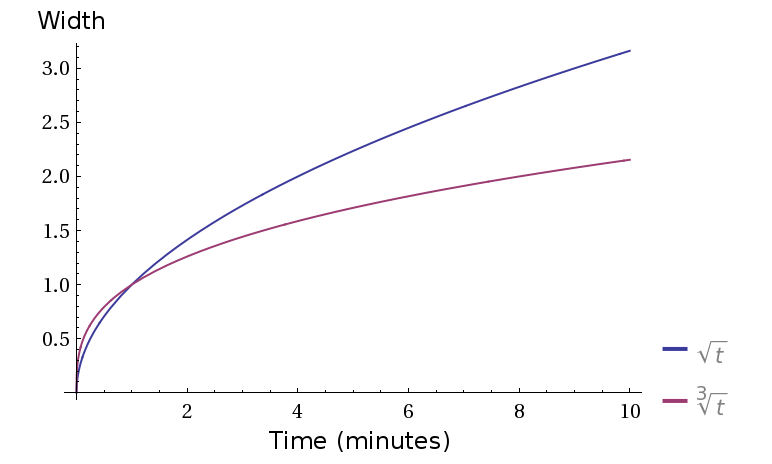
But it’s also a quantitative difference. Remember that in the Tetris world, you end up with a jagged skyline, while in the sticky Tetris world, the skyline is more smooth. By studying how the topmost layer of particles (the skyline) widens over time, physicists can classify growth processes into different categories. In the jargon of the field, processes that grow at different rates really belong into different Universality Classes.

powerlaws

If the skyline of a growth process widens according to the blue curve, it falls into the same universality class as Tetris. If it widens according to the purple curve, it falls into the same universality class as Sticky Tetris.

You can think of universality classes like a sort of mathematical filing cabinet. Say that you’re studying how ice particles clunk together on your windshield. If the rate at which the skyline widens matches the blue curve above, ice clunking is in the same universality class as Tetris. If it matches the purple curve, then ice clunking is in the same universality class as Sticky Tetris. Now, there are other universality classes out there, and not all growth processes can be neatly filed into a universality class. But the key point is that many seemingly different physical systems, when analyzed mathematically, show identical patterns of growth. This slightly mysterious tendency for very different things to behave in very similar ways is the essence of universality.

What’s more, there is a rich mathematical theory behind this sticky Tetris universality class, described by an equation known as the Kardar–Parisi–Zhang (KPZ) equation. To give you a sense of how current this research is, it was as late as 2010 that mathematicians managed to prove that this KPZ equation is in the same universality class as sticky Tetris.

These deep connections between coffee rings and the KPZ equation took Peter Yunker by surprise. In Yunker’s words, “Alexei Borodin, a mathematician from MIT, contacted us after we published a paper on how particle shape affects particle deposition regarding the coffee-ring effect. He saw our experimental videos online and was reminded of simulations that he has performed. I think this is a great example of the value of reaching out across disciplines – we never would have studied this topic without Alexei bringing it to our attention.”

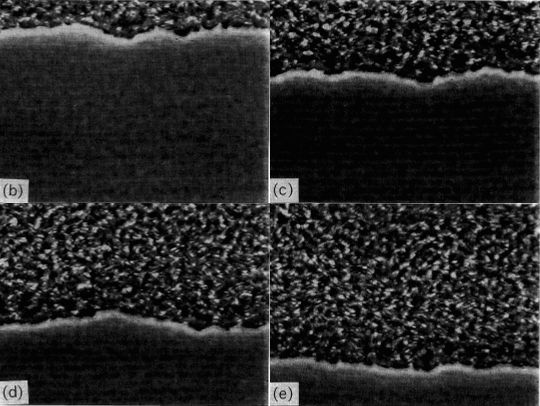
And this sticky Tetris universality class has turned up in all sorts of odd places. One example involves burning paper. A physics experiment in 1997 took sheets of copier paper, carefully lit them on fire from one end, and recorded the flame front as it burnt through the paper. Here’s a sketch of what they saw. You’re looking at multiple snapshots of the flame, as it burns through the paper.

slowburn

Snapshots of a flame as it burns through copier paper. J. Maunuksela et al., Phys. Rev. Lett. 79, 1515 (1997).

As the flame burns through the paper, it develops a smooth, wavy pattern. And when the physicists studied the growth of this flame front in detail, they found that it exactly matches the predictions of the KPZ equation. They repeated their experiment using cigarette paper as well as copier paper, and saw the same results. In their words, “The second set of experiments on the cigarette paper gave results consistent with those for the copier paper despite the fact that the cigarette paper is strongly anisotropic and may contain nontrivial correlations.” (Always gotta watch out for those nontrivial correlations in cigarette paper.)

And another example that’s pretty neat and unexpected – bacterial colonies. A team of Japanese physicists showed in 1997 that in certain nutrient conditions, the edge of a bacterial colony grows outwards in exactly the manner predicted by the KPZ (sticky Tetris) universality class. Here’s an animated gif of this in action, adapted from their paper. What you’re looking at is a zoomed in photograph of the edge of a bacterial colony, as it grows in a petri dish.

bacteria_opt

Now, if you think about it, there’s something deeply puzzling here. Bacterial colonies, travelling flames, and coffee particles are all totally different systems, and there’s no reason to expect that they should obey the same mathematical laws of growth. So what’s behind this mysterious universality? Why do such different beasts play by the same rules?

You might have noticed that all these examples look a little, well, fractal-esque. It turns out that the phenomenon of universality is intricately connected to the fact that these systems are each self-similar, like fractals. As I zoomed my camera into the ice particles on my windshield, the overall pattern looked basically the same. The same is true for the front of the flame, the edge of the bacterial colony, or the skyline of sticky Tetris. Here’s an example of a curve that’s self-similar (or scale-invariant, as physicists like to call it).

Fractals of the world, Unite! Self-similarity is at the heart of universality.

Surprisingly, this self-similarity implies that many of the nitty-gritty physics details of bacteria, flames, or coffee turn out to be irrelevant. According to Peter, “the fractal nature of these growth processes is essential to their universality. In order to be universal, a system cannot depend on its microscopic details, like particle size or typical interaction lengthscale. Thus, a universal system should be scale-invariant.”

Which brings me back to the ice particles on my windshield. They clumped together in these wonderfully fractal-esque patterns that, to my eye, looked a lot like sticky Tetris. I wanted to know if there’s a connection between these ice particles and the KPZ universality class. I put the question to Peter Yunker.

He responded, “These videos are fantastic. I agree with you that the underlying process occurring here appears quite similar to a KPZ process. However, this may be a great example of why it is difficult to identify KPZ processes in real experiments. The rearrangements of these structures have a strong effect on how the interface is developing. Thus, it is very unlikely that this system exhibits the same growth exponents as a KPZ process.”

It seems that the very piece of physics that makes these ice patterns short-lived is also what makes them so hard to study. And so, let me end with a very short video, a tiny meditation on the theme of growth and longevity. ;)


References

Coffee Stains Test Universal Equation. Physics 6, 7 (2013) - an excellent readable account on the research of Yunker, Yodh, Borodin and colleagues

In Mysterious Pattern, Math and Nature ConvergeNatalie Wolchover does a really great job of covering Universality from a totally different angle. If you’re not reading her stuff, you ought to!

Ace mathematician Terrence Tao has written a good explainer on Universality. It’s a long read that’s packed with insights.

Animated gifs of Tetris simulations and coffee deposition data were made with permission from data by Yunker et al. (2013)

Academic References

Effects of Particle Shape on Growth Dynamics at Edges of Evaporating Drops of Colloidal Suspensions. Yunker, Lohr, Still, Borodin, Durian and Yodh, Phys. Rev. Lett. 110, 035501 (2013)

Suppression of the coffee-ring effect by shape-dependent capillary interactions. Yunker, Still, Lohr and Yodh, Nature 476, 308–311 (2011)

The Kardar-Parisi-Zhang equation and universality class by Ivan Corwin - Although very mathematical, this an excellent and clearly written review of the KPZ equation and its connection to Universality, written by one of the experts in the field.

Self-Affinity for the Growing Interface of Bacterial Colonies. Wakita, Itoh, Matsuyama and Matsushita, J. Phys. Soc. Jpn. 66 (1997)

Kinetic Roughening in Slow Combustion of Paper. Maunuksela, Myllys, Kähkönen, Timonen, Provatas, Alava and Ala-Nissila, Phys. Rev. Lett. 79, 1515–1518 (1997)


25 Mar 08:43

Interesting tree biology

by noreply@blogger.com (Minnesotastan)

The image above shows an entirely natural phenomenon, occurring inside the hollow (rotten) core of a white pine.
Whorled branch cores look like spokes inside the trunk of a white pine, top. The cores were resistant to the rot that consumed the center of the tree, which walled off the damage and continued to grow new wood for more than 20 years.
When I was a little kid, my parents and I used to search the woods for fallen rotten pine logs.  Opening them would sometimes reveal two treasures - grubs that could be used for fishing bait, and "knots" I suppose similar to the above, which were fragrant additions to the fireplace.

Text and image from an entry in the Washington Post's fascinating Urban Jungle series.
25 Mar 07:24

The long and short of honey bee tongues

by Rusty
Tertiarymatt

Good pics of a bee engaging in robbing a flower, in this one.

Some sources say honey bees are “long-tongued” and some say they are “not long-tongued.” So, which is it? After spending a couple of hours with Google and a stack of books, I’ve come to a conclusion, but it’s not crystal clear. According to a paper by R. P. Hawkins called “Length of tongue in a [...]
25 Mar 04:59

Argument preview: Marriage and the Court’s “friends” — Part I

by Lyle Denniston
Tertiarymatt

Pretty good post on the role of amici and what's in the offing for this case. I continue to marvel at the bankruptcy of the appeal here, but it's important to know the mind of your opponents.

Also I think the standing issue is a curious one, and could have larger consequences than at first appears.

This is the first of two articles examining the arguments made in the Supreme Court’s two same-sex marriage cases by the “friends of the Court” — the amici who have filed written briefs, a lengthy list.  This article deals with the amici arguments in the case of California’s Proposition 8 ban on gay marriages, Hollingsworth v. Perry (12-144), to be heard at 10 a.m. on Tuesday.  Part II, to appear Monday, will cover the amici arguments on the federal Defense of Marriage Act case, United States v. Windsor (12-307), set for a hearing at 10 a.m. on Wednesday.

The role of amici

Under the Supreme Court’s rules, a brief from an amicus curiae (amicus, for short, or amici in the plural) is supposed to bring to the Court’s attention “relevant matter not already brought to its attention by the parties.”  If a brief does not do so, the rule adds, the document “burdens the Court, and its filing is not favored.”  But that is a rule that is not rigorously enforced: many amici briefs make arguments that exactly or at least closely parallel those made by the parties, and many of these briefs overlap each other.  Sometimes they speak in the narrow scope of an advocacy group’s special interests, sometimes they sweep quite broadly.  And many do, indeed, enlarge the Court’s perspective on the potential impact of this or that decision, and it is not uncommon for such a brief to be quoted directly in an opinion of the Court.  In a case with the high visibility, and potentially broad impact, of the same-sex marriage cases, scores of those briefs are filed.   There are almost ninety in the Proposition 8 case; two dozen of them apply both to that case and to the Defense of Marriage Act case.

To file an amicus brief, it is necessary to have either the consent of the parties, or consent of the Court.  In the Proposition 8 case, the parties gave blanket consent to all such briefs.   Most amici speak to the Court only through their written arguments; except for the federal government when it is acting as an amicus (as it is in this case), amici do not often get permission to take part in oral arguments.

For Tuesday’s hearing, under a one-hour schedule, the Court is not dividing the hearing between the issues of its authority to decide the case and the constitutionality of Proposition 8.  Charles J. Cooper, of the Washington, D.C., law firm of Cooper & Kirk, will appear first for the sponsors of the ballot measure, with thirty minutes of time.  He will be followed by the lawyer for the two same-sex couples who challenged that provision, Theodore B. Olson of the Washington office of Gibson, Dunn & Crutcher, with twenty minutes.  Finally, the Obama administration’s lawyer, Solicitor General Donald B. Verrilli, Jr., will have ten minutes to make the government’s case as an amicus.  The Chief Justice is likely to allow the hearing to go on beyond an hour.

All of the briefs filed in the Proposition 8 case — by the parties and the amici — can be found at this link.  Posts discussing the briefs of the sponsors of Proposition 8 can be read here and here.   A post on the brief of the two same-sex couples who challenged that measure is here.

The Court’s authority to rule

The Supreme Court simply does not have the power, constitutionally speaking, to rule on the validity of California’s Proposition 8 — or on any case — unless it is assured that there is a live “case or controversy” actually before it.   The Constitution’s Article III limits the federal courts, including the highest court, to deciding cases in which, at every stage, there is a genuine dispute between two opposing sides, each of whom had “standing” — in other words, a legal right to be there.

To have “standing,” under Article III, each side must show that it has a direct, not a theoretical, interest in the case, and that its claim is one that can be vindicated by the court, if, in the end, it were to win.

When the Court on December 7 granted review of Hollingsworth v. Perry, it told the lawyers to file briefs  and be prepared to argue orally on whether the sponsors of that ballot measure had Article III “standing” to pursue their appeal to the Supreme Court, after the Ninth Circuit Court had struck down their measure.   Those sponsors at this point are the only ones directly involved in defending Proposition 8; state officials in California refused to do so.

The Court did not appoint a special amicus to argue separately on the Article III point, as it did on jurisdictional issues in the other case, on the federal Defense of Marriage Act.   If the Court were counting on the parties in the Proposition 8 case to go deeply into the Article III issue, it may be disappointed.  In response to the Court’s addition of that question to the case, the proponents of the measure devoted fewer than five pages to that in their main brief and fewer than three pages in their reply brief; the same-sex couples’ brief offered just under four pages on it; the San Francisco local government’s brief had three pages, and the federal government’s amicus brief had no discussion at all of that issue.

When the constitutional challenge to Proposition 8 was filed in federal district court in San Francisco, the ballot measure’s sponsors were allowed to take part in the trial as intervenors to defend the measure — that is, they were in the case opposite the two same-sex couples who challenged the amendment to the California constitution.   When the sponsors then sought to take the case on to the Ninth Circuit Court after the district judge had struck down the measure, the appeals court first asked the California Supreme Court for advice on whether the sponsors could take the state’s place in defending the measure.  After the state court said yes to that question, the Circuit Court ruled that, because the state could have appealed but did not and because the sponsors “stand in the shoes” of the state, they satisfied Article III and thus were allowed to appeal to defend the measure.  It then struck down the proposition on the merits, on a narrower theory than the district judge had applied.

Amici supporting the sponsors’ role

 There are some forty amici briefs filed in support of Proposition 8, and two of them deal with the question of the ballot measure sponsors’ right to be in court to defend it.

The California-based Center for Constitutional Jurisprudence, joined by former U.S. Attorney General Edwin Meese III, devoted more than two-thirds of its brief to support ”standing” for the proponents.  The brief provided a full history of the role of the people of California as citizen-legislators, and relied strongly on the state supreme court ruling allowing the sponsors to act as the state for purposes of defending the victory that the state’s voters had given them at the polls in November 2008.   The brief added that the sponsors had a special interest all of their own in defending their measure — something that the state court had not decided.  If the state attorney general had defended Proposition 8, the brief said, she would not have had to show any such special interest, but the sponsors had one, anyway, in shoring up the validity of their measure.

A group of conservative advocacy organizations, led by Citizens United and its affiliates, described as non-profit social welfare or educational organizations, bolstered the argument in favor of finding “standing” for the proponents by relying on the Constitution’s Tenth Amendment.  That provision, protecting the vast array of powers “reserved” to the states, this brief contended, gives the states the power to decide who can represent the people of that state.   Going further than others have done in supporting “standing” in the case, this filing said that the Supreme Court and other federal courts simply do not have the power to decide whether the state is properly represented by the proponents.

Amici opposing “standing”

There are almost fifty amici briefs filed in support of the same-sex couples who challenged Proposition 8, and four of them are devoted entirely or in considerable part to opposing “standing” for the measure’s backers.

Those briefs are from the state of California, former Acting U.S. Solicitor General Walter Dellinger (now a Washington lawyer), Equality California (an advocacy group for gay, lesbian, bisexual, and transgender Californians), and the Columbia Law School Sexuality and GenderLaw Clinic, joined by the Society of American Law Teachers.

Those documents generally have two themes: first, that the issue of Article III “standing” is different from the question of who, under state law, can speak for the state in court, so the California Supreme Court decision did not settle the federal issue, and, second, that the right to actually represent the state in court is reserved under Article III for those who also have the duty to enforce state laws — that is, actual government officials — because only they face a legal injury against the state if one of its laws was nullified in court.

When the state court ruled that the measure’s backers could stand in for the state, it did not rule on the separate issue of whether those individuals also had to show that they had a special interest of their own in making a defense.  That, according to these amici,  is what is missing for the proponents in their attempt to pursue the case in the Supreme Court.  As the state of California argued, the backers have only the same interest as any California voter who supported Proposition 8 at the polls, and that is not enough.  They do not have to answer to the citizens of the state, the way officials must, according to California.

The Ninth Circuit Court, that brief said, simply ignored that separate question in allowing the sponsors to appeal.   As attorney Dellinger’s brief added, the Circuit Court finding of Article III standing for the sponsors in this case would mean that “a state could authorize any citizen of the state to enforce or defend any state law in any court so long as it makes clear that the citizen is representing the state’s interest rather than his own….Neither Congress nor a state has authority to confer standing on private parties when they otherwise would not have it.”

Equality California’s brief actually provided an interpretation of the California Supreme Court ruling that would minimize the interest of the measure’s sponsors, and argued that this reduced role will not satisfy Article III.   The Columbia law clinic’s brief asserted that the Court could allow the sponsors to appeal only by “dramatically” expanding “the set of injuries that give rise” to standing under the national Constitution. The Court, that brief contended, should not make it easy for states to sidestep Article III’s requirements.

The constitutional issue

More than twelve years ago, California voters went to the polls and approved Proposition 22.  That changed a state law dealing with family relationships to provide that “only marriage between a man and a woman is valid or recognized in California.”  In May 2008, the California Supreme Court ruled that Proposition 22 violated the state’s constitution, which guaranteed equal protection of the laws.  In response, more than 18,000 same-sex couples obtained licenses and were married.

In the November 2008 election, however, the state Supreme Court ruling was overturned at the ballot box by the state’s voters’ approval of Proposition 8.  It won by a margin of 52.5% to 47.5% — about 5.4 million “yes” votes to about 4.9 million “no” votes.  That changed the state constitution (not just a state law) to read exactly as Proposition 22 would have made state law to read: “Only marriage between a man and a woman is valid or recognized in California.”  The provision went into effect the day after the election, and same-sex marriages in the state stopped.

A challenge, based upon state law, to Proposition 8′s validity then began, leading to a ruling by the state supreme court in May 2009 upholding the measure, but refusing to strike down the marriages that had occurred in the meantime.   That decision was not based in any way on federal constitutional issues.  The marriages that had occurred in the interim were the last in the state since then, because Proposition 8 remains on the books pending the outcome of the case now before the Justices.

Shortly before the California court had ruled on Proposition 8, a lesbian couple, Kristin Perry and Sandra Stier of Berkeley, and a gay couple, Jeffrey Zarrillo and Paul Katami of Burbank, who had been denied marriage licenses because of Proposition 8 began a federal constitutional challenge to the ballot measure.   In August 2010, U.S. District Judge Vaughn R. Walker of San Francisco struck down the provision, finding it violated the Constitution’s guarantees of legal equality and due process.

Judge Walker concluded that there was no need to create a new and free-standing right of same-sex marriage, declaring that the existing institution of civil marriage had to be equally available, and could not be denied on the basis of sexual identity or orientation.

After that, the measure’s sponsors took the case on to the Ninth Circuit Court, leading to a divided decision in February last year striking down Proposition 8.  The Circuit Court said it was not ruling on whether same-sex couples had to be given equal marriage rights, since the California situation was one in which those couples had once been allowed to marry, and then that was taken away — partly out of disapproval of homosexuality.  That ruling, considerably narrower than Judge Walker’s decision, was based upon a 1996 Supreme Court decision (Romer v. Evans) striking down a Colorado state constitutional amendment taking away from gays and lesbians any chance to obtain state or local laws to protect them from discrimination based on their sexual orientation.

The Circuit Court, however, put its decision on hold for the duration of appeals.  Marriages could resume if the Supreme Court were to strike down Proposition 8, but not if the Court upheld the measure.   If the Justices were to rule that the backers had no right to appeal, lower federal courts will then have to sort out what follows, including whether both the Circuit Court’s decision and Judge Walker’s ruling would be nullified.

Amici supporting Proposition 8

The more than three dozen amici briefs in support of Proposition 8 range widely over issues of science, religion, morality, politics, and law, but there are some specific dominant themes: opening marriage to same-sex couples would ruin the institution and would threaten the nation and the nation’s children, the very nature of marriage — keeping humanity going by childbearing — requires that it be confined to those who can procreate naturally, people and their state legislatures should be left alone to decide whether to allow such marriages, gays and lesbians are seeking a special right to marry rather than simple equality of access to marriage, the Court should move cautiously in creating new constitutional rights, Proposition 8 should be judged by the most tolerant constitutional standard but it could withstand even a more exacting test, and Judge Walker’s decision was based largely on flawed social science, which is often driven by political bias.

Individually, the briefs range from anxious concern about the recent trends toward more liberality on gay rights issues to core legal arguments against same-sex marriage.

Nineteen states offered the Court a brief that spans the twin threats that are perceived — one to states’ rights, the other to “marriage as we know it.”  On the first, state interests get fervent repetition: the brief said that the Ninth Circuit “overrode a state citizenry’s use of state democratic channels to address a state court’s interpretation of a state constitution on a matter of core state responsibility.” And, on the second, the brief argued that the lower court ruling will lead to “disintegration of perhaps the most fundamental and revered cultural institution of American life.”

The Marriage Anti-Defamation League’s brief defined the threats as “harassment and reprisals” against those who have the “civic courage” to seek to preserve traditional marriage, even as those who favor “redefining marriage” are gaining “significant political and cultural power.   That group expressed fear of even greater hostility if the supporters of opposite-sex marriages continued to get attacked as “irrational and bigoted.”

On purely legal grounds, there are amici who argue that the pressure for same-sex marriage is not the same as the movement to permit mixed racial marriage, or even the movement to protect the privacy of gay and lesbian sexual activity by ending anti-sodomy laws.   A group of African-American pastors stressed the first point, and an advocacy group, the American Civil Rights Union, the second.

Some of the briefs sought to warn the Court that it could not confine a ruling to Proposition 8 just to California.  The Eagle Forum Education & Legal Defense Fund, for example, argued that if Proposition 8 were to fall, that would, by implication, “undermine any preference for husband-wife marriage.”  That brief, in particular, sought to portray the movement for same-sex marriage as an attempt to establish a constitutional “right to same-sex marriage.”

A number of the briefs engaged the issue of the proper standard for constitutionality to be applied to Proposition 8, with the Concerned Women for America, for example, contending that the growing political power of gays and lesbians across the country does not justify giving them the added protection of a more demanding test of constitutionality.   There is simply no basis, that brief and others asserted, for treating the homosexual community as a special target for discrimination without the political clout necessary to defense itself.

There is a good deal of argument about the perceived religious dimension to the arguments over marriage, with the Patrick Henry College in a Virginia suburb of Washington, D.C., contending that because laws have been based on religion and morality “from the founding of the Republic to modern times,” Californians should be allowed to make a choice against homosexuality as “moral error,” and with a host of conservative religious organizations, led by the National Association of Evangelicals, arguing that what is at stake is “a fundamental conflict” over differing visions of marriage “and a demand by the proponents of one conception that this Court declare the other one unconstitutional.”

The Becket Fund for Religious Liberty forecast a “perpetual struggle without prospect of a political resolution,” if the judiciary were now to take away from the political process the conflict over same-sex marriage.  The commitments on opposite sides of that conflict, it warned, “are simply too great on both sides to impose a judicial resolution. And setting church and states permanently at odds would be bad for both.”

Some of the briefs on that side made a strong assault on the social science arguments that same-sex parents are no threat to their children’s lives or futures, such as a group of professors in that discipline arguing that the better view is the “longstanding” one that “the ideal environment for raising children is a stable biological mother and father….What is clear is that much more study must be done on these questions.”   The Institute for Marriage and Public Policy’s brief, also focusing on social science arguments, added that the behavioral sciences “have a long history of being shaped by politics and ideology.”  The Court, that group suggested, should abandon any focus on such data and decide this case solely “on the basis of the law.”

A group of conservative scholars, led by Princeton’s Robert P. George, made an effort to simplify the issue, declaring: “What we have come to call the gay marriage debate is not a debate about homosexuality, but about marriage.  It is not about whom to treat as eligible to marry, but about what marriage is.  It marks a pivotal stage in a decades-long struggle between two views of the meaning of marriage.”

Amici opposing Proposition 8

The Obama administration, which had taken no part in the Proposition 8 case as it wound through lower courts, opted to get involved after the Supreme Court agreed to rule on it.  In its role as an amicus, it chose to argue only on the constitutionality of the measure, bypassing any thoughts on the sponsors’ right to be in court.   On the constitutional issue, it took a cautious approach, urging the Court to decide the case in a way that would only extend marriage rights to same-sex couples in eight more states, in addition to the nine that already allow gay marriage.  Since that filing, another state — Colorado — has become the ninth state to move into the category of new states that would be covered by the administration’s approach.  (A post more fully discussing the government’s constitutional argument can be read here.)

Nearly four dozen merits briefs filed by other amici urging the Court to strike down Proposition 8 attempted, like those on the other side, to put before the Court a wide array of claims and they, too, touched on many of the same general fields but from sharply differing perspectives.  There is a strong progressive cast to these briefs, treating same-sex marriage as a defining new human rights issue but one that can trace its origins to other, respected and even revered civil rights movements.   There is a studied effort to portray same-sex couples as normal couples with aspirations for family life and child-rearing no different from traditional couples.   And there is a similar effort to reassure the Court that allowing gays and lesbians to marry will not shake the foundations of the Republic, or of American morality.

A brief filed by Marriage Equality USA, for example, argued that “millions of lesbian and gay Americans share the same hopes and dreams of other Americans, including finding a special person to marry, building a family and life together, and growing old with each other….And they want their marriages to have the same legal validity and official recognition that everyone else’s marriages have.”   That brief contains testimonials of the benefits that have come to same-sex couples who have been allowed to marry.

One brief that has already drawn a substantial amount of publicity was filed by a group of conservatives and libertarians, several of whom have held office in Republican administrations, recounting their own conversion of belief to “there is no legitimate, fact-based reason for denying same-sex couples the same recognition in law that is available to opposite-sex couples.”   That brief sought to make a gracious acknowledgment of the sincerity of those who continue to oppose same-sex marriage, and made a distinct effort to assure religious institutions that none of them would be compelled to foster such marriages against their own doctrines of faith.  That document fit into a general pattern of trying to ease anxiety over a ruling against Proposition 8.

There also is an attempt to suggest that the perceived trend in America toward acceptance of such marriages is but a part of a global trend, as part of a claimed “universalist vision of human rights,” as a brief from International Human Rights Advocates put it.  There are “global values such as morality and fairness,” that document said, and it argues that the Proposition 8 case calls upon the Court to implement those values through the constitutional concepts of due process and equal protection.

A group of one hundred business firms, in their brief, urged the Court to look beyond Proposition 8 itself and pave the way for striking down “all laws in all states barring couples of the same sex from marrying.”  Laws like the California measure, those companies contended, “discriminate against many of the amici‘s customers, clients, vendors, and employees.”

Although many briefs seemed determined not to aggravate fears about homosexuality, there are a few that energetically attack the campaign that led to Californians’ approval of Proposition 8.   The Southern Poverty Law Center’s brief, for one, recounted what it said was evidence that the measure emerged out of “deep-seated animus towaqrd gay men and lesbians….The record shows, without doubt, that animus toward homosexuals put Proposition 8 on the ballot and carried it to victory, which is exactly what the courts below found.”  At least part of the rationale for such arguments is that they recall the Court’s Romer decision in 1996 in Colorado, reestablishing the right of homosexuals to an equal role in seeking legislation favorable to their interests — the decision most relied upon by the Ninth Circuit in this case.

A number of the briefs sought to point the Court toward studies showing that homosexual orientation was not a human choice, but a condition with which one is born — an argument that bears upon the question of whether gays and lesbians are the targets of discrimination for who they are, not for what they are capable of doing in life.   An example was the brief of the Gay and Lesbian Medical Association.  Another, from a coalition led by the American Psychological Association, told the Court that “homosexuality is a normal expression of human sexuality” and that gays and lesbians form “stable, committed relationships that are equivalent to heterosexual relationships in essential respects.”

There also are briefs seeking to apply arguments against gender discrimination to the rights of gays and lesbians, such as the document filed by several groups led by the National Women’s Law Center and a separate one by the National Organization for Women Foundation along with the Feminist Majority Foundation.

The list of arguments against same-sex marriage that supporters of Proposition 8 make are challenged in several briefs focused directly on legal issues, such as one by a group led by the American Academy of Matrimonial Lawyers.   That filing, in particular, sought mainly to refute the argument that same-sex marriage constitutes a fundamental threat to children.  While marriage does, indeed, “foster stability for children,” that brief said, citing the other side’s main defense, that “is a powerful reason to permit marriage for same-sex couples, not to ban it.  When same-sex couples are denied the right to marry, their children suffer serious, tangible harm.”

Seeking to counter the argument that gays and lesbians were attempting to gain a right exclusive of their own to marry, amici briefs against Proposition 8 pressed the argument that marriage has long been a fundamental right, and the only issue is whether it will be available equally.   Some three dozen professors of family law and constitutional law filed such a brief, urging that the Court not confine a ruling against the ballot measure on the narrow ground that the Ninth Circuit did — the invalidity of taking away a previously existing right of marriage equality — and nullify it on the broad, due process ground that was a part of Judge Walker’s ruling in the District Court.

Another legally centered brief, by a group of political science professors, attempted to refute the argument that gays and lesbians have now acquired such significant influence in politics that they can take care of themselves legally.   Homosexuals, the document said, “are vastly underrepresented” in legislative bodies and other governing entities.

Thirteen states, some of which still have laws that ban same-sex marriage, told the Court that all of their number have been moving toward the elimination of discrimination, including that based on sexual orientation, and they argued that Proposition 8 ran directly counter to that trend by singling out same-sex couples for discriminatory treatment in California’s marriage laws.

Briefs addressing religious issues in this controversy reached the Court from a broad coalition of mainstream faith organizations to a collection of atheist and “freethinker” groups.

The competition in amici advocacy

Under the Court’s rules, the briefs of amici are filed in a sequence, with those supporting the group or individual pursuing the appeal to the Court filed first, and those in opposition coming later.  This provides something of an advantage to the later group, because they can seek to counter the earlier group’s arguments, and there is no chance for a rebuttal to their points, except in the reply brief from the party directly involved — here, the sponsors of Proposition 8.   The Court’s rules provide explicitly that the Court’s clerk “will not file a reply brief for an amicus curiae.”

There is no indication, however, that the Court is inclined to favor one wave of amici, or the other.   As the Justices move toward a decision in a case, and begin framing arguments for this or that outcome, they and their clerks will dip into the pile of amici filings to buttress those arguments, or to help them counter points by Justices who are circulating conflicting drafts.  In a case as deeply controversial as the same-sex marriage cases, the competition among amici very likely will balance out.

In association with Bloomberg Law

22 Mar 18:17

No Comment

meep!

Brought to you by Headphones.

22 Mar 05:42

Book Review: Mike Veach’s “Kentucky Bourbon Whiskey”

by John Hansell
Tertiarymatt

LIKKER

Whisky Advocate contributor Fred Minnick joins us today with a review of Mike Veach’s Kentucky Bourbon Whiskey. Veach’s book disputes many whiskey legends and offers new evidence for bourbon’s origins.

Veach CoverIn the new book Kentucky Bourbon Whiskey: An American Heritage (University of Kentucky Press), author and bourbon historian Mike Veach shreds industry legends and offers new evidence on bourbon’s origins.

Veach discredits the stories of Evan Williams and Elijah Craig for being Kentucky’s first distiller and inventing bourbon respectively. This is nothing new. Henry Crowgey’s book Kentucky Bourbon: The Early Years of Whiskeymaking (University of Kentucky Press, 1971) made these points. But, Veach offers the first evidence that two French brothers are the most likely candidates for inventing bourbon around 1807.

Because French brandy makers are considered the first to age spirits in wood, Veach argues Louis and John Tarascon, originally from the Cognac region, most likely established aging whiskey in barrels. The Tarascon brothers shipped barrels from Shippingport, Kentucky to New Orleans.

But, Veach admits historians will likely never know who truly invented the product we enjoy today. If Vegas were to set odds on who’d find bourbon’s true origins, however, Veach would be an easy front-runner.

As an archivist at the Filson Historical Society, which stores 1.8 million historical documents including original Lewis & Clark papers, Veach sorts through handwritten letters, diaries, and papers from early America. Researchers from all over the world visit the Filson Historical Society for publishing scholarly works. Whiskey is a mere fraction of the society’s archives, but the bourbon historian is always on the lookout for something whiskey-related.

In the pile of parchment inked in early American cursive penmanship, Veach found a July 15, 1826, letter from a Lexington, Ky., grocer to distiller John Corlis. The grocer told Corlis the burnt-inside barrels made better whiskey, giving the first known reference to charred barrels for Kentucky whiskey.

Veach’s book is filled with many great factual whiskey nuggets like the Corlis barrel, making Kentucky Bourbon Whiskey a must read for bourbon lovers. The book peruses untold histories, such as the New York tasting of “Old Bourbon vs. Old Rye” in which 21 year old Old Crow defeated a Pennsylvania rye of similar age. There’s also the infamous Whisky Ring scandal of 1875 and the questionable 1980s Blanton’s blind tastings that raised eyebrows at Maker’s Mark.

Veach’s easy-to-read style combines a scholarly approach with a narrative voice, using facts to move along the history without bogging down the pages with footnotes.

The author is quick to give credit where credit due, too, praising the efforts of Elmer T. Lee, Chris Morris, and Bill Samuels for keeping bourbon interesting and marketable. He also mentions the explosion of whisky media in the 1990s, giving credit to John Hansell’s Malt Advocate (now this publication), Whisky Advocate contributor Chuck Cowdery’s 1992 PBS documentary “Made and Bottled in Kentucky,” and several bourbon-related books.

This book will become a scholarly reference, and I can only hope future whiskey writers use Kentucky Bourbon Whiskey as a factual guide when covering bourbon.

21 Mar 14:34

ARIADNE AND THE SCIENCE by Molly Crabapple & Warren Ellis: The Complete Illustrated Story

by Warren Ellis

This is a very short story by me, broken into five parts and illustrated by Molly Crabapple.  Limited-edition prints of all five of Molly’s pieces are still available at this link.

No-one knows how old Ariadne is any more.  She’s said by many to live in seclusion within a cloaked and baroque lunar atelier, which is a strange thing for a woman known to have wanted to see everything there is to see.  Some say that, by some hypercosmic string magic, she watches herself as a child, studying the day that curious young Ariadne had her idea.  No-one had told little Ariadne not to ask questions, and when she worked out that plants were the best machines of all, she asked why they couldn’t be made to do things that her computer machines could do.  And when no-one had a good enough response, Ariadne came up with the best answer of all: I will find out by learning how to make them do that.  And that is why Ariadne lives on the moon, and why we are all here today.

There was lots of names for the thing Ariadne made: computational flora, iGrass, memory trees, That Damned Stuff. There were lots of names for Ariadne, too, because when she got tired of nobody being able or willing to answer her questions, she just released Ariadne’s Meadow into the world. Fields began thinking, and forests began processing, and the world discovered that Ariadne’s Meadow was actually quite a nice place that just wanted to help. So much so that seven years later, when everyone discovered that Meadow probes had begun to break up Mercury, Venus and Mars for power, living space and computing strata, nobody really minded very much.

Very soon, the solar system was a mass of warm and grassy island computers.  But Ariadne was far from finished.  The best machines ever should be able to answer all the questions, and she knew there was more to see.  And so there were soon trees that stood so high and strange that their silver tops crested up into the universe next door.  Ariadne grew bridges across the multiverse, the set of all possible universes, just to see what she could see, which is of course the best reason of all.  And, on the foot of every bridge she crossed, she gave Meadow to every Earth she found.  As did Meadow itself, when it explored on its own, as it was a friendly kind of Damned Stuff, and also because weeds get bloody everywhere.

But what Ariadne discovered on her walks with the Meadow was that there were bigger places to see.  The multiverse hangs in the metaverse, a room where all the universes hang like sheets on a great hypermagnetic wave.  And the Xenoverse is the weather outside that room that causes the wave.  And the Hyperverse is the weather system that causes those winds.  And the Omniverse is the impossibly giant ecology that contains all things.  Ariadne, of course, knew as well as you and I that weeds get bloody everywhere. So it was not an impossibly long time before she, in a boat of Meadow, could look down on all of creation and know that everything everywhere was really nothing more than things growing.  And she, no less than a clever woman who never learned not to ask questions, did look down, and smiled.

After that, of course, Ariadne could be said to have seen all the places there were to see. Which it’s why many say she retired to the old Moon that still hung above old Earth (because she never changed anything just for the sake of change, and the old Moon was still a perfectly good old Moon). A lonely, lovely little atelier on the Moon, just Ariadne and her science, as the new reality she’d grown for everyone crept and budded and bloomed all around the Omniverse. But Ariadne and the science is the reason we’re all here, and why no-one has died since the Meadow first grew. So, perhaps, listen to the people who knew her best, because they say she’s ageless because she trained the creepers of Meadow along Time itself, and now she dances along them, meeting all the people who ever were and teaching them always to ask questions. Because that, as I said, is why we’re all here.

Words by Warren Ellis, pictures by Molly Crabapple.

Limited-edition prints of all five of Molly’s pieces are still available at this link.

© Warren Ellis & Molly Crabapple 2012

20 Mar 04:17

The Matter with Kansas, Again

by n+1 magazine
Tertiarymatt

Sigh.

by Ben Merriman

Image: Image copyright (c) 1999, US Army Corps of Engineers

I am an expatriate Kansan. For this reason my friends press me to explain the latest episode of political stupidity whenever my home state surfaces in the national media. Since moving away I have been asked to account for the assassination of Dr. George Tiller, the abolition of the Kansas Arts Commission, and the ongoing nastiness of Fred Phelps and the Westboro Baptist Church. The long struggle over the place of evolution in the state education curriculum followed me into my undergraduate years. Recently in the news we have witnessed the political success of the conservative faction of the state Republican Party: a first step toward eliminating the income tax; the privatization of Medicaid; and the introduction of a package of restrictive, even cruel anti-abortion legislation. Meanwhile, the most damaging conservative activity—the gradual dissolution of the state government—has garnered little national attention. The unmaking of the state has accelerated in the two years since Governor Sam Brownback took office, and during this legislative session is being pursued with redoubled fervor.  

Kansas wasn't always this way. Until World War I, the state was a hotbed of radicalism: it produced figures such as John Brown and Mary Lease, and was a major base of operations for the Populist and Socialist movements. Then, for eighty years, the state went quiet, becoming a watchword for everything middling and dull in American politics. It is only since the 1990s that Kansas has become associated with a long row of reactionary ideas, leading many commentators to argue that the state took an abrupt right turn. In fact, exactly the opposite is the case: Kansas is terminally moderate. What’s troubling about the case of Kansas is that conservatives have framed all their ideas in the blandest common sense discourse, while their opponents have rarely been capable of responding with anything more vigorous than polite disagreement. The result threatens to undermine the very existence of the state.

The fact is, the conservative faction in Kansas is relatively weak. Though Kansans vote overwhelmingly Republican, there are seventeen states where a higher proportion of residents self-identify as “conservative.” Because most Kansans will vote Republican most of the time, but most Kansans do not identify themselves as conservatives, the results of low-turnout primary elections can lead to dramatic political swings. The protracted contest over evolution, for instance, hinged on Republican primaries for seats on the State Board of Education, with extremists, moderates, extremists, and moderates winning in four successive elections. Evolution is now firmly installed in the state curriculum, though the leader of the anti-evolutionist group, Steve Abrams, is firmly installed in the State Senate, where he serves as Chair of the Education Committee. But the pendulum never stops: a moderate primary challenge forced the now-disbarred State Attorney General Phill Kline (an anti-abortion crusader, Kline lied to state agencies numerous times to advance his anti-abortion activities) from public life in 2008, while conservatives defeated several moderate incumbent senators in primary challenges in 2012.

Wholesale privatization of public health services, a hallmark of the early period of Brownback's term as Governor, only reverses the work of Kathleen Sebelius. Sebelius, a two-term Democratic governor, was elected after serving as the State Insurance Commissioner, and campaigned on her successful prevention of a private takeover of Kansas BlueCross BlueShield. Had she not accepted an appointment as President Obama's Secretary of Health and Human Services, she very probably would have won Brownback's vacated US Senate seat in 2010. Sebelius was, in her own way, a knee-jerk moderate: she left office with few positive achievements, but routinely blocked the more extreme measures of the State Legislature. The assurance of her quiet veto, in turn, led many moderates to vote for extreme measures that they otherwise would have defeated on the floor.

Even the visible and occasionally violent struggle over abortion is a sign of moderacy. Kansas had, and still has, more permissive abortion laws than most of its neighbors, explaining why the infamous Summer of Mercy took place in Wichita rather than Oklahoma City, and why George Tiller was still performing legal abortions when he was shot in 2009.

The most sensational instances of Kansas conservatism, in other words, have been the result of crass opportunism, rather than hidebound conviction, and often fail to endure. Less visible, but more important, has been the steady elimination of state services, accompanied at every step by tax cuts. Education and health services have been singled out for attack, leading to the elimination of many thousands of jobs in the last year. Another huge round of cuts is planned for this year, as well as a package of laws meant to make cuts harder to resist in the future. The courts and the public unions have been the most effective opponents of austerity, and both face major attacks. If the conservatives succeed, those most hurt will be the poor, especially those living in rural areas. 

Low population density makes rural communities extremely vulnerable to state cuts. The elimination of a school or clinic may force residents to drive to the next county (or the one after) to access a service. There are nearly 150 public high schools in the state with 150 students or fewer, many of them barely able to remain open. Cuts in state funding for public education, which could come to thousands of dollars per pupil in the coming years, will force many of these small school districts to close or consolidate. This will produce endless travel time for the unlucky students. It will also mean the demise of many small communities: the social life of the local school sustains many towns throughout the state, and when a high school closes, the community often dissolves.

Huge cuts to the state income tax will be offset by the continuation of a sales tax increase and the elimination of a number of tax credits primarily benefiting the poor. Kansans making less than $20,000 could see their annual taxes increase by several hundred dollars. This does not include other ways that life will be made more expensive. Lower levels of state support for necessary institutions such as universities, courts, and roads will be made up by increases in tuition, fees, and tolls. In the past decade, the University of Kansas tripled tuition in an attempt to make up for cuts in state support. Despite this the University has seen increases in class size and time to graduation, lower completion rates, and the deferral of vital maintenance. 

Underneath taxation is an idea of society. Taxes in Kansas have long supported public goods that are both necessary and too expensive to be paid for solely by the people who need them. Because the state is huge and speckled with small communities, infrastructure and schooling were important funding priorities. Though the political life of mid-20th century Kansas was unglamorous, it supported an idea of prudent, rational government that attempted to provide for the necessities of civic life.

Nobody paying attention would doubt that the more conservative elected officials in Kansas think that both taxation and public goods are essentially bad—the same may be said of the most vocal conservatives throughout the US. The Kansans have been successful, and retained office, because they never make this claim directly. Each individual cut has been presented as prudent and necessary—nothing more. Even the elimination of the highest of three state income tax brackets, the first step in a declared project of abolishing the income tax, was not offered as a statement about the injustice of taxation. Tax cuts are merely a way to stimulate economic growth. If things continue in this way, the conservatives will whittle the state down to a highway and a football team without ever saying in so many words that government is bad.

The conservative faction has never been forced to declare its real position because the opposition does not contest the terms of debate or offer an alternative vision for the state. When Governor Brownback abolished the Kansas Arts Commission, he did so on the grounds of expense. Defenders of the Arts Commission immediately conceded that dollars were the best way of measuring art. They responded by saying that public arts funding is good for the local economy, and the Arts Commission was, in any event, not expensive. What the defenders did not say was that art was good in itself, or good for the public in ways that do not tell on a ledger. 

Every new retrenchment is met with a half-rebuttal: opponents express the polite hope that Brownback's cuts really will stimulate economic growth, however ridiculous this claim may be. Moreover, they never say that a state government, rather than being a checkbook to be balanced, is a guarantor of the public good and a reflection of the state's ideas about itself.

Perhaps opponents have a hard time describing the public good because the state has changed so rapidly. Kansas has become, in a short time, a metropolitan society. More than half the population lives in just five of the state's 105 counties. (Adding in the census-defined suburbs of these areas brings the total to 70%.) These same five counties represented only 30% of the population in 1950, and 11% in 1910. Economic power is even more concentrated: eighty-nine of the state's counties are poorer today than they were a generation ago, and the most populous areas are also the wealthiest. Many of the key proponents of state cuts come from these prosperous communities, which make net transfers of wealth to the rest of the state and would be least injured by the elimination of public services.

Aside from sectional conflict, there is a very real division between the national allegiances of the most influential conservatives and the values of most Kansans. It is widely understood that Governor Brownback is preparing for a 2016 presidential bid, and Brownback's Kansas is already being presented as a national model for conservative governance. Conservative groups such as the Club for Growth and the American Tax Coalition have been intervening in state-level elections for many years. Though figures like Brownback have ingratiated themselves with the restless conservative wing of the national GOP, they are at odds with the 57% of Kansans who identified themselves as moderate or liberal in a Gallup poll released in February. 

Anti-government conservatism has already been a damaging import; the rest of the country should not let the anti-government conservatism plated with mild rhetoric become Kansas's most dangerous export. While this mixture may come naturally to politicians in Kansas, there is no reason to believe that it could not be cynically imitated elsewhere. For the good of the state and the country, it will be necessary to force the conservative faction to declare its real values. This will require a new vocabulary for talking about Kansas. Its radical tradition was a product of farm communities and small towns; these are irretrievably lost to history. But there is something to be learned from the fractious spirit of early 20th century Kansas, which saw conflict between waning Populism, the growing socialism of the Voice of Reason, the small-town Progressivism of William Allen White, and the racism of the Democratic Party and the Ku Klux Klan. These factions voiced often bitter disagreement over what the state was and should be, and their disagreement exposed real conflicts. 

The same must happen now, in the face of a new set of conflicts. There are deepening sectional differences between the Northeastern corner (where Kansas City and Topeka can be found) and the rest of the state. The national conservative ambitions thrust upon Kansas cut against the desires of the majority of its citizens. Most fundamentally, there is a division between those who see the state as plentiful and those who do not. The fact is, Kansas is a mostly empty place, and always has been. It is not a rich place, and never will be. But the conservatives have made the war of all against all into a government policy when, in truth, Kansas is more than wealthy enough to afford to be a community. The question is whether Kansans have the mettle to argue out what kind of community it should be.

Purchase print issue »

20 Mar 03:42

International Home + Housewares Show 2013: Countertop Gardens and Kitchen Farming

Tertiarymatt

Thinking about trying this myself with our used grounds.

ihhs2013_blog_hdr-1.jpgIHHS_Green_Urbio.JPGA wall garden from our friends at Urbio

As Americans become more conscious of food politics and increasingly seek out local ingredients, one of my favorite trends of recent years is countertop gardening kits. What's more local than your own kitchen? Perfect for small spaces and urban dwellers, the idea of growing your own greens indoors is not new, but the most recent offerings are less complicated and more thoughtfully designed.

As we reported last week with Click and Grow's, designers have invested time into creating beautiful countertop gardening systems that turn the blackest thumbs, green. I particularly love the Grow Green terracotta boxes from Swedish design duo, Cult Design. The stacking boxes contain the right amount of moisture to cultivate varying sprouts—alfalfa, broccoli sprouts, beans and more. Their "kitchen farming" line of products are simple and functional.

IHHS_Green_CultSprouts.JPG

Back to the Roots, a young startup from two UC Berkeley graduates, diverts and reuses 3.6 million pounds of coffee grounds a year as soil in their Mushroom Kits. Each Mushroom kit grows up to 1.5 pounds of pearl oyster mushrooms right from the box.

IHHS_Green_BacktotheEarth.JPG

IHHS_Green_BacktotheEarth2.JPG

(more...)


20 Mar 03:41

How a Doctor's Five-Minute, $15 iPhone Hack Could Affect 600 Million Lives

Tertiarymatt

Impressive piece of kludging.

bogoch-iphone-hack.jpg

Despite ubiquitous assurances that "There's an app for that," one thing not included in the "that" is the detection of soil-transmitted helminths in human beings. (Helminths are the scientific name for hookworms and their nasty little friends.) Hookworm is a particular problem in developing nations without access to proper medical screening facilities, and Dr. Isaac Bogoch, a Canadian internal medicine specialist, figured out a clever way to tackle that with an extraordinarily simple smartphone hack.

We transformed a mobile phone into a microscope by temporarily mounting a 3-mm ball lens (Edmund Optics, Barrington, NJ) to the camera of an iPhone 4S (Apple, Cupertino, CA) with double-sided tape (3M, St. Paul, MN)... A small hole was punctured in the middle of the double-sided tape, and the ball lens was positioned in this hole. The ball lens was then centered over the iPhone camera lens, with the tape holding the lens to the camera for stability.

Kato-Katz thick smear slides were directly placed up against the double-sided tape, such that a small space less than 1 mm separated the lens from the slide (Figure 1). The mobile phone microscope was placed on top of a slide, which was illuminated from below by a generic, small, handheld incandescent flashlight powered by one AA battery. Images were viewed on the mobile phone screen, and magnification was increased with the digital zoom function; we estimate that this method could achieve an equivalent of 50-60 u magnification. The microscopist manually manipulated the slide underneath the mobile phone microscope to examine the entire area of stool on the slide.

Dr. Bogoch then tested his hacked iPhone on samples taken from schoolchildren in Tanzania and achieved a detection rate accurate to 69.4%—not good enough to eradicate the problem, but certainly a promising start. Dr. Bogoch's research paper in the American Journal of Tropical Medicine and Hygiene [PDF] estimates the hack can be "easily assembled in less than 5 minutes at a cost of approximately US $15."

We know you're thinking "Doc, that is awesome—but you pressed your phone up against human poo?" Of course he didn't, the man is a doctor!

The thick double-sided tape (3M) that held the ball lens to the mobile phone provided a 1-mm buffer zone between the slide and ball lens. In addition, the cellophane strip placed over stool on the slide prevented the ball lens from becoming contaminated with stool.

Understandably, Apple, 3M, and lens manufacturer Edmunds Optics would probably be squeamish about running a commercial advertising Dr. Bogoch's accomplishment. But the health implications for this hack are not to be underestimated. Hookworms reportedly infect more than 600 million people around the globe.

If you've been searching for a socially important Kickstarter project, I'd say you reach out to Dr. Bogoch and get down to business.

(more...)


19 Mar 16:56

Aged To Perfection

Tertiarymatt

Only freaks eat mac & cheese with a spoon.

meep!

Tonight’s comic will get cheesier in time

18 Mar 17:32

Case Study: HydroPack, Hydration for a World in Need by Farrell Calabrese

Tertiarymatt

#beprepared Pretty clever, if a little slow.

With additional editorial support from Nathan Jones, Keith Lampi, Gaylon White, Jos de Wit

Natural disasters can happen anywhere with little or no warning. When they do, they threaten community water sources and jeopardize public health by destroying vital pipelines or existing sanitation systems allowing the introduction of contaminants into the drinking water supply. One of the most immediate concerns post-disaster is providing a supply of clean, safe hydration to survivors to help prevent the occurrence and spread of waterborne diseases.

"Water is one of the first things that a victim of a natural disaster has to have to survive," says Nathan Jones, vice president of government and institutional sales at HTI. "Many of the deaths that occur from natural disasters don't happen because of the disaster itself, but what happens later—the waterborne disease that sweeps through the population."

hydropack_Kenya_Flood.jpgEvery few years, villages in Mudimbia, Kenya are destroyed from floodwaters.

Humans can only live for a few days without hydration. In fact, waterborne illness can be the leading cause of death in the aftermath of a disaster. According to UNICEF, 1.5 million children die of waterborne illnesses every year. One in five children worldwide die from diarrhea—that's more than AIDS, malaria and measles combined. On any given day, over 50% of the world's hospital beds are occupied by people suffering from water borne disease.

Today, more than 1 billion people worldwide lack access to safe drinking water and the United Nations predicts that by 2025, 2/3 of the world's population will face periodic and severe water shortage.

Hydropack_ListenPeople_01.jpg

Starting in a Corvallis, Oregon, garage in 1987, Keith Lampi, now executive vice president and chief operating officer for Hydration Technology Innovations (HTI), Robert Salter and some college friends began focusing on how forward osmosis could be used in various humanitarian and industrial applications. In 1988, Lampi and Salter founded HTI in Albany, Oregon, with the purpose of utilizing their engineering and chemistry expertise to pioneer innovative membrane technology research using forward osmosis as a foundation.

When a fire destroyed HTI's Albany facility in 2007, the disruption ironically allowed Lampi and his team a bit of space to work on some of the world's wicked water problems. From those efforts, the HydroPack was born—an emergency hydration solution created specifically for use during the critical first days after a natural disaster.

Hydropack_Haiti2.jpgVictims of the 2010 earthquake in Haiti received HydroPacks

"Our earliest forward osmosis pouch was a two-liter bag that we had developed for the military. But it required radio frequency welding and was fairly expensive to make," says Dr. Jack Herron, director of product development at HTI. "Our desire was to create a relatively inexpensive pouch for disaster relief. The picture I had in mind was a 10-year-old child in a flood in India. What would he be attracted to and want to drink? What could he use properly without training? I knew from my days as a soccer dad that kids love juice pouches, so that was sort of the model. We also wanted to utilize a heat-seal process to keep the cost down. The HyrdroPack was the result."

(more...)


18 Mar 08:48

Tracking sediments' fate in largest-ever dam removal

Tertiarymatt

The continuing sage of the Elwha Dam Removal.

Any day now, the world's largest dam-removal project will release a century's worth of sediment. For marine geologists, it's a unique opportunity to study natural and engineered river systems.