Shared posts

19 May 19:42

Sensible Packaging by Burgopak for Lapka

Tertiarymatt

This is neat, but I like the one on Kickstarter that was like the scanner bit of a tricorder better.

Burgopak-Lapka-0.jpg

Last we heard from Burgopak, they'd sent us their packaging design for Little Printer (a.k.a. the BERG-o-pack), and it so happens that their latest project also happens to be for a product that we'd covered before (let's just say that all parties involved have impeccable taste).

lapka1.png

Lapka is a set of "artisan electronic devices" for gathering data about one's immediate surroundings: each of the four building-block-like sensors can be attached to one's iPhone through the standard headphone jack. Coupled with a free app, they can provide detailed information on radiation, organic matter, electromagnetic fields and humidity—interesting features in themselves, enhanced by the product's quasi-organic, vaguely totemic form factor.

Burgopak-Lapka-1.jpg

To complement Lapka's effort to make the product look more like jewelry or tabletop sculptures than gadgets, Burgopak notes that "The products themselves are luxury tools that convey their connection with nature. The packaging, we felt, should do the same."

From the beginning this was not intended to feel like an, 'Apple' product. It is intended to disrupt preconceived expectations about consumer electronics. Brown kraft board, single colour print and incredibly limited product information were all intentional features.
The devil, as they say, is in the detail; using precise harmonious proportions (derived from the product) Burgopak created a simple tray to protect and frame the product. This was wrapped in a sleeve with an integrated lock and finished with a single tamper evident seal.

Burgopak-Lapka-3.jpg

(more...)


19 May 01:19

Amazing Sea Butterflies Are the Ocean’s Canary in the Coal Mine

Bugle-shell pteropod thumb

Bugle-shell pteropod

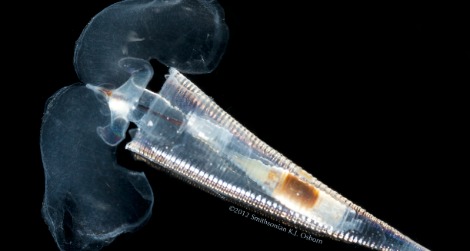
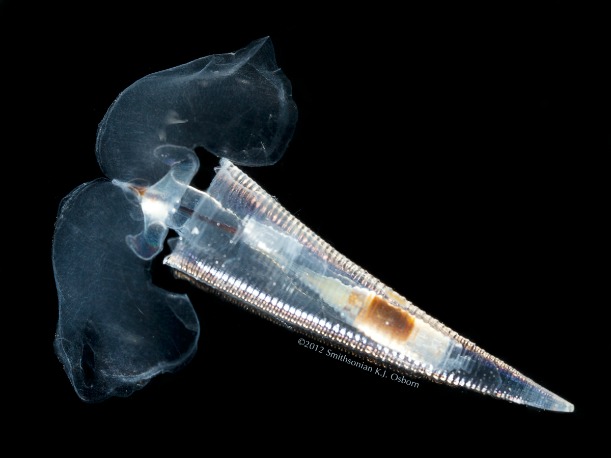
The shelled sea butterfly Hyalocylis striata can be found in the warm surface waters of the ocean around the world. Photo: © Karen Osborn

The chemistry of the ocean is changing. Most climate change discussion focuses on the warmth of the air, but around one-quarter of the carbon dioxide we release into the atmosphere dissolves into the ocean. Dissolved carbon dioxide makes seawater more acidic—a process called ocean acidification—and its effects have already been observed: the shells of sea butterflies, also known as pteropods, have begun dissolving in the Antarctic.

Tiny sea butterflies are related to snails, but use their muscular foot to swim in the water instead of creep along a surface. Many species have thin, hard shells made of calcium carbonate that are especially sensitive to changes in the ocean’s acidity. Their sensitivity and cosmopolitan nature make them an alluring study group for scientists who want to better understand how acidification will affect ocean organisms. But some pteropod species are proving to do just fine in more acidic water, while others have shells that dissolve quickly. So why do some species perish while others thrive?

It’s a hard question to answer when scientists can hardly tell pteropod species apart in the first place. The cone-shaped pteropod shown here is in a group of shelled sea butterflies called thecosomes, from the Greek for “encased body.” There are two other groups: the pseudothecosomes have gelatinous shells, and the gymnosomes (“naked body”) have none at all. Within these groups it can be hard to tell who’s who, especially when relying on looks alone. Scientists at the Smithsonian’s National Museum of Natural History are using genetics to uncover the differences among the species.

This effort is led by zoologist Karen Osborn, who has a real knack for photography: in college, she struggled over whether to major in art or science. After collecting living animals while SCUBA diving in the open ocean, she brings them back to the research ship and photographs each in a shallow tank of clear water with a Canon 5D camera with a 65mm lens, using three to four flashes to capture the colors of the mostly-transparent critters. The photographs have scientific use—to capture never-before-recorded images of the living animals—and to “inspire interest in these weird, wild animals,” she said. All of these photos were taken in the Pacific Ocean off the coasts of Mexico and California.

Clione

This gymnosome (Pneumodermopsis sp.) pulls shelled pteropods from their shells with a set of suckers. Photo: © Karen Osborn

Although sea butterflies in the gymnosome group, like the one seen above, don’t have shells and are therefore not susceptible to the dangers of ocean acidification, their entire diet consists of shelled pteropods. If atmospheric CO2 continues to rise due to the burning of fossil fuels and, in turn, the ocean becomes more acidic, their prey source may disappear—indirectly endangering these stunning predators and all the fish, squid and other animals that feed on the gymnosomes.

Fleshy pteropod

Cavolinia uncinata. Photo: © Karen Osborn

For years, sea butterflies were only collected by net. When collected this way, the animals (such as Cavolinia uncinata above) retract their fleshy “wings” and bodies into pencil eraser-sized shells, which often break in the process. Researchers then drop the collected pteropods into small jars of alcohol for preservation, which causes the soft parts to shrivel—leaving behind just the shell. Scientists try to sort the sea butterflies into species by comparing the shells alone, but without being able to see the whole animals, they may miss the full diversity of pteropods.

Fleshy pteropod

This may be the same species as the previous sea butterfly (Cavolinia uncinata), or it could be a different species that has gone unnoticed for decades. Photo: © Karen Osborn

More recently, scientists such as Osborn and Smithsonian researcher Stephanie Bush have begun collecting specimens by hand while SCUBA diving in the open sea. This blue-water diving allows her to collect and photograph fragile organisms. As she and her colleagues observe living organisms in more detail, they are realizing that animals they had thought were the same species, in fact, may not be! This shelled pteropod (Cavolinia uncinata) is considered the same species as the one in the previous photo. Because their fleshy parts look so different, however, Bush is analyzing each specimen’s genetic code to establish whether they really are the same species.

Pteropod egg case

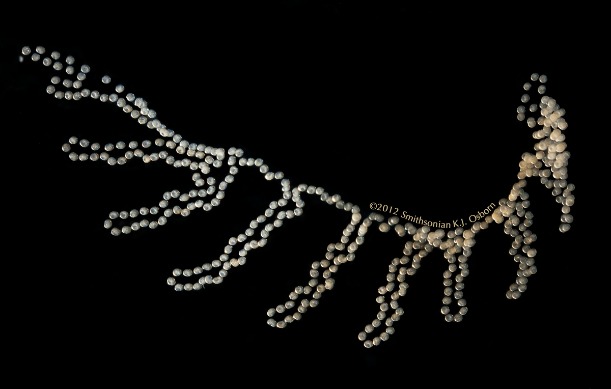
Mass of Cavolinia uncinata eggs. Photo: © Karen Osborn

This string of eggs shot out of Cavolinia uncinata when it was being observed under the microscope. The eggs are attached to one another in a gelatinous mass, and, had they not been self-contained in a petri dish, would have floated through the water until the new pteropods emerged as larvae. Their reproduction methods aren’t well studied, but we know that pteropods start off as males and once they reach a certain size switch over to females. This sexual system, known as sequential hermaphroditism, may boost reproduction because bigger females can produce more eggs.

Limacina spiral

In the Arctic, this pteropod species (Limacina helicina) can compose half of the zooplankton swimming in the water column. Photo: © Karen Osborn

This pteropod (Limacina helicina) has taken a beating from being pulled through a trawl net: you can see the broken edges of its shell. An abundant species with black flesh, each of these sea butterflies are the size of a large grain of sand. In certain conditions they “bloom” and, when fish eat too many, the pteropod’s black coloring stains the fishes’ guts black.

Phonograph pteropod

The shell of Clio recurva is a perfect landing strip for a colony of hydroids. Photo: © Karen Osborn

Not only is the inside of this shell home to a pteropod (Clio recurva), but the outside houses a colony of hydroids—the small pink flower-like animals connected by transparent tubing all over the shell. Hydroids, small, predatory animals related to jellyfish, need to attach to a surface in the middle of the ocean to build their colony, and the tiny shell of Clio is the perfect landing site. While it’s a nice habitat for the hydroids, this shell probably provides less than ideal protection for the pteropod: the opening is so large that a well equipped predator, such as larger shell-less pteropods, can likely just reach in and pull it out. “I would want a better house, personally,“ says Osborn.

Clione

It was once thought that Clione limacina was found in the Antarctic and Arctic, but it’s likely that they are two separate species. Photo: © Karen Osborn

Gymnosomes are pteropods that lack shells and have a diet almost entirely composed of shelled pteropods. This species (Clione limacina), exclusively feeds on Limacina helicina (the black-fleshed pteropod a few slides back). They grab their shelled relative with six tentacle-like arms, and then use grasping jaws to suck their meal out of the shell.

  This post was written by Emily Frost and Hannah Waters. Learn more about the ocean from the Smithsonian’s Ocean Portal.

18 May 09:50

Red Sparowes - At the Soundless Dawn (Full Album) (by...


Red Sparowes - At the Soundless Dawn (Full Album) (by TheodorusSpoke)

Strong hints of Hungry Ghosts, EitS, ISIS, and so on.  A very good record. 

18 May 08:19

Jonathan Frakes & Marina Sirtis - Reunion Of The Rikers.mp4...

Tertiarymatt

NERDZ


Jonathan Frakes & Marina Sirtis - Reunion Of The Rikers.mp4 (by Donald Leverett)

Nerds.

18 May 04:15

Ask the author: Floyd Abrams & his fighting faith

by Ronald Collins
Tertiarymatt

I don't agree with a lot of what he says here, but I respect his devotion to the principle of the matter.

The following is a series of questions posed to Floyd Abrams by Ronald Collins on the occasion of the publication of Abrams’s new book, Friend of the Court: On the Front Lines with the First Amendment (Yale University Press, 2013).Floyd Abrams

Welcome, Floyd.  Thank you for taking the time to participate in this Question and Answer exchange for our readers.  And congratulations on the publication of your second book.

Question:

You’re seventy-six years old and still quite active in litigating First Amendment cases. And now another book about your life in the law, the law of the First Amendment, that is.  Would it be fair to say that you love your work?  

Answer:

Yes. I’ve been very lucky in a lot of ways — my family, my law firm, and my good fortune in being able to devote a good deal of my professional and personal time to seeking to protect and expand First Amendment  principles.

Question:

The title and subtitle of your latest book suggest that you are venturing, on the one hand,  to help the Court better understand the First Amendment while, on the other hand, battling those who would undermine the First Amendment.  Can you say a few words about your roles as educator and combatant?  

Answer:

I think it is possible to play both roles — educator and litigator.  Indeed, some litigation, particularly on constitutional topics, necessarily and inevitably educates and sometimes even enlightens. But the role of a litigator, after all, is to seek to prevail — the litigation equivalent of Justice William Brennan telling his law clerks that the most important thing for a member of the Court is to know how to count to five. I also, and independently from my appearances in courts, have given a lot of speeches, written a lot of articles and engaged in a lot of debates, many of which are set forth in Friend of the Court. It is in those documents, far more than what I say as counsel, that my own views are set forth.

Question:

In the Introduction to Friend of the Court you mention the gulf between the First Amendment bar and those who in the legal academy who write about the First Amendment.  Share with us some of your thoughts on that subject and how law schools train their students.

Answer:

My core criticism of the legal academy, at least in its First Amendment teaching, is not that it’s too “academic”; it’s that it doesn’t take the First Amendment — at least as I understand it — seriously enough. In my book, I quote twice from a passage of Isaiah Berlin in which he observed that “[e]verything is what it is: liberty is liberty, not equality or fairness or justice or culture, or human happiness or a quiet conscience.” In this country, I would substitute the words “First Amendment” for “liberty.” That does not mean that equality and other significant values necessarily lack constitutional or other legal support; it does mean that when we speak of the First Amendment, we should be speaking of individual liberty and not of a watered-down version drafted to accommodate those other interests — ones which can generally be protected without intruding into areas protected by the First Amendment.

Question:

The legal philosopher Ronald Dworkin, who died recently, admonished: “we must take care not to convert the First Amendment from a matter of principle to a pointless mantra that subverts rather than sustains democracy.”  What is your answer to that?

Answer:

Ronald Dworkin was a great student and teacher of both philosophy and law and we should be grateful that he has left so significant a body of work for us to continue to learn from. But I think he erred greatly in maintaining that First Amendment cases should be decided on the basis  of our view — or the Supreme Court’s view — of whether or not the speech at issue in a case  advances “democracy.”  That was one basis for his disapproval of the Citizens United ruling.

My view is that suppression of speech, particularly but not exclusively political speech, is inconsistent with what the First Amendment is most clearly and importantly about. That does not make the First Amendment a “pointless mantra”; it is the point of the First Amendment to prevent government from determining who can speak and what is worth saying.

Question:

If you can forgive my indelicacy, how do you respond to the charge that you do the bidding for big-money corporate America?  You stand with them, so the indictment goes, on copyright law, on campaign financing, and on advertising, even tobacco advertising!  By that measure, one might dare to ask the “Devil’s advocate”: “Have you no conscience, sir?” When you get such questions, as I trust you do, how do you reply?

Answer:

I reply by saying that I have spent a good deal of my professional life representing corporations, usually with no critical response by those who are offended at the identity of others of my clients. The corporations my critics seem to like (or forgive me for representing) publish newspapers, broadcast on television, own museums and the like. The ones they take offense about are more purely commercial and thus, I suppose, less deserving in the view of these critics of First Amendment protection.

I accept none of this for three reasons. First, I do not believe the First Amendment should be limited to particular classes of speakers. Second, I do not believe the First Amendment protects speakers as much as it protects speech — regardless of its source. Third, I am a lawyer who is willing and indeed pleased to represent a wide range of clients with a wide range of problems; that is, after all, what lawyers do.

Question:

Thirty years ago you wrote a piece in The New York Times Magazine (reproduced in your book) expressing serious concerns about the government’s efforts to control information.  In McBurney v. Young, decided a few weeks ago, a unanimous Supreme Court, in an opinion by Justice Samuel Alito, declared:  “This Court has repeatedly made clear that there is no constitutional right to obtain all the information provided by FOIA laws. . . .  It certainly cannot be said that such a broad right has ‘at all times, been enjoyed by the citizens of the several states which compose this Union, from the time of their becoming free, independent, and sovereign.’” The Court also added that no such right was recognized under the common law, and early American history does not support that notion, either. Moreover, the current administration, like its predecessors, seems bent on controlling more and more information. What is your reply to all of this? 

Answer:

I do not believe the First Amendment itself requires the government to disclose much in the way of information. Looking at the issue broadly, I agree with Justice Potter Stewart that the First Amendment is neither an Official Secrets Act nor a Freedom of Information Act. That said, I do believe that the government should be far more transparent than it is, that it should release far more information than it does and that there is a continuing problem of vast over-classification by the government.

Question:

In Friend of the Court you write a lot about various attacks on the press, both historical and current.  I trust you saw the May 13, 2013 AP story in which it is alleged that “the government seized . . . records for more than twenty separate telephone lines assigned to AP and its journalists in April and May of 2012.”  Are you familiar with this and do you have any comment on it?  

Answer:

The Department of Justice’s action in obtaining vast amounts of telephone records of the AP at multiple sites for a two-month period is deeply disturbing. I have no reason to doubt the good faith of the government; the leak was obviously about highly sensitive matters. But I can think of no good reason why the DOJ could not have conferred with the AP and ultimately let the courts decide the issue, if judicial action was sought by either side. From my perspective, what occurred is not different conceptually from the FBI sending agents into the AP and demanding the immediate turnover of its telephone records.

The inhibiting effect — the word “chilling” has become a one-word cliché but it is applicable here — of this sort of behavior by the DOJ is obvious here — on the press, on potential whistle-blowers, and the like. And I cannot give the DOJ or this administration the benefit of the doubt: there have been too many leak investigations, too zealous an approach to them, too little attention paid to the dangers in the government invading a newsroom.

Question:

You are on record as being a staunch defender of the holding in Citizens United v. Federal Election Commission (2010). You devote an entire chapter to it in your book.  Last August, President Obama expressed an oppositional sentiment: “Over the longer term, I think we need to seriously consider mobilizing a constitutional amendment process to overturn Citizens United.” How would you respond to the President?    

Answer:

I would urge the President to review Justice Anthony Kennedy’s opinion for the Court in Citizens United. I would ask him what his answer is to Justice Kennedy’s three hypothetical questions in that case: “The Sierra Club runs an ad, within the crucial phase of 60 days before the general election, that exhorts the public to disapprove of a congressman who favors logging in national forests; the National Rifle Association publishes a book urging the public to vote for the challenger because the incumbent U.S. Senator supports a handgun ban; and the American Civil Liberties Union creates a web site telling the public to vote for a presidential candidate in light of that candidate’s defense of free speech. All that advocacy,” Justice Kennedy wrote,  “would be criminal under the statute that the Supreme Court has now held to be unconstitutional.”

I would ask the President if he agreed that such speech could constitutionally be banned. And I would ask him if he really wants to be remembered as the first president who proposed a constitutional amendment narrowing the scope of the First Amendment.

Question:

In a recent interview on this blog, Marcia Coyle said this: “I have tremendous respect for Floyd Abrams. He is a hero to many of us in the media and I’m not surprised at all at his view of the case. He is a true champion of the First Amendment. I do think Citizens United was an aggressive decision. Citizens United had abandoned its facial challenge to the relevant provisions in the lower court so there was no record. The majority was ready to issue a decision overruling Austin and the provision in McCain-Feingold without briefing or argument, and there were narrower grounds on which to rule, alternatives offered even in Citizens United’s brief. Calling the decision aggressive does not necessarily mean that I thought it was wrong.”

Was Citizens United an “aggressive decision”? What is your reply to Ms. Coyle? 

Answer:

Of course Citizens United was an aggressive opinion. So, as I pointed out in my oral argument in the case, was New York Times v. Sullivan.  The Court did not have to go as far as it did. But as in Sullivan and too many other cases to cite here in which the Court concluded that a broad opinion was necessary, it provided one. I feel obliged to add that an awful lot of academics who seemed unconcerned at (and even celebrated) the breadth of many decisions of the Warren Court seem terribly preoccupied by the scope and procedural history of Citizens United.

Question:

You close your book with the following words: “Is it really too much to ask that those who claim they care about the First Amendment – everybody that is – stand in favor of free speech even when the speech at issue pains them ideologically?”  

We as a nation have certainly made progress on that score.  But do you really think we can make yet more progress? And what will it take for us to do so?

Answer:

It’s so hard to say. And in the so very polarized world in which we live today, it is hard to be optimistic. But we have to keep trying.

Question:

I hear you have another book in the works.  True?  What can you tell us about that?

 Answer:

True. And I have nothing to say about it.

In association with Bloomberg Law

18 May 04:07

You’re fired.

Tertiarymatt

#batshare


You’re fired.

17 May 19:04

How To Use Pee In Your Garden

by Erica
Tertiarymatt

Pisssssssss

If you can get over the ewwww factor, pee-cycling your own urine into the garden makes good sense. Fresh urine is high in nitrogen, moderate in phosphorus and low in potassium and can act as an excellent high-nitrogen liquid fertilizer or as a compost accelerator.

How To Use Pee In Your Garden

Components of Urine

The exact breakdown of urine varies depending on the diet of the pee-maker. The more protein a person consumes, the more nitrogen will be excreted into the urine. Typical Western Diet pee has an NPK ratio of about 11-1-2. In comparison, blood meal is 12-2-1 and cottonseed meal is 7-2-2.

Urine also contains salt – sometimes quite a lot of it if you are hopped up on a diet of canned soup and french fries. Because of both the salt and high nitrogen levels, urine should generally be diluted 10:1 before use on garden crops. Greater dilution – 20:1 or more – is appropriate for more tender plants, seedlings and potted plants which are more susceptible to salt build up.

Keep in mind that areas with a lot of rain (Seattle!) tend to leach salts out of the soil, so salt build up is something gardeners in arid climates should be more concerned about.

Fresh pee can have a pH anywhere from 5 to 9 depending on a person’s diet, but it tends to move toward neutral as it ages and breaks down when applied outside. I would not personally worry too much about the variable pH of urine for garden use.

Safety Issues

In a healthy person, urine is sterile. In someone with decent hygiene and wiping technique, it should more-or-less stay that way as it leaves the body. Cross contamination with fecal matter (health risk!) can be a concern, so perfect your front-to-back TP technique if you are going to pee-cycle.

If you are on medication, don’t fertilize with your pee. If you have a UTI or other infection or – well, let’s just say anything funky going on in or around your pee-hole – your urine is not fit for garden use.

Grossness Issues

Assuming the safety issues are satisfactorily addressed, then the grossness issue is cultural programing and you should think about if it’s programming you want to keep in your brain. Most gardeners, after all, are pleased as punch to get ahold of a big load of cow poop for their garden, and that fertilizer has a far greater chance of spreading harmful pathogens than pee.

Here’s a few other things to think about:

“Urine accounts for only 1% of the total volume of wastewater, but it contains up to 80% of all the nutrients.”
-Science Daily

A typical toilet flusher wastes “up to 22 liters of drinkable water every day, one three- to six-liter flush at a time. What follows…is the long and costly process of sanitizing the water that was clean before you answered nature’s call. Using so much water per flush unnecessarily increases the volume of our waste and the cost of its transportation and treatment, ecologists say….The process also leaves a huge carbon footprint.”
-Time Magazine

Basically, the environmental and financial cost to piss in a bunch of drinking-quality water and then process it back into drinking water is huge. Separating urine from solid waste – through direct pee-cycling or urine-separating toilets – could go a long way to offset this cost by reducing the burden on wastewater treatment programs.

If the tree-hugger eco stuff doesn’t move you to action, consider the cost of a bag of blood meal. Now consider the cost of your pee. You will never find a more easy-to-acquire, cheaper source of fast acting nitrogen.

Basic courtesy is to not apply urine to those parts of the plant that will be consumed (i.e., as a foliar feed for spinach). Even so, if pee-cycled fertilizer on food crops just grosses you out, consider using this resource on fruit trees, perennials, and ornamental plantings, including your nitrogen-lovin’ lawn, instead.

5 Ways To Use Pee In The Garden

Okay, I’ve convinced you! You are ready to drop trou’ and add your liquid gold deposit to your garden. But how do you pee in the garden in the most effective way (and without getting arrested for indecent exposure in the process!)?

1. Compost Accelerator
Is your compost pile cold? A little long on carbon and low on nitrogen? Pee, poured or – ahem – directly deposited – on the pile can start to speed things up and add moisture. If you are nervous about using urine directly on your plants, incorporating urine into a compost pile is the way to go.

2. Dilution is The Solution
Dilute fresh urine at a 4:1 ratio and apply to the root-zone of corn every two weeks or as needed. (Some people say corn, being a grass, can handle fertilization with straight urine. Proceed with caution.)
Dilute fresh urine at a 10:1 ratio and apply to the root-zone of fruiting plants like tomatoes, peppers and eggplant, or to leafy crops like cabbage, broccoli, spinach and lettuce every two weeks or as needed.
Dilute fresh urine at a 20:1 ratio and water in to the root zone of seedlings and new transplants.

3. The Straw Bale Sprinkle
When Straw Bales are used for gardening, they must be “conditioned” or partially broken down / composted before use. This is accomplished with the addition of a very high nitrogen fertilizer. Guess which free, Bud Lite-hued high-nitrogen fertilizer I’d recommend?

4. Deep Mulch Direct Application
If you thickly mulch your woody perennials, cane fruit and fruit trees with a high-carbon material like leaves or woodchips, you can apply your urine straight onto the mulch, which will absorb and moderate the straight shot of nitrogen in your pee.

5. That Asparagus Smell!
If asparagus makes your pee smell funny, take revenge and pee on your asparagus! Nutrient hungry, deep rooted, perennial and salt-tolerant, asparagus might be the ideal crop to fertilize with pee. If you grow your asparagus under a thick layer of carbonaceous mulch, like straw or wood chips, use the Direct Mulch Direct Application technique, otherwise dilute 2:1 if your asparagus is in the sandy soil it prefers, or 4:1 in heavier soil. Apply throughout the growing season, along with a good source of potassium, like bone meal, in the early spring.

Pee-cycling Sexism

So Adam and Eve are standing in the Garden of Eden right after the Creation and God is handing out the last of the talents, qualities and features he has for each of them. He reaches into his bag and pulls out a slip of paper.

Ability to Pee Standing Up,” booms God. “Okay, who wants this one?”

“Oh, pick me!” yells Adam, “Pick me! Peeing while standing up sounds like such a very male thing to do, God. I really think that one has to go to me. Sorry Eve, but I really think I need this one.”

God looks at Eve, who just shrugs. “Sure, if it’s that important to him, give Adam the peeing thing. I don’t really care.”

God hands Adam the slip of paper and says, “Forevermore, Adam, by your choice shall men be endowed with the ability to pee whilst standing.”

Adam grins and God reaches to the very bottom of his bag. “Just one more, and I guess since Adam got Peeing While Standing Up, this last one goes to you, eh, Eve? Let’s see…”

God unfolds his final slip of paper. “Okay, here you go Eve: Multiple Orgasms is all yours.”

{ba-dum-bum}

It is a fact of life that men are better equipped to pee all over things. If you are a male gardener, combine your skills and start marking your veg territory with pride. The Deep Mulch Direct Application method will be simplest if you want to water directly from the hose, so to speak.

Ladies, I highly recommend you use Adam’s gift to all men to your advantage, too. Got a husband? Boyfriend? Better yet, a son or two? Give them carte blanche permission to pee on the compost pile. Direct that natural ability (and, dare I say, inclination) for outdoor pee marksmanship towards something good for your garden.

But don’t let the guys have all the fun. You’ll notice that most of the techniques for applying urine as a fertilizer call for dilution anyway, which means a watering can or container is going to be involved. Most women with regular access to lady-specific medical care have had plenty of practice peeing in cups – put that experience to use, for the good of your garden.

Do you already pee on the compost, or does the very idea of pee-cycling leave you pissed!?

17 May 13:01

Can You Heat Your Home With Bricks and Twigs? Paul Wheaton Thinks So.

by Erica

Let’s say, just for argument’s sake, that you think the world would be a better place if the collective “we” used less coal, oil, natural gas, nuclear energy and other heat-generating resources.

Or, maybe you don’t give a rip about the environment but you sure like saving money.

Perhaps you just need a reliable DIY way to heat your off-grid cabin?

Enter the Rocket Mass Heater, a “hyper-efficient wood-burning stove” (Wikipedia) and the preferred home heating solution for hip enviro-survivalist-DIY-off-grid-natural-building types since 1970.

I’m no expert, but as far as I can tell, a Rocket Stove is a way to build a massive jet-engine-type-burner (think “turkey fryer BTUs from something that looks like a coffee can”) that runs on twigs and kindling. These have the advantage of being DIY-able for nearly free if you have the right random collection of stuff hanging around.

A Rocket Mass Heater is basically one of those jet-engine-type-burners and a special exhaust tube built into a big mass of masonry-type stuff that radiates heat out into your home. (For goodness sake, don’t use my description to build one – you’ll blow something up – go get a proper plan.)

The result of mixing a jet engine that runs on twigs with a lot of masonry bricks?

Well, according to Richsoil.com, Rocket Mass Heaters have some serious advantages over conventional home heating methods:

  • Heat your home with 80% to 90% less wood
  • Exhaust is nearly pure steam and CO2 (a little smoke at the beginning)
  • Radiant heat from one fire can last for days
  • Build one in a day and half
  • Buildable for less than $20

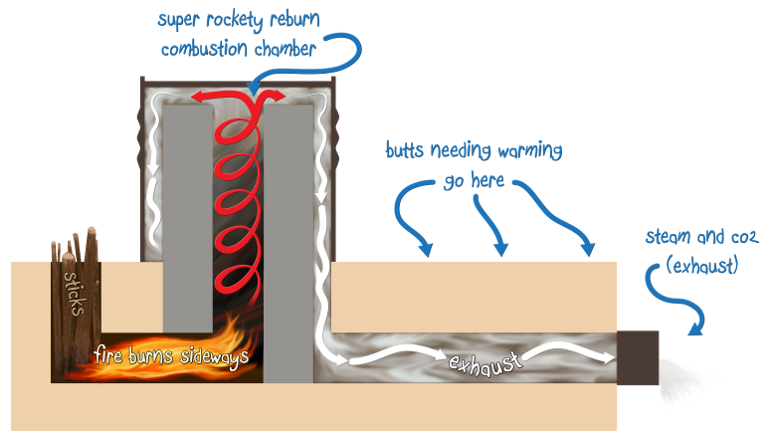
I only partially grok the fire science behind Rocket Mass Heaters, but this photo helps to make it more clear:

Image:Richsoil.com

What makes a Rocket Mass Heater unique is the extremely well insulated chimney that gets so hot it burns off smoke and particulate and creates a strong air-flow current that results in a super-clean, nearly smoke-free burn using minimal wood.

The “Mass” in a rocket mass heater is important too – the super hot combustion chamber and the exhaust channel radiate their heat out through rocks, fire-bricks, fire-cob and the other high mass stuff that surrounds them and this radiant heat means that a small RMH fire can warm a home for days. This mass means that Rocket Mass Heaters tend to have a particular look – kinda like if a clay pizza oven and a window seat had a baby.

Which can be far more attractive than it sounds, actually. Like this:

Image: Ernie Wisner, Rocket Mass Heater super-expert

Or this:

Screen shot 2013-03-04 at 11.15.39 PMImage: Cob Cottage Publications via Amazon.com

If you are as intrigued as I was when I started learning about Rocket Mass Heaters, you can find a ton more info at the Permies.com Forum dedicated to wood burning stoves. I also like this video for a good overview on how these heaters are put together.

And if you think this crazy brick-and-twig off-grid heating system might be for you, you may want to get in on an active Kickstarter Campaign started by Paul Wheaton of Permies.com. He’s making a 4-Set DVD series on how to build Rocket Mass Heaters (and other related stuff) without blowing up your house or melting your face off. The trailer for the Kickstarter is worth a watch below if this technology interests you.

If you could learn to build one safely, would you go off-grid for your home heat with a Rocket Mass Heater?

17 May 08:10

How To Make A Heavy Duty Potato Cage

by Erica

Every year about this time gardeners start inflicting all manner of experiments upon the humble spud. We drop them into burlap sacks, grow pots, wood towers, mesh towers, tire towers, garbage cans, straw bales and more. We attempt the Square Foot method, the Ruth Stout method, the Hilled Row Method, the Plastic Mulch Method.

The goal with these various growing methods is always the same: maximum possible yield of clean, unblemished potatoes in a minimum of space. To achieve this ideal, potatoes need moist, rich, acidic soil under the seed spud and loose, dryish, lightweight soil or other matter above, where the vine will grow and new tubers will form. These conditions are easily created in container culture, and bins and cages give the added advantage of dead-simple harvest. Once the vines die back, you tip-and-pick.

So it seems that potatoes should be the perfect candidate for all these grow-bin experiments. And yet, for all the internet promises – “Grow 100 Pounds of Potatoes in 4 Square Feet!” – I have never, ever, ever heard from an actual person who has achieved results like these. In fact, often I think that the potato usually manages some yield no matter how you grow it more from the insuppressibility of the tuber than the creativity or skill of gardeners.

My own experiments two years ago in burlap sack potato growing were a dismal failure. Last year I grew potatoes both in ground and in large Rubbermaid plastic tubs. The potatoes grown in the ground were fine: the quality and quantity were neither spectacular nor terrible. The tub-grown taters did better. I filled the tubs with purchased compost and was rewarded with a good yield of very clean, nicely shaped if slightly small potatoes for most varieties grown. (French Fingerling was the clear winner.)

But by the end of the season, ants had found the bins and had made a happy colony inside the warm, protected, loose soil. Harvesting required overcoming the fear-factor of dozens of ants swarming my forearms and hands as I plucked the potatoes from the soil. And all that purchased compost cost a pretty penny.

So this year, I am trying yet another way. I hope (don’t all we potato growers?) that maybe I’ve found the perfect very low cost, portable, good-drainage, large-scale container for growing. In a few months, the results will, one way or another, speak for themselves.

Assembling the Cages

OLYMPUS DIGITAL CAMERA

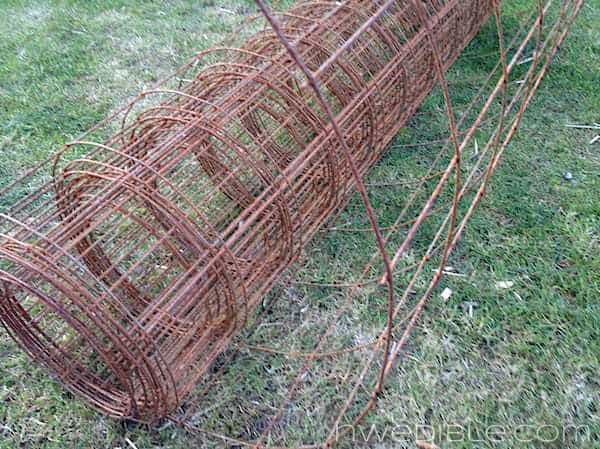
My Heavy Duty Potato Cage starts, like so many projects around my yard, with a roll of concrete reinforcing mesh. This is the same roll of mesh I’ve used to make rebar arch trellises, pea climbing supports, tomato cages, cloche supports and more. This one 5′-wide, 150′-foot long roll of concrete mesh is like the garden gift that just keeps giving.

IMG_3337

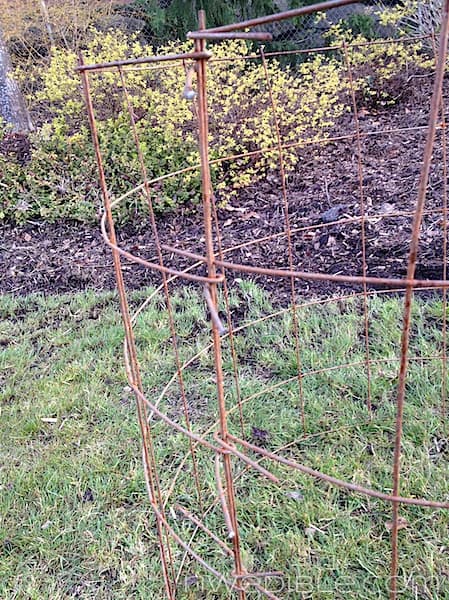
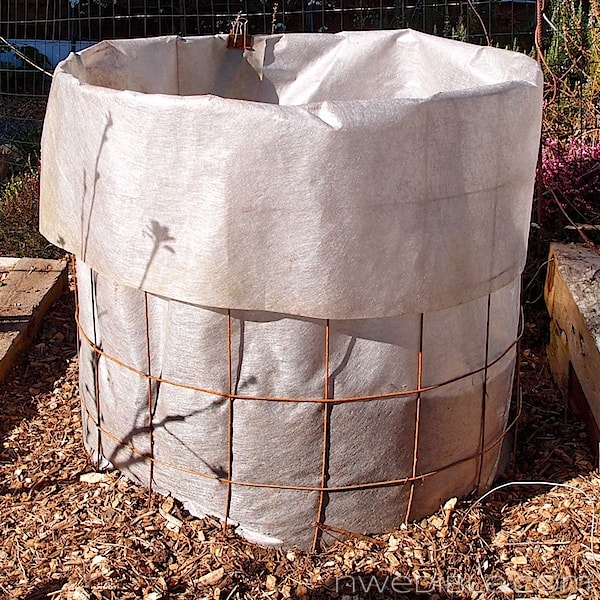
I cut a 9 foot section of the mesh and then cut that in half lengthwise. This gave me two sections, each 9 feet long and 2-1/2 feet tall. Each section was wrapped into a circle (the mesh naturally wanted to curl up so this was easy) and I twisted and folded the loose ends of the mesh back around the opposite edge to hold the circle securely. Result: easy heavy duty potato cages.

IMG_3341

I decided on locations for my potato cages and roughly leveled the ground where the cages would sit. I set the potato cages into place and used a few landscape staples to hold them in place.

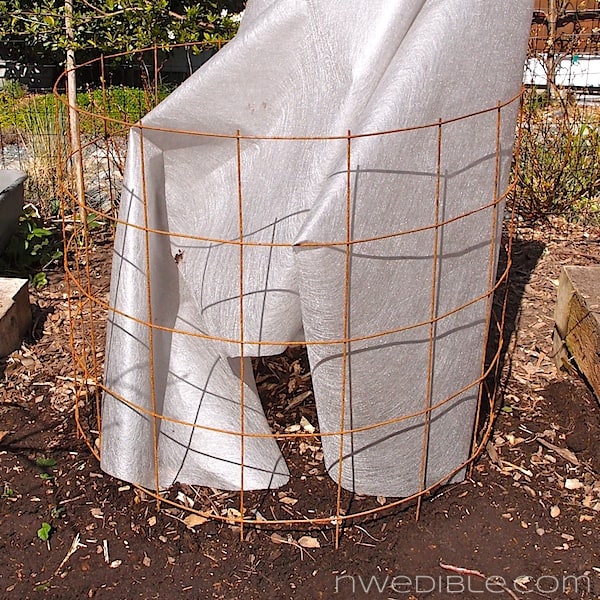
Then, I cut a section of landscape fabric to fit inside the mesh potato cage. I fitted the landscape fabric down to the ground but left the bottom of the potato cage open. I smoothed the landscape fabric against the edge of the cage as best I could.

OLYMPUS DIGITAL CAMERA

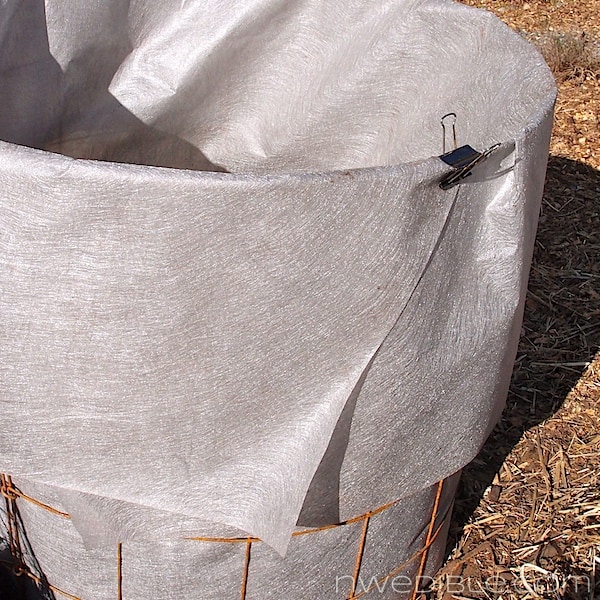
I folded the extra landscape fabric at the top of the cage over, and held the fabric in place with a binder clip (binder clips are essential garden tools!).

OLYMPUS DIGITAL CAMERA

Filling the Potato Cages!

One of the things I like about these cages is their substantial size. But big containers needs lots of soil, and trucking in loads of compost just isn’t in my budget this year.

One of my goals for this project was to reduce the cost by coming up with a good growing material that was on site (not something I had to buy in a bag). Straw, although less expensive than bagged compost, is still $12 a bale in my urban area, and I had terrible results using straw in my burlap sacks so I ruled that out.

I have had pretty good luck growing potatoes in various forms of compost. My chickens make excellent compost for me. However, though I am not particularly squeamish, I hesitate to use fresh chicken bedding (i.e., uncomposted chicken poop) for root vegetables like this.

In the end, the answer was under my feet. We mulch our network of garden paths with free woodchips from a tree trimmer friend of mine. Scratching aside the top layer of last year’s chips revealed wonderful, rich, fine-textured soil just underneath.

OLYMPUS DIGITAL CAMERA

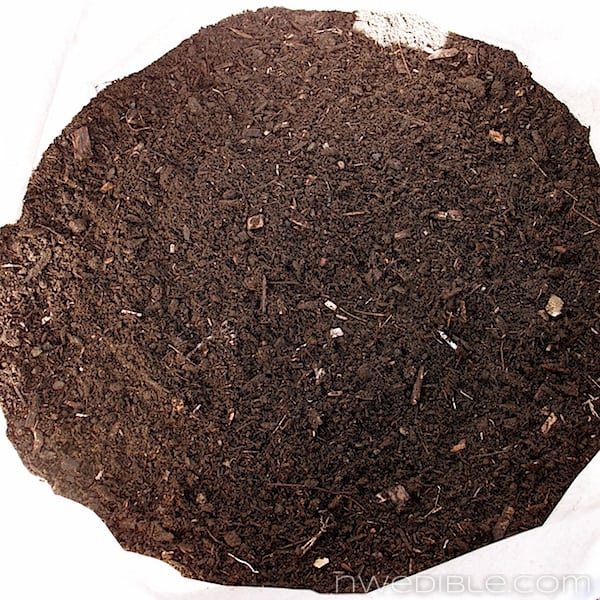
I dug up as much wood chip path compost as I needed to fill the potato cages about a foot or 14 inches deep. This was actually really easy, and barely made a dent in my network of paths. If chucks of wood chips or less composted material made it into the bin, I didn’t sweat it.

OLYMPUS DIGITAL CAMERA

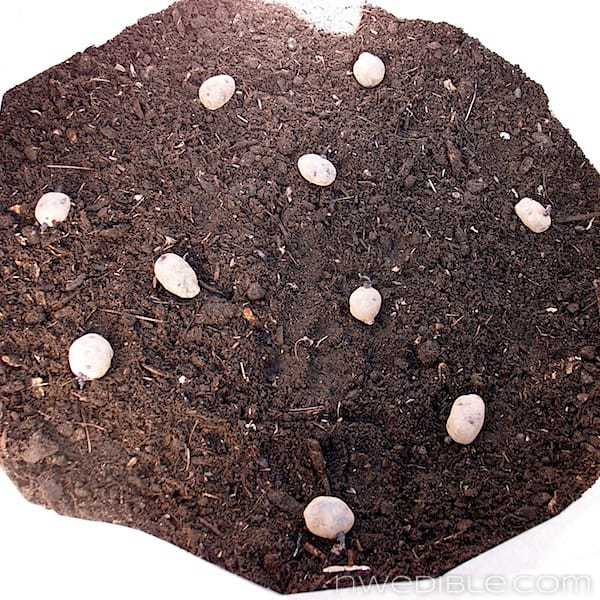
I dumped some of last years finer (bagged) compost on top, and mixed it into the top layer of soil. This brought the soil level up to about 16 or 18 inches. Then I laid out my seed potatoes atop the soil in each bin.


OLYMPUS DIGITAL CAMERA

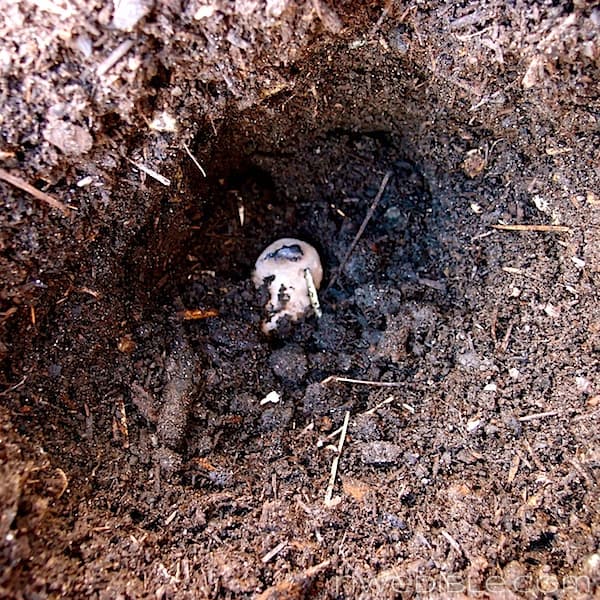
I scooped out a hole about 5 inches deep for each seed potato and dropped it in.

OLYMPUS DIGITAL CAMERA OLYMPUS DIGITAL CAMERA

The light, fluffy soil was smoothed back over everything.

OLYMPUS DIGITAL CAMERA

Can’t Build Just One

I made four of these cages, and they were fast and easy to put together. The concrete mesh, lined with landscape fabric, didn’t deflect or bend under the weight of the soil, and so far there’s been no leaking of soil.

OLYMPUS DIGITAL CAMERA

I’m pretty optimistic about this design. The landscape fabric should act in much the same way as expensive grow pots, allowing a lot of air and moisture flow and encouraging beneficial air pruning or roots as compared to plastic or masonry containers. Unlike burlap, the landscape fabric should stay in one piece and not start to rot out within a few weeks of soil contact.

OLYMPUS DIGITAL CAMERA

And of course it was cheap. Because I had concrete mesh and a roll of landscape fabric lying around from other projects, and was able to utilize the wood chip compost from on-site, this project was free to me. If you had to buy the mesh and landscape fabric new, you still shouldn’t be out more than $10 or so for each bin.

I’ll update you on how this is working as the potatoes grow.

How are you growing potatoes this year and what method has given you the best success?

17 May 08:03

Judge refuses to back down on “Plan B”

by Lyle Denniston

A federal judge in New York, in a blistering new denunciation of the Obama administration for what he said was playing politics with women’s health, refused on Friday to lift his order that the Plan B emergency contraceptive be made available over the counter to women of all ages.  He did give the government until Monday to start pursuing an appeal to the Second Circuit Court, but criticized that appeal as “frivolous.”

Senior U.S. District Judge Edward R. Korman of Brooklyn aimed most of his harsh critique at Secretary of Health and Human Services Kathleen Sebelius, saying once again that she has abused her position and has frustrated women’s access to Plan B even though the government’s own scientists say it is safe and effective in preventing pregnancy if taken soon after unprotected intercourse.  He derided the arguments that the Justice Department plans to make in its appeal, saying that Sebelius herself has undercut those arguments.   One argument, he said, was “silly.”

Korman went even further, accusing the administration of making a “sweetheart arrangement” with the company that makes Plan B pills, negotiated one day before the government filed a formal notice that it would appeal, lowering the age of no-prescription action to the contraceptive from seventeen to fifteen.  That deal was worked out, the judge asserted, to “provide a sugarcoating” for the appeal the government was planning. The government waited as long as it could to respond to the judge’s April 5 order requiring broader access to the drug, the judge said.

Under that arrangement, Korman said, the Plan B maker — Teva Women’s Health, Inc. — stands to gain a commercial advantage in selling the contraceptive, and women may find it harder to obtain the drug than they would have under the judge’s order.  Women will have to prove their age to a pharmacist or drugstore retail clerk to obtain Plan B, under the Food and Drug Administration’s new arrangement.

The Justice Department told the judge last week that it would challenge his order with two legal arguments: first, that the judge had no authority to order open access to the one-pill version of Plan B (known as Plan B One-Step) because the two-pill version was the only one at issue before him; and, second, that his order intruded on the FDA’s normal process of reviewing when to switch a prescription drug to over-the-counter status.

Judge Korman sought to answer both arguments on the way toward suggesting that the appeal on those grounds would be “frivolous.”  He said the issue of which pill version was before him was no longer an issue, because Teva — instead of taking advantage of the wider access that the judge ordered —  had made its new deal with the FDA to restrict access to any version to those fifteen years old and older.  That issue, he said, is probably moot now.

The judge rejected the argument that he was infringing on FDA’s expertise by issuing a specific order on over-the-counter access.  That is precisely what the experts at FDA had wanted, before Secretary Sebelius overruled them, the judge said, so it was the Secretary who engaged in “undermining the public’s confidence in the drug approval process.”  Sebelius, he remarked sharply, made a “bad-faith, politically motivated decision,” and she “lacks any medical or scientific expertise.”

By refusing to delay his own order as the government asked, the judge said, he was vindicating FDA’s expert judgment that Plan B should be available without a prescription and over the counter to women of all ages.

To a separate argument by Justice Department lawyers that the judge’s access order will only lead to public confusion about which contraceptive is available to women, Judge Korman replied that it is the new arrangement made with Teva that is going to result in confusion.  The judge ticked off the multi-layered system of access that would result from the arrangement FDA has just made with Teva.

It was “nonsensical,” the judge said, to work out that arrangement: first, women fifteen years of age or older will be allowed to buy the one-pill version, but only from a store with an on-site pharmacy and only if they can prove their age; second, other versions of the contraceptive with the same basic ingredient as Teva’s Plan B will only be available from behind the counter and only for women over the age of seventeen who can prove their age with a government-issued ID; and, third, women who do not have a government ID or who are under the age of fifteen will not have any access to Teva’s one-pill version and must get a prescription for a competing product, such as a generic version.

This system is sure to cause confusion, much more than the judge’s order on wide access, he said.

While he denied the requested postponement of his order pending an appeal, he said he would not implement his order over the weekend, giving the Justice Department until noon Monday to file a request for a delay with the Second Circuit Court.


In association with Bloomberg Law

17 May 06:36

Master juggler Michael Moschen weaves rhythm, physics, and...

by rion
Tertiarymatt

The most brilliant thing about this is how he resists the ready, comfortable rhythms.


Master juggler Michael Moschen weaves rhythm, physics, and hand-eye coordination into this wonderful performance called The Triangle

There are a few more jugglers juggling in the archives.

Thanks, Shonali.

17 May 06:32

In this documentary short, Shaped on all Six Sides by Kat...

by rion


In this documentary short, Shaped on all Six Sides by Kat Gardiner, Andy Stewart shares his philosophies about his relationship with and respect for the craft of wooden boat carpentry. This quote on quality and his place in the work stood out:

A lot of the allure of working on wooden boats, actually, is because the sea is the final arbitrator of the quality of your work. It’s very gratifying to see repairs that I’ve done 30 years ago still holding up, and so I feel like I’m part of a long continuum of craftsman keeping vessels around and alive. 

It reminded me of the NYTimes article, The Stories That Bind Us, which lays out the benefits of children knowing their family history. Sharing traditions and values through storytelling can help to develop an “intergenerational self,” an understanding of their part in a family narrative that is built with both successes and difficult challenges. A good read

17 May 06:31

sharpen the shears..the boss is back….

by tom

Hi all, Tom Ritson here – apprentice to Mr Mahon.

English Cut, Bespoke, Savile Row, Tailors
(ripped down and ready for the masters re-cut)

Well, my first blog post has arrived. Hopefully you have seen the introductory video two posts back and are ready to receive my take on the Savile Row tailoring trade as an apprentice behind the scenes of English Cut.

Mr Mahon has now returned from the USA after a very successful trip to San Francisco & New-York. He has informed me of the lovely clients he has met again this time round…. I just wish I was there to meet them too!

Whilst in the USA I have been holding the fort in our workshop, preparing for the work that proceeds the boss’s return to England. With a fresh order book and many fittings to re-cut and continue on their journey through our workshop, we are now getting stuck in to the work ahead.

One of my first jobs is to ‘rip-down’ basted garments, ready for Mr Mahon to re-cut. I use a surgical blade to carefully take apart the garments (one slip of the knife and I’m out of a job) so there is a set method and great deal of care taken. After marking the alterations to be made whilst on the client at the fitting, each garment is again inspected on return to our workshop and paper patterns adjusted accordingly. Mr Mahon then re-cut’s every one to ensure the best posible cut prior to being made up fully by the coat maker and finisher. When the garment bastes are ripped-down and married up with each client’s paper pattern, it’s under the cutting board they go – ready and waiting to see the shears again.

As for new orders taken on the trip, I’m sending samples, ordering cloth and finalising paperwork. This can take a while due to the bulk numbers gained from these trips, however, I’m working my way through them methodically. Also, this gives me time to get familiar with the new bespoke client names I’ll be seeing over the coming months.

For the weeks ahead, I’ll be working closely with Mr Mahon, whilst he and I begin cutting the new orders and seeing this round of fittings off to our coat makers and finishers. I can’t wait to see these finished and ready for dispatch….

I very much look forward to the many subjects I shall be covering this year…. a very exciting time to be writing about the business, as there’s certainly lot’s more to come.

Kind regards,

Tom Ritson

Apprentice to Mr Mahon


17 May 05:11

Cornel West: How Intellectuals Betrayed the Poor (by...


Cornel West: How Intellectuals Betrayed the Poor (by bigthink)

I don’t always agree with Brother West, but he’s pretty on point here.

17 May 04:17

"Thesis" Composition for pedal steel (David Phillips), trombone...

Tertiarymatt

Ben is a cool dude. He sent me his album ("Cucumber, the Album") some years ago, all for free like.


"Thesis" Composition for pedal steel (David Phillips), trombone (Greg Stephens & Andy Strain), bass trombone (Jack Madden), violin (Christina Stanley & Tammie Dyer), cello (Crystal Pascucci), and double double bass (Jason Hoopes, Adam Lowdermilk & Edward Stumpp).

Live at the Signal Flow Music & Sound Art Festival, Jeannik Méquet Littlefield Concert Hall, Mills College, 3/8/12 
mixed with:
Live at the Luggage Store 2/23/12 
mixed with:
Electronic improvisations (Fall 2011) (sourced from Moog 3P & Arp 2600) edited (Spring 2012) and arranged for transcription/notation.

Initially born from recordings sourced from extensive solo improvisations on the Mills Moog Studio’s ARP 2600, and Moog 3P analog synthesizers, I edited these recordings with as little additional processing as possible to maintain the electronic instruments’ timbral qualities into a cohesive preliminary, electronic recording. I then worked with composer Daniel Steffey, who transcribed the recording into traditional notation to be performed by the players you hear tonight. Combining my fascination with the unstable qualities in both acoustic and analog electronic instruments with my enjoyment in the physicality of the players gracefully struggling with their instruments I address my concern with electronic music performance (a person and a box) in a formal space such as a concert hall. Title courtesy of Dorothy Berry.

16 May 23:48

Agents of S.H.I.E.L.D.

Tertiarymatt

Is it just me, or does this look terrible?


Agents of S.H.I.E.L.D.

15 May 19:27

On the Constant Moment - clayton cubitt photographic works

Tertiarymatt

Siege is an intriguing dude, with his strangely severe exterior, deep kindness, and commitment to art.

On the Constant Moment - clayton cubitt photographic works:

We exist on a treadmill of forgetting and anticipating. We labor to preserve what we treasure of our past, even while the present shotguns us with a thousand new options, one of which must become our future. One of which we must choose. In this maelstrom of time it is hard to be calm; to understand what warrants attention, and what can be ignored. This state of tranquility and presence has been the essence of the modern photographic act, best characterized in the popular mind by Cartier-Bresson’s concept of the “Decisive Moment." 

Cartier-Bresson believed that the photographer is like a hunter, going forth into the wild, armed with quick reflexes and a finely-honed eye, in search of that one moment that most distills the time before him. In this instant the photographer reacts, snatching truth from the timestream in the snare of his shutter. The Decisive Moment is Gestalt psychology married to reflexive performance art in the blink of a mechanical eye.

It is the creation of art through the curation of time.

In Ancient Rome, officials in charge of overseeing the assets of the Empire were called Curators. This meant, literally, "caretaker." The fall of the Roman Empire left the Catholic Church to carry on the role of curator, and by the Middle Ages the role had become ecclesiastical, with parish priests caretaking the souls of their flock. In fact, Cartier-Bresson’s choice of the term “decisive moment" itself comes from a quote by a 17th century Cardinal de Retz: “There is nothing in this world that does not have a decisive moment." The Cardinal’s role as a political agitator lends a Machiavellian patina to the phrase when you read the rest of the quote, which continues, "and the masterpiece of good ruling is to know and seize this moment."

The modern relationship of “curator" to “art" arose in the princely courts of the Renaissance, when aristocrats sought to outshine each other in their support for the arts, and began building wings on their palaces for the showcasing of these collections, along with expensive printed catalogs to extend the reach of the art (and the glory of the owner.) As we transitioned from aristocratic feudalism to the democratic nation state this form evolved into the modern museum and its attendant curators.

Presently the act of curation, or the title of curator at least, is undergoing an elastic expansion. Companies employ celebrities to curate the lineups of cultural festivals, and stylists to curate capsule collections of fashion they can sell to untapped demographics. Online, members of the Tumblr generation compliment each other on their “curation." On Facebook each day we see a continuous scroll of content curated by friends, and companies that pay for the privilege of sneaking in with them. 

The rest of this is absolutely worth reading. You may not agree with his vision, but it’s an interesting take on a likely future.

15 May 15:38

Birds and Dinosaurs

Tertiarymatt

I like xckd, but this is simply not correct. By the same logic, humans, dinosaurs and birds are all a type of bilaterally symmetrical proto-sponge.

Sure, T. rex is closer in height to Stegosaurus than a sparrow. But that doesn't tell you much; 'Dinosaur Comics' author Ryan North is closer in height to certain dinosaurs than to the average human.
15 May 08:05

(via Cult of Luna)

Tertiarymatt

Great version of the closing track from Vertikal.


(via Cult of Luna)

14 May 22:38

Top 10 Whiskies Reviewed in Whisky Advocate’s Summer Issue

by John Hansell
Tertiarymatt

Interesting mix. I note the presence of a lot of rye on this list.

Here is your sneak preview of the top 10 whiskies from Whisky Advocate’s summer issue Buying Guide. The list begins with #10 and ends with the #1 whisky.

#10: Glen Garioch Cask #992 14 year old 1998, 54.6%, $100Glen Garioch Cask 992

Quite fragrant, with a thick, oily texture. Sweet notes (vanilla, sticky toffee), ripe barley, earthy peat, licorice root, and a hint of melon and citrus. Very clean and characterful. A lot of fun to drink. Nicely done! I can’t imagine a 14 year old Glen Garioch tasting any better than this. (A Julio’s Liquor Exclusive)John Hansell

Advanced Whisky Advocate magazine rating: 90

#9: Breckenridge Bourbon, 43%, $40Breckenridge Bourbon

WHACK! The spicy smack of the nose sends me to check the mashbill; sure enough, this is 38% rye. The nose fumes with youthful zest: cinnamon, bright mint, sun-warmed green grass. Pour some on the palate for more explosive entertainment; sweet cinnamon red-hots burst, corn pops, and the oak burns on into the rye-high finish. This is one excitable boy of a bourbon, and it’s got me humming along. Impressive.—Lew Bryson

Advanced Whisky Advocate magazine rating: 90

#8: Angel’s Envy Rye, 50%, $70AngelsEnvyRyeLR           

The folks at Angel’s Envy once again push the envelope with this 95% rye whiskey finished in Caribbean rum casks. Vibrant, spicy rye notes (cinnamon and mint) are tamed by rich maple syrup, graham cracker crust, nutty toffee, candy floss, subtle tropical fruit, and creamy vanilla. Warm, spicy, rummy finish. This is a mood whiskey—not one I would drink every day—but the flavors marry nicely and the sweetness tames this high-testosterone rye whiskey. Bonus points for uniqueness.—John Hansell

Advanced Whisky Advocate magazine rating: 90

#7: Cutty Sark Prohibition, 50%, $30

The Real McCoy! It’s said that during Prohibition Bill McCoy serviced the better speakeasies with proper Cutty Sark; hence the name. If this is a recreation of what they might have been drinking back then, you can see why they kept fighting over it. This is another bold, earthy, smoky blend with oily, industrial notes. There’s crabapple, smoke, bitter lemon, grapefruit, and even black currant. It would seem blended whisky is where it’s at right now! Great stuff.—Dominic Roskrow

Advanced Whisky Advocate magazine rating: 90

#6: Jura 1977 Vintage, 46%, $900Jura 1977 Vintage

This vintage expression from Jura has been matured in three first-fill bourbon casks and then finished for one year in a ruby port pipe. Just 498 bottles have been released. Apricots, pineapple, caramel, butterscotch, sultanas, and white chocolate on the nose. The palate is warm and spicy, with subtle pine and citrus fruits, along with coconut and a hint of peat. Long in the finish with more vanilla before dried fruits and oak kick in. The delicate peat remains.—Gavin Smith

Advanced Whisky Advocate magazine rating: 90

#5: Paul John Single Cask Whisky P1-163, 57%, £60Paul John Single Cask P1-163

Another hard to get Indian whisky, but further proof that the category isn’t a one-trick pony. This single cask release is the second from the John Distilleries and a significant step upward. An altogether more complex whisky with an earthy prickly peat at one level, and a rich pureed pear heart with orange fruit and berries. The combination is quite gorgeous and with a little water you get whisky’s answer to a summertime flower show. Impressive stuff.—Dominic Roskrow

Advanced Whisky Advocate magazine rating: 91

Kavalan Bourbon Oak#4: Kavalan Bourbon Oak, 46%, $100

Surprise, surprise. This is like the school’s best pitcher, who then steps onto the football team and throws for a game-winning touchdown. This is a whole new side to Kavalan. Remember Faith No More doing “Easy”? Having out-sherried and out-bourboned us with kickass rock n roll whisky, Kavalan goes for gentle and croony, with vanilla and honey. The coup de grace? Apple pie and cream morph into licorice and menthol. Exquisite.—Dominic RoskrowMillstone Rye 100

Advanced Whisky Advocate magazine rating: 93

#3: Millstone Rye 100, 50%, €53

From the distillery that received last year’s World Whisky award comes another contender for the title in 2013. This is called 100 because it’s 100 percent rye distilled in pot stills, 100 proof, and 100 months old (a bit over eight years). It’s big, and perfectly balanced between honey and fruit, sparkling distinctive raunchy spice, and a dash of ginger biscuits. This is rye to die for. Superb.—Dominic Roskrow

Advanced Whisky Advocate magazine rating: 93

#2: Amrut Greedy Angels, 50%, $225Amrut Greedy Angels

A whopping three-quarters of the spirit put in these casks was taken by greedy angels. It has a big waft of crystallized pineapple, tropical fruits, and spiky spice on the nose. On the palate, red licorice, syrupy jellied fruits, some mandarin, cherry lozenge, and tinned strawberries, and the same menthol rancio you’d kill for in a 30 year old scotch. This is Amrut’s oldest-ever whisky; it’s as rare as hen’s teeth…and just 8 years old. Awesome.—Dominic Roskrow

Advanced Whisky Advocate magaine rating: 94
Lot No 40 2012 Release

#1: Lot No. 40 2012 Release, 43%, C$40

Distilled from 90% rye grain and 10% rye malt, Lot No. 40 boldly mingles the galvanizing piquancy of distilled rye grain with the soaring floral fragrance of malted rye, and a fruitiness born of age. It begins with hard, dusty, earthy rye, and sour rye bread, followed by a trio of baking spices: cloves, nutmeg, and blistering ginger. A farm-tinged sourness fades into citrus fruit with velvet tannins. (Canada only)—Davin de Kergommeaux

Advanced Whisky Advocate magazine rating: 94


14 May 21:55

What can we learn from a tiny seahorse that might help us make...

by rion


What can we learn from a tiny seahorse that might help us make stronger robotics or armor in the future? UCSD Materials Science Ph.D. student Michael Porter explains what his team has learned about the flexible structure of a seahorse’s prehensile tail.

There are more fish swimming, including these sea dragons and other syngnathidae, in the archives.

via Gizmodo.

14 May 21:14

Pink Lube

by Erika Moen

Oh my g-g-g-goooooooooooosh, I love Pink lube, it is so good to me. Like I mentioned in the comic, one of the nice things about starting this review comic is that it’s forcing me to actually do some extra research about the products I’ve been using for years and I’m learning all this cool stuff– like how Pink uses all those natural supplements like Aloe Vera and Vitamin E in it, which I’m pretty sure is why it doesn’t cause that burn-y feeling I get from pretty much all other lubes. So, that’s cool!

If you’d like to try out some Pink for yourself, I’ve got some fine affiliates who carry this very product:


Buy it from one of our Affiliates


NOTE: This review was written long before I’d set up any affiliate relationships; my views here are completely unbiased by beautiful, beautiful money.

Also, NiteTimeToys has set up a discount code just for OJST readers! Enter “OhJoy” at checkout to get 10% off your purchase, how freakin’ sweet is that??

EDIT (same day), My other lovely affiliate, Lovehoney, is giving away a TENGA Red Flip Hole Male Masturbator to celebrate Masturbation May! Just comment on their blog post (which has a lovely little write up about OJST) to be entered to win.

14 May 16:45

John Cage Plays Amplified Cacti and Plant Materials with a Feather (1984)

by Dan Colman
Tertiarymatt

Very odd, but that's to be expected.

On January 1, 1984, 25 million viewers tuned in to watch Good Morning, Mr. Orwell!, a live satellite program created by the Korean-born video artist, Nam June Paik. According to reports in The New York Times, Paik created the program with the hope of proving that television could be “an instrument for international understanding rather than an ominous means of thought control,” as George Orwell warned in 1984. And Paik made his pitch with the help of names you’ll recognize from the 1980s cultural scene (assuming your memory goes back that far) – Peter GabrielLaurie Anderson, George Plimpton, Oingo Boingo, Philip Glass, the Thompson Twins, Merce Cunningham and Allen Ginsberg.

Above, we’re featuring one memorable performance from Good Morning, Mr. Orwell!, which aired on PBS stations across the US: the avant-garde composer John Cage playing amplified cacti and plant materials with nothing but a feather. Joined on stage by fellow composer Takehisa Kosugi, Cage performs an improvisation that could have accompanied a Merce Cunningham dance. Meanwhile, George Plimpton, a founder of The Paris Review and the host of Good Morning, Mr. Orwell!, provides some narration.

Related Content:

John Cage Unbound: A New Digital Archive Presented by The New York Public Library

John Cage Performs Water Walk on “I’ve Got a Secret” (1960)

The Controversial Sounds of Silence: John Cage’s 4’33″ Performed by the BBC Symphony Orchestra

John Cage Plays Amplified Cacti and Plant Materials with a Feather (1984){POSTLINK} is a post from: Open Culture. You can follow Open Culture on Facebook, Twitter, Google Plus and by Email.

14 May 02:48

Anthro News takes on the adjunct crisis, and while commenting will cost you, the irony is free

by Ryan
Tertiarymatt

It seems likely to me that the solution to this will involve an academic union of some sort that will allow those who are currently being exploited to band together and flex some muscle. Of course, very often the problem is beyond the university administration, and lies with the state legislatures, and that's a much larger battle.

This just in.  It appears that the AAA is starting to address some of the serious issues that adjunct scholars are facing day in and day out.  In a new post on the Anthropology News site, AAA president Leith Mullings takes on the adjunct issue.  This is good news, because this issue seriously needs some critical attention, especially since more and more new PhDs keep hitting the labor force each year.  This problem isn’t going away any time soon.  Mullings starts off her post about “Inequality Within” by citing Sarah Kendzior’s 2012 piece “The closing of American academia,” which highlights just how bad things are getting in academia these days.

Mullings covers many of the key aspects of the adjunct problem: 1) lack of access to adequate health care; 2) the fact that about 3/4 of the teaching workforce is NOT on the tenure track; 3) the abysmally low pay for many adjuncts (median compensation per class is about 2700 bucks); 4) adjuncts have to deal with high travel costs in order to teach enough classes; 5) retirement benefits are lacking; 6) they have very limited access to educational resources (many don’t have offices, libraries, etc); 7) serious job insecurity, which often “translates into lack of academic freedom.”

Clearly, there’s no shortage of problems.  We all know this.  The question now is what we’re all going to do about it.  Sit back and watch, or find a way to band together to start making some changes?  Mullings concludes her post with this:

It is time to again turn our attention to better informing ourselves and to doing all we can to improve the conditions our colleagues and students confront. By the 2013 annual meeting, the CLR intends to: administer a short survey to department chairs about adjuncts in anthropology; organize sessions about the contingent workforce for the annual meeting; report on their survey findings in AN, analyze the results of the CAW 2010 Survey of Contingent Faculty Members and Instructors; and present a resolution to the membership for their consideration. These are only the first steps in returning to a more activist stance in addressing this most critical issue.

Let me say this: I think it’s a good thing to that AAA is finally weighing in on this issue.  This is what needs to happen.  It’s time to pay attention and stop sweeping these unpleasant issues aside.  Mullings does a good job of highlighting what’s going on, and just how grave things are looking.  Clearly, more people need to hear about what’s going on with all those adjuncts out there, and some serious changes need to take place.  So, good on the AAA for jumping on the band wagon and speaking up about this.  If we are going to really address the “inequality within,” then we need to get some real dialog going.  This AN piece is meant to contribute to that dialog, but unfortunately it falls a bit short.  Why?  Well, in order to actually join the conversation on Anthropology News you have to be a paid member of the AAA (the site clearly states: “Posting comments is a benefit for AAA members”).  This is unfortunate, since it severely limits the conversation and feedback that such a post can generate.  It’s also pretty ridiculous.

The AAA opens the door for discussion, and then immediately closes it off for a large swath of people (and you gotta wonder: how many of them are adjuncts who, ironically, can’t afford to pay yearly membership dues?).  So, if you’re a non-member and you want to share your opinions and add your voice to the ideas that Mullings has put fort here, you are out of luck.  No dice.  You gotta pay to play.  While I think that Anthropology News does a great job of getting the face of anthropology online, it’s little things like this that really take away from their project.  I don’t get it–this kind of thing just shoots the whole thing in the foot.  What’s the point of putting something online and only allowing a very limited (and insular) audience to take part in the conversation?  It makes no sense.  Especially considering the issues that this particular post seeks to address.

Irony overload.  Well, at least that’s free.

Fortunately for all of you out there in Savage Minds reader-land–and the blogosphere in general–I have an easy solution.  Want to voice your opinions, concerns, fears, ideas, or reservations about the adjunct crisis?  Well, you can do that right here, FOR FREE.  So, go ahead, make your voice be heard.  Have something to say about the proposals that Mullings puts forth here?  Do you have any comments about the role the AAA can or should play in all this?  Want to share some of your own experiences in the world of adjuncting?  Have some suggestions?  Go ahead, comment away.  The sooner we confront these issues, the better.


12 May 02:22

ayben-aybende (by rapman111) I came across Ayben a long time...

Tertiarymatt

Sadly this track doesn't seem to be on the Ayben record you can get on Amazon, which is shame, because it's a bomb track, without doubt. She's a killer MC.


ayben-aybende (by rapman111)

I came across Ayben a long time ago, looking for music for bellydancer friends on Myspace.  She’s  super fucking impressive, and raps explicitly about women’s rights, domestic abuse, and rape.  Turkish hip-hop is really interesting.  I saw a short documentary about Ayben and her friends that I cannot now find.  

Also, her proper album (available on Amazon) has an anti-capitalist reggae track in english, along with a number of fairly hard guitar driven tracks, and one slightly goofy song that doesn’t settle with the rest of her work, at least from a sound perspective.

12 May 02:17

http://whiskyreviews.blogspot.com/2013/05/blog-post_8085.html

by ralfy
Tertiarymatt

Still sad my bottle of Talisker is gone, and that it's so bloody expensive these days.

whisky review 361 - Talisker 10yo re-reviewed 2013 

11 May 22:42

My zombie flies: pets I could do without

by Rusty
Tertiarymatt

In the "Hey did you know it sucks to be a bee?" and "Parasitism is fucking weird" beats.

My plan was to split my largest hive before I left town for a week. Although my husband was willing to deal with a swarm if necessary, I decided it was better to save him the trouble. Before I could begin, I had to prepare a place to put the split. I decided on my [...]
11 May 13:10

Anti-authoritarianism and Mental Illness

Tertiarymatt

Interesting idea.

In my career as a psychologist, I have talked with hundreds of people previously diagnosed by other professionals with oppositional defiant disorder, attention deficit hyperactive disorder, anxiety disorder and other psychiatric illnesses, and I am struck by (1) how many of those diagnosed are essentially anti-authoritarians, and (2) how those professionals who have diagnosed them are not. Anti-authoritarians question whether an authority is a legitimate one before taking that authority seriously. Evaluating the legitimacy of authorities includes assessing whether or not authorities actually know what they are talking about, are honest, and care about those people who are respecting their authority. And when anti-authoritarians assess an authority to be illegitimate, they challenge and resist that authority—sometimes aggressively and sometimes passive-aggressively, sometimes wisely and sometimes not. Some activists lament how few anti-authoritarians there appear to be in the United States. One reason could be that many natural anti-authoritarians are now psychopathologized and medicated before they achieve political consciousness of society’s most oppressive authorities.

Read the rest here:  http://www.madinamerica.com/2012/02/why-anti-authoritarians-are-diagnosed-as-mentally-ill/

09 May 20:45

READER MAIL: THIS IS FOR THE MISFITS

Tertiarymatt

I really like Siege, in a weird internet way.

claytoncubitt:

hello clayton

yet again, i see something in you that inspires. as a kid, i wanted to go to art school, i wanted to create. i had a good eye for color, and i enjoyed putting visual elements together. it calmed me. my mother did not nourish this creativity, and absolutely shunned the idea of me ever going to art school with the intention of making things. to my mother, and to many people in general, art was a hobby. art was not something people did to make a living, and she was poor enough as it was. she worked hard, lived with a man who i did see make much effort to help, and seemed unhappy. i thought about escaping a lot. but the belief was ingrained in my head, that i would never be able to make art, go to art school, etc. 

the fact that you went so far as to have the motivation, the encouragement, to enter an art competition [and win!] as a kid is really cool. and having the determination to still create beautiful things, despite not having money to go to art school, is inspiring. i wish i’d had the strength and foresight to do likewise.

i’m making small steps. thank you for inspiring.

This is for the poor kids. The misfits. The neglected dreamers.

You sit in the back of the class because you’re ashamed of your hand-me-downs. You can’t afford glasses so you can’t see the board. You don’t have enough money for your own art supplies, and your school doesn’t supply them because all that money goes to the jocks, so you guiltily shoplift them. The entire machine you’re being pushed through is engineered to ignore you in favor of the elites. The athletes. The rich kids. 

Read More

09 May 15:34

The original cast.


The original cast.