Surfaces are complicated. Triangles are simple. That’s an idea behind some methods of creating computer graphics and some advanced mathematics. If we have a surface, we can take a bunch of points on the surface and connect them into triangles to obtain an approximation of the surface. That’s all well and good, but how reliable is the triangulation? How accurately does it reflect the properties of the original surface? For example, as we increase the number of triangles in the approximation of the surface, will the surface area of the triangulated surface get close to the surface area of the original surface?
[More]Shared posts
15 Dec 02:16
Counterexamples in Origami
A triangulation of a dolphin. Image: public domain, via Wikimedia Commons.


10 Dec 19:49


Young Photographer Highlights The Every-Day Racism That Many Of Us Don’t See
by Dovilas
Today’s fight against racism is not as much a large-scale fight against overt and symbolic foes like Nazis or the KKK as it is an every-day fight against people’s ingrown bigotry and ignorance – against the every-day “micro-aggressions” through which people express their bigotry. This point is illustrated perfectly by young U.S. photographer Kiyun, who created a series of images of Fordham University students holding up placards with micro-aggressions that they’ve heard.
The micro-aggression, originally coined academically in the 1970s, is a small behaviour, phrase or other action that exhibits a hostile or derogatory attitude towards a minority – or, in this case, towards racial minorities. The comments, attitudes and actions that Kiyun’s subjects have witnessed are just that – minor acts of social aggression that affirm those people’s bigotries against the subjects of Kiyun’s photos.
Kiyun’s project essentially underscores the importance of empathy and communication. Even when we don’t think that we’re offending someone, others may not see it that way.
Source: Tumblr


Young Photographer Highlights The Every-Day Racism That Many Of Us Don’t See originally appeared on Bored Panda on December 10, 2013.
Kristina.magic likes this
10 Dec 19:38
A Funny Birthday Card for When You’re Not Sure What to Write
by Kimber Streams
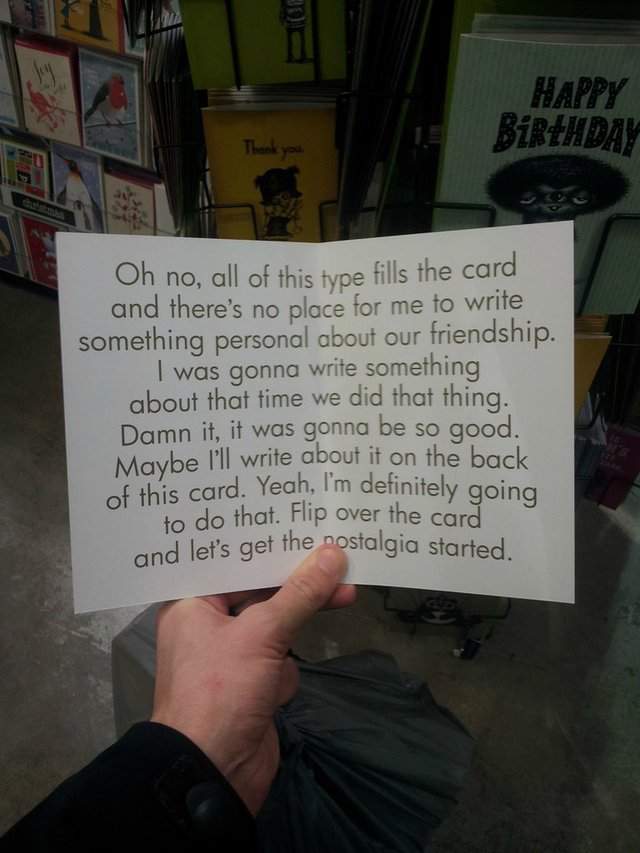
Redditor TheOneInTheHat shared a funny birthday card by Bald Guy Greetings that’s perfect when for when you’re not sure what to write. It’s available to purchase online from Bald Guy Greetings.
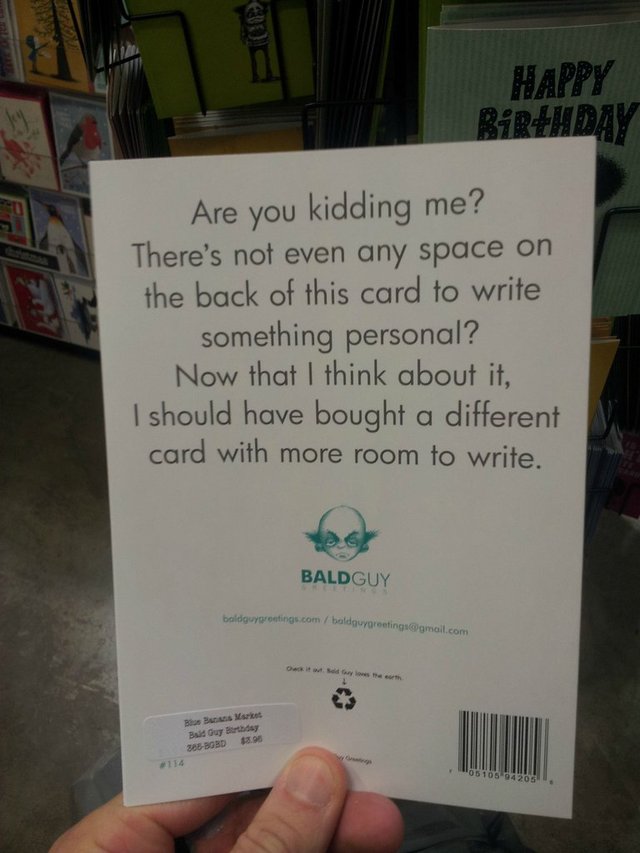
images via TheOneInTheHat
Gyula, Russian Sledges likes this
09 Dec 23:52


The hardest tongue-twister
by Rob Beschizza
MIT scientists have determined the hardest twingtuster.
Try and say “pad kid poured curd pulled cod” 10 times fast.
Man, I can't even say it once.
    
|
dvillarreal, John Doe likes this
09 Dec 23:47


New York City's placebo buttons and "The Post Hoc Fallacy"
by Mark Frauenfelder
David McRaney, host of Boing Boing's most popular podcast, You Are Not So Smart, just posted this fun video about "The Post Hoc Fallacy" ("just because B follows A doesn't mean that A causes B") to promote his new book, You Are Now Less Dumb.
|
|
Cooper Griggs, Sean.inglis likes this
09 Dec 23:43

Joly writes, "Sauropod specialist Mike Taylor notes growing concern among scientists about the heavy-handed takedown practices of academic publishing company Elsevier, including serving DMCA notices on contributing authors who also self-publish their papers. (Thanks, Joly!)


Elsevier censors self-publication by papers' co-authors
by Cory Doctorow
Joly writes, "Sauropod specialist Mike Taylor notes growing concern among scientists about the heavy-handed takedown practices of academic publishing company Elsevier, including serving DMCA notices on contributing authors who also self-publish their papers. (Thanks, Joly!)
|
|
09 Dec 23:32

Peter Higgs: I wouldn't be productive enough for today's academic system
by Decca Aitkenhead
Physicist doubts work like Higgs boson identification achievable now as academics are expected to 'keep churning out papers'
Peter Higgs, the British physicist who gave his name to the Higgs boson, believes no university would employ him in today's academic system because he would not be considered "productive" enough.
The emeritus professor at Edinburgh University, who says he has never sent an email, browsed the internet or even made a mobile phone call, published fewer than 10 papers after his groundbreaking work, which identified the mechanism by which subatomic material acquires mass, was published in 1964.
He doubts a similar breakthrough could be achieved in today's academic culture, because of the expectations on academics to collaborate and keep churning out papers. He said: "It's difficult to imagine how I would ever have enough peace and quiet in the present sort of climate to do what I did in 1964."
Speaking to the Guardian en route to Stockholm to receive the 2013 Nobel prize for science, Higgs, 84, said he would almost certainly have been sacked had he not been nominated for the Nobel in 1980.
Edinburgh University's authorities then took the view, he later learned, that he "might get a Nobel prize – and if he doesn't we can always get rid of him".
Higgs said he became "an embarrassment to the department when they did research assessment exercises". A message would go around the department saying: "Please give a list of your recent publications." Higgs said: "I would send back a statement: 'None.' "
By the time he retired in 1996, he was uncomfortable with the new academic culture. "After I retired it was quite a long time before I went back to my department. I thought I was well out of it. It wasn't my way of doing things any more. Today I wouldn't get an academic job. It's as simple as that. I don't think I would be regarded as productive enough."
Higgs revealed that his career had also been jeopardised by his disagreements in the 1960s and 70s with the then principal, Michael Swann, who went on to chair the BBC. Higgs objected to Swann's handling of student protests and to the university's shareholdings in South African companies during the apartheid regime. "[Swann] didn't understand the issues, and denounced the student leaders."
He regrets that the particle he identified in 1964 became known as the "God particle".
He said: "Some people get confused between the science and the theology. They claim that what happened at Cern proves the existence of God."
An atheist since the age of 10, he fears the nickname "reinforces confused thinking in the heads of people who are already thinking in a confused way. If they believe that story about creation in seven days, are they being intelligent?"
He also revealed that he turned down a knighthood in 1999. "I'm rather cynical about the way the honours system is used, frankly. A whole lot of the honours system is used for political purposes by the government in power."
He has not yet decided which way he will vote in the referendum on Scottish independence. "My attitude would depend a little bit on how much progress the lunatic right of the Conservative party makes in trying to get us out of Europe. If the UK were threatening to withdraw from Europe, I would certainly want Scotland to be out of that."
He has never been tempted to buy a television, but was persuaded to watch The Big Bang Theory last year, and said he wasn't impressed.
theguardian.com © 2013 Guardian News and Media Limited or its affiliated companies. All rights reserved. | Use of this content is subject to our Terms & Conditions | More Feeds
08 Dec 20:46


David Simon: 'There are now two Americas. My country is a horror show'
by David Simon
The creator of The Wire, David Simon, delivered a coruscating speech about the divide between rich and poor in America, and how capitalism has lost sight of its social compact. This is an edited extract
America is a country that is now utterly divided when it comes to its society, its economy, its politics. There are definitely two Americas. I live in one, on one block in Baltimore that is part of the viable America, the America that is connected to its own economy, where there is a plausible future for the people born into it. About 20 blocks away is another America entirely. It's astonishing how little we have to do with each other, and yet we are living in such proximity.
There's no barbed wire around West Baltimore or around East Baltimore, around Pimlico, the areas in my city that have been utterly divorced from the American experience that I know. But there might as well be. We've somehow managed to march on to two separate futures and I think you're seeing this more and more in the west. I don't think it's unique to America.
I think we've perfected a lot of the tragedy and we're getting there faster than a lot of other places that may be a little more reasoned, but my dangerous idea kind of involves this fellow who got left by the wayside in the 20th century and seemed to be almost the butt end of the joke of the 20th century; a fellow named Karl Marx.
I'm not a Marxist in the sense that I don't think Marxism has a very specific clinical answer to what ails us economically. I think Marx was a much better diagnostician than he was a clinician. He was good at figuring out what was wrong or what could be wrong with capitalism if it wasn't attended to and much less credible when it comes to how you might solve that.
You know if you've read Capital or if you've got the Cliff Notes, you know that his imaginings of how classical Marxism – of how his logic would work when applied – kind of devolve into such nonsense as the withering away of the state and platitudes like that. But he was really sharp about what goes wrong when capital wins unequivocally, when it gets everything it asks for.
That may be the ultimate tragedy of capitalism in our time, that it has achieved its dominance without regard to a social compact, without being connected to any other metric for human progress.
We understand profit. In my country we measure things by profit. We listen to the Wall Street analysts. They tell us what we're supposed to do every quarter. The quarterly report is God. Turn to face God. Turn to face Mecca, you know. Did you make your number? Did you not make your number? Do you want your bonus? Do you not want your bonus?
And that notion that capital is the metric, that profit is the metric by which we're going to measure the health of our society is one of the fundamental mistakes of the last 30 years. I would date it in my country to about 1980 exactly, and it has triumphed.
Capitalism stomped the hell out of Marxism by the end of the 20th century and was predominant in all respects, but the great irony of it is that the only thing that actually works is not ideological, it is impure, has elements of both arguments and never actually achieves any kind of partisan or philosophical perfection.
It's pragmatic, it includes the best aspects of socialistic thought and of free-market capitalism and it works because we don't let it work entirely. And that's a hard idea to think – that there isn't one single silver bullet that gets us out of the mess we've dug for ourselves. But man, we've dug a mess.
After the second world war, the west emerged with the American economy coming out of its wartime extravagance, emerging as the best product. It was the best product. It worked the best. It was demonstrating its might not only in terms of what it did during the war but in terms of just how facile it was in creating mass wealth.
Plus, it provided a lot more freedom and was doing the one thing that guaranteed that the 20th century was going to be – and forgive the jingoistic sound of this – the American century.
It took a working class that had no discretionary income at the beginning of the century, which was working on subsistence wages. It turned it into a consumer class that not only had money to buy all the stuff that they needed to live but enough to buy a bunch of shit that they wanted but didn't need, and that was the engine that drove us.
It wasn't just that we could supply stuff, or that we had the factories or know-how or capital, it was that we created our own demand and started exporting that demand throughout the west. And the standard of living made it possible to manufacture stuff at an incredible rate and sell it.
And how did we do that? We did that by not giving in to either side. That was the new deal. That was the great society. That was all of that argument about collective bargaining and union wages and it was an argument that meant neither side gets to win.
Labour doesn't get to win all its arguments, capital doesn't get to. But it's in the tension, it's in the actual fight between the two, that capitalism actually becomes functional, that it becomes something that every stratum in society has a stake in, that they all share.
The unions actually mattered. The unions were part of the equation. It didn't matter that they won all the time, it didn't matter that they lost all the time, it just mattered that they had to win some of the time and they had to put up a fight and they had to argue for the demand and the equation and for the idea that workers were not worth less, they were worth more.
Ultimately we abandoned that and believed in the idea of trickle-down and the idea of the market economy and the market knows best, to the point where now libertarianism in my country is actually being taken seriously as an intelligent mode of political thought. It's astonishing to me. But it is. People are saying I don't need anything but my own ability to earn a profit. I'm not connected to society. I don't care how the road got built, I don't care where the firefighter comes from, I don't care who educates the kids other than my kids. I am me. It's the triumph of the self. I am me, hear me roar.
That we've gotten to this point is astonishing to me because basically in winning its victory, in seeing that Wall come down and seeing the former Stalinist state's journey towards our way of thinking in terms of markets or being vulnerable, you would have thought that we would have learned what works. Instead we've descended into what can only be described as greed. This is just greed. This is an inability to see that we're all connected, that the idea of two Americas is implausible, or two Australias, or two Spains or two Frances.
Societies are exactly what they sound like. If everybody is invested and if everyone just believes that they have "some", it doesn't mean that everybody's going to get the same amount. It doesn't mean there aren't going to be people who are the venture capitalists who stand to make the most. It's not each according to their needs or anything that is purely Marxist, but it is that everybody feels as if, if the society succeeds, I succeed, I don't get left behind. And there isn't a society in the west now, right now, that is able to sustain that for all of its population.
And so in my country you're seeing a horror show. You're seeing a retrenchment in terms of family income, you're seeing the abandonment of basic services, such as public education, functional public education. You're seeing the underclass hunted through an alleged war on dangerous drugs that is in fact merely a war on the poor and has turned us into the most incarcerative state in the history of mankind, in terms of the sheer numbers of people we've put in American prisons and the percentage of Americans we put into prisons. No other country on the face of the Earth jails people at the number and rate that we are.
We have become something other than what we claim for the American dream and all because of our inability to basically share, to even contemplate a socialist impulse.
Socialism is a dirty word in my country. I have to give that disclaimer at the beginning of every speech, "Oh by the way I'm not a Marxist you know". I lived through the 20th century. I don't believe that a state-run economy can be as viable as market capitalism in producing mass wealth. I don't.
I'm utterly committed to the idea that capitalism has to be the way we generate mass wealth in the coming century. That argument's over. But the idea that it's not going to be married to a social compact, that how you distribute the benefits of capitalism isn't going to include everyone in the society to a reasonable extent, that's astonishing to me.
And so capitalism is about to seize defeat from the jaws of victory all by its own hand. That's the astonishing end of this story, unless we reverse course. Unless we take into consideration, if not the remedies of Marx then the diagnosis, because he saw what would happen if capital triumphed unequivocally, if it got everything it wanted.
And one of the things that capital would want unequivocally and for certain is the diminishment of labour. They would want labour to be diminished because labour's a cost. And if labour is diminished, let's translate that: in human terms, it means human beings are worth less.
From this moment forward unless we reverse course, the average human being is worth less on planet Earth. Unless we take stock of the fact that maybe socialism and the socialist impulse has to be addressed again; it has to be married as it was married in the 1930s, the 1940s and even into the 1950s, to the engine that is capitalism.
Mistaking capitalism for a blueprint as to how to build a society strikes me as a really dangerous idea in a bad way. Capitalism is a remarkable engine again for producing wealth. It's a great tool to have in your toolbox if you're trying to build a society and have that society advance. You wouldn't want to go forward at this point without it. But it's not a blueprint for how to build the just society. There are other metrics besides that quarterly profit report.
The idea that the market will solve such things as environmental concerns, as our racial divides, as our class distinctions, our problems with educating and incorporating one generation of workers into the economy after the other when that economy is changing; the idea that the market is going to heed all of the human concerns and still maximise profit is juvenile. It's a juvenile notion and it's still being argued in my country passionately and we're going down the tubes. And it terrifies me because I'm astonished at how comfortable we are in absolving ourselves of what is basically a moral choice. Are we all in this together or are we all not?
If you watched the debacle that was, and is, the fight over something as basic as public health policy in my country over the last couple of years, imagine the ineffectiveness that Americans are going to offer the world when it comes to something really complicated like global warming. We can't even get healthcare for our citizens on a basic level. And the argument comes down to: "Goddamn this socialist president. Does he think I'm going to pay to keep other people healthy? That's socialism you know. HBO contract. Motherfucker."
What do you think group health insurance is? You know you ask these guys, "Do you have group health insurance where you …?" "Oh yeah, I get …" you know, "my law firm …" So when you get sick you're able to afford the treatment.
The treatment comes because you have enough people in your law firm so you're able to get health insurance enough for them to stay healthy. So the actuarial tables work and all of you, when you do get sick, are able to have the resources there to get better because you're relying on the idea of the group. Yeah. And they nod their heads, and you go "Brother, that's socialism. You know it is."
And ... you know when you say, OK, we're going to do what we're doing for your law firm but we're going to do it for 300 million Americans and we're going to make it affordable for everybody that way. And yes, it means that you're going to be paying for the other guys in the society, the same way you pay for the other guys in the law firm … Their eyes glaze. You know they don't want to hear it. It's too much. Too much to contemplate the idea that the whole country might be actually connected.
So I'm astonished that at this late date I'm standing here and saying we might want to go back for this guy Marx that we were laughing at, if not for his prescriptions, then at least for his depiction of what is possible if you don't mitigate the authority of capitalism, if you don't embrace some other values for human endeavour.
And that's what The Wire was about basically, it was about people who were worth less and who were no longer necessary, as maybe 10 or 15% of my country is no longer necessary to the operation of the economy. It was about them trying to solve, for lack of a better term, an existential crisis. In their irrelevance, their economic irrelevance, they were nonetheless still on the ground occupying this place called Baltimore and they were going to have to endure somehow.
That's the great horror show. What are we going to do with all these people that we've managed to marginalise? It was kind of interesting when it was only race, when you could do this on the basis of people's racial fears and it was just the black and brown people in American cities who had the higher rates of unemployment and the higher rates of addiction and were marginalised and had the shitty school systems and the lack of opportunity.
And kind of interesting in this last recession to see the economy shrug and start to throw white middle-class people into the same boat, so that they became vulnerable to the drug war, say from methamphetamine, or they became unable to qualify for college loans. And all of a sudden a certain faith in the economic engine and the economic authority of Wall Street and market logic started to fall away from people. And they realised it's not just about race, it's about something even more terrifying. It's about class. Are you at the top of the wave or are you at the bottom?
So how does it get better? In 1932, it got better because they dealt the cards again and there was a communal logic that said nobody's going to get left behind. We're going to figure this out. We're going to get the banks open. From the depths of that depression a social compact was made between worker, between labour and capital that actually allowed people to have some hope.
We're either going to do that in some practical way when things get bad enough or we're going to keep going the way we're going, at which point there's going to be enough people standing on the outside of this mess that somebody's going to pick up a brick, because you know when people get to the end there's always the brick. I hope we go for the first option but I'm losing faith.
The other thing that was there in 1932 that isn't there now is that some element of the popular will could be expressed through the electoral process in my country.
The last job of capitalism – having won all the battles against labour, having acquired the ultimate authority, almost the ultimate moral authority over what's a good idea or what's not, or what's valued and what's not – the last journey for capital in my country has been to buy the electoral process, the one venue for reform that remained to Americans.
Right now capital has effectively purchased the government, and you witnessed it again with the healthcare debacle in terms of the $450m that was heaved into Congress, the most broken part of my government, in order that the popular will never actually emerged in any of that legislative process.
So I don't know what we do if we can't actually control the representative government that we claim will manifest the popular will. Even if we all start having the same sentiments that I'm arguing for now, I'm not sure we can effect them any more in the same way that we could at the rise of the Great Depression, so maybe it will be the brick. But I hope not.
David Simon is an American author and journalist and was the executive producer of The Wire. This is an edited extract of a talk delivered at the Festival of Dangerous Ideas in Sydney.
theguardian.com © 2013 Guardian News and Media Limited or its affiliated companies. All rights reserved. | Use of this content is subject to our Terms & Conditions | More Feeds
07 Dec 00:15


Turn Your Bike into an Electric Hybrid with MIT’s “Copenhagen Wheel”
by Dan Colman

Bonaverde’s “Roast-Grind-Brew Coffee Machine” seemed like one of the cooler inventions I’ve recently stumbled upon. But then I came across this: The Copenhagen Wheel. Originally created by researchers at MIT, the Copenhagen Wheel “transforms ordinary bicycles quickly into hybrid e-bikes.” It allows bike riders to “capture the energy dissipated while cycling and braking and save it for when you need a bit of a boost” — like climbing a hill in San Francisco. The wheel also feeds data to your iPhone, allowing you to monitor pollution levels, traffic congestion, and road conditions in real-time. After spending several years in development, the wheel can now be pre-ordered online and it will ship next spring. It retails for $699.
Get more background information on The Copenhagen Wheel via this MIT web site.
Related Content:
Designers of the Invisible Bike Helmet Describe Their Revolutionary Product in Short Documentary
Science Behind the Bike: Four Videos from the Open University on the Eve of the Tour de France
Brussels Express: The Perils of Cycling in Europe’s Most Congested City
David Byrne: From Talking Heads Frontman to Leading Urban Cyclist
Turn Your Bike into an Electric Hybrid with MIT’s “Copenhagen Wheel” is a post from: Open Culture. You can follow Open Culture on Facebook, Twitter, Google Plus and by Email.
07 Dec 00:00


Scary tire commercial from Japan
by David Pescovitz
Japanese tire dealer Autoway released this commercial to scare you into remembering the importance of good traction. I think that's the point anyway.
|
|
nealteam and -1 others like this
06 Dec 23:58


Letter sent in 1945 just now returned to sender
by David Pescovitz
The San Francisco Chronicle newspaper received this returned mail last week. The USPS label says: “Not deliverable as addressed. Unable to forward.” No surprise, considering the letter was mailed in 1945 and the intended recipient had moved from that address before 1970 and has since died. The reporter who mailed the letter is also long dead. "How did a 68-year-old letter get delivered to the Chronicle?"
|
|
nealteam, J.w.dillow and -1 others like this
06 Dec 23:54
Men move more than women do inside an MRI machine
by Maggie Koerth-Baker
There's a new paper out suggesting that ladies' brains are different from mens' (in ways that support Western stereotypes of gender behavior, natch). It's pretty flawed and has been heavily critiqued, but one critique surprised me — turns out, there's evidence that men tend to move more than women do when you put them in an MRI machine, something that could throw off any attempt to compare MRI data between men and women. 


|
|
06 Dec 17:45


King James Programming: Markov chain trained on the Bible and a comp sci textbook
by Cory Doctorow
 Michael Walker trained a Markov chain with the King James Bible and Structure and Interpretation of Computer Programs, a classic computer science textbook. The result is King James Programming, a tumblr filled with comp-sci-inflected biblespeak. I could read it all day long.
...his brother whom he slew; and we will walk in my statutes, and do them: I am the LORD: I will not lie nor repent: for he is Lord of lords, and King of kings: and they that were burnt had offered; and they were divided hither and thither, so that they operate on “abstract data.”...
12:2 And I will make all my goodness pass before thee, and our sins be upon us, because of our use of not and lisp-value.
And Satan stood up against them in that day, and leap for joy: for, behold, your reward is great in heaven: for he maketh his sun to rise on the evil and on the role of procedures in program design.
Abstractly, we can imagine that the values used for test-divisor should not be made manifest; neither any thing hid, that shall not be as it becometh the gospel of Christ.
King James Programming (via JWZ)
(Image: (KJV) 1631 Holy Bible, Robert Barker/John Bill, London. King James Version, juxtapose^esopatxuj/Wikimedia Commons, CC BY-SA) 
|
|
J.w.dillow and -1 others like this
05 Dec 22:35


23 Vintage Ads That Would Be Banned Today
by Tomas
Even though you might deny it, it won’t change the fact that you live in a world created by marketers. Advertising is a powerful force that has shaped our attitudes and behavior since the beginning of the 20th century when it got into radio, and the late 1940s when it got into television.
With great power comes great responsibility, but try telling that to someone working in the advertising field in the early 20th century. Even today, advertising doesn’t try very hard to conform to moral standards, but after looking back at some offensive, racist and sexist vintage ads – today’s ads are as good as gold.
Besides being discriminating, vintage ads were also full of lies. Interesting fact – the first American advertisement to use a sexual sell was created by a woman for a soap product.
Whether we like it or not, it is a piece of history worth seeing for everyone. Enjoy these 25 offensive vintage ads and, as always, don’t forget to tell us what you think.
1. The Harder A Wife Works, The Cuter She Looks!

2. Men Ask “Is She Pretty?” Not “Is She Clever?”

3. Doesn’t Your Mama Wash You With Fairy Soap?

4. Use “Chlorinol” And Be Like De White Nigger

5. Cocaine Toothache Drops

6. Keep Her Where She Belongs…

7. Cochon Prodigue

8. Show Her It’s A Man’s World

9. That’s What Wives Are For!

10. Youngest Customers In The Business

11. Don’t Worry Darling, You Didn’t Burn The Beer!

12. Men Are Better Than Women!

13. If Your Husband Ever Finds Out..

14. More Doctors Smoke Camels

15. More Doctors Smoke Camels #2

16. Blow In Her Face

17. Begin Early.Shave Yourself

18. It’s Nice To Have A Girl Around The House

19. Because Innocence Is Sexier Than You Think

20. Smoking Santa

21. Merry Christmas For Every Smoker!

22. Is It Always Illegal To Kill A Woman?

23. SEGA: The More You Play The Harder It Gets

You sit there, eyes glued to the writhing, arcade-quality graphics, pulling and squeezing your knob…

Now you can play with yourself for hours with SEGA’s hand held, full colour games system…
23 Vintage Ads That Would Be Banned Today originally appeared on Bored Panda on December 2, 2013.
Дмитрий Вольтер likes this
05 Dec 17:48
David Cameron conseille aux Britanniques d'arrêter d'apprendre le français et de plutôt prendre des cours de chinois
by Alice Bru
David Cameron, le Premier ministre britannique, est revenu de son voyage en Chine avec de grandes idées. Selon Bloomberg, les écoliers britanniques devraient abandonner l'étude du français et de l'allemand au profit du mandarin. Cela tombe bien, l'enseignement d'une deuxième langue sera obligatoire dès le primaire à partir de septembre 2014. «Le temps que les enfants nés aujourd'hui terminent leurs études, la Chine sera la première économie mondiale. Il est temps d'abandonner la tradition de l'apprentissage du français et de l'allemand et de faire apprendre le chinois à plus d'enfants», a déclaré Cameron. Actuellement, 200.000 personnes étudient le mandarin outre-Manche. L'objectif de David Cameron est de doubler ce chiffre. En ce sens, un accord a été signé avec la Chine pour doubler le nombre d'assistants linguistiques de langue chinoise d'ici 2016. Selon FT.com, seules 3% des écoles primaires proposent des cours de chinois, et 9% des établissements d'enseignement secondaire. L'accord comprend aussi la formation de professeurs chinois pour enseigner au Royaume-Uni, et, plus surprenant, un voyage d'étude de l'enseignement des mathématiques en Chine. Les derniers tests Pisa ont révélé que le niveau des écoliers britanniques stagnait, voire diminuait, alors que les résultats des élèves asiatiques continuaient d'augmenter. L'offre majeure d'enseignement d'une seconde langue à l'école se cantonne aux proches voisins de la Grande-Bretagne: ... Lire la suite

05 Dec 16:32


Asian people 11 times more likely to be stopped at UK borders, analysis finds
by Alan Travis
EHRC analysis suggests stereotyping rather than intelligence may be key factor in use of counter-terrorism powers
Fresh concerns that Asian people are more than 11 times more likely than white people to be stopped at British airports and ports and questioned under counter-terrorism powers have been raised by the Equality and Human Rights Commission (EHRC).
A new experimental pattern of analysis of the ethnicity of the 50,000 people a year who are stopped to determine if they are involved in terrorism suggests that stereotyping rather than intelligence may be a key factor in the use of the powers under schedule 7 of the Terrorism Act 2000.
The powers, which were used in August to stop and seize documents from David Miranda, the partner of the former Guardian journalist Glenn Greenwald, require no prior suspicion and can only be lawfully used to determine whether an individual is "concerned in the commission, preparation or instigation of acts of terrorism".
Examinations under the powers can include basic questioning, a search and seizure of property and detention for up to nine hours.
The EHRC experimental analysis shows that there were high levels of examinations of passengers of certain ethnic backgrounds compared with white passengers.
The figures show that among the 53,992 people stopped at all British ports and airports in 2012-13, those who were Asian were 11.3 times more likely to be stopped than those who were white. Those who were black were 6.3 times more likely to be stopped and those who were mixed race were 3.6 times more likely to be stopped.
The EHRC briefing paper published on Thursday says that when a more detailed analysis was done of the 2010-11 schedule 7 stops on the basis of nine separate ethnic categories, including Indian, Pakistani, Bangladeshi and Chinese, those with a Pakistani background were shown to have a highly disproportionate number of stops.
Pakistani people were 52 times more likely to be stopped than white people, 135 times more likely to be questioned and examined for more than an hour, and 154 times more likely to be detained.
Mark Hammond, the EHRC chief executive, said schedule 7 was a necessary and useful power in the provision of national security.
He said: "If used intelligently and proportionately the police can protect the public against terrorist threats. However, stopping people based on stereotypes could lead to time and resources being misdirected and have a negative impact on relations with black and ethnic minority groups."
Hammond, who said the research suggested there might be an imbalance in the use of schedule 7 against ethnic minorities, added: "We are also concerned by the fact that people can be detained for lengthy periods without the reasonable suspicion required for other stop-and-search powers."
The equality commission says it will use the analysis to work with the Home Office and the police to ensure they are following their own guidelines, which ban discrimination on ethnic grounds in the exercise of these powers.
The code of practice for port Border Force officers and police special branch says they must ensure "that the selection of persons for examination is not solely based on their perceived ethnic background".
The analysis has been published as the House of Lords discusses changes to the schedule 7 powers as part of government amendments to the crime and antisocial behaviour bill.
The home secretary, Theresa May, is proposing to reduce the maximum period of detention from nine hours to six, to introduce new rights for the person detained to consult a solicitor and a ban on intimate searches, among other changes.
The government's official counter-terror watchdog, David Anderson QC, has also proposed that the power to detain people under schedule 7 without any suspicion of wrongdoing should be dropped completely. The commission has also backed amendments that would require "reasonable suspicion" to examine anybody for longer than one hour.
theguardian.com © 2013 Guardian News and Media Limited or its affiliated companies. All rights reserved. | Use of this content is subject to our Terms & Conditions | More Feeds
04 Dec 17:15



The linguistics of Black Metal, and how to translate common English phrases into the Dark Lord's Tongue
by Xeni Jardin
The Black Metal band "Code." Photo: Shutterstock.
Doug Moore's "Death Metal English" post at Invisible Oranges is the funniest thing I've read on the internet in a long time. He performs a linguistic analysis of the lyrics in Norwegian Black Metal music, notes its use of adjectives and baroquely florid multisyllabic arcaneness, and offers some helpful translations of common English phrases.
Normal English: “This bok choy isn’t very good”
Death Metal English: “CASTIGATING THE VERDANT ISSUANCE OF THE SOILS OF JIANGNAN”Normal English: “I need to take a nap”
Death Metal English: “RIPPED INTO THE UTTER EXHAUSTION OF THE MIDDLE DAY”Normal English: “Thanks for explaining the train schedule”
Death Metal English: “PROFFERING GRATITUDE UPON THE CHRONOCRATION OF THE JUGGERNAUTS OF RETICULATED METALS AND FIRE”Normal English: “You have to mow the lawn”
Death Metal English: “BRING DOWN THE SCYTHE OF GODS UPON THE NECKS OF THE GREEN-RIBBED LEGIONS AND SWEEP AWAY THEIR WRETCHED BODIES; THOU ART IMPLORED BY ME”
Read the whole thing. It's been making the rounds for a few weeks, but I'm so glad I caught it.
Video above: Vile – “Chapter Of Obeisance Before Giving Breath To The Inert One In The Presence Of The Cresent-Shaped Horns”
|
|
Benjaminsavage, Markku.lempinen and -1 others like this
04 Dec 14:39


HOWTO commit reverse racism
by Cory Doctorow
Lachlan writes, "My friend Aamer Rahman is an Australian comedian, one half of the duo Fear of a Brown Planet who makes race, religion and capitalism a central part of his comedy. Here he is, looking like Malcolm X, with a fantastic rant on reverse racism in his comedy."
Aamer Rahman (Fear of a Brown Planet) - Reverse Racism (Thanks, Lachlan!) 
|
|
04 Dec 04:06
Italian Hand Gestures Explained by an Italian Woman
by Kimber Streams
An Italian woman named Veronika Poli demonstrates and explains Italian hand gestures in this video.
04 Dec 02:15

"How to Swear Around the World is a funny guidebook to(you guessed it), swearing in another language. The essential phrasebook will help you become an impressive curser in dozens of different languages, it is illustrated with handy visual guides and features phonetic pronunciation so that readers can curse like a native. A fun gift for the traveller in your family, he´ll be swearing proficiently in dozens of languages in no time!
Available in Europe here


HOW TO SWEAR AROUND THE WORLD
by HOW TO SWEAR AROUND THE WORLD
"How to Swear Around the World is a funny guidebook to(you guessed it), swearing in another language. The essential phrasebook will help you become an impressive curser in dozens of different languages, it is illustrated with handy visual guides and features phonetic pronunciation so that readers can curse like a native. A fun gift for the traveller in your family, he´ll be swearing proficiently in dozens of languages in no time!
Available in Europe here
03 Dec 02:23


Slavoj Žižek on the Feel-Good Ideology of Starbucks
by Dan Colman

Back in 2010, we presented an animated video where Slavoj Žižek, our favorite Slovenian theorist, identified a new trend in modern capitalism. Nowadays, marketers have found a crafty way to rework Max Weber’s Protestant Ethic. They tell us we can achieve personal redemption not through hard work and amassing savings, but by consuming the right products. When you buy eco-friendly products, fair trade goods, or products that yield some kind of charitable dividend, you don’t have to think twice about the cost of your consumerism. Not when you’ve done some good and earned yourself some good capitalist karma.
This line of thinking returns in Žižek’s new film The Pervert’s Guide to Ideology, where, once again, he focuses on one of the world’s most effective marketing operations, Starbucks. This, after having seemingly imbibed a “Venti” or “Trenta” portion of the product.
To drill deeper into Zizek’s thoughts on this subject, see his 30-minute lecture “First as Tragedy, Then as Farce.” For more clips from his new film, see our recent posts:
Slavoj Žižek Examines the Perverse Ideology of Beethoven’s Ode to Joy
Slavoj Žižek’s Pervert’s Guide to Ideology Decodes The Dark Knight and They Live
via Biblioklept
Slavoj Žižek on the Feel-Good Ideology of Starbucks is a post from: Open Culture. You can follow Open Culture on Facebook, Twitter, Google Plus and by Email.
m19duncan likes this
02 Dec 23:56
Musician Shows Off His Incredible Finger Drumming Skills
by Kimber Streams
London-based musician Cadien shows off his impressive finger drumming skills in this incredible video.
02 Dec 21:00
Old-fashioned insults
by Rob Beschizza
A retired British sportsman recently used the term "rotter" to describe a thief, the word carrying a certain delicious combination of archaism, unusualness and irony. 


|
|
nealteam and -1 others like this
30 Nov 21:33


Linux.Darlloz worm attacks embedded systems
by Cory Doctorow

A Symantec researcher has discovered a worm that runs on embedded Linux systems, like those found in set-top boxes and routers. It's common for owners of these devices to forget about them, letting them run in the background for so long as they don't misbehave -- and as a result, they are often out of date. The worm, called Linux.Darlloz, attacks out-of-date Linux installations running on Intel hardware (a small minority in the embedded systems world), but it would not be hard to modify it to attack embedded linuces on other chips.
In addition to being out-of-date, many of these systems have "forever day" bugs that will never be patched by their vendors, making them especially hard to secure. The anonymously authored "Internet Census 2012: Port scanning /0 using insecure embedded devices" showed that a dedicated attacker could compromise well over a million devices without much work, recruiting them to run unprecedented denial of service attacks (I wonder if anyone's thought of using this method for mining Bitcoins?).
As the researcher Ang Cui has demonstrated, embedded systems attacks are especially pernicious because it's difficult to boot them from known-good sources. Once an attacker compromises your router, printer, or set-top box, she can reprogram it to give the appearance of accepting updates without actually installing them, meaning that the system can never be provably restored to your control.
The details of the Linux.Darlloz show a much more primitive and unambitious attack, but it hints at a pretty frightening future for the compromised Internet-of-Things (I wrote a short story about this, called "The Brave Little Toaster").
"Upon execution, the worm generates IP addresses randomly, accesses a specific path on the machine with well-known ID and passwords, and sends HTTP POST requests, which exploit the vulnerability," Hayashi explained. "If the target is unpatched, it downloads the worm from a malicious server and starts searching for its next target. Currently, the worm seems to infect only Intel x86 systems, because the downloaded URL in the exploit code is hard-coded to the ELF binary for Intel architectures."
The researcher went on to say the attacker behind the Intel version is also hosting ELF files that exploit the other chip architectures. The “e_machine” value in ELF header indicates that the worm is for ARM architecture.
While not posing much of a real-world threat now, Darlloz demonstrates a major shortcoming with most Internet-of-things devices available today—they typically run Linux or other types of open source code that are woefully out of date. Making matters worse, many Internet-connected consumer devices can't be updated because their lightweight hardware can't handle the requirements of newer code versions. Hijacking one of these devices thus becomes much easier than exploiting, say, an up-to-date version of Windows, OS X, or Linux.
New Linux worm targets routers, cameras, “Internet of things” devices [Dan Goodin/Ars Technica] 
|
|
30 Nov 17:33

Tips are not optional, they are how waiters get paid in America | Chelsea Welch
by Chelsea Welch
An Applebee's diner refused to leave a tip for religious reasons. The waitress who exposed it wonders if Jesus will pay her bills
• There will always be people who stiff waiters on tips, but it's rarely personal
I was a waitress at Applebee's restaurant in Saint Louis. I was fired Wednesday for posting a picture on Reddit.com of a note a customer left on a bill. I posted it on the web as a light-hearted joke.
This didn't even happen at my table. The note was left for another server, who allowed me to take a picture of it at the end of the night.
Someone had scribbled on the receipt, "I give God 10%. Why do you get 18?"
I assumed the customer's signature was illegible, but I quickly started receiving messages containing Facebook profile links and websites, asking me to confirm the identity of the customer. I refused to confirm any of them, and all were incorrect.
I worked with the Reddit moderators to remove any personal information. I wanted to protect the identity of both my fellow server and the customer. I had no intention of starting a witch-hunt or hurting anyone.
Now I've been fired.
The person who wrote the note came across an article about it, called the Applebee's location, and demanded everyone be fired -- me, the server who allowed me to take the picture, the manager on duty at the time, the manager not on duty at the time, everyone. It seems I was fired not because Applebee's was represented poorly, not because I did anything illegal or against company policy, but because I embarrassed this person.
In light of the situation, I would like to make a statement on behalf of wait staff everywhere: We make $3.50 an hour. Most of my paychecks are less than pocket change because I have to pay taxes on the tips I make.
After sharing my tips with hosts, bussers, and bartenders, I make less than $9 an hour on average, before taxes. I am expected to skip bathroom breaks if we are busy. I go hungry all day if I have several busy tables to work. I am expected to work until 1:30am and then come in again at 10:30am to open the restaurant.
I have worked 12-hour double shifts without a chance to even sit down. I am expected to portray a canned personality that has been found to be least offensive to the greatest amount of people. And I am expected to do all of this, every day, and receive change, or even nothing, in return. After all that, I can be fired for "embarrassing" someone, who directly insults his or her server on religious grounds.
In this economy, $3.50 an hour doesn't cut it. I can't pay half my bills. Like many, I would love to see a reasonable, non-tip-dependent wage system for service workers like they have in other countries. But the system being flawed is not an excuse for not paying for services rendered.
I need tips to pay my bills. All waiters do. We spend an hour or more of our time befriending you, making you laugh, getting to know you, and making your dining experience the best it can be. We work hard. We care. We deserve to be paid for that.
I am trying to stand up for all of us who work for just a few dollars an hour at places like Applebee's. Whether a chain steakhouse or a black-tie establishment, tipping is not optional. It is how we get paid.
I posted a picture to make people laugh, but now I want to make a serious point: Things like this happen to servers all the time. People seem to think that the easiest way to save money on a night out is to skip the tip.
I can't understand why I was fired over this. I was well liked and respected at Applebee's. My sales were high, my managers had no problems with me, and I was even hoping to move up to management soon. When I posted this, I didn't represent Applebee's in a bad light. In fact, I didn't represent them at all.
I did my best to protect the identity of all parties involved. I didn't break any specific guidelines in the company handbook – I checked. But because this person got embarrassed that their selfishness was made public, Applebee's has made it clear that they would rather lose a dedicated employee than an angry customer. That's a policy I can't understand.
I am equally baffled about how a religious tithe is in any way related to paying for services at a restaurant. I can understand why someone could be upset with an automatic gratuity. However, it's a plainly stated Applebee's policy that a tip is added automatically for parties over eight like the one this customer was part of. I cannot control that kind of tip; it's done by the computer that the orders are put into. I've been stiffed on tips before, but this is the first time I've seen the "Big Man" used as reasoning.
Obviously the person who wrote this note wanted it seen by someone. It's strange that now that the audience is wider than just the server, the person is ashamed.
I have no agenda here. I seek no revenge against the note writer. I have no interest in exposing their identity, and, at this point, I'm not even sure I want my job back. I was just trying to make a joke, but I came home unemployed.
I've been waiting tables to save up some money so I could finally go to college, so I could get an education that would qualify me for a job that doesn't force me to sell my personality for pocket change.
While this story has garnered immense media attention, my story is not uncommon. Bad tips and harsh notes are all part of the job. People get fired to keep customers happy every day.
As this story has gotten popular, I've received inquiries as to where people can send money to support me. As a broke kid trying to get into college, it's certainly appealing, but I'd really rather you make a difference to your next server. I'd rather you keep that money and that generosity for the next time you eat out.
Editor's note: Chelsea added the final two paragraphs at 2:30pm EST on Friday.
theguardian.com © 2014 Guardian News and Media Limited or its affiliated companies. All rights reserved. | Use of this content is subject to our Terms & Conditions | More Feeds
rafael nonato likes this
29 Nov 03:14
MS Paint master nears centenary
by Rob Beschizza


Yasutada.sudo, J.w.dillow and 4 others like this
28 Nov 21:59
A Gene for Smelling Asparagus in Urine?
by Emma Steppe
Throughout this semester, I have enjoyed delving deeper into the science behind important health research and blogging about it. Most of the time, research provides insight and implications for improving health in the real world. However, sometimes science findings are just, for lack of a better word, weird. For example, in the past several years, […]
The post A Gene for Smelling Asparagus in Urine? appeared first on Mind the Science Gap.