Shared posts
05 Dec 17:40
Vladimir Poutine n'arrive jamais à l'heure, y compris pour le Pape
by Laurent Pointecouteau
Pour leur première rencontre, le 25 novembre 2013 au Vatican, Vladimir Poutine a fait attendre le pape François cinquante minutes. Et il fait ça tout le temps, comme le relève Bloomberg. Non seulement le président russe a déjà fait attendre un pape par le passé –c’était Jean Paul II, avec un quart d’heure de retard– mais il a également eu un quart d’heure de retard pour la reine d’Angleterre, une demi-heure pour le président sud-coréen (ce qui a beaucoup déplu à Séoul), et même trois heures pour Ioulia Timochenko, à l’époque où elle était la Première ministre de l’Ukraine (le pays est passé depuis sous un gouvernement pro-russe, et Timochenko y purge une peine de prison). La liste est longue, et le Christian Science Monitor en avait même dressé une autre l’an dernier: deux heures pour le président finlandais, 40 minutes pour Angela Merkel, une demi-heure pour le couple royal espagnol… Le plus fort, nous dit Bloomberg, c’est que «tout le monde supporte l’attente. Aucun dignitaire étranger n’a jamais annulé un rendez-vous avec Poutine à cause de son retard». «Evidemment, les investisseurs étrangers ne vont pas ignorer la Russie sous prétexte que Poutine n’arrive jamais à temps à ses rendez-vous», remarquait le Moscow Times, qui s’est exprimé sur la question, une chose «rare pour un média russe», souligne l’article du Christian Science Monitor. L’article de Bloomberg enfonce le clou en rappelant cette ... Lire la suite

03 Dec 02:32


Watch Soviet Animations of Winnie the Pooh, Created by the Innovative Animator Fyodor Khitruk
by Dan Colman

Note: To activate subtitles, click the CC icon at the bottom of the video.
In 1962, the animator Fyodor Khitruk made his directorial debut with Story of One Crime, a film that broke with a Soviet tendency to make imitations of Disney-style animations. The film, as The Guardian explained in its 2012 obituary for the animator, came as a shock. It was stylistically simple and dealt with themes that Disney films would never touch — like, why would a polite clerk murder two housewives with a frying pan? Khitruk made other films that were packed with social commentary, often taking aim at abuses in the Soviet system. But, he also made straightforward animations for children, none more famous than his series of films based on AA Milne’s beloved Winnie the Pooh books.

Created between 1969 and 1972, Khitruk’s three films star a bear named “Vinni-Pukh” who looks nothing like the Winnie the Pooh that Westerners grew up with. (You can see the original illustrations of Pooh by E.H. Shepard here.) But viewers will certainly recognize the storyline and spirit of the original Pooh in the Soviet adaptations. For decades, these films have enchanted East European viewers, both young and old. And they still occasionally appear on Russian TV.

Above, you can watch the three animations online. They appear in the order in which they were released: 1) Winnie-the-Pooh (Винни-Пух, 1969), 2) Winnie-the-Pooh Goes on a Visit (Винни-Пух идет в гости, 1971); and 3) Winnie-the-Pooh and the Day of Concern (Винни-Пух и день забот, 1972).
As noted up top, you might need to click the “CC” icon at the bottom of the YouTube videos in order to activate the subtitles. Unfortunately, we can’t vouch for the accuracy of the translations.
Related Content:
Hear the Classic Winnie-the-Pooh Read by Author A.A. Milne in 1929
Two Beautifully-Crafted Russian Animations of Chekhov’s Classic Children’s Story “Kashtanka”
Watch The Amazing 1912 Animation of Stop-Motion Pioneer Ladislas Starevich, Starring Dead Bugs
The Complete Wizard of Oz Series, Available as Free eBooks and Free Audio Books
Watch Soviet Animations of Winnie the Pooh, Created by the Innovative Animator Fyodor Khitruk is a post from: Open Culture. You can follow Open Culture on Facebook, Twitter, Google Plus and by Email.
Nestor.komarnytsky likes this
01 Dec 21:53


The “Pursuit of Ignorance” Drives All Science: Watch Neuroscientist Stuart Firestein’s Engaging New TED Talk
by Ayun Halliday

Neuroscientist Stuart Firestein, the chair of Columbia University’s Biological Sciences department, rejects any metaphor that likens the goal of science to completing a puzzle, peeling an onion, or peeking beneath the surface to view an iceberg in its entirety.
Such comparisons suggest a future in which all of our questions will be answered. In Dr. Firestein’s view, every answer can and should create a whole new set of questions, an opinion previously voiced by playwright George Bernard Shaw and philosopher Immanuel Kant.
A more apt metaphor might be an endless cycle of chickens and eggs. Or, as Dr. Firestein posits in his highly entertaining, 18-minute TED talk above, a challenge on par with finding a black cat in a dark room that may contain no cats whatsoever.
According to Firestein, by the time we reach adulthood, 90% of us will have lost our interest in science. Young children are likely to experience the subject as something jolly, hands-on, and adventurous. As we grow older, a deluge of facts often ends up trumping the fun. Principles of Neural Science, a required text for Firestein’s undergraduate Cellular and Molecular Neuroscience course weighs twice as much as the average human brain.
The majority of the general public may feel science is best left to the experts, but Firestein is quick to point out that when he and his colleagues are relaxing with post-work beers, the conversation is fueled by the stuff that they don’t know.
Hence the “pursuit of ignorance,” the title of his talk.
Given the educational context, his choice of wording could cause a knee-jerk response. He takes it to mean neither stupidity, nor “callow indifference,” but rather the “thoroughly conscious” ignorance that James Clerk Maxwell, the father of modern physics, dubbed the prelude to all scientific advancement.
I bet the 19th-century physicist would have shared Firestein’s dismay at the test-based approach so prevalent in today’s schools.
The ignorance-embracing reboot he proposes at the end of his talk is as radical as it is funny.
For more of Stuart Firestein’s thoughts on ignorance check out the description for his Columbia course on Ignorance and his book, Ignorance: How It Drives Science.
Related Content:
Orson Welles Explains Why Ignorance Was His Major “Gift” to Citizen Kane
Noam Chomsky Explains Where Artificial Intelligence Went Wrong
Steven Pinker Explains the Neuroscience of Swearing (NSFW)
Ayun Halliday recently directed 16 homeschoolers in Yeast Nation, the world’s first bio-historical musical. Follow her @AyunHalliday.
The “Pursuit of Ignorance” Drives All Science: Watch Neuroscientist Stuart Firestein’s Engaging New TED Talk is a post from: Open Culture. You can follow Open Culture on Facebook, Twitter, Google Plus and by Email.
29 Nov 22:05
You Don’t Know Africa
by swissmiss

I remember learning and knowing all of the African countries in High School. I am glad David Bauer built You Don’t Know Africa to help me refresh my memory. There’s worse ways to spend a few Internet minutes. So, go ahead, play.
29 Nov 16:44
Tiny Animals on Fingers, Photos of Itty-Bitty Animals on People’s Fingers
by Kimber Streams

Tiny Animals on Fingers is exactly what it sounds like: a photo collection of itty-bitty animals on people’s fingers. Visit Flickr to see more of the cute creatures on their human perches.


images via Tiny Animals on Fingers
via io9
29 Nov 03:56
What Is Sea Level? by MinutePhysics
by Kimber Streams
MinutePhysics host Henry Reich explains how scientists calculate sea level when the Earth is neither flat nor perfectly spherical in his latest video, “What Is Sea Level?”
29 Nov 03:38
Glove and Boots Share Their Top Ten List of Single Digit Numbers
by Justin Page
“You know what number two is, don’t you? Number two is feces!”
On a recent episode of Glove and Boots, Internet puppets Fafa the Groundhog and Mario shared their funny top ten list of single digit numbers. Things get pretty heavy when Fafa and Mario tap into the Six Degrees of Kevin Bacon.
This is the stupidest top ten list ever.
29 Nov 02:21
The price of a plane
by Rob Beschizza
Boeing publishes a price list for its commercial airliners right there on its website. 737-700s are going cheap at $76m! I love that the 767-2C has a star by it and "Call for pricing." [via]


|
29 Nov 02:19


23andMe vs. the FDA in less than 4 minutes
by Maggie Koerth-Baker
At what point does interesting-but-potentially-incorrect-or-misleading information become a potential threat to health? How do you regulate a product that current regulations were never set up to handle? The University of Michigan's Risk Science Center put together this quick cartoon that neatly summarizes the problems and questions at the heart of the FDA's crackdown on 23andMe, which Xeni wrote about on Monday.
A couple of other smart takes on this that have come out in the past couple of days:
• Genomics expert Michael Eisen delves deeper into the question of how we should regulate personal genetic testing.
• Journalist David Dobbs rounded up some diverse opinions. You should pay attention to his blog. He's been doing a lot of great reporting on genetics and culture and is planning on publishing a longer piece on the 23andMe stuff later this week.
|
|
nealteam, J.w.dillow and one other like this
29 Nov 02:08


Kinematics: 4D printing for foldable, flexible forms
by Cory Doctorow
Jessica sez, "Kinematics is a system for 4D printing that creates complex, foldable forms composed of articulated modules. The system provides a way to turn any three-dimensional shape into a flexible structure using 3D printing. Kinematics combines computational geometry techniques with rigid body physics and customization. Practically, Kinematics allows us to take large objects and compress them down for 3D printing through simulation. It also enables the production of intricately patterned wearables that conform flexibly to the body."
The process begins with a 3D scan of the client. This produces an accurate 3D model of the body upon which we draw the form of the desired dress. For this example, the top of the dress conforms exactly to the torso, but the skirt has a larger silhouette, allowing for the dress to drape and flow as the wearer moves.
The surface of the sketched dress is then tessellated with a pattern of triangles. The size of the triangles can be customized by the designer to produce different aesthetic effects as well as different qualities of movement in the dress (the smaller the triangle, the more flexible the structure / the more fabric like it behaves). Next we generate the kinematics structure from the tessellation. Each triangle becomes a panel connected to its neighbors by hinges. The designer can apply different module styles to these panels to create further aesthetic effects.
Kinematics (Thanks, Jessica!) 
|
|
J.w.dillow, mama and one other like this
28 Nov 21:12


Israeli court fines woman for refusing to circumcise her son
Woman, who says she will not physically harm her son, must pay £86 a day until the operation is done, rabbinical court says
An Israeli woman has been fined by a religious court for refusing to circumcise her infant son.
The rabbinical court ruled last week that circumcision was for the child's welfare and that the woman must pay 500 shekels (£86) a day until the child has had the procedure. The woman told the court she refuses to physically harm her son.
The case is the first time a religious court in Israel has punished a parent for refusing to circumcise a child. There is no law requiring circumcision in Israel, but the vast majority of Jews are circumcised, in line with Jewish law. Rabbinical courts have authority over certain family matters.
The justice ministry, which is representing the mother, said on Thursday it would be likely appeal the case to Israel's supreme court.
theguardian.com © 2013 Guardian News and Media Limited or its affiliated companies. All rights reserved. | Use of this content is subject to our Terms & Conditions | More Feeds
28 Nov 19:49


Americans Were Asked To Place European Countries On A Map. Here’s What They Wrote:
by Dovilas
How sure are you of your geographical knowledge? Buzzfeed recently put Americans’ geographical knowledge to the test with a survey in which participants had to write in countries’ names on a blank European political map. Unfortunately, they didn’t fare too well, but some of their responses are hilarious (or hilariously mis-informed).
But don’t be so quick to judge Americans – when Buzzfeed posted a similar survey testing Brits’ knowledge of the 50 United States, they also came up short. On the one hand, knowing a country’s states is different from knowing independent countries, but on the other, some U.S. states are larger than some European nations, and some U.S. states have larger economies than some European nations.
The gaps in these survey-takers’ knowledge also speak to historical and political realities. Very few survey-takers could correctly identify the former Soviet satellites or the nations that make up the Balkan peninsula. Many of the nations in these areas haven’t been around (independently) for quite as long as their counterparts in less turbulent parts of Europe.
No matter what, though, we can all probably agree that there are at least a few Americans who should dust off the old atlas or geography textbook and check out what the world looks like across the pond!


Americans Were Asked To Place European Countries On A Map. Here’s What They Wrote: originally appeared on Bored Panda on November 27, 2013.
25 Nov 01:32


Read Rejection Letters Sent to Three Famous Artists: Sylvia Plath, Kurt Vonnegut & Andy Warhol
by Josh Jones
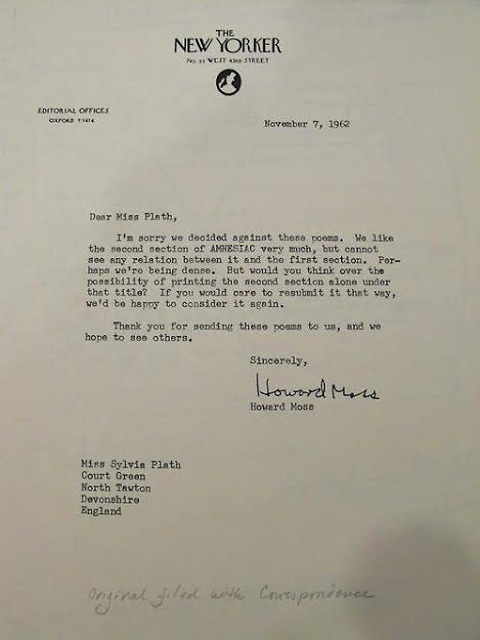
Every successful artist must master the art of accepting rejection. “Fail better,” said Beckett in his grim euphemism for perseverance. “I love my rejection slips,” wrote Sylvia Plath in every hopeful poet’s favorite quote. “They show me I try.” Plath—who also wrote “I am made, crudely, for success”—collected scores of rejection letters, receiving them even after the considerable success of 1960’s The Colossus and Other Poems. The 1962 letter above (click here to view in a larger format), from The New Yorker, doesn’t exactly reject a Plath submission, but it does recommend cutting the entire first section of “Amnesiac” and resubmitting “the second section alone under that title.” “Perhaps we’re being dense,” demurs editor Howard Moss.

The rejection must have been all the more painful since Plath was under a contract with the magazine, which entitled her to “an annual sum for the privilege of having a ‘first reading’ plus subsequent publishing rights to her new poetry,” Plath scholars tell us. And yet “much to her distress she mainly received rejections during November and December 1962.” The poem was eventually broken in two, with the first half published as “Lyonnesse,” but not by Plath herself but by publishers after her death. Hear Plath read the full poem as she intended it in her edition of Ariel, above.
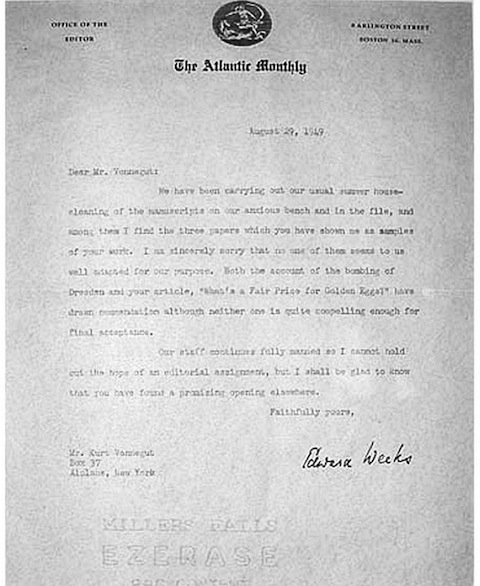
Kurt Vonnegut received an impersonal, and it would seem, long-overdue rejection letter from editor of The Atlantic Edward Weeks in 1949. Weeks writes breezily that he found Vonnegut’s “samples” during the “usual summer house-cleaning,” announcing its slush-pile status. Weeks does at least give the impression that someone, if not him, had read Vonnegut’s submissions. The aspiring writer was 27 years old, striking out “just a few years after surviving the bombing of Dresden as a POW,” Letters of Note informs us, and still twenty years away from publishing his groundbreaking novel Slaughterhouse Five. Letters of Note also provides us with the transcript below for the badly faded typescript.
The Atlantic Monthly
August 29, 1949
Dear Mr. Vonnegut:
We have been carrying out our usual summer house-cleaning of the manuscripts on our anxious bench and in the file, and among them I find the three papers which you have shown me as samples of your work. I am sincerely sorry that no one of them seems to us well adapted to for our purpose. Both the account of the bombing of Dresden and your article, “What’s a Fair Price for Golden Eggs?” have drawn commendation although neither one is quite compelling enough for final acceptance.
Our staff continues fully manned so I cannot hold out the hope of an editorial assignment, but I shall be glad to know that you have found a promising opening elsewhere.
Faithfully yours,
(Signed, ‘Edward Weeks’)
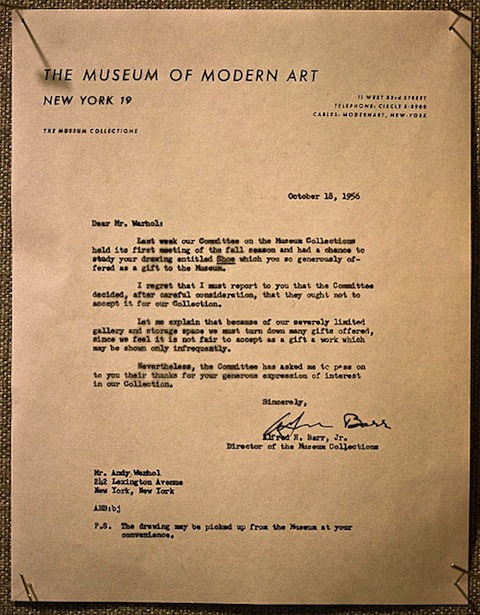
Of course visual artists are not immune. Andy Warhol received the above rejection letter from New York’s Museum of Modern Art when he attempted to donate a drawing in 1956. To its later chagrin, the museum wouldn’t let him give his work away:
Last week our Committee on the Museum Collections held its first meeting of the fall season and had a chance to study your drawing entitled Shoe which you so generously offered as a gift to the Museum.
I regret that I must report to you that the Committee decided, after careful consideration, that they ought not to accept it for our Collection.
The Warhol rejection circulated a few years ago after the MoMA tweeted Letters of Note’s post on it (read the full transcript there). Its most galling feature: a postscript that reads, with dismissive courtesy, “The drawing may be picked up from the museum at your convenience.”
Related Content:
Gertrude Stein Gets a Snarky Rejection Letter from Publisher (1912)
No Women Need Apply: A Disheartening 1938 Rejection Letter from Disney Animation
New Yorker Cartoon Editor Bob Mankoff Reveals the Secret of a Successful New Yorker Cartoon
Josh Jones is a writer and musician based in Durham, NC. Follow him at @jdmagness
Read Rejection Letters Sent to Three Famous Artists: Sylvia Plath, Kurt Vonnegut & Andy Warhol is a post from: Open Culture. You can follow Open Culture on Facebook, Twitter, Google Plus and by Email.
25 Nov 01:31


Noam Chomsky on Commemorating the JFK Assassination: It “Would Impress Kim Il-Sung”
by Dan Colman
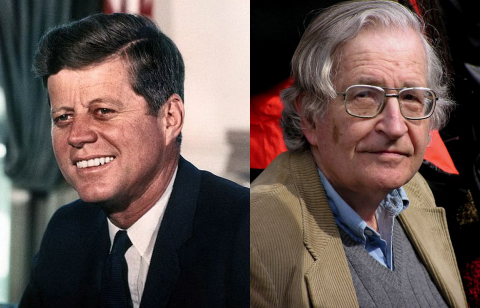 In recent decades, historians have tried to offer a balanced assessment of JFK’s life and legacy, offering clear-eyed accounts of his handling of foreign and domestic policy, and raising questions about his infidelities and health problems, all the while chipping away at the Camelot myth. On Friday, the 50th anniversary of the Kennedy assassination, the hagiography returned, and even perennial cads like Rush Limbaugh had little bad to say about America’s 35th president. He simply insisted that JFK would be a conservative, if still alive today.
Perhaps the only notable exception was Noam Chomsky. Never a fan of Kennedy (or probably any other American president for that matter), Chomsky was asked by Truthout, “Do you find it odd that the country is focusing on a 50th anniversary remembrance of the Kennedy assassination?” A leading question, no doubt, to which Chomksy replied, “Worship of leaders is a technique of indoctrination that goes back to the crazed George Washington cult of the 18th century and on to the truly lunatic Reagan cult of today, both of which would impress Kim Il-sung. The JFK cult is similar.” It’s what you get when you live in “a deeply indoctrinated society.” If you’re ready to have Chomsky throw more cold water (or is it combustible gasoline?) on the JFK legacy, head over to Truthout for more.
P.S. Don’t shoot the messenger on this…
via Leiter Reports
Related Content:
Noam Chomsky Slams Žižek and Lacan: Empty ‘Posturing’
Watch Manufacturing Consent: Noam Chomsky and the Media (1992)
Noam Chomsky vs. William F. Buckley, 1969
Noam Chomsky on Commemorating the JFK Assassination: It “Would Impress Kim Il-Sung” is a post from: Open Culture. You can follow Open Culture on Facebook, Twitter, Google Plus and by Email.
24 Nov 14:37


Holy Crap, Tamagotchis Are Coming Back From the Dead
by Ashley Feinberg

Remember Tamagotchis? Of course you do. They taught you about responsibility. They taught you about friendship. And perhaps most importantly, they taught you that friends don't leave friends in feces-filled rooms for days at a time—because then they will die. But now, it's time to impart that wisdom on a new generation. Rejoice, friends, for the Tamagotchi is back.
|
|
22 Nov 23:15
Two Elderly British Actors Reenact a YouTube Comment Fight Between Justin Bieber Fans
by EDW Lynch
Two elderly British actors reenact a YouTube comment fight between Justin Bieber fans in this hilarious video from UK sketch comedy channel Dead Parrot.
22 Nov 23:07
Morph, A Clever Aircraft Seating Concept That Has an Adjustable Fabric-on-Frame Design
by EDW Lynch
Morph is a design concept for an adaptable economy airline seat that can be easily adjusted to accommodate passengers of different sizes and shapes. Instead of traditional cushions, Morph features fabric stretched over the seat frame. A row of three seats consists of one unified frame with moveable armrests that act as partitions. By moving the armrests left or right, seats can be made wider or smaller. Similarly the seat backs and seat pans can be adjusted by moving supports hidden under the fabric. Morph was created by Seymourpowell, a London-based design company.

Cutaway view of Morph

Two possible seating configurations for Morph
images and video via Seymourpowell
22 Nov 22:01
Is the Man Who Is Tall Happy?
by Dana Stevens
Is the Man Who Is Tall Happy?, the French director Michel Gondry’s animated documentary about the linguist, philosopher, and left-wing activist Noam Chomsky, seems at first like it’s going to be dragged down by an excess of whimsy. As he queries the 84-year-old M.I.T. professor about everything from his groundbreaking work in childhood language acquisition to his views on religion, astrology, and life after death, Gondry deals with the eternal talking-head-interview quandary—what am I going to show on screen besides a boring stationary shot of my interesting subject’s face?—by hand-illustrating Chomsky’s ideas as the philosopher explains them. Gondry has a delightful drawing style, childlike but elegant, with figures that morph playfully into other shapes or break up and skitter across the screen as letters. Intermittently we’ll get a shot of Chomsky’s face as he talks—sometimes seen on an animated movie screen, or otherwise embedded in the drawn image. In the background, if we listen, we can hear the faint clicking sound of the 16mm camera Gondry used to shoot his two long interviews with Chomsky. Occasionally, we even see Gondry at his home animation station (which is not a computer but an old-fashioned Oxberry animation stand) laboriously photographing one drawing after another. If we are to take this film’s autobiographical metanarrative at its word, Gondry’s filmmaking process was DIY to the point of near-insanity.
22 Nov 20:06
Spectrogram Visualization of a Dial-Up Modem Handshake Sound
by EDW Lynch
Back in February Scotty H created this video spectrogram of the dial-up modem handshaking sound—the distinctive series of warbles and hisses that was once the soundtrack of connecting to the Internet. To find out exactly what the modem is “saying,” take a look at this detailed spectrogram infographic of the dial-up modem handshaking process by Oona Räisänen.

(see it larger)
via reddit
22 Nov 19:24


Americas' Natives Have European Roots
The 24,000-year-old remains of a young boy from the Siberian village of Mal’ta have added a new root to the family tree of indigenous Americans. While some of the New World's native ancestry clearly traces back to east Asia, the Mal’ta boy’s genome -- the oldest known of any modern human -- shows that up to one-third of that ancestry can be traced back to Europe.
[More]
22 Nov 19:23
Every John F. Kennedy Street, Park, Airport, and School in the World
by Chris Kirk
Fifty years after the assassination of John F. Kennedy, the former president’s name survives in hundreds of schools, streets, parks, and centers that memorialize him across the globe. Slate looked for as many memorials as it could find and plotted each on the map above. The result is an illustration of the president’s influence not only in the U.S. but also the entire world. Did we miss a memorial? Email us at slate.kennedy.tips@gmail.com.
22 Nov 19:22
White or Dark, but Never Scrambled
by Brian Palmer
Americans will eat tens of millions of turkeys this Thanksgiving. In 2012, Explainer asked why we eat turkey meat but not turkey eggs. The original article is reprinted below:
22 Nov 19:19

Just 2 Genes from Y Chromosome Needed for Male Reproduction
The Y chromosome is often thought of as defining the male sex. Now scientists find that only two genes on the Y chromosome are needed in mice for them to father offspring.
[More]
22 Nov 18:59
A true science horror story
by Maggie Koerth-Baker
In which a graduate student in cancer genetics regales us all with a tale of the disgustingly horrific things that can end up growing in a cell culture plate if you aren't careful. Do not read while eating.


|
|
dvillarreal, nealteam and -1 others like this

22 Nov 18:44


Because is a new, Internet-driven preposition, because grammar
by Cory Doctorow
 The English language has a new preposition, driven by Internet conventions: "Because." It's not clear where this originates, but I like the theory that's it's a contraction of "$SOMETHING is $MESSED_UP, because, hey, politics!"
English Has a New Preposition, Because Internet [Megan Garber/The Atlantic]However it originated, though, the usage of "because-noun" (and of "because-adjective" and "because-gerund") is one of those distinctly of-the-Internet, by-the-Internet movements of language. It conveys focus (linguist Gretchen McCulloch: "It means something like 'I'm so busy being totally absorbed by X that I don’t need to explain further, and you should know about this because it's a completely valid incredibly important thing to be doing'"). It conveys brevity (Carey: "It has a snappy, jocular feel, with a syntactic jolt that allows long explanations to be forgone").
But it also conveys a certain universality. When I say, for example, "The talks broke down because politics," I'm not just describing a circumstance. I'm also describing a category. I'm making grand and yet ironized claims, announcing a situation and commenting on that situation at the same time. I'm offering an explanation and rolling my eyes—and I'm able to do it with one little word. Because variety. Because Internet. Because language.
(via Making Light) 
|
|
Vvicked, neonicwind likes this
22 Nov 18:28


The Swing At The End Of The World Lets You Swing 2,600 Meters Above Sea Level
by Dovilas
Playground swings are pretty fun as far as playground attractions go, but let’s face it – they’re vanilla. Luckily, the Swing at the End of the World located at La Casa Del Arbol (The Treehouse) in Baños, Ecuador has solved that problem by hanging a long swing at the height of a steep drop-off with a gorgeous mountain view.
The swing’s unique location 2,600 meters above sea level offers visitors a beautiful and terrifying view of the Tungurahua Volcano. Although it might look like it hangs over a cliff, the swing actually just hangs over a steep slope. Either way, falling would probably mean death, but that doesn’t stop adventurous swingers from giving the swing at the end of the world a go. And it’s probably worth it, because the rush of adrenaline, the feeling of freedom, and the amazing surrounding views must be one-of-a-kind.
Besides the death-defying swing (we say this because of the bar holding it up, which looks a bit thin from here), La Casa Del Arbol is a great place to hike and enjoy the views even if you don’t feel like scaring yourself to death.
(Editor’s note: Vanilla is a perfectly fine flavor. It’s just an expression)
via: mymodernmet.com

Image credits: tapiture.com

Source: thoughtsfromadreamer

Image credits: bathtobanos.org

Image credits: unboxingtraveller.com

Image credits: eaholo.blogspot.com

Image credits: Rinaldo W.

Image credits: bathtobanos.org

Image credits: Bureau of Educational & Cultural Affairs
The Swing At The End Of The World Lets You Swing 2,600 Meters Above Sea Level originally appeared on Bored Panda on November 20, 2013.
Jenny likes this
22 Nov 18:28


The Addams Family’s Living Room Was Actually Pink!
by Dovilas
Almost everybody knows the Addams family – their creepy monochrome antics are a TV classic. Which makes these pictures all the more surprising, then – they indicate that the Addams family’s living room set was covered in pink, red, turquoise, and other decidedly non-Addams-family-ish colors.
There can be various reasons behind this striking contrast. Because the Addams Family was filmed in black and white, the colors for some of the items simply didn’t matter – if they found an object that looked just right for the set but was colored baby blue, they could still use it. Another reason was the way that black-and-white film registers certain colors when shooting. In other black-and-white films, characters often had to wear strange shades of lipstick (like brown or green) to get the right shades to appear on black-and-white film. As such, many of the color choices on this strangely colorful Addams family set were probably deliberate – they all came together to create the dark and quirky world that so many of us know and love.
The Addams Family, consisting of Gomez, Morticia, Uncle Fester, Lurch, Grandmama, Wednesday, Pugsley and Thing, began as a set of characters created by cartoon artist Charles Addams. Their popularity also saw them adapted for TV, film and other media.
via: fastcodesign


The Addams Family’s Living Room Was Actually Pink! originally appeared on Bored Panda on November 21, 2013.
22 Nov 18:24
Honey Bees detecting Cancer
by swissmiss

Portuguese designer Susana Soares has developed a device for detecting cancer and other serious diseases using trained bees. Truly fascinating! Read more over on dezeen.
(Thanks Barbara)
22 Nov 17:07
La vraie recette du döner kebab
by Ariane Bonzon
En Turquie, le döner kebab existe au moins depuis le XVIe siècle, mais pas sous la forme d’un sandwich. Stricto sensu et historiquement, le döner kebab, ce sont des tranches de viande rôtissant sur une broche qui tourne.
Il provient du verbe turc «döndurmek» (tourner) et «kebab» (viande rôtie). A l’origine, le döner kebab est fait de mouton, viande favorite des Ottomans pour lesquels rien n’était perdu puisqu’ils utilisaient «l’énorme queue graisseuse» de l’animal pour cuisiner ou «fabriquer des chandelles». On en trouve la trace à Istanbul au siècle de Soliman le Magnifique (le XVIe), selon l’historien Robert Mantran qui décrit ces «fines tranches de mouton qui ont rôti en tournant devant un feu de braise» appelées «deuner kebab», également évoqués par certains voyageurs orientalistes du XVIIIe.
Quant à la manière de rôtir à la verticale, d’enfiler les tranches de viandes sur la broche de manière à former un gros cône qui cuit doucement à 10-15 cm du grill et que l’on débite ensuite en fines lamelles au couteau, est-ce une invention turque?
C’est un restaurateur de Bursa, du nom de Cevat Iskender, qui aurait été le premier, à la fin du XIXe siècle, «à renverser la broche sur sa base et empiler le charbon à la verticale» raconte son petit fils dans un article de l’International Herald Tribune du 11 septembre 1996.
Du veau à Istanbul
Aujourd’hui, m’ont expliqué plusieurs bouchers ... Lire la suite


