Kelly Clarkson had a lot to prove in 2004. Thankful, her debut album after she became the first-ever American Idol champion, was a fine if unremarkable effort, featuring the same hip-hop-influenced pop that dominated much of the early 2000s. "Miss Independent" was a jam for sure, but it wasn't enough to be termed a "breakout." So she had had yet to truly make good on what the Idol nation saw in her. To many, Clarkson seemed destined to remain a glorified pageant winner who would soon fade away.
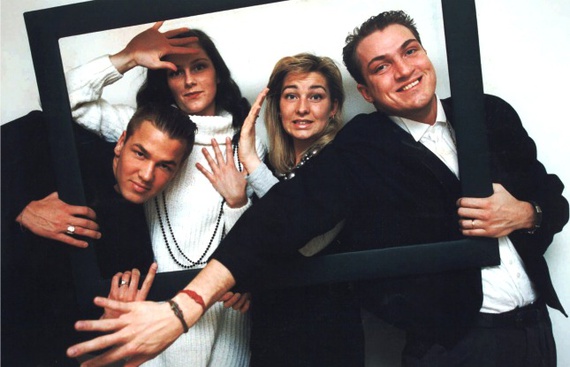
Then she released her sophomore album, Breakaway. On that record—which holds up surprisingly well on its 10th anniversary this week—was three minutes and eight seconds of pop perfection called “Since U Been Gone.” The track would go on to transform three individuals' careers, Clarkson's included, and would serve as a sign of what was coming for the pop-music scene. It’s still the best pop song released in the past decade.
When she first heard it, Clarkson thought “Since U Been Gone” was “a little poppy”; not surprising from producer Max Martin, who had enjoyed previous success with songs like “I Want It That Way” from the Backstreet Boys and “…Baby One More Time” by Britney Spears. But Clarkson’s suggestion to add heavier guitars and drums paid off big time. The pop/rock hybrid sound kept the song’s catchy hook from overstaying its welcome. It wasn’t competing with a variety of sound-alikes, so it stayed fresh—a pleasant surprise every time it came on a playlist. And unlike Avril Lavigne tracks that strained to read as "punk," Clarkson's new sound remained pure, delectable pop.
It also allowed Clarkson to win over fans of multiple genres. Rock artists like Dave Grohl and Ted Leo have confessed to loving “Gone,” the latter even recording a cover.
Martin had enjoyed plenty of success before “Gone,” but with Clarkson (who he also recorded “Behind These Hazel Eyes” with), he injected rock energy into his formula. That sound would continue on in his work with artists like P!nk (“So What”) and Katy Perry (“I Kissed a Girl”). His producing partner, Dr. Luke (née Lukasz Gottwald), was a band member on Saturday Night Live with a few production credits to his name. Thanks to “Gone,” his career caught fire. Despite recent sexual-abuse allegations about Dr. Luke brought forth by one of his most recognizable collaborators, Kesha, there’s no denying the Swedish producers’ marked influence on the following decade in pop.
In fact, part of what made “Gone” stick out as something special in its year was how much more of a pronounced hip-hop influence there was on the charts the time. The No. 1 song in the country the week of Breakaway’s release, for example, was "My Boo," by Usher and Alicia Keys. Remember “My Boo”? It was a fun duet between two of the biggest artists of the moment. Such a song would be far too slow for today’s pop climate, but put in the same company as the No. 1s before and after it—Ciara’s “Goodies” and Snoop Dogg’s “Drop It Like It’s Hot”—and it makes sense.
In contrast, Clarkson’s song is inimitably 2004, but it would be just as at home in 2014. Big choruses and soft/loud dynamics have always been a crucial part of pop, but “Gone” doubled down on those components. The verses hum along relatively quietly; the hook explodes; the result is arenas full of people jumping. Largely due to Martin and Luke’s influence, this kind of song has come to dominate the airwaves in the years since—and Clarkson got there long before Kesha, still rocking the dollar sign in her name, brushed her teeth with a bottle of Jack in “TiK ToK.”
But “Gone” was so much more than its production. It managed a rare trick: It coupled hooky—yet not repetitive—lyrics with a message that transcends time, gender, and situation. The emotion of “Gone” is unfiltered: I loved you, but you never loved me back. But I’m better off, and “I’m so moving on.” Unrequited love, a need for revenge; these aren’t the most novel themes. But Martin and Dr. Luke made them sound fresh. And Clarkson, the artist America chose to represent them on the pop stage, made good with an incredible vocal.
There have been strong pop songs to come after “Since U Been Gone,” of course. "TiK ToK" was just as influential on the party rock sound that continues to dominate airwaves. "Bad Romance" and other early Lady Gaga tracks were the signs of a promising new artist with something new to say. "Call Me Maybe" and "Shake It Off" stretched catchy hooks to their extreme, becoming viral phenomena along the way. And Adele’s “Rolling in the Deep” was equally successful at mixing formats and genres to produce a unique sound on pop radio.
But as far as I can tell, none of those tracks have quite the effect on a bar full of people, or a dance floor, or a karaoke room, as “Since U Been Gone” does. And those places are where pop music matters the most. The energy is frantic; everyone knows all the words. The joy of hearing it is made even better knowing that Clarkson, the first and arguably only true American Idol, fulfilled a nation’s hope in her with one perfect song.
Callisto, an online sexual assault reporting system under development by a nonprofit called Sexual Health Innovations, aims to change this and provide better options for victims of sexual assault on college campuses.
The project builds on the idea of “information escrows” proposed by Ian Ayres and Cait Unkovic in a 2012 Michigan Law Review article. Mr. Ayres, an economist at Yale’s law school, and Ms. Unkovic, a graduate student at the University of California-Berkeley, suggest that reporting of misbehavior that is difficult or costly for victims to disclose might be increased if people had the option to report that information to a third party who would make the disclosure only if others also reported misconduct by the same individual.
In 2006, the year after the storm, wage and salary income for the average Katrina victim in our sample is roughly $2,200 lower than their matched counterparts. Remarkably, the earnings gap is erased the following year, and by 2008, the hurricane victims actually have higher wage income and total income than control households.
That is from a new NBER working paper by Tatyana Deryugina, Laura Kawano, and Steven Levitt. I agree with this claim:
…strong ties to a place, especially a place with limited economic opportunities such as New Orleans, have adverse economic consequences. When forced by an exogenous shock to migrate, people are able to choose from a wide range of possible locations to move to, and they seem to choose places that offer them better economic opportunities.
We usually hear that being “authentic” is to “be yourself”, as opposed to “pretending”. But consider some clues about authenticity:
People who believe they’re behaving authentically are less distressed and have higher self-esteem. … Feeling inauthentic in one’s dealings with other people correlates with symptoms of depression. … Women … report much greater feelings of personal authenticity in their romantic relationships than men do, and as teens, they’re more likely than boys to say that they can be themselves with their best friends. On the other hand, teen boys report feeling more authentic with their dads than teen girls do—and young men say they feel more authentic around professors than their female classmates do. … When adults … were asked how authentic they felt in the presence of various people, work colleagues came in dead last. (more)
This clue seems especially telling:
Subjects sometimes reported feeling more authentic when they acted “out of character” during activities in the lab, such as playing Twister or debating medical ethics. Introverts felt “truer to themselves” when they were acting like extroverts; ditto disagreeable people who were acting agreeable, and careless people who were acting conscientiously. (more)
Note that people felt the most “authentic” here when they were less like their usual self! This tempts me to guess that the feeling of authenticity is actually a feeling of being accepted and respected, with an absence of stress about if one is so accepted. So when a personality spectrum has a more respected end, we all feel more authentic when we feel that we look like that end of the spectrum.
This fits the other correlates above; people feel more authentic when they feel more accepted and respected in their role, regardless of if that role is who they “really” are.
Maybe there is no real you. There are just the yous that you can construct, and the you that you can make that seems the most accepted and respected, that is who you prefer to see as the “real” you.
Last year I rejoined the ranks of the spouse-free. Things sure changed since the last time I was single.
For starters, it is not necessary for men to ask women for revealing selfies. Those photos just start showing up on your phone after you exchange numbers. A revealing selfie in 2014 is essentially just a digital business card for your dating life.
I have also discovered that the most-used characters on my phone keyboard are emoticons. When single people text each other, every sentence has to end with an exclamation mark or a smiley emoticon or else it looks like you lost interest since the last time you texted thirty seconds ago.
For the most part, texting is just a means of feeling connected at a distance. The content isn't terribly important. But the pauses between text messages mean A LOT. Single people monitor the pauses between text replies to decipher real meaning in the content. For example, if I text "I really enjoyed our time together," the real message is contained in the timing of the message not the content. If the text is sent while one person is still driving home from a date, that means you feel a strong connection. But if I text something nice and have to wait seven hours for a reply, the seven-hour wait is the message, not the content of the reply.
Single people in 2014 frequently break up with each other by text, but the words are only the punctuation at the end of the break up. The actual break-up happens with what is called "the taper." The taper is when you are texting someone at a predictable rate, such as several times per day, and you gradually reduce your texting to one message every third day. That's the taper, and it tells the other person your interest has tapered too.
But here's my biggest insight about the single world: Expectations.
I have observed two approaches to dating. One approach involves creating a checklist of expectations that you have for your next romantic partner. You might want a minimum height, a good job, geographic proximity, the same travel preferences, and on and on and on.
Then you find out that no one on the planet fits your criteria. So you have to make hard decisions about which items on the checklist you want to give up on. And if you do give up on those items, you probably resent your partner forever or try to change him/her to conform to the checklist. And that is doomed to fail.
The long checklist is a modern dating problem. Two-hundred years ago, if you and your romantic partner both liked square dancing, you had everything in common. The checklist looked like this:
Are you alive?
Do you like square dancing?
Today the checklist for a romantic partner is 25-items long. Literally no one meets the requirements of anyone else's checklist. So setting expectations before searching for a romantic match is doomed to fail. And the checklist approach is the primary method that most people are using. It is no wonder that 70% of marriages are unhappy
Let's call the 25-item checklist a "goals" approach to dating.
The other approach to life is the "no expectations" method I am trying to cultivate. This is more of a system than a goal. The idea is that you arrange your life so you meet lots of people and you put no expectations on any of them. If I meet someone with a 4.5 tennis level and lots of free time, perhaps I have a new tennis partner. If we click on some other level, that's great too. No expectations.
It is too early to say if my systems approach is successful. But the first year or so have been wonderful. I'm never stressed or disappointed. Everything pleasant that happens to me feels like a gift.
Stress is essentially the gap between what you optimistically expect to happen and what actually does. That means you can eliminate stress either by changing your expectations or by changing what actually happens. Most people are trapped in a doomed loop of wishful thinking that our romantic partners will change their basic nature and start conforming to our unrealistic expectations if only we complain long enough. For comparison, here's how my model of no-expectations works:
Other Person: Do you want a hug?
Me: Yes
That's the beginning and end of my expectations. Or at least I want it to be. It isn't easy to release expectations, but I hold it as an ideal.
To be fair, if kids are part of the equation you probably do need a checklist before getting involved. So the no-expectations system isn't for every situation. I'll let you know how it works for me.
Interesting throughout, with moments of real brilliance — on show business, politics, race, America. “George Bush revolutionised the presidency. He was the first president who only served the people who voted for him. He operated like a cable network. Obama is a network guy. He’s trying to get everybody. And I think he’s figured out, and maybe a little late, that there’s some people he’s never going to get”
Poor people often do not make investments, even when returns are high. One possible explanation is that they have low aspirations and form mental models of their future opportunities which ignore some options for investment.
This paper reports on a field experiment to test this hypothesis in rural Ethiopia. Individuals were randomly invited to watch documentaries about people from similar communities who had succeeded in agriculture or business, without help from government or NGOs. A placebo group watched an Ethiopian entertainment programme and a control group were simply surveyed.
…Six months after screening, aspirations had improved among treated individuals and did not change in the placebo or control groups. Treatment effects were larger for those with higher pre-treatment aspirations. We also find treatment effects on savings, use of credit, children’s school enrolment and spending on children’s schooling, suggesting that changes in aspirations can translate into changes in a range of forward-looking behaviours.
By Tanguy, Dercon, Orkin, and Taffesse.
I’ve been reading a lot on the economic theory and evidence on personality, identity, and mental models of the self. If I had to recommend three things:
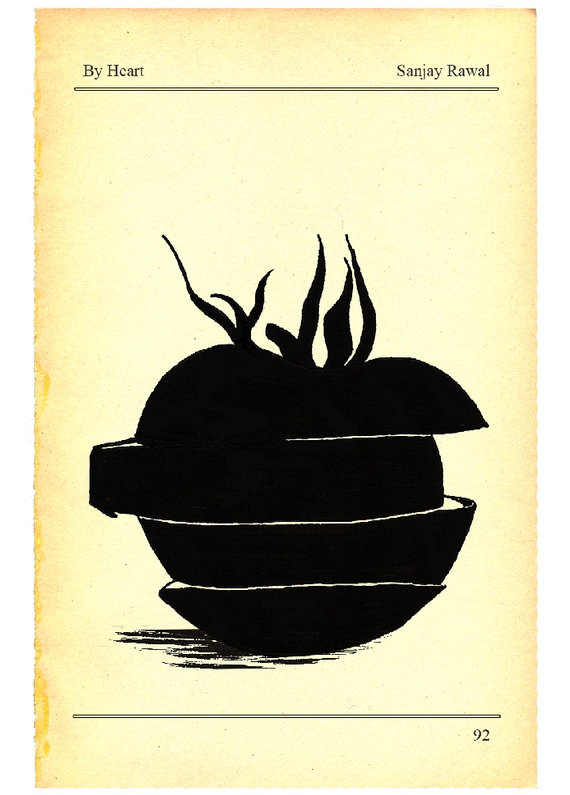
By Heart is a series in which authors share and discuss their all-time favorite passages in literature. See entries from Claire Messud, Jonathan Franzen, Amy Tan, Khaled Hosseini, and more.
Doug McLean
When academic researchers quantify consumer preference for local, sustainable produce, you hear a lot about freshness, taste, and environmental factors. In restaurants that source directly from small farms, you hear about old-world methods, pampered livestock, and unpolluted pastures. And yet one standard is surprisingly absent from these conversations about food. What are the human costs of conventional agriculture? On large farms, laborers are typically paid a pittance; they tend to live in sub-par conditions, without even basic protections from wage theft, occupational hazards, and sexual harassment. Still, in most studies (see here, here, and here) academic researchers don’t even ask about labor when they’re taking stock of consumer preferences. As an issue, it’s simply off the consumer radar.
A new documentary, Food Chains, is an attempt to change that. Inspired by the research in Barry Estabrook’s book-length expose, Tomatoland, and the heroic efforts of The Coalition for Immokalee Workers (CIW), a pioneering worker advocacy group that’s won for landmark agreements with huge retailers—the film chronicles life on Florida’s tomato fields with unprecedented detail. It shows how the CIW’s successes have improved daily life for workers, but explores why they still can’t make a living wage.
When I spoke with Food Chains director Sanjay Rawal for this series, we both agreed it made sense to look at the conventionally grown tomato as our “text.” The fruit, after all, is a legible object—with a little training, you can see the ways supply-chain practices are written all across its (artificially-ripened) skin. In our conversation, he close-reads America’s grocery-store staple, exploring the implications of practices that dictate the tomato’s shape, size, color, taste, and price.
Food Chains—narrated by Forest Whitaker, executive produced by Eva Longoria—is in theaters now.
Sanjay Rawal: I grew up in the East Bay, in a very urban setting. And yet the tomato fields were always close by: In my hometown San Leandro, Del Monte had its main breeding and research station in the U.S. Up until the late '80s, Del Monte was the second-largest tomato-processing company in the world. They were pretty much a ubiquitous brand in vegetables, from bananas and beans to canned goods and tomatoes.
My father worked for Del Monte as a breeder, and sometimes in the summer he’d bring me and my friends to work with him. My earliest memories of agriculture involved riding my BMX bike up and down rows of tomato crops. Whenever you needed a snack, there was stuff on the vines. The Del Monte fruits tasted great—they were being bred for good taste, which was my father’s speciality. I never grew up with a bad-tasting tomato. It wasn’t until I got to college, and ate food-service tomatoes for the first time, when I understood that not everybody was so lucky.
My degree is in molecular biology. When I graduated from Berkeley, I moved to New York to study with an Indian spiritual teacher named Sri Chinmoy. But you can’t really leave your past behind. While Sri Chinmoy was encouraging me to do human-rights work around the world, and I traveled to maybe 40 countries, my dad started his own agricultural genetics company. Since that’s my degree, he needed my help—and I began working with him on the side. It was a mom and pop operation, but we were known for good taste. Many of the varieties of tomatoes that are grown by Del Cabo, the organic varieties that you see in Trader Joe’s and Whole Foods, were developed by my dad.
But most of the tomatoes we eat aren’t bred for taste. They’re an industrial product, really—95 percent of the produce we eat in America comes from a massive supply chain with a lot of different nodes. It’s important to understand that, despite the power of the local food movement, large farmers’ markets only exist in major urban areas. Only 2 to 3 percent of our produce goes through those farmers’ market environments.
The rest of our produce, of course, goes through grocery stories—and grocery stores are built on their produce sections. The majority of profits come from the geographic perimeter of a stores: produce, meat and dairy, and now self-service hot-food bars. So the produce section is critically important. And market research shows that a produce section needs to be stocked with two things of high quality and constant quantity, year-round: bananas and tomatoes. If a market doesn’t have bananas and tomatoes, studies say, they’ll most likely lose the customer’s loyalty.
Beefsteak tomatoes are designed to stack well, look ripe, and endure a long journey to your table—not to taste good on your plate.
And this is where our study of the tomato begins. There’s a reason your average grocery store looks exactly the way it does—and those reasons have very little to do with your dinner plate, and everything to do with the supply chain. When tomatoes are picked, they must have what’s called “shipability”: strength and vigor. The main requirement for supermarket tomatoes is that they arrive intact, with a certain degree of coloring, and a certain lack of blemishing. Customers won’t buy bruised, broken tomatoes. In fact, bruised and broken tomatoes rot very quickly. A supermarket buyer will spot-inspect tomatoes, basically reaching into cases, pulling out a couple odd tomatoes. If he or she happens to pull out one with a blemish, the entire shipment is rejected.
Grocery-store tomatoes have to be a very specific size and shape, too. When you look at a supermarket shelf, things have to be uniform. You can’t have a funny-looking small tomato sitting among the red, round beefsteak tomatoes. In the last 20, 30 years, the grocery industry has increased its requirement for supply chain-related qualities (shape, endurance, uniformity) at the expense of the taste. That’s why your average beefsteak tomatoes are boxy, hard, and the same bright red. They’ve been designed to stack well, look ripe, and endure a long journey to your table—not to taste good on your plate.
Once they’re picked, tomatoes are shipped to a packing facility near the field. Those facilities must do the initial sorting and packing—because when workers are harvesting, they’re just pulling like crazy. With all the jostling and chaos in the field, some of those tomatoes might not be the right size, they might be bruised, and they’re not going to be clean. They’re washed and resorted at this first facility.
Produce, the way supermarkets earn the majority of their profits, is an entirely unregulated market.
After a long journey by truck, tomatoes are usually deposited in repacking centers in the geographic region of their end-destination grocery store. There, they’re emptied out of their crates and boxes and again hand-sorted. This is true for the tiniest cherry tomato to the largest beefsteak tomato. The bad ones are pulled out, and they’re all repacked. They’re also gassed. As you've seen in our film, tomatoes are often harvested green. It’s in this final repacking facility, that they’re treated with ethylene, a gas that ends up ripening the skin.
The way people ended up conceiving this technique—it’s urban legend, but makes sense scientifically—was that green tomatoes were packed with shipments of bananas. Well, bananas emit ethylene gas—so even though the tomatoes were shipped green, they arrived with skins fully ripened. With time, people realized that ethylene is a ripening agent. The problem is that it works only for the outside of the tomato, not the inside, so most grocery-store tomatoes are only as ripe as when they were picked. That’s the main reason a homegrown tomato takes better than a supermarket tomato: it’s picked when it’s fully ripe. This ripening and color requirement has nothing to do with consumer taste preferences. It’s all done so that the product looks good on the shelf.
Of course, the other thing the consumer notices—besides red coloring and unblemished skin—is the tomato’s price.
Remember for a moment that products for the public good—electricity, gas, heating oil, fuel—have price regulations. When the supply is low, consumers don’t get gouged, and when supply is high, prices go down accordingly. But produce, the way supermarkets earn the majority of their profits, is an entirely unregulated market.
In 2008, the average price at the retail for a red, round tomato was $2.94 per pound. That was 2008—it’s increased since then. And supermarkets buy on a “spot market”: They look at a range of providers for the lowest prices farms are willing to take. The farms have power when there’s lots of demand and very low supply, but usually it’s the other way around: grocers have a huge number of suppliers to choose from, and they choose for cheapness. Demand for tomatoes spikes when there’s been a severe weather incident in Florida or Mexico, but typically supply is abundant. This means that grocery stores have tremendous power over the farms that supply them—and it’s resulted in a drop in profit for farmers of more than 50 percent since 1991.
Since grocers tend to pay what they want for supply, they can also set fixed prices in their stores. Price fluctuates at the farm gate, based on demand, but the consumer rarely sees that variation. This means grocers occasionally take a hit when demand surges, but mostly they benefit from bountiful supply. Tomato farmers get about 90 cents per pound today. But last summer, for example, the average price a farmer received for a 25-pound box of tomatoes was $3—equal to 12 cents per pound. That’s less than break-even. It costs more, at that stage, for a farmer to harvest their tomatoes than to let them rot on the vine.
When farmers are pressured so much by the grocery system, there’s no margin for them to pay more to their laborers. They have very high costs of doing business. They’re getting their seeds from multi-billion companies like Monsanto and their fertilizer and pesticides from companies as big as Dow and Bayer. They’re getting their machines from companies like John Deere. And they’re selling to companies like Walmart that capture one one of every three grocery-store dollars in this country.
Meanwhile, grocery stores reap huge revenues. The No. 2 grocery store in this country, Kroger, makes $96 billion in gross revenue, which is more gross revenue than Microsoft and Google combined. That’s gross revenue, of course, not profitability. People argue that grocery-store margins are miniscule compared to tech, but that’s even more evidence to the argument of grocery-store power. If Kroger is only making $4 billion out of its $96 billion in gross revenue, it's spending $92 billion on its supply chain. That means Kroger has a tremendous amount of market power to dictate the terms—not just the color, the shipability, the size, but the pricing.
As companies like Kroger and Walmart try to capture as much each retail dollar as possible, the pressure is felt most greatly by farmworkers, who have seen their wages remain stagnant since the 1970s. In the tomato fields, farmers on average pay 1.6 cents per pound to workers. Thanks to efforts by the Coalition of Immokolee Workers and the Fair Food Program, that rate has increased in Florida over the last eight or nine years. But it still leaves farmworkers earning wages well below the poverty line.
There are some 2 million farmworkers all around the country, and the majority are paid by the piece picked. It’s really a legacy of slavery—the way people on plantations were paid by the bushel of cotton they picked, for example. Today, that piece rate must correlate, by federal law, with the equivalent of minimum wage. But, too often, this doesn’t happen. In her book The American Way of Eating, for example, Tracie McMillan described picking garlic for a whole day. She only picked enough garlic to earn about $25 over an 8-hour day. In order to comply with federal minimum wage standards, her employer, a labor contractor, reported to the government that she worked three hours. We’ve seen this across the U.S. With the way farmworkers are picked, and with the lack of enforcement state by state and at the federal level, it’s very easy for farmworkers to not be paid according to the hours that they’ve picked.
The Florida tomato industry—dare I say it—has the most progressive agricultural industry in America.
Things are different now in Florida. The Florida tomato industry—dare I say it—has the most progressive agricultural industry in America. It’s the only one that has blanket enforcement for labor laws and pay laws. They’ve achieved it by eliminating that middle level of labor contractors. Around the country, farmworkers are employed by middlemen labor contractors who might drive them to work every day in busses, house them, even feed them. In return, those farmworkers are usually fielding a number of deductions from their paychecks: deductions for their contractor’s labor costs.
They are good people who treat their workers well, but when shocking things happen it’s usually at this labor-contractor level. Someone might work a couple weeks and actually end up in debt—and that’s when they might slide into the scenario that advocates call modern-day slavery. They become indentured servants. In Florida, the tomato industry was once known as ground zero of modern-day slavery—because there was a severe lack of enforcement, and a huge number of bad eggs, so to speak. By organizing and through hard work, that oppression has been transformed into a more discernibly progressive environment where workers are treated well and paid better. That transformation is at the heart of our film.
When we look at the retail price of a tomato—whether we call it $2.94 on average or $2.99—the farmer is getting on average 90 cents of that pound. In the Florida tomato industry, the farmworker is getting 1.6 cents on the pound. The Fair Food Program and the Coalition of Immokelee Workers are trying to pressure these large buyers to return one penny per pound back to the system, so that the workers who are doing the difficult work of harvesting, and on whose backs these profits are being made, can make 2.5 cents per pound. Having their wages lifted by 50 to 60 percent is the difference between poverty and a living wage.
There are two elements of the Fair Food Program: the code of conduct and the price. In order to sell to Walmart, or the 11 other corporations that have signed on, farms need to comply. That’s why 98 percent of Florida's tomato-growing industry is bound to this code of conduct: They might be sending tomatoes to Publix this week and Wal-Mart the next, so most choose to comply.
The average family of four would have to pay an extra $68 per year to double the wages of every farmworker in this country.
Unfortunately, the workers only get the penny-per-pound premium if those tomatoes end up on the shelves, or in the burgers or burritos, of companies that have signed on. And the vast majority of tomatoes coming out of Florida aren’t ending up with Fair Food retailers. They’re going to Kroger, Publix, Safeway, and Wendy’s. So while the workers on those farms are covered by the code of conduct—because those farms need to be able to sell to Walmart, Taco Bell, and Chipotle—the workers by and large don’t see the wage increase.
The average farmworker earns about $12,000 per year. And while the Fair Food Program has seen over $15 million over the last four years as Fair Food bonuses, the vast majority of workers aren’t seeing their wages double the way the program intends.
But grocery stores could solve this problem instantly by passing the cost on to the consumer. That’s what the farmworkers we chronicle in the film are fighting for. We filmed the workers demonstrating, taking hunger strikes, just for a chance to discuss the issue with Publix executives—but no one would even have the conversation. Which is strange, because it really wouldn’t cost that much to make a difference.
We did a calculation based on the per capita expenditure of a family of four on fresh-market tomatoes at grocery stores. Getting that penny passed entirely on to consumers would cost a family of four about 44 cents per year. That’s less than one penny per week. If we expand that calculation and look at the consumption of a family of four of every single fresh market item of produce through every channel—whether it’s food service, fresh market or grocery store use—the average family of four would have to pay an extra $68 per year to double the wages of every farmworker in this country. That’s less than $1.25 per week. It’s staggering. It means nothing to consumers. We’re not talking about the dollar-per-pound price between conventional and organic we see. We’re talking about pennies on the dollar.
If the supermarket industry refuses to absorb that penny—which they most certainly could afford—I’m sure consumers would be willing. They might not even notice, to be honest.
But markets, in a sense, are agnostic. Food markets don’t move unless consumer preferences go a certain direction. That’s why the most important thing a consumer can do these days is ask questions. Don’t just ask your retailer, chef, restauranteur, where their food comes from. Ask: Did the person who picked this lettuce, or this tomato, or this garlic make a living wage?
And that’s where documentary films can play a crucial role: in educating the public to ask these questions. Publications like The Atlantic do incredible, investigative pieces, but very few news organizations in the U.S. have the budgets or the bandwidth to spend a year or two or three on an investigative piece. But a documentary film timeline is that long. It took us three-and-half years to finish this movie. During that time we were able to sneak onto farms all across the country. We were able to film 400 hours of interviews and footage which didn’t make it into the final, 82-minute films. We were able to do our own nationwide analysis nationwide from the farmworker level to the executives of gigantic supermarket corporations. We didn’t necessarily have the budget—we drove ourselves into deep debt. But because we had the time, we were able to uncover things that we never could have in six months.
Very few farmworkers complain about doing the work—most of the farmers I met love being in the field.
Longform investigative reporting, whether it takes the form of a 30-page article, or 300-page nonfiction book, or 90-minute documentary, provides American citizens with an important source of information. Documentaries are great because they’re purely visual. The question documentary filmmakers are always asked when they’re pitching their stories is: Why are you making a film about this? Why not write a book? A documentary film has to be incredibly visually engaging.
In the case of Food Chains, we had an incredible opportunity to show consumers something that they never see, primarily because of our detachment from the process of growing and harvesting food. We took cameras into the fields. And because of our director of photography, Forest Woodward, we were able to capture the beauty of the harvest. Very few farmworkers complain about doing the work—most of the farmers I met love being in the field. What they don’t like is the daily stripping away of their dignity, the denial of their humanity. That’s what we wanted to show visually in the film as well. It’s not the poverty alone, or the hard work alone. It’s the fact that at the end of the day the workers go home with less of their humanity than they might have started the day. That’s not fair.
We wanted to visually link between the beautiful environments of restaurants and grocery stores, with the reality in the fields—hopefully bridging the gap between the workers who are responsible for the meals we’re eating, and consumers who benefit from the labor at the base of our supply chain.
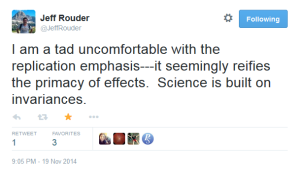
I’ve been puzzling over this tweet from Jeff Rouder:
Surely, I thought, psychology is built out of effects. What could be wrong with focussing on testing which ones are reliable?
But I think I’ve got it now. The thing about effects is that they show you – an experimental psychologist – can construct a situation where some factor you are interested in is important, relative to all the other factors (which you have managed to hold constant).
To see why this might be a problem, consider this paper by Tsay (2013): “Sight over sound in the judgment of music performance”. This was a study which asked people to select the winners of a classical music competition from 6 second clips of them performing. Some participants got the audio, so they could only hear the performance; others got the video, so they could only see the performance; and some got both audio and video. Only those participants who watched the video, without sound, could select the actual competition winners at above chance level. This demonstrates a significant bias effect of sight in judgements of music performance.
To understand the limited importance of this effect, contrast with the overclaims made by the paper: “people actually depend primarily on visual information when making judgments about music performance” (in the abstract) and “[Musicians] relegate the sound of music to the role of noise” (the concluding line). Contrary to these claims the study doesn’t show that looks dominate sound in how we assess music. It isn’t the case that our musical taste is mostly determined by how musicians look.
The Tsay studies took the 3 finalists from classical music competitions – the best of the best of expert musicians – and used brief clips of their performances as stimuli. By my reckoning, this scenario removes almost all differences in quality of the musical performance. Evidence in support for this is that Tsay didn’t find any difference in performance between non-expert participants and professional musicians. This fact strongly suggests that she has designed a task in which it is impossible to bring any musical knowledge to bear. musical knowledge isn’t an important factor.
This is why it isn’t reasonable to conclude that people are making judgments about musical performance in general. The clips don’t let you judge relative musical quality, but – for these equally almost equally matched performances – they do let you reflect the same biases as the judges, biases which include an influence of appearance as well as sound. The bias matters, not least because it obviously affects who won, but proving it exists is completely separate from the matter of whether the overall judgements of music, is affected more by sight or sound.
Further, there’s every reason to think that the conclusion from the study of the bias effect gives the opposite conclusion to the study of overall importance. In these experiments sight dominates sound, because differences due to sound have been controlled out. In most situations where we decide our music preferences, sounds is obviously massively more important.
Many psychological effects are impressive tribute to the skill of experimenters in designing situations where most factors are held equal, allowing us to highlight the role of subtle psychological factors. But we shouldn’t let this blind us to the fact that the existence of an effect due to a psychological factor isn’t the same as showing how important this factor is relative to all others, nor is it the same as showing that our effect will hold when all these other factors start varying.
UPDATE: The paper does give evidence that the sound stimuli used do influence people’s judgements systemmatically – it was incorrect of me to say that differences due to sound have been removed. I have corrected the post to reflect what I believe the study shows: that differences due to sound have been minimised, so that differences in looks are emphasised.
FDR once tried to move Thanksgiving, as an act of economic stimulus. If Putin is going to recreate some version of a non-communist yet Soviet-like empire in his part of the world, perhaps he could also bring back the 24-game world chess championship match? Season four of Homeland is in fact remarkably good, after I had written the show off. When will everyday flying feel like Thanksgiving travel? I am teaching myself Yucatán-style cooking, which involves lots of achiote. sour orange juice (naranja agria), Mexican oregano, and white vinegar. Cass Sunstein argues that nudging is philosophically defensible (at the very least); I would like to read a paper on friendship and nudging — how much would I want democratically elected friends to nudge me and why exactly might I object? Macro is the one field which has lost relative attention since 1970, perhaps gathering new data there is so tough. Here are four animals that lie, including moths. Why is more than seven percent of the industrial space in Kansas City, Missouri underground in former limestone mines? There is a consumption boom in the Philippines, I will visit there again next summer. The George Packer New Yorker profile of Angela Merkel was one of the best articles of the year.
I am thankful and grateful for many things, Happy Thanksgiving everyone…!
There are some interesting and under-reported papers on this topic, here is one of them, by Jordan D. Matsudaira and Emily Greene Owens, here is the abstract:
In 2006, approximately 49% of violent crimes were not reported to police. Being the victim of sexual assault is expensive; each incident imposes an external cost of over $100k on the victim. However, recent estimates of the total social cost are an order of magnitude larger suggesting that from a social welfare standpoint rape is likely to be underreported if the victim’s demand for reporting is price elastic. In spite of the centrality of victim reporting in the functioning of the criminal justice system, to date there is very little systematic evidence on what governments can do to encourage victims to report crimes. We estimate the sensitivity of victims to the cost of reporting in an Alaskan city between 1993 and 2006, during which time a chief of police publicly supported a policy of charging victims of sexual assault for medical procedures required to collect evidence against their attackers. Using a triple differences approach that compares trends in reported sexual assaults to other index crimes over time and across Alaskan cities, we estimate that this shift in cost of approximately $1,200 from the city government to victims reduced the number of reported rapes by between 50 and 80%. This large response highlights the importance of public policies which reduce the private cost of reporting crime.
If you are going to ask “when will China clean up its air?”, you might wish to look at South Korea, a country with a broadly similar industrial profile, although of course Korea is much further along in terms of economic development.
As of 2002, South Korea was ranked 120th of 122 countries for air quality by the World Economic Forum. And at that time South Korea was pretty much a fully developed nation, economically speaking that is. South Korea was also already a democracy, and we know from Casey Mulligan (with Gil and Sala-i-Martin) that democracies tend to have cleaner air than autocracies, ceteris paribus.
Might we consider the possibility that China won’t clean up its air anytime soon? The good news, however, is that once Korea started its environmental clean-up, improvements came pretty rapidly. More recently, they come in at #43 on a more general index of environmental quality.
Huh. Someone built a working particle accelerator out of Lego bricks. Ok, it doesn't accelerate protons, but it does spin a small Lego ball around the ring much faster than I would have guessed.
Update: I stand corrected, the Lego particle accelerator does indeed accelerate protons, just a lot of them very slowly, accompanied by all manner of other particles.
A letter to the editor in The Times today details an unusual lifesaving technique from a quick-thinking shepherd.
Sir, Atul Gawande's article "How a checklist saved a little girl's life" (Opinion, Nov 22) reminded me of an event in the late 1970s, when an infant fell into the garden pond of one of my neighbours. On hearing an anguished scream followed by pleas for help, I and an elderly neighbor dropped our gardening tools and struggled over the hedges and fence that separated us from the commotion.
The three-year-old girl was at the bottom of the pond; I jumped in, pulled her out and passed her lifeless body to my neighbour. He lay her down, got hold of her ankles, lifted her up and began, in a lunatic fashion, to swing her around his head. Horrified and paralysed, the child's mother and I watched as, moments later, water poured from the child's mouth and nose, and she gave a loud cry.
I asked my neighbour where he'd learnt to do such a thing. He said he'd been a shepherd for 30-odd years, and when lambs were born "dead" it was the standard way of making them breathe and of ridding their mouth of birth debris. But for the grace of this old shepherd, Aaron, that child would not be alive today.
Genius. I wonder if this centrifuge move might be more effective in helping lighter drowning victims breathe than CPR. (via @JRhodesPianist & @themexican)
Here are the other non-fiction books of the year which took my fancy, mostly in the order I read them, noting that the link usually leads you to my previous review or comments:
Alice Goffman, On the Run: Fugutive Life in an American City. A sociology graduate student hangs out with lawbreakers and learns about police oppression, an excellent micro-study. My column on her book is here.
David Eimer, The Emperor Far Away: Travels at the Edge of China. A look at China’s outermost regions and their ethnic minorities. Just imagine that, we had two excellent popular China books in the same year.
The Falling Sky: Words of a Yanomami Shaman, by Davi Kopenawa. Repetitious in parts, sometimes incoherent too, but it offers a smart and unique perspective you won’t get from any of the other books on this list or any other.
Edward Hirsch, A Poet’s Glossary, assorted facts and insights about the English language, you don’t have to feel like reading a book about poetry to find this worthwhile.
David Sterling, Yucatán: Recipes from a Culinary Expedition, huge, expensive, wonderful, more than just a cookbook though it is that too. I’ve spent some of the last few weeks learning these recipes and what makes them tick.
Stephen Kotkin, Stalin, vol. 1. This one I have only read a part of (maybe 150 pp.?), it is very long and does not fit my current reading interests, but it seems very good and impressive and also has received strong reviews. So I feel I should include it.
So who wins? If I had to pick a #1, it would be The Very Revd John Drury, Music at Midnight: The Life and Poetry of George Herbert, not the kind of book I would be expecting to coronate, which is a testament to the magnetic force it has exercised over my imagination.
My fiction picks were here. There are still some wonderful books to come out this year, and already-published books I will still read, especially after mining other “best of” lists, so around Dec.31 or so I’ll post an updated account of what I would add to this list.
I found this to be a diffuse year in movies, one where old-style mainline releases lost their grip on a lot of multiplexes and opened up the market for more quality and diversity than we have seen for a long time. My cinematic self came away from the year quite happy, yet without a clear favorite or a definite sense of which movies will last the ages. Here are the ones I very much enjoyed or otherwise found stimulating:
The Invisible Woman, the secret love life of Charles Dickens.
The One I Love, an excellent movie about mind games, love, and commitment. This was perhaps the most clever movie of the year and also the most underrated.
Skeleton Twins
Lucy, the energy and style overcame the absurdity. That gives Scarlett Johansson two for the year.
Fury, an old-style WWII movie with Brad Pitt, there is a good David Denby review here.
Of that whole list, for favorites I would pick Fury as #1, along with Touch of Sin. Both of them need to be seen on a large screen.
For TV, the Modern Orthodox Jewish dating show Srugim was a clear first, this year I didn’t watch many movies on video but thought Terence Malick’s 2012 To the Wonder had been underrated.
1. They have been reported to exist in Australia, India, Mauritania, Burma, and the Mediterranean, but the best known are in Brazil.
2. In parts of southern Brazil, human fisherman have been cooperating with dolphins for many generations (of each species).
3. If fishermen clap just the right way, dolphins will herd fish into the desired areas of fishermen, in muddy lagoon areas.
4. The dolphins perform a distinctive kind of dive to signal to the humans it is time to cast the net for the fish.
5. Only some individual dolphins are able (willing?) to do this well, perhaps the others belong to the forty-seven percent.
5b. The dolphins which cooperate with the fisherman are also more social, more socially connected, and more cooperative with other dolphins.
6. The Brazilian fishermen name the star cooperating dolphins after ex-presidents, soccer players, and Hollywood stars.
7. The names aside, it is not clear whether dolphins benefit from offering this assistance; some commentators suggest the dolphins end up with isolated or injured fish from these exercises.
At Reddit, a user called Cabbagetroll posted a very short summary of the Bible.
GENESIS
God: All right, you two, don't do the one thing. Other than that, have fun.
Adam & Eve: Okay.
Satan: You should do the thing.
Adam & Eve: Okay.
God: What happened!?
Adam & Eve: We did the thing.
God: Guys
THE REST OF THE OLD TESTAMENT
God: You are my people, and you should not do the things.
People: We won't do the things.
God: Good.
People: We did the things.
God: Guys
Los Angeles Men’s Central Jail “is a cauldron of racial tension where violence is easily stirred” — except in K6G, “the gay wing”, where inmates have “surprised everyone by setting up a small and flourishing society behind bars”. Pressure from straight inmates to get placed in K6G has led the Sheriff’s Department to use a “classification officer” for “weeding out impostors” by means of “a series of questions about gay culture”
My last post got me thinking about the liberal vs. conservative slant of different jobs. Here are twosources of data.
Consider some jobs that lean conservative: police, doctor, religious worker, insurance broker. These seem to be jobs where there are rare big bad things that can go wrong, and you want to trust workers to keep those from happening. That explanation can also makes some sense of these other conservative jobs: graders & sorters, electrical contractors, car dealers, truckers, coal miners, construction workers, gas service station workers, non-professor scientist. Conservatives are more focused on fear of bad things, and protecting against them.
Now consider a set of jobs that lean liberal: professor, journalist, artist, musician, author. From these you might focus on the fact that these jobs have rare but big upsides. So the focus here might be on the small chance that a worker will be come a rare huge success. This plausibly seems the opposite of a conservative focus on rare big losses.
But consider these other liberal jobs: psychiatrist, lawyer, teacher. Here the focus might be just on people who talk well. And that can also make sense of many of the previous list of liberal jobs. It might also makes sense of another big liberal job: civil servant.
I’m not suggesting these are the only factors that influence which jobs are liberal vs. conservative, but they do seem worth exploring.
Which other factors might help explain the distribution of conservative vs. liberal jobs?
The critique of Silicon Valley is also that it isn’t very diverse. At Twitter, for instance, 90 percent of the tech employees are male and more than 50 percent of them are white.
I think these discussions are totally valid. Now, I disagree with many of the specific points.
What’s your take?
Shall we? Let’s launch right into it. I think the critique that Silicon Valley companies are deliberately, systematically discriminatory is incorrect, and there are two reasons to believe that that’s the case. No. 1, these companies are like the United Nations internally. All the diversity studies say that the engineering population is like 70 percent white and Asian. Let’s dig into that for a second. First, apparently Asian doesn’t count as diverse. And then “white”: When you actually go in these companies, what you find is it’s American people, but it’s also Russians, and Eastern Europeans, and French, and German, and British. And then there are the Chinese, Japanese, Koreans, Thais, Indonesians, and Vietnamese. All these different countries, all these different cultures. To believe in a systematic pattern of discrimination, you’d have to believe that we’re discriminatory toward certain people without being discriminatory at all toward an extremely broad range of ethnicities and religions. Because of Pakistanis, we’re seeing a higher-than-ever proportion of Muslim employees in a lot of our companies.
No. 2, our companies are desperate for talent. Desperate. Our companies are dying for talent. They’re like lying on the beach gasping because they can’t get enough talented people in for these jobs. The motivation to go find talent wherever it is is unbelievably high.
Conversation with Silicon Valley technology investor about innovation, education, work, Snowden, Facebook, Bitcoin. “There are a lot of different reasons why the focus has been on bits and not on atoms for the last 40 years. It costs $100,000 to start a new software company. It costs maybe $1,000,000,000 to get a drug through the FDA. So you’re obviously going to have more video game companies than real drugs. That’s the world”
A new pop-up restaurant in Amsterdam, which bills itself as the world’s first for solo eaters, aims to remove the social stigma of forking dinner without a companion. In fact, there isn’t a two-top in the joint.
…“The taste of persons eating alone seems different, and even more intense, according to our guests,” says Marina van Goor, owner of the temporary eatery, which is called Eenmaal. As such, the chef takes care to serve four-course meals (at a moderate €35, or roughly $48, including drink) prepared from quality local and organic ingredients. Even the interior is left intentionally raw and no-frills, to emphasize the simple pleasure of unapologetically eating alone.
I look forward to every Thursday in a way that I don't remember awaiting the release of an episode of anything recently. There's something very intimate about someone telling you a story that close to your ears.
That's Jason Reitman echoing the thoughts of the many listeners who have turned Serial -- a new podcast from the producers of This American Life -- into the fastest growing podcast ever. Twenty years ago, we were all hooked on TV and radio. Twenty years of technology advances later, we're all hooked on TV and radio. Content is king.
To me, abortion belongs to the same category as the early Cesarean I will need to undergo because of previous surgeries. That is to say, it is a crucial medical option, a cornerstone in women's reproductive health care. And during pregnancy, should some medical, economic, or emotional circumstance have caused my fate to be weighed against that of my baby, I believe that my rights, my health, my consciousness, and my obligations to others -- including to my toddler daughter -- outweigh the rights of the unborn human inside me.
A new English translation of the “unsanitised” first edition of Grimm’s Fairy Tales reveals that Rapunzel was impregnated by her prince; the evil queen was Snow White‘s biological mother; and Cinderella’s step-sisters chopped lumps off their feet. Wilhelm Grimm censored later editions, deleting some stories entirely — including, thankfully, the tale of a family massacre entitled How Some Children Played At Slaughtering







 facebook
 reddit