Scientists have been studying the brain for centuries, and still we have “exactly zero convincing theories of how it all works”. We can hope to make incremental progress by gathering more data from more experiments. But for any serious explaining of the brain, what we need most is theoretical breakthroughs — “conceptual foundations for understanding the biological basis of mental processes”
With the antenna up my sleeve and the magazines chafing my ribs, I joined my party in the neutral patch of grass in the middle of the yard. There we met the group of men who were helping their court member collect his bill. It reminded me of Napoleon sitting down with the czar on a raft in the middle of a border river. This central clearing was used for such resolutions every day. After the appropriate declarations of force had been made and sabers had been sufficiently rattled, a solution was reached that did not leave anyone hurt. Our side did not permit their side to harm the debtor, but the debt was acknowledged. A collection was taken to pay the bill, and no blood was shed. The social order had been restored, but only after the prospect of violence had arisen.
A first hand account of the logic of prison violence. Very insightful. Reminds me of Diego Gambetta on the Sicilian Mafia– what fills the gap when the state chooses not to enforce contracts. Highly recommended.
Catherine Weinberger of UCSB has a new paper out with that title in the Review of Economics and Statistics, and it echoes some of the themes I discussed in Average is Over. Here is the abstract:
Data linking 1972 and 1992 adolescent skill endowments to adult outcomes reveal increasing complementarity between cognitive and social skills. In fact, previously noted growth in demand for cognitive skills affected only individuals with strong endowments of both social and cognitive skills. These findings are corroborated using Census and CPS data matched with Dictionary of Occupational Titles (DOT) job task measures; employment in and earnings premiums to occupations requiring high levels of both cognitive and social skill grew substantially compared with occupations that require only one or neither type of skill, and this emerging feature of the labor market has persisted into the new millennium.
You will find ungated copies here, and for the pointer I thank Ben Southwood.
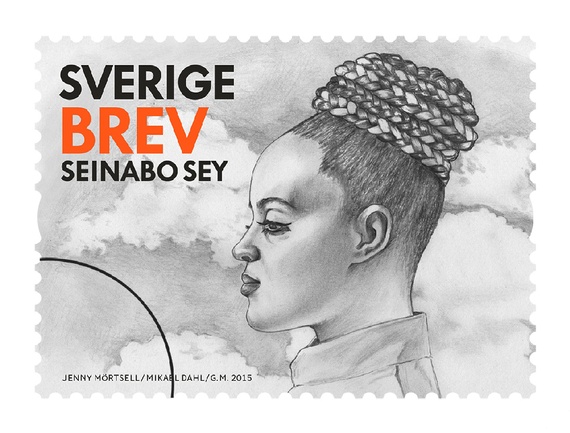
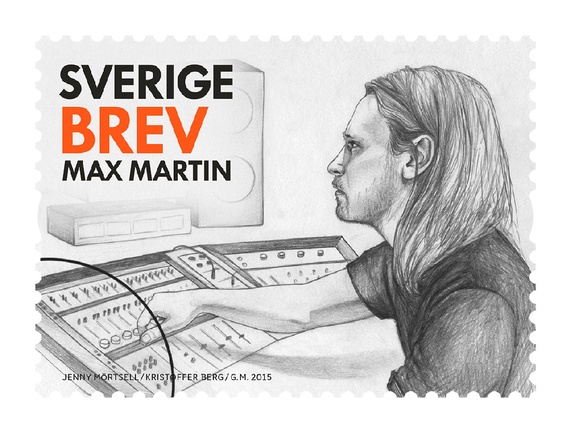
"Stamp design engages people." So says PostNord, the Scandinavian postal giant, which yesterday announced a new set of five stamps commemorating Sweden's outsize influence on popular music. "Sweden, with a population of only 9 million, is third in world (sic) in pop music exports," said the company in a press release. "PostNord is profiling this achievement by issuing stamps featuring a selection of the Swedish artists and songwriters who are currently spreading Swedish music across the world."
PostNord
The stamps, which were carefully selected by Frimärksrådet, Sweden's Stamp Advisory Committee, feature EDM giant Avicii, producer Max Martin (the force behind such karaoke staples as "…Baby One More Time," "I Want It That Way," and "Since U Been Gone"), dance-pop star Robyn, alt-country act First Aid Kit, and soul-pop singer Seinabo Sey, who made the cut despite only having released two singles and being relatively unknown outside of Sweden. The images were crafted in pencil by Brooklyn-based artist Jenny Mortsell.
PostNord
Sweden's outsize global influence in the field of popular music has been undeniable ever since ABBA won the Eurovision Song Contest in 1974. Artists including Rozette, Ace of Base, The Cardigans, and a then-teenage Robyn ascended the charts in the '80s and '90s (as did Rednex, whose unshakeable hit "Cotton Eye Joe" marked the first ill-advised fusion of country and techno). Martin, who collaborated with Rednex on the song "Wish You Were Here," started working with the Backstreet Boys on their 1995 self-titled debut album and has been churning out pop earworms ever since.
PostNord
The country's musical exports aren't limited to pop, however: Ever since the Romeo + Juliet soundtrack accompanied the Baz Luhrmann movie in 1996, Swedish indie acts have been featured prominently in MiniDisc/generic MP3 player/iTunes playlists. Remember The Wannadies' "You and Me Song"? And Eagle-Eye Cherry's "Save Tonight"? And Peter Bjorn and John's "Young Folks"? And Jose Gonzalez, and Jens Lekman, and The Knife, and The Hives, and Shout Out Louds, and Lykke Li? Did you know that both Spotify and SoundCloud are Swedish inventions? More recently, The Tallest Man on Earth reached No. 35 on the US album charts with his third record, There's No Leaving Now, and Tove Lo hit No. 3 on the singles chart with her song "Habits (Stay High)."
PostNord
Nolan Feeney, analyzing the phenomenon of Swedish music for The Atlantic last year, deduced that the country (whose population is only slightly larger than New York City) dominates the charts for the following reasons: the positive influence of ABBA, which inspired young Swedes to make music; the fact that 89 percent of the country's population speaks English; and the convenient truth that Swedish artists receive a healthy amount of government support. In other words, it's just another reminder of how everything's better in Scandinavia, from the stamps to the money to the furniture to the advanced system of statist individualism. But at least when it comes to this particular export, we can all benefit. Thank you for the music, Sweden.
What’s the kindest thing you almost did? Is your fear of insomnia stronger than your fear of what awoke you? Are bonsai cruel? Do you love what you love, or just the feeling? Your earliest memories: do you look though your young eyes, or look at your young self? Which feels worse: to know that there are people who do more with less talent, or that there are people with more talent? Do you walk on moving walkways? Should it make any difference that you knew it was wrong as you were doing it? Would you trade actual intelligence for the perception of being smarter? Why does it bother you when someone at the next table is having a conversation on a cell phone? How many years of your life would you trade for the greatest month of your life? What would you tell your father, if it were possible? Which is changing faster, your body, or your mind? Is it cruel to tell an old person his prognosis? Are you in any way angry at your phone? When you pass a storefront, do you look at what’s inside, look at your reflection, or neither? Is there anything you would die for if no one could ever know you died for it? If you could be assured that money wouldn’t make you any small bit happier, would you still want more money? What has been irrevocably spoiled for you? If your deepest secret became public, would you be forgiven? Is your best friend your kindest friend? Is it any way cruel to give a dog a name? Is there anything you feel a need to confess? You know it’s a “murder of crows” and a “wake of buzzards” but it’s a what of ravens, again? What is it about death that you’re afraid of? How does it make you feel to know that it’s an “unkindness of ravens”?
— Jonathan Safran Foer, from his writing on the side of a Chiptole cup. At that Vanity Fair link are Toni Morrison’s and Michael Lewis’s two-minute entries. Worth reading.
Everyone knows graffiti artist extraordinaire Banksy is a man. What this post presupposes is, maybe she's a woman?
But what Banksy Does New York makes plain is that the artist known as Banksy is someone with a background in the art world. That someone is working with a committee of people to execute works that range in scale from simple stencil graffiti to elaborate theatrical conceits. The documentary shows that Banksy has a different understanding of the street than the artists, street-writers, and art dealers who steal Banksy's shine by "spot-jocking" or straight-up pilfering her work-swagger-jackers who are invariably men in Banksy Does New York.
All of which serves as evidence against the flimsy theory that Banksy is a man.
Overseen and designed by its residents until its destruction by the Hong Kong government in 1993, Kowloon Walled City was once the most densely populated place on Earth. Before demolition, a group of Japanese researchers scoured the city, documenting every inch of the cramped settlement, resulting in a book full of dense drawings of the city. Here's just some of the detail from one of the drawings:
…we compared the polarization of 19- and 20-year-olds in an election year. Both age groups were eligible to vote, but only the 20-year-olds were able to vote in the previous election — and thus had a chance to formally commit themselves to candidates and ideologies.
We found that the 20-year-olds held stronger and more uniform views than the 19-year-olds. That wasn’t just a result of aging: When we looked at more age groups, we found that 18- and 19-year-olds, both of whom were ineligible to vote in the previous election, were similarly polarized; there were also no polarization differences between 20- and 21-year-olds, both of whom were able to vote previously. This and other evidence led us to conclude that exposure to the voting process more effectively committed people to a candidate or party…
A combination of neutrality and persistent voting would be ideal. But our psychologies are complicated. If they override our narrow self-interest and lead us to vote instead of free-riding, the very act of voting may make us more partisan. Sporadic voters can provide an antidote: Their previous lack of engagement may serve as a counter to partisanship.
There is a line between apathy and neutrality. People who sit out all elections provide little value to a democracy. People who sit out some elections, jumping in at crucial times, serve an important role as a reserve army of the uncommitted.
I once argued to Ashok Rao that public intellectuals and other influential persons should not vote at all for this reason. By not voting, they will keep the quality of their influence higher.
From the emergence of markets in the 13th century to the scientific revolution of the 17th century to castles in the 11th century, this is a list of historian Ian Mortimer's 10 biggest changes of the past 1000 years.
Most people think of castles as representative of conflict. However, they should be seen as bastions of peace as much as war. In 1000 there were very few castles in Europe -- and none in England. This absence of local defences meant that lands were relatively easy to conquer -- William the Conqueror's invasion of England was greatly assisted by the lack of castles here. Over the 11th century, all across Europe, lords built defensive structures to defend them and their land. It thus became much harder for kings to simply conquer their neighbours. In this way, lords tightened their grip on their estates, and their masters started to think of themselves as kings of territories, not of tribes. Political leaders were thus bound to defend their borders -- and govern everyone within those borders, not just their own people. That's a pretty enormous change by anyone's standards.
"Twerking is not feminism," Annie Lennox declared in a recent interview with NPR after Steve Innskeep her opinion of Beyoncé. "It's not—it's not liberating, it's not empowering. It's a sexual thing that you're doing on a stage; it doesn't empower you. That's my feeling about it." This is a consistent stance for Lennox. A month ago she called Beyoncé "feminism lite." Last year she decried videos by Miley Cyrus and Rihanna:
I have to say that I'm disturbed and dismayed by the recent spate of overtly sexualized performances and videos. You know the ones I'm talking about. It seems obvious that certain record companies are peddling highly styled pornography with musical accompaniment. As if the tidal wave of sexualised imagery wasn't already bombarding impressionable young girls enough ... As long as there's booty to make money out of, it will be bought and sold.
All of which raises a somewhat confusing question: Wasn't Annie Lennox herself a sex symbol not so long ago?
J Records
Admittedly, Lennox isn't selling her booty here, said booty being tastefully concealed behind her. Instead, she's selling her boots, her rakish hat, and the everything (and nothing) in between. The sexiness is in sophisticated contrast between the forthright nudity, the high-fashion accessories, and the way those accessories conceal and accentuate her crotch, Similarly, in the famous "Sweet Dreams" video, Lennox's androgynous suit and crew cut, not to mention the phallic rocket take-off, contrast with the frankly sensual close-ups of her lips singing or her eyes opening. She's sexy in that she is simultaneously available and not available, and in the self-aware, winking quirkiness with which she navigates between the two. Looking at Lennox's own history of performances, it seems clear that she's not against sexual display in itself. Rather, she's against, as she says, "overt" display. Drape that boot just so; button up just right; let the heat come from the tease rather than from the reveal.
There's nothing wrong or hypocritical about Lennox's self-presentation; the way she packages herself is consistently both witty and sexy. But does that make it better, or more feminist than Beyoncé's self-presentation, or Rihanna's? Or does it mean that Lennox is just approaching sexuality from a slightly different cultural place—a place that has, maybe, something to do with whiteness?
A good bit of Lennox's sexuality, and a lot of its charm, is in its quirkiness; the stiff future/synth androgyny, the knowing hipness of the girl who gets that perfect vintage hat and then has the chutzpah to wear nothing else. Lennox is playing the butch top, but it's a fun, accessible butch top—androgynous domme as manic pixie dream girl. And as a number of commenters have pointed out, the manic pixie dream girl is iconicallywhite. Cutesy free-spirited sprites are insistently femme in a way that is often denied to black women, who are culturally stereotyped as masculine. More, black women tend to be insistently sexualized, while the MPDG is sexy because she's innocent. Lennox is able to play with androgyny and dominance and still come across as a pop confection for mainstream audiences because of the way she's able to use tropes around, and against, the fact that she has the body of a petite white woman.
In contrast, black women have to negotiate a different set of expectations and stereotypes. Beyoncé's ultra-femme, sexualized style may seem retrograde to Lennox, who has an easy cultural access to femininity. But in a culture where black women often aren't perceived as women, and where black women are still mostly excluded from the fashion industry, putting on high heels might be more meaningful than getting a crew cut. "When the image of the perfect woman is coded from childhood as Snow White, the fairest and most sunburned in all the land, the idea becomes that all the rest of us are just donning costumes to imitate true beauty," writer Shaadi Devereaux notes. If, as Deveraux says, "black womanhood is inherently viewed as drag performance," then Beyoncé being feminine pushes back against cultural tropes every bit as much as Lennox wearing a suit.
Putting on high heels might be more meaningful than getting a crew cut.
Similarly, Lennox's quip that "As long as there's booty to make money out of, it will be bought and sold," fits uncomfortably into a long tradition of linking black women's rear ends to prostitution in an effort to stigmatize both (as Sir Mixalot pointed out some years back). Beyoncé doesn't actually twerk in general, but when Nicki Minaj shakes her thing all about in "Anaconda" while talking about the "skinny bitches in the club," she's responding directly to women like Lennox, who imply that not having a booty is a sign of virtue.
Lennox has criticized Miley Cyrus as well—and in doing so underlines the extent to which her comments about sex and feminism are also about race. Cyrus is physically similar to Lennox; she's a very thin, small white woman with short hair. Cyrus, though, rejected her innocent, child-star pixie-ish youth. And the way she rejected it was by picking up twerking because it "feels black." Miley wanted to stop being an innocent dream, and so she coded herself as black to be sexually dangerous. And then Annie Lennox comes along and confirms that, yes, Miley is now sexually dangerous. Miley is pro-twerking, Lennox is anti-twerking, but whether through eager appropriation or censorious sneering, they both work together to confirm that black women's sexuality is other and (wonderfully or horribly) degraded. Inadvertently, Lennox ends up defining real feminism, non-lite feminism, as a pixie dream of white.
We the Economy is a series of 20 short videos that attempt to explain important economic concepts. For instance, acclaimed director Ramin Bahrani did a video about regulatory capture starring Werner Herzog, Patton Oswalt, and the Sherman Antitrust Act of 1890.
Anchorman director Adam McKay directed an animated My Little Pony-esque video about wealth distribution and income inequality featuring the voice talents of Amy Poehler, Maya Rudolph, and Sarah Silverman.
Paul Allen and Morgan Spurlock are behind the effort, with Bob Balaban, Steve James, Catherine Hardwicke, and Mary Harron directing some of the other videos. (via mr)
Examining an original dataset of more than 8,500 antislavery petitions sent to Congress (1833–1845), we argue that American women’s petition canvassing conferred skills and contacts that empowered their later activism.
We find that women canvassers gathered 50% or more signatures (absolute and per capita) than men while circulating the same petition requests in the same locales. Supplementary evidence (mainly qualitative) points to women’s persuasive capacity and network building as the most plausible mechanisms for this increased efficacy.
We then present evidence that leaders in the women’s rights and reform campaigns of the nineteenth century were previously active in antislavery canvassing. Pivotal signers of the Seneca Falls Declaration were antislavery petition canvassers, and in an independent sample of post–Civil War activists, women were four times more likely than men to have served as identifiable antislavery canvassers.
For American women, petition canvassing—with its patterns of persuasion and networking—shaped legacies in political argument, network formation, and organizing.
many organizations maintain a purely transactional relationship with their members, simply asking them to donate money or take action without being responsive to members’ needs in return. In a series of field experiments, I found that organizations that emulate characteristics of social relationships—such as being responsive to people’s goals, referring to a shared past and implied future, and acting as openers who invite others to open up to them–make people more likely to sign petitions, recruit others, and attend meetings.
I think activism could be a really important area of study in developing countries. Is it a technology that can be easily adapted and transferred, but there are barriers to diffusion? Could they be overcome? And what’s the social science embedded in classic organizing techniques. What could we learn about how rebel groups or parties grow support by looking at activist tactics.
Late one night in August, Mishay Simpson shot Andrew Noll after he walked into her Davis Islands home unannounced. Simpson, the wife of semiprofessional golfer Rhett Simpson, later told investigators that Noll was a former friend who had been stalking her and threatening to hurt her family.
When the home's alarm went off and she heard someone coming up the stairs, she grabbed a 9mm Ruger. When the door opened, she fired.
A bullet sliced through Noll's chest and exited his back, piercing a painting on the wall behind him.
Noll, 23, survived the shooting. But there was much more to the story than what Simpson, 28, told police.
Among the things she omitted: She and Noll had an affair. ...
A few weeks before the shooting, Simpson tried to break things off. ...
In the hours before the shooting, he texted her again. She said her husband was out of town and she was going to bed. Noll later told police that he interpreted that to mean it was okay to come over. He tried entering the alarm code, but it didn't work.
The alarm sounded as he headed upstairs. When she fired, he could smell the gunpowder.
As he lay bleeding, Noll raised the phone and snapped a selfie.
Here is a new paper by Aaron A. Duke and Laurent Bègue:
The hypothetical moral dilemma known as the trolley problem has become a methodological cornerstone in the psychological study of moral reasoning and yet, there remains considerable debate as to the meaning of utilitarian responding in these scenarios. It is unclear whether utilitarian responding results primarily from increased deliberative reasoning capacity or from decreased aversion to harming others. In order to clarify this question, we conducted two field studies to examine the effects of alcohol intoxication on utilitarian responding. Alcohol holds promise in clarifying the above debate because it impairs both social cognition (i.e., empathy) and higher-order executive functioning. Hence, the direction of the association between alcohol and utilitarian vs. non-utilitarian responding should inform the relative importance of both deliberative and social processing systems in influencing utilitarian preference. In two field studies with a combined sample of 103 men and women recruited at two bars in Grenoble, France, participants were presented with a moral dilemma assessing their willingness to sacrifice one life to save five others. Participants’ blood alcohol concentrations were found to positively correlate with utilitarian preferences [emphasis added] (r = .31, p < .001) suggesting a stronger role for impaired social cognition than intact deliberative reasoning in predicting utilitarian responses in the trolley dilemma. Implications for Greene’s dual-process model of moral reasoning are discussed.
The NY Times interviewed several people in their 80s who are still killing it in their careers and creative pursuits. Says Ruth Bader Ginsberg about surprises about turning 80:
Nothing surprised me. But I've learned two things. One is to seek ever more the joys of being alive, because who knows how much longer I will be living? At my age, one must take things day by day. I have been asked again and again, "How long are you going to stay there?" I make that decision year by year. The minute I sense I am beginning to slip, I will go. There's a sense that time is precious and you should enjoy and thrive in what you're doing to the hilt. I appreciate that I have had as long as I have... It's a sense reminiscent of the poem "Gather ye rosebuds while ye may." I had some trying times when my husband died. We'd been married for 56 years and knew each other for 60. Now, four years later, I'm doing what I think he would have wanted me to do.
The interviews are accompanied by an essay by Lewis Lapham, himself on the cusp of 80.
John D. Rockefeller in his 80s was known to his business associates as a crazy old man possessed by the stubborn and ferocious will to know why the world wags and what wags it, less interested in money than in the solving of a problem in geography or corporate combination. By sources reliably informed I'm told that Warren Buffett, 84, and Rupert Murdoch, 83, never quit asking questions.
1) The conceptual innovators who peak creatively early in life. They have firm ideas about what they want to accomplish and then do so, with certainty. Pablo Picasso is the archetype here; others include T.S. Eliot, F. Scott Fitzgerald, and Orson Wells. Picasso said, "I don't seek, I find."
2) The experimental innovators who peak later in life. They create through the painstaking process of doing, making incremental improvements to their art until they're capable of real masterpiece. Cezanne is Galenson's main example of an experimental innovator; others include Frank Lloyd Wright, Mark Twain, and Jackson Pollock. Cezanne remarked, "I seek in painting."
2. Kenneth D. Durr, The Best Made Plans: Robert R. Nathan and 20th Century Liberalism. I may be biased because I just gave a talk at the Nathan Foundation and received it as a gift copy. I call this the “real history of economic thought.” It’s a look at the career of a man who worked with Simon Kuznets to improve gdp statistics, helped lead the war effort in the 1940s, supported the civil rights movement, founded a major economic consulting firm, and supported the idea and practice of economic development, most of all for South Korea and Myanmar. It’s a splendid look at twentieth century economics as it actually influenced the world, without centering the story on academia. By the way, here is Diane Coyle on Walter Lippmann.
3. Marlon James, A Brief History of Seven Killings. This account of 1970s Jamaica, centered on a plot to shoot Bob Marley, shows a remarkable amount of talent, as well as a mastery of plot construction and different novelistic voices, some of which are in Jamaican patois. If you pick up this book you will be impressed and indeed many of the reviews are glowing. Yet somehow never did I care, feel entertained, or wish to read further. I stopped. I remain interested in that era, but will instead recommend a viewing — or reviewing — of The Harder They Come or Marley.
4. John D. Mueller, Redeeming Economics: Rediscovering the Missing Element. That element would be Providence, and this work looks at how Scholastic insights can serve as a foundation for economic thought. Loyal MR readers will know that is not exactly my brew, but some of you will find this of interest.
He talks and writes nonsense about capitalism and politics. His book, Revolution, is a dud. But in person it scarcely matters. His presence is electrifying. Everyone he touches glows with pleasure. “The only person I can think of who comes close to Brand in terms of the effect he has on others is Bill Clinton; if the two were together, I suspect the comedian would make the former US president look gauche by comparison”
Schmidt’s emergence as Google’s “foreign minister”—making pomp and ceremony state visits across geopolitical fault lines—had not come out of nowhere; it had been presaged by years of assimilation within U.S. establishment networks of reputation and influence.
…By all appearances, Google’s bosses genuinely believe in the civilizing power of enlightened multinational corporations, and they see this mission as continuous with the shaping of the world according to the better judgment of the “benevolent superpower.” They will tell you that open-mindedness is a virtue, but all perspectives that challenge the exceptionalist drive at the heart of American foreign policy will remain invisible to them.
This is the impenetrable banality of “don’t be evil.” They believe that they are doing good. And that is a problem.
It is interesting reading, if only to hear a skeptical outsider’s perspective of the web of Washington intrigue.
I am reminded of Dave Eggers’ new book, The Circle. It’s the story of a technology behemoth that gradually eliminates privacy from the Internet and daily life. Again, the ideals of Google-y executives drive the world down a darkening path.
It is not a subtle book. As Ayn Rand was to free markets, Eggers is to privacy. But it was entertaining and, for someone who lives a degree of his life online, it was thought provoking and kept me reading to the vaguely clumsy end.
The common thread is that good intentions can blind us more than bad ones. An insight easy to forget when you’re in the service of country or humanity.
This amazing video, introduced by Philip Zimbardo, discusses a real world Milgram “experiment” in which people obeyed an authority figure to an astounding degree, even when the authority figure was just on the telephone.
The video comes from the Heroic Imagination Project which hopes to use the results of social psychology to help people to take effective action in challenging situations. More videos on obedience to authority, including from Milgram’s experiment, can be found in the resource section along with other social psychology videos and other interesting materials.
Here is one more, this time a little lighter, an experiment in which people find themselves unexpectedly married:
Only 43 people in the world are known to have Rhesus-null blood, of whom a mere six are regular blood donors. They are “infinitely precious to medicine and science”. The “null” means that their blood has no Rhesus antigens; it can be used for transfusions without fear of rejection. “It’s the golden blood”. Those who have it can save “countless lives”. But their gift becomes a curse if they ever need a transfusion themselves
When's the last time I let you down? Ok, maybe don't answer that. But, when I tell you that a short film about the hand gestures used by a quarry boss guiding massive excavators harvesting marble is well worth watching, you're gonna go ahead and watch it, right? Because this is a beautiful little film.
I was so taken by the chief, watching him work. How he can move gigantic marble blocks using enormous excavators, but his own movements are light, precise and determined.
The goal should be that the reader can make the recipe his or her own -- that the instructions are clear and good enough that after a few tries, he or she can improvise to please themselves. The chef gives ideas so that the cook can profit. It's not dictation; it's inspiration.
Few parasitoids are more bizarre or disturbing than the wasps of the genus Glyptapanteles, whose females inject their eggs into living caterpillars. Once inside, the larvae mature, feeding on the caterpillar’s body fluids before gnawing through its skin en masse and emerging into the light of day. And despite the trauma, not only does the caterpillar survive---initially at least---but the larvae proceed to mind-control it, turning their host into a bodyguard that protects them as they spin their cocoons and finish maturing. Then, finally, the caterpillar starves to death, but only after the tiny wasps emerge from their cocoons and fly away.
On the polarisation of and politicisation of American public opinion. When you know a person’s view on one big issue in the news — be it Ebola, Jennifer Lawrence, Rotherham, global warming, ISIS, or Ferguson — you can fairly reliably predict her view on the others. “When an issue gets tied into a political narrative, it stops being about itself and starts being about the wider conflict between tribes”
By Heart is a series in which authors share and discuss their all-time favorite passages in literature. See entries from Claire Messud, Jonathan Franzen, Amy Tan, Khaled Hosseini, and more.
Doug McLean
“The greater the work of literature, the easier the parody,” Ernest Hemingway once said, perhaps knowing he’d one day be an easy target. Hemingway’s famously terse, epicurean style has been widely mocked and mimicked, from The International Hemingway Imitation Competition to scenes in Woody Allen’s Midnight in Paris. Yet it’s impossible to imagine American literature without Hemingway’s brand of economy and dramatic understatement. So what makes his prose better than the punchlines? In an conversation for this series, Vikram Chandra, author of Geek Sublime, looks to Hemingway’s famous story “The Snows of Kilimanjaro,” for stylistic effect, the constructed nature of “realism,” and what successful minimalism requires.
Geek Sublime: The Code of Beauty, The Beauty of Code is a fascinating book. Unlike most writers, who tend to scrape by on low-tech odd jobs, Chandra found himself fascinated by burgeoning computer technologies in the 1980s. To support his writing habit, he learned to write programs and assemble machines. His book looks at the way computer code does and doesn’t resemble literary language; at the same time, he seeks to codify hard-to-pin-down nature of literary beauty.
Vikram Chandra is the author of Red Earth and Pouring Rain and Sacred Games, which was a finalist for the National Books Critic’s Circle Award. His short stories, collected in Love and Longing in Bombay, have appeared in The Paris Review and The New Yorker. He teaches creative writing at the University of California, Berkeley, and spoke to me by phone.
Vikram Chandra: I must have been 14, in Bombay one summer, home from school and looking for something exciting to read. At the local paying library, where you could rent out books for a couple of days for a couple of rupees, I'd already gone through all the thrillers and westerns. I finally came across an intriguing edition of Hemingway’s short stories. It had a racy cover: a guy with a big gun, a damsel in distress. I took the book home, and reading it was an astonishing experience.
As I first worked through those stories, sitting at our kitchen table, I didn’t quite understand everything that was going on. And yet I was very aware of the emotional effect the book was having on me. I especially remember coming to the third story in that edition, “The Snows of Kilimanjaro.” It begins with an epigraph:
Kilimanjaro is a snow-covered mountain 19,710 feet high, and is said to be the highest mountain in Africa. Its western summit is called the Masai “Ngaje Ngai,” the House of God. Close to the western summit there is the dried and frozen carcass of a leopard. No one has explained what the leopard was seeking at that altitude.
I found this peculiarly moving in some way, even though I wasn’t quite sure what to make of it at first. You get this image without context. It’s reportage, almost—flat language that explains a series of facts. Maybe there’s a little bit of opening up in that last line, “No one has explained what the leopard was seeking at the altitude,” which seems to allude to something larger, more significant. Most of this could be something read by a 10th-grader in a textbook, but that last sentence lifts off, in a sense, into the story.
“The Snows of Kilimanjaro,” like many Hemingway stories, is about survival: a writer, Harry, has injured his leg on a thorn while on a safari, and the wound becomes infected with gangrene. As he and his wife Helen await help, hoping a rescue plane will arrive before he dies, Harry thinks back on his life, his regrets, and all the work he left unfinished.
For most of the story, the epigraph seems like an incongruous choice. It leads us to expect a story about the snowy heights, when we remain grounded on the African plains. But it starts to make sense when we reach the end, in the moments before Harry dies. He begins to fantasize that the rescue plane has come. A man named Compton flies him towards the famous mountaintop:
Compie turned his head and grinned and pointed and there, ahead, all he could see, as wide as all the world, great, high, and unbelievably white in the sun, was the square top of Kilimanjaro. And then he knew that there was where he was going.
It’s a wonderful, epiphanic image—and suddenly the mysterious epigraph becomes completely meaningful. A kind of resonance reaches backward through the story, as it were, binding the whole thing together. It’s a typical example of delayed decoding.
And yet the moment itself is very ambiguous. We don’t quite know whether our protagonist is really experiencing a moment of belief. Is this merely another of his fantasies? In other words, is the fact that he finally finds release in the image merely another self-comforting failure? The leopard never quite reaches the height, after all—it falls short of reaching the House of God. Does the carcass then become kind of redemptive image of what he spent his life doing, or is it actually a measure of failure?
I think one thing is clear: He’s understood these things too late, and he’s failed in what should have been his vocation to understand things and then write them. This imperative to write is very important. The last epiphany, if it is really one, has come too late because he’s too ill to write it for us. In the literal world of the story, he cannot write down this last, breathtaking insight, even though we see it.
In the writing of Geek Sublime, I tried to go back to this formative reading experience, and use it as the springboard for my investigation of what poetic language does. And I think that becoming immersed in the Indian tradition of literary theory has helped me articulate the peculiar effect of Hemingway’s epigraph. Part of this has to do with the idea of “the real” in fiction. It’s especially relevant because I recently discovered that Hemingway got something wrong in that first sentence. It reads: “Kilimanjaro is a snow-covered mountain 19,710 feet high.” That’s actually not the correct height. It’s 19,341 feet.
As a writer you do very careful research, but whenever you put in an exact number in your fiction, there’s always the chance somebody’s going to write in and say, “You idiot, you got it wrong.” This epigraph, which seems to me to be beautiful in its reporting of facts, becomes ironic because it’s not even reporting the fact right. And this highlights the fact that the passage—although it seems to be doing something that’s very factual and journalistic—is actually doing something else altogether.
Indian literary theorists became interested in this idea of flat language fairly early. In the seventh century, a theorist named Bhāmaha wrote that there are two modalities of language used in literature. The first is what he calls vakrokti, which literally means “crooked speech”—it might be more accurate to say “oblique speech,” which includes all figures of speech. Metaphor and simile are vakrokti because they saying something obliquely. Vakrokti, he says, “underlies all figures of speech, imparting beauty to them and needs, assiduously, to be cultivated by poets, for there can be no figure for want of it.” But then he suggests that another type of poetic language is used—and he’s one of the first Indian theorists to articulate this. He calls this second mode svabhāvokti, which means saying a thing as it is.
The example he gives is a little verse about a cow-herd trying to drive off his cattle from entering a rice field. It goes like this:
Shouting, inviting others for help, running helter-skelter, crying, the cow-herd, with a stick in his hand, is driving the cattle away from the rice crop.
Bhāmaha’s saying that this is somehow beautiful in the way the language simply speaks what is happening. But he’s careful to point out that simple reportage does not necessarily have a literary effect. If you just say something like, “The sun has set. The moon has come up. The birds are returning to their nests,” he says, then you’re just listing details. This kind of language he calls vārtta (literally “news,” information), and claims it has no literary significance or effect.
So perhaps what distinguishes Hemingway’s epigraph from mere, unliterary reportage—from vārtta—is the sense that there’s some significance implied beneath the surface of the flatness. This fits with Hemingway’s famous theory about the iceberg, which he applied to plain-stated language:
If a writer of prose knows enough of what he is writing about he may omit things that he knows and the reader, if the writer is writing truly enough, will have a feeling of those things as strongly as though the writer had stated them. The dignity of movement of an ice-berg is due to only one-eighth of it being above water. A writer who omits things because he does not know them only makes hollow places in his writing.
It’s not about what you say. It’s about what you leave out—and the intelligent reader will be able to sense the weight of all that’s been omitted. That’s the problem with vārtta—it’s flat writing without depth. Svabhāvokti is writing that appears flat, but actually creates a feeling of subterranean depth.
And that’s something that Bhāmaha, and other Indian writers from the seventh century onwards got right: They started putting svabhāvokti, a depiction of the real, in their lists of figures of speech. That’s an interesting idea, because it means that realism is not something that is transparent. It’s not just the glass through which we see. It is also a figure of speech. It is something that we utilize in a certain way, tactically, to create a literary effect. Realism, in other words, is just another convention—another form of artifice used to achieve a particular effect.
In the ninth century, a theorist called Rudraṭa does a very good of thinking about this also. The “real,” he says, is that class of figures wherein “the nature of the thing is described, and this must be pregnant of sense, but not ironical, comparative, hyperbolic, or punned.” That’s the key here: the language must directly state the nature of a thing that’s described, and yet it must also be “pregnant of sense.” Even in the flat description of something, you somehow make it contain a certain resonance, a richness of emotion. This realization can account for the whole success of Hemingway’s emotive but famously stripped-down prose.
The Sattasaī (“The Seven Hundred”) is an anthology containing seven hundred Prakrit poems. The anthology is attributed to a king in the first century, but most scholars think that that’s too early—it was probably composed some time between the third and sixth century.
The Sattasaī is filled with lovely, very simple poems like:
As though seizing the first sign of spring,
The south wind whirls the first aṃkolla leaf
Through the village streets.
There’s ways of reading significance into that aṃkolla leaf: the south wind is the monsoon wind, and that means that the aṃkolla has finished flowering. But there’s something in that image itself, in the frozenness of it, which has that kind of pregnancy of sense in it that Rudraṭa discusses. Here’s another one.
A swarm of gnats hovers over the buffalo’s shoulders.
When he hits them with his horn
They hum like the plucked strings of a lute.
Here, we have a simile—“like the plucked strings of a lute.” But is the simile what really what makes the verse work? No, I don’t think so: It’s the description itself as a frozen thing, as a moment captured.
Finally, the most quoted poem out of the entire Seven Hundred anthology is one that goes:
Look,
a still, quiet crane
shines on a lotus leaf
like a conch shell lying
on a flawless emerald plate.
There are many interpretations of this simple verse, which drove 9th-century critics partial to implicature crazy with its potential meanings. Some of these critics argue that the poem depicts a woman speaking to her lover. By describing the still, quiet crane, she’s saying “Look, there’s nobody over there. That’s why the crane is not disturbed—therefore, we can go over there and, you know, have fun.” Other writers say the speaker and her lover are actually having sex as this is spoken, and she doesn't want him to climax quite yet. That imperative, “look” is the speaker trying to distract her lover—it’s essentially the Indian version of “think about baseball.”
But I think the complex interpretations–although they’re certainly viable–aren’t really necessary. These poems are simple depictions of moments that, because of context and suggestive language, somehow become meaningful and start to resonate. Their literary effect is to make us see the everyday world in a new way. A theorist from the 11th century, Mahimabhatta, a logician who also wrote about aesthetics, puts this into perspective nicely.
“Every object has two faces,” he wrote. “One is its ordinary face, which is referred to by our common parlance. The other face is not apparent. It is discernible only by immediate perception, intuition. Only the genius of a writer with a tranquil mind engaged in creative activity can discover it […] With that inner eye, the writer is able to see the essential reality of the objects. The description of this essential nature of things is svabhāvokti in literature.”
Writers catch the extraordinariness of ordinariness in sudden bursts of language.
This is directly related to “The Snows of Kilimanjaro”: the story is about a writer who regrets relinquishing his gift—regrets turning away from his writing to drink and hang out at fancy parties. The story is about learning to understanding the implications of what you confront—the layers of meaning behind every day reality—and the effort and fierce energy you have to put in to keep that literary “inner eye” open. The ease of falling away from this way of seeing is Harry’s tragedy, and giving up on his responsibilities is what actually destroys our protagonist. The writing left undone makes him rot—physically and metaphorically—so badly that he finally has to die.
If every object has two faces, the writer's job is to see not just the ordinary face of it, but the other aspect of it, too. Writers catch the extraordinariness of ordinariness in sudden bursts of language. That’s what the writer in Hemingway's story talks about, and tries to achieve, and finally realizes he’s betrayed.
To see that other face, the wonder in the ordinary thing, and then to be able to catch that in language and to be able to communicate to another person—I think that’s what Hemingway’s leopard is seeking. It’s a dangerous track. It requires real effort, and it can wear on you; if you’re not doing it, you know that you’re not doing it, and that’s exhausting, too. The leopard seeks the mountaintop—the ultimate truth, the House of God—but may freeze before it gets there.
Hemingway spoke a lot about that kind of daily struggle that every writer goes through. And that’s the grind: You’re never sure, as a writer, that you’ll really reach the peak. In the middle of a project, you never know that the journey will be worth it. I think when I was very young, I thought that when I got older, I’d reach a stage where I’d be confident in my writing—where I could just sit down every day and happily churn it out. That doesn’t happen. It never gets any better. You’re always unsure, and you’re never know whether your work will turn out how you want it to. My wife, Melanie Abrams, who’s also a novelist, is somewhere in the beginning of her next novel. A couple of months back, she came up to me and said, “Oh, I’m in the grind again. I hate it.” I said, “Sorry, dear”—of course, I understood, but I couldn’t offer any easy way out. The only way to get through it is just to do the damn thing.
But you never really know what you have—no one can explain what we’ve been seeking, just the way the leopard’s frozen body appears without apparent explanation. When we die, all that’s left is our work, which can only speak for itself like that frozen corpse; no one will know what heights we sought, and why. The book goes out into the world, and who knows? You might think you failed, when it turns out you’ve actually done something valuable. On the other hand, you win all the prizes, get all the adulation—and with time it turns out that what you wrote wasn’t much good after all.
That’s the ambiguity the story leaves us with. Do we know what the leopard was looking for? One way to read it is well, the leopard was dumb. There’s no prey up that high. On the other hand, was it a metaphorical leopard—and is anyone who makes it up that high successful?
On a stylistic level, there’s a real pleasure in moving from flatness to richness again—the way Hemingway does.
In the end, all that’s left is the work. I can report with complete certainty that the only way you do it is through endless revision, and reading, and reading, and hearing the same thing again and again in your head till you’re sick of it. You look for patterns that you bring out in each draft. I think, on a stylistic level, there’s a real pleasure in moving from flatness to richness again—the way Hemingway does in his epigraph, as the dry topographical descriptions give way to the more resonant detail about the leopard. It’s a trick you can very effectively deploy. The first example that comes to mind is from Macbeth, where he says: “No, this my hand will rather the multitudinous seas incarnadine, making the green one red.” The multisyllabic richness of “multitudinous seas incarnadine”—it’s oblique, crooked speech, at least in its Latinate richness—followed by the very Anglo-Saxon simplicity of, “making the green one red.” It’s a repetition, but the repetition works: After the long, rolling cadence of the first line, you get the dagger blow of the last line.
This principle works in so many kinds of writing, and not just on a sentence-to-sentence level. You can juxtapose the richness of fantasy against something done in a very realistic or so-called realistic way. “The Snows of Kilimanjaro” juxtaposes flights of fancy—the liberating dreams of a dying man—and his radiant memories against the hard fact of his decaying body.
As you continue working, you start to see the same kind of rhythms happening on a large scale, and you slowly start to build them. And sometimes, in a rare, beautiful moment, you change one word, you pull a comma out: Suddenly, everything falls into place, and it’s delicious.
“We haven’t succeeded in France to undertake the labour market reforms that are similar to those in Germany, Scandinavia and so on,” he said in telephone interview from the French city of Toulouse, where he teaches.
France is plagued by record unemployment and Tirole described the French job market as “catastrophic” earlier on Monday, arguing that the excessive protection for employees had frozen the country’s job market.
“We haven’t succeeded also in downsizing the state, which is an issue because we have a social model that I approve of – I’m very much in favour of this social model – but it won’t be sustainable if the state is too big,” he added.
Tirole remarked that northern European countries, as well as Canada and Australia, had proven you could keep a welfare social model with smaller government. In contrast, he said France’s “big state” threatened its social policies because there will not be “enough money to pay for it in the long run”.
There’s no easy line in summarizing my contribution and the contribution of my colleagues. It is industry-specific. The way you regulate payment cards has nothing to do with the way that you regulate intellectual property or railroads. There are lots of idiosyncratic factors. That’s what makes it all so interesting. It’s very rich.
It requires some understanding of how an industry works. And then the reasoning is very much based on game theory. Usually we don’t have a perfectly competitive market, so we use game theory, which describes situations with a small number of actors. And information economics, those are the tools. But then you go into the industries and try to think about the possible rules. It’s not a one-line thing.
 Story from Slate. Hat tip to @MadihaAfzal.