12 Jul 00:10
by Lijian Zuo, Jiangsheng Yu, Xueliang Shi, Francis Lin, Weihua Tang, Alex K.-Y. Jen
In this work, a highly efficient parallel connected tandem solar cell utilizing a nonfullerene acceptor is demonstrated. Guided by optical simulation, each of the active layer thicknesses of subcells are tuned to maximize its light trapping without spending intense effort to match photocurrent. Interestingly, a strong optical microcavity with dual oscillation centers is formed in a back subcell, which further enhances light absorption. The parallel tandem device shows an improved photon-to-electron response over the range between 450 and 800 nm, and a high short-circuit current density (J
SC) of 17.92 mA cm−2. In addition, the subcells show high fill factors due to reduced recombination loss under diluted light intensity. These merits enable an overall power conversion efficiency (PCE) of >10% for this tandem cell, which represents a ≈15% enhancement compared to the optimal single-junction device. Further application of the designed parallel tandem configuration to more efficient single-junction cells enable a PCE of >11%, which is the highest efficiency among all parallel connected organic solar cells (OSCs). This work stresses the importance of employing a parallel tandem configuration for achieving efficient light harvesting in nonfullerene-based OSCs. It provides a useful strategy for exploring the ultimate performance of organic solar cells.

High-efficiency nonfullerene solar cells are demonstrated with a parallel tandem structure. Compared to the single-junction cell, significantly improved power conversion efficiency is achieved owing to enhanced light trapping and reduced charge recombination with diluted light intensity distribution. The champion cell efficiency over 11% represents the highest among all reported organic parallel tandem cells.
12 Jul 00:08
Green Chem., 2017, 19,3813-3819
DOI: 10.1039/C7GC01055A, Paper

Open Access
Max Braun, Markus Antonietti
A simple and continuous flow process set-up for the production of 2,5-dimethylfuran from fructose using (non-noble metal based) heterogeneous catalysis.
The content of this RSS Feed (c) The Royal Society of Chemistry

12 Jul 00:04
by Ruilian Qi, Meina Wang, Linyi Zhu, Zhang Liu, Yuchun Han and Yilin Wang

Langmuir
DOI: 10.1021/acs.langmuir.7b00997

11 Jul 23:58
by Maud Bollenbach, Pedro G. V. Aquino, Joao Xavier de Araujo-Junior, Jean-Jacques Bourguignon, Frédéric Bihel, Christophe Salome, Patrick Wagner, Martine Schmitt
Abstract
A simple, sustainable, efficient, mild, and low-cost protocol was developed for d-glucose-assisted Cu-catalyzed Ullmann reactions in water for amides, carbamates, and nitrogen-containing heterocycles. The reaction was compatible with diverse aryl/heteroaryl iodides, giving highly substituted pyridine, indole, or indazole rings. This method offers an attractive alternative to existing protocols, because the reaction proceeds in aqueous media, occurs at or near ambient temperature, and provides the N-arylated products in good to high yields.

Naturally efficient! A protocol for the smooth N-arylation of amides, carbamates, and azoles is described in water at almost room temperature with the help of inexpensive and commercial catalysts (see figure). The method enables the selective conversion of polyhalogenated aromatics and provides access to pharmacology relevant motifs.
yang and -1 others like this
11 Jul 00:35
Green Chem., 2017, 19,3951-3992
DOI: 10.1039/C7GC01566F, Tutorial Review
Lian Yang, Tao Dong, Hrishikesh M. Revankar, Cheng-Pan Zhang
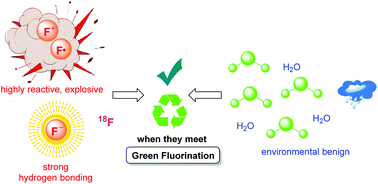
Advances of fluorination in aqueous media during the last few decades are summarized in this review.
The content of this RSS Feed (c) The Royal Society of Chemistry

11 Jul 00:25
Chem. Sci., 2017, 8,6433-6438
DOI: 10.1039/C7SC01980G, Edge Article
Open Access
Jacob E. Dander, Emma[space]L. Baker, Neil K. Garg
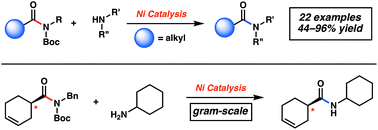
We report a two-step approach to achieve the transamidation of secondary aliphatic amides using non-precious metal catalysis.
The content of this RSS Feed (c) The Royal Society of Chemistry

11 Jul 00:16
Chem. Sci., 2017, 8,6375-6379
DOI: 10.1039/C7SC01703K, Edge Article
Open Access
Naoki Noto, Takashi Koike, Munetaka Akita
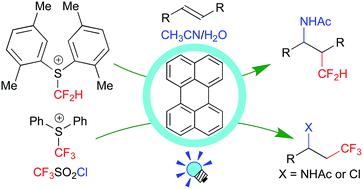
A new electrophilic CF2H reagent and metal-free photocatalytic di- and tri-fluoromethylation by perylene were developed.
The content of this RSS Feed (c) The Royal Society of Chemistry

10 Jul 08:57
Publication date: 25 July 2017
Source:Applied Catalysis A: General, Volume 542
Author(s): Jorge Quesada, Laura Faba, Eva Díaz, Salvador Ordóñez
The ethanol condensation catalyzed by mixed oxides is studied in this work, considering not only the activity but also the stability of these materials. Concerning to the activity, different weight hourly space velocities (WHSV) were tested, obtaining the highest conversion and 1-butanol selectivity with Mg-Al, mainly at 673K and a WSHV of 7.9h
−1. On the other hand, dehydration products, observed with Mg-Zr in relevant amounts, limit the results obtained with this material. Deactivation studies were carried out by combining the measurement of reactant and products in the gas phase and in the catalytic surface using spectroscopic techniques (DRIFT). Good stability was observed with both materials at low temperatures (lower than 673K), whereas at the highest one, Mg-Zr suffers relevant deactivation justified by the permanent adsorption of aldehydes and oxygenated oligomers on the active sites. It has been demonstrated that Mg-Al mixed oxides are promising catalyst for 1-butanol production from ethanol not only in terms of activity, but also in terms of catalyst stability.
Graphical abstract

10 Jul 01:50
by Xiaochuan Yang, David Acevedo, Adil Mohammad, Naresh Pavurala, Huiquan Wu, Alex L. Brayton, Ryan A. Shaw, Mark J. Goldman, Fan He, Shuaili Li, Robert J. Fisher, Thomas F. O’Connor and Celia N. Cruz

Organic Process Research & Development
DOI: 10.1021/acs.oprd.7b00130

10 Jul 01:11
by Qunchao Zhao, Long Lu, Qilong Shen
Abstract
An electrophilic shelf-stable monofluoromethylthiolating reagent S-(fluoromethyl) benezenesulfonothioate (1) was developed. In the presence of a copper catalyst, reagent 1 coupled with a variety of aryl boronic acids to give the corresponding monofluoromethylthiolated arenes in high yields. In addition, addition of reagent 1 to alkyl alkenes in the presence of a silver catalyst gave alkyl monofluoromethylthioethers in high yields.

An electrophilic shelf-stable monofluoromethylthiolating reagent, S-(fluoromethyl) benzenesulfonothioate (1), was developed. Reagent 1 couples with a variety of aryl boronic acids or unactivated alkenes to give the corresponding monofluoromethylthiolated arenes and alkanes in high yields.
10 Jul 00:59
by Félix Rodríguez, Pedro Alonso, Pilar Pardo, Raquel Fontaneda, Francisco Javier Fañanás
Abstract
The synthesis of cyclic alkenyl halides (mainly fluorides, chlorides and bromides) from alkynol or enyne derivatives by an acid-mediated cationic cyclisation reaction is disclosed. This high-yielding, scalable and technically simple method complements and challenges conventional methodologies. This study includes the development of biomimetic cationic cyclisation reactions of polyenyne derivatives to give interesting halogen-containing polycyclic compounds. The application of this reaction in the key step of the synthesis of two terpenes, namely austrodoral and pallescensin A, and the potent odorant 9-epi-Ambrox demonstrates the potential of the reaction for natural product synthesis.

It's all under regio-control! Cyclic alkenyl fluorides, chlorides, bromides and iodides are readily obtained by a cationic cyclisation process. Related biomimetic polycyclisation reactions allow the synthesis of interesting polycyclic core skeletons that may be used in the context of natural product synthesis (see scheme).
07 Jul 00:59
by Porwal, Digvijay
Synthesis
DOI: 10.1055/s-0036-1588476

B(C6F5)3 is shown to catalyze the deoxygenation of sulfoxides and sulfones to the corresponding sulfides with Et3SiH as the stoichiometric hydride source. While the method is limited in terms of functional group tolerance, it is applicable to the reduction of alkyl/aryl-, aryl/aryl-, and alkyl/alkyl-substituted sulfoxides, including the benzyl/benzyl-substituted derivative. The same protocol converts alkyl/aryl- but not aryl/aryl-substituted sulfones into sulfides.
[...]
© Georg Thieme Verlag Stuttgart · New York
Article in Thieme eJournals:
Table of contents | Abstract | Full text
07 Jul 00:56
by Thanh Binh Nguyen and Pascal Retailleau

Organic Letters
DOI: 10.1021/acs.orglett.7b01775

07 Jul 00:38
by Yoshito Kishi, Yanran Ai, Ning Ye, Qiaoyi Wang, Kenzo Yahata
Abstract
A zirconium/nickel-mediated one-pot synthesis of ketones is reported. In the presence of Zn or Mn, Cp2ZrCl2 was found to dramatically accelerate the coupling and suppress side product formation via an I![[RIGHTWARDS ARROW]](http://onlinelibrarystatic.wiley.com/undisplayable_characters/002192.gif) SPy displacement at the same time. Unlike Zn/Pd- and Fe/Cu-mediated one-pot ketone syntheses, the new method is effective for nucleophiles bearing OR or equivalent functional groups at the α-position. A mechanism comprising a nickel catalytic cycle, a zirconium catalytic cycle, and ZrNi transmetalation is proposed, and Cp2ZrCl2 and/or low-valent Zr species are suggested to play crucial dual roles.
SPy displacement at the same time. Unlike Zn/Pd- and Fe/Cu-mediated one-pot ketone syntheses, the new method is effective for nucleophiles bearing OR or equivalent functional groups at the α-position. A mechanism comprising a nickel catalytic cycle, a zirconium catalytic cycle, and ZrNi transmetalation is proposed, and Cp2ZrCl2 and/or low-valent Zr species are suggested to play crucial dual roles.

Accelerating additive: A zirconium/nickel-mediated one-pot synthesis of ketones is reported. In the presence of metallic zinc or manganese, Cp2ZrCl2 dramatically accelerates the coupling and suppresses side product formation. This method is applicable to nucleophiles bearing OR or equivalent functional groups at the α-position.
06 Jul 05:52
by Valerio Isoni, Ken Mendoza, Eleen Lim and Soo Khean Teoh

Organic Process Research & Development
DOI: 10.1021/acs.oprd.7b00107

05 Jul 06:12
Green Chem., 2017, 19,3671-3678
DOI: 10.1039/C7GC01392B, Paper
Fergal Byrne, Bart Forier, Greet Bossaert, Charly Hoebers, Thomas J. Farmer, James H. Clark, Andrew J. Hunt
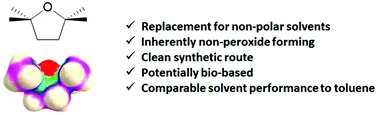
An inherently non-peroxide forming ether solvent, 2,2,5,5-tetramethyltetrahydrofuran (2,2,5,5-tetramethyloxolane), has been synthesized from readily available and potentially renewable feedstocks, and its solvation properties have been tested.
The content of this RSS Feed (c) The Royal Society of Chemistry

04 Jul 01:37
by Alessandro Vetere, Daniel Pröfrock, Wolfgang Schrader
Abstract
Owing to the environmental hazards arising from sulfur-containing combustion products, strong legal regulations exist to reduce the sulfur content of transportation fuels down to a few ppm. With the ongoing depletion of low-sulfur crude oil reservoirs, increased technological efforts are needed for crude oil refining to meet these requirements. The desulfurization step is a critical part of the refining process but partly suffers from the recalcitrance of certain species to sulfur removal and the inability to quantitatively understand the behavior of individual compound classes during the process. We herein present a new and simple approach for the parallel quantification of three different classes of sulfur species present in crude oils by LC separation and on-line detection and quantification by ICP-MS/MS. This approach will help to estimate the amount of recalcitrant species and thus facilitate the optimization of desulfurization conditions during fuel production.

Sulfur in oil: The desulfurization of crude oil probably is the catalytic reaction with the highest output in industry. The optimization of such processes, however, is not based on molecular information but on bulk parameters that do not contain any structural information. A detailed quantitative and qualitative analysis is now reported that enables the optimization of such important processes based on molecular information.
30 Jun 02:59
by Wu Liang, Zhijie Zhang, Dong Yi, Qiang Fu, Suyuan Chen, Lu Yang, Fengtian Du, Jianxin Ji, Wei Wei
A simple and convenient copper-catalyzed direct oxyphosphorylation of enamides with P(O)-H compounds and dioxygen has been developed under mild conditions. This methodology can allow the synthesis of a series of valuable β-ketophosphine oxides/β-ketophosphonates in moderate to good yields with a broad substrate scope simply by using readily-available starting materials.

A simple and convenient copper-catalyzed direct oxyphosphorylation of enamides with P(O)-H compounds and dioxygen leading to β-ketophosphine oxides/β-ketophospho- nates has been developed.
30 Jun 02:43
by Gaspar Pinto, Gloria Mazzone, Nino Russo, Marirosa Toscano
Abstract
Organophosphate-degrading enzyme from Agrobacterium radiobacter P230 exhibits promiscuity, not only in the reactions it catalyzes, but also in the metals it uses to catalyze those reactions. Here, three different binuclear metal centers were studied: di-CdII, di-MnII and ZnII–FeII. This enzyme uses these metal centers for hydrolyzing trimethyl- and dimethyl-phosphates. Both mechanisms were studied at DFT level of theory using a cluster model approach. The ground spin state was determined for each enzyme. The outcomes confirmed that the hydrolysis of phosphotriester is faster than that of phosphodiester and in some case the phosphodiesterase reaction does not occur. The computed activation energies are in agreement with previous experimental results for phosphotriesterase enzymes.

Metallic differences: Organophosphate-degrading enzyme from Agrobacterium radiobacter (OPDA) has an active site, which includes a pair of metal ions and exhibits promiscuity. Here, three different binuclear metal centers in the active site of this enzyme were studied: Cd–Cd, Zn–Fe, and Mn–Mn. The study confirmed that the hydrolysis of phosphotriester is faster than that of phosphodiester and in some case the phosphodiesterase reaction does not occur.
28 Jun 22:51
by Jing Yang Quek, Christopher L. Magee and Hong Yee Low

Langmuir
DOI: 10.1021/acs.langmuir.7b01175

28 Jun 22:47
by Klaus Friedel Ortega, Sven Anke, Fatih Özcan, Soma Salamon, Jsutus Heese, Corina Andronescu, Joachim Landers, Heiko Wende, Wolfgang Schuhmann, Martin Muhler, Thomas Lunkenbein, Malte Behrens
Abstract
Monocrystalline, yet porous mosaic platelets of cobalt ferrite, CoFe2O4, can be synthesized from a layered double hydroxide (LDH) precursor by thermal decomposition. Using an equimolar mixture of Fe2+, Co2+, and Fe3+ during co-precipitation, a mixture of LDH, (FeIICoII)2/3FeIII1/3(OH)2(CO3)1/6⋅m H2O, and the target spinel CoFe2O4 can be obtained in the precursor. During calcination, the remaining FeII fraction of the LDH is oxidized to FeIII leading to an overall Co2+:Fe3+ ratio of 1:2 as required for spinel crystallization. This pre-adjustment of the spinel composition in the LDH precursor suggests a topotactic crystallization of cobalt ferrite and yields phase pure spinel in unusual anisotropic platelet morphology. The preferred topotactic relationship in most particles is [111]Spinel∥[001]LDH. Due to the anion decomposition, holes are formed throughout the quasi monocrystalline platelets. This synthesis approach can be used for different ferrites and the unique microstructure leads to unusual chemical properties as shown by the application of the ex-LDH cobalt ferrite as catalyst in the selective oxidation of 2-propanol. Compared to commercial cobalt ferrite, which mainly catalyzes the oxidative dehydrogenation to acetone, the main reaction over the novel ex-LDH cobalt is dehydration to propene. Moreover, the oxygen evolution reaction (OER) activity of the ex-LDH catalyst was markedly higher compared to the commercial material.

Topotactic: Porous, crystalline, mosaic platelets of the cobalt ferrite spinel, CoFe2O4, were synthesized by thermal decomposition of a layered double hydroxide precursor. Interesting chemical properties were observed compared to commercial spinel, and were demonstrated by 2-propanol oxidation catalysis and oxygen evolution reaction catalysis.
28 Jun 07:31
Chem. Soc. Rev., 2017, 46,4168-4217
DOI: 10.1039/C6CS00751A, Review Article
Open Access
Jiale Yong, Feng Chen, Qing Yang, Jinglan Huo, Xun Hou
This review systematically summarizes the recent developments of superoleophobic surfaces, focusing on their design, fabrication, characteristics, functions, and important applications.
The content of this RSS Feed (c) The Royal Society of Chemistry

27 Jun 00:12
by Moreshwar B. Chaudhari, Yogesh Sutar, Shreyas Malpathak, Anirban Hazra and Boopathy Gnanaprakasam

Organic Letters
DOI: 10.1021/acs.orglett.7b01616

27 Jun 00:06
by Xiao-Feng Wu, Chaoren Shen, Zhihong Wei, Haijun Jiao
Abstract
The palladium-catalyzed chemoselective carbonylation of bromoaryl triflates is reported. The selective C−Br bond versus C−OTf (OTf=triflate) bond functionalization can be remarkably tuned by the combination of the ligand [4,5-bis(diphenylphosphino)-9,9-dimethylxanthene (Xantphos) vs. 1,1′-bis(diphenylphosphino)ferrocene (DPPF)] and the solvent (toluene vs. DMSO). The respective ligand and solvent effects are rationalized by DFT calculations. In contrast, the monodentate ligands BuPAd2 and tBu3P prefer the selective C−Br bond activation and are solvent insensitive.

Keep control: Palladium-catalyzed chemoselective carbonylation of bromoaryl triflates is reported. The influencing effects of different solvents (polar vs. non-polar) and ligands (e.g., monodentate vs. bidentate) on the chemoselectivety is discussed based on experimental observations as well as DFT calculations (see scheme; Xantphos=4,5-bis(diphenylphosphino)-9,9-dimethylxanthene, DPPF=1,1′-bis(diphenylphosphino)ferrocene).
26 Jun 02:06
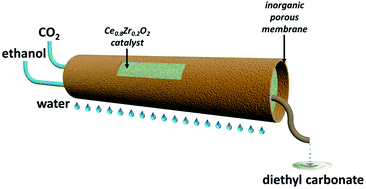
Green Chem., 2017, 19,3595-3600
DOI: 10.1039/C7GC00916J, Paper
Junhui Wang, Zhengping Hao, Sebastian Wohlrab
Carbon dioxide esterification at atmospheric pressure in the presence of dehydrating membranes produces more diethyl carbonate compared to batch processes.
The content of this RSS Feed (c) The Royal Society of Chemistry

26 Jun 00:48
by Partha Sarathi Mukherjee, Paramita Das, Atul Kumar, Prodip Howlader
Abstract
A water-soluble Pd6 trigonal prism (A) was synthesized by two-component coordination-driven self-assembly of a PdII 90° acceptor with a tetraimidazole donor. The walls of the prism are constructed by three conjugated aromatic building blocks, which means that the confined pocket of the prism is hydrophobic. In addition to the hydrophobic cavity, large product egress windows make A an ideal molecular vessel to catalyze otherwise challenging pseudo-multicomponent dehydration reactions in its confined nanospace in aqueous medium. This study is an attempt at selective generation of the intermediate tetraketones and xanthenes by fine-tuning the reaction conditions employing a supramolecular molecular vessel. Moreover, either poor or no yield of the dehydrated products in the absence of A under similar reaction conditions supports the ability of the confined space of the barrel to promote such reactions in water. Furthermore, we focused on the rigidification of the tetraphenylethylene-based tetraimidazole unit anchored within the PdII coordination architecture; enabling counter-anion dependent aggregation induced emission in the presence of water.

Dehydration in water: A water-soluble trigonal prism was synthesized (see figure). The hydrophobic cavity of the prism was employed for selective formation of intermediate tetraketones and xanthenes by fine-tuning the reaction conditions in aqueous media.
26 Jun 00:43
by Toshihide Taniguchi, Takuya Naka, Mitsutaka Imoto, Motonori Takeda, Takeo Nakai, Masatoshi Mihara, Takumi Mizuno, Akihiro Nomoto and Akiya Ogawa

The Journal of Organic Chemistry
DOI: 10.1021/acs.joc.7b00767

23 Jun 03:01
by Cornelia Zaugg, Gunther Schmidt and Stefan Abele

Organic Process Research & Development
DOI: 10.1021/acs.oprd.7b00124

23 Jun 03:00
by María Castro Rodríguez, Ignacio Rodríguez García, Roman Nicolay Rodríguez Maecker, Laura Pozo Morales, J. Enrique Oltra and Antonio Rosales Martínez

Organic Process Research & Development
DOI: 10.1021/acs.oprd.7b00098

23 Jun 02:55
by Wangcheng Zhan, Jinglin Wang, Haifeng Wang, Jinshui Zhang, Xiaofei Liu, Pengfei Zhang, Miaofang Chi, Yanglong Guo, Yun Guo, Guanzhong Lu, Shouheng Sun, Sheng Dai and Huiyuan Zhu

Journal of the American Chemical Society
DOI: 10.1021/jacs.7b01784