Shared posts

20 Dec 16:50

Shia LaBeouf plagiarism accusation of the day

by Rob Beschizza
"The LaBeouf Plagiarism Train of 2013 shows no sign of stopping," writes Defamer's Lacey Donohue. "at this point, he's either the world's biggest asshole and doing it on purpose, or the world's stupidest asshole and can't stop himself." The latest: an "about" page on LaBoeuf's Campaign Book website, copied verbatim from PictureBox.

PictureBox:

Why is PictureBox? Because I love the things I love and I want to champion them. I tend toward outliers and I'm obsessed with the history of visual culture writ large and small. But look, ostensibly PictureBox is a publishing company. I publish around 10 books a year (graphic novels, prose, design, art, etc.) as well as assorted specialty items like DVDS, CDs, and prints. Each project comes from my own tastes and relationships, and are rooted in what I believe in. Since it's just me running this thing, you're pretty much seeing me through those books and this site.

LaBoeuf:

Why The Campaign Book? Because I love the things I love and I want to champion them. I tend toward outliers and I'm obsessed with the history of visual culture writ large and small. But look, ostensibly The Campaign Book is a publishing company. I publish around 10 books a year (graphic novels, prose, design, art, etc.) as well as assorted specialty items like DVDS, CDs, and prints. Each project comes from my own tastes and relationships, and are rooted in what I believe in. Since it's just me running this thing, you're pretty much seeing me through those books and this site.

Just little 'ol Shia!


20 Dec 16:43

The Auteurs of Christmas

by Miss Cellania

(YouTube link)

This video imagines Christmas morning as envisioned by various notable filmmakers. You will no doubt recognize the styles of most of them -if you've seen any of their movies. My favorites are Martin Scorsese and Stanley Kubrick. Not that I'd wait in line to watch the full movies, but their Christmas scenes both made me laugh! As one commenter explained, they couldn't get enough fake blood to do Tarantino. A low budget would explain the absence of Michael Bay as well. This video is a Christmas greeting from Fourgrounds Media. -via Digg

20 Dec 16:42

EFF's holiday wishlist

by Cory Doctorow

The Electronic Frontier Foundation has posted its annual holiday wishlist of policy initiatives, business practices, and action by individuals. It's a kind of beautiful dream, and I long for the day that we attain it. And remember: everyone falls short of their ideals, but these are the best ideals to fall short of. I've included some of the wishes after the jump, but go read the full list.

Citizens, organizations, privacy officials, and governments should unite around the International Principles on the Application of Human Rights to Communications Surveillance and add their voices to declare that mass surveillance violates international human rights.

The U.S. Congress should create a new Church Committee to find out what intelligence agencies are actually doing; since mass surveillance is a global problem, we also need parliamentary commissions of inquiry around the world to look into the same question.

Congress should pass meaningful reform to the Computer Fraud and Abuse Act and the Electronic Communications Privacy Act.

The Department of Justice should notify everyone who's been convicted of a crime using evidence derived—directly or indirectly—from warrantless surveillance programs (not just a cherry-picked handful of defendants).

All communications companies should publish transparency reports showing the scope and nature of government requests for user information. The Internet industry, led by Google, has made this a standard for corporate transparency, but telecom companies are still totally missing in action.

All Internet sites should adopt cryptographic best practices for every connection, every time, including PFS, STARTTLS, HSTS, and encrypted traffic between data centers.

In 2014, every certificate authority and web browser should commit to adopt Google's Certificate Transparency system to detect and stop the issuance of fake certificates that facilitate spying on web users.

EFF's 2013 Holiday Wishlist

(Image: 618 - Party Lights, a Creative Commons Attribution (2.0) image from zooboing's photostream)


20 Dec 16:40

Walk across New Hampshire with Larry Lessig and friends to fight corruption and reform campaign finance

by Cory Doctorow

Larry Lessig and friends are walking the length of New Hampshire for #NHRebellion, to reform campaign finance and try to end corruption in American politics (see Larry's excellent TED Talk about this, above). The two-week walk starts on January 11, the anniversary of Aaron Swartz's death. You can walk with Larry and the rest of the NHRebellion, or you can sponsor them (or both!).

The #NHRebellion was inspired by the late Doris Haddock, aka, Granny D, a citizen of New Hampshire, and who, at the age of 88, walked across the country with a simple sign on her chest: “campaign finance reform.”

Long before I came to the issue, Granny D was recruiting anyone she could to the critically important cause of changing the way campaigns are financed. She believed, as I do, that the current system is a kind of “corruption.” And she believed, as I have come to believe, that unless we find a way to change it, our government will be incapable of addressing sensibly any of the critical issues that it must resolve. Granny D devoted the last part of her life to this fight. The #NHRebellion will continue her work.

The point of the January march is to focus the citizens of New Hampshire on this critical issue of corruption, so that they in turn will focus the candidates in 2016 on corruption too. We will be asking people from across the state to ask the candidates they will inevitably meet over the next two years: “How will you end this corruption?” And the hope is that if New Hampshire makes this an issue, it might well become an issue for the nation as well.

from the the-burdens-of-being-Lessig’s-friend department


20 Dec 16:40

UN adopts resolution in favor of digital privacy

by Cory Doctorow


The UN General Assembly has unanimously adopted a resolution called "The right to privacy in the digital age," introduced by Germany and Brazil. The resolution sets the stage for the adoption of broader privacy protection in UN treaties and resolution. The Electronic Frontier Foundation has written a set of (excellent) "People's Principles" (sign on here) for future work on digital privacy in the world.

The Principles make clear that:

* Critical Internet infrastructure must be protected: No law should impose security holes in our technology in order to facilitate surveillance. Dumbing down the security of hundreds of millions innocent people who rely on secure technologies in order to ensure surveillance capabilities against the very few bad guys is both overbroad and short-sighted. The assumption underlying such efforts—that no communication can be truly secure—is inherently dangerous, leaving people at the mercy of good guys and bad guys alike. It must be rejected.

* Monitoring equals surveillance: Much of the expansive state surveillance revealed in the past year depends on confusion over whether actual "surveillance" has occurred and thus whether human rights obligations apply. Some have suggested that if information is merely collected and kept but not looked at by humans, no privacy invasion has occurred. Others argue that computers analyzing all communications in real-time for key words and other selectors is not "surveillance" for purposes of triggering legal protections. These differences in interpretation can mean the difference between targeted and mass surveillance of communications. Definitions matter. States should not be able to bypass privacy protections on the basis of arbitrary definitions.

* We must protect metadata: It’s time to move beyond the fallacy that information about communications is not as privacy invasive as communications themselves. Information about communications, also called metadata or non-content, can include the location of your cell phone, clickstream data, and search logs, and is just as invasive as reading your email or listening to your phone calls—if not more so. What is important is not the kind of data is collected, but its effect on the privacy of the individual. Thus, the law must require high standards for government access. Our metadata needs to be treated with the same level of privacy as our content.

* Privacy must be protected across borders: Privacy protections must be consistent across borders at home and abroad. Governments should not bypass national privacy protections by relying on secretive informal data sharing agreements with foreign states or private international companies. Individuals should not be denied privacy rights simply because they live in another country from the one that is surveilling them. Where data is flowing across borders, the law of the jurisdiction with the greatest privacy protections should apply.

* We must restore proportionality: Authorities must have prior authorization by an independent and impartial judicial entity in order to determine that a certain act of surveillance has a sufficiently high likelihood to provide evidence that will address a serious harm. Any decisions about surveillance must weigh the benefits against the costs of violating an individual's privacy and freedom of expression. Respect for due process also requires that any interference with fundamental rights must be properly enumerated in law that is consistently practiced and available to the public. A judge must ensure that freedoms are respected and limitations are appropriately applied.

One Small Step for Privacy, One Giant Leap Against Surveillance


20 Dec 16:39

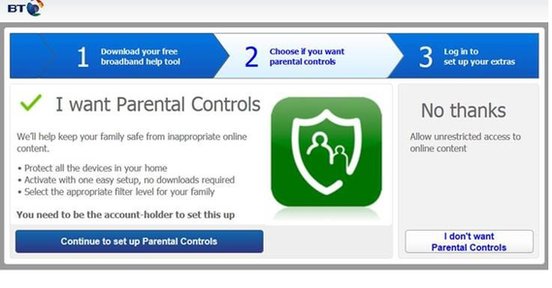
UK's Great Firewall of Cameron blocks sexual health, rape crisis centre, sex ed sites

by Cory Doctorow


The unaccountable, multi-million-pound feel-good porn filters that UK ISPs were ordered to install by the Prime Minister are (predictably) grossly overblocking the Web. Among the (predictable) victims: sites related to sexual health, sex education, and pornography "addiction." Also, rape crisis centres. Done in one, Davey, you've kept the nation's children safe with your insane political posturing.

Among the sites TalkTalk blocked as "pornographic" was BishUK.com, an award-winning British sex education site, which receives more than a million visits each year.

TalkTalk also lists Edinburgh Women's Rape and Sexual Abuse Centre website as "pornographic."

The company also blocked a programme ran by sex education experts, taught to 81,000 American children that has been in development for more than 20 years.

TalkTalk's filter is endorsed by Mr Cameron but it failed to block 7% of the 68 pornographic websites tested by Newsnight.

Sky's filter fared much better, blocking 99% of sites, but it did block six porn-addiction sites.

Porn filters block sex education websites [Mike Deri Smith/BBC]

(via Reddit)


20 Dec 16:37

Is that cool news true? Here's how you judge.

by Maggie Koerth-Baker
Love this list of 20 rules of thumb to help you analyze the validity of science news. A lot of it boils down to statistics and common sense (hey, you guys, scientists are human), but it's also stuff that easy to lose sight of when you're excited or scared or totally fascinated. Print this out and read it before you click "share".


19 Dec 21:40

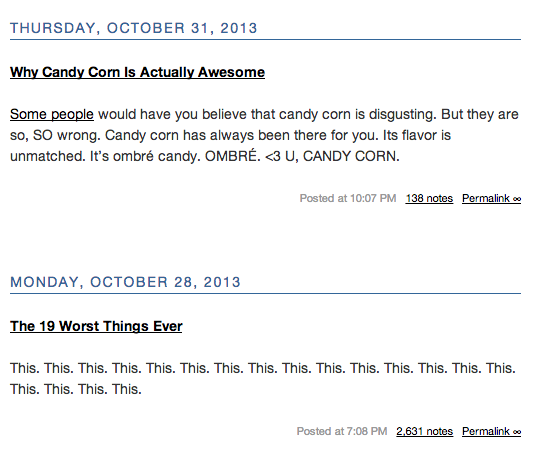
Buzzfeed Articles Without the GIFs, a tumblog of greatness

by Xeni Jardin
19 Dec 21:39

Chuck Norris Tops Van Damme's Split With an Epic Christmas Split

CGI Chuck Norris is better than the real Jean-Claude Van Damme.

Submitted by: Unknown

19 Dec 21:37

Bob Hope Enterprises claims the Feds' Bob Hope Christmas Special is under copyright

by Cory Doctorow

Rogue archivist Carl Malmud writes, "In 2009, I wrote to Boing Boing to kick off our FedFlix program. The headline was The next year, Brian Stelter wrote this up for the New York Times, writing "Dust off a disc. Maybe it's video of a Bob Hope Christmas show, or maybe it's the Apollo 11 moon landing. Insert a blank disc. Duplicate."

Since then, we've put over 6,000 government videos up on the Internet Archive and YouTube, with over 50 million views.

So, imagine my surprise when Bob Hope Enterprises did a Copyright Strike on our YouTube account. They're insisting that the government cataloging records are wrong. Bob Hope Enterprises didn't go after the government, and they didn't go after Amazon, which sells a copy in a joint deal with the government.

Nope, going after the big guys is tough, so they're going after the Internet, saying “When viewers can stream entire shows to their smart TVs it kills demand for the DVD.” So much for patriotism and so much for Christmas. We made the video private on YouTube :( and dark on the Internet Archive. :((

Merry Christmas to everybody! Even to the grinches at Bob Hope Enterprises. Bah, humbug!

This video is private. (Thanks, Carl!)


19 Dec 21:30

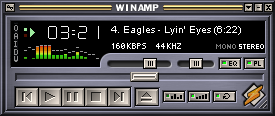
Ode to Winamp

by Rob Beschizza


It really whipped the llama's ass. [The Atlantic]


19 Dec 21:28

GNU Privacy Guard crowdfunding for new infrastructure

by Cory Doctorow

GNU Privacy Guard (GPG) is the free/open version of Pretty Good Privacy (PGP), the gold standard in secure email and other kinds of eavesdropping-proof, authenticated, private storage and communication. The GPG project relies on donations and voluntary subscriptions to keep up-to-date and support new platforms. They're running a crowdfunding campaign that's shooting for €24,000, which they'll spend on rolling out an all-new site (with Tor access!), as well as GPG 2.1, tutorials, subscription management, material for people throwing Cryptoparties (security-training events) and many other laudable goals. I rely on GPG every day, so I've put in €100. I hope you'll give, too.

Main features

- Brand new GnuPG website
- Release of GnuPG 2.1
- Anonymous Tor network access to gnupg.org
- New server for web infrastructure
- New user friendly design optimised for desktop and mobile
- Fresh download page catering to all devices
- Updated collection of external videos, guides, and courses
- New page for Cryptoparties
- Continued availability of all existing pages and manuals
- New subscription handling system for sustaining GnuPG development

GnuPG: new website and infrastructure (Thanks, John!)


19 Dec 21:02

Project for Awesome fundraising video about EFF

by Cory Doctorow

Jason writes, "Every year the YouTube community gets together for the Project for Awesome. A 48 hours event to raise money for all of our favourite charities by making, watching, commenting on and sharing videos about charities. This year, I've decided to support the Electronic Frontier Foundation in my contribution to the project."

The EFF works to promote free and open internet, freedom of speech, privacy for individuals and transparency in governments. Based on the essential information released by Edward Snowden, Chelsea Manning and Wikileaks we know that the US government has been spying on Americans and non-Americans alike for years. The EFF is currently waging multiple court battles challenging the constitutionality of these unwarranted spying programs. They need our help and support to keep the government accountable for their actions.

Project For Awesome 2013 | The Electronic Frontier Foundation | jalestro (Thanks, Jason!)


19 Dec 21:02

Italy passes Internet censorship laws: regulator can censor sites on 12 days' notice without judicial review

by Cory Doctorow

Italy has passed an Internet censorship bill that allows for a regulator to order the national blocking of websites without judicial review. If the website's operator wants to come to Italy to object, they have as little as 12 days to do so. ISPs that fail to comply with the censorship orders face fines of €250,000 per day.

The entertainment industry was quick to voice its satisfaction. "It's good regulation that gives us a much-needed 12-day fast track system," Enzo Mazza, CEO of Fimi, Italy's music industry lobby group, told ZDNet. "So far, when some international sites were involved we could rely only upon the criminal justice system which meant it was between 30 and 45 days before the access to a site was blocked."

However, some lawyers and activists hold a different view. According to them, by speeding up the process, the new regulations pave the way for unfair verdicts.

"Copyright is a complicate matter and I don't see how AgCom, which doesn't have a dedicated copyright team, could explore all the nuances of certain cases with the necessary diligence in such a short time," Guido Scorza, a lawyer and expert in online law at the forefront of the opposition to the document, said.

All this rush could also result in a restriction of the citizens' rights to freedom of expression, he added. With only five days (or three for the fast track) to file their counter arguments, it's very unlikely that any single user would try to fight for their rights to publish the disputed content, thus leaving the door open for uneven-handed decisions. "If you are a judge who would you rule in favour of, the party that was able to back its position or the one that did not even bother to make a case?" Scorza said.

Italy's site-blocking law comes into effect: A threat to Pirate Bay or a curse on online freedom? [Raffaele Mastrolonardo/Zdnet] (Thanks, Raffaele!)


19 Dec 17:25

Compilation of silent music

by David Pescovitz
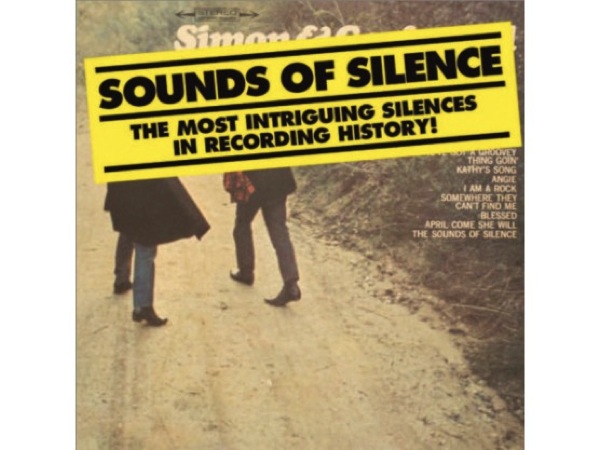
21924 0Sounds of Silence is a new compilation of silent tracks by the likes of Orbital, Crass, Andy Warhol, Sly & The Family Stone, John Denver, Afrika Bambaataa, John Lennon and Yoko Ono, and many more artists. According to the avant-garde Italian label Alga Marghen that issued the LP, limited to just 250 copies, "The carefully chosen silences of this anthology are intrinsically linked to the medium of reproduction itself and reveal it's nude materiality. They expose their medium in all its facets and imperfections, including the effect of time and wear. At the most basic level, these silences are surfaces. And it is in their materiality that they distinguish themselves from the conceptual experiments of John Cage with "4'33"." Of course, the title (and sleeve) is its own musical reference. Below, enjoy Lennon and Ono's "Two Minutes Silence" from 1969.


19 Dec 17:17

Take a Look Back at the WINs of 2013!

Submitted by: Unknown

Tagged: BAMF , compilation , Video , win
19 Dec 17:14

TOM THE DANCING BUG: U.S. Income Inequality in Six Panels, featuring Lucky Ducky

by Ruben Bolling

BE THE FIRST ON YOUR BLOCK to see Tom the Dancing Bug, by @RubenBolling, every week! Members of the elite and prestigious INNER HIVE get the comic emailed to their inboxes at least a day before publication -- and much, much MORE!

JOIN or DON'T.


19 Dec 17:08

These Pups Love the Snow

18 Dec 02:30

Secretive TPP treaty could kill creator's right to get copyrights back from studios, labels and publishers

by Cory Doctorow

The Electronic Frontier Foundation has new analysis of the leaked Trans Pacific Partnership (TPP) treaty, a secretive trade deal being hammered out without any public oversight, and set to be fast-tracked through the US Congress without substantial debate. EFF's piece focuses on the treaty's provisions that affect "termination rights," an obscure but important part of copyright law that allows creators to take their assigned copyrights back from the companies who bought them after 35 years. The studios, labels and publishers hate this, as it allows creators who scored big hits early in their careers when they were getting paid peanuts for their work to take those successful works back and re-sell them at a more appropriate price. EFF's view is that the TPP draft endangers Termination Rights.

It's more proof that just because many creators are on the side of the big entertainment companies, it doesn't follow that the companies are on the side of their creators. Any creator who endorses TPP, thinking that expansions to copyright will always benefit them, had better look again: TPP is a way of taking away one of the most valuable rights that creators have and handing it over to Big Content to make billions off of.

The section of the TPP labeled QQ.G.9 appears to be a more direct challenge to termination rights. It says:

Each Party shall provide that for copyright and related rights, any person acquiring or holding any economic right in a work, performance, or phonogram: may freely and separately transfer that right by contract; and by virtue of a contract, including contracts of employment underlying the creation of works, performances, and phonograms, shall be able to exercise that right in that person's own name and enjoy fully the benefits derived from that right.1

The termination right, of course, is a limit on free transfer. As a result, instead of a narrow attack on the termination rights of musicians by reclassifying their works as “works-for-hire,” the text here could eliminate termination rights for everyone. It is an open question whether QQ.G.9 would actually mandate such a significant change in U.S. law, but it is worth noting that the provision specifically targets “phonograms”—legal jargon for sound recordings. Furthermore, an addition proposed by Chile seems to have been designed to mitigate the possibility of broad scale legal changes, leaving us concerned about the ramifications of the current language.

The TPP's Attack on Artists' Termination Rights [Parker Higgins and Sarah Jeong/EFF]


18 Dec 02:28

EFF's best books of 2013

by Cory Doctorow
The Electronic Frontier Foundation has produced a reading list for the best books on technology, law and freedom in 2013. It includes several books I reviewed here, such as Black Code, The Internet Police, Coding Freedom and Rewire, as well as a few that I'm desperate to get to, such as Schneier's Carry On, Lapsley's Exploding the Phone and Greenberg's This Machine Kills Secrets.


18 Dec 02:16

CopyrightX: Harvard's ground-breaking MOOC on copyright law

by Cory Doctorow


Nathaniel writes, "Copyright X -- AKA 'The MOOC the New Yorker actually liked' -- is tooling up for a second run at it, expanding on its unusual, hybrid format. This year, in addition to the real-world classes attended by 100 Harvard Law students and online sections for 500 students -- taking the M out of MOOC -- the course is adding more 'satellites' and integrating them more with the other two course communities. The satellites are, for the most part, meat-space classes in about 10 locales around the world, each taught by an expert in copyright law. Apply here."

CopyrightX (Thanks, Nathaniel!)


18 Dec 02:16

Google Zeitgeist 2013

by Miss Cellania

(YouTube link)

Google has released their annual video highlighting what people searched for the most in the past year. They also have an interactive site in which you can explore the top searches of the year. It's somwhat confusing, as it is all image-based, and what does "View #my2013 Gallery" mean, anyway? I did not search for any of those things! At least, I don't think so, as most of them aren't labeled.

The "trends globe" is kind of interesting. You can check 150 cities of the world to see what their residents searched for the most by date. And yes, it's a little creepy how they start with the city you are closest to right now. (It took me to Cincinnati, which just shows you how far out in the sticks I am -the nearest big city is not even in my state!) Don't spin the globe too fast, or we'll all get dizzy!

-via Digg  

18 Dec 02:07

Santa Inserted into Famous Paintings

by John Farrier

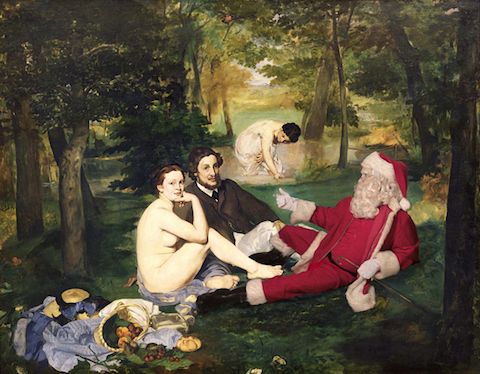
Here is Eduoard Manet's Le Déjeune sur l'Herbe (Luncheon on the Grass), a painting rejected for the presitigious Salon exhibition of 1863. Classical nudity was respectable in Academic art at the time, but the presence of fully clothed gentlemen indicated that this was a contemporary and therefore scandalous scene.

It didn't help Santa's reputation at the time, either.

Okay, the original did not have Santa Claus. Over the past 25 years, photographer Ed Wheeler has taken self-portraits while dressed as Santa. He often digitally inserts himself into famous paintings. You can view more in the series here.

-via Pleated Jeans

18 Dec 02:06

Paul Dini explains why execs don't want girls watching their superhero shows

by Cory Doctorow


Comics creator Paul Dini did a guest appearance on Kevin Smith's podcast "Fatman on Batman" podcast, and talked, in part, about the gender considerations of execs in new animation/superhero kids' show design, Vi transcribed the relevant piece, in which Dini recounts conversations he's had with execs who insist that they don't want any girl fans of their shows, because girls don't buy toys. And to keep girls from watching the shows, they make sure that girls are always presented as sidekicks, "one step behind the boys." It's absolutely infuriating.

DINI: "They're all for boys 'we do not want the girls', I mean, I've heard executives say this, you know, not Ryan(?) but at other places, saying like, 'We do not want girls watching this show."

SMITH: "WHY? That's 51% of the population."

DINI: "They. Do. Not. Buy. Toys. The girls buy different toys. The girls may watch the show -- "

SMITH: "So you can sell them T-shirts if they don't-- I disagree, A, I think girls buy toys as well, I mean not as many as f***ing boys do, but, B, sell them something else, man! Don't be lazy and be like, 'well I can't sell a girl a toy.' Sell 'em a T-shirt, man, sell them f***ing umbrella with the f***ing character on it, something like that. But if it's not a toy, there's something else you could sell 'em! Like, just because you can't figure out your job, don't kill chances of, like, something that's gonna reach an audi -- that's just so self-defeating, when people go, like… these are the same fuckers who go, like, 'Oh, girls don't read comics, girls aren't into comics.' It's all self-fulfilling prophecies. They just make it that way, by going like, 'I can't sell 'em a toy, what's the point?'

DINI: "That's the thing, you know I hate being Mr. Sour Grapes here, but I'll just lay it on the line: that's the thing that got us cancelled on Tower Prep, honest-to-God was, like, 'we need boys, but we need girls right there, right one step behind the boys' -- this is the network talking -- 'one step behind the boys, not as smart as the boys, not as interesting as the boys, but right there.' And then we began writing stories that got into the two girls' back stories, and they were really interesting. And suddenly we had families and girls watching, and girls really became a big part of our audience, in sort of like they picked up that Harry Potter type of serialized way, which is what The Batman and [indistinct]'s really gonna kill. But, the Cartoon Network was saying, 'F***, no, we want the boys' action, it's boys' action, this goofy boy humor we've gotta get that in there. And we can't -- ' and I'd say, but look at the numbers, we've got parents watching, with the families, and then when you break it down -- 'Yeah, but the -- so many -- we've got too many girls. We need more boys.'"

SMITH: "That's heart-breaking."

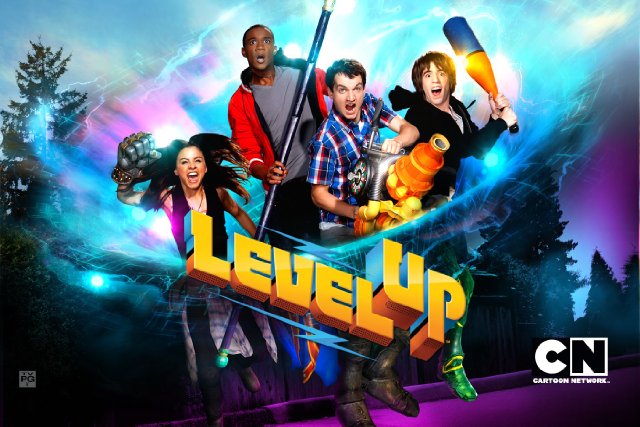
DINI: "And then that's why they cancelled us, and they put on a show called Level Up, which is, you know, goofy nerds fighting CG monsters. It's like, 'We don't want the girls because the girls won't buy toys.' We had a whole… we had a whole, a merchandise line for Tower Prep that they s***canned before it ever got off the launching pad, because it's like, 'Boys, boys, boys. Boys buy the little spinny tops, they but the action figures, girls buy princesses, we're not selling princesses.'"

Fatman on Batman 52: 'Beware the Batman' talk (via IO9)


18 Dec 02:03

NSA's bulk phone data collection ruled unconstitutional, 'almost Orwellian,' by federal judge

by Xeni Jardin


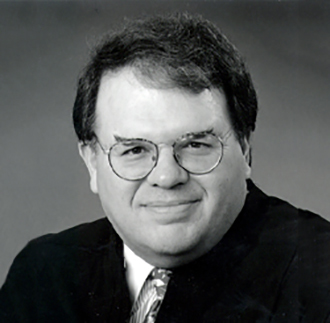
Judge Richard Leon (dcd.uscourts.gov)

In the nation's capital today, a federal judge has ruled that the National Security Agency's program of bulk phone record collection violates the reasonable expectation of privacy guaranteed to Americans by the Constitution. The judge ordered the federal government to stop gathering call data on two plaintiffs, and to destroy all previously-collected records of their call histories.

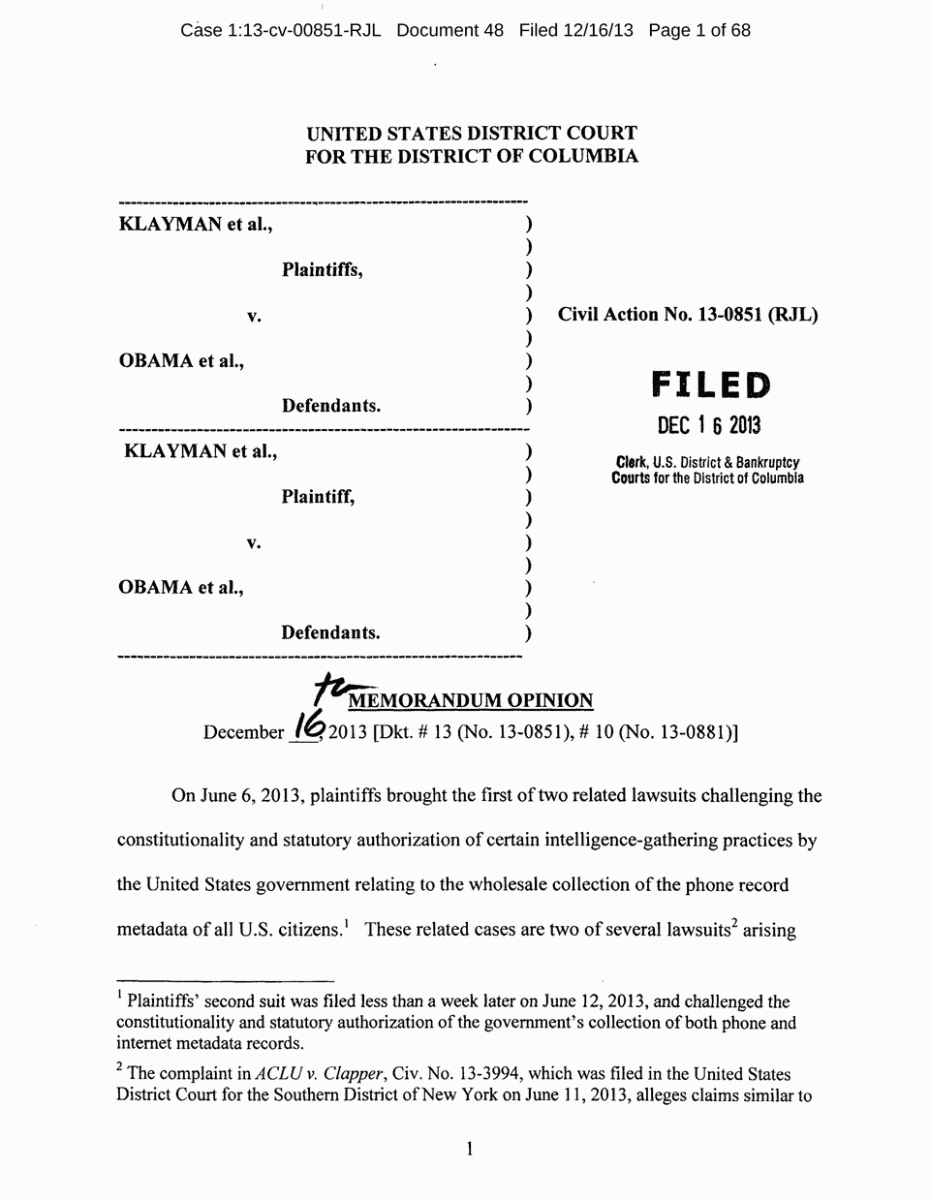
The ruling by Judge Richard Leon (PDF Link), a US district judge in the District of Columbia, is stayed pending a likely appeal--which may take months. In his 68-page memorandum, Leon wrote that the NSA's vast collection of Americans' phone metadata constitutes an unreasonable search or seizure under the Fourth Amendment.

"Father of the Constitution" James Madison would be “aghast” at the NSA's actions if he were alive today, wrote Leon.

“The government does not cite a single case in which analysis of the NSA’s bulk metadata collection actually stopped an imminent terrorist attack,” the judge wrote.

“Given the limited record before me at this point in the litigation – most notably, the utter lack of evidence that a terrorist attack has ever been prevented because searching the NSA database was faster than other investigative tactics – I have serious doubts about the efficacy of the metadata collection program as a means of conducting time-sensitive investigations in cases involving imminent threats of terrorism.”

“Because the government can use daily metadata collection to engage in ‘repetitive, surreptitious surveillance of a citizen’s private goings on,’ the NSA database ‘implicated the Fourth Amendment each time a government official monitors it,” Leon said.

"The almost-Orwellian technology that enables the government to store and analyze the phone metadata of every telephone user in the United States is unlike anything that could have been conceived in 1970."

From Charlie Savage's report in the Times:

Vanee Vines, a spokeswoman for the N.S.A., had no immediate comment on the ruling by Judge Leon, a 2002 appointee of President George W. Bush. The ruling is the first successful legal challenge brought against the program since it was revealed in June after leaks by the former N.S.A. contractor Edward J. Snowden. It was brought by several plaintiffs led by Larry Klayman, a conservative public-interest lawyer. The American Civil Liberties Union has filed a similar lawsuit in the Southern District of New York.


Still from video released by Wikileaks on October 12, 2013 shows intel leaker Edward Snowden speaking during a dinner with US ex-intelligence workers and activists in Moscow on October 9, 2013.

Edward Snowden, the former NSA contractor whose leaks led to the controversy, issued a statement from his exile in Russia to journalist Glenn Greenwald. Snowden's statement was published by the New York Times and other outlets:

“I acted on my belief that the NSA's mass surveillance programs would not withstand a constitutional challenge, and that the American public deserved a chance to see these issues determined by open courts,” Snowden wrote. “Today, a secret program authorized by a secret court was, when exposed to the light of day, found to violate Americans’ rights. It is the first of many.”

More: NYT, NPR, Guardian, CNN.

Read the judge's 68-page Memorandum Opinion [PDF Link].


18 Dec 01:56

The iPhone is a remix

by Rob Beschizza

Two mutually exclusive ideas are often voiced: first, that Apple's a shameless thief, and second, that its products are revolutionary. The truth--and the crux of the company's genius for design--lies in-between. Kirby Ferguson, of Everything Is A Remix fame, deconstructs the iPhone's eclectic inspirations and origins. Keep an eye out for Kirby's forthcoming new series, This is Not a Conspiracy Theory.


16 Dec 15:42

Santa Classics

by cparker

Santa Classics ed Wheeler
For his series titled “Santa Classics” photographer Ed Wheeler dresses up as Santa, takes a shot of himself in a certain position under carefully arranged lighting, and then composites the photo into an image from classic art.

The Previous/Next buttons aren’t obvious at the lower left of the website home page. There is also a link to show thumbnails.

The photographs will be on display at bahdeebahdu in Philadelphia to December 21, 2013.

[Via Flavorwire]

16 Dec 05:41

Google yanks vital Android privacy feature

by Cory Doctorow

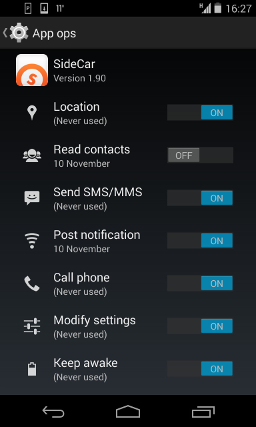
Well, that didn't take long: shortly after Google added a new Android feature that let you deny apps access to your sensitive personal data, they have revoked it. This is frankly terrible, and the Electronic Frontier Foundation's Peter Eckersley has some very pointed commentary, recommendations for Android customers, and advice for Google:

A moment ago, it looked as though Google cared about this massive privacy problem. Now we have our doubts. The only way to dispel them, frankly, is for Google to urgently reenable the App Ops interface, as well as adding some polish and completing the fundamental pieces that it is missing:

* Android users should be able to disable all collection of trackable identifiers by an app with a single switch, including data like phone numbers, IMEIs, information about the user's accounts.

* There should be a way to disable an app's network access entirely. It is clear that a large fraction of apps (including flashlights, wallpapers, UI skins, many games) simply don't need network access and, as we saw last week, are prone to abuse it.

* The App Ops interface needs to be smoothed out an properly integrated into the main OS user interface, including the Settings->Apps menus and the Play Store. There are numerous ways to make App Ops work for developers. Pick one, and deploy it.

In the mean time, we're not sure what to say to Android users. If app privacy is especially important to you — if, for instance, you want to be able to install an app like Shazam or Skype or Brightest Flashlight without giving it permission to know your location — we would have to advise you not to accept the update to 4.4.2. But this is also a catastrophic situation, because the update to Android 4.4.2 contains fixes to security and denial-of-service bugs. So, for the time being, users will need to chose between either privacy or security on the Android devices, but not both.

Google, the right thing to do here is obvious.

Google Removes Vital Privacy Feature From Android, Claiming Its Release Was Accidental


15 Dec 23:09

Weekend Links: The Thermodynamics of Coffee and Cream

by Erin
spriteleigh

Several remixes that I might have already shared individually

Counterintuitively, adding cream to a cup of a coffee helps slow down its cooling process. An explanation of the underlying physics at work is given here, alongside a fascinating super-slow-motion video of still black coffee transformed by the addition of cream.

*

There isn’t actually a Love Actually sequel in the works, but this fake, fan-made trailer featuring zombies, death threats, hobbits, and Hogwarts is a reminder that the original cast has been keeping busy with other projects since the movie’s 2003 release anyway.

*

In a massive time-saving move, YouTube has compiled the year’s most viral videos into a single, 5:47-long pop culture smorgasbord.

*

Here, too, are the year’s top ten viral memes. Wow. Such compilation.

*

While one kindergartener’s classmates made generic hand gestures signifying Santa Claus’s pointy hat and long beard during their annual Christmas concert, the five-year-old KODA, or “kid of deaf adults,” translated the entire program into American Sign Language so her parents could experience the holiday cheer as well.

*

David Thibault, the sixteen-year-old French Canadian reincarnation of Elvis, puts his skills to festive use with a remarkably familiar-sounding rendition of the crooner’s classic, “Blue Christmas.”

*

Let these fatal family feuds in history be a reminder to take it easy on your relatives during the holidays.

December 15, 2013 - 12:30pm
15 Dec 23:05

Amazon takes away access to purchased Christmas movie during Christmas

by Cory Doctorow

Disney Prep and Landing 2' if you're curious) and it was gone from our library and couldn't be found on the site at all. Amazon has explained to me that Disney can pull their content at any time and 'at this time they've pulled that show for exclusivity on their own channel.' In other words, Amazon sold me a Christmas special my kids can't watch during the run up to Christmas. It'll be available in July though!"

To be fair, the Amazon rep gave me a very generous credit to watch something else, recognizing that this is a suck policy.

But at a minimum, beware, somewhere buried in the legalese is the right for Amazon and partners to pull content away from you, even content you specifically paid for, anytime they want.

Maybe this is standard in the new digital world and not limited to Amazon. If so, screw the new digital world and give me a physical copy.

Yes, Disney is stupid and evil for doing this. But when Amazon decided that it would offer studios the right to revoke access to purchased videos, they set the stage for this. They stuck the gun on the mantelpiece in Act One, and they don't get to act all surprised now that it went off in Act Three. Anyone who didn't see this coming failed to do so because it was their job not to see it coming.

This is what was set in motion in the 1970s, when we started using the term "intellectual property" instead of "copyright" or "author's monopoly." If the movie is Disney's "property" for ever and ever, it follows that it is never your property, no matter that you "buy" it. And since "IP" is embedded in everything from blenders to cars to yoga studios, there is nothing that you can ever own -- you can only be a tenant in someone else's fields, an ambulatory wallet for a rentier looking for "passive income" while suckers like you work for a living and pay rent on everything in your life, only to have it yanked away from you at the landlord's pleasure.