Shared posts

12 Apr 15:25

Appeals court overturns conviction of Andrew “weev” Auernheimer in iPad hacking case

by Xeni Jardin


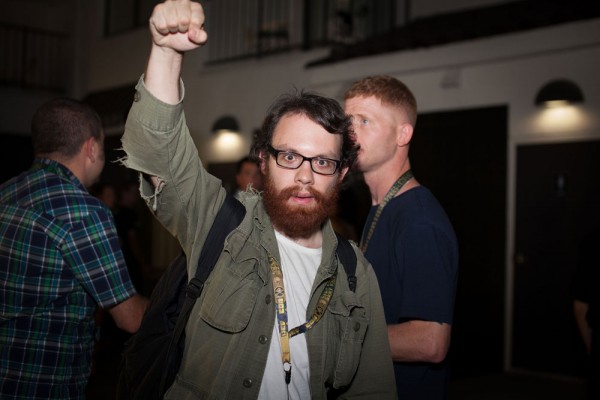
Andrew “Weev” Auernheimer, in 2012. Photo: pinguino.
Notorious hacker and troll weev was released from prison this evening. A federal appeals court today overturned his conviction in a case of significance for all security researchers.

Weev exposed a security flaw in AT&T's website and obtained the personal data of more than 100,000 iPad users. He was charged with violating the Computer Fraud and Abuse Act (CFAA), and sentenced to three and a half years in prison. Today's ruling says prosecutors did not have the right to charge him in a state where none of the alleged crimes occurred.

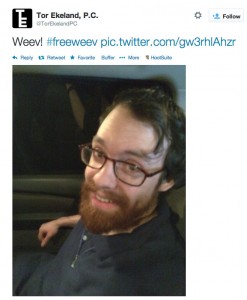
Weev's conviction has been vacated! #freeweev

— Tor Ekeland, P.C. (@TorEkelandPC) April 11, 2014

Kim Zetter in Wired:

Andrew “Weev” Auernheimer was in Arkansas during the time of the hack, his alleged co-conspirator was in California, and the servers that they accessed were physically located in Dallas, Texas and Atlanta, Georgia. Prosecutors therefore had no justification for bringing the case against Auernheimer in New Jersey, a federal appeals panel ruled this morning. The appeal was closely watched in cyber law and civil liberties circles, and Auernheimer had a powerhouse legal team that handled his case pro-bono.
From Ars Technica:
The case against Auernheimer, who has often been in solitary confinement for obtaining and disclosing personal data of about 140,000 iPad owners from a publicly available AT&T website, was seen as a test case on how far the authorities could go under the Computer Fraud and Abuse Act (CFAA), the same law that federal prosecutors were invoking against Aaron Swartz. But in the end, the Third US Circuit Court of Appeals didn't squarely address the controversial fraud law and instead said Auernheimer was charged in the wrong federal court.

"Although this appeal raises a number of complex and novel issues that are of great public importance in our increasingly interconnected age, we find it necessary to reach only one that has been fundamental since our country’s founding: venue," the appeals court wrote. "The proper place of colonial trials was so important to the founding generation that it was listed as a grievance in the Declaration of Independence" (PDF).

From the EFF:

Auernheimer was represented on appeal by the Electronic Frontier Foundation (EFF), Professor Orin Kerr of George Washington University, and attorneys Marcia Hofmann, and Tor Ekeland. In an opinion issued this morning by the U.S. Court of Appeals for the Third Circuit, Judge Michael Chagares wrote that the government should not have charged Auernheimer in New Jersey, which had no direct connection to AT&T or Auernheimer.

"We're thrilled that the Third Circuit reversed Mr. Auernheimer's conviction," EFF Staff Attorney Hanni Fakhoury said. "This prosecution presented real threats to security research. Hopefully this decision will reassure that community."

Here is today's court ruling [PDF].

For more on weev, this Gawker profile is a good place to start. Don't miss his thoughts on The Jews.

FUCK YEAH!!! RT @TOREKELANDPC riding back to nyc now. #freeweev pic.twitter.com/sqIdEvyo6k

— Anonymous (@YourAnonNews) April 12, 2014

Yes Hello, @rabite here. Out of prison for mere hours and I am already hijacking YAN. Was just on a hunger strike. AMA.

— Anonymous (@YourAnonNews) April 12, 2014


12 Apr 15:25

Hilarious: Pro Golfers Playing on Miniature Golf Courses

by John Farrier


(Video Link)

This is the funniest video I've seen all week. Simon Connor took video footage of professional golfers attempting to sink putts and digitally added obstacles from miniature golf tournaments. Watch masters of the sport, such as Angel Cabrera and Tiger Woods, attempt to get through loops, windmills, and other hazards.

-via 22 Words

12 Apr 15:21

LA Sheriffs launch crowdsourced crowd control: LEEDIR, a surveillance app that uses your photos and videos

by Xeni Jardin


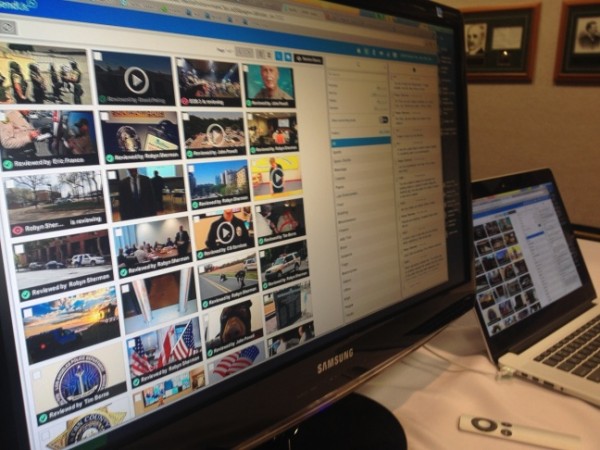
A monitor displaying videos and photos uploaded to LEEDIR (Large Emergency Event Digital Information Repository) on April 10, 2014. The app that allows civilians to upload material to law enforcement after a disaster or emergency. Erika Aguilar, KPCC

The Los Angeles County Sheriff’s Department today unveiled a software program that allows US law enforcement agencies who adopt it to solicit and gather videos and photos of "emergency events" from the public.

Under the leadership of disgraced former LA County Sheriff Lee Baca, the department is said to have conceptualized the web service and smartphone app, which was built by Citizen Global with Amazon. It's called LEEDIR, an acronym for Large Emergency Event Digital Information Repository. Citizen Global brands it as "public safety through crowdsourcing."

In today's announcement, earthquakes, terrorist attacks, and the Boston Marathon bombings were mentioned as scenarios in which LEEDIR could help law enforcement respond to disasters or large-scale public security threats. One might also imagine large citizen protests like Occupy Wall Street being the focus of such crowdsourced surveillance. From Erika Aguilar's report at KPCC radio:

[Commander Scott Edson with the L.A. County Sheriff’s Department] said he realized not many law enforcement agencies have the extra bandwidth and extra storage to collect mass amounts of data in a short period of time. He reached out to Citizen Global, a private technology group that was providing uploading services to broadcast media companies seeking to collect videos and photos from eyewitnesses.

“It’s becoming part of our communication fabric,” said Nick Namikas, co-CEO of Citizen Global. “So I think this is the next phase of our see something, say something…it’s now see something, send us something.”

The LEEDIR website and app are not live all the time. A law enforcement or local government agency must send a request to Citizen Global to activate the uploading program. There’s no cost to the law enforcement agency to use LEEDIR if the emergency affects more than 5,000 people or covers five square miles and at least two public safety agencies respond.

Read or listen to the rest of the KPCC report here.

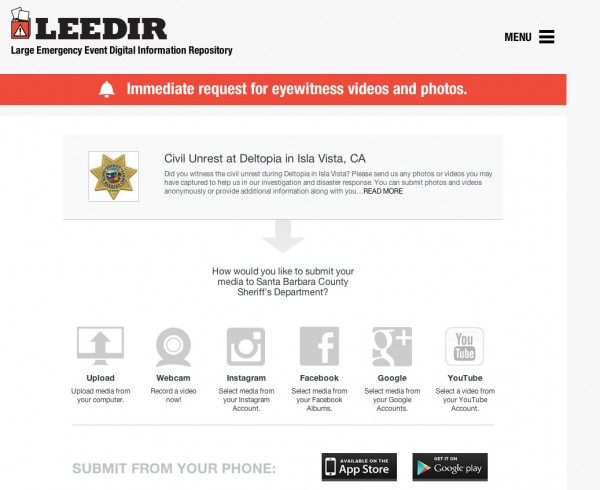
As you can see from the screengrab below, this week the Santa Barbara County Sheriff’s Department is using LEEDIR to gather photos and videos from eyewitnesses of a chaotic street party in Isla Vista that led to over 100 arrests. Sheriff's investigators hope the images they receive will allow them to ID more suspects. According to today's announcement, agencies might typically retain uploaded content for a month or two, then delete it. But there's no requirement to delete it, nor is there a guarantee of true anonymity for uploaders, though you do not have to provide your name.

Below, a screenshot of the LEEDIR website.


Above: The LEEDIR iphone app, with which the public is invited to upload photos and video to law enforcement. Surely there could be no privacy concerns with downloading such an app to your smartphone.

Below, a promotional video released in 2013 with former Los Angeles County Sheriff Lee Baca, who is credited with leading the development of LEEDIR. Baca's administration was plagued by corruption and scandal, and he resigned amid ongoing investigation into possible criminal activity. Certainly no such imperfect leader would misuse LEEDIR.


11 Apr 20:29

Glenn Greenwald and Laura Poitras enter the US for first time since Snowden leaks

by Xeni Jardin
A first since they began reporting on the material leaked by NSA whistleblower Edward Snowden: Glenn Greenwald and Laura Poitras, landing in the United States. There have been concerns that the US might detain them if they entered the country.

#Glenngreenwald and #LauraPoitras arrive safely at JFK airport. There was fear they'd be arrested over #edwardsnowden pic.twitter.com/xhssow3Lfe

— Ted Shaffrey (@TedShaffrey) April 11, 2014

(Disclosure: I'm on the board of the Freedom of the Press Foundation with all three)


11 Apr 04:14

The Story Behind Bliss, Windows XP's Desktop Photo

by Chris Higgins

Microsoft announced this week that support for Windows XP has ended. Released in 2001, it's one of the longest-lived consumer desktop operating systems, and one of the most popular. Its popularity has made Microsoft's choice for the default desktop image into a ubiquitous icon of the twenty-first century.

The default desktop image for Windows XP is called Bliss. Taken by Charles O'Rear in 1996, it shows a dreamily idyllic hillside in the sun. Here's the story of how "Bliss" came to be:

While it's hard to know for sure, "Bliss" is a leading candidate to be the most-viewed photograph of all time. Another possibility is The Blue Marble although, let's face it, we haven't been booting up to stare at that image for thirteen years.

Equally compelling is the story of the Windows 95 startup sound, created by musician Brian Eno.

April 10, 2014 - 2:42pm
11 Apr 04:13

EFF seeks student activists for campus network

by Cory Doctorow


The Electronic Frontier Foundation is launching a major campus organizing initiative and is looking to build a network of trusted campus activists to work with. They're sending staffers on a road-trip to speak at universities and colleges and want to hear from you. They've released a set of community organizing tools to help you get started.

There are plenty of ways to take part, no matter how much organizing experience you have.

* Start a group: Talk to friends and community members to gauge who else in your network is interested in digital freedom. Form a group that can discuss the issues and plan ways of advocating for your rights. For some tips on getting started, check out our guide on how to build a coalition on campus and in your community.

* Bring digital rights to an existing group: These issues are everybody's issues, no matter where on the political spectrum you lie. You can work with existing political, civil liberties, activist, and computer-related groups and urge members to take on a digital rights campaign.

* Organize an event: We have plenty of suggestions for events you can throw, from film screenings to rallies, parties to speaker series.

* Let your voice be heard: We are all part of the digital rights movement together, and your voice is as important as ours. Learn how to coordinate with local and national campaigns, and amplify your message by reading our tips on engaging with the press.

While many student groups and local community organizations are working on surveillance reform in light of the recent disclosures about massive government spying, it’s not only the NSA that we’re fighting: we’re demanding open access to publicly funded research; we’re fighting to protect the future of innovation from patent trolls; we’re urging companies and institutions to deploy encryption; we're defending the rights of coders and protecting the free speech rights of bloggers worldwide—the list goes on.

EFF is Expanding into Student and Community Organizing, and We Need Your Help


10 Apr 03:31

Back Side Of Classic Album Cover Art Is Finally Revealed

by Zeon Santos

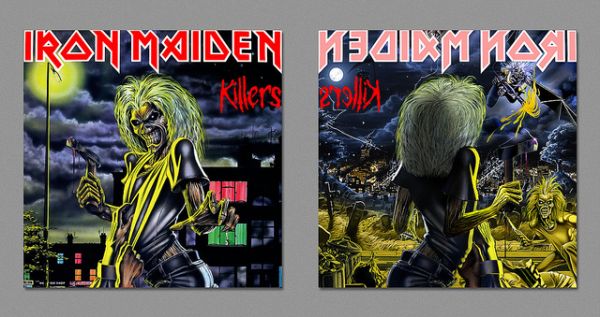
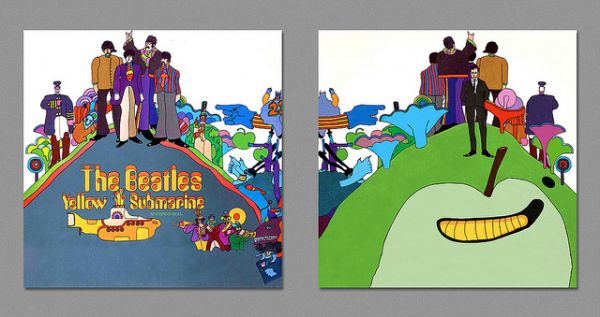
Classic album art is the one thing sorely missing from this world of mp3 downloads and digital music. The large, colorful artworks from such famous artists as Roger Dean, Hipgnosis, H.R. Giger and Andy Warhol, just to name a few, were an enjoyable bonus to the audible delights that awaited listeners in-between the grooves.

But what did the back side of classic album covers look like? Generally they had very little to do with the front, choosing to contain the track listings instead, but Flickr user Harvezt wasn't content with only seeing half the scene, so they used their formidable illustrative skills to finally reveal the back sides of classic album covers in a series called "The Dark Side of the Covers".

-Via Laughing Squid

10 Apr 02:38

Everything is a Remix vs Patent Trolls

by Cory Doctorow

Adi from EFF writes, "Engine Advocacy worked with artist Kirby Ferguson (of Everything is a Remix fame) to create this great primer on patent trolls. It beautifully and succinctly lays out the patent problem, which is one of the hottest topics on the Hill right now. EFF, Public Knowledge, and Engine are pushing for people to call their senators to demand strong patent reform, and we have a handy tool at fixpatents.org for all you to do so!"


10 Apr 01:28

Game of Goats

by Miss Cellania
spriteleigh

Because of course. The song's great, too.

(YouTube link)

Try getting through this video without giggling. You just try. There are enough screaming goats with humanish voices on YouTube that it is possible, with clever editing, to make them sing a song. Well, enough if you add that one sheep. Here, they sing the introductory theme to their favorite TV show, Game of Thrones. Too bad they don’t know the lyrics. -via Uproxx

09 Apr 23:13

Condoleezza Rice, surveillance and torture fan, joins Dropbox board

by Rob Beschizza

You don't need Mike Judge to remind you how dumb the valley is. Buried on page 3 of a Businessweek story by Brad Stone and Ari Levy, via Sam Biddle at Valleywag:

Dropbox has also added a prominent fourth member to a board of directors that Houston has until now kept small—Condoleezza Rice. The former secretary of state’s consulting firm, RiceHadleyGates, has been advising the startup on management issues for the last year. Now she’ll help the company think about such matters as international expansion and privacy, an issue that dogs every cloud company in the age of Edward Snowden and the NSA. “As a country, we are having a great national conversation and debate about exactly how to manage privacy concerns,” Rice says about her new position. “I look forward to helping Dropbox navigate it.”

Rice joining Dropbox is the insult, not the injury, which is in the firm's DNA: customer privacy as a feature, not a principle.


09 Apr 20:43

Marvel At This Winter Soldier Inspired Meme - Hail Hydra

by Zeon Santos

Internet memes are so timely nowadays that they spring up from pop culture the minute the source of their inspiration is released, often before many people have even seen whatever the meme is referencing.

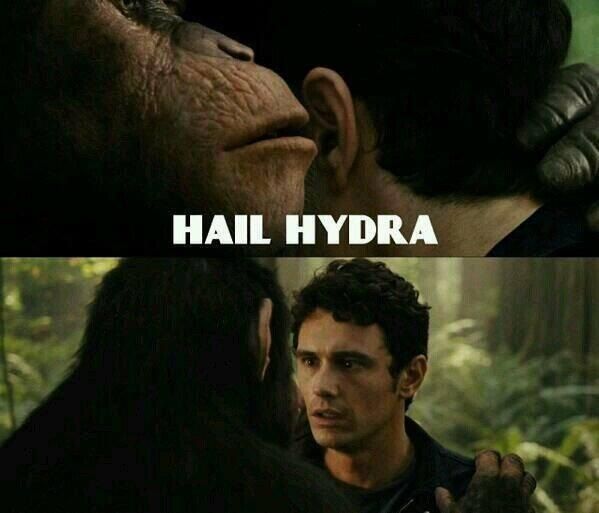
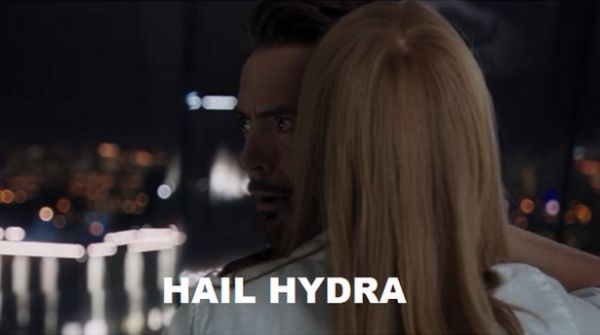
The newest addition to this timely geek fare is the Hail Hydra meme, which sprang from a scene in Captain America Winter Soldier (no spoilers!) where one character whispers "Hail Hydra" into the ear of another character in a sinister manner.

Suddenly the internet is full of secret agents announcing their allegiance to Hydra with a whisper, in the greatest meme conspiracy of all time.

-Via Gamma Squad

08 Apr 22:40

Online test-proctoring: educational spyware that lets third parties secretly watch and listen to you through your computer

by Cory Doctorow
Rebecca from EFF writes, "How would you feel about having your computer taken over by online test-taking software - complete with proctors peering through your laptop camera? Reporters at the Spartan Daily (the student paper for San Jose State University) have an interesting story about new software in use there, and the legitimate concerns that some students have. The data-broker connection is especially chilling to those worried about their personal information." The company's response? "We're a customer service business, so it’s really not advantageous for us to violate that trust." Oh, well, so long as that's sorted out then.


08 Apr 20:31

All 5,179 Game Of Thrones Deaths In Under Three Minutes

by Zeon Santos

(Video Link)

Game of Thrones is back and bloody as ever, but we’re not here to post spoilers. Instead we’re going to take a look back at all the bloodshed, mayhem, murder and deadly deception from the last three seasons courtesy of this supercut from Digg that shows all 5,179 on-screen deaths from Game of Thrones in under three minutes.

That’s like twenty nine deaths per second, how do they manage to find time to build such a compelling storyline with all that head chopping going on?

This video features tons of spoilers if you haven't seen the first three seasons of the show, and a whole cartload of violence which may be considered NSFW

-Via GeekTyrant

08 Apr 16:06

Emoji-nation: Classic Artwork Meets Modern Social Media Icons

by Alex Santoso

In her artwork series emoji-nation, Natasya Ptichek mashed up classical works of art with modern elements we are familiar with. The Ukrainian artist overlaid Windows-style dialog boxes and social media notifications and icons over paintings to create ironic commentaries.

Ptichek's first emoji-nation series paired emoticons with iconic artwork, whereas her third one reimagined famous artwork as movie posters. Below are selected work from Ptichek's second, fourth, and fifth installments of emoji-nation:

View more of Nudnik's emoji-nation artwork series on her Behance page - via kottke

07 Apr 22:36

Restoring CC attribution to Flickr, because Yahoo broke it

by Cory Doctorow


You may know that Flickr is one of the largest repositories of freely usable public domain and Creative Commons photos in the world, hosting collections contributed by libraries, national archives, foundations, museums, galleries, and individual users (I've uploaded more than 10,000 CC-BY-SA images of my own). However, with its latest redesign, Flickr has made is very difficult to copy the images it has been entrusted with, and nearly impossible to correctly attribute them in accord with their license terms.

Today, we're fixing that. A little, anyway.

Years ago, Boing Boing reader Cory Dodt (no relation, obviously) created a script called "attributr" that took the structured license data in each Flickr image page and created a snippet of text that set out the permalink for the image, its creator's name, and the license it was released under, along with a link to the license -- for example:

(Image: Modern Book for Girls, a Creative Commons Attribution (2.0) image from snigl3t's photostream)

Late last month, Yahoo updated the Flickr pages for each image in a way that removed all the structured Creative Commons license data, breaking the script. And CC users who tried to make use of the images Flickr is privileged to host found that replicating the attribution text by hand was nearly impossible. The page used scripts that intercepted copy-to-clipboard shortcuts and also broke text-selection, so that it was nearly impossible to copy the name of image or the name of its creator to your clipboard unless you found it in the page's source-code.

In addition to removing the structured, machine-readable CC metadata, the new Flickr pages also don't make use of the standard CC license logos, familiar due to hundreds of millions (possible billions, by now) of webpages that use those logos to signal in familiar terms that the material on the pages can be shared.

Finally, the links for downloading the high-resolution versions of CC licensed images that had been entrusted to Flickr have been buried under a cryptic ellipsis.

Cory Dodt has replicated his Flickr script, with the caveat that it is now extraordinarily fragile, because it scrapes the Flickr source, and any future changes will break it. Accordingly, it's hosted on github so that it can be maintained when (inevitably) it breaks.

But this is bigger than one script. I have a long history with Flickr. I served as an advisor to Stewart Butterfield and Caterina Fake when they were working on a game called Game Neverending, and Stewart offered to prioritize GNE's photo-sharing feature to help me court a woman I'd started dating overseas. The feature was so successful they folded up GNE and renamed it Flickr, and now I am married to that woman. I owe my marriage to Flickr, and Flickr exists in part because of my marriage.

Over the years, I continued to advise and cheer on Flickr as it became a powerhouse for CC-licensed images, one of the most important photographic resources on the planet.

I understand Yahoo's desire to update Flickr in the face of competitive pressure from other image-sharing services, and I celebrate its design experiments. But the current iteration -- either through negligence or deliberate intent -- terribly undermines the Flickr Commons and does not do justice to the trust and generosity of its many institutional and individual contributors.

I hope that Yahoo will take speedy action to remediate this issue. Honestly, restoring the CC metadata -- a feature that's been part of Flickr since the day it added CC licenses -- is trivial. Using real CC logos will have virtually no visual impact on the pages. And putting the download link back where it belongs, visible and located near the CC license, is a minor change. Ending the interception of control-C on the page so that users can copy the names of the images and their posters would be trivial.

And if Yahoo doesn't do this, I think it's time to start thinking about hosting CC images somewhere else -- perhaps Wikimedia Commons, or a purpose-built site. Flickr still has its admirable API for bulk-ingesting CC images and rehosting them in a way that facilitates the sharing that their copyright holders and custodians expressly desired for them.

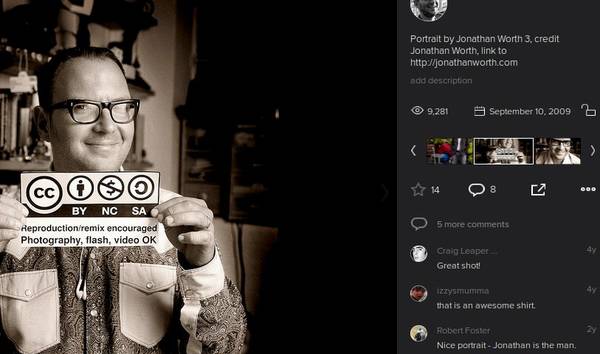
(Image: Portrait by Jonathan Worth, CC-BY-SA)


07 Apr 21:10

If I Just Ignore Him, Maybe He'll Go Away...

spriteleigh

I just really like everything about this.
-Mr. Simpson

Submitted by: (via nevadamountains)

Tagged: dogs , goats , funny , weird , Video
06 Apr 16:59

Jurassic Park Without CGI

by Miss Cellania

(YouTube link)

Michael T. Mann was impressed with thee movie Jurassic Park, but wondered what it would be like if there were no computer-generated dinosaurs in it. So he re-edited several key scenes with more “conventional” special effects for the dinosaurs. That didn’t seem to be as good as the original, so he messed with the ending of the movie just a little to make up for it. The result is quite ridiculous, even downright stupid, but you will laugh at some point or another. Don’t miss the post-credit easter egg. -via The A.V. Club

05 Apr 21:44

Super Mario Cat

by Miss Cellania
spriteleigh

This is so well done

(YouTube link)

Finally, a video that combines the two biggest obsessions on the internet -cats and video games! See what happens when a handsome black cat finds himself in a Super Mario World. This video from Michael Tivikoff shows how a cat collects coins, deals with Koopas and mushrooms, and achieves a power-up! He even finds time to stop and smell the fire flowers. -Thanks, Michael!

04 Apr 20:45

Crowdfunding Novena, the fully open/transparent laptop project

by Cory Doctorow

Remember Bunnie Huang's fully open laptop? Bunnie and Sean "xobs" Cross prototyped a machine he called the "Novena" in which every component, down to the BIOS, was fully documented, licensed under FLOSS licenses, and was totally modifiable by its owner.

Now, Bunnie and Xobs have teamed up with Sutajio Kosagi for a crowdfunding campaign to take the laptop into production. $500 gets you the board, $1200 gets you a desktop version, $2000 gets you a laptop and $5000 get you a "heirloom laptop" in a handmade wooden case crafted by Portland-area luthier Kurt Mottweiler.

The Novena is "not a device made for consumer home use" -- it has lots of components that are exposed during normal use, has no moisture- or static-resistance built into it, etc. It's intended as a piece of high-quality lab equipment for people interested in the long-term project of building fully open, everyday use computers where surveillance, abusive commercial practices, and other proprietary horribles are substantially harder to accomplish than in the current hardware/software ecosystem.

Noah Swartz notes, "I for one am super excited about it because it's meant specifically for hackers and tinkerers. The motherboard has a Spartan-6 CSG324-packaged FPGA built right into it, and if you opt for the conversion-tablet form factor you also get bunni's own battery controller which allows you to use cheap RC car or airplane batteries instead of expensive laptop specific ones by moving the load balancing circuits off of the battery itself. Also the internals of the case are covered in mounting holes (dubbed the peek array after Nadya Peek: https://www.youtube.com/watch?v=iIUE8VVLjCE) which allow you to affix whatever sort of add-ons you want to the inside of the laptop."

I've put in for one of the laptops. I can't wait.

In the design shown here, you can access the internals without having to remove a single screw – in fact, the laptop opens itself for you. With the slide of a latch, the screen automatically pops open thanks to an internal gas spring. As the internals are naked when the screen is up, this is not a computer for casual home use. Another side benefit of this design is there's no fan noise – when the screen is up, the motherboard is exposed to open air and a passive heatsink is all you need to keep the CPU cool.

Another feature of this design is the LCD bezel is made out of a single, simple aluminum sheet. This allows users with access to a minimal machine shop to modify or craft their own bezels – no custom tooling required. Hopefully this makes adding knobs and connectors, or changing the LCD relatively easy. In order to encourage people to experiment, we will ship desktop and laptop devices with not one, but two LCD bezels, so you don't have to worry about having an unusable machine if you mess up one of the bezels!

The panel covering the “port farm” on the right hand side of the case is designed to be replaceable. A single screw holds it in place, so if you design your own motherboard or if you want to upgrade in the future, you're not locked into today's port layout. We take advantage of this feature between the desktop and the laptop versions, as the DC power jack is in a different location for the two configurations.

Finally, the inside of the case features a “Peek Array”. It's an array of M2.5 mounting holes (yes, they are metric) populating the extra unused space inside the case, on the right hand side in the photo above. It's named after Nadya Peek, a graduate student at MIT's Center for Bits and Atoms. Nadya is a consummate maker, and is a driving force behind the CBA's Fab Lab initiative. When we designed this array of mounting bosses, we imagined someone like Nadya making their own circuit boards or whatever they want, and mounting it inside the case using the Peek Array.

Novena (Thanks, Noah!)


04 Apr 20:37

Mozilla CEO resigned

by David Pescovitz
In response to the furor around Brendan Eich's disgusting support of a 2008 bigoted California ballot initiative against same-sex marriage, he has resigned as CEO of Mozilla Corporation, makers of Firefox. (CNN)

In a blog post, Mozilla Foundation chairperson Mitchell Baker wrote:

Mozilla prides itself on being held to a different standard and, this past week, we didn’t live up to it. We know why people are hurt and angry, and they are right: it’s because we haven’t stayed true to ourselves.

We didn’t act like you’d expect Mozilla to act. We didn’t move fast enough to engage with people once the controversy started. We’re sorry. We must do better.


03 Apr 20:06

Winnie the Pooh does Darth Vader

by Cory Doctorow

Here's voice-actor Jim "Winnie the Pooh" Cummings doing Darth Vader's lines from Star Wars in the voice of Winnie, and other key characters as Darkwing Duck and his other best-known voices; he appears with Lauren Landa, another voice actor with a distinguished resume of anime and game voices. It's pretty much perfect.

Jim Cummings CtCon 2013 - Star Wars with Winnie the Pooh (via Kelly the Mortal Girl)


03 Apr 17:09

Gravity Alternate Scene

by Miss Cellania

(YouTube link)

This explains everything -and fixes it, too! Masterfully edited pieces of the movies Gravity and Superman IV: The Quest for Peace are mashed up to save the day -and change the entire Sandra Bullock film to a short subject. -via Buzzfeed

03 Apr 17:07

Big Data has big problems

by Cory Doctorow


Writing in the Financial Times, Tim Harford (The Undercover Economist Strikes Back, Adapt, etc) offers a nuanced, but ultimately damning critique of Big Data and its promises. Harford's point is that Big Data's premise is that sampling bias can be overcome by simply sampling everything, but the actual data-sets that make up Big Data are anything but comprehensive, and are even more prone to the statistical errors that haunt regular analytic science.

What's more, much of Big Data is "theory free" -- the correlation is observable and repeatable, so it is assumed to be real, even if you don't know why it exists -- but theory-free conclusions are brittle: "If you have no idea what is behind a correlation, you have no idea what might cause that correlation to break down." Harford builds on recent critiques of Google Flu (the poster child for Big Data) and goes further. This is your must-read for today.

Test enough different correlations and fluke results will drown out the real discoveries.

There are various ways to deal with this but the problem is more serious in large data sets, because there are vastly more possible comparisons than there are data points to compare. Without careful analysis, the ratio of genuine patterns to spurious patterns – of signal to noise – quickly tends to zero.

Worse still, one of the antidotes to the ­multiple-comparisons problem is transparency, allowing other researchers to figure out how many hypotheses were tested and how many contrary results are languishing in desk drawers because they just didn’t seem interesting enough to publish. Yet found data sets are rarely transparent. Amazon and Google, Facebook and Twitter, Target and Tesco – these companies aren’t about to share their data with you or anyone else.

New, large, cheap data sets and powerful ­analytical tools will pay dividends – nobody doubts that. And there are a few cases in which analysis of very large data sets has worked miracles. David Spiegelhalter of Cambridge points to Google Translate, which operates by statistically analysing hundreds of millions of documents that have been translated by humans and looking for patterns it can copy. This is an example of what computer scientists call “machine learning”, and it can deliver astonishing results with no preprogrammed grammatical rules. Google Translate is as close to theory-free, data-driven algorithmic black box as we have – and it is, says Spiegelhalter, “an amazing achievement”. That achievement is built on the clever processing of enormous data sets.

But big data do not solve the problem that has obsessed statisticians and scientists for centuries: the problem of insight, of inferring what is going on, and figuring out how we might intervene to change a system for the better.

Big data: are we making a big mistake? [Tim Harford/FT]

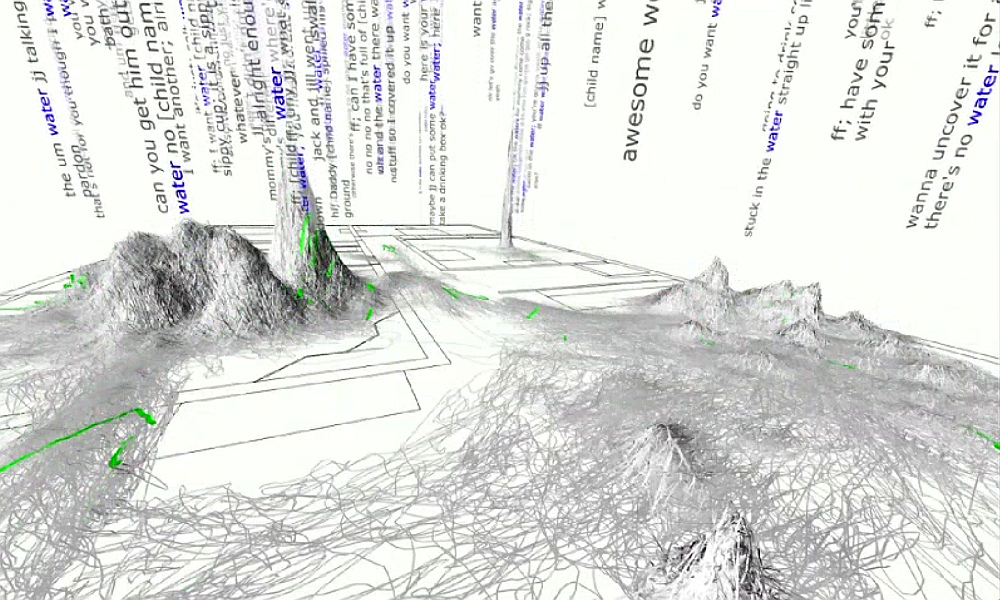
(Image: Big Data: water wordscape, Marius B, CC-BY)


01 Apr 23:00

The Internet should be treated as a utility: Susan Crawford

by Cory Doctorow


Susan Crawford (previously) is America's best commentator on network policy and network neutrality. In this interview with Ezra Klein, she makes the case for treating Internet access as a utility -- not necessarily a right, but something that markets do a bad job of supplying on their own. She describes how regulatory failures have made America into a global Internet laggard, with enormous damage to the nation's competitiveness and potential, and provides a compelling argument for locating the market for service in who gets to light up your fiber, not who gets to own it. Drawing on parallels to the national highway system and the electrification project, Crawford describes a way forward for America where the Internet is finally viewed as "an input into absolutely everything we do," and not merely as a glorified video-on-demand service.

Susan: The reason the internet is the most important development in my life is that you don't have to ask anybody for permission to start something new. You can launch something in your garage and it becomes an extraordinary thing like Facebook or Google.

What the FCC did is to try to simultaneously say, "here's some rules for the internet but we're not going to label internet access as a utility," and the DC Circuit just a month ago or so said, "You can't have it both ways. You can't both say the internet access is a luxury and have these rules about keeping this permissionless internet open."

That's why net neutrality — which is the idea that anybody can use the internet for whatever application or service they want to — is under such threat. It's because our regulator has given up its authority to say anything to the providers of high speed internet access and in that vacuum we got tremendous consolidation. Comcast is enormous company. It’s the largest media company by revenue in the world at this point. Comcast is essentially able to force Netflix to pay tribute in order to reach Netflix's subscribers.

That's possible because again our regulator has given up all oversight of these high speed internet access networks.

Ezra: If Comcast was sitting here, they would say, I think, that you began that answer by saying that the beauty of the internet is that any new company can come on to it but that, at the end of the answer, it was about Netflix, a massive incumbent who uses tremendous amounts of bandwidth. They would argue that in a limited bandwidth world, in order to keep space for the new entrants, they need to charge the incumbents taking up tremendous bandwidth. You don't think that is a reasonable response.

Susan: No, not at all actually. Right now they're charging Netflix. But Netflix got a very good price because it's so big — that’s the incumbency you mentioned. What about the next person? The next company that uses a lot of capacity could be a telemedicine service, could be distance education, they're also going to have to pay tribute to Comcast.

Comcast is making north of 95 percent profit on its provision of high-speed internet access services. Its capital expenditures as a percentage of its revenue are down to 14 percent. It's in harvesting mode. It's making tremendous amounts of money. It doesn't need to charge those companies that want to reach their subscribers, it's just can so that's what's going on.

Why the government should provide internet access


01 Apr 21:54

Rob Ford and Canada's neoliberal agenda

by Cory Doctorow


If you've shaken your head in wonder that Canadians -- gentle, sensible Canadians -- had elected a drug-addicted, violent, lying buffoon to run its largest city, this excellent account of the rise of the Canadian neoliberal right by historian Paul Cohen is required reading. Cohen draws on disparate threads from Preston Manning to Mike Harris and connects them to Stephen Harper, Rob Ford, and the rise of a nasty, ugly Made-in-Canada version of Thatcherism, Reaganism, and modern neoliberalism.

Once the Conservatives took the full measure of Ford’s electoral appeal in a city that has long been a Liberal party fortress, they happily plugged him into their long-term Ontario strategy. Here was a genuine, Canadian-grown Tea Party insurgency whose flames the Conservative party could fan and whose power its leaders thought they could harness. Though Ford bankrolled his campaign with loans from his family, the big Conservative donors who had supported his principal opponent switched horses, paying off Ford’s $600,000 in campaign debt.

Ford’s campaign manager went on to manage the Conservatives’ campaign in Ontario in the 2011 federal elections and today runs a political consulting firm with the president of the Ontario Conservative Party. Ford campaigned tirelessly on behalf of the Conservatives in 2011, contributing to an unexpectedly strong showing in the Toronto metro area. A grateful Harper invited Ford on a fishing trip at his summer residence and attended a barbecue at Ford’s mother’s home. Praising the Fords as a “great Conservative political dynasty” (a nod to Ford’s father and his brother Doug, who sits on city council), Harper compared how Ford “is cleaning up the NDP mess here in Toronto” (referring to Canada’s social democratic New Democratic Party) to the way he himself was fixing the “left-wing mess federally.” Conservative strategists saw in Ford the key to winning Ontario provincial elections and making inroads in Toronto in the 2015 federal elections. Ford had become a rising, well-connected Tory star with a seemingly bright future.

In retrospect, it’s nothing short of astonishing just how much dysfunction the Canadian right was willing to put up with in order to stand by its man in Toronto. Months after news emerged that a video of the mayor smoking crack might exist, Harper was still happy to engineer photo ops with Ford and publicly support the mayor’s reelection campaign. As recently as last October, a leading corporate lawyer and Conservative fundraiser reaffirmed his support for the embattled Ford, declaring that his “economic record is spectacular.” It was only when police confirmed the existence of the crack video that the same right-wing political formations, leaders, and media outlets who had jumped on Ford’s bandwagon and made him their political creature scrambled for the exits.

The Passion of Rob Ford, or the Neoliberal Making of Toronto’s Municipal Crisis [Paul Cohen/Dissent]

(via Mefi)

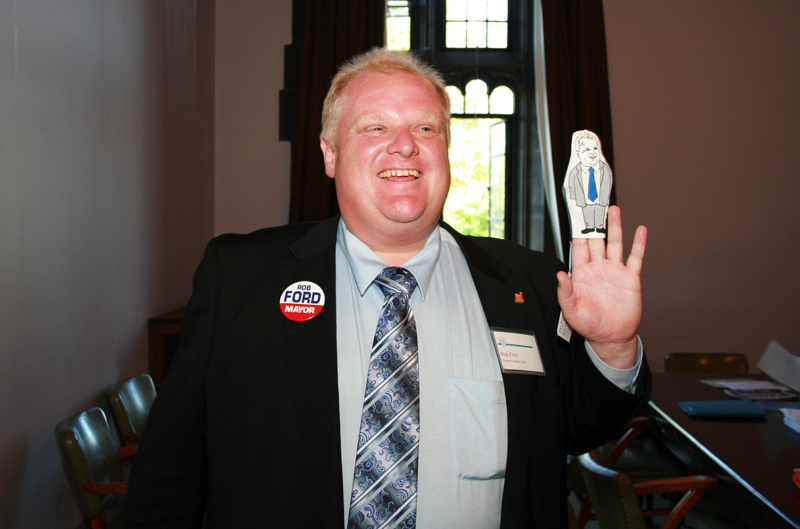
(Image: Rob Ford with puppet, Shaun Merritt, CC-BY)


01 Apr 18:59

FCC adds 100MHz of spectrum to the commons

by Cory Doctorow

The FCC has unanimously voted to open up 100MHz of spectrum at the bottom end of the 5GHz band, redesignating them as open spectrum, under rules similar to those that created the original Wifi boom. Previously, the spectrum had been exclusively allocated to a satellite telephony company. Adding more open spectrum is amazingly great news, and even better is the bipartisan support for the move, which was attended by very promising-sounding remarks from commissioners from both parties about the value of open spectrum as a source of innovation and public value.

The FCC vote opens those unlicensed airwaves so they can be used by consumer electronics equipment, including Wi-Fi routers. With the new airwaves, Wi-Fi equipment can handle more traffic at higher speeds.

“This items transforms the spectrum from virtually unusable to usable for Wi-Fi,” Wheeler said.

Commissioner Jessica Rosenworcel, who's a vocal advocate of opening up unlicensed airwaves to create opportunities for experimentation and innovation, pointed to unlicensed airwaves' economic benefit, which is already at $140 billion annually.

FCC votes to boost Wi-Fi [Kate Tummarello/The Hill]

(via /.)


01 Apr 16:52

Linkrot on The Million-Dollar Homepage

by Rob Beschizza
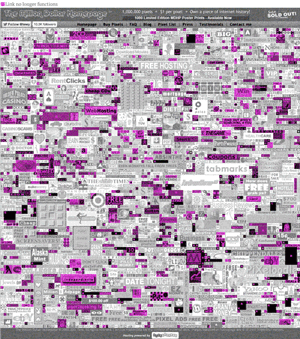
The Million Dollar Homepage was a lucrative advertising gimmick launched in 2005: one pixel cost one dollar. Nearly a decade on, 22 percent of the links on the homepage are dead, reports David Yanofsky. [via]

I bet a lot of the 'live' stuff is effectively dead, too: squatted, sold and repurposed domains. But that would be much harder to check for. Perhaps a "heat map" showing how many DNS changes the domain for each ad has undergone since 2005?

These non-functioning links account for 221,900 of the million pixels—$221,900 worth of real estate, assuming the pixels have kept their value in the last eight years.

The atrophy of links has been shown to stabilize over time, meaning we should expect fewer than 22% of links to break over the next eight years. The longer a link continues to work on a webpage, the longer it can been expected to work into the future.

Nonetheless, it remains a problem for thought experiments and seminal works alike. Researchers at Harvard found that at least 50% of URL-based legal citations in US Supreme Court opinions, for instance, no longer point to the originally referenced material.


01 Apr 16:43

HOPE X/EFF fundraiser

by Cory Doctorow
Emmanuel Goldstein from 2600 Magazine writes, "This summer's HOPE X conference is having a special EFF fundraiser for the entire month of April. Ten percent of every ticket sale will be donated to the Electronic Frontier Foundation as recognition of the essential work they're doing for the entire online community. In addition, there will be a huge EFF presence at the HOPE X conference, with multiple talks and presentations. HOPE X is being held July 18-20 at the Hotel Pennsylvania in New York City."


31 Mar 20:31

Podcast: Collective Action - the Magnificent Seven anti-troll business-model

by Cory Doctorow


Here's a reading (MP3) of a my November, 2013 Locus column, Collective Action, in which I propose an Internet-enabled "Magnificent Seven" business model for foiling corruption, especially copyright- and patent-trolling. In this model, victims of extortionists find each other on the Internet and pledge to divert a year's worth of "license fees" to a collective defense fund that will be used to invalidate a patent or prove that a controversial copyright has lapsed. The name comes from the classic film The Magnificent Seven (based, in turn, on Akira Kurosawa's Seven Samurai) in which villagers decide one year to take the money they'd normally give to the bandits, and turn it over to mercenaries who kill the bandits.

Why has Warner gotten away with its theft of ‘‘Happy Birthday’’ for so long? Because the interests of all the people who pay the license fee are diffused, and Warner’s interests are concentrated. For any one licensor, the rational course of action is paying Warner, rather than fighting in court. For Warner, the rational course is fighting in court, every time.

In this regard, Warner is in the same position as copyright and patent trolls: the interests of the troll are concentrated. Their optimal strategy is to fight back when pushed. But it’s the reverse for their victims: the best thing for them to do is to settle.

Collectively, though, the victims are always out more than the cost of a defense. That is, all the money made by a troll from a single stupid patent is much more than the cost of fighting to get the patent invalidated. All the money made by Warner on ‘‘Happy Birthday’’ dwarfs the expense of proving, in court, that they weren’t entitled to any of it.

The reason the victims don’t get together to fight back is that they don’t know each other and have no way to coordinate among each other. In economists’ jargon, they have a ‘‘collective action problem.’’

Mastering by John Taylor Williams: wryneckstudio@gmail.com

John Taylor Williams is a audiovisual and multimedia producer based in Washington, DC and the co-host of the Living Proof Brew Cast. Hear him wax poetic over a pint or two of beer by visiting livingproofbrewcast.com. In his free time he makes "Beer Jewelry" and "Odd Musical Furniture." He often "meditates while reading cookbooks."

MP3


31 Mar 17:33

Google Maps' spam problem presents genuine security issues

by Cory Doctorow


Bryan Seely, a Microsoft Engineer demonstrated an attack against Google Maps through which he was able to set up fake Secret Service offices in the company's geo-database, complete with fake phone numbers that rang a switch under his control and then were forwarded to real Secret Service offices, allowing him to intercept and record phone-calls made to the Secret Service (including one call from a police officer reporting counterfeit money). Seely was able to attack Google Maps by adding two ATMs to the database through its Google Places crowdsourcing tool, verifying them through a phone verification service (since discontinued by Google), then changing them into Secret Service offices. According to Seely, the disabling of the phone-verification service would not prevent him from conducting this attack again.

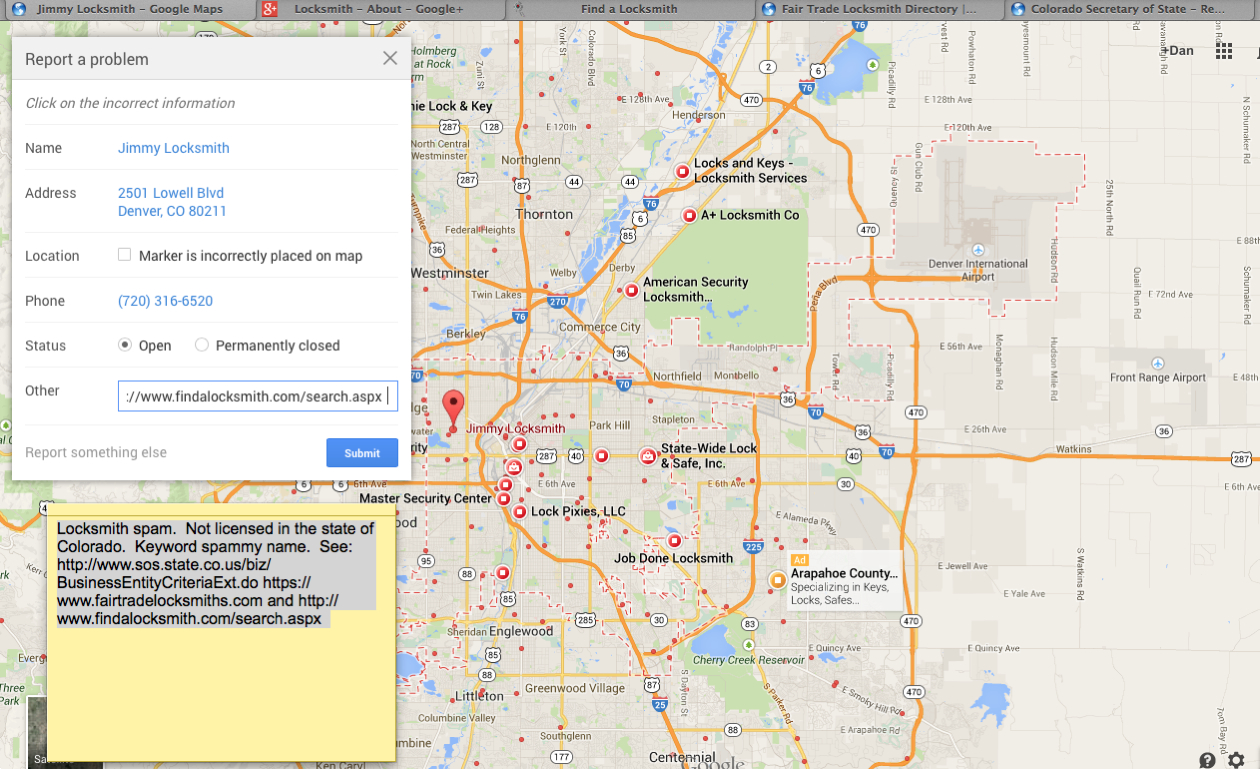
As Dune Lawrence points out, this is a higher-stakes version of a common spam-attack on Google Maps practiced by locksmith, carpet cleaning, and home repair services. Spammers flood Google Maps with listing for fake "local" companies offering these services, and rake in high commissions when you call to get service, dispatching actual local tradespeople who often charge more than you were quoted (I fell victim to this once, when I had a key break off in the lock of my old office-door in London and called what appeared to be a "local" locksmith, only to reach a call-center who dispatched a locksmith who took two hours to arrive and charged a huge premium over what I later learned by local locksmiths would have charged).

A detailed post by Dan Austin describes this problem, points out that Google is more than four years late in delivering promised fixes to the problem, and offers solutions of his own. He suggests that the high Google Adwords revenue from spammy locksmiths and other services is responsible for the slow response to the problem.

All of this ends up costing real local businesses their business, he says. Search for “locksmith in Denver, CO” in Google Maps, and you get more than 600 results. Virtually none of them, Austin says, are for licensed local locksmiths. Instead, your search for someone to get you back into your car in Denver pulls up numbers for a fake local business. Your call gets routed to a center somewhere far away, someone who’s not necessarily a licensed locksmith gets sent to help you, and charges you far above what you were quoted over the phone.

Austin says that Google’s inaction stems from the fact that the company is actually making money off the scammers through sales on Google AdWords for search terms such as “locksmith.”

“Google’s basically getting a not insignificant amount of their income from scammers—if you look at locksmiths, 99 percent of them are scammers,” says Austin. “It’s an investment of time and energy and resources to actually go through and verify all the legitimate locksmiths in the U.S. Google doesn’t really want to get into it—they don’t see it as a security issue.”

How Scammers Turn Google Maps Into Fantasy Land [Dune Lawrence/Business Week]

(via Hacker News)