Think about this when men tell you that they know what women are really like.
A substantial body of literature suggests that women change what they eat when they eat with men. Specifically, women opt for smaller amounts and lower-calorie foods associated with femininity. So, some scholars argue that women change what they eat to appear more feminine when dining with male companions.
For my senior thesis, I explored whether women change the way they eat alongside what they eat when dining with a male vs. female companion. To examine this phenomenon, I conducted 42 hours of non-participant observation in two four-star American restaurants in a large west coast city in the United States. I observed the eating behaviors of 76 Euro-American women (37 dining with a male companion and 39 dining with a female companion) aged approximately 18 to 40 to identify differences in their eating behaviors.
I found that women did change the way they ate depending on the gender of their dining companion. Overall, when dining with a male companion, women typically constructed their bites carefully, took small bites, ate slowly, used their napkins precisely and frequently, and maintained good posture and limited body movement throughout their meals. In contrast, women dining with a female companion generally constructed their bites more haphazardly, took larger bites, used their napkins more loosely and sparingly, and moved their bodies more throughout their meals. The unbearable daintiness of women who eat with men
On the size of bites, here’s an excerpt from my field notes:
Though her plate is filled, each bite she labors onto her fork barely fills the utensil. Perhaps she’s getting full because each bite seems smaller than the last… and still she’s taking tiny bites. Somehow she has made a single vegetable last for more than five bites.
I also observed many women who were about to take a large bite but stopped themselves. Another excerpt:
She spreads a cracker generously and brings it to her mouth. Then she pauses for a moment as though she’s sizing up the cracker to decide if she can manage it in one bite. After thinking for a minute, she bites off half and gently places the rest of the cracker back down on her individual plate.
Stopping to reconstruct large bites into smaller ones is a feminine eating behavior that implies a conscious monitoring of bite size. It indicates that women may deliberately change their behavior to appear more feminine.
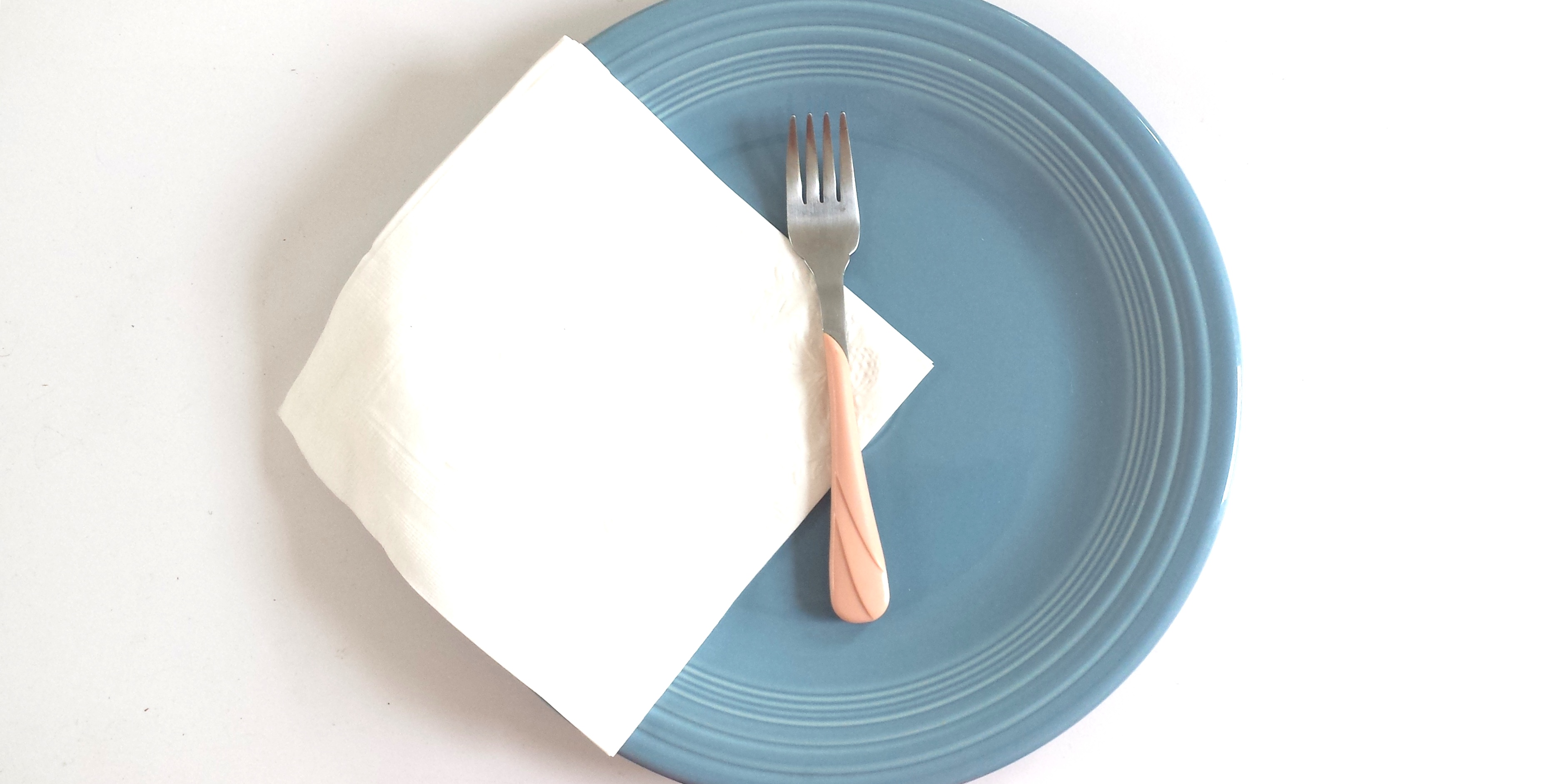
I also observed changes in the ways women used their napkins when dining with a male vs. female companion. When their companion was a man, women used their napkins more precisely and frequently than when their companion was another woman. In some cases, the woman would fold her napkin into fourths before using it so that she could press the straight edge of the napkin to the corners of her mouth. Other times, the woman would wrap the napkin around her finger to create a point, then dab it across her mouth or use the point to press into the corners of her mouth. Women who used their napkins precisely also tended to use them quite frequently:
Using her napkin to dab the edges of her mouth – finger in it to make a tiny point, she is using her napkin constantly… using the point of the napkin to specifically dab each corner of her mouth. She is using the napkin again even though she has not taken a single bite since the last time she used it… using napkin after literally every bite as if she is constantly scared she has food on her mouth. Using and refolding her napkin every two minutes, always dabbing the corners of her mouth lightly.
In contrast, women dining with a female companion generally used their napkins more loosely and sparingly. These women did not carefully designate a specific area of the napkin to use, and instead bunched up a portion of it in one hand and rubbed the napkin across their mouths indiscriminately.
Each of the behaviors observed more frequently among women dining with a male companion versus a female one was stereotypically feminine. Many of the behaviors that emerged as significant among women dining with a female companion, on the other hand, are considered non-feminine, i.e. behaviors that women are instructed to avoid. Behavioral differences between the two groups of women suggest two things. First, women eat in a manner more consistent with normative femininity when in the presence of a male versus a female companion. And, second, gender is something that people perform when cued to do so, not necessarily something people internalize and express all the time.
Kate Handley graduated from Occidental College this month. This post is based on her senior thesis. After gaining some experience in the tech industry, she hopes to pursue a PhD in Sociology.
Dante Servin, the Chicago police detective who was off-duty on the
March 2012 night that he shot and killed 22-year-old Rekia Boyd with an unregistered firearm,
was cleared on Monday of all charges. Servin fired over his shoulder,
from his car, with a 9mm semi-automatic, into an alley where Boyd and
her friends were walking, unarmed, with their backs turned to him. He
hit Boyd in the back of her head and killed her.
Servin maintains—and the judge ruled—that he was justified: that Boyd’s boyfriend Antonio Cross raised a cell phone that
seemed, at the time, to be a gun. Servin has insisted that he did this
out of fear, and “felt threatened” after telling Boyd and her three
friends to quiet down.
In the
video taken after he left the courtroom, Servin, without making eye
contact with the camera, goes on some absolutely chilling shit: “Any
police officer especially would have reacted in the exact same way I
reacted,” he says. “I’m glad to be alive. I saved my life that night.”
Rekia
Boyd’s mother, giving her statement, disagrees: “They just found this
man not guilty on all counts, and he blew my daughter’s brains out in
the alley,” she says.
I want one of those scenes in a dude bro film where “tomboy” chick has to wear a dress to go undercover or whatever, but instead of the guys drooling as she walks down the stairs, they’re like “k. U need to stop. Go put the cargo pants back on. You look super uncomfortable and awkward in that. Brutus, you go be the fake prostitute.”
I’m just imagining this super ripped guy called Brutus being like ‘YESSS!!! I’VE ALWAYS WANTED TO BE THE FAKE PROSTITUTE!! Now is my time to shine!!’
“Poverty is not simply having no money — it is isolation, vulnerability, humiliation and mistrust. It is not being able to differentiate between employers and exploiters and abusers. It is contempt for the simplistic illusion of meritocracy — the idea that what we get is what we work for. It is knowing that your mother, with her arthritic joints and her maddening insomnia and her post-traumatic stress disordered heart, goes to work until two in the morning waiting tables for less than minimum wage, or pushes a janitor’s cart and cleans the shit-filled toilets of polished professionals. It is entering a room full of people and seeing not only individual people, but violent systems and stark divisions. It is the violence of untreated mental illness exacerbated by the fact that reality, from some vantage points, really does resemble a psychotic nightmare. It is the violence of abuse and assault which is ignored or minimized by police officers, social services, and courts of law. Poverty is conflict. And for poor kids lucky enough to have the chance to “move up,” it is the conflict between remaining oppressed or collaborating with the oppressor.”
“A family on a healthy diet can expect to pay $2,000 more a year for food than one having less nutritious meals, say researchers who recommend that the cost gap be closed. The research in Thursday’s issue of British Medical Journal Open reviewed 27 studies from 10 high-income countries to evaluate the price differences of foods and diet patterns.”
Let the record reflect the conclusive result of empirical research spanning 27 studies from 10 countries: healthy eating is fucking expensive and people who deny this reality are annoying and full of shit.
There’s a game called “Rust” in which you play a character in a wilderness. When it first came out, everyone was assigned the same avatar: a white dude. As we all know, “white dude” is the default everywhere, so no one complained.
Then, in an upgrade, they added other avatar options: different faces, different skin color. As an interesting experiment, these options were not under player control: they were randomly assigned. White dudes logging in suddenly found that their avatar might be a black dude (still a dude, at least; female avatars aren’t yet available).
If the skin color is forced on you, you won’t like it…OK, where were you when everyone was forced to play a white dude?
Not trying to be racist, it just comes naturally to you, I guess.
You don’t want to “take the chance of playing a black character.” Why? What would happen to you in the game? This is an entirely cosmetic feature, you know.
But please, self-awareness! Turn it around. Racism must be a big deal if the devs are MAKING PEOPLE PLAY AS WHITE CHARACTERS.
Here’s a lovely summary of what’s going on in this situation.
Why is it that the supposed lack of choice with regards to the player’s avatar only became a concern after people of color were added to the game? The reactions reflect a failure on the part of some gamers to recognize that whiteness is a race at all. These players appear to think of whiteness as a neutral type of embodiment, the universal category of humanity against which all those who do “have” a race (anyone who is not white) are compared. The backlash also confirms a theory posited by new media scholar Lisa Nakamura that, on the Internet, there is a tendency to assume that, in the absence of direct statements to the contrary, the people that we meet are white. Indeed, as Nakamura writes in “Digitizing Race: Visual Cultures of the Internet”:
Until lately, the structure of the Internet has been such that it has greatly facilitated covering [or passing]; early utopians especially lauded and adored the Internet’s ability to hide or anonymize race as its best and most socially valuable feature. The Internet was just as much a machine for not-seeing as it was a machine of vision, at least in terms of race and gender identity.
In other words, by reintroducing the visualization of difference into the virtual world, Rust is making gamers question their racialized assumptions about the people they are interacting with online.
Making people question their assumptions…it’s like skepticism and critical thinking and all those good things science-minded people like to promote! I guess the problem is that white people must not be science-minded.
Oh, that’s not fair. We’re looking at a subset of white people in this example. Maybe it’s just gamers who are stupid.
but what if a vampire drank the blood of someone who was anemic like would they be seriously grossed out
“what the fuck is this”
“i have anemia”
“can you take something for that you should probably take something for that this shit is nasty to drink let alone have running through your body i’m setting up a doctor’s appointment for you”
“dude really you don’t have to just leave what the fu—”
“you disgust me here take these iron supplements”
“where did you even get th—”
“shut up and take your pills and dont forget your vitamin D”
“i’m going to check up on you weekly to make sure you’re taking them”
“that’s not necessary”
“maybe we should work on a dietary plan with foods rich in iron and other things for you”
“do you get this involved with all of your meals”
VAMPIREDUDE: did u get the cookbook i orderd 4 u
ME: Oh my god, first of all stop using text speak, you told me you were 278, second how did you know where I LIVED, third yes I got it.
VAMPIREDUDE: heard onions were good 4 blood, eat lots
ME: So you can have a tasty meal? I guess you’d rather I stay away from garlic, huh.
VAMPIREDUDE: UR being v rude I just got u a present!!!
ME: THE COOKBOOK IS CALLED “HOW TO TASTE DELICIOUS,” I AM CALLING THE COPS
“support the troops” =/= “support the US foreign policy and bullshit military decisions”
you should absolutely support the soldiers and veterans who are suffering from mental illness like PTSD and depression, have committed suicide, suffering disabilities received from combat, addictions and unemployment and were ultimately let down by their government
you dont have to support the war or our military involvements, but why wouldn’t you support those who are doing the job you aren’t and are ultimately being fucked over for it left and right
honestly lets just cut through all the academia and circular conversations and just get to the bottom line: the idea that bi people have it easier is quantifiably untrue. bi people have higher rates of rape, abuse, poverty and mental illness than straight and lg people. whether straight passing privilege does or does not make logical sense is irrelevant. what matters is how things play out in real life, and in real life, bi people do not have privilege over lg people. it is literally that simple.
I had such fun drawing all the carnage in my last comic I decided to do it all again, but this time with magic instead of a mattock.
Btw, I too have been searching for the Mirror of Mind-Freeing for many years. Currently I’m cursed with an insatiable love of art and illustration. I’m hoping the mirror can show me that I’m really a stock broker, or maybe a dentist. I hear both those pay pretty well. :)
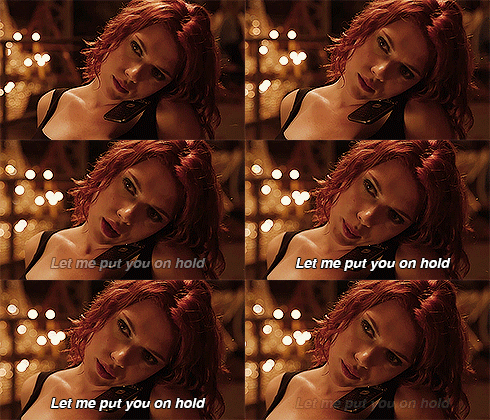
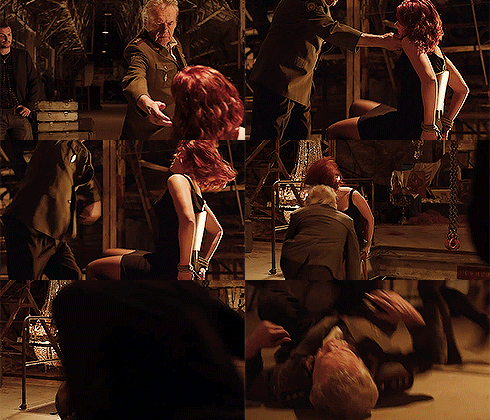
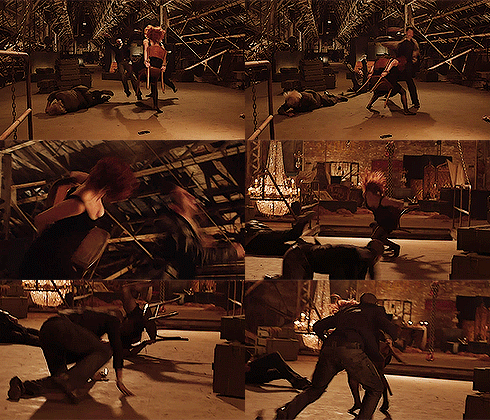
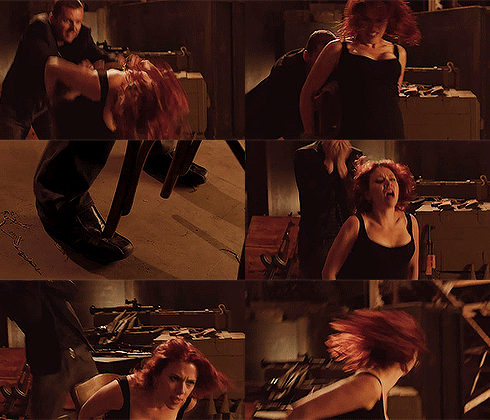
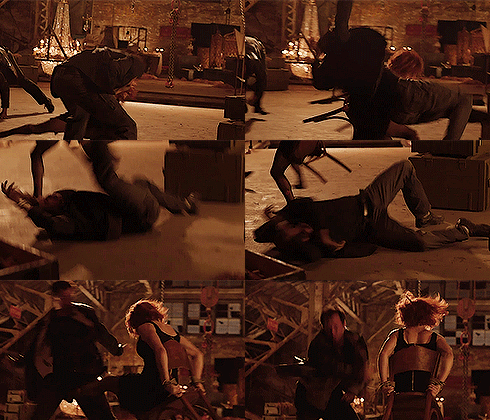
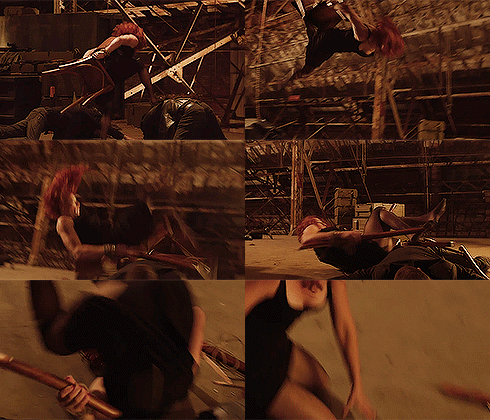
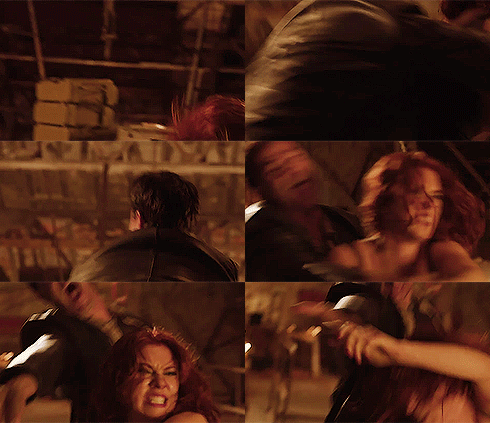
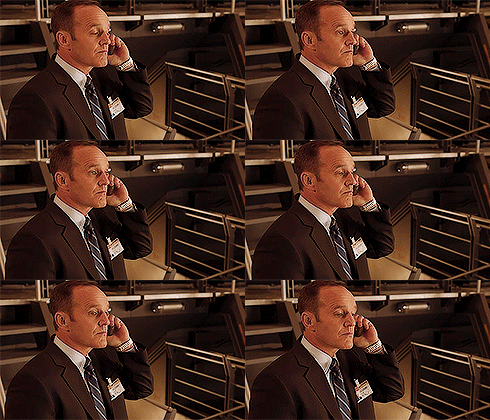
My favorite part is how Phil’s not even slightly concerned. Not even a tiny bit tense. He’s just bopping there, waiting until she’s done. The sound of breaking bones is Natasha’s hold music.
The sound of breaking bones is Natasha’s hold music.
out of all the aspects of millennial-bashing, i think the one that most confuses me is the “millennials all got trophies as a kid, so now they’re all self-centered narcissists” theory
like— kids are pretty smart, y’all. they can see that every kid on the team gets a trophy and is told they did a good job; they can also see that not every kid on the team deserves a trophy, and not everyone did do a good job
the logical conclusion to draw from this is not “i’m great and i deserve praise”— it’s “no matter how mediocre i am, people will still praise me to make me feel better, so i can’t trust any compliments or accolades i receive”
this is not a recipe for overconfidence and narcissism. it is a recipe for constant self-guessing, low self-esteem, and a distrust of one’s own abilities and skills.
where did this whole “ugh millennials think their so-so work is super great” thing even come from it is a goddamn mystery
what fucking kills me is, yeah, maybe we got the trophies, but who gave them out
this is not a recipe for overconfidence and narcissism. it is a recipe for constant self-guessing, low self-esteem, and a distrust of one’s own abilities and skills.
It’s also what I observed happening as a singing teacher: the older kids literally would not believe a positive word I said until I had proved I would tell them they screwed up/had done badly/etc. I did so in as useful a way as possible (“So this passage. We really need to work on this passage. A lot. This passage is not good yet.”), but with almost every adolescent I taught I had to prove I would give them straight-up criticism before they would parse my praise as anything other than meaningless “the grownups always do this” noise.
This is literally a huge chunk of what is wrong with me. By the time I reached high school, I assumed all praise was fake–made up to spare my feeling. Even today, I struggle with accepting compliments or feeling proud of my work.
"It’s hard to imagine asking victims of violent crimes what they could have done to prevent what happened to them." ~Unless the violent crime is domestic abuse. Then it's really easy.
This year’s jury consisted of Justin Gerard, Virginie Ropars, Greg Ruth, Annie Stegg Gerard, and Dice Tsutsumi, and determined Silver and Gold recipients in eight categories. The Spectrum Advisory Board also selected the 2015 Grand Master Honoree.
Please join us in congratulating all of the finalists and recipients!
Advertising
GOLD: Taylor Wessling—Barbarians: Faust SILVER: Yuko Shimizu—Tokyo Night Show
Runners-up:
Johnny Dombrowski—Murder on the Orient Express
Edward Kinsella III—Vernacchio
Victo Ngai—The Cloisters
Book
GOLD: Dan dos Santos—Taking Flight SILVER: Scott Gustafson—Jack and the Sleeping Giant
Runners-up:
Jeffrey Alan Love—Radiant State
Petar Meseldžija—The Giants are Coming
Sam Weber—cover for Dune by Frank Herbert
Comics
GOLD: Audrey Benjaminsen—Bernadette, page 1 SILVER: Alex Alice—Castle in the Stars
Oh, good. The Old Reader has found the WEIRD part of the internet.
During the 1970s, the Scarfolk Education Publishing company produced packs of cards which taught children about society and its expectations. In particular, the cards focused on eradicating any false notions that children may have picked up from prohibited books, unauthorised wise people and illegal time immigrants (a flood of which materialised in 1979 to stockpile cake following a devastating pudding famine in the future).
In addition to the 1979 'Unlearn Privacy' pack, examples from which can be seen below, other series included 'Unlearn Altrusim', 'Unlearn Democracy' and 'Unlearn Contentment'.
The aforementioned time immigrants claimed that, by the year 2017, surveillance and the invasion of privacy become so ubiquitous that citizens' brains are connected to a central network. No thought, conscious or otherwise, is permitted expression unless it has been approved by a state computer programme nicknamed 'Brain O'Brien'. However, a backlog quickly accumulates, and many people go without a thought of their own for months, if not years at a time.
Fortunately, the government predicted such an emergency and prepared in advance a series of standardised thoughts, ideas and opinions which it inputs directly into citizens' minds. No doubt it is this considerate civic gesture which leads to the overwhelming majority vote for the incumbent party in many subsequent elections.
The bonus card above comes from an earlier pack, 'Unlearn Compassion', which was published in 1971.
I have yet to meet a woman in a relationship with another woman who hasn’t encountered a guy suggesting a threesome. Hey dude, what’s up with taking the one of the only possible configurations of sex and intimacy that doesn’t involve you as a demographic, and then just mentally shoving yourself in the middle of it?
I wish we could have pet dinosaurs, I bet they’d be smart and like birds or something. Big fluffy ones you could feed with snake mice and stuff. Jurassic Park could’ve been huge if they bred big cute fluffy dinosaurs. You could take them on walks! Teach them things! They’d probably sound like slowed-down birds! Adorable!!
Realistically they probably would hate you and rip you apart but… imagine

 A substantial body of literature suggests that women change what they eat when they eat with men. Specifically, women opt for smaller amounts and lower-calorie foods associated with femininity. So, some scholars argue that women change what they eat to appear more feminine when dining with male companions.