
Shared posts
02 Feb 18:28
Filed under: Columns, Congress, Constitutional Law, Politics, Society, Supreme Court


HOW TO [REALLY] CHANGE THE SUPREME COURT: THREE REFORMS THAT COULD MAKE FOR A BIGGER AND BETTER COURT
by jonathanturley
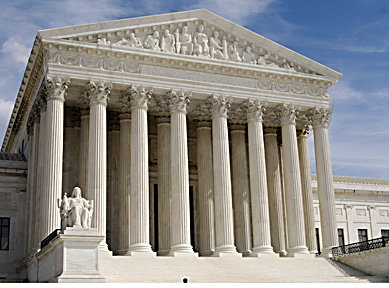
I recently published a column in the Los Angeles Times on reforming the Supreme Court with three fundamental changes that could be accomplished without a constitutional amendment. Below is a longer version of that column on the three reforms and their implications.
Donald Trump ran on the promise to “reinvent” government with new approaches and ideas. One of the institutions that Trump focused on the most was the United States Supreme Court and the selection of the replacement of Associate Justice Antonin Scalia. Yet, the addition of Judge Neil Gorsuch to the Court is unlikely to move the center of gravity of the Court. Indeed, even with the three justices who will be in their 80s during Trump’s first term, any change in legal doctrine is likely to be incremental. However, if Trump wanted to truly transform the Court, he should look beyond mere changes in personnel and address long-standing deficiencies of the Court. Here are three reforms that would greatly improve the Court as an institution and secure a lasting and worthy legacy for the 45th President of the United States.
EXPAND THE COURT
I have long argued for the expansion of the Supreme Court. For the first time, with both houses in the control of one party as well as the White House, this badly needed reform could be accomplished.
Our Court is demonstrably and dysfunctionally too small. The size of the Court is not established in the Constitution and it has been different sizes throughout history. When it first convened in the Royal Exchange Building in 1790, only two of six members showed up. It has been larger and smaller than its current complement of nine members. That number was largely accidental. The Court used to change with the number of circuits and in 1869 that number was 9. That’s it. We really never had a national debate on the ideal size of this key institution.
Ever since we moved to a nine-member court, we have had the problem of the single swing justice – a court of one. For years, the Court was effectively Sandra Day O’Conner on major questions like abortion or affirmative action or criminal justice. Now Anthony Kennedy plays that swing role.
Years ago, I recommended the expansion of the Court to 19 members – an increase that would occur incrementally with no president filling more than two new positions per term. That would bring the size of our court in line with the top courts of other countries. Those countries specifically adopted larger courts to avoid the concentration of power that we have in this country where one or two jurists can dictate sweeping changes. Germany has 16 members, Japan 15, the United Kingdom 12, India 31, and Israel 15. Spain has 74 while France counts 124.
Under my proposal, two justices each year would also return to the prior tradition of sitting on lower courts – a tradition that I believe was unwisely abandoned and has produced a Court seen as out of touch and at times arrogant. That would leave a voting court of 17 members (about the size of our circuit courts when they sit as a whole or en banc). There would be greater turn over for presidents and more importantly a broader expression of views. It would also reduce the recurring confirmation spasms. While it may seem counterintuitive, these positions are so few and thus so important that we tend to pick people who are not outstanding in their views or writings. Indeed, presidents look for nominees who have never uttered an interesting thought to avoid confirmation hearing problems. Our Court is too small and our justices are too powerful. It is time to expand the Court
CAMERAS IN THE COURTROOM
The Framers were such great believers in the need for justice to be done in public that they put it into the Constitution. The Sixth Amendment guarantees of public trials and the Supreme Court has noted that “[b]y immemorial usage, wherever the common law prevails, all trials are in open court, to which spectators are admitted.” Of course, when it comes to its own transparency, the Court is steadfastly in the dark. Justices have vigorously opposed cameras for years, even threatening to resign over the reform. The decision of Congress in response should be easy: order the inclusion of cameras and then thank the retiring justices for their service.
The Framers would have loved the concept of televised hearings. These were men who were fascinating by technology and new ideas. A simple technology that would allow any citizen to watch arguments would have been a no brainer for most Framers who heavily favored public trials. Instead, the Court makes people wait in line (some individuals even hiring line “sitters”) for days to get a relatively small number of seats in the courtroom. It is a ridiculous exercise that is played out every session of the Court, but Congress has not stepped in to end the lunacy.
When Congress moved to order cameras in 1999, the Court started to release audiotapes at selective arguments. It simply made the situation more bizarre. There is a technology to allow citizens to not just hear but see every argument, but the Court continues to act like supreme troglodytes. Notably, the objection some Justices have made is not the fear of grandstanding by lawyers but by their colleagues. In 2007, Justice Anthony Kennedy objected that “[i]f you introduce cameras, it is human nature for me to suspect that one of my colleagues is saying something for a soundbite.” Denying the public the right to see the hearing of their highest court to protect justices from temptation is not a particularly compelling argument. Congress should waste no time and bring this facially absurd debate to an end. Congress needs to order the access of C-Span coverage of every argument before the Court.
ETHICS ON THE COURT
The Supreme Court is not just an island protected from modern technology but an island protected from judicial ethics. Both are by design of the justices themselves. In a self-serving interpretation, justices have long insisted that, since no lower jurist can possibly judge their conduct, they cannot be subject to judicial ethics like all other judges. It is an interpretation at odds with the highest courts of other countries. It is also at odds with common sense.
The Justices insists that they can only be their own judges and that they have voluntarily agreed to “refer” to the Code of Judicial Conduct for guidance. Often it appears that the justices honor the code primarily in the breach. Justices routinely appear in public speeches where they have discussed pending issues and cases. Justices have attended political fundraisers and have ruled in cases where they or their spouses have financial interests.
Congress should require the adoption of a formal code of ethics, including a process by which citizens can file complaints against justices. For those justices who insist on remaining their own judges of conduct, they have the same option as camera-phobic jurists: they can retire. In Federalist 10, James Madison observed that “No man is allowed to be a judge in his own cause.” However, there are nine such people who demand precisely that unilateral power when it comes their own ethics.
Despite our collective respect for the Supreme Court, it should not blind us to its flaws. These three reforms would transform the Court into a more diverse and dynamic institution. If Trump truly wants to think “bigly,” he should give us a bigger and better court.
Jonathan Turley is the Shapiro Professor of Public Interest Law at George Washington University where he teaches a course on the Constitution and the Supreme Court.
Filed under: Columns, Congress, Constitutional Law, Politics, Society, Supreme Court
31 Jan 19:24


Secret Docs Reveal: President Trump Has Inherited an FBI With Vast Hidden Powers
by Glenn Greenwald
TimB"One of the documents contains an alarming observation about the nation’s police forces, even as perceived by the FBI. Officials of the bureau were so concerned that many of these police forces are linked to, at times even populated by, overt white nationalists and white supremacists, that they have deemed it necessary to take that into account in crafting policies for sharing information with them."
In the wake of President Donald Trump’s inauguration, the FBI assumes an importance and influence it has not wielded since J. Edgar Hoover’s death in 1972. That is what makes today’s batch of stories from The Intercept, The FBI’s Secret Rules, based on a trove of long-sought confidential FBI documents, so critical: It shines a bright light on the vast powers of this law enforcement agency, particularly when it comes to its ability to monitor dissent and carry out a domestic war on terror, at the beginning of an era highly likely to be marked by vociferous protest and reactionary state repression.
In order to understand how the FBI makes decisions about matters such as infiltrating religious or political organizations, civil liberties advocates have sued the government for access to crucial FBI manuals — but thanks to a federal judiciary highly subservient to government interests, those attempts have been largely unsuccessful. Because their disclosure is squarely in the public interest, The Intercept is publishing this series of reports along with annotated versions of the documents we obtained.
Trump values loyalty to himself above all other traits, so it is surely not lost on him that few entities were as devoted to his victory, or played as critical a role in helping to achieve it, as the FBI. One of the more unusual aspects of the 2016 election, perhaps the one that will prove to be most consequential, was the covert political war waged between the CIA and FBI. While the top echelon of the CIA community was vehemently pro-Clinton, certain factions within the FBI were aggressively supportive of Trump. Hillary Clinton herself blames James Comey and his election-week letter for her defeat. Elements within the powerful New York field office were furious that Comey refused to indict Clinton, and embittered agents reportedly shoveled anti-Clinton leaks to Rudy Giuliani. The FBI’s 35,000 employees across the country are therefore likely to be protected and empowered. Trump’s decision to retain Comey — while jettisoning all other top government officials — suggests that this has already begun to happen.
When married to Trump’s clear disdain for domestic dissent — he venerates strongman authoritarians, called for a crackdown on free press protections, and suggested citizenship-stripping for flag-burning — the authorities vested in the FBI with regard to domestic political activism are among the most menacing threats Americans face. Trump is also poised to expand the powers of law enforcement to surveil populations deemed suspicious and deny their rights in the name of fighting terrorism, as he has already done with his odious restrictions on immigration from seven Muslim-majority countries. Understanding how the federal government’s law enforcement agency interprets the legal limits on its own powers is, in this context, more essential than ever. Until now, however, the rules governing the FBI have largely been kept secret.

Donald Trump enters the stage at the Republican National Convention on July 18, 2016, in Cleveland, Ohio.
Photo: Alex Wong/Getty Images
Today’s publication is the result of months of investigation by our staff, and we planned to publish these articles and documents regardless of the outcome of the 2016 election. The public has an interest in understanding the FBI’s practices no matter who occupies the White House. But in the wake of Trump’s victory, and the unique circumstances that follow from it, these revelations take on even more urgency.
After Congress’s 1976 Church Committee investigated the excesses of Hoover’s FBI, in particular the infamous COINTELPRO program — in which agents targeted and subverted any political groups the government deemed threatening, including anti-war protesters, black nationalists, and civil rights activists — a series of reforms were enacted to rein in the FBI’s domestic powers. As The Intercept and other news outlets have amply documented, in the guise of the war on terror the FBI has engaged in a variety of tactics that are redolent of the COINTELPRO abuses — including, for example, repeatedly enticing innocent Muslims into fake terror schemes concocted by the bureau’s own informants. What The Intercept’s reporting on this new trove of documents shows is how the FBI has quietly transformed the system of rules and restraints put in place after the scandals of the ’70s, opening the door for a new wave of civil liberties violations. When asked to respond to this critique, the FBI provided the following statement:
All FBI policies are written to ensure that the FBI consistently and appropriately applies the lawful tools we use to assess and investigate criminal and national security threats to our nation. All of our authorities and techniques are founded in the Constitution, U.S. law, and Attorney General Guidelines. FBI policies and rules are audited and enforced through a rigorous internal compliance mechanism, as well as robust oversight from the Inspector General and Congress. FBI assessments and investigations are subject to responsible review and are designed to protect the rights of all Americans and the safety of our agents and sources, acting within the bounds of the Constitution.
Absent these documents and the facts of how the bureau actually operates, this may sound reassuring. But to judge how well the bureau is living up to these abstract commitments, it is necessary to read the fine print of its byzantine rules and regulations — which the FBI’s secrecy has heretofore made it impossible for outsiders to do. Now, thanks to our access to these documents — which include the FBI’s governing rulebook, known as the DIOG, and classified policy guides for counterterrorism cases and handling confidential informants — The Intercept is able to share a vital glimpse of how the FBI understands and wields its enormous power.
For example, the bureau’s agents can decide that a campus organization is not “legitimate” and therefore not entitled to robust protections for free speech; dig for derogatory information on potential informants without any basis for believing they are implicated in unlawful activity; use a person’s immigration status to pressure them to collaborate and then help deport them when they are no longer useful; conduct invasive “assessments” without any reason for suspecting the targets of wrongdoing; demand that companies provide the bureau with personal data about their users in broadly worded national security letters without actual legal authority to do so; fan out across the internet along with a vast army of informants, infiltrating countless online chat rooms; peer through the walls of private homes; and more. The FBI offered various justifications of these tactics to our reporters. But the documents and our reporting on them ultimately reveal a bureaucracy in dire need of greater transparency and accountability.
One of the documents contains an alarming observation about the nation’s police forces, even as perceived by the FBI. Officials of the bureau were so concerned that many of these police forces are linked to, at times even populated by, overt white nationalists and white supremacists, that they have deemed it necessary to take that into account in crafting policies for sharing information with them. This news arrives in an ominous context, as the nation’s law enforcement agencies are among the few institutional factions in the U.S. that supported Trump, and they did so with virtual unanimity. Trump ran on a platform of unleashing an already out-of-control police — “I will restore law and order to our country,” he thundered when accepting the Republican nomination — and now the groups most loyal to Trump are those that possess a state monopoly over the use of force, many of which are infused with racial animus.
The Church Committee reforms were publicly debated and democratically enacted, based on the widespread fears of sustained FBI overreach brought to light by aggressive reporters like Seymour Hersh. It is simply inexcusable to erode those protections in the dark, with no democratic debate.
As we enter the Trump era, with a nominated attorney general who has not hidden his contempt for press freedoms and a president who has made the news media the primary target of his vitriol, one of the most vital weapons for safeguarding basic liberties and imposing indispensable transparency is journalism that exposes information the government wants to keep suppressed. For exactly that reason, it is certain to be under even more concerted assault than it has been during the last 15 years. The revealing, once-secret FBI documents The Intercept is today reporting on, and publishing, demonstrate why protecting press freedom is more critical than ever.
READ OUR INVESTIGATION ON THE FBI’S SECRET RULES.
The post Secret Docs Reveal: President Trump Has Inherited an FBI With Vast Hidden Powers appeared first on The Intercept.
25 Jan 17:54


Get Ready for the First Shocks of Trump’s Disaster Capitalism
by Roger Hodge
We already know that the Trump administration plans to deregulate markets, wage all-out war on “radical Islamic terrorism,” trash climate science and unleash a fossil-fuel frenzy. It’s a vision that can be counted on to generate a tsunami of crises and shocks: economic shocks, as market bubbles burst; security shocks, as blowback from foreign belligerence comes home; weather shocks, as our climate is further destabilized; and industrial shocks, as oil pipelines spill and rigs collapse, which they tend to do, especially when enjoying light-touch regulation.
All this is dangerous enough. What’s even worse is the way the Trump administration can be counted on to exploit these shocks politically and economically.
Naomi Klein explains how the Trump administration might take advantage of coming crises to Jeremy Scahill at the Women’s March, Jan. 21, 2017.
Speculation is unnecessary. All that’s required is a little knowledge of recent history. Ten years ago, I published “The Shock Doctrine,” a history of the ways in which crises have been systematically exploited over the last half century to further a radical pro-corporate agenda. The book begins and ends with the response to Hurricane Katrina, because it stands as such a harrowing blueprint for disaster capitalism.
That’s relevant because of the central, if little-recalled role played by the man who is now the U.S. vice president, Mike Pence. At the time Katrina hit New Orleans, Pence was chairman of the powerful and highly ideological Republican Study Committee. On September 13, 2005 — just 14 days after the levees were breached and with parts of New Orleans still underwater — the RSC convened a fateful meeting at the offices of the Heritage Foundation in Washington, D.C.
Under Pence’s leadership, the group came up with a list of “Pro-Free-Market Ideas for Responding to Hurricane Katrina and High Gas Prices” — 32 policies in all, each one straight out of the disaster capitalism playbook.

Vehicles form a line at an Exxon gas station off of Interstate 55 in Jackson, Miss., Aug. 30, 2005. The station was one of the few in the city with both power and gas one day after Hurricane Katrina made landfall.
Photo: Rick Guy/The Calrion Ledger/AP
To get a sense of how the Trump administration will respond to its first crises, it’s worth reading the list in full (and noting Pence’s name right at the bottom).
What stands out in the package of pseudo “relief” policies is the commitment to wage all-out war on labor standards and on the public sphere — which is ironic because the failure of public infrastructure is what turned Katrina into a human catastrophe. Also notable is the determination to use any opportunity to strengthen the hand of the oil and gas industry.
The first three items on the RSC list are “automatically suspend Davis-Bacon prevailing wage laws in disaster areas,” a reference to the law that required federal contractors to pay a living wage; “make the entire affected area a flat-tax free-enterprise zone”; and “make the entire region an economic competitiveness zone (comprehensive tax incentives and waiving of regulations).”
Another demand called for giving parents vouchers to use at charter schools, a move perfectly in line with the vision held by Trump’s pick for education secretary, Betsy DeVos.
All these measures were announced by President George W. Bush within the week. Under pressure, Bush was eventually forced to reinstate the labor standards, though they were largely ignored by contractors. There is every reason to believe this will be the model for the multibillion-dollar infrastructure investments Trump is using to court the labor movement. Repealing Davis-Bacon for those projects was reportedly already floated at Monday’s meeting with leaders of construction and building trade unions.
Back in 2005, the Republican Study Committee meeting produced more ideas that gained presidential support. Climate scientists have directly linked the increased intensity of hurricanes to warming ocean temperatures. This connection, however, didn’t stop Pence and the RSC from calling on Congress to repeal environmental regulations on the Gulf Coast, give permission for new oil refineries in the United States, and to greenlight “drilling in the Arctic National Wildlife Refuge.”
All these measures are a surefire way to drive up greenhouse gas emissions, the major human contributor to climate change, yet they were immediately championed by the president under the guise of responding to a devastating storm.
The oil industry wasn’t the only one to profit from Hurricane Katrina, of course. So did a slew of well-connected contractors, who turned the Gulf Coast into a laboratory for privatized disaster response.
The companies that snatched up the biggest contracts were the familiar gang from the invasion of Iraq: Halliburton’s KBR unit won a $60 million gig to reconstruct military bases along the coast. Blackwater was hired to protect FEMA employees from looters. Parsons, infamous for its sloppy Iraq work, was brought in for a major bridge construction project in Mississippi. Fluor, Shaw, Bechtel, CH2M Hill — all top contractors in Iraq — were hired by the government to provide mobile homes to evacuees just 10 days after the levees broke. Their contracts ended up totaling $3.4 billion, no open bidding required.
And no opportunity for profit was left untapped. Kenyon, a division of the mega funeral conglomerate Service Corporation International (a major Bush campaign donor), was hired to retrieve the dead from homes and streets. The work was extraordinarily slow, and bodies were left in the broiling sun for days. Emergency workers and local volunteer morticians were forbidden to step in to help because handling the bodies impinged on Kenyon’s commercial territory.
And as with so many of Trump’s decisions so far, relevant experience often appeared to have nothing to do with how contracts were allocated. AshBritt, a company paid half a billion dollars to remove debris, reportedly didn’t own a single dump truck and farmed out the entire job to contractors.
People wait for assistance after being rescued from their homes a day earlier in the Ninth Ward as a small fire burns after Hurricane Katrina, Aug. 31, 2005, in New Orleans.
Photo: Mario Tama/Getty Images
Even more striking was the company that FEMA paid $5.2 million to perform the crucial role of building a base camp for emergency workers in St. Bernard Parish, a suburb of New Orleans. The camp construction fell behind schedule and was never completed. When the contractor was investigated, it emerged that the company, Lighthouse Disaster Relief, was actually a religious group. “About the closest thing I have done to this is just organize a youth camp with my church,” confessed Lighthouse’s director, Pastor Gary Heldreth.
After all the layers of subcontractors had taken their cut, there was next to nothing left for the people doing the work. For instance, the author Mike Davis tracked the way FEMA paid Shaw $175 a square foot to install blue tarps on damaged roofs, even though the tarps themselves were provided by the government. Once all the subcontractors took their share, the workers who actually hammered in the tarps were paid as little as $2 a square foot. “Every level of the contracting food chain, in other words, is grotesquely overfed except the bottom rung,” Davis wrote, “where the actual work is carried out.”
In Mississippi, a class-action lawsuit forced several companies to pay hundreds of thousands of dollars in back wages to immigrant workers. Some were not paid at all. On one Halliburton/KBR job site, undocumented immigrant workers reported being wakened in the middle of the night by their employer (a sub-subcontractor), who allegedly told them that immigration agents were on their way. Most workers fled to avoid arrest.
This corruption and abuse is particularly relevant because of Trump’s stated plan to contract out much of his infrastructure spending to private players in so-called public-private partnerships.
In the Katrina aftermath, the attacks on vulnerable people, carried out in the name of reconstruction and relief, did not stop there. In order to offset the tens of billions going to private companies in contracts and tax breaks, in November 2005 the Republican-controlled Congress announced that it needed to cut $40 billion from the federal budget. Among the programs that were slashed were student loans, Medicaid, and food stamps. In other words, the poorest people in the United States subsidized the contractor bonanza twice: first, when Katrina relief morphed into unregulated corporate handouts, providing neither decent jobs nor functional public services; and, second, when the few programs that directly assist the unemployed and working poor nationwide were gutted to pay those bloated bills.
Jenny Bullard carries a pair of boots from her home, which was damaged by a tornado, Jan. 22, 2017, in Adel, Ga.
Photo: Branden Camp/AP
This is the disaster capitalism blueprint, and it aligns with Trump’s own track record as a businessman all too well.
Trump and Pence come to power at a time when these kinds of disasters, like the lethal tornadoes that just struck the southeastern United States, are coming fast and furious. Trump has already declared the U.S. a rolling disaster zone. And the shocks will keep getting bigger, thanks to the reckless policies that have already been promised.
What Katrina tells us is that this administration will attempt to exploit each disaster for maximum gain. We’d better get ready.
Portions of this article were adapted from “The Shock Doctrine: The Rise of Disaster Capitalism.”
Top photo: In this 2005 photograph, a man watches a house burn on Napoleon St. as helicopters try to extinguish the fire in Hurricane Katrina-ravaged New Orleans.
The post Get Ready for the First Shocks of Trump’s Disaster Capitalism appeared first on The Intercept.
24 Jan 16:55
On Monsanto and the First Amendment
TimBReverend Billy, so eloquent! "What would Jesus buy" is still on my to-watch list
Reflections on a trial by a professional protester.
20 Jan 15:44
Israeli Lawmakers Celebrate the New “King of the United States” With Evangelicals
by Zaid Jilani
TimB"Speaking to a gathering that included a who’s who of Christian right leaders — including [FRC]’s Tony Perkins, [FFC] founder Ralph Reed, and Duck Dynasty star Phil Robertson..."
duck dynasty lol
Right-wing Israeli lawmakers in town for Donald Trump’s inauguration addressed prominent American evangelicals gathered at Greater New Hope Baptist Church in downtown Washington, D.C. on Thursday, lecturing them on the importance of moving the U.S. embassy to Jerusalem and offering hope that President-elect Donald Trump would fulfill his promise to do so.
Speaking to a gathering that included a who’s who of Christian right leaders — including Family Research Council’s Tony Perkins, Faith & Freedom Coalition founder Ralph Reed, and Duck Dynasty star Phil Robertson — Israeli Knesset member Yehuda Glick, who belongs to Prime Minister Benjamin Netanyahu’s Likud Party, spoke about Trump’s election in messianic terms.
He began his remarks by approvingly quoting Psalm 72, which speaks of welcoming a new king. “It is a prayer for King Solomon, and it is the prayer for all kings and especially a prayer for the king of the United States.”
He then pivoted to explaining his own path to politics — how he went from a hardline rabbi advocating permanent settlements in the Palestinian territories to being elected as a Likud lawmaker — describing his victory as a miracle.
“Tomorrow, 21 hours from now, and 14 minutes, there will be another miracle!” he said, speaking of Trump’s election to sustained applause.
“Trump throughout his campaign, again and again and again repeatedly spoke about Israel and Jerusalem,” he reminded them, his voice escalating as if giving a sermon. “We’re so close, friends of Jerusalem and Israel! […] He can choose to be a Cyrus! He can choose to say Jerusalem, all nations should recognize Jerusalem!”
(Cyrus is the Persian King referred to in the Hebrew Bible who rescued Jews from their exile in Babylon.)
Moving the U.S. embassy to Jerusalem is a goal sought by Israeli government officials, such as Netanyahu, who seek to make Jerusalem the undivided capital of the state of Israel. That would preclude the Palestinians from establishing a state that includes East Jerusalem — where 300,000 of them live today with severely curtailed rights. Most international observers believe that this would render the two-state solution impossible and thus be damaging to peace.
While campaigning for president, Donald Trump initially wouldn’t commit to moving the embassy — but by the end of the campaign cycle placed himself fully behind the relocation to Jerusalem. Asked about Trump’s current position on Thursday, incoming White House Press Secretary Sean Spicer asked reporters to “stay tuned.” “There will be a further announcement on that,” he said.
At a briefing on Capitol Hill before the event, Glick was joined by Sharren Haskel, the Knesset’s youngest lawmaker and a fellow Likud member, who echoed many of the same themes in an interview with The Intercept.
“In this new administration, we have a lot of hopes,” Haskel told The Intercept. “We do hope that one of the first moves that Donald Trump will do is to move the embassy.”
Glick told The Intercept that many in Israel didn’t feel like Obama was willing to consider their point of view. “Can you imagine the president of France saying, ‘Listen I don’t think it’s a good idea that Washington should be your capital. Maybe Orlando!'”
(The residents of Washington, D.C. may be without full voting rights but they are not militarily occupied or denied citizenship like the Palestinians in East Jerusalem.)
“Jerusalem is the capital of Israel whether you like it or you don’t,” he concluded.
With Trump, on the other hand, Glick is hopeful.
“President Trump and Vice President Pence have both expressed what I feel, and I’m not a god, I don’t know how to read hearts, I have felt genuine true sincere friendship with Israel.”
Top photo: Greater New Hope Baptist Church, in Washington.
The post Israeli Lawmakers Celebrate the New “King of the United States” With Evangelicals appeared first on The Intercept.
19 Jan 01:42
Harvey Cox’s Radicalism | The Nation
TimBWe went to the same church for a while, Old Cambridge Baptist Church near Harvard Square. Maybe you could go meet him!
Annotations:
-
Indeed, the right’s dominance over public expressions of Christianity has been so pronounced that it has created something of a crisis for liberal and left-wing Christians: How can one launch a Christian critique of poverty, inequality, racism, or the United States’ seemingly endless appetite for war when Christianity, at least as it has largely been understood by one’s comrades, is often associated with the fundamentalist right? How can one invoke the egalitarian and communitarian ideals of the faith when the right has so dominated the public landscape that the very notion of “left Christianity” is often now a puzzling idea?
-
Cox attained international fame with the 1965 publication of his book The Secular City, which welcomed some aspects of secularization and critiqued the constraints of organized religion, even urging the faithful to find holiness in the world outside the church.
-
But his observation that Christians must find a way to respond to the emergent forms of modern life remains as relevant as ever. It even serves as something of a call to arms: Liberal Christianity must find a way to engage with the world, not withdraw from it.
-
It’s easy to track changes in Christian theology through the trajectory of Cox’s work; over his long career, he began to shift away from a focus on generalities to paying special attention to different theologies arising from different types of knowledge. Like much of the human sciences at the time, Cox’s theology became much more focused on the sociology and localities of religious expression.
-
The Market as God attempts to begin this work, challenging how political liberalism constrains moral and religious critiques from entering the public sphere, and how economic liberalism—by insisting the market holds primacy above all—constrains us from building a more just and equal society. In it, Cox argues that over the past several decades, the market has usurped God’s throne and ensconced itself, godlike, as its own source of insight. Economists have become our new priests and theologians, interpreting and disseminating the market’s signs, while historians elevate its narratives through a process of devotional mythmaking. The market has its liturgical year in banking holidays and the cycles of economic boom and bust, and its eschatology in promises of ever greater wealth, freedom, and progress. Where people used to turn to religion to anchor their lives and order their priorities, they now turn to an increasingly vast and voracious market, against which dissent is often a futile heresy.
-
“God is the original creator of all,” he argues, and “God’s purpose in putting people in charge of his wealth…is to meet the needs of all human beings.” This simple, ancient Christian notion has all the makings of the kind of liberation theology that could overcome the Vatican’s critique: It is both thoroughly orthodox and yet also entirely radical, and it brings the liberatory possibilities of the Gospel into our own communities. “We as human beings constructed [the market],” Cox writes, “and we can renovate, dismantle, or transform it if we want to.”
19 Jan 01:35

In-Camera Light Paintings by Hannu Huhtamo Sprout in the Darkness Like Alien Blooms
by Christopher Jobson
Utilizing a variety of light tools, Finland-based artist Hannu Huhtamo works in the dark to create these delightfully unusual light paintings. Appearing like alien flowers blooming in forests and abandoned buildings, each piece is created in-camera without the aid of Photoshop. Great Big Story recently met with Huhtamo to go behind-the-scenes and learn more about how he conceives and executes each photo in the video above.


Chelsea likes this
18 Jan 05:42
President Obama Commutes Prison Sentence For Chelsea Manning
by Alex Emmons
TimB!!!!!!!
President Obama has commuted the majority of the remaining prison sentence of Army whistleblower Chelsea Manning, who was sentenced to 35 years in military prison in 2013 for leaking hundreds of thousands of documents to Wikileaks. Manning will be released on May 17 from Fort Leavenworth Military Prison, where she would otherwise have been detained until 2045.
While serving as an army intelligence analyst, Manning sent hundreds of thousands of classified diplomatic and military documents to Wikileaks, revealing, among other things, a dramatically higher civilian death count in Iraq and Afghanistan than the Pentagon revealed publicly, and the chilling video of a U.S. Apache helicopter gunning down journalists in central Baghdad.
White House spokesperson Josh Earnest spoke about the possibility of clemency on Friday, saying Manning was “exposed to due process, was found guilty,” and that she “acknowledged wrongdoing.” He also appeared to close the door on last-minute clemency for other whistleblowers, saying NSA whistleblower Edward Snowden revealed material that is “far more serious and far more dangerous.”
Even with her sentence commuted, Manning will have spent more time in detention than anyone convicted of leaking to news organizations: Just under seven years. After being arrested in 2010, she endured 11 months of solitary confinement, and was repeatedly denied medical care for her gender dysphoria.
In September, Manning staged a five-day hunger strike, and ended it only after the Army allowed her to consult a surgeon to receive gender-affirming surgery. Later that month, the Army punished Manning in retaliation for a suicide attempt, and she spent a week in solitary confinement.
Human rights activists and lawyers for Manning celebrated the decision.
“I’m relieved and thankful that the president is doing the right thing and commuting Chelsea Manning’s sentence,” said Chase Strangio, an attorney with the ACLU representing Manning, in a statement. “Since she was first taken into custody, Chelsea has been subjected to long stretches of solitary confinement — including for attempting suicide — and has been denied access to medically necessary health care. This move could quite literally save Chelsea’s life, and we are all better off knowing that Chelsea Manning will walk out of prison a free woman, dedicated to making the world a better place and fighting for justice for so many.”
The move was quickly hailed by human rights groups. “Instead of punishing the messenger, the U.S. government can send a strong signal to the world that it is serious about investigating the human rights violations exposed by the leaks and bringing all those suspected of criminal responsible to justice in fair trials,” said Erika Guevara-Rosas, Americas Director at Amnesty International.
[Disclosure: First Look Media Works, Inc., publisher of The Intercept, made a $50,000 matching-fund donation to Chelsea Manning’s legal defense fund through its Press Freedom Litigation Fund, and Glenn Greenwald, a founding editor of The Intercept, donated $10,000.]
Top Photo: A photo of Pfc. Chelsea Manning, provided by the Army.
The post President Obama Commutes Prison Sentence For Chelsea Manning appeared first on The Intercept.
13 Jan 20:06


The Deep State Goes to War with President-Elect, Using Unverified Claims, as Democrats Cheer
by S. Abbas Raza
TimBI don't have a lot to say except "agreed", Glennzilla rules, I've been loving all of it
Glenn Greenwald in The Intercept:
In January, 1961, Dwight Eisenhower delivered his farewell address after serving two terms as U.S. president; the five-star general chose to warn Americans of this specific threat to democracy: “In the councils of government, we must guard against the acquisition of unwarranted influence, whether sought or unsought, by the military-industrial complex. The potential for the disastrous rise of misplaced power exists and will persist.” That warning was issued prior to the decadelong escalation of the Vietnam War, three more decades of Cold War mania, and the post-9/11 era, all of which radically expanded that unelected faction’s power even further.
This is the faction that is now engaged in open warfare against the duly elected and already widely disliked president-elect, Donald Trump. They are using classic Cold War dirty tactics and the defining ingredients of what has until recently been denounced as “Fake News.”
Their most valuable instrument is the U.S. media, much of which reflexively reveres, serves, believes, and sides with hidden intelligence officials. And Democrats, still reeling from their unexpected and traumatic election loss as well as a systemic collapse of their party, seemingly divorced further and further from reason with each passing day, are willing — eager — to embrace any claim, cheer any tactic, align with any villain, regardless of how unsupported, tawdry and damaging those behaviors might be.
The serious dangers posed by a Trump presidency are numerous and manifest. There are a wide array of legitimate and effective tactics for combatting those threats: from bipartisan congressional coalitions and constitutional legal challenges to citizen uprisings and sustained and aggressive civil disobedience. All of those strategies have periodically proven themselves effective in times of political crisis or authoritarian overreach.
But cheering for the CIA and its shadowy allies to unilaterally subvert the U.S. election and impose its own policy dictates on the elected president is both warped and self-destructive. Empowering the very entities that have produced the most shameful atrocities and systemic deceit over the last six decades is desperation of the worst kind.
More here.
Austin.soplata likes this
10 Jan 19:00
“I Don’t Think We’re Free in America” – An Interview with Bryan Stevenson
by Alice Speri
TimBBryan Stephenson rules, I read his book "Just Mercy", would recommend
Although the United States has just elected a new president whose promise to make America great “again” evoked an unspecified, presumably more glorious past, Americans’ appreciation of their own history, and particularly its most damning chapters, is limited at best.
The country’s long history of racial violence can hardly be denied, but that history is regularly erased from public commemoration. Some civil rights victories are celebrated, but the violence that preceded them is seldom acknowledged.
Aiming to confront and reclaim that history, the Equal Justice Initiative, led by civil rights attorney and author Bryan Stevenson, launched its “Lynching in America” initiative, a yearslong effort to compile the most comprehensive record of racial terror lynchings between 1877 and 1950. The project includes a detailed report of more than 4,000 lynchings in 12 states in the South, including 800 that were previously unreported, as well as plans for a museum in Montgomery, and an effort to erect markers in the places where lynchings took place.
That the effort has so often met the resistance of local officials is, to Stevenson, just another sign of how urgently this public conversation is needed, as is an honest assessment of the ways in which the racism of the past endures today. Earlier this year, vandals once again shot up a sign marking the site in Mississippi where in 1955 Emmett Till’s brutalized body was found. In December, President Obama signed a reauthorization of the Emmett Till Act, which directs the DOJ and FBI to continue the investigation of cold civil rights-era hate crimes.
To Stevenson and those fighting to promote greater awareness of the nation’s racial history, this is hardly about history alone. Since the November election, the Southern Poverty Law Center has documented 1,094 hate incidents across the country. But as manifestations of the country’s persistent racism have multiplied, so have attempts to discount it. Shortly after the election, The Intercept spoke with Stevenson about America’s failure to come to terms with its racist past — and therefore its present.
“Lynching in America” was a response to the lack of public memorials commemorating the thousands of African Americans lynched in the country. Your argument is that we can’t move forward if we don’t take stock of this history. Yet this violence is not forgotten — certainly not by its victims and their descendants, but also by today’s racists. Just in the last few months we have seen people show up at football games dressed as President Obama with a noose around his neck, or black freshmen at the University of Pennsylvania being added to a social media account that included a “daily lynching” calendar invitation and photos of people hanging from trees.
There’s no question that there’s a consciousness and an awareness about our history of slavery, and terrorism, and segregation. But that doesn’t mean there’s an appreciation of the significance of that history, and people will invoke elements of that history in a way that is oppressive and bigoted and problematic because there is no appreciation of the significance of that history. Part of our work is aimed at trying to re-engage this country with an awareness and understanding of how our history of racial inequality continues to haunt us. I don’t think we’re free in America — I think we’re all burdened by this history of racial injustice, which has created a narrative of racial difference, which has infected us, corrupted us, and allowed us to see the world through this lens. So it becomes necessary to talk about that history if we want to get free.
Our project is trying to do that. We want there to be some acknowledgement that we’re a post-genocide society, that when white settlers came to this continent, there were millions of native people here whom we’ve killed through famine and war and disease, and that we forced off their land sometimes in cruel and barbaric ways. And instead of acknowledging that genocide we said, “No, those people are different, they’re not really people, they’re savages,” and we used this narrative of racial difference to justify this horrific behavior. That same narrative of racial difference was employed to justify centuries of slavery.
For me, the great evil of American slavery wasn’t involuntary servitude and forced labor, it was this narrative of racial difference. In my view, slavery didn’t end in 1865, it just evolved. It turned into decades of terrorism and violence directed at people of color and this terrorism has profound implications for a range of contemporary issues: the urban North and West, the ghettoes, the relocation of millions of black people into these spaces. Black people in Cleveland, Chicago, Detroit, Boston, Minneapolis, Los Angeles, and Oakland did not go to those communities as immigrants seeking economic opportunities, they went to those communities as refugees and exiles from terror in the American South. That legacy has to be revisited if we’re going to appropriately understand the iconography of lynching, or even the language around the Civil War and the resistance to enfranchisement and emancipation.
Even in the context of civil rights, we focus on the heroism of civil rights leaders without focusing on the intense resistance to integration by white political leaders. And that’s what we’re trying to do: trying to engage this country into a more honest accounting of what it means to be a slave society, what it means to be a place where terrorism and mass atrocities took place, what it means to have been an apartheid country for decades. If we have that appreciation, things will change. We won’t be able to celebrate Jefferson Davis’s birthday as a state holiday — as we do in Alabama — or celebrate Confederate Memorial Day or celebrate Robert E. Lee day without being seen as offending the notion that slavery is wrong. It would be unconscionable for Adolf Hitler’s birthday to be celebrated in Germany.
Your efforts to set up markers of lynchings and other sites of racial violence, for instance by commemorating a major slave market in Montgomery, were sometimes met with fierce resistance by local leaders. Are they actually denying that this history is real?
They are denying it. They are saying, “Slavery was wonderful for black people. The Civil War was about state rights. Black people were treated well during enslavement. Lynching was just tough justice; they were all criminals who deserved lethal punishment. Black people were better off in segregated schools; we just all wanted to be in our own place.” This process of truth telling will push some people to try to deny it. And if there’s not complete denial, there’s certainly no shame. You’d be hard pressed to find anything that looks like a public expression of shame about slavery, or lynching, or segregation.
When we present the history, people have a hard time saying it didn’t happen, they just say we shouldn’t talk about it. When we tried to put up markers in downtown Montgomery, local historical officials said it would be “too controversial” to put up markers that talk about slavery. They didn’t say that didn’t happen, they just said it would be controversial, it would be unsettling, it would be uncomfortable for people to be reminded of slavery even though we have 59 markers and monuments to the Confederacy in the same space.
You argue that understanding this history is essential to understanding not only acts of overt racism and hate happening today, but also the ways in which racism has become engrained in virtually every aspect of our society. Has that narrative of racial difference become institutionalized?
I don’t think there’s any question that our failure to deal honestly with this history has made us vulnerable to tolerating bias and discrimination in virtually every sector. It’s not just the overt acts of hate that we see on campuses — although I think those are a direct manifestation of this. It’s also the way in which you can have the Bureau of Justice Statistics saying that one in three black male babies is expected to go to jail or prison during his lifetime and nobody cares. That’s not a policy or a political issue that our leaders are talking about. There is a presumption of dangerousness and guilt that gets assigned to black or brown people and people just see that as well, that’s America. We tolerate bias and discrimination and bigotry in ways that we wouldn’t tolerate them if we had a higher shame index about our history.
That certainly is evident in the way we’ve seen some of this rhetoric and demonization of people based on their ethnicity or religion or any of these other things; that’s clearly an example of that. But it manifests in other ways too. That the two largest high schools in Montgomery are Robert E. Lee High and Jefferson Davis High is a manifestation of this failure to confront history. That people are actually trying to eliminate the Voting Rights Act is a manifestation of this history. That people resent when we talk about bias and discrimination because they think that’s all we talk about is a manifestation of this history. I think it’s hard to find things that are not implicated by our failure to deal with this history more honestly. I really can’t identify many parts of our popular life, our cultural life, our social or political life, that are not haunted by this history of racial inequality.
The openly hateful rhetoric of the election, and then the election’s result itself, have shocked many who might have liked to think this country was “not as racist” anymore. What you seem to say is that this is all very much part of a continuous history that was never truly interrupted?
I think we’re seeing an affirmative use of people’s racial resentment and ethnic resentment to gain power in a way that we haven’t seen before at the national level. I live in Alabama and there’s nothing exceptional about the last election. When you live in places like Alabama, this is the political culture that we’ve seen since the civil rights movement. But at the national level, it’s interesting to see an affirmative use of this kind of racial intolerance, racial resentment, this shameless advocation of America’s great past as a tool for gaining political power. We’ll see how that plays out and what that means.
Are you saying you’re less terrified, because you’re used to it?
I am most worried about the poor and vulnerable people who have had to endure lifetimes of bigotry and discrimination, and who are now going to have to continue meeting those challenges without the possibility of a Justice Department that will protect them, or a federal government that will be attentive to their complaints, or health care, or support systems. There’s a whole host of things that have made enduring the challenges of bias and discrimination in this country a little easier, because of federal programs and because of efforts to try to be responsive. Those programs are now under attack and that will make dealing with the burden even harder. So in that sense, yes, I am worried about the current political future of this nation. But I’m also worried about it in this other sense: I think our identity is shaped not by how we treat the rich, the powerful, and the privileged — we are shaped by how we treat the poor, the incarcerated, the disfavored. And if we say, we only want to be an America for people who have lived here for five generations, we only want to be an America for people who are Christian, and a particular kind of Christian, we only want to be an America for straight people, or white people, then we become a country that is at war with its ideals, with its values, with its principles, with its very Constitution.
Do you agree with the interpretation that this election was a “whitelash” — a white backlash against a changing country and against its first black president?
I think there are a lot of complex factors — I don’t think it can be reduced to any one thing. I certainly think it is a troubling moment in American history when someone can employ this rhetoric of hate and division and bigotry and become elected to the presidency of the United States. I think it is a crisis for America and its identity, its relationships around the world and its relationship with ethnic minorities. Many of us see this as an enormous step backwards, and we’re going to have to figure out how to recover when the nation has done when it has apparently done.
One of the “takes” on the election we have heard repeated in countless ways since November is the idea that, somehow, we talked about racism “too much,” and failed to reach out to growingly resentful white voters. A project like yours is predicated on public discussion. How do you even do that when any attempt to discuss racism is preempted by this aversion to any discussion that’s not about the ways in which whites have perceived a decline in their status and power?
There’s nothing that anybody can point to about the global economy, about trade, about jobs, about declining opportunities that have affected the white working class that hasn’t impacted black people and poor people ten times as hard. It’s not sufficient to talk about the unique challenges of white working class people. Whatever their problems are, they are the same problems that black working class people have, and brown working class people have, and black and brown people are also burdened with a presumption of dangerousness and guilt and a network of other issues. When you have 90 percent of the power and status and it drops to 85 percent, you can use your 85 percent of power and status to complain a lot about the 5 percent you lost, but when you have 5 percent of the status and power and you lose three percent you only have two percent to complain. So there is a disproportionate ability to make your loss, your problems, your struggles seem like the most important struggle, because you have so much more power and status. I am skeptical about this idea that somehow we have done too much to address the challenges of people of color, address the challenges of immigrants, and the challenges of the poor. I just don’t find much evidence of that.
There is a lack of knowledge, and I think knowledge prompts conversation. If you know you live in a city or a county or a space where a dozen people were killed in acts of mass violence, it changes your relationship to that space. If you don’t know it, then it’s never even something you need to think about. The first act is education, bringing to mind and consciousness this history. That’s why we’re trying to do what we’re doing.
This interview has been edited for length and clarity.
The post “I Don’t Think We’re Free in America” – An Interview with Bryan Stevenson appeared first on The Intercept.
07 Jan 23:40

Excerpts from The Farfarers, by Farley Mowat (also published as The Alban Quest):
The amazing value of the walrus
by Minnesotastan

Excerpts from The Farfarers, by Farley Mowat (also published as The Alban Quest):
Up to fourteen feet long, superbly muscled, clad in a hide as tough as armour, adult walrus fear nothing in the ocean. Gregarious, and amiable except when roused in defence of kith and kin, they once lived in vast and far-flung tribes in all the northern oceans.They have been known by many names. Eskimos called them aivalik; Russians called them morse; Scandinavians knew them as hvalross; Englishspeakers have called them sea-cows and sea-horses.By whatever name, walrus have been a major source of wealth for human beings from dim antiquity.One day in the museum of the Arctic and Antarctic Institute in Leningrad, a Siberian archaeologist handed me an intricately carved piece of yellowed bone. What did I think it was?“Ivory?” I hazarded. “Elephant, or maybe mammoth?”“Ivory, da. The hilt of a sword from an excavation in Astrakhan on the old trade route to Persia. But it is neither elephant nor mammoth. It is morse. You must know that for a very long time morse tusks were the main source of ivory in northern Asia and Europe. Sometimes they were worth more than their weight in gold.”He went on to tell me of a Muscovite prince captured by Tartars whose ransom was set at 114 pounds of gold—or an equal weight in walrus tusks. This was no isolated example. From very ancient times until as late as the seventeenth century, walrus ivory was one of civilization’s most sought-after and highly valued luxuries. Compact and portable, the teeth in their natural “ingot” state served as currency or were carved into precious objects—some purely ornamental; some quasi-functional, as sword and dagger pommels; and some religious, including phallic symbols in fertility cults.“The tooth of the morse,” the archaeologist continued, “was white gold from time out of mind. There was nothing: no precious metals, gems, spices, no valuta more sought after. How odd that such hideous monsters should have been the source of such wealth.”Wealth derived from walrus was not limited to ivory. The inch-thick leather made from the hides of old bulls would stop musket balls and offered as much resistance to cutting and thrusting weapons as did bronze. For tens of centuries it was the first choice of shield makers and their warrior customers.The hide had other uses as well. Split into two or even three layers, it made a superb sheathing for ships’ hulls. A narrow strap, cut spirally from a single hide, could yield a continuous thong as much as two hundred feet in length. When rolled into the “round,” such a thong became rope as flexible and durable as that made from the best vegetable fibres, and it was a good deal stronger. In fact, walrus-hide rope remained the preferred cordage and rigging on some north European and Asian vessels until as late as the sixteenth century.
Although walrus are today restricted almost exclusively to Arctic waters, they were formerly found in Europe south to the Bay of Biscay and, in the western Atlantic, as far to the south as Cape Cod. However, as people became more numerous and more rapacious, and as walrus ivory steadily increased in value, the more southerly herds were exterminated, one by one...
Getting the feel of the job, Poole’s crew [in 1603] killed about four hundred walrus and sailed home with eleven tuns of oil and several casks of tusks. When they returned to Bear Island the following year, they were professionals...Within eight years of Poole’s first visit to Bear Island, thirty to forty thousand walrus had been butchered, and so few remained as to be not worth hunting.An even worse slaughter took place in New World waters, especially in the Gulf of St. Lawrence, where every year more than 100,000 sea cows hauled out on the beaches of the Magdalen Islands alone...
Up to 25,000 walrus were killed each year on the beaches of the Magdalen Islands during the 1700s.
Reposted from 2016 to accompany a recent post on the same subject matter.
07 Jan 23:30

The Twin Prime Hero - Issue 43: Heroes
by Michael Segal
Yitang “Tom” Zhang spent the seven years following the completion of his Ph.D. in mathematics floating between Kentucky and Queens, working for a chain of Subway restaurants, and doing odd accounting work. Now he is on a lecture tour that includes stops at Harvard, Columbia, Caltech, and Princeton, is fielding multiple professorship offers, and spends two hours a day dealing with the press. That’s because, in April, Zhang proved a theorem that had eluded mathematicians for a century or more. When we called Zhang to see what he thought of being thrust into the spotlight, we found a shy, modest man, genuinely disinterested in all the fuss.
Mathematicians don’t tend to get famous. That’s probably because it’s hard for the public to grasp what they do. The importance of the light bulb, penicillin, or DNA is easy to understand, and Edison, Fleming, and Crick are household names. The likes of Euler, Riemann, or Dirichlet seem, by comparison, outside of mainstream awareness.
But mathematicians also star in some of the most dramatic stories in science. The lone, unrecognized genius laboring away on a groundbreaking theory over many years is more fiction than fact for most of modern science—but not…
Read More…
24 Dec 04:54
Unified framework for information integration based on information geometry [Statistics]
by Masafumi Oizumi, Naotsugu Tsuchiya, Shun-ichi Amari
TimBHaven't read yet, but I read part of a Shun-ichi Amari book once and it was awesome and mathy, talking about the geometry of the space of all probability distributions and stuff.
Assessment of causal influences is a ubiquitous and important subject across diverse research fields. Drawn from consciousness studies, integrated information is a measure that defines integration as the degree of causal influences among elements. Whereas pairwise causal influences between elements can be quantified with existing methods, quantifying multiple influences among...
22 Dec 04:33
Socialism in an Age of Reaction
by Noam Chomsky
The new issue of Jacobin is out now. To mark its release, we’re offering discounted introductory subscriptions.
As he approaches ninety years old, Noam Chomsky’s bibliography just keeps expanding. Fortunately for the international left, he also continues giving interviews.
Earlier this month, less than a week before his eighty-eighth birthday, Chomsky sat down for a conversation at his office in Cambridge, Massachusetts. Interviewed by Vaios Triantafyllou, a graduate student at the University of Pennsylvania, Chomsky discussed everything from socialism, human nature, and the Adam Smith to the US president-elect. (The transcript has been condensed and edited for clarity.)
As Donald Trump fills out his Cabinet, Chomsky allows that the future could be one of bigotry and scapegoating. But the choice is still up to us: “Whether that could succeed,” Chomsky says of divide-and-conquer tactics, “depends on the kind of resistance that will be mounted by people just like you.”
How should socialists think about the relationship between reforms that humanize the existing system of production (as proposed by Sanders) and the long-term goal of abolishing capitalism altogether?
Well, first of all we should recognize that, like most terms of political discourse, socialism has more or less lost its meaning. Socialism used to mean something. If you go back far enough, it meant basically control of production by producers, elimination of wage labor, democratization of all spheres of life; production, commerce, education, media, workers’ control in factories, community control of communities, and so on. That was socialism once.
But it hasn’t meant that for a hundred years. In fact, what were called the socialist countries were the most anti-socialist systems in the world. Workers had more rights in the United States and England than they had in Russia, and it was somehow still called socialism.
As far as Bernie Sanders is concerned, he is a decent, honest person, and I supported him. What he means by socialism is New Deal liberalism. In fact, his actual policies would not have been a great surprise to General Eisenhower. The fact that this is called a political revolution is a sign of how far to the right the political spectrum has shifted, mainly in the last thirty years, since the neoliberal programs began to be instituted. What he was calling for was a restoration of something like New Deal liberalism, which is a very good thing.
So, going to your question, I think we should ask: should people who care about human beings, and their lives and concerns, seek to humanize the existing system of production by the means you describe? And the answer is, sure they should do that, that’s better for people.
Should they set out the long-term goal of abolishing capitalist economic organization altogether? Sure, I think so. It’s had its achievements, but it is based on quite brutal assumptions, anti-human assumptions. The very idea that there should be a certain class of people who give orders by virtue of their ownership of wealth and another huge class who take orders and follow them because of their lack of access to wealth and power, that’s unacceptable.
So, sure it should be abolished. But those are not alternatives. Those are things you do together.
One of the main arguments used against socialism is that human nature is by definition selfish and competitive, and hence is only conducive to capitalism. How would you respond?
Bear in mind that capitalism is a tiny period of human society. We never really had capitalism, we always had one or another variant of state capitalism. The reason is capitalism would self-destruct in no time. So the business classes have always demanded strong state intervention to protect the society from the destructive effect of market forces. It’s often business that it’s in the lead, because they don’t want everything destroyed.
So we’ve had one or another form of state capitalism during an extremely brief period of human history, and it tells us essentially nothing about human nature. If you look at human societies and human interactions, you can find anything. You find selfishness, you find altruism, you find sympathy.
Let’s take Adam Smith, the patron saint of capitalism — what did he think? He thought the main human instinct was sympathy. In fact, take a look at the word “invisible hand.” Take a look at the actual way in which he used the phrase. Actually, it’s not hard to find out, because he only used it twice in any relevant sense, once in each of his two major books.
In his one major book, The Wealth of Nations, the phrase appears once, and it appears in what amounts to a critique of neoliberal globalization. What he says is that, if in England, the manufacturers and merchants invested abroad and imported from abroad, they might benefit, but it would be harmful to England. But their commitment to their home country is sufficient, so they are unlikely to do this and therefore, by an invisible hand, England will be saved from the impact of what we call neoliberal globalization. That’s one use.
The other use is in his other major book, The Theory of Moral Sentiments (which people don’t read much, but for him it was the major book). Here he is an egalitarian, he believed in equality of outcome, not opportunity. He is an Enlightenment figure, pre-capitalist.
He says, suppose in England, one landowner got most of the land and other people would have nothing to live on. He says it wouldn’t matter much, because the rich landowner, by virtue of his sympathy for other people would distribute resources among them, so that by an invisible hand, we would end up with a pretty egalitarian society. That’s his conception of human nature.
That’s not the way “invisible hand” is used by the people who you took courses with or whose books you read. That shows a difference in doctrine, not in fact, about human nature. What we actually know about human nature is that it has all of these possibilities.
Do you think it’s necessary to sketch out concrete proposals for a future socialist order, creating a solid alternative that appeals to the majority of people?
I think people are interested in authentic long-term socialist goals (which are not what is usually called socialism). They should be thinking through carefully how the projected society should work, not in extensive detail, because a lot of things just have to be learned by experiment, and we don’t know enough to plan societies in detail by any means. But general guidelines could be worked out, and many of the specific problems can be discussed.
And that should just be part of people’s popular consciousness. That’s how a transition to socialism could take place. When it becomes part of the awareness, consciousness, and aspirations of the large majority of the population.
So, take for example one of the major achievements in this direction, maybe the major one: the anarchist revolution in Spain in 1936. There had been decades of preparation for that: in education, in activism and efforts — sometimes beaten back — but when the moment came with the fascist attack, the people had in their minds the way they wanted the society to be organized.
We have seen it in other ways, too. Take, say, Europe’s reconstruction after the Second World War. The Second World War had really devastating effects for much of Europe. But it really didn’t take them very long to reconstruct state capitalist democracies because it was in people’s heads.
There were other parts of the world that were pretty much devastated, and they couldn’t do it. They didn’t have the conceptions in their mind. A lot of it is human consciousness.
Syriza came to power claiming a commitment to socialism. But they ended up cooperating with the European Union, and didn’t step down even after they were forced to implement austerity. How do you think we can avoid a similar outcome in the future?
I think the real tragedy of Greece, aside from the savagery of the European bureaucracy, Brussels bureaucracy, and Northern banks, which was really savage, is the Greek crisis didn’t have to erupt. It could have been taken care of pretty easily at the very beginning.
But it happened, and Syriza came into office with a declared commitment to combat it. In fact they actually called a referendum, which horrified Europe: the idea that people should be allowed to decide something about their own fate is just anathema to European elites — how can democracy even be permitted (even in the country where it was created).
As a result of this criminal act of asking people what they want, Greece was punished even further. The demands of the Troika got much harsher because of the referendum. They were fearing a kind of domino effect — if we pay attention to people’s desires, others might get the same idea, and the plague of democracy might actually spread, so we have to kill it right away at the roots.
Then Syriza did succumb, and ever since then they have done things that I think are quite unacceptable.
You ask how people should respond? By creating something better. It’s not easy, especially when they are isolated. Greece, alone, is in a very vulnerable position. If the Greeks had had support from progressive left and popular forces elsewhere in Europe, they might have been able to resist the demands of the Troika.
What is your opinion of the system Castro created in Cuba after the revolution?
Well, what Castro’s actual goals were, we don’t actually know. He was sharply constrained from the first moment, by a harsh and cruel attack from the reigning superpower.
We have to remember that literally within months after his taking office, the planes from Florida were beginning to bomb Cuba. Within a year, the Eisenhower administration, secretly, but formally, determined [the US would] overthrow the government. Then came the Bay of Pigs invasion. The Kennedy administration was furious about the failure of the invasion, and immediately launched a major terrorist war, economic war that got harsher through the years.
Under these conditions it is kind of amazing that Cuba survived. It is a small island right offshore of a huge superpower which is trying to destroy it, and obviously depended on the United States for survival all of its recent history. But somehow they survived. It was true that it was a dictatorship: a lot of brutality, a lot of political prisoners, a lot of people killed.
Remember, the US attack on Cuba was ideologically presented as necessary to defend ourselves from Russia. As soon as Russia disappeared, the attack got harsher. There was almost no comment on that, but it tells you that the preceding claims were just an outright lie, as of course they were.
If you look at US internal documents, they explain very clearly what the threat of Cuba was. So back in the early ’60s, the State Department described the threat of Cuba as Castro’s successful defiance of US policy, going back to the Monroe Doctrine. The Monroe Doctrine established the claim — they couldn’t implement it at the time, but the claim — to dominate the Western Hemisphere, and Castro was successfully defying that.
That’s not tolerable. It is like somebody saying, let’s have democracy in Greece, and we just can’t tolerate that, so we have to destroy the threat at its roots. Nobody can successfully defy the master of the hemisphere, in fact of the world, hence the savagery.
But the reaction was mixed. There were achievements, like health, literacy, and so on. The internationalism was incredible. There is a reason why Nelson Mandela went to Cuba to praise Castro and thank the Cuban people almost as soon as he got out of jail. That’s a Third World reaction, and they understand it.
Cuba played an enormous role in the liberation of Africa and the overthrow of apartheid — sending doctors and teachers to the poorest places in the world, to Haiti, Pakistan after the earthquake, almost everywhere. The internationalism is just astonishing. I don’t think there has been anything like it in history.
The health achievements were astonishing. Health statistics in Cuba were about like the United States, and take a look at the differences in wealth and power.
On the other hand, there was a harsh dictatorship. So there was both.
Transition to socialism? We cannot even talk about this. The conditions made it impossible, and we don’t know if there was an intention.
In recent years, several movements have sprung up in the US criticizing the current form of social and economic organization. Nevertheless, most of them have united against a common enemy, instead of uniting around a common vision. How should we think about the state of social movements and their ability to unite?
Let’s take the Occupy movement. Occupy was not a movement, it was a tactic. You can’t sit forever in a park near Wall Street. You can’t do it for more than a few months.
It was a tactic I had not predicted. If people had asked me, I would have said, don’t do it.
But it was a great success, an enormous success, with a big impact on people’s thinking, on people’s action. The whole concept of concentration of wealth (1 percent and 99 percent), it was there of course, at the background of people’s understanding, but it became prominent — even became prominent in the mass media (in the Wall Street Journal, for example) — and it led to many forms of activism, it energized people and so on. But it wasn’t a movement.
The Left, in a general sense, is very much atomized. We live in highly atomized societies. People are pretty much alone: it’s you and your iPad.
The major organizing centers, like the labor movement, have been severely weakened, in the United States very severely, by policy. It didn’t happen like a hurricane. Policies have been designed to undermine working-class organization, and the reason is not only that unions fight for workers’ rights, but they also have a democratizing effect. These are institutions in which people without power can get together, support one another, learn about the world, try out their ideas, initiate programs — and that’s dangerous. That’s like a referendum in Greece. It’s dangerous to allow that.
We should recall that during the Second World War and the Depression, there was an upsurge in popular, radical democracy, all over the world. It took different forms, but it was there, everywhere.
In Greece it was the Greek revolution. And it had to be crushed. In countries like Greece, it was crushed by violence. In countries like Italy, where the US/ British forces entered in 1943, it was crushed by attacking and destroying the anti-German partisans and restoring the traditional order. In countries like the United States, it was crushed not by violence — capitalist power doesn’t have that capacity here — but starting in the late ’40s, huge efforts were undertaken to try to undermine and destroy the labor movement. And it went on.
It picked up sharply under Reagan, it picked up again under Clinton, and by now the labor movement is extremely weak (in other countries, it’s taken different forms). But that was one of the institutions which did let people come together to act cooperatively and with mutual support, and others have been pretty much decimated as well.
What can we expect from Donald Trump? Does his rise provide ground for redefining and uniting a socialist movement around a common vision in the United States?
The answer to that is basically up to you and your friends. It really depends on how people, especially young people, react. There are plenty of opportunities, and they could be taken. It is not inevitable by any means.
Just take what is likely to happen. Trump is highly unpredictable. He doesn’t know what he plans. But what might happen, for example, one possible scenario is this: a lot of people who voted for Trump, working-class people, voted for Obama in 2008. They were seduced by the slogans “hope” and “change.” They didn’t get hope, they didn’t get change, they were disillusioned.
This time they voted for another candidate who is calling for hope and change and has promised to deliver all kinds of amazing things. Well, he is not going to deliver them. So, what happens in a couple of years, when he hasn’t delivered them and that same constituency is disillusioned?
What’s very likely is that the power system will do what it typically does under such conditions: try to scapegoat the more vulnerable to say, “Yeah, you haven’t gotten what we promised, and the reason is those worthless people, the Mexicans, the blacks, the Syrian immigrants, the welfare cheats. They are the ones who are destroying everything. Let’s go after them. The gays, they are the ones to blame.”
That could happen. It’s happened over and over in history with pretty ugly consequences. And whether that could succeed depends on the kind of resistance that will be mounted by people just like you. The answer to this question should be directed to you, not to me.
Celebrate the new issue of Jacobin, “The Party We Need,” with a discounted subscription.
13 Dec 19:40
[Report] Mind the gap: Neural coding of species identity in birdsong prosody
by Makoto Araki
Juvenile songbirds learn vocal communication from adult tutors of the same species but not from adults of other species. How species-specific learning emerges from the basic features of song prosody remains unknown. In the zebra finch auditory cortex, we discovered a class of neurons that register the silent temporal gaps between song syllables and are distinct from neurons encoding syllable morphology. Behavioral learning and neuronal coding of temporal gap structure resisted song tutoring from other species: Zebra finches fostered by Bengalese finch parents learned Bengalese finch song morphology transposed onto zebra finch temporal gaps. During the vocal learning period, temporal gap neurons fired selectively to zebra finch song. The innate temporal coding of intersyllable silent gaps suggests a neuronal barcode for conspecific vocal learning and social communication in acoustically diverse environments.
Authors: Makoto Araki, M. M. Bandi, Yoko Yazaki-Sugiyama
07 Dec 19:35
12/05/16 PHD comic: 'What we spend time thinking about'
| Piled Higher & Deeper by Jorge Cham |
www.phdcomics.com
|
|
 |
||
|
title:
"What we spend time thinking about" - originally published
12/5/2016
For the latest news in PHD Comics, CLICK HERE! |
||
07 Dec 19:34
Late Shows Added for Hari Kondabolu's Triple Door Three-Night Stand
by Sean Nelson
TimBFor Yohan, so you can know that he's doing well :-D
by Sean Nelson

10 pm shows added for this man's Tues-Wed Dec 6-7 shows at the Triple Door Mindy Tucker
If you were sad when you learned that some of Hari Kondabolu's triumphant three-night run of shows this week at the Triple Door had sold out, dry your eyes. The venue has added late shows Tuesday and Wednesday at 10pm. That's in addition to the 7:30pm shows. Two shows a night. Show business. Tuesday at 7:30 is already sold out. HOWEVER: There are still tickets for Tuesday at 10, Wednesday at 7:30, and Wednesday at 10. (Also, while you're there, you might want to try the green beans from Wild Ginger. They are super dope.) I did a very long, interesting state of the union interview with Kondabolu about his life as a touring comic that I will post on Tuesday afternoon. In the meantime, you might want to check out this profile from the Portland Mercury's Emily Prado:
“When it comes to comedy, you hope for an open mind.... The second you put a label on, there are a bunch of people that aren’t interested anymore,” he says. “They don’t even know what they’re not interested in—they’re not interested in an image they have in their head.” Yet the minute you remove that label, Kondabolu swears they’ll laugh. If a joke is funny, he says, it should be able to stand alone.
“I like talking about people’s issues whether it’s racism, sexism, homophobia, or religion,” he says. “Whatever people hold close or have to deal with is interesting and that’s not political to me—that’s people’s lives.”
06 Dec 18:47
Fake Facebook News Could Have Caused a Mass Shooting
by Charles Mudede
by Charles Mudede

Getting that Facebook fake news fix. Rawpixel.com/shutterstock.com
From the morning news dispatch:
A man walked to a pizzeria, Comet Ping Pong, in the D.C. area, to self-investigate a Facebook-type story that claimed Hillary Clinton and her campaign manager were running a child sex ring in the pizzeria's backrooms. Apparently, Michael Flynn, the retired general Trump picked for advise on matters concerning national security, circulated this ridiculous but very popular fake news story. The self-investigator, who, according to the Washington Post, was armed with an AR-15 assault-style rifle, a Colt .38 caliber handgun, and a shotgun, did not find pedophiles in the pizzeria (which, however, does have tables for ping pong, a pastime that might be popular with pedophiles), did fire one of his weapons, did not kill anyone, did get arrested. But this man is not lost. He is consistent with his times. On Sunday, the VP-elect Pence actually said on ABC’s This Week that the president is entitled to spread fake news.
05 Dec 18:43
The Cholula pyramid and the fight for its preservation
Locals fight to save largest pyramid in the world from developers in Mexico's Cholula village.
05 Dec 18:30
Guessing Credit Card Security Details
by Bruce Schneier
Researchers have found that they can guess various credit-card-number security details by spreading their guesses around multiple websites so as not to trigger any alarms.
From a news article:
Mohammed Ali, a PhD student at the university's School of Computing Science, said: "This sort of attack exploits two weaknesses that on their own are not too severe but when used together, present a serious risk to the whole payment system.
"Firstly, the current online payment system does not detect multiple invalid payment requests from different websites.
"This allows unlimited guesses on each card data field, using up to the allowed number of attempts -- typically 10 or 20 guesses -- on each website.
"Secondly, different websites ask for different variations in the card data fields to validate an online purchase. This means it's quite easy to build up the information and piece it together like a jigsaw.
"The unlimited guesses, when combined with the variations in the payment data fields make it frighteningly easy for attackers to generate all the card details one field at a time.
"Each generated card field can be used in succession to generate the next field and so on. If the hits are spread across enough websites then a positive response to each question can be received within two seconds -- just like any online payment.
"So even starting with no details at all other than the first six digits -- which tell you the bank and card type and so are the same for every card from a single provider -- a hacker can obtain the three essential pieces of information to make an online purchase within as little as six seconds."
That's card number, expiration date, and CVV code.
From the paper:
Abstract: This article provides an extensive study of the current practice of online payment using credit and debit cards, and the intrinsic security challenges caused by the differences in how payment sites operate. We investigated the Alexa top-400 online merchants' payment sites, and realised that the current landscape facilitates a distributed guessing attack. This attack subverts the payment functionality from its intended purpose of validating card details, into helping the attackers to generate all security data fields required to make online transactions. We will show that this attack would not be practical if all payment sites performed the same security checks. As part of our responsible disclosure measure, we notified a selection of payment sites about our findings, and we report on their responses. We will discuss potential solutions to the problem and the practical difficulty to implement these, given the varying technical and business concerns of the involved parties.
BoingBoing post:
The researchers believe this method has already been used in the wild, as part of a spectacular hack against Tesco bank last month.
MasterCard is immune to this hack because they detect the guesses, even though they're distributed across multiple websites. Visa is not.
03 Dec 16:38

Otherworldly Pencil Sculptures by Jennifer Maestre
by Christopher Jobson

Originally inspired by the form and function of a sea urchin, artist Jennifer Maestre constructs unwieldy organic forms using pencils and pencil shavings that bloom like unworldly flowers. Some of her latest pieces appear to have grown tentacles and rest atop pedestals like scaley octopi. The artworks are designed to simultaneously attract the viewer but also offer a certain aesthetic defense. She shares in her artist statement:
The spines of the urchin, so dangerous yet beautiful, serve as an explicit warning against contact. The alluring texture of the spines draws the touch in spite of the possible consequences. The tension unveiled, we feel push and pull, desire and repulsion. The sections of pencils present aspects of sharp and smooth for two very different textural and aesthetic experiences. Paradox and surprise are integral in my choice of materials.
Several pieces by Maestre were recently on view as part of an exhibition titled “Waste to Art” in Baku, Azerbaijan. You can see more of her works-in-progress on Facebook.


Lu, Lani Evitts likes this
03 Dec 16:33

Treacherous Stair Steps by ‘Skurk’
by Christopher Jobson


Here’s a fun piece from last April by Norway-based artist Skurk who turned the light fixtures of this stairwell into a creepy anglerfish that lights up at night. You can see more of his latest work on Instagram. (via Colossal Submissions)
Lani Evitts, M and 2 others like this
02 Dec 22:07

Ingenious Hack for Sketching with Two Point Perspective Using an Elastic String
by Christopher Jobson

This quick video demonstrates how to use a long elastic string anchored at the horizon of a canvas to sketch a drawing with two point perspective. With as many art and drawing classes I’ve taken, I’ve never seen this method used before. A more traditional and accurate method would involve a ruler and maybe a drafting table if you’re super fancy, but this seems like a great method for mocking up something quickly. The video posted on Facebook is uncredited and apparently came from Instagram. Anyone know the artist/designer? (via Reddit, The Awesomer)
Update: The individual demonstrating this technique is architect Reza Asgaripour.
Daniel, Martin Schwendtner and 6 others like this
02 Dec 20:11

Salvador Dali’s Rare Surrealist Cookbook Republished for the First Time in over 40 Years
by Christopher Jobson

Published only once in 1973, Les Diners de Gala was a dream fulfilled for surrealist artist Salvador Dali who claimed at the age of 6 that he wanted to be a chef. The bizarro cookbook pairs 136 recipes over 12 chapters (the 10th of which is dedicated to aphrodisiacs) with the his exceptionally strange illustrations and collages created especially for the publication. The artworks depict towering mountains of crayfish with unsettling overtones of cannibalism, an unusual meeting of a swan and a toothbrush in a pastry case, and portraits of Dali himself mingling with chefs against decadent place settings. Recipes include such delicacies as “Thousand Year Old Eggs”, “Veal Cutlets Stuffed With Snails”, “Frog Pasties”, and “Toffee with Pine Cones”.
Dali is widely known for his opulent dinner parties thrown with his wife Gala, events that were almost more theatrical than gustatory. Guests, many of the celebrities, were required to wear completely outlandish costumes and an accompaniment of wild animals often roamed free around the dinner table. Despite the unusual ingredients and preparation methods, many of the old school recipes in Les Diners de Gala originated in some of the top restaurants in Paris at the time including Lasserre, La Tour d’Argent, Maxim’s, and Le Train Bleu. Lest you think anything in the book might be remotely healthy, it offers a cautionary disclaimer at the outset:
We would like to state clearly that, beginning with the very first recipes, Les Diners de Gala, with its precepts and its illustrations, is uniquely devoted to the pleasures of Taste. Don’t look for dietetic formulas here.
We intend to ignore those charts and tables in which chemistry takes the place of gastronomy. If you are a disciple of one of those calorie-counters who turn the joys of eating into a form of punishment, close this book at once; it is too lively, too aggressive, and far too impertinent for you.
Only around 400 copies of Les Diners de Gala are known to survive, most of which sell for hundreds of dollars. However Taschen has finally made this rare book available for the first time in 43 years as a new reprint currently available for pre-order. If this whets your Dali appetite, don’t miss the 150th anniversary edition of his 1969 illustrations for Alice in Wonderland. (via Brain Pickings, It’s Nice That)


Lani Evitts, Rndmailbox likes this
28 Sep 20:49

New Scenes of Fantasy and Disaster on Traditional Blue Porcelain Dinner Plates by Calamityware
by Kate Sierzputowski

Look once you see your grandmother’s china, look twice and you see… Big Foot? Don Moyer, the graphic designer behind Calamityware (previously here and here), has designed several more white porcelain plates playfully poking the traditional blue Willow pattern design. On his plates, intricate patterns found on the outer edge trick the eye until one notices mysterious occurrences happening near the center. Pirate ships take over Victorian villages, swamp monsters grab for traditional Japanese pagodas, and erupting volcanoes threaten to overtake peaceful towns.
Two of Moyer’s newest plate designs, a group of savage zombie poodles and a soaring pterodactyl, are currently on Kickstarter. You can purchase these plates on Calamityware’s website, where you will also find some dishware crawling with ants and flies.


Lani Evitts likes this

13 Sep 20:28
 Comparing prison unto the world has been no more complex than comparing one TV room to another. The black TV room and the prison society that allows and perpetuates it have not been providing me with a window to America — they have provided a lamentable mirror. That mirror is reflecting the reality that racial segregation, particularly tacitly, is all too American. The America one sees and experiences depends on what TV room the color of one’s skin mandates.
I Was a CIA Whistleblower. Now I’m a Black Inmate. Here’s How I See American Racism.
by Peter Maass
I do not like prison. No one should.
It is a strenuous, unceasing effort to cope with the ordeal of being incarcerated at a federal prison. I find myself identifying with the title character from Shakespeare’s “Richard II” when he laments his own effort to adjust to confinement by wondering, “I have been studying how I may compare this prison where I live unto the world.” I do my best to resist the thought that prison is a reflection of our society, but the comparisons are unavoidable. Unlike “Richard II,” my “studying” has not been so much a comparison as an unhappy realization.
From the moment I crossed the threshold from freedom to incarceration because I was charged with, and a jury convicted me of, leaking classified information to a New York Times reporter, I needed no reminder that I was no longer an individual. Prison, with its “one size fits all” structure, is not set up to recognize a person’s worth; the emphasis is removal and categorization. Inmates are not people; we are our offenses. In this particular prison where I live, there are S-Os (sex offenders), Cho-Mos (child molesters), and gun and drug offenders, among others. Considering the charges and conviction that brought me here, I’m not exactly sure to which category I belong. No matter. There is an overriding category to which I do belong, and it is this prison reality that I sadly “compare unto the world”: I’m not just an inmate, I’m a black inmate.
Thinking that you know about something and actually experiencing it are completely different. Previously, my window into prison life was informed, in part, by the same depictions in movies, TV shows, and books that the rest of America has seen. And unfortunately, as a child I heard firsthand so many stories about prison life from people I knew that it seemed commonplace. I expected there to be a separation of the races — by some accounts “necessary” racial segregation — because that is what I saw, read, and heard. My expectations and naiveté could not prepare me for actually living in it, however.
I didn’t have to be taught the rules of prison society, particularly in regard to racial segregation, because they are so ingrained in just about every aspect of prison society that they seem instinctual. Even though there is no official mandate, here, I am my skin color. Whenever, in my stubborn idealism, I refuse to acknowledge being racially categorized and question the submission to it, the other prisoners invariably respond, “Man, this is prison.”
These distinctions are maintained even when I’m watching TV, because there is no integrated TV watching in prison. I am not welcome to watch in the “white,” “Hispanic,” or “Native” TV rooms. So I spend a lot of time in the black TV room. There are no spatial advantages or disadvantages to this segregation, because all the rooms have one or two tables, one or two TVs that offer the same channels, and the occasional pigeon flitting about indoors.
For me, the black TV room is a place of solace for reading, writing, being frustrated by Sudoku, and generally escaping from the everyday pain of prison life. However, even as an escape, its very existence constantly reminds me of the pervasiveness, pointlessness, and harmfulness of separation along racial lines. It is a reflection of America outside these walls. What I see in prison is sad, but what I’m seeing from prison is worse.
Since arriving here last June, and from the black TV room, I have seen news reports on the racially motivated shooting of black parishioners at the Emanuel African Methodist Episcopal Church in Charleston, and seemingly unending and routine instances of black citizens, including Philando Castile in Minnesota and Alton Sterling in Louisiana, falling victim to excessive force and being killed by law enforcement officers. I have also seen reports of law enforcement officers being killed in attacks no less horrific. The sadness I feel at what has been happening outside these walls was already festering inside me before I became an inmate; when I entered prison, I was still reeling from the death of Michael Brown in the St. Louis area, which I proudly call home.
Watching these tragedies from prison, and especially from the black TV room, has been a profound experience. Throughout the days when the shootings were being covered and commentary on the news channels was ongoing, both TVs in the black TV room were constantly tuned in. As the events were unfolding on the news, I was struck by the uncommon silence in the TV room. Accentuating the uneasy silence was an air of frustration and a palpable lack of surprise and shock not only from the others, but also from myself. I, for one, did not know what to say. And that silence was impacted by another burning question I had no answer for, especially being in prison: What am I, or anyone else here, to do? A possible answer came in the form of a comment from one of my fellow viewers that was as stark in breaking the silence as it was in defining where I was and what I was seeing. “Man, this is America,” he said.
I cannot and will not accept that viewpoint, so I wanted and needed to know that outside the black TV room and outside the prison walls, the rest of America also found it unacceptable. I ventured out to see how the news was playing out in the other TV rooms. With the pretext of going to the ice machine (funny how we can’t watch TV together, but we can use the same ice machine), I passed by the white TV room. Those TVs were not tuned to the news reports of the shootings. Instead, one was playing ESPN, the other COPS. I didn’t make it into the Hispanic or Native TV rooms, but it became clear that the America of the white TV room, at least, was not the same as the one that was playing out in the black TV room, both on and off the screen.
Illustration: Matt Rota for The Intercept.
In prison, I see that mindset of latent and allowable racism creating and being typified by racial segregation. On TV, I see that very same mindset in tragic action outside the prison walls through the use of racial profiling throughout the country, racially motivated voter ID laws, politicians stoking racial anxieties for votes, a criminal justice system that engages in racially disparate application and enforcement of the law, and much more. Such all-too-American, misguided practices foster, if not encourage, societal segregation and incite the dangers that necessarily accompany it. I can argue that the Charleston church shooter, the white law enforcement officers who have killed black citizens, and the black men who have killed law enforcement officers acted out of an animosity fueled by this same sort of prison mindset. What I have seen of the America I was a part of is the unfortunate and natural extension of what I’m living in prison.
Call me naive, call me a dreamer, and I’ll wear those monikers proudly because I still believe, even from prison, in this country and what it is supposed to stand for. Has that been my personal experience and what I’ve been seeing from prison? No. As merely one example, during my time in the CIA it became clear, in the organization’s words and actions toward me, that they saw me not as an American who wanted to serve his country but as “a big black guy.” But my dreams of America are far more enduring than a prison TV room mentality. There is a black America, there is a white America, there are many Americas. The greatness and promise of this country lies in equality reinforced by our differences rather than defined by them. My America is not a prison. For now, I’m confined to the black TV room at the Federal Correctional Institution in Englewood, Colorado. When I am free, I don’t want to feel that I’m merely going from one prison to another.
Sign up for The Intercept Newsletter here.
The post I Was a CIA Whistleblower. Now I’m a Black Inmate. Here’s How I See American Racism. appeared first on The Intercept.
11 Sep 15:51
Veterans for Kaepernick
by Rory Fanning
Our new issue, “Rank and File,” is out now. To celebrate its release, new subscriptions are discounted.
Last week San Francisco 49ers quarterback Colin Kaepernick refused to stand for the national anthem, saying “I am not going to stand up to show pride in a flag for a country that oppresses black people and people of color . . . There are bodies in the street and people getting paid leave and getting away with murder.”
Amid an uproar online and in the media, former Army Ranger Rory Fanning shared a photo of himself at Wrigley Field, refusing to stand for the national anthem as a show of support for Kaepernick’s act. Within two days the photo had been shared one hundred thousand times online. For a time #VeteransForKaepernick was the top trending hashtag on Twitter.
Fanning served two tours in Afghanistan with the 2nd Ranger Battalion, in the same unit as former NFL star Pat Tillman. In 2009 he walked across the country for the Pat Tillman Foundation. He is currently on an anti-recruitment tour of the Chicago Public Schools (CPS), sponsored by the Chicago Teachers Union.
Jacobin contributor Jason Farbman spoke with Fanning about the outpouring of support for Kaepernick, the role of athlete protest, and the connections between sports and the military.
What made you decide to “sit with Kaepernick?”
Because he’s right. We know there’s no accountability for police when they murder African Americans at unprecedented rates. Just as the United States has been killing people around the world since 9/11 with impunity, the US state is also killing its own citizens (disproportionately black) with impunity here at home.
Last year 1,200 people were killed by police — zero of which resulted in convictions for murder or even manslaughter.
Personally, I have a difficult time standing for the nation anthem. I entered the military fully expecting to be fighting for the cause of freedom and democracy, and trusting that I would be making the world safer after 9/11.
But once in Afghanistan in January 2003, I quickly learned my job was to draw the Taliban back into the fight. The Taliban surrendered only a few months after the initial US invasion. This is to say nothing about the bait-and-switch invasion of Iraq.
Between 1980 and 2001, there were around three hundred suicide bombings around the world with only 10 percent directed at the United States or US interests. Since 2001 there’s been more than 2,500 suicide bombs with more than 90 percent directed at the United States and US interests.
So it’s not just my personal experience, the numbers alone show that the world is far more dangerous after fifteen years of endless American-led war. Since 9/11 we’ve also killed a million people, the vast majority civilians. We are killing brown people with impunity overseas, just like we are killing people of color with impunity here at home.
Then after returning from Afghanistan I saw how the security state had grown at home. I saw that the United States has the largest prison population in the history of the world, with African Americans (there are a lot of people of color in the military) being disproportionately incarcerated. Public schools are being gutted in every city. The media and politicians barely mention our endless trillion-dollar wars and drone operations.
One could add many more items to this list of reasons not to stand for the national anthem. Kaepernick chose one, which is incredibly important and on a lot of minds right now.
He is choosing not to lie to himself, the world, or all the people who thought they died to ensure we lived in a free country, by claiming this is “the land of the free” when it is not. This is the opposite of an insult to those who died thinking they were fighting for liberty.
And yet initial accounts in the mainstream media portrayed Kaepernick’s act as the self-indulgence of a petulant, spoiled athlete.
The thought that Kaepernick has nothing to lose is completely wrong. I just spent the last two years working with former Chicago Bulls player Craig Hodges on his memoir. Hodges used his position to fight for justice, leading an attempt to boycott Nike and another to demand President George W. Bush do more to address the needs of black people. Craig was blackballed by the NBA and lost everything as a result.
We saw the same thing happen to John Carlos after he stood with his fist raised in Mexico in 1968. As Carlos recounts in his autobiography, he too lost everything. So it’s actually a very courageous and risky thing Kaepernick is doing. This is to say nothing about all the threats he’s received.
I don’t want to see what happened to Hodges and Carlos happen to Kaepernick. This is a big reason why I sat during the national anthem during the Cubs game.
What was the response like at Wrigley Field?
Judging from what I saw online I didn’t imagine the response would be good. I prepared myself for beer to be thrown on me, that someone might try to pick a fight, or even that I might be kicked out of the stadium. But actually the response was quite different: next to no pushback from everyone else in the bleachers, all of whom were standing.
And online, there has been a rising tide of support for Kaepernick — particularly from active duty soldiers and veterans. Why?
Anyone who’s been to a sports event in this country, or seen one on television, knows full well the connection that is made between sports and military. From the national anthem to the jets flying overhead to the convenient trotting out soldiers to “thank them,” nationalism and “patriotism” is constantly forced down the throats of sports fans.
 Many soldiers thought they were going overseas to sacrifice for freedom and democracy. But they are not seeing those ideals being practiced in this country.
Kaepernick’s protest is resonating with soldiers who feel like they’ve been lied to. One thing that has come across clearly from so many soldiers’ tweets and posts is that soldiers do not feel like they are risking their lives so the state can kill with impunity here in the United States.
Speaking of the military, you’ve been touring Chicago public schools on an anti-recruitment tour sponsored by the Chicago Teachers Union. You’ve spoken with hundreds of students. What have you learned?
I’ve seen firsthand how public education is being privatized and destroyed. There are also next to no jobs available in the inner city of Chicago. And the military is taking advantage of this. CPS has more kids in the Junior ROTC program than in any other city.
50 percent of them are black, 45 percent Latino. Of Chicago’s ten thousand students in JROTC, up to 40 percent will actually join the military. If these kids stay in Chicago they face few job prospects and could be killed with impunity.
With no good options, they are cornered into joining the military where they risk be killed and are certainly being asked to kill brown people. We are not seeing the same sort of recruitment and JROTC kids in wealthier white suburbs.
Much like veterans, athletes have potential access to platforms from which to draw attention to important political issues that might get overlooked or get misrepresented in the mainstream media. With athletes, that platform is potentially enormous. What might it take to see more athletes speaking out for justice?
We know by now that there are lots of other professional athletes that have some ideas about the injustice in the world. When those athletes look at those who speak out — like Colin Kaepernick — what lessons do we want them to draw? That if you open your mouth and you say what’s right, that you’ll be attacked viciously and potentially lose everything you’ve worked your entire life for? If that’s the case we shouldn’t expect more athletes to stand up for what’s right; we should expect them to keep their mouths shut.
We want athletes to see that if they say what’s right, then they’ll be supported by masses of people. That it will do some good. And that’s why I went out to support him and I’ve been so excited to see such an outpouring of support — particularly from people in the military.
Our new issue, “Rank and File,” is out now. To celebrate its release, new subscriptions are discounted.
30 Aug 15:21
Colombia ceasefire ends half-century-long war
Government and FARC fighters declare end to 52-year-old conflict, with a peace deal expected to be signed in September.