It was Rage Against the Machine who famously screamed the friendly reminder that your anger is a gift. Thankfully for all of us, Noel Gallagher uses that gift and makes us all laugh.
This time out, the former Oasis guitarist is sharing his deep hate of the music video process as some clever bloke across the pond has spliced together the best moments from the Time Flies compilation. Enjoy below as Gallagher shares about everything from being drunker than his brother Liam to sharing that helicopters cost “a fucking fortune.”
Let’s hope 2014 is the year we get another solo album from Noel and his High Flying Birds.
Inspired by high school architecture class where he was assigned to create simple paper models using cut paper manilla folders, San Francisco-based designer Luca Iaconi-Stewart went home to begin construction on an extremely ambitious project: a 1:60 scale reproduction of a Boeing 777 using some of the techniques he learned in class. That was in 2008, when Iaconi-Stewart was just a junior in high school.
Unbelievably, the project continues five years later as he works on and off to perfect every aspect of the plane. Relying on detailed schematics of an Air India 777-300ER he found online, he recreates the digital drawings in Adobe Illustrator and then prints them directly onto the paper manilla folders. But everything has to be perfect. So perfect, that Iaconi-Stewart says he’s actually built two airplanes, the one you see here and the numerous failed attempts including three tails, two entire sets of wings, and multiple experiments to ensure everything is just so.
The paper plane-making wunderkind hopes to finally wrap up the project this summer and isn’t quite sure what will happen next, but thinks an even larger 20-foot model could be an interesting next step. So far there are no plans for the completed model to go anywhere, but it would look great in an aeronautical museum or in the lobby of a certain aircraft manufacturer’s lobby. Just some suggestions. All photos courtesy Luca Iaconi-Stewart. (via Wired)
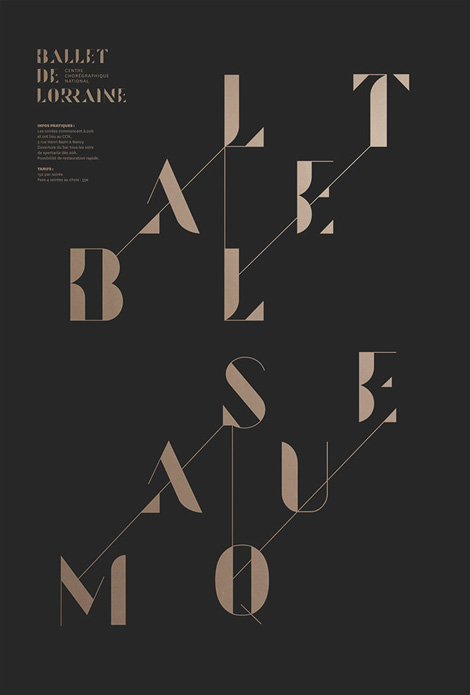
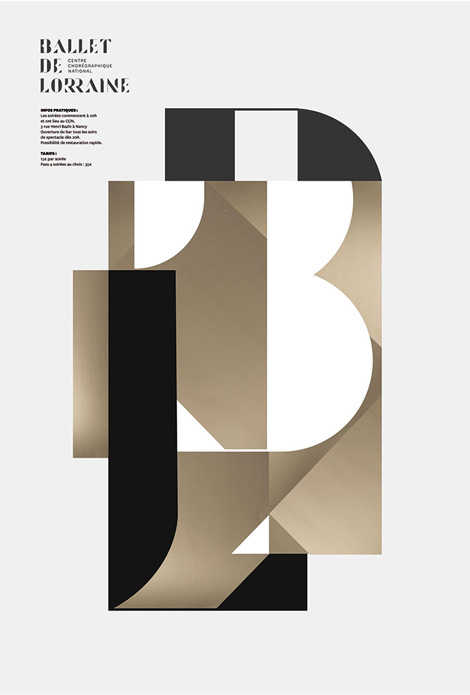
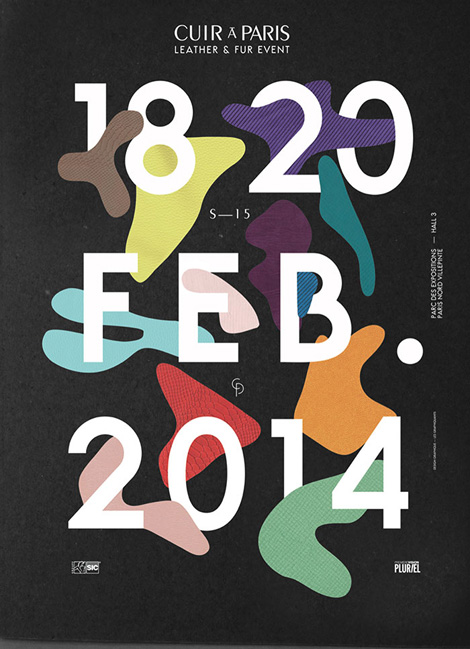
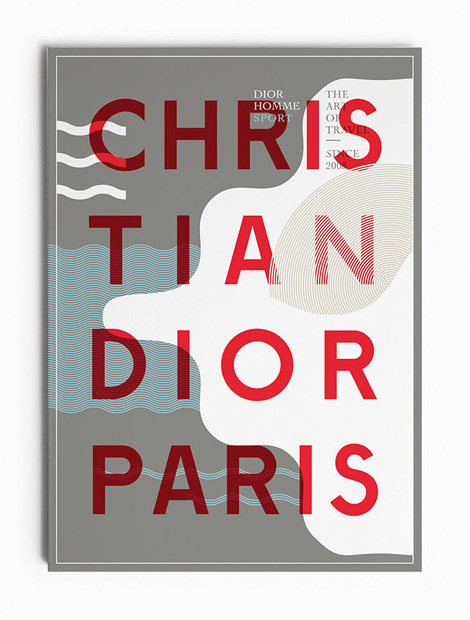
Established in 2008, Les Graphiquants is a design studio based in Paris, France. With a portfolio that is ripe in typographic exploration, they create work that is highly expressive and uncompromising in it’s approach.
Splayed across a giant paper canvas with pieces of charcoal firmly grasped in each hand, Heather Hansen begins a grueling physical routine atop a sizeable paper canvas. Her body contorts into carefully choreographed gestures as her writing implements grate across the floor, the long trails resulting in a permanent recording of her physical movements. Part dance and part performance art, the kinetic drawings are a way for Hansen to merge her love for visual art and dance into a unified artform. The final symmetrical patterns that emerge in each pieces are reminiscent of a Rorschach test, or perhaps cycles found in nature.
Calculation (Sequence) #2. Acrylic, china ink/canvas.
In the midst of our daily binge of emailing, Tweeting, Facebooking, app downloading and photoshopping it’s almost hard to imagine how anything was done without the help of a computer. For Venezuelan artist Rafael Araujo, it’s a time he relishes. At a technology-free drafting table he deftly renders the motion and subtle mathematical brilliance of nature with a pencil, ruler and protractor. Araujo creates complex fields of three dimensional space where butterflies take flight and the logarithmic spirals of shells swirl into existence. He calls the series of work Calculation, and many of his drawings seem to channel the look and feel of illustrations found in Da Vinci’s sketchbooks. In an age when 3D programs can render a digital version of something like this in just minutes, it makes you appreciate Araujo’s remarkable skill. You can see much more here. (via ArchitectureAtlas)
While vacationing on the Maldives Islands, Taiwanese photographer Will Ho stumbled onto an incredible stretch of beach covered in millions of bioluminescent phytoplankton. These tiny organisms glow similarly to fireflies and tend to emit light when stressed, such as when waves crash or when they are otherwise agitated. While the phenomenon and its chemical mechanisms have been known for some time, biologists have only recently began to understand the reasons behind it. You can see a few more of Ho’s photographs over on Flickr.
These videos by Adam Magyar are one of those things that are difficult to explain verbally, but as soon as you see it, you realize how completely amazing it is. Filmed in Tokyo, New York and Berlin, Magyar positioned himself on trains as they pulled into subway stops, filming the waiting crowds at 50 frames per second using a high speed camera. The resulting footage creates an uncanny feeling as the train is clearly moving quickly through the station, but the people seem to remain motionless. Any of these scenes wouldn’t seem out of place in a Ron Fricke film. To learn more about how Magyar filmed them, head on over to PetaPixel. (via The Fox is Black)
Update: There’s another great piece about Magyar’s work over on Medium.
Forum: CG News
Posted By: Andrew-Plumer
Post Time: 01-17-2014 at 12:04 AM
Text:
Platige Image have just released the spot created by Juice studio and directed by Tomek Bagiński.
Created for BBC Sport Winter Olympics coverage it was put together for RKCR/Y&R agency together with Stink & Red Bee Media.
CLIENT: BBC Marketing James Parry
AGENCY: RKCR/Y&R
PRODUCTION COMPANY: Stink & Red Bee Media
POSTPRODUCTION: Juice
POST HOUSE: Platige Image
DIRECTOR: Tomek Bagiński DOP: Wojtek Zieliński
RKCR/Y&R Executive Creative Director: Mark Roalfe
Creative Team: Barnaby Blackburn, Gustavo Kopit, Lembi De Carvalho Business
Director: David Pomfret Account Director: Ben Boyles Senior Planner: Henry Gray
STINK
Producer: Sally Rigg
Executive Producer: Edward Grann
RED BEE MEDIA
Producer: Edel Erickson
JUICE/PLATIGE IMAGE
Executive Producer: Adam Tunikowski, Michał Dwojak-Hara Technical
Director: Tomasz Dyrduła
Art Director: Michał Misiński
Lead VFX: Jakub Wrzalik, Tomasz Dyrduła Lead
Render: Jarosław Handrysik
Lead Compositing: Łukasz Stolarski, Michał Misiński
Matte painting: Michał Misiński, Aaron Chavda, Marcin Karolewski, Maciej Haraf, Wojciech Magierski, Alexander Isaksson, Thomas Pringle, Katarzyna Niemczyk
VFX: Tomasz Dyrduła, Jakub Wrzalik, Pieter Mentz, Michał Gadek, Piotr Białousz, Jarosław Handrysik
3D: Tomasz Dyrduła, Piotr Koczan, Wojtek Tunikowski, Sebastian Ośka, Błażej Kowalski, Jakub Wrzalik
Layout: Tomasz Dyrduła 3D
Scanning: Izabela Kuś, Andrzej Poznański
Compositing: Michał Misiński, Łukasz Stolarski, Marcin Karolewski, Michał Dwojak-Hara, Magdalena Samosiej, Przemysław Słabiak
Animation: Aleksandra Rafalska, Błażej Kowalski Offline: Cezary Szumski, Marta Michno Technical support: Łukasz Matkowski, Michał Dwojak-Hara
Costumes: Malwina Wędzikowska
Sound design: Factory
CG supervising: Błażej Kowalski, Tomasz Dyrduła, Michał Gadek
Artist Brett Kern creates detailed ceramic objects that at first appear almost indistinguishable from inexpensive inflatable toys. Kern mimics the tell-tale wrinkles and forms of air-filled toys like dinosaurs, astronauts, balloons, and even whoopie cushions—all made from clay. You can see more work in his gallery, and he has several pieces available in his Etsy shop. (via Laughing Squid)
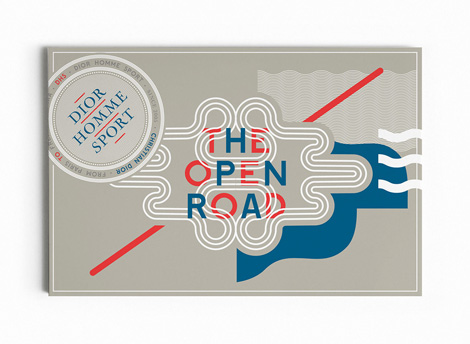
In the mid-1920s cinema technician, filmmaker, and cinematographer Claude Friese-Greene traveled across the UK with a new color film camera to create his famous collection of films, The Open Road. The filmmaker’s trip culminated in London with scenes that captured the daily life of Londoners as well as several iconic cityscapes. The films were restored in 2005 by the BFI and circulated widely online.
Fast forward 86 years later. Starting early last year filmmaker Simon Smith, armed with his own camera, traversed the footsteps of Friese-Greene to make his own film. The result is uncanny. Smith matched the original films shot by shot, mimicking the timing and angle almost perfectly for nearly 6 minutes of footage. While the differences between London of 1926 and 2013 are easy to spot when viewing the films side-by-side, what’s more amazing are the similarities. While clothing styles and car designs changed a bit, it’s almost impossible to tell some of these shots apart if it weren’t for the quality of the film. Watch it and see. (via Stellar)
Ce millionnaire chinois, classé dans les 400 plus grandes fortunes de Chine, est un homme fascinant : tout d'abord parce qu'il souhaite racheter le New York Times pour la modique somme d'un milliard de dollars (ou deux ou trois milliards), mais aussi et surtout parce qu'il a la meilleure carte de visite du monde.
Today is the launch of the Dead Pirates EP ” Over the hills”, for the occasion we pressed 1000 heavy white vinyls. You can listen and get it here : thedeadpirates.com
London-based Moth Collective (David Prosser, Marie-Margaux Tsakiri-Scanatovits, Daniel Chester and sound designer Joe Tate) recently released work for two causes – the Amazonia Security Agenda and the NSPCC (National Society for the Prevention of Cruelty to Children).
For more about the making of the Amazonia Security Agenda, check out the excellent interview with Moth Collective by Rob Munday at Director’s Notes.
Sarah’s Story matches voiceover of a victim of abuse with a single POV shot out a train window. The landscape evolves to match the protagonist’s tale. I love how the illustrative style parallaxes and layers. The wind and rain in particular feel visceral.
Amazonia Security Agenda Credits
Directed by Moth Collective
Written by Global Canopy Programme
Sound Design: Joe Tate
Animation: Daniel Chester, Marie-Margaux Tsakiri-Scanatovits, David Prosser and Jonathan Djob Nkondo
Additional Artworking: Thea Glad, Iria Lopez, James Hatley
English Voiceover: Yolanda Kakabadse (President of WWF International)
Portuguese Voiceover: Camila Pitanga
Spanish Voiceover: Gustavo De La Hoz
Client: Global Canopy Programme
Sarah’s Story Credits
Directed by Moth
Design, Animation, Compositing: Daniel Chester
Additional Animation: Anna Ginsburg, Maryam Tafakory
Sound Design: Joe Tate
Agency: YCN
Client: NSPCC
Family Crests in Japan – 1 Volume
An extensive, uncommon reference on Japanese family crests (originally published in 2 volumes). Distinguished by their simplicity, consistency and directness, these “visual language systems” have been inspirational to many Japanese graphic designers, most notably Yusaku Kamekura. Profusely illustrated with black/white (and some color) covering a wide range of subjects. Japanese chapter introductions and index. Beautifully designed and printed in Japan.
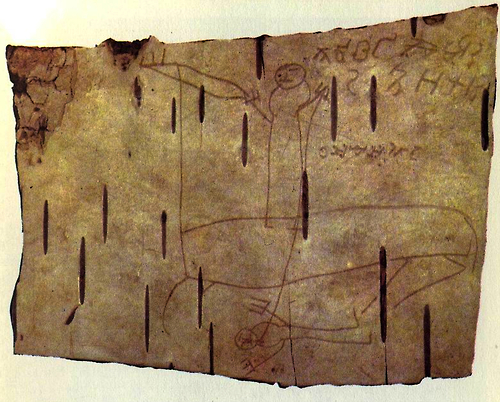
Michael sez, "Apparently medieval Russian schoolroooms used birch bark for things like writing practice. Erik Kwakkel, medieval book historian at Leiden University, Netherlands, has some charming photos of stick-figure illustrations on bark by kids who, like kids everywhere, got a bit bored with the lesson and started doodling in the margins. There are links to more images (and an interesting scholarly article) at the bottom of the post."
The most special items, however, are the ones shown above, which are from a medieval classroom. In the 13th century, young schoolboys learning to write filled these scraps with alphabets and short texts. Bark was ideal material for writing down things with such a short half-life. Then the pupils got bored and started to doodle, as kids do: crude drawings of individuals with big hands, as well as a figure with a raised sword standing next to a defeated beast (lower image). The last one was drawn by Onfim, who put his name next to the victorious warrior. The snippets provide a delightful and most unusual peek into a 13th-century classroom, with kids learning to read - and getting bored in the process.
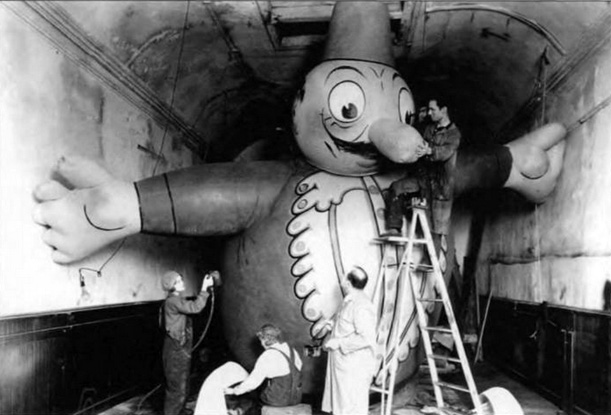
Anthony Sarg (center) and puppeteers touch up a parade balloon in 1929. (image: Macy’s Thanksgiving Day Parade)
The first Macy’s Thanksgiving Day parade (then known as the Macy’s Christmas Parade) was held in 1924 and culminated in front of Macy’s department store in New York City, where the elaborate holiday window displays were unveiled. Thousands gathered to see the displays, which were designed by Anthony Frederick Sarg, a noted puppeteer and theatrical designer. Sarg was also the artistic director / mastermind of the parade and, during the fourth annual Macy’s Christmas Parade in 1927, he introduced the enormous inflatable cartoons and caricatures that would become almost synonymous with the annual holiday tradition.
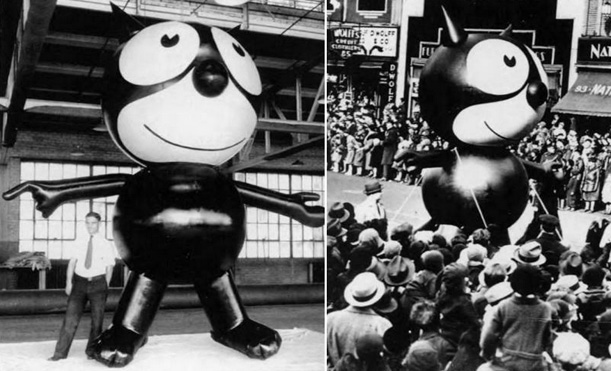
The 1927 Felix the Cat balloon. One of the first balloons to be carried down Broadway on Thanksgiving Day. (image: Macy’s Thanksgiving Day Parade)
Creativity was in Sarg’s genes. Born in Germany, his father was an artist, his grandfather a wood-carver, and his grandmother was a painter who gave the young Sarg a collection of mechanical toys that may have inspired the imagination of the burgeoning designer. But it wasn’t until he saw a performance by famed puppeteer Thomas Holden, who essentially invented the marionette, that Sarg found his calling. He began experimenting with puppet designs and stagings around 1917, eventually earning renown for his particularly sophisticated puppet shows that included performances of Faust and Don Quixote. After World War I, Sarg moved to New York City and quickly gained a reputation as a practical joker, the life of the party and a tireless worker. In his various ventures, the designer, inventor and illustrator worked on cartoons, children’s books, mechanical toys, advertising and of course, window displays and balloons.
These first parade balloons were filled with oxygen not helium, and were propped up by teams of puppeteers – usually just Macy’s employees drafted into parade service. These balloons, such as 1920s biggest cartoon star Felix the Cat (above), were cruder and smaller than today’s Godzilla-like monsters but still charmed and captivated the throngs of onlookers who came to ring in the holiday season.
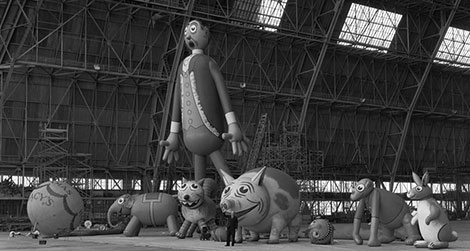
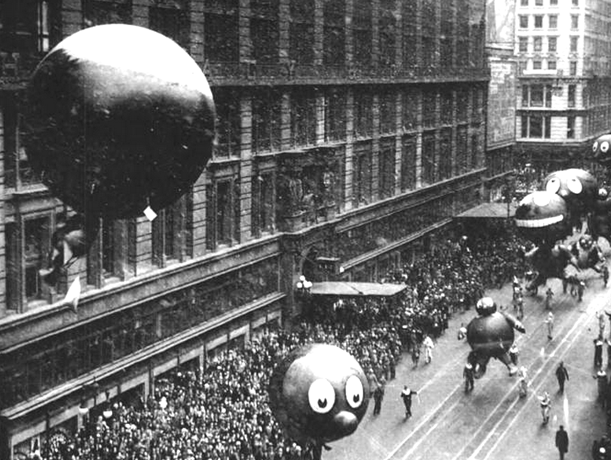
Distant view of man standing with Macy’s Day Parade balloons (image: Goodyear Tire & Rubber Company Records)
Other early balloons included a 20-foot-long elephant, a 60-foot-long tiger and an enormous hummingbird. In 1928, the parade culminated with a release of the now-helium-filled balloons into the skies above the city. The stunt was a crowd-pleaser and the following year, the balloons were designed with release valves to make their ascent easier and Macy’s offered rewards for their capture and return. The tradition that continued until 1932, when a daredevil pilot thought it would be fun to capture the balloons with her biplane and nearly crashed when the rubberized canvas wrapped itself around the plane’s wing.
The balloon ascent at the end of the 1930 Parade (image: Ballard Institute of Puppetry, University of Connecticut via Macy’s Thanksgiving Day Parade)
The rubberized silk balloons were produced by the Goodyear Tire & Rubber Company in Akron, Ohio, and their archives at the University of Akron include some amazing pictures of these early behemoths.
via Design Decoded http://blogs.smithsonianmag.com/design/2013/11/the-puppeteer-who-brought-balloons-to-the-thanksgiving-day-parade/