Shared posts

12 Mar 14:22

Dzhokhar Tsarnaev's Lawyer Owned Prosecutors in the Boston Bombing Trial Today

by Allie Conti

Last Wednesday, the Boston Bomber trial began with a startling admission: Lead defense attorney Judy Clarke, speaking on the behalf of her client, 21-year-old Dzhokhar Tsarnaev, used her opening statement to clear the air and lay out her intentions.

"It was him," she told the jury.

With the pesky matter of the 30 federal criminal charges largely brushed aside, Clarke posed a rhetorical question: "So why a trial?" Her mission, it became clear, is not to prove the innocence of her client but rather to keep him alive.

In order to keep capital punishment off the table, Clarke is taking on the uneasy task of making a jury feel sorry for a guy she's already admitted is a homegrown terrorist.

So Clarke must illustrate that Tsarnaev was more of a typical college kid than a radicalized anti-American. She wants to prove that one of the perpetrators of the April 15, 2013, attack was influenced by the other—while Dzhokhar Tsarnaev was a pothead who looked like a member of the Strokes, chased girls, and geeked out at Game of Thrones, it was his brother, Tamerlan, who talked him into filling pressure cookers with shrapnel and wreaking havoc on an unsuspected crowd. After all, it was Tamerlan, as Rolling Stone reported in 2013, who brought religion into the household and who never quite assimilated into the American mainstream.

Assistant US Attorney William Weinreb opened arguments by showing photos of the people who died in the attack, hoping to anger the jurors and to paint Tsarnaev as a monster deserving no sympathy. On Monday, he continued with that strategy by having FBI Special Agent William Kimball showcase some of Tsarnaev's social media output, and specifically his tweets. There was a picture of a city the agent identified as Mecca, and Cyrillic text that he translated as "I shall die young." Perhaps most damning was a quote he said came from Anwar al-Awlaki, the prominent al Qaeda terrorist killed by US drone attack in 2011.

The agent insinuated that a Twitter account under the name J_Tsar (Tsarnaev's nickname was Jahar) showed the defendant hated America and was planning jihad well in advance of the 2013 Boston Marathon. But cross-examination by defense lawyers quickly made the feds look incredibly silly.

For instance, the account's cover photo that was supposed to be Mecca was actually a mosque in Grozny, the capital of Tsarnaev's homeland, the Chechen Republic. That ominous tweet that was interpreted as a death wish? That was actually a lyric from a Russian pop song—something that Kimball might have figured out had he bothered to follow links on the account, one of which led to the music. The alleged al-Awlaki quote came from the Koran.

Perhaps most embarrassing for the US Attorney's office and the FBI is that both agencies are apparently oblivious to American slang. That became blatantly clear when a Tsarnaev attorney named Miriam Conrad tore the whole testimony apart, asking him to define the phrase "mad cooked."

"Crazy?" the agent replied, incorrectly. (It means high.)

He had also misinterpreted references to Comedy Central shows Tosh.0 and Key and Peele. In fact, according to the Guardian the only slang the agent could identify correctly was "LOL."

On Tuesday, the jury also got to see the very-not-normal note about martyrdom that Tsarnaev scrawled while awaiting capture. But when you're trying to prove someone hates America, it's not great for your case if the accused ends up knowing more about the country's youth culture than you do. And these goofs show that the prosecution is also painting Tsarnaev as a "stereotypical" terrorist when the reality is much more complex and terrifying. After all, what, in 2015, does a normal terrorist act like? And if he or she can go from riffing off of Comedy Central to murdering human beings—how scary is that?

Follow Allie Conti on Twitter.

11 Mar 14:06

Big Budget Games Are a Dying Breed

by editor@motherboard.tv. (Motherboard)
Mattalyst

True, of course - it's the same trajectory radio and movies followed. Why haven't books gone the same direction? Because while some books are also the result of a team of people working expensively over a long period of time, creativity sells at least as easily as research does - and as importantly, publishing has become easier and easier (especially since the advent of Amazon). By corollary, the solution to the AAA problem is Steam...and the big studios are hoisting their own petard and accelerating their stagnation by trying to segregate their own offerings into Steamalikes (Origin, Uplay, etc).

After a two year delay, PlayStation 4-exclusive The Order: 1886 unfortunately wasn't worth the wait. Bad reviews poured in upon its release, all criticizing its boring gameplay, uninteresting narrative, and short length. Kotaku said it was, a brief, drab adventure starring a group of characters who all seem to dislike their lives. With the harsh criticism came a resurgence of familiar questions: How long should a game be to warrant a $60 price tag? Are games just too expensive?

Those questions lead to the starker problems with the state of games, particularly AAA titles. AAA (pronounced triple-A) games are those with the highest budgets and largest production teams. Video game publisher Activision, for example, invested $500 million on Destiny's development, marketing, and other costs associated with making a huge game. These games earn by far the most revenue and are always expected to be the best the industry has to offer.

Of course, big budgets don't guarantee good games.

Last year's Halo: The Master Chief Collections multiplayer had a bug that prevented players from joining parties with friends. Assassin's Creed: Unity saw massive glitches that caused faces to disappear. Even new titles like Destiny and Titanfall, despite the hype around them, earned relatively low review scores. Their budgets were astronomical, the marketing relentless, but the games fell short. They either failed to deliver on their promises, or were simply broken.

The Order: 1886 works as advertised. It's a big, expensive, flagship game for the PlayStation 4, but it's still not enough.

As many developers have noted, including Metal Gear creator Hideo Kojima and former Battlefield developer David Goldfarb, more money does not encourage creativity; it smothers it. So much money on the line makes creativity risky, so publishers push for stability. They want last year's hit with just enough new paint to justify buying it again at full price.

And as budgets increase, the ability to make a profit decreases. The $60 price tag is not enough, so publishers sell more content for the game separately after release to make it last longer and keep the money coming in. Even then, its not enough. Celebrated developers like Irrational Games (known for the acclaimed Bioshock series) have closed down because they couldn't justify their headcount. Publisher Square Enix said that 2013's Tomb Raider reboot failed to meet expectations even after it sold 3.4 million copies.

AAA development is simply crumbling under its own weight.

Conversely, independent developers have the freedom to explore new, exciting ideas usually avoided by AAA games. But without the aura of AAA, they can't ask for as much money.

They want last year's hit with just enough new paint to justify buying it again at full price

Indie games usually cost something between $20 and "pay what you want" and to many players even that's not cheap enough. Monument Valley, an indie mobile game that shot up the charts recently because it was featured on House of Cards, received a slew of 1-star reviews on the app stores because it dared to charge for new levels. The new levels cost developer ustwogames $549,000 to develop. The price it asked for in return for its work, which offended players so much: $2.

Gamers want something new, but arent willing to pay for it unless it looks as expensive as the latest Call of Duty. Call of Duty's developers, meanwhile, can barely get the game out the door in working order and with enough hours of content to justify its $60 price tag, and so can't afford to take any risks.

Games are at a standstill, controlled by the oblivious gamer that wants games with the highest of quality at the lowest price in their hands as soon as possible. The industry attempts to concede to the gamers whim for bigger and better in a short timeframe, but what we get in return are broken, or boring, games.

That's how we get The Order: 1886, an expensive, beautiful, fully functioning, and hugely advertised game that nobody likes. It was too short, but it's too expensive to make it any longer. It had ambitions about its new world, story, and cinematography, but in the end felt the constraint of budgets grip.

The good news, perhaps, is that The Order also confirms that change is coming. Ready or not, gamers will see an incoming sea change in gaming, if for no other reason that the AAA model can no longer sustain itself.  


Lead image: The miserable heroes of The Order: 1886. Credit: Sony Computer Entertainment

11 Mar 05:29

Photo


11 Mar 04:41

erikamoen: periscopestudio:Hey! The Tragedy Series hardcover...


erikamoen:

periscopestudio:

Hey! The Tragedy Series hardcover comes out in ONE WEEK! The book is a steal, too. We hope that everyone who has loved Benjamin Dewey’s comics on tumblr will support him by picking up the collection. 

tragedyseries:

The final tragedy will be posted next week. In the mean time, I hope that if you have enjoyed the series, you will consider supporting my efforts by pre-ordering the complete collection. I’ll see you all soon at emerald city!

Oh dudes, I cannot wait to get the Tragedy Series book. Ben shared the proof with us in the studio, which was impressive enough, I can’t even imagine how much better it’s going to look in its intended hard cover form.

10 Mar 22:33

Frozach Submitted

10 Mar 22:29

Wikipedia Sues NSA Over Dragnet Internet Surveillance

by Cora Currier

Wikipedia is suing the NSA over surveillance programs that involve tapping internet traffic en masse from communications infrastructure in the U.S. in order to search it for intelligence purposes.

The lawsuit argues that this broad surveillance, revealed in documents leaked by former NSA contractor Edward Snowden, violates the First Amendment by chilling speech and the open exchange of information, and that it also runs up against Fourth Amendment privacy protections.

“The surveillance that we’re challenging gives the government virtually unfettered access to U.S. communications and the content of those communications,” said Patrick Toomey, an attorney with the American Civil Liberties Union, which is bringing the litigation on behalf of the Wikimedia Foundation, which operates Wikipedia, and a group of human rights and media organizations including The Nation magazine and Amnesty International, who say that their sensitive overseas communications are imperiled by the NSA’s snooping.

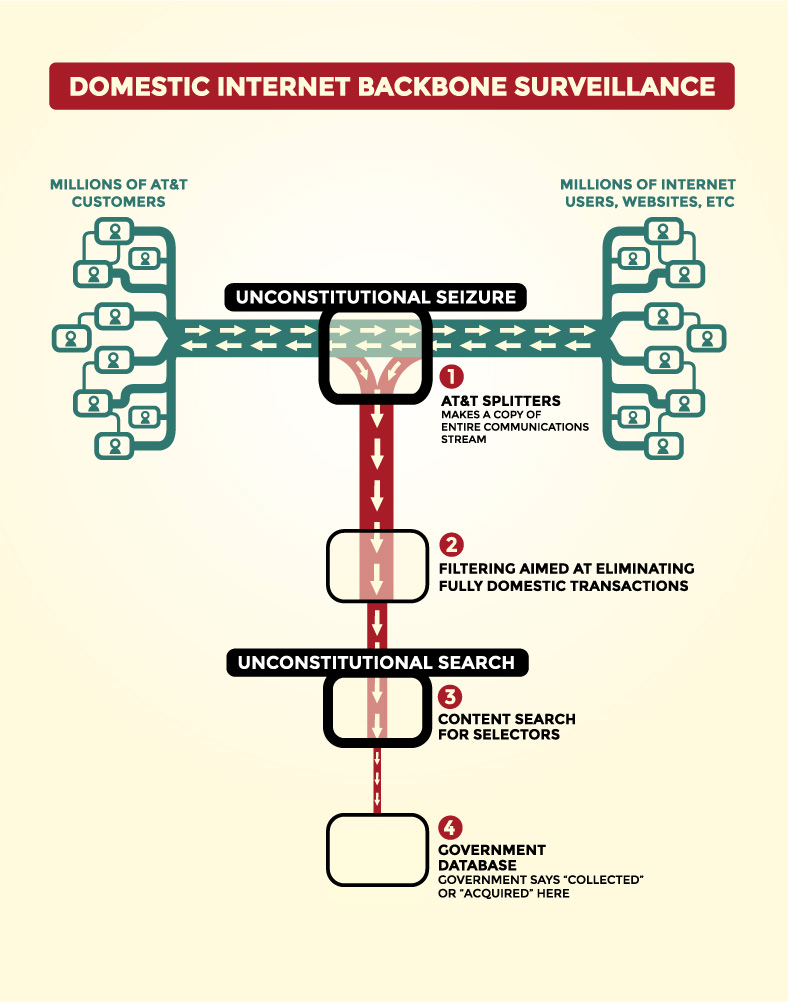
So-called “upstream” surveillance involves direct access to the physical cables, switches and routers that enable the flow of information across the internet. With its upstream efforts, the agency essentially copies virtually all international text-based communications — emails, instant messages, web searches and the like — and searches them for terms related to its investigations. In the process, purely domestic conversations can also be swept up and retained by the NSA.

“The NSA copies and reviews the communications of millions of innocent people to determine whether they are discussing or reading anything containing the NSA’s search terms,” ACLU lawyers wrote in their complaint filed today in the United States District Court in Maryland. “Its purpose is to identify not just communications that are to or from the NSA’s targets but also those that are merely ‘about’ its targets.”

In an op-ed in today’s New York Times announcing the lawsuit, Wikipedia’s co-founder, Jimmy Wales, and Lila Tretikov, executive director of the Wikimedia Foundation, cited the tens of thousands of volunteers who write and edit Wikipedia entries around the world.

Many of those volunteer contributors, they note, “prefer to work anonymously, especially those who work on controversial issues or who live in countries with repressive governments.” The fear that the NSA could be collecting information on contributors, and perhaps sharing that intelligence with other governments, “stifles freedom of expression and the free exchange of knowledge that Wikimedia was designed to enable.”

With billions of users worldwide, Wikipedia processes countless international communications and requests for data from its servers. As one NSA slide from the Snowden files indicates, the NSA is interested in HTTP, the protocol for those requests, “because nearly everything a typical user does on the Internet uses” it. The slide includes a picture of Wikipedia’s logo. (An administration official told Reuters, “We’ve been very clear about what constitutes a valid target of electronic surveillance. The act of innocuously updating or reading an online article does not fall into that category.”)

Upstream collection occurs under the Foreign Intelligence Surveillance Act, or FISA, a law passed in the 1970s to regulate overseas spying, and amended in 2008 to allow collection of Americans’ international communications under more expansive terms — so long as the NSA’s target is a foreigner outside the U.S., and it involves broadly defined “foreign intelligence information.”

In addition to constitutional questions, the new lawsuit argues that the 2008 law, expansive though it is, still “authorizes surveillance only of targets’ communications; it does not authorize surveillance of everyone.”

Nicole Navas, a spokeswoman with the Justice Department, said in an email that the department is “reviewing the complaint.”

If the case moves forward at all, it will reflect the impact of Snowden’s revelations.

A previous challenge by Amnesty International and others to warrantless spying on Americans’ international conversations was tossed out because the court said the plaintiffs couldn’t prove that their communications could be monitored under the 2008 FISA Amendments Act. The Supreme Court upheld that decision in February 2013, just a few months before the first Snowden documents were published.

The Snowden documents, and subsequent admissions by the government, said Toomey, “have made clear that the government it not just monitoring targets, but that in order to find the communications of those targets it is monitoring the communications of nearly everyone. That broadens the scope of the surveillance at issue, and removes some of the obstacles [to getting standing] that we encountered in the previous case.”

Separate challenges to the constitutionality of collecting metadata on domestic calls, under Section 215 of the Patriot Act, are awaiting decisions in three federal appeals courts.

Photo: Gregory Bull/AP

The post Wikipedia Sues NSA Over Dragnet Internet Surveillance appeared first on The Intercept.

10 Mar 22:17

Photo


10 Mar 20:24

Are You Smarter Than a Cop?

by Donovan X. Ramsey

Are You Smarter Than a Cop?

Matt Darisse, a sergeant in the Surry County Sheriff's Department, was sitting in his patrol car on the morning of April 29, 2009. Darisse was monitoring northbound traffic on a stretch of Interstate 77 near Dobson, North Carolina. He says that just around 8:00 a.m. he saw a Ford Escort pass his car. According to Darisse, the driver looked nervous, staring forward and gripping the steering wheel, so he decided to pull onto the road and follow the car. After a few miles, Darisse says the Escort approached some traffic and braked. That's when he noticed that one of the car's brake lights, the right one, was out. It was all the reason he needed, he thought, to initiate a stop.

Darisse approached the car and found two men: Maynor Vasquez behind the wheel and Nicholas Heien lying down under a blanket in the backseat. Darisse asked for Vasquez's license and registration for the vehicle. Both checked out. The sergeant couldn't shake his suspicion of the two, however. Vasquez seemed nervous, Heien remained sprawled out in the backseat throughout the stop, and question as to where the pair was going produced inconsistent answers.

Darisse wanted to search the car. He asked permission from Vasquez, who explained that the vehicle belonged to his friend in the backseat. Heien consented to the search. By this time, another officer had arrived on the scene. The two began a search of the car and Darisse eventually came across a duffle bag. In the side compartment of that duffle, he found a sandwich bag containing 54.2 grams of cocaine. Both men were arrested. Heien was charged with two counts of attempted trafficking. It would have been just another drug bust except for one thing: North Carolina has no law against operating a vehicle with just one brake light.

The Fourth Amendment of the Constitution requires "reasonable suspicion" to justify any police stop. That means that a police officer has to have more than a hunch, but facts or circumstances that might lead a reasonable person to believe that a crime has been or will be committed. Darisse had his hunch about the Ford Escort, but it was the busted brake light that he believed justified stopping the vehicle and initiating the search that would lead to the discovery of cocaine. What he didn't know, however, was the specific language of North Carolina's statute on brake lights.

"No person shall sell or operate on the highway of the State any motor vehicle, motorcycle or motor-driven cycle, manufactured after December 31, 1955, unless it shall be equipped with a stop lamp on the rear of the vehicle…the stop lamp may be incorporated into a unit with one or more other rear lamps."

During his trial, Heien filed a motion to have the evidence in his case suppressed. He argued that he did indeed have a functioning "stop lamp" as required by law. The trial court denied his motion, but The North Carolina Court of Appeals agreed and reversed that decision. After some additional legal back and forth, the case ended up before the Supreme Court of the United States where the nine justices were asked to decide if the Fourth Amendment's requirement for reasonable suspicion is indeed met if an officer's suspicion is based on a mistake of law.

In a ruling of eight to one, the justices decided at the end of last year that ignorance of the law may not be a defense for civilians who break it but it is one for the officers charged with enforcing it. They ruled against Heien, deciding that police officers can make stops based on a misunderstanding of the law without violating the Fourth Amendment. Chief Justice Roberts wrote that the court's decision "does not discourage officers from learning the law." He argued that only objectively reasonable mistakes were permitted in the decision. Such a ruling raises questions, however, about what police officers are indeed required to know of the law and what they can get away with not knowing.

Sonia Sotomayor was the only justice to dissent in the case of Heien v. North Carolina. She is, coincidentally, also the only sitting justice with criminal trial experience. In her dissent, Sotomayor wrote of the "human consequences" when officers make mistakes of law.

"One wonders how a citizen seeking to be law-abiding and to structure his or her behavior to avoid these invasive, frightening, and humiliating encounters could do so," she wrote. "This result is bad for citizens, who need to know their rights and responsibilities, and it is bad for police, who would benefit from clearer direction."

An analysis of nationwide police officer instruction and training standards reveals that police officers learn surprisingly little about the law before they're empowered to enforce it. Hours required for police academy training are relatively short, state officer examinations don't account for legal knowledge and what police officers do know about civilian rights and state law is often undermined by departmental practices.

Requirements to become a police officer vary by state. On average, applicants must be about 21 years of age, possess a valid drivers license, and around two years of college education (which can be substituted in some states with active duty military service.) Officers are also required to complete a few hundred hours of police academy training, instructional and physical, and pass physical and written exams.

The national average of academy training required is just over 600 hours. The bar is much lower in many states, however, particularly in most of the South. Louisiana, for example, requires just 360 hours of training for officer certification. That's compared to the 1,500 hours it requires for barber certification. On the other hand, Washington D.C. requires 1,120 hours of police academy training—more than any other state.

Raymond E. Foster retired as a lieutenant with the Los Angeles Police Department after 24 years of service. Today, he is a police instructor, college lecturer and author, having written 10 books on policing. Foster says, when it comes to legal education, what officers learn in police academies is limited.

"There's probably an hour-long class that focuses on the Bill of Rights, in particular the First, Second, Fourth, Fifth and Eighth Amendments," he says. "Once those are basically covered, then there's another 10 hours that focus on state statutes and court decision that have shaped the way police officers interpret the law."

Not only is the legal education minimal at police academies across the country but the style of instruction also limits officer understanding, according to Foster.

"Much of police academy education is rote memorization," he says. "The academies more or less teach officers to list things and do basic tasks."

More than half of 18,000 police departments and agencies throughout the country use the National Police Officer Selection Test to screen its officers. A 2009 study guide from the U.S. Capitol Police available online describes the exam format as four separately timed test sections. The first three sections use multiple-choice and true-false items to test math skills, reading comprehension and grammar. The last section on incident report writing essentially tests a prospective officer's ability to correctly complete an incident report. Shockingly, the exam contains no items to test for knowledge of the law.

Jenn Rolnick Borchetta was a senior attorney representing thousands of New Yorkers on Floyd v. the City of New York, the class action case that successfully challenged the NYPD's use of Stop and Frisk. She says her experience on Floyd highlighted for her just how little some officers know about the law.

"Officers can recite the legal standard for stops straight out of the law books: to conduct a stop, an officer must have reasonable, articulable suspicion that the person has committed a crime, is committing a crime or is about to commit a crime. I've questioned officers who cannot explain reasonable suspicion beyond that line," says Borchetta. "Officers with years of experience cannot give me one example of what reasonable suspicion looks like."

It is this lack of applied understanding that often results in mistakes of law. It's not just individual officer knowledge, however, but also flawed departmental practices that result in civil rights violations.

"Policing institutions cannot blame widespread constitutional violations—like we saw in the NYPD's stop and frisk practice—on individual officers," Borchetta says. "NYPD brass demanded to see stops, summonses and arrests of young black men, penalized officers who failed to meet stop quotas and refused to discipline officers found by the Civilian Complaint Review Board to have abused their authority in stops of black people. Widespread constitutional violations in policing come from the top down."

Christopher Dunn, associate legal director with the New York Civil Liberties Union agrees.

"Focusing on officer supervision is an important part of having an effectively trained police force," says Dunn. "The most important factor in an officer's conduct on a day-to-day basis is what their supervisor tells them to do."

Last week, the White House and its Task Force on 21st Century Policing released its first report with recommendations for police reform, including improving education and training. The report asks Congress to approve additional funds for education, it endorses scenario-based training and additional training for leadership in police departments and, perhaps most importantly, the report recommends that police academies require basic recruit and in-service officer training on policing in a democratic society.

"Police officers are granted a great deal of authority," it reads, "and it is therefore important that they receive training on the Constitutional basis of and the proper use of that power and authority."

Donovan X. Ramsey is writer based in New York. He's currently a Demos Emerging Voices fellow.

[Illustration by Jim Cooke]


Take our quiz, Are You Smarter Than a Cop? [Note: Four of the quiz questions were pulled from a 2009 US Capitol police department study guide. Actual exams are supervised, timed within each section, and contain more than 70 items in all.]

10 Mar 19:03

Photo


10 Mar 18:08

Soda Drinker Pro

Mattalyst

PAX highlight #1!

Real Time Soda Simulation

Soda Drinker Pro is the premier in software in the first person soda drinking genre.  Experience what it’s truly like to drink a soda at the beach, in the park, and even… in SPACE!!!

With Soda Drinker Pro, you don’t need to have a soda in hand to experience a soda in your mind.

The Original FPS    (First Person Soda)

Increase your soda drinking abilities with Soda Drinker Pro!  Many soda drinking simulations only give you the can, but in Soda Drinker Pro you get the real deal slurps and all.  Imagine the feeling knowing at any moment you could take a soda and place it to your lips.  And then YOU decide when to sip it!

Download Soda Drinker Pro TODAY!

You are minutes away from soda drinking perfection.  Just click that button below and download your very own copy of Soda Drinker Pro.

Download Now!

10 Mar 18:04

Movie matinée, Formento + Formento


© Formento + Formento.


© Formento + Formento.


© Formento + Formento.


© Formento + Formento.


© Formento + Formento.


© Formento + Formento.


© Formento + Formento.


© Formento + Formento.


© Formento + Formento.

Movie matinée, Formento + Formento

10 Mar 16:59

ragingdarcy:hey-assbutt-its-a-parade:finndicate:vjezze: Amsterdam...


ragingdarcy:

hey-assbutt-its-a-parade:

finndicate:

vjezze:

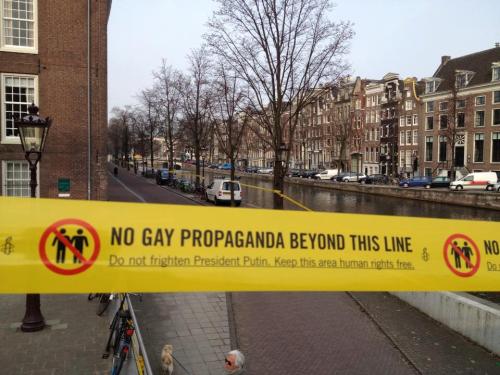
Amsterdam is turning rainbow for a visit of the Russian president Putin. The council of the city of Amsterdam has decided to hang out the gay pride flag on all council owned buildings and offices, in protest to Russia’s new anti-gay law.

there’s several of these as well;

image

pretty sure Amsterdam is now the sass capital of the world

amsterdamn

Amsterdaaaaaaaaamn

10 Mar 03:43

Masquerada: Songs and Shadows Reveal Trailer

Mattalyst

PAX highlight #3!

(somewhat more seriously than the first 2)

Masquerada: Songs and Shadows is a 2.5D isometric RPG, built in the vein of Baldur's Gate and Dragon Age where you can pause combat to plan tactics for your ...
10 Mar 02:43

In this picture the photographer has used an extremely narrow...


In this picture the photographer has used an extremely narrow depth of focus in order to highlight this cat’s gummy pores and straw adornments


WHY tho

10 Mar 00:07

Here’s The Joke Tim Schafer Made That Has Gamergate Freaking Out - C'mon.

by Victoria McNally

Last night, Tim Schafer of Double Fine Games hosted the 15th annual Game Developer’s Choice Awards to a room full of his peers at the Game Developer’s Conference (GDC) in San Diego. Of course, it would be pretty difficult to make jokes and celebrate the gaming industry without at least mentioning the, ahem, sea lion in the room, and Schafer did so pretty spectacularly. How do we know this? Because all the prominent Gamergaters are losing their shit and calling him a racist. Welp, this oughta be good.

If you’re not able to view the video, here’s what he did: rather than poke fun at Gamergate himself, he created a sockpuppet account—using a literal sock puppet, of course—to make all the jokes for him, which resulted in this bit when he began to speak about visual art in gaming:

Sock: How many gamergaters does it take to make a single piece of armor?

Schafer: Oh, god, I don’t know.

Sock: Fifty. One to do the modeling, one to do the materials, and forty-eight to tweet that it’s not your shield.

Okay, so it’s definitely not the best joke (and Schafer’s puppet voice is terrible), but at least it works purely on a strictly linguistic, wordplay-centric sense. Armor? Shield? Get it?

But many Gamergaters were not happy about the use of their #NotYourShield hashtag, with which people of color, LGTBQ people, and women tweet about how they like Gamergate so those who are against the movement on the grounds that it behaves pretty unfairly to those kinds of people are clearly being disingenuous. (Hey head’s up, we aren’t.) It wasn’t just offensive to them—it was hate speech. And they sure did let the Internet know about it.

Tim Schafer SPECIFICALLY went out of his way to engage in hate speech against minorities, alternate gender identities, and sexualities.

— Oliver Campbell (@oliverbcampbell) March 5, 2015

I am still at a loss for words…what Tim did is a huge setback to peace and diversity.

— Mark Kern (@Grummz) March 5, 2015

By the way, the “Not Your Shield” campaign, despite attracting some real marginalized people who truly believe in the “ethics in game journalism” angle, was reportedly conceived of as a way to deflect genuine criticism from those who specifically got into the movement as a way to spew hate at Zoe Quinn.

if y'all missed @TimOfLegend's joke, NotYourShield is the tag Gamergate made to use marginalized people as shields pic.twitter.com/rLENIYQHPh

— weaponized irony (@alexlifschitz) March 5, 2015

also #notyourshield was purely to deflect when people started calling out #gamergate as misogynistic pic.twitter.com/1RpX737gQf

— moves like Jaggi (@TheQuinnspiracy) September 6, 2014

Meanwhile, one of the panels that Zoe Quinn spoke at earlier this week literally required a police presence—which is almost unheard of at GDC—because of all the death threats she’s gotten since Gamergate began. So, yeah. Forgive me if I’m not grabbing my pitchfork for Schafer just yet.

But enough about my angry mob gear. What do you all think of the joke, friends?

Are you following The Mary Sue on Twitter, Facebook, Tumblr, Pinterest, & Google +?

09 Mar 21:27

Welcome to VA-11 HALL-A

Mattalyst

PAX highlight #2!

After much discussion and input from our cybernetic cat focus group, we decided to release the "Prologue" so you can a) see what the final game will be like b) drown us with feedback and c) help us eat more than dollar-store ramen.

It's also a great way for you to get two games for the price of one!

So, when do I get the full game?

We're hoping to release it in December, but that might be difficult as we're trying to put it on as many platforms as possible. If you want to keep track of our development, head to our devlog where we file updates almost daily.

09 Mar 21:22

Video: Amazing ASCII fluid simulator

by David Pescovitz

Fluid simulator in ASCII by Yusuke Endoh. (via Waxy)

09 Mar 20:22

New Zealand Prime Minister Retracts Vow To Resign if Mass Surveillance Is Shown

by Glenn Greenwald

In August 2013, as evidence emerged of the active participation by New Zealand in the “Five Eyes” mass surveillance program exposed by Edward Snowden, the country’s conservative Prime Minister, John Key, vehemently denied that his government engages in such spying. He went beyond mere denials, expressly vowing to resign if it were ever proven that his government engages in mass surveillance of New Zealanders. He issued that denial, and the accompanying resignation vow, in order to reassure the country over fears provoked by a new bill he advocated to increase the surveillance powers of that country’s spying agency, Government Communications Security Bureau (GCSB) — a bill that passed by one vote thanks to the Prime Minister’s guarantees that the new law would not permit mass surveillance.

Since then, a mountain of evidence has been presented that indisputably proves that New Zealand does exactly that which Prime Minister Key vehemently denied — exactly that which he said he would resign if it were proven was done. Last September, we reported on a secret program of mass surveillance at least partially implemented by the Key government that was designed to exploit the very law that Key was publicly insisting did not permit mass surveillance. At the time, Snowden, citing that report as well as his own personal knowledge of GCSB’s participation in the mass surveillance tool XKEYSCORE, wrote in an article for The Intercept:

Let me be clear: any statement that mass surveillance is not performed in New Zealand, or that the internet communications are not comprehensively intercepted and monitored, or that this is not intentionally and actively abetted by the GCSB, is categorically false. . . . The prime minister’s claim to the public, that “there is no and there never has been any mass surveillance” is false. The GCSB, whose operations he is responsible for, is directly involved in the untargeted, bulk interception and algorithmic analysis of private communications sent via internet, satellite, radio, and phone networks.

A series of new reports last week by New Zealand journalist Nicky Hager, working with my Intercept colleague Ryan Gallagher, has added substantial proof demonstrating GCSB’s widespread use of mass surveillance. An article last week in The New Zealand Herald demonstrated that “New Zealand’s electronic surveillance agency, the GCSB, has dramatically expanded its spying operations during the years of John Key’s National Government and is automatically funnelling vast amounts of intelligence to the US National Security Agency.” Specifically, its “intelligence base at Waihopai has moved to ‘full-take collection,’ indiscriminately intercepting Asia-Pacific communications and providing them en masse to the NSA through the controversial NSA intelligence system XKeyscore, which is used to monitor emails and internet browsing habits.”

Moreover, the documents “reveal that most of the targets are not security threats to New Zealand, as has been suggested by the Government,” but “instead, the GCSB directs its spying against a surprising array of New Zealand’s friends, trading partners and close Pacific neighbours.” A second report late last week published jointly by Hager and The Intercept detailed the role played by GCSB’s Waihopai base in aiding NSA’s mass surveillance activities in the Pacific (as Hager was working with The Intercept on these stories, his house was raided by New Zealand police for 10 hours, ostensibly to find Hager’s source for a story he published that was politically damaging to Key).

That the New Zealand government engages in precisely the mass surveillance activities Key vehemently denied is now barely in dispute. Indeed, a former director of GCSB under Key, Sir Bruce Ferguson, while denying any abuse of New Zealander’s communications, now admits that the agency engages in mass surveillance.

Meanwhile, Russel Norman, the head of the country’s Green Party, said in response to these stories that New Zealand is “committing crimes” against its neighbors in the Pacific by subjecting them to mass surveillance, and insists that the Key government broke the law because that dragnet necessarily includes the communications of New Zealand citizens when they travel in the region.

So now that it’s proven that New Zealand does exactly that which Prime Minister Key vowed would cause him to resign if it were proven, is he preparing his resignation speech? No: that’s something a political official with a minimal amount of integrity would do. Instead — even as he now refuses to say what he has repeatedly said before: that GCSB does not engage in mass surveillance — he’s simply retracting his pledge as though it were a minor irritant, something to be casually tossed aside:

When asked late last week whether New Zealanders have a right to know what their government is doing in the realm of digital surveillance, the Prime Minister said: “as a general rule, no.” And he expressly refuses to say whether New Zealand is doing that which he swore repeatedly it was not doing, as this excellent interview from Radio New Zealand sets forth:

Interviewer: “Nicky Hager’s revelations late last week . . . have stoked fears that New Zealanders’ communications are being indiscriminately caught in that net. . . . The Prime Minister, John Key, has in the past promised to resign if it were found to be mass surveillance of New Zealanders . . . Earlier, Mr. Key was unable to give me an assurance that mass collection of communications from New Zealanders in the Pacific was not taking place.”

PM Key: “No, I can’t. I read the transcript [of former GCSB Director Bruce Ferguson’s interview] – I didn’t hear the interview – but I read the transcript, and you know, look, there’s a variety of interpretations – I’m not going to critique–”

Interviewer: “OK, I’m not asking for a critique. Let’s listen to what Bruce Ferguson did tell us on Friday:”

Ferguson: “The whole method of surveillance these days, is sort of a mass collection situation – individualized: that is mission impossible.”

Interviewer: “And he repeated that several times, using the analogy of a net which scoops up all the information. . . . I’m not asking for a critique with respect to him. Can you confirm whether he is right or wrong?”

Key: “Uh, well I’m not going to go and critique the guy. And I’m not going to give a view of whether he’s right or wrong” . . . .

Interviewer: “So is there mass collection of personal data of New Zealand citizens in the Pacific or not?”

Key: “I’m just not going to comment on where we have particular targets, except to say that where we go and collect particular information, there is always a good reason for that.”

From “I will resign if it’s shown we engage in mass surveillance of New Zealanders” to “I won’t say if we’re doing it” and “I won’t quit either way despite my prior pledges.” Listen to the whole interview: both to see the type of adversarial questioning to which U.S. political leaders are so rarely subjected, but also to see just how obfuscating Key’s answers are.

The history of reporting from the Snowden archive has been one of serial dishonesty from numerous governments: such as the way European officials at first pretended to be outraged victims of NSA only for it to be revealed that, in many ways, they are active collaborators in the very system they were denouncing. But, outside of the U.S. and U.K. itself, the Key government has easily been the most dishonest over the last 20 months: one of the most shocking stories I’ve seen during this time was how the Prime Minister simultaneously plotted in secret to exploit the 2013 proposed law to implement mass surveillance at exactly the same time that he persuaded the public to support it by explicitly insisting that it would not allow mass surveillance.

But overtly reneging on a public pledge to resign is a new level of political scandal. Key was just re-elected for his third term, and like any political official who stays in power too long, he has the despot’s mentality that he’s beyond all ethical norms and constraints. But by the admission of his own former GCSB chief, he has now been caught red-handed doing exactly that which he swore to the public would cause him to resign if it were proven. If nothing else, the New Zealand media ought to treat that public deception from its highest political official with the level of seriousness it deserves.

Photo: Mark Mitchell/AP

The post New Zealand Prime Minister Retracts Vow To Resign if Mass Surveillance Is Shown appeared first on The Intercept.

09 Mar 20:15

Photo


09 Mar 20:12

robotcosmonaut:Riot Break, 2012via aleatoryalarmalligator

09 Mar 20:11

Selfie Vibrator with HD Camera (NSFW)

It doesn't have to be a holiday or special occasion to surprise your lady with a thoughtful gift. The Svakom Gaga Sex Selfie Stick even has a foolproof, built-in mechanism for gauging how much she likes it. Come on, sugar lips, say cheese and give me a great big orgasm for the camera!

Just when you thought it couldn't get any better (or more ludicrous) than the butt selfie stick, the Svakom Gaga takes the selfie craze to new depths with its Sex Selfie Stick, a vibrator featuring a built-in HD camera and LED lights at the business end for ladies to record (or watch live on FaceTime!) their orgasms from the inside. Colonel Angus is gonna be so jealous.

The Gaga's illuminated HD camera promises to capture the internal carnival of vibrator fun time in "remarkably clear footage." Its FaceTime compatibility enables other parties (i.e., dude in the room, dude overseas) to get a front row view of the action too. Kind of like an ultrasound at the obstetrician, but without the killjoy element of seeing proof that pretty soon you're going to have a live baby to deal with.

Aside from the bird's eye view of rapidly contracting vaginal muscles it provides, the Sex Selfie Stick is a pretty standard vibrator. Powered by rechargeable battery with 6-speeds, hypoallergenic, and waterproof. It's compatible with Macs for Face Time use, and also includes a software disc for those with a PC.

09 Mar 20:10

nonespark: A STREAKER CUT THE ACTUAL CONTESTANT OFF AND BLEW...


nonespark:

A STREAKER CUT THE ACTUAL CONTESTANT OFF AND BLEW THROUGH IT LIKE HE’S SONIC THE FUCKING HEDGEHOG WHAT THE FUCK

09 Mar 19:08

Don’t be a dick

09 Mar 19:04

Drinking Poison Control Medicine Is the Newest Bougie Health Fad

by Hilary Pollack
Drinking Poison Control Medicine Is the Newest Bougie Health Fad
08 Mar 07:58

Photo


07 Mar 16:11

Saturday Evening Post, Juan Carlos Ruiz Burgos


Saturday Evening Post, Juan Carlos Ruiz Burgos

07 Mar 16:05

A Vape Hoodie for the Casual Douche 

by Ashley Feinberg

Do you like to be comfortable? Are you an asshole? Then boy do we have the garment for you. It's the world's first vape/hoodie combo, and Fred Durst just bought eight.

Read more...


06 Mar 21:38

Wait a minute, did Rush Limbaugh just ADMIT DEFEAT???

Mattalyst

Hahah, that last paragraph


With assholes like Rush Limbaugh, all you have to do is wait…

For days the rumor has circulated that WLS 890AM, the Chicago market Cumulus-owned talk radio station, is about to drop Rush Limbaugh from its 11 a.m. to 2 p.m. Monday through Friday slot at the end of March, although the company...

06 Mar 19:43

Pattern recognition, Silvie De Burie


Silvie De Burie


Silvie De Burie


Silvie De Burie


Silvie De Burie


Silvie De Burie

Pattern recognition, Silvie De Burie

06 Mar 09:56

Photo