Sent to you by Lori via Google Reader:
Photo
via Women to the Front on 10/25/12

Things you can do from here:
- Subscribe to Women to the Front using Google Reader
- Get started using Google Reader to easily keep up with all your favorite sites
MassaPorrada nesses caras que não fazem nada.
As autoridades responsáveis pela Guarda Municipal e pelas polícias Militar e Civil afirmaram durante a segunda-feira (29) que vão apurar as supostas falhas cometidas no atendimento às vítimas que foram agredidas por skinheads na Savassi. Os dois rapazes atacados com chutes e pedradas teriam procurado integrantes das três corporações após o fato e não conseguiram ajuda para registrar um boletim de ocorrência.
O relato da agressão feito por uma das vítimas repercutiu nas redes sociais durante o fim de semana. Juliano Cardoso de Azevedo, de 32 anos, desabafou em seu blog após ser espancado pelos dois skinheads na esquina da avenida Cristóvão Colombo com a rua Antônio de Albuquerque. Um amigo do jornalista também foi atacado.
No texto, Juliano conta que a agressão aconteceu na última sexta-feira, após os dois saírem do show do Kid Abelha no Chevrolet Hall. Eles foram abordados após se despedirem com um abraço.
"Não sei o nome do que passei na madrugada de sexta-feira. As cenas aparecem quando fecho os olhos. Uma voadora no peito. Uma pedrada na cabeça. As frases de efeito: vamos exterminar você. Vou matá-lo", descreveu Juliano no texto.
Segundo o jornalista, as autoridades não atenderam aos pedidos de socorro feitos logo após a agressão. Diante da dificuldade em registrar um boletim de ocorrência, as vítimas optaram por conseguir atendimento médico e procurar a polícia somente no domingo.
"Parados na avenida mais movimentada, iluminada e protegida – Cristóvão Colombo, debaixo da vigilância da Guarda Municipal. Sangrando, desesperados, pedimos ajuda e ouvimos: – não podemos fazer nada. Ligue para o 190. Os agressores rindo a poucos metros. As testemunhas silenciosas. Ninguém fez nada. O atendente sugere que devíamos ir diretamente ao hospital. A ocorrência ficaria a cargo da polícia que fica instalada no Pronto Socorro do João 23. Ele dormia. Acordado de seu sono dos deuses: não posso fazer nada. Para fazer ocorrência você deve ir à Seccional da rua Carangola", narra Juliano.
Diante da repercussão do caso, o comando da Guarda Municipal abriu um inquérito para apurar as circunstâncias do fato e apontar possíveis falhas. Os agentes que estavam no local serão ouvidos nesta terça-feira (30) para apresentar a versão deles do ocorrido.
A Polícia Civil afirmou que todo posto policial é obrigado a receber queixa e que o suposto erro ocorrido no HPS será investigado. Já a PM garantiu que vai analisar a gravação do telefonema feito ao 190 para checar se houve falha no atendimento.
Foto: Reprodução/Blog Juliano Azevedo
O post Autoridades de segurança apuram falhas no atendimento às vítimas de skinheads na Savassi apareceu primeiro em Bhaz.
MassaCaralhinhos voadores! Os sete gatinhos!
 These carved bone phalluses with finely detailed wings -- dating back 1,600 to 2,000 years -- were dug up in Britain and recently published in the journal Britannia.
Splendid!
These carved bone phalluses with finely detailed wings -- dating back 1,600 to 2,000 years -- were dug up in Britain and recently published in the journal Britannia.
Splendid!
Submitted by: Unknown (via Animal New York)
Tagged: ancient roman artifacts , carved bone phalluses with wings Share on FacebookWhen Gawker reporter Adrian Chen publicly outed troll and influential Reddit user Violentacrez as Michael Brutsch two weeks ago in what many are calling the "best story of the Web," he changed the nature of the Internet forever. The resulting journalist-sanctioned public shaming:
1. Highlighted how ignorant the media is of Internet culture.
2. Forced the Internet’s core psyche, sometimes referred to as the "hive mind," to mature from a teenage boy to a relatively respectful young adult almost overnight.
3. Legitimized digital lynch mobs.
Our technology may have evolved, but our attitudes have not: Nothing pleases humanity more than a good public shaming. Instead of pelting rotten tomatoes at a man locked in the town square stockade, society’s "sinners" are now paraded on national television, courtesy of Anderson Cooper, and branded with a scarlet “T." (Just Google "Michael Brutsch" if you don’t know what I mean.)
Brutsch is now the physical face of the most hated thing on the Internet: the Troll. That anonymous person who goes out of his way to provoke a response. While few people understand what trolls actually are, where they came from and why they do what they do, it is generally accepted that they are the scum of the Web. Hating on them unconditionally is not just acceptable, it's encouraged, as Cooper implied by calling Brutsch a sad “little person,” sitting “alone in his room, typing on his keyboard, interacting with people he doesn't even know.” Cooper did stop short of calling him a “neckbeard,” but other outlets have not - he's been called a "monster," and even falsely tied to the suicide of Amanda Todd and the "capper" community.
Brutsch didn’t create the act of trolling, nor was he the original or most notorious troll. (Brutsch might not even be a troll, as tech culture journalist Xeni Jardin pointed out.) Nor is Brutsch the first man to have an offensive porn collection, or the first man to sexualize children. Regardless, Brutsch will be made an example of, dammit, because we the media (or as Forbes Kashmir Hill called it, “The Internet Cool Kids”) are sick and tired of these vile human beings mucking up our Internet! Never mind that the same media leverages these same transgressors to drive pageviews - all cloaked in hand-wringing and faux outrage (an act Reddit itself is guilty of) . And, of course, the same said media also sexualizes children.
Calling Brutsch’s transgressions “vile” isn’t an overstatement - his stuff was downright disgusting. Brutsch had his hands in some of the most controversial subreddits, including /r/incest, /r/misogyny, /r/beatingwomen, /r/chokeabitch, /r/Jewmerica, /r/Jailbait, /r/niggerjailbait, /r/rapebait, /r/picsofdeadkids and /r/creepshots, just to name a few. If you are offended by those titles, that’s the point of a Troll: Brutsch’s online behavior is so offensive that anyone that wants to be considered a respectable member of society has no choice but to oppose his behavior.
As Chen describes trolling in his unmasking piece: “A troll exploits social dynamics like computer hackers exploit security loopholes, and Violentacrez calmly exploited the Reddit hive mind's powerful outrage machine and free speech values at the same time.” If “troll” wasn’t the hot button word of the year, we’d be calling Brutsch’s digital binders of scantily clad or beaten women “performance art.”
Whitney Phillips, a scholar studying Internet trolling culture, put it another way, calling trolls “cultural scavengers” that “engage in a process I describe as cultural digestion: They take in, regurgitate, and subsequently weaponize existing tropes and cultural sensitivities.” Trolls don’t engage in this sort of behavior alone or in a vacuum, Phillips said. Rather, they come out to play when they have a supportive “host culture.”
AKA: Reddit.
This is exactly what Brutsch meant when he told CNN's Drew Griffin that Reddit “enabled” and “encouraged” his online behavior: “When two years ago, when all of this was at its height, the audience was appreciative, and supportive of the sort of gallows humor that I put out there.” When Brutsch, who is one year shy of 50, said he was catering to an audience of college kids, he means this both literally and figuratively. Brutsch’s fanbase isn’t necessarily college-aged, but the core Internet psyche is.
Established sometime between late 1993 and 1999 through sites like Usenet and WebCrawler, and then reborn in 2003 with the creation of 4chan, the Internet psyche is skeptical, self-absorbed, sadistic and lazy - except when it comes to porn, cute animals, digital pranks and acts of Internet vigilantism. For various reasons, perhaps elated to being wealthy, white and privileged, users connected to this hive mind regularly post the most disturbing (re: misogynist, racist) content they can find. You might see this behavior as a way to compensate for, and feel alive in, their mundane real-world existences.
The infamous Usenet troll Ted Frank told Stryker in an interview for his book Epic Win For Anonymous: How 4chan’s Army Conquered The Web, that trolling served as “an educational tool for newcomers.” Modern trolling culture has evolved from its roots on Usenet, however, and Frank “insists” the trolling similarities between 4chan and Usenet are “an etymological coincidence.” (In fact, the notion of trolling can be traced back even further than Usenet: Stryker describes comedian Andy Kaufman as one of the finest examples of a “pre-Internet troll,” and draws parallels with the “Greek prankster Pan, the Norse god Loki, and the conniving Native American Coyote.”)
As the Internet goes mainstream and effectively kills the mantra "there are no girls on the Internet," older generations, women and traditional media increasingly bump into this hive mind. Their presence will age and mature the digitial pysche just by being there, is the hope.

Much of Reddit’s young, trolling psyche comes from 4chan, specifically /b/, but 4chan has managed to stay out of headlines during this flame war. “I don't understand why everyone was upset at jailbait, while 4chan continually posts bullshit across the internet and no one bats an eye,” wrote redditor he_cried_out_WTF in response to the Violentacrez controversy. “4chan is apparently the petulant child that everyone pretends doesn't exist as it throws yet another vase on the floor.”
Reddit (and 4chan) aren’t the only social news sites that regularly tap into the vase-throwing Internet psyche: Digg, 9gag, Fark, Something Awful, Encyclopedia Dramatica, Buzzfeed, The Daily Dot, Know Your Meme and the entire I Can Haz Cheezburger clan regularly regularly tune in. Even Erik Martin and fellow paid Reddit employees were guilty of listening to this psyche when they cried “free speech” and “privacy” as knee-jerk reactions, when they could have denounced the misogynistic and racist behavior Brutsch catered to.
Brutsch gave the community exactly what it wanted. In return, he heaped up “meaningless Internet points... It had a reward, like the monkey that pushes the button to get a food pellet, it's addictive” said Brutsch on national television. “Why do people spend money playing [World of Warcraft], why do people play games like that to build up their meaningless stats?, [it’s] exactly the same as 800,000 karma on Reddit.” Gamification, baby.
Our reaction, as both journalists and "respectable members of society" prove we're not that different from Brutsch and the dark side of the Internet. We behaved trollishly when we celebrated his job loss, demanded he be imprisoned or burn in hell, and gleefully discussed how his life is now ruined forever. Our collective outrage - what trolls eat for breakfast - also earned us meaningless Internet points in the form of Facebook likes and Twitter RTs. Chen's piece made White Knights of us all, but is that enough to fix all the societal ills Brutsch was pointing out with his "trolling?" And is a digital lynching really the way to go?
We don't accept this kind of treatment of criminals in the real world - our current justice system is not ruled by a mob mentality - but Chen's piece and the resulting digital lynching is generally viewed as an acceptable means of punishment online.
Perhaps, though, the most ironic aspect of this journalist-sanctioned public trial and execution, is that it generated from well-known Reddit "trolls" themselves.
Um relato de agressão feito por um jornalista belo-horizontino está repercutindo nas redes sociais neste fim de semana. Juliano Cardoso de Azevedo, de 32 anos, desabafou em seu blog após ser espancado por dois skinheads na esquina da avenida Cristóvão Colombo com a rua Antônio de Albuquerque.
Um amigo do jornalista também foi atacado por chutes e pedras. No texto, Juliano conta que a agressão aconteceu na última sexta-feira, após os dois saírem do show do Kid Abelha no Chevrolet Hall. Eles foram abordados após se despedirem com um abraço.
“Não sei o nome do que passei na madrugada de sexta-feira. As cenas aparecem quando fecho os olhos. Uma voadora no peito. Uma pedrada na cabeça. As frases de efeito: vamos exterminar você. Vou matá-lo”, descreveu Juliano no texto.
Segundo o jornalista, as autoridades não atenderam aos pedidos de socorro feitos logo após a agressão. Diante da dificuldade em registrar um boletim de ocorrência, as vítimas optaram por conseguir um atendimento médico e procurar a polícia somente neste domingo.
“Parados na avenida mais movimentada, iluminada e protegida – Cristóvão Colombo, debaixo da vigilância da Guarda Municipal. Sangrando, desesperados, pedimos ajuda e ouvimos: – não podemos fazer nada. Ligue para o 190. Os agressores rindo a poucos metros. As testemunhas silenciosas. Ninguém fez nada. O atendente sugere que devíamos ir diretamente ao hospital. A ocorrência ficaria a cargo da polícia que fica instalada no Pronto Socorro do João 23. Ele dormia. Acordado de seu sono dos deuses: não posso fazer nada. Para fazer ocorrência você deve ir à Seccional da Rua Carangola”, narra Juliano.
As duas vítimas ficaram cerca de 2 horas no Hospital de Pronto-Socorro João XXIII. O amigo do jornalista levou cerca de 7 pontos na cabeça.
Confira o texto publicado por Juliano na íntegra:
“É difícil falar daquilo que incomoda. O corpo dói pouco, mas a alma está detonada. Algumas coisas perdem a graça e, sobretudo, o sentido. Como dar significado à violência? Como explicar os motivos de tamanha crueldade? Como entender a barbárie humana, quando tudo pede paz?
Não sei o nome do que passei na madrugada de sexta-feira. As cenas aparecem quando fecho os olhos. Uma voadora no peito. Uma pedrada na cabeça. As frases de efeito: vamos exterminar você. Vou matá-lo.
Eu estava na Savassi, na região mais democrática de Belo Horizonte: ponto de encontro de emos, neogóticos, patys, playboys, fashionistas, gays, jovens, velhos, estudantes uniformizados, economistas, e uma minoria – os que abominam tudo isso – os skinheads. Dois deles me atacaram. Não me esqueço da careca, das tatuagens, dos olhos endemoninhados, do ódio.
O motivo aparente: abracei um amigo dizendo boa noite, após nos divertirmos no show do Kid Abelha. Estávamos felizes, brincando, falando amenidades. Parados na avenida mais movimentada, iluminada e protegida – Cristóvão Colombo, debaixo da vigilância da Guarda Municipal. Sangrando, desesperados, pedimos ajuda e ouvimos: – não podemos fazer nada. Ligue para o 190. Os agressores rindo a poucos metros. As testemunhas silenciosas. Ninguém fez nada. O atendente sugere que devíamos ir diretamente ao hospital. A ocorrência ficaria a cargo da polícia que fica instalada no Pronto Socorro do João 23. Ele dormia. Acordado de seu sono dos deuses: não posso fazer nada. Para fazer ocorrência você deve ir à Seccional da Rua Carangola.
Meu amigo ganhou uma cicatriz na cabeça de uns sete pontos. Vai carregar esta marca sempre que passar na esquina da Cristóvão Colombo com Antônio de Albuquerque. Nossa alma se desmanchou. Chorei, pedi ajuda, desabafei nas redes sociais. Quem devia me dar segurança, me humilhava com um jogo de empurra. Meu problema, não era compromisso de ninguém. Entendi que a culpa foi minha por ser simpático. Agradável e educado. Era uma despedida.
Senti que foi uma despedida de uns valores que acredito como cristão: não dá pra perdoar tudo. Perdoo o sujeito que não possui amor ao próximo, mas não perdoo a violência. A agressão, o ódio. Jamais perdoarei quem me bateu. Jamais esquecerei o descaso das forças de segurança, as quais eu pago diariamente com meu suor de trabalhador. Minha integridade foi machucada. Meu direito constitucional foi rasgado no momento que precisei dele especialmente.
Mesmo sendo esclarecido, percebi que nada adianta quando você é a vítima. Como vou reconhecer duas faces para colocar na cadeia, se eles estão soltos aos montes pelas ruas de uma capital considerada “amiga”? Eles devem estar felizes agora contando numa roda, enaltecendo os golpes, os palavrões, os agredidos – devem estar cuspindo no chão, arrotando, vomitando mentiras como batemos em cinco magrelos que precisavam de um corretivo. Eles batem muito mesmo. Atingiram um único golpe na minha dignidade.
Relutei em dividir esta história. A coragem foi dada pelos amigos. E ao escutar uma das minhas músicas prediletas (Proud – Heather Small), senti meu coração dizer que o mundo precisa saber que a violência cruel está nas nossas ruas. Crueldade máxima. Sou orgulhoso do que sou, do que faço, das minhas conquistas, das minhas opiniões, do desejo de mudar este cenário. E peço que todos tenham cuidado por onde andam, em quem confiam. O mundo de rosas existe, mas as minhas pétalas estão despedaçadas até a próxima primavera.”
Foto: Reprodução/Blog Juliano Azevedo
O post Jornalista é agredido por skinheads na Savassi e relata momentos de terror apareceu primeiro em Bhaz.

Among experimental psychologists, successful replication enhances belief in a finding, while a failure to replicate is often interpreted to mean that one of the experiments is flawed. This view is wrong.Say you took a pack of playing cards and removed half the red cards. Your pack would now be 2/3rds black, so if you took a random sample of cards, say a poker hand of 5 cards, then you'd expect more blacks than reds (a significant 'effect' of color). But you'd still expect some reds, and some random hands would in fact be entirely red, just by chance. If someone claimed to have drawn 10 random hands and they'd all been mainly black, that would be implausible - "too good".
Because experimental psychology uses statistics, empirical findings should appear with predictable probabilities. In a misguided effort to demonstrate successful replication of empirical findings and avoid failures to replicate, experimental psychologists sometimes report too many positive results.
Rather than strengthen confidence in an effect, too much successful replication actually indicates publication bias, which invalidates entire sets of experimental findings...
Even populations with strong effects should have some experiments that do not reject the null hypothesis. Such null findings should not be interpreted as failures to replicate, because if the experiments are run properly and reported fully, such nonsignificant
findings are an expected outcome of random sampling... If there are not enough null findings in a set of moderately powered experiments, the experiments were either not run properly or not fully reported. If experiments are not run properly or not reported fully, there is no reason to believe the reported effect is real.
 Francis G (2012). Publication bias and the failure of replication in experimental psychology. Psychonomic Bulletin and Review PMID: 23055145




 Liked this entry ? subscribe to Nuit Blanche's feed, there's more where that came from. You can also subscribe to Nuit Blanche by Email, explore the Big Picture in Compressive Sensing or the Matrix Factorization Jungle and join the conversations on compressive sensing, advanced matrix factorization and calibration issues on Linkedin.


Aired as The Quest For Tannu Tuva in the UK and The Last Journey Of A Genius in the US, this hour-long program is the last extended interview that physicist Richard Feynman gave; he died a few days after the recording.
Richard Feynman was not only an iconoclastic and influential theoretical physicist and Nobel laureate but also an explorer at heart. Feynman through video recordings and comments from his friend and drumming partner Ralph Leighton tell the extraordinary story of their enchantment with Tuva, a strange and distant land in the centre of Asia.
While few Westerners knew about Tuva, Feynman discovered its existence from the unique postage stamps issued there in the early 20th century. He was intrigued by the unusual name of its capital, Kyzyl, and resolved to travel to the remote, mountainous land. However, the Soviets, who controlled access, were mistrustful, unconvinced that he was interested only in the scenery. They obstructed his plans throughout 13 years.
I could watch this guy talk all day long. Feynman is a national treasure; we should give Andrew Jackson the boot and put Feynman on the $20.
Tags: physics Richard Feynman science video I just heard about the woman whose Kindle ebooks were wiped when her account was suspended, and it got me thinking: Do I really own anything that I've bought with DRM? It seems like I could lose it at any time, or lose the ability to view something just because I switched devices. How can I get rid of the DRM so I can keep my own backups?
Sincerely,
Sick of DRM
Dear SoD,
It's always a bit disheartening to hear about content getting changed or removed because of DRM. Combined with the news a few years ago that Amazon could wipe content they didn't have the license for, DRM is increasingly an issue with further reaching implications than simply keeping you from pirating content. Wiping content is one issue—but DRM also usually locks the media to your device or service—which means you often can't transfer your library between different devices. With that in mind, let's first take a quick look at what you're actually buying when you buy DRM content before digging into how to remove DRM from videos and books.
 Just as a quick primer here, we should note what exactly it is you're purchasing when you buy digital content, and why this problem exists in the first place. When you purchase digital content, you're typically just buying a license to use it. You do not "own" the books or media you purchase in traditional terms. For example, here's Amazon's Terms of Use (bolding ours):
Upon your download of Kindle Content and payment of any applicable fees (including applicable taxes), the Content Provider grants you a non-exclusive right to view, use, and display such Kindle Content an unlimited number of times, solely on the Kindle or a Reading Application or as otherwise permitted as part of the Service, solely on the number of Kindles or Supported Devices specified in the Kindle Store, and solely for your personal, non-commercial use. Kindle Content is licensed, not sold, to you by the Content Provider.
Most Terms of Use at other digital stores follow Amazon here, and they all also have something similar to this little caveat:
In addition, you may not bypass, modify, defeat, or circumvent security features that protect the Kindle Content.
So, just so you know: removing DRM from ebooks and videos is typically against the Terms of Use. Most services like Amazon or Barnes and Noble allow you to store your books or video purchases in the cloud so you can download them again later. But they're always restricted to their apps, and that's a bummer.
 The easiest way to strip DRM from Kindle books (and Barnes and Noble, Adobe Digital Content, etc) is with the free ebook software Calibre, DRM removal plugins, and a copy of the Kindle desktop software (PC/Mac). These directions are for Kindle, but will work with Barnes and Noble, Adobe Digital Editions, and older formats. Here's what you need to do:
It's a little convoluted, but once you get the hang of it, Calibre is a solid way to backup all your purchased ebooks.
 Movies are slightly easier to remove DRM from then ebooks, but the process isn't free. For this, we like Tunebite ($25) on Windows, or Noteburner M4V Converter ($50) on Mac. Both will cost you a little money, but removing DRM from video files downloaded from the likes of Amazon or iTunes is an incredibly simple process.
Alternately, you can record directly from your computer using a screen recording tool (any of these five will do). You will, of course, have to wait for the entire movie since it operates essentially like dubbing, but if you already use screen recording tools it's a free option for backing up your movies.
As a few commenters have noted in the discussion, Requiem is also an excellent way to remove DRM from iTunes downloads. The process is pretty self-explanatory. Download a version of Requiem that corresponds to your version of iTunes, and open up the video files you want to remove the DRM with.
 While it is possible to strip away all the DRM from the content you already own, it's even better to buy from sellers that don't use DRM in the first place. That's easier said than done, of course, as most major stores (iBooks, iTunes, Amazon, Barnes and Noble, etc) all use DRM for their content.
For books, crowdfunded efforts like Story Bundle or Humble Ebook Bundle are great ways to get DRM-free books, but they're not the same as a store. Occasionally, you can also grab books directly from a publisher like Tor that come DRM-free, or grab older books from Project Gutenberg.
The same goes for videos. Much like books, you have to go directly to a performer to get a DRM-free video. For instance, comedians Louis CK, Jim Gaffigan, and Aziz Ansari both released their comedy shows free of DRM, but those types of instances are few and far between (occasionally smaller films, like Indie Game: The Movie will do it). However, if you really want to avoid DRM, it's still easier to buy a physical disc and rip it yourself—whether it's a DVD or Blu-Ray disc. They still technically have DRM, but it's the easiest to bypass.
The fact is, while piracy is certainly an issue, so is user experience. You want to pay money for something knowing you'll be able to use it in the future regardless of what device you have in your hand, and DRM often makes that hard. Author Cory Doctorow describes this problem pretty bluntly as: "If you can't open it, you don't own it." Worse, when you're locked into a certain store or hardware, you end up getting stuck on the upgrade treadmill because your content is locked to one type of device. Sure, Amazon's Kindle app exists across platforms, but if you buy a Nook, you all of a sudden have no books. Same if you buy movies from iTunes and switch away from the Apple TV. And there's always a (slight) chance any given service will stop providing support. Then you're really left in the lurch. Photo by Gavin Baker.
Sincerely,
Lifehacker
Have a question or suggestion for Ask Lifehacker? Send it to tips+asklh@lifehacker.com.
Title photo by Austin Parrish Thomas.
Our small corner of the internet freaked out yesterday when Linn Nygaard noticed that all her books had been wiped from her Kindle and her Amazon account had been closed. Nygaard's account and books have since been restored but the incident has caused many to remember that, oh yeah, the Kindle is more of a Blockbuster Video-like rental store than a reading device. To that end, Zachary West has posted instructions for converting all of your DRM'd Kindle books into a non-DRM format that you can read on any number of devices.
Tags: books DRM Kindle Linn Nygaard Zachary West
Este artigo é um guia completo, para qualquer utilizador novato ou experiente, para ter oUbuntu 12.10 Quantal Quetzal compatível com, praticamente, todos os formatos multimédia existentes: desde ficheiros de música mp3 e wma até ficheiros de vídeo DivX e DVDs encriptados. Para além disso, depois de seguir este artigo, o seu Ubuntu ainda terá instalado o Flash (para ver vídeos do Youtube), Java e até descompactadores de ficheiros dos mais variados formatos (zip, rar, 7z). Nada lhe faltará em termos de compatibilidade com formatos multimédia!
Este artigo é já bastante conhecido e reconhecido pela comunidade, pois sempre que é publicada uma nova versão do Ubuntu, a equipa do Ubuntued faz este artigo para ajudar a comunidade a ter o seu Ubuntu o mais completo possível ao nível de formatos multimédia. A cada nova versão deste artigo, tentamos melhorar ainda mais em relação aos anteriores. Como poderá constatar, neste artigo são apresentadas várias soluções mediante as suas necessidades! Assim tentamos com este artigo agradar "Gregos e Troianos", ou seja, tentamos agradar toda a gente conforme os seus gostos pessoais.
Apesar de este artigo ser um artigo bastante comum, pois é criado sempre um a cada nova versão do Ubuntu, não pense que este artigo podia ser substituído por um outro mais antigo! A verdade é que os programadores do Ubuntu estão sempre a inovar e apresentar novas soluções, novos pacotes e até novos procedimentos de instalação destes pacotes.
Prova disso é o atual pacote minimalista (se não sabe do que falo, verá mais à frente pormenores sobre ele) que já traz praticamente tudo o que um utilizador normal (≃mediano) precisa, desde codecs para leitura de ficheiros mp3 até ao Flash e Java! Assim, convido-o a ler este artigo e, se o achar pertinente, convido-o a partilhar com os seus conhecidos nas redes sociais de forma a que toda a gente que utiliza o Ubuntu possa tê-lo à sua medida em termos de leitura de formatos multimédia!
-----------------------

MassaOs jornais que prestam agradecem.


 Brazil's major newspapers have collectively opted out of Google News after the search giant refused publishers' demands to pay for indexing their article headlines and excerpts.
All 154 members of the National Association of Newspapers in Brazil (ANJ), who collectively represent 90% of the country's newspaper circulation, have pulled their content from Google's news aggregator, according to the Knight Center for Journalism in the Americas.
Google, as the company has argued elsewhere, believes it shouldn't have to pay to include content because it sends so much traffic to news sites -- approximately 4 billion clicks per month, a Google spokesperson said at a media conference in São Pa…
Continue reading...
More About: Brazil, Google, Media
 The Tor Project is one of the simplest and easiest ways to browse the internet anonymously, but the network relies on volunteers to donate bandwidth. Instructables user fNX wanted to do their part, so they dedicated a Raspberry Pi as a Tor relay.
The Instructable takes a standard Raspberry Pi with Raspbian installed, and then walks you through the process of getting the network configured, and Tor installed. It's relatively simple provided you're familiar with Linux. The end result is a cheap relay and the fuzzy feeling that you're helping others browse the web anonymously. You can, of course, do this on any operating system, but the Raspberry Pi is a handy way to help out without bogging down your primary computer.
Raspberry Pi Tor relay | Instructables
MassaArgumento impecável.

MassaShareado pra ler depois. Não falem comigo nesse assunto por favor porque eu não tive tempo de assistir ainda. :-D
When planet-hunter Greg Laughlin (UC-Santa Cruz) took his turn at the recent press conference announcing the Alpha Centauri B findings, he used the occasion to make a unique visual comparison. One image showed the planet Saturn over the limb of the Moon, as shown immediately below in a 1997 photo from Krzysztof Z. Stanek. Think of this as the Galilean baseline, for when Galileo went to work on the heavens with his first telescope, the Moon was visually close at hand and Saturn a mysterious, blurry object with apparent side-lobes.

Laughlin contrasted that with the image I ran yesterday, showing the Alpha Centauri stars as viewed from Saturn, a spectacular vista including the planet and the tantalizing stellar neighbors beyond. Four hundred years after Galileo, we thus define what we can do — a probe of Saturn — and we have the image of a much more distant destination we’d like to know a lot more about. The findings of the Geneva team take us a giant step in that direction, revealing a small world of roughly Earth mass in a tight three-day orbit around a star a little smaller and a little more orange than the Sun. What comes next is truly interesting, both for what is implied and for what we are capable of doing.

Image: Have another look: Alpha Centauri as seen from Saturn space. These days we can see Saturn’s features in sharp detail thanks to Cassini, but Centauri A and B remain distant and enigmatic. The discovery of Centauri B b is the first step in sharpening our focus. Credit: JPL/NASA.
Be sure to check Alpha Centauri B b on Greg’s systemic blog for his latest thoughts.
Closing on Alpha Centauri
Surprisingly, there is a 10 percent chance that Centauri B b is a transiting world, and a slightly higher chance still if the new planet is in the orbital plane of the binary stars. Remember, the primary Centauri stars are just eleven degrees from being seen edge-on to us. We’re talking about a very challenging detection scenario, but one that’s not out of the question for an instrument like the Hubble Space Telescope. Clearly, a transit would be a major boost, allowing us to determine the radius and the density of the planet (and, obviously, confirming its existence). Stéphane Udry (Observatoire de Genève) told the news conference that a proposal to examine Centauri B for transits has already been sent to the Hubble team.
Radial velocity work on the Centauri stars has proven tricky business, requiring 500 nights of observing time spread over a nine year period. But things are going to get a bit more complicated still, as Laughlin explained in an email on Tuesday. For Centauri A and B are not exactly static, and stray light from the brighter Centauri A can contaminate the studies of B:
I really like the particular way that the narrative is unfolding. The presence of the 3.2-day planet, taken in conjunction with the myriad Kepler candidates and the other results from the HARPS survey, quite clearly points to the possibility, and I would even say the likelihood, of finding additional planets at substantially more clement distances from the star. Alpha Cen A and B, however, are drawing closer together over the next several years, severely metering the rate at which high-precision measurements can be obtained. This builds suspense! It reminds me a bit of a mission like New Horizons, where the long coast to the destination serves to build a groundswell of excitement and momentum for the dramatic close encounter.
At the news conference, Laughlin likened our current state to halftime at a football game. We’ve pulled out a major detection but even as we start to speculate about rocky worlds further out in the system, we’re faced with increasingly difficult observations. We can expect the Alpha Centauri story to unfold slowly, but Xavier Dumusque (Centro de Astrofísica da Universidade do Porto) pointed out how much more difficult it becomes to find planets as we move further out in the Centauri B system, adding that it would take at least twice as many measurements as the Geneva team has now made. Right now the researchers are saying the HARPS spectrograph might be limited to a planet with a lower mass limit of about four Earth masses here, but Stéphane Udry added that new ESO instrumentation was in the works that offered, in the not so distant future, good prospects for finding an Earth-mass planet in the habitable zone.
A 230-day orbit around Centauri B should put us right in the middle of the habitable zone, the place we’d most like to find a terrestrial world. Fortunately, it’s a region of orbital stability — the effects of Centauri A only become problematic as we move as much as 3 AU out from the star. Before we can find a habitable zone planet, we’ll need to confirm Centauri B b and begin to study it, which is where that useful transit could come in. The probable picture is stark — a rocky, lava-world with a surface temperature somewhere around 1500 Kelvin, surely in a tidally locked orbit. Not exactly a clement place, but the implication of other worlds in this system will urge us forward.
Putting the new planet in perspective involves seeing the overall picture of exoplanet research, which could be changed by the discovery. In his email, Laughlin noted the possibilities:
I think that this is important for a society that is increasingly expectant of immediate interactivity and instant gratification… I hope that this detection of Alpha Cen B b provides an impetus for the funding of additional radial velocity infrastructure, and also for space-based missions such as TESS, which can find and study the very best planets orbiting the very nearest stars.
Will the focus now shift from the statistical wonders being revealed by Kepler to the many nearby stars about which we have little planetary information? We saw the other day that the ESA mission concept called NEAT offers new ways to study Alpha Centauri and other nearby stars, and TESS (Transiting Exoplanet Survey Satellite) is likewise out there as a concept that would allow us to survey 2.5 million of the brightest stars in the sky. Data from a mission like this could be handed off to the James Webb Space Telescope for more intense investigation. All that depends on funding and the continued awakening of interest in planets around neighboring stars.
The Choice of Centauri B
We have three stars in the Alpha Centauri system, but Centauri B has been at the center of the current effort, not only by the Geneva team but by Debra Fischer’s team and a third group in New Zealand. Why Centauri B and not its brighter partner, Centauri A? Both could have planets, and in the case of A we can’t rule out planets as large as ten Earth masses (gas giants would probably have been detected by now). What a fascinating scenario that is: Two planetary systems, each with the possibility of a planet in the habitable zone. Imagine the spur to space travel that would give any civilization there, to find a habitable world within easy striking distance!
The focus is on Centauri B because it is a more promising study for the radial velocity methods used in this investigation. Its level of stellar activity is low, which means there are fewer perturbations that can distort radial velocity measurements. It’s also a cooler star than our Sun, which means the habitable zone will be closer to the star than around the brighter Centauri A. Remember that with radial velocity methods we’re looking at incredibly tiny distortions in the movement of the star (in the case of Centauri B b, 51 centimeters per second, or 1.8 kilometers per hour, the highest precision ever achieved using this method). A smaller mass means stronger radial-velocity variation for a planet of similar mass, hence an easier detection.

Image: An artist’s impression of the planet orbiting Alpha Centauri B, a member of the triple star system that is the closest to Earth. Alpha Centauri B is the most brilliant object in the sky and the other dazzling object is Alpha Centauri A. Our own Sun is visible to the upper right. The tiny signal of the planet was found with the HARPS spectrograph on the 3.6-metre telescope at ESO’s La Silla Observatory in Chile. Credit: ESO/L. Calçada/N. Risinger (skysurvey.org).
Not that Centauri B is an easy target. There are plenty of factors intrinsic to the star that can introduce jitter in these observations and thus render planet detection difficult. A huge part of the Geneva team’s work has been to examine HARPS spectrograph observations between February 2008 and July 2011 to model and remove all non-planetary sources of perturbation. From the paper:
The raw radial velocities of α Centauri B… exhibit several contributing signals that we could identify. Their origin is associated with instrumental noise, stellar oscillation modes, granulation at the surface of the star, rotational activity, long-term activity induced by a magnetic cycle, the orbital motion of the binary composed of a Centauri A and B, light contamination from a Centauri A, and imprecise stellar coordinates.
Each of these factors had to be modeled and subtracted from the data. The team performed Monte Carlo simulations to check against the signal at 3.236 days being an artifact from the elimination of the stellar signals and was able to conclude that the signal is real. Xavier Dumusque, lead author of the discovery paper, showed the press conference graphs of Centauri B’s magnetic activity, noting that as the latter went up, radial velocity jitter increased. Notice how subtle these effects are and remember that they must be understood to get the real picture:
For the Sun, as for other stars similar to α Centauri B in spectral type, convection induces a blueshift of the stellar spectra. Therefore, no convection means no convective blueshift inside these regions, and so the spectrum of the integrated stellar surface will appear redshifted. Because a redshift means a measured positive radial velocity, a positive correlation between the magnetic cycle variation and the long-term radial velocity variation is then expected.
Get the noise out of the data and that 51 centimeter per second signal persists as Centauri B b.
Significance of the Find
There was a sense of exhilaration in the air on Tuesday as the buzz around an Alpha Centauri planet built, and when the embargo was lifted, reports of the find filled the social media as the early articles began to appear online. Just how big a deal is Centauri B b? A skeptic could point out that while finding an Earth-mass planet is significant, it must still be confirmed, and in any case, this is an Earth-mass planet that is nothing like a clement, habitable world. Then too, the level of investigation involved here was so intense that it may be years before we learn about other planets in this system, not to mention planets around Centauri A or Proxima.
NASA’s John Grunsfeld, Science Mission Directorate Associate Administrator for the agency, had this to say about NASA’s plans in the days after the discovery:
“NASA’s James Webb Space Telescope (JWST) will provide a unique facility that will serve through the next decade as the mainstay for characterization of transiting exoplanets. The main transit studies JWST will be able to undertake are: discovery of unseen planets, determining exoplanet properties like mass, radius, and physical structure, and characterizing exoplanet atmospheres to determine things like their temperature and weather. If there are other planets in the Alpha Centauri system farther from the star, JWST may be able to detect them as well through imaging.
“NASA is also studying two medium-class exoplanet missions in our Explorer program, and in the spring of 2013 will select one of them to enter development for flight later in the decade.”
Clearly the game is afoot. A confirmed Centauri B b would tell us that planet formation is indeed possible in the nearest stellar system to our own — this had by no means been obvious, and the debate over planet formation mechanisms in close binaries has been brisk. The presence of a rocky planet here obviously implies the presence of other worlds, and the Geneva team holds out strong hope that we’re up to the task of finding them. From the paper:
The optimized observational strategy used to monitor α Centauri B is capable of reaching the precision needed to search for habitable super-Earths around solar-type stars using the radial-velocity technique. However, it requires an important investment in observation time, and thus only few targets can be observed over several years. Recent statistical analyses and theoretical models of planetary formation suggest that low-mass rocky planets and especially Earth twins should be common. We are therefore confident that we are on the right path to the discovery of Earth analogues.
Alpha Centauri is obviously a prime target for any future interstellar probe because it is so much closer than other stars. Space-based instrumentation will one day be able to tell us something about the larger Centauri B system, assuming other planets are present. The discovery of a terrestrial world in the habitable zone here would be a spur to exploration that could drive public interest and funding for increasingly sophisticated technologies. Maybe a distant but theoretically reachable green and blue world is out there around our nearest neighbor, but we won’t know until we commit the resources to continue the investigation. Centauri B b is an exciting start to characterizing this fascinating system, a process that will demand time, patience, and effort just as rigorous as the Geneva team put in here. Well done to all involved!

Interesting paper: "Before We Knew It: An Empirical Study of Zero-Day Attacks In The Real World," by Leyla Bilge and Tudor Dumitras:
Abstract: Little is known about the duration and prevalence of zeroday attacks, which exploit vulnerabilities that have not been disclosed publicly. Knowledge of new vulnerabilities gives cyber criminals a free pass to attack any target of their choosing, while remaining undetected. Unfortunately, these serious threats are difficult to analyze, because, in general, data is not available until after an attack is discovered. Moreover, zero-day attacks are rare events that are unlikely to be observed in honeypots or in lab experiments.In this paper, we describe a method for automatically identifying zero-day attacks from field-gathered data that records when benign and malicious binaries are downloaded on 11 million real hosts around the world. Searching this data set for malicious files that exploit known vulnerabilities indicates which les appeared on the Internet before the corresponding vulnerabilities were disclosed. We identify 18 vulnerabilities exploited before disclosure, of which 11 were not previously known to have been employed in zero-day attacks. We also find that a typical zero-day attack lasts 312 days on average and that, after vulnerabilities are disclosed publicly, the volume of attacks exploiting them increases by up to 5 orders of magnitude.
Massa"the problem with the internet is that"... "teens use the internet".
There, I fixed it for your.
 We feel the empowering nature of presumed anonymity when we sign online. No matter how long we've been alive or how smart we may be, we often neglect the permanence of the data we contribute to the internet. Young developer Will Smidlein explains the problem concisely and poignantly:
The problem with the internet is that nothing is temporary. There's always a cache, a backup, a screenshot, a file. And teens use the internet. And when people use the internet, they don't always think before they act. ... Technology abstracts us from the emotions that humans require for every day interaction. Trust, fear, compassion, empathy. It all goes out the window with a screen name.
We easily hurt ourselves and others when we act first and think second. It may have once been common sense, but with personal responsibility abstracted thanks to a series of tubes we have to take that extra step to remember ourselves.
Permanent | Life of Will via Swissmiss
Photo by kated (Shutterstock).
Utopia? Distopia?
São dos dois conceitos mais universalmente utilizados em ficção científica. Segundo a Wikipedia:
Utopia: Tem como significado mais comum a ideia de civilização ideal, imaginária, fantástica. Pode referir-se a uma cidade ou a um mundo, sendo possível tanto no futuro, quanto no presente, porém em um paralelo. O “utopismo” consiste na ideia de idealizar não apenas um lugar, mas uma vida, um futuro, ou qualquer outro tipo de coisa, numa visão fantasiosa e normalmente contrária ao mundo real. O utopismo é um modo absurdamente otimista de ver as coisas do jeito que gostaríamos que elas fossem.
Distopia: é o pensamento, a filosofia ou o processo discursivo baseado numa ficção cujo valor representa a antítese da utopia ou promove a vivência em uma “utopia negativa”. As distopias são geralmente caracterizadas pelo totalitarismo, autoritarismo, por opressivo controle da sociedade. Nelas, caem as cortinas, e a sociedade mostra-se corruptível; as normas criadas para o bem comum mostram-se flexíveis. A tecnologia é usada como ferramenta de controle, seja do Estado, seja de instituições ou mesmo de corporações. Distopias são frequentemente criadas como avisos ou como sátiras, mostrando as atuais convenções sociais e limites extrapolados ao máximo.

Quando criança eu gostava muito de ciência, mas não me interessava a fantasia. Até para a ficção científica eu torcia o nariz. Mas isso até os dez anos de idade, quando comprei um livro de divulgação científica de Isaac Asimov, “O Colapso do Universo”.
Ele contava de forma dramática a história das estrelas de diversos tamanhos, passando por sua formação até seu derradeiro final, como gigantes vermelhas, anãs brancas, estrelas de nêutrons ou buracos-negros. Gostei tanto do livro (cheguei a apresentar um trabalho na escola sobre ele) que ansiosamente persegui inúmeros outros livros de divulgação de Asimov, até que um dia não resisti: comprei um de seus livros de ficção científica (“Poeira de Estrelas”).
Naquela época (1985), talvez seja preciso dizer, as coisas eram diferentes. Não havia internet, e eu não conhecia ninguém que tivesse interesse em literatura de ficção científica. Alguns amigos gostavam de Star Trek, e vez que outra encontrava alguém que ficava acordado e assistia a Sessão Corujão na Globo – já que VHS era meio caro e pouca gente tinha no Brasil.

Ilustração de Franco Brambilla (www.francobrambilla.com), parte de uma série que retrata alienígenas invadindo cenas típicas de décadas passadas
Daí era possível conversar sobre filmes como “A última esperança da terra” ou “No mundo de 2020”, “Planeta dos macacos”, “Logan’s run”, “Silent running”, etc. Mas de forma geral, minha experiência com Ficção Científica consistia em passar horas em sebos e ir montando um mapa de possíveis leituras com algumas referências feitas em introduções, ou recomendações de velhos donos de sebos.
Fora a mera curiosidade científica e talvez uma mente imaginativa, não parei muito para tentar entender porque eu segui o “caminho do geek”, ou seja, afinal de contas porque eu pessoalmente haveria criado essa afinidade.
Mas o certo é que, já naquela época, a Ficção Científica era anacrônica: eram livros velhos, de páginas amareladas, da “era de ouro”, isto é, os anos 50. O futurismo, as “previsões” científicas, não me interessavam tanto (e isso foi muito antes do steampunk, que realmente transformou o anacronismo num estilo).
Três fatores pareciam me fascinar nesses primeiros contatos:
Com o passar dos anos fui construindo um conhecimento relativamente bom de uma vasta gama de autores, e outros três fatores contribuíram para que eu depurasse meu gosto e encontrasse novos interesses dentro da ficção científica:
Repito: numa era sem internet, onde certos livros eram inalcançáveis, e existiam apenas como lenda.

Com o passar do tempo meu interesse começou a se voltar a histórias de cunho mais filosófico, psicológico e antropológico. A ficção científica guiou a maior parte de meus interesses e perspectivas, e quando o “futuro chegou”, em algum momento dos anos 90, e se abriram os portais da cultura irrestrita com a Internet, creio que ela me ajudou a encarar as mudanças de forma diferente da maioria das pessoas ao meu redor.
Ao mesmo tempo é curioso como a ficção científica envelheceu e perdeu relevância no mundo de hoje: ela já era velha na década de oitenta, e só foi caducando mais até os dias de hoje.
É claro que há o comentarista de Facebook que posta algo no sentido de “meu deus, toda essa vida em redes sociais, isso é um horror para os relacionamentos, as pessoas vivem em bolhas!” (a inovação como pathos), e o neófilo fascinado, que vê todos os seus gadgets como extensões naturais de sua humanidade (a inovação como ethos). Eu já tendo a ver com certo olhar cansado: foram tantas leituras de robôs terríveis e espaçonaves maravilhosas, utopias e distopias, mundos ótimos que se revelam horripilantes e vice-versa, que naturalmente surgiu certo distanciamento analítico e engajamento mais criterioso nesses tipos de visões ora catastróficas, ora deslumbradas.
Mas a ficção mesmo, produzida nos últimos 10 anos especialmente, não parece ter relevância alguma. Talvez eu tenha que ler mais Cory Doctorow, ou algo assim. Mas virou muito mais cultura de nicho do que era no passado, isso sem dúvida.
Particularmente com relação a como a tecnologia afeta nossa humanidade, a ficção científica tem nos preparado desde que Mary Shelley escreveu Frankenstein. Esse é o tema central desse gênero de literatura fantástica: seja ele mais crítico e desconfiado com a tecnologia, seja ele progressista, deslumbrado e propagandista com a mesma.
É curioso que o tema nos seja tão desinteressante hoje, ao mesmo tempo que é talvez uma explicação: chega, né? A distopia e a utopia já estão aqui e agora, totalmente operantes.
Ainda assim, aproveito para fazer meia dúzia de recomendações. Alguns desses livros podem ser encontrados em português também (links para as edições na nossa língua estarão entre parênteses).

1) “The Three Stigmata of Palmer Eldrich“, Philip K. Dick
Um traficante interplanetário dotado de estigmas como os de Jesus Cristo vende uma droga que permite a trabalhadores em condições chinesas atuais vivam uma “segunda vida” amena e relativamente feliz ao brincarem com bonecos. (Em português.)
2) “The Sirens of Titan“, Kurt Vonnegut Jr.
Douglas Adams, autor da popular série Guia do Mochileiro das Galáxias, aprendeu tudo que sabia desse romance. Um milionário e seu cão penetram uma “infundíbula-crononsinclástica” e surgem como projeções de tempos em tempos, revelando aos poucos a função da história humana.
3) “Babel 17“, Samuel R. Delany
Uma língua é inventada como uma arma, ela altera o modo de pensar dos que a aprendem, transformando-os em traidores. Muitos elementos de linguística são apresentados. (Em português.)
4) “Concrete Island“, J. G. Ballard
Robinson Crusoe, mas no meio da “selva de pedra”.
5) “Schrödinger’s Cat Trilogy“, Robert Anton Wilson
Uma brincadeira com elementos de Finnegans Wake, de James Joyce, mais contracultura hippie drogada, personagens que são como “partículas-onda”, um anão que promove uma forma de terrorismo baseada em distorcer estatísticas, mudança de sexo e os Illuminati.
6) “The Dragon’s Egg“, Robert L. Forward
Um romance de ficção científica no estilo Hard (com muitos detalhes científicos corretos e precisos) mas de especulação imaginativa fantástica: uma civilização de seres inteligentes se forma não na base orgânica da vida terrestre, mas com o plasma da superfície de uma estrela. Um satélite humano estabelece comunicação, porém a civilização nasce, se desenvolve e morre em questão de dias humanos.
E, se vocês se interessarem por história da FC e quiserem ficar com vontade de ler uma pá de livros, duas aulas em áudio sobre Ficção Científica são excelentes: “TTC – Science Fiction – The Literature of Technological Imagination” e “TMS – From Infinity An Exploration of Science Fiction Literature”. Juro que tentei encontrar links onde vocês pudessem comprar tais cursos, mas não os encontrei… eles podem ser encontrados na sua forma “pirata” através do Google, mas isso é por sua conta e risco.
Na coluna “WTF”, Eduardo Pinheiro tem total liberdade para nos ajudar a ver o que precisa ser visto.
“WTF” no sentido do espanto que dá origem à filosofia, à ciência, às tradições de sabedoria. E WTF no sentido do impacto que isso talvez nos cause, quebrando cegueiras, ilusões.
Além de seguir o papo abaixo nos comentários, você pode enviar suas mais profundas perguntas para wtf@papodehomem.com.br.

Artigos Relacionados

A new joint Harris/BrandYourself study released Monday shows that nearly one third of U.S. adults have looked up information about a candidate online, which puts more onus on campaigns to get their online messaging straight. Encouragingly in the face of so much negative political messaging, positive information found online seemed to be surprisingly persuasive.
The study found that of those who were searching online, what they found often made a big difference. An impressive 54% reported finding something positive about the candidate that influenced them to actually vote for the politician. A slightly smaller number of respondents to the study (51%) found information that influenced them into not voting for the candidate in question.
Seeing positive results is thus at least, if not slightly more, important as burying negative information about a politician or launching full-scale attacks on an opponent.
 Who's looking at candidate info was also revealed in the study, and the demographic is about what you would expect: In terms of jobs, students did the most online searching, with 48% of students looking up politicians online. On the other end of the spectrum, the unemployed have the lowest percentage of political researchers, with just 28% reporting they would look up a candidate.
Looking at the age breakdown, with 35% of 18-34 year-olds looking up candidates versus just 26% of 45-54 year-olds looking, you might come to the conclusion that it's mostly the younger generation with the most online interest about their elected officials. But don't count out the older generation yet.
The same poll showed that in the 55+ age category, 30% of respondents were seeking online information. And in the jobs breakdown, 31% of retirees were looking for political info. If anything, the study revealed that while online interest in politics seems to wane as people get older, it picks up again in the post-retirement years.
Whatever online searchers are finding, it's making a difference to their voting behavior.
"We know there is a tremendous amount of information online about elections in recent years, as well as social media conversation," explained Anthony Rotolo, Professor at Syracuse University School of Information Studies. "These findings show us that these online interactions are undeniably having a large impact on voters' decisions. This is significant because online strategy continues to become a central part of political campaigning, making it very important to know that searching online for a candidate has an impact."
Positive information seems have the greatest level of impact - especially on students. Some 62% of students reported getting info that leaned them into voting for a candidate, while only 41% were persuaded by negative information that caused them to not vote for someone.
Perhaps the study reinforces what many of us have suspected all along: mudslinging and name-hijacking like "santorum" may get all the attention, but that's not really what people want to see. They're looking for reasons to vote for something, not just against something else. Successful candidates will make sure they find that positive information.
Lead image courtesy of Shutterstock. Chart from BrandYourself/Harris.
 |
The trouble with a color’s name is that it never really is perceived as the exact same color to two different individuals — especially if they have a stake in a website’s emotional impact. Name a color, and you’re most likely to give a misleading impression. Even something like “blue” is uncertain. To be more precise, it could be “sky blue”, “ocean blue”, “jeans blue” or even “arc welder blue”.
Descriptions vary with personal taste and in context with other colors. We label them “indigo”, “jade”, “olive”, “tangerine”, “scarlet” or “cabaret”. What exactly is “electric lime”? Names and precise shades vary — unless you’re a computer.
When computers name a color, they use a so-called hexadecimal code that most humans gloss over: 24-bit colors. That is, 16,777,216 unique combinations of exactly six characters made from ten numerals and six letters — preceded by a hash mark. Like any computer language, there’s a logical system at play. Designers who understand how hex colors work can treat them as tools rather than mysteries.
Pixels on back-lit screens are dark until lit by combinations of red, green, and blue. Hex numbers represent these combinations with a concise code. That code is easily broken. To make sense of #970515, we need to look at its structure:
The first character # declares that this “is a hex number.” The other six are really three sets of pairs: 0–9 and a–f. Each pair controls one primary additive color.

The higher the numbers are, the brighter each primary color is. In the example above, 97 overwhelms the red color, 05 the green color and 15 the blue color.
Each pair can only hold two characters, but #999999 is only medium gray. To reach colors brighter than 99 with only two characters, each of the hex numbers use letters to represent 10–16. A, B, C, D, E, and F after 0–9 makes an even 16, not unlike jacks, queens, kings and aces in cards.

Being mathematical, computer-friendly codes, hex numbers are strings full of patterns. For example, because 00 is a lack of primary and ff is the primary at full strength, #000000 is black (no primaries) and #ffffff is white (all primaries). We can build on these to find additive and subtractive colors. Starting with black, change each pair to ff:
#000000 is black, the starting point.#ff0000 stands for the brightest red.#00ff00 stands for the brightest green.#0000ff stands for the brightest blue.Subtractive colors start with white, i.e. with the help of #ffffff. To find subtractive primaries, change each pair to 00:
#ffffff is white, the starting point.#00ffff stands for the brightest cyan.#ff00ff stands for the brightest magenta.#ffff00 stands for the brightest yellow.
Hex numbers that use only three characters, such as #fae, imply that each ones place should match the sixteens place. Thus #fae expands to #ffaaee and #09b really means #0099bb. These shorthand codes provides brevity in code.
In most cases, one can read a hex number by ignoring every other character, because the difference between the sixteens place tells us more than the ones place. That is, it’s hard to see the difference between 41 and 42; easier to gauge is the difference between 41 and 51.

The example above has enough difference among its sixteens place to make the color easy to guess — lots of red, some blue, no green. This would provide us with a warm violet color. Tens in the second example (9, 9 and 8) are very similar. To judge this color, we need to examine the ones (7, 0, and 5). The closer a hex color’s sixteens places are, the more neutral (i.e. less saturated) it will be.
Understanding hex colors lets designers do more than impress co-workers and clients by saying, “Ah, good shade of burgundy there.” Hex colors let designers tweak colors on the fly to improve legibility, identify elements by color in stylesheets, and develop color schemes in ways most image editors can’t.
To brighten or darken a color, one’s inclination is often to adjust its brightness. This makes a color run the gamut from murky to brilliant, but loses its character on either end of the scale. For example, below a middle green becomes decidedly black when reduced to 20% brightness. Raised to 100%, the once-neutral green gains vibrancy.
A funny thing happens when we treat hex colors as if they were increments of ten. By adding one to each of the left-hand character of each pair, we raise a color’s brightness while lowering its saturation. This prevents shades of a given color from wandering too closely to pitch black or brilliant neon. Altering hex pairs retains the essence of a color.

In the example above, the top set of shades appears to gain yellow or fall to black, even though it’s technically the same green hue. By changing its hex pairs, the second set appears to keep more natural shades.
By default, browsers underline text to denote links. But thick underlines interfere with letters’ descenders. Designers can make underlines less obtrusive by scaling back hex colors. The idea is to make the tags closer to the background color, while the text itself gains contrast against the background.
To make this work, every embedded link needs a <span> inside of every <a>:
a { text-decoration:underline;color:#aaaaff; }
a span { text-decoration:none;color:#0000ff; }

As you can see here, underlines in the same color as the text can interfere with parts of type that drop below the baseline. Changing the underline to resemble the background more closely makes descenders easier to read, even though most browsers place underlines above the letterforms.
Adding spans to every anchor tag can be problematic. A popular alternative is to remove underlines and add border-bottom:
a { text-decoration: none; border-bottom: 1px solid #aaaaff; }
A recurring design problem is that a specific color may be technically correct but has an unintended effect. For example, some designs call for headers and body copy to be the same color. We have to keep in mind that the thicker the strokes of large text appears, the darker the small text appears.

h1, p { color: #797979; }

h1 { color: #797979; }
p { color: #393939; }
While technically identical, the body of the copy is narrower, and more delicate letterforms make it visually brighter than the heading. Lowering the sixteens places will make the text easier to read.
Neutral backgrounds may be easy to read against, but “neutral” doesn’t have to mean “bland”. Adjusting the first and last byte can make a background subtly warmer or cooler.

#404040 — neutral#504030 — warmer#304050 — coolerIs that too much? For a more subtle shift, use the ones places instead:

#404040 — neutral#594039 — warmer#394059 — coolerRecognizing the structure of a hex number’s number/letter pairs gives designers a unique tool to explore color combinations. Unlike color wheels and charts, rearranging pairs in a hex number is a simple process to change hues while keeping values similar. As a bonus, the results can be unpredictable. The simplest technique is to move one pair of characters to a different spot, which trades primary colors.
A common design technique to make text or other visual elements coordinate with a photo is to use colors from within that photo. Understanding hex colors can take that a step further, by deriving new colors that coordinate with the photo without taking directly from the photo.

Don’t let the code intimidate you. With a little creativity, hex colors are a tool at your disposal. If nothing else, next time someone asks if you can solve a problem with code in any language, you can simply say:
“Shouldn’t be harder than parsing hexadecimal triplets in my head.”
You may be interested in the following articles and related resources:
(il)
© Ben Gremillion for Smashing Magazine, 2012.
MassaEu quero um do Bruce Schneier!!!!
The true story of the Seth Godin Action Figure: [Update: they may be all gone by the time you read this, sorry...]
It's a joke. But it's a real product, with tongue in cheek.
It was all for charity (the Acumen Fund gets all my royalties). An old interview with all the details here, including narwhals.
Years and years ago, I suggested this project to my friends at Archie McPhee because they're brilliant and funny and I'm jealous of what they do all day. And they (after six months of trying to persuade other, better authors to say yes) agreed.
And now, years later, after thousands of these little guys were sold, we come to the end of the line. Action figures are falling out of favor, they say, and they need to make room for bacon mints and flying pigs. And there's only a thousand left. Is your dashboard bereft? Here's your chance.
You can get yours for about half price! Just type in the discount code: pokethebox when you order (they tell me this is only for US orders).
Thanks, guys. Archie McPhee made me small, plastic, articulated and delighted, all at the same time. Now I know how Mr. Bill feels.
MassaTentei comprar mas só vende no Zuza... :-(
 It's hard being a computer geek, especially when you get headaches from staring at a screen all day. Gunnar glasses are a great way to keep eyestrain at bay, and you can grab them at a serious discount this week on Woot.
We've talked about the magic of Gunnar glasses before, and while they're pretty expensive, they occasionally go on sale for some pretty great prices. Today is one of those days: Woot is holding another sale on a number of different Gunnar styles, so if you missed out on the sale last time, you can grab a pair for as low as $35. They'll be on sale for the next two days, so grab them now while you can—they have a few styles, but they sell out quickly. Hit the link below to check them out.
Gunnar Gaming Glasses Galore! | Woot!
MassaBonitinho.

I am a conflicted tech reporter. I started covering the technology beat because of my love for the power of the smartphone. But the conspicuous consumption of gadgets, with its attendant human and environmental costs, makes me feel as though I'm complicit in injustice. To reconcile these feelings, I've settled on five principles for owning a smartphone. They help me use my device to its fullest potential.
Smartphones are not just for email, Facebook and fantasy football. They are multi-sensory assistant droids that extend our powers of creativity and observation. They’re loaded with powerful cameras, microphones and accelerometers. We can interact with the info they store with our fingers or our voices. They can communicate with other computers. And there’s an app for everything.
To take full advantage of these pocket-sized supercomputers is to be a more dynamic, fully realized human being. Communicate visions with Instagram! Tweet or blog observations! Capture inspiring quotations and share them with friends! Damn the data trail, track my location and create a spatial record of life being lived! Why? Why not?
If I meet someone on the street who needs directions, I will show him or her the way with my best map app. If someone needs a question answered, I'll look it up for them. If a friend drops her keys in the movie theater, I'll use the light to help her find them. If someone needs a locksmith or a mechanic or a police officer, I've got a way to help right in my pocket.
 3. I will support my community with my smartphone.
Smartphones are not just personally empowering. They are sensitive data nodes that can make a whole city smarter. My location info helps Google, Apple and other mapping companies compute local traffic patterns. My city of San Francisco ties me into civic meetings via smartphone.
In Portland, Oregon, where I used to live, an app called PDX Reporter for iPhone and Android lets residents report potholes, graffiti, street light outages and other problems by submitting a location-tagged report. I could even upload a photo. When a program like that becomes available here, I'll use it.
This is the one that weighs on me the most. Smartphone manufacturing comes with labor problems and environmental damage. Smartphone use drains the planet of energy and resources. There’s no such thing as a purely ethical smartphone, so any purchase is a compromise.
And yet we love our gadgets. Great new phones come out every year (if you’re an Apple user) or freaking constantly (if you’re an Android user). Smartphones are hardly just for geeks anymore, but they’re certainly for people who love technology. Sometimes it’s hard to resist buying the latest technology if you love it.
I will resist it. My phone could land Apollo 11 on the moon in the background while I play Angry Birds. If it can do what I need it to do, I will not replace it. I will keep it until a new one comes along that blows it away in so many ways that it makes me faster, better and stronger. And if I can’t find someone who needs my old one, I will do whatever I can to recycle it.
My smartphone is a portal to vast worlds, but I will not let that alienate me from my physical surroundings, especially the people. If I'm with people, I don’t need a phone to mediate my interaction anymore, so I will keep it in my pocket. I will check my notifications later. I will use it only if I need directions or an answer to a question. Then I will put it back in your pocket.
Samsung's depiction of addicted iPhone users

Can you think of other smartphone principles? I think these are a good start.



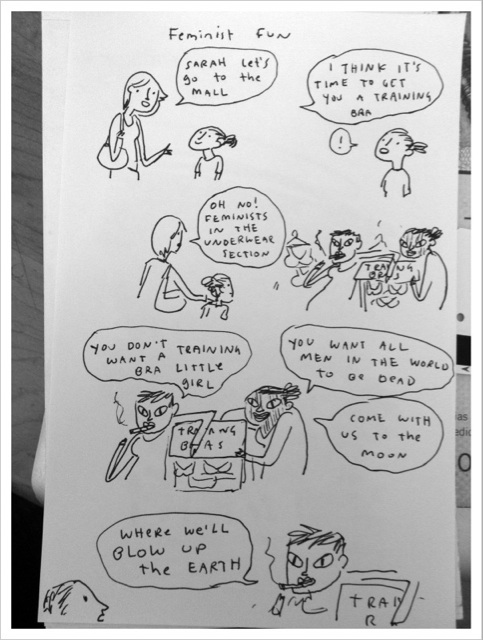
God, what a nightmare! To wake up to Straw Feminists in the closet, one of the greatest bogeymen of all time!
Looks like feminism has been in the news a lot these days! It's of interest to me, which is why you saw that Guardian cartoon come of it last time. This time around, this sketch is more of a reaction to people coming up to me and saying they like "the Feminists" cartoons I draw. They're referring to the Strong Female Characters. Color me surprised! The SFC occupy a space in what is often shown to us to be "feminist" in movies and stuff, but that's not what they are. Their main deal is that they are horrible people! Granted, it's one of the words on the poster, but that's not what they are, it's a joke. I ain't in the business of misrepresenting equal rights movements, if I can help it. Rights for all!
These snakey ladies made an appearance a while ago as a twitter sketch:
esse foi o vídeo citado no programa de segunda, 8 de outubro, 13 horas.