Mahmoudthis is crap. who is the audience? if it's a nontechnical audience, do you really need 3+ minutes to explain collaboration? if it's an audience that is, or will be, technical, then you've just succeeded in feeding them the shitty, watered-down, branded version of stuff they need to learn, instead of the actual stuff they need to learn. only maybe-effective case i can see is if it's for investors to feel smart when they invest, maybe.
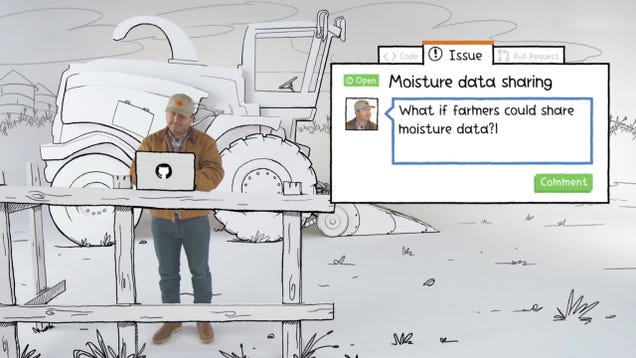
As ubiquitous as it is, GitHub is a little baffling for beginners because it’s not evident at the start how it actually works. So, GitHub made a video to help make sense of it all.
Mahmoudummm, stephen, i think their count is wrong? they say 227k, my total from https://tools.wmflabs.org/wlm-stats/ says 277k
Mahmoudi see they have an API. time for hatenote?
World's largest and most authoritative structured repository of hate speech
Mahmoudgood news, baaaaad image
 Scientists find Alzheimer's drug makes teeth grow back
Researchers at King's College London found that the drug Tideglusib stimulates the stem cells contained in the pulp of teeth so that they generate new dentine -- the mineralised material under the enamel.Tideglusib switches off an enzyme called GSK-3 which prevents dentine from carrying on forming. Scientists showed it is possible to soak a small biodegradable sponge with the drug and insert it into a cavity, where it triggers the growth of dentine and repairs the damage within six weeks.
Professor Paul Sharpe, lead author of the study, of the Dental Institute, from King's College London, said: "The simplicity of our approach makes it ideal as a clinical dental product for the natural treatment of large cavities, by providing both pulp protection and restoring dentine. "In addition, using a drug that has already been tested in clinical trials for Alzheimer's disease provides a real opportunity to get this dental treatment quickly into clinics."
Based on the "previouslies" in this post (ten years ago, seven years ago, three years ago), I'm starting to suspect the hand of the powerful Oral Decay Lobby in suppressing this technology.

finally, get it all out of there. no one wants it. c’mon body, no half measures here, i wanna be hollowed out downtown
Mahmoudterry pratchett banged neil gaiman's mom
So, Neil Gaiman today.
Neil: “This was back in 1998, Terry [Pratchett] and I were sharing a hotel room to save money. I stayed out late, it was 3AM. So I did that thing that you do when you’re trying not to wake someone, tip-toeing to the bed. And from a dark corner of the room I hear a voice: “Have you any idea of the time? Your mother and I were worried sick.” Terry was still awake.“
Mahmoudwould be sweet if there was an RSS feed of these
Mahmoudmy drives are your drives, folks
Mahmoudsena, quick, specialize!!
Mahmoudspecifics are good to know, but didn't everyone already kinda hate patton?
Mahmoudso happy
The previous entry got the attention it needed, and the maintainers of the VLC project connected with both Emularity developers and Emscripten developers and the process has begun.
The best example of where we are is this screenshot:
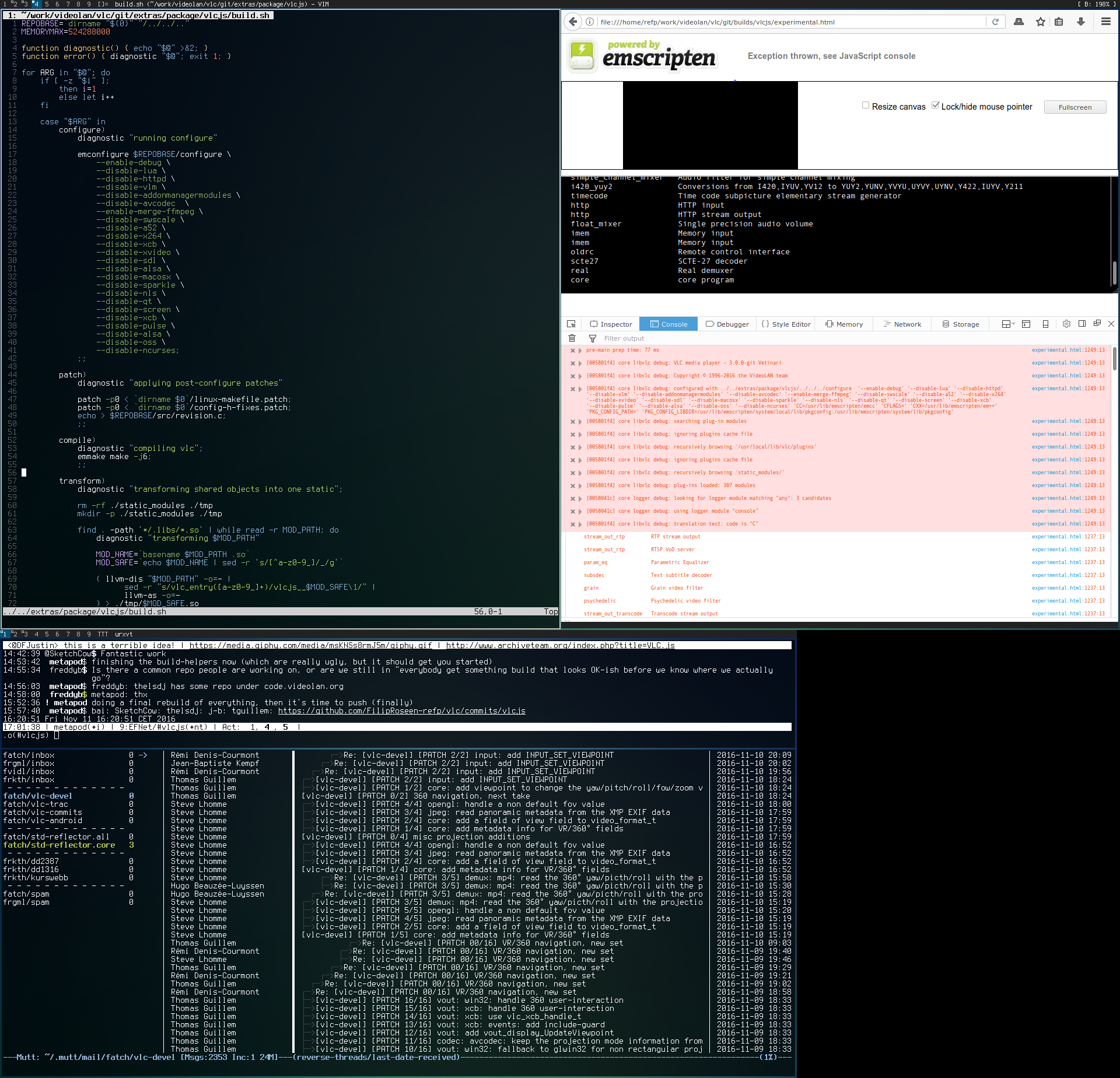
The upshot of this is that a javascript compiled version of the VLC player now runs, spits out a bunch of status and command line information, and then gets cranky it has no video/audio device to use.
With the Emularity project, this was something like 2-3 months into the project. In this case, it happened in 3 days.
The reasons it took such a short time were multi-fold. First, the VLC maintainers jumped right into it at full-bore. They’ve had to architect VLC for a variety of wide-ranging platforms including OSX, Windows, Android, and even weirdos like OS/2; to have something aimed at “web” is just another place to go. (They’d also made a few web plugins in the past.) Second, the developers of Emularity and Emscripten were right there to answer the tough questions, the weird little bumps and switchbacks.
Finally, everybody has been super-energetic about it – diving into the idea, without getting hung up on factors or features or what may emerge; the same flexibility that coding gives the world means that the final item will be something that can be refined and improved.
So that’s great news. But after the initial request went into a lot of screens, a wave of demands and questions came along, and I thought I’d answer some of them to the best of my abilities, and also make some observations as well.

When you suggest something somewhat crazy, especially in the programming or development world, there’s a variant amount of response. And if you end up on Hackernews, Reddit, or a number of other high-traffic locations, those reactions fall into some very predictable areas:
So, quickly on some of these:
But let’s shift over to why I think this is important, and why I chose VLC to interact with.
First, VLC is one of those things that people love, or people wish there was something better than, but VLC is what we have. It’s flexible, it’s been well-maintained, and it has been singularly focused. For a very long time, the goal of the project has been aimed at turning both static files AND streams into something you can see on your machine. And the machine you can see it on is pretty much every machine capable of making audio and video work.
Fundamentally, VLC is a bucket that, when dropped into with a very large variance of sound-oriented or visual-oriented files and containers, will do something with them. DVD ISO files become playable DVDs, including all the features of said DVDs. VCDs become craptastic but playable DVDs. MP3, FLAC, MIDI, all of them fall into VLC and start becoming scrubbing-ready sound experiences. There are quibbles here and there about accuracy of reproduction (especially with older MOD-like formats like S3M or .XM) but these are code, and fixable in code. That VLC doesn’t immediately barf on the rug with the amount of crapola that can be thrown at it is enormous.
And completing this thought, by choosing something like VLC, with its top-down open source condition and universal approach, the “closing of the loop” from VLC being available in all browsers instantly will ideally cause people to find the time to improve and add formats that otherwise wouldn’t experience such advocacy. Images into Apple II floppy disk image? Oscilloscope captures? Morse code evaluation? Slow Scan Television? If those items have a future, it’s probably in VLC and it’s much more likely if the web uses a VLC that just appears in the browser, no fuss or muss.

Fundamentally, I think my personal motivations are pretty transparent and clear. I help oversee a petabytes-big pile of data at the Internet Archive. A lot of it is very accessible; even more of it is not, or has to have clever “derivations” pulled out of it for access. You can listen to .FLACs that have been uploaded, for example, because we derive (noted) mp3 versions that go through the web easier. Same for the MPG files that become .mp4s and so on, and so on. A VLC that (optionally) can play off the originals, or which can access formats that currently sit as huge lumps in our archives, will be a fundamental world changer.
Imagine playing DVDs right there, in the browser. Or really old computer formats. Or doing a bunch of simple operations to incoming video and audio to improve it without having to make a pile of slight variations of the originals to stream. VLC.js will do this and do it very well. The millions of files that are currently without any status in the archive will join the millions that do have easy playability. Old or obscure ideas will rejoin the conversation. Forgotten aspects will return. And VLC itself, faced with such a large test sample, will get better at replaying these items in the process.
This is why this is being done. This is why I believe in it so strongly.
I don’t know what roadblocks or technical decisions the team has ahead of it, but they’re working very hard at it, and some sort of prototype seems imminent. The world with this happening will change slightly when it starts working. But as it refines, and as these secondary aspects begin, it will change even more. VLC will change. Maybe even browsers will change.
Access drives preservation. And that’s what’s driving this.
See you on the noisy and image-filled other side.
Mahmoudbeen doin this for days
Part of the New Internet Grammar: using question marks not to denote questions, but upturns in voice, so that a tentative statement gets a question mark but a flatly delivered question doesn’t.
why would you do this
It just seems right?
Mahmoudman
Mahmoudto this day i still don't know why chemistry stuff trends so high in the "Trending" tab of TOR. Like, I see a bunch of chinese people liking this, but that's a heckuva way to keep up to date on chemistry papers, kudos to them!
Iridium catalysts containing dative nitrogen ligands are highly active for the borylation and silylation of C−H bonds, but chiral analogs of these catalysts for enantioselective silylation reactions have not been developed. We report a new chiral pyridinyloxazoline ligand for enantioselective, intramolecular silylation of symmetrical diarylmethoxy diethylsilanes. Regioselective and enantioselective silylation of unsymmetrical substrates was also achieved in the presence of this newly developed system. Preliminary mechanistic studies imply that C−H bond cleavage is irreversible, but not the rate-determining step.

Iridium works now: A new chiral pyridinyloxazoline ligand was developed, which enables enantioselective, intramolecular silylation of symmetrical diarylmethoxy diethylsilanes. Regioselective and enantioselective silylation of unsymmetrical substrates was also achieved in the presence of this newly developed system.
Mahmoudgood

Part of Volkswagen’s $14.7 billion Dieselgate settlement requires the company to offer buybacks to nearly half a million owners whose cars cheated emissions tests. But that settlement does not stipulate that those bought-back cars have to be in good shape, so some owners are stripping their vehicles down.
Mahmoudaw
I've never met that person, so that never happened.
We've had over six thousand different bands and headliner-level DJs since then, so that would have been a hell of a thing.
Mahmoudthis is legit research

Mahmoudhelluva tour video
Mahmoudmy favorites are the ones that sound abhorrent but end up being extremely innocent?
Mahmoudtfw turns out you were the stinky one
Mahmoudsomeone make this a font already :')
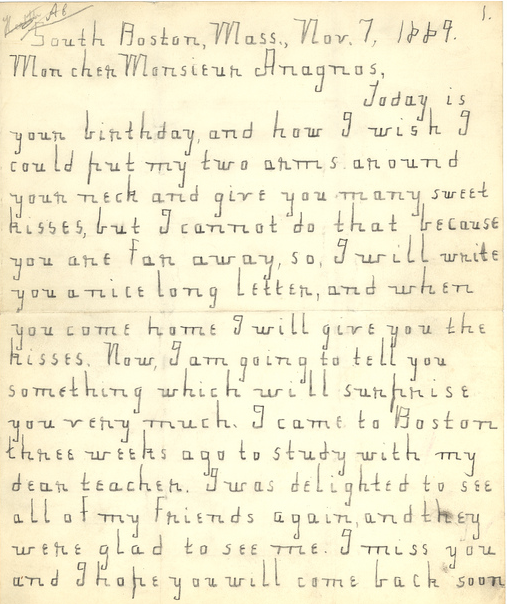
Image by Flickr, courtesy of Perkins School for the Blind
The inspirational blind and deaf activist and educator Helen Keller learned to speak aloud, but, to her great regret, never clearly.
Her careful penmanship, above, is another matter. Her impeccably rendered upright hand puts that of a great many sighted people—not all of them physicians—to shame.
Keller learned to write—and read—with the help of embossed books as a student at Perkins School for the Blind. The United States didn’t adopt Standard Braille as its official system for blind readers and writers until 1918, when Keller was in her late 30’s. Prior to that blind readers and writers were subjected to a number of competing systems, a situation she decried as “absurd.”
Some of these systems had their basis in the Roman alphabet, including Boston Line Type, the brainchild of Perkins’ Founding Director, Samuel Gridley Howe, an opponent of Braille. Students may have preferred dot-based systems for taking notes and writing letters, but Boston Line Type remained Perkins’ approved printing system until 1908.
There’s more than an echo of Boston Line Type in Keller’s blocky characters, as well as her spacing. Deviating from penmanship forms learned at school is a luxury exclusive to the sighted. Until formation became instinctual, Keller relied on a grooved board to help her size her characters correctly, an exhausting process. Small wonder that she ended many of her early letters with “I am too tired to write more.”
Perkins has published a Flickr album of letters Keller wrote between the ages of 8 and 11 to then-director Michael Anagnos, including 3 pages in French. Leafing through them, I marveled less at her ability and determination than my (sighted) 16-year-old son’s lack of interest in developing a respectable-looking hand.
Keller’s handwriting is so above reproach that it quickly fades to the background, upstaged by her charming manners and girlish preoccupations. A sample:
If you go to Roumania, please ask the good queen Elizabeth about her little invalid brother and tell her that I am very sorry that her darling little girl died. I should like to send a kiss to Vittorio, the little prince of Naples, but teacher says she is afraid you will not remember so many messages.
Browse Perkins’ collection of Keller’s handwritten letters to Michael Anagnos here.
Related Content:
Helen Keller Speaks About Her Greatest Regret — Never Mastering Speech
Ayun Halliday is an author, illustrator, theater maker and winemaker who played Annie Sullivan in her high school’s production of The Miracle Worker. Follow her @AyunHalliday.
Helen Keller Had Impeccable Handwriting: See a Collection of Her Childhood Letters is a post from: Open Culture. Follow us on Facebook, Twitter, and Google Plus, or get our Daily Email. And don't miss our big collections of Free Online Courses, Free Online Movies, Free eBooks, Free Audio Books, Free Foreign Language Lessons, and MOOCs.


