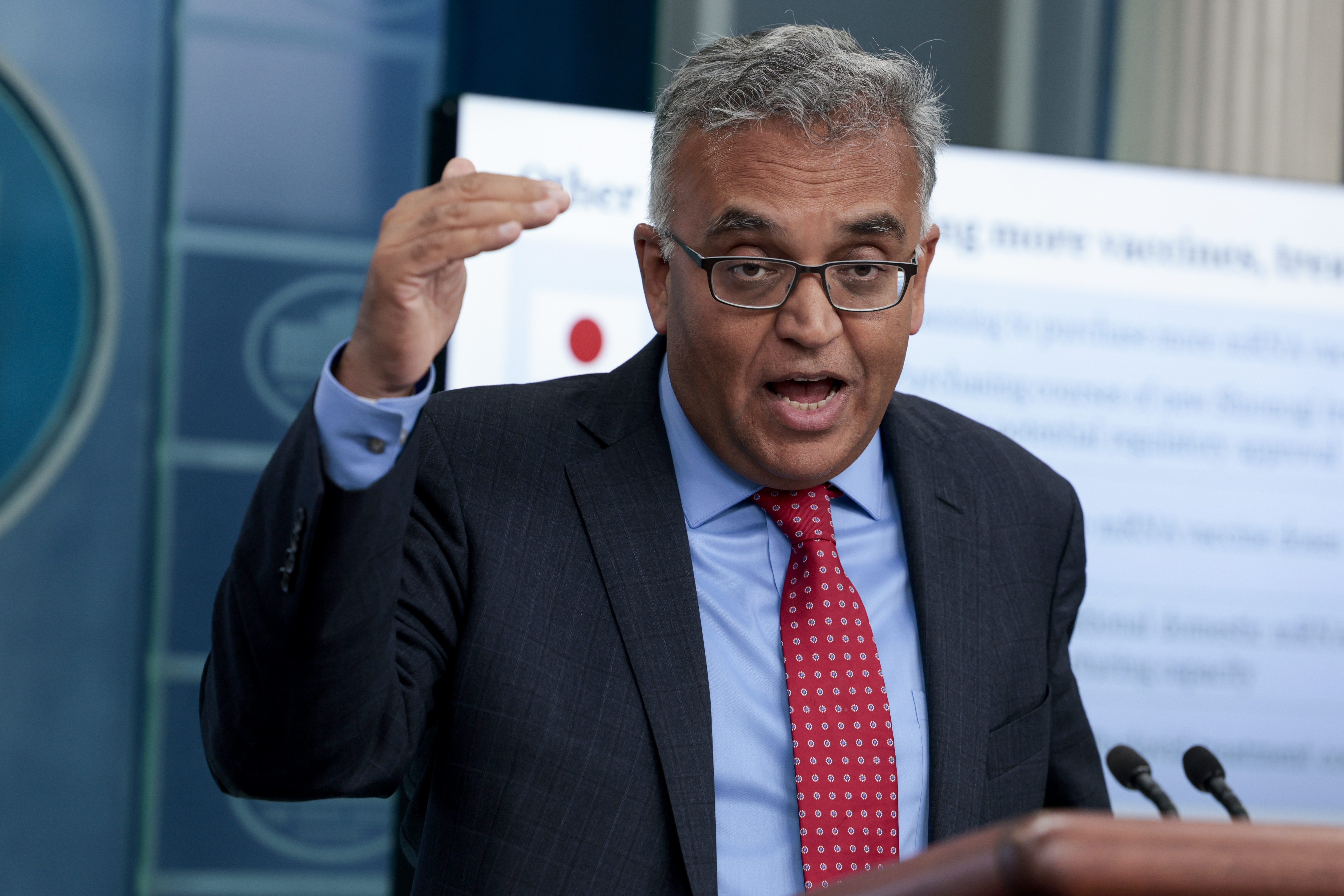
Enlarge / White House Coronavirus Response Coordinator Dr. Ashish Jha gestures as he speaks at a daily press conference in the James Brady Press Briefing Room of the White House on April 26, 2022 in Washington, DC. (credit: Getty | Anna Moneymaker)
The US could see a significant surge in COVID-19 cases, hospitalizations, and deaths this fall and winter unless the country prepares and acts, according to public health experts with the Biden administration.
Last week, administration officials told reporters in a background briefing that some disease models projected that the US could see 100 million coronavirus infections this winter, though there is a wide range of possibilities. The noted forecast assumed that omicron subvariants continued to be dominant in the country, rather than a dramatically different variant potentially worsening the outlook.
In an interview Sunday on ABC's This Week, White House COVID-19 response coordinator Ashish Jha reiterated the warning of a winter surge, noting that each pandemic winter so far has included large surges, and the conditions will be prime for another this season. Protection from first and even second boosters will wane by this fall. Meanwhile, the virus will continue to evolve new variants and subvariants, and people will huddle indoors during the cold weather and end-of-year holidays.
Enlarge / An artist's rendering of Star Harbor Academy in Colorado. (credit: Star Harbor)
A group of astronauts, engineers, and business executives is betting on a vibrant space economy by launching a new initiative called "Star Harbor." Among several planned activities, this spaceflight campus would train future astronauts and make facilities such as a neutral buoyancy laboratory and high-gravity centrifuge publicly available.
Star Harbor has already acquired 53 acres in Lone Tree, Colorado, for about $25 million, said Star Harbor founder and Chief Executive Maraia Tanner in an interview. The company plans to open the mixed-use development campus, just south of Denver, beginning in 2026.
The centerpiece of the new development will be Star Harbor Academy, Tanner said, estimating its development cost at $120 million. The academy will include the capability for microgravity flights, a neutral buoyancy facility, high-gravity centrifuge, land-based and underwater habitats, hypobaric and hyperbaric chambers, a human performance center, and more.
Amazon is recruiting rural local businesses to deliver packages seven days a week, 360 days a year. | Carol M. Highsmith/Buyenlarge/Getty Images
The e-commerce giant is recruiting local businesses in Alabama, Mississippi, and Nebraska as part of a secretive new delivery program.
Since at least last summer, Amazon has quietly been recruiting mom-and-pop shops in rural America to join an experimental delivery program. The company is paying participating small businesses a per-package fee to deliver Amazon orders within a 10-mile radius to their neighbors’ homes in states like Nebraska, Mississippi, and Alabama.
The local businesses Amazon is recruiting range from florists to restaurants to IT shops, and none of them are required to haveprior delivery experience — just a commitment to deliver Amazon packages seven days a week, around 360 days a year, and a physical location to receive parcels each morning.
As Amazon’s ambitions to speed up delivery times and handle more of its own deliveries has grown, rural America has posed the thorniest logistical and financial challenges. While delivery drivers in cities and suburbs might be able to deliver two dozen packages per hour or more, the distance between homes in rural and other remote communities means drivers can only handle half that amount or less, making deliveries to these locales more costly. As a result, Amazon has handed off these deliveries to partners including UPS and, most notably, the US Postal Service, to handle the so-called “last mile” in small-town America.
The new local business delivery beta test seems aimed at perhaps one day replacing its existing partners as Amazon’s sales grow and the Postal Service navigates its own financial and operational challenges. Amazon hopes the new program could help it take more control over customer deliveries in sparsely populated areas and improve the delivery speed to these customers’ doors. The company has already tried versions of the program in a few international markets, including India since 2015, but the testing in the United States is more recent.
The delivery program marks just the latest example of Amazon offering small businesses an opportunity to earn new revenue by integrating with the tech giant’s growing ecosystem. From third-party merchants offering up inventory that bolsters Amazon’s massive online product catalog, to urban delivery companies working exclusively for Amazon to ferry hundreds of orders a day to the homes of Prime customers, Amazon has perfected the art of attracting small businesses with new business opportunities, while simultaneously making the Amazon product more attractive — all the while keeping enough distance from the partners so they can avoid liability if something goes wrong.
In the case of the new delivery initiative, Amazon is only recruiting existing businesses, in part because they already possess liability insurance, one Alabama small business owner who is participating in the program says the company told them. Some of these small businesses are being paid around $2.50 to $3 per package, and have recently been successful in persuading Amazon to add modest increases to their rates as gas prices have soared. An Amazon webpage marketing the program says business owners can expect to make $1,500 to $2,000 a week if they deliver 600 to 800 packages weekly. That amounts to roughly $2.50 per package. Marc Wulfraat, a logistics consultant whose firm tracks Amazon’s warehouse network, told Recode he would have expected the pay to be at least $3.50 per package to make the service attractive to businesses.
By positioning the opportunity as a side hustle for rural businesses rather than a core money-maker, Amazon might be able to offer these businesses just enough financial incentive to keep them satisfied with the gig while making the tough economics of rural delivery work. But if Amazon’s history with small businesses is predictive of future relationships, some partners will find great success with the program while others will leave disappointed or disenchanted.
Amazon is pitching the initiative — currently called the Amazon Hub Delivery Partner program internally — as a way to bring in supplemental income by handling anywhere from a couple of dozen to a few hundred packages a day.
“All of our partners operate primary businesses and this program provides opportunity to help supplement their income,” Lauren Samaha, an Amazon spokesperson, said in a statement.
In return, the small businesses and their workers have to commit to accept and deliver packages every day of the week, including Sundays, with just five holidays off each year, according to answers in a FAQ section of a webpage marketing the program. In the past, Amazon has at times cut back the package volume earmarked for a given small business if they don’t complete the deliveries. But the small business owner who spoke to Recode said the program has provided a nice financial boost for his family during the pandemic, as well as some neighbors he’s hired.
“The appeal is diversifying the business and also creating jobs for people in the community,” the Alabama business owner told Recode. The business owner requested anonymity to speak candidly about the program without Amazon’s permission. “That’s something we care about, and it’s been really good for my jobbers.”
But the Amazon partner also warned that some small businesses have found the commitment too demanding on top of their core operation and have backed out.
“Seven days a week for me is not a big deal because I’m at my shop every day,” they said. “But for some people, it is a big deal.”
Revelations of the new delivery program come as Amazon continues to take control over more customer orders from the time an order is placed on its app to the moment it arrives at a customer’s door. Amazon is doing this partly out of necessity as online shopping volumes, especially during holiday seasons, outstrip the transportation and delivery capacities of the country’s largest parcel delivery companies. Amazon would also eventually like to offer its logistics services to other companies as an additional money-maker.
In cities and suburbs, packages shipped through Amazon’s own AMZL delivery network are contracted out to thousands of delivery firms — referred to internally as delivery service providers or DSPs — that are created by entrepreneurs to exclusively service Amazon with fleets of 20 to 40 vans. The employees or contractors hired by these firms typically drive Amazon-branded vans or trucks, wear Amazon-branded uniforms, and are monitored and judged by Amazon technology and performance expectations.
But Amazon doesn’t recruit entrepreneurs to start these companies in rural areas because the volume of packages in these geographies hasn’t historically been able to support standalone businesses. Enter the small-business shops looking to just make supplemental money as part of the new rural delivery program. These business owners and their workers use their own vehicles to handle deliveries.
In job listings, Amazon hiring managers say the program is expanding in 2022. The Alabama small business owner said that Amazon reps have told them the program is emerging from the pilot phase and has been approved for greater investment. Samaha said the program is still in beta testing.
In a short, taped webinar online, Amazon said that one of its earliest partners — a florist in Nebraska — began delivering Amazon packages in July 2021. In recent months, Amazon has been joining local chambers of commerce in rural communities and pitching the program in town hall-style gatherings. A public webpage says the company is currently accepting business referrals in just 10 states: Alabama, Arkansas, Florida, Iowa, Michigan, Minnesota, Mississippi, Missouri, Nebraska, and South Dakota.
Nearly a decade ago, Amazon started offering Sunday delivery of packages through a partnership with the US Postal Service to make the shipping perks of the Prime membership program even more attractive. But even years later, the USPS does not support Sunday delivery in every town in America, leaving a hole that these small mom-and-pop establishments are now being asked to fill.
“Small towns are not used to that,” the Alabama small business owner said. “Customers have been very thankful for that.”
Rural USPS postal carriers and postmasters have also previously told Recode that the increase in e-commerce shopping during the pandemic has at times led to an overwhelming amount of Amazon parcels on top of regular mail, resulting in routes taking considerably longer than the amount of time carriers are actually being paid for.
Amazon’s other logistics end game is to eventually make its delivery network available to non-Amazon businesses, though the timeline of fulfilling that ambition was pushed back by the pandemic. Yet if Amazon eventually wants to do that, it may need to prove that it can offer wider and more consistent delivery coverage than the traditional players do today.
“Amazon is trying to figure out ways to be smarter than the established [shipping] carriers,” said Marc Wulfraat, the logistics consultant. “They want to cover any zip code so they can go out to market and [sell] their logistics as a service. The problem is… it’s a huge expense to get to that last 15 percent of the population.”
But with rural mom-and-pop shops taking on some of those expenses, Amazon may very well get there. Along the way, even more of the country will end up working for the Amazon labor machine.
It’s becoming quite clear that Elon Musk’s approach to dealing with complex issues is not to actually understand the complex realities behind them, but to simply say what he thinks an audience wants to hear, and perhaps relatedly, to simply accept the last thing that someone presented to him as the official state of things. The latest in the long line of bizarrely contradictory and nonsensical breadcrumbs that Musk is leaving regarding his planned approach to handling content moderation on Twitter includes a full warm embrace of the EU’s highly censorial Digital Services Act, as tweeted by Thierry Breton, the European Commissioner for the Internal Market.
The video is pretty short, but here’s a rough transcript:
Breton: So we’re in Austin, together with Elon Musk. Thank you, Elon, for welcoming me.
Musk: Thank you. You’re most welcome.
Breton: Of course, we discussed many issues, and I was happy to be able to explain to you the DSA, a new regulation in Europe, and I think that now, you understand very well. It fits pretty well with what you think we should do on the platform?
Musk: I think it’s exactly aligned with my thinking. I think I very much agree… It’s been a great discussion. I agree with everything you said, really. I think we’re very much of the same mind and anything that my companies can do that would be beneficial to Europe, we want to do that.
Musk responded to Breton’s tweet by saying that “we are very much on the same page.”
Of course, the actual DSA setup seems extremely different than what Musk has said he wants regarding a platform that allows most speech. As we’ve discussed, the DSA, as currently construed would make something of a mess for speech online, and would put much more onerous regulations in place regarding how websites can moderate, and how much content they need to pull down.
Earlier in the day, Musk had once again (after falsely claiming that Twitter has a leftwing bias) tweeted that his preference was to “hew close to the laws of countries in which Twitter operates.” Further saying “If the citizens want something banned, then pass a law to do so, otherwise it should be allowed.”
This is all nonsense on multiple levels. First of all, many, many countries are not actually democracies. So, laws are not always the will of the citizens. Secondly, in the US, we have things like the 1st Amendment that are actually designed so that Congress cannot pass a law that bans speech. But, most importantly, the laws of a country make a terrible guide for content moderation, because they’re really trying to serve two very different purposes.
Over the past few years, Twitter has actually been one of the leading companies speaking out about the very serious potential problems with the EU’s approach to speech in the DSA. It’s been a key player in explaining how the rules that the EU is looking to put in place could be damaging for free speech and also how the rules should be changed to avoid attacking free speech. And in walks Musk, with apparently little to no understanding of the details or the nuances, and just endorses the entire approach.
And, let’s not even bother getting into the fact that much of the meeting was actually to discuss other issues regarding Tesla and the EU, and how Musk notes that his companies (plural) want to do what’s best for Europe. People have raised serious questions about the business needs of Tesla in countries like China and India may run into issues with how Twitter is moderated, and now Musk is effectively announcing that if it’s good for Tesla in Europe, he’ll happily agree to much greater speech suppression on the site.
If you actually support free speech, it’s pretty damn maddening, because the last thing we need right now is a company like Twitter endorsing the current DSA approach, which would take a sledge hammer to certain speech rights. But, according to Musk, it’s all good, because it’s what the law says.
A diamond shape represents counts, and as you scroll, shapes fill the screen until you only see the tips. The shapes overflow beyond what we can or want to understand. The time series line on the bottom shows cumulative deaths over time, leading towards the one-million mark.
There are all sorts of silly and made up reasons to be mad at Disney, but those shouldn’t take away from the many legitimate ways in which Disney is a terrible, awful company. For years, it was one of the most aggressive in pushing for ever expanded copyrights, and was one of the chief lobbyists pushing to extend copyright in all sorts of directions. To be honest, over the last two decades, some of the other big Hollywood/media companies have gotten even more aggressive than Disney, but Disney has certainly remained aggressively awful.
And, of course, any time someone pushes back on this aspect of Disney colonizing culture, they pull out the copyright landlord’s favorite justification: “we’re doing it for the artists.” Over and over again, we see the big TV and movie studios, the giant record labels, and the biggest publishers claiming they need to fight for ever expanded copyrights to help the actual creators — all while doing absolutely everything they possibly can to avoid paying anyone anything at all.
Even for those of us deeply aware of the nature of “Hollywood Accounting,” the story that came out late in 2020 was still stunning. The Science Fiction & Fantasy Writers of America (SFWA) kicked off a campaign on behalf of famed author Alan Dean Foster — who wrote many of the early Star Wars books. Disney had claimed that when it bought the Hollywood studio 20th Century Fox, that it only bought the assets and none of the liabilities, and therefore, Disney’s lawyers claimed, it could keep on publishing the books Foster wrote without paying any royalties.
Now, that’s quite a trick. Indeed, if you could do that, well, then it would seem to create quite a lucrative business opportunity. Sign up a bunch of creatives to publishing deals. Hell, promise them extremely high royalty rates (you’re not going to end up paying them, so who cares?), and then after the contracts are in, sell off the “assets” but not the “liabilities” of your business to a different entity, allowing them to keep publishing and you never actually have to pay any royalties. Genius! Pure evil. But, genius.
But it seems especially rich that Disney, which has spent so many decades insisting its out there fighting the good fight to support “creative artists” to be doing this. Recently, the SFWA published an update on the campaign, noting that while Disney did agree to pay some high profile authors, it is still refusing to do it for less well known authors:
You’ve paid some authors what you owed them. But there are other creators that you don’t want to talk about. And, because you did not take our advice, new creators are coming forward who are owed money, too.
You still refuse to recognize your obligations to lesser-known authors who wrote media tie-in works for Marvel, for Star Wars, for Aliens, for Predator, for Buffy: TVS, and more, universes that you’ve bought the rights to, along with the obligations to those creators. You’ve re-published their works but have failed to do even the bare necessities of contract and talent management. You’ve failed to pay these writers royalties they’re legally owed and have not given them the courtesy of royalty statements and reprint notices.
This is shameful, and it points to the hollowness of Disney’s long-running holy war to get us all to “respect copyright.” Disney respects copyright only to the extent that it serves as a charter for corporate abuse of creators, or a means by which Disney can reach beyond its corporate walls and dictate the conduct of its competitors or other industries. When it comes to copyright as a tool for securing the rightful wages of creative workers, Disney exhibits contempt far beyond the taunts of The Pirate Bay or the insouciance of bootleg DVD hawkers in a night market.
Copyright’s power to create worker power has always been oversold, mostly by giant entertainment companies who correctly understood that the more copyright creators got, the more copyright they could expropriate through non-negotiable contracts. Copyright isn’t useless to creators, but it is also no substitute for fair contracting laws, labor organizing, and antitrust enforcement.
His article also looks at a few others ways that Disney is trying to use copyright to abuse, rather than help artists.
Of course, I was curious what organizations, that pretend to “represent the creators,” had to say about all of this, so I went to the website of CreativeFuture. Their website insists that they’re there to help “creative people.” They even have this amazingly ridiculous banner (that they apparently registered a trademark over, because why not?)
So, here’s a story where the industry is literally refusing to pay creative people what they’re contractually owed, for their creations. Surely, CreativeFuture has spoken up about this attack on the livelihoods of creators, right? I mean, the organization even set up a whole hashtag campaign, #StandCreative, to pretend it is “standing with” creators. So, surely, they’ve come out in support of Alan Dean Foster and the SFWA and all of the creators Disney is not paying, right? Right?!?
Huh. Guess not.
Instead, the top article on their website… is attacking EFF, the organization Cory Doctorow works for. Doctorow is out there advocating for artists to actually get paid, while CreativeFuture is attacking his work and pretending it actually supports creatives.
I wonder why CreativeFuture isn’t supporting these creative people? Hmm. I mean, I’m sure that CreativeFuture’s board of directors would be right there at the front of the line demanding that Disney pay the writers it owes, right? I mean, look, let’s just grab a randomly selected CreativeFuture board member and see…
So who is that? Oh, just the senior executive vice president, secretary and general counsel to the… oh…. The Walt Disney Company. Ah, well. That explains it.
Well, I’m sure some of CreativeFuture’s other board members would note his conflict of interest and stand up for the actual creators, right? Hmm. There’s Leah Weil, the General Counsel of Sony Pictures, so that’s not going to work. Oh, and the General Counsel of Warner Bros., John Rogovin, (well until just recently). Well, I’m sure this other person, Kimberly Harris will stand up for… oh, oh I see. General Counsel for NBCUniversal, you say?
Yes, yes, I’m beginning to see why CreativeFuture apparently wants nothing to do with this actual campaign to support actual creators. It might interfere with the interests of the Hollywood studios that set up CreativeFuture as a pure front group in the first place.
The Centers for Disease Control and Prevention is now investigating 109 cases of unexplained liver inflammation—hepatitis—in young children from 25 states over the past seven months. Of the 109 affected children, five have died, and 15 (14 percent) required liver transplants. The children were all under the age of 10, and 90 percent were hospitalized.
The CDC's announcement Friday marks a dramatic uptick in the US's reported cases, which was limited to nine confirmed cases in Alabama just three weeks ago. The cases also add to a mounting global tally, which reached upward of 300 cases from more than two dozen countries.
But, despite the boom in cases, CDC and international health investigators are still puzzled about the cause of the illnesses. Severe hepatitis is rare in young children, and unexplained cases of severe hepatitis are rarer.
This response speaks to real challenges that lawmakers are running up against, and the legal pushback the White House could encounter on any executive actions. But it’s still been disappointing for advocates, who want the Biden administration to take more creative approaches that could keep up the fight on abortion access.
There are no silver bullets here. Anything the administration tries would almost certainly be contested, often in courts full of Republican appointees. And while they might help on the margins, none of the actions available would fully restore abortion rights in states where they’re being threatened.
“I think whatever comes next is a novel legal tactic. I would be really pessimistic that the courts, stacked that they are, would be receptive, but that doesn’t mean we shouldn’t try,” says Khiara Bridges, a UC Berkeley law professor and faculty director for the Center on Reproductive Rights and Justice.
In a press statement on Tuesday, Biden said he’d called on the White House Gender Policy Council and the White House counsel to “prepare options for an administration response.” He noted, too, that the administration would have its plans ready when a Supreme Court decision is finalized. “We will be ready when any ruling is issued,” Biden emphasized.A White House spokesperson did not respond to a request for comment for this story.
According to experts and advocates who spoke with Vox, here are a few avenues the administration could consider.
Increase access to medication abortion by challenging state laws
If successful, this could allow people in all states, even places where there are abortion bans, to obtain a medication abortion up to 10 weeks into a pregnancy.
The FDA has already issued regulations that make it easier to obtain a medication abortion. In April 2021, it approved changes that enabled people to receive a prescription via telemedicine and get medication through the mail, a regulation the agency made permanent in December.
Nineteen states, however, have passed laws that directly contradict the FDA’s regulations, requiring people to consume abortion pills with a clinician present.
Legal experts argue that the Department of Justice could challenge these laws since federal regulations supersede state policies. If Roe falls, this would also mean that such challenges could attempt to preserve access to medication abortion in all states, even those that try to implement wholesale bans.
“A similar argument previously worked for a different drug,” write Drexel University law professor David Cohen, University of Pittsburgh law professor Greer Donley, and Temple University law professor Rachel Rebouché, in a New York Times op-ed outlining potential executive actions. In 2014, a pharmaceutical company challenged Massachusetts’s attempt to regulate an opioid drug differently from the federal government, and won.
In this scenario, the legal challenge could be brought by the Department of Justice, a manufacturer of medication abortion, or abortion providers. When asked about this option, a Biden adviser told the New York Times that the president wouldn’t be telling DOJ what to do.
This approach, like any that Biden takes via executive action, is poised to face significant opposition. One gray area, says Boston University law professor Nicole Huberfeld, is the jurisdiction states have over what physicians and providers are able to do, since the FDA’s authority doesn’t cover limits a state places on doctors and pharmacists.
Were the challenge to succeed, however, it could mean that people in all 50 states would be able to access medication abortion.
“We are well aware that these could be challenged and they could lose, but there’s no reason to cut off options before you try them and let the other side win before you even fight the battle,” Cohen told Vox.
Allow clinics to establish themselves on federal lands
In states that have imposed abortion bans, the federal government could also try to lease out federal lands and allow clinics to operate on them.
Because federal lands aren’t subject to states’ civil laws, and there’s room to interpret criminal laws, clinics could theoretically establish themselves on places like military bases and tribal lands, without having to deal with a state’s bans. “Even though the land is inside the border of a state, it wouldn’t be governed by the laws of a state,” says Bridges.
Any activity on these lands would instead be governed by federal law, meaning providers who operate there and people who travel there for abortions wouldn’t have to face state penalties. Cohen notes that there are past cases when a state’s right-to-work laws have not applied to how companies approach unionization if they are located on federal lands.
The exact approach, though, is untested and is also poised to get legal pushback from those who are opposed.
Enforce Medicaid coverage in states that try to implement outright bans
Because of the Hyde Amendment, federal funds can’t be used for most abortions, though there are exceptions for rape, incest, and cases when a pregnant woman’s life is endangered. In practice, this has meant that Medicaid isn’t able to cover many abortions, though it can still be used in rare instances. (States can also use their own Medicaid money to cover abortions, but the federal government has little say in how these funds are applied.)
Some states, including Arkansas, Kentucky, and Louisiana, have trigger laws that would go into effect if Roe is overturned. These laws would ban abortion even in the cases of some of the exceptions outlined in the Hyde Amendment. The Arkansas law, for example, makes no exceptions for cases of rape or incest.
For bans like these, the administration could argue that federal Medicaid funds should still be used to cover abortions in the narrow areas where they apply. The Department of Health and Human Services could encourage states to maintain coverage of abortion in these specific cases, as well as abortion services.
“The states are supposed to cover abortion services allowed by the Hyde Amendment under Medicaid,” says University of Pennsylvania law professor Allison Hoffman. “HHS could encourage them to do so. HHS could also try to enforce a state’s violation of federal law by not covering it.”
This policy wouldn’t apply to many abortions, and could also face legal challenges, but it could ensure that a segment of people would still be able retain access.
Such enforcement would likely come in the form of a warning that HHS issues to states, says Boston University law professor Nicole Huberfeld. The agency is unlikely to withhold Medicaid funding because of the damage that would cause to providers and recipients, she notes.
In addition to executive actions, activists have pushed the president to be more vocal about his support on the subject in general. “If he won’t even talk about abortion (no votes or budget needed) or give us a plan he’s won’t go bold to protect us,” We Testify executive director Renee Bracey Sherman posted on Twitter on Wednesday.
Biden has been hesitant to embrace abortion rights for much of his career. He questioned the initial Supreme Court decision on Roe and once voted for an amendment that would have allowed states to overturn it, changing course in 1983. Similarly, on the Hyde Amendment, he previously favored keeping it and relented after severe blowback from his party.
Biden’s reluctance to use the term “abortion” is also tied to what he sees as politically tenable.“Longtime advisers said that Mr. Biden’s position on the issue was clear and that he preferred to use words like ‘privacy’ rather than ‘abortion’ because it appealed to a wider swath of the public,” the New York Times’s Peter Baker reported.
Advocates note that they’re merely urging the administration to consider all the channels that are available, even if prospects look bleak.
“We’ve seen over the past few years and the pandemic what the federal government could do,” says Morgan Hopkins, the executive director of campaigns at advocacy group All Above All. “People who need abortions deserve that kind of energy.”
ProPublica is a nonprofit newsroom that investigates abuses of power. Sign up to receive our biggest stories as soon as they’re published.
When U.S. Supreme Court Justice Samuel Alito, in a draft opinion obtained and published this week by Politico, detailed his justifications for overturning Roe v. Wade, he invoked a surprising name given the case’s subject. In writing about abortion, a matter inextricably tied to a woman’s control over her body, Alito chose to quote from Sir Matthew Hale, a 17th-century English jurist whose writings and reasonings have caused enduring damage to women for hundreds of years.
The so-called marital rape exemption — the legal notion that a married woman cannot be raped by her husband — traces to Hale. So does a long-used instruction to jurors to be skeptical of reports of rape. So, in a way, do the infamous Salem witch trials, in which women (and some men) were hanged on or near Gallows Hill.
Hale’s influence in the United States has been on the wane since the 1970s, with one state after another abandoning his legal principles on rape. But Alito’s opinion resurrects Hale, a judge who was considered misogynistic even by his era’s notably low standards. Hale once wrote a long letter to his grandchildren, dispensing life advice, in which he veered into a screed against women, describing them as “chargeable unprofitable people” who “know the ready way to consume an estate, and to ruin a family quickly.” Hale particularly despaired of the changes he saw in young women, writing, “And now the world is altered: young gentlewomen learn to be bold” and “talk loud.”
An excerpt from Hale’s “Letter of Advice.”
(Via Google Books)
Hale became Lord Chief Justice of England in 1671. In his time (Hale’s contemporaries included Oliver Cromwell and Charles II), Hale was a respected, perhaps even venerated, jurist known for piety and sober judgment. He wrote a two-volume legal treatise, “The History of the Pleas of the Crown,” that has proved influential ever since.
Alito, in his draft opinion, invokes “eminent common-law authorities,” including Hale, to show how abortion was viewed historically not as a right, but as a criminal act. “Two treatises by Sir Matthew Hale likewise described abortion of a quick child who died in the womb as a ‘great crime’ and a ‘great misprision,’” Alito wrote.
Even before “quickening” — defined by Alito as “the first felt movement of the fetus in the womb, which usually occurs between the 16th and 18th week of pregnancy” — Hale believed an abortion could qualify as homicide. “Hale wrote that if a physician gave a woman ‘with child’ a ‘potion’ to cause an abortion, and the woman died, it was ‘murder’ because the potion was given ‘unlawfully to destroy her child within her,’” Alito wrote.
Courts have long leaned on precedents established by old cases and the scholarship of legal authorities from centuries gone by. But what happens when you trace citations back to their ancient source? In Hale’s case, you sometimes find a man conceiving precepts out of thin air. Other times it was the opposite, as he clung to notions that were already becoming anachronistic in the last half of the 17th century.
Consider the marital rape exemption. In “Pleas of the Crown,” Hale wrote, “The husband cannot be guilty of a rape committed by himself upon his lawful wife for by their mutual matrimonial consent and contract the wife hath given up herself in this kind unto her husband which she cannot retract.” So, according to Hale, marriage, for a woman, amounts to contractual forfeit, in which she loses legal protection or recourse should her husband sexually assault her.
Hale’s pronouncement became the accepted common law and served as foundation in the United States for immunizing a husband accused of raping his wife. And where did Hale’s pronouncement come from? What did he base it upon? Who knows? “Hale appears to have been the first to articulate what later would become an accepted legal principle, that a husband cannot be charged with raping his wife,” according to a footnote in one law review article. Another law review article, titled “The Marital Rape Exemption: Evolution to Extinction,” called Hale’s pronouncement “an unsupported, extrajudicial statement” lacking in authority.
Starting in the 1970s, states began to abandon the marital rape exemption, in whole or in part. In 1981, the Supreme Court of New Jersey wrote that it could find no support for Hale’s proposition among earlier writers. Hale’s declaration, the court found, “cannot itself be considered a definitive and binding statement of the common law, although legal commentators have often restated the rule since the time of Hale without evaluating its merits.” In 1984, the Supreme Court of Virginia wrote: “Hale's statement was not law, common or otherwise. At best it was Hale's pronouncement of what he observed to be a custom in 17th century England.” The Virginia court went on to note, “Moreover, Hale cites no authority for his view nor was it subsequently adopted, in its entirety, by the English courts.”
Like the marital rape exemption, the so-called Hale Warning to jurors caused centuries of misfortune in the American courts.
In “Pleas of the Crown,” Hale called rape a “most detestable crime.” Then, in words quoted many times since, he wrote, “It must be remembered, that it is an accusation easy to be made and hard to be proved, and harder to be defended by the party accused, tho never so innocent.”
Hale evoked the fear of the false accuser — and made for that fear a legal frame, which lasted for more than 300 years. In weighing the evidence in cases of alleged rape, jurors (all men, in Hale’s time and for long after) needed to consider a series of factors, Hale wrote. Did the woman cry out? Did she try to flee? Was she of “good fame” or “evil fame”? Was she supported by others? Did she make immediate complaint afterward?
Hale’s words and formulation became a standard feature of criminal trials in the United States, with jurors instructed by judges to be especially wary of allegations of rape. The effect was predictable: Charges of rape were frequently rejected. In the United States, one early example was chronicled by historian John Wood Sweet in his soon-to-be-published book, “The Sewing Girl’s Tale.” (I was allowed to read an advance copy.)
In 1793, in New York City, an aristocrat, Henry Bedlow, was accused of raping a 17-year-old seamstress, Lanah Sawyer. Bedlow hired six lawyers, including a future U.S. Supreme Court justice, who used Hale’s framework to destroy Sawyer. Sawyer said she screamed. But, one attorney asked the jury, did she also stamp her feet? Witnesses spoke of Sawyer’s good fame, according to the trial record. But “she may have had the art to carry a fair outside, while all was foul within,” the same attorney argued. “Ultimately, the defense team’s dizzying effort to dispute and distort reality had been part of a relentless effort to transform a young woman who mattered into one who didn’t,” Sweet wrote. The jury took 15 minutes to acquit.
Starting in the 1970s and 1980s, courts in the United States began moving away from instructing juries with Hale’s admonition to be particularly skeptical of rape claims. The repudiation of Hale became so complete that when a Maryland lawmaker, in 2007, invoked Hale’s words in a state legislative hearing, it was met with “outrage,” according to the Washington Post.
Despite those legal changes, the fear of the false rape accuser still persists in the justice system, at times leading to horrendous outcomes. I began researching Hale when writing, with T. Christian Miller, “An Unbelievable Story of Rape,” published by ProPublica and the Marshall Project. The story reconstructs what happened when a young woman in Lynnwood, Washington, reported being raped. We later expanded the story into a book, “Unbelievable,” in which we described Hale’s influence in rape cases at greater length. (The story also became a Netflix series.)
Then there was Hale’s role in what today is synonymous with the perversion of justice: witch trials.
In 1662, Hale presided at a jury trial in Bury St. Edmunds in which two women, Amy Denny and Rose Cullender, were accused of being witches. In a book on this case, “A Trial of Witches,” authors Ivan Bunn and Gilbert Geis wrote that by 1662, “belief in witches was in retreat in England.” Hale, however, was not part of that retreat. He believed witches were real. “Hale represented not a mainstream position but rather one rapidly becoming anachronistic,” Bunn and Geis wrote.
What’s more, Hale instructed the jurors that witches were real. A written record of the trial recounts what Hale told them: “That there were such creatures as witches he made no doubt at all; for first, the scriptures had affirmed so much. Secondly, the wisdom of all nations had provided laws against such persons, which is an argument of their confidence of such a crime.”
The jury convicted Denny and Cullender, after which Hale sentenced both women to hang. (Four years before, Hale had also sentenced to death another woman convicted of being a witch.)
Hale’s influence, once again, extended beyond the immediate case and his time. Thirty years later, his handling of the trial in Bury St. Edmunds, preserved in written record, served as a model in Salem, Massachusetts, in the infamous witch trials in 1692. “Indeed, the Salem witch-hunts might not have taken place if there had not been a trial at Bury St. Edmunds: the events at Salem notoriously imitated those at Bury,” Bunn and Geis wrote.
Hale is known mostly for his legal treatises. But his views toward women are perhaps best revealed in a letter he wrote to his grandchildren, titled “Letter of Advice.” (In a twitter thread this week I said Hale’s letter was 182 pages long. I may have understated it. I’ve since found a version online that goes on for 206 pages.)
The title page of Hale’s letter.
(Via Google Books)
In this letter, Hale prescribes individualized counsel for three granddaughters.
Mary, he wrote, possessed great wit and spirit, and “if she can temper the latter, will make an excellent woman, and a great housewife; but if she cannot govern the greatness of her spirit, it will make her proud, imperious, and revengeful.”
Frances, he wrote, possessed great confidence: “If she be kept in some awe, especially in relation to lying and deceiving, she will make a good woman and a good housewife.”
Ann, he wrote, possessed a “soft nature.” “She must not see plays, read comedies, or love books or romances, nor hear nor learn ballads or idle songs, especially such as are wanton or concerning love-matters, for they will make too deep an impression upon her mind.”
Hale complained in his letter that young women “make it their business to paint or patch their faces, to curl their locks, and to find out the newest and costliest fashions.” And with that, he was just getting started. Hale followed with a 160-word sentence that is a marvel in its depth of disdain.
“If they rise in the morning before ten of the clock, the morning is spent between the comb, and the glass, and the box of patches; though they know not how to make provision for it themselves, they must have choice diet provided for them, and when they are ready, the next business is to come down, and sit in a rubbed parlour till dinner come in; and, after dinner, either to cards, or to the exchange, or to the play, or to Hyde Park, or to an impertinent visit; and after supper, either to a ball or to cards; and at this rate they spend their time, from one end of the year to the other; and at the same rate they spend their parent’s or husband’s money or estates in costly clothes, new fashions, chargeable entertainments: their home is their prison, and they are never at rest in it, unless they have gallants and splendid company to entertain.”
Some observers have been taken aback that Alito referenced Hale. But not everyone was surprised. Eileen Hunt, a Notre Dame political science professor who has written extensively about Mary Wollstonecraft, author of the path-breaking 1792 treatise “A Vindication of the Rights of Woman,” tweeted:
“It is a truth universally acknowledged that a conservative Supreme Court justice will cherry-pick an Enlightenment-era man as a timeless authority on reproductive rights but ignore #Wollstonecraft’s pivotal philosophical views on women, mothering, and the sexual double standard.”
Enlarge / Amazon's new purchase explainer and the "learn more" link.
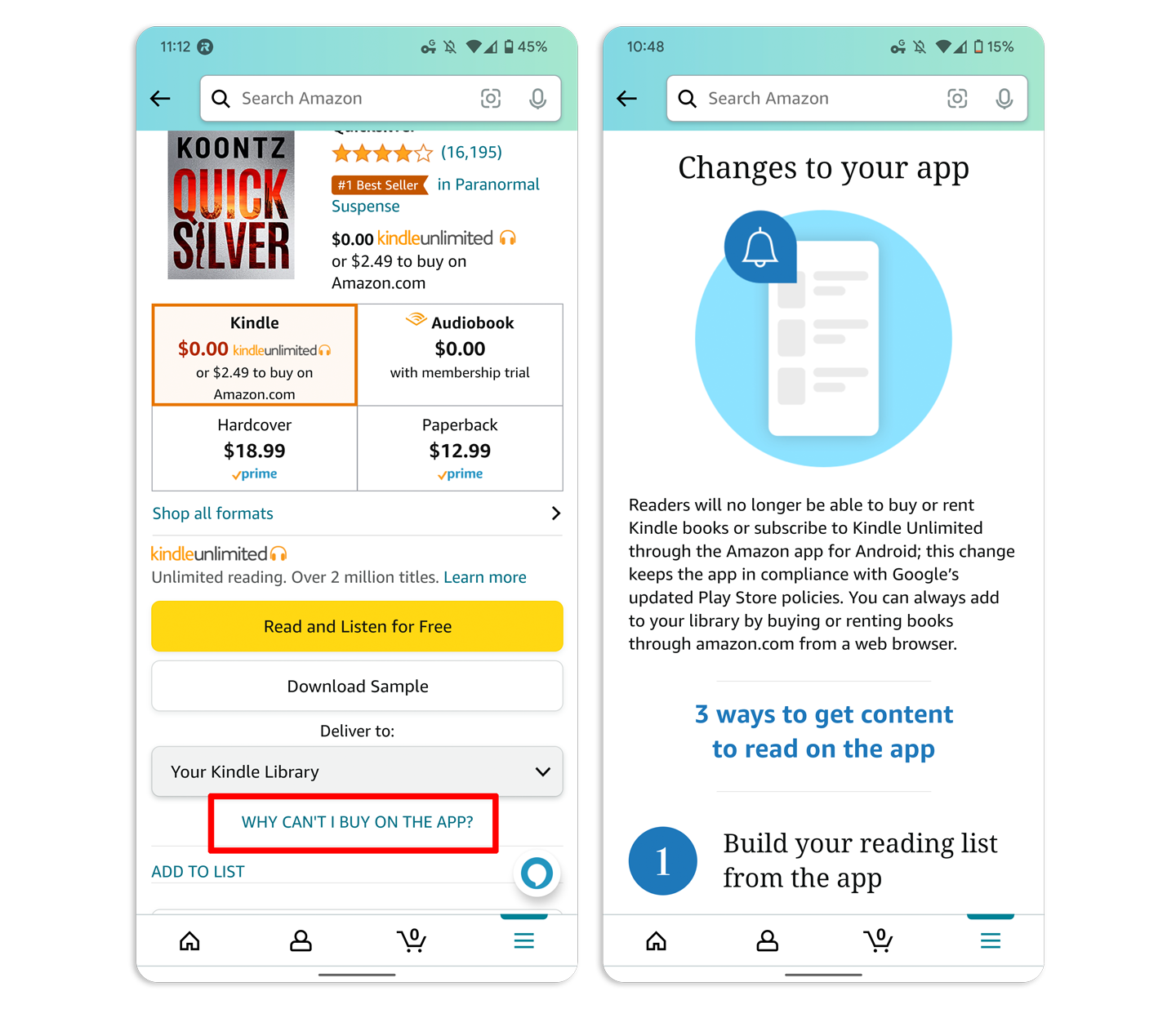
Following up on its earlier move to pull Audible audiobook purchases from its Play Store app, Amazon is also turning off Kindle digital book purchases on Android. The Google Play purchasing crackdown is to blame, of course. Starting on June 1, Google will require all Play Store apps to use Google Play billing for digital purchases or face removal from the marketplace. Google Play billing technically has been in the rules for a while, but Google is ending a hands-off enforcement policy that effectively allowed companies to run their own billing systems.
When you visit the Amazon app, you can still buy physical books, but digital purchases now show a "Why can't I buy on the app?" link instead of a purchase button. Amazon's link shows a popup that says, "To remain in compliance with the Google Play Store policies, you will no longer be able to buy new content from the app. You can build a reading list on the app and buy on [the] Amazon website from your browser."
Amazon Music purchases have also been shut down on the Google Play app. The move brings Amazon's Google Play app in line with the iOS app, which also doesn't allow digital purchases. On Android, Amazon is pushing users to the website, where they can still buy digital content or sign up for an unlimited subscription, which avoids the Play Store purchase lockdown.
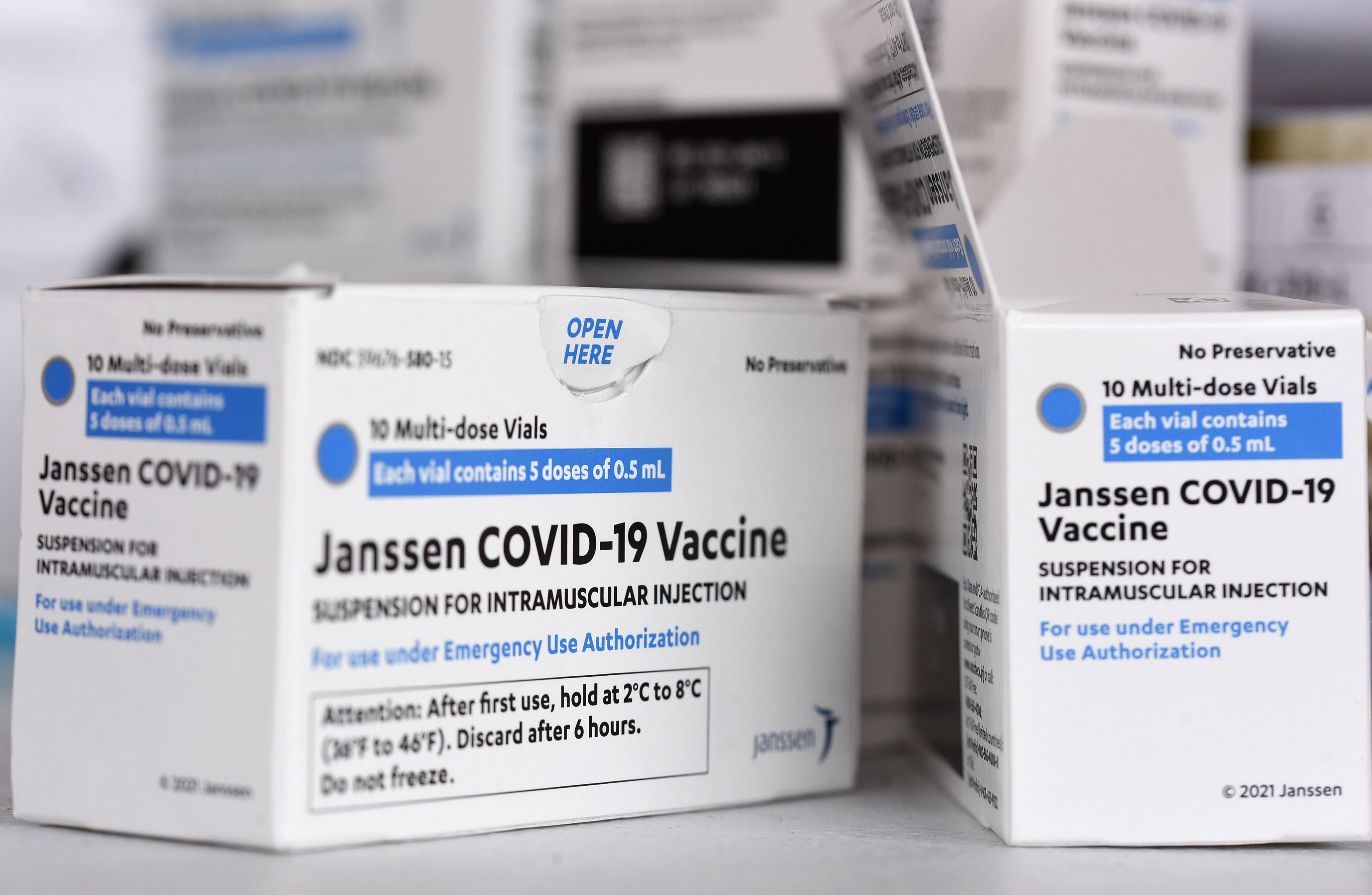
From now on, the J&J vaccine is only to be used in people ages 18 and up who are unable or unwilling to receive an alternative COVID-19 vaccine. That includes people who have had a life-threatening allergic reaction (anaphylaxis) to an mRNA COVID-19 vaccine, people who have personal concerns about mRNA COVID-19 vaccines and would otherwise not get vaccinated, and people who don't have access to mRNA COVID-19 vaccines.
The limitation comes as the FDA and the Centers for Disease Control and Prevention have been closely monitoring people who received J&J COVID-19 vaccinations for TTS. To date, the agencies have identified and confirmed 60 cases of TTS linked to the vaccine, including nine deaths. That represents a rate of 3.23 TTS cases per million doses of J&J vaccine administered, and a rate of 0.48 TTS deaths per million doses of vaccine administered, the FDA said Thursday.
And Alito’s opinion is also a warning that, after Roe falls, the Court’s Republican majority may come for landmark LGBTQ rights decisions next, such as the marriage equality decision in Obergefell v. Hodges (2015) or the sexual autonomy decision in Lawrence v. Texas (2003).
To be clear, the leaked opinion is a draft. While Politico reports that five justices initially voted to overrule Roe, no justice’s vote is final until the Court officially hands down its decision. And even if Alito holds onto the five votes he needs to overrule Roe, one or more of his colleagues in the majority could insist that he make changes to the opinion.
The Constitution is a frustrating document. Among other things, it contains multiple provisions stating that Americans enjoy certain civil rights that are not mentioned anywhere in the document itself. The Ninth Amendment, for example, provides that “the enumeration in the Constitution, of certain rights, shall not be construed to deny or disparage others retained by the people.”
Over time, the Supreme Court has devised multiple different standards to determine which of those unenumerated rights are nonetheless protected by our founding document. Some of these standards are very much at odds with each other.
The central thrust of Alito’s draft opinion in Dobbs v. Jackson Women’s Health Organization, the case seeking to overrule Roe, is that only rights that are “deeply rooted in this Nation’s history and tradition” and “implicit in the concept of ordered liberty,” are protected. This method of weighing unenumerated rights is often referred to as the “Glucksberg” test, after the Court’s decision in Washington v. Glucksberg(1997).
Though Alito’s Dobbs opinion largely focuses on why he believes that the right to abortion fails the Glucksberg test, there is no doubt that he also believes that other important rights, such as same-sex couples’ right to marry, also fail Glucksberg and are thus unprotected by the Constitution. Alito said as much in his Obergefell dissent, which said that “it is beyond dispute that the right to same-sex marriage is not among those rights” that are sufficiently rooted in American history and tradition.
Notably, the majority opinion in Obergefell rejected Alito’s claim that all unenumerated rights flow from Glucksberg. The Glucksberg approach, Justice Anthony Kennedy wrote for the Court in Obergefell, “is inconsistent with the approach this Court has used in discussing other fundamental rights, including marriage and intimacy.”
Alito has also shown no signs that he respects Obergefell as a precedent that should be followed even if he disagrees with it. That said, we do not yet know if Alito has five votes to overrule Obergefell (or to attack older precedents such as Lawrence); it’s possible that some of the Court’s other Republicans would join with its three Democrats to preserve marriage equality.
Alito’s draft Dobbs opinion, in other words, probably should be read as an opening bid to his colleagues. How far will they go with him in attacking other rights?
Justice Kennedy built decisions like Lawrence and Obergefell on a foundation of sand
For many years, Justice Anthony Kennedy was the pivotal figure in the legal struggle for gay equality. Obergefell and United States v. Windsor (2013), which held that the federal government must recognize same-sex marriages, were both 5-4 decisions authored by Kennedy. Kennedy also penned the Lawrence opinion and the Court’s decision in Romer v. Evans (1996), the first Supreme Court decision establishing that the Constitution places limits on the government’s ability to target gay or bisexual individuals.
Given his longtime role as the Court’s voice on gay rights, it’s tempting to think of Kennedy as a staunch supporter of these rights (I use the word “gay” and not “LGBTQ” because Kennedy’s four opinions concerned discrimination on the basis of sexual orientation and not gender identity). But the reality is almost certainly more nuanced. Decisions like Obergefell and Windsor were the products of an uneasy alliance between the conservative Kennedy and his four liberal colleagues. And, in closely divided cases, majority opinions are often assigned to the justice who is most on the fence — on the theory that this justice is unlikely to flip their vote if they can tailor the majority opinion to their own idiosyncratic views.
The result is that Kennedy’s great gay rights decisions were poorly argued. They ignore longstanding doctrines that could have provided a firm foundation for a rule barring discrimination on the basis of sexual orientation. Instead, they often substitute needlessly purple prose for the meat-and-potatoes work of legal argumentation.
In Lawrence, for example, Kennedy tells us that “when sexuality finds overt expression in intimate conduct with another person, the conduct can be but one element in a personal bond that is more enduring,” and that “as the Constitution endures, persons in every generation can invoke its principles in their own search for greater freedom.” But he does little to tie his decision to foundational legal doctrines, thus leaving the rights protected by Lawrence more vulnerable to being overturned by a dedicated, conservative majority.
The strongest argument that discrimination on the basis of sexual orientation violates the Constitution, meanwhile, is rooted in the Constitution's provision stating that no one shall be denied the “equal protection of the laws.” As the Court held in Cleburne v. Cleburne Living Center (1985), this provision provides heightened constitutional protection to groups that have historically faced discrimination because they possess a trait that “frequently bears no relation to ability to perform or contribute to society.” And there’s no reasonable argument that sexual minorities are not such a group.
By the mid-20th century, for example, many city police forces employed “morals squads” that arrested hundreds of gay men every year. In 1952, Congress prohibited gay men and lesbians from immigrating to the United States. A year later, President Dwight Eisenhower signed an executive order barring gay people from the federal workforce and requiring federal contractors to discharge employees who engage in “sexual perversion.”
Congress did not lift the ban on gay immigrants until 1990. The ban on gay federal employees wasn’t fully lifted until 1998.
But Kennedy largely ignored this equal protection argument, and instead grounded decisions like Lawrence and Obergefell in a weaker unenumerated rights framework. Obergefell, for example, did not hold that marriage discrimination is unconstitutional because it is discrimination. It held that same-sex couples benefit from an unenumerated “right to marry.”
One problem with this approach is that it was clear, by the time Lawrence and Obergefell were decided, that the Court’s right flank was eager to narrow the scope of unenumerated rights and apply the “history and tradition” framework that Alito relies on in Dobbs. Glucksberg, after all, was decided six years prior to Lawrence.
By adopting the weaker unenumerated rights framework, in other words, Kennedy tied gay rights to a legal regime that was already under attack from the Court’s right flank.
It was inevitable that, if conservative Republicans took over the Court, they would swiftly move against Roe v. Wade. Because Lawrence and Obergefell are doctrinally similar to Roe, that means this inevitable attack on abortion rights also endangers LGBTQ rights.
Alito is the Court’s staunchest opponent of LGBTQ rights
Alito is the Court’s consummate legal strategist, constantly looking for ways to move the law to the right, and ever eager to bury bones in one opinion that can be dug up in a future case to score another conservative victory.
Writing for the Court in Knox v. SEIU(2012), for example, Alito asserted that previous Court decisions permitting public-sector unions to charge nonmembers for certain services the union provides to those nonmembers were “something of an anomaly.” This swipe at unions bore fruit in Janus v. AFSCME (2018), which overruled the decisions Alito criticized in Knox and cut off an important source of union funding.
Alito’s Dobbs opinion, with its exclusive reliance on the Glucksberg framework to determine which unenumerated rights are protected by the Constitution, reads much like Alito is trying to run the same play that he successfully pulled off in Knox — slipping language into one opinion that can be used to justify another conservative victory in a future decision.
Much of the draft Dobbs opinion tracks Alito’s analysis in his Obergefell dissent. Like the abortion opinion, Alito’s dissent against marriage equality claims that the only unenumerated rights protected by the Constitution are “those rights that are ‘deeply rooted in this Nation’s history and tradition.’”
Alito then spends the bulk of his opinion claiming that “traditionally,” the right to marry “was inextricably linked to the one thing that only an opposite-sex couple can do: procreate” — an argument that, if taken seriously, would also prohibit people who are post-menopausal or who have undergone a vasectomy or hysterectomy, among other things, from being married.
Alito’s disdain for LGBTQ rights is apparent in his Obergefell dissent, a rhetorical choice that sets him aside even from several of his fellow Republican justices. Some of Alito’s conservative colleagues, who dissented in major LGBTQ rights decisions, went out of their way to state in those dissents that they bear no personal animus toward sexual or gender minorities.
Dissenting in Lawrence, for example, Justice Clarence Thomas made clear that he thinks that the so-called sodomy law at issue in that case is “uncommonly silly” and that, if he were a Texas state lawmaker, he “would vote to repeal it.” Similarly, while Justice Brett Kavanaugh dissented from the Court’s decision in Bostock v. Clayton County (2020), which held that existing civil rights laws prohibit discrimination against LGBTQ employees, Kavanaugh concluded his Bostock dissent by declaring his respect for the “extraordinary vision, tenacity, and grit” of “gay and lesbian Americans” who’ve “worked hard for many decades to achieve equal treatment in fact and in law.”
Alito’s Obergefell dissent, by contrast, treats the moral case for LGBTQ equality as so insignificant that it must bow to concerns that conservatives might be made to feel bad if same-sex couples are allowed to marry. The Obergefell decision, Alito complains, “will be used to vilify Americans” who believe that same-sex couples do not deserve equal rights. And people who express anti-LGBTQ views “will risk being labeled as bigots.”
Of course, the First Amendment protects the right of all Americans to disparage their political opponents, and to use strong language such as the word “bigot” when criticizing someone’s political viewpoint. And the Supreme Court has never held that someone’s constitutional rights must be diminished due to fears that someone, somewhere, might say something mean about people who oppose those rights. Imagine if the Court had backed away from Brown v. Board of Education (1954) due to fears that white supremacists might be shunned or condemned.
In any event, Alito appears to believe that it is more important to protect social conservatives from being made to feel bad than it is to protect LGBTQ Americans from systemic discrimination by their own government. This blinkered approach is likely to drive his approach to LGBTQ rights in the future.
But will Alito have five votes to overrule cases like Obergefell?
It’s likely that a majority of the current Court believes that cases like Lawrence and Obergefell were wrongly decided. After all, of the four justices who dissented in Obergefell, three are still on the Court. Two of the justices in the majority, meanwhile, were replaced by conservative Trump appointees.
But the principle of stare decisis — the doctrine that courts typically should be bound by their previous decisions — is supposed to foster stability in the law, and it’s also supposed to discourage justices from tossing out precedents simply because those justices disagree with them. So anti-LGBTQ litigators need to do more than simply convince a majority of the justices that Obergefell should have come down the other way when it was originally decided. They also have to convince at least five justices to overturn the legal basis for hundreds of thousands of Americans’ existing marriages.
It would be shocking if any of the liberal justices — Justices Sonia Sotomayor, Elena Kagan, and incoming Justice Ketanji Brown Jackson — vote to overrule decisions like Obergefell. Chief Justice John Roberts also appears to have made his peace with marriage equality. Roberts joined the majority opinion in Pavan v. Smith(2017), which reaffirmed Obergefell’s holding that same-sex couples must enjoy the exact same marital rights as opposite-sex couples.
Meanwhile, in a 2020 opinion joined by Alito, Thomas complained that Obergefell has “ruinous consequences for religious liberty.” Three justices — Thomas, Alito, and Gorsuch — dissented in Pavan. That suggests that Alito has two natural allies in the fight against LGBTQ rights.
To sustain decisions like Obergefell and Lawrence, in other words, defenders of those decisions likely need to pick up either Kavanaugh or Justice Amy Coney Barrett’s vote to prevail.
At his confirmation hearing, Kavanaugh endorsed Alito’s view that Glucksberg provides the proper framework for determining which unenumerated rights are protected by the Constitution. But Kavanaugh has also written that Supreme Court precedents should only be overruled if they are “grievously or egregiously wrong.” And that the Court should ask whether overruling a past decision would upset “legitimate expectations of those who have reasonably relied on the precedent” — such as the expectations of same-sex couples who are already married.
Barrett, meanwhile, has explicitly opposed same-sex marriage in the past. In 2015, for example, she signed onto a letter to Catholic bishops embracing the church’s conservative stance on marriage disclination. According to that letter, the church’s teachings on topics that include “marriage and family founded on the indissoluble commitment of a man and a woman ... provide a sure guide to the Christian life, promote women’s flourishing, and serve to protect the poor and most vulnerable among us.”
Similarly, according to the LGBTQ rights group Lambda Legal, Barrett also gave a presentation in 2016 “in which she expressed that marriage should not be viewed as a fundamental right for same-sex couples and instead should be decided on a state-by-state basis.”
But, if Barrett’s plan is to simply dodge cases attacking decisions like Obergefell, that plan is unlikely to work for very long. Eventually, a panel of right-wing appellate judges could force the Court’s hand by issuing a decision permitting a state to ban same-sex marriages, daring the Supreme Court to leave that decision in place.
A Supreme Court showdown over LGBTQ rights, in other words, is probably inevitable. And lawyers eager to ban marriage equality or criminalize gay sex most likely start with at least three justices in their pocket.
Temporary fencing went up outside the Supreme Court Wednesday night. It’s a similar design to the tall fencing that went up around the Capitol after January 6—and around the White House complex in the summer of 2020. The fencing is designed to prevent people from scaling it: As one fence vendor explains, the tight mesh […]
For many years we’ve discussed the sheer ridiculousness of the “triennial review” process of Section 1201 of the DMCA. If you’re lucky, and don’t spend that much time deep in the weeds of semi-obscure copyright law, Section 1201 of the DMCA is the “anti-circumvention” part of the law, that was initially designed to outlaw breaking digital rights management (DRM) tools. Of course, 1201 was written broadly, saying that basically any attempt to “circumvent a technological measure” (even just talking about ways to circumvent a technological measure) would itself be considered copyright infringement even if the underlying purpose for which you were circumventing the technological measure had nothing whatsoever to do with copyright.
This was a bizarrely structured law for so many reasons, and even the drafters of it at the time realized that this would likely lead to all sorts of perfectly reasonable and normal activity being declared “infringing” of copyrights. Indeed, lots of companies almost immediately moved to take advantage of this in order to block people from using “unauthorized” ink cartridges in printers, or unauthorized garage door openers, among other things.
So, the drafters of the DMCA added in this ridiculously weird safety valve: every three years, people could apply to the Librarian of Congress to “exempt” certain classes of items from the law for a three year period. The process itself is ridiculous. People need to apply for the exemption, then there’s a public comment period, followed by recommendations from the director of the Copyright Office, before the Librarian of Congress comes down from the mountain and blesses certain types of circumvention as non-infringing for the next three years.
No sane system would ever do things this way. A reasonable legislature would realize that if you have to apply for exemptions every three years, perhaps the underlying law itself is problematic. But, no, every three years we go through this ridiculous song and dance. Sometimes it leads to truly wacky outcomes, like the time, a decade ago, when the Librarian of Congress refused to renew the phone unlocking exemption, forcing Congress to grandstand about how they should fix things (something that never actually happened).
Anyway… last year was the latest three year cycle, and it’s gotten to the point that it’s barely even worth reporting on the results, which the Librarian of Congress adopted last fall. One of them was an expansion of an earlier exemption (from six years prior) exempting the circumvention of technological protection measures (TPMs) on medical devices in order to access the data on those devices. For the 2021 round, petitioners sought to expand that exemption somewhat, getting rid of the part of the original exemption that limited it to “wholly or partially implanted” devices, arguing that it should apply to any type of medical device.
The Copyright Office recommended allowing this broader exemption and the Librarian of Congress agreed:
For the reasons detailed in the
Register’s Recommendation, the Register
concluded that accessing medical data
outputs likely qualifies as a fair use and
that expanding the exemption to
include non-implanted medical devices
and non-passive monitoring would not
alter the fair use analysis. Additionally,
the Register concluded that proponents
set forth sufficient evidence that the
‘‘wholly or partially implanted’’
language and the passive monitoring
limitation are causing, or are likely to
cause, adverse effects on these
noninfringing uses. The Register also
recommended expanding the exemption
to permit circumvention ‘‘by or on
behalf of a patient.’’ After consultation
with the U.S. Food and Drug
Administration, the Register
recommended removing the language
requiring compliance with other laws,
and replacing it with a statement that eligibility for the exemption does not
preclude liability from other applicable
laws.
Basically, in the midst of a pandemic, where locked down medical devices had represented a real problem, the Copyright Office and the Librarian of Congress reasonably decided that both users of medical devices, and their medical care professionals, ought to be able to circumvent various technological protection measures in order to access their own data.
All of this should be relatively uncontroversial. But… that’s not how any of this works. Earlier this year, some medical device company trade associations decided to sue the Librarian of Congress over this exemption. They’re using the standard administrative law argument that the exemption was “arbitrary and capricious.” The complaint has a lot of overwrought language:
The Exemption is manifestly unlawful. By issuing a rule that enables unregulated, for-profit service providers to piggyback off the creative efforts and intellectual property
of medical device manufacturers, it not only thwarts the purpose of the Copyright Act, but
also puts patient safety, device integrity, and device cybersecurity at risk. What is more, the
process by which the Exemption was adopted was infected with major procedural errors, including a failure to address many of the significant legal concerns raised by plaintiffs and other opponents.
In the course of the rulemaking at issue here, moreover, the Library of Congress
was acting as an executive agency and is therefore subject to the strictures of, and judicial review under, the Administrative Procedure Act (APA). Because the Exemption is not in accordance with law and was adopted without observance of required procedures, it should be
set aside. Alternatively, if the Library of Congress did not assume the character of an executive agency within the meaning of the APA, the Exemption violates separation-of-power principles twice over. Either way, it should be vacated.
Then, before the government was able to respond to the lawsuit, the medical device makers moved for summary judgment. A big part of their argument is that because this exemption might will allow third party companies to service medical devices (at a cheaper rate than the manufacturers themselves) that it serves a purpose unrelated to copyright and thus is not allowed as an exemption:
But the exemption is for a manifestly infringing use. It was granted at the behest—and solely for the commercial benefit—of two so-called
independent service operators, or ISOs, which are unregulated third-party service providers who
freeride on the creative labors of device manufacturers. And the Librarian readily admitted the
true reason for her decision: Allowing ISO circumvention would reduce the cost of machine
servicing contracts and thus serve a separate executive-branch policy. But the DMCA does not
grant the Librarian free-ranging policymaking authority untethered to copyright law. In approving the exemption, moreover, the Library failed to address numerous substantial comments that
called into question the underlying fair-use analysis. The exemption is thus unlawful many times
over: It is contrary to the statutory text, it is arbitrary and capricious, and it was promulgated
without observance of procedure required by law
So, to some extent, I find this absolutely hilarious. Because the reason medical device manufacturers lock down these devices with TPMs and then rely on the DMCA to block competitive service providers is also wholly unrelated to copyright law. So, they are actually the ones abusing copyright law to lock out competition — and then when they’re effectively called on it by the Librarian of Congress, they whine that the Librarian of Congress can’t use the triennial review process to exempt their abuse of copyright law, because… it goes beyond the intention of copyright law!
The government has responded, asking for a chance to actually file a motion to dismiss before it has to deal with the summary judgment demand and noting the somewhat bizarre rush by the medical device manufacturers for summary judgment when they waited many months before filing the lawsuit in the first place.
Either way, this really appears to be little more than an extremely cynical move by the device manufacturers. Hopefully the court sees through it, but should it succeed, I imagine we’ll see many other similar lawsuits filed on behalf of other industries where exemptions were granted, potentially taking us back to an even worse world, in which companies can abuse the 1201 anti-circumvention rules to block out all sorts of competition.
The first Thursday of May is apparently "World Password Day," and to celebrate Apple, Google, and Microsoft are launching a "joint effort" to kill the password. The major OS vendors want to "expand support for a common passwordless sign-in standard created by the FIDO Alliance and the World Wide Web Consortium."
The standard is being called either a "multi-device FIDO credential" or just a "passkey." Instead of a long string of characters, this new scheme would have the app or website you're logging in to push a request to your phone for authentication. From there, you'd need to unlock the phone, authenticate with some kind of pin or biometric, and then you're on your way. This sounds like a familiar system for anyone with phone-based two-factor authentication set up, but this is a replacement for the password rather than an additional factor.
A graphic has been provided for the user interaction:
Today is the fourth consecutive day of protests and rallies since a Supreme Court draft opinion overruling Roe v. Wade was leaked Monday night. Pro-choice and anti-abortion protesters have been crowding in front of the Supreme Court day and night, and there aren’t plans to stop anytime soon. Here are some of the actions taking […]
A few days ago, Motherboard revealed they were able to purchase the location data of visitors to Planned Parenthood clinics for just $160 from a company named SafeGraph. While SafeGraph refused to comment at the time, they’ve since written a blot post announcing they’ll be ending the practice. But not without spending much of the blog downplaying obvious potential harm:
…there are always extreme hypothetical corner cases, and in some cases these are worth actively preventing.
In light of potential federal changes in family planning access, we’re removing Patterns data for locations classified as NAICS code 621410 (‘Family Planning Centers’) from our self-serve “shop” and API to curtail any potential misuse of its data.
Like the last dozen companies caught in location data scandals, SafeGraph implies this was all an over-reaction because they saw no examples of the data being abused (not that they spent much time verifying identities or looking) and individual identities weren’t exposed due to aggregation and anonymization:
SafeGraph also has a Patterns dataset that shows how groups of people interact with a place (fully aggregated and anonymized). SafeGraph has always committed to the highest level of privacy practices ensuring individual privacy is NEVER compromised. We use differential privacy to ensure anonymity.
But there’s been just an absolute parade of quality studies showing how “anonymization” is meaningless, and user identities can be teased out of such datasets with only a modicum of additional data from other sources. That companies just keep pretending these studies don’t exist is both absurd and insulting. SafeGraph also sold this data with no user identity verification.
Obviously, the harm here is that abortion (and helping those seeking abortion) is criminalized in numerous states, and this data becomes useful for both law enforcement and politicians — but also potentially violent authoritarians who feel harassment efforts have been validated by an extremely unpopular right wing Supreme Court decision.
This cycle we’re in, where a company gets caught being cavalier with user location data, then only sheepishly backs away after a news outlet discovers the practice (while insisting they didn’t actually do anything wrong), isn’t working. There’s very often no meaningful penalty, no third party confirmation that the company has changed anything it claims to have changed, and no real incentive for other actors to stop misbehaving, since the financial cost is minimal to nonexistent and the reputation hit fleeting.
SafeGraph stopping this collection and sale doesn’t stop the countless other data brokers, adtech companies, telecoms, app makers, and big tech giants that are also routinely cavalier with user location and other data — including abortion clinic visitor data (in fact it took Vice all of a day to find another broker doing this same thing). All of this has been greenlit by regulators and lawmakers soaked in campaign contributions.
We’ve built a massive interconnected ecosystem of rampant data over-collection and monetization with little to no meaningful oversight, whether we’re talking about your broadband and wireless provider, prayer and meditation apps, or period tracking apps. This data has already been abused by a wide variety of cops, people posing as cops, criminals, stalkers, and others. Believing it won’t also be abused by a surging U.S. authoritarian right is dangerous wishful thinking.
The justice system loves a stacked deck. Well, certainly the prosecutorial side loves it. Courts are, at best, ambivalent. Occasionally, this behavior gets called out.
When the DOJ made it clear it wasn’t really interested in a thorough examination of its many dubious forensic techniques, Judge Jed Rakoff resigned from just-formed “Forensic Science Committee” by pointing out the DOJ’s obvious disinterest in actual justice.
The notion that pre-trial discovery of information pertaining to forensic expert witnesses is beyond the scope of the Commission seems to me clearly contrary to both the letter and the spirit of the Commission’s Charter… A primary way in which forensic science interacts with the courtroom is through discovery, for if an adversary does not know in advance sufficient information about the forensic expert and the methodological and evidentiary bases for that expert’s opinions, the testimony of the expert is nothing more than trial by ambush.
Another federal judge (Don Willett of the Fifth Circuit Appeals Court) pointed out how qualified immunity stacks the deck against civil litigants, making it almost impossible to hold government employees accountable for clear rights violations.
Section 1983 meets Catch-22. Plaintiffs must produce precedent even as fewer courts are producing precedent. Important constitutional questions go unanswered precisely because those questions are yet unanswered. Courts then rely on that judicial silence to conclude there’s no equivalent case on the books. No precedent = no clearly established law = no liability. An Escherian Stairwell. Heads defendants win, tails plaintiffs lose.
In this case, we see another stacked deck. But not only does the court not care, it claims it’s ok for the deck to be stacked because it’s not four-of-a-kind, it’s just a flush. (h/t Matt Gillette)
Arizona law prohibits “No more than two members from the same professional discipline” from serving on the clemency board at the same time.
And here’s the state’s clemency board:
The current board is made up of: one former superior court commissioner and assistant attorney general; a former federal agent with over 30 years’ experience; a retired officer who spent 30 years with the Phoenix Police Department; and a 20-plus-year detective, also with the Phoenix PD. The fifth seat on the board is currently vacant.
One prosecutor and three law enforcement officers. It would seem to be a clear violation of the law prohibiting more than two people from “same professional discipline.” Somehow, Maricopa County Superior Court Judge Stephen Hopkins disagrees.
His decision [PDF] claims law enforcement isn’t even a profession, so having a bunch of people from the law enforcement side of the justice system doesn’t turn a clemency board into a “nope, get executed” board. First, the judge defines “profession,” using a lot of words that definitely sound like they could apply to law enforcement.
Historically, “professions” or “professionals” denoted doctors, lawyers, or the clergy as these were the only people that could read and write in Latin. Perks, R.W., Accounting and Society (Chapman & Hall 1993); BC Medical Journal, vol. 58, no. 5 (June 2016). That term has been broadened over the years. But it still typically denotes highly specialized work, advanced degrees, licensure, and adherence to a known and recognized set of standards. In other words, a profession is “a special type of occupation . . . (possessing) corporate solidarity . . . prolonged specialized training in a body of abstract knowledge, and a collectivity of service orientation . . . a vocational sub-culture which comprises implicit codes of behavior, generates an esprit de corps among members of the same profession, and ensures them certain occupational advantages . . . (also) bureaucratic structures and monopolistic privileges to perform certain types of work.” Turner, C. and Hodge, M.N., Occupations and Professions (1970).
But, no says this judge. It isn’t. How is it not that? Let’s let the judge explain.
Historically, law enforcement has not been thought of as a “profession.” It is not regulated as other professions are, and has little of the characteristics of what is typically considered a profession.
Go on…
Oh, I guess that’s it. There’s nothing else in there that explains how the judge arrived at this conclusion, other than by looking at the long list of profession features above and deciding within the space of two sentences does not apply to people commonly thought of as being part of “law enforcement.”
To prove he’s right, the judge offers an example that deliberately misconstrues the petitioner’s argument that all of the members “have a law enforcement background.”
Moreover, Petitioner’s definition of professional discipline is extremely broad. A person who worked for one week as a volunteer 9-1-1 operator is, under Petitioner’s definition, the equivalent of a forty year homicide detective.
That’s not what’s being argued. Every member of the board spent several years in the law enforcement profession, something that’s made clear by the judge’s footnote — one he apparently added in hopes of shoring up his own conclusions.
In simplistic terms, one member worked for Phoenix Police Department primarily as a homicide investigator and was then an employee of a security firm and later a city council member. One member was a Phoenix Police Department employee, as officer, detective, and supervisor in various assignments. One member was an ATF and DEA agent, and upon retirement was an educator at Glendale Community College. To the extent law enforcement may be considered a “profession” the Court finds from the information presented that each of these three members represent a different “discipline” within the large rubric of law enforcement based upon their employment histories.
These are all people who spent years, if not decades, in the field of law enforcement. I guarantee that, if asked, they would consider themselves to have been part of the law enforcement profession. They would have referred to themselves as law enforcement officers while working for law enforcement agencies. This decision is pure pedantry that ignores the common background of the board members to arrive at the conclusion they’re as unique as snowflakes.
All this does is ensure people facing the clemency board will find zero sympathy since everyone on the board was involved at one time or another in the business of locking people up. To decide this board’s make up isn’t problematic is to ignore the obvious in favor of the esoteric.
Now that Roe has been overturned, you might want to think twice about what you do with your phone. | Getty Images/iStockphoto
The pre-Roe world didn’t have data privacy laws. The post-Roe world needs them.
The Supreme Court decision to overturn Roe v. Wade has made abortion illegal in many parts of the United States, with a possible future where it’s illegal everywhere. The pervasive and barely regulated data collection industry could have a big role to play in investigating and proving cases against people accused of performing or getting abortions.
A lot of data is readily available if law enforcement wants it because there’s very little, legally, restricting its collection. And we know the police use that data all the time, getting it through court order or by simply buying it. Through your phone and your computer, they can find out where you go, who you interact with, what you say, what you search the internet for, which websites you visit, and what apps you download.
This isn’t just true of abortion-related data; police have always had ways to access your private data. But now, a lot of people who weren’t concerned about what the police or data brokers knew about them before may suddenly have a lot to worry about — and there’s very little out there to keep their private lives private in a court of law.
“The dangers of unfettered access to Americans’ personal information have never been more obvious,” Sen. Ron Wyden, a longtime advocate and proponent of online privacy laws, told Recode.
One bigconcern seems to be whether period tracker apps could be used to find and prosecute people who get abortions. Period apps are problematic for a lot of reasons, but somehow tipping off the police that you got an abortion is pretty far down on the list. Far worse is the pervasive and barely regulated data collection industry that has been allowed to build and share detailed profiles of all of us for years. The fact is, it’s easy enough to delete a period app from your phone. It’s a lot harder to delete the data it collected about you. And it’s justaboutimpossible to conceal the rest of the online trail that could help prove you broke an anti-abortion law.
“The dangers of unfettered access to Americans’ personal information have never been more obvious”
There’s the possibility that all of this data could be used to go after people who get or perform illegal abortions because it’s already being used to help in the investigation of many crimes. An internet search for abortion-inducing drugs was used as evidence to charge with murder a woman who gave birth to a stillborn baby (those charges were dropped). Google data obtained by police placed a man’s phone near the site of a murder; the man was arrested but was later released without charge. Several cases against alleged January 6 insurrectionists have been built on data obtained from companies like Google and Meta. Immigration and Customs Enforcement (ICE) buys location data to try to find entry points used by undocumented immigrants.
That doesn’t mean there’s nothing you can do. The internet as we know it didn’t exist pre-Roe, when abortion was illegal. It does now. Online privacy laws, on the other hand, largely don’t. But they could.
All the data you give away — and who can get it
For now, as long as they follow the appropriate legal channels, law enforcement agencies canobtain pretty much everything you do on your devices. For almost all of us, that’s a lot of data. You can try to lock down your own device, but if the data is also possessed by a third party like Google, that’s where the police will go to get the information they want.
This can include what’s known as reverse search warrants or keyword searches for devices that were in a certain location — say, a building in which police suspect illegal abortions are being performed — or for devices that searched for certain keywords, like “where can I get an abortion.” There’s a legal gray area here. Some judges have ruled that such searches are unconstitutional, but they’re still happening. In fact, the use of them has increased exponentially in the last several years.
“There’s a lot of opportunity for police to take advantage of the lack of clarity in the law,” Nathan Freed Wessler, deputy director of the ACLU’s speech, privacy, and technology project, said. “Which is why lawmakers can and should step in.”
But there’s no gray area when it comes to evidence law enforcement can get about you specifically if they have reason to believe you’ve committed a crime. To give a recent example: Many cases against alleged January 6 insurrectionists were built on data the FBI got from Google and social media. In some cases, this included the suspect’s movements to and from their homes as well as within the Capitol building. It also included the contents of their emails, web searches, websites visited, and YouTube videos watched. You might think the police having such a large data trail to follow is a good thing when it’s used against people whose actions you disagree with. You might not feel the same way if it’s used against people whose actions you support.
That means that, in places where abortion is illegal, there won’t be much a company like Google can do if police have a warrant for data that could be evidence of a crime. There’s also the possibility that people pretending to be the police could obtain data, too. As Bloomberg recently reported, it has happened before. That’s why privacy and civil rights advocates say the less data those companies are forced to give to law enforcement, the better. Laws that minimize the amount of data collected, that restrict what other parties can do with that data, and that allow consumers to delete their data would go a long way here.
There’s also the data that the police (and any other especially motivated private citizens) can buy. Data brokers, it turns out, make for a nice workaround to the Fourth Amendment. Law enforcement can simply buy data it would otherwise have to get a court order for, which it may then use to help in its investigations.
We have plenty of examples of this to draw from: The IRS, the FBI, the DEA, ICE, and even the military do this. This data can be as granular as the movements of an individual in the real world, and data brokers love to combine it with what that individual does online for an even more comprehensive and revealing profile. During the Trump administration, ICE didn’t just use cellphone location data to find a tunnel underneath an abandoned KFC that was used to smuggle drugs over the border; it also used it to find out where undocumented immigrants were crossing the border. It’s entirely possible that authorities could use this type of movement data to find out where illegal abortions are being performed.
It’s not just the government that can buy this data. Private businesses and people do it all the time. Vice recently purchased aggregated location data for a week’s worth of visits to 600 “family planning centers,” some of which offer abortions, for just $160 from a company called SafeGraph. (The government is one of SafeGraph’s customers, by the way.) After Vice published a story detailing how it sold data about family planning centers, SafeGraph said it would stop, but it’s safe to assume there are other companies out there still doing similar things. We also have cases of advertising companies using geofencing, or targeting ads to devices within a certain location, to send anti-abortion ads to people inside women’s health clinics.
Data brokers will often say that their data is aggregated and anonymized, but we know there’s no guarantee that the data will stay aggregated and anonymous. Last summer, a priest was outed after a Catholic news outlet obtained location data sourced from Grindr. The Wall Street Journal recently reported that Grindr’s data was routinely shared with or sold to Grindr’s ad partners. These are very real, very bad examples of how location data can be obtained, re-identified, and used against someone if it falls into the wrong hands — perhaps those belonging to anti-abortion activists who believe any actions they take are righteous. They also highlight why we need to regulate this industry to prevent it from happening again.
If abortion laws can change, so can privacy laws
There are privacy bills out there that would slow or stop the flow of data that could be used against them. Perhaps the end of Roe v. Wade will be what gets these languishing bills over the finish line.
“There are a number of types of laws that could really make a difference,” Wessler said. “Some of them aimed at what law enforcement can get access to, and some aimed at what companies are allowed to collect and sell about us without our express permission and consent.”
The Fourth Amendment Is Not for Sale Act would close the loophole that allows law enforcement to buy information from data brokers that they’d otherwise have to get with a warrant. Sen. Wyden introduced the bill in April 2021, and it has bipartisan and bicameral support.
“Passing the Fourth Amendment Is Not For Sale Act would make it harder for Republican states to persecute women by buying up big databases of information without warrants and then hunt down anyone seeking an abortion,” Wyden told Recode.
But it doesn’t stop all this data from being out there to be purchased in the first place, and not just by the police. “Far more needs to be done to protect the rights of pregnant people. Every company that collects, stores, or sells personal data should be aware that they could soon be a tool for a radical far-right agenda that is trying to strip women of their fundamental privacy rights,” Wyden explained.
All this assumes that these companies care about who uses their data and how. It also suggests that they’ve implemented measures to minimize and control the flow of it. The fact is, they usually don’t have to do this, and they make more money if they don’t.
There are a number of types of laws that could really make a difference
Consumer privacy laws would go a long way toward reducing what data is out there and available for anyone to access in the first place. Several bills like this have been introduced in Congress over the years, some with better protections than others. The recently introduced American Data Privacy and Protection Act, which is bipartisan and bicameral, is even making some headway in Congress. Meanwhile, other countries and even some states have advanced stronger consumer privacy laws in recent years.
Privacy laws that require affirmative opt-in consent to collect data — especially sensitive data, like location, health data, and search histories — and give consumers control over if that data is sold or shared would go a long way here. Opt-in consent is the difference between Apple’s App Tracking Transparency feature, which doesn’t give out certain types of data unless you tell it to, and Facebook, which just lets you opt out of being tracked after the fact, as long as you can find the option in your privacy settings.
Many privacy advocates also believe opt-in consent should be required before a company can share or sell that data to third parties. Data minimization rules, they say, would also help because these would only allow what an app needs to function to be collected. Customers should also have the right to delete their data upon request.
In lieu of a federal consumer privacy law, individual states have tried to pass their own. A few have recently passed industry-friendly laws that privacy advocates aren’t fond of. But then there’s California, which has the strongest privacy law in the country, or Illinois, which has a biometric privacy law, or Maine, which bans internet service providers from selling their customer’s data without the customer’s consent. New York state lawmakers have been trying to ban reverse search and keyword warrants for years.
A lack of digital privacy might have been a deal you were willing to make when you thought you knew the laws and assumed you’d never break them. But, as the Roe reversal illustrates, laws can change. Unless privacy laws also change, by the time you realize you do have something to hide, it’ll be too late.
Update, June 24, 12:30 pm ET: This story has been updated to reflect that Roe v. Wade has been overturned.
Sri Lankan Navy soldiers work to remove debris — including tiny plastic pellets called nurdles — blanketing the beach near Colombo, Sri Lanka, in May 2021, after the Singapore-registered container ship MV X-Press Pearl caught fire and sank near Colombo Harbor. | Ishara S. Kodikara/AFP via Getty Images
“We’re making these nurdles and basically spilling oil, just in a different form.”
NEW ORLEANS — On an overcast day in April, on the edge of Chalmette Battlefield, a few miles outside the city, Liz Marchio examined a pile of broken twigs and tree branches on the bank of the Mississippi River. “Usually I try to look — oh, there’s one,” said Marchio, a research associate for the Vertebrate Museum at Southeastern Louisiana University. She bent down to pick up something with a pinch of her thumb and forefinger and placed it in her palm for me to see.
The object in Marchio’s hand was small, round, and yellowish-white, about the size of a lentil. It looked like an egg, as if a fish or salamander or tadpole could come wriggling out of it. Marchio handed it to me and turned to flip over a tree branch floating in the water, where dozens more lay waiting underneath. She made a sound of disgust. We had come hunting, and we had quickly found our quarry: nurdles.
A nurdle is a bead of pure plastic. It is the basic building block of almost all plastic products, like some sort of synthetic ore; their creators call them “pre-production plastic pellets” or “resins.” Every year, trillions of nurdles are produced from natural gas or oil, shipped to factories around the world, and then melted and poured into molds that churn out water bottles and sewage pipes and steering wheels and the millions of other plastic products we use every day. You are almost certainly reading this story on a device that is part nurdle.
That is the ideal journey for a nurdle, but not all of them make their way safely to the end of a production line. As Marchio and I continued to make our way upriver toward New Orleans’ French Quarter, she began collecting nurdles in ziplock bags, marking in red Sharpie the date, location, number of beads collected, and the time taken to collect them.
Neel Dhanesha/Vox
Nurdles mix easily with the debris floating in the Mississippi River.
Neel Dhanesha/Vox
Liz Marchio collects nurdles beside a levee in New Orleans’s Lower Ninth Ward in April.
At one point, on the side of a levee outside the Lower Ninth Ward, she collected 113 nurdles in five minutes. This is not uncommon: An estimated 200,000 metric tons of nurdles make their way into oceans annually. The beads are extremely light, around 20 milligrams each. That means, under current conditions, approximately 10 trillion nurdles are projected to infiltrate marine ecosystems around the world each year.
Hundreds of fish species — including some eaten by humans — and at least 80 kinds of seabirds eat plastics. Researchers are concerned that animals that eat nurdles risk blocking their digestive tracts and starving to death. Just as concerning is what happens to the beads in the long term: Like most plastics, they do not biodegrade, but they do deteriorate over time, forming the second-largest source of ocean microplastics after tire dust. (A nurdle, being less than 5 millimeters around, is a microplastic from the moment of its creation, something also known as a primary microplastic.)
There’s much we still don’t know about how plastics can harm the bodies of humans and animals alike, but recent research has shown that microplastics can be found in the blood of as much as 80 percent of all adult humans, where they can potentially harm our cells. We may not eat the plastic beads ourselves, but nurdles seem to have a way of finding their way back to us.
In most of the United States, the federal and local government respond to nurdle spills big and small in the same way: by doing practically nothing. Nurdles are not classified as pollutants or hazardous materials, so the Coast Guard, which usually handles cleanups of oil or other toxic substances that enter waterways, bears no responsibility for them.
Likewise, most state governments have no rules in place around monitoring, preventing, or cleaning up nurdle spills; a spill is often an occasion of great confusion as local and state environmental agencies try to figure out who might be responsible for managing it. In the eyes of the federal government and every state except California, which began regulating marine plastics in 2007, nurdles are essentially invisible. For all official purposes, a nurdle that has escaped into the wild may as well have entered a black hole.
“Here in Louisiana, we’re making these nurdles and basically spilling oil, just in a different form,” said Mark Benfield, an oceanographer at Louisiana State University who studies microplastics, “And no one notices it, and no one seems to do anything about it.”
A nurdle often escapes from the plastic production process in mundane ways, slipping into drains at factories or spilling out of cargo containers while being transported by trains and ships. When nurdles are being loaded into trains, for example, they are often blown into rail cars using large hoses. The beads can leak around the edges of hoses at factories and out the sides of rail cars as they travel to distribution centers; Benfield and Marchio have both found nurdles lining the sides of tracks used by nurdle-carrying trains.
Sometimes, however, a large spill — often during transportation — will send millions or even billions of nurdles out into the world all at once, coating shorelines with deposits so thick they could be mistaken for banks of snow.
In May 2021, a container ship off the coast of Sri Lanka caught fire and sank, releasing an estimated 1,680 metric tons of nurdles in an incident the United Nations called “the single largest plastic spill on record.” About a year earlier, in August 2020, a storm hit a ship docked at the port of New Orleans, knocking a container filled with bags of nurdles into the Mississippi River. Hundreds of millions of beads escaped from their bags, coating local beaches in white plastic and floating down toward the Gulf of Mexico. They would remain long after the spill; Marchio pointed to a small dimple on the side of the first nurdle we found that identified it as a likely remnant of that spill.
“Big spills, like by ship containers and barge … that’s probably about once a year,” said Jace Tunnell, director of the University of Texas’ Mission-Aransas National Estuarine Research Reserve and founder of the Nurdle Patrol citizen science project, which asks contributors to count nurdles on their local beaches and uses the data to create a map of the pollution.
The map could easily be mistaken for a map of plastic production sites: The vast majority of red and purple dots, which correspond to particularly high levels of nurdles, appear in the petrochemical hubs of Texas and Louisiana. “What happens every single day — it’s a chronic problem — is the loss of pellets during on-loading and off-loading and during transportation,” Tunnell said.
Most plastic does not biodegrade, and a spilled nurdle does not simply disappear. Many wash up on shorelines, like the ones Marchio and I saw, where they easily blend in with the sand, shells, and assorted debris; if undisturbed, they will likely remain there for hundreds if not thousands of years.
A nurdle in the wild is a sneaky thing. Even before it starts breaking down, it is difficult to spot from afar, unlike the plastic bags or bottles we often associate with plastic pollution. It does not give off a heat signature or emit fumes, or create a sheen on the surface of water the way an oil spill might. What it does do is attract toxic pollutants. A nurdle floating down, say, the Mississippi River will absorb the pollutants riding alongside it while sloughing off the water, Benfield told me. It also provides a convenient home for phytoplankton, which will go on to attract zooplankton, which eat the phytoplankton and emit dimethyl sulfide — better known as the smell of the sea.
For many marine animals, the smell of the sea is the smell of food. Seabirds like albatrosses and petrels track dimethyl sulfide to locate patches of plankton from afar, swooping down to pluck their plankton-eating prey out of the water. A nurdle is the size and shape of a fish egg; its camouflage is nearly perfect after some time in the water, looking and smelling like easy pickings to fish, birds, turtles, and crustaceans alike.
Once eaten, nurdles can tangle a creature’s intestines or make it feel as if it is full, said Benfield. A 1992 EPA report found that at least 80 species of seabirds ate nurdles; Benfield said that number has since more than doubled. Plastics provide no nutrients to animals, but an animal that fills up on the beads will eat less food as a result, meaning it could starve to death without even knowing it was starving — especially if its digestive tract is too small to pass the nurdle. Photographs from the aftermath of the spill in Sri Lanka showed fish filled with the pellets, white plastic lining their insides.
Saman Abesiriwardana/Pacific Press/Shutterstock
A dead fish with a mouth full of nurdles washed ashore on a beach near Wellawatta in Colombo, Sri Lanka, after a container ship caught fire and sank near the Colombo harbor in May 2021.
Eranga Jayawardena/AP
A crab makes its way across a Sri Lankan beach covered in nurdles days after the container ship sank. There were 87 shipping containers of nurdles on board.
Plastics are endocrine disruptors, meaning they can stunt an animal’s development, and researchers are studying whether toxic pollutants can pass from a nurdle into an animal’s tissue and subsequently up the food chain. But measuring the full impact is difficult, in part because it’s difficult to know exactly what causes a marine animal to die in a world that is increasingly hostile to marine animals.
Preventing nurdle spills, say Tunnell and Benfield, would involve a number of deceptively simple changes. Companies can place containers in loading areas to catch any nurdles that fall during their loading and unloading from rail cars, install screens on storm drains to catch beads that wash away, or make the bags they’re packed into before being shipped out of a sturdier material so they’re less likely to split open. Workers can double-check valves on rail cars to make sure they’re fully tightened and vacuum up nurdles that spill onto factory floors.
Cleaning nurdles up after they’ve spread through an ecosystem is much harder, and no one wants to be responsible for it. The most promising solutions so far involve machines that are essentially vacuums with sieves that filter out sand while sucking up the nurdles. But they have yet to be widely tested, let alone adopted, and they’d be of little use cleaning up beads in the water.
Nurdles have a significant impact on the environment long before they are formed, as well. The vast majority of the plastics plants in the United States are located alongside communities of color, which are disproportionately impacted by industrial pollution. Those plants emit a toxic mixture of pollutants including ethylene oxide, styrene, and benzene; there are so many petrochemical plants located between Baton Rouge and New Orleans that the area has become known as “cancer alley.”
The tide may slowly be turning: Last year, residents of Louisiana’s majority-Black St. James Parish managed to delay the construction of a massive new plastics plant in their community, arguing that they’d suffer undue environmental harm, but the plants that are already in the area will continue to pump out both nurdles and the pollutants that come from making them.
As the world moves toward renewable energy and demand for fossil fuels is expected to peak in the near future, the oil and gas industry is increasingly shifting its business focus to plastic production. Plastic production is expected to triple by 2050 thanks to a fracking boom in the United States that makes natural gas extremely cheap to produce. That will lead to a rise in nurdle production. The question on researchers’ minds is where these beads will end up.
Mark Benfield scrunched up his face as he bent at the waist to examine the sand below him, placing his hands on his knees for support and looking a bit like a human-sized question mark. “This is hard on your back,” said Benfield. “A few decades from now we’ll all have nurdle-related back issues. Nurdle-osis, like scoliosis,” he joked.
We were standing on the beach at Elmer’s Island Wildlife Refuge, on the Gulf of Mexico a couple of hours’ drive south of New Orleans. The beach was empty aside from Benfield, myself, a couple of LSU students, and the occasional crab or seagull. This was the place where, in 2021, Benfield had found hundreds of nurdles nestled in the dunes, indicating a spill somewhere offshore. At first, Benfield thought they may have been the remnants of the 2020 spill in New Orleans. “But when we started to look at the shape and the weights, they were different,” Benfield said, “so there was some big spill of nurdles that we didn’t even know happened.”
Neel Dhanesha/Vox
Mark Benfield searches for nurdles at the Elmer’s Island Wildlife Refuge on the Gulf Coast of Louisiana. “Your eyes start to get a search image for them after a while,” Benfield said.
Neel Dhanesha/Vox
Mark Benfield holds a nurdle he found. Nurdles are usually smaller than 5 millimeters around, making them primary microplastics.
By the time Benfield and I went to Elmer’s Island, most of those nurdles had disappeared. Storms had eaten away at the dunes, and the wind likely pushed the beads inland to the marsh just north of where we were standing, where they would quickly settle into the mud and become unrecoverable. Within a few minutes of arriving, however, Benfield found one hidden amid a pile of sticks that had washed up on the sand. “This must be pretty recent,” he said; it had probably washed in with the tide a day or two ago, though there was no way to tell when it had spilled or where it had come from. Benfield produced a ziplock from a pocket of his cargo pants and dropped the nurdle inside.
The sound of shells crunching underneath our shoes accompanied us as we made our way up the beach; occasionally, Benfield would drop to his hands and knees to check whether he was looking at a nurdle or a shell. “I used to come to the beach to look for shark teeth,” Benfield said. “Now I’m looking for nurdles.”
That changed for Benfield after the 2020 spill in New Orleans. While he had been studying microplastics in the Gulf of Mexico since 2015 and found nurdles in the Mississippi River during previous research trips, he’d only ever pulled a handful out of the river at most; that August, they blanketed the banks. Benfield recruited Marchio, who worked for the Jean Lafitte National Historic Park at the time, to help document the spill, and together they spent days traveling to points along the Mississippi River, laying down square frames and counting tens of thousands of beads in the space of a single square foot.
As the local community learned about the spill through local news outlets and word of mouth, concerned residents organized cleanup efforts. Word got out that Benfield was interested in the nurdles, and people began sending him samples. At one point, Marchio found an entire bag of nurdles, practically intact, underneath a wharf in New Orleans. The name of the manufacturer, Dow Chemical, was still clearly stamped on the bag, along with a warning: “DO NOT DUMP INTO ANY SEWERS, ON THE GROUND, OR INTO ANY BODY OF WATER.”
Neel Dhanesha/Vox
Mark Benfield holds a nearly intact bag of nurdles recovered after a container full of nurdles fell off a ship docked in New Orleans in 2020.
While Benfield, Marchio, and the volunteers busied themselves with trying to document and clean up the spill, state and federal agencies spent weeks trying to decide who, if anyone, ought to be responsible for oversight of the spill and any potential cleanup.
While the Coast Guard usually takes responsibility for cleanups of oil and toxic substances that spill into waterways, it has no responsibility for nontoxic spills. Because nurdles aren’t deemed hazardous to human health under federal or Louisiana state law, a court had to decide which agency, if any, was responsible for cleaning up the spill, said Gregory Langley, a spokesperson for the Louisiana Department of Environmental Quality (DEQ). “The problem with court action is it’s not instantaneous,” Langley said.
The Mississippi River, of course, was not beholden to the courts; while the agencies waited and debated whose job it was to clean up the nurdles, the current carried them downriver. “If you lose something in the river,” said Langley, “it’s gone.”
About three weeks after the spill, the ship’s operator paid for a small crew of men with booms, leaf blowers, and butterfly nets to clean up a small section of the river. The voluntary cleanup, the DEQ reasoned, rendered waiting for the court a moot point; no determination was made about which agency, if any, would have been responsible for the spill.
That cleanup crew was mostly for show, Benfield told me, and most of the nurdles had already disappeared, carried downriver by the current and blown away by the wind. The DEQ still doesn’t know who would be responsible for cleaning up such a spill in the future. “All of that is subject to court action,” Langley told me. So the DEQ would still have to wait for a court decision in the event of a future spill.
Benfield and Marchio have since become the de facto Louisiana outpost of a countrywide effort to document, map, and, eventually (they hope) stop nurdle spills. In the aftermath of the 2020 spill, Benfield turned his lab in LSU’s Baton Rouge campus into a sort of evidence room. When I visited, jars of nurdles lined the countertop by a sink; dozens more were packed into boxes, ready to be shipped to Jace Tunnell in Texas so he could include them in teaching kits he sends to schools around the country. The bag of nurdles Marchio found underneath the wharf in New Orleans sat in one corner, next to a bucket filled with a mixture of sand, twigs, and nurdles brought in by a well-meaning local who helped with the cleanup in 2020.
When Benfield finds new nurdles, he analyzes them under a spectrometer to see what they are made of; he hopes to eventually build a database of nurdles so that they can be traced back to their origin. In an ideal world, he’d receive samples of nurdles from plastics manufacturers that could make that sort of tracing easier, but he doubts they would be open to the idea; there’s no business case for accountability, he reasons.
Neel Dhanesha/Vox
Benfield analyzes a nurdle found at the Elmer’s Island Wildlife Refuge using a spectrometer in his lab at Louisiana State University. He hopes to eventually build a database of nurdles that can be used to trace them to their source.
“It’s ridiculous. If I went to the river and tossed in hundreds of plastic bags, I’d be in trouble,” Benfield said. Under Louisiana law, he would likely be fined somewhere between $500 and $1,000 for littering, at the least, and have to serve a few hours in a litter abatement program. “But because (the nurdles) are so small,” he continued, “the companies get away with it.”
Being the documenter of plastic pellets is thankless work. There’s little funding for researching them, and Benfield, Marchio, and Tunnell often speak with the air of people resigned to the seemingly quixotic quest of tilting at nurdles. “Nurdles infiltrate your brain,” Marchio said to me once. “I have to remember that my role is monitoring, not cleaning. If I try to clean, I’ll just get frustrated.”
So what does doing something about nurdles look like?
The plastics industry’s stance on plastic pollution at large has long been that recycling needs to be improved. More responsible consumer behavior and waste-management practices, the industry line goes, will bring post-consumer plastics back to manufacturers that can reuse them. But a nurdle almost never reaches a consumer’s hands in its base form, and asking consumers to solve the nurdle problem through recycling would be akin to asking drivers to clean up an oil spill by conserving the fuel in their cars. Unlike a finished plastic product, the solution to nurdle spills, like nurdles themselves, will have to be found somewhere in the plastic production process.
For a brief moment a few years ago, it seemed as though the answer could come from the courts. In 2019, a federal judge in Texas approved a $50 million settlement in a case brought by Diane Wilson, a retired shrimper, which alleged that a plant run by the Taiwanese plastics giant Formosa Plastics had violated its permits by illegally discharging nurdles into the water in and around Lavaca Bay, on the Gulf Coast in Calhoun County, Texas.
The settlement, which was the largest of its kind in American history to result from a civil environmental lawsuit, included a consent decree that committed Formosa to “zero discharge” standards. In other words, the company’s plant at Lavaca Bay’s Point Comfort had to stop releasing pellets into the water or risk fines of up to $10,000 for each violation in the first year, increasing annually to a maximum of $54,000 per violation.
Formosa isn’t quite keeping its end of the bargain. Since it began operations in June 2021, said Wilson, a wastewater monitoring facility set up to keep tabs on Formosa’s pellet discharge has logged at least 239 violations, for fines totaling $5.3 million and counting. “The implementing of this consent decree is the hardest thing we have ever done,” said Wilson, who at 73 years old has been an environmental activist for more than 30 years. “You’ve got to be on them all the time. Most of my life is almost full-time Formosa.”
For Formosa, which is the sixth-largest chemical company in the world with sales of $27.7 billion in 2020, a $5.3 million fine is “almost like the cost of doing business,” Tunnell said. At least for now, it seems it’s cheaper to simply keep racking up those small fines over time than to make any potential large investments that would be needed to stop the nurdles from spilling in the first place.
In the meantime, Wilson told me, fishers in Lavaca Bay continue to pull up fish with nurdles in their guts; oyster fishers have found the beads nestled in their catch like pearls. The area is home to a mercury superfund site — an EPA designation for contaminated industrial areas that receive funding for cleanup efforts — that was closed to fishing for decades due to the threat of mercury poisoning. Mercury has already devastated local marine life; now, Wilson says researchers and activists are concerned the nurdles may absorb the mercury and become vectors that can carry the mercury beyond Lavaca Bay. “People just ignore it,” Wilson said.
Mark Felix/AFP via Getty Images
The Formosa Plastics plant in Point Comfort, Texas, south of Houston, in November 2021. It set up shop here in 1983, near the waters where shrimpers used to catch shrimp in abundance.
Mark Felix/AFP via Getty Images
Former shrimper Diane Wilson outside the Formosa Plastics plant in Point Comfort, Texas, in November 2021. Wilson has been documenting alleged pollution by Formosa for years.
While Wilson’s lawsuit was a remarkable victory, it was also an indicator of the difficulty of addressing nurdle pollution piecemeal. Wilson and her collaborators spent years collecting thousands of beads from around the area — including one discharge site in the middle of the water, which Wilson had to kayak out to — and it was only through amassing a mountain of evidence that she was able to convince a judge that Formosa’s Point Comfort plant was responsible for the beads that were washing up in the area. Attributing nurdles to a particular source is difficult, and repeating the feat would require a similar effort for every nurdle production plant in the country.
“I think the best place to start is to take a small step backward and recognize we have laws on the books already that are meant to regulate pollution and emissions from manufacturing and production facilities,” said Anja Brandon, US plastics policy analyst at the Ocean Conservancy, a nonprofit that works to protect oceans and marine life. “Namely in this instance, the Clean Water Act, kind of our bedrock environmental law.”
The Clean Water Act passed in 1972 after the Cuyahoga River in Cleveland, Ohio, caught fire in 1969, drawing national attention to the country’s polluted waterways. Today, the act regulates the discharge of various pollutants into waters around the country; it’s a major reason why many of the nation’s rivers are cleaner now than they were 50 years ago.
“These laws haven’t been updated to meet the needs of the moment,” said Brandon. In most of the country, she explained, “plastic nurdles have essentially gotten off scot free because they have yet to be classified or specifically labeled as a pollutant.” The rare exception is California, which in 2007 became the first and so far only state to pass a law classifying nurdles as pollutants to be regulated under the Clean Water Act, citing their contribution to litter on beaches and the possibility that they could be mistaken for food by marine animals.
Lawmakers in Texas and South Carolina have introduced similar legislation, though both bills seem stuck. The Texas bill, introduced in the House by representative Todd Hunter last year, never moved forward, while the South Carolina bill passed the state senate in 2021 but was recently shelved in the House.
Closing the nurdle loophole, says Brandon, would require classifying nurdles as a pollutant under the Clean Water Act at the federal level. Lawmakers have shown some support for this approach: In 2020, then-Sen. Tom Udall (D-NM) introduced the Break Free From Plastics Pollution Act, which would have put in place wide-ranging regulations on plastics and recycling.
Identical bills were reintroduced in the House by Alan Lowenthal (D-CA) and in the Senate by Jeff Merkley (D-OR) in March 2021, but neither bill has moved beyond committee. In April 2021, Sen. Dick Durbin (D-IL) introduced the much shorter and more tightly focused Plastic Pellet Free Waters Act, which would give the EPA regulatory control over nurdles through the Clean Water Act; that bill has also been stalled.
The plastics industry is opposed to both bills. “We do not think that plastics belong in the environment. They belong in the economy,” said Joshua Baca, vice president of the plastics division at the American Chemistry Council, a major plastics industry trade group. That said, he continued, “The Break Free From Plastics Pollution Act is really a bad piece of legislation. It has a very nice title. But it can be very misleading to the average person.”
Legislation like the Break Free From Plastics Pollution Act or the Plastic Pellet Free Waters Act, Baca argued, are disguised attempts to simply shut down plastic manufacturing in the US more broadly. “We generally think that the best approach here is to think about this holistically in a way that looks at loss across the entire value chain and puts in place best practices to avoid the loss within the environment,” he continued.
Baca pointed to Operation Clean Sweep, or OCS, a voluntary program run by the American Chemistry Council and the Plastics Industry Association that’s meant to curb nurdle leaks and spills but maintains no oversight mechanism and imposes no penalty for failure to comply.
“Many of our companies are inserting state-of-the-art technology within their facilities ... to ensure that they limit the loss of pellets going on,” Baca said. When I asked Baca for more information, he demurred, citing the possible use of proprietary technology.
Formosa Plastics, the subject of Diane Wilson’s lawsuit, is not only a participant in Operation Clean Sweep but also a member of OCS blue, a “data-driven VIP member offering” of Operation Clean Sweep that “enhances the commitment to management, measurement, and reporting of unrecovered plastic releases into the environment from resin handling facilities.” Members receive plaques commemorating their enrollment.
Neel Dhanesha/Vox
Nurdles seen under a microscope. The nurdle in the middle has begun degrading through exposure to the elements; the white ones nearby are from recent spills and haven’t been in the environment long enough to start degrading. It is estimated nurdles can stay in the environment for hundreds or even thousands of years.
“I think they have a lot of good practices that ought to be mandatory, but they’re voluntary,” said Tunnell. “That obviously does not work. There needs to be accountability.” One way to create that accountability, Tunnell told me, would be to classify plastic pellets as hazardous substances outright, which would not only bring much tighter scrutiny to the production process but also give the Coast Guard the authority to coordinate and perform cleanups whenever a spill occurs. This is something like the nuclear option for nurdles, and would no doubt be the subject of stiff opposition from the plastics industry if it ever becomes a matter of debate.
For Tunnell, the stakes are existential. A failure to stop nurdles from spilling would be like giving up on the future of our world. “At the end of the day, it comes down to the next generation,” Tunnell said. “These plastic pellets will be around for hundreds of years. It’s not like they dissolve. They’re just accumulating and accumulating, and even if you’re in high school right now, your great-grandkids will see the same pellets on the beach. So I think we owe it to my great-grandkids and their great-grandkids to do something about this now.”
Enlarge / A woman watches white flags on the National Mall on September 18, 2021 in Washington, DC. Over 660,000 white flags were installed here to honor Americans who have lost their lives to COVID-19 epidemic. (credit: Getty | Chen Mengtong)
An estimated 14.91 million people worldwide died in 2020 and 2021 due to the COVID-19 pandemic, according to an analysis of global excess deaths released Thursday by the World Health Organization.
The estimate—with a 95 percent confidence interval of 13.3 million to 16.6 million—is significantly larger than the number of reported deaths directly caused by COVID-19 during that time, which was around 5.42 million by official counts. But, estimates of excess death try to capture the true toll of the pandemic—direct and indirect deaths. The estimate is done by comparing the number of deaths that occurred during a time period to those expected to occur in that period based on historical mortality data and modeling. Such modeling also accounts for historical differences, such as fewer traffic and influenza deaths during the pandemic due to movement and health restrictions.
Thus, excess death estimates aim to capture not only reported COVID-19 deaths, but also unreported COVID-19 deaths and deaths indirectly caused by COVID-19. Those can include people dying of preventable, non-COVID conditions because they delayed or avoided health care in fear of becoming infected, or because their health care system was overburdened with COVID-19 patients and unable to provide optimal care.
Bird flu currently poses little threat to humans, but it’s hell for the birds.
The final month of Minnesota Timberwolves basketball was livelier than ever this season, and not just because they nearly upset the Memphis Grizzlies in their first-round playoff series.
During one game in mid-April, a woman glued her hand to the court. A few days later, another woman chained herself to the goal post. The following week, a third woman, dressed as a referee, stormed the court before removing her jacket, exposing a shirt underneath that read “Glen Taylor roasts animals alive.”
The protests, coordinated by the animal rights group Direct Action Everywhere, were aimed at the Timberwolves’ majority owner Glen Taylor. Taylor also owns Rembrandt Enterprises, a large Iowa egg producer that has culled — meaning deliberately killed — 5.3 million of its hens in response to a widespread bird flu outbreak (and then laid off nearly all of its staff).
Carlos Gonzalez/Star Tribune via Getty Images
Alicia Santurio disrupted a Minnesota Timberwolves basketball game in April, protesting the team’s owner, Glen Taylor, who also owns an Iowa egg farm that culled 5.3 million chickens in response to a bird flu outbreak.
While the virus has a near 100 percent mortality rate among infected poultry — and can spread rapidly among birds, especially in packed industrial farming conditions — it’s currently believed to pose little threat to human beings. It only rarely spills over to people, and only to those who come into close contact with infected birds. Even when there are human infections, “the viruses are unable to efficiently transmit between humans,” notes Michelle Wille, a virus ecologist at the University of Sydney.
But when certain strains of avian flu do manage to infect humans, it can be deadly. From 2003 to 2021, a little more than half of the 863 people who contracted an earlier strain of H5N1 died. The H5N1 strain currently spreading appears to be less transmissible and less severe to humans than those that infected people in the past, and only two people have tested positive for the strain — a man in the United Kingdom last December, and a man in Colorado last week.
The Colorado man — a prison inmate who had come in direct contact with presumably infected birds while working at a culling operation as part of a pre-release workprogram — experienced a few days of fatigue and recovered after being treated with an antiviral drug. Around 10 people who came into contact with him are under close observation.
Beyond the occasional one-off case in close human contacts, the bigger worry is that an unchecked flu that spreads among birds has plenty of opportunities to mutate in a way that allows it to transmit efficiently from person to person, thereby kicking off a new influenza pandemic. A widespread bird flu outbreak in 2005 raised alarm bells and prompted the US Senate to allocate $4 billion to prepare for a possible influenza pandemic — though when a new flu pandemic did break out in 2009, the origin was ultimately found in a swine virus.
So far, the bird flu has mostly been a problem for birds. It’s not the disease that’s killing most of them, however — it’s their owners.
When chicken, turkey, and egg companies detect one infected bird, they kill the whole flock in an effort to slow the spread of the virus. And they’re doing so using a variety of excruciating methods, including spraying birds with a suffocating water-based foam or closing off barn vents to raise temperatures so the birds die by heat stroke, a practice called ventilation shutdown, which can take 1.5 to 3.75 hours to kill them.
“It’s horrendous,” says Craig Watts, a former large-scale chicken farmer and currently a director of field operations for the Socially Responsible Agriculture Project, a nonprofit that advocates against industrial livestock operations. “I’ve been in those houses when the power went out and the generator didn’t kick on. In just a few minutes [the heat] is unbearable. … I can’t imagine that going on for hours and hours.”
According to the Storm Lake Times, a newspaper based near Rembrandt’s operation, the companyused ventilation shutdown plus, or VSD+, meaning they also pumped heat into their barns to kill the birds faster, a practice being employed in several states.Rembrandt Enterprises did not respond to a request for comment.
The situation is horrific, but given the industrialized nature of the US poultry industry and its response to past bird flu outbreaks, animal advocates say it’s unsurprising. Nearly all birds raised for meat and eggs in the US are raised on factory farms, where producers raise hundreds of thousands to millions of animals per year. And most of these animals are genetically identical, which could make them more vulnerable to bird flu. Some experts say the intensification of animal farming — raising more animals closer together — could also be increasing the virulence and transmission rate of bird flu strains.
Dena Jones of the Animal Welfare Institute says the 2014-2015 bird flu outbreak in the US, which led to the culling of more than 50 million animals — the largest cull in US history — didn’t prompt any real change in the industry.Instead, mega operations that raise millions of birds per year are continuing to be built across the country, from Oregon to Wisconsin and West Virginia to North Carolina as US chicken and egg consumption rises.
“We’re doubling down on this same system by raising more animals with less genetic diversity and higher density in larger operations, and all of that contributes to making it difficult to humanely kill an animal during an emergency,” Jones said.
There are culling methods that kill the birds much quicker than ventilation shutdown, such as spraying them with nitrogen-filled foam or gassing them in small enclosures, a method some producers are using to address this outbreak. There’s also a race to create an effective bird flu vaccine that could be used to slow the spread of future outbreaks, a race the USDA is partially funding.
Considering the speed at which bird flu spreads among commercial poultry flocks, and how painful it is for infected birds, the industry has no choice but to mass cull. But the USDA’s approval of ventilation shutdown in 2015 and the rise of its use in recent years, combined with the slow pace of vaccine approval and adoption, mean that for the time being, the birds themselves will continue to receive little consideration in the fight against bird flu. The ongoing expansion and intensification of US animal agriculture, along with a rise in animal disease outbreaks, might also mean that we need to learn how to live with the bird flu and the looming threat it poses.
Bird flu spread, explained
Migratory waterfowl, like ducks, geese, and terns, are the natural hosts of highly pathogenic avian influenza strains, but can largely — though not always — carry and spread the virus without showing symptoms.
Wild birds rarely come into direct contact with farmed chickens and turkeys, most of which are raised in large indoor barns — especially in more developed economies — but instead spread the virus when their fecal droppings, saliva, or nasal secretions contaminate animal feed or land on surfaces like farmworkers’ clothing or farm equipment. Researchers say the global poultry trade also contributes to the worldwide spread of the bird flu through the import and export of infected poultry.
Once any birds test positive for the virus, the whole flock is culled, as the flu can quickly spread to the tens of thousands of other hens, chickens, or turkeys in a single farm. And the flu itself is agonizing for infected poultry. Chickens have trouble breathing and suffer from extreme diarrhea, and sometimes develop swelling around their head, neck, or eyes. Turkeys’ wings can become paralyzed and they might experience tremors.
Daniel Acker/Bloomberg via Getty Images
A turkey farm in Illinois in 2019. Over the last few months, millions of chickens and turkeys have been culled — primarily at large-scale farms — to slow the spread of the bird flu.
Bird flu outbreaks have been recorded in commercial poultry flocks since at least the 19th century, but the frequency accelerated — and became a bigger issue in the poultry industry — starting in 1997, when an outbreak of H5N1 in Hong Kong chicken farms led to 18 infections in people, six of whom died. Officials responded by culling all 1.3 million chickens in Hong Kong in the winter of 1997-98. Since then, outbreaks have occurred around the world every few years.
And not much beyond mass culling can be done to slow the spread once it starts. Adel Talaat, a professor of microbiology at the University of Wisconsin-Madison, says we should improve disease surveillance and farm biosecurity to help prevent new outbreaks and slow the spread, but a vaccine that could reliably reduce transmission would go a long way.
At the moment, there aren’t any highlyeffective vaccines on the market, but Talaat is working to develop one using a database of thousands of avian influenza antigens to create a “composite” vaccine that he hopes will protect against current and future virus strains. “Our job is to try to stop this cycle of transmission,” Talaat says. “Because if you stop the cycle of transmission you will be able to basically stop the mutation and stop the replication of the virus.”
Jeff Miller/UW-Madison
Adel Talaat, a professor of microbiology at University of Wisconsin-Madison, is developing a bird flu vaccine he hopes can be used to slow the spread of future bird flu outbreaks.
He estimates it could take up to five years until he completes his work and hopefully receives USDA approval, and says a mass vaccination program in the early phase of a bird flu outbreak could be effective at slowing the spread of the virus.
“In a big country [like the US], once we start seeing any one case, we know it’s going to go throughout the states — state by state — so we really should start an aggressive campaign for vaccination right away,” Talaat says.
Aside from the ineffectiveness of currently available bird flu vaccines, they’re also made in such a way that it’s impossible to distinguish vaccinated, non-infected birds from infected birds. And because no country wants to import meat from potentially infected birds, the vaccines have been a non-starter. Talaat hopes his vaccine will solve this long-standing problem.
A spokesperson with the National Turkey Federation told Vox over email that the trade group “supports vaccine development and believes it can be done relatively quickly. However, World Organisation for Animal Health (OIE) rules impose severe trade penalties for vaccine use, and we are encouraging USDA to work aggressively for a change in those rules.”
“Decisions on vaccinations require many data and we’re investigating an avian influenza vaccine that could distinguish from the wild-type virus,” Rick Coker, a USDA spokesperson, said over email. “We do not have a time frame on any potential vaccine or how it would be used.”
There are also efforts underway to create a gene-edited chicken breed immune to bird flu. But for now, the primary way to prevent the flu from killing poultry is by killing poultry.
Toward less cruel culling methods
During the 2014-2015 bird flu outbreak, the most common culling method in the US entailed spraying turkeys with suffocating water-based foam; with this method, it takes seven to 15 minutes for the birds to die, and it causes significant pain. The second-most common method was gassing hens with carbon dioxide in small enclosures, which can render birds unconscious within 30 seconds.
But according to the USDA, deploying these methods was sometimes too slow to meet the need of depopulating infected flocks within 24 hours. So, at the end of 2015, fearing another wave of outbreaks, the USDA approved ventilation shutdown — closing off air vents so the temperature rises, which can take hours for the birds to die by heat stroke. The USDA now says ventilation shutdown alone, without added heat or CO2, should only be used as a last-resort measure.
Over email, Coker with the USDA told Vox that ventilation shutdown plus should only be used under “constrained circumstances,” like when depopulation by water-based foam or CO2 gassing is not possible. Various factors, like epidemiological information and housing and environmental conditions are weighed by USDA personnel, farm operators, and state officials when deciding whether or not to use VSD+. “Should VSD+ be authorized on-site, responders will carry it out quickly and as humanely as possible,” he said.
Despite the policy to only use it under constrained circumstances, VSD+ has already been employed in at least six states and on millions of birds during this current outbreak.
Will Lowrey, an attorney with the animal rights group Animal Outlook who has submitted public records requests on VSD+, found that in addition to being used on the 5.3 million Rembrandt hens, it has also been used on commercial poultry farms in Kentucky, Delaware, Minnesota (Jennie-O/Hormel), Missouri (Tyson Foods), and Wisconsin.
Producers do have some incentive to use VSD+ over other culling options. To receive reimbursement for costs incurred during depopulation and disposal, they have to use a culling method permitted by the American Veterinary Medical Association (AVMA), a nongovernmental trade group, and VSD+ generallyrequires less labor and supplies than most other methods.But it’s an inhumane practice.
In the AVMA’s culling guidelines for VSD+, the organization cites research conducted at North Carolina State University in 2016 meant to replicate and study ventilation shutdown. Researchers placed one chicken at a time in a small enclosure and pumped in heat, carbon dioxide, or both. Animal Outlook obtained footage from that experiment via a Freedom of Information Act request and shared it with Marina Bolotnikova for the Intercept. You can view the experiment below (warning: it’s graphic).
In the video, a bird appears to be gasping for air, unable to stand, and according to a veterinarian interviewed by the Intercept, showing signs of attempting to vocalize (the video has no audio). It took around 91 minutes for the birds to die of just ventilation shutdown, 53 minutes when heat was added, 11.5 minutes when carbon dioxide was added, and nine minutes when both heat and carbon dioxide were added. Other research has found that times are much longer for hens in stacked cage systems, as opposed to turkeys and chickens raised for meat who live on barn floors.
A coalition ofmore than1,500 veterinarians, appropriately called Veterinarians Against Ventilation Shutdown, say the process isinhumane and are calling on the American Veterinary Medical Association to classify it as “not recommended” for culling. An investigator with Direct Action Everywhere — the group that’s been disrupting Minnesota Timberwolves games — says they entered a Rembrandt facility after depopulation and allegedly found some birds who had survived ventilation shutdown plus.
“On the floor and in the cages we found … upwards of 100 chickens [still alive],” the investigator, who spoke with me on the condition of anonymity, said. “If you [extrapolate that for] the parts of the facility we didn’t go into, maybe several hundred chickens were still stuck in cages or running around loose.”
Jones says more humane methods need to be prioritized, like nitrogen-filled foam and small-enclosure gassing, which knock animals unconscious before they die.
Despite the challenges that come with these methods — increased costs and labor, among others — Watts, the ex-chicken farmer, says change would be a matter of the industry prioritizing animal welfare.
“I hear the industry argument about everything costing too much,” he said. “If they’re serious about animal welfare, you and I [wouldn’t be] having this discussion on what could be done better — they would already be doing it.” He wants to see the industrialized model that dominates US agriculture today — the model he once raised birds in — replaced by farms with smaller flock sizes, and where birds are given outdoor access and more space.
Factory-farming animals is an inherently risky business. And when a system that crams tens of thousands of birds together is faced with a highly-transmissible, lethal virus, that system is largely defenseless. At best, industry can work to minimize harm, but only if it’s willing to pay increased costs. But the conditions on today’s meat and egg farms — and the approval and adoption of ventilation shutdown — demonstrate a drive toward efficiency, not welfare.
“In the short term, it would be my preference to see something more painless and quick” used to cull the birds, says Watts. “In the long term, what we’re looking at is a very flawed system — it’s time to just basically push it off a ledge and reboot and start over.”
It wasn’t even a question: They were going to need bottle service. This was Onyx’s birthday. A very special occasion. All his friends were going to be there. Plus, they had to make up for last year, when they couldn’t celebrate at all because everybody was on lockdown. So even though it was an extra […]
Committee members wait for the beginning of a meeting of the Democratic National Committee’s Rules and Bylaw Committee on April 13, 2022 in Washington, DC. | Alex Wong/Getty
Iowa is on the outs, and the DNC is allowing wannabe early states to apply in the coming weeks.
Update, May 11, 2022: This post has been updated with the full list of states intending to apply for for early nominating contest positions.
Democrats may finally knock the Iowa caucuses out of their prized first position in the presidential nominating process, in what could be that calendar’s biggest shakeup in decades.
States that want a shot at holding an early primary or caucus had to submit a letter of intent to the Democratic National Committee last week. And the existing early states — Iowa, New Hampshire, Nevada, and South Carolina — had to reapply, arguing why they deserve their spots.
A total overhaul is unlikely, but Iowa is in real danger of being moved from the start of the early lineup or dropped from it after the botched 2020 caucuses, which were plagued with technical difficulties and extraordinarily slow reporting of results. A new Midwestern state could be added to the mix, as could a fifth early state, and the order could be changed.
The calendar is crucial to the United States’ lengthy and convoluted presidential nominating process. States that go early have few delegates, but an outsized impact on the contest’s overall narrative — they can elevate and winnow out contenders before bigger states weigh in.
So choices about the early states and their sequence made now could help determine the identity of future presidents. Joe Biden led national polls of Democrats as 2020 began, but his poor showings in Iowa and New Hampshire nearly wrecked his chances. Then, his strength in another early state, South Carolina, saved him right before Super Tuesday. If South Carolina wasn’t in that lineup, Biden might well not be president today.
Still, this rollercoaster of contests is a rather odd way to pick a nominee as compared to the simpler alternative of a national primary vote. There are justifications — most notably that starting with small states gives less-known contenders a chance to distinguish themselves — but the impact of the early states can often feel random and arbitrary. Without a more sweeping overhaul to the system, that won’t change.
This is mostly about demoting Iowa
No one person or group dictates the primary calendar from the top down; state governments or state parties set their own dates for their nominating contests. But the earliest part of the calendar is the one area where national party leaders have used a heavy hand. Only certain states are granted permission to hold primaries before a certain date (recently, that’s been the first Tuesday in March). If other states try to jump the line, the parties will threaten to strip them of some or all of their delegates to the convention.
Iowa and New Hampshire had placed themselves in front of the pack for decades, but by the mid-2000s Democrats were feeling increasingly queasy about that. Both states are heavily white, and not very representative of the Democratic Party’s voter base. So in 2006, the DNC decided that two more racially diverse states, Nevada and South Carolina, would get special permission to hold early contests (after Iowa and New Hampshire). Republicans followed suit, and despite some ill-fated attempts by other states to move earlier, this four-state roster gradually became the status quo.
But Democrats have grown increasingly dissatisfied with Iowa’s role, for several reasons. Racial diversity remains a concern, with the first two states still being small white ones. Iowa has also become a safely Republican state in general elections, rather than a swing state Democrats hope to keep in their camp. Others have long criticized caucus systems generally for lacking a secret ballot and requiring too great a time commitment from voters.
The biggest problem, though, is that the two most recent Iowa Democratic presidential caucuses were controversial and messy. The issue in 2016 was a lack of a paper trail on the actual vote count for the caucuses (which happen predominantly through in-person discussions). Because of that, reforms for 2020 were aimed at increasing transparency, but in practice they complicated the reporting process, badly slowing down the process of getting results, which ended up taking about a week. Technical difficulties and obvious errors in the count made the whole thing look like a clown show.
Basically, Democrats felt they’ve granted Iowa this enormous authority over their nomination contest for so long, and that lately Iowa has been screwing it up.
Step right up, and apply to be an early state!
Rather than explicitly target Iowa, the DNC has put the whole slate of early states up for grabs. The Democratic Party from any state that wants to hold an early contest can apply to do so. The states that already have such contests need to apply again, too (so Iowa Democrats will get a chance to make their case).
The DNC’s Rules and Bylaws Committee will review these applications and come up with a proposed early state lineup. Then the full DNC will have to approve their choices. The committee said last month that it will consider having up to five states go early, and laid out the standards they’ll use to judge the applicants.
1) Diversity: Democrats want the overall early state lineup to demonstrate racial and ethnic diversity, as well as economic diversity and union representation. They also want at least one state from each of the country’s four regions: Northeast, Midwest, South, and West.
2) Competitiveness: They also want the overall calendar to “contribute to the party’s ability to win in the general election.” Many have interpreted this as a suggestion that swing states will get a leg up.
3) Feasibility: Democrats are also going to consider whether states actually can move their contests earlier (for instance, some might have a Republican legislature that won’t cooperate), whether they seem capable of running a “fair, transparent and inclusive” nominating process, and whether the costs and logistics of campaigning there might be too high (meaning big states will face an uphill battle).
These guidelines may significantly narrow the field. For one, they seem tailored to disadvantage Iowa, which is not racially diverse, is no longer competitive in most general elections, and did not run a competent process in 2020. New Hampshire, Nevada, and South Carolina can all argue they perform well on at least two of those three metrics. And if Iowa is dropped, the regional representation requirement means a Midwestern applicant might be a strong contender as a replacement (though they may not go first).
Any newly approved primary state would also have to be able to move its primary earlier. But the Republican National Committee has already said it plans to stick with the existing calendar. That would suggest that, if Republicans control a state’s governorship or legislature, they might not agree to move it. Alternatively, Democrats in the state could hold a primary administered by the party (rather than the state) or a caucus instead. But the party has lately frowned on caucuses due to accessibility concerns, and on the Democratic side, every state but Iowa has ditched them.
Who is applying, and who has the best shot?
In addition to the existing four early states, the Washington Post reports that Democrats in Connecticut, Delaware, Maryland, New Jersey, New York, Illinois, Michigan, Minnesota, Nebraska, Oklahoma, Georgia, Texas, Colorado, Washington state, and Puerto Rico all sent letters of intent to the DNC, as did Democrats Abroad (a group for Democrats who live outside the US).
And the standards laid out by the DNC suggest some have more of a shot than others.
The first question will be what happens to Iowa. Though Iowa Democrats will still get to make their case to the DNC (the state party chair has said they’re exploring “changes to the caucuses that would make them more straightforward, transparent and accessible”), it’s widely expected at this point that they will end up either demoted to a later spot in the early state roster, or dropped altogether as an early state.
Moving Iowa to, say, the third, fourth, or a new fifth early slot might seem like the moderate approach. But that would mean the caucuses would remain tremendously important. All the early states matter — recall how important South Carolina’s primary three days before Super Tuesday 2020 was in setting the stage for Biden’s triumph. So if the DNC has lost confidence in Iowa’s caucuses, moving them later in the early state lineup won’t necessarily solve that problem.
In either case, though, Democrats would need another state to go first, and existing early states New Hampshire and Nevada are currently viewed as the main contenders. Both are small in population, general election swing states, and have successfully administered these contests. New Hampshire is less racially diverse, but they also have a state law requiring no primary be held before theirs (Nevada will be switching from caucuses to a primary for 2024) which will cause drama if the DNC tries to put another state ahead of them.
If Iowa does lose its early state spot entirely, the DNC needs another Midwestern state. According to the DNC’s regional categorization, Michigan, Minnesota, Illinois, Nebraska, and Oklahoma are the applicants who’d fit.
Of them, early speculation has focused on Michigan and Minnesota. Racially, Michigan has a larger Black population (13.7 percent) than Minnesota (7 percent), but a greater share of Minnesota’s population is Asian American and American Indian, compared to Michigan’s. Both states are important for Democrats’ electoral math; Michigan is the clearer swing state, but Minnesota did nearly tip to Trump in 2016. Regarding logistics, Michigan is nearly twice as populous as Minnesota, but the two states are of comparable physical size, and Minnesota winters are worse. Republicans hold both chambers of Michigan’s state legislature and Minnesota’s state Senate, so GOP consent would be needed to move the primary in both states.
The hopes of non-Midwestern applicants probably hinge on whether the DNC decided to allow a fifth early state. The path of least resistance may be to stick with just four, since playing favorites might result in bad feelings among states that don’t get picked. Recall the drama that happened last time the DNC expanded the early state map — Florida and Michigan, which weren’t picked, moved their primaries earlier anyway, the DNC barred candidates from campaigning there and threatened to block their delegates, and it was a big mess.
So to justify this bonus slot, a state would probably have to argue that they bring something essential to the table that the incumbent in their region doesn’t.
Interested state party leaders will get to make their pitches — both in public, and in behind-the-scenes politicking — in the coming weeks. Formal applications are due June 3, and the states will give presentations to the Rules and Bylaws Committee later in June.
Is this any way to pick a president?
We shouldn’t lose sight of what’s really happening: The DNC is selecting which states’ voters will get more of an influence on the presidential contest than others.
This is a feature of the way the US’s strange nomination process has evolved, with a staggered series of state contests unfolding over months, mostly timed by the states themselves. Inevitably, some states have to go first. And the media, party insiders, activists, and the candidates themselves all treat those early state results as immensely important. Later contests can impact candidates’ delegate haul, but they don’t have anything close to the power of reshaping the race’s overall narrative.
Defenders of the current system argue that it lets lesser-known candidates make their case in a smaller, more manageable setting (rather than getting swamped by the best-known, best-funded candidate nationally). The early states also perform the function of winnowing the field — narrowing down what can be a large and confusing set of options to a few contenders before most of the country votes.
But the system also has drawbacks. One is simple unfairness: From the Electoral College to the Senate, the US system often treats some states’ voters as more important than others, and the primary calendar creates a similar dynamic. Another is volatility. Does it really make sense to have a major party nominee so heavily influenced by the exact sequence of four states out of fifty that go first?
A total rethink of the nomination system doesn’t seem to be on the table, though. So it may take some time to appreciate the significance of whatever changes are approved this year. It’s possible that 2024 will be a uniquely uncompetitive primary cycle, if Biden and Trump both run and lock down support in their respective parties. But if that changes on either side, things will get very interesting very quickly, with the early states playing a starring role.
IRS employees sort through returns at a facility in Ogden, Utah. | Alex Goodlett/Washington Post via Getty Images
“Automatic returns” could vastly simplify tax season for millions of people.
For many Americans, doing your taxes isn’t all that complicated. It’s just data entry.
The actual work of doing your taxes mostly involves rifling through various Internal Revenue Service forms you get in the mail. There are W-2s listing your wages, 1099s showing miscellaneous income like from one-off gigs, 1098s showing mortgage interest or tuition payments, etc.
But here’s the thing about those forms: The IRS has them, too. For many people, the IRS has all the information it needs to calculate their taxes, send taxpayers a filled-out return, and have them sign it and send it right back to the IRS if everything looks in order.
This isn’t a purely hypothetical proposal. Countries like Denmark, Belgium, Estonia, Chile, and Spain already offer such ”pre-populated returns” to their citizens. And a new paper estimates that at least 41 percent of American households — some 62 million tax filing units — could have their entire tax returns handled this way with no further intervention necessary.
Tens of millions of unnecessary returns
The paper is by four economists: Lucas Goodman and Andrew Whitten at the Department of the Treasury’s Office of Tax Analysis, Bruce Sacerdote of Dartmouth, and Katherine Lim of the Minneapolis Fed. Half the authors working at the Treasury helps explain the dataset the paper uses: a randomized, representative sample of actual tax returns filed in 2019. The IRS strictly regulates who gets to use this kind of granular tax data (it must be for tax policy work), but it’s a goldmine for those researchers.
In this case, the IRS data let the authors actually generate “pre-populated returns” for taxpayers, based on information the IRS already knew, and then compare those returns to the ones actually filed by taxpayers. If they match, that means a pre-populated return policy could work for that person.
“A pre-populated return is deemed successful if its calculated tax liability is approximately equal to the tax liability actually reported on the 2019 tax return,” the authors explain. This was one of two methods they used; the second sorted through the IRS returns looking for complications that would prevent a pre-populated return from being correctly compiled. That approach tended to produce higher estimates of how many returns could be put together automatically.
The former, more conservative approach found that 41 percent of returns, representing 62 million tax units, could have accurate returns pre-prepared by the IRS in this fashion. (A tax unit could be a single person, a single parent-headed family, a married couple and their offspring, etc. — whoever’s represented by the tax return.) The less conservative approach, counting everyone without complications that might prevent an automatic return, puts the number at 73 million returns, or 48 percent.
Pre-populated returns could also help people who aren’t currently filing taxes. In the US, many people are not required to file an income tax return, usually because they earn too little money to trigger that requirement or because the money they do get is from a partially exempt source like Social Security. But those people often would benefit from filing a return because of benefits like the earned income and child tax credits. Those credits are refundable, meaning that you don’t have to have a positive income tax burden to receive them; the earned income tax credit (EITC) in particular is designed to mostly go to low-income people who don’t earn enough to owe income taxes.
So the authors of the automatic filing paper estimated how many non-filers could get tax benefits under an automatic filing system. They estimate that 7.2 million tax units who aren’t required to file are owed refunds, averaging some $411 each. Those units would be likelier to get their refunds under a pre-populated filing system.
Ending tax returns … for everybody?
For the tens of millions of households for whom pre-populated filing works, it could be a huge leap forward. But 41-47 percent of households is not a majority, and in an ideal world, the other 53-59 percent of tax units would be able to benefit from a system like this too. So what are the barriers preventing them?
The paper’s appendix table A2 estimates the share of returns with different attributes that prevent a pre-populated return from working. The most common, affecting 16.2 percent of returns, is Schedule C or self-employment income: People have a different estimate for their earnings from self-employment or odd jobs than the 1099 forms sent to the IRS indicate. They might have significant business expenses or jobs that didn’t trigger a 1099 form that alter their actual taxes due.
The next most common, affecting 10.9 percent of returns, is itemized deductions. These have become much less frequently done since the standard deduction was increased by the Trump tax bill in 2017, but almost everyone who itemizes claims the charitable deduction or the state property tax deduction. Both of those rely on information that isn’t consistently reported to the IRS, so they can’t be included on pre-populated returns.
Both of those are tricky issues to get around. Especially with the rise of “gig economy” employers like Uber, Lyft, and DoorDash that issue 1099s and treat employees as contractors, more and morelow-income people are relying on self-employment income where discrepancies can arise that make auto-filing impossible. You could resolve the itemized deduction issue by eliminating itemized deductions, but I somehow doubt the people whose taxes you’d simplify in the process would thank you for it.
Other problems, though, might be easier to fix. A significant share of taxpayers had wage income that was different from what their W-2 forms indicated; better wage reporting requirements for businesses might get around that. Difficulties determining what share of pension income is taxable also came up a fair amount, which a simpler pension taxation system might address. As a volunteer tax preparer, I’ve had pension issues come up a lot and our current system is mindbogglingly complex. I love thinking about taxes and, nonetheless, learning the “simplified method” for pension taxation made me want to die.
But even if “only” two out of every five returns can be done by the IRS automatically, it’s worth asking: why aren’t they? Even if “only” 62 million households would benefit, that would still save a huge amount of time and angst every year, and make tax season run much more smoothly.
The IRS estimates that the average non-business filer spends nine hours a year filing their 1040. Even if we assume returns capable of being auto-filled are less complex and only take half as long, that adds up to 279 million hours of life, or nearly 32,000 years of life, not wasted if 62 million filers were able to auto-file their taxes. Sounds nice!
Enlarge / Dr. Peter Marks, director of the Center for Biologics Evaluation and Research within the Food and Drug Administration, testifies during a Senate Health, Education, Labor, and Pensions Committee hearing on the federal coronavirus response on Capitol Hill on March 18, 2021, in Washington, DC. (credit: Getty | Pool)
The pandemic coronavirus will likely become a seasonal respiratory virus, much like influenza, requiring annual booster shots each fall, according to three top officials at the US Food and Drug Administration.
In a commentary piece published this week in the medical journal JAMA, the officials make a case for seasonal shots and caution that preparation for this winter's potential surge needs to begin no later than next month.
"The timeframe to determine the composition of the COVID-19 vaccine for the 2022-2023 season, to use alongside the seasonal influenza vaccine for administration in the Northern Hemisphere beginning in about October, is compressed because of the time required for manufacturing the necessary doses," the officials write. "A decision on composition will need to be made in the US by June 2022."
Overturning precedent isn’t easy, but Jim Bopp has been fighting for decades.
When Jim Bopp graduated from law school in 1973, overturning Roe v. Wade was fresh in his mind.
He came up with a plan and hit the stacks, he recalled on Today, Explained, Vox’s daily news explainer podcast: “I would go to either the law school library or the Supreme Court Library at the State Capitol. I had to go find the books about the Supreme Court, the history of the Supreme Court, and particularly, overturning precedent.”
Overturning precedent isn’t easy. But this episode of Today, Explainedshares the story of how his plan worked. A few weeks ago, we traveled to Indiana to meet with Bopp, who has been trying to overturn Roe v. Wade for most of his adult life. A partial transcript of our conversation, edited for length and clarity, is below.
Noel King
Where did you get the idea for this chipping away at Roe strategy?
Jim Bopp
The NAACP.
Noel King
Plessy versus Ferguson.
Jim Bopp
Exactly. Plessy v. Ferguson, leading to Brown v. Board of Education.
Noel King
Explain the whole thing.
Jim Bopp
When I got involved with National Right to Life, one of my first tasks was to develop a strategy to overturn Roe v. Wade. And to implement that strategy. And so I read all about the NAACP strategy because it has been well covered. It was very conscious. I mean, Thurgood Marshall put it together and implemented it.All the elements of what you could see in prior cases, other instances where precedent had been overturned, all the elements that the NAACP recognized had occurred in all these cases and then implemented successfully were all there.
Noel King
They’re identifying individual cases, the NAACP, they’re saying, if we get this in front of the Supreme Court, the Supreme Court could make a decision on this particular case that would overturn Plessy v. Ferguson.
Jim Bopp
Right.
Noel King
And they keep doing that.
Jim Bopp
And they keep doing that, but they do it even in a more sophisticated way.
Noel King
How so?
Jim Bopp
They were dealing with Plessy v. Ferguson and the doctrine was separate but equal and they said, “well, we’ve got to undermine” — remember the word “undermine” because what you need to do is undermine the precedent by getting the courts to question it, explain it, or change it’s — “the doctrine, distinguish it, until they’re finally ready to jettison it by overruling it.” So they started with a medical school.
Noel King
(Quick correction: It was a law school; the rest of this story is accurate.)
Jim Bopp
And the reality of a separate school for Blacks that would be equal to the white is preposterous. Okay. And of course didn’t exist in the real world. And the court said, “no, the Black school is not equal,” and they struck it down. And then they just kept working their way down until they got to the Topeka, Kansas, elementary school.
Noel King
So, this was now the incrementalist strategy. Bring abortion case after abortion case before the Supreme Court that the court has to rule on. And try to undermine the precedent of Roe.
Jim Bopp
I set out to advance the conservative cause to make it a majority, not to live in the minority. What was a fringe idea, which was conservative ideas, has become mainstream. That’s huge.
Twelve percent took place in states that have trigger bans, laws passed that would immediately outlaw most abortions in the first and second trimesters if Roe were overturned. (Those states are already some of the most restrictive.) And 27 percent occurred in states that plan to enact other new restrictions.
Amber Heard and Johnny Depp at a screening of Black Mass during the BFI London Film Festival at Odeon Leicester Square on October 11, 2015, in London, England. | Photo by Mike Marsland/WireImage
Why Johnny Depp and Amber Heard accused each other of domestic violence.
Johnny Depp is now appealing the only win Amber Heard got in their stunning defamation trial this summer. In June, Depp was awarded $15 million in damages, including $5 million in punitive damages, which the judge capped to $350,000, the legal limit in Virginia. In total, he is entitled to $10.35 million. The jury awarded Heard $2 million, with the finding that former Depp attorney Adam Waldman had defamed her. Now, TMZ reports that Depp is appealing Heard’s win. Heard already filed an appeal on Depp’s win in July.
The counter-appeals are just the latest development in the media sensation of the Fairfax County, Virginia, trial of Johnny Depp vs. Amber Heard. When the trial was in oral arguments this spring, the nation was riveted.Vanity Fair reported that as Court TV broadcast the trial, it doubled its daytime ratings. Hashtags associated with the trial have repeatedly trended across Twitter, as viewers watch and discuss the celebrity case of the year — its messiness, its scandal, the glamorous movie stars at its heart, and the question of what to believe and how much.
This was a murky, perplexing trial. While it was technically a defamation trial over a newspaper article — with Depp suing Heard and Heard countersuing Depp — at its center was one big conflict. Amber Heard said Johnny Depp abused her. Depp said Heard abused him. So what’s the truth?
Strikingly for our post-Me Too world, both the jury and the loudest voices on the internet overwhelmingly sided with Depp. That’s despite the fact that Depp already lost one version of this case in the UK. And while there’s compelling evidence that violence came from both people in this marriage, it’s far from clear that Heard was the primary aggressor.
What Depp does have is the stronger public profile. Though it’s been over a decade since he put out a true critical hit, he’s delivered enough acclaimed work over the course of his long career to earn himself a fair amount of goodwill.
In a statement, Heard attributed Depp’s win squarely to that profile. “I’m heartbroken that the mountain of evidence still was not enough to stand up to the disproportionate power, influence, and sway of my ex-husband,” she said. “I’m even more disappointed with what this verdict means for other women. It is a setback. It sets back the clock to a time when a woman who spoke up and spoke out could be publicly shamed and humiliated. It sets back the idea that violence against women is to be taken seriously.”
The star of hits like Edward Scissorhands, Donnie Brasco, and the many, many Pirates of the Caribbean sequels, Depp has been nominated for three Oscars and been named People’s Sexiest Man Alive twice. For a while, at least, he was one of those people who are so bankable that they seem able to get away with anything: a white man who is also a true A-list sex symbol. He was up there in the upper echelon: George Clooney, Brad Pitt, Leonardo DiCaprio, and Johnny Depp.
As Depp’s film career declined over the course of the 2010s, his personal and financial troubles began. In 2017, Depp sued both his longtime business managers and his entertainment lawyer, claiming they had mismanaged his finances.
An infamous Rolling Stone profile from this period paints Depp as a fading and deluded icon, cut off from reality by his money, his fame, and copious amounts of drugs. He is, Rolling Stone declared brutally, “a punchline: bankrupt, isolated and one more mistake away from being blackballed from his industry.”
Heard, on the other hand, was just beginning to approach the point of becoming a household name when she first met Depp on the set of The Rum Diary in 2009. (At the time, both were in relationships with other people.) Over 20 years younger than Depp, she had her first major job as a supporting character in the 2008 Judd Apatow stoner comedy Pineapple Express. When The Rum Diary came out in 2011, it was a sign that she was entering a new phase of her career: playing the love interest of A-listers.
From there, Heard went on to play major roles in 2015’s Magic Mike XXL and The Adderall Diaries. And in 2017, she was cast in her biggest role to date as Mera, the queen in DC Comics’ Aquaman franchise.
All this is to say that when these two figures met, and throughout their marriage, Johnny Depp was a known quantity to the American public. Amber Heard was very much not. Moreover, their relationship coincided with Depp’s long and very public downward spiral.
By 2012, Depp and Heard had split up with their respective partners and begun dating each other. In 2014 they got engaged, and in 2015, they got married.
Then, in 2016, Heard filed for divorce. Four days later, she filed a request for a restraining order. Everything else would follow from there.
Here is your guide to the trial of Johnny Depp vs. Amber Heard: what we know, what we don’t know, how everyone involved is spinning their narrative, and what it all means for the future of how we talk about gendered violence in the post-Me Too world.
Jim Lo Scalzo/AFP via Getty Images
Amber Heard speaks to her legal team as Johnny Depp returns to the stand at their Fairfax County trial, April 21, 2022.
Who is suing whom and why?
Johnny Depp sued Amber Heard for defamation because of an op-ed she published in the Washington Post in 2018. In the op-ed, headlined “I spoke up against sexual violence — and faced our culture’s wrath. That has to change,” Heard never mentions Depp, but she refers to herself as “a public figure representing domestic abuse.”
Depp and his lawyers have argued, and a judge has agreed, that Heard is clearly implying that Depp abused her over the course of their year-long marriage.
Heard first publicly accused Depp of domestic violence in May 2016 when, days after filing for divorce, she requested and received a temporary restraining order on the grounds of domestic violence. Depp’s lawyer promptly issued a statement saying that Heard was lying, “attempting to secure a premature financial resolution by alleging abuse.”
When the pair eventually reached an out-of-court divorce settlement in August 2016, Heard withdrew her request for a permanent restraining order. The pair also issued a joint statement that bizarrely made the claim that neither of the contradictory statements each made about each other were true. On the one hand, “There was never an intent of physical or emotional harm” (so Depp wasn’t abusive), and on the other, “Neither party has made false accusations for financial gains” (so Heard wasn’t lying for a better financial settlement).
In what appeared to be a move meant to back up the second half of that joint statement, Heard, who reportedly got $7 million in the settlement, announced that she would donate her settlement to charity, dividing it between the ACLU and the Children’s Hospital of Los Angeles. (This will come up again later.)
The announcement seemed to be sending a signal: Heard couldn’t have been lying about Depp abusing her for money, because she didn’t get any money out of the divorce. What motivation for making her accusation could she have, unless it were true?
This first wave of accusations and denials all came fairly early in 2016, months before the election of Donald Trump and more than a year before the accusations against Harvey Weinstein that would send the culture exploding into a new way of talking about the abuses of famous men. Some feminist pop culture commenters (myself included) were up in arms about the story, but by and large there was little energy there. After the divorce settlement, it seemed poised to melt away like a piece of cultural ephemera, a vague memory that America largely agrees to wince away from and just not talk about too loudly, like Rob Lowe’s sex tape. Depp would keep working and Heard probably wouldn’t, and that would just be the way things went.
Then, in October 2017, the first accusations against Harvey Weinstein dropped, and the world changed. Suddenly there was intense outrage around the idea that powerful men all over Hollywood were abusing women and getting away with it. The idea that Johnny Depp’s ex-wife felt the need to get a restraining order against him was abruptly very powerful.
Perhaps more confusingly, this case is something like a do-over. In 2018, Depp sued the executive editor and publisher of the British tabloid The Sun for libel after it referred to him as a “wife beater” in an article, bringing the case to the notoriously more plaintiff-friendly British courts.
When Depp’s suit against the Sun went to trial in London in 2020, the burden was on the Sun to show that its statement about Depp was correct. Despite the odds stacked against it, the newspaper, which called on Heard to detail 14 instances during which she said Depp abused her, succeeded. The judge accepted that “Mr. Depp put her in fear of her life,” and soon after Depp announced that he had been asked to resign from the Fantastic Beasts franchise.
Because Depp sued the Sun, however, and not Heard, that verdict wasn’t grounds to dismiss Depp’s suit against Heard. It will go forward in Virginia.
Evelyn Hockstein/AFP via Getty Images
Amber Heard listens to Johnny Depp as a picture of an injury to his face is seen on a screen during their Fairfax County trial, April 20, 2022.
Is this a case of “mutual abuse”? Or is it DARVO?
If there’s one thing that’s clear in the Depp-Heard case, it’s that not that much is clear. This story is overwhelmingly messy and complicated.
There is compelling evidence that Depp acted violently towards Heard. In the UK trial, Heard submitted witness testimony; contemporaneous text messages, emails, and diary entries; and photographs of her bruises. Taken together, they demonstrated a clear pattern of abuse, most often when Depp was under the influence of drugs or alcohol. In order to fake them, Heard would have had to spend years plotting to besmirch Depp’s name. (He claims she did.)
While the details are too extensive to catalog exhaustively in this article, here’s a brief overview of some of the most discussed incidents in question.
In June 2013, one of Heard’s close female friends hugged her. According to Heard, Depp, drunk and high on mushrooms, flew into a rage, grabbed the woman’s wrists and threatened to hurt her. He then allegedly trashed the cabin where he and Heard were staying, hit Heard, and threw glasses at her. Multiple witnesses agree that Depp certainly got angry and trashed the cabin, and discovery also yielded contemporaneous texts between Depp and the actor Paul Bettany in which they fantasize together about burning Heard as a witch. “Let’s drown her before we burn her!!!” Depp texts at one point. “I will fuck her burnt corpse afterwards to make sure she’s dead.”
In March 2015, while in Australia, Heard says that Depp spent three days on a violent tear, during which she says he repeatedly assaulted her. Both Heard and Depp agree that the tip of Depp’s finger was severed during this period (Depp says Heard threw a bottle at him and cut it off, while Heard says Depp cut it off himself from punching the wall and a plastic wall-mounted phone), and that he then used the injured finger to scrawl demeaning graffiti about Heard over a mirror and lampshade. Both Heard’s sister and her friend Rocky Pennington testified that they saw her covered in bruises and cuts shortly after the incident in question, and that Heard told them then that Depp had attacked her. Texts show Depp’s staff agreeing to say they didn’t know how he lost the tip of his finger.
“I accept that she [Heard] was the victim of sustained and multiple assaults by Mr Depp in Australia,” wrote UK Judge Andrew Nicol in his judgment. “It is a sign of the depth of his rage that he admitted scrawling graffiti in blood from his injured finger and then, when that was insufficient, dipping his badly injured finger in paint and continuing to write messages and other things. I accept her evidence of the nature of the assaults he committed against her. They must have been terrifying. I accept that Mr Depp put her in fear of her life.”
There is also compelling evidence that Heard behaved violently toward Depp over the course of their relationship.
Depp has made public audio recordings of conversations he had with Heard over the course of their relationship. In the recordings, which were first published by the Daily Mail shortly before the UK trial in January 2020, Heard refers to hitting Depp. She says, “I’m sorry that I didn’t ... hit you across the face in a proper slap, but I was hitting you, it was not punching you. Babe, you’re not punched. I don’t know what the motion of my actual hand was, but you’re fine, I did not hurt you, I did not punch you, I was hitting you.”
Depp responds that “I just couldn’t take the idea of more physicality, more physical abuse on each other,” warning Heard that “I’m scared to death we are a fucking crime scene right now.” Heard replies, “I can’t promise you I won’t get physical again. God, I fucking sometimes get so mad I lose it.”
In another audio recording during a conversation about the Australia incident, Heard appears to mock the idea that Depp might position himself as a victim.
“I lost a fucking finger, man,” says Depp. “I had a can of mineral spirits thrown at my face.”
“You can tell people it was a fair fight, and then see what the jury and judge thinks,” Heard says. “Tell the world, Johnny. Tell them, ‘Johnny Depp, I, a man, I’m a victim, too, of domestic violence, it’s a fair fight,’ and see how many people believe or side with you.”
In April 2022, Depp’s team presented this recording at the trial in Fairfax during Depp’s testimony. Depp’s lawyer asked him how he responded when Heard proposed he tell the world he was a victim of domestic violence, and Depp replied, “I said, ‘Yes, I am.’”
Depp’s team also leaned on the difference between Depp’s reported history and Heard’s. While Depp has previously been accused of property damage and verbal threats, he’s never before been accused of the kind of violence Heard describes in her account, which previous girlfriends have described as uncharacteristic of him. Heard, however, does have some minor accusations of violence to account for.
In 2009, Heard got into an argument at an airport with her then-girlfriend Tasya van Ree. Police arrested Heard after she allegedly struck van Ree’s arm, but charges were never pressed. Van Ree has released a statement sticking by Heard, saying the incident was blown out of proportion and and chalking it up to what she describes as the cops’ misogyny and homophobia.
And Heard’s former assistant, Kate James, testified in court this April that when she asked Heard for a pay raise, Heard spat in her face.
Depp also argued that Heard hasn’t actually donated her full divorce settlement to charity as she said she would. (I told you that one would come back!) While Heard promised to give the ACLU $3.5 million, the ACLU has confirmed that she only donated $1.3 million, and that it believes at least $500,000 of that money came from Elon Musk, whom Heard briefly dated after her divorce from Depp. Depp’s team seems to be trying to imply here that Heard does actually need some money, and that maybe that was her motive all along for going after Depp.
So what do we do with these two competing narratives?
On April 14, Depp’s team called marriage counselor Laurel Anderson to the stand at the Fairfax trial. Anderson, who counseled Depp and Heard during their marriage, said she considered their dynamic to be one of “mutual abuse.”
Anderson testified that she saw Heard bruised after altercations with Depp, and that Heard told her she had initiated physical fights with Depp on multiple occasions. She said she believed, but was not certain, that Depp had also initiated physical fights with Heard. Both Depp and Heard have said that they experienced physical abuse as children, and Anderson’s theory is that their relationship pushed them back into toxic childhood patterns, with each abusing the other and neither one ultimately more responsible than the other.
“I don’t believe in mutual abuse. I don’t believe that two parties decide to meet in the kitchen and box it out,” Ruth Glenn, president and CEO of the National Coalition Against Domestic Violence, told NBC News. Glenn argues that every altercation between two people has a “primary aggressor,” and that if the other party hits back in self-defense, that doesn’t count as mutual abuse.
Another concept from domestic violence research that may prove more useful to our understanding of this case is called DARVO.
“DARVO refers to a reaction perpetrators of wrong doing, particularly sexual offenders, may display in response to being held accountable for their behavior,” writes Jennifer J. Freyd, a professor emeritus of psychology at the University of Oregon. “DARVO stands for Deny, Attack, and Reverse Victim and Offender. The perpetrator or offender may Deny the behavior, Attack the individual doing the confronting, and Reverse the roles of Victim and Offender such that the perpetrator assumes the victim role and turns the true victim — or the whistle blower — into an alleged offender.”
In this case, both Depp and Heard claim that they are being falsely smeared as an abuser by the true abuser. If one of them is telling the truth, the other may be engaging in DARVO. But which one?
That may not be a question that can be answered to the satisfaction of a criminal court, beyond a shadow of a doubt. But here’s what we do know.
Johnny Depp is 23 years older than Amber Heard, exponentially more famous, and for most of their relationship was much richer than she was. (Neither one of them seems to have all that much liquid cash right now.) Of the two of them, he was the one in the position to wield power. And in the UK, where it is extremely difficult to prove a case like this, a court has already found that Depp was most likely the perpetrator and aggressor.
So if all that is the case, then why did the jury make a decision suggesting that Depp is a victim and Heard is an abuser? And why do so many people online seem to agree?
Photo by Paul Morigi/Getty Images
A Johnny Depp supporter outside the Fairfax County Circuit Court on April 11, 2022.
Why does it seem like so many people online are rooting for Johnny Depp?
The sheer volume of online support for Depp has become one of the biggest oddities of this case. On Reddit, Twitter, and TikTok, people are loudly declaring their support for Depp and their surety that Heard is a liar.
“Posters on Twitter and TikTok have overwhelmingly backed Depp, with hashtags like ‘JusticeForJohnnyDepp’ racking up nearly 3 billion views on TikTok. Similar hashtags have been tweeted thousands of times,” reported NBC News as the trial began.
“Why does it seem like the entire internet is Team Johnny Depp?” asked Vice, citing memes that refer to Heard as a “liar,” a “gold digger,” and “Amber Turd,” as well as a viral TikTok that addresses Heard with the line, “He could have killed you, he had every right.”
“To read the posts, you’d think Heard was on trial for a slew of violent crimes against Depp, not being sued over a newspaper column,” says Mel magazine.
Part of all this fury might be attributed to Depp’s and Heard’s respective positions within some distinctively toxic internet subgroups. In his newsletter, tech journalist Ryan Broderick put together a straightforward summary of the overlap. “Basically a lot of boring men think Johnny Depp is cool, [Zack] Snyder fans think Amber Heard’s issues with Depp have impacted the release of DC movies, Harry Potter adults are mad that Depp was removed from the Fantastic Beasts franchise after he was accused of domestic violence, and a lot of TERFs viciously defend anything online about Harry Potter because of J.K. Rowling’s increasingly public transphobia,” Broderick wrote.
There’s also some evidence that Depp’s team has used social media bots in the past to gin up outrage against Heard. In 2020, Heard’s team commissioned a report from Bot Sentinel, a group that uses artificial intelligence to detect troll bots. It found multiple Twitter accounts that it considered dubious, including one that posted, “Fire her from all her rolls blacklist this crazy liar,” and another that said, “I am starting a petition. To get Amber Heard blacklisted from Hollywood!”
The report doesn’t mean that every Johnny Depp supporter on the internet is actually a robot. But it does suggest that Depp’s team has a history of strategically amplifying the conversation about him to make it appear that public opinion is more united on his side than it actually is.
And they’re not alone. Plenty of conservative outlets seem to have decided that the Depp-Heard story was good for their brand, and to have devoted considerable resources to promoting it. A recent Vice report found that the Daily Wire spent tens of millions of dollars promoting ads and videos with a bias against Heard.
Depp has also become a symbol of sorts for those who want to have a conversation about male victims of domestic violence, both in good faith and in bad.
On Twitter, earnest posts about Depp abound with the hashtag #BelieveMaleVictims. The National Domestic Violence Hotline estimates that one in seven adult men in the US has been the victim of intimate partner violence, but says that men are less likely than women to report their abuse or seek out help. Supporters of Depp argue that his willingness to identify as a victim of domestic violence is a powerful gesture towards breaking that stigma.
“One can only hope that public attention surrounding the Depp trial will impart the importance of protecting oneself and believing male victims, too,” says the Washington Examiner.
Meanwhile, Mel magazine reports that in the so-called manosphere where men’s rights activists expound on the evils of feminism, Depp has become a hero. “His trial fits neatly into a tapestry of claims that men are under attack, woven alongside clumsy narratives about false rape accusations and mothers lying to block children from their fathers,” Mel says, citing comments in which Depp supporters bemoan our culture’s “disproportional focus on female ‘suffering’” and call for the destruction of “the believe all women with no evidence narrative.”
Here, the ambiguity of this case is essentially offering cover for a Me Too backlash. For those who feel that the Me Too movement went too far, siding with Depp over Heard becomes a chance to position their opposition to the movement as a principled support for male abuse victims rather than a reactionary misogynistic fury.
The culture has spent decades admiring Depp’s talent and beauty and charisma, and all of that admiration doesn’t just go away now. Depp’s fans have made a powerful emotional investment in him, and many of them are willing to leap on any little moment of ambiguity in this case as proof of Depp’s innocence. In a trial this messy, there are a lot of ambiguities.
In the end, perhaps that’s what’s most damning about the larger conversation around this trial: the inability to handle the ambiguities. Faced with a portrait of a relationship in which there’s compelling evidence of violence and toxic behavior on both sides, our culture seems unable to accept that we may simply be looking at a story without heroes. Instead, we demand a tidy narrative with a heroic redemption arc — and if the hero is a beloved, charismatic, and powerful white man, well, all the better.
It’s difficult to see Depp’s reputation fully recovering from his recent string of lawsuits. Even after Heard accused him of domestic abuse, Hollywood had plenty of cover to continue business as usual, as it worked with Depp up until he dragged the fight into the courtroom. He wasn’t fired from Fantastic Beasts, after all, until he lost his UK case. It’s not clear whether a win in the US court system will fully redeem his reputation. And Heard, who has less of an established reputation to protect her, is potentially at even more risk.
If this case proved one thing, however, it’s that Johnny Depp is still a star, and he’s still capable of commanding the nation’s attention. And for a movie star whose light is fading fast, maybe that’s enough.
Correction, June 1, 9:40 pm: A previous version of this article misstated the amount Johnny Depp was awarded in the verdict. It was $15 million. That includes $5 million in punitive damages, which was capped to $350,000 per Virginia law.
Update, June 1, 4 pm: This article was originally published on May 4, 2020. It has been updated with the jury’s verdict.
Update, November 3, 5 pm: This article has been updated with Depp’s appeal.
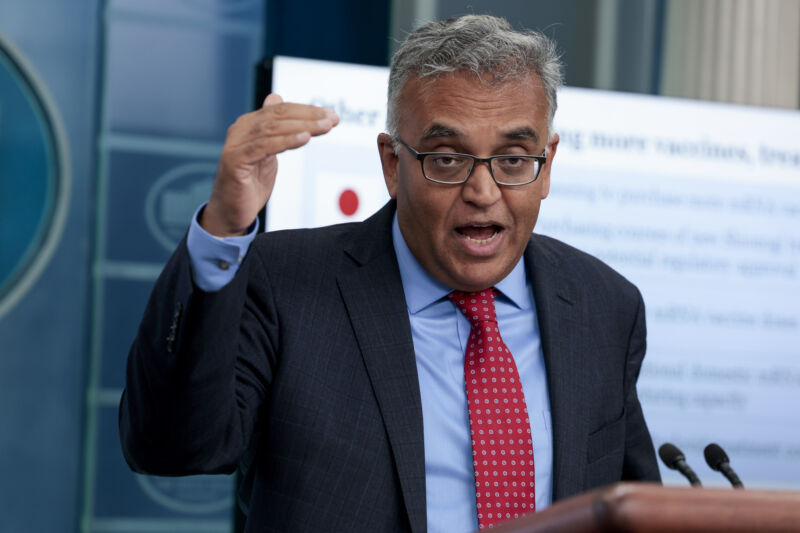

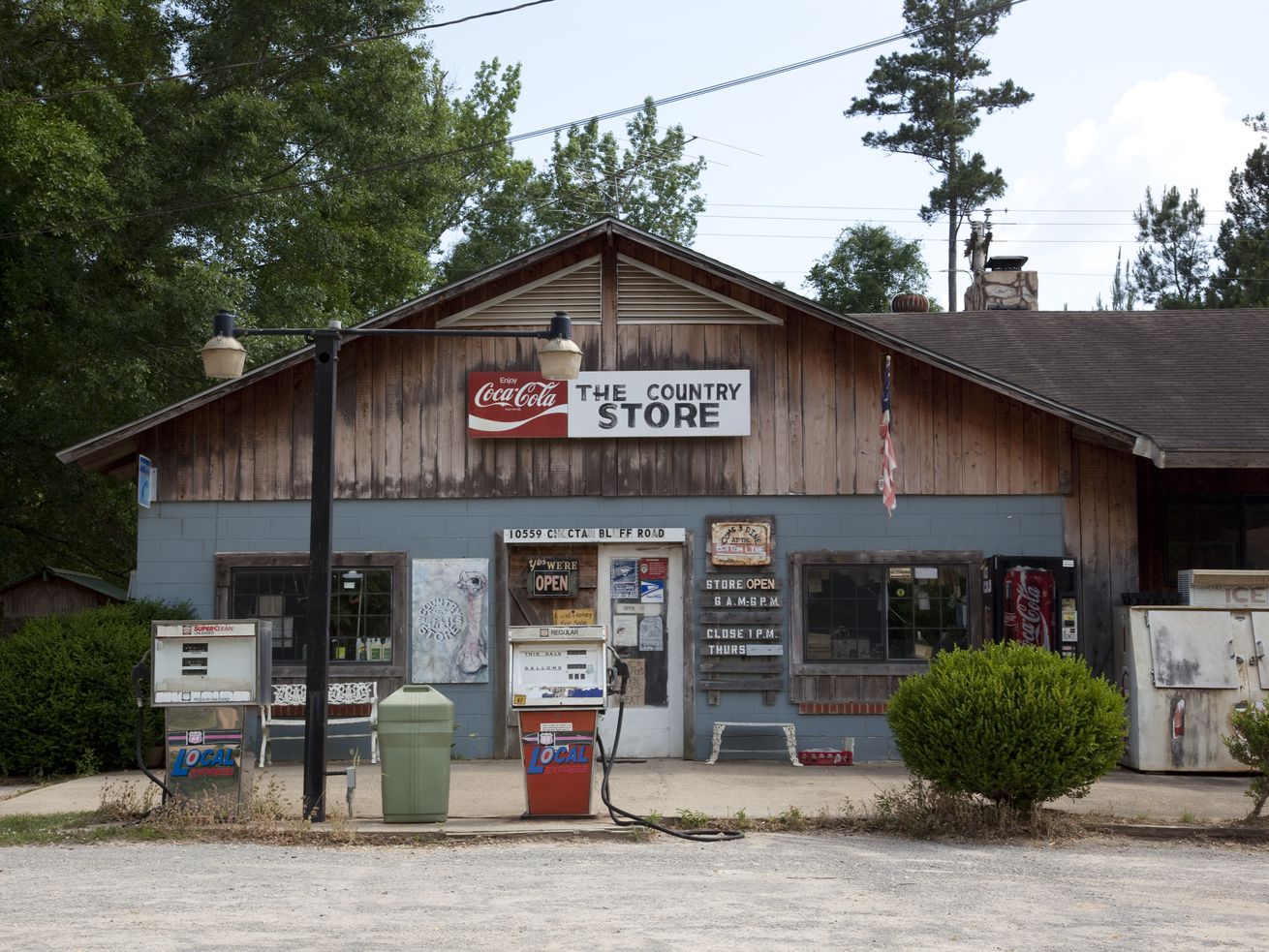



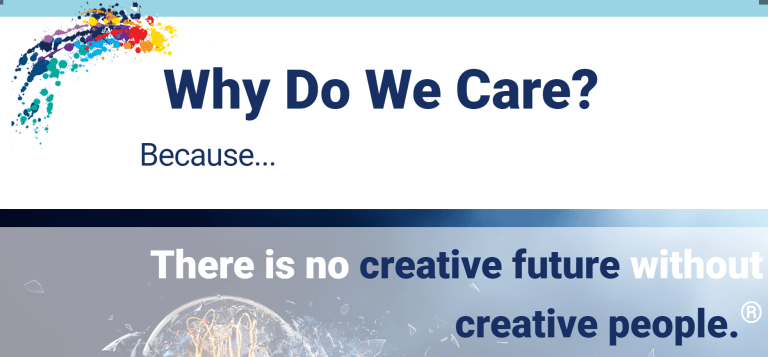



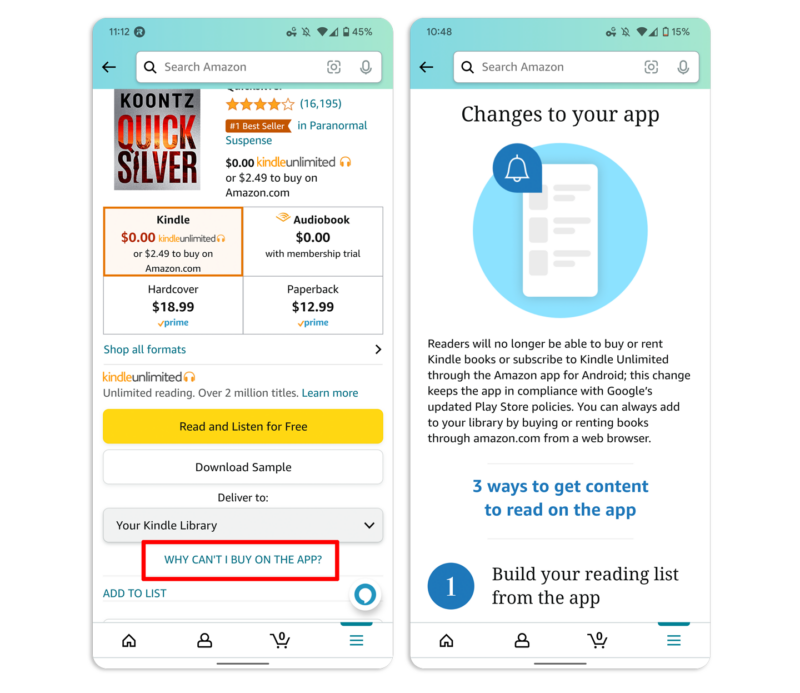
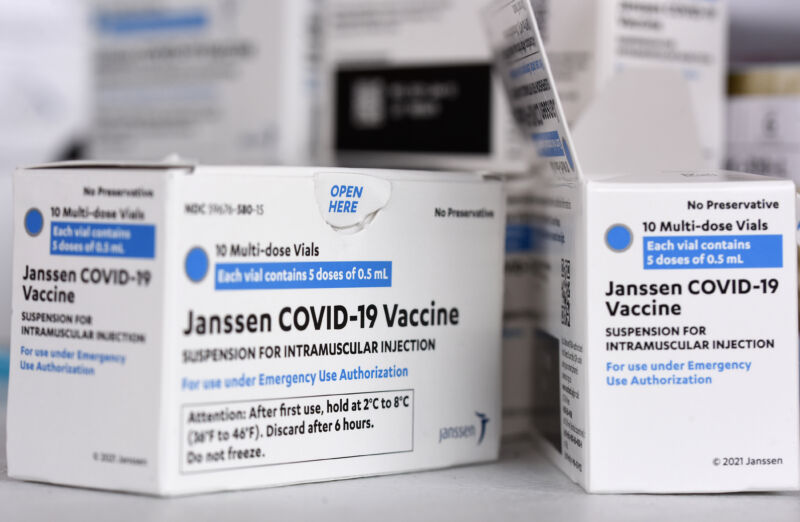

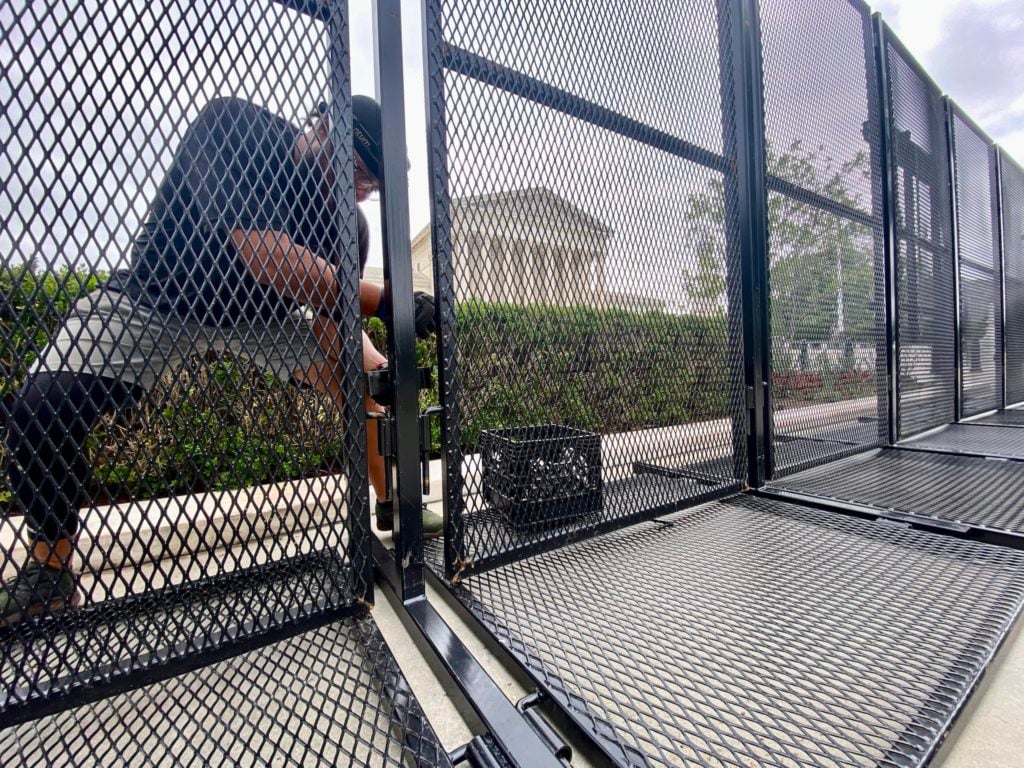
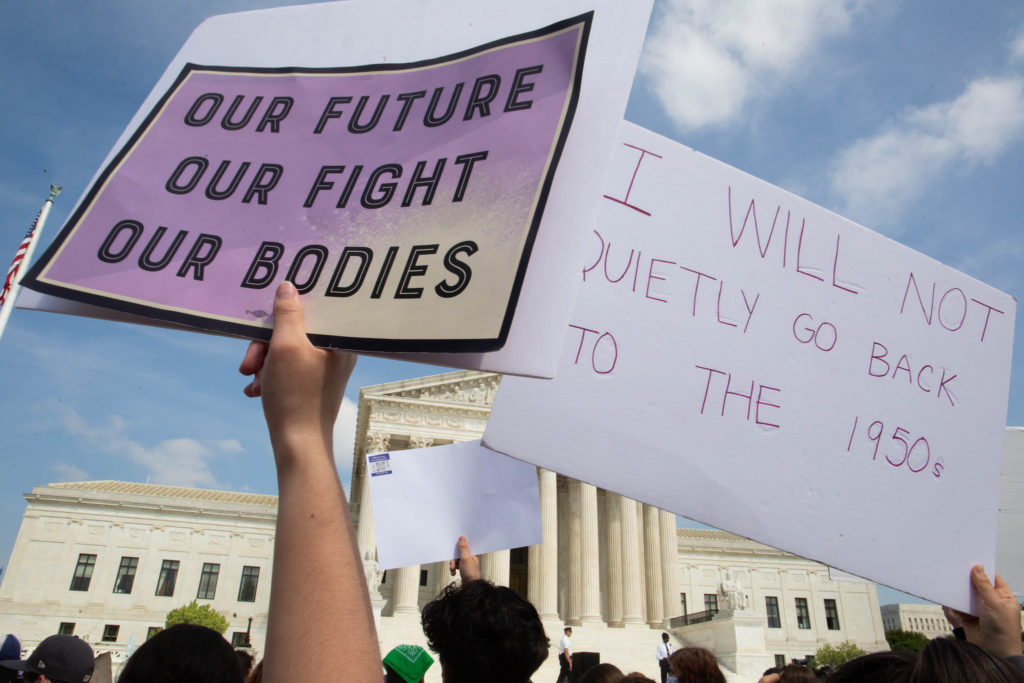

/cdn.vox-cdn.com/uploads/chorus_asset/file/23440698/IMG_4719.jpg) Neel Dhanesha/Vox
Neel Dhanesha/Vox
/cdn.vox-cdn.com/uploads/chorus_asset/file/23440700/IMG_4715.jpg) Neel Dhanesha/Vox
Neel Dhanesha/Vox
/cdn.vox-cdn.com/uploads/chorus_asset/file/23440723/shutterstock_editorial_11986878e_a.jpg) Saman Abesiriwardana/Pacific Press/Shutterstock
Saman Abesiriwardana/Pacific Press/Shutterstock
/cdn.vox-cdn.com/uploads/chorus_asset/file/23440834/AP21161555468484a.jpg) Eranga Jayawardena/AP
Eranga Jayawardena/AP
/cdn.vox-cdn.com/uploads/chorus_asset/file/23440970/IMG_4557.jpg) Neel Dhanesha/Vox
Neel Dhanesha/Vox
/cdn.vox-cdn.com/uploads/chorus_asset/file/23440973/IMG_4536.jpg) Neel Dhanesha/Vox
Neel Dhanesha/Vox
/cdn.vox-cdn.com/uploads/chorus_asset/file/23440995/IMG_4756.jpeg) Neel Dhanesha/Vox
Neel Dhanesha/Vox
/cdn.vox-cdn.com/uploads/chorus_asset/file/23441002/IMG_4781.jpeg) Neel Dhanesha/Vox
Neel Dhanesha/Vox
/cdn.vox-cdn.com/uploads/chorus_asset/file/23441006/GettyImages_1237070736.jpg) Mark Felix/AFP via Getty Images
Mark Felix/AFP via Getty Images
/cdn.vox-cdn.com/uploads/chorus_asset/file/23441017/GettyImages_1237070586.jpg) Mark Felix/AFP via Getty Images
Mark Felix/AFP via Getty Images
/cdn.vox-cdn.com/uploads/chorus_asset/file/23441221/IMG_4833.jpg) Neel Dhanesha/Vox
Neel Dhanesha/Vox


/cdn.vox-cdn.com/uploads/chorus_asset/file/23433856/GettyImages_1391615988.jpg) Carlos Gonzalez/Star Tribune via Getty Images
Carlos Gonzalez/Star Tribune via Getty Images
/cdn.vox-cdn.com/uploads/chorus_asset/file/23438209/2LDKg_the_bird_flu_has_resulted_in_the_death_of_more_than_36_million_chickens_and_turkeys_since_february__2_.png)
/cdn.vox-cdn.com/uploads/chorus_asset/file/23433878/GettyImages_1182547600.jpg) Daniel Acker/Bloomberg via Getty Images
Daniel Acker/Bloomberg via Getty Images
/cdn.vox-cdn.com/uploads/chorus_asset/file/23433865/Talaat_Adel_lab20_3849.jpg) Jeff Miller/UW-Madison
Jeff Miller/UW-Madison



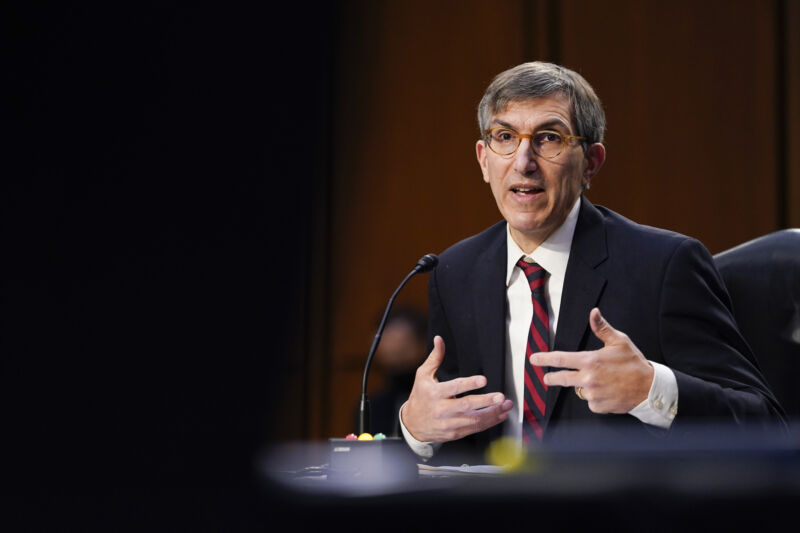

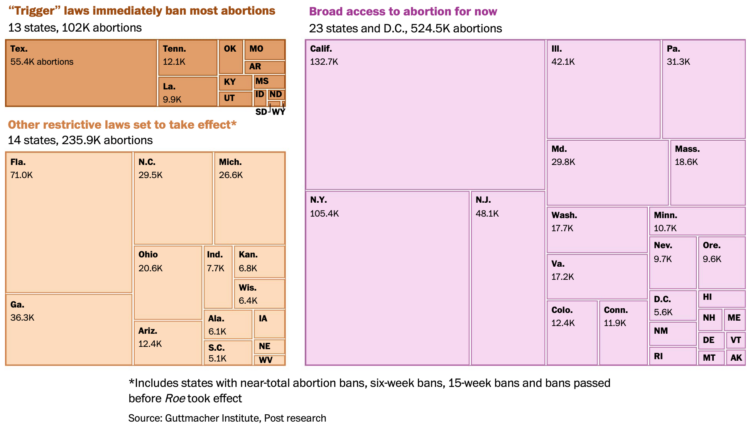


/cdn.vox-cdn.com/uploads/chorus_asset/file/23437283/1240134594.jpg) Jim Lo Scalzo/AFP via Getty Images
Jim Lo Scalzo/AFP via Getty Images
/cdn.vox-cdn.com/uploads/chorus_asset/file/23437287/1240110101.jpg) Evelyn Hockstein/AFP via Getty Images
Evelyn Hockstein/AFP via Getty Images
/cdn.vox-cdn.com/uploads/chorus_asset/file/23437290/1390864234.jpg) Photo by Paul Morigi/Getty Images
Photo by Paul Morigi/Getty Images