Lindsey
Shared posts
Poop Drones Are Keeping Sewers Running So Humans Don’t Have to
Seasonal COVID shots may no longer be possible under Trump admin
Under President Trump, the Food and Drug Administration may no longer approve seasonal COVID-19 vaccines updated for the virus variants circulating that year, according to recent statements by Trump administration officials.
Since the acute phase of the pandemic, vaccine manufacturers have been subtly updating COVID-19 shots annually to precisely target the molecular signatures of the newest virus variants, which continually evolve to evade our immune responses. So far, the FDA has treated these tweaked vaccines the same way it treats seasonal flu shots, which have long been updated annually to match currently circulating strains of flu viruses.
The FDA does not consider seasonal flu shots brand-new vaccines. Rather, they're just slightly altered versions of the approved vaccines. As such, the regulator does not require companies to conduct lengthy, expensive vaccine trials to prove that each slightly changed version is safe and effective. If they did, generating annual vaccines would be virtually impossible. Each year, from late February to early March, the FDA, the Centers for Disease Control and Prevention, and the World Health Organization direct flu shot makers on what tweaks they should make to shots for the upcoming flu season. That gives manufacturers just enough time to develop tweaks and start manufacturing massive supplies of doses in time for the start of the flu season.

County Council overrides Elrich’s veto of tax breaks for workforce housing developers
Jawando, Mink side with county executive, who called initiative ‘fiscally irresponsible’
The post County Council overrides Elrich’s veto of tax breaks for workforce housing developers appeared first on Bethesda Magazine.
Judge: Trump’s national security reasoning for anti-union EO was 'pretext for retaliation'
U.S. District Judge Paul Friedman issued the finding Monday in a 46-page opinion explaining his decision last week to enjoin the administration from implementing the March executive order, following a lawsuit from the National Treasury Employees Union.
“The scope of the executive order when compared with the intent of Congress in passing the [Civil Service Reform Act], coupled with the surrounding statements in the [White House] fact sheet and [Office of Personnel Management] guidance—which strongly suggest that President Trump’s invocation of [the statute’s national security exemption] was mere pretext for retaliation and for accomplishing unrelated policy objectives—are persuasive reasons to believe NTEU will likely be successful on the merits of its claim,” Friedman wrote.
In federal courts, judges generally are expected to assume that government officials properly discharged their duties, a concept called the “presumption of regularity.” But Friedman found that the White House and OPM’s public explanations for the executive order, as well as the exemption of some law and immigration enforcement unions from the edict, override that presumption.
“In sum, the OPM guidance says little about national security, notwithstanding the national security valence of [the statute]," he wrote. “On examination, the OPM guidance and the executive order appear to be more about accomplishing the administration’s goal of substantially changing the nature of the federal workforce. The OPM guidance lists numerous examples of earlier policy directives by the president and OPM, identifies the difficulties collective bargaining agreements posed to accomplishing those directives, and states that those obstacles are now gone as a result of the executive order ... Indeed, it is strong evidence that the president’s invocation of [the national security exemption] was to remove barriers created by the [labor statute] to his unrelated policy objectives.”
Even when taken at face value, the judge found that the president’s determinations, which involved shuttling entire agencies outside of the federal sector labor statute when only a mere fraction of their work implicates national security, did not meet the standard that an agency subcomponent must have a “primary function’ of national security in order to be exempted from the law.
“While the government never explicitly states how it interprets ‘primary function,’ its arguments related to each of the agencies and subdivisions reflect either an overly broad interpretation of the term or a disregard of the term entirely,” Friedman wrote. “The government’s arguments related to each of the agencies and subdivisions illustrate this point by either pointing to generalized mission statements of the agencies referencing national security, or by pointing to individual functions that segments of the agencies or subdivisions perform that have a national security valence, and then concluding that the entire agencies’ or subdivisions’ ‘primary function’ is national security.”
Though unions typically fail in lawsuits against employing agencies in district court, because they are required to first pursue their claims before the Federal Labor Relations Authority, Friedman said the executive order precludes their ability to seek redress, as the FLRA does not hold jurisdiction at agencies that have been excluded from the statute. And the FLRA has already indicated it would dismiss a complaint filed by NTEU in relation to the executive order.
“The administrative review scheme, however, is not available to challenge the executive order’s exclusion of the agencies and subdivisions subject to the executive order for the simple reason that those agencies and subdivisions have been excluded from the [statute’s] coverage by the very executive order at issue here,” he wrote. “Indeed, the exact case the government contends NTEU should bring to the FLRA was attempted in 2002 in the context of a different executive order invoking the [national security exemption], and the FLRA dismissed the case for lack of jurisdiction.”
]]>
Trump’s Policies Are Creating Uncertainty for Fossil Fuel Companies
Federal minimum wage falls below poverty lines
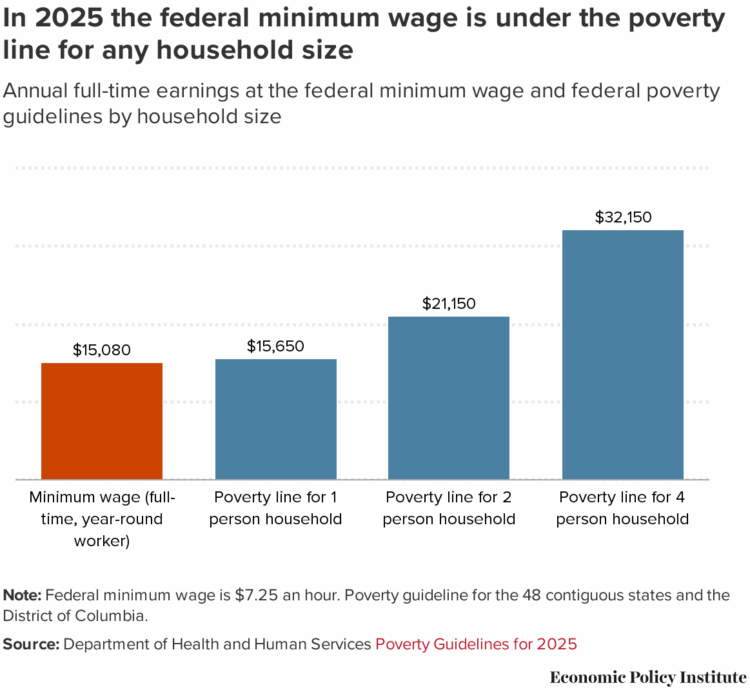
Each year, poverty thresholds are calculated based on the cost of living, so thresholds rise over time with inflation. However, the federal minimum wage hasn’t changed since 2009 in the United States, which means the minimum wage is now a poverty wage:
When the minimum wage was created as part of the Fair Labor Standards Act in 1938, the policy was intended to protect the nation from “the evils and dangers resulting from wages too low to buy the bare necessities of life.”1 The federal wage floor is clearly not fulfilling this objective anymore because of a historically long period of inaction by Congress. The last time Congress increased the federal minimum wage was in July 2009, meaning that as prices have risen over the last 15 years, the value of the minimum wage has fallen by 30%.

Inspector General Probes Whether Trump, DOGE Sought Private Taxpayer Information or Sensitive IRS Material
by William Turton, Avi Asher-Schapiro, Christopher Bing and Andy Kroll
ProPublica is a nonprofit newsroom that investigates abuses of power. Sign up to receive our biggest stories as soon as they’re published.
A Treasury Department inspector general is probing efforts by President Donald Trump and Elon Musk’s Department of Government Efficiency to obtain private taxpayer data and other sensitive information, internal communications reviewed by ProPublica show.
The office of the Treasury Inspector General for Tax Administration has sought a wide swath of information from IRS employees. In particular, the office is seeking any requests for taxpayer data from the president, the Executive Office of the President, DOGE or the president’s Office of Management and Budget.
The request, spelled out in a mid-April email obtained by ProPublica, comes as watchdogs and leading Democrats question whether DOGE has overstepped its bounds in seeking information about taxpayers, public employees or federal agencies that is typically highly restricted.
The review appears to be in its early stages — one document describes staffers as “beginning preplanning” — but the email directs the IRS to turn over specific documents by Thursday, April 24. It’s not clear if that happened.
The inspector general is seeking, for instance, “All requests for taxpayer or other protected information from the President or Executive Office of the President, OMB, or DOGE. Include any information on how the requestor plans to use the information requested, the IRS’s response to the request, and the legal basis for the IRS’s response,” the email says.
The inquiry also asks for information about requests for access to IRS systems from any agency in the executive branch, including the Department of Homeland Security, the Social Security Administration and DOGE.
The Treasury Inspector General for Tax Administration office, known as TIGTA, is led by acting Inspector General Heather M. Hill. When Trump fired 17 inspectors general across a range of federal agencies in January, those working for the Treasury Department were not among the ones axed.
The White House, DOGE, OMB and Musk did not respond to requests for comment Friday.
Previously, the administration has said, “Those leading this mission with Elon Musk are doing so in full compliance with federal law, appropriate security clearances, and as employees of the relevant agencies, not as outside advisors or entities.”
A TIGTA spokesperson, Becky D’Ambrosio, said the agency “does not disclose specific details of ongoing work or timelines.” She said the office has received multiple requests from Congress. “When possible, we are incorporating these requests into our ongoing work providing independent oversight of IRS activities.”
The April 15 request follows concerns expressed by some within the IRS that DOGE employees under Musk’s direction have improperly accessed taxpayer information or shared it with other government agencies, said multiple people familiar with the matter who spoke on the condition of anonymity for fear of retaliation.
Earlier this month, a group of Democratic senators urged the Treasury inspector general to investigate whether the Trump administration was “violating strict taxpayer privacy laws” by giving DOGE personnel wide access inside the agency.
“Taxpayer data held by the IRS is, by design, subject to some of the strongest privacy protections under federal law, the violation of which can trigger civil and criminal sanctions,” the lawmakers wrote in their request.
In March, three senators said they were troubled by reports the IRS had entered into a sharing agreement to help the Department of Homeland Security “locate suspected undocumented immigrants.” Trump has promised deportations on a massive scale.
A spokesperson for Sen. Ron Wyden, one of the signees of both requests, declined to comment. DHS referred a request for comment from ProPublica to the Treasury Department, which did not respond.
The inspector general examination comes amid major upheaval at the Treasury Department and the IRS, as the administration moves to fire thousands of agency workers and DOGE digs deeper into IRS databases. Melanie Krause resigned as the acting commissioner of the IRS after the agency reached an agreement to share taxpayer data with the DHS.
A former senior official at TIGTA told ProPublica the review could lead to a criminal investigation if reviewers find evidence of lawbreaking. The same official said it’s possible those leading the review could face political repercussions, as have scores of prosecutors, FBI agents, law firms and others who have questioned Trump’s actions.
Emails from the inspector general to IRS employees earlier this month asked them to provide copies of any written agreements to share taxpayer data with entities including the Department of Homeland Security, the Social Security Administration, DOGE, the Office of Personnel Management or other agencies.
It also seeks a full list of non-IRS employees who are part of DOGE or its affiliates. This year, ProPublica has been profiling the figures working for DOGE.
Danielle Citron, a leading privacy legal scholar at the University of Virginia, said the email suggests that the inspector general may be probing for violations of the Privacy Act, which requires agencies to safeguard citizens’ information and only share it across the government in specific cases. The kind of blanket data-sharing agreement the Trump administration is seeking with the IRS, she said, is “exactly what the Privacy Act is designed to avoid.”
CNN and Wired have reported that DOGE is attempting to build a master database that combines information from the IRS, DHS, Social Security Administration and other agencies. The database would be used for immigration enforcement, the outlets reported.
This is not the first time Trump administration decisions at the IRS have prompted an inspector general inquiry.
As ProPublica reported, a senior IRS lawyer warned the agency’s leaders in late February that its plan to terminate nearly 7,000 probationary employees based on poor performance was untrue and a “fraud.” The IRS proceeded with the firings, which have since been challenged in federal court.
After the firings, the IRS inspector general began scrutinizing the mass terminations, said a person familiar with the effort who wasn’t authorized to speak with reporters. The status of the probe is not known.
Scientists Find Measles Likely To Become Endemic in the US Over Next 20 Years
AI secretly helped write California bar exam, sparking uproar
On Monday, the State Bar of California revealed that it used AI to develop a portion of multiple-choice questions on its February 2025 bar exam, causing outrage among law school faculty and test takers. The admission comes after weeks of complaints about technical problems and irregularities during the exam administration, reports the Los Angeles Times.
The State Bar disclosed that its psychometrician (a person or organization skilled in administrating psychological tests), ACS Ventures, created 23 of the 171 scored multiple-choice questions with AI assistance. Another 48 questions came from a first-year law student exam, while Kaplan Exam Services developed the remaining 100 questions.
The State Bar defended its practices, telling the LA Times that all questions underwent review by content validation panels and subject matter experts before the exam. "The ACS questions were developed with the assistance of AI and subsequently reviewed by content validation panels and a subject matter expert in advance of the exam," wrote State Bar Executive Director Leah Wilson in a press release.

The president’s procurement order offers a real opportunity. Let’s not squander it
As I said then: buckle up, there’s more to come.
Indeed, on April 15, the president signed what could be a very impactful, procurement-centered executive order. And this one has the potential to move the needle forward in important and positive ways.
To start, let’s set aside some of the rhetoric surrounding the order and focus instead on what it actually requires. There are two key parts. The first is establishing a requirement for agencies to procure commercial, rather than custom, software. The second is a major streamlining of the Federal Acquisition Regulation, the 2000+ page tome that governs most all federal procurement.
While not entirely new, both goals are well worth supporting and pursuing. Done right, the order offers the potential for real transformation. So, what will success require?
First, it is essential to pay attention to and learn from the lessons of the past. For example, the development of the Federal Acquisition Streamlining Act, the most significant reform effort in recent history, was one of the most collaborative policy initiatives I have ever been involved in. Great care was taken to involve all relevant stakeholders to engage in open dialogue among agency, congressional, industry and third-party experts. Further, it was not only remarkably collaborative, it was also entirely non-partisan. Only through that kind of open and collaborative process was it possible to build the requisite trust so critical to success. Beyond the importance of collaboration in any major change effort, the reality of our contemporary politics makes it all the more critical. To be clear, the politicization of acquisition really began more than twenty years ago and since that time, real or perceived procurement errors or “scandals” have all too often become proxies for broader policy battles. That cannot continue if we are serious about empowering the acquisition workforce and transforming the culture. That workforce needs to believe their leaders have faith in them, will support them and see them as part of the solution rather than the source of the problem. Without that, real change will prove elusive.
Second, the new EO is not the first time a preference for commercial solutions has been established. This was a core component of FASA — and the evolution of FAR Part 12, which governs commercial items — and has been the focus of most every reform effort since.
Here, too, the FASA experience and what followed offers important insight. Most significantly, there is a big difference between the commercial buying authorities as they were originally envisioned and the FAR Part 12 of today. The original FAR Part 12 recognized that the core tenets of public procurement could be achieved in a system that was not burdened by traditional government-specific contracting requirements that were principally the product of the days when the government — particularly the Pentagon — was a monopsony buyer.
Unfortunately, since the passage of FASA, some 150 contract clauses have been layered on to the original FAR Part 12, many of which have no statutory basis. That would be a great place to start the FAR review.
It is also notable that when opportunities have emerged in the past to take a “clean sheet” approach to federal acquisition, especially the Federal Aviation Administration’s Blue-Ribbon Panel and the evolution of Other Transactions Authorities, the end result often looked very much like Part 12 — as Part 12 was originally envisioned. And in both of those cases, achieving the full potential of the reforms has been inhibited by a tendency to add unnecessary FAR clauses — or “non-FAR” clauses that have much the same effect — and which serve as primary obstacles for commercial companies entering the federal market. This is particularly true of a continued reliance on government-unique cost accounting procedures that bear limited resemblance to the accounting standards that govern the rest of the economy and of often arcane, zero-sum approaches to intellectual property and technical data rights.
Third, the real inculcation can’t happen without a clear future vision and the commitment of the human and other resources that will be needed. FAR transformation is a multi-functional, cross organization challenge and must be approached as such. Contracting professionals do not operate in a vacuum.
FASA, especially its aftermath, taught us that simplifying the rules was not the same thing as making acquisition “easier.” Indeed, in some ways it made it more complex. Commercial buying itself requires different and varied skills and culture than traditional FAR models. We almost certainly underestimated the human capital component of what it would take to affect the kind of major changes we envisioned. This remains an unavoidable reality. Driving sustainable change, especially in the world’s largest and most complex organization is not merely a matter of simplifying rules and capitalizing on technology. For change like this to take hold, thoughtful, data-supported talent management and development, rather than arbitrary assumptions or personnel cuts, must hold sway.
There’s a lot to unpack in the FAR and all of the agency supplements covered by the order. And doing so in 180 days is a mammoth undertaking. But much of the crucial groundwork has already been laid.
And complicated as it may be, every time I wonder if yet another such effort is worth it, I remind myself that one of the government’s first uses of artificial intelligence was to help acquisition professionals decipher the acquisition rules. That’s crazy. Now, we have another chance to change the game. Let’s not squander it.
]]>
Elrich vetoes tax breaks for developing workforce housing
County executive says no to ‘fiscally irresponsible and unnecessary’ legislation
The post Elrich vetoes tax breaks for developing workforce housing appeared first on Bethesda Magazine.
Police arrest teens in stabbing Friday at Rockville Metro station
Man was pepper-sprayed, stabbed, beaten with skateboard, police say
The post Police arrest teens in stabbing Friday at Rockville Metro station appeared first on Bethesda Magazine.
DOGE Is Building a Master Database to Surveil and Track Immigrants
Scientists Find Promising Indication of Extraterrestrial Life—124 Light-Years Away
CVE, global source of cybersecurity info, was hours from being cut by DHS
The Common Vulnerability and Exposures, or CVE, repository holds the answers to some of information security's most vital questions. Namely, which security issue are we talking about, exactly, and how does it work?
The 25-year-old CVE program, an essential part of global cybersecurity, is cited in nearly any discussion or response to a computer security issue, including Ars posts. CVE was at real risk of closure after its contract was set to expire on April 16. The nonprofit MITRE runs CVE and related programs (like Common Weakness Enumeration, or CWE) on a contract with the US Department of Homeland Security (DHS). A letter to CVE board members sent Tuesday by Yosry Barsoum, vice president of MITRE, gave notice of the potential halt to operations.
"If a break in service were to occur, we anticipate multiple impacts to CVE, including deterioration of national vulnerability databases and advisories, tool vendors, incident response operations, and all manner of critical infrastructure," Barsoum wrote.

AP: Trump admin to kill IRS free tax-filing service that Intuit lobbied against
The Trump administration plans to kill the free tax filing program operated by the Internal Revenue Service, the Associated Press reported today, citing two anonymous sources.
The IRS launched Direct File in a pilot for the 2024 tax filing season. It was available to taxpayers in 12 states last year and was available in 25 states this year. The program's website says the filing tool will be open until October 15 for people who obtained deadline extensions, but it hasn't been updated to account for the plan to end Direct File.
"The program had been in limbo since the start of the Trump administration as Elon Musk and the Department of Government Efficiency have slashed their way through the federal government," the AP article said. "Musk posted in February on his social media site, X, that he had 'deleted' 18F, a government agency that worked on technology projects such as Direct File."

Why are two Texas senators trying to wrest a Space Shuttle from the Smithsonian?
Should the city of Houston, which proudly bills itself as "Space City," have a prized Space Shuttle orbiter on public display?
More than a decade ago, arguably, the answer was yes. After all, the Space Shuttle program was managed from Johnson Space Center, in southeastern Houston. All the astronauts who flew on the shuttle trained there. And the vehicle was operated out of Mission Control at the Houston-based facility.
But when the final decisions were being made to distribute the shuttles 15 years ago, the Houston community dragged its feet on putting together a competitive proposal. There were also questions about the ability of Space Center Houston to raise funding to house the shuttle within a new display area, which magnified concerns that the historical vehicle, like a Saturn V rocket before it, would be left outside in the region's humid environment. Finally, other cities offered better proposals for displaying the shuttles to the public.

User with Russian IP address tried to log into NLRB systems following DOGE access, whistleblower says
The whistleblower, Daniel Berulis, provided forensic evidence and internal documentation to Congress and the U.S. Office of Special Counsel, accusing DOGE of exfiltrating large volumes of confidential data and disabling various security monitoring systems used to scan for malicious behavior in NLRB’s networks, NPR first reported.
The user attempting to log in relied on a newly created DOGE email account and the attempts were “near real-time,” according to the Berulis disclosure. It’s not clear whether the user was actually in Russia because hackers often use techniques to remotely mask their true location.
The login attempts were blocked, but the person used a correct username and password, suggesting that adversaries may already be testing entry points potentially exposed by DOGE’s activities across the government.
The whistleblower’s disclosure was accompanied by a cover letter from his attorney, Andrew Bakaj of Whistleblower Aid, which said that, after he raised concerns internally about DOGE’s inroads into the agency, he received a physically taped threat on his door containing personal information and overhead photos of him walking his dog.
A DOGE spokesperson did not immediately return a request for comment. DOGE, overseen by Elon Musk, is not an official government agency and was stood up as a reworking of the U.S. Digital Service at the start of the Trump administration to eliminate perceived federal spending waste.
The accusations from Berulis are not an isolated incident, NPR reported, citing an aide for the Democratic minority on the House Oversight Committee who said the panel is “in possession of multiple verifiable reports showing that DOGE has exfiltrated sensitive government data across agencies” for reasons that are unknown.
“This case has been particularly sensitive as it involves the possibility of sophisticated foreign intelligence gaining access to sensitive government systems, which is why we went to the Senate Intelligence Committee directly,” said Bakaj. Spokespeople for Sens. Tom Cotton, R-Ark. and Mark Warner, D-Va., the top lawmakers on the Senate panel, did not immediately return requests for comment.
The disclosures underscore the breadth of DOGE’s expansion across the federal landscape, and follow mounting legal challenges over its sweeping access to Americans’ financial and personal data. How that data is being protected, processed or used remains unclear.
Broader security and privacy concerns about DOGE have been compounded by the cost-cutting entity’s access to highly sensitive labor information and the potential conflict of interest posed by Elon Musk’s dual role in government and as chief of companies under active NLRB investigation, including SpaceX and Tesla. NLRB’s case systems contain data like union organizing activities, employee whistleblower identities, legal strategies and proprietary business information.
The whistleblower claims DOGE engineers used secretive and suspicious methods to pull sensitive information from the NLRB’s systems. They shut off security tools that track activity, deleted evidence of what they accessed and used software that made their work nearly invisible, Berulis alleged in filings.
A big spike in data leaving the agency followed, possibly through a technique that hides stolen data in normal-looking internet traffic, according to the disclosures. One engineer also appeared to be working on a tool designed to pull files from the agency’s internal case system. Security experts told NPR those tactics resemble the playbook of foreign hackers and not federal workers.
]]>
Is Airplane Mode on Flights Necessary or Outdated? (2025)
Decline in European travelers to U.S.
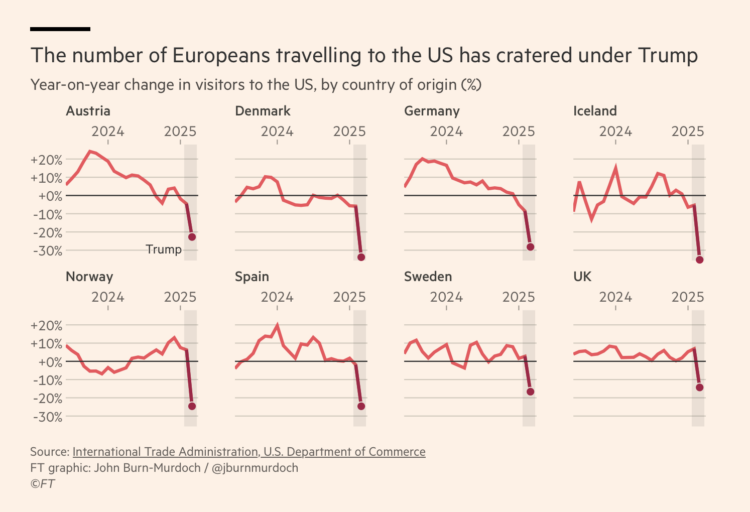
These charts will shock you I am sure. Travel to the United States for Europeans appears much less popular year-over-year. Financial Times shows the steep drop (paywalled) since the new administration began.
Numbers are based on data from the International Visitor Arrivals Program (ADIS I-94), which as the name suggests, tracks the number of people arriving at air and sea ports.
Tags: Europe, Financial Times, tourism
Car safety experts at NHTSA, which regulates Tesla, axed by DOGE
Job cuts at the US traffic safety regulator instigated by Elon Musk’s so-called Department of Government Efficiency disproportionately hit staff assessing self-driving risks, hampering oversight of technology on which the world’s richest man has staked the future of Tesla.
Of roughly 30 National Highway Traffic Safety Administration workers dismissed in February as part of Musk’s campaign to shrink the federal workforce, many were in the “office of vehicle automation safety,” people familiar with the situation told the Financial Times.
The cuts are part of mass firings by Doge that have affected at least 20,000 federal employees and raised widespread concern over potential conflicts of interest for Musk given many of the targeted agencies regulate or have contracts with his businesses.

The Data Shows Trump’s ‘Radical Leftist Judge’ Claims Are Pure MAGA Delusion & Projection
For four years, Trump supporters regularly exploited the federal judiciary, carefully selecting friendly judges in single-judge districts to block Biden administration policies through nationwide injunctions. Now that the shoe is on the other foot, with courts regularly ruling against Trump’s executive actions, they’re crying foul — claiming an army of “radical leftist” judges has secretly infiltrated the courts.
The flood of judicial rulings against Trump isn’t coming from some shadowy cabal of leftist judges — it’s coming from Trump’s own unprecedented wave of executive actions while Congress sits idle. Law professor Steve Vladeck, who has been studying jurisdiction shopping extensively, recently analyzed the data and found that “the cause of this unprecedented flurry of judicial activity is neither the judges nor the courts; it’s the policies they’re reviewing.”
During the Biden administration, certain names became very familiar in major policy cases: Judge Matthew Kacsmaryk, Judge Reed O’Connor, Judge Terry Doughty. This wasn’t coincidence — it was strategy. MAGA lawyers deliberately filed cases in jurisdictions with single judges known to be sympathetic to their cause, guaranteeing their cases would land before friendly faces.
Now that Trump is back in power, the people who loved the ability to go to a single judge knowing they’d likely rule against Biden and issue a nationwide injunction are suddenly freaking out and accusing those bringing suits of using far leftist radical Marxist judges. There’s just one big problem: it’s not true. At all.
Vladeck and his researchers find that, yes, courts are ruling against Trump frequently, but note that’s because he’s doing a ton of crazy shit, issuing over 100 executive orders while Congress is sitting on its hands. But, more importantly, there’s little evidence of the kind of judge shopping that MAGA was famous for the last four years:
With one fleeting exception, one of the 67 lawsuits we found in which interim relief has been sought against Trump administration policies have been filed in “single-judge divisions” (where a case has a 100% chance of being assigned to a specific judge). This kind of “judge-shopping” is distinct from “forum-shopping,” in which litigants with options pick where to file based on various factors, perhaps including the overall composition of the local bench. At least with regard to finding a way to bring a case so that a specific, hand-picked judge will be assigned to decide it, we haven’t seen any of those in the cases in our dataset.
(And if you’re wondering about that “fleeting” exception, that case was reassigned 24 hours later).
Indeed, they found that the one court in a “blue” state that has a single judge division (in Massachusetts) just quietly changed its rules so these kinds of cases (targeting nationwide injunctions) would be more randomly assigned across all 20 judges in the district. This stands in stark contrast to the response in Texas, where courts famous for judge shopping essentially refused to implement new policies meant to prevent it.
Meanwhile, Dems seem to be bending over backwards to make sure judge selection is random and fair. It’s almost as if one party wants to cheat and the other actually cares about judicial fairness. Crazy.
But… maybe everyone challenging Trump is still getting these supposed crazed Marxist judges. Well, the data again says “fuck no.”
To help make clear how the party of the President who appointed the relevant judge is not driving these rulings, of the 20 cases in our dataset that were assigned to Republican-appointed district judges, nine of those saw grants of a TRO and/or PI. Thus, even looking at the cases before Republican-appointed district court judges alone, plaintiffs have still obtained preliminary relief in 45% of the cases in which they’ve sought it. That’s … high.
One last point on the data: The only subset of appointees whose rulings have been uniform are district judges appointed by President Trump. Of the 67 cases we identified, eight have been assigned to judges Trump appointed between 2017 and 2021. In all eight of those cases, the district court denied interim relief. Whatever that says about Trump appointees, note what it says about judges appointed by previous Republican presidents: Of the 12 cases in our dataset assigned to such judges, nine of them have produced a TRO against the challenged policy, a PI, or both. I understand that there are those to whom you literally can’t be a Republican if you do anything to oppose Trump. But any claim that judges like John Bates, Richard Leon, and Royce Lamberth are liberal squishes betrays the claimant’s utter lack of seriousness.
The pattern here is striking: Trump-appointed judges protect Trump, while other Republican-appointed judges frequently rule against him when his actions violate the Constitution. Yet in MAGA world, this becomes evidence of some vast leftist conspiracy.
It’s a perfect example of the “every accusation is a confession” phenomenon. Having spent years actually gaming the judicial system through careful judge shopping, they assume everyone else must be doing the same thing — even when the evidence shows exactly the opposite.
And now, in a final twist of irony, MAGA forces are suddenly calling to eliminate nationwide injunctions entirely — the very tool they relied on repeatedly during the Biden years. It’s almost as if their only consistent principle is “whatever helps Trump.”
Trump’s EPA Plans to Stop Collecting Greenhouse Gas Emissions Data From Most Polluters
ProPublica is a nonprofit newsroom that investigates abuses of power. Sign up to receive our biggest stories as soon as they’re published.
The Environmental Protection Agency is planning to eliminate long-standing requirements for polluters to collect and report their emissions of the heat-trapping gases that cause climate change. The move, ordered by a Trump appointee, would affect thousands of industrial facilities across the country, including oil refineries, power plants and coal mines as well as those that make petrochemicals, cement, glass, iron and steel, according to documents reviewed by ProPublica.
The Greenhouse Gas Reporting Program documents the amount of carbon dioxide, methane and other climate-warming gases emitted by individual facilities. The data, which is publicly available, guides policy decisions and constitutes a significant portion of the information the government submits to the international body that tallies global greenhouse gas pollution. Losing the data will make it harder to know how much climate-warming gas an economic sector or factory is emitting and to track those emissions over time. This granularity allows for accountability, experts say; the government can’t curb the country’s emissions without knowing where they are coming from.
“This would reduce the detail and accuracy of U.S. reporting of greenhouse gas emissions, when most countries are trying to improve their reporting,” said Michael Gillenwater, executive director of the Greenhouse Gas Management Institute. “This would also make it harder for climate policy to happen down the road.”
The program has been collecting emissions data since at least 2010. Roughly 8,000 facilities a year now report their emissions to the program. EPA officials have asked program staff to draft a rule that will drastically reduce data collection. Under the new rule, its reporting requirements would only apply to about 2,300 facilities in certain sectors of the oil and gas industry.
Climate experts expressed shock and dismay about the apparent decision to stop collecting most information on our country’s greenhouse gas emissions. “It would be a bit like unplugging the equipment that monitors the vital signs of a patient that is critically ill,” said Edward Maibach, a professor at George Mason University. “How in the world can we possibly manage this incredible threat to America’s well-being and humanity’s well-being if we’re not actually monitoring what we’re doing to exacerbate the problem?”
The EPA did not address questions from ProPublica about the Greenhouse Gas Reporting Program. Instead, the agency provided an emailed statement affirming the Trump administration’s commitment to “clean air, land, and water for EVERY American.”
The agency announced last month that it was “reconsidering” the greenhouse gas reporting program. In a little-noticed press release issued on March 12, when the EPA sent out 24 bulletins as it celebrated the “most consequential day of deregulation in U.S. history,” EPA Administrator Lee Zeldin described the reporting program as “burdensome.” Zeldin also claimed that the program “costs American businesses and manufacturing millions of dollars, hurting small businesses and the ability to achieve the American Dream.”
Project 2025, the far-right blueprint for Trump’s presidency, suggested severely scaling back the Greenhouse Gas Reporting Program and also described it as imposing burdens on small businesses.
In contrast, climate experts say the EPA reporting program, which tallies between 85% and 90% of all greenhouse gas emissions in the U.S., is in many ways a boon to businesses. “A lot of companies rely on the data and use it in their annual sustainability reports,” said Edwin LaMair, an attorney at the Environmental Defense Fund. Companies also use the data to demonstrate environmental progress to shareholders and to meet international reporting requirements. “If the program stops, all that valuable data will stop being generated,” LaMair said.
The loss of that data could have a devastating effect on the world’s ability to rein in the disastrous effects of the warming climate, according to Andrew Light, who served as assistant secretary of energy for international affairs in the Biden administration. Light noted that addressing the dangerous and costly extreme weather events requires international collaboration — and that our failure to collect data could give other countries an excuse to abandon their own reporting.
“We will not get to the kinds of temperature stabilization needed to protect Americans against the worst climate impacts unless we get the cooperation of developing countries,” Light said. “If the United States won’t even measure and report our own emissions, how in the world can we expect China, India, Indonesia and other major growing developing countries to do the same?”
In its first months, the Trump administration has shown waning support for the reporting program. The EPA left the portal through which companies share data closed for several weeks and, in March, pushed back the emissions reporting deadline. Then last Friday, a meeting held with several program staff members raised further questions about the fate of future data collection, according to sources who were briefed on the meeting and asked not to be named for fear of retribution.
At the meeting, political appointee Abigale Tardif, who is principal deputy assistant administrator of the EPA’s office of air and radiation, instructed staff to draft a rule that would eliminate reporting requirements for 40 of the 41 sectors that are now required to submit data to the program. Tardif did not respond to inquiries from ProPublica about this story. Political appointee Aaron Szabo, who was present at the meeting and is awaiting confirmation as assistant administrator to the office, declined to answer questions, directing a reporter to EPA communications staff.
Before joining the EPA, Tardif and Szabo worked as lobbyists. Szabo represented the American Chemistry Council and Duke Energy among other companies and trade groups and Tardif worked for Marathon Petroleum and the American Fuel and Petrochemical Manufacturers Association.
Some climate advocates noted that industry stands to benefit from the elimination of greenhouse gas reporting requirements. “The bottom line is this is a giveaway to emitters, just letting them off the hook entirely,” said Rachel Cleetus, senior policy director with the Climate and Energy program at the Union of Concerned Scientists.
Cleetus derided the choice to stop documenting emissions as ostrich-like. “Not tracking the data doesn’t make the climate crisis any less real,” she said. “This is just putting our heads in the sand.”
US DOGE Service Agreement With Department of Labor Shows $1.3 Million Fee—and Details Its Mission
Elon Musk's DOGE Is Getting Audited
Hundreds urge County Council to fund MCPS, other budget priorities
Schools spending, other services top list of concerns during public hearings on proposed fiscal year 2026 plan
The post Hundreds urge County Council to fund MCPS, other budget priorities appeared first on Bethesda Magazine.
Protesting Tips: What to Bring, How to Act, How to Stay Safe
County zoning change to expedite process for commercial-to-residential building conversions
County Council also approves property tax relief program for such developments
The post County zoning change to expedite process for commercial-to-residential building conversions appeared first on Bethesda Magazine.