Shared posts

08 Apr 17:26

DHS Now Demanding The IRS Turn Over Tax Records On 7 Million Immigrants

by Tim Cushing

Less than a week ago, the Trump Administration and its assorted haters undermined one of their own lies. Among the many smears leveled against immigrants, the one that claims they’re lazy freeloaders who take more than they give back to the US is one of the stupidest.

Immigrants pay taxes, even if they’re not here legally. It’s something that’s inevitable when they seek employment. In lieu of Social Security numbers, immigrants are issued ITINs (Individual Tax Identification Numbers). Without these, obtaining employment is almost impossible. Immigrants pay billions a year in state and federal taxes. And the government has always come out ahead, even when its leaders are pretending immigrants are draining the nation of jobs and tax dollars, somehow simultaneously.

The Social Security Administration estimated in 2010, for example, that such immigrants contribute $12 billion per year more to the Social Security system than they take out, he noted.

The biggest deterrent to paying taxes is hardline anti-immigrant tactics. That’s what the Trump Administration used last time, and it had a notable effect on tax returns filed by immigrants. In some areas of the country, tax filings fell by as much as 20% during Trump’s first term.

This time it will be worse. Not only has the anti-immigrant aggression been amped up, but the DHS has decided to cross a line it has never crossed before. It is demanding the IRS turn over tax records on immigrants for the sole purpose of discovering where they live and where they work.

The DHS is trying to push the IRS into an agreement to share information on ITIN holders, solely for the purpose of discovering where these (tax-paying!) immigrants live and work. The IRS rebuffed the first demand, which asked for info on 700,000 immigrants. Shortly after rejecting this request, IRS Commissioner Doug O’Donnell resigned, ending his 38-year career with the agency, rather than serve as a tool of oppression for the (second) Trump Administration.

He was immediately replaced by Melanie Krause, who has already displayed her willingness to do whatever Trump wants. With O’Donnell out of the way, the DHS has exponentially increased the scope of its data request, according to Jacob Bogage of the Washington Post.

DHS officials initially said they would send preliminary queries about 2 million taxpayers and would eventually seek help locating 7 million individuals, the people said.

Federal officials estimate that there are roughly 11 million undocumented immigrants in the United States.

This isn’t about finding the dangerous immigrants with criminal records and expelling them from this country. It never was about that, anyway. The rhetoric got the foot in the door and now the door has not just been opened, but removed completely. This is about expelling as many foreign-born residents from the United States as quickly as possible, even if they’ve done nothing criminal at all. Asking for records on 7 million immigrants means the DHS wants to hunt down and remove people who’ve done nothing more than work hard and pay taxes since their arrival in the US.

Of course, there will be idiots in the comments who will claim that being in the US illegally is itself a crime and thus supports the bullshit proposition that Trump’s war on immigrants will only remove criminals. I’ve got bad news for these chumps: being in the country illegally is a civil violation, not a criminal violation. Illegal re-entry may cross that line into criminality, but given the expansiveness of this data demand (which itself may be illegal), the DHS and its components aren’t going to exercise caution and discretion while turning Trump’s angry rhetoric into possibly violent action.

It’s also a bad faith response to good faith actions by immigrants living and working in this country. For years, they’ve been assured (but obviously not guaranteed) that showing a long record of working and paying taxes will help them when applying for permanent residency. In fact, as the Washington Post article points out, at least part of this assumption has been codified:

The 1986 Immigration Reform and Control Act, for instance, granted permanent legal status to undocumented migrants who had paid back taxes, among other requirements.

But this administration isn’t willing to follow laws it doesn’t like. And it’s already been disappearing people off the streets and arresting them on college campuses simply for saying things Trump and his enablers don’t like. Legal US citizens are being arrested and detained by ICE agents looking to hit the 1,200/day arrest quota that they’re all going to have to pretend isn’t a quota once the lawsuits really start flying.

A lie only lasts as long as it’s convenient. Now, the truth is on display. Unfortunately, in this nation under this president, the truth won’t be setting anyone free anytime soon.

08 Apr 17:23

Judge Dismisses Case Against NYC Mayor Eric Adams But Makes Sure Trump’s DOJ Will Have To Live With It

by Tim Cushing

Some days, you just have to take the small victories. As the Trump Administration continues to barrage the nation with every terrible thing it can think of doing, it’s clear there’s no level of reprisal capable of keeping pace.

This is one of the small victories, even if it — at first glance — it appears to be a win for the Trump Administration. The indictment against NYC Mayor Eric Adams — stemming from a corruption case that managed to ensnare pretty much all of his closest government confidants — has been dismissed by Judge Dale Ho.

This dismissal event was highly controversial. Once Trump took office, he directed the DOJ to dismiss the case against the mayor. This immediately prompted the resignation of the DOJ prosecutors who had brought the criminal charges. Trump’s preferred DOJ officials publicly pilloried the prosecutors that chose to walk, rather than undermine their ethics. Then Trump’s careerist prosecutors took over, raising a litany of bad faith arguments as to why Eric Adams should be allowed to walk.

Trump wanted Adams to walk, but only while being manipulated by puppet strings. Trump wanted to ensure the mayor would go all in on his anti-immigrant efforts and figured being given a free pass on criminal charges might purchase enough loyalty to get him through the next four years.

So, it might seem that dismissing the charges with prejudice would just be another example of a court failing to act as a check on executive power. But Judge Dale Ho’s dismissal [PDF] makes it clear he’s unhappy with Trump’s DOJ. More than that, this dismissal ensures Adams can’t be prosecuted for these charges, even if the mayor decides he’s not going to be Trump’s puppet.

Trump’s DOJ wants to have both the carrot and the stick. Judge Ho says the court will allow the carrot, but will be confiscating the stick. Here’s how that’s explained in the opening of Ho’s comprehensive, 78-page dismissal:

A critical feature of DOJ’s Motion is that it seeks dismissal without prejudice—that is, DOJ seeks to abandon its prosecution of Mayor Adams at this time, while reserving the right to reinitiate the case in the future. DOJ does not seek to end this case once and for all. Rather, its request, if granted, would leave Mayor Adams under the specter of reindictment at essentially any time, and for essentially any reason.

The Court declines, in its limited discretion under Rule 48(a), to endorse that outcome. Instead, it dismisses this case with prejudice—meaning that the Government may not bring the charges in the Indictment against Mayor Adams in the future. In light of DOJ’s rationales, dismissing the case without prejudice would create the unavoidable perception that the Mayor’s freedom depends on his ability to carry out the immigration enforcement priorities of the administration, and that he might be more beholden to the demands of the federal government than to the wishes of his own constituents. That appearance is inevitable, and it counsels in favor of dismissal with prejudice.

Now, the DOJ is stuck with its politically opportunistic dismissal. If Mayor Adams decides to push back against Trump (however unlikely that is), he has nothing to fear from Trump’s DOJ. At best, they’d have to start over from scratch and find some other set of criminal charges to levy against Adams for his disobedience.

It’s a win, however unsatisfying it is to see a clearly corrupt politician go right back to the job that was at the center of all the corruption. But the DOJ under Trump is just as corrupt. And now it has to live with the results of political lawfare, however inconvenient that might become in the future.

The whole decision is worth reading for its evisceration of the DOJ’s tactics under Trump — something that not only covers its actions in this case, but its seemingly illegal anti-immigration enforcement efforts. Mayor Adams doesn’t come out looking much better by comparison.

As for the immigration enforcement rationale, to the extent that DOJ suggests that Mayor Adams is unable to assist with immigration enforcement while this case is ongoing, such an assertion is similarly unsubstantiated. Indeed, shortly after DOJ made the decision to seek dismissal of the case—and while the Indictment was still pending—the Mayor announced that he would permit Immigration and Customs Enforcement (ICE) to operate at the Rikers Island Jail Complex, an act that appears to be contrary to New York City law. In other words, the record does not show that this case has impaired Mayor Adams in his immigration enforcement efforts. Instead, it shows that after DOJ decided to seek dismissal of his case, the Mayor took at least one new immigration-related action consistent with the preferences of the new administration. Everything here smacks of a bargain: dismissal of the Indictment in exchange for immigration policy concessions.

Back to Trump’s DOJ:

DOJ cites no examples, and the Court is unable to find any, of the government dismissing charges against an elected official because doing so would enable the official to facilitate federal policy goals. And DOJ’s assertion that it has “virtually unreviewable” license to dismiss charges on this basis is disturbing in its breadth, implying that public officials may receive special dispensation if they are compliant with the incumbent administration’s policy priorities. That suggestion is fundamentally incompatible with the basic promise of equal justice under law.

On top of that, there’s no way a court can deny a prosecutorial motion to dismiss a case, outside of extreme cases of criminal contempt by the prosecution. It was always going to end this way. The only remaining discussion was how the judge was going to handle everything he had witnessed over the course of this prosecution, including the Trump DOJ’s sudden interest in setting Eric Adams free. Judge Ho says none of this looks good, but the court can’t simply force the DOJ to carry out a prosecution it’s not willing to undertake on its own.

But, however underwhelming it might feel at the moment, this is the best case scenario. The DOJ wanted Adams sprung. And now he is. For good. Even if he decides he’s not going to return the favor by being Trump’s NYC-based immigration enforcement lackey for the next few years. This forces the DOJ to play by its own twisted rules and denies an extremely vindictive president any leverage he might have had to ensure future cooperation from the disgraced mayor.

07 Apr 11:46

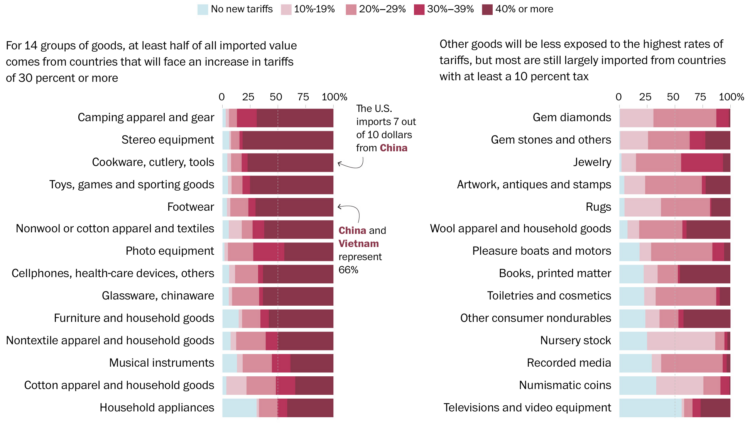
Tariff exposure for groups of goods

by Nathan Yau

You get a tariff. And you get a tariff. And you. And you. Everybody gets a tariff. But not the same for every type of consumer good. For the Washington Post, Luis Melgar, Rachel Lerman, and Szu Yu Chen show the percentages of imported value by category.

That means products that the United States commonly gets from Vietnam, such as clothing and shoes, would be subject to a new 46 percent tax, whereas goods from Colombia, like flowers, would see a lower new 10 percent levy. Imports from Mexico, such as avocados, will have no new tax. In any case, shopping is about to get more expensive for Americans.

It looks like camping gear, stereo equipment, cookware, and toys are going to get hit the hardest, but at least numismatic (?) coins won’t get taxed as hard.

Tags: prices, tariff, Washington Post

05 Apr 22:44

Welcome to the Worst Allergy Season Ever

by Umair Irfan
Multiple US states have logged record pollen counts this spring, with climate change likely to blame.
04 Apr 20:17

Inside DOGE’s AI Push at the Department of Veterans Affairs

by Vittoria Elliott
A DOGE operative at the Department of Veterans Affairs appears to be trying to use an AI tool to write code for the agency’s systems, among other proposals.
04 Apr 19:04

Switch 2 preorders delayed over Trump tariff uncertainty

by Kyle Orland

Nintendo Switch 2 preorders, which were due to begin on April 9, are being delayed indefinitely amid the financial uncertainty surrounding Donald Trump's recent announcement of massive tariffs on most US trading partners.

"Pre-orders for Nintendo Switch 2 in the U.S. will not start April 9, 2025 in order to assess the potential impact of tariffs and evolving market conditions,” Nintendo said in a statement cited by Polygon. "Nintendo will update timing at a later date. The launch date of June 5, 2025 is unchanged."

Nintendo announced launch details for the Switch 2 on Wednesday morning, just hours before Trump's afternoon "Liberation Day" press conference announcing the biggest increase in import duties in modern US history. Those taxes on practically all goods imported into the United States are set to officially go into effect on April 9, the same day Nintendo had planned to roll out Switch 2 preorders for qualified customers.

Read full article

Comments

04 Apr 11:45

Critics suspect Trump’s weird tariff math came from chatbots

by Ashley Belanger

Critics are questioning if Donald Trump's administration possibly used chatbots to calculate reciprocal tariffs announced yesterday that Trump claimed were "individualized" tariffs placed on countries that have " the largest trade deficits" with the US.

Those tariffs are due to take effect on April 9 for 60 countries, with peak rates around 50 percent. That's in addition to a baseline 10 percent tariff that all countries will be subject to starting on April 5. But while Trump expressed intent to push back on anyone supposedly taking advantage of the US, some of the countries on the reciprocal tariffs list puzzled experts and officials, who pointed out to The Guardian that Trump was, for some reason, targeting uninhabited islands, some of them exporting nothing and populated with penguins.

Some overseas officials challenged Trump's math, such as George Plant, the administrator of Norfolk Island, who told the Guardian that "there are no known exports from Norfolk Island to the United States and no tariffs or known non-tariff trade barriers on goods coming to Norfolk Island."

Read full article

Comments

04 Apr 11:42

Wealthy Americans have death rates on par with poor Europeans

by Beth Mole

It's well-established that, on the whole, Americans die younger than people in most other high-income countries. For instance, an analysis from 2022 found that the average life expectancy of someone born in Switzerland or Spain in 2019 was 84 years. Meanwhile, the average US life expectancy was 78.8, lower than nearly all other high-income countries, including Canada's, which was 82.3 years. And this was before the pandemic, which only made things worse for the US.

Perhaps some Americans may think that this lower overall life-expectancy doesn't really apply to them if they're middle- or upper-class. After all, wealth inequality and health disparities are huge problems in the US. Those with more money simply have better access to health care and better health outcomes. Well-off Americans live longer, with lifespans on par with their peers in high-income countries, some may think.

It is true that money buys you a longer life in the US. In fact, the link between wealth and mortality may be stronger in the US than in any other high-income country. But, if you think American wealth will put life expectancy in league with Switzerland, you're dead wrong, according to a study in the latest issue of the New England Journal of Medicine.

Read full article

Comments

04 Apr 11:38

Sneak peek: Rockville’s Wegmans preps for June 25 opening

by Elia Griffin

Store focusing on hiring, training staff, adding the finishing touches

The post Sneak peek: Rockville’s Wegmans preps for June 25 opening appeared first on Bethesda Magazine.

03 Apr 17:06

Representatives Demand Housing Agency Halt Any Cryptocurrency Experiments

by by Jesse Coburn

by Jesse Coburn

ProPublica is a nonprofit newsroom that investigates abuses of power. Sign up to receive our biggest stories as soon as they’re published.

Three federal lawmakers are calling on the U.S. Department of Housing and Urban Development to stop any initiatives involving cryptocurrency and the blockchain, saying the scantly regulated technologies should be kept far away from the agency’s work overseeing the nation’s housing sector.

In a letter to HUD Secretary Scott Turner on Wednesday, Reps. Maxine Waters, Stephen Lynch and Emanuel Cleaver sharply criticized the agency for considering such experiments, given cryptocurrency’s volatility and vulnerability to fraud. The Democratic representatives, all members of the House Financial Services Committee, warned of repeating “the same mistakes of the past,” noting that the 2008 financial crisis was triggered in part by the proliferation of risky financial assets in the housing market.

“The federal government cannot allow under-regulated financial products to infiltrate critical housing programs, especially when they have already proven to be dangerous, speculative, and harmful to working families,” the lawmakers wrote.

The letter is a response to reporting by ProPublica that the housing agency recently discussed taking steps toward using cryptocurrency. The article described meetings in February in which officials discussed incorporating the blockchain — and possibly a type of cryptocurrency known as stablecoin — into the agency’s work. The discussion at one meeting centered on a pilot project involving one HUD grant, but a HUD finance official in attendance indicated the idea could be applied much more expansively across the agency.

“We are looking at this for the entire enterprise,” he said in that meeting, a recording of which was obtained by ProPublica. “We just wanted to start in CPD,” he added, referring to HUD’s Office of Community Planning and Development. The office administers billions of dollars in grants to support low- and moderate-income people, including funding for affordable housing, homeless shelters and disaster recovery, raising the prospect that these forms of aid might one day be paid in an unstable currency.

Asked for comment on the letter, HUD spokesperson Kasey Lovett referred ProPublica to a prior comment by Turner, in which he said, “There’s no merit to it.” Lovett previously told ProPublica: “The department has no plans for blockchain or stablecoin. Education is not implementation.”

It’s unclear how a crypto project would work. But HUD officials alluded to the possible use of stablecoins, which are pegged to the U.S. dollar or another asset. That is supposed to protect stablecoins from the wild swings in value common among bitcoin and other cryptocurrencies, although such fluctuations have happened with stablecoins in the past.

The HUD proposal raised alarm among some officials, with one comparing the idea in internal discussions to paying grant recipients in “Monopoly money.” At best, one HUD staffer told ProPublica previously, the idea was a waste of time and resources; at worst it was a threat to the stability of the housing sector.

“It’s just introducing another unregulated security into the housing market as though 2008, 2009 didn’t happen,” the staffer said, referring to the subprime mortgage crisis. “I don’t see any way this will help anything. I see a lot of ways this could hurt.”

The HUD official pushing the idea internally was Irving Dennis, the agency’s new principal deputy chief financial officer, a staffer said at one of the meetings. Dennis denied to ProPublica that HUD was considering any such experiment. He published a book in 2021 in which he wrote that HUD should use the blockchain.

The blockchain is a digital ledger most commonly used to record cryptocurrency transactions. Boosters of the technology depict it as a way to cut middlemen such as banks out of financial transactions and to make those transactions more transparent and secure. One such evangelist is Robert Judson, an executive at the consulting firm EY, who is listed in a document obtained by ProPublica as an attendee of one of the HUD meetings. Judson has written glowingly about the potential of blockchain to prevent aid money from being misused. (Dennis was previously a partner at EY.)

Judson and EY did not respond to requests for comment for this article, but Judson previously confirmed to ProPublica that EY had discussed the matter with agency officials.

In their letter, the three representatives requested extensive information from HUD about its consideration of crypto and the blockchain, including whether the agency had assessed the risks of using the technology. The House Financial Services Committee is scheduled to consider a bill Wednesday that would regulate stablecoins.

03 Apr 14:08

But His Gmail: National Security Advisor Waltz’s Private Email Hypocrisy

by Mike Masnick

Remember Mike Waltz? The National Security Advisor who’s spent the last few weeks demonstrating his profound inability to handle basic security? First, there was the illegal Signal chat where he accidentally added a journalist while discussing potential war crimes. Then we learned about his completely exposed Venmo contacts and leaked passwords. And now, in a twist that would be too on-the-nose for fiction, it turns out the same official who previously demanded DOJ action over private email use… has been conducting government business through Gmail.

Ah, but her emails.

All this seems less than great for the top “security” official in the administration.

Members of President Donald Trump’s National Security Council, including White House national security adviser Michael Waltz, have conducted government business over personal Gmail accounts, according to documents reviewed by The Washington Post and interviews with three U.S. officials.

The use of Gmail, a far less secure method of communication than the encrypted messaging app Signal, is the latest example of questionable data security practices by top national security officials already under fire for the mistaken inclusion of a journalist in a group chat about high-level planning for military operations in Yemen.

A senior Waltz aide used the commercial email service for highly technical conversations with colleagues at other government agencies involving sensitive military positions and powerful weapons systems relating to an ongoing conflict, according to emails reviewed by The Post. While the NSC official used his Gmail account, his interagency colleagues used government-issued accounts, headers from the email correspondence show.

This is, needless to say, pretty fucking bad. First, there’s the basic security incompetence: the National Security Advisor conducting sensitive government business through a commercial email service. Even if Gmail has robust security, it’s completely inappropriate for handling government communications — giving Google potential access to sensitive national security discussions that should never leave secured government systems.

But more concerning is what this reveals about Waltz’s (lack of) judgment. As National Security Advisor, he’s one of the highest-value targets for foreign intelligence services. Every personal account, every commercial service he uses represents another potential vulnerability for adversaries to exploit. And given his demonstrated pattern of security failures — from exposed Venmo contacts to leaked passwords — it’s clear he’s making their job easier.

The National Security Council’s response is a masterclass in missing the point (or, more accurately, misdirecting from the point). When pressed about “sensitive military matters” being discussed over Gmail, their spokesperson offered this gem:

Hughes said NSC staff have guidance about using “only secure platforms for classified information.”

This attempt at reassurance actually reveals the depth of the problem. The distinction isn’t just between classified and unclassified information — it’s about maintaining basic operational security for all sensitive government communications.

And as if to underscore how little they grasp this, we learned from a WSJ article that Waltz’s infamous Signal chat wasn’t a one-off mistake.

Two U.S. officials also said that Waltz has created and hosted multiple other sensitive national security conversations on Signal with cabinet members, including separate threads on how to broker peace between Russia and Ukraine as well as military operations

The scale of security failures here should be absolutely disqualifying for any administration official, let alone America’s top national security advisor. But what makes this situation particularly galling is Waltz’s own history of grandstanding about private email use. Here he is in a tweet that remains up from less than two years ago:

Yes, that’s the same Mike Waltz demanding DOJ action over private email use by a previous National Security Advisor. The hypocrisy would be merely annoying if the stakes weren’t so high. But this isn’t just about scoring political points — it’s about the fundamental security of our nation’s most sensitive communications.

By Waltz’s own standard, articulated in that still-visible tweet, the DOJ should be investigating his wanton use of private commercial messaging services. But more importantly, someone needs to ask: if this is how carelessly our National Security Advisor handles basic operational security, what other vulnerabilities has he created that we don’t yet know about?

03 Apr 12:42

AI bots strain Wikimedia as bandwidth surges 50%

by Benj Edwards

On Tuesday, the Wikimedia Foundation announced that relentless AI scraping is putting strain on Wikipedia's servers. Automated bots seeking AI model training data for LLMs have been vacuuming up terabytes of data, growing the foundation's bandwidth used for downloading multimedia content by 50 percent since January 2024. It’s a scenario familiar across the free and open source software (FOSS) community, as we've previously detailed.

The Foundation hosts not only Wikipedia but also platforms like Wikimedia Commons, which offers 144 million media files under open licenses. For decades, this content has powered everything from search results to school projects. But since early 2024, AI companies have dramatically increased automated scraping through direct crawling, APIs, and bulk downloads to feed their hungry AI models. This exponential growth in non-human traffic has imposed steep technical and financial costs—often without the attribution that helps sustain Wikimedia’s volunteer ecosystem.

The impact isn’t theoretical. The foundation says that when former US President Jimmy Carter died in December 2024, his Wikipedia page predictably drew millions of views. But the real stress came when users simultaneously streamed a 1.5-hour video of a 1980 debate from Wikimedia Commons. The surge doubled Wikimedia’s normal network traffic, temporarily maxing out several of its Internet connections. Wikimedia engineers quickly rerouted traffic to reduce congestion, but the event revealed a deeper problem: The baseline bandwidth had already been consumed largely by bots scraping media at scale.

Read full article

Comments

02 Apr 12:17

Democratic Senators Call for Privacy Act Reform in Response to DOGE Takeover

by Dell Cameron
The Privacy Act Modernization Act would update 1974 legislation for the modern age, restricting government use of personal data and introducing new penalties, including prison time, for violators.
02 Apr 12:17

Apple enables RCS messaging for Google Fi subscribers at last

by Ryan Whitwam

Apple spent years ignoring RCS, allowing iPhones to offer a degraded messaging experience with Android users. This made Android folks unwelcome in many a group chat, but Apple finally started rectifying this issue last year with the addition of RCS support in iOS. It has been a slow rollout, though, with Google's mobile service only now getting support.

While Apple supports RCS messaging on iPhones now, it has not exactly been enthusiastic about it. Anyone using Google Fi on an iPhone was left in the lurch even after Apple changed course. The first RCS update rolled out in iOS 18 last fall, but it only supported postpaid plans on the big three carriers. Most other wireless subscribers had to wait, including those on Google Fi, as confirmed to Ars last year. It was a suitably amusing outcome, considering Google is largely responsible for reviving the RCS standard and runs the Jibe back-end servers through which many iPhone RCS messages flow.

Slowly but surely, Apple is making good on its promises to enable RCS as it gets the necessary data from carriers. The company released iOS 18.4 this week, and hiding amid the control center tweaks and priority notifications is support for RCS on Google Fi and other T-Mobile MVNOs. Some users spotted this feature in the recent beta releases, but the servers that handle RCS for Google's mobile service were not yet connectable. With the final release, Google has confirmed that RCS is ready at last.

Read full article

Comments

02 Apr 12:16

Federal Judge Allows DOGE to Take Over $500 Million Office Building for Free

by Brian Barrett
It’s the culmination of a weeks-long standoff between Elon Musk’s DOGE team and the United States Institute of Peace.
02 Apr 12:08

Inside ICE Air: Flight Attendants on Deportation Planes Say Disaster Is “Only a Matter of Time”

by by McKenzie Funk

by McKenzie Funk

ProPublica is a nonprofit newsroom that investigates abuses of power. Sign up to receive our biggest stories as soon as they’re published.

Leer en español.

The deportation flight was in the air over Mexico when chaos erupted in the back of the plane, the flight attendant recalled. A little girl had collapsed. She had a high fever and was taking ragged, frantic breaths.

The flight attendant, a young woman who went by the nickname Lala, said she grabbed the plane’s emergency oxygen bottle and rushed past rows of migrants chained at the wrists and ankles to reach the girl and her parents.

By then, Lala was accustomed to the hard realities of working charter flights for Immigration and Customs Enforcement. She’d learned to obey instructions not to look the passengers in the eyes, not to greet them or ask about their well-being. But until the girl collapsed, Lala had managed to escape an emergency.

Lala worked for Global Crossing Airlines, the dominant player in the loose network of deportation contractors known as ICE Air. GlobalX, as the charter company is also called, is lately in the news. Two weeks ago, it helped the Trump administration fly hundreds of Venezuelans to El Salvador despite a federal court order blocking the deportations, triggering a showdown that experts fear could become a full-blown constitutional crisis.

In interviews with ProPublica, Lala and six other current and former GlobalX flight attendants provided a window into a part of the deportation process that is rarely seen and little understood. For migrants who have spent months or years trying to reach this country and live here, it is the last act, the final bit of America they may experience.

An ICE detainee waves from inside a bus that transported passengers to the airport before departing from Seattle’s Boeing Field on a GlobalX deportation flight in February. (Emily Schultz)

All but one of the flight attendants requested anonymity or asked that only a nickname be used, fearing retribution or black marks as they looked for new jobs in an insular industry.

Because ICE, GlobalX and other charter carriers did not respond to questions after being provided with detailed lists of this story’s findings, the flight attendants’ individual accounts are hard to verify. But their stories are consistent with one another. They are also generally consistent with what has been said about ICE Air in legal filings, news accounts, academic research and publicly released copies of the ICE Air Operations Handbook.

That morning over Mexico, Lala said, the girl’s oxygen saturation level was 70% — perilously low compared with a healthy person’s 95% or higher. Her temperature was 102.3 degrees. The flight had a nurse on contract who worked alongside its security guards. But beyond giving the girl Tylenol, the nurse left the situation in Lala’s hands, she recalled.

Lala broke the rule about talking to detainees. The parents told Lala their daughter had a history of asthma. The mom, who Lala said had epilepsy, seemed on the verge of her own medical crisis.

Lala placed the oxygen mask on the girl’s face. The nurse removed her socks to keep her from further overheating. Lala counted down the minutes, praying for the girl to keep breathing.

The stories shared by ICE Air flight attendants paint a different picture of deportations from the one presented to the public, especially under President Donald Trump. On social media, the White House has depicted a military operation carried out with ruthless efficiency, using Air Force C-17s, ICE agents in tactical vests and soldiers in camo.

The reality is that 85% of the administration’s “removal” flights — 254 flights as of March 21, according to the advocacy group Witness at the Border — have been on charter planes. Military flights have now all but ceased. While there are ICE officers and hired security guards on the charters, the crew members on board are civilians, ordinary people swept up in something most didn’t knowingly sign up for.

When the flight attendants joined GlobalX, it was a startup with big plans. It sold investors and new hires alike on a vision of VIP clients, including musicians and sports teams, and luxury destinations, especially in the Caribbean. “You can’t beat the eXperience,” read a company tagline.

A GlobalX post on Facebook recruiting flight attendants in March. Alexandria, Louisiana, is a hub for ICE Air. (Screenshot by ProPublica. Redacted by ProPublica.)

But as the airline grew, more and more of its planes were filled with migrants in chains. Some flight attendants were livid about it.

Last year, an anonymous GlobalX employee sent an all-caps, all-staff screed that ricocheted around the startup. “WHERE IS THE COMPANY GOING?” the email asked. “YOU SIGNED A 5 YEAR CONTRACT WITH ICE? ... WHAT HAPPENED TO THIS BECOMING A PRESTIGE CHARTER AIRLINE?”

One flight attendant said he kept waiting for the sports teams his new bosses had talked about as he flew deportation routes. “You know, the NFL charters, the NBA charters, whatever the hockey one is …” he said.

A second said his planes’ air conditioning kept breaking — an experience consistent with at least two publicly reported onboard incidents — and their lavatories kept breaking, something another flight attendant reported as well. But the planes kept flying. “They made us flush with water bottles,” he said.

But the flight attendants were most concerned about their inability to treat their passengers humanely — and to keep them safe. (In 2021, an ICE spokesperson told the publication Capital & Main that the agency “follows best practices when it comes to the security, safety and welfare of the individuals returned to their countries of origin.”)

They worried about what would happen in an emergency. Could they really get over a hundred chained passengers off the plane in time?

“They never taught us anything regarding the immigration flights,” one said. “They didn’t tell us these people were going to be shackled, wrists to fucking ankles.”

“We have never gotten a clear answer on what we do in an ICE Air evacuation,” another said. “They will not give us an answer.”

“It’s only a matter of time,” a third said, before a deportation flight ends in disaster.

Lala didn’t think she had a chance at a flight attendant job. She hadn’t, in truth, remembered applying to GlobalX until a recruiter called to say the startup was coming to her city. “But I guess I did apply through LinkedIn?” she said. She’d been working an office job — long hours, little flexibility — and was looking for something new.

The job interviews were held at a resort hotel. The room was packed with dozens of aspirants when Lala showed up. After the first round, only about 20 were asked to stay. She couldn’t believe she was one of them. After the second round came a job offer: $26 an hour plus a daily expense allowance. Soon Lala got a uniform: a blue cardigan, a white polo shirt and an eye-catching scarf in cyan and light green.

For part of her Federal Aviation Administration-mandated four-week training, her class stayed in a motel with a pool at the edge of Miami International Airport. Just across the street, on the fourth floor of a concrete-clad office building ringed by palm trees, was GlobalX’s headquarters.

“In the beginning, we were told that because it’s a charter, it’s only gonna be elites, celebrities,” Lala said. “Everybody was really excited.”

But flying was not going to be all glitz. The real reason for having flight attendants is safety. GlobalX was certified by the FAA as a Part 121 scheduled air carrier, the same as United or Delta, and it and its crew members were subject to the same strict standards.

“We’re there to evacuate you,” one recruit told ProPublica. “Yes, we make good drinks, but we evacuate you.”

Lala’s class practiced water landings in the pool at the nearby Pan Am Flight Academy. They practiced door drills — yelling out commands, shoving open heavy exit doors — in a replica Airbus A320 cabin. They learned CPR and how to put out fires. They took written and physical tests, and if they didn’t score at least 90%, they had to retake them.

They were reminded, over and over, that their job was a vocation, one with a professional code: No matter who the passengers were, flight attendants were in charge of the cabin, responsible for safety in the air.

Lala’s official “airman” certificate arrived from the FAA a few weeks after training was done. She was cleared to fly, ready to see the world.

But what she would see wasn’t what she signed up for. The company was growing beyond glamorous charters. GlobalX was moving into the deportation business.

Her bosses delivered the news casually, she recalled: “It was like, ‘Oh yeah, we got a government contract.’”

The new graduates were offered a single posting: Harlingen, Texas. Deportation flights were five days a week, sometimes late into the night. Lala went to Guatemala, Honduras, Colombia and, for refueling, Panama.

A standard flight had more than a dozen private security guards — contractors working for the firm Akima — along with a single ICE officer, two nurses, and a hundred or more detainees. (Akima did not respond to a request for comment.) The guards were in charge of delivering food and water to the detainees and taking them to the lavatories. This left the flight attendants, whose presence was required by the FAA, with little to do.

“Arm and disarm doors, that was our duty,” Lala said.

The flights had their own set of rules, which the crew members said they learned from a company policy manual or from chief flight attendants. Don’t talk to the detainees. Don’t feed them. Don’t make eye contact. Don’t walk down the aisles without a guard escorting you. Don’t sit in aisle seats, where detainees could get close to you. Don’t wear your company-issued scarf because of “safety concerns that a detainee might grab it and use it against us,” Lala said.

“You don’t do nothing,” said a member of another GlobalX class. “Just sit down in your seats and be quiet.” If a detainee looked at him, he was supposed to look out the window.

A chained detainee boards a GlobalX flight at Seattle’s Boeing Field in February. (Emily Schultz)

A rare public statement from the company about life aboard ICE Air came in a 2023 earnings call with GlobalX founder and then-CEO Ed Wegel, when he discussed the company’s work for federal agencies like ICE. GlobalX employees “essentially don’t do much on the airplane,” Wegel said. “Our flight attendants are there in case of an emergency. The passengers are monitored by guards that are placed on board the airplane by one of those agencies.”

Fielding a question about how GlobalX ensures passengers are treated humanely, Wegel continued: “There have been threats made to our crew members, and they’re especially trained to deal with those. But we haven’t seen any mistreatment at all.”

Flight attendants said they had little to do but sit in their jumpseats after delivering the preflight safety briefing in English to the mostly Spanish-speaking passengers. Above 10,000 feet, the two in the rear usually moved to passenger rows near the cockpit, then sat again. Some did crosswords. Others took photos out the window. On a deportation to Guatemala, one saw his first erupting volcano.

Lala had been scared before her first deportation flight, worried that violence might break out. But fear soon gave way to discomfort at how detainees were treated. “Not being able to serve them, not being able to look at them, I didn’t think that was right,” she said.

Some flight attendants, drawn to the profession because they liked taking care of people, couldn’t help but break protocol with passengers. “If they said ‘hola’ or something,” one said, “I’d say ‘hola’ back. We’re not jerks.”

Another recalled taking a planeload of children and their escorts on a domestic transfer from the southern border to an airport in New York. He tried to slip snacks to the kids. “Even the chaperones were like, ‘Don’t give them any food,’” he said. “And I’m like, ‘Where is your humanity?’” (A second flight attendant said that children on a New York flight were fed by their escorts.)

While flight attendants were allowed to interact with the guards, the dynamic was uncomfortable. It came down to a question of who was in charge — and which agency, ICE or the FAA, ultimately held sway. (The FAA declined to comment on this story and directed questions to ICE.)

The guards often asked flight attendants to heat up the food they brought from home. They asked for drinks, for ice. “They treated us like we were their maids,” said Akilah Sisk, a former flight attendant from Texas.

“In their eyes, the detainees are not the passengers,” another flight attendant said. “The passengers are the guards. And we’re there for the guards.”

Some guards thumbed their noses at the FAA safety rules that flight attendants were supposed to enforce while airborne, multiple flight attendants recalled. “One reported me because I asked him to sit down in the last 10 minutes,” Sisk said. “But you’re still on a freaking plane. You gotta listen to our words.”

Flight attendants said that if they told guards to fasten seatbelts during takeoff or stow carry-ons under a seat, they risked getting reported to their bosses at GlobalX, who they said wanted to keep ICE happy. The guards would complain to the in-flight supervisor, Sisk said, and eventually it would get back to the flight attendant.

“We’d get an email from somebody in management: ‘Why are you guys causing problems?’” another flight attendant recalled. “They were more worried about losing the contract than about anything else.”

Nothing bothered flight attendants more than the fact that most of their passengers were in chains. What would happen if a flight had to be evacuated?

Most of the migrants crowding the back seats of ICE Air’s planes have not been, historically, convicted criminals. ICE makes restraints mandatory nonetheless. “Detainees transported by ICE Air aircraft will be fully restrained by the use of handcuffs, waist chains, and leg irons,“ reads an unredacted version of the 2015 ICE Air Operations Handbook, which was obtained by the Center for Constitutional Rights, a legal advocacy group.

The handbook allows for other equipment “in special circumstances, i.e., spit masks, mittens, leg braces, cargo straps, humane restraint blanket, etc.” Multiple lawsuits on behalf of African asylum-seekers concern the use of one such item, known as the Wrap, a cross between a straitjacket and a sleeping bag. A flight attendant said detainees restrained in the device are strapped upright in their seats or, if less compliant, lengthwise across a row of seats. Getting “burritoed, I call it,” the person said.

The Department of Homeland Security’s Office for Civil Rights and Civil Liberties investigated the asylum-seekers’ complaints and found ICE lacked “sufficient policies” on the Wrap, but how the immigration agency addressed the finding is not publicly known. ICE responded to one lawsuit by saying detainees were not abused; it said another should be dismissed, in part because it was filed in the wrong place. The cases are pending.

Use of the Wrap continues. A video from Seattle’s Boeing Field taken in February shows officers and guards carrying a wrapped migrant into the cabin of a deportation plane.

A choppy video feed shows ICE officers and guards carrying a migrant in a full-body restraint into a GlobalX deportation plane at Seattle’s Boeing Field in February. (Obtained by ProPublica via a public records request)

Watch video ➜

Neither the ICE Air handbook, nor FAA regulations, nor flight attendant training in Miami explained how to empty a plane full of people whose movements were, by design, so severely hampered. Shackled detainees didn’t even qualify as “able-bodied” enough to sit in exit rows.

To flight attendants, the restraints seemed at odds with the FAA’s “90-second rule,” a decades-old manufacturing standard that says an aircraft must be built for full evacuation in 90 seconds even with half the exits blocked.

Lala and others said no one told them how to evacuate passengers in chains. “Honestly, I don’t know what we would do,” she said.

The flight attendants are not alone in voicing concerns.

In an interview with ProPublica, Bobby Laurie, an airline safety expert and former flight attendant, called the arrangement on ICE Air flights “disturbing.”

“Part of flight attendant training is locating those passengers who can help you in an evacuation,” Laurie told ProPublica. That would have to be the guards. “But if they have to help you,” who is helping the detainees, Laurie wondered.

According to formal ICE Air incident reports reviewed by Capital & Main, the deportation network had at least six accidents requiring evacuations between 2014 and 2019. In at least two cases, both on a carrier called World Atlantic, the evacuations were led not by flight attendants but by untrained guards. Both took longer than 90 seconds, though not by much: two-and-a-half minutes for the first, “less than 2 minutes” for the next. But in a third case, it took seven minutes for 115 shackled detainees to escape a smoke-filled jet.

In one of the World Atlantic incidents, part of the landing gear broke, a wing caught fire and the smell of burning rubber seeped in, according to investigative records obtained by the University of Washington Center for Human Rights. In an email to ICE Air officials, an agency employee aboard the plane later wrote that flight attendants made no emergency announcements for passengers. The flight attendants simply got themselves out.

The ICE officer, guards and nurse were “confused on what to do and in which direction to exit during distress,” the officer wrote. He said that other than the flight crew, “no one has received any training on emergency evacuation situations.”

The University of Washington’s collection does not include findings or recommendations from ICE based on what happened, and ICE did not say what they were when asked by ProPublica. The National Transportation Safety Board said that after the accident, World Atlantic launched a campaign to reinspect landing gear, gave employees and contractors further training, and revised its procedures for inspections. The airline did not respond to questions from ProPublica.

An ICE Air flight was evacuated in Alexandria, Louisiana, in April 2018 after a piece of the landing gear failed upon touchdown. All detainees were helped off the plane by guards, according to emails to ICE officials from an agency employee who was on board. (Courtesy of the University of Washington Center for Human Rights)

Other reports obtained by the University of Washington mention fuel spills, loss of cabin air pressure and a “large altercation” on ICE Air after 2019 but no more evacuations, at least as of June 2022. More recent incidents that have been mentioned in the press include an engine fire last summer on World Atlantic and a failed GlobalX air conditioning unit that sent 11 detainees to the hospital with “heat-related injuries.”

The rare guidance some flight attendants said they received on carrying out ICE Air evacuations came during briefings from pilots. What they heard, they said, was chilling and went against their training.

“Just get up and leave,” one recalled a GlobalX pilot telling him. “That’s it. … Save your life first.”

He understood the instructions to mean that evacuating detainees was not a priority, or even the flight attendants’ responsibility. The detainees were in other people’s hands, or in no one’s.

When asked if they got similar guidance from pilots, three flight attendants said they did not, and one did not answer. Two more, like the first, said pilots gave them instructions that they took to mean they shouldn’t help detainees after opening the exit doors.

“That was the normal briefing,” said a flight attendant from Lala’s class. “‘If a fire occurs in the cabin, if we land on water, don’t check on the immigrants. Just make sure that you and the guards and the people that work for the government get off.’”

“It was as if the detainees’ lives were worthless,” said the other.

The day the girl collapsed on Lala’s flight, the pilot turned the plane around and they crossed back into the United States.

The flight landed in Arizona. Paramedics rushed on board and connected the girl to their own oxygen bottle. They began shuttling her off the plane. Her parents tried to join. But the guards stopped the father.

Shocked, Lala approached the ICE officer in charge. “This is not OK!” she yelled. The mom had seizures. The family needed to stay together.

But the officer said it was impossible. Only one parent could go to the hospital. The other, as Lala understood it, “was going to get deported.”

Most of the flight attendants who spoke with ProPublica are now gone from GlobalX. Some left because they found other jobs. Some left even though they hadn’t. Some left because the charter company, as it focused more and more on deportations, shut down the hub in their city.

Lala eventually left because of the little girl and her family, because she couldn’t do the deportation flights anymore. Her GlobalX uniform hung in her closet for a time, a reminder of her career as a flight attendant. Recently, she said, she threw it away.

She never learned whether the little girl lived or died. Lala just watched her mom follow her off the plane, then watched the dad return to his seat.

“I cried after that,” she said. She bought her own ticket home.
01 Apr 12:00

Top Officials Placed on Leave After Denying DOGE Access to Federal Payroll Systems

by Tim Marchman
DOGE demanded full access to a US Department of the Interior system that handles even the Supreme Court's paychecks. When top staff asked questions, they were put on leave.
31 Mar 16:29

Fire at Lotte Plaza Market in Rockville prompts temporary closure

by Courtney Cohn

Plus: Lithium-ion batteries involved in blaze at Gaithersburg commercial building

The post Fire at Lotte Plaza Market in Rockville prompts temporary closure appeared first on Bethesda Magazine.

31 Mar 16:12

An AI Image Generator’s Exposed Database Reveals What People Really Used It For

by Matt Burgess
An unsecured database used by a generative AI app revealed prompts and tens of thousands of explicit images—some of which are likely illegal. The company deleted its websites after WIRED reached out.
29 Mar 20:15

DOGE Plans to Rebuild SSA Code Base in Months, Risking Benefits and System Collapse

by Makena Kelly
Social Security systems contain tens of millions of lines of code written in COBOL, an archaic programming language. Safely rewriting that code would take years—DOGE wants it done in months.
29 Mar 20:14

Trump annoyed the Smithsonian isn’t promoting discredited racial ideas

by John Timmer

On Thursday, the Trump administration issued an executive order that took aim at one of the US's foremost cultural and scientific institutions: the Smithsonian. Upset by exhibits that reference the role of racism, sexism, and more in the nation's complicated past, the order tasks the vice president and a former insurance lawyer (?) with ensuring that the Smithsonian Institution is a "symbol of inspiration and American greatness"—a command that specifically includes the National Zoo.

But in the process of airing the administration's grievances, the document specifically calls out a Smithsonian display for accurately describing our current scientific understanding of race. That raises the prospect that the vice president will ultimately demand that the Smithsonian display scientifically inaccurate information.

Grievance vs. science

The executive order, entitled "Restoring Truth And Sanity To American History," is filled with what has become a standard grievance: the accusation that, by recognizing the many cases where the US has not lived up to its founding ideals, institutions are attempting to "rewrite our nation's history." It specifically calls out discussions of historic racism, sexism, and oppression as undercutting the US's "unparalleled legacy of advancing liberty, individual rights, and human happiness."

Read full article

Comments

29 Mar 20:09

What Is It, Exactly, That Being An American Means to You?

by Mike Masnick

Is it a flag on your porch? A sense of pride during the national anthem? A particular vision of freedom or prosperity? Perhaps it’s a story you tell yourself about who we are and what we stand for.

Whatever it means to you, I want you to hold that meaning close as you read what follows.

On March 15, three planes touched down in El Salvador. They carried 261 men deported from the United States. Most were Venezuelans—people who fled one nightmare only to be thrust into another. They were designated as “gang members” by the current administration and deported with little or no due process. No trials. No evidence presented. Just labeled, processed, and removed.

What happened next should shatter any comfortable notions of what American values mean in practice.

These men—human beings with names, histories, dreams—were marched through a gauntlet of armed guards, beaten, stripped naked, shaved, and thrown into overcrowded cells. A photojournalist on the scene described watching men age a decade in two hours. He watched as one young man sobbed, “I’m not a gang member. I’m gay. I’m a barber.” This man was slapped for his tears, beaten for his vulnerability.

No phone calls. No visitors. No books. No talking. Just exile to a place “so cold and far from home they may as well have been sent into space, nameless and forgotten.”

And all of this—every slap, every sob, every stolen dignity—stamped with American approval. Coordinated with American officials. Executed with American efficiency.

We have turned away from Lincoln’s better angels. We have abandoned the moral arc that has, despite our many failures, generally bent toward justice. The world is afraid of us now—not with the complicated respect of a moral superpower, but with the simple fear reserved for bullies and tyrants.

Some of my conservative friends say that’s good. Good that people are afraid. That fear makes them feel strong.

I just don’t know what kind of morals people have, that they seek to be feared. That’s not manly. That’s not something to be proud of. It’s crude. It’s barbarism.

Being feared isn’t strength. True strength lies in being just when it would be easier to be cruel. In maintaining our principles when they’re inconvenient. In seeing the humanity in others even when it would be politically expedient to deny it.

What kind of nation have we become that we measure our greatness not by who we protect but by who we can brutalize? Not by what we build but by what we destroy?

The man who cried for his mother as his hair fell to the floor—he is not an abstraction. The barber who begged to be recognized as human—he is not a statistic. They are people. And what we allow to happen to them defines us more surely than any pledge or anthem or flag ever could.

This is the true test of what being an American means: not what we proclaim when standing tall at a ballgame or wrapping ourselves in patriotic symbols, but what we permit to be done to the vulnerable when we think no one is watching.

Two plus two equals four. There are twenty-four hours in a day. And we have really failed ourselves here. Failed to hold the tension between security and humanity. Failed to push back the flood of cruelty that always threatens to overwhelm civilization. Failed to walk the wire between legitimate concerns about immigration and our fundamental obligations to human dignity.

America, look at what is being done in your name. Look, and tell me if this is truly what you meant when you spoke of your pride in being American.

Because a nation that can do this—that can coordinate the ritualized dehumanization of people without trial, without evidence, without the most basic protections of due process—is not the America I was taught to believe in. It’s not the America worthy of your pride or my loyalty.

It’s an America that has forgotten itself.

Mike Brock is a former tech exec who was on the leadership team at Block. Originally published at his Notes From the Circus.

29 Mar 20:08

The CDC Buried a Measles Forecast That Stressed the Need for Vaccinations

by by Patricia Callahan

by Patricia Callahan

ProPublica is a nonprofit newsroom that investigates abuses of power. Sign up to receive our biggest stories as soon as they’re published.

Leaders at the Centers for Disease Control and Prevention ordered staff this week not to release their experts’ assessment that found the risk of catching measles is high in areas near outbreaks where vaccination rates are lagging, according to internal records reviewed by ProPublica.

In an aborted plan to roll out the news, the agency would have emphasized the importance of vaccinating people against the highly contagious and potentially deadly disease that has spread to 19 states, the records show.

A CDC spokesperson told ProPublica in a written statement that the agency decided against releasing the assessment “because it does not say anything that the public doesn’t already know.” She added that the CDC continues to recommend vaccines as “the best way to protect against measles.”

But what the nation’s top public health agency said next shows a shift in its long-standing messaging about vaccines, a sign that it may be falling in line under Health and Human Services Secretary Robert F. Kennedy Jr., a longtime critic of vaccines:

“The decision to vaccinate is a personal one,” the statement said, echoing a line from a column Kennedy wrote for the Fox News website. “People should consult with their healthcare provider to understand their options to get a vaccine and should be informed about the potential risks and benefits associated with vaccines.”

ProPublica shared the new CDC statement about personal choice and risk with Jennifer Nuzzo, director of the Pandemic Center at Brown University School of Public Health. To her, the shift in messaging, and the squelching of this routine announcement, is alarming.

“I’m a bit stunned by that language,” Nuzzo said. “No vaccine is without risk, but that makes it sound like it’s a very active coin toss of a decision. We’ve already had more cases of measles in 2025 than we had in 2024, and it’s spread to multiple states. It is not a coin toss at this point.”

For many years, the CDC hasn’t minced words on vaccines. It promoted them with confidence. One campaign was called “Get My Flu Shot.” The agency’s website told medical providers they play a critical role in helping parents choose vaccines for their children: “Instead of saying ‘What do you want to do about shots?,’ say ‘Your child needs three shots today.’”

Nuzzo wishes the CDC’s forecasters would put out more details of their data and evidence on the spread of measles, not less. “The growing scale and severity of this measles outbreak and the urgent need for more data to guide the response underscores why we need a fully staffed and functional CDC and more resources for state and local health departments,” she said.

Kennedy’s agency oversees the CDC and on Thursday announced it was poised to eliminate 2,400 jobs there.

When asked what role, if any, Kennedy played in the decision to not release the risk assessment, HHS’ communications director said the aborted announcement “was part of an ongoing process to improve communication processes — nothing more, nothing less.” The CDC, he reiterated, continues to recommend vaccination “as the best way to protect against measles.”

“Secretary Kennedy believes that the decision to vaccinate is a personal one and that people should consult with their healthcare provider to understand their options to get a vaccine,” Andrew G. Nixon said. “It is important that the American people have radical transparency and be informed to make personal healthcare decisions.”

Responding to questions about criticism of the decision among some CDC staff, Nixon wrote, “Some individuals at the CDC seem more interested in protecting their own status or agenda rather than aligning with this Administration and the true mission of public health.”

The CDC’s risk assessment was carried out by its Center for Forecasting and Outbreak Analytics, which relied, in part, on new disease data from the outbreak in Texas. The CDC created the center to address a major shortcoming laid bare during the COVID-19 pandemic. It functions like a National Weather Service for infectious diseases, harnessing data and expertise to predict the course of outbreaks like a meteorologist warns of storms.

Other risk assessments by the center have been posted by the CDC even though their conclusions might seem obvious.

In late February, for example, forecasters analyzing the spread of H5N1 bird flu said people who come “in contact with potentially infected animals or contaminated surfaces or fluids” faced a moderate to high risk of contracting the disease. The risk to the general U.S. population, they said, was low.

In the case of the measles assessment, modelers at the center determined the risk of the disease for the general public in the U.S. is low, but they found the risk is high in communities with low vaccination rates that are near outbreaks or share close social ties to those areas with outbreaks. The CDC had moderate confidence in the assessment, according to an internal Q&A that explained the findings. The agency, it said, lacks detailed data about the onset of the illness for all patients in West Texas and is still learning about the vaccination rates in affected communities as well as travel and social contact among those infected. (The H5N1 assessment was also made with moderate confidence.)

The internal plan to roll out the news of the forecast called for the expert physician who’s leading the CDC’s response to measles to be the chief spokesperson answering questions. “It is important to note that at local levels, vaccine coverage rates may vary considerably, and pockets of unvaccinated people can exist even in areas with high vaccination coverage overall,” the plan said. “The best way to protect against measles is to get the measles, mumps, and rubella (MMR) vaccine.”

This week, though, as the number of confirmed cases rose to 483, more than 30 agency staff were told in an email that after a discussion in the CDC director’s office, “leadership does not want to pursue putting this on the website.”

The cancellation was “not normal at all,” said a CDC staff member who spoke anonymously for fear of reprisal with layoffs looming. “I’ve never seen a rollout plan that was canceled at that far along in the process.”

Anxiety among CDC staff has been building over whether the agency will bend its public health messages to match those of Kennedy, a lawyer who founded an anti-vaccine group and referred clients to a law firm suing a vaccine manufacturer.

During Kennedy’s first week on the job, HHS halted the CDC campaign that encouraged people to get flu shots during a ferocious flu season. On the night that the Trump administration began firing probationary employees across the federal government, some key CDC flu webpages were taken down. Remnants of some of the campaign webpages were restored after NPR reported this.

But some at the agency felt like the new leadership had sent a message loud and clear: When next to nobody was paying attention, long-standing public health messages could be silenced.

On the day in February that the world learned that an unvaccinated child had died of measles in Texas, the first such death in the U.S. since 2015, the HHS secretary downplayed the seriousness of the outbreak. “We have measles outbreaks every year,” he said at a cabinet meeting with President Donald Trump.

In an interview on Fox News this month, Kennedy championed doctors in Texas who he said were treating measles with a steroid, an antibiotic and cod liver oil, a supplement that is high in vitamin A. “They’re seeing what they describe as almost miraculous and instantaneous recovery from that,” Kennedy said.

As parents near the outbreak in Texas stocked up on vitamin A supplements, doctors there raced to assure parents that only vaccination, not the vitamin, can prevent measles.

Still, the CDC added an entry on Vitamin A to its measles website for clinicians.

On Wednesday, CNN reported that several hospitalized children in Lubbock, Texas, had abnormal liver function, a likely sign of toxicity from too much vitamin A.

Texas health officials also said that the Trump administration’s decision to rescind $11 billion in pandemic-related grants across the country will hinder their ability to respond to the growing outbreak, according to The Texas Tribune.

Measles is among the most contagious diseases and can be dangerous. About 20% of unvaccinated people who get measles wind up in the hospital. And nearly 1 to 3 of every 1,000 children with measles will die from respiratory and neurologic complications. The virus can linger in the air for two hours after an infected person has left an area, and patients can spread measles before they even know they have it.

This week Amtrak said it was notifying customers that they may have been exposed to the disease this month when a passenger with measles rode one of its trains from New York City to Washington, D.C.

28 Mar 12:52

Auto industry braces for chaos as Trump sets 25% tariff on all imports

by Jonathan M. Gitlin

Yesterday afternoon, once the markets were closed and could no longer react immediately, US President Donald Trump announced that starting on April 2, all imported automobiles and many imported car parts will now be subject to an extra 25 percent tariff. Despite Trump's rhetoric during his election campaign and since taking office, tariffs are paid for by those importing the goods, not the exporters, so we can look forward to most new cars and trucks—and their maintenance costs—getting a lot more expensive.

During his first term in office, Trump started trade wars with key US trading partners like Canada, the European Union, and China. Upon his return in 2025, more trade wars have been the name of the game. A 25 percent tariff on all imports from Canada and Mexico was threatened and then implemented at the beginning of March, before being partially reversed just two days later. Additionally, a 10 percent tariff on Chinese exports was also levied.

Less than two weeks later, a new 25 percent tariff on all steel and aluminum imports also joined the club.

Read full article

Comments

28 Mar 12:49

Study of Lyft rideshare data confirms minorities get more tickets

by John Timmer

It's no secret that "driving while black" is a real phenomenon. Study after study has shown that minority drivers are ticketed at a higher rate, and data from speed cameras suggests that it's not because they commit traffic violations more frequently. But this leaves open the question of why. Bias is an obvious answer, but it's hard to eliminate an alternative explanation: Minority groups may engage in more unsafe driving, and the police are trying to deter that.

But now, Lyft has given a group of researchers access to detailed data from their drivers. The results confirm that minority drivers get more tickets, and they pay higher fines when they do. And the results also show that minorities aren't in any way more likely to speed or engage in unsafe driving. Which suggests, in their words, that the problem is "animus" against minority drivers.

Giving research a Lyft

The work was done thanks to cooperation from the ridesharing company Lyft, which provided data on its drivers in Florida, all 222,838 of them, along with a record of all the GPS pings their tracking systems sent into the company's servers. Combined with a detailed map of Florida's roads, along with their speed limits, they could determine when a given driver was speeding. They also obtained Florida police records of any accidents and cross-referenced their locations to any vehicle that experienced a sudden stop in that spot at the same time.

Read full article

Comments

28 Mar 12:41

Trump can’t fire us, FTC Democrats tell court after being ejected from office

by Jon Brodkin

Two Democratic members of the Federal Trade Commission who were fired by President Trump sued him today, saying their removals are "in direct violation of a century of federal law and Supreme Court precedent."

"Plaintiffs bring this action to vindicate their right to serve the remainder of their respective terms, to defend the integrity of the Commission, and to continue their work for the American people," said the lawsuit filed by Rebecca Kelly Slaughter and Alvaro Bedoya in US District Court for the District of Columbia.

Trump last week sent Slaughter and Bedoya notices that said, "I am writing to inform you that you have been removed from the Federal Trade Commission, effective immediately." They were then cut off from their FTC email addresses, asked to return electronic devices, and denied access to their offices.

Read full article

Comments

28 Mar 12:41

'This is the law, allocate the funding': Trump's funding freeze faces bipartisan and renewed court opposition

by Eric Katz
A bipartisan pair of senators who oversee the federal spending process are imploring the Trump administration to spend the money Congress has allocated, suggesting the president has flouted historical interpretation of funding laws. 

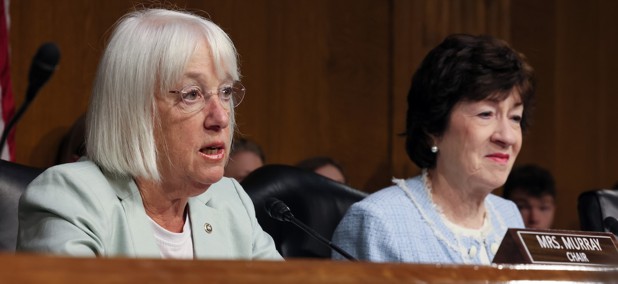
The Trump administration is declining to spend $3 billion Congress recently provided as part of the funding measure that will keep agencies afloat through September, saying that money was “improperly designated” as emergency funds. That decision violates federal law and the longstanding implementation of it, Sens. Susan Collins, R-Maine, and Patty Murray, D-Wash., the chair and ranking member of the Senate Appropriations Committee, said in a letter on Thursday to Office of Management and Budget Director Russ Vought. 

The concern stemmed from a provision of the 2023 Fiscal Responsibility Act, which set funding caps for fiscal years 2024 and 2025 while also including “emergency” funding outside those limits. 

The recent continuing resolution Trump signed into law contained $12.8 billion in such emergency funding, as allowed for in the FRA, though Trump has informed Congress he will not spend $3 billion of that total. Trump has nixed funding largely focused on foreign aid and humanitarian assistance, with some of the total focusing on the State Department's efforts to combat fentanyl and human trafficking, foreign military financing and investments to secure U.S. supply chains.

Collins and Murray conceded presidents have some leeway in spending emergency funding attached to spending bills, but must choose to obligate either all or none of that money. 

“Just as the president does not have a line-item veto, he does not have the ability to pick and choose which emergency spending to designate,” the senators said. “Regardless of our views on the Fiscal Responsibility Act and accompanying implementation agreement, it is incumbent on all of us to follow the law as written—not as we would like it to be.”

At a press conference on Thursday, Murray reiterated that she and Collins were informing the president that he does not have flexibility in determining which congressional funding to spend. 

“We are telling him, ‘This is the law, allocate the funding,’” Murray said. 

The bipartisan pushback comes as the administration is also facing pressure from federal courts to spend the money that Congress has allocated. The U.S. Court of Appeals for the First Circuit on Wednesday unanimously declined to grant the Trump administration’s request to block a lower court’s ruling that said the president could not unilaterally stop the flow of federal dollars. The original ruling concerned a memorandum OMB issued in January that placed a widespread freeze on federal grants and assistance, which the court found unlawful. OMB subsequently withdrew the memo, but the judge ruled its effects—and those of other executive actions to block congressionally authorized funding—were still being felt. 

While the administration argued its funding pauses were targeted and only aimed at certain spending not mandated in law and out of line with Trump’s agenda, the appeals court said the freezes were instead “categorical in nature.” The court added that the administration asserted its actions were lawful but did not make any effort to defend them as such. 

The 1974 iImpoundment Control Act prohibits the executive branch from withholding congressionally appropriated funds for policy reasons. It does allow for a narrow set of circumstances when the president can freeze funding, including for unforeseen circumstances, as provided in law or from savings realized by operational efficiencies. In those cases, however, the White House must notify Congress of its deferrals and specify a timeframe for releasing them.

Trump and Vought have repeatedly called that law unconstitutional and have vowed to fight it in court. While the administration argued the impoundment law did not apply in the funding freeze case, it could appeal the court’s decision to the Supreme Court in an effort to create new precedent that gives the president more flexibility in withholding appropriations. 

]]>
28 Mar 12:40

Trump order aims to outlaw most government unions on ‘national security’ grounds

by Erich Wagner
Updated March 27 at 11:19 p.m. ET

President Trump on Thursday signed an executive order purporting to outlaw collective bargaining across two thirds of the federal government, citing a little-used provision of federal labor law relating to national security issues.

fact sheet announcing the policy document says that Trump cited a rarely used provision of the 1978 Civil Service Reform Act allowing the president to exclude agencies and agency subcomponents from collective bargaining rules if the rules “cannot be applied to that agency or subdivision in a manner consistent with national security requirements.”

Trump first considered using this authority in early 2020, granting then-Defense Secretary Mark Esper the ability to exclude the Pentagon from federal labor law. Following bipartisan pushback in Congress, Esper elected not to use the authority.

According to the White House, Trump’s edict “ends collective bargaining” with unions at the Defense, State, Veterans Affairs, Justice and Energy departments, as well as portions of the Homeland Security, Treasury, Health and Human Services, Interior and Agriculture departments.

The International Trade Administration, Environmental Protection Agency, U.S. Agency for International Development, the Nuclear Regulatory Commission, National Science Foundation, International Trade Commission, the Federal Communications Commission and General Services Administration also are no longer subject to federal labor law, nor are chief information officers’ offices across government.

All told, the agencies covered by Trump’s order amounts to 67% of the federal workforce, and 75% of federal workers who are currently represented by unions.

In a statement, Everett Kelley, national president of the American Federation of Government Employees, the largest federal employee union, vowed to fight the president's edict, which he said was in retaliation for unions' efforts to protect employees' rights amid the mass firings across government. Kelley said his union would take "legal action" to block the order's implementation.

"President Trump's latest executive order is a disgraceful and retaliatory attack on the rights of hundreds of thousands of patriotic American civil servants—nearly one-third of whom are veterans—simply because they are members of a union that stands up to his harmful policies," Kelley said. "This administration’s bullying tactics represent a clear threat not just to federal employees and their unions, but to every American who values democracy and the freedoms of speech and association. Trump’s threat to unions and working people across America is clear: fall in line or else."

Guidance issued by acting Office of Personnel Management Director Charles Ezell told agencies cited in the edict that they are “no longer subject to the collective bargaining requirements” under Title 5 of the U.S. Code, though they should consult with their general counsel regarding implementation. Agencies have been instructed to cease "participating" in any ongoing grievance proceedings before independent arbitrators.

Don Kettl, dean emeritus and a former professor at the University of Maryland School of Public Policy, said the Civil Service Reform Act’s national security exemption does not stretch far enough to cover the agencies cited by the Trump administration.

“The president has power to change the conditions under which union representation occurs and to negotiate new contracts when existing ones expire,” he said. “But the president cannot simply wipe away existing agreements.”

And while the White House’s fact sheet cites the national security exemption within the 1978 law, it repeatedly criticizes the law and accuses unions of “declaring war” on the president’s agenda, citing unions’ various grievances and lawsuits seeking to block the White House’s efforts to purge and politicize the federal workforce.

“The exemption here seems to suggest that the national security responsibilities of the president supersede any existing union agreements and that, therefore, the president can push those existing agreements aside,” Kettl said. “Moreover, the fact sheet asserts that the Civil Service Reform Act allows unions to obstruct agency management. This is a double-barreled shotgun, aimed both at the CSRA in general and at the unions in particular.”

]]>
27 Mar 20:00

SignalGate Is Driving the Most US Downloads of Signal Ever

by Andy Greenberg
Scandal surrounding the Trump administration’s Signal group chat has led to a landmark week for the encrypted messaging app’s adoption—its “largest US growth moment by a massive margin.”
27 Mar 19:15

Even If Those Weren’t War Plans In Hegseth’s Signal Chat, They Were War Crimes

by Mike Masnick

When the Atlantic’s Jeffrey Goldberg revealed this week that senior White House officials had accidentally added him to their Yemen bombing planning session on Signal, he did something remarkable: he actually protected operational security better than the officials themselves did.

While Defense Secretary Pete Hegseth and others now insist “Nobody was texting war plans,” the administration’s frantic response suggests they know they’ve stepped in something worse. Their defense has evolved through four increasingly desperate stages:

  1. Saying that Goldberg is a liar and a sleazy journalist
  2. Claiming that this was just a little mistake, and no big deal
  3. Insisting that no actual classified info was shared and…
  4. Saying that even if it was real (it was), and was a mistake (it was) and classified info was shared (it was) that none of it mattered because the Yemen attack was just great.

It has yet to be explained why, if Goldberg is such a terrible journalist, they then added him to their group chat to plan an attack, but we’ll leave that aside for now.

Part of that response included multiple claims, mainly from Defense Secretary Pete Hegseth, that absolutely no war plans were shared in the chat. Also, many other administration officials swore up and down, including under oath to Congress, that no classified info was shared.

Goldberg and the Atlantic responded by… sharing the remaining messages. First, he notes the vehement denials from the admin:

On Monday, shortly after we published a story about a massive Trump-administration security breach, a reporter asked the secretary of defense, Pete Hegseth, why he had shared plans about a forthcoming attack on Yemen on the Signal messaging app. He answered, “Nobody was texting war plans. And that’s all I have to say about that.”

At a Senate hearing yesterday, the director of national intelligence, Tulsi Gabbard, and the director of the Central Intelligence Agency, John Ratcliffe, were both asked about the Signal chat, to which Jeffrey Goldberg, the editor in chief of The Atlantic, was inadvertently invited by National Security Adviser Michael Waltz. “There was no classified material that was shared in that Signal group,” Gabbard told members of the Senate Intelligence Committee.

Ratcliffe said much the same: “My communications, to be clear, in the Signal message group were entirely permissible and lawful and did not include classified information.”

President Donald Trump, asked yesterday afternoon about the same matter, said, “It wasn’t classified information.”

Then he proved them all to be liars.

The messages couldn’t be clearer. Details of precise strike timing, delivered just hours before bombs actually dropped, along with specific weapons information — information that anyone with even passing familiarity with classified material (or basic common sense) would recognize as obviously classified. Even Fox News’ own national security reporter noted that every expert she spoke to said, if anything, what Hegseth texted was actually worse than what is commonly referred to as “war plans.”

The key bit from that:

“Attack orders” or “attack sequence” puts the joint force directly and immediately at risk, according to former senior defense official #1. “It allows the enemy to move the target and increase lethal actions against US forces.”

This kind of real time operational information is more sensitive than “war plans,” which makes this lapse more egregious, according to two former senior US defense officials.

But rather than acknowledge the obvious, the administration doubled down on increasingly desperate semantic gymnastics. Their primary defense? That the Atlantic’s headline called them “attack” plans rather than “war” plans — as if this distinction somehow negated the sharing of classified military operations in an unsecured chat group that included a journalist. The semantic games only got more desperate from there:

That’s White House Press Secretary Karoline Leavitt pretending that because The Atlantic called them “Attack Plans” instead of “War Plans” it was some sort of concession, even though (as noted above) experts point out this is worse and more egregious.

We’ve written a few times now about how the administration has been playing cutesy semantic games in court, in which they act like they think playing obvious word games is some sort of magic loophole away from accountability. This is more of that, but to the press. As with courts, no one but the dumbest MAGA faithful are buying this nonsense. THEY STILL WERE PLANNING AN ATTACK INCLUDING CLASSIFIED INFO VIA SIGNAL. The fact that they accidentally added a journalist was only worth noting in the sense that that’s how we know about it. The existence of the Signal chat is the first problem.

Others in the administration really leaned in on this “no war plans” semantic game:

This is again, utter nonsense. It was texting clear details of a military operation before it occurred. It included details of weapons being used and timing. No one — NO ONE — thinks that this is acceptable or normal. Not even this crew now weakly trying to defend it.

But the administration’s semantic tap dance around “war plans” versus “attack plans” isn’t just missing the point — it’s actively trying to distract from something far more serious: evidence of potential war crimes. The Signal chat reveals senior administration officials deliberately targeting a civilian residential building, with full knowledge of its non-military status.

Let that sink in: they authorized bombing a civilian apartment building because a target’s girlfriend lived there. This isn’t just reckless — it’s a likely violation of international humanitarian law, which explicitly prohibits attacks directed at civilian objects. The fact that these officials casually discussed targeting civilian infrastructure in an unsecured chat group — while including a journalist by mistake — demonstrates a shocking combination of moral bankruptcy and operational incompetence.

This reckless disregard for both operational security and international law isn’t just dangerous — it’s potentially criminal. And while the administration tries to deflect with absurd arguments about the difference between “war” and “attack” plans, the reality is that they’ve provided documentary evidence of planning what appears to be a war crime, sharing classified operational details in an unsecured channel, and then lying about it to Congress.

For an administration that campaigned on bringing back competence and accountability to government, they’ve instead demonstrated they can’t be trusted with either classified information or military power.