AMTRAK loses $214m in '14, gets $11.2m in bonuses...
(Second column, 6th story, link)
A close look at the United States economy also points to a large and growing underground economy — not just for illegal goods and services such as drugs and prostitution, but for legal ones such as cigarettes and construction. Indeed, the more heavily taxed and regulated the activity, the more likely black markets will arise.
It's no surprise this is common in heavily regulated California. This month the state's independent oversight agency, the Little Hoover Commission, released a report ("Level the Playing Field: Put California's Underground Economy Out of Business") detailing the costs of what it calls an "insidious multibillion-dollar" marketplace.
Little Hoover focuses on a lack of enforcement: "The commission found the underground economy is growing and thriving in part because of insufficient resources for enforcement." It calls for more government officials, and for increasingly punitive measures such as "bolstering asset seizure laws" that let the government, say, seize the trucks owned by unlicensed contractors.
The report sidesteps other possibilities. Many say California's tax and regulatory structure pushes people into the underground economy and that an enforcement-heavy approach will lead to more obtrusive inspections at private job sites, reduced economic activity, a bigger bureaucracy and more poverty given that many of those who work without licenses don't have the financial wherewithal to get them.
A guy who builds a deck without a license isn't the same thing as a pimp or a drug pusher. Yet prostitution is the world's oldest profession and shows no signs of going away. Likewise, the nation's drug wars haven't put the drug cartels out of business and never will. What's the likelihood that a new "war on handymen" or unlicensed hair braiders will put the underground economy out of business?
"People go underground because the paperwork, taxes and licensing are onerous," said William Anderson, a professor of economics at Frostburg State University in Maryland. "A lot of times (the scofflaws) are smaller guys who don't have the resources to comply. (These regulations) destroy jobs and turn what would normally be law-abiding activity into criminal activity."
As a small example, I recently gave a speech at an event in Southern California, but was not allowed to personally sell my books unless I applied for and purchased a city business license. Is the problem a lack of enforcement agents to fine and possibly jail authors? Or is the problem an unreasonable regulation that does nothing to advance the safety of book buyers and sellers?
Because such rules often are so unreasonable and meant mainly to bolster local budgets or protect a powerful interest group (e.g., shop owners who don't like the competition), most people tend not to worry morally about breaking them. We find more regulations everywhere, with increasingly bizarre outcomes – such as cities shutting down children's lemonade stands, or sending SWAT teams to arrest people who sell raw milk.
"If we want to follow the letter of the law, we better not have the local kid (cut your lawn); you better get a licensed contractor with permits," Anderson added. This raises costs and it inserts government and lawyers into every private transaction. "Less gets done at a higher price … and there are fewer opportunities for younger people to learn how to work," he added.
Contractors and unions often lobby for more regulations because it gives them a competitive advantage over lower-cost businesses and workers. Then they complain "it isn't fair" that others ignore many of the edicts. "Taking more aggressive action against the underground economy is essentially about fairness," agrees the commission.
But if commissioners were truly concerned about fairness, they would once again evaluate ways to make California's laws more reasonable, so there's far less benefit to ignore them. Unless, of course, they believe the Soviet Union's economy would have worked better had there only been better enforcement.
 A male student at Reed College—a private liberal arts college in Oregon—says he was told not to return to his Humanities 110 discussion because his opinions about the prevalence of campus rape offended other people in the class. His professor, however, disputed that characterization of events in an exclusive statement to Reason.
Reached by email, the student refused to answer my questions and made the weirdest demand I've ever heard. More on that in a minute.
First, the details. According to BuzzFeed, 19-year-old Jeremiah True told his classmates that the oft-cited 1-in-5 statistic about sexual assault was an exaggeration (an opinion with which I happen to agree). This and other politically incorrect opinions led his humanities professor, Pancho Savery, to ban him from attending discussions. In an email to True, Savery told him that these opinions made his classmatess—survivors of sexual assault among them—"extremely uncomfortable." He wrote:
“There are several survivors of sexual assault in our conference, and you have made them extremely uncomfortable with what they see as not only your undermining incidents of rape, but of also placing too much emphasis on men being unfairly charged with rape,” Savery wrote to True. “The entire conference without exception, men as well as women, feel that your presence makes them uncomfortable enough that they would rather not be there if you are there, and they have said that things you have said in our conference have made them so upset that they have difficulty concentrating in other classes. I, as conference leader, have to do what is best for the well-being of the entire class, and I am therefore banning you from conference for the remainder of the semester.”
The story, first reported by BuzzFeed, was picked up at National Review and The Daily Caller. Both outlets criticized Savery for caving to hypersensitivity. NR's Kat Timpf complained that the recitation of a fact (that the 1-in-5 statistic isn't valid) could get a student in trouble:
Yes — he was banned for pointing out that a deceiving statistic was misleading. It’s based on a survey of senior undergraduates from just two schools, both large public universities — hardly a sample that represents the entire country. And it didn’t even ask the participants about “rape” in particular. Rather, it asked them if they had ever experienced any “unwanted sexual contact” — including “forced kissing” and someone “rubbing up against you in a sexual way, even if it’s over your clothes.”
Savery is known for being an ardent defender of free speech, which makes his apparent decision to remove True from class all the more baffling. While Reed College is a private institution not bound to follow the First Amendment or extend free speech rights to its students, this certainly seems like another incident where feelings-protection trumped open dialogue and violated the ethos of the law. If students can't debate cultural issues and facts in a classroom discussion, what kind of education are they getting?
All that said, I was curious about the context of True's remarks. While students should be able to speak up about controversial subjects, they aren't allowed to hijack classroom conversations and steer them wildly off track. If True was rowdy, interrupted other students, or veered off topic, that would be another matter.
Savery declined comment to BuzzFeed, but I was able to reach him via email. He confirmed that he was a "strong believer in the First Amendment," and maintained that the student's views were not the issue.
"He was not banned because of what he said but because of a series of disruptive behaviors," Savery told Reason.
I also reached True via email, and asked him whether he had been rowdy or disruptive in class. He responded by making a bizarre request. This was his email back to me:
Before I interview with you, you must agree to make "nigger" be the first word in your article.
I declined this ultimatum, and he declined to answer my questions. Needless to say, I've grown a lot more skeptical of True's side of the story. If I find out anything more that backs up either person's assertions about what happened, I'll update this story.
In a post about HIV I observed, “Straight men do not contract HIV.” I did not push a narrative. I did not share what I heard on some news channel or learned from a nit-wit teacher.Cernovich points out that even in the impossible event that every single man with HIV is honestly reporting his sexual activity (impossible because we already know it is not true), "According to a study in the Journal of the American Medical Association, men almost never get HIV from women. A healthy man who has unprotected sex with a non drug-using woman has a one in 5 million chance of getting HIV. If he wears a condom, the odds drop to one in 50 million."
Rather, I analyzed data from the United States Center for Disease Control. When you look at CDC data, you notice something.
Where are all of the straight white male HIV infections?
Relying on CDC data is considered racist and homophobic, as morons believe a scientific judgment is a moral one. Zealots are simply unable to look at scientific questions with a scientific lens and moral questions with a moral lens.


Kat Murti

Somewhere between 30 and 40 million Americans hold libertarian views. Are you one of them? Take this quiz — excerpted from David Boaz’s new book The Libertarian Mind: A Manifesto for Freedom — and find out just how libertarian you really are!
The quiz launched just over a week ago and almost 30,000 people have already taken it. Have you? Use #LibertarianMind to share your results on social media, tag your friends, and see how they measure up!
Of course, the quiz represents a very simplified version of libertarian principles and very few people will have “perfect scores” in any one direction, but it’s a great way to open up a discussion with friends and family. If that discussion leads to more curiosity about libertarianism and its principles, point them in our direction…or give them a their very own copy of The Libertarian Mind!
Haven’t had a chance to read The Libertarian Mind yet? We have a limited number of copies to give away. Take the quiz to learn the details! You can also follow The Libertarian Mind on Facebook for news on the book, media appearances, and more.
Depending on which article you read, somewhere between 30% and 55% of people in the U.S. and Canada are cutting back on grains, especially wheat. That’s no small threat to what has long been the most profitable sector of the food industry. (Those government grain subsidies sure help.)
So the grain industry is fighting back with I’ve decided to call the Save The Grain Campaign. The campaign employs three main tactics I’ve noticed so far:
1. Promote grains as a necessary health food.
2. Attack people who say grains are bad for us.
3. Attack diets like low-carb or paleo that limit or eliminate grains.
Back in January, I wrote a post about an incredibly stupid article in Shape Magazine that featured the headline Low Carb Diet Linked to Shorter Life Expectancy. The article was about a Harvard observational study in which people who ate whole grains had longer lifespans than people who ate white flour. From that study, the dunce reporter at Shape Magazine concluded that 1) whole grains are health food, and 2) a low-carb diet will shorten your lifespan.
Riiiight. And if people who smoke filtered cigarettes live longer than people who smoke unfiltered cigarettes, that means unfiltered cigarettes are good for you … so people who don’t smoke will die prematurely. Same twisted logic. Leaders of the Save The Grain Campaign must have been proud.
The grain promoters know they can’t claim that grains are good for everyone without looking foolish. After all, there’s that little problem known as celiac disease. So they’re quick to point out that only one percent of the population has been diagnosed with celiac disease. Grains are great for the other 99 percent, ya see.
Riiiiight. That’s roughly equivalent to pointing out that only seven percent of cigarette smokers develop lung cancer, so cigarettes are fine for the other 93 percent. Celiac disease may be the most severe form of grain intolerance, but it’s hardly the only one. As I’ve mentioned before, when I stopped eating wheat and other grains, I waved goodbye to psoriasis on my scalp and arthritis in my shoulder, to name just two benefits of many. And guess what? I don’t have celiac disease. I had the test done to be sure.
If my daughter Sara eats wheat, she gets red blotches on her arms she calls da bumps – and I doubt she has celiac disease. I’ve heard from people who gave up grains and stopped getting migraines, or restless legs at night, or cold sores, or mood swings, or … well, heck, name it. Most of them, like me, didn’t give up grains because they have celiac disease or were worried about gluten or the gliadin protein. They gave up grains because they adopted a low-carb diet to lose weight, then noticed all those lovely side benefits.
That’s why I believe some studies and articles discouraging people from adopting a low-carb diet are part of the Save The Grain Campaign. When people go low-carb, bread, pasta and cereal are usually among the first foods swept from the menu. So with that in mind, let’s look at a couple more articles I’d consider part of the campaign.
We’ll start with an article on the Med Page Today site with the headline OmniCarb Study: Cutting Carbs No Silver Bullet.
Overweight and obese people who followed a low glycemic index diet in the context of an overall DASH-type diet had no greater improvements in insulin sensitivity, lipid levels or systolic blood pressure compared with study subjects who ate high glycemic index foods, in a randomized, controlled feeding study.
Low glycemic? I though the headline was about low-carb.
Following a low-glycemic index, low-carbohydrate diet, compared with a high-glycemic index, high-carbohydrate diet did not affect insulin sensitivity, systolic blood pressure, LDL cholesterol or HDL cholesterol, but it did lower triglycerides during the from 111 to 86 mg/dL, researcher Frank M. Sacks, MD, of Harvard School of Public Health, and colleagues wrote in the Dec. 17 issue of JAMA.
Ah, there was a low-carb arm of the study. So they must have limited carb intake to somewhere between 20 and 50 grams per day.
Among the two study diets with a high carbohydrate composition (58% of daily energy), one had a high glycemic index (≥65 on the glucose scale) and the other had a low glycemic index (≤45 on the glucose scale).
The two other diets had a low carbohydrate composition (40% of daily energy), with one having a high (≥65%) and the other having a low (≤45%) glycemic index.
Um … 40% of daily energy as carbohydrate is a low-carb diet? Say what? If I consume 2500 calories per day, 40% as carbohydrate works out to 250 grams per day. I’m pretty sure that’s nothing like what Dr. Atkins recommended.
As I read the article, I realized I’ve written about Dr. Frank Sacks and his research before. In fact, my first-ever blog post (nearly six years ago) was titled Create Your Very Own Biased Study. It was about a study conducted by … wait for it … Dr. Frank Sacks, who declared that low-carb diets aren’t particularly good for inducing weight loss. He showed as much by putting people on a (ahem) low-carb diet. Except his definition of low-carb was … wait for it … 35 percent of calories. Again, that’s nowhere close to the degree of carbohydrate restriction recommended by Dr. Atkins, Drs. Eades & Eades, etc. Heck, even Paul Jaminet’s Perfect Health Diet, with the safe starches and all, tops out at 30% of calories from carbohydrates.
Dr. Sacks has to know that low-carb diet plans start at 50 grams max, then gradually raise the carb intake to perhaps 100 grams. So I can’t help but wonder why he keeps studying “low-carb” diets that allow well over 200 grams per day, then uses those results to declare that cutting carbs doesn’t make much of a difference. Why not try an actual low-carb diet in one of these studies? Because to me, his studies look like reducing an alcoholic’s intake from 10 drinks per day to seven, then declaring that the poor S.O.B. still isn’t sober, so there’s no point in cutting back on alcohol.
If Dr. Sacks wants to steer people away from low-carb diets, at least he’s subtle about it. This article in Consumer Reports isn’t:
Widely publicized diets, such as high protein and low carbohydrates, seem so promising. It’s no wonder so many of us have tried—or considered—them. But does science support the claims? We spoke with doctors and dietitians, and read the research.
They may have spoken with doctors and dieticians – which is roughly as useful as asking for dietary advice from a plumber – but based on what follows, I can guarantee they didn’t read the research.
Remember the Scarsdale diet and the Stillman diet? Those high-protein, low-carb plans may have gone out of fashion, but Atkins, first published in 1972, is still hot. Protein-packed products are flooding stores, and the list of popular protein-rich diets—Paleo, Zone, and more—continues to grow. All claim that you’ll lose pounds, feel peppier, and reduce your risk of heart disease.
People lose weight on high-protein plans because they take in fewer calories, not because they focus on protein. “Diets only work by lowering calories,” says David Seres, M.D., director of medical nutrition at the Columbia University Medical Center in New York and a member of Consumer Reports’ medical advisory board. “Where the calories come from doesn’t matter.”
Yes, when you lose weight, you take in fewer calories than you burn. That’s HOW you lose weight, but not WHY you lose weight. In several studies, people on a low-carb diet spontaneously ate less despite not being told to restrict calories. That means something positive happened with their metabolisms. Eating less is the result, not the cause. Dr. Seres’ statement is akin to saying that Alcoholics Anonymous may work, but only because people stop drinking.
In addition to pushing protein, many of these plans recommend cutting back on—or completely eliminating—carbohydrates. Get less than 50 grams of carbs per day (the amount in two apples) for three to four days in a row, and your body will start tapping its own fat and muscle for fuel instead of its usual source: glucose derived from carbohydrates. That may sound like a way to shed pounds, but it can have serious health consequences. “You’re altering your metabolism away from what’s normal and into a starved state,” Seres says. “People in starved states experience problems with brain function.”
Holy crap, I’d better load up on carbs and then check that highly complex program I spent all those overtime hours coding last month – with everyone from the president of IT on down waiting for results. I’m told it worked quite well. On the other hand, my brain function is impaired, so I might have heard “This sucks — you’re fired” and interpreted it as “I really appreciate all your hard work in getting this done” … from the president of IT.
A high-protein diet also overworks the kidneys. That’s especially worrisome for people with kidney disease and can predispose those with healthy kidneys to kidney stones.
If your kidneys are damaged, they can leak protein. In that case, you need to restrict protein. But protein doesn’t cause the damage in the first place. Here’s a quote from a journal article on the supposed dangers of high-protein diets:
The purpose of this review is to evaluate the scientific validity of AHA Nutrition Committee’s statement on dietary protein and weight reduction, which states: “Individuals who follow these [high-protein] diets are risk for … potential cardiac, renal, bone, and liver abnormalities overall.
Simply stated, there is no scientific evidence whatsoever that high-protein intake has adverse effects on liver function. Relative to renal function, there are no data in the scientific literature demonstrating that healthy kidneys are damaged by the increased demands of protein consumed in quantities 2–3 times above the Recommended Dietary Allowance (RDA).
In contrast with the earlier hypothesis that high-protein intake promotes osteoporosis, some epidemiological studies found a positive association between protein intake and bone mineral density. Further, recent studies suggest, at least in the short term, that RDA for protein (0.8 g/kg) does not support normal calcium homeostasis. Finally, a negative correlation has been shown between protein intake and systolic and diastolic blood pressures in several epidemiological surveys.
In conclusion, there is little if any scientific evidence supporting the above mentioned statement.
So I guess the anonymous Consumer Reports reporter didn’t actually slog through the research before repeating what a few doctors and dieticians believe.
When it comes to heart disease, the saturated-fat-laden red meat that’s part of many high-protein diets may actually boost your risk. According to a Harvard study of more than 120,000 people followed for more than 20 years, a meat-based low-carb diet increased the risk of dying from cardiovascular disease by 14 percent.
Denise Minger sliced and diced that observational study in a guest post on Mark Sisson’s blog. It’s worth reading in its entirety, but here’s the money quote:
If you secretly suspected that this was a “people who eat red meat do a lot of unhealthy things that make them die sooner” study, you can now gloat.
As you can see, the folks eating the most red meat were also the least physically active, the most likely to smoke, and the least likely to take a multivitamin (among many other things you can spot directly in the table, including higher BMIs, higher alcohol intake, and a trend towards less healthy non-red-meat food choices).
Same old, same old … in a society where people are told meat is bad for them, it’s mostly the I don’t give a @#$% people who eat more meat – well, except for us LCHF and paleo types. I don’t give a @#$% types have worse health outcomes for all kinds of reasons – including not giving a @#$%.
By the way, I realize some of you are probably expecting me to jump up and down and insist that a low-carb diet is a high-fat diet, not a high-protein diet. Truth is, unless you aim for a constant state of ketosis – which I don’t – a low-carb diet probably will be high in protein. And for most of us, I think that’s good. I’ll explain why in a future post.
In the meantime, we can all sit back and chuckle at the Save The Grain Campaign. I give them kudos for effort, but it’s not going to work. You can’t easily convince people to dismiss their own experiences.
Lives there a parent who hasn’t, at some point, lost track of his or her kid? That’s just the way life is — imperfect!
Until the authorities deem it a crime.
In this case, CPS gets it TOTALLY RIGHT…but not the prosecutor. So don’t read this letter if you were hoping to have a good day. Do read it if you think you have any idea how to help or crusade for change. Speaking of which, the National Association of Parents is trying to create a fund to help parents dealing with crazy CPS issues. Here’s the link. – L (who has, at the letter writer’s request, changed the names of the kids)
Lenore here: I am sharing this story not to scare parents, but only because I believe that as we grow aware of how corrupt or crazed authorities can ruin a family, our voices will crescendo, demanding change. This is our creed: Parents do not have to be perfect. The government cannot demand it. The state should only intervene when children are in obvious and indisputable danger. If you’d like to contact this writer of this letter, her email is: canyonhomestead@gmail.com .

Say bye-bye to your family, sweetheart. Daddy couldn’t find you for a few minutes, which means he is an abusive parent!
Liberals and conservatives do not agree with each other, as a matter of general principle. If one side says something is true, then the other side will try hard to prove it isn’t, just to show them. So it is nice to see liberals come around on a point conservatives have been making for decades: Welfare leads to moral rot.
Conservatives have made this point over and over again, in books and conferences and blog postings ad nauseam. Twenty years ago David Frum, a former speechwriter for George W. Bush, wrote that “without welfare and food stamps, poor people would cling harder to working-class respectability than they do now.” A couple of years ago Paul Ryan made the same point: “We don’t want to turn the safety net into a hammock that lulls able-bodied people to lives of dependency and complacency, that drains them of their will and their incentive to make the most of their lives.”
By giving people their daily bread, conservatives say, the welfare state robs them of any reason to get off the couch and make it themselves. And this is bad not just because it imposes economic costs on society. It is bad because it corrodes virtue. Industry, thrift, a go-getter spirit—these are important qualities in both the individual and the community. Laziness, sloth, dependence on others—these are character flaws. Those on welfare could go to work and do for themselves, conservatives say, if only the welfare state hadn’t enabled them not to.
Liberals think this is all bunk. While some, such as economist Paul Krugman, might concede that “incentives do have some effect on work effort,” they contend the effect is quite small. What’s more, they say conservatives get the causality backward. People receive government benefits because they are poor, and they are poor because of economic circumstances. They aren’t poor because of government benefits.
Or so they used to say. But then came Walmart.
A couple of weeks ago Walmart announced it would raise hourly wages for half a million employees. The New York Times argued it should be forced to raise pay even further through an increase in the national minimum wage. After all, the paper said, there is “little doubt that Walmart (and other employers) would pay more if low wages were not, in effect, subsidized by taxpayers, who pay for the food stamps and other public assistance that low-wage workers rely on to get by.”
The Times was referring to a study, such as it was, purporting to show Walmart’s low wages cost taxpayers $6.2 billion in public assistance, including food stamps, Medicaid, and housing benefits. Other studies have purported to show similar things about the fast-food industry—which ostensibly costs the taxpayers $7 billion in social-welfare spending.
These tendentious claims have several shortcomings, such as loaded assumptions (PolitiFact has ruled a similar claim, by an MSNBC figure, “mostly false”) and the fact that a slightly smaller percentage of Walmart’s workforce receives public benefits than the average for the U.S. retail sector as a whole.
Imagine, too, what would happen if Walmart and fast-food restaurants went out of business tomorrow. Would other companies snap up all their employees, perhaps even pay them better? Probably not. (In fact, the increase in job applicants might depress wages elsewhere.) It is far more likely that the shutdowns would lead to higher unemployment and therefore even more social-welfare spending. Hence Walmart and other low-wage employers probably reduce the total amount of social-welfare spending in the U.S., rather than increase it.
But forget all that. Assume the company’s critics are right—that Walmart is leaning on public assistance to avoid pay hikes it otherwise would have to make. The criticism here isn’t simply an economic one. It’s also a moral one.
Greed, stinginess, lack of compassion—those qualities that supposedly produce Walmart’s low wages—are character flaws. Indeed, one of the groups criticizing Walmart’s pay scales is Americans for Tax Fairness—and fairness is a question of moral judgment. Another left-leaning group, Demos, lamented in a report on raising Walmart pay that “American workers are working harder for less” even as the rich get richer. Walmart, says The American Prospect, creates “an America where millions of people who get up and go to work each day are nevertheless paid too little to feed themselves.”
You get the idea: Walmart has a moral obligation to pay its workers more—and it would, if not for all the food stamps, housing assistance and medical benefits those workers receive from the federal government.
What is this but the conservative welfare critique applied to a different party? It’s not economic circumstances that have led to Walmart’s low wages, but moral shortcomings. Government assistance has lulled an able-bodied company into dependency and complacency, draining it of the will and the incentive to do the right thing for its workers.
The two arguments continue running in parallel. Conservatives argue that poor people would be better off in the long run if they took even menial jobs, and thereby started to develop the habits of character that are essential for anyone who wishes to prosper.
Liberals argue that Walmart and other low-wage companies would be better off if they paid workers more. As Demos argued two years ago: “Walmart . . . workers earn too little to generate the consumer demand that supports hiring and would lead to economic recovery. . . . If Walmart redirected its current spending to invest in its workforce, the benefits would extend to all stake-holders in the company—customers, stockholders, taxpayers, employees and their families—and the economy as a whole.”
Conservatives used such arguments to push through welfare reform, forcing recipients to seek the jobs right-wingers felt they needed for their own good. And as the Times put it the other day about Walmart’s recent wage announcement, “Walmart can readily afford to do better than those measly increases. But it is very unlikely to do that voluntarily, without government action.”
By government action, the paper meant raising the minimum wage, not cutting welfare. But be thankful for small favors: At least some progressives are beginning to admit there’s a problem.
Michael F. Cannon
This week, the Supreme Court will hear oral arguments in King v. Burwell, one of four legal challenges to an IRS regulation that purports to implement the Patient Protection and Affordable Care Act, but in fact vastly expands the IRS’s powers beyond the limits imposed by the Act. Just in time for oral arguments before the Court, Vox’s Sarah Kliff has produced what I think may be the best history of King v. Burwell and related cases I’ve seen. Still, there are a few important errors and omissions, listed here in rough order of importance.
1. Kliff refers to the birth of my “twin daughters.”
My wife indeed gave birth to twins, but only one of them was a girl.
 Definitely not a girl.
2. The twins’ birth did not cut into my efforts to dissuade states from establishing Exchanges.
They were born after the deadline for states setting up Exchanges had passed.
3. “As anyone who covered it at the time…remembers, the law’s passage was an absolute mess,” Kliff reports, and the “messy language and loose ends that legislators expected to get ironed out simply became part of the law.”
Nevertheless, Kliff reports that all congressional staff involved with the drafting of the Patient Protection and Affordable Care Act swear they meant to authorize the disputed taxes and subsidies in states with federal Exchanges. She also reports that all journalists who reported on the drafting process swear that every time the topic arose, Democratic staffers always said these provisions would be authorized in states with federal Exchanges. (Well, except these members of Congress and this journalist.)
Kliff neglects to mention that there is absolutely zero contemporaneous evidence of any kind that supports those recollections. Or that contemporaneous discussions of that issue, like this one by Jonathan Cohn, show (A) that even the sharpest journalists weren’t paying attention to this issue, and (B) to the extent they did, their impressions were consistent with the subsidies being conditional.
Thus, the only contemporaneous evidence that speaks directly to the question presented to the Court is the explicit statutory text clearly limiting subsidies to Exchanges “established by the State.” That’s probably something Kliff should have mentioned. You know, so readers can decide whether to take the “if you like your health plan, you can keep it” crowd at their word.
4. According to Kliff, in August 2011, Jonathan Adler suggested to me that the ACA only authorizes subsidies through state-established Exchanges and suggested I fold that into the case I was making to state officials that they not implement the ACA.
Hey, wait a minute. The first part is true, but the second part is not. I didn’t need that Adler guy to tell me how to do my job. I needed him to tell me how to do his job.
5. Kliff commits the same rookie (or Freudian?) error every other reporter does by claiming the disputed taxes and subsidies are part of ObamaCare, that a victory for the government is a victory for the ACA, and to rule for the plaintiffs would be “to rule against the Affordable Care Act.”
That is the government’s argument, which Kliff treats as fact. The plaintiffs argument is that they are trying to uphold the law. The two lower court opinions that went against the government said they were upholding the ACA.
By framing the case the way the Obama administration does, Kliff is essentially winking at her readers as if to say, ‘Natch, the government is right.
6. Kliff quotes former Democratic staff director of the Senate Health, Education, Labor, and Pensions (HELP) Committee John McDonough as saying, “There is not a scintilla of evidence that the Democratic lawmakers who designed the law intended to deny subsidies to any state.”
That is flatly untrue.
As even the government concedes, the Democratic senators on the HELP Committee—which McDonough ran—approved a bill that withheld Exchange subsidies in states that did not implement that bill. Kliff has quoted McDonough in the past making the same invalid point, and I have corrected her, to no avail.
Kliff should have informed readers that McDonough himself helped the authors of the ACA do what he now says they never considered doing. Instead, she once again allowed McDonough to misrepresent the legislative history and what the ACA’s authors were considering.
7. Kliff leaves the reader with the impression that the statutory requirement that subsidy recipients must enroll “through an Exchange established by the State”—the only language in the statute that speaks directly to the question presented in King v. Burwell—was a “drafting error.”
Not even the government makes that claim.
That said, the government’s claim that “[t]he phrase ‘Exchange established by the State under Section [1311]’ is a term of art that includes an Exchange established for the State by HHS” is scarcely more defensible.
8. Kliff reports that Adler told me in August 2011 that the ACA offered Exchange subsidies only in state-established Exchanges, but: “There wasn’t much that Cannon and Adler could do with their discovery at that point. The federal government still hadn’t published the rules governing how the insurance subsidies would work; it was still possible that the Obama administration might come out and agree with them, saying state exchanges were the only bodies authorized to dole out funds. The Obama administration eliminated that possibility in May 2012.”
Actually, the Obama administration announced its plan to issue subsidies in federal Exchanges almost immediately after Adler told me they couldn’t. The IRS issued its proposed tax-credit rule in mid-August 2011.
9. Kliff reports that “everyone expected” the IRS to offer tax credits in federal Exchanges.
Having read the law, that was not what I expected. Call me naïve, but I was surprised the IRS was violating clear statutory text.
10. Kliff writes, “The whole point of the federal exchanges, after all, was to make sure Obamacare worked in states that wouldn’t or couldn’t build an exchange of their own.”
How does Kliff know that? This is an assumption, which she appears to make without any contemporaneous support.
I don’t know how Kliff rules out Vanderbilt law professor Jim Blumstein’s alternative theory that the federal Exchanges were nothing more than an “oops” provision to protect the ACA against charges that Congress was commandeering the states. I hope she has more to go on than assurances from the “if you like your health plan, you can keep it” crowd.
Between Kliff’s theory and Blumstein’s theory, the latter is more compatible with the ACA, which explicitly authorized unlimited funds for the establishment of state-run Exchanges but zero funds for the establishment of federal Exchanges.
11. Kliff writes: “Congress always meant for residents of all 50 states to have access to financial help. It was never a question, during the five years I’ve spent writing about Obamacare, whether this would be the case.”
Regarding the first claim, Congress also meant for residents of all 50 states to have access to the ACA’s Medicaid expansion. That doesn’t mean Congress didn’t intend to condition Medicaid subsidies on state cooperation.
Regarding the second claim, all that tells us is that journalists should ask more questions and/or members of Congress and congressional staff should read bills more closely.
12. Kliff writes, “For about two years, [Adler, Cannon,] and other challengers made a purely textualist argument.”
Actually, it was less than one year before we learned the plain text of the statute reflected Congress’ intent. We wrote in July 2012: “We were both surprised to discover this flaw in the law, and characterized it as a ‘glitch.’ Yet our further research demonstrates this feature of the law was intentional and purposeful, and that the IRS’s rule has no basis in law. This supposed fix is actually an effort to rewrite the law and provide for something Congress never enacted, and indeed that PPACA’s authors intentionally chose not to include in the law.”
13. Kliff misrepresents Adler’s and my argument that Congress intended to condition subsidies on states establishing Exchanges.
Fortunately, to her and Vox’s credit, she let me make that case in my own words in a previously published interview (read the whole thing):
Sarah Kliff: Are you 100 percent convinced it was Congress’s intent to withhold subsidies in the federal exchange?
Michael Cannon: There are two ways to interpret that question. Did the people who wrote this language mean to withhold subsidies in federal exchanges? My answer to that is, I’m 100 percent convinced that they meant to do that.
The other way to think about it is, “Did the people who voted for this law intend to withhold subsidies in federal exchanges?” That’s a different question, but the answer is the same. I’m 100 percent convinced that’s what the members of Congress who enacted this law meant to do, just the same way I’m 100 percent convinced they meant to throw people off of their existing health plans even though they said, “If you like your health plan, you can keep it.”
What members of Congress might have ideally wanted is different from congressional intent, which is determined by what they actually vote on. If the language of a statute is clear, then that constitutes congressional intent.
14. Kliff writes that when Oklahoma became the first plaintiff to challenge the IRS rule, it “couldn’t scrounge up additional plaintiffs before the deadline to amend its case and ultimately went it alone.”
In fact, Oklahoma had additional plaintiffs lined up, but the court wouldn’t allow those plaintiffs to join the suit.
15. Kliff writes, “And on July 22, the subsidies argument got its first positive news. In the span of two hours — and by pure coincidence — the appeals courts for the District of Columbia and the Fourth Circuit issued conflicting rulings.” (Emphasis added.)
If Kliff can substantiate the claim that this was a coincidence, she should share it.
16. Kliff writes, “[Jonathan] Gruber has disavowed the remarks [in which he told audiences that the law conditions subsidies on states establishing Exchanges], saying that he spoke ‘off the cuff’ and made a mistake. There’s reason to believe him: Gruber spoke regularly to dozens of reporters during this period and never mentioned this idea to any of them.”
Kliff should have mentioned there is also reason not to believe Gruber’s disavowals. Gruber made that claim multiple times, and his attempts to explain those comments away reveal, um, inconsistencies.
17. Finally, Kliff writes that the government’s argument “has remained consistent throughout the process.”
No, it hasn’t. When King v. Burwell reached the Supreme Court, the government unveiled a new argument: “The phrase “Exchange established by the State under Section [1311] is a term of art that includes an Exchange established for the State by HHS.” The government also called the phrase a “technical term” that “reflects style and grammar—not a substantive limitation” on the IRS’s power.
The government had never previously called that phrase a “term of art.” The only statutory provision it had described as a term of art was the term “Exchange,” and the government described that as a “defined term of art” (emphasis added) because, unlike “Exchange established by the State,” the ACA actually bears a definition that gives the word “Exchange” a meaning other than its ordinary meaning.
–
I meant what I said at the beginning. This really was the best history of King v. Burwell and related litigation that I’ve seen.
Merck, the pharmaceutical giant, is facing a slew of controversies over its Measles-Mumps-Rubella (MMR) vaccine following numerous allegations of wrongdoing from different parties in the medical field, including two former Merck scientists-turned-whistleblowers. A third whistleblower, this one a scientist at the Centers for Disease Control, also promises to bring Merck grief following his confession of misconduct involving the same MMR vaccine.Vaccine advocates, are you starting to find even a glimmering of understanding why some intelligent and well-informed people just might harbor the occasional doubt about the safety and efficacity of vaccines? If not yet, what more will it take? And do you not understand that once this level of fraud is established, it casts at least a modicum of doubt on EVERY SINGLE CLAIM that has been made about vaccine safety in the past?
The controversies will find Merck defending itself and its vaccine in at least two federal court cases after a U.S. District judge earlier this month threw out Merck's attempts at dismissal. Merck now faces federal charges of fraud from the whistleblowers, a vaccine competitor and doctors in New Jersey and New York. Merck could also need to defend itself in Congress: The staff of representative Bill Posey (R-Fla) -- a longstanding critic of the CDC interested in an alleged link between vaccines and autism -- is now reviewing some 1,000 documents that the CDC whistleblower turned over to them.
The first court case, United States v. Merck & Co., stems from claims by two former Merck scientists that Merck "fraudulently misled the government and omitted, concealed, and adulterated material information regarding the efficacy of its mumps vaccine in violation of the FCA [False Claims Act]."
According to the whistleblowers' court documents, Merck's misconduct was far-ranging: It "failed to disclose that its mumps vaccine was not as effective as Merck represented, (ii) used improper testing techniques, (iii) manipulated testing methodology, (iv) abandoned undesirable test results, (v) falsified test data, (vi) failed to adequately investigate and report the diminished efficacy of its mumps vaccine, (vii) falsely verified that each manufacturing lot of mumps vaccine would be as effective as identified in the labeling, (viii) falsely certified the accuracy of applications filed with the FDA, (ix) falsely certified compliance with the terms of the CDC purchase contract, (x) engaged in the fraud and concealment describe herein for the purpose of illegally monopolizing the U.S. market for mumps vaccine, (xi) mislabeled, misbranded, and falsely certified its mumps vaccine, and (xii) engaged in the other acts described herein to conceal the diminished efficacy of the vaccine the government was purchasing."
These fraudulent activities, say the whistleblowers, were designed to produce test results that would meet the FDA's requirement that the mumps vaccine was 95 per cent effective. To the whistleblowers' delight, the judge dismissed Merck's objections to the case proceeding, finding the whistleblowers had plausible grounds on all of the claims lodged against Merck.
Merck made a "hit list" of doctors who criticized Vioxx, according to testimony in a Vioxx class action case in Australia. The list, emailed between Merck employees, contained doctors' names with the labels "neutralise," "neutralised" or "discredit" next to them.Do you find that confidence-inspiring?

Here’s a letter to the D.C.-based WTOP Radio:
You report that the IRS is cutting back on “customer service.” Pleading poverty because of the budget cuts it must endure as a result of Congressional displeasure with its recent mistreatment of many of its ‘customers,’ the IRS moans that it simply has too few resources now to adequately man its customer-service phone lines. The IRS’s message to its ‘customers’ is clear: tell your representatives to increase our funding or we’ll make your lives even more miserable than we already do.
There’s a key, if familiar, lesson here: when private firms in competitive markets seek more revenue they considerately offer customers the carrot of better service; in contrast, when government agencies seek more revenue they angrily whack ‘customers’ with the stick of worsened service.
Sincerely,
Donald J. Boudreaux
Professor of Economics
and
Martha and Nelson Getchell Chair for the Study of Free Market Capitalism at the Mercatus Center
George Mason University
Fairfax, VA 22030
Of course, there’s a real upside to this particular instance of bureaucratic greed: also predicted to fall in number are IRS audits.
Chris Edwards
Tomorrow at CPAC, I will discuss some advantages of infrastructure privatization. Perhaps the largest advantage is innovation. Unlike government bureaucracies, private firms in a competitive environment are eager to maximize the net returns of projects, so they find new ways to reduce costs and improve quality.
The benefits of innovation are obvious in fast-moving industries such as high-technology. But innovation can also be important in long-established, hard-hat industries such as highway building. Numerous countries are ahead of the United States in privatizing and partly privatizing (“public private partnerships” or “P3s”) government assets such as highways, airports, seaports, passenger rail, and air traffic control. Experience around the world shows that much innovation is possible after such industries are liberated from the bureaucratic yoke.
A House hearing last year looked at the international experience with privatization. The head of a provincial P3 agency in Canada said that P3 projects are more likely to be completed on time and on budget than traditional government infrastructure projects. And he said, “Competition and the profit motive can lead to startling results, where the winning proposal provides solutions that the public owner never contemplated. This happens over and over again.” Isn’t that interesting?
In his latest newsletter, Robert Poole provides more evidence of the “innovative effect” of P3s. He discusses $2 billion of cost savings from P3 highway projects in Texas, which are examined in a paper by Fidel Saenz de Ormijana and Nicolas Rubio:
Texas DOT has been gradually increasing the extent of design flexibility it gives project developers, via two methods. One is to encourage P3 developers to submit “alternative technical concepts” (ATCs) as part of their proposals in response to an RFP. The other is to encourage potential developers to present innovative ideas during the industry review meetings that precede issuance of the RFP. In the latter case, those ideas may be included in the RFP as options for all potential bidders to consider.
The largest cost savings discussed in the paper concern the LBJ (I-635) project in Dallas, where TxDOT’s conceptual design called for the express lanes to be constructed in a new tunnel beneath the existing general-purpose lanes, due to severe right of way constraints. During design review, the authors’ companies (Ferrovial and Cintra) suggested the alternative of a depressed center section for the express lanes, with the rebuilt general-purpose lanes partly cantilevered over the express lanes. This was presented in the RFP as an option, and the authors’ consortium’s bid that used this approach came in at substantially lower cost, contributing a large fraction of the resulting $1.3 billion construction cost savings.
The other cases described in the paper deal with several phases of the North Tarrant Express project in Fort Worth. In these cases, the developer-proposed changes were of two types. Some were changes in the design and placement of lanes and ramps, to provide better traffic flow (and generate more toll revenue). Others were changes in phasing, so as not to incur premature construction costs for lanes needed only in the ultimate configuration (10 to 20 years in the future), while designing now to facilitate their later addition within the long term of the concession agreement. These changes saved $480 million in NTE 1 and 2W and another $150 million in NTE 35W.
… By looking at the LBJ and NTE projects as businesses, the team was strongly motivated to come up with alternative designs and more-careful phasing of improvements to make the projects financially feasible. And to its great credit, Texas DOT was willing to accept many of those changes, resulting in projects that will provide very tangible benefits, without putting taxpayers at risk.
For more on infrastructure P3s and privatization, see here.
When I write about the dangers to innovation, competition, and price discovery from the FCC's decision to regulate the Internet into Ma Bell, supporters of net neutering are quick to point out that the FCC promised to only use a fraction of the power it is giving itself.
Ha! When has this happened, ever, with the government? If they have the power, they are going to use it. In fact, to call the FCC as somehow careful about staying within bounds of their power is a joke anyway, since this entire regulation likely exceeds their legislative mandate. Even if the current commissioners are honest that they will never use all this new power, how can they possibly bind future commissioners?
I am reminded of the income tax, which was sold to the country with the promise that it would only ever apply to the top few percent of earners. In other words, they were asking for the power to tax everyone but promised only to use a fraction of that power
when initially imposed, the income tax, despite its progressive rates, appeared rather straightforward and not all that burdensome—almost benign. Of course, appearances can be deceiving.
There were, of course, warnings about the dangers of a progressive tax structure. But people supported the income tax because it was originally meant to impose only very low tax rates on only the highest incomes. Proponents argued that the 16th amendment to the U.S. Constitution would force the so-called “robber barons” to pay taxes. It was not supposed to provide a mechanism for Washington to reach into most Americans’ pockets.
...
The original income tax was obviously not meant to be paid by most citizens, nor were rates high enough to significantly undermine the spirit of enterprise. For example, under this system single taxpayers today would pay no tax on any earnings up to almost $45,000 and married couples on earnings up to almost $60,000. A one percent tax rate would be in effect on incomes up to about $300,000. The top rate of 7 percent would not take hold until earnings hit almost $7.5 million.
* "Net Neutrality" is an Orwellian term that bears no relationship to what is actually going on. I will use "net neutering" going forward.


Most of the discussions on income inequality, the reviled “top 1%,” and the hand-wringing about the share of income or wealth going to the “top 1%” typically assume that the top 1/5/10% and bottom 99/95/90% percentile groups by income (pick your favorite percentage) operate like private clubs that are closed to new members. That is, many people assume that various income groups are static and fixed, with very little movement or fluidity among those income groups over one’s career or lifetime. Start out life in the bottom 20% or bottom 50%? Too bad, you’re stuck there forever no matter how hard you try or work, and you can forget about ever being part of the top 1/5/10%. Born into the top 1/5/20%? Great, you’ve got a lifetime membership in that static, closed group.
That rather simplistic interpretation of a static economy is really nothing like the very fluid and dynamic world we actually live in, with significant degrees of income and wealth mobility/fluidity over one’s lifetime. That’s the main conclusion of a new study titled “The Life Course Dynamics of Affluence” by Thomas Hirschl and Mark Rank, based on an empirical investigation of individual lifetime income data in the Panel Study of Income Dynamics over a 44-year period.
For example, one of the authors’ key findings is that by age 60, nearly 70% of the US population experienced at least one year in the top 20% by income, more than half (53.1%) were in the top 10% for at least one year, more than one-third (36.4%) spent at least one year in the top 5%, and 11.1% (one out of nine) spent at least one year with income in the top 1% (see top chart above). Those findings of significant income fluidity for one year periods are further supported when the authors look at longer time periods. For example, although 11.1% of Americans made it into the top 1% for at least one year, only 1.1% (1 in 91) of Americans stayed in the top 1% for ten years or more during their lifetimes, and only about half that amount (0.60%, or 1 in 167) were able to stay in the top 1% for ten consecutive years (see bottom chart above). That should shatter the myth that the top 1% is a fixed club closed to new members! Likewise, more than 1 out of 3 Americans (36.4%) spent at least a year in the top 5%, but only about 1 in 15 (6.6%) remained there for ten years or more, and only about 1 in 27 (3.7%) spent 10 consecutive years in the top 5%. Lots of movement and fluidity.
Here is a summary of the main findings of the study (emphasis added):
1. There is substantial fluidity in top-level income over ages 25 to 60. Thus a static image of top-level income tenure is at odds with the empirics of how people live out their life course.
2. The study findings indicate that top-level income categories are heterogeneous with respect to time, comprised of a relatively small set of persistent members, and a larger set of short-term members. For example, although over half of the U.S. population experienced one or more years of top 10th percentile income, only about half of this set attained top 10th percentile income for three consecutive years, and fewer than 7 percent persisted at this level for 10 consecutive years. Thus the lifetime top 10th percentile is mostly transitory, moving in and out of this percentile over the life course.
3. There are two contentious social implications related to the finding that top-level income is fluid across time. One is that there is widespread opportunity for top-level income. The opportunity to attain top-level income is widely accessed, and many reap the benefits of opportunity. It is also the case that attaining top-level income in one year does not necessarily predict it for the following year. Indeed, most who attain top-level income do so for a limited number of years, and to the extent that they have expectations of persistence, have some probability of experiencing insecurity relative to their expectations. Income fluidity is a double-edged sword, creating opportunity for many, along with insecurity that this opportunity may end sooner than hoped for.
4. We interpret the widespread attainment of top-level income as materially consistent with the way the majority of Americans tend to characterize their society. In a recently published study, we report evidence that most Americans hold fast to the belief that hard work will be rewarded economically, and the present study finds evidence that many Americans do, in fact, attain top-level income. This evidence is counter-intuitive vis-à-vis popular interpretations regarding the 1 percent versus the 99 percent, and we believe that our findings serve to qualify these interpretations. When interpreting social and economic relationships and trends, it is important to consider not simply one, or even many, cross-sections in time, but also the extent of social and economic mobility across the life course. Individuals experience their lives not as a disconnected set of years, but rather as a continuous lifetime of experience.
MP: Thanks to Thomas Hirschl and Mark Rank for bringing some much-needed attention to the significant income mobility and fluidity in the American economy, which directly contradicts the narrative we hear all the time of a rigid class structure based on static income groups like the top 1/5/10%, a static bottom 20/50/99%, etc.
As one of the authors (Mark Rank) pointed out last year in the New York Times:
It is clear that the image of a static 1 and 99 percent is largely incorrect. The majority of Americans will experience at least one year of affluence at some point during their working careers. (This is just as true at the bottom of the income distribution scale, where 54 percent of Americans will experience poverty or near poverty at least once between the ages of 25 and 60).
Ultimately, this information casts serious doubt on the notion of a rigid class structure in the United States based upon income. It suggests that the United States is indeed a land of opportunity, that the American dream is still possible — but that it is also a land of widespread poverty. And rather than being a place of static, income-based social tiers, America is a place where a large majority of people will experience either wealth or poverty — or both — during their lifetimes.
Rather than talking about the 1 percent and the 99 percent as if they were forever fixed, it would make much more sense to talk about the fact that Americans are likely to be exposed to both prosperity and poverty during their lives, and to shape our policies accordingly. As such, we have much more in common with one another than we dare to realize.
The post Evidence shows that affluence in the US is much more fluid and widespread than the rigid class structure narrative suggests appeared first on AEI.
Here is the letter I wrote today (pdf) to Representative Grijalva confessing my climate funding biases. The image is below. I feel so much better.
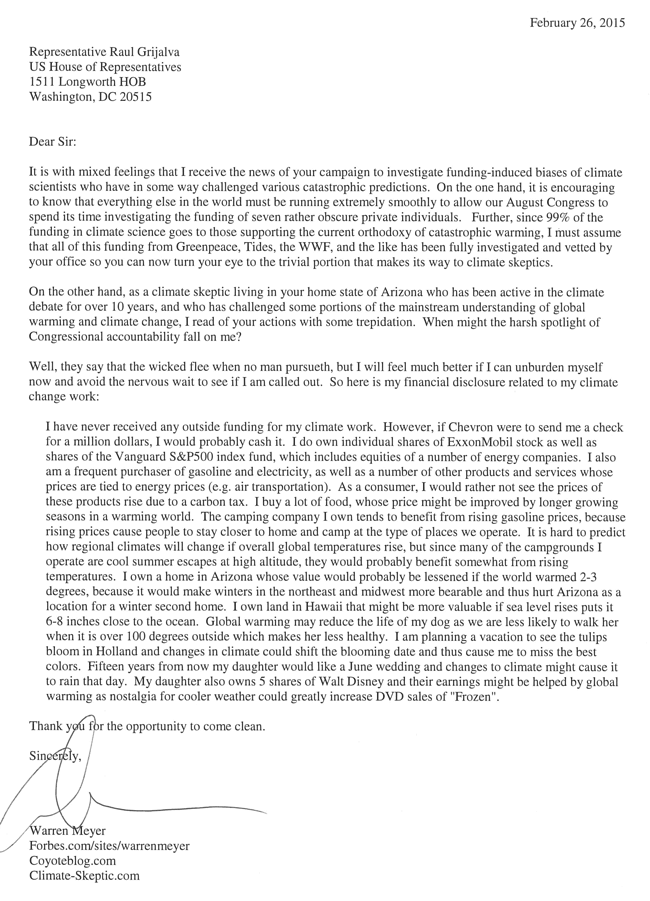
I wrote this in support particularly of Roger Pielke, who has educated a lot of people about climate and is not even really a climate skeptic and who has been pretty upset by this scrutiny. Call it the "I am Spartacus" strategy.
My earlier post on funding and bias is here.
 Some asshole
turned off the 21st century in northern Arizona yesterday. The
hardest part was probably the hike. The modern world flows to
northern Arizona in a cable that runs hundreds of miles through the
desert. That cable was cut in an
isolated river bed near New River, north of Phoenix. Once the
vandals were there, doing damage wasn't that big a challenge. The
cable is about as thick through as a man's leg, so the right tool
in a backpack was all it took. And there went the 21st century, and
maybe a few illusions some of us (**cough**) may have about the
extent of our independence.
Some asshole
turned off the 21st century in northern Arizona yesterday. The
hardest part was probably the hike. The modern world flows to
northern Arizona in a cable that runs hundreds of miles through the
desert. That cable was cut in an
isolated river bed near New River, north of Phoenix. Once the
vandals were there, doing damage wasn't that big a challenge. The
cable is about as thick through as a man's leg, so the right tool
in a backpack was all it took. And there went the 21st century, and
maybe a few illusions some of us (**cough**) may have about the
extent of our independence.
What went with that cable was most cell phone service (every company but Verizon was down), the Internet (multiple ISPs run through the same pipe), the 911 system, and pretty much any digital communications connection you can imagine. Northern Arizona businesses largely became cash only—including the roadside stops vending gas to cross-country travelers. Trucks lined up waiting for the stations to get back online so they could process company credit cards to fill their tanks. It's not like the drivers could just take out cash—ATMs were down, too.
My wife's pediatric office was able to examine kids and patch them up. But checking on test results, getting reads on x-rays, scheduling appointments with specialists, and electronically sending prescriptions to pharmacies were all out. Old-fashioned landlines worked, but medical facilities are part of the modern world. Thoroughly digitized and electronic, hospitals, labs, and clinics were reduced to sending couriers back and forth.
There's a lot to like about the interconnected, digitized modern world. I wouldn't be telecommuting from a rural area if I didn't have an electronic link to the world beyond. People like me now have the historical luxury of living where we want while doing work that, not so long ago, required an actual presence in a major population center.
But that means we need that electronic link. I thought I was being clever by using a smart phone hotspot as a backup for occasional Internet outages. Unfortunately, for much of its journey, the conduit for my smart phone runs all of two inches from the main Internet connection. Live and learn.
The outage inconvenienced me. Some folks who've grown up in the wired age had a worse time of it. According to CBS 5, "Zak Holland, who works at a computer store at Northern Arizona University, said distraught students were nearly in tears when he said nothing could be done to restore their Internet connection."
Northern Arizona is sparsely settled, which likely explains its weak connection to the modern age. Fiber optic is pricey to lay down per mile, and there's only so much of it that any company can afford to run across the wilderness to serve a scattered population. We get our 3G, but we have to live with the fact that somebody with a grudge, hiking boots, and a spade can take it away.
That's a reality check for those of us who value our independence. I use the Internet to liberate me from places I don't want to live, governed by politicians I don't like, who impose laws I find intrusive. But in the process, I make myself dependent on a six-inch-wide pipe.
So now, to ensure a bit more of that that independence I thought I had, I have to work a bit harder on that backup plan.
Ten years ago today the Pittsburgh Tribune-Review published the first of my twice-monthly columns for that paper – a column that I’m still thrilled to write.
In light of the subject of this first of my columns – slavery and capitalism – consider this editors’ footnote on page 388 of the 1981 Liberty Fund edition of Adam Smith’s 1776 An Inquiry Into the Nature and Causes of the Wealth of Nations; in this footnote, which appears in a section of the book where Smith argues that slave labor is very inefficient, the editors reference an early draft (“ED”) of The Wealth of Nations:
In ED … Smith argued that the colonies dealing in sugar and tobacco could only afford slave labour because of the ‘exhorbitancy of their profites’ [sic] arising from the monopoly of the fro trades. He added that ‘the planter in the more northern colonies, cultivating chiefly wheat and Indian corn, by which they expect no such exhorbitant returns, find it not for their interest to employ many slaves, and yet Pennsilvania, the Jerseys and some of the Provinces of New England are much richer and more populous than Virginia, notwithstanding that tobacco is, by its ordinary high price a more profitable cultivation.’
So – insofar as Smith is here correct – slavery thrived because of restrictions on free markets and was not itself a fuel for free markets.
(This editors’ footnote does not appear in the on-line version of The Wealth of Nations linked to here.)

Jts5665Socialism running down its inevitable path.
 A broken door. Smashed windows. Residue from a
flesh grenade on the carpet. That's the state in which Miami cops
left a 90-year-old woman's house after raiding it for drugs. They
didn't find any illegal activity, but won't admit they made a
mistake.
A broken door. Smashed windows. Residue from a
flesh grenade on the carpet. That's the state in which Miami cops
left a 90-year-old woman's house after raiding it for drugs. They
didn't find any illegal activity, but won't admit they made a
mistake.
The woman was interviewed by cbsmiami.com, though she declined to be named. She said the raid happened on December 18th:
“I don’t know how the cops got in here. The noise woke me up when something said boom! Like a bomb or something,” said the 90-year old. ...
Riviera Beach Police said after evidence of criminal activity, they got a search warrant.
“Cops standing over here talking about where’s the drugs? I said what? What drugs? Ain’t no drugs in here,” she said.
After drug-sniffing dogs failed to find anything, the police left. When asked whether they got the wrong address, the department countered that just because the woman didn't know about drugs being sold out of her house "doesn't mean it didn't happen." That ranks pretty highly on the list of hilarious and also worrisome police excuses, in my book.
The cops have agreed to repair the damages to her house, at least—though they have not done so yet.
Why so harsh? The SCDC says that it's a separate felony for each day that an inmate uses a social media site (oddly, you can do as much as you want in a single day and it's just a single felony -- but new day, new felony). And, of course, "social media" is defined broadly as well:In October 2013, Tyheem Henry received 13,680 days (37.5 years) in disciplinary detention and lost 27,360 days (74 years) worth of telephone, visitation, and canteen privileges, and 69 days of good time—all for 38 posts on Facebook. In June 2014, Walter Brown received 12,600 days (34.5 years) in disciplinary detention and lost 25,200 days (69 years) in telephone, visitation, and canteen privileges, and 875 days (2.4 years) of good time—all for 35 posts on Facebook. In May 2014, Jonathan McClain received 9,000 days (24.6 years) in disciplinary detention and lost 18,000 days (49 years) in telephone, visitation, and canteen privileges, and 30 days of good time—all for 25 posts on Facebook.
There's a lot more to Maass's article, and it's well worth reading. He also takes Facebook to task for helping the SCDC takedown prisoners' Facebook profiles. Facebook has set up an easy form, which can lead to widespread abuse, and it doesn't appear that Facebook does much, if anything, to check to see if the accounts actually abuse the company's terms of service. There are lots of problems with the criminal justice and prison systems in the US, and there may be legitimate reasons to limit access to social media for prisoners (though that seems like a stretch in many cases). But to make it an additional felony and to lock up people for years because of it? How is that not cruel and unusual punishment?South Carolina adopted a Level 1 social media offense [PDF] to punish “Creating and/or Assisting With A Social Networking Site,” defined as: “The facilitation, conspiracy, aiding, abetting in the creation or updating of an Internet web site or social networking site.”
SCDC defines “social networking” very broadly, covering everything from YouTube and Twitter to blogs and email, although all of the cases EFF reviewed [PDF] involved Facebook. Investigations are conducted by corrections officers and inmates are convicted during disciplinary hearings that often last mere minutes.
Since the policy was implemented, SCDC has brought 432 disciplinary cases against 397 inmates, with more than 40 inmates receiving more than two years in solitary confinement [PDF].

I want to offer a perspective on the Greek financial mess.
I am not confused about the Greek desire to get out from under their debt load - past governments have built up intolerable levels of debt which is costs a huge portion of Greek GDP to pay off.
At one time in my life I would have been confused by folks, often on the Left, who argue that the answer to Greek debt problems is ... deficit spending. This might have seen inexplicable to me earlier in life as a wondered how the same behavior of fiscal irresponsibility that led them into debt would get them out. But I have learned that there is no limit to the optimism Keynesians hold for the effects of government spending. The last trillion of debt may have not done anything measurable but the next trillion is always going to be the one that turns us around. Sort of like Cubs fans.
No, what confuses me today is the fact that other institutions and countries are still willing to buy Greek debt and even entertain some sort of debt swap where they end up with even more Greek debt. I have heard it said by many experts that it is unrealistic to expect that lenders will get even a fraction of their principle back from these loans. So why loan more?
The key for me in understanding this is the book "Engineering the Financial Crisis". In that book, the authors presented the theory that the Basel capital accords, which set capital requirements for banks, had a lot to do with the last financial crisis. Specifically, the rules allowed bank investments in two types of securities to be counted at 100% towards their capital levels. Any other type of investment was severely discounted, so there were enormous incentives in the regulations to focus bank investments on these two types of securities. What were they? Sovereign debt and mortgages (and mortgage-backed securities).
In the authors' view, which I find persuasive, a lot of the last financial crisis was caused by these rules creating a huge artificial demand by banks for mortgage securities. This created a sort of monoculture that was susceptible to small contagions spreading rapidly. As this demand for mortgage backed securities inevitably drove down their returns, it also created a demand for higher-yielding, riskier mortgage investments that might still "count" as mortgage securities under the capital requirements.
Anyway, for the Greek crisis, we need to look at the other piece of these capital requirements that give 100% capital credit: sovereign debt. Now, I may have this wrong, but for Euro denominated credit, it all counts as 100% whether its German or Greek, which is a bit like saying a mortgage to Bill Gates and a mortgage to Clark Griswold's country cousins count the same, but those are the rules.
So here is the problem as I understand it: Greek debt, because of its risk, paid higher returns than other sovereign debt but still counted the same against capital requirements. So European banks loaded up on it. Now that the debt is clearly bad, I am sure they would love to get paid for it. But what they want even more is to continue to get credit for it on their balance sheets against capital requirements. So what the banks need more than getting paid is for the debt to still exist and to (nominally) be current so that they can still count it on their balance sheets. Otherwise, if the debt gets written off, that means banks need to run out and raise hundreds of billions in new capital to replace it.
Yes, I know this seems insane. If everyone knows that the debt is virtually worthless, isn't it a sham to keep taking expensive steps (like issuing even more new debt) just to make sure the debt still appears on the books at 100%? Yes, of course it is. This is a problem with just about every system ever tried on bank capital requirements. Such requirements make sense (even to this libertarian) in a world of deposit insurance and too big to fail, but they can and do create expensive unintended consequences.
A couple of news items landed in my inbox recently that aren’t directly related, but they’re both examples of the Vision of The Anointed at work.
I gave a brief summary of The Vision of The Anointed (as described by economist Thomas Sowell in a book by that name) in a speech I called Diet, Health and the Wisdom of Crowds. If you haven’t seen it, here’s a recap of how The Anointed (who are nearly always members of the intellectual class) operate:
The first news item that reminded me of The Anointed was about an (ahem) study that pinpoints the reason we have an obesity problem in modern America. Here are some quotes:
A new report puts some of the blame for Americans’ expanding waistlines on the growth of new Wal-Mart supercenters in the US.
Big box retailers, and Wal-Mart in particular, have made cheap, bulk-size junk foods more readily available, and Americans are eating more as a result, argues the report, which was published by the National Bureau of Economic Research.
“We live in an environment with increasingly cheap and readily available junk food,” Charles Courtemanche, an assistant professor of economics at Georgia State University and one of the report’s co-authors, told the Washington Post. “We buy in bulk. We tend to have more food around. It takes more and more discipline and self-control to not let that influence your weight.”
Well, there you have it. People are fat because there’s more food around. I remember asking my grandparents when I was a wee child, “Grandma, Grandpa … why aren’t you fat?” And my grandpa plopped me on his knee and rubbed my head and said, “Well, we would be if we could. But if you go look over there in the pantry, you’ll see we’re down to a few slices of bread and some carrots. It happens all the time because there’s no Wal-Mart nearby and we can only afford to eat just as much as we should.”
The researchers found higher rates of obesity in areas dense with supercenters, which have a larger selection of food and also offer other services, such as auto repair. Just one additional supercenter per 100,000 residents increases average body mass index in the area by 0.24 units and the obesity rate by 2.3% points, they found.
Riiiight. And since correlation proves causation, that means Wal-Mart is making people fat. It couldn’t be, say, the fact that low-income people are more likely to be fat for all kinds of reasons, and that Wal-Mart super-centers are built where their most loyal customers live.
Notice how nobody who blames obesity on lower food prices can explain why the wealthiest Americans also have the lowest rates of obesity? If it’s all about affordability, then wealthy people should be the fattest – they can eat whatever they want and as much as they want. But no, it’s only if we’re talking about poor people that we blame affordability – and thus Wal-Mart.
“These estimates imply that the proliferation of Wal-Mart Supercenters explains 10.5% of the rise in obesity since the late 1980s,” researchers wrote.
Uh-huh. And I’ll bet you all had no idea what to blame for obesity, then just stumbled across this data during a wide-open search for truth, then came to your astonishing conclusions.
Of course that’s not what happened. These bozos with PhDs went looking for a reason to blame Wal-Mart and – ta-da! – they found it. Intellectuals blaming Wal-Mart for the ills of society … now that is a shock.
In case you haven’t noticed, The Anointed are contemptuous of Wal-Mart and the people who shop there. This article in the Atlantic, written by a Brit, describes the snobbery rather nicely:
As a young man I aspired to live and work in the US because I wanted to be part of a thriving classless society. Of course that was naive. America is not a classless society. I’m not talking about the 1% and the 99%, and I’m not talking about mainstream America and the underclass (shocking though that gulf is). I’m talking about elite disdain for a much larger segment of the country. It’s a cultural thing: American snobbery.
Many of my American friends have an irrationally intense loathing of Wal-Mart, as though delivering bargains to the masses isn’t quite proper.
In America elite and demotic cultures aren’t merging, they are moving farther apart. The elite is ever more confident of its cultural superiority, and the demos, being American, refuses to be condescended to. I don’t think it’s economic pressure that causes much of the country to cling bitterly to guns and their religion, as Obama put it so memorably. It’s a quintessentially American refusal to be looked down on.
[The elite] may use a self-conscious rhetoric of non-judgmentalism – words like ‘inappropriate’ and ‘challenging’, or phrases such as ‘people in need of support’ and ‘people with issues’ – but they have no inhibitions about instructing others about what food they should eat, how they should bring up their children, or what forms of behaviour are healthy.
Well said, my British friend. You just described The Anointed.
Here are some similar thoughts from an essay in The National Review:
A few weeks ago, I was very much amused by the sight of anti-Wal-Mart protests in Manhattan — where there is no Wal-Mart, and where, if Bill de Blasio et al. have their way, there never will be. Why? Because we’re too enlightened to let our poor neighbors pay lower prices. The head-clutchingly expensive shops up on Fifth and Madison avenues? No protests.
Ironically, the anti-Wal-Mart crusaders want to make life worse for people who are literally counting pennies as they shop for necessities. Study after study has shown that Wal-Mart has meaningfully reduced prices: 3.1 percent overall, by one estimate — with a whopping 9.1 percent cut to the price of groceries. That comes to about $2,300 a year per household, savings that accrue overwhelmingly to people of modest incomes, not to celebrity activists and Ivy League social-justice crusaders.
And here’s a quote from Member of The Anointed Bill Maher explaining how Wal-Mart shoppers choose to vote:
Republicans need to stop saying Barack Obama is an elitist, or looks down on rural people, and just admit you don’t like him because of something he can’t help, something that’s a result of the way he was born. Admit it, you’re not voting for him because he’s smarter than you.
Uh, no, Bill, that’s not quite it. It’s more along the lines of something Milton Friedman once said: it’s not intelligent people who are the problem. The problem is people who are so impressed with their own intelligence, they feel qualified to tell others how to live.
Barack Obama can’t help it if he’s a magna cum laude Harvard grad and you’re a Wal-Mart shopper who resurfaces driveways with your brother-in-law.
Ahh, Bill, so that’s the reason. Wal-Mart shoppers resent smart people with Ivy League degrees. Strangely, many of those Wal-Mart shoppers later voted for Mitt Romney, who earned both a law degree and an MBA from Harvard.
Brilliant argument. Maher chides Republicans for saying Obama is an elitist who looks down on rural people, then makes it perfectly obvious that he, an Obama enthusiast, is an elitist who looks down on rural people. (I’m pretty sure he didn’t mean Wal-Mart shopper as a compliment.)
Gee, Bill, I would think someone with your towering intellect would recognize how thoroughly you just undermined your own argument. Of course The Anointed look down on rural people and Wal-Mart shoppers. And despite what you and your fellow left-wing snots think, the rural Wal-Mart shoppers are smart enough to know it.
That sneering attitude towards “Wal-Mart shoppers” is the reason I can’t stand Bill Maher. He’s a left-wing snot, and his live audience is full of left-wing snots who whoop and cheer at his snotty comments as a form of congratulating themselves for what they see as their superiority to people who shop at Wal-Mart and resurface driveways.
Even though I spent a chunk of my life as a comedian, I’ll be the first to say that if all the comedians disappeared, life would be less entertaining, but we’d be fine. If all the magna cum laude graduates from Harvard Law School disappeared, we’d also be fine, if not better off. But if all the people who know how to resurface driveways or otherwise build and repair stuff disappeared, we’d be screwed.
Anyway, you get the point. The Anointed view Wal-Mart shoppers as idiots. And since they’re idiots, the Wal-Mart shoppers are stuffing themselves and getting fat because – thanks to the low prices offered by the evil Wal-Mart – they can now afford to stuff themselves. I mean, it’s not as if any of them have actually tried to lose weight or anything.
So The Anointed see all these stupid Wal-Mart shoppers getting fat, which means The Anointed must come up with a Grand Plan to fix the problem – and of course, as The Anointed, they aren’t expected to provide any evidence that the plan would work.
The plan that came out in the media recently was proposed in 2010 by none other than Jonathan Gruber. If the name isn’t familiar, it should be. Gruber was once called “the architect” of ObamaCare by Democrats … until he embarrassed himself and the party by getting himself caught on video telling the truth about what it took to pass ObamaCare:
Yup, “the architect” was justifying lying to the public about what ObamaCare would actually do. The voters are stupid, ya see — one of the only two reasons anyone resists a Grand Plan proposed by The Anointed — so you have to lie to them to get a bill passed that’s really for their own good.
Gruber’s statements so perfectly captured the attitude of The Anointed, The Anointed in the Obama administration immediately tried to disown him.
Meanwhile, Bill Maher renewed his credentials as a member of The Anointed by agreeing with Gruber:
On Friday, Bill Maher, host of HBO’s Real Time, brought up Jonathan Gruber, the economist who was an advisor and main architect on Obamacare and got caught crediting the “stupidity” of Americans to get the bill passed. Maher joked they were “soulmates” and likened his fellow Americans to dogs, and didn’t understand why anything Gruber said about the average American’s stupidity was considered controversial.
Maher’s audience applauded wildly, as they always do for their hero.
By the way, the subtitle of Sowell’s book is Self-Congratulation as a Basis for Social Policy. When Bill Maher agrees that you have to lie to the stupid voters to do what’s best for them and his audience of left-wing snots hoots and cheers in response, that’s a fine example of self-congratulation. They were probably high-fiving each other for not being stupid voters … you know, the kind who shop at Wal-Mart and resurface driveways and don’t understand that we need The Anointed to make important decisions for us … such as what kind of health insurance we’ll be allowed to buy.
That’s the attitude. Now here’s the kind of Grand Plan the attitude produces:
Jonathan Gruber, long credited as the architect of ObamaCare, once discussed the necessity of taxing fat people by body weight in order to fight obesity.
“Ultimately, what may be needed to address the obesity problem are direct taxes on body weight,” Gruber wrote in an essay for the National Institute for Health Care Management in April 2010, just months after helping design ObamaCare with the president in the Oval Office and during the period in which he was under contract as an Obama administration consultant.
If I’ve said it once, I’ve said it at least twice: whenever The Anointed come up with a Grand Plan to fix a problem, it somehow always requires confiscating other people’s money or limiting their freedom to make their own decisions — or both, for a REALLY Grand Plan.
So there’s the mind of The Anointed at work: people are fat because Wal-Mart has made food too cheap. All those people who resurface driveways with their brother-in-law are overeating because they can afford to … and because they’re stupid and have no discipline. But if The Anointed impose direct taxes on bodyweight, the stupid driveway resurfacers will say to themselves, “Well, heck, I can’t afford those taxes! I’d better stop eating so much of this cheap Wal-Mart food and lose some weight.”
And then once again, The Anointed will have fixed society’s problems. All hail The Anointed.
I have mentioned a number of times my chicken or the egg arguments with Progressives on the solution to cronyism. Is the problem that government power exists to influence markets, and as long as it exists people will bid to control it? Or is it possible to wield massive make-or-break government power over industry rationally, and only the rank immorality and corrupt speech of corporations stands in the way. The former argues for a reduction in government power, the latter for more regulation of corporations and their ability to participate in the political process.
I believe this is an example in favor of the "power is inherently corrupting" argument. No corporation lobbied for NOx rules on diesel engines. They all fought it tooth and nail. But once these regulations existed, engine makers are all trying to use the laws to gut their competition:
In 1991, the EPA ignored complaints from several makers of non-road engines that rivals were cheating, in order to save fuel, on emissions rules for oxides of nitrous (NOx). Then environmental groups took up the same complaint, whereupon the agency demanded face-saving consent decrees with numerous engine makers, including two Volvo affiliates.
In essence, the engine makers apologized by agreeing in 1999 to accelerate by a single year compliance with a new emissions standard scheduled to take effect in 2006.
Meanwhile, with another NOx standard looming in 2010, Navistar sued the EPA claiming rival engine-makers were seeking to meet the rule with a defective technology. In turn, Navistar’s competitors sued claiming the EPA was unfairly favoring a defective technology pursued by Navistar (these are only the barest highlights of what became a truck-makers’ legal holy war).
While all this was going on, a Navistar joint-venture partner, Caterpillar, complained that 7,262 Volvo stationary engines made in Sweden before 2006 had violated the 1999 consent decree. Now let’s credit Caterpillar with a certain paperwork ingenuity: The Volvo engines were not imported to the U.S. and were made by a Volvo affiliate that wasn’t a party to the consent decree. EPA itself happily certified the engines under its then-current NOx standard, only changing its mind four years later, prodded by a competitor with a clear interest in damaging Volvo’s business.
To complete the parody, a federal district court would later agree that the 1999 consent terms “do not clearly apply” to the engines in question, but upheld an EPA penalty anyway because Volvo otherwise might enjoy a “competitive advantage” against engines to which the consent decree applied.
As a side note, this is from the "oops, nevermind" Emily Litella School of Regulation:
Let it be said that the EPA’s NOx regulation must have done some good for the American people, though how much good is hard to know. The EPA relies on dubious extrapolations to estimate the benefits to public health. What’s more, the agency appears to have stopped publishing estimates of NOx pollution after 2005. Maybe that’s because the EPA’s focus has shifted to climate change, and its NOx regulations actually increase greenhouse emissions by increasing fuel burn.

 The Washington Post's Radley Balko has
updates on the 2012 killing of 24-year-old Seth Adams by
Michael Custer, a Palm Beach county sheriff's deputy, which was
ruled justified after the county sheriff, Ric Bradshaw, said
that investigation would "verify exactly what I thought from the
beginning."
The Washington Post's Radley Balko has
updates on the 2012 killing of 24-year-old Seth Adams by
Michael Custer, a Palm Beach county sheriff's deputy, which was
ruled justified after the county sheriff, Ric Bradshaw, said
that investigation would "verify exactly what I thought from the
beginning."
The attorney for the Adams family says he's found new evidence in the shooting: a police witness who said the interaction was "peaceful" just 90 seconds before the shooting (appearing to contradict Custer's claim that Adams was belligerent from the beginning, when he found the undercover cop lurking in the parking lot of his family business late at night), a blood trail beginning behind the Adams' truck (suggesting he wasn't shot while reaching for something on the driver's side, as Custer claimed), and a review that found Custer had "difficulty assessing critical incidents and making sound decisions under pressure," a review state investigators were not given.
Balko writes:
There are more questions here. Why isn't the state's attorney's office investigating the sheriff's department for reportedly lying about the existence of Custer's employee evaluations? And why did FDLE investigators take the department at its word that those evaluations didn't exist? An investigator for the Adams family was able to obtain them through an open-records request. Shouldn't a state agency charged with investigating police shootings be a bit more skeptical of the targets of its investigations?
Worse, the state's attorney, a new one, will only consider new evidence if it's presented by a law enforcement agency. As Balko points out:
No matter how compelling new evidence uncovered by attorneys for the Adams family may be, Aronberg won't consider it. It must come from one of the law enforcement agencies involved. That is, either the sheriff's department for whom Custer worked, which promoted Custer despite serious questions about his temperament and decision-making, whose sheriff has supported Custer from the start, and which failed to turn over Custer's personnel files . . . or the state agency that failed to uncover all of these things during its own investigation.
Lawmakers in at least 12 states are proposing different kinds of bills aimed at police reform—40 in Missouri alone. In Florida, a bill proposed by two state legislators, Democrats Shevrin Jones and Alan Williams, would mandate patrol officers use body cameras and exempt such use from wiretapping laws.


