Shared posts

18 Jun 04:04

Behold: The 'Simple' Rules for Fighting Federal Asset Forfeiture

by Scott Shackford

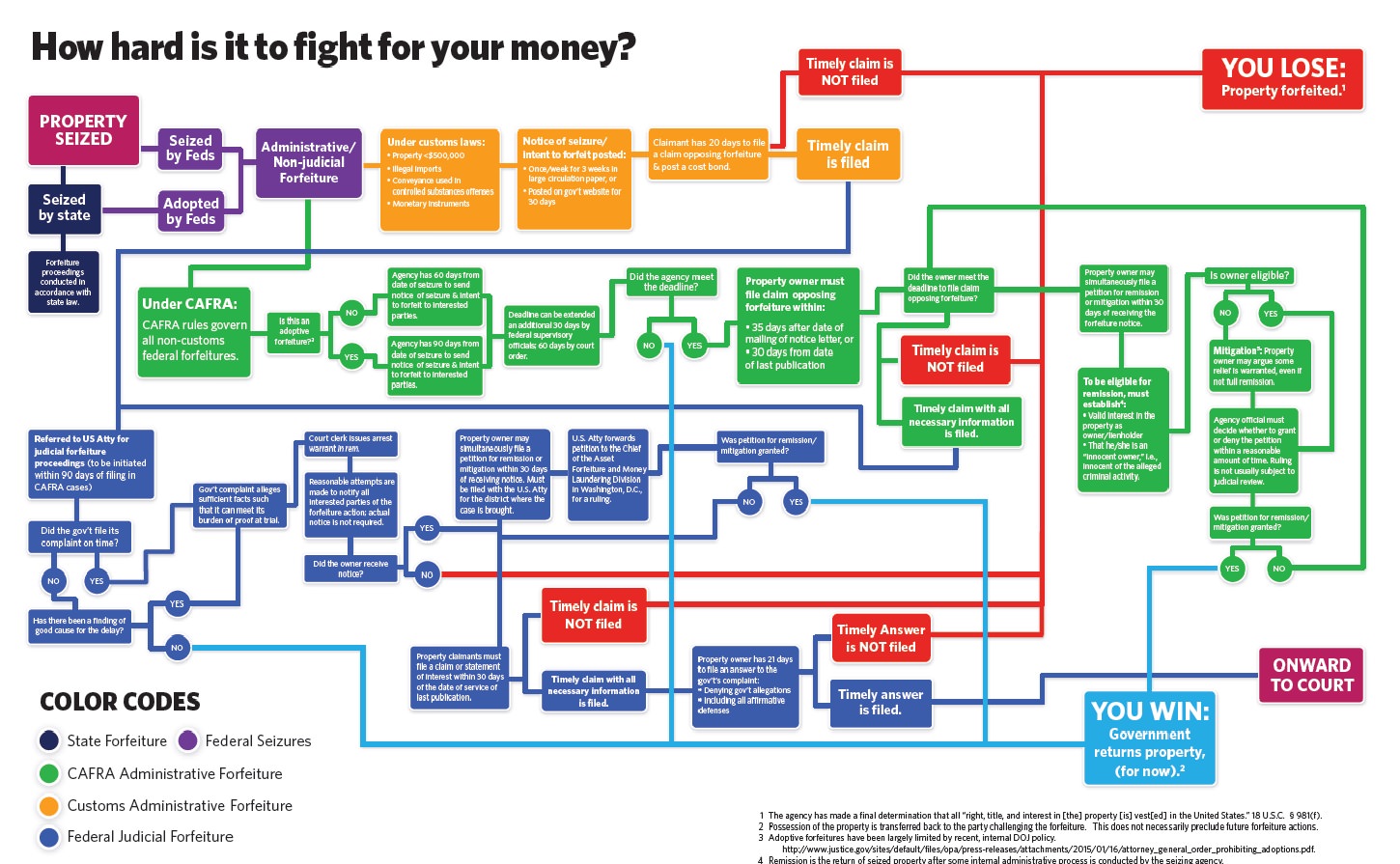
"Dear Reason: I never thought this would ever happen to me ..."The Heritage Foundation, as part of a multipartisan effort to help educate Americans about our abuse-prone police civil asset forfeiture system, has produced a lovely pamphlet explaining how the whole racket works, complete with an illustrated story.

Reason, along with the American Civil Liberties Union, the Institute for Justice, the National Association of Criminal Defense Lawyers, and others, have offered up some of the information used within the pamphlet to explain how civil asset forfeiture works and how police can seize your property without ever actually charging you with a crime.

Take a look at the pamphlet here. "Arresting Your Property" is designed to inform those who haven't been following asset forfeiture stories, which is a way of saying that regular Reason readers might not see much within the pamphlet about which they're not already familiar. The illustrated asset forfeiture story within is remarkably similar to the case Jacob Sullum just blogged about this morning.

Consider the pamphlet mostly as a resource to shove at friends and buddies who don't understand what this whole scandal is about. There is, however, one component worth highlighting to Reason readers. We have written frequently about how complicated it is to fight asset forfeiture. "Arresting Your Property" puts together a massive flowchart to show just how challenging it is. (Click for a larger image):

Worst board game ever.

Keep in mind: This is just the federal asset forfeiture process. States have their own procedures (assuming they're not using the Department of Justice's program to federalize it) and their own complicated flow charts that can be just as bad, or even worse.

Reason has a massive archive of stories related to asset forfeiture here

18 Jun 03:51

Obama Thinks The Free Market Killed Neighborhood Diversity. In Fact, It Was the New Deal

by admin

Here is a very telling paragraph from the HUD's new proposed fair housing rule

Despite the existing obligation to AFFH, in too many communities, the Fair Housing Act has not had the impact it intended — housing choices continue to be constrained through housing discrimination, the operation of housing markets, investment choices by holders of capital, the history and geography of regions, and patterns of development and the built environment.

So, they list "discrimination" as a problem, but then look at the other four items they list as problems.  These can all be summarized as "the normal operation of free markets, property rights, and individual choice."

Oddly missing from this list of causes is what many historians consider to be the #1 cause of lack of neighborhood diversity and ghetto-ization:  The Federal Government and the New Deal.  New Deal rules essentially forced the concentration of blacks into just a few neighborhoods.   The biggest unmixing of races in New York can be seen between 1930 and 1950.   Blacks in Brooklyn went from fairly evenly mixed to concentrated in Bed-Stuy, all directly attributable to New Deal rules.   Basically, ever since then, we have just been living with the consequences.  Via NPR in an interview with Richard Rothstein

On how the New Deal's Public Works Administration led to the creation of segregated ghettos

Its policy was that public housing could be used only to house people of the same race as the neighborhood in which it was located, but, in fact, most of the public housing that was built in the early years was built in integrated neighborhoods, which they razed and then built segregated public housing in those neighborhoods. So public housing created racial segregation where none existed before. That was one of the chief policies.

On the Federal Housing Administration's overtly racist policies in the 1930s, '40s and '50s

The second policy, which was probably even more effective in segregating metropolitan areas, was the Federal Housing Administration, which financed mass production builders of subdivisions starting in the '30s and then going on to the '40s and '50s in which those mass production builders, places like Levittown [New York] for example, and Nassau County in New York and in every metropolitan area in the country, the Federal Housing Administration gave builders like Levitt concessionary loans through banks because they guaranteed loans at lower interest rates for banks that the developers could use to build these subdivisions on the condition that no homes in those subdivisions be sold to African-Americans.

Postscript:  Here is how the Ken Burns New York documentary series explained it, though the source page is no longer available:

Government policies began in the 1930s with the New Deal's Federal Mortgage and Loans Program. The government, along with banks and insurance programs, undertook a policy to lower the value of urban housing in order to create a market for the single-family residences they built outside the city.

The Home Owners' Loan Corporation, a federal government initiative established during the early years of the New Deal went into Brooklyn and mapped the population of all 66 neighborhoods in the Borough, block by block, noting on their maps the location of the residence of every black, Latino, Jewish, Italian, Irish, and Polish family they could find. Then they assigned ratings to each neighborhood based on its ethnic makeup. They distributed the demographic maps to banks and held the banks to a certain standard when loaning money for homes and rental. If the ratings went down, the value of housing property went down.

From the perspective of a white city dweller, nothing that you had done personally had altered the value of your home, and your neighborhood had not changed either. The decline in your property's value came simply because, unless the people who wanted to move to your neighborhood were black, the banks would no longer lend people the money needed to move there. And, because of this government initiative, the more black people moved into your neighborhood, the more the value of your property fell.

The Home Owners' Loan Corporation finished their work in the 1940s. In the 1930s when it started, black Brooklynites were the least physically segregated group in the borough. By 1950 they were the most segregated group; all were concentrated in the Bedford-Stuyvesant neighborhood, which became the largest black ghetto in the United States. After the Home Owners Loan Corp began working with local banks in Brooklyn, it worked with them in Manhattan, the Bronx, and Queens.

The state also got involved in redlining. (Initially, redlining literally meant the physical process of drawing on maps red lines through neighborhoods that were to be refused loans and insurance policies based on income or race. Redlining has come to mean, more generally, refusing to serve a particular neighborhood because of income or race.) State officials created their own map of Brooklyn. They too mapped out the city block by block. But this time they looked for only black and Latino individuals.

This site has some redlining maps, including one of Brooklyn, prepared by the Feds.  Remember, this is not some evil Conservative business CABAL, these are Roosevelt Democrats making these maps.  This site adds:

While the HOLC was a fairly short-lived New Deal agency, the influence of its security maps lived on in the Federal Housing Authority (FHA) and the GI Bill dispensing Veteran’s Administration (VA). Both of these government organizations, which set the standard that private lenders followed, refused to back bank mortgages that did not adhere to HOLC’s security maps. On the one hand FHA and VA backed loans were an enormous boon to those who qualified for them. Millions of Americans received mortgages that they otherwise would not have qualified for. But FHA-backed mortgages were not available to all. Racial minorities could not get loans for property improvements in their own neighborhoods—seen as credit risks—and were denied mortgages to purchase property in other areas for fear that their presence would extend the red line into a new community. Levittown, the poster-child of the new suburban America, only allowed whites to purchase homes. Thus HOLC policies and private developers increased home ownership and stability for white Americans while simultaneously creating and enforcing racial segregation.

The exclusionary structures of the postwar economy pushed African Americans and other minorities to protest. Over time the federal government attempted to rectify the racial segregation created, or at least facilitated, in part by its own policies. In 1948, the U.S. Supreme Court case Shelley v. Kraemer struck down explicitly racial neighborhood housing covenants, making it illegal to explicitly consider race when selling a house. It would be years, however, until housing acts passed in the 1960s could provide some federal muscle to complement grassroots attempts to ensure equal access.


17 Jun 20:02

Overwrought Language of the Day

by admin

Our Overwrought language award this week comes from Kevin Drum of Mother Jones, writing about Paul Ryan's budget plan.  Drum calls Ryan's budget a "Vision of a Dickensian Hellhole".  He quotes Jonathon Chait as saying, "Its enactment would amount to the most dramatic rollback of government since the New Deal."

All this for a budget that proposes to reduce government spending to about 19% of GDP, a level that we have not seen since the Dickensian Hellhole of ... the Bill Clinton Presidency.  During the New Deal, spending hovered around 10% of GDP.

This is the ratchet effect that big government lovers are so adept at employing.  Under President Obama (with a lot of help from George Bush and a Democratic Congress) spending has skyrocketed to an unprecedented-except-in-WWII level of over 25% of GDP.  But suddenly Drum and Chait and company want to define that level as the new baseline, below which any drop is now "Dickensian."  Which is another reason that we should never, ever create a new government spending program because once established they are impossible to eliminate, no matter how stupid and wasteful.


17 Jun 14:41

Conscription and the Minimum Wage

by Don Boudreaux
(Don Boudreaux)

Tweet

Here’s another letter to a frequent – and always quite hostile – e-mail correspondent:

Mr. Aaron the Aaron

Dear Mr. the Aaron:

Like many ‘Progressives,’ you champion both conscription and the minimum wage.  As such, you call my opposition to conscription “dogmatic,” while you reckon that my opposition to minimum-wage legislation results from my being (quoting one of your earlier e-mails) “blind to employers’ power over employees.”

Allow me to summarize your policy position: You wish to force people to work for certain employers (governments) at wages that these people judge to be too low but that you judge to be acceptably high for them, while simultaneously forcing people not to work for other employers (private firms) at wages that these people judge to be acceptably high but that you judge to be too low for them.  In short, you presume to forcibly override with your own assessment – or with that of politicians whom you mysteriously trust – the assessments of each of millions of individuals of what are and what are not acceptable working terms and conditions for these individuals.

I could comment further on your arguments’ inconsistencies (for example, no employer has as much “power over employees” as does one that can actually conscript workers).  But I’ll simply add that the lone consistency that knits together all of your arguments is a faith that employment arrangements dictated by force are superior to those reached through mutual and voluntary consent.

Sincerely,
Donald J. Boudreaux
Professor of Economics
and
Martha and Nelson Getchell Chair for the Study of Free Market Capitalism at the Mercatus Center
George Mason University
Fairfax, VA  22030

17 Jun 02:28

Prisons Without Walls: We're All Inmates In The American Police State

by Tyler Durden

Submitted by John Whitehead via The Rutherford Institute,

“It is perfectly possible for a man to be out of prison and yet not free—to be under no physical constraint and yet be a psychological captive, compelled to think, feel and act as the representatives of the national state, or of some private interest within the nation wants him to think, feel and act. . . . To him the walls of his prison are invisible and he believes himself to be free.”—Aldous Huxley, A Brave New World Revisited

Free worlders” is prison slang for those who are not incarcerated behind prison walls.  Supposedly, those fortunate souls live in the “free world.” However, appearances can be deceiving.

“As I got closer to retiring from the Federal Bureau of Prisons,” writes former prison employee Marlon Brock, “it began to dawn on me that the security practices we used in the prison system were being implemented outside those walls.” In fact, if Brock is right, then we “free worlders” do live in a prison—albeit, one without visible walls.

In federal prisons, cameras are everywhere in order to maintain “security” and keep track of the prisoners. Likewise, the “free world” is populated with video surveillance and tracking devices. From surveillance cameras in stores and street corners to license plate readers (with the ability to log some 1,800 license plates per hour) on police cars, our movements are being tracked virtually everywhere. With this increasing use of iris scanners and facial recognition software—which drones are equipped with—there would seem to be nowhere to hide.

Detection and confiscation of weapons (or whatever the warden deems “dangerous”) in prison is routine. The inmates must be disarmed. Pat downs, checkpoints, and random searches are second nature in ferreting out contraband.

Sound familiar?

Metal detectors are now in virtually all government buildings. There are the TSA scanning devices and metal detectors we all have to go through in airports. Police road blocks and checkpoints are used to perform warrantless searches for contraband. Those searched at road blocks can be searched for contraband regardless of their objections—just like in prison. And there are federal road blocks on American roads in the southwestern United States. Many of them are permanent and located up to 100 miles from the border.

Stop and frisk searches are taking place daily across the country. Some of them even involve anal and/or vaginal searches. In fact, the U.S. Supreme Court has approved strip searches even if you are arrested for a misdemeanor—such as a traffic stop. Just like a prison inmate.

Prison officials open, search and read every piece of mail sent to inmates. This is true of those who reside outside prison walls, as well. In fact, “the United States Postal Service uses a ‘Mail Isolation Control and Tracking Program’ to create a permanent record of who is corresponding with each other via snail mail.” Believe it or not, each piece of physical mail received by the Postal Service is photographed and stored in a database. Approximately 160 billion pieces of mail sent out by average Americans are recorded each year and the police and other government agents have access to this information.

Prison officials also monitor outgoing phone calls made by inmates. This is similar to what the NSA, the telecommunication corporation, and various government agencies do continually to American citizens. The NSA also downloads our text messages, emails, Facebook posts, and so on while watching everything we do.

Then there are the crowd control tactics: helmets, face shields, batons, knee guards, tear gas, wedge formations, half steps, full steps, pinning tactics, armored vehicles, and assault weapons. Most of these phrases are associated with prison crowd control because they were perfected by prisons.

Finally, when a prison has its daily operations disturbed, often times it results in a lockdown. What we saw with the “free world” lockdowns following the 2013 Boston Marathon bombing and the melees in Ferguson, Missouri and Baltimore, Maryland, mirror a federal prison lockdown.

These are just some of the similarities between the worlds inhabited by locked-up inmates and those of us who roam about in the so-called “free world.”

Is there any real difference?

To those of us who see the prison that’s being erected around us, it’s a bit easier to realize what’s coming up ahead, and it’s not pretty. However, and this must be emphasized, what most Americans perceive as life in the United States of America is a far cry from reality. Real agendas and real power are always hidden.

As Author Frantz Fanon notes, “Sometimes people hold a core belief that is very strong. When they are presented with evidence that works against that belief, the new evidence cannot be accepted. It would create a feeling that is extremely uncomfortable, called cognitive dissonance. And because it is so important to protect the core belief, they will rationalize, ignore and even deny anything that doesn’t fit in with the core belief.”

This state of denial and rejection of reality is the essential plot of John Carpenter’s 1988 film They Live, where a group of down-and-out homeless men discover that people have been, in effect, so hypnotized by media distractions that they do not see their prison environment and the real nature of those who control them—that is, an oligarchic elite.

Caught up in subliminal messages such as “obey” and “conform,” among others, beamed out of television and various electronic devices, billboards, and the like, people are unaware of the elite controlling their lives. As such, they exist, as media analyst Marshall McLuhan once wrote, in “prisons without walls.” And of course, any resistance is met with police aggression.

A key moment in the film occurs when John Nada, a homeless drifter, notices something strange about people hanging about a church near the homeless settlement where he lives. Nada decides to investigate. Entering the church, he sees graffiti on a door: They live, We sleep. Nada overhears two men, obviously resisters, talking about “robbing banks” and “manufacturing Hoffman lenses until we’re blue in the face.” Moments later, one of the resisters catches Nada fumbling in the church and tells him “it’s the revolution.” When Nada nervously backs off, the resister assures him, “You’ll be back.”

Rummaging through a box, Nada discovers a handful of cheap-looking sunglasses, referred to earlier as Hoffman lenses. Grabbing a pair and exiting the church, he starts walking down a busy urban street.

Sliding the sunglasses on his face, Nada is shocked to see a society bombarded and controlled on every side by subliminal messages beamed at them from every direction. Billboards are transformed into authoritative messages: a bikini-clad woman in one ad is replaced with the words “MARRY AND REPRODUCE.” Magazine racks scream “CONSUME” and “OBEY.” A wad of dollar bills in a vendor’s hand proclaims, “THIS IS YOUR GOD.”

What’s even more disturbing than the hidden messages, however, are the ghoulish-looking creatures—the elite—who appear human until viewed them through the lens of truth.

This is the subtle message of They Live, an apt analogy of our own distorted vision of life in the American police state. These things are in plain sight, but from the time we are born until the time we die, we are indoctrinated into believing that those who rule us do it for our good. The truth, far different, is that those who rule us don’t really see us as human beings with dignity and worth. They see us as if “we’re livestock.”

It’s only once Nada’s eyes have been opened that he is able to see the truth: “Maybe they’ve always been with us,” he says. “Maybe they love it—seeing us hate each other, watching us kill each other, feeding on our own cold f**in’ hearts.” Nada, disillusioned and fed up with the lies and distortions, is finally ready to fight back. “I got news for them. Gonna be hell to pay. Cause I ain’t daddy’s little boy no more.”

What about you?

As I point out in my book Battlefield America: The War on the American People, the warning signs have been cautioning us for decades. Oblivious to what lies ahead, most have ignored the obvious. We’ve been manipulated into believing that if we continue to consume, obey, and have faith, things will work out. But that’s never been true of emerging regimes. And by the time we feel the hammer coming down upon us, it will be too late.

As Rod Serling warned:

All the Dachaus must remain standing. The Dachaus, the Belsens, the Buchenwalds, the Auschwitzes—all of them. They must remain standing because they are a monument to a moment in time when some men decided to turn the earth into a graveyard, into it they shoveled all of their reason, their logic, their knowledge, but worst of all their conscience. And the moment we forget this, the moment we cease to be haunted by its remembrance. Then we become the grave diggers.

The message: stay alert.

Take the warning signs seriously. And take action because the paths to destruction are well disguised by those in control.

This is the lesson of history.

17 Jun 00:25

Encrypted Email, Easy and Free

by J.D. Tuccille

Demand is high, so you'll have to wait in line a bit for the outfit to free up capacity, but all ProtonMail email accounts requested by June 17 (that's tomorrow), get an upgrade to 1GB of storage. The storage is nice, but it's the email accounts itself that matters. That's because ProtonMail is a free, browser-based, encrypted email service. It gives you security without having to master glitchy plugins or challenging tech (yes, you geeks—lots of people find this stuff challenging). It's pretty much like using Gmail, but minus the likelihood of being snooped on by marketing types, intelligence snoops, or asshole federal prosecutors.

ProtonMail got its start in the wake of Edward Snowden's revelations, when scientists at CERN decided that they didn't really want to provide browsing opportunities for the NSA. The service's technology is designed so that, unlike the late, lamented Lavabit, only users have access to their own email—there's no ability to comply with subpoenas. Servers are based in Switzerland, reducing the likelihood of backdoors being installed by the world's pushier intelligence services (among other things, they can use American court orders for toilet paper, so you don;t have to wait out the encryption wars).

Together with other encrypted and also-free communications offerings, like TextSecure, Signal, and RedPhone, ProtonMail makes relatively (let's emphasize that) secure communications accessible to pretty much everybody.

Keep it coming folks. These are the sort of developments we need.

16 Jun 20:23

The FDA's Trans Fat Ban: Their Laws, Your Body

by Walter Olson

The Obama administration’s Food and Drug Administration today announced a near-ban, in the making since 2013, on the use of partially hydrogenated vegetable fats (“trans fats”) in American food manufacturing. Specifically, the FDA is knocking trans fats off the Generally Recognized as Safe (GRAS) list. This is a big deal and here are some reasons why:

  • It’s frank paternalism. Like high-calorie foods or alcoholic beverages, trans fats have marked risks when consumed in quantity over long periods, smaller risks in moderate and occasional use, and tiny risks when used in tiny quantities. The FDA intends to forbid the taking of even tiny risks, no matter how well disclosed.
  • The public doesn’t agree. A 2013 Reason-RUPE poll found majorities of all political groups felt consumers should be left free to choose on trans fats.  Even in heavily governed places like New York City and California, where the political class bulldozed through restaurant bans some years back, there was plenty of resentment.
  • The public is also perfectly capable of recognizing and acting on nutritional advances on its own. Trans fats have gone out of style and consumption has dropped by 85 percent as consumers have shunned them. But while many products have been reformulated to omit trans fats, their versatile qualities still give them an edge in such specialty applications as frozen pizza crusts, microwave popcorn, and the sprinkles used atop cupcakes and ice cream. Food companies tried to negotiate to keep some of these uses available, especially in small quantities, but apparently mostly failed.
  • Government doesn’t always know best, nor do its friends in “public health.” The story has often been told of how dietary reformers touted trans fats from the 1950s onward as a safer alternative to animal fats and butter. Public health activists and various levels of government hectored consumers and restaurants to embrace the new substitutes. We now know this was a bad idea: trans fats appear worse for cardiovascular health than what they replaced. And the ingredients that will replace minor uses of trans fats – tropical palm oil is one – have problems of their own.
  • Even if you never plan to consume a smidgen of trans fat ever again, note well: many public health advocates are itching for the FDA to limit allowable amounts of salt, sugar, caffeine, and so forth in food products. Many see this as their big pilot project and test case. But when it winds up in court, don’t be surprised if some courtroom spectators show up wearing buttons with the old Sixties slogan: Keep Your Laws Off My Body.
16 Jun 18:17

The Three M’s: Milosevic, Mugabe, and Maduro

by Steve H. Hanke

What do Slobodan Milosevic, Robert Mugabe, and Nicolás Maduro have in common? The Communist Manifesto and inflation.

At 480% per annum, Venezuela’s inflation is currently the world’s highest. The Bolivarian Revolution is pushing prices up at a rate of 36% per month. Will these punishing inflation numbers spell the end of President Nicolás Maduro’s reign? Maybe not. Milosevic’s Yugoslavia and Mugabe’s Zimbabwe witnessed much higher inflation rates, and both hung on for many years.

Slobodan Milosevic was in the saddle when inflation gutted the rump Yugoslavia. Milosevic’s inflationary madness reached its peak in January 1994, when the monthly inflation rate hit 313,000,000% – almost nine million times greater than Venezuela’s current monthly rate. Nonetheless, Milosevic retained his grip on what was left of Yugoslavia for another six years.

In 2008, Zimbabwe out-did Yugoslavia when Zimbabwe recorded the second-highest hyperinflation in history. With Robert Mugabe at the helm, hyperinflation peaked at a staggering 79,600,000,000% per month, or a daily rate of 98%. Despite this astronomical figure, Mugabe remains in office to this day – over seven years since the hyperinflation ended.

While hyperinflation is not a recipe for building a politician’s popular support, it is not a certain death knell, either. Don’t count Maduro out, yet. As long as he retains popular support and “controls” the ballot boxes, he will stay in the saddle.

16 Jun 18:08

Russians and Chinese Got Snowden Documents the Old-Fashioned Way

by Ronald Bailey

CrptographyBrokenBritish surveillance functionaries placed a story over the weekend in the Sunday Times (London) claiming that the Russians and Chinese had gotten hold of the documents that Edward Snowden sneaked out of the NSA computers and had broken their encryption. As my colleague Scott Shackford points out the Sunday Times offered nothing more than the assertions of unnamed British spy agency sources as evidence. He noted that one of the Sunday Times' reporters actually admitted on CNN: "We just publish what we believe to be the position of the British government at the moment."

Over at Wired, cryptographer and Harvard Berkman Center fellow Bruce Schneier also dismisses the claims against Snowden made by British intelligence service disinformation specialists published in the Sunday Times. On the other hand, he does think that Russian and Chinese spies have in fact obtained most of the documents taken by Snowden, but not from Snowden. First, try as they might, journalists to whom Snowden delivered the documents will have great difficulty in preventing digital infiltration by national intelligence services.

Secondly, Russian and Chinese hackers (at the behest of their governments) have had great success in penetrating U.S. government networks. Consequently, they are very likely to have taken many of the Snowden documents directly from the NSA's own servers. Schneier explains:

I believe that both China and Russia had access to all the files that Snowden took well before Snowden took them because they’ve penetrated the NSA networks where those files reside. After all, the NSA has been a prime target for decades...

In general, it’s far easier to attack a network than it is to defend the same network. This isn’t a statement about willpower or budget; it’s how computer and network security work today. A former NSA deputy director recently said that if we were to score cyber the way we score soccer, the tally would be 462–456 twenty minutes into the game. In other words, it’s all offense and no defense.

In this kind of environment, we simply have to assume that even our classified networks have been penetrated. Remember that Snowden was able to wander through the NSA’s networks with impunity, and that the agency had so few controls in place that the only way they can guess what has been taken is to extrapolate based on what has been published. Does anyone believe that Snowden was the first to take advantage of that lax security? I don’t.

This is why I find allegations that Snowden was working for the Russians or the Chinese simply laughable. What makes you think those countries waited for Snowden? And why do you think someone working for the Russians or the Chinese would go public with their haul?

So Snowden becomes a cover-your-ass excuse for the failures of surveillance state fuctionaries.

Hat tip Richard Rohde.

16 Jun 18:06

CHART: Animals most likely to kill you...

16 Jun 14:46

Some Links

by Don Boudreaux
(Don Boudreaux)

Tweet

Radley Balko explains that there is in America no credible evidence of a new nationwide crimewave.

Dan Sanchez details some especially nasty unintended (if not entirely unforeseen) consequences of Uncle Sam’s foreign-policy and military adventures abroad.  (HT Bob Murphy)

My colleague Alex Tabarrok reviews, in today’s Wall Street Journal, Alvin Roth’s new book, Who Gets What – and Why.

Richard Ebeling is correct: today’s American “Progressives” are intellectual – and ethical – descendants of Bismarck.  A slice:

The American progressives, many of whom as graduate students in philosophy, political science, economics, and history had studied at German universities in the closing decades of the nineteenth and the open decade of the twentieth century, came back from their foreign education with confidence that an elite of “experts” trained like themselves should be and would be the social engineers of the future.

For instance, one of the leading Americans influenced by his German welfare-statist professors was Richard Ely, a founder of the American Economic Association and a leading proponent of this new “cradle to grave” political paternalism.

Would you prefer to live today on an annual salary, in 2015 dollars, of $50,000 or in 1985 on an annual salary (in 1985 dollars) of $500,000?  James Pethokoukis correctly notes that the answer isn’t obvious for most people.

Greg Mankiw is understandably unimpressed with the arguments offered in favor of reauthorizing that great geyser of cronyism, the U.S. Export-Import Bank.  A slice:

Three arguments for the Ex-Im Bank were given:

1. It creates jobs.  Of course it does!  If the government were to put the names of all businesses into a hat, pull out a few randomly, and give those a per unit subsidy, those businesses would expand and hire more workers. That would not make it a good policy, however, because the wrong jobs would be created.

2. It returns money to the Treasury.  Really?  If the bank were truly a profitable venture, we could privatize it.  I bet if the government tried to sell off the Ex-Im Bank, it wouldn’t get much, if anything at all.  If the Bank’s activity were actually profitable, we wouldn’t need a government-run bank to do it.

3. Other countries give similar subsidies to their firms. So what? If other nations engage in corporate welfare, that is no reason for the United States to follow suit in the name of a level playing field.  We don’t need to import other nations’ bad policies.

16 Jun 13:23

Spam Isn't Even Trying to be Clever Anymore

funny-facebook-fail-spam-legit

Submitted by: (via HolstenerLiesel)

Tagged: email , spam , seems legit
15 Jun 20:06

jedavu: Unbelievable Places That Look Like They’re From Another...


Tianzi Mountains, China


Fly Geyser, Nevada, Usa


Dragonblood Trees, Socotra, Yemen


Pamukkale, Turkey


Glowworms Cave, New Zealand


Abraham Lake, Canada


Monte Roraima - Venezuela


Dallol Volcano, Ethiopia


Son Doong Cave, Vietnam


Giants Causeway In Northern Ireland

jedavu:

Unbelievable Places That Look Like They’re From Another Planet

Unbelievable Places That Look Like They’re From The Mushroom Kingdom

15 Jun 18:39

The Disposable Life of a 20-Year-Old Confidential Informant

by Anthony L. Fisher

On June 27, 2014, the body of 20-year-old Andrew Sadek, a promising electrical student at the North Dakota State College of Science (NDSCS) in Wahpeton, North Dakota, was pulled from the Red River bordering North Dakota and Minnesota.

Missing for two months, the young man was found shot in the head, wearing a backpack filled with rocks. 

The grisly death of a college student in one of the safest towns in the state, where violent crime is extremely rare, did not lead to a sweeping investigation. In fact, police immediately said they did not suspect foul play.

Such a supposition strains credulity as it is, but what would be slowly revealed over the following months is that Andrew had been working as a confidential informant for the police, and that his school knew that authorities were busting its students and using them as bait to catch drug dealers

This is a story of overzealous prosecution of minor drug offenses by a task force answerable only to itself, callous official indifference toward a grieving family, and a lack of transparency by authorities that raises more questions than it answers. 

Paramount among these questions: Why are police using non-violent, first-time offenders in the very dangerous role of confidential informant?  

A QUIET FARM KID

Growing up on a family-owned farm in Rogers, North Dakota, Andrew Sadek was active with the raising of their cattle and particularly close to his parents, who lost their older son, Nick, in a car accident in 2005.

Andrew was a few weeks shy of graduation when he went missing in May 2014. Days later, the Sadeks received the shocking news that a warrant had been issued for Andrew's arrest for two felony counts of distributing a controlled substance. 

In an interview with Reason TV, Andrew's mother, Tammy, described her deceased younger son as "kind of a homebody" whose only previous brush with the law was a speeding ticket.

"His dreams were to become an electrician and take over the family farm," Tammy says of Andrew. "We sent him off to college, he was excelling at college. That's why this was such a shock to us."

For two gut-wrenching months, the Sadeks prayed Andrew would come home to the farm to help with the spring calving, while police continued to assume Andrew was on the lam.

Then, Andrew's body was found.

Shot. Wearing the backpack filled with rocks. Not wearing the clothes he was last seen in. Without his wallet. An autopsy proved inconclusive in determining suicide or homicide, and no weapon has yet been found.

But according to the Sadeks, Sgt. Steve Helgeson of the NDSCS Campus Police, the lead officer in charge of the investigation, tried to convince them that their son put on the rock-filled backpack, shot himself in the head, and somehow propelled himself into the river. 

Tammy says Sgt. Helgeson told her "That's what kids do in that area, they commit suicide," referring to the golf court bridge over the river that connects the Bois de Sioux golf course.

No one who knew Andrew supports this theory. His friend Justin Rippentrop told Reason TV that Andrew was a "laid-back, generous, fun-loving guy," who never showed depressive tendencies and seemed in particularly good spirits as his graduation date approached. Crucially, no one at the college has indicated that Andrew was exhibiting any signs of emotional distress, and no suicide note has been found.

A DRUG TASK FORCE LACKING TRANSPARENCY AND ACCOUNTABILITY

What the police knew but continued to keep from the Sadeks, was that Andrew had been working as a confidential informant for the Southeast Multi-County Agency (SEMCA), a drug task force answerable only to its own board, a 12 person committee made up of local senior police officers and elected officials.

Andrew first came into contact with SEMCA in April 2013, after he twice sold marijuana, a total of 4.5 grams or $80 worth, to a confidential informant. Shortly thereafter, a police raid on Andrew's dorm room turned up nothing but a small plastic grinder and some marijuana residue. 

But the grinder, plus the two sales to SEMCA's informant in a "school zone," which in North Dakota includes colleges, was enough for authorities to threaten Andrew with two Class A felony charges, each carrying a possible 20 year sentence. Or, he could "voluntarily" agree to work as a confidential informant.

Upon enrolling at NDSCS, Andrew signed a Family Educational Rights and Privacy Act (FERPA) waiver obligating the school to inform his parents of any disciplinary issues, but the school never notified the Sadeks following the raid on his dorm room, or any time thereafter.

Faced with the prospect of spending the bulk of his life in prison, and without consulting a lawyer or his parents, Andrew chose to become an informant, agreeing to make two controlled buys from each of three SEMCA-targeted drug dealers. 

When Andrew was last seen leaving his dorm building on May 1, 2014, he still owed SEMCA one last controlled buy. 

Refusing to accept authorities' speculation that Andrew had committed suicide, the Sadeks hired a private investigator, who discovered a significant amount of water in the wheel wells of Andrew's car, suggesting that someone may have driven Andrew's car to the banks of the river where his body was found, before returning it to the campus parking lot. 

WHO'S IN CHARGE HERE?

Because Andrew's body was found on the Minnesota side of the river, the NDSCS campus police claimed the case was not in their jurisdiction, which the North Dakota Attorney General's office confirmed. But the Minnesota Bureau of Criminal Apprehension told Valley News Livea newscast in Fargo, North Dakota, that they have nothing to do with it. For all the agencies involved with busting Andrew Sadek for selling a small amount of pot, no agency is willing to take the lead in solving his violent death. 

Valley News Live reporter Nicole Johnson told Reason TV, "It took a long time to get the results of the autopsy. So I called (Sgt.) Steve Helgeson, the officer in charge of this case, and he told me it was not a top priority." Johnson adds that no one who has directly worked on the case has answered a question of theirs since Andrew was found in June 2014.

Finding no help from the local authorities, the Sadeks' demanded a state-wide investigation, which culminated in a report from the North Dakota Attorney General's Bureau of Criminal Investigation, released in January 2015.

The report revealed for the first time that Andrew had been working as a confidential informant for SEMCA. 

That the school knew of the raid on Andrew's dorm room in 2013, but allowed his parents to learn this news only after he went missing raises significant ethical and legal questions in its own right. But the fact that SEMCA only disclosed Andrew's status as a confidential informant because they were forced to by the Attorney General, more than a year after the young man was first targeted by the task force, demonstrates a heartless lack of concern for confidential informants even after they end up dead.

The SEMCA report runs all of four and a half pages, nearly half of which merely names the board members and the authors of the report.  And despite the obvious dangers inherent with being an informant working for the police to bust drug dealers, the report found that SEMCA had acted appropriately when using Andrew, a non-violent first time offender, as a C.I. The report's conclusion offered four minor tweaks to protocol, such as having a "Pre-Ops briefing" and assigning a supervisor to each case. 

In February 2015, Reason's Jacob Sullum wrote about Wahpeton Police Chief Scott Thorsteinson, a SEMCA board member, and his response to the violent death of a confidential informant in his town:

Thorsteinson conceded that police informants work in "a dangerous subculture" but said cops usually "bend over backwards to protect their C.I."

Thorsteinson said Sadek's death is no cause for reflection on the methods used by drug warriors in North Dakota. "These types of investigations are conducted the same way pretty much everywhere where people breathe in and out," he said. "They never did anything wrong that needed to be changed." Thorsteinson, who acknowledged that Sadek's mother "had to go through a difficult ordeal," explained that busting drug offenders is a thankless but necessary job. "Law enforcement... we're generally not popular," he told KVLY. "The sheep dog is not loved by the flock, and they're hated by the wolf, but we do it anyway." In Thorsteinson's view, the citizens he serves are sheep, while harmless pot dealers like Sadek are wolves.

The lack of a statewide chain of command allowed SEMCA to operate as an entity answerable only to itself. And though SEMCA's board remains intact, the agency now falls under the jurisdiction of the North Dakota attorney general. When contacted by Reason TV about the use of college students as confidential informants, Liz Brocker, a spokesperson for North Dakota's Attorney General Wayne Stenehjem, replied, "We have no opinion about confidential informants." 

The Wahpeton Police Department, Richland County State's Attorney, SEMCA, and both NDSCS and its campus police department all either declined to comment or did not respond to Reason TV's request for comment.

DISPOSABLE YOUNG LIVES

Andrew Sadek is not the only young person to be terrified into working as a C.I. In 2014, a confidential informant at the University of Massachusetts died of a drug overdose, prompting criticism that if his parents had been notified, he might have been able to receive treatment for substance abuse. In 2015, Buzzfeed reported on the widespread use of confidential informants on the campus of Ole Miss.

Most notably, in 2008, Florida State student Rachel Hoffman was murdered when police compelled her to make an illegal gun purchase. A sweeping 2012 New Yorker article recounted Hoffman's tragic fate:

She had never fired a gun or handled a significant stash of hard drugs. Now she was on her way to conduct a major undercover deal for the Tallahassee Police Department, meeting two convicted felons alone in her car to buy two and a half ounces of cocaine, fifteen hundred Ecstasy pills, and a semi-automatic handgun.

The operation did not go as intended. By the end of the hour, police lost track of her and her car. Late that night, they arrived at her boyfriend's town house and asked him if Hoffman was inside. They wanted to know if she might have run off with the money. Her boyfriend didn't know where she was.

"She was with us," he recalled an officer saying. "Until shit got crazy."

Two days after Hoffman disappeared, her body was found in Perry, Florida, a small town some fifty miles southeast of Tallahassee, in a ravine overgrown with tangled vines. Draped in an improvised shroud made from her Grateful Dead sweatshirt and an orange-and-purple sleeping bag, Hoffman had been shot five times in the chest and head with the gun that the police had sent her to buy.

Hoffman's death led to state-wide reforms regarding the use of confidential informants, including common-sense modifications such as forbidding the use of recovering drug addicts as informants, additional training for informants and officers, and more robust recordkeeping requirements so that unsuitable candidates are not needlessly placed in potentially lethal situations. In March 2015, a new proposal made it through Florida's Senate Criminal Justice Committee to "add teeth" to "Rachel's Law," which includes criminal penalties for officers who fail to follow protocol or endanger their assigned informants. 

THE DEATH THEY WISH WOULD GO AWAY

When the police aggressively prosecute young people unfamiliar with the criminal justice system and then use them as confidential informants, they assume a certain amount of responsibility for their safety. But the lack of interest by the agencies that ensnared Andrew Sadek in vigorously investigating his death as potential murder suggests they wish the case would just go away.

Which only begs the question, why?

Why are the authorities not investigating this case with the same aggressive zeal they continue to use on the campus of NDSCS busting small-time drug sellers?

The heartbroken Sadek family searches for justice for their son, though they are not confident that any law enforcement agency will continue to investigate Andrew's death. Tammy hopes that Andrew's death can serve as a cautionary tale to other young people who get in over their heads and feel they have no other choice but to work as an informant.

"I don't want other kids to end up in this situation," Tammy says. "Talk to your parents. Talk to a lawyer. Don't do the police's job for them."

About 9.45 minutes. 

Written and Produced by Anthony L. Fisher.

Camera by Alex Manning.

Special Thanks to Jim Wareham, Ike Walker, Nicole Johnson and Bradford Arick of Valley News Live.

MUSIC: "I Was a Boy" and "Dishonest" by Wooden Ambulance (http://www.facebook.com/wooden.ambulance); "Old" by Smokey Hormel (http://www.smokeyhormel.com)

Scroll down for downloadable versions of this video, and subscribe to Reason TV's YouTube channel for daily content like this.

15 Jun 16:20

Missing Footage

by Charles Oliver

Chicago police erased 86 minutes of video taken from the security camera of a Burger King located 100 yards from where a cop shot a 17-year-old boy to death, according to the store's manager. Laquan McDonald was shot 16 times, nine in the back. The missing video runs from 9:13 to 10:39 p.m. McDonald was shot around 9:50 p.m. Police deny erasing the video.

13 Jun 22:09

Bobby Jindal on Obama’s socialism

by Mark Perry

The comments below by Gov. Bobby Jindal appeared in yesterday’s WSJ in its “Notable and Quotable” feature (emphasis mine):

From Louisiana Gov. Bobby Jindal’s response to a question on Mike Gallagher’s June 10 syndicated talk-radio show about the “moral case” made this week by President Obama for ObamaCare:

Let’s call Obama’s remarks exactly what they are. The president made the moral case for socialism. Let’s not sugarcoat it, that’s exactly what he believes. He doesn’t hide it, he doesn’t pretend, we shouldn’t either. This isn’t new. Those who favor socialism always make the moral case for it. The truth is, maybe they actually believe in it, but in the real world, socialism harms, it weakens the economies of countries that have tried it. It just does. Weaker economies hurt everybody in them. Socialism kills incentive, opportunity, freedom. It is the opposite of what America is all about. Look, socialism always harms the people it claims to help the most. It handicaps them, leaving them weaker, less self-determined, less free.

We should have this debate out in the open. His “moral case” for ObamaCare is actually immoral. Spending money you don’t have is immoral. Borrowing more money than you can pay back is immoral. Lying to the American people is immoral, so it’s ironic he chooses to use the terms “moral case” or “moral imperative” to make the case for what I think is a very flawed law. The Supreme Court, I hope, rules the correct way. We need to repeal this, replace this. Mike, we cannot measure success by how many people are dependent on government. That’s what President Obama wants. That is the opposite of what America stands for.

The post Bobby Jindal on Obama’s socialism appeared first on AEI.

13 Jun 22:07

Here’s a story about government abuse of power that’s so incredible and scary, you almost can’t believe it

by Mark Perry

There’s a very disturbing two-part series by Lenore Skenazy on Reason’s “Hit and Run Blog,” here are links to those articles and some excerpts:

Part I. “11-Year-Old Boy Played in His Yard. Child Protection Services Took Him, Felony Charge for Parents”:

One afternoon this past April, a Florida mom and dad I’ll call Cindy and Fred could not get home in time to let their 11-year-old son into the house. The boy didn’t have a key, so he played basketball in the yard. He was alone for 90 minutes. A neighbor called the cops, and when the parents arrived—having been delayed by traffic and rain—they were arrested for negligence.

They were put in handcuffs, strip searched, fingerprinted, and held overnight in jail.

It would be a month before their sons—the 11-year-old and his 4-year-old brother—were allowed home again. Only after the eldest spoke up and begged a judge to give him back to his parents did the situation improve.

Cindy and Fred cannot be sure who called the cops and turned their lives upside down. (They have their suspicions.) But they do know who told them they needed to take parenting classes, get therapy, and promise never to let their kids play in their own backyard without a watchman again. They know who took their children away. And you know, too.

Part II.Trouble Not Over for Florida Parents of 11-Year-Old Taken in CPS Dispute”:

Yesterday I ran an interview with the Florida mom whose children were removed from their home for a month after a neighbor reported the family to Child Protective Services because their 11-year-old son was left outside by himself for 90 minutes.

This story is so incredible, some people almost can’t believe it—and I can see why. It is as crazy as Maryland’s Child Protective Services accusing Danielle and Alexander Meitiv of negligence for letting their kids walk home from the park in Silver Spring. Unfortunately, sometimes this kind of thing happens. But when it is sufficiently publicized, change can happen—which is why publicizing these cases is important. And in fact, as Donna St. George reported in yesterday’s Washington Post, Maryland’s CPS has just issued new guidelines, saying, Children playing outside or walking unsupervised does not meet the criteria for a CPS response absent specific information supporting the conclusion that the child has been harmed or is at substantial risk of harm if they continue to be unsupervised.”

I hope this starts a trend.

The parents from yesterday’s story—”Cindy” and “Fred”—want their anonymity preserved. They don’t want to provoke the government officials handling their case, and Cindy has very real concerns that she would lose her job if her identity was revealed. But to quell the idea that this couldn’t have really happened, here is page 1 below of the county court documents ordering the children to be removed from their home. (I blacked out anything I thought might reveal their identities. The full, unredacted document has been viewed by Reason editors.)

CPS

After this legal mess is safely behind her, Cindy may talk to the press—or not. Right now, the kids are back with their parents, but the family remains in limbo. At yesterday’s court appearance the judge instructed the family’s lawyer and the prosecutor to try come to a mutual arrangement and return to court at the end of the month.

MP: This story illustrates perfectly why it’s so dangerous to grant too much power to government authorities, and how concentrated government power eventually affects even the most innocent, law-abiding citizens. A government that will lock you up in a cage for smoking weeds grown in your back yard is a government that will take your children away from you for playing basketball unsupervised in your own yard. That same government will also seize your cash and keep it from you even if you broke no law and are not charged with a crime. They’ll anally probe you against your will with a forced colonoscopy if they suspect you are hiding a small amount of drugs. They’ll break into your house with a SWAT team kill your dogs and throw stud grenades that explode in your toddler’s face, scaring him for life, etc. etc. etc. You get the point……

A case like this is almost unbelievable because it goes way beyond nanny statism into the dangerous realm of state totalitarianism. For those of you who put faith in the government and tolerate them regulating your life, allow them to tell you what you can and can’t put in your body – which plants and weeds and what type of milk you’re allowed to ingest, accept government laws that force employers to pay their workers a mandated wage, etc., be careful what your wish for…. and watch out when a neighborhood snitch calls your government and they come and seize your unsupervised children.

Update/Related: An eye-popping op-ed in today’s WSJ by Brian T. Majeski (editor of Music Trades magazine, where you view the entire article) documents how the once-boring music industry has come under attack on various fronts by teams of federal regulators who have tormented the industry with punitive fines, armed raids and even threats of jail. Here’s an excerpt of “The Federal Marching Band of Music Regulators“:

For more than a century, the music industry escaped the gaze of government agencies thanks to its small scale—$6.8 billion now in the U.S.—and its wholesome, noncontroversial products. Few things seem less deserving of federal regulation than a 5th grader with an oboe. On the rare occasions in history when prominent officials took notice, the magazine I edit, Music Trades, ran celebratory headlines: “President Taft At Baldwin Piano Plant Opening,” or “Clinton Says Playing Music Made Me President.”

Over the past seven years, however, the tenor of the government’s interest in the music business has changed. Our magazine now regularly carries accounts of punitive fines, armed raids and threats of jail time.

Here are six examples from the article of the “federal marching band of music regulators” harassing the music industry:

1. In 2007 the Federal Trade Commission launched a broad and far-fetched price-fixing investigation against instrument and equipment manufacturers.

2. In March 2013 the FTC then turned its sights on the Music Teachers National Association, a 139-year old organization comprised primarily of women who give piano lessons in their homes.

3. In 2009 armed FBI agents burst into the Gibson Guitar plant in Nashville, Tenn., seizing pallets of ebony and rosewood. Two years later, agents staged an encore at the Gibson plant in Memphis.

4. Last year Gold Tone Banjo was fined $110,000 by the Fish and Wildlife Service over a few bits of oyster shell. These aren’t endangered species, but farmed oysters like on menus everywhere.

4. Then there’s the Federal Communications Commission, which evaluates electronic devices to ensure that they don’t emit radio waves that interfere with broadcast signals, wireless communication or other electronic devices. Recently, the FCC has used this authority to extract fines for technicalities: $50,000 for displaying a pre-production prototype of an audio effects processor on a website before it was FCC approved; $25,000 for placing the FCC labeling on the wrong side of the package of a digital mixer; and an inexplicable $425,000 fine for a guitar effects pedal that included a chip—the same kind found in virtually every smartphone—that it claimed was not compliant.

5. Proposition 65, a California statute covering potential carcinogens, has forced the industry to defend the legality of guitar strings because a nickel alloy that has been used for decades contains trace elements of lead.

6. Bans on ivory cause hassle for musicians traveling to the U.S. because 50-year-old violins and guitars contain a few grams of the stuff.

And what is the overall effect of these overzealous regulators and its sprawling bureaucracy on the music industry?

The fines and legal fees associated with these investigations have topped $35 million, a pittance in Washington, D.C., but a significant sum for a small, low-margin industry. In addition, they divert time from management and have depressed industry spirits, as many wonder what’s next. It isn’t coincidental that this increased attention from the feds has been accompanied by a period of stagnant industry growth. If the sprawling federal bureaucracy has sapped the vitality of the little music industry, is it having a similar effect on the rest of the economy?

MP: Thanks overzealous federal regulators with your sprawling federal bureaucracy, you’ve made America a much safer and better place. Not.

The post Here’s a story about government abuse of power that’s so incredible and scary, you almost can’t believe it appeared first on AEI.

13 Jun 22:04

Quotation of the Day…

by Don Boudreaux
(Don Boudreaux)

Tweet

… is from page 159 of the 1997 Johns Hopkins University Press edition of H.L. Mencken’s 1956 collection, Minority Report:

No politician is ever benefited by saving money; it is spending it that makes him.

12 Jun 21:55

The "Rodney Dangerfield" President

by Tyler Durden
Jts5665

Good ol' Rodney...

Presented with no comment...


Source: Investors.com

12 Jun 16:31

Your Government At Work

by admin

Statists believe in a kind of alchemy.  They will say that individual citizens cannot be trusted with, say, selecting their own health plan.  This must be entrusted to a government official who gained such lofty powers by ... being selected by the self-same citizens that couldn't be trusted to choose a health plan.  How is it that schlubs who cannot be trusted can be elected by the mass of schlubs who cannot be trusted, placed into a monopoly with guns and no competition, and miraculously suddenly be trusted?

As you probably know, the institution that demands ever more power because of external threats to our security and constantly bashes private companies for not being careful enough with privacy had most of its employee data  stolen by a group of Chinese hackers. After the hack was made public, the government claimed the hack was discovered due to their diligent internal security efforts.  This turns out not to be the case, and the reality is pretty damn funny:

At the time, OPM said the breach was discovered as the agency “has undertaken an aggressive effort to update its cybersecurity posture, adding numerous tools and capabilities to its networks.”

But four people familiar with the investigation said the breach was actually discovered during a mid-April sales demonstration at OPM by a Virginia company called CyTech Services, which has a networks forensics platform called CyFIR. CyTech, trying to show OPM how its cybersecurity product worked, ran a diagnostics study on OPM’s network and discovered malware was embedded on the network. Investigators believe the hackers had been in the network for a year or more.

Update:  Extra points for this one:

The breach has expedited plans by the Senate to vote on cybersecurity legislation, with Majority Leader Mitch McConnell (R., Ky.) saying Tuesday a vote now could be held in the coming days.

Mr. McConnell said he planned to use an annual defense policy bill currently on the Senate floor to advance the cybersecurity measure, which is aimed at responding to a growing prevalence of data breaches at large U.S. companies.

So the government gets breached because it is using outdated software major private companies have long-ago replaced or patched, and the reaction is to...place new demands on private companies?

11 Jun 14:13

Fatal Flaw in the USGCRP Climate and Health Assessment

by Patrick J. Michaels, Paul C. "Chip" Knappenberger

Global Science Report is a feature from the Center for the Study of Science, where we highlight one or two important new items in the scientific literature or the popular media. For broader and more technical perspectives, consult our monthly “Current Wisdom.”

— 

Yesterday, we posted some excerpts from the Background section of our submitted Comment on the draft report on climate and health from the U.S. Global Change Research Program (USGCRP). In that section, we argued that the USGCRP was overlooking (ignoring?) a vital factor that shapes the influence of climate change on the health and well-being of Americans—that is, that the adaptive process is actually spurred by climate change itself. Without recognition of this fact, projections are often alarmist and pessimistic.

Today, we wanted to highlight what we found to be the fatal flaw in the entire USGCRP report—that the USGCRP fails to describe the net impact of climate change on public health, instead, presenting only a narrow and selective look at what they determine to be negative impacts (and even those examples tend to be miscast).

Here’s what we had to say about this:

The first sentience of the Climate and Health Assessment exposes the report’s fatal flaw “Climate change is a significant threat to the health of the American people.” This statement is based upon the untested assumption that the climate of the mid-to-late 20th century in the United States is the optimal one for the health of Americans. Yet nowhere, to our knowledge, can the basis for such an assumption be found in the scientific literature. Without establishing the ideal climate, it is pure speculation to make a statement like the one noted above. The USGCRP Climate and Health Assessment is not a comprehensive review of how climate impacts all aspects of the well-being of Americans, but rather a narrow and selective look at how projected changes in climate (projections that are largely grounded in climate model projections which have known faults and limitations) may impact some narrow and selective facets of human health. Sure, there are negatives associated with any change, but that is not the overarching question. The relevant question, and the one not answered by the USGCRP, is what is the net outcome of climate change on the population of Americans.

Admittedly, answering such a question is exceedingly difficult, if not impossible. There are so many confounding factors in play. Obvious examples include changing population demographics (including age-structure), changing medical technologies, changing health care, changing diets, and changing habits. On the climate side of things, additional complicating factors are to be found including improving weather forecasts, improving warning systems, improving observational systems, and improving preparation. But it is quite likely that it is the non-obvious influences which are most at play.

Compounding the situation is that the impacts of a changing climate are not constant over various timescales. Climate change provokes the development and adoption of adaptive measures-measures which insulate us against future impacts and lowers the future threat. Depending on the types of adaptive measures deployed, these may become effective on timescales from weeks to decades (or even longer). For example, an unusual summer heatwave may increase daily mortality in unprepared localities for a few days, but adaptive measures ranging from simple actions (community awareness programs and cooling centers) with deployment in times in weeks to months, to more elaborate (heat watch/warming systems, building design), with deployment horizons from years to decades.

And one must be careful not to fall prey to confusing climate change with climate (including climate variability).  Too often reports like these are written with blinders on that mislead the authors into thinking that all impacts are a result of climate changes, when, in fact, climate change plays but a tiny role in the overall climate—with the role of human-caused climate change extremely difficult to identify, much less even be anticipated in a robust manner.

Perhaps the largest hurdle the USGCRP has to overcome to establish a growing threat from climate change is that the simplest measure of human well-being, life expectancy, shows a large increase since the beginning of the 20th century (Figure 1).

Figure 1. Life expectancy at birth, United States, 1900-2013 (data source: Centers for Disease Control, http://www.cdc.gov/nchs/data/nvsr/nvsr64/nvsr64_02.pdf).

Life expectancy is indicative of the sum total of all influences on the well-being of Americans and shows that the overall climate has been increasing favorable. This has occurred at the same time as a rise in global and national temperatures (from whatever the cause).

But, climate (including variability and change) is eminently more complex than a simple annual average of a large area temperature can indicate (a parameter that no individual experiences). As we try to decrease the temporal and spatial scales to those relevant for human health, the complexities of the climate overwhelms our abilities to project them more than a few days into the future.

Oversimplifications therefore become commonplace, such as using coarse resolution climate model output involving a limited number of variables to downscale to local time and places. This procedure is one is widely recognized as being fraught with uncertainty, and thus produces non-robust and unreliable results.

 Our bottom line is not pretty for the USGCRP and their Climate and Health Assessment:

[This] compounds to produce a nearly intractable situation in which determining the role on anthropogenic climate change in the overall health and well-being of Americans, now and in the future, becomes fraught with nearly unavoidable pitfalls, many of which the USGCRP has stepped directly in. In doing so, the USGCRP has produced a document that serves not to inform the public as to the existing state of robust science on the topic of climate and human health, but rather to misinform them and local, state and national policy as well.

11 Jun 13:40

RYAN SNAPS: YOU'LL READ OBAMATRADE AFTER WE PASS IT!


RYAN SNAPS: YOU'LL READ OBAMATRADE AFTER WE PASS IT!


(Third column, 3rd story, link)
Related stories:
11 Jun 12:44

Quotation of the Day…

by Don Boudreaux
(Don Boudreaux)

Tweet

… is from page 115 of the 5th edition (2015) of Thomas Sowell’s Basic Economics (original emphasis):

To many people, even today, high profits are often attributed to high prices charged by those motivated by “greed.”  In reality, most of the great fortunes in American history have resulted from someone’s figuring out how to reduce costs, so as to be able to charge lower prices and therefore gain a mass market for the product.  Henry Ford did this with automobiles, Rockefeller with oil, Carnegie with steel, and Sears, Penney, Walton and other department store chain founders with a variety of products.

11 Jun 01:44

REASON MAG ANGER: User Subpoena Stomps on Free Speech...


REASON MAG ANGER: User Subpoena Stomps on Free Speech...


(First column, 4th story, link)
Related stories:
10 Jun 20:59

Log of Members Who Read Bill -- Also Locked in Private Room!


Log of Members Who Read Bill -- Also Locked in Private Room!


(First column, 11th story, link)
Related stories:
10 Jun 18:23

Fighting for the Right to Control Other People's Property

by admin

Deborah Vollmer appears to be a nightmare neighbor in this story from the Washington Post (via Maggie's Farm).  She is absolutely hell-bent on preventing her neighbor from doing anything to their house that she would not do to it.  If her neighbor's aesthetics don't match hers, she takes them to court.

“Some people may question my motives,” Vollmer said. “But what’s happening in this town, these developers, tearing down old homes. I’m standing up for my rights. . . . And then this whole thing just kind of evolved” from that...

What could possibly be driving this woman? Friend and Chevy Chase resident John Fitzgerald said that her stubborn streak has roots deep in her past. Vollmer forged her career defending the rights of those without means. And that, he said, inculcated in her a desire to protect principles until the bitter end.

What right or principle is she fighting for?  The right to micro-manage her neighbor's property.  Read the article, this woman seems to be a total nightmare, all because she wants everyone else's house to look exactly like hers.

She should move to California.  She would fit right in.  She would be a perfect candidate to sit on the California Coastal Commission, for example.

We have a sort-of similar fight brewing here in Phoenix where a few local residents were trying to prevent another resident from tearing down and rebuilding his tired old house, which happened to have been designed by Frank Lloyd Wright's studios.  I appreciate Mr. Wright's work, but also know he designed some unlivable crap.  He was an artist, experimenting, and sometimes the experiments were not great.  He was also a businessman, always short of money, and sometimes his projects did not get his full artistic attention.  In my view, this was such a house.

I have the same answer for Ms. Vollmer that I do for those Wright house enthusiasts -- if you want to control a piece of property, buy it.  If you don't have the money, encourage other people to chip in.  But if you can't get enough people who similarly value your vision for the property to fund its acquisition, don't take the shortcut of using your influence with the government to impose the cost on taxpayers, or worse, on the individual property holder.

10 Jun 18:23

Obama Extends War With Eastasia Hours After Declaring He Has Never Been At War With Eastasia

by admin

Via Zero Hedge:

Just when we thought the absurdity that marks every single day of Obama's reign could not possibly be surpassed, we learned that 4 hours (3 hours and 47 minutes to be precise) after the US president vowed to sign a new law banning bulk data collection by the NSA (named, for purely grotesque reasons, the "USA Freedom Act"), the Obama administration asked the secret Fisa surveillance court to ignore a federal court that found bulk surveillance illegal and to once again grant the National Security Agency the power to collect the phone records of millions of Americans for six months.

Or, as the Guardian's Spencer Ackerman, who spotted this glaring page out of Josef Stalin's playbook, summarized it:

June 2, 6:03pm: Obama says he'll sign law banning bulk collection. June 2 9:50pm: DOJ asks secret court for 180 more days of bulk collection

— Spencer Ackerman (@attackerman) June 8, 2015

According to Ackerman, this latest travesty by the administration "suggests that the administration may not necessarily comply with any potential court order demanding that the collection stop."

10 Jun 03:56

EPA Power Plant Rule Can Go Forward, Says Federal Court

by Ronald Bailey

EPA LogoThe EPA is the process of promulgating rules that would limit the amount of carbon dioxide electricity generation plants may emit. The regulatiolns are part of the Obama Administration's efforts to reduce the emissions of greenhouse gases thought by many researchers to be the main contributor to global climate change. Since coal emits relatively greater amounts of carbon dioxide when burned than other fuels, the new rules would significantly cut back on the amount of coal used to produce electricity. In an effort to forestall the adoption of the new rules, several states and power companies sued the agency in federal court arguing that the regulations are unconstitutional. Today the U.S. Court of Appeals for the District of Columbia Circuit ruled narrowly that the courts should not now intervene before the EPA rule is actually made final. That is likely to happen in August.
The Examiner reports:

The proposed EPA regulation, called the Clean Power Plan, seeks to curb electricity sector carbon emissions 30 percent below 2005 levels by 2030. It would allow states to reduce emissions by upgrading power plant energy efficiency, converting coal-fired power to natural gas, adding renewable power and enhancing customers' energy efficiency.

"EPA is pleased that the court has denied the challenges to our proposed Clean Power Plan and confirmed our assessment that they are premature," EPA spokeswoman Liz Purchia said.

But the ruling is just a temporary reprieve for rule supporters, with the real slog coming once the agency finalizes the regulation in August. The federal court didn't consider the merits of the plaintiffs' arguments in its opinion, noting that it didn't have purview to do so when the rule was in draft form. ...

Plaintiffs, led by attorney Laurence Tribe — a mentor of Obama at Harvard Law School — argued the proposal was unconstitutional because it calls on potential emissions reductions outside of individual smokestacks and delves into states' energy planning.

Interestingly, Tribe (who works as an attorney for one of the plaintiffs) testified before Congress earlier this year, asserting:

EPA lacks the statutory and constitutional authority to adopt its plan. The obscure section of the Clean Air Act that EPA invokes to support its breathtaking exercise of power in fact authorizes only regulating individual plants and, far from giving EPA the green light it claims, actually forbids what it seeks to do.

Even if the Act could be stretched to usurp state sovereignty and confiscate business investments the EPA had previously encouraged and in some cases mandated,as this plandoes, the duty to avoid clashing with the Tenth and Fifth Amendments would prohibit such stretching. EPA possesses only the authority granted to it by Congress. It lacks “implied” or “inherent” powers.

Its gambit here raises serious questions under the separation of powers, Article I, and Article III, because EPA is attempting to exercise lawmaking power that belongs to Congress and judicial power that belongs to the federal courts. The absence of EPA legal authority in this case makes the Clean Power Plan, quite literally, a “power grab.”

EPA is attempting an unconstitutional trifecta: usurping the prerogatives of the States, Congress and the Federal Courts - all at once. Burning the Constitution should not become part of our national energy policy.

Alas, burning sections of the Constitution has been policy for a while now. We shall how these arguments fare later this year.

09 Jun 19:23

Feds Subpoena Reason Foundation

by Tim Lynch

Two killers are on the loose, having escaped from a New York prison, but federal prosecutors in New York are hunting for some individuals who posted comments to a blog post over at the Reason web site.  Stay with me as I try to explain…

By way of background, Reason’s Nick Gillespie wrote a blog post about the federal prosecution of the man behind the Silk Road project, a sophisticated narcotics distribution operation. (If you’re tempted to comment on that post, please finish reading this post first. Seriously.) That man, Ross Ulbricht, was recently sentenced to life in prison, without the possibility of parole.  Like Cato, Reason has been a long time critic of the drug war.  Thus, most of Reason’s web site readers believe that nearly all criminal prosecutions for narcotics violations are misguided and unjust.  So it was no surprise to learn that the comments to Gillespie’s post had harsh things to say about the government, including the sentencing judge, in that case.  Some evidently went so far as to say the judge should be killed.   Enter the federal government with subpoenas to Reason so agents can track down those anonymous commentators for further investigation.

Ken White at Popehat broke the story and has a very good post that dismantles the government’s actions in detail here (be advised that there is some profanity).

I have not spoken to our friends at Reason on this matter, but it seems safe to say that they are likely outraged by this subpoena.  (Remember that failure to comply with a subpoena will be considered a federal crime!  Being threatened in these circumstances is outrageous!)   They are being asked (excuse me, ordered) to assist the government to track down and harass (perhaps even arrest and prosecute) some of their readers.  And for what?  Expressing opinions that are supposed to be protected by the Constitution.  Our friends can try to fight the subpoena by going to court and having it quashed, but that could entail thousands of dollars in attorneys fees – and the chances of success are not that great. 

Perhaps as the word gets around, the feds will withdraw the subpoena under pressure.  That might happen, but the downside of that is that this subpoena power will, in law, remain virtually unchecked.  When will it resurface, and against who?  Maybe a person or organization that is in an even weaker position to resist and fight back in court.  Establishing a legal precedent would be desirable here, but, again, it could be very expensive to wage a court battle.  

For Cato scholarship regarding the power of grand juries, go here.

For another example of what New York federal prosecutors think about their power vis-a-vis free speech, go here.   


09 Jun 19:14

This Map Details Whether Asset Forfeiture Laws in Your State Are Good or Awful

by Scott Shackford

The liberty-loving activists at FreedomWorks has produced a useful tool to examine the quality of civil asset forfeiture laws (the rules that allow police to seize and often keep money and property from busts) across the states. They've put together a new map that grades each state and the federal government on the basis of the following questions:

  • What is the standard of proof the government must meet to forfeit a person's property?
  • Who has the burden of prove innocence or mistake—the government or the property owner?
  • What percentage of forfeiture funds are retained by law enforcement?

In case it's not immediately clear, the best states would be ones that require the highest standards of proof of criminal behavior (beyond reasonable doubt) for seizure, states that require the government prove the property was involved in crimes rather than the citizen having to prove innocence, and states where law enforcement retains less (or none) of the forfeited funds, thereby avoiding economic incentives to abuse the system.

As the map below shows, very few states can proudly declare that they've put their citizenry first in the creation of their asset forfeiture laws (click the map for a larger picture):

Click for larger map

Note that the top grade goes to New Mexico, which recently passed massive reforms to its civil asset forfeiture rules. They are the only full "A" grade on the map. FreedomWorks' full report explaining each state's grade notes:

The Legislature recently passed reforms and they were signed into law by Governor Martinez. The state now requires a criminal conviction before property can be forfeited and all forfeiture funds now go directly to the state's general fund. Additionally, state and local law enforcement are prohibited from sending seized property to the federal government for "equitable sharing," where they would receive up to 80% of the proceeds.

The only other state on the top of grade chart is North Carolina, which earned an A-. They don't get full credit because the state puts the burden of proof on the property owner to prove his or her innocence. After that, the grades start going downhill very quickly. Only a handful of states (and the District of Columbia) get B's, and the rest are all C's or lower.

FreedomWorks also grades the federal asset forfeiture system and gives it a dreadful D-, something people should keep in mind whenever they think the Department of Justice can fix whatever ails our local law enforcement agencies. The standard of proof for federal asset seizure is low, the property owner bears all the burden of proving innocence, and the feds can keep it all. The "Equitable Sharing Program" allows state and municipal law enforcement agencies to "partner" with federal agencies for busts, allowing (even encouraging) local agencies to bypass whatever restrictions states put into place to cash in on this D- system and keep 80 percent of what they seize. New Mexico's new regulations forbid the law enforcement agencies in the state from participating in this system. California is now poised to possibly do the same. Michigan is working on a package of reforms that don't go nearly as far.

An important note on these grades: The state grades do not take into account whether law enforcement agencies bypass the state laws and use the Department of Justice's program. The Institute for Justice, the legal activists who also help fight for forfeiture reform, had their own set of grades they produced back in 2010. North Carolina, for example, got a lower grade (a C+) because law enforcement agencies would get millions in proceeds from asset forfeiture from the federal government, even though the state itself does not let police keep what they seize.

Below the fold, the full FreedomWorks report is embedded.

Civil Asset Forfeiture: Grading the States