Shared posts

08 Jun 21:17

Monday afternoon links

by Mark Perry
Jts5665

Several good charts today.

retire2014

1. Chart of the Day I. The chart above is an updated version of one I used for this CD post last November, and shows the relationship from 1990 to 2014 between: a) real annual median household income and b) the number of US retirees as a share of the US adult population. In the five year period between 2009 and 2014, the number of retired Americans increased by 5.5 million, which was the largest five-year increase in US history, and more than double the 2.5 million increase in the previous five-year period. Given that wave of recent retirements, there have been millions of older, experienced, highly-paid workers going from their peak earning levels to a much lower retirement income that would typically include Social Security payments, pensions, and distributions from retirement accounts. As those millions of retirees are replaced in the workforce by younger, less experienced, lower paid workers, median household income could be falling even though the average income of working Americans could be rising.

A regression analysis of the 2005-2014 period shows that a 1% increase in the retirees’ share of the US adult population is associated with a $1,861 decline in real median household income (R-squared = 72.5%).

=====================================

cardeaths

2. Chart of the Day II (above). Based on new data released by the NHTSA last week, the US traffic fatality rate fell last year to 1.08 fatalities per 100 million vehicle miles, the lowest fatality rate in history, and 85% below the rate in 1950 (7.24).

3. Who-d a-Thunk It I? A politician — Sen. Gary Peters (D-Michigan) — is a proponent of increasing the minimum wage to $20 per hour by 2020 for low-skill, limited-experience workers, unless they work for him as unpaid interns? Source.

4. Who-d a-Thunk It II? Portugal decriminalized drugs 14 years ago – and now hardly anyone dies from overdosing? Source.

5. Drug War Updates from WaPo: a) Harsh sentences, a legacy of the “War on Drugs,” have left elderly behind bars (source), and b) In the meth corridor of Iowa, a federal judge comes face to face with the reality of congressionally mandated sentencing (source).

6. Ethanol Fact of the Day I: Last year’s production and use of 14 billion gallons of corn ethanol resulted in 27 million tons more carbon emissions than if Americans had used straight gasoline in their vehicles. Source.

7. Ethanol Fact of the Day II: On an energy-equivalent basis, ethanol has been more expensive than gasoline for more than three decades. As Robert Bryce showed in a recent report for the Manhattan Institute, the Renewable Fuel Standard now imposes about $10 billion annually in additional fuel costs on motorists over and above what they would have paid for gasoline alone.

8. Markets in Everything. Allstate Corp. is expected to start rolling out insurance for drivers working for app-based car services such as Uber and Lyft, beginning on a limited basis in just a few states this year.

==============================

lfpr

9. Chart of the Day III (above). The male labor force participation rate (LFPR) has been in a steady decline for more than 65 years, due to the aging of the US male population, and helps explain in part why the overall LFPR is at the lowest level since 1978.

===========================

10. Chart of the Day IV (below). From The Economist, showing that “Workers in poor countries have never had it so good. Two decades ago the extremely poor accounted for more than a third of all workers in developing countries, around 750 million people. Today their numbers have halved. The fastest-growing group are those considered “middle class”: they now represent 40% of the labor force in poor countries.”

middleclass


The post Monday afternoon links appeared first on AEI.

08 Jun 21:01

4gifs: Spiderdog does a 12 foot wall climb. [video]


4gifs:

Spiderdog does a 12 foot wall climb. [video]

08 Jun 20:59

Is Obamacare's Medical Socialism Working?

by Shikha Dalmia

The real curse of Obama-don’t-care is that instead of discussing how to fix America’s admittedly crazy health care Obamacare Socialismsystem, we will now be arguing about how to make this exercise in socialism work — or prove to liberals who want to believe that it is working that it is not.
They’ve been touting the tremendous success of the law ever since healthcare.gov stopped crashing anytime four people logged on simultaneously. Their new tactic is to take the direst predictions of the law’s critics, show how those didn’t come true, and, voila, declare that everything is just peachy.

But on the real world test of what the law is actually doing to the wallets of exchange customers, a very different picture emerges, I point out in The Week. I note:

Every year, companies selling coverage through ObamaCare's exchanges have to ask state regulators to approve their premiums for the following year — a practice more appropriate for the Soviet Union than an allegedly free-market economy. And this year, according to several news reports, some are requesting increases of over 50 percent…

What's more, these hikes are likely just a prelude to far bigger ones in future years. Why? Because two programs — risk corridor and reinsurance — that were meant to "stabilize" rates in ObamaCare's first few years so that insurers could obtain the right mix of enrollees are set to expire next year...

So, to recap: ObamaCare has fallen short of its enrollment target, hiked insurance premiums, failed to cut down on ER visits, and flopped in its attempt to improve hospitals' bottom line.

Other than that it’s working great.

Go here to read the whole thing.

08 Jun 17:00

Honest Leftist Admits Desire for Spite-Driven Tax Policy

by Daniel J. Mitchell

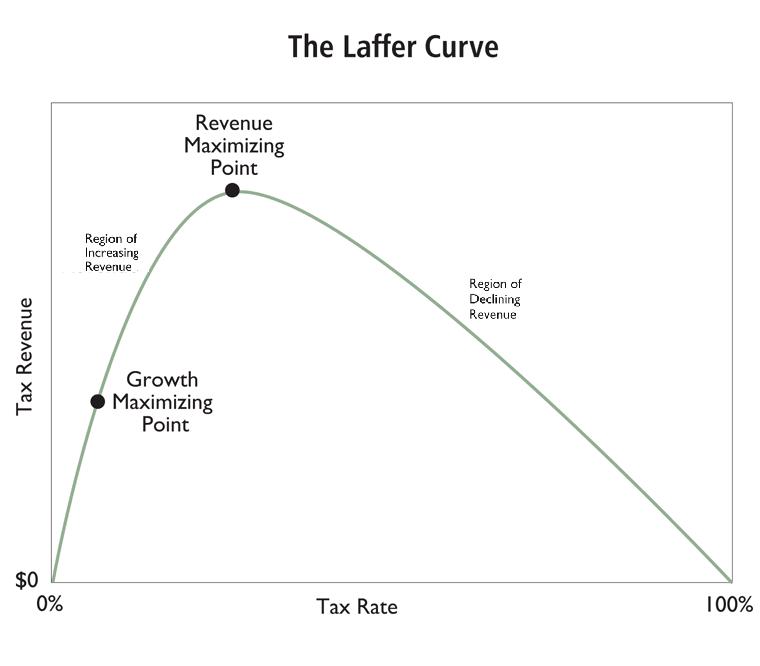
Every so often, I’ll assert that some statists are so consumed by envy and spite that they favor high tax rates on the “rich” even if the net effect (because of diminished economic output) is less revenue for government.

In other words, they deliberately and openly want to be on the right side (which is definitely the wrong side) of the Laffer Curve.

Just in case you think I’m exaggerating in order to make my opponents look foolish, check out this poll of left-wing voters who strongly favored soak-the-rich tax hikes even if there was no extra tax collected.

But now I have an even better example.

Writing for Vox, Matthew Yglesias openly argues that we should be on the downward-sloping portion of the Laffer Curve. Just in case you think I’m exaggerating, “the case for confiscatory taxation” is part of the title for his article.

Here’s some of what he wrote.

Maybe at least some taxes should be really high. Maybe even really really high. So high as to useless for revenue-raising purposes — but powerful for achieving other ends. We already accept this principle for tobacco taxes. If all we wanted to do was raise revenue, we might want to slightly cut cigarette taxes. …But we don’t do that because we care about public health. We tax tobacco not to make money but to discourage smoking.

The tobacco tax analogy is very appropriate.

Indeed, one of my favorite arguments is to point out that we have high taxes on cigarettes precisely because politicians want to discourage smoking.

As a good libertarian, I then point out that government shouldn’t be trying to control our private lives, but my bigger point is that the economic arguments about taxes and smoking are the same as those involving taxes on work, saving, investment.

Needless to say, I want people to understand that high tax rates are a penalty, and it’s particularly foolish to impose penalties on productive behavior.

But not according to Matt. He specifically argues for ultra-high tax rates as a “deterrence” to high levels of income.

If we take seriously the idea that endlessly growing inequality can have a cancerous effect on our democracy, we should consider it for top incomes as well. …apply the same principle of taxation-as-deterrence to very high levels of income. …Imagine a world in which we…imposed a 90 percent marginal tax rate on salaries above $10 million. This seems unlikely to raise substantial amounts of revenue.

I suppose we should give him credit for admitting that high tax rates won’t generate revenue. Which means he’s more honest than some of his fellow statists who want us to believe confiscatory tax rates will produce more money.

But honesty isn’t the same as wisdom.

Let’s look at the economic consequences. Yglesias does admit that there might be some behavioral effects because upper-income taxpayers will be discouraged from earning and reporting income.

Maybe…we really would see a reduction of effort, or at least a relaxation of the intensity with which the performers pursue money. But would that be so bad? Imagine the very best hedge fund managers and law firm partners became inclined to quit the field a bit sooner and devote their time to hobbies. What would we lose, as a society? …some would presumably just move to Switzerland or the Cayman Islands to avoid taxes. That would be a real hit to local economies, but hardly a disaster. …Very high taxation of labor income would mean fewer huge compensation packages, not more revenue. Precisely as Laffer pointed out decades ago, imposing a 90 percent tax rate on something is not really a way to tax it at all — it’s a way to make sure it doesn’t happen.

While I suppose it’s good that Yglesias admits that high tax rates change incentives, he clearly underestimates the damaging impact of such a policy.

He presumably doesn’t understand that rich people earn very large shares of their income from business and investment sources. As such, they have considerable ability to alter the timing, level, and composition of their earnings.

But my biggest problem with Yglesias’ proposals is that he seems to believe in the fixed-pie fallacy that public policy doesn’t have any meaningful impact of economic performance. This leads him to conclude that it’s okay to pillage the “rich” since that will simply mean more income and wealth is available for the rest of us.

That’s utter nonsense. The economy is not a fixed pie and there is overwhelming evidence that nations with better policy grow faster and create more prosperity.

In other words, confiscatory taxation will have a negative effect on everyone, not just upper-income taxpayers.

There will be less saving and investment, which translates into lower wages and salaries for ordinary workers.

And as we saw in France, high tax rates drive out highly productive people, and we have good evidence that “super-entrepreneurs” and inventors are quite sensitive to tax policy.

To be fair, I imagine that Yglesias would try to argue that these negative effects are somehow offset by benefits that somehow materialize when there’s more equality of income.

But the only study I’ve seen that tries to make a connection between growth and equality was from the OECD and that report was justly ridiculed for horrible methodology (not to mention that it’s hard to take serious a study that lists France, Spain, and Ireland as success stories).

P.S. This is my favorite bit of real-world evidence showing why there should be low tax rates on the rich (in addition, of course, to low tax rates on the rest of us).

P.P.S. And don’t forget that leftists generally view higher taxes on the rich as a precursor to higher taxes on the rest of the population.

P.P.P.S. In the interests of full disclosure, Yglesias says I’m insane and irrational.

08 Jun 14:50

Saturday Morning Breakfast Cereal - Know Your Linguistic Philosophies

by admin@smbc-comics.com
08 Jun 02:28

103 Years Later, Wall Street Turned Out Just As One Man Predicted

by Tyler Durden

In 1910, three years before the US Federal Reserve was founded, Senator Nelson Aldrich, Frank Vanderlip of National City (Citibank), Henry Davison of Morgan Bank, and Paul Warburg of the Kuhn, Loeb Investment House met secretly at Jekyll Island in Georgia to formulate a plan for a US central bank just years ahead of World War I.

The result of their work was the so-called Aldrich Plan which called for a system of fifteen regional central banks, i.e., National Reserve Associations, whose actions would be coordinated by a national board of commercial bankers. The Reserve Association would make emergency loans to member banks, and would create money to provide an elastic currency that could be exchanged equally for demand deposits, and would act as a fiscal agent for the federal government.

In other words, the Aldrich Plan proposed a "central bank" that would be openly and directly controlled by Wall Street commercial banks on whose behalf it would solely operate, instead of doing so indirectly, behind closed doors and the need for criminal probe of Yellen's Fed seeking to find who leaked what to whom.

The Aldrich Plan was defeated in the House in 1912 but its outline became the model for the bill that eventually was adopted as the Federal Reserve Act of 1913 whose passage not only unleashed the Fed as we know it now, but the entire shape of modern finance.

In 1912, one person who warned against the passage of the Aldrich Plan, was Alfred Owen Crozier: a man who saw how it would all play out, and even wrote a book titled "U.S. Money vs Corporation Currency" (costing 25 cents) explaining and predicting everything that would ultimately happen, even adding some 30 illustrations for those readers who were visual learners. 

The book, which is attached at the end of this post, is a must read, but even those pressed for time are urged to skim the following illustrations all of which were created in 1912, and all of which predicted just what the current financial system would look like.

Or, in the words of Overstock's CEO Patrick Byrne, "that's uncanny"

@zerohedge that's uncanny.

— Patrick Byrne (@OverstockCEO) June 5, 2015

From "U.S. Money vs Corporation Currency" (which can and should be read for free on Google), here are the selected illustrations:


None of this was rocket science: should the power to create money fall into the hands of a private few, or an entity working purely on their behalf (and lest there is any confusion, a multi-trillion bailout of the US financial system and the ongoing ZIRP/QE regime has benefited almost entirely that handful of people who stood to lose trillions in paper wealth should US banking as we know it end), it would "inaugurate a financial and industrial reign of terror." It was clear as day 103 years ago.


Fast forward 103 years when who should end up with that power? A group of central banking career academics, currently in the midst of a criminal probe what and how much information they leaked to a select group of private Wall Street interests and commercial bankers.

Why? Simple.


The country now knows: "Democracy" forgot.

* * *

Full book below (link for free ebook):

04 Jun 13:46

Sign Of The Times: Warrant Canary Management Software Is Now A Thing

by Glyn Moody

Warrant canaries -- regularly-updated public statements that an organization has not been served with a secret government subpoena -- are not a new idea, but it's interesting to observe how they are still evolving. As Mike noted in an article that appeared in November 2013, they were originally suggested for libraries, and then were picked up by major Internet companies like Apple. Now there's a move into the world of publishing. The Intercept’s parent company, First Look Media, has just unveiled its first warrant canary:

Status: All good
Period: April, 2015

During this period, First Look Media Inc. has received:

Zero National Security Letters
Zero Foreign Intelligence Surveillance Court orders
Zero gag orders that prevent us from from stating that we have received legal process seeking our customers' information

Lynn Oberlander
General Counsel, Media Operations
First Look Media, Inc
As The Intercept article announcing this move points out, there is a site called Canary Watch, which keeps track of warrant canaries. That's one sign of the increasing normalization of the idea. Another is the release of new software from First Look called AutoCanary:
AutoCanary is a desktop program for Windows, Mac, and Linux that makes the process of generating machine-readable, digitally signed warrant canary statements simpler.
Here's how it works:
Choose one person in your organization (probably your General Counsel) to be responsible for signing warrant canary statements. This person must have a PGP key.

Choose how often you wish to issue canary statements (available options include weekly, monthly, quarterly, and semi-annually).

Set a recurring event with a reminder in your calendar to sign your canary statement. This is important: failing to publish your canary statement on time could result in automated alarms ringing. If your canary stops tweeting, it may lead your users to believe you’ve received a gag order when you haven’t.

Create a page on your website to publish your warrant canary message
That's hardly a complicated process, but it's good to see First Look making it even easier with AutoCanary, especially since the software has been released as open source, along with pdf-redact-tools, "a set of tools to help with securely redacting and stripping metadata from documents before publishing." Partly as a result of this move, we can probably expect to see many more warrant canaries being published in the future.

Follow me @glynmoody on Twitter or identi.ca, and +glynmoody on Google+


Permalink | Comments | Email This Story


04 Jun 13:45

Documents Show DEA Running Ever-Increasing Number Of Wiretap Applications Through Friendlier Local Courts

by Tim Cushing

It looks like the DEA has upped the amount of surveillance it's performing, most likely not as a result of increasing drug trafficking, but more likely due to other contributing factors. According to information obtained through a USA Today FOIA request, 2014 was a record year for DEA wiretapping -- another in a decade-long string of consecutive "record years." (A slight, probably-Snowden-related dip in requests notwithstanding.)

The DEA conducted 11,681 electronic intercepts in the fiscal year that ended in September. Ten years earlier, the drug agency conducted 3,394.
At first glance, it would appear that the DEA is simply being more aggressive in its drug enforcement efforts. But more likely this is a sign that the DEA is just getting better at streamlining its wiretapping request procedures. To begin with, it appears the DEA doesn't feel federal courts need to be involved in federal investigations -- at least not when local courts will perform the same function but faster and with fewer questions asked.
DEA agents now take 60% of those requests directly to local prosecutors and judges from New York to California, who current and former officials say often approve them more quickly and easily.
Not only does this allow DEA agents to more easily obtain permission to deploy wiretaps, but its "BUY LOCAL!" plan allows it to dodge additional scrutiny from the DOJ. While state courts are supposed to adhere to DOJ guidelines while approving wiretaps, it appears smaller courts are less likely to challenge DEA requests.
Agents said many of the cases in which state judges authorize wiretaps end up being prosecuted in state courts, where challenges to wiretap evidence are less common. According to records the district attorney submitted to California's attorney general, for example, only about 2% of the 1,400 wiretaps authorized in Riverside County over the past five years were later challenged in state court.
As USA Today's Brad Heath points out, the DEA seems to love Riverside County. Judges there approved more wiretap applications than any other jurisdiction in the country, leading to the applications routed through it doubling from 2013 to 2014.

The DEA, however, claims there's no venue shopping or DOJ-ducking going on here. It's all just part of the magical complicated world of drug enforcement.
Moses said DEA agents were "making no attempt to circumvent federal legal standards and protections by instead pursuing state wiretap authorizations." Instead, he said, the rapid growth of state-authorized eavesdropping reflects local prosecutors' increased willingness to take on complex wiretap investigations, which often involve teams of local police and federal agents. At the same time, he said, some federal prosecutors "may be unable to support wire intercept investigations due to manpower or other resource considerations," so agents take their cases to state officials rather than see them dropped.
That all sounds very plausible, but still doesn't explain why the DEA is running so many joint operations out of Riverside County. Be that as it may, the uptick in requests can also be attributed to the agency's long-running parallel construction schemes, which may now include communications gathered with the assistance of purchased exploits and malware. While many judges may be a bit hesitant to sign off on man-in-the-middle attacks to implant spyware on cellphones, they're perfectly happy to John Hancock normal law enforcement methods like wiretaps that achieve the same end.

Permalink | Comments | Email This Story


04 Jun 13:41

Kids in Police-Run Youth Camp Allegedly Beaten, Threatened By Cops

by Robby Soave
Jts5665

This is disturbing...

DrillCalifornia children who “talked back” to their parents or teachers were encouraged to enroll in a police-run boot camp designed to build character. But the San Luis Obispo County Sheriff’s Office is investigating the camp for allegedly physically and verbally abusing the kids—many of whom came home beaten and bruised.

According to the Los Angeles Times:

The children, ages 11 to 17, suffered cuts and bruises after being beaten in what was described as “the dark room” during the weeklong boot camp in San Luis Obispo, their attorney, Greg Owen, said. One boy suffered broken bones in his hand when an officer stepped on it because he was not performing a push-up properly, Owen said.

After returning from the boot camp, the children remained silent about what happened because they feared retaliation, the lawyer said.

“They were threatened [that] if they told they would be found and get hurt badly,” Owen said, adding that he was representing 10 children but believes that there may be more, including from previous camps. …

The children’s parents had paid $400 for an educational and physical activity program to improve their behavior, Owen said. He said some of the children were recommended for the intervention program by their schools after talking back to their teachers and parents.

South Gate police officials said the program spans 20 weeks and is designed to “change the destructive behavior of an at-risk youth” by introducing a structured regimen and educational trips. The boot camp took place during one of those trips.

I don’t know if these kinds of programs are generally effective (I tend to doubt it), but one thing I’m sure won’t improve the kids’ behavior and authority issues is treating them like conscripted soldiers and beating the crap out of them. One kid even told KTLA 5 that a drill sergeant stood on his hand and broke his fingers.

A spokesperson for the police department that runs the boot camp said no had ever made complaints along these lines in its 20-year history. It’s not yet known whether charges will be filed.

04 Jun 13:30

Quotation of the Day…

by Don Boudreaux
(Don Boudreaux)

Tweet

… is from pages 62-63 of a selection from Oscar Wilde’s February 1891 Forthnightly Review essay, “The Soul of Man Under Socialism” – a selection that appears in the superb just-published reader, Individualism, edited by George H. Smith and Marilyn Moore:

Selfishness is not living as one wishes to live, it is asking others to live as one wishes to live.  And unselfishness is letting other people’s lives alone, not interfering with them.  Selfishness always aims at creating around it an absolute uniformity of type.  Unselfishness recognizes infinite variety of type as a delightful thing, accepts it, acquiesces in it, enjoys it….  For the egoist is he who makes claims upon others, and the Individualist will not desire to do that.

04 Jun 13:26

Video: Stuffed Toy Tiger Intimidates German Shepherd

03 Jun 15:58

The DEA Bypasses Federal Oversight to Better Snoop on Us All

by Scott Shackford

Broken windows policingReason has written extensively in our coverage of police asset forfeiture about how local law enforcement agencies bypass state restrictions by turning to the Department of Justice’s looser federal sharing program. Doing so allows some law enforcement agencies to keep more of the money and property they seize.

It seems as though the Drug Enforcement Administration (DEA) has reversed this dynamic, all in the name of more easily snooping on people. USA Today has determined that the DEA has drastically increased its use of electronic surveillance over the past decade by deliberately bypassing its own federal oversight and turning to local prosecutors. The Department of Justice (DOJ) has tougher requirements to permit eavesdropping than states and local judges:

The DEA conducted 11,681 electronic intercepts in the fiscal year that ended in September. Ten years earlier, the drug agency conducted 3,394.

Most of that ramped-up surveillance was never reviewed by federal judges or Justice Department lawyers, who typically are responsible for examining federal agents' eavesdropping requests. Instead, DEA agents now take 60% of those requests directly to local prosecutors and judges from New York to California, who current and former officials say often approve them more quickly and easily.

Drug investigations account for the vast majority of U.S. wiretaps, and much of that surveillance is carried out by the DEA. Privacy advocates expressed concern that the drug agency had expanded its surveillance without going through internal Justice Department reviews, which often are more demanding than federal law requires.

Wiretaps — which allow the police to listen in on phone calls and other electronic communications — are considered so sensitive that federal law requires approval from a senior Justice Department official before agents can even ask a federal court for permission to conduct one. The law imposes no such restriction on state court wiretaps, even when they are sought by federal agents.

A DEA spokesperson insisted their agents weren’t trying to bypass oversight, but rather the states and local prosecutors have gotten more willing to participate in wiretap investigations and bring in local police to assist. Also, DEA agents still have to follow federal safeguards for wiretapping, even if they don’t go through the DOJ or federal judges for approval.

It occurs to me to go back to my initial comparison to federal asset forfeiture rules. By bringing in local police to assist, whatever these cases are must almost certainly then become joint operations, which means the police can then use the federal program to try to seize and keep more of whatever they find in these investigations.

The USA Today piece does not attempt to look at or correlate these investigations with participation in the federal Equitable Sharing Program, but there has been a similar increase in law enforcement agencies turning to the federal program for civil asset forfeiture. The story notes increases in turning to local courts for wiretap approval in Southern California, a doubling in Riverside.  In April, the Drug Policy Alliance released a report showing that revenue California cities have seen from participating in the federal asset forfeiture reform has tripled over the same time frame covered as this USA Today report, while revenue from state asset forfeiture has remained the same. No doubt local prosecutors and law enforcement agencies are thrilled to help the DEA with their wiretapping. There’s quite the financial incentive involved.

03 Jun 03:58

When Ideology Takes A Back Seat to Party Politics

by admin

The brief time I led the Equal Marriage Arizona efforts to amend the Constitution to allow gay marriage was a real eye-opener for me.  I expected that since I was not a member of the largest gay activist groups, I might have to work to build up trust.  But it turned out, trust was not an issue.  I seldom had anyone question my sincerity.  However, I quickly found all the major gay rights groups (excepting the ACLU, bless their hearts) not just neutral or skeptical but actively opposing our effort.  Several people in these organizations dragged me in the figurative back room and explained that the leadership of their group would never accept a non-Democrat getting credit for such a success.  And one member of prominent organization (hint:  has same initials as Hillary Rodham Clinton) told me that their internal position was that they did not want gay marriage to come to Arizona until after 2016 because they wanted Hillary to be able to run on the issue and hoped to flip AZ blue in 2016.

So, a couple of years ago I would never have believed this story, but now it seems all too familiar

Just this week, legislators introduced a bill that would encourage drug companies to apply to sell contraceptives without a prescription.

But if Republican Sens. Cory Gardner of Colorado and Kelly Ayotte of New Hampshire, along with four other GOP senators, were expecting flowers from Planned Parenthood and others for their bill, the Allowing Greater Access to Safe and Effective Contraception Act, they should brace for disappointment. Suddenly, the idea doesn’t sound so great, and the former supporters aren’t mincing words.

Planned Parenthood president Cecile Richards said the bill is a “sham and an insult to women.”

Karen Middleton of NARAL Pro-Choice Colorado even got personal, saying, “Cory Gardner can’t be trusted when it comes to Colorado women and their health care.”...

Beneath the fear-mongering lies the more likely reason for the change of heart on the left. The bill was simply introduced by the wrong party.

02 Jun 17:20

Lousy Cartoonist Blames ‘libertarian negligence’ for Potholes in L.A. and Afghanistan

by Matt Welch

No really, this happened. |||The main question about Ted Rall after all these years is whether the rancid cartoonist's draftsmanship is as miserable as his logic. (Look to the right to see that tension play out in real time.) In an L.A. Times opinion piece about potholes yesterday, however, Rall's horrendous argumentation may have finally gained the upper (lower?) hand.

Here's your spit-take of a headline: "Potholes and crumbling roads, brought to you by libertarian negligence." Come again?

What would happen if the potholes never got fixed? The libertarian "the government that governs best is the government that doesn't exist" hypothesis is my tongue-in-cheek suggestion in today's cartoon.

Actually, I know the answer. I've seen the state of roads after decades of libertarianism/negligence — and my back has felt it — in Afghanistan before the U.S. began road reconstruction around 2005.

Granted, Afghanistan has been laboring under the yoke of libertarian misrule for decades now, but what about the City of Angels? Well, the 15-member City Council—the one that recently passed the biggest teaching moment of a minimum wage hike in the country—contains exactly one registered Republican, and zero Libertarians. For the past 55 years the city has had exactly one non-Democratic mayor, widely derided by conservatives as a RINO. A political power structure once famous for anti-union sentiment has now become so thoroughly labor-dominated that local bosses don't even bat an eye about publicly lobbying for individualized carve-outs to laws they just pushed through.

Will magically disappear now. ||| lapotholes.comMeanwhile, when it comes to potholes, the people who care about them longer than tax-hike day tend to be—wait for it!—libertarian, while the people who put scare-quotes around "pothole politics" tend to share more in common politically with Ted Rall. As I wrote in 2008:

In Los Angeles, my former city representative, Tom LaBonge, was tolerated as an eccentric for being the only member of the 15-member City Council to express genuine interest in street repairs (though the road in front of my house still had craters large enough to hide a baby). When a coalition of black, brown, and lefty-white politicians took over city government early this decade, one local alternative weekly urged the council to "think big" and not get bogged down in mere "pothole politics."

Rall's column starts off with this bit of delusional thinking: "The L.A. City Council approved a budget that would, among many other things, allow the city to fill 350,000 potholes." Why is that delusional? Because as Reason told you in 2011, we've been here before:

Angelenos [...] voted in 2008 to approve a new county-wide sales tax, set at the seemingly reasonable rate of a ha'penny. Measure R was heavily advertised as a tax that would fix potholes,repair the county's disgraceful road infrastructure, and "get traffic moving." The Los Angeles County MTA's Measure R splash page highlights the road and driving elements of the measure, with its top bullet point noting that MTA has disbursed "$100 million for...projects such as pothole repairs, major street resurfacing, left-turn signals, bikeways, pedestrian improvements, streetscapes, traffic signal synchronization and local transit services."

More than two years in, Los Angeles now fixes nearly a third fewer potholes than it did before. According to the Measure R expenditure plan [pdf] a mere 15 percent of money from the sales tax is designated for road service. The largest portion goes to new rail projects, though only the Expo Line from USC is currently under active construction. 

Literally every year, the city's debased political class promises to fix potholes forever if voters only approve this one last tax increase. Meanwhile, city monies are routinely squandered on everything but. L.A.'s own controller said as recently as last year that money is not the problem with street repair:

The streets bureau also does not always prioritize its repair work based on common-sense criteria such as traffic volume, heavy vehicle loads and mass-transit loads. So despite the slurry work that's taken place, some of the city's busiest and most important thoroughfares remain in the worst condition, impeding traffic and commerce, making bike riding unsafe and turning bus rides into bumpy, uncomfortable journeys.

Our auditors also found that the Bureau of Street Services has undercollected $190 million in fees from utility companies that cut and dig into our streets, money that could have been used to perform miles of repairs. Likewise, between 2011 and 2013, it did not fully utilize its budgeted funds. Auditors found that $21 million earmarked for street repairs was returned to various funding sources unused. And the city has also spent more to produce its own asphalt than it would have if it had paid a vendor for it.

So yes, go ahead and blame libertarians, Ted Rall. Meanwhile, for those who wish to actually solve rampant infrastructure problems in Democratic-dominated municipalities, you might want to consult the libertarian next door:

Thanks to serial tipster CharlesWT for the link.

UPDATE: On Twitter, Greta Kasatkina points to a UK cartoonist using a different tack to address potholes. I don't want to give it away, but let's just say his/her name is "Wanksy."

02 Jun 13:46

Protecting Perks, Power, & Profits Has Perverted The Entire System

by Tyler Durden

Submitted by Bill Bonner via Bonner & Partners,

We’ve been trying to find something good to say about our generation – the baby boomers, who have dominated life back in the U.S. for at least the last 30 years.

But we keep running into the same problem: We have been so eager to protect our perks, power, and profits we have perverted the entire system.

Capitalism takes you into the future... with innovation, failure, and surprise. You invest, you lose your money, you try something different, and you stumble forward. Capitalism is constantly burying its mistakes and discovering tomorrow.

Cronyism, on the other hand, keeps you in the past. It is today and yesterday trying to stop tomorrow from happening.

...by bribing public officials (they are remarkably cheap; in terms of return on investment nothing else comes close)… restricting… regulating… controlling… central planning… bailing out well-established businesses… rewarding stockholders… paying off voters, lobbyists, and special interests… and distorting the political establishment, with its geriatric candidates and tired themes.

And guess what? Cronyism depends on the credit bubble. The future is where new wealth is created. When you try to stop or twist the future into the shape want, you prevent this wealth from ever happening.

So, you switch from creating wealth now to taking wealth from the future, so you can consume it now. That’s how the credit bubble got so big. And that’s why almost nobody wants to see it pop.

Cronies owe money. They borrow money. They depend on borrowed money for their budgets, their spending, their bonuses, their portfolios, their welfare checks, and their special privileges.

They all depend so heavily on borrowing that few of them – whether in academia, media, business, finance, or government – can see the truth… let alone speak it.

They are all paid not to see it. And if they do see it, they keep their mouths shut.

Who is left on the other side? Who is left to say something?

02 Jun 13:40

Chocolatey Goodness

by Tim Knight from Slope of Hope

With all the grumbling and grousing I do here, I thought I'd share a feel-good story I happened upon last night. It's about the Hershey Company. Specifically, it's about a secret arrangement the founder of the company made to help orphans. As revealed on Wikipedia: (with some boldface emphasis by me):

Unable to have children of his own, Milton S. Hershey founded the Milton Hershey School in 1909 for orphans. In 1918, Milton S. Hershey and his wife, Catherine Hershey, donated all of their considerable wealth, of around 60 million dollars, to the boarding school upon Catherine Hershey's death. The Hershey Trust Company is now the largest shareholder and beneficiary to the School. Before his death, Milton Hershey ensured the school would live on by donating 30% of all future Hershey profits to the school. Due to this generous donation by America's largest chocolate company, MHS now has over 7 billion dollars in assets, making it one of the richest schools in the world. Today, the Milton Hershey School provides free education, health care, counseling and a friendly home to 2000 orphans in financial need.

The school's programs include sports, arts, religious studies, sciences, math, language and many other subjects. School colors are gold and brown. Students must wear a uniform to class provided to them by the School to encourage equality. Their admissions is primarily based on age and financial need for the orphans. The school also provides "House Parents", which are hired couples, paid to take care of and nurture the students. The school's "fellowship" project provides students with Hershey employee visits to build long lasting relationships and provide career counseling. Additionally, the school is located in Hershey, Pennsylvania, a city created by Milton Hershey himself. The city offers security, a church, a post office and other services for the students. Many of its designs resemble Hershey chocolate products, such as the Hershey Kisses light posts. Most notably perhaps is the fact that Mr. Milton Hershey prohibited The Hershey Company from using the School as an advertisement or marketing strategy. The school's primary goal is to provide young orphans with the skills necessary to support themselves and their families in the future.

Isn't that cool? Can you imagine, say, Steve Jobs allocating 30% of Apple's profits - - forever - - to a given charitable cause? And, the real kicker - - to expressly forbid the company from exploiting this generosity for marketing or advertising purposes?

Here in Palo Alto, for instance, there is the Ronald McDonald house. It's a very well-funded hospital for very sick children. I think it's terrific that McDonald's funds this (setting aside the fact that the food they've given the country the past fifty years hasn't exactly been a boon for good health), but when I see all the posters of Ronald McDonald given kids with, say, cancer a big Ronald hug, my cynicism meter does go "ping" a bit.

But never did I suspect, with all the Hershey's I've bought over the years to create my award-winning s'mores, that a big chunk of the company's profits during its entire history were causing to this worthy cause. Mr. Hershey must have been a good egg.

02 Jun 13:38

Kyle Bass Was Right: Texas To Create Own Bullion Depository, Repatriate $1 Billion Of Gold

by Tyler Durden

Most investors have heard Kyle Bass' rather eloquent phrase, "buying gold is just buying a put against the idiocy of the political cycle. It's that simple." However, what few may remember was his warnings in 2011, suggesting the University of Texas Investment Management Co. take delivery of its gold - as opposed to trusting it in the 'safe' hands of COMEX massively levered paper warehouse. Now, as The Star Telegram reports, Texas is going one step further with State Rep. Giovanni Capriglione asking the Legislature to create a Texas Bullion Depository, where Texas could store its gold. The goal is to create a secure facility that would allow the state to bring home more than $1 billion in gold bars that are owned by UTIMCO and are now housed at HSBC in New York.


From 2011:

"The University of Texas Investment Management Co., the second-largest U.S. academic endowment, took delivery of almost $1 billion in gold bullion and is storing the bars in a New York vault, according to the fund’s board."


The decision to turn the fund’s investment into gold bars was influenced by Kyle Bass, a Dallas hedge fund manager and member of the endowment’s board, Zimmerman said at its annual meeting on April 14. Bass made $500 million on the U.S. subprime-mortgage collapse.


“Central banks are printing more money than they ever have, so what’s the value of money in terms of purchases of goods and services,” Bass said yesterday in a telephone interview. “I look at gold as just another currency that they can’t print any more of.”

And now, as The Star Telegram reports, UTMICO would prefer a Texas depository than a New York one...

“We are not talking Fort Knox,” Capriglione said. “But when I first announced this, I got so many emails and phone calls from people literally all over the world who said they want to store their gold … in a Texas depository.


“People have this image of Texas as big and powerful … so for a lot of people, this is exactly where they would want to go with their gold.” And other precious metals.


House Bill 483 would let the Texas comptroller’s office establish the state’s first bullion depository at a location yet to be determined.


Capriglione’s changes to the bill must be approved by Monday, the last day of the 84th legislative session.


The goal is to create a secure facility that would allow the state to bring home more than $1 billion in gold bars that are owned by the University of Texas Investment Management Co. and are now housed at the Hong Kong and Shanghai Bank in New York.


“The depository would be an agency of the state located in the Office of the Comptroller, directed by an administrator appointed by the Comptroller with the advice and consent of the Governor, Lieutenant Governor and Senate,” according to a fiscal analysis of the bill.


The depository could also hold deposits of gold and other precious metals from financial institutions, cities, school districts, businesses, individuals and countries.


“This will allow for bullion to be deposited here, as well as any other investments that … any state agencies, businesses or individuals have,” Capriglione said.


Storage fees will be charged, perhaps generating revenue for the state. For instance, Texas pays about $1 million a year to store its gold in New York, Capriglione said.


A fiscal note attached to the bill states that the depository will have “an indeterminate fiscal impact” on the state, depending on the number of transactions and fees, but says it’s too early to determine the extent.


“It’s unusual,” said Cal Jillson, a political science professor at Southern Methodist University. “So far as I know, there are no states with bullion depositories.”

*  *  *

Perhasps the fact that Texas doesn't trust New York suggests the unitedness of the states is starting to quake and surely "the idiocy of the political cycle" has only got worse...

"buying gold is just buying a put against the idiocy of the political cycle. It's that simple."

This is Capriglione’s second attempt to create the depository.

Two years ago, then-Gov. Rick Perry was on board, saying work was moving forward on “bringing gold that belongs to the state of Texas back into the state.”


“If we own it,” Perry has said, “I will suggest to you that that’s not someone else’s determination whether we can take possession of it back or not.”


In 2013, the Legislature ended before Capriglione could win approval of the bill.


Jillson said the bill’s sentiment is consistent with the anti-federal approach that conservative lawmakers have taken this year. “It’s in line with the idea that Texas is exceptional and needs to keep a distance from the federal government that respects individual states’ depositories,” he said.

Sounds like Texas - just like Austria, Germany, Russia, and China to name just four - no longer trusts the status quo.

02 Jun 13:36

From The Keynesian Archives: Who Said In 2010 That "Europe Is An Economic Success"

by Tyler Durden

Paul Krugman says a lot of funny things. 

Indeed, if one is predisposed to being cynical about the 7-year bout of Keynesian madness that has infected DM central banks in the post crisis world, virtually everything Paul Krugman says is funny. 

But some caution is warranted because while Krugman may be an endless source of entertainment for anyone who has even a shred of respect for sound money policies, he is also — as we pointed out when the Nobel prize winner took his economic insanity on a field trip to its natural habit in Japan last year — there are two words that should strike fear in the hearts of any rational-thinking citizen of the world, and those two words are “Paul Krugman.” 

At no time in history is the above more apparent than now, with seemingly the entire world on its way to becoming Japan because at the end of the day, everyone's answer to why central planning hasn’t delivered on its lofty promises is simply this: not enough Keynes.

Having thus set the stage, we bring you this classic Krugman throwback quote from 2010:

"The real lesson from Europe is actually the opposite of what conservatives claim: Europe is an economic success, and that success shows that social democracy works."


Shortly thereafter, that “economic success” would turn into an unmitigated nightmare both from an economic and political perspective, with the entire periphery losing bond market access in mid-2012 due to the perception of fiscal irresponsibility, an event which was promptly followed up by a Keynesian rhetorical haymaker from Mario Draghi that temporarily stemmed the crisis but wasn’t enough to bring the EU economy back to life and so finally, the ECB went (nearly) full-Kuroda in March, all just to celebrate the fact that "hey, at least inflation isn’t negative anymore" and at least now, only Greece is on its way out because, ironically, it has “too much debt.” 

Certainly doesn't look like “success” to us, although, as Krugman reminds us, you have to look past math when you’re evaluating economic outcomes:

“Actually, Europe’s economic success should be obvious even without statistics.”

And because we couldn’t resist, here's why things have gone from bad to worse in Greece over the past month:

Tomorrow I will be meeting with the Nobel Prize-winning economist @NYTimeskrugman #Greece

— Alexis Tsipras (@tsipras_eu) April 17, 2015

02 Jun 13:30

Ron Paul: "Ex-Im Bank Is Welfare For The 1%"

by Tyler Durden
Jts5665

We've been hearing US chamber of commerce ads on the radio lately pushing the renewal of this program for the benefit of "small businesses". Boeing has a big presence here so they are probably the local "small business" being alluded to.

Submitted by Ron Paul via The Ron Paul Institute for Peace & Prosperity,

This month Congress will consider whether to renew the charter of the Export-Import Bank (Ex-Im Bank). Ex-Im Bank is a New Deal-era federal program that uses taxpayer funds to subsidize the exports of American businesses. Foreign businesses, including state-owned corporations, also benefit from Ex-Im Bank. One country that has benefited from $1.5 billion of Ex-Im Bank loans is Russia. Venezuela, Pakistan, and China have also benefited from Ex-Im Bank loans.

With Ex-Im Bank’s track record of supporting countries that supposedly represent a threat to the US, one might expect neoconservatives, hawkish liberals, and other supporters of foreign intervention to be leading the effort to kill Ex-Im Bank. Yet, in an act of hypocrisy remarkable even by DC standards, many hawkish politicians, journalists, and foreign policy experts oppose ending Ex-Im Bank.

This seeming contradiction may be explained by the fact that Ex-Im Bank’s primary beneficiaries include some of America’s biggest and most politically powerful corporations. Many of Ex-Im Bank’s beneficiaries are also part of the industrial half of the military-industrial complex. These corporations are also major funders of think tanks and publications promoting an interventionist foreign policy.

Ex-Im Bank apologists claim that the bank primarily benefits small business. A look at the facts tells a different story. For example, in fiscal year 2014, 70 percent of the loans guaranteed by Ex-Im Bank’s largest program went to Caterpillar, which is hardly a small business.

Boeing, which is also no one’s idea of a small business, is the leading recipient of Ex-Im Bank aid. In fiscal year 2014 alone, Ex-Im Bank devoted 40 percent of its budget — $8.1 billion — to projects aiding Boeing. No wonder Ex-Im Bank is often called “Boeing’s bank.”

Taking money from working Americans, small businesses, and entrepreneurs to subsidize the exports of large corporations is the most indefensible form of redistribution. Yet many who criticize welfare for the poor on moral and constitutional grounds do not raise any objections to welfare for the rich.

Ex-Im Bank’s supporters claim that ending Ex-Im Bank would deprive Americans of all the jobs and economic growth created by the recipients of Ex-Im Bank aid. This claim is a version of the economic fallacy of that which is not seen. The products exported and the people employed by businesses benefiting from Ex-Im Bank are visible to all. But what is not seen are the products that would have been manufactured, the businesses that would have been started, and the jobs that would have been created had the funds given to Ex-Im Bank been left in the hands of consumers.

Another flawed justification for Ex-Im Bank is that it funds projects that could not attract private sector funding. This is true, but it is actually an argument for shutting down Ex-Im Bank. By funding projects that cannot obtain funding from private investors, Ex-Im Bank causes an inefficient allocation of scarce resources. These inefficiencies distort the market and reduce the average American's standard of living.

Some Ex-Im Bank supporters claim that Ex-Im Bank promotes free trade. Like all other defenses of Ex-Im Bank, this claim is rooted in economic fallacy. True free trade involves the peaceful, voluntary exchange of goods across borders — not forcing taxpayers to subsidize the exports of politically powerful companies.

Ex-Im Bank distorts the market and reduces the average American's standard of living in order to increase the power of government and enrich politically powerful corporations. Congress should resist pressure from the crony capitalist lobby and allow Ex-Im Bank's charter to expire at the end of the month. Shutting down Ex-Im Bank would improve our economy and benefit most Americans. It is time to kick Boeing and all other corporate welfare queens off the dole.

*  *  *

02 Jun 13:26

NSA Is Offline So Here "They" Come: Multiple Bomb Threats Made Against US Aircraft, NBC Reports

by Tyler Durden

Update: ALL THE BOMB THREATS TO U.S. PLANES FOUND NOT CREDIBLE: CNBC

You don't say. Now let's find the NSA agent who dialed them in.

* * *

Who could have seen this coming? Just 24 hours after the NSA goes "dark" from "securing" the nation against terrorist threat (by recording and storing all domestic phone calls) we get this:

  • BOMB THREATS PHONED INTO AIRPORTS, CNBC SAYS

According to NBC, these threats are against planes already in the sky.

BREAKING: Multiple bomb threats made about US aircraft in the air, @tomcostellonbc reports. http://t.co/bYdMijkcoo

— CNBC Now (@CNBCnow) June 2, 2015

Passengers are being deplaned after a bomb threat hoax in Philadelphia


What turned out to be a hoax led to police searching a US Airways flight and its passengers after it landed at Philadelphia International Airport Tuesday morning.

The airport confirmed there was a police investigation going on around 6:30 a.m. after flight 648 from San Diego landed as scheduled in Philly with 88 passengers and five crew on board.

The aircraft had taken off from California at 10:35 p.m. PDT and landed in Philadelphia on schedule shortly after 6:15 a.m. EDT.

"The TSA Operations Center in Washington, DC had received a phone threat stating that there was an explosive device on the plane," said Philadelphia Police Chief Inspector Joe Sullivan. "Out of an abundance of caution" the airport declared a bomb threat and moved the plane to a remote area.

And from NBC:

At least five bomb threats were phoned in Tuesday against flights originating or landing in the United States, government sources told NBC News. The sources said that the threats were not deemed credible.


Four of the five flights — one each from US Airways, Delta Air Lines, United Airlines and the Mexican carrier Volaris — landed. The fifth, Korean Air Flight 23 from Seoul to San Francisco, was still in the air, scheduled to land Tuesday afternoon.


In Philadelphia, police met the US Airways plane, Flight 648 from San Diego, when it landed. NBC Philadelphia reported that a police bomb squad, including dogs, searched the plane and passengers and gave the all-clear. 


The three other flights that had landed were Delta Flight 55, from Los Angeles to Atlanta; United Flight 995, from San Francisco to Chicago O'Hare; and Volaris Flight 939, from Portland, Oregon,to Guadalajara, Mexico.


Hoax threats have been made against almost a dozen planes over the past two

*  *  *

US equity markets dropped on the news but judging by how fast stocks rebounded after the original CNBC report it makes one wonder if this was just a trial balloon to see how fast BTFDers BTFD after a terrorism headline. The answer: 5 minutes.


Conclusion: the Fear Department will need to work harder to overcome the natural instinct of an entire generation of BTFDers to inspire a marketwide panic.

02 Jun 03:00

Daily Deal: MCSE Business Intelligence 5 Course Training

by Gretchen Heckmann
It's never a bad idea to get extra certifications in your industry to help your career along. For 91% off list, you can get one year of access to the MCSE Business Intelligence 5-Course Training through iCollege and prepare yourself for the Microsoft Certified Solutions Engineer exam. Once you've completed the five courses, you can sit for the exam at any Prometric Testing Center in the world (exam vouchers are not included in this deal). The courses cover querying and administering Microsoft SQL servers, implementing a data warehouse, creating data reports and models, and designing business intelligence solutions with Microsoft SQL servers.

Note: We earn a portion of all sales from Techdirt Deals. The products featured do not reflect endorsements by our editorial team

Permalink | Comments | Email This Story


02 Jun 02:59

US Government Making Another Attempt To Regulate Code Like It Regulates International Weapons Sales

by Tim Cushing

When code is treated like weapons, bad things happen. Governing bodies have previously treated encryption as weaponry, ensuring that only the powerful will have access to strong encryption while the general public must make do with weaker or compromised variants.

More recently, the US government went after the creator of a 3D-printed gun, claiming the very existence of printing instructions violated international arms regulations. So, it's not just the end result that's (potentially) covered under this ban (the actual weapon) but the data and coding itself. That's currently being fought in court, carrying with it some potentially disturbing implications for several Constitutional rights.

Now, it appears the conflation of physical weapons/weaponized code is possibly going to make things much, much worse. The EFF notes that the US government's adoption of recommended changes to an international arms trafficking agreement (the Wassenaar Arrangement) will likely cause very serious problems for security researchers and analysts in the future.

The BIS's version of the Wassenaar Arrangement's 2013 amendments contains none of the recommended security research exceptions and vastly expands the amount of technology subject to government control.

Specifically, the BIS proposal would add to the list of controlled technology:

Systems, equipment, components and software specially designed for the generation, operation or delivery of, or communication with, intrusion software include network penetration testing products that use intrusion software to identify vulnerabilities of computers and network-capable devices.

And:


Technology for the development of intrusion software includes proprietary research on the vulnerabilities and exploitation of computers and network-capable devices.

On its face, it appears that BIS has just proposed prohibiting the sharing of vulnerability research without a license.
As if things weren't already dangerous enough for security researchers, what with companies responding with threats and lawyers -- rather than apologies and appreciation -- when informed of security holes and the US government always resting its finger on the CFAA trigger. Violating the terms of this agreement could see researchers facing fines of up to $1 million and/or 20 years in prison.

Wassenaar was originally limited to physical items used in conventional weapons, like guns, landmines and missiles. It was amended in December 2013 to include surveillance tech, mainly in response to stories leaking out about Western companies like Gamma (FinFisher) and Hacking Team selling exploits and malware to oppressive governments, which then used these tools to track down dissidents and journalists.

The push to regulate the distribution of these tools had its heart in the right place, but the unintended consequences will keep good people from doing good things, while doing very little to prevent bad people from acquiring and deploying weaponized software.

The Wassenaar Arrangement's attempt to wrestle a mostly ethereal problem into regulatable problem was, for the most part, handled well. It defined the software it intended to control very narrowly and provided some essential exceptions:
Notably, the controls are not intended apply to software or technology that is generally available to the public, in the public domain, or part of basic scientific research.
But, even so, it still contained the potential to do more harm than good.
We have significant problems with even the narrow Wassenaar language; the definition risks sweeping up many of the common and perfectly legitimate tools used in security research.
Either interpretation (Wassenaar, BIS) is a problem. The BIS version is much worse, but both will result in a less-secure computing world, despite being implemented with an eye on doing the opposite, as Robert Graham at Errata Security points out.
[G]ood and evil products are often indistinguishable from each other. The best way to secure your stuff is for you to attack yourself.

That means things like bug bounties that encourage people to find 0-days in your software, so that you can fix them before hackers (or the NSA) exploit them. That means scanning tools that hunt for any exploitable conditions in your computers, to find those bugs before hackers do. Likewise, companies use surveillance tools on their own networks (like intrusion prevention systems) to monitor activity and find hackers.

Thus, while Wassenaar targets evil products, they inadvertently catch the bulk of defensive products in their rules as well.
And the results will disproportionately negatively affect those who need these protections the most. This is the end result of controls written with physical items (which originates from physical manufacturing plants and travel on physical means of conveyance) in mind but copied-pasted to handle "items" that can traverse the internet with no known originating point.
That's not to say export controls would have no leverage. For example, these products usually require an abnormally high degree of training and technical support that can be tracked. However, the little good export controls provide is probably outweighed by the harm -- such as preventing dissidents in the affected countries from being able to defend themselves. We know they do little good know because we watch Bashar Al Assad brandish the latest iPhone that his wife picked up in Paris. Such restrictions may stop the little people in his country getting things -- but they won't stop him.
The "open-source" exception in Wassenaar can be useful, up to a point. Researchers could post their findings to Github, as Graham points out, to ensure they're still protected. This, of course, means the Arrangement is still mostly useless, as the moment it's put into the public domain, any entity cut out of the distribution loop by this agreement can immediately make use of posted vulnerabilities and exploits. It also makes research destined to be open-sourced forbidden weaponry until the point it's actually made public. So, a laptop full of research is a prohibited weapon, while a Github post containing the same is not.
When security researchers discover 0-day, they typically write a proof-of-concept exploit, then present their findings at the next conference. That means they have unpublished code on their laptop, code that they may make public later, but which is not yet technically open-source. If they travel outside the country, they have technically violated both the letter and the spirit of the export restrictions, and can go to jail for 20 years and be forced to pay a $1 million fine.
Pro tip:
Thus, make sure you always commit your latest changes to GitHub before getting on a plane.
Statements made by the BIS aren't exactly comforting. The BIS's implementation doesn't include an open-source exception, but supposedly, this will still be taken into consideration when the US government starts throwing around fines and prison sentences. Randy Wheeler of the BIS:
"We generally agree that vulnerability research is not controlled, nor is the technology related to choosing a target or finding a target, controlled." However, she undermined her message by stating that any software that is used to help develop 0-day exploits for sale would be covered by the proposal.
Again, bad for researchers. This gives the government leeway to imply intent when prosecuting, because the allowed and the forbidden look very similar while still in their formative stages.
[T]he only difference between an academic proof of concept and a 0-day for sale is the existence of a price tag.
Even if the exploit is not on the market at the point the government steps in, it would take very little to insinuate that it would have been headed to market, if not for the speedy intervention of regulators.

There is some good news, however. The BIS is accepting comments on its proposed adoption (and partial rewrite) of the amendments to the Wassenaar Arrangement. The comment period ends on July 20, 2015, so sooner rather than later would be good if you're interested in steering the government away from doing further damage to the livelihoods of security researchers.

Permalink | Comments | Email This Story


01 Jun 15:12

Govt Wipes Recent Vaccine Injury Data from Website...


Govt Wipes Recent Vaccine Injury Data from Website...


(Third column, 17th story, link)

31 May 09:59

The True Cost

by Don Boudreaux
(Don Boudreaux)

Tweet

Here’s a letter to the Los Angeles Times:

Fashion critic Booth Moore is clearly moved by Andrew Morgan’s new documentary, “The True Cost,” which highlights the terrible work conditions and pay in third-world factories that manufacture the inexpensive clothing now enjoyed by denizens of rich countries (“’The True Cost’ documentary tallies global effect of cheap clothes,” May 28).  Yet not once in her review of “The True Cost” does Ms. Moore ask the key question that is asked by those scholars who, above all others, think most deeply and consistently about true costs: economists.  That question is “As compared to what?”

Compared to work conditions and pay today in rich countries such as the U.S. and Sweden, work conditions and pay today in developing countries are indeed awful.  But despite being the one comparison that apparently is central to the film, this comparison is inappropriate and misleading.  Instead, the relevant comparison is of third-world workers’ current pay and work conditions with these workers’ realistic alternatives.  The fact that so many third-world workers willingly endure the harsh conditions and low pay that now prevail in third-world garment factories is powerful evidence that these workers’ alternatives are even worse.  Therefore, if Mr. Morgan and other activists succeed in their efforts to reduce the rich-world’s demand for clothing produced in the third world, many third-world factory workers will personally suffer the true cost of rich-world-activists’ economically ignorant concern for them – namely, being obliged to toil at jobs that pay even less and in conditions that are even dirtier and more dangerous.

Sincerely,
Donald J. Boudreaux
Professor of Economics
and
Martha and Nelson Getchell Chair for the Study of Free Market Capitalism at the Mercatus Center
George Mason University
Fairfax, VA  22030

29 May 19:10

Cool News: A Dresden Files T-Shirt

by Pat

Fair warning here: Spoilers. If you haven’t read the Dresden files…

Well… first off. If you haven’t read the Dresden Files, you’re missing one of the best fantasy series in existence and you really should consider checking it out. Really really. Seriously.

Secondly, if you haven’t read the series, this blog isn’t for you. Partly because I’m going to be talking about stuff that won’t make any sense if you don’t know anything about the books. But *mostly* because some of the stuff I’m going to say here has really significant spoilers for the series.

Specifically, I’m going to be talking about stuff that happens in the most recent book: Skin Game. Big stuff that happens at the end of Skin Game.

So… yeah. If you read this it’s going to ruin big character and plot arcs that progress over the course of (does a quick count) nine books.

So stop reading if you don’t want that ruined.

As an alternate, you can go check out this video of me doing an interview with Jim Butcher a couple years ago.

Or you can go vote on which Kingkiller t-shirt designs we’ll end up using in the fundraiser next week.

Last Warning: I’m not going to be coy. Real spoilers for Skin Game below…

*     *     *

Over the years, I’ve been pretty clear about my love of Jim Butcher’s work, especially the Harry Dresden series.

As evidence, I submit for your perusal my embarrassingly gushy Goodreads review of Skin Game.

19486421

I first read this book more about two years ago. Yeah. Before it even came out. I’m enough of a rabid fan that I sweet-talked my way into getting an advance reading copy.

Since then, I’ve read/listened to the book at least two more times.

And every time it gets to the end of the book… at the very end outside the carpenter’s house where everything is at its most bleak…. I laugh my ass off with pure joy and delight when Butters takes up the sword.

Because of this, for years now, I’ve wanted a t-shirt that shows a hand holding up a katana hilt with a lightsaber blade. Underneath it the words: “Polka will never die!”

My desire for this t-shirt has come and gone over the years, but it’s never gone entirely away. And recently, when I re-listened to Skin Game, it came back full force.

So I told my assistant Amanda about it (she’s a big Dresden fan as well) and her face lit up. “I want one too!” she said immediately.

Then she said, “We should make them for Worldbuilders.”

This shows she’s a better person than I am. I just wanted one for me.

At this point in my career, I’m lucky enough to know Jim Butcher a little bit. We’ve met at conventions a couple times. Had a few dinners together. He’s really a delightful guy. A proper geek, funny and smart. If you ever get the chance to catch him at a signing or hear him speak at a convention, it’s well worth your time.

What’s more, he’s helped out Worldbuilders a couple times in the past. So I plucked up my courage and dropped him a line, asking how he’d feel about letting Worldbuilders do a t-shirt as part of our upcoming fundraiser.

And he said yes.

It’s hard to squee when you’re a baritone, but I gave it my best shot. (Have I mentioned that Jim is a really delightful guy?)

That e-mail exchange was just last week, and we *just* managed to get the paperwork tied up. So now all we really need is a graphic for the shirts.

Here’s the thing: we could design this in house. But neither of the two artists I work with the most, Brett and Nate, have read the Dresden books. (Shameful, I know. I gave both of them a stern talking-to.)

I could hire someone to do it too…. but honestly, when I do a project like this, I firmly believe there’s no substitute for the passion and enthusiasm of the fans. Whenever I reach out to y’all creatively, you come back with things so much better than I ever could have imagined.

So I’m reaching out to the artistic geeks among you to see if any of you would like to take a shot and making this t-shirt design.

I won’t lie, our timeline is a little ridiculous. The fundraiser starts on June 1st, so we only have a couple of days.

But if you’re a fan of the Dresden Files, and you have the ability to art, and you’re interested in putting your skills to use for a good cause…. Well… that would be pretty awesome of you. You’d make a lot of geeks happy, and you’d be helping feed hungry kids, too.

A few notes:

  • Keep in mind that this design is for a t-shirt.
  • I asked Jim to confirm the color of the blade, and he said: “In the books, the blade is white edged in gold, like bright sunlight.”
  • Submissions go to: tshirt (at) worldbuilders.org
  • We need the entries by 12:00pm Central Time on Saturday, May 30.

I know. It’s not much time. But we can’t wait any longer because we’ll need to sort through submissions, e-mail back and forth with artists, fine-tune the design, and still launch it with the rest of the fundraiser on Monday, June 1st.

So there you go. I’m kinda silly excited about this. It’s like an early birthday present for me.

If you have any questions, please feel free to ask them down in the comments.

If you haven’t voted on the kingkiller t-shirt designs yet, you should check them out over here.

Lastly, I’m trying to think of something nice I can do for the artists who have been submitting designs for us. So if you are one of those artists (or if you’re just a clever person) I’d welcome any suggestions down in the comments.

Thanks for being awesome everyone,

pat

29 May 16:12

NASA: El Niño driven ‘stagnant upper-air pattern spread numerous storms and heavy rains [into] central Texas’ no mention of ‘climate change’

by Anthony Watts
The climate zealots were out in force this week trying to link the rains in Texas to ‘climate change’. The press release from NASA makes no such connections, but instead blames a mundane weather pattern induced by El Niño. Video and explanatory graphic follows. From NASA/Goddard Space Flight Center: Severe flooding hits central Texas, Oklahoma …
29 May 15:43

Good Precedents against NSA Spying

by Jim Harper

With debate about NSA spying continuing in the Senate, it’s worth looking at some of the historical and modern precedents for protecting our communications and communications data. A few highlights:

  • The earliest precedent for protection of communications in the United States is the treatment of mail. The founders used postal mail to communicate their revolutionary ideas and even to plan their insurrection against the tyranny of King George, so they prioritized protecting the privacy of the mail. In the Act of Feb. 20, 1792, passed a few short years after ratification of the Constitution, the U.S. Congress enshrined protections for mail in the law, creating heavy fines for opening or delaying mail.
  • The Supreme Court confirmed the existence of constitutional protection for postal communications in Ex Parte Jackson. In that 1877 case, the Court described the Fourth Amendment’s guarantees in very interesting and clear language: “Letters and sealed packages … are as fully guarded from examination and inspection, except as to their outward form and weight, as if they were retained by the parties forwarding them in their own domiciles.” Though we place mail in the hands of government agents, the Fourth Amendment protects it like it’s inside our homes.
  • The year Ex Parte Jackson case was decided, both Western Union and the Bell Company began providing voice telephone service. The Supreme Court addressed constitutional protection for phone calls some decades later in 1928. The Olmstead case was wrongly decided, we now know. It found that telephone communications weren’t protected by the Constitution. So the dissents are where to look for precedential language. Justice Brandeis’s famous dissent spoke of the “right to be let alone,” but Justice Butler provided thinking and language that should have more lasting value: “The contracts between telephone companies and users contemplate the private use of the facilities employed in the service,” he wrote. “The communications belong to the parties between whom they pass.” The communications belong to the parties. That’s a fasacinating and important way to think about our communications, as property that we own.

When the Court reversed Olmstead in 1967’s Katz decision, it unfortunately and inadvertently produced a Fourth Amendment doctrine basing constitutional protection on “reasonable expectations of privacy.” People do reasonably expect privacy in their communications, but “reasonable expectations” doctrine is not well equipped for administering the Fourth Amendment. We saw that in Smith v. Maryland, the 1979 case in which the Court used no research or even consideration of the opposing view in finding that people have no expectation of privacy in data about their phone calls. Happily, the Court has eschewed “reasonable expectation” doctrine in many recent cases.

When the Second Circuit Court of Appeals ruled that the NSA spying program is illegal a few weeks ago, it treated data as property. When we reduce our thoughts and records to digital form and send them over the Internet, we’re doing the same thing the founders did when they wrote letters and put them in the mail. Those communications are still ours, and they should be protected in transit as if they are in the home. America’s private telecommunications system is not like the U.S. mail, of course. We’re not handing our calls over to the government like we hand our letters to the U.S. Postal Service. Our calls and Internet communications should be more protected than the mail because we are using service providers that are obligated by contract and regulation to protect our privacy.

The communications data the NSA is accessing belongs to the parties between whom it passes. It is not the government’s to take—not without a particularized warrant based on the requisite level of suspicion. There’s good precedent for that.

29 May 15:06

Friday Funnies: Why Fret Over the NSA?

by Rick McKee

29 May 12:51

Patients and Doctors, not the FDA, Should Choose Right Medicine

by Doug Bandow

Good ideas in Congress rarely have a chance. Rep. Fred Upton (R-Mich.) is sponsoring legislation to speed drug approvals, but his initial plan was largely gutted before he introduced it last month.

Drug discovery is an uncertain process. Companies consider between 5,000 and 10,000 substances for every one that ends up in the pharmacy. Of those, only one-fifth actually makes money—and must pay for everything.

As a result, the average per drug cost exceeds $1 billion, most often thought to be between $1.2 and $1.5 billion. Some estimates run more.

Naturally, the Food and Drug Administration insists that its expensive regulations are worth it. Unfortunately, while the agency undoubtedly prevents some bad pharmaceuticals from getting to market, it delays or blocks far more good products.

The average delay in winning approval of a new drug rose from seven months in 1962, when the FDA’s power was dramatically increased, to 30 months in 1967. Approval time now is estimated to run as much as 20 years.

Economist Sam Peltzman found no evidence that changing the law reduced the introduction of ineffective or unsafe pharmaceuticals. After all, companies don’t make money selling medicines that don’t work. And putting out something dangerous is a fiscal disaster. Observed Peltzman:  the “penalties imposed by the marketplace on sellers of ineffective drugs prior to 1962 seem to have been enough of a deterrent to have left little room for improvement by a regulatory agency.”

Alas, the FDA increases the cost of all medicines, delays the introduction of most pharmaceuticals, and prevents some from reaching the market. That means patients suffer and even die needlessly.

Congress has applied a few bandages over the years. One was to create a process of user fees through the Prescription Drug User Fee Act. The measure was estimated to save as much as $30 billion and as many as 310,000 life years.

A special procedure for “Accelerated Approval” of drugs aimed at life-threatening conditions also was created. Unfortunately, noted Nature Biotechnology, few medicines qualified and “in recent years, FDA has been ratcheting up the requirements.”

The Wall Street Journal reported that some desperate patients today who are “frustrated by the slow pace of clinical drug trials or unable to qualify, are trying to brew their own version of an experimental compound at home and testing it on themselves.” Overall, far more people die from no drugs than from bad drugs.

The deadliest pre-1962 episode involved Elixir Sulfanilamide and killed 107 people. Around 3500 users died from Isoproterenol, an asthmatic inhaler. Vioxx was blamed for a similar number of deaths, though the claim was disputed. Most of the more recent incidents would not have been prevented from a stricter approval process. 

The death toll from agency delays of medicines like beta-blockers is much greater. Analyst Dale Gieringer figured that the benefits of FDA regulation “could reasonably be put at some 5,000 casualties per decade or 10,000 per decade for worst-case scenarios.  In comparison … the cost of FDA delay can be estimated at anywhere from 21,000 to 120,000 lives per decade.”

Fundamental reform is necessary. The FDA should be limited to assessing safety. Further, the agency should be stripped of approval monopoly. As a start, drugs okayed by other industrialized states should be available in America.

As I argue in the Freeman, “Patients and their health care providers also could look to private certification organizations, which today are involved in everything from building codes to electrical products to kosher food. Medical organizations already maintain pharmaceutical databases and set standards for drug treatments. They could move into testing and assessment.” 

No doubt, some people would make mistakes. But they do so today. With more options, more people’s needs would be better met.

Instead of arguing over regulatory minutiae Congress should address who decides who gets treated how. Today it is Uncle Sam. Tomorrow it should be all of us.


27 May 16:39

Joe Arpaio and the Virtues of Dark Money

by admin

Robert Robb has an interesting piece in our paper today about the challenges in defeating even a deeply flawed Joe Arpaio in the Republican primary.  In doing so, he reminds us of some (but by no means all) of Arpaio's worst characteristics, and makes a good case for why dark money in elections makes sense:

The missing element in the anti-Arpaio coalition is actually the business community.

Arpaio's war chest doesn't have to be matched. But making the case against him would require a campaign in the $2-$3 million range, beyond the reach of what an opponent is going to be able to raise.

If Arpaio is to be defeated, the business community probably has to conclude that he's enough of a damaging menace to warrant funding an independent campaign in that range. But the money isn't the only hurdle.

With Arpaio, there's a risk of criminal investigations and bogus criminal charges if you oppose him. That's part of what makes him a damaging menace. So, any such independent campaign would likely have to be by a dark-money group that didn't disclose its contributors.

It would be fascinating to watch the dark-money scolds react to a dark-money campaign to defeat Arpaio while protecting donors against his documented retaliatory proclivities.