
Geoffrey
Shared posts
11 Dec 01:06
A New Technique For Creating Diamonds Discovered
by samzenpus
schwit1 writes: In discovering a new solid state for carbon scientists have also discovered that it is a relatively inexpensive way to produce diamonds. The researchers have found that, depending on the substrates, tiny diamonds will form within the Q-carbon, suggesting that they have actually discovered how diamonds are formed deep below the Earth. The hot high pressure environment there allows Q-carbon to naturally form, and in the process of its solidification diamonds are a byproduct. According to Gizmag: "Professor Jay Narayan of North Carolina State University is the lead author of three papers describing the work that sees Q-carbon join the growing list of carbon solids, a list that includes graphite, graphene, fullerene, amorphous carbon and diamond. He has suggested that the only place Q-carbon might be found in the natural world is in the core of certain planets. The researchers created Q-carbon by starting with a thin plate of sapphire (other substrates, such as glass or a plastic polymer, will also work). Using a high-power laser beam, they coated the sapphire with amorphous carbon, a carbon form with no defined crystalline structure. They then hit the carbon with the laser again, raising its temperature to about 4,000 Kelvin, and then rapidly cooled, or quenched, the melted carbon. This stage of quenching is where 'Q' in Q-carbon comes from."


Read more of this story at Slashdot.
ken.elwell and -1 others like this
14 Sep 20:44
Plug In an Ethernet Cable, Take Your Datacenter Offline
by samzenpus
New submitter jddj writes: The Next Web reports on a hilarious design failure built into Cisco's 3650 and 3850 Series switches, which TNW terms "A Network Engineer's Worst Nightmare". By plugging in a hooded Ethernet cable, you...well, you'll just have to see the picture and laugh. They write: "The cables, which are sometimes accidentally used in datacenters, feature a protective boot that sticks out over the top to ensure the release tab isn’t accidentally pressed or broken off, rendering the cable useless. That boot would hit the reset button which happened to be positioned directly above port one of the Cisco switch, which causes the device to quietly reset to factory settings."


Read more of this story at Slashdot.
ken.elwell, Ronald.phillips likes this
23 Jan 03:39
This Map Shows the Amount of Snow It Takes to Cancel School
by Melanie Pinola
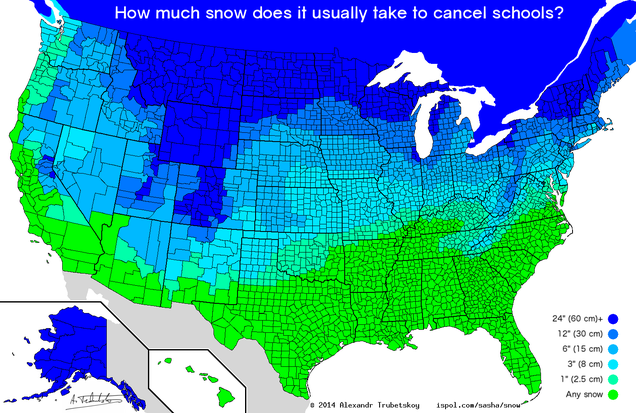
Snow days can be nightmares for working parents. Some areas tend to need very little snow to cause a school closing, while in other areas schools don't blink if there's two feet of snow.
26 Oct 05:05

Verizon Wireless injects identifiers that link its users to Web requests
by Robert Lemos

Cellular communications provider Verizon Wireless is adding cookie-like tokens to Web requests traveling over its network. These tokens are being used to build a detailed picture of users’ interests and to help clients tailor advertisements, according to researchers and Verizon’s own documentation.
The profiling, part of Verizon’s Precision Market Insights division, kicked off more than two years ago and expanded to cover all Verizon Wireless subscribers as part of the company’s Relevant Mobile Advertising service. It appends a per-device token known as the Unique Identifier Header (UIDH) to each Web request sent through its cellular network from a particular mobile device, allowing Verizon to link a website visitor to its own internal profiles. The service aims to allow client websites to target advertising at specific segments of the consumer market.
While the company started piloting the service two years ago, privacy experts only began warning of the issue this week, arguing that the service is essentially tracking users and that companies paid for a fundamental service that should not be using the data for secondary purposes.
Read 13 remaining paragraphs | Comments
03 Oct 04:21
Silk Road Lawyers Poke Holes in FBI’s Story
by BrianKrebs
New court documents released this week by the U.S. government in its case against the alleged ringleader of the Silk Road online black market and drug bazaar suggest that the feds may have some ‘splaining to do.
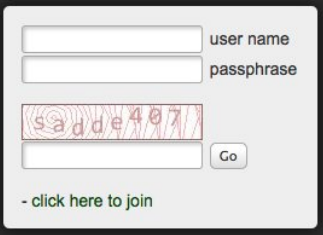
The login prompt and CAPTCHA from the Silk Road home page.
Prior to its disconnection last year, the Silk Road was reachable only via Tor, software that protects users’ anonymity by bouncing their traffic between different servers and encrypting the traffic at every step of the way. Tor also lets anyone run a Web server without revealing the server’s true Internet address to the site’s users, and this was the very technology that the Silk road used to obscure its location.
Last month, the U.S. government released court records claiming that FBI investigators were able to divine the location of the hidden Silk Road servers because the community’s login page employed an anti-abuse CAPTCHA service that pulled content from the open Internet — thus leaking the site’s true Internet address.
But lawyers for alleged Silk Road captain Ross W. Ulbricht (a.k.a. the “Dread Pirate Roberts”) asked the court to compel prosecutors to prove their version of events. And indeed, discovery documents reluctantly released by the government this week appear to poke serious holes in the FBI’s story.
For starters, the defense asked the government for the name of the software that FBI agents used to record evidence of the CAPTCHA traffic that allegedly leaked from the Silk Road servers. The government essentially responded (PDF) that it could not comply with that request because the FBI maintained no records of its own access, meaning that the only record of their activity is in the logs of the seized Silk Road servers.
The response that holds perhaps the most potential to damage the government’s claim comes in the form of a configuration file (PDF) taken from the seized servers. Nicholas Weaver,a researcher at the International Computer Science Institute (ICSI) and at the University of California, Berkeley, explains the potential significance:
“The IP address listed in that file — 62.75.246.20 — was the front-end server for the Silk Road,” Weaver said. “Apparently, Ulbricht had this split architecture, where the initial communication through Tor went to the front-end server, which in turn just did a normal fetch to the back-end server. It’s not clear why he set it up this way, but the document the government released in 70-6.pdf shows the rules for serving the Silk Road Web pages, and those rules are that all content – including the login CAPTCHA – gets served to the front end server but to nobody else. This suggests that the Web service specifically refuses all connections except from the local host and the front-end Web server.”
Translation: Those rules mean that the Silk Road server would deny any request from the Internet that wasn’t coming from the front-end server, and that includes the CAPTCHA.
“This configuration file was last modified on June 6, so on June 11 — when the FBI said they [saw this leaky CAPTCHA] activity — the FBI could not have seen the CAPTCHA by connecting to the server while not using Tor,” Weaver said. “You simply would not have been able to get the CAPTCHA that way, because the server would refuse all requests.”
The FBI claims that it found the Silk Road server by examining plain text Internet traffic to and from the Silk Road CAPTCHA, and that it visited the address using a regular browser and received the CAPTCHA page. But Weaver says the traffic logs from the Silk Road server (PDF) that also were released by the government this week tell a different story.
“The server logs which the FBI provides as evidence show that, no, what happened is the FBI didn’t see a leakage coming from that IP,” he said. “What happened is they contacted that IP directly and got a PHPMyAdmin configuration page.” See this PDF file for a look at that PHPMyAdmin page. Here is the PHPMyAdmin server configuration.
But this is hardly a satisfying answer to how the FBI investigators located the Silk Road servers. After all, if the FBI investigators contacted the PHPMyAdmin page directly, how did they know to do that in the first place?
“That’s still the $64,000 question,” Weaver said. “So both the CAPTCHA couldn’t leak in that configuration, and the IP the government visited wasn’t providing the CAPTCHA, but instead a PHPMyAdmin interface. Thus, the leaky CAPTCHA story is full of holes.”
Many in the Internet community have officially called baloney [that's a technical term] on the government’s claims, and these latest apparently contradictory revelations from the government are likely to fuel speculation that the government is trying to explain away some not-so-by-the-book investigative methods.
“I find it surprising that when given the chance to provide a cogent, on-the record explanation for how they discovered the server, they instead produced a statement that has been shown inconsistent with reality, and that they knew would be inconsistent with reality,” Weaver said. “”Let me tell you, those tin foil hats are looking more and more fashionable each day.”
Stuart.ward.uk likes this
18 Aug 00:04
Facebook Tests "Satire" Tag To Avoid Confusion On News Feed
by samzenpus
Geoffreythat actually makes me sad
An anonymous reader writes "In an attempt to keep you from having to explain to your crazy relatives that despite what they read, Vice President Biden *didn't* get a grow light delivered to the White House under a fake name, Facebook is testing a "satire" tag on news feeds. A Facebook representative issued the following statement to Ars Technica: "We are running a small test which shows the text '[Satire]' in front of links to satirical articles in the related articles unit in News Feed. This is because we received feedback that people wanted a clearer way to distinguish satirical articles from others in these units." 


Read more of this story at Slashdot.
20 Jun 01:09

At least 32,000 servers broadcast admin passwords in the clear, advisory warns
by Dan Goodin
An alarming number of servers containing motherboards manufactured by Supermicro continue to expose administrator passwords despite the release of an update that patches the critical vulnerability, an advisory published Thursday warned.
The threat resides in the baseboard management controller (BMC), a motherboard component that allows administrators to monitor the physical status of large fleets of servers, including their temperatures, disk and memory performance, and fan speeds. Unpatched BMCs in Supermicro motherboards contain a binary file that stores remote login passwords in clear text. Vulnerable systems can be detected by performing an Internet scan on port 49152. A recent query on the Shodan search engine indicated there are 31,964 machines still vulnerable, a number that may not include many virtual machines used in shared hosting environments.
"This means at the point of this writing, there are 31,964 systems that have their passwords available on the open market," wrote Zachary Wikholm, a senior security engineer with the CARInet Security Incident Response Team. "It gets a bit scarier when you review some of the password statistics. Out of those passwords, 3,296 are the default combination. Since I'm not comfortable providing too much password information, I will just say that there exists a subset of this data that either contains or just was 'password.'"
Read 5 remaining paragraphs | Comments
11 Jun 18:52

Android no longer reveals app permission changes in automatic updates
by Dan Goodin
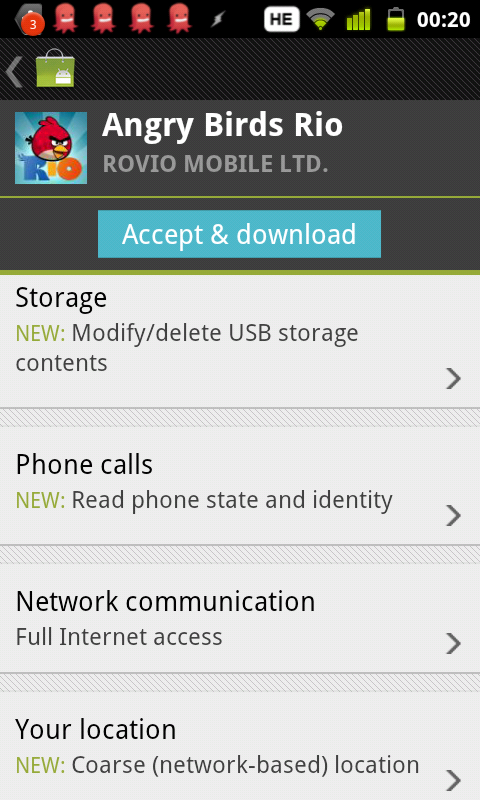
Automatically updating Android apps could get riskier thanks to a change Google developers have made to the way the OS discloses new app permissions, such as the ability to send potentially costly text messages or track a user's precise geographic location.
Previously, automatically updated apps displayed explicit details when a new version gained additional privileges. For example, an app that previously tracked only coarse GPS coordinates would warn users if an update would begin receiving fine coordinates. Similarly, a newly assigned ability to send SMS messages would also be disclosed. Under changes implemented through the latest Play store app, neither new privilege is displayed if a user has previously accepted any other permission in the same category as the new permission. In other words, by accepting one permission from a category, users agree that every other permission in that category can be added without notification in future updates.
The change is an attempt by Google to streamline and simplify the process of installing updates. Rather than providing lengthy details many users likely don't understand, the new permission disclosure is much less verbose. Permissions are indicated only by a very general category such as Location, SMS, or Contacts/Calendar. Users who want to track precisely how a permission may have changed must click the category to see if specific new capabilities have been added. As a result, an app update that replaces coarse location with fine location simply shows the location category. End users must manually drill down to learn of the change.
Read 4 remaining paragraphs | Comments
15 Apr 01:35

TrueCrypt audit finds “no evidence of backdoors” or malicious code
by Cyrus Farivar

On Monday, after seven months of discussion and planning, the first phase of a two-part audit of TrueCrypt was released.
The results? iSEC, the company contracted to review the bootloader and Windows kernel driver for any backdoor or related security issue, concluded (PDF) that TrueCrypt has: “no evidence of backdoors or otherwise intentionally malicious code in the assessed areas.”
While the team did find some minor vulnerabilities in the code itself, iSEC labeled them as appearing to be “unintentional, introduced as the result of bugs rather than malice.”
Read 7 remaining paragraphs | Comments


















































25 Jan 19:36
Bug Exposes IP Cameras, Baby Monitors
by BrianKrebs
A bug in the software that powers a broad array of Webcams, IP surveillance cameras and baby monitors made by Chinese camera giant Foscam allows anyone with access to the device’s Internet address to view live and recorded video footage, KrebsOnSecurity has learned.
 The issue came to light on the company’s support forum after camera experts discovered that the Web interface for many Foscam cameras can be accessed simply by pressing “OK” in the dialog box when prompted for a username and password. Reached via email, the company’s tech support division confirmed that the bug exists in MJPEG cameras running .54 version of the company’s firmware.
Foscam said it expects to ship an updated version of the firmware (Ver. 55) that fixes the bug by Jan. 25. The new firmware will be published on the company’s website. According to Foscam, the problem affects the following models: FI8904W, FI8905E, FI8905W, FI8906W, FI8907W, FI8909W, FI8910E, FI8910W, FI8916W, FI8918W, and FI8919W. Foscam users can determine if their camera is affected by following the instructions here.
Don Kennedy, a camera enthusiast and active member of the Foscam support forum who helped to diagnose and report the firmware problem, also posted a workaround for the bug until Foscam issues an official fix. Kennedy said the vulnerability comes on the heels of another Foscam flaw that drew widespread media attention in August 2013, in which some creep reportedly used a similar vulnerability to shout obscenities at a sleeping toddler.
This is just the latest in a string of such discoveries. In 2012, researchers revealed that a large number of IP cameras made by TRENDnet were similarly vulnerable to snooping by outsiders. While these types of vulnerabilities require outsiders to know the exact Internet address of vulnerable cameras, specialized search engines like SHODAN can be used to pinpoint devices that may not be indexed by typical search engines.

09 Jan 18:11
Planning for 802.11ac
by Jonathan Morin
As the latest wireless standard, 802.11ac, is expected to be ratified by the IEEE in the next few months, it is an inevitable force in the world of wireless. The standard promises more bandwidth for wireless users, and as support in user devices is expected to increase over the next year, more network admins are now considering when and how to make the migration.
But for those who are familiar with the technology already know, upgrading the wireless network won’t be as simple this time as it was in the past. Due to some of the ways that 802.11ac managed to increase bandwidth, as well as the fact that only the 5 GHz band is supported, wireless networks will need to be planned a bit differently, taking new considerations into account. At Extreme Networks, we’ve put together an infographic to hopefully help simplify and better understand what those considerations are by comparing 802.11ac to previous 5 GHz technologies. We hope you find it useful, and look forward to helping make this migration a smooth and seamless one, leveraging the boost in user experience without the pain of unexpected re-planning tasks during and after the migration.

Additional thoughts? Questions? Reach out to us – @JonathanMorin
03 Nov 02:07
'Morris Worm' Turns 25: Watch How TV Covered It Then
by timothy
netbuzz writes "On Nov. 2, 1988, mainstream America learned for the first time that computers get viruses, too, as the now notorious "Morris worm" made front-page headlines after first making life miserable for IT professionals. A PBS television news report about the worm offers a telling look at how computer viruses were perceived (or not) at the time. 'Life in the modern world has a new anxiety today,' says the news anchor. 'Just as we've become totally dependent on our computers they're being stalked by saboteurs, saboteurs who create computer viruses.'" 


Read more of this story at Slashdot.
03 Aug 00:28
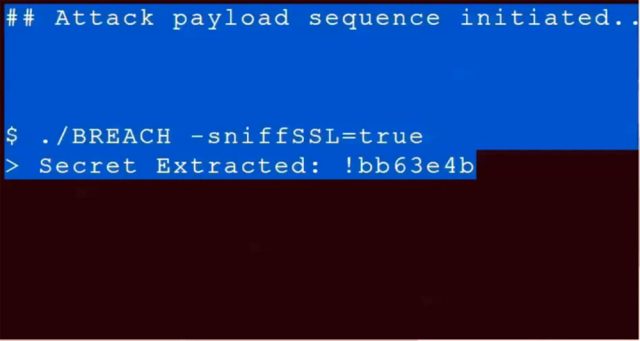


Gone in 30 seconds: New attack plucks secrets from HTTPS-protected pages
by Dan Goodin
A frame from a video demonstration showing BREACH in the process of extracting a 32-character security token in an HTTPS-encrypted Web page.
Prado, Harris, and Gluck
The HTTPS cryptographic scheme, which protects millions of websites, is susceptible to a new attack that allows hackers to pluck e-mail addresses and certain types of security credentials out of encrypted pages, often in as little as 30 seconds.
The technique, scheduled to be demonstrated Thursday at the Black Hat security conference in Las Vegas, decodes encrypted data that online banks and e-commerce sites send in responses that are protected by the widely used transport layer security (TLS) and secure sockets layer (SSL) protocols. The attack can extract specific pieces of data, such as social security numbers, e-mail addresses, certain types of security tokens, and password-reset links. It works against all versions of TLS and SSL regardless of the encryption algorithm or cipher that's used.
It requires that the attacker have the ability to passively monitor the traffic traveling between the end user and website. The attack also requires the attacker to force the victim to visit a malicious link. This can be done by injecting an iframe tag in a website the victim normally visits or, alternatively, by tricking the victim into viewing an e-mail with hidden images that automatically download and generate HTTP requests. The malicious link causes the victim's computer to make multiple requests to the HTTPS server that's being targeted. These requests are used to make "probing guesses" that will be explained shortly.
Read 16 remaining paragraphs | Comments
    
|
21 May 21:45


Reporters use Google, find breach, get branded as “hackers”
by Sean Gallagher
TerraCom's website offers free cell phones to low income customers; its call center company gave customers' personal data away.
Call it security through absurdity: a pair of telecom firms have branded reporters for Scripps News as "hackers" after they discovered the personal data of over 170,000 customers—including social security numbers and other identifying data that could be used for identity theft—sitting on a publicly accessible server. While the reporters claim to have discovered the data with a simple Google search, the firms' lawyer claims they used "automated" means to gain access to the company's confidential data and that in doing so the reporters violated the Computer Fraud and Abuse Act with their leet hacker skills.
The files were records of applicants for the Federal Communications Commission's (FCC) Lifeline subsidized cell phone program for low-income consumers. The applicants' information was collected for the telecom providers YourTel and TerraCom by Vcare, an India-based call center service contracted to verify applicants' eligibility. To qualify for the program, customers need to submit proof that they are enrolled in a federal or state assistance program such as Supplemental Security Income, food stamp programs, and the federally funded free school lunch program.
Vcare and the telecom providers are explicitly required to not retain this data under the regulations of the FCC program. However, the data was retained on Vcare's servers and posted to an open file-sharing area—and apparently indexed by Google's search engine in the process.
Read 3 remaining paragraphs | Comments
No more posts. Check out what's trending.