Shared posts

11 Jun 00:53

Newswire: Morrissey has canceled his tour—again

by Marah Eakin
firehose

"For some cities on that tour—Chicago, for example—this marks the third or fourth time in a row Morrissey has bailed on a show."

Morrissey has pulled a Morrissey and canceled all upcoming dates on his North American tour. In a statement, Morrissey’s team said, “The respiratory infection Morrissey contracted in Miami has worsened, and in the interest of making a full recovery,” the Smiths frontman needs to stay home with his sniffles. The statement goes on to say, “Morrissey thanks his fans for their compassion, understanding, and well-wishes during this difficult period as he recuperates.” 

For some cities on that tour—Chicago, for example—this marks the third or fourth time in a row Morrissey has bailed on a show. Morrissey had 11 dates remaining on this run, including stops in New York, Boston, and Washington, D.C. No word on when these may be rescheduled, then canceled.

11 Jun 00:41

Here's NASA's New Design for a Warp Drive Ship

by Annalee Newitz
firehose

I'll take two, please

kind of wish they'd put the mesh up somewhere so someone can build it into a sim

https://www.flickr.com/photos/123021064@N05/sets/72157644113972600/

Here's NASA's New Design for a Warp Drive Ship

In 2012, NASA physicist Harold White revealed that he and a team were working on a design for a faster-than-light ship . Now he's collaborated with an artist to create a new, more realistic design of what such a ship might actually look like.

Read more...


11 Jun 00:40

D&D Next (5E) D&D Licensed Tools: Morningstar!

by Morrus
firehose

their online toolkit being built by a company that hasn't released or updated a product in 2.5 years

This has appeared on WotC's website:

We are excited to announce our newest licensee, Trapdoor Technologies. Trapdoor is working on an integrated toolset and rules knowledge base to support the new edition of Dungeons & Dragons. Combining rules, character sheets, and adventures together into a clean interface, Trapdoor's goal is to create tools for Dungeon Masters and players that will allow for fast and easy management of their game. Known for now as Codename: Morningstar, the tools will have a limited playtest at Origins Game Fair.

To learn more about Codename: Morningstar, Trapdoor Technologies and how to participate in the upcoming beta, visit codenamemorningstar.com.

There's nothing at the site quite yet, but it looks like we now know a little more about WotC's plans for online tools!

More info here:
http://www.enworld.org/forum/content...ls-Morningstar!
11 Jun 00:39

Eric Cantor Loses G.O.P. Primary - NYTimes.com

by gguillotte
firehose

WOWWWWWWWWWWWWWWWWWWWWWWWWWWWWWWWWWWWWWWWWWWWWWWW

In a stunning upset, Eric Cantor of Virginia, the House majority leader, has lost the Republican primary to Dave Brat, a Richmond-area college professor who ran to Mr. Cantor’s right. Mr. Cantor was expected to cruise to victory, although he had been pushed to portray himself as a hard-liner, especially on immigration. The results were foreshadowed at a district convention last month in Henrico County, Mr. Cantor’s home base, when conservatives ousted one of his loyalists as chairman while he looked on.
11 Jun 00:20

PORTLAND’5 Ticketing | NEIL deGRASSE TYSON

by gguillotte
firehose

Tickets starting at $35. This is for a second day of lectures that was added after the first sold out.

Enjoy an evening with astrophysicist Neil deGrasse Tyson! Doors will open 1 hour prior to show time. Wednesday, September 17, 2014 at 7:30 pm. Facility: Arlene Schnitzer Concert Hall
11 Jun 00:20

Male Teen Kills Student in Oregon School and Then Himself, Police Say - ABC News

by gguillotte
firehose

The gym teacher who was grazed was apparently the target.

Witnesses said a male fired an assault rifle in the school locker room and outside the gym, chasing physical education teacher Todd Rispler. Police Chief Scott Anderson confirmed that Rispler had suffered minor injuries and was treated at the scene. Authorities said they'd identified the shooter but would not release his name yet. They were notifying the shooter's parents as well as the parents of the student who was killed. According to The Associated Press, Troutdale police found the gunman dead in a school bathroom. His cause of death was not released. Authorities did not say whether he was a student at Reynolds.
10 Jun 23:48

So much Arctic ice has melted that we need a new atlas

by Gwynn Guilford
This satellite image released by NASA Wednesday Sept. 28, 2005 shows the minimum concentration of Arctic sea ice in 2005 occurring on September 21, 2005, when the sea ice extent dropped to 2.05 million sq. miles, the lowest extent yet recorded in the satellite record. New satellite observations show that sea ice in the Arctic is melting faster while air temperatures in the region are rising sharply, scientists say. Since 2002, satellite data have revealed unusually early springtime melting in areas north of Siberia and Alaska. Now the melting trend has spread throughout the Arctic, according to a national collaboration of scientists study released by the University of Colorado at Boulder's National Snow and Ice Data Center statement released Wednesday Sept. 28, 2005. (AP Photo/NASA

It used to be wars, Communism and colonialism that kept atlas illustrators on their toes. These days, though, their biggest headache is global warming.

For instance, when the National Geographic Atlas of the World is published this coming September, its renderings of the ice that caps the Arctic will be starkly different from those in the last edition, published in 2010, reports National Geographic.  That reflects a disquieting long-term trend of around 12% Arctic ice loss per decade since the late 1970s—a pace that’s picked up since 2007. This comparison from the US National Snow and Ice Data Center, although not the one used by National Geographic, should give a sense of how much skimpier that Arctic ice cover has gotten:

But drawing Arctic ice isn’t as uncontroversial as you might think. A few years ago, the Times Atlas mistakenly suggested that the Greenland ice sheet had shrunk by 15% since 1999, which it later retracted. Even choices made by the National Geographic atlas geographers have elicited criticism.

First is the issue of which years to compare. Arctic ice trends vary wildly by year. The atlas geographers’ use of data from 2012—a freakishly low year—risks misleading readers, as Walt Meier, a scientists at NASA’s Cryospheric Sciences Lab, told NatGeo.

Then there’s the matter of which ice to illustrate.

Every winter, cold temperatures seal the Arctic under a sheet of ice. By late summer, though, the sun’s warmth has melted millions of square kilometers of that ice. Scientists refer to these two seasonal extremes as  “total maximum sea ice cover,” measured in March, and “total minimum sea ice cover,” taken in September (that’s what’s in the YouTube above). Here’s how both measures in 2013 compared with those of 1980:

Tap to expand image
Note the increased variation in the “total minimum” metric.​National Snow and Ice Data Center

There’s also a third crucial metric: “multiyear ice,” which is ice that has survived at least two summers without melting. This older ice is a vital buttress against faster melting and the rising sea levels that would result. Typically three to four meters (10 to 13 feet) thick, multiyear ice is harder to melt and reflects more sunlight than new ice does, keeping solar heat from warming surrounding seas, which would accelerate melting all the more.

Not long ago, multiyear blanketed the Arctic. But that older ice has receded at a much brisker clip than the young, thinner ice. Now just 7% of Arctic ice is at least five years old, half of what it was in 2007, and a quarter of what it was in the late 1980s.

Tap to expand image
​National Snow and Ice Data Center

In order to become older ice, of course, younger ice has to stay firm right through the year. The “total minimum sea ice cover” is a measure of how much ice makes it through summer without melting. But the National Geographic atlas depicts the ice as it stands in March (“total maximum sea ice cover”), before a lot of it has melted, which NASA’s Meier says might mislead the public.

The atlas’s geographers, however, say that there’s only so much they can include before they confuse the reader. And they have a point; keeping the three metrics straight is tough. They also vary so widely that looking at one or two data points alone risks exaggerating the overall trend. And seen in aggregate, the long-term trend doesn’t need exaggeration: The yellow line below shows the sea ice extent in 1980, the black is the 1981-2010 average, and the brown is 2013. Even if you treat 2007 (blue line) and 2012 (dotted line) as outliers, that’s an alarming decrease.

Tap to expand image
​National Snow and Ice Data Center


10 Jun 23:46

Why 1 million Chinese migrants are building a new empire in Africa

by Howard W. French
An alternative path to prosperity.

After days of coordinating with me over patchy cell phone connections, Hao Shengli arrived in Mozambique’s capital city of Maputo. He’d come to load up on supplies and to collect me for the long ride back to the farmland he owned in a remote southern part of the country.

When his white Toyota pickup stopped in front of my hotel, Hao was barking into his phone. He was in a hurry, and he was angry. There was a brisk handshake, followed by a lot more shouting in salty Chinese as he struggled to make himself understood by a country man from whom, I could grasp, he wanted to buy goods.

“China is a big fucking mess with all of its “fucking dialects,” Hao said to me in English after hanging up.

As I stood there, already sweating in the midmorning heat, Hao began to train his abuse on John, his tall and sinewy Mozambican driver, who had been coolly smoking a cigarette while rearranging the supplies on the Toyota’s flatbed to make room for my bags.

“You, cabeça não bom, motherfucker,” he said. The final curse came in Chinese: he’d employed three languages in one short and brutal sentence.

Having overheard me speaking Spanish to the driver and assumed it to be Portuguese, he pleaded with me to help him translate. “Could you please explain to this motherfucker where we need to go? We’ve got to get out of here. We need to be on the road.”

For more than a decade, the Chinese government has invested hugely in Africa. The foundation for this partnership was laid in1996, when President Jiang Zemin proposed the creation of the Forum on China-Africa Cooperation (FOCAC) in a speech at the Organization of African Unity headquarters in Addis Ababa. Four years later, FOCAC convened triumphantly for the first time, gathering leaders from forty-four African countries in Beijing. China pledged, among other things, to double assistant to the continent,create a $5 billion African development fund,cancel outstanding debt, build new facilities to house the OAU (later replaced by the AfricanUnion), create “trade and. economic zones” around the continent, build 30 hospitals and 100 rural schools, and train 15,000 African professionals. Fitch Ratings estimated that China’s Export-Import Bank extended $67.2 billion in loans to sub-Saharan African countries between 2001 and 2010-$12.5 billion more than the World Bank.

Although there are no official figures, evidence suggests that at least a million private Chinese citizens have arrived on African soil since 2001, many entirely of their own initiative,not by way of any state plan. This “human factor”has done as much as any government actionto shape China’s image in Africa and condition its tics to the continent. By the timeI met Hao, in early 2011, merchants in Malawi,Namibia, Senegal, and Tanzania were protesting the influx of Chinese traders. In the gold-producing regions of southern Ghana, government officials were expelling Chinese wildcat miners. And in Zambia, where recent Chinese arrivals had established themselves in almost every lucrative sector of the economy, their presence had become a contentious issue in national elections.

Aswe left the capital, we passed the new national stadium, nearing completion byChinese work crews at the edge of town. Built to support the country’s bid to host the 2013 continent-wide Africa Cup of Nations, it was a showcase gift from the Chinese government,intended as a statement of generosity and solidarity. China has become an avid practitioner of this kind of prestige-project diplomacy. I asked Hao whether a $65 million stadium was the best sort of gift for Mozambique, one of the ten poorest countries in the world.

“Chinese government projects in Mozambique have all failed,” he said. “That’s because the Chinese ganbu [bureaucrats] don’t know how to communicate on the same level with the blacks.” He shook his head and wagged a stubby index finger excitedly.

I asked him about his early days in the country. A prior attempt to do business overseas,in Dubai, had gone bad. Chinese agricultural experts there who had been on African aid missions planted a very powerful idea in his mind: Go to Africa, where you can acquire good land cheaply. He had flown to Maputo alone, and no one had greeted him at the airport. “I didn’t understand a fucking word thatwas being said to me.” On his own, he made his way into town and found a flophouse. Making little headway-he spoke neither Portuguesenor English- he soon gave in to the temptation to call up some fellow Chinese he had found online while still in China.

“I thought if I met a few people I could distract myself a bit, learn about the situation from them, and then figure out how to get some land. But I quickly discovered that not all Chinese people are your friends. The Chinese folks here, or at least a portion of them,a big portion of them, are really bad characters.They arc looking for a way to get hold of your money. Yeah, they’ll do any thing for you, but they won’t do anything for free. It’s all about money.”

Hao had naively loaned money to various Chinese people he met who seemed to have fallen on hard times and offered to help guide him. A few months later, having been burned by several such encounters, he left for the countryside, following the very route we were taking northward.

When he reached the southern part of Inhambane province, he said, he contacted the provincial government about acquiring land, and they directed him to local officials. He found some who were receptive, and he set about ingratiating himself by helping on road and bridge-repair projects.

“I took chargeof the work all by myself,” he said proudly. “In the end, 1 was able to secure a piece of land.”

Hao had scored big, but before long there were other things to worry about. He hadn’t thought much about the people who lived on the land or controlled it before he came along,or even who his neighbors were. After a period of warm enough hospitality, people from nearby villages began to ask him how he had gotten the land and to demand compensation,with some of them, claiming the area was an ancestral holding.

“The local people are really not friendly. They arc peasants, and they resent the idea that the government took their land and gave it to us. They have no land for themselves. They’re not comfortable. They are working forus, and they arc not comfortable with it. In fact, the Mozambique government has given us land, but it’s not forever. After a few years, once we’ve put the land to good use, perhaps they will take another tack and try to reclaim it from us. But we’ve got our own ideas. We’re also making plans.”

The first-person plural had been creeping into his banter, but only now did its significance become clear.

“I have been bringing my children here,” he said. “My older son, my younger son, eventually my daughter. I’m taking them out of school in China and bringing them all here. Within the next ten or so years we need to raise enough money, and then if my son has a lot of offspring with local girls-my two sons, in fact, if they’ve had lots of children-well,what do the children become! Are they Chinese or Mozambicans?”

Hao told me his older son already had a live-in African girlfriend. Then he proceeded to answer his own question. “The mothers are Mozambicans, but the land will be within our family. Do you get it! This means that because the children will be Mozambicans they can’t treat us as foreigners. If need be we can even put the property in their name, protectively, but it will remain ours. It will be in my clan.”

Hao said that his older son had been with him on his newly acquired land for about half a year now. His younger son, who was 14, had ‘joined them a few weeks earlier. “The older boy is doing fine already,” he said, with evident pride. “He’s doing a lot of training.”

“Training?”

“I’m guiding him,” he said. “It’s not hard physical labor. I have to encourage him, have him fool around a bit, catch some fish, shoot a gun, hunt some birds. Boom, boom! That way he’ll be happy. He already shoots well.”

I told him that his son’s experience seemed to mirror the way youth were treated in theCultural Revolution, when schools were closed and young people were “”sent down” by the millions to work alongside peasants in the countryside.

“That’s how I was raised. Young people in China today no longer learn bow to chi ku,”he said. The expression means to “eat bitterness,” to endure great hardship. “I want my son to become a real man, a worthy person.”

After a couple hours’ on the road, we dropped John off at the main square of Maxixe,a snoozy little drive-through town that nonetheless enjoys the status of economic capital of Inhambane. John, who was from Maxixe, spoke happily about being able to sleep at home with his family after several days away. His main employers, a group of road builders from Hao’s home province of Henan, shared a house just off the narrow main road. When Hao invited me into their home, he introduced them as lao xiang, people from his hometown or region, a connection that resonates deeply for many overseas Chinese. Hao’s friends lived in a modern, one-story villa with a large living room and a kitchen in the back, from which emanated the very distinctive aromas of a home-cooked Chinese dinner, In the living room, which had the feel of a frat house, two men and a woman were hunched in nearly identical poses over laptops, each at a separate cheap desk, connecting with friends in China.

I secretly hoped that we would be asked to stay for dinner. The traditionally generous hospitality I was accustomed to from traveling in China seemed to make this a safe bet, but no invitation came, Hao talked business with one of the Henan road men in an adjacent bedroom and then we were on our way, with Hao at the wheel. His banter picked up again as he spoke of the utility of having friends, especially laoxiang like this, living nearby.

“I’ve only gotten sick once since I’ve been here, but it was malaria, and it was a very badcase,” he told me. “I’m lucky that they came looking for me. I was laid out flat on my back atmy farm, all alone, sweating and shivering there in my own vomit, They took me right away to the hospital, and I’m told that this saved my life.”

The full moon had risen high in the sky,and we had begun slicing through little townships every few minutes as the population density of the area increased. There were glimpses of prayer vigils in clapboard churches; smoky, ramshackle saloons filled with garrulous drinkers; women sitting by the roadside wrapped in printed shawls, hunched, half asleep over storm lanterns as they awaited nighttime buyers. All this activity signaled a city was nearby. Hao announced with relief that we were about to enter Massinga, the city nearest to his farm. I asked him how he had come to settle in Mozambique.

“I went to an African trade fair in Fujian province and there were lots of Chinese businesspeople there,” he said. “I got excited by all the talk of business opportunities in Africa. Later I figured my· English is no good, though, so I got the idea that if I went to an English-speaking country, English being a popular language, Chinesepeople would be everywhere.

“I’ll be damned if I understood Portuguese, but damn it, I figured, neither do most Chinese people in general, so what the fuck? There must be great undiscovered opportunities there, and I won’t have to be constantly looking over my shoulder for other Chinese coming to compete with me, cheat me out of my money, or steal my ideas.”

As we pulled into Massinga, Hao announced, almost sheepishly, a major change of plans, He had decided to have me sleep at a cheap hotel rather than, host me himself. He had been unable to reach his son, he said, to make sure there was dinner waiting for us, and this way I’d be sure to have an evening meal.

In the courtyard of the roadside hotel, we sat at a plastic table with an exposed bulb above us and ordered a late dinner. While we waited for the food, Hao asked me for the third time that day about my itinerary. I told him I’d just been in Ethiopia and that the next country on my itinerary was Namibia.

“What is Namibia?” he asked.

I drew him a crude map in my spiral note; book. “Ethiopia is up here,” I said, pointing to the continent’s northeastern shoulder. “Mozambique is here. And Namibia is over here. It’s on the Atlantic coast.” Hao wanted to know how far away that placed Namibia from where we were. Several hundred miles, I said.

I started to fill in the map to show him some of the other countries I planned to visit.

When I sketched Senegal’s position, at the continent’s westernmost point, I added Europe, tracing its downward slope toward Africa.

“Here is Portugal,” I said, which produced a look of confusion. He asked me what Portugal was exactly. It was the colonial power that once controlled Mozambique, I told him. As he nodded, still looking uncertain, I added that it was the place where the Portuguese language came from.

He knew that Mozambique had been a European colony, a zhimindi, but he had not known it had been Portugal’s colony. “I thought Portuguese came from Brazil,” he explained.

I drew South America on the map for him and told him that Brazil, too, had been a Portuguese colony. Hao began making some connections, thinking of Macau, the tiny formerly Portuguese enclave near Hong Kong.

“Son of a bitch,” he exclaimed. “You wonder how the fuck little countries like Portugal controlled so many big, faraway countries. It’s just like the way the Europeans carved up China, I suppose.” After a pause, he asked: “Where is America?”

I sketched North America onto my crude and now crowded map. Hao had always assumed that it was part of Europe.

Hao’s geographic curiosity waned and the conversation shifted back to his African ambitions, which apparently went far beyond his farm. “I’ve got lots of other plans, lots of projects,” he said. “1 want to open a beverage factory. I want to produce tea for sale and for export that will be grown on our own land.” There was talk about building a charcoal-processing factory, for which he had already broken ground, 120 miles to the north. It would produce honeycombed braziers for cooking. At first, he said, these would be sold only in Mozambique. but later the export potential back to China, and perhaps around the world, would be very great.

As we drove northward out of Massinga the next morning, Hao became reticent, and he offered only clipped, almost grudging answers to my questions. After we were waved through a roadblock at the edge of town, he pulled over suddenly. He said he didn’t enjoy driving, and asked if I would take over. With me at the wheel, we proceeded in a vaguely eastward direction down a graded trunk road, which soon led us past a tiny settlement where a cluster of people by the roadside gave us a halfhearted wave. Beyond this dusty outpost lay dense, tangled bush punctuated now and then by a neatly swept clearing with a solitary aluminum shack.

The road had narrowed considerably and the smoothness of its first leg had given way to an obstacle course of divots and tree stumps and the occasional peasant balancing huge loads of scavenged wood atop his head. Hao instructed me to stop up ahead, where I could see the road cresting beneath a stand of oil palms in the distance. When I reached that point, we came upon a group of men sitting and standing in conversation at the edge of a cleared field. Hao stuck his head out the window and began calling out in his unique and polyglot pidgin: “Ganma, ganma, zheli, trabalho, ganma? Wei shenme? What are you doing? What are you doing? Here, work. What are you doing? Why?”

The local men gestured off into the distance and answered that someone else was paying better now. This was a showdown over wages, a walkout. “Why should you pay us differently?” one of the Mozambican men asked.

Hao grew excited and started to curse. He was saying, mostly in Chinese, that he was not going to raise their pay. The two sides went back and forth like this for a few minutes. Hao was sweating profusely, wiping his brow with a hand towel. “Forget it. I don’t need you,” he said. “I’ll find other workers.” With that, the men picked up their belongings and trudged off in the direction we had just come from.

Hao laughed even as he continued to swear. “Africans like nothing better than to get together and complain,” he said. “My son told me we don’t need these people any longer, though. Why should we pay them more?”

Within a few minutes, Hao’s homestead appeared around a bend. There were two shacks thrown together roughly with poles, canvas, straw mats, and whatever other cheap materials were at hand. We climbed out of the vehicle into the heat and light.

Hao was eager to show me the place. Beyond the huts lay his experimental garden, a handful of acres where he was already growing stevia, tea, and a variety of Chinese vegetables.

He plucked some of the stevia leaves and crumpled them in his hand, urging: me to taste them, which I did; they produced an instant and overpowering sweetness.

We circled back around the huts and wandered into a large, open plain. The dark, pliant soil was crisscrossed with irrigation canals. Hao pointed out the concrete blocks here and there, sunk in the muck of the channels. He explained that they were the remnants of a system of locks that had been built by the Portuguese.

“They built all of this and then they left it,” he said, evidently bewildered. “When we first arrived, even our tractors had trouble passing here. I had to employ a lot of blacks to dear the fields, and I had to clear them three times before the bush would finally yield.” He fixed me with a fierce expression and offered his best measure of himself. “Some of the Chinese who have come to work the land in this country under sun this strong have failed,” he said.”Others before them have failed, too. But for me, there is no such thing as failure. I am no ordinary man.”

Excerpted from China’s Second Continent by Howard W. French Copyright © 2014 by Howard W. French. Excerpted by permission of Knopf, a division of Random House LLC. All rights reserved. No part of this excerpt may be reproduced or reprinted without permission in writing from the publisher. We welcome your comments at ideas@qz.com. 

10 Jun 23:44

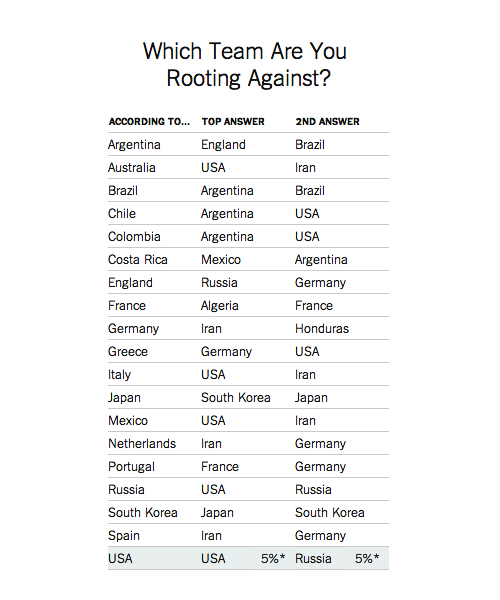
Everybody hates everyone, World Cup

firehose

LOL RUSSIA!


Everybody hates everyone, World Cup

10 Jun 23:36

keyframedaily: lapitiedangereuse: This was Marlene Dietrich’s...

firehose

via Russian Sledges


keyframedaily:

lapitiedangereuse:

This was Marlene Dietrich’s first trip to America, just shortly after the Berlin premiere of “The Blue Angel”. Joseph von Sternberg had invited her to Hollywood where he would transform her into the svelte, glamorous film star she later became.

Watch The Blue Angel (1930).

10 Jun 23:28

Watch David Lynch interview the dead Leland Palmer (Ray Wise)...

firehose

via Russian Sledges


Watch David Lynch interview the dead Leland Palmer (Ray Wise) for the Twin Peaks box set above and see a restoration comparison below:

See the full details on the set here.

10 Jun 23:28

Defend yourself! - Imgur

by djempirical
10 Jun 23:27

Tom Lehman joins The Long View podcast to discuss his design process, playtesting, publishing,...

firehose

no, not that Tom Lehman. no, not that Tom Lehman either.

wtf is it about giving people who have the last name Lehman the first name Tom, stop it. stop it

Tom Lehman joins The Long View podcast to discuss his design process, playtesting, publishing, collaboration, expansions and more:

http://boardgamegeek.com/boardgamepodcastepisode/120244/the-long-view-tom-lehman-interview

10 Jun 23:25

Debate Over Wooden or Plastic Cutting Boards Ends Here | Organic Authority

by OnlyMrGodKnowsWhy
8d2cc425146099670fad12b892654e24
OnlyMrGodKnowsWhy

Augh everything I know is a lie

You see both of them at Sur La Table, in friends’ kitchens, even in professional kitchens—both wooden and plastic cutting boards. But which is really better? The debate is as old as good versus evil itself: old, natural ways versus new, improved (and somewhat questionable) technologies. While each home cook has their preference, one actually is better than the other. Do you know which it is?

First, let’s look at the arguments for each cutting board.

The plastic cutting board:

  • Plastic is cheap. Downright cheap. At 5 to 10 bucks a pop, you can buy a plastic cutting board for every season, every food group, hell, every kitchen counter. A small pink one for the meats, a large green one for the veggies—it’s convenient and cheap. That’s why Americans love their plastics.
  • Then there’s the sanitary belief that plastic is dishwasher-safe, so it can be popped in for a clean, sanitary washing (unlike wooden boards, which are not dishwasher-safe).
  • Plastic is non-porous, meaning it doesn’t allow things to soak into it as easily as things made of natural fibers (aka wood). Proponents of plastic believe that since bacteria can’t soak into the cutting board, it’s a safer, more sanitary option.

But in reality, the non-porous surfaces of plastic are only good as long as they are brand-spanking new. Once knives start chopping into plastic cutting boards, they create irreparable nicks, scratches and divots in the board—creating permanent homes for bacteria which can’t be cleaned or washed thoroughly.

Now let’s look at the case for wooden cutting boards:

  • Wooden cutting boards have been the choice for thousands of years, so they appeal to the mentality that loves “tried and true,” old-fashioned and au natural products.
  • Then there’s the pro-porous theory of wood. Since wood is porous, it allows bacteria to settle in, but because of the way the wooden grains align, all bacteria are trapped, suffocate and die. So the bacteria come in, and they die. 
  • Furthermore, you’ll never see the nicks, bumps and scrapes of a plastic cutting board on a wooden one. Their grains prevent any knife cuts on the board, which results in a long-lived cutting board that doesn’t produce dents. It’s easier to clean than a dented and dinged plastic board, and thought to be more sanitary because of it.

So what’s the better choice?

UC Davis Food Laboratory conducted a rare independent study comparing the two cutting boards, and the verdict is out: wooden cutting boards are better. Even the oldest wooden cutting boards still performed as well as new, and they cleaned just as easily. Old plastic boards, on the other hand, were impossible to get all the bacteria out of, and the bacteria persisted on the surface.

Take that; new, cheap technology.

Image adapted from sidewalk flying, Flickr, Creative Commons 2.0

Original Source

10 Jun 23:22

Violent crime is down in Denver since Colorado legalized marijuana.

by Mark Strauss

Violent crime is down in Denver since Colorado legalized marijuana. Data shows murders, assaults and burglaries declined during the first three months of the year, compared with the same period for 2013. Some opponents, however, say the criminal effect of decriminalizing marijuana won't be felt for several years

Read more...


10 Jun 23:20

EditShare Opens Public Beta for Lightworks for Mac

by Bryant Frazer
firehose

my company (but not my office's product)

"the first pro NLE to be available on three platforms — Mac OS X, Windows, and Linux. It's perhaps best-known as the editorial system of choice for Thelma Schoonmaker, who has been cutting Martin Scorsese's features for decades, dating back to Raging Bull. But it was also used on The King's Speech, Bruce Almighty, Pulp Fiction, and The Truman Show."

EditShare made its Lightworks NLE available on the Mac yesterday, with the release of a public beta version of the software. That makes Lightworks the first pro NLE to be available on three platforms — Mac OS X, Windows, and … more »
10 Jun 23:19

Credit Card Breach At P.F. Chang's

by Soulskill
schwit1 tips a post by Brian Krebs saying that P.F. Chang's China Bistro, a nationwide restaurant chain, is the latest victim of a massive data breach. The company is currently investigating. Krebs writes: On June 9, thousands of newly-stolen credit and debit cards went up for sale on rescator[dot]so, an underground store best known for selling tens of millions of cards stolen in the Target breach. Several banks contacted by KrebsOnSecurity said they acquired from this new batch multiple cards that were previously issued to customers, and found that all had been used at P.F. Chang's locations between the beginning of March 2014 and May 19, 2014. ... The items for sale are not cards, per se, but instead data copied from the magnetic stripe on the backs of credit cards. Armed with this information, thieves can re-encode the data onto new plastic and then use the counterfeit cards to buy high-priced items at big box stores, goods that can be quickly resold for cash (think iPads and gift cards, for example).

Share on Google+

Read more of this story at Slashdot.


10 Jun 23:19

I Still Love Batman

I just don’t love the version where he’s a creep or a fascist.

You can still write a Batman who cares about people, that’s the Batman I care about. Almost all my favorite Batman writers have that element in their version of the character. 

If I wanted to read the Punisher, I’d read the Punisher. 

10 Jun 23:16

Verizon bungled attempts to get fiber in NYC buildings, landlords say

by Jon Brodkin
firehose

all carriers suck forever

'In one case, Verizon wrongly identified an ophthalmologist named Tammy Chu as the owner of a building. When Chu received a complaint from Verizon in December 2013, she informed the company that she was not the owner of the building and therefore had no authority to deny or permit any installations inside the structure. Yet two months later, she received another letter from Verizon in the form of a petition for orders of entry, she wrote in a letter to the State Public Service Commission and Verizon.

"Verizon should do some research to confirm the names of the building owners before making accusations," she wrote. "Such erroneous accusations should not be inconsequential. This experience indicates how incompetent Verizon is."

In response to another petition from Verizon, Sequoia Condominium attorneys wrote in April that Verizon "failed to properly seek access to the subject premises prior to the commencement of this proceeding." The building operator "has made numerous attempts to schedule access for the installation of the fiber optic network with various Verizon representatives." The condo superintendent met with a Verizon contractor to determine next steps, but "thereafter, no further communication nor any additional attempt to access the subject premises for the purpose of the installation of the aforesaid fiber-optic network was made by any Verizon representative."

A building owner in the Bronx wrote, "I have tried repeatedly to reach out to Richard Fipphen, the Verizon representative, to arrange for Verizon to have access, but have not received a response. I would be glad to arrange access for Verizon, please have someone contact me to move this matter along."'
...
'An IT manager for a real estate firm headquartered in NYC told Ars that "Verizon has not been cooperative in getting FiOS service to our properties. In most cases, we've been on Verizon's waiting list for over twelve months. We used to try to get regular updates from Verizon on their install schedule, but our dedicated reps rarely return phone calls… We even offered to pay all capital expenses associated with the build-in, but this did not change their attitude. In one case, we were successful in bringing FiOS to one of our Fifth Avenue office properties, but only after the client, who has a personal relationship with a Verizon VP, made a personal request."'
...
'Building owner Hamdi Nezaj didn't want to give Verizon access to his buildings because of a bad experience with the company. "On 3 properties that I own, the installation of FiOS was done recklessly," he wrote. "The installation consisted of drilled open holes that created damage to the foundation of the building, while stapled wires were left exposed and hanging."

At one building, installation was never completed. "I voiced my objections to Verizon [about] the work performed, noting the reckless work performed on the property, and still even after 2 years, they never came back to fix the holes that were drilled, fix the boxes they installed, and put molding on their respective wires," he wrote.'

But probably not where you live.

With Verizon struggling to bring FiOS to every corner of New York City as promised, the company has been arguing with landlords about gaining access to buildings where tenants might want to buy Verizon's fiber-based Internet, phone, and TV service.

Verizon's fiber now passes buildings in "90 percent of the Bronx, 89 percent of Brooklyn, 94 percent of Manhattan, 90 percent of Queens and virtually the entirety of Staten Island," the company says. That's short of the 100 percent Verizon was supposed to achieve by June 30, 2014 according to its franchise agreement. And the percentage of buildings where residents can actually buy FiOS is lower.

"The various percentages refer to the amount of fiber in the streets and avenues, our obligation. The numbers have nothing to do with building penetration," Verizon spokesperson John Bonomo told Ars.

Read 23 remaining paragraphs | Comments

10 Jun 23:11

Portland-area population could jump by 725,000 in 20 years, Metro forecasts

10 Jun 22:50

DC Comics Writer Chuck Dixon Claims His Conservative Politics Lost Him Jobs in Comics

firehose

'Dixon and artist Paul Rivoche (whose graphic novel adaptation of a popular conservative reading of the history of the Great Depression hit shelves in the last month)'

gee what a coinkeydink

Chuck Dixon has not just written a lot of Batman comics, he was heavily involved in my favorite era of the character, in which the state of Batman's relationships with his various surrogate family members and friends held just as much weight as his triumph over his foes. And while Gail Simone is more closely associated with the Birds of Prey, Dixon was the first to popularize the all-female superhero team in a way that wasn't primarily for the male gaze. From his most popular and longstanding work in the DC Universe alone, you would not immediately guess that Dixon is an outspoken social conservative. This weekend, Dixon and artist Paul Rivoche (whose graphic novel adaptation of a popular conservative reading of the history of the Great Depression hit shelves in the last month) published a post on the Wall Street Journal's opinion section bemoaning the predominantly liberal bias of modern comics (as they see it), claiming that Dixon's career dried up once he started to voice his political views in the workplace, and calling conservative creators of all stripes to take up the torch and catch up to the left wing in their dominance of the market. I think.
10 Jun 22:44

carudamon119: カップヌードルCM 「サムライ in ブラジル 」 Cup Noodle’s commercial...


carudamon119:

カップヌードルCM 「サムライ in ブラジル 」

Cup Noodle’s commercial film “Samurai in Brazil”

10 Jun 22:41

Examples of work and flawless colors from Tadahiro Uesugi


Examples of work and flawless colors from Tadahiro Uesugi

10 Jun 22:37

Vincent D’Onofrio Joins The Netflix Daredevil Series As Classic Marvel Character

firehose

Kingpin

No, not that one.
10 Jun 22:30

Alienware Steam Machine now a Windows PC for the living room

by Peter Bright
firehose

"Starting at $549" glwt

Alienware

Dell-owned Alienware plans to take the PC into the living room with a new PC called the Alpha. The Alpha was intended to be a Steam Machine running Valve's Debian Linux-based SteamOS—it was first shown off with a dozen other Steam Machines at CES earlier this year—but that's no longer going to be the case.

With Valve delaying the Steam Machines until 2015 after design issues with its Steam Controller, Alienware has had to change its plans. The Alpha will ship with 64-bit Windows 8.1 and a wireless Xbox 360 controller instead.

The systems are on track to ship during this year's holiday season. Starting at $549, the Alpha will come with a Core i3 Haswell processor, 4GB RAM, a 500GB hard disk, dual-band 802.11ac 1x1 Wi-Fi, Bluetooth 4.0, HDMI in and out, gigabit Ethernet, and two each of USB 2 and USB 3 ports. Upgrades will include Core i5 and i7 processors, 8GB RAM, hard disks up to 2TB, and 2x2 802.11ac.

Read 2 remaining paragraphs | Comments

10 Jun 22:29

FCC says it wasn't hacked, its commenting system is just old

by Jacob Kastrenakes

Issues with the Federal Communications Commission's aging comment system likely led to it going down for several hours last week, a falter that gained wide attention as many associated it with a viral segment from John Oliver's new HBO series calling for people to comment on the commission's controversial new net neutrality proposal. Though the FCC has not pinpointed an exact cause, it says that a certain database error that can cause the commenting system to freeze occurred in large numbers last week due to an increase in traffic. It says that it has no signs that this was the result of hackers though. "We do not have evidence to suggest it was a malicious attack or a nefarious activity," an FCC spokesperson tells The Verge.


"It's not set up to receive the load of comments we received last week."

Motherboard is reporting to the contrary, however, saying that an insider claims that a sustained effort from attackers brought the site down, and not any site issues. For now, it's reasonable to believe that it was, as the FCC says, just an issue of a large increase in visitors triggering errors across its 17-year-old site. "This could have been caused by a number of things. Because our system is so old," the spokesperson says, "it's not set up to receive the load of comments we received last week."

The recurring error is what's known as a "dead record lock," which essentially results in the system occasionally locking up when it sees too many simultaneous requests. "Certain databases — certainly old creaky ones like the FCC's — if you try to do that, it locks up," the spokesperson says, "and the more you do that, the more it freezes up and people can't comment or file or search for comments." The FCC has previously requested funds to modernize its commenting system, though there's no indication that an overhaul will happen in the near future. The commission has addressed the errors that occurred last week in an attempt to guard against them taking down the site again in the future.

10 Jun 22:29

Temptation

firehose

everybody keeps killing Ruby

Instead of diving right into Swift by writing Vesper for Mac, I’m tempted to do a warm-up project first, just to get the hang of the language.

Chris Lattner on Twitter:

Of course Swift supports #! scripts, you can immediately execute a swift script with "xcrun swift -i".

What’s the obvious thing to do? I could replace my Ruby-based static blog generator with Swift code.

I probably won’t do this. But I’m tempted — and I bet somebody does this.

10 Jun 22:28

It's Really Hard to Be a Good Guy With a Gun

by gguillotte
firehose

sorry: Gawker

"We had our biases in this argument. My wife is the child of a cop who's lost a partner in a shootout and had a lifetime of run-ins with wannabe civilian heroes. My father is one of those wannabe heroes. So am I. Dad and I have had our concealed carry permits for a combined 42 years."

My wife and I got into an argument last night over a dead man. His name was Joseph Robert Wilcox. He was 31 on Sunday, the day he tried to stop cop-killer Jerad Miller in a Las Vegas Walmart and was shot by Miller's wife Amanda. Wilcox was a good guy with a gun. It cost him his life.
10 Jun 22:21

Google buys satellite imaging company Skybox for $500 million

by Cyrus Farivar
firehose

great

Google has just acquired satellite imaging company Skybox for a cool half-billion dollars.

According to Inc. magazine, the Mountain View startup launched its first “minibar-sized” satellite into orbit in November 2013 and will launch eight more by the end of 2015. It plans to have 24 satellites in its constellation by 2018. With Google’s backing, though, that timeline could get accelerated.

Skybox is unique because it’s one of the rare companies to provide high-resolution photography from space. The company wants to use computer analytics to unlock valuable data from satellite images—potentially worth a lot of money to future clients.

Read 2 remaining paragraphs | Comments

10 Jun 22:06

Google, Autism Speaks team up on database of whole genomes

by gguillotte
firehose

great

Autism Speaks is teaming up with Google on what the research foundation says is the world's largest database of whole genomes, a move that could accelerate research into autism spectrum disorder.