Yes, the Kindle Voyage is unquestionably the star of tonight's announcements from Amazon. But here's another thing that millions of people will likely be buying come October: a $79 Kindle with a touchscreen, faster performance, and more memory. (If you're wondering, that price is indeed "with offers.") Amazon's entry-level e-reader is seeing some nice upgrades this year, with an all-touch interface serving as the most obvious change. The company is officially bidding farewell to physical controls on Kindle. Sorry button fans; you can press those side bezels all you want, but nothing will happen. If you've ever picked up a Kindle Paperwhite, you already know how this works. Amazon's touch navigation hasn't led to many complaints for that product, and many consumers will probably be thrilled to see it move down the line. In terms of build, the base Kindle is starting to feel a bit blocky and uninspired, but it still carries out its core function — reading books — wonderfully.
It's also now 20 percent faster, Amazon says, and offers twice the built-in memory so you can carry more ebooks with you at any given time. Nearly all of the software features on the higher-up Kindles are available with the cheaper model, too. Those include Goodreads integration, X-Ray, Kindle FreeTime, and a vocabulary builder; the latter two are aimed at younger readers. And later this fall, Amazon will expand the feature set further when it adds support for family libraries and its $9.99-per-month Kindle Unlimited subscription service through a software update. All in all, it's exactly what you'd expect from a new Kindle: iterative but substantial improvements to a formula that Amazon has mastered.
It's hard not to fall immediately in love with Amazon's new top-of-the-line e-reader. It's called the Kindle Voyage and it ticks off virtually every single hardware complaint I've had about the Kindle Paperwhite. Available for preorder now and shipping in October, it's selling for $199 and will sit alongside the Paperwhite and a new low-end Kindle — which gives Amazon a full lineup of three touchscreen e-readers (a GSM 3G version will be available for $60 more).
The Voyage is thinner, lighter, and ever-so-slightly smaller than the Paperwhite, but the big deal is the screen. Amazon has increased the resolution so that it reaches 300 pixels per inch, which makes text incredibly sharp and readable. I ratcheted the text size all the way down to the lowest setting and found it to still be crisp and sharp enough to read. At a more reasonable font setting, it's the best reading experience I've seen on an electronic device.
Along with the higher resolution, the screen is also higher contrast. It doesn't quite reach the black-on-white distinction you can get with paper or with an LCD, but it's a subtle improvement over the Paperwhite — enough that you'll appreciate it after your fifth straight hour reading Game of Thrones. It's backlit, of course, but Amazon has made improvements there too: there's an ambient light sensor which allows the Voyage to dynamically adjust the brightness depending on your settings.
The ambient setting is actually smarter than you'd expect. If it detects you're reading in the dark — say, in bed — it will slowly lower the brightness. The idea is that your eyes naturally adjust to darkness over time, so what seems bright enough at first will be too bright once your pupils dilate. It's a thoughtful, clever feature, and Amazon also says that you can fine tune the behavior if you don't like the default.
The screen also finally sits flush with the front of the Voyage, making a single flat pane of glass. Yes, it's glass instead of plastic, but Amazon has "micro-etched" a matted texture to it so that it's non-reflective in sunlight. Kindle VP Dave Limp says that Amazon also "tried to mimic the texture of paper" on the screen. After using it for a few minutes, I wouldn't quite give it that description, but it certainly feels more natural than a glossy pane.
Having a flush touchscreen is great, but hardcore Kindle owners still like the idea of physical buttons for turning pages. You don't need to move your thumb that way, or hassle with an e-paper refresh rate that frankly still isn't as responsive as a regular tablet LCD. Rather than bring back physical buttons, Amazon is opting for a new thing it's called "PagePress." Basically, the left and right bezels of the Voyage can detect when you "squeeze" the tablet. You don't have to squeeze it very hard, fortunately, and there's a subtle vibration when you do (which you can also tweak or turn off). It's not as straightforward as a button, but at least it's not as finicky as a touch-sensitive bezel.
Amazon is adding more software features to its e-reader lineup, including a thing it calls "Word Wise," which expands out the text to make room for little hints about the meaning of certain words. But the bigger deal is Family Library, which lets family members with different Amazon accounts finally lend each other certain types of content, including ebooks.
I'll need to spend real time with the Voyage to see if it truly lives up to the excellent first impression that it makes. But on first blush, about the only thing it's really missing from my wishlist is waterproofing. I may still be a believer in the technological superiority of actual paper books, but if the Voyage delivers, it could finally take the crown.
Facebook has begun vigorous enforcement of its “name policy,” requiring all users of the social network to provide their real names—those “listed on your credit card, driver’s license or student ID.” The policy is not new—Facebook has long asked for users’ “real names” at registration—but it has come under new fire after Facebook disabled the profile of San Francisco LGBT activist and drag queen Sister Roma last week, forcing her to post under her legal name “Michael Williams.”
The social media outrage was almost immediate. An online petition on Change.org demanding Facebook change its policy has already garnered 18,300 signatures. Today, Facebook representatives met with members of the drag and LGBT communities in San Francisco. Regardless of the outcome of today’s meeting at Facebook HQ, (I’m pessimistic considering the protesters only got to meet with Facebook’s “PR and Pride” teams), these people’s lives have already been impacted by Facebook’s enforcement policy.
I should know. I haven’t been able to use my personal profile on Facebook since Aug. 27 when it was shut down.
Much like Sister Roma, Facebook told me that their “systems indicated that [my] account may not be authentic based on a variety of factors” and I was blocked from Facebook on Aug. 26; I would have to submit a “scanned image or digital picture” of a “government-issued ID” (pursuant to their updated ID policy) to the Facebook Help and Support Center in order to regain access. After changing the name on my profile to match the name on my ID, a representative for Facebook twice referred me to the name policy about “titles of any kind,” implying that “Yitz”—my Hebrew name, which I have used since conversion to Judaism nearly 15 years ago—was a “religious title.” After sending in two additional pieces of supplementary ID reflecting my new name (the one on all of my IDs), I was warned that Facebook’s Support Center would simply “not respond” to me any longer. (Update: To clarify, my profile was re-enabled with my birth name after sending Facebook my personal identification information. However, given that I have used my Hebrew name for over a decade, I could no longer interact on Facebook with a community who didn’t recognize me. I took down my profile photo as a result.)
The impact of Facebook’s name policy is not limited to the LGBT or faith-based community. Young job seekers have long turned to modified forms of their names to hide personal profiles from prospective employers, not surprising considering that 70% of hiring managers in 2010 reported rejecting candidates (pdf) due to information obtained via social media. Some Facebook users reported being locked out even when using their legal names: Chase Nahooikaikakeolamauloaokalani Silva of Hawaii had his middle name shortened to “N” when Facebook declared his given name to be fraudulent (too many “repeating characters,” maybe?). One San Francisco-area therapist told CNN he uses pseudonymity to prevent his patients from seeing his personal social profile. Numerous victimsofabuse and bullying have posted in vain to Facebook’s Help and Support Center asking to have their legal names and birthdates removed from the eyes of their abusers, leading one user to comment that Facebook “does not care” about users’ safety. In fact, no one seems to be immune: even Lady Gaga had to “merge” her real name with her 67-million-like fan page.
Today’s the big day. Meeting with @Facebook. We’re representing a million users with “fake” names with a million valid reasons. #MyNameIs
To Facebook’s credit, a “real name” policy can help to reduce trolling and cyberbullying, since users are often disinhibited when protected by a veil of perceived anonymity. However, as Google noted in July, after reversing its three-year name policy on Google+, such a policy can lead to “unnecessarily difficult experiences” for some users.
@stevekerns@ylove If @facebook changes my name without my consent it will cause me problems w my biz but ALSO serious emotional damage
Facebook has a responsibility to address the existential issues it has placed on some of its users. “No response” is not an answer. Putting users’ lives in danger, as is the case with abuse victims and some LGBT users, is unacceptable conduct for any social network. For Facebook to enforce such a policy only months after having allowed gender-variant users to choose from dozens of gender options is incongruous at best and hypocritical at worst. If the site wants to rely so heavily on its users’ data for its paid targeting and advertising products, it must provide a platform on which users are comfortable and willing to share that data.
Facebook’s “real name” policy is now creating users who are afraid of being outed, victimized, fired, or otherwise negatively impacted—a far cry from the “safe community” Facebook espouses to be.
You could call it Little Brother, though it's really more like husbands and wives, lovers and exes who secretly watch their partners — from a distance. They are cyberstalking — using digital tools that are a lot cheaper than hiring a private detective.
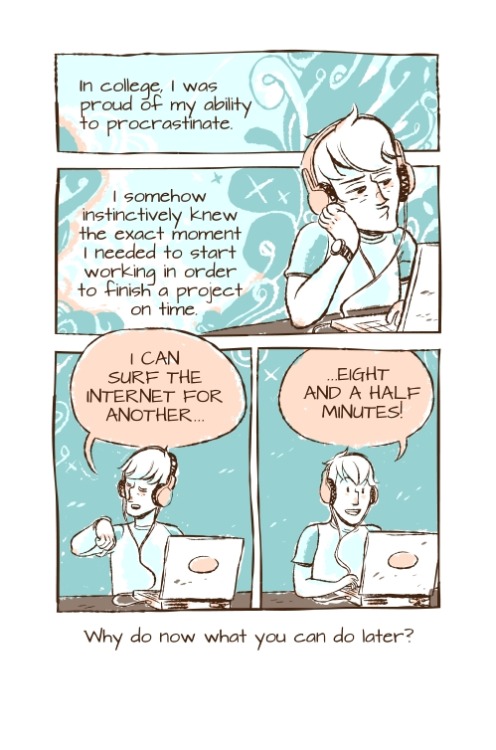
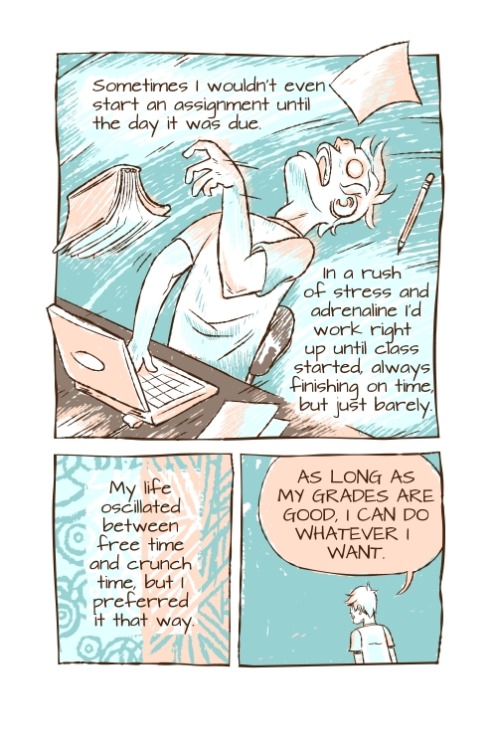
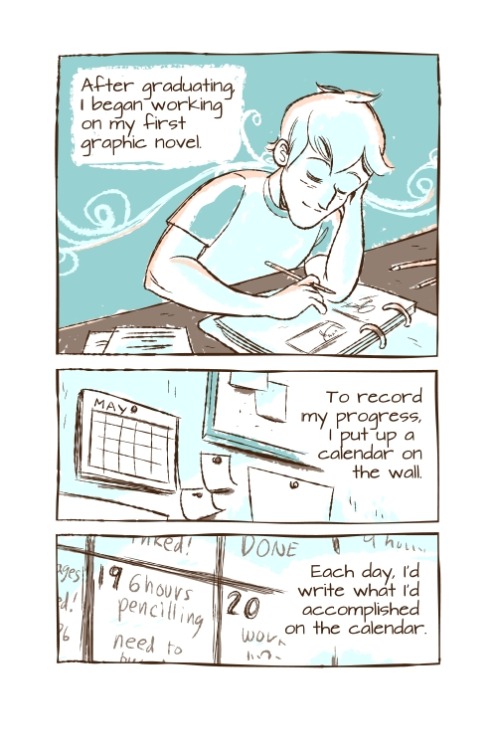
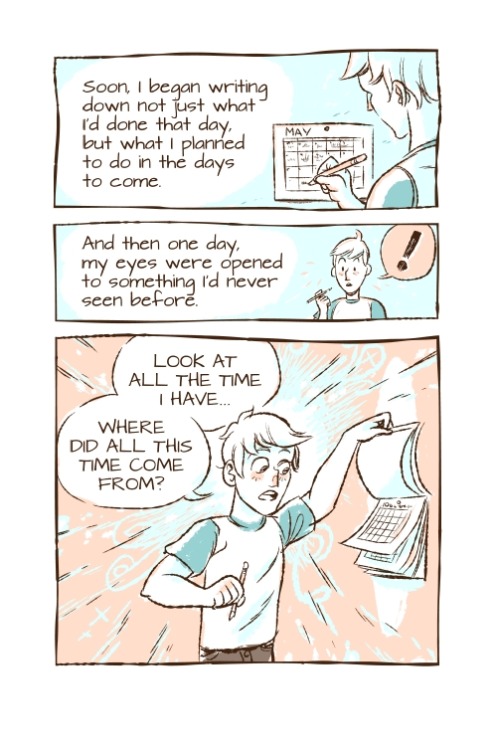
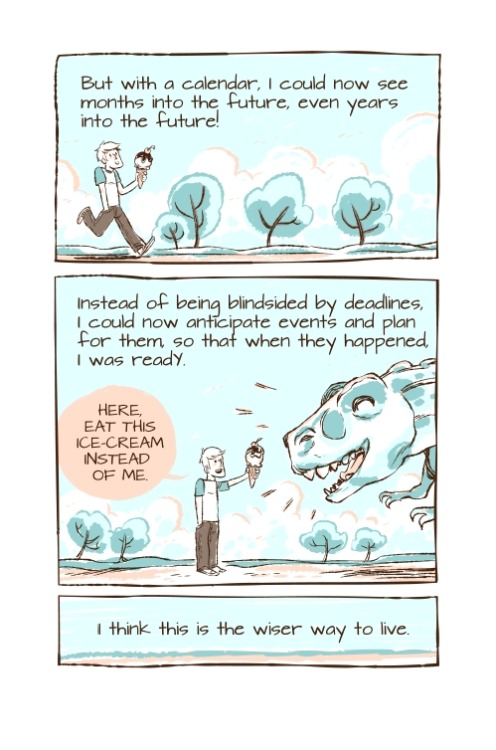
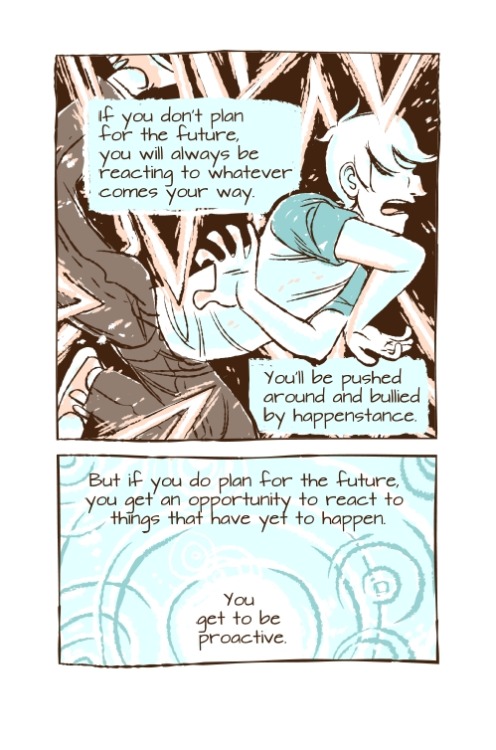
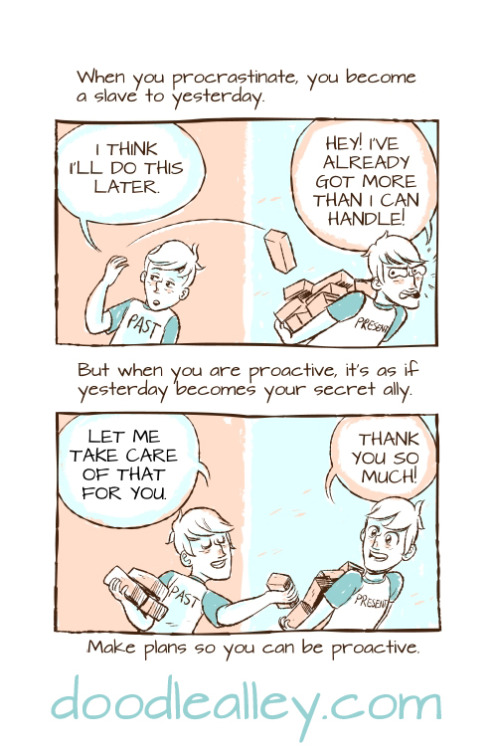
I’ve been working on my Procrastination Problem. I’ve got a ridiculously busy Fall term coming up. So I’m drawing inspiration from this guy and his awesome comics.
I really need to print this out and put it on my wall or something, cause this is a major issue for me. Perhaps I’ll get a calendar too.
Deep-packet inspection is the one of the most invasive things a country can do to its internet. Employed by repressive regimes from Russia to Bahrain, it lets governments look into the content of web traffic as it moves over the network, allowing them to censor websites in real time and conduct detailed surveillance of citizen's activities on the web. They also require sophisticated equipment, usually provided by a western company. As a result, DPI installations are usually kept secret for as long as possible.
Encryption systems like Tor can still be used to hide traffic from the system
But sometimes, they can't. An exclusive Buzzfeed report seems to have caught the Egyptian government in the act, confirming that the country is currently installing a new DPI system with a company called See Egypt, a sister company to the American Blue Coat. Blue Coat got in trouble a few years ago for selling a similar system to Syria, which launched a subsequent State Department investigation, but it doesn't seem to have slowed them down.
The Egyptian system is capable of monitoring conversations on most chat apps, including Skype, WhatsApp, and Viber, as well as direct messages sent over Twitter. That capability is particualrly important given the central role chat programs played in the country's Arab Spring protests. According to an official in the Egyptian government, the system will be used to monitor Islamist political activity and anyone taking part in "debauchery" or "homosexual acts." For anyone living in Egypt, encryption programs like the Tor Browser and Chatsecure can still hide traffic from the system when used properly.
The polls have spoken: Americans are afraid, again. 47% believe the U.S. is less safe than it was before the 9/11 terror attacks in 2001, up from 28% last year. And concerns about protecting civil liberties have dropped from 47% to 35%. But will this change in mood last? And how will it impact the midterm elections?
It takes skill to lovingly craft a "large image of male genitalia" on a football field, but that's only a small part of this story. There are a lot of layers to this 100 yard long, penis-shaped onion.
1. This is the home of the Bedford Kicking Mules.
2. The prank was carried out with the help of a kid's 50 year old mother.
3. The landscaper fixing the field is the self-proclaimed "boss of the moss."
★★★
Supplement your morning reading with more critical sports-penis articles:
HealthKit may record a lot of data, but until third party apps can access it, it will sit lazily on a figurative couch.
Andrew Cunningham
On Wednesday morning, apps designed to connect to the new iOS HealthKit framework were set to launch alongside the brand new iOS 8, but those apps, hungry for your data about calories and fitness progress, apparently hadn't laced their jogging shoes. Shortly after the new version of iOS launched, developers learned that their HealthKit-ready apps and updates had been pulled from the App Store.
A few developers, including the creator of Carrot Fit, soon reported receiving calls and e-mails from Apple confirming that "HealthKit... isn't ready to launch," and later in the day, Apple publicly confirmed that HealthKit support would have to wait until a bug was fixed.
"We discovered a bug that prevents us from making HealthKit apps available on iOS 8 today," an Apple spokesperson told Ars in a statement. "We're working quickly to have the bug fixed in a software update and have HealthKit apps available by the end of the month."
According to court documents, Dread Pirate Roberts was identified because a CAPTCHA service used on the Silk Road login page leaked the users' true location.
'FCC Chairman Tom Wheeler today said 4Mbps is too slow to be considered broadband and that Internet service providers who accept government subsidies should offer at least 10Mbps.'
Contrary to what AT&T and Verizon would have you believe, FCC Chairman Tom Wheeler today said 4Mbps is too slow to be considered broadband and that Internet service providers who accept government subsidies should offer at least 10Mbps.
Last week, we reported on AT&T and Verizon urging the FCC to abandon a proposal that would redefine broadband download speeds from 4Mbps to 10Mbps. If the standard is raised, ISPs that accept government subsidies to build networks in hard-to-reach rural areas would have to provide the higher speed. AT&T and Verizon argued that 4Mbps is good enough, but Wheeler said otherwise today at a hearing in front of the US House Committee on Small Business.
US Rep. Blaine Luetkemeyer (R-MO) pointed to communities with little or no access to high-speed broadband, saying if the minimum speed isn’t high enough, “rural constituents in my district will be left on the wrong side of the digital divide.”
In “best news ever” news, Mystery Science Theater 3000‘s Satellite of Love has docked with Vimeo! Yes, literally right now, you can watch 80 different episodes of MST3K – and they’ve even got more classic episodes coming soon. Be still, my tiny, cynical heart!
If you head over to Vimeo On Demand, you’ll see the full list of MST3K episodes available for your viewing pleasure, including fan faves like “Gamera,” “Laserblast,” and “The Final Sacrifice.” You can rent an episode for $2.99, or you can buy an episode forever for $9.99. If you want the whole shebang, that’s going to run you about $300 – which still saves you about $500 and also gives you immediate download access to any new (old) episodes released, so it’s not all that bad (I guess?).
Apparently, Vimeo is working on clearing the rights to the other 118 episodes of MST3K and will make them available online as they are able – but they’re promising 12 more within the year. Digital distribution of the show has been a bit tricky, given that each episode features a full-length movie that also requires lawyering and rights and all that fancy jazz. Variety is reporting that you can also grab these 80 episodes on iTunes, Google Play, Amazon Instant Video, and Vudu.
While I’m bummed that the episodes aren’t free to stream (nor are they available for those of us outside of the US, but that is easily remedied), if paying a few bucks means we get more MST3K, I’m all for it. Also, I really hope they release the Shorts, too – those are my absolute favorite. I’m a q-tip, what are you!
i love seeing girls close ranks when their fella is cheating, instead of defending him and attacking the other girls. like seriously. it warms my cold, cold heart so much.
i need the rest of this story, where did you put the body
I’ve always wanted to do this. I hope they all went out for ice cream later too.
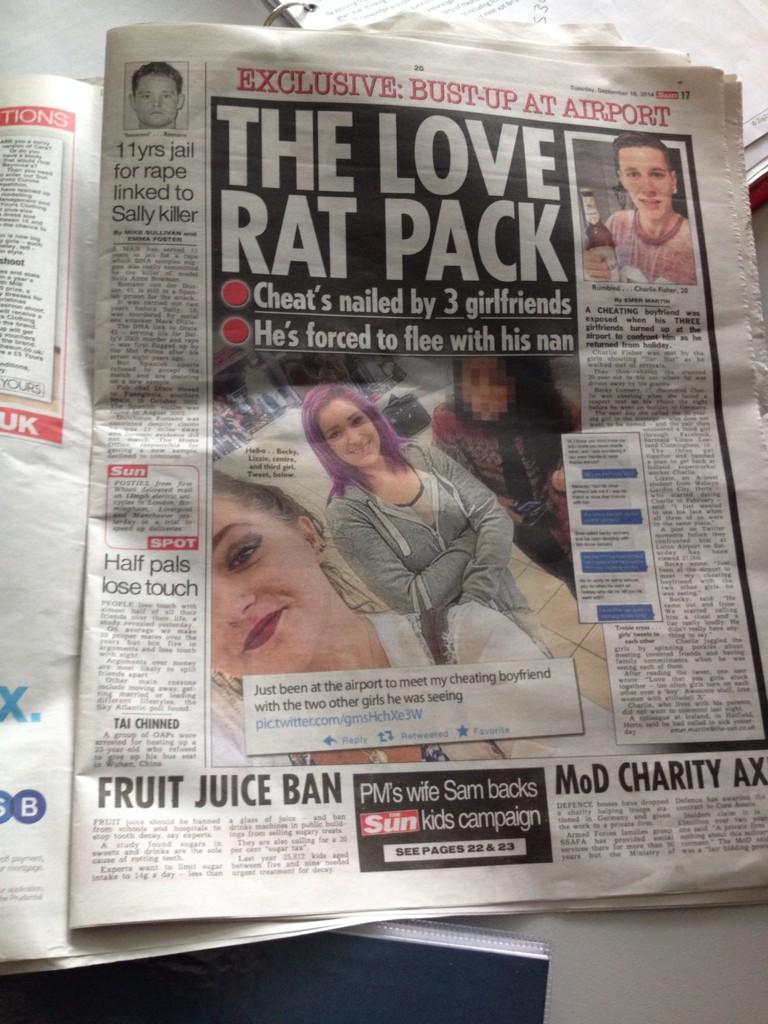
A cheating boyfriend got his comeuppance when he touched down in the UK following a holiday – and walked straight into his three girlfriends.
Charlie Fisher, 20, had barely set foot on English soil at Luton Airport when he heard someone shouting ‘liar, liar’ – and saw the three girls he had been seeing being each other’s backs marching towards him.
Becky Connery, 17, said she planned the (not so) welcome party after finding out her love rat boyfriend had been texting a girl behind her back.
‘He came out and froze,’ she told The Sun.
The girls found each other through text and Facebook and hatched the plan (Picture: Lizzie Leeland-Cunningham)
‘We started calling him a cheat and a liar really loudly. He didn’t have anything to say.’
After seeing the message, Becky got in touch with the 20-year-old girl – who does not want to be identified – and together, the pair found a third girl through Facebook, Lizzie Leeland-Cunningham.
‘I just wanted to see his face when all three of us were in the same place,’ Lizzie, 19, told The Sun.
Becky later said that after confronting her cheating ex, he ‘ran to his nana’.
Charlie, from Hertfordshire, would invent friends and lie about family commitments in order to juggle the three girls, according to reports.
Darren Sproles went off last night, totaling 203 all-purpose yards and pinballing around like, well, a pinball. The folks at Uproxx did a brilliant job scoring his night to the music from Super Mario Bros., but we felt like making a few changes.
We don't care how good a defender you are, one simply cannot tackle a player under the power of a Super Star -- you'll die, just like that. Unfortunately, Sproles' power-up wore off just a touch too early.
Less than two months after launching its DRM-free backup program, digital comics platform comiXology has announced a second wave of 14 more participating publishers. Image Comics, Dynamite Entertainment, Zenescope Entertainment, MonkeyBrain Comics, Thrillbent and Top Shelf Productions are now joined in the program by IDW Publishing, Valiant Entertainment, Oni Press, Fantagraphics Books, Aspen Comics, Action […]
It’s no secret that Tim Cook is stylistically different from his predecessor, the brilliant but mercurial Steve Jobs. The leadership transition has has had a dramatic effect on the company’s culture and structure, as documented by Bloomberg Businessweek’s latest interview with Cook. He has opened up how the company organizes departments, recruits talent is recruited, and designs products, doing away with Jobs’s more closed, compartmentalized approach.
Before Cook took over, Apple was strictly broken up into different highly specialized departments; they shared very little and were united mostly by Jobs’s presence.
Now finance and operations employees sit alongside hardware or software engineers in product roadmap sessions, teams are much larger, and Cook will pointedly ask about spending and hiring in product review sessions, to the objection of some Apple traditionalists, according to the interview.
For example, rather than walling off a small, exclusive group to design the new Apple Watch, the team “included hundreds of engineers, designers, and marketing people” as well as metallurgists and algorithm specialists.
“The lines between hardware, software, and services are blurred or are disappearing,” Cook told Businessweek. “The only way you can pull this off is when everyone is working together well. And not just working together well but almost blending together so that you can’t tell where people are working anymore, because they are so focused on a great experience that they are not taking functional views of things.”
Cook has been on a hiring spree to add expertise in the areas he lacks. Unlike Jobs, who wanted control over the entire company’s vision, Cook is more willing to let others share ownership. Cook maintains an intense focus on his particular area of expertise, management of the company’s supply chain.
Recent hires include co-founders of Beats Entertainment Jimmy Iovine and Dr. Dre (through Apple’s recent acquisition of the company), watchmaker Tag Heure’s Paul Pruniaux, Yves Saint Laurent’s Paul Deneve, and ex-Burberry CEO Angela Ahrendts.
The aim is to shore up the company’s knowledge of selling new categories of luxury goods, but provide a diversity of experience and perspective that Cook values, Apple board member Susan Wagner said.
Though Apple’s internal management seems to have opened up, its product plans are bound to remain top secret.
Senators who have vocalized their opposition to net neutrality are taking in, on average, 40 percent more campaign cash from the broadband-delivery industry than those who support it, according to an analysis of campaign data.
The data (XLSX)—a Maplight analysis of campaign contributions prepared for Ars Technica—highlights the disparity between what the monied Washington interests want compared to the public's desires. Most of the 800,000 initial public comments to the Federal Communications Commission backed the FCC adopting net neutrality rules. The commission is weighing whether to enact regulations that, among other things, could prevent broadband providers from charging for Internet fast lanes. The public commenting period ended Monday.
What the commission will do is anybody's guess, but the political money so far is lining up against net neutrality. No vote date has been set.
CBS announced today that feminist icon Gloria Steinem will make a cameo appearance on The Good Wife, where presumably she’ll have some kind of light conversation with Alicia Florrick and we’ll all implode from the sheer perfection. Steinem’s cameo will be in the third episode of the upcoming sixth season, which premieres this Sunday. By showing up on The Good Wife, Steinem joins the hallowed ranks of Donna Brazile, Michael Bloomberg, Bill DeBlasio, and Bill Maher, all of whom have all done turns on the CBS drama.
Julianna Margulies, who stars as Alicia, told Live! With Kelly And Michael that she fangirled pretty hard when filming with Steinem. “I made a fool of myself and then had to email her and had to apologize,” she said, confirming that Margulies is just like all the rest of us, except with exponentially better wigs. Check out the segment below.
Blood Bowl developer Cyanide Studio announced the impending launch of its new sports management game today, Front Page Sports Football. The PC simulation game has players managing a fictitious football team, picking from over 2,300 plays to lead...





















 Blood Bowl developer Cyanide Studio announced the impending launch of its new sports management game today, Front Page Sports Football. The PC simulation game has players managing a fictitious football team, picking from over 2,300 plays to lead...