Socks in sandals
Link (thanks, mshenna!)

It may look like this adorably chubby squirrel is just innocently scampering about, but that's just what it wants you to think. This tree rat is about to commit a crime.


Unofficial Maps: Maxwell Roberts’ Variants on the Boston MBTA Map
Thanks to pretty much the entire Internet for sending me a link to Boston Magazine’s story about Maxwell Roberts’ work on alternate MBTA “T” maps. I’m not going to review them all, but I would recommend that you click through and evaluate them yourself. Personally, the rotated hexalinear version shown above is my favourite.*
What I’m interested in talking about is Roberts’ approach to transit map design. Whereas most designers will automatically gravitate to a standard 45°/90° diagram, or maybe consider one or two slightly more unusual options, Roberts explores every variant he can think of, and then some more. Octolinear, hexalinear, tetralinear, concentric, curvilinear… every one is put to the test and designed in full, regardless or not of whether it’s actually a good idea to do so (his rotated tetralinear Boston map really doesn’t work, for example). Although a heck of a lot of work, this approach certainly allows a full and honest comparison of the benefits and drawbacks of every approach, side by side. As he says in the article:
If you don’t try to exhaustively explore a city like this, I don’t think you can really say that you understand how a network fits together, what its key challenges are, and how best to address them.
Roberts is very interested in the psychology of using transit maps – how our brain perceives and processes information presented to us – so his method makes a lot of sense. For example, he strongly believes that curvilinear maps (made up of long, curved lines with no straight segments) have good usability, while I believe that they simply don’t look good from an aesthetic point of view.
*I will point out that all of his maps would have to be reworked when the Green Line extension north of Lechmere opens, as none of them line up properly with the Lowell commuter rail line (which the extension will share right-of-way with). Future-proofing a map is also an important part of the design process!
Source: Boston Magazine via everyone who reads the blog!
See also: all posts about Maxwell Roberts

firehosevia ThePrettiestOne

Black Youth Excellence of the Day: Meet 5-Year-Old Louisiana Native Anala Beevers, A Kid With An IQ of 145
New Orleans native Anala Beevers possesses an IQ over 145 at just five years old. Her natural genius helped her learn the alphabet at just four months old. “When she was born I’d say the ABCs to her and she would mouth the ABCs along with me,” says Anala’s mother Sabrina Beevers. “Then by 10 months old she could identify and point to each letter when I’d say it, before she could even talk.”
By 18 months Anala was reciting numbers in both Spanish and English. By her fifth birthday – which she celebrated this month—she could recite the name of every North American state on the map, plus every capital. Recent YouTube clips show Anala also naming the capitals of countries worldwide.
“We finally had to look at her and ask ‘Is this normal for a baby to do?’” says her father Landon Beevers.
When the Beevers finally put Anala together with other kids, the couple could really tell their daughter was strikingly different. So this year Anala Beevers skipped pre-K and was enrolled directly into Kindergarten at the Marrero Academy for Advanced Studies in Jefferson Parish. “They do have advanced study classes there,” says Landon, who expresses worry about Anala’s limited local education choices going forward. ”But her current school is not challenging enough for her; their resources are limited. We don’t know what we’ll do next for her, school-wise.”
At home though, “We are doing everything we can to maximize her potential. Anything she wants to explore we put it out there for her,” says her father, who plans to provide Anala with as normal a childhood as a genius can have. “We don’t have to push her or make her do anything, we don’t even make her sit down and read books,” he says, “she comes to us with all of that, tells us what she wants to learn.”
Though he has joked that his daughter “needs a reality show,” Landon claims he’s turned down “The Today Show” and “Good Morning America” to keep his little one’s life as simple as possible. Anala has nonetheless been written about extensively. In 2013, Landon Beevers told People magazine that his daughter’s smarts make her harder to deal with. Anala has publicly claimed she’s smarter than her parents (they publicly agreed) and even corrects their grammar.
“She’s more aware, her mind works faster, and she doesn’t just take things at face value,” says Landon. “She’s always gonna look deeper into it, which means she does challenge us a lot. We talk to her and respond to her like she’s an adult, and we get in a debate with her and then realize we’re debating a four-year-old! But the thing is, her arguments are valid – juvenile but intelligent.”
“Like the other day,” her mother recalls, “she asked why blue soap makes white bubbles—things that never crossed our minds.”
Beevers was recently invited to become one of 2,800 MENSA members under the age of 18 (the current youngest being 2 years old). The exclusive high-IQ club accepts only those who score at the 98th percentile on an IQ test – whereas young Alana Beevers placed in the 99th percentile range, putting her intelligence in the top one percent of all humanity.
Her parents say little Anala always has a new pursuit. The little genius is currently studying every book she can about volcanoes and astronomy; she can name planets and dinosaurs. “Though most recently now she’s on an artistic tip,” says her father. “She’s doing a lot of creative things right now. But it’s never just one thing. She’s a multi-tasker. Her mind never stops.”
Source: The Louisiana Weekly
Oooooof, I hope that little girl gets to spend some time with kids who are her own emotional age, not just adults who “forget” they’re talking to a 4-year-old.

Head coach Brian Houston: "Our football field sits between the Arctic Ocean and the lagoon. We lost the ball at practice the other day. Somebody out there will find it. Hopefully they'll bring it home."
Sports Illustrated's excellent Underdogs series, a run of mini-documentaries on high school football teams, travels to Barrow, Alaska, which Wikipedia calls the world's 11th-northernmost public dwelling. It's the United States' northernmost town, meaning this will go down as the coldest football program ever.
Barrow's unique geography means that the school contends with challenges no other high school team faces: The town located is so far north that the team must fly to every away game, and there's only enough money in the budget to bring 19 players. The Whalers sleep on air mattresses in opponents' gyms instead of in hotels. Their home field is so close to the Arctic Ocean that the team actually loses balls in the water during practice.
But those problems pale in comparison to the social issues in the area. Alaska has one of the highest rates of domestic violence in the country, and alcoholism is rampant. Coach Brian Houston, a social worker, tries to use football to teach life lessons and prepare his players for college.
You should obviously watch it.
firehose"Ads that brands have to pay to place in newsfeed, however, are apparently fine" AW REALLY WOW

Facebook plans to start deprecating newsfeed posts from brand pages that it sees as "too promotional," according to a blog post late Friday.
These types of posts aggravate users more than usual and they'd rather not see them. Ads that brands have to pay to place in newsfeed, however, are apparently fine, according to an evaluation Facebook did with users.
Facebook has long pushed for companies, personalities, and brands to represent themselves with pages and create content to fill users' news feeds. Eventually, enough brands created pages that quantity became a problem, so Facebook began applying an algorithm to curate users' newsfeeds.
Read 8 remaining paragraphs | Comments
firehoseI hate professional programmers
Sometimes I see code like this:
if {
…stuff…
} else {
…other stuff…
}
That’s pretty much a-okay with me.
Pretty much. Until I want to comment-out the else block. There’s no way to do a line-wise selection and hit cmd-/ (when it works) and comment out just the else block.
Update 3:15 pm: Dan McTough reminds me that there is a way to do this. My objection is that it’s more difficult and requires more paying-attention. It’s easier to go to the start of a block and select to the end — it requires almost no thought.
Also: many people like } else { on the ground that it makes it easier to notice the else. Okay.
firehoseinteresting! one of the advantages of the + line was higher power drain capacity, but I didn't expect them to also be more efficient
that 100mA idle on the A+ is just lovely
Raspberry Pi A+ How Much Power Does It Need?, from RasPi.TV:
…As before, when I did a similar thing for the B+, I used my trusty eMeter. But this time I used it inline with an ISO-TECH IPS 3303D bench power supply (at 5.2V) to corroborate the readings.
Methodology
I wanted to see how much current each Pi would consume under four circumstances….
- Idling in command line – low CPU load
- Starting LXDE desktop – heavy CPU load
- Watching Big Buck Bunny in HD – GPU load
- Filming Full HD video with Pi camera – GPU load + camera load
So this was done for each Pi in turn, A+, then B+, then A. I didn’t bother with the B as we had a separate B+/B comparison when B+ was launched. (I did the B rev 2 without filming the next day and updated the table.) All measurements were using a bench-supply set to a regulated 5.2V….

 Each Friday is PiDay here at Adafruit! Be sure to check out our posts, tutorials and new Raspberry Pi related products. Adafruit has the largest and best selection of Raspberry Pi accessories and all the code & tutorials to get you up and running in no time!
firehosenever seen a games company in as bad of a need of a reorg as Ubi, especially Montreal


Read more of this story at Slashdot.

firehoselearn 2 shawshank

Cyrus Farivar
Some prisoners told Ars that despite the cellphone ban, phones do show up on the inside.
23 more images in gallery
Usually cameras are not allowed inside San Quentin State Prison, but for a special media event such as the one held on Thursday, an exception was made. Reporters were treated to about two hours inside the prison and got a chance to meet and interact with inmates one-on-one.
Ars hopes to return to San Quentin in the coming weeks to see how they have progressed in their coding classes.
Read on Ars Technica | Comments
firehosejokes aside, i think _everything_ is too hard for Ubisoft to animate, women included
I once met a woman from Paris. I don't know her name, but she usually wore a green dress and for some reason spoke with a thick English accent. Every five minutes, at seemingly random places throughout the city, a thief would steal her purse and she'd scream for someone to help. It was a never-ending cycle that lasted for years.
She lived in the French Revolution-era Paris depicted in Assassin's Creed: Unity, one of the most beautiful, detailed cities I've ever explored in a video game. But the city is also a facade, attempting to mask my least favorite game in the series since the original. It's beautiful, but Unity is a bland, repetitive, and unimaginative adventure that doesn't do the city justice. When you're rushing through Paris, dashing across the rooftops, many of its issues simply breeze right past you. But as soon as you stop to soak up some of that Parisian charm you'll spot something off: a weird glitch, a character walking into a wall, a guard that decides to kill you because you ran too fast.
If you wait long enough, you'll hear the woman calling, wondering why no one will help her get her purse back.
Assassin's Creed: Unity stars Arno Dorian, a young man who, like every video game hero before him, is out for revenge. In this case, he’s avenging his father’s death, which leads him to join the ranks of the assassins. Unity continues the century-spanning tale of the conflict between assassins and Templars that holds the Assassin's Creed series together, and it's just as confusing as ever. I rarely knew why I was doing something, other than because it would somehow help Arno's quest to find the man who killed his father.
I rarely knew why I was doing something
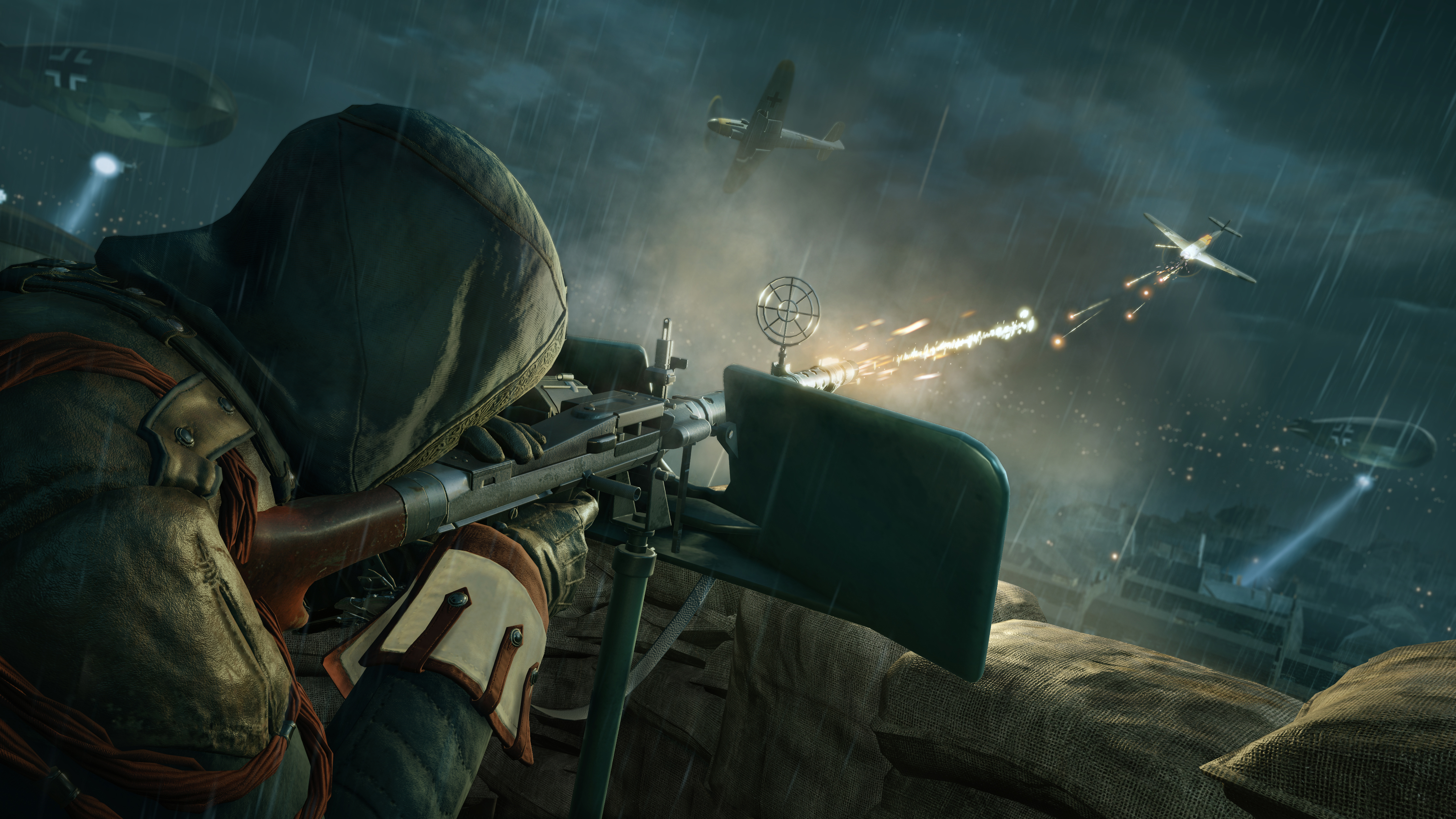
There's also the weird, convoluted sci-fi narrative that sits on top of the main story, just like in past games: you're not actually Arno, but someone from the modern day revisiting his memories using fancy new technology. Unity's story is basically what would happen if Dan Brown wrote a video game after binging on too many Twilight Zone episodes. At one point someone actually says the phrase "a rare breed of human with a surplus of ancient DNA," and you're supposed to make sense of it. The story also takes itself far too seriously. Despite the fact that it includes both magical swords and a scene where you shoot down WWII fighter planes using a machine gun bolted onto the Eiffel Tower, there’s very little humor in the game.
Much like Aiden Pearce in Watch Dogs, another Ubisoft game, Arno has basically no memorable personality traits, aside from the fact that he's a sociopathic killer. There's a scene where he kills multiple people just so he can steal some wine and have a drink. Afterwards, he doesn't express remorse: he's just mad someone stole his watch while he was passed out from drinking. He’s an incredibly unlikable lead.
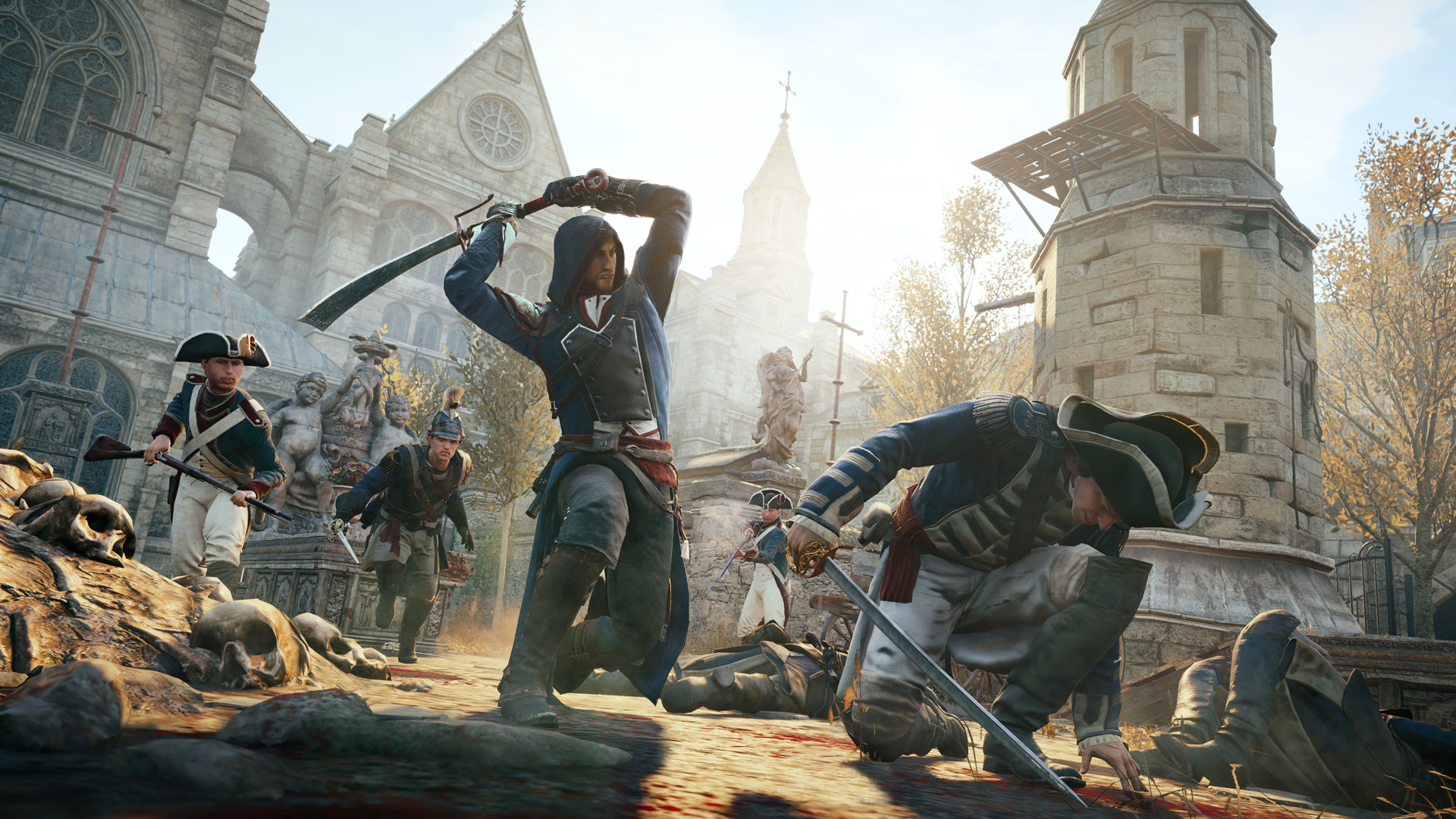
Of course, storytelling has never been Assassin's Creed's strong suit. The games are just an excuse to throw you in a massive city and have fun. And Paris circa 1791 is easily the biggest, most detailed city in the series to date. It's not just that it's huge, but it's also dense in a way that's incredibly convincing. Since the game takes place during the French Revolution, you'll often come across impressively huge crowds of people protesting in the streets. Viewed from atop one of the incredibly lifelike buildings in the game, these crowds are amazing to behold. At times the city’s design makes it clear it’s a video game level — there are plenty of conveniently placed hiding spots and carts of hay to jump into — but because everything else feels so true to life, it's easy to dismiss those concessions. Scaling a towering, Gothic church and peering through the stained glass windows just because you can is a pretty amazing feeling. You can also go inside more buildings than ever before, and the transition is seamless.
If only that wonderful city gave you more interesting things to do in it.

The core story missions in Unity will feel familiar if you've played any game in the series before. Too familiar. For the most part, they involve sneaking into a carefully guarded building to steal something or kill someone, and then, once that's done, you run the hell away. At the outset of each mission, Arno will perch atop a building across the street, scanning his surroundings for things and people he can use to sneak in more easily. The idea is that each mission is somewhat of a sandbox, with multiple ways of tackling the same problem. You might be able to bribe a cleaner to open a window so you can slip in undetected, or you might just be a badass assassin and stealthily kill every guard in your way, but these options only really change the experience slightly. In practice, the assassination missions all largely feel the same, just in different locations.
Nothing here really feels distinctly Parisian
It still feels amazing when you pull off an assassination cleanly, and the thrill of hiding in the shadows and terrorizing guards is still there. But Unity doesn't really make good on its promise of giving you a huge amount of freedom to pull off these kills. It always felt like there was a proper way to do things, and finding that route made the game a whole lot easier, but also less satisfying. Unfortunately, the side missions don't provide much of a distraction from the uninspired assassinations. The ones I played were either simple fetch quests or had me guarding a character from harm while they walked from one location to another. They were all pretty boring, and the meagre rewards for doing them meant I stopped about a third of the way into the game to focus on the story. Unity’s rendition of Paris features incredible buildings to climb and explore, diverse neighborhoods that all feel distinct, but none of these aspects are put to use in the mission design. Nothing here really feels distinctly Parisian.
Unity's missions aren’t exactly bad, they're just bland and forgettable. What can make them frustrating is when the controls get in the way. Like other Assassin's Creed games, Unity features a very automated control scheme: you can make Arno run, jump, or climb simply by holding the right button at the right time. When it works right, it's brilliant, letting you scale huge buildings and speed across the Parisian skyline with little effort. But on multiple occasions Arno leapt to his death when I was trying to dive into a cart full of hay, and he has an unfortunate tendency to get stuck on tiny bits of furniture or scenery. After spending more than 20 hours with the game, I still can't successfully get through an open window on the first try.
The control issues are particularly problematic during chase sequences, where one small error means you have to start the whole thing over again. Arno may be a budding master assassin, but he's prone to small errors. Compounding the control problems is a laundry list of technical issues that plague Unity. Some are merely cosmetic: you'll come across people running in place and see characters simply pass through one another as if they were ghosts. Once I spotted a man seemingly impaled by a tree, yet he made sure to wave at people who passed by.
These errors can be funny, but they really take you out of the experience. It's hard to feel like you're really exploring Paris when a man floats by, riding an invisible horse. The scope of the city and the huge crowds also seem to have put a major dent in the game's performance, as the frame rate would often drop significantly, turning Unity into a choppy mess. This was particularly true during scenes with lots of people in them. I also had issues with the sound: in one instance, the drone of characters in a tavern was so loud it drowned out what I think was an emotionally significant cut scene. It's hard to know for sure since I could barely hear it.
When everything clicks, Unity reminds me why Assassin's Creed has become so popular. The joys of scaling a massive building or expertly pulling off an assassination are unique to the franchise, and they're thrilling. But aside from the beautiful setting, there's not much here to distinguish Unity from past games. A bigger game doesn’t make for a better one, and while Paris offers more places to go, it doesn’t give you new things to do.
Maybe it's a case of franchise fatigue — there's been a new Assassin's Creed game in some form every year since 2009 — but nearly every aspect of the game, from its mission design to its story, feels like a rehash of old ideas. Toss in some terrible glitches and frustrating controls, and you have a game that feels like a step backward for the series. Considering it's the first Assassin's Creed built exclusively for the new generation of game consoles, that's incredibly disappointing.
There's a woman pestering me to catch the thief who stole her purse, but I keep ignoring her. I know the chase will just bore me.

firehose'These are some of the accusations I've received: I hate science, I hate progress, I hate men, and that now no one will remember this space landing. None of this is true.
Though I wrote a critical piece about Taylor's shirt, I am not excluded from appreciating Taylor as a scientist, or the Philae landing as a profound act of human intelligence. Nor does it mean the landing is forever tarnished by what I wrote, along with incredible support of my colleague Arielle Duhaime-Ross. Writers can be egotists, but no one is crazy enough to think an op-ed is bigger than this decade-long experiment in space.
The hope of a critic is that their work inspires readers to have conversations. Critics seek to analyze and evaluate what seems obvious and is assumed, to help people rethink things. Matt Taylor himself had a change of heart about the shirt and gave a heartfelt apology today: "The shirt I wore this week," he said, "I made a big mistake and I've offended many people and I'm very sorry about this." Taylor obviously didn't expect to be the person who'd inspire an overdue conversation about sexism in the science community, and he has handled himself with grace and empathy.
I love the science community, so much so that I want it to expand in positive, healthy ways. I hope for it to be more diverse and inclusive. As humans, we criticize because we care deeply about things. We don't criticize because we seek to attack someone, we criticize because we want to make many other people feel welcome.'
Most writers don't enjoy writing critical pieces. I certainly don't. I understand whenever I open my text editor that the people I cover have their own personal battles happening just off stage. Even someone's worst behavior is generally the result of a series of events I don't yet know, and are rarely a singular and uninspired malicious act.
Which is to say, most people don't wake up in the morning hoping to piss someone off.
Yesterday I wrote about Matt Taylor, a scientist who worked on the Philae spacecraft landing, an amazing moment in which man-made technology settled itself onto a comet. The work of Taylor and other members of the European Space Agency is astonishing and inspiring. They delivered a true historical moment to our planet.
Unfortunately in that moment, Taylor chose to wear a "bowling shirt covered in scantly clad caricatures of sexy women in provocative poses." Despite assuming Taylor to be a brilliant scientist, I couldn't stop thinking about that shirt.
And so, because The Verge had already covered the news of the landing extensively, I wrote my feelings about the shirt and what I feel it represents: an environment stretching across the tech, science, and video game communities that is exclusionary to women and minorities. I included a bold headline, "I don't care if you landed a spacecraft on a comet, your shirt is sexist and ostracizing," to emphasize a point I wish I'd expanded upon in the body of the piece: an incredible and important act does not make even casual or unintentional sexism okay.
The reaction to that piece has been strong, to say the least. Some people agree with me. Others think I'm nitpicking, which is understandable. Like Taylor and anyone else, I am not immune to criticism. Looking back, I do wish I'd been a little less passionate and little more careful about how I reacted, and I think people who've contacted me are correct to ask for a more sober response in a situation like this.
There is, however, one type of reply to the piece that most concerns me and that I want to dissect. It's the belief that criticism is inherently all-encompassing, that disliking part of something means a critic dislikes the whole. And worse, that if someone or something receives negative criticism, it is spoiled for the remainder of history.
These are some of the accusations I've received: I hate science, I hate progress, I hate men, and that now no one will remember this space landing. None of this is true.
Though I wrote a critical piece about Taylor's shirt, I am not excluded from appreciating Taylor as a scientist, or the Philae landing as a profound act of human intelligence. Nor does it mean the landing is forever tarnished by what I wrote, along with incredible support of my colleague Arielle Duhaime-Ross. Writers can be egotists, but no one is crazy enough to think an op-ed is bigger than this decade-long experiment in space.
The hope of a critic is that their work inspires readers to have conversations. Critics seek to analyze and evaluate what seems obvious and is assumed, to help people rethink things. Matt Taylor himself had a change of heart about the shirt and gave a heartfelt apology today: "The shirt I wore this week," he said, "I made a big mistake and I've offended many people and I'm very sorry about this." Taylor obviously didn't expect to be the person who'd inspire an overdue conversation about sexism in the science community, and he has handled himself with grace and empathy.
I love the science community, so much so that I want it to expand in positive, healthy ways. I hope for it to be more diverse and inclusive. As humans, we criticize because we care deeply about things. We don't criticize because we seek to attack someone, we criticize because we want to make many other people feel welcome.
Or as media critic Anita Sarkeesian eloquently puts it at the beginning of her videos in the series Tropes vs Women in Video Games: "It's both possible and even necessary to simultaneously enjoy a piece of media while also being critical of its more problematic or pernicious aspects."
firehoseooh

Get the arcade game experience by making your own Bluetooth Arcade joystick and button controller.
If you’re into playing classic video games, there’s just no substitute for an arcade joystick and buttons. The clicky feel, the ball top stick, it’s all part of the experience. Not only that, but these games were originally tuned for these types of controllers. So if you’re going for high scores, you may find you actually perform better with the right equipment in your hands.
Adafruit has some great products to make one of these for yourself. We can even leverage a little bit of the 21st century to make our 20th century experience wireless with the creation of Bluefruit EZ-Key.
Before we start with the rest of this project, check out the Bluefruit tutorial as you’ll need to refer to it for information on how to pair the module and remap the keys (this tutorial does not require remapping the keys but if you want to customize your joystick)
firehosedon't you hate it when you forget to pack your charger on a long trip
Read more of this story at Slashdot.

Read more of this story at Slashdot.

firehoseWelcome to New Orleans

The All-Pro tight end is done with jumping into the stands after some folks got a little too friendly for his liking.
New Orleans Saints tight end Jimmy Graham is one of the most prolific players in the game. When scoring a touchdown at home last week against the San Francisco 49ers, Graham shared his enthusiasm by vaulting into the crowd, Lambeau Leap-style. Unfortunately, those days have apparently come to a quick end, after Graham was groped by a fan, per Mike Triplett of ESPN.
Graham was famous for dunking the ball over the crossbar after touchdowns, but that move was outlawed by the NFL before this season. Leaving him with a bevy of other options including the good-old-fashioned-but-chronically-underrated spike, Graham decided to become one with the fans until a man by the name of Scott McGowan, dressed in the guise of a joker.
This goes out as a lesson to all fans everywhere. You can like your team, you can love the players, but you can't go grabbing their backside because of that love.
"I just wanted to go and thank all the fans for being there," Graham said. "But people were trying to thank me a little too much."
firehosevia Toaster Strudel
firehosevia Rosalind: "aaaaaaaaaaaAAAAAAAAAAAAAAAAAAAAAAAAAAAAAAAAAAAAAAAAAAAAAa"

firehosevia Toaster Strudel

Bill and Hillary Clinton as students, 1972 pic.twitter.com/ErUWzsMKmi
— Historical Pics (@HistoricalPics) November 14, 2014
firehosevia multitasksuicide