My cat likes to give my dog baths and she smacks him if he moves while she’s licking him. Now he’s literally trained to where if she licks him once he sits down without any hesitation looking all embarrassed
my cat literally trained him to do that I can’t stop laughing
You’ve probably heard of “false confessions,” when pressure from the police and long interrogations can make someone confess to a crime they didn’t actually commit. According to this study, it’s actually not that difficult to give someone a false memory of a serious crime.
At least 50 U.S. law enforcement agencies have secretly equipped their officers with radar devices that allow them to effectively peer through the walls of houses to see whether anyone is inside, a practice raising new concerns about the extent of government surveillance.
'Righteous indignation reigns, a carryover from Jon Stewart’s lead-in, and Wilmore seems to be playing a somewhat more sardonic version of himself, again a la Stewart.'
Talk about big shoes to fill. Not only does The Night Show with Larry Wilmore have to follow the satirical powerhouse that is The Daily Show, it also has to compete with the brilliantly sharp legacy of The Colbert Report. Wilmore does his best in the first episode, showing surprising poise and cohesiveness for a brand new show. Each episode, like Politically Correct before it, will live and die on its panel, which comprises two of the three segments. Luckily, WIlmore proves a smart and capable host in his auspicious debut.
Wilmore sits, somewhat oddly and intimidatingly, at the head of a long glossy table. His monologue is more long-form stand-up than quick zingers, and he uses the same sharply sarcastic tone he used as a Daily Show corespondent. In fact, as the name of the show implies, The Nightly Show is much more of a sequel to The Daily ...
Sleater-Kinney’s breakup in 2006 seemed like a logical step for the group, who had been together since 1994. The band’s members were, naturally, interested in pursuing their own routes in life after 12 years, a long time to do anything consistently. Janet Weiss worked with her group, Quasi, and played drums for Stephen Malkmus And The Jicks. Corin Tucker invested herself in becoming a badass mom, and then eventually fronted her own group, The Corin Tucker Band. And Carrie Brownstein went on to create Portlandiawith pal and fellow ex-rocker Fred Armisen.
But you can’t keep a good band down, and late last year, Sleater-Kinney announced a reunion, as well as a new album, No Cities To Love. That the group went back into the studio is admirable, especially considering how many groups reunite these days just as part of a slightly bitter cash grab. But the ...
"if you haven’t seen every other episode and paid close attention, pretty much nothing will make any sense"
There hasn’t been any new Venture Bros for a year and a half. The intervening time between the season five finale and tonight’s double-sized special marked over a decade since the show premiered. (Though that comes out to an average of only just over six episodes a year.) But watching “All This And Gargantua-2,” it hardly feels like it’s been any time at all. Co-creators Jackson Publick and Doc Hammer are just so effective at immersing viewers in the world of the show, getting them invested in a whole array sad characters, and pacing their often-insane stories. By now, The Venture Bros is practically a perpetual motion machine—its plate-spinning seems delicate, but it’s not hard to imagine it going on practically indefinitely. And there are so, so many moving parts in this episode.
It really does make sense for “All This And Gargantua-2” to ...
And the racial divide is perhaps most stark in the upper echelons of government, where minorities are vastly underrepresented and politics is still dominated by older white men.
Nearly half of US states have yet to elect a black woman or man to the US House of Representatives, according to an analysis by Dr. Eric Ostermeier, a researcher at the Center for the Study of Politics and Governance at the University of Minnesota.
This may be the most diverse Congress ever, alongside the nation’s first black president, but in a country where 13.2% of adults are black, there are currently no black governors, only two black senators, and just 44 black US reps (about 10% of the House).
States that have yet to elect a black to the US House of Representatives include Massachusetts and Delaware, where 8.1% and 22% of adults, respectively, are African-American. The highest number of blacks elected to Congress have come from California, Illinois and New York.
In the new clip for their song "Coyotes," Modest Mouse's videographers have recreated a somewhat infamous incident in 2002, in which a wild coyote climbed aboard the MAX Light Rail at Portland International Airport. Unlike in real life—that coyote was captured by the Port of Portland's wildlife team and escorted off the train before it left the station—this coyote gets a full ride through the city, in a MAX carriage all to himself. Presumably filmed with either a domesticated coyote or a coyote-resembling dog (I hope), the video is an eye-pleasing tribute to both Portland and coyote lovers.
The song itself is a drowsy waltz in keeping with Modest Mouse's earlier work, and is sumptuously produced, with echoey guitars lurching in and out of the landscape. It's a beautiful recording, with lyrics that—in broad strokes—are seemingly about mankind's tricky, sometimes contentious relationship with nature. The song will be available as a digital download starting tomorrow and, of course, will appear on Modest Mouse's upcoming album, Strangers to Ourselves, which comes out March 3. The first 2,500 vinyl pre-orders of the album contain a 7-inch that includes "Coyotes" on the B-side to "Lampshades on Fire," the album's other advance track (check it out here).
The coyote/MAX incident was famously documented in another song by a Portland powerhouse group: Sleater-Kinney's "Light Rail Coyote," from their 2002 album One Beat. More about that here.
Coincidentally, Modest Mouse's song and video also comes on the heels of the heartwarming news of a Seattle dog who takes the bus to the dog park all by herself.
In case you missed it, last week we got some weird, sad news that a local high schooler had had her production of Evil Dead: The Musical canceled after school authorities allegedly deemed it not "school-appropriate." Will Fries announced that The Funhouse Lounge would be hosting a few performances, with a second venue likely to be confirmed later. Today, we know that venue's identity: Post5 Theatre, which will be hosting additional performances of Evil Dead: The Musical.
You can buy tickets to those shows here, and here.
And! There's more! The writer of Evil Dead: The Musical wrote an email to the students who tried to produce his show, and it is awfully kind-hearted and endearing. A choice excerpt:
I just wanted to write a quick note to thank you for putting on this show. I heard that the production was almost cancelled because it wasn't deemed "school-appropriate". And while I think it is totally crazy you even tried to put this on in a school. I love that you tried. And I love even more that you're continuing to put it on even when "the man" tried to stop you.
I'm proud to have written a show that isn't appropriate for school. And I'm proud of you all for putting it on the way it was meant to be. It's the grooviest story I've heard in some time.
I know there's a cat cafe opening in Portland THIS SATURDAY, but this just may be the cutest thing ever.
'Surprisingly, even though this was also Khan’s second marriage, he has been spared of the same personal scrutiny and backlash at home. These double standards were natural given that Reham was a woman in a staunchly patriarchal society and consequentially a soft target. However, given how Khan has mainstreamed previously opaque concepts such as democracy, accountability and voter rights for a large section of the Pakistani population in the past, one hopes he will extend the same consideration to gender biases and stereotyping in his “Naya Pakistan”—New Pakistan—as well.'
Pakistan experienced its own version of the royal wedding when the country’s best looking cricketer-turned-politician, 62-year-old Imran Khan tied the knot with former BBC journalist Reham Khan on Jan. 8. Local TV channels broke into a frenzy as they tried to outdo each other while covering every aspect of the wedding—from the menu and the groom’s ill-fitting choice of footwear to speculation about the future role of Mrs Khan in her spouse’s political career.
Social media took things even further as the hashtags #ImranwedsReham and #MerayKaptaanKiShadiHay started trending and the debate about who is the real “catch” in the union picked up momentum. Nadeem Farooq Paracha, a journalist and writer, dubbed the coverage of the wedding by the local media as “crass and at times downright silly.”
“Unfortunately responsibility and the electronic media are still at loggerheads in the country,” he added.
Khan with Jemima Goldmsith in 2002(Reuters/Mian Khursheed)
However, given Pakistani media’s historical fascination with Khan’s playboy aura, their fixation with his matrimonial proceedings was no surprise. Khan’s first marriage to English journalist and heiress Jemima Goldsmith in 1995—a partnership that lasted nine years before the two parted ways since it was difficult for Goldsmith to adapt to life in Pakistan—had also sparked similar curiosity and excitement at the time. Khan’s decision to keep his personal life private despite being a media darling for over two decades provided the press with further impetus to fill the missing gaps in information with gossip, speculation and sensationalism.
The only thing different the second time around was that instead of a handful of channels indulging in this hype, now it was three dozen channels (that had sprung up after the media boom in Pakistan during Musharraf’s era) competing for ratings and the most shocking scoop on the couple. Anyone watching news on TV channels in Pakistan during those few days could have never guessed that a massacre in Nigeria had claimed thousands of lives—or how all of Europe had been shaken up by an attack on the offices of the French satirical magazine Charlie Hebdo that left 12 people dead.
The wedding bells had drowned out everything. Even tragedy at home. Less than a month ago, the nation had received one of its worst blows when the Taliban attacked an army-run school in Peshawar and killed 132 children—a fact that Khan was painfully reminded of when he paid a visit to the school with his new wife three days after it re-opened and was met with hostility and chants of “Go Imran, Go” by angry parents.
“Imran Khan was busy with his wedding ceremony while we were weeping for our children,” a mother of one of the deceased children told The Express Tribune.
However, it was Khan’s new wife, who was a target of the most visceral comments online.
Being a divorcee and a working woman—things that the average Pakistani woman still struggles with—raised questions about her “honour” and suitability as a life partner
Those who were angered, disappointed and suspicious of the controversially timed wedding largely outnumbered the well-wishers for the couple. The fact that Reham was much more relatable compared to Goldsmith, having been born to Pakistani parents in Libya, didn’t really ease the media scrutiny either.
Everything from the 41-year-old’s relationship with her first husband (whom she married at the age of 19 and soon divorced due to alleged domestic abuse and differences over her career) to her upbringing of the three children from her first marriage and choice of clothes was dragged into the public eye and ripped apart.
Being a divorcee and a working woman—things that the average Pakistani woman still struggles with—raised questions about her “honour” and suitability as a life partner for the widely revered Khan. However, what was most surprising was that this misogynistic attitude towards Reham was not just limited to the usual suspects, but could even be traced to women and the otherwise usually liberal urban elites as well.
According to The Daily Mail, internet trolls had even gone as far as labelling her a lesbian based on a picture of her stroking another woman’s back and claimed to be in possession of images of her in a sex shop in the UK, where she is seen in a pink nightdress with a collar around her neck and a whip slung over her shoulder.
A 2011 footage of Reham handling and cooking pork sausages at a fair in West Sussex was widely circulated on the internet. Touching or eating pork is forbidden under Islamic laws, and Reham faced a steady stream of criticism after the clip resurfaced.
Old pictures of Reham wearing knee-length dresses and speculation about the timing and motives of her relationship with Khan also began circulating on at least two Facebook groups.
These comments reportedly left Reham, who now works as an anchor for a prime time TV show on one of the leading channels in Pakistan, very disturbed.
Surprisingly, even though this was also Khan’s second marriage, he has been spared of the same personal scrutiny and backlash at home. These double standards were natural given that Reham was a woman in a staunchly patriarchal society and consequentially a soft target.
However, given how Khan has mainstreamed previously opaque concepts such as democracy, accountability and voter rights for a large section of the Pakistani population in the past, one hopes he will extend the same consideration to gender biases and stereotyping in his “Naya Pakistan”—New Pakistan—as well.
Anthony "Tony" F. Verna, the inventor of the instant replay in sports broadcasting, has died. Verna, who passed away aged 81 in Palm Desert, California, first saw his creation shown during CBS' broadcast of the Army vs. Navy football game on December 7th, 1963. "This is not live!," announcer Lindsey Nelson had to explain after the network replayed an Army touchdown. "Ladies and gentlemen, Army has not scored again."
"This is not live!," announcer Lindsey Nelson had to explain
Verna, who worked as a producer when his instant replay was debuted, moved on to direct interviews with two presidents, the US broadcast of Live Aid, and five Super Bowls. The concept has endured — when Super Bowl XLIX is broadcast in two weeks, it will rely on Verna's replay, and 51 years after its first use, it's hard to imagine watching televised professional sports without the aid of his invention. Instant replay has allowed for some of the most controversial and memorable sporting moments, and the proliferation of the technology has changed the rules of a number of games.
The NFL, realizing that viewers at home could immediately see if referee calls were accurate, incorporated replays to overturn decisions on the field. Even more staunchly traditionalist sports have adopted instant replays as part of their rules — Major League Baseball began using expanded replays to challenge and confirm umpire calls last year, and FIFA finally adopted goal-line technology for the 2014 soccer World Cup after instant replay showed a series of goals that were awarded or denied inaccurately. While Verna has gone, his instant replay will live as long as professional sports are broadcast.
In a speech prepared for delivery at a British think tank, Jindal said some immigrants are seeking "to colonize Western countries, because setting up your own enclave and demanding recognition of a no-go zone are exactly that." He also said Muslim leaders must condemn the people who commit terrorism in the name of faith as "murderers who are going to hell."
Jindal aides said he did not make significant changes to the prepared text.
The claims on "no-go zones" are similar to those a Fox News guest made last week about places where non-Muslims were not welcome in parts of the United Kingdom such as Birmingham, and "Muslim religious police" enforce faith-based laws.
Steven Emerson, an American author who often is asked about terror networks, told Fox News that in Britain "there are actual cities like Birmingham that are totally Muslim, where non-Muslims just simply don't go in."
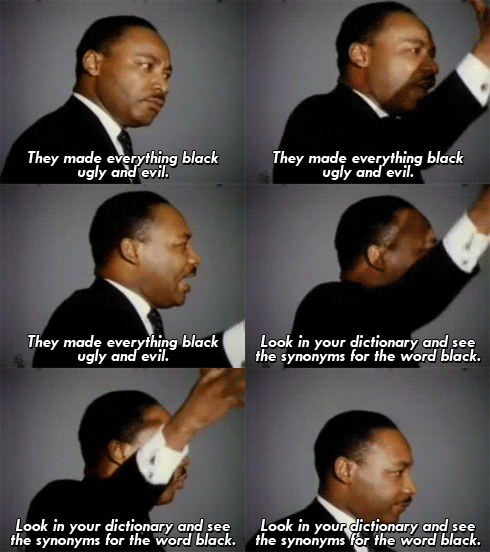
The Seahawks chose to observe Martin Luther King Jr. Day by tweeting out a photo of quarterback Russell Wilson crying after the win with an inspirational quote from King, the civil rights leader. Comparing winning a football game to all of the hardship King suffered through as he fought for peace and harmony is not the best idea, to say the least. To make it laughably worse, the Seahawks included "We shall overcome" on the original tweet. Not surprisingly, the tweet was deleted very soon after it was posted.
Chinese messaging service WeChat has apologized to users in its home country after accidentally showering them with the emoji of the American flag. Citizens in China using the app created by tech giant Tencent complained that typing the phrase "civil rights" in English triggered animations of the patriotic icon raining down their screens. WeChat explained that this was simply an Easter egg celebrating Martin Luther King day and that it had been intended to be seen American users only.
"internationalization is not easy!"
The flag emoji as they appeared on Chinese users' screens. (Weibo)
"Please forgive us for any misunderstanding caused!" said the company in a blog post on Weibo, explaining that a technical glitch had caused the emoji to appear in China. "The road towards internationalization is not easy!" Although WeChat’s emoji showers may sound odd they're a familiar sight to the app's 270 million international users. They're triggered in a variety of languages for phrases including "miss you" (sparkling emoji), "happy birthday" (cake emoji), and "xoxo" (kissing emoji), with WeChat often introducing holiday-specific keywords such as "Merry Christmas" and "Happy New Year." This appears to be the first year however that the company has tried to celebrate a US-only holiday.
The South China Morning Post reports that Chinese citizens complained via social media that the feature showed WeChat "pandering" to the US, with members of the Communist Youth League asking why were there no keywords that triggered similarly patriotic Chinese emoji. One widely-circulated post on microblogging site Weibo challenges Tencent to explain why they introduced the emoji in the first place, with the poster reportedly adding that in their opinion "American can't represent civil rights."
The next title to be prepended with the name of legendary game designer Sid Meier won't be another Civilization game, but it will be an extension of the latest game in that series. Developer Firaxis and publisher 2K Games today announced Sid Meier's Starships, an "early 2015" digital download for Windows, OS X, and the iPad centered on guiding a fleet of the titular ships through the galaxy.
“When designing Starships, I was intrigued by the idea of exploring the next chapter in the story of Civilization: Beyond Earth," Meier said in a press release. "What happens after we colonize our new home and eventually build starships to take to the stars? What has become of our long-lost brothers and sisters from the planet Earth? My goal was to create an experience that focuses on starship design and combat within a universe filled with interstellar adventure, diplomacy, and exploration.”
The announcement doesn't go into minute detail on gameplay, but it says players will be tasked with the Civilization-reminiscent tasks of "build[ing] a planetary federation by exploring the galaxy, expanding its influence and domain, researching futuristic technologies and engaging in deep, turn-based tactical space combat." The cinematic trailer accompanying the announcement talks of a post-Beyond Earth civilization building a starship to investigate a signal from a far-off alien world in need of aid.
The revival of T-Mobile US has given cellular customers more viable options, but that doesn't mean the company is going to become a sustainable business.
Deutsche Telekom CEO Timotheus Höttges said that “We have done what we had to do," Re/code reported. “We had built an infrastructure and this infrastructure had to get utilized and we did that with very aggressive promotions.”
via Olena Bulygina: "Joichi Ito, Director, MIT Media Lab on bitcoin"
In the post that follows I’m trying to develop what I see to be strong analogues to another crucial period/turning point in the history of technology, but like all such comparisons, the differences are as illuminating as the similarities. I'm still not sure how far I should be stretching the metaphors, but it feels like we might be able to learn a lot about the future of Bitcoin from the history of the Internet. This is my first post about Bitcoin and I’m really looking more for reactions and new ideas than trying to prove a point. Feedback and links to things I should read would be greatly appreciated.
I’m fundamentally an Internet person -- my real business life started around the dawn of the Internet and for most of my adult life, I’ve been involved in building layers and pieces of the Internet, from helping start the first commercial Internet service provider in Japan to investing in Twitter and helping bring it to Japan. I’ve also served on the boards of the Open Source Initiative, the Internet Corporation for Names and Numbers (ICANN), The Mozilla Foundation, Public Knowledge, Electronic Privacy Information Center (EPIC), and been the CEO of Creative Commons. Given my experiences in the early days of the net, it’s possible that I’m biased and everything new looks like the Internet.
Having said that, I believe that there are many parallels between the Internet and Bitcoin and there are many lessons from the Internet that can help provide guidance in thinking about Bitcoin and its future, but there are also some important differences.
The similarity is that Bitcoin is a transportation infrastructure that is decentralized, efficient and based on an open protocol. Instead of transferring packets of data over a dynamic network in contrast to the circuits and leased lines that preceded the Internet, Bitcoin’s protocol, the blockchain, allows trust to be established between mutually distrusting parties in an efficient and decentralized way. Although you could argue that the ledger is “centralized”, it’s created through mechanical decentralized consensus.
The Internet has a root -- in other words, just because you use the Internet Protocol doesn’t mean that you’re necessarily part of the Internet. To be part of THE Internet, you have to agree to the names and numbers protocol and root servers that are administered by ICANN and its consensus process. You can use the Internet Protocol and make your own network, using your own rules for names and numbers, but then you’re just a network and not The Internet.
Similarly, you can use the blockchain protocol to create alternative bitcoins or alt.coins. This allows you to innovate and use many of the technological benefits of Bitcoin, but you are no longer technically interoperable with Bitcoin and do not benefit from the network effect or the trust that Bitcoin has.
Also like the beginning of the Internet, there are competing ideas at each of the levels. AOL created a dialup network and really helped to popularize email. It eventually dumped its dialup network, its core business, but survived as an Internet service. Many people still have AOL email accounts.
With crypto-currencies, there are coins that don’t connect to the “genesis block” of Bitcoin -- alt.coins that use fundamentally the same technology. There are alt.coins that use slightly different protocols and some that are fundamentally different.
On top of the coin layer, there are various services such as wallets, exchanges, service providers with varying levels of vertical integration -- some agnostic to whichever cryptocurrency ends up “winning” and some tightly linked. There are technologies and services being built on top of the infrastructure that use the network for fundamentally different things than transacting units of value, just as voice over IP used the same network in a very different way.
In the early days of the Internet, most online services were a combination of dialup and x.25 a competing packet switching protocol developed by Comité Consultatif International Téléphonique et Télégraphique, (CCITT), the predecessor to the International Telecom Union (ITU), a standards body that hangs off of the United Nations. Many services like The Source or CompuServe used x.25 before they started offering their services over the Internet.
I believe the first killer app for the Internet was email. On most of the early online services, you could only send email to other people on the same service. When Internet email came to these services, suddenly you could send email to anyone. This was quite amazing and notably, email is still one of the most important applications on the Internet.
As the Internet proliferated, the TCP/IP stack, free software that anyone could download for free and install on their computer to connect it to the Internet, was further developed and deployed. This allowed applications that ran on your computer to use the Internet to talk to other programs running on other computers. This created the machine-to-machine network. It was no longer just about typing text into a terminal window. The file transfer protocol (FTP) and later Gopher, a text-based browsing and downloading service popular before the web was invented, allowed you to download music and images and create a world wide web of content. Eventually, permissionless innovation on top of this open architecture gave birth to the World Wide Web, Napster, Amazon, eBay, Google and Skype.
I remember twenty years ago, giving a talk to advertising agencies, media companies and banks explaining how important and disruptive the Internet would be. Back then, there were satellite photos of the earth and a webcam pointing at a coffee pot on the Internet. Most people didn’t have the imagination to see how the Internet would fundamentally disrupt commerce and media, because Amazon, eBay and Google hadn’t been invented -- just email and Usenet-news. No one in these big companies believed that they had to learn anything about the Internet or that the Internet would affect their business -- I mostly got blank stares or snores.
Similarly, I believe that Bitcoin is the first “killer app” of The Blockchain as email was the killer app for the beginning of the Internet. We are in the process of inventing eBay, Amazon and Google. My hunch is that The Blockchain will be to banking, law and accountancy as The Internet was to media, commerce and advertising. It will lower costs, disintermediate many layers of business and reduce friction. As we know, one person’s friction is another person’s revenue.
One of the main things we worked on when I was on the board of ICANN was trying to keep the Internet from forking. There were many organizations that didn’t agree with ICANN’s policies or didn’t like the US’s excessive influence over the Internet. Our job was to listen to everyone and create an inclusive and consensus-based process so that people felt that the benefits of the network effect outweighed the energy and cost of dealing with this process. In general we succeeded. It helped that almost all of the founders and key technical minds and technical standards organizations that designed and ran the Internet worked together with ICANN. This interface between the policy makers and the technologists -- however painful -- was viewed as something that wasn’t great but worked better than any of the other alternatives.
One question is whether there is an ICANN equivalent needed for Bitcoin. Is Bitcoin email and The Blockchain TCP/IP?
One argument about why it might not be the same is that ICANN fundamentally had to deal with the centralization caused by the name space problem created by domain names. Domain names are essential for the way we think the Internet works and you need a standards body to deal with the conflicts. The solutions to Bitcoin’s centralization problems will look nothing like a domain name system (DNS), because although there is currently centralization in the form of mining pools and core development, the protocol is fundamentally designed to need decentralization to function at all. You could argue that the Internet requires a degree of decentralization, but it has so far survived its relationship with ICANN.
One other important function that ICANN provides is a way to discuss changes to the core technology. It also coordinates the policy conversation between the various stakeholders: the technology people, the users, business and governments. The registrars and registries were the main stakeholders since they ran the “business” that feeds ICANN and provides a lot of the infrastructure together with the ISPs.
For Bitcoin it’s the miners -- the people and companies that do the computation required to secure the network by producing the cryptographically secure blockchain at the core of Bitcoin -- all in exchange for bitcoin rewards from the network itself. Any technical changes that the developers want to make to Bitcoin will not be adopted unless the miners adopt them, and the developers and the miners have different incentives. It’s possible that the miners have some similarities to the registrars and registries, but they are fundamentally different in that they are not customer-facing and don’t really care what you think.
As with ICANN, the users do matter and are key for the network effect value of Bitcoin, but without the miners the engine doesn’t run. The miners aren’t as easy to identify as the registrars and registries and it’s unclear how the dynamics of incentives for the miners will develop with the value of bitcoin fluctuating, the difficulty of mining increasing and the transaction fees being market driven. It’s possible that they will develop into a community with a user interface and a governance function, but they are mostly hidden and independent for a variety of reasons that are unlikely to change for now. Having said that, one of the first publicly traded Bitcoin companies is a miner.
The core developers are different as well. The founders of the Internet may have been slightly hippy-like, but they were mostly government-funded and fairly government-friendly. Cutting a deal with the Department of Commerce seemed like a pretty good idea to them at the time.
The core Bitcoin developers are cypherpunks who do what they do because they don’t trust governments or the global banking system and are trying to build a distributed and autonomous system, one that is impervious to regulation and meddling by anyone at any time. At some level, Bitcoin was designed to not care what regulators think. The miners have an economic interest in Bitcoin having value, since that’s what they’re paid in, and they care about scale and the network effect, but the miners probably don’t care if it’s Bitcoin or an alt.coin that ends up winning, as long as their investments in hardware and plant don’t disappear before they make a return on their investment.
Regulators clearly have an incentive to influence the rules of the network, but it’s unclear whether the core developers really need to care what the regulators think. Having said that, without some sort of buy-in by regulators, it’s unlikely to scale or have the mainstream impact that the Internet did.
Very much like the early days of the Internet, when we saw the power of Internet email but hadn’t yet invented the Web, we are just imagining the potential uses of concepts such as crypto-equity and smart contracts … to name just a few.
I believe it’s possible that over-regulation could cause Bitcoin or the blockchain to never achieve its full potential and remain a feature of the side-economy, much in the same way that the Tor anonymizing system is extremely valuable to people who really need privacy but not really used by “normal people”... yet.
What helped make the Internet successful was the lack of regulation and the generally inclusive and permissionless nature of innovation. This was driven in large part by free and open source software and the venture capital community. The question I have is whether the fact that we’re now talking about “money” and not “content,” and that we seem to be innovating at a much higher speed -- venture capital investment in Bitcoin is outpacing early Internet investments, the dialog in popular media is growing, and governments are very interested in Bitcoin -- makes this a completely different game. I think ideas like the five-year moratorium on Bitcoin regulation proposed by US Representative Steve Stockman are a good idea. We really have no idea what this whole thing is going to turn into, so a focus on dialog versus regulation is key.
I also believe that layer unbundling and innovation at each layer, assuming that the other layers will sort themselves out, is a good idea. In other words, exchanges and wallets that are coin-agnostic or experiments with colored coins, side chains and other innovations that are “unbundled” as much as possible allow the learnings and the systems created to survive regardless of exactly how the architecture turns out.
It feels a lot to me like when we were arguing over ethernet and token ring -- for the average user, it doesn’t really matter which we end up with as long as in the end it’s all interoperable. What’s different is that there is more at stake and it’s moving really fast, so the shape of failure and the cost of failure might be much more severe than when we were trying to figure out the Internet and a lot more people are watching.
Oki Sato, head designer of the design studio nendo, was named Designer of the Year by French interior design trade show Maison et Objet, which runs in Paris from January 23 to January 27, 2015. Representatives of the trade show asked Sato to design a chocolate to present this month. Sato took inspiration from onomatopoeic Japanese words for textures and designed Chocolatexture, a set of finely crafted chocolates all the same size and made from the same ingredients, but shaped to represent different words for textures. The sharp points and geometric style of the chocolates give an air of modern simplicity and humor.
Alice Zielinski is currently an MIT undergraduate studying aeronautical & astronautical engineering and computer science & electrical engineering. In this article, she tells us that
"Many MIT students recount questions about their GPA, test scores, magnificent things they’ve built, other accomplishments—while I often find myself trying to convince people that I actually attend MIT. The reactions that I’ve received from people range from amusing to borderline offensive, from delightful to ‘what??’"
Just another thing to show to your friends who don’t believe that sexism in STEM is a thing. Especially since she had to write a follow up addressing negative responses.