Menswear Dog sits for an exclusive interview and photoshoot with harpersbazaar
Head on over to Bazaar.com for the full feature
Menswear Dog sits for an exclusive interview and photoshoot with harpersbazaar
Head on over to Bazaar.com for the full feature

So there's a giant cloud hanging out in the Milky Way galaxy that smells a little bit like rum and tastes a little bit like raspberries. Here's why Sagittarius B2 may be the most delicious cloud in space.


The best superhero movie ever made, The Incredibles, is getting a long-awaited sequel. And count your blessings — it's getting made by the original Incredibles director, Brad Bird.

Back in March, Genki Sudo and his synchronized dance group World Order (previously) officially opened the 2015 Japanese baseball season by throwing the opening pitch in an ensemble choreographed movement. While Sudo actually threw the ball, the other members of the group created the effect of many independent arms, a reference to the thousand-armed Senju Kannon deity of Japanese tradition. The pitch took place at Miyagi Stadium in Japan.


GIF and photo via Spoon & Tamago
via Spoon & Tamago
Last week a large truck-mounted construction crane abruptly tipped over during the erection of a party tent at the Dallas Museum of Art. The crane’s boom fell on the museum’s facade, causing minor damage and propping the crane at an alarming angle. According to CBS Dallas/Fort Worth, many onlookers mistook the sight of the upended crane for a new art installation. Fortunately there were no serious injuries in the accident.


photos by G.J. McCarthy/Dallas Morning News
firehoseyo saucie
firehoseYOU'RE IN AN ENCOUNTER!
(comic; back into the hole)
firehosevia Osiasjota: "minha vida"

firehoseback into the hole

In the space of a week, Sean Vesce, creative director at E-Line, met with four different groups, including an Alaska Native elders group that counted William Hensley, who helped negotiate the Alaska Native Claims Settlement Act of 1971, among its members. He also met with a group of kids hand-picked by the Alaska Native community to represent youth issues and a group of CITC employees of indigenous heritage.
The fourth meeting was with an artists and storytellers group, where Vesce met Ishmael Hope, an actor, playwright, and poet who immediately delivered some hard truths about the project. Hope’s father is Tlingit, an Alaska Native people whose culture is based in the southeastern portion of the state. Hope is an expert in the Tlingit language. His mother is Iñupiaq, an Alaska Native people who hail from the state’s northernmost regions and who currently live in large numbers in the town of Barrow, Alaska, which sits above the Arctic Circle.
“[Ishmael] was the one that came out right at the outset and said, ‘Hey, look, if you guys are thinking that you’re gonna come up here once in a while and make your game down in Seattle, and check in with us once in a while to see if you’re on the track, there’s a long list of films and books and other kinds of artists that have come up to try that, and they have all failed,’” Vesce recalled. “‘If you want to succeed in this, if you want to create something that’s really appropriate and authentic, and you want to make something that not only excites people outside Alaska but makes people inside Alaska proud, you’re going to have to involve us in a very direct way, throughout the entire development.’ That really set the tone with us, in the way that we engaged with the community from that point forward.”
Hope and Vesce had a lengthy dialogue about how Westerners needed to break down internalized stereotypes, especially if they wanted to share, articulate, and understand an indigenous worldview. Without the ability to articulate the Alaska Native experience, Never Alone would be dead on arrival.
(via dailydot)
Never Alone is amazing. And we need to do more of this.
(via jessicalprice)
firehoseanother project done
back into the hole
firehoseBritish Cambridge, sadly
firehosevia ThePrettiestOne
yo saucie
The 5 Biases Pushing Women Out of STEM - HBR
(via
)
And this is why focusing on ‘getting more girls interested in STEM’ is a wrongheaded approach. Girls ARE interested in STEM, but the douchebags who make up the majority of STEM fields are not interested in acknowledging our humanity, intelligence, and capability. Funny how they assume that’s somehow our fault too, and we must just not be interested or dedicated enough.
(via australopithecusrex)
firehoseyo, is it
firehosehow was the last episode of lesbian bear tragedy


firehosejohn keough beat

presumably because i have incriminating photographs of john darnielle stealing the key to the city, i was allowed to do another tour poster for the mountain goats. the topic of the poster is werewolf.
printed by my dudes at industry print shop in texas, available in the cities that are written on it on the dates that the concerts happen, possibly online afterwards, depending on how many people are too terrified to buy one in person.
i grew up pretty obsessed with wrestling and i am of a background whose traditions emphasize the dominance of werewolf over all other monsters, so this one was especially fun to do.
firehosecapped at $842,442
firehoselife goals
firehosevia ThePrettiestOne
While the ’50s is famous for its family-friendly attitude, the number of hours that parents spend engaged in childcare as a primary activity has been rising ever since:
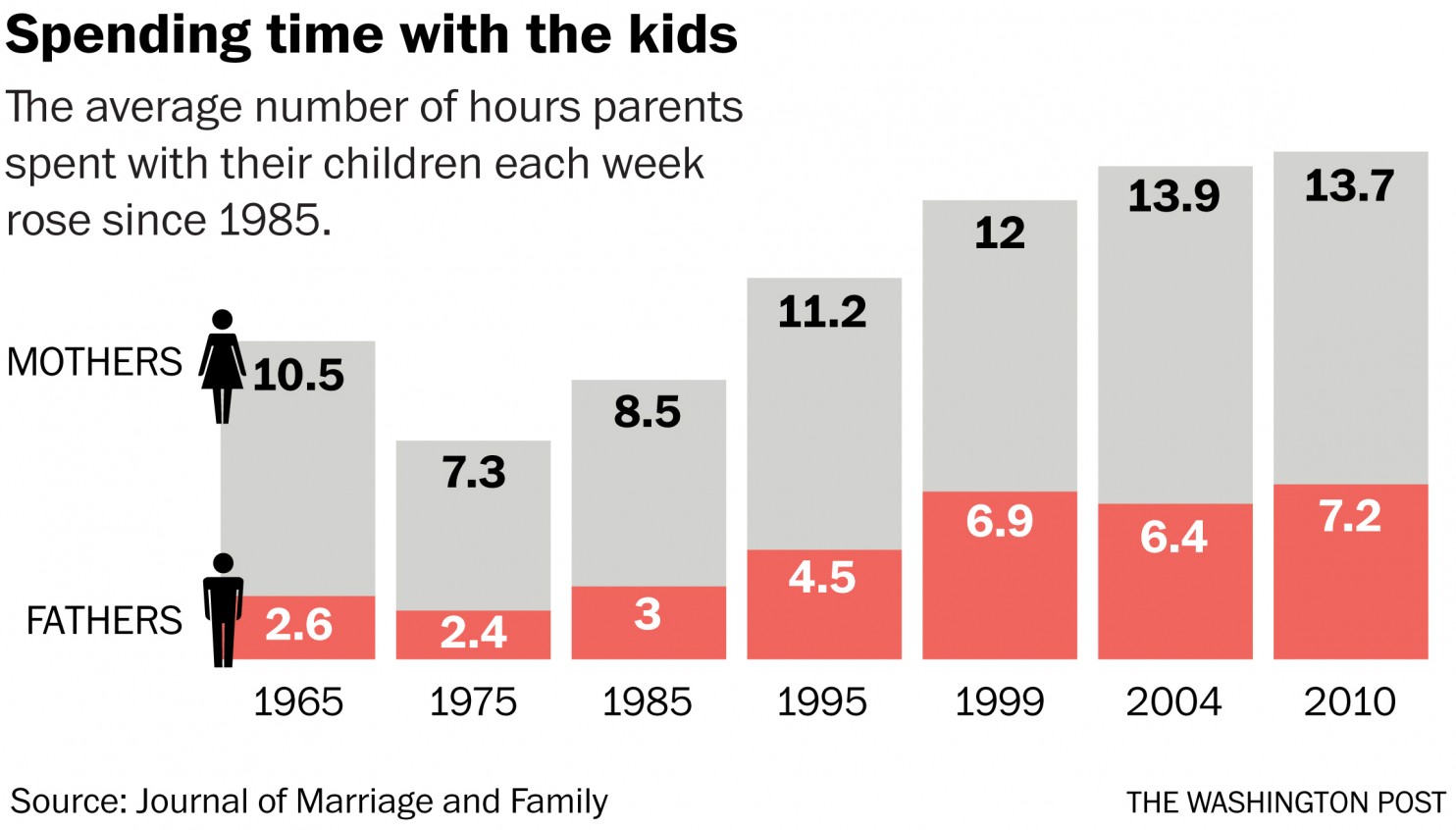
The driving force behind all this focused time is the idea that it’s good for kids. That’s why parents often feel guilty if they can’t find the time or even go so far as to quit their full-time jobs to make more time.
This assumption, however, isn’t bearing out in the science, at least not for mothers’ time. Sociologist Melissa Milkie and two colleagues just published the first longitudinal study of mothers’ time investment and child well being. They found that the time mothers spent with their children had no significant impact on their children’s academic achievement, incidence of behavioral problems, or emotional well-being.
Quoted at the Washington Post, Milkie puts it plainly:
I could literally show you 20 charts, and 19 of them would show no relationship between the amount of parents’ time and children’s outcomes… Nada. Zippo.
Benefits for adolescents, they argued, were more nuanced, but still minimal.
These findings suggest that the middle-class intensive mothering trend may be missing its mark. As Brigid Shulte comments at the Washington Post, it’s really the quality, not the quantity that counts.
The findings also offer evidence that women can work full-time, even the long hours demanded in countries like the U.S., and still be good mothers. Shulte points out that the American Academy of Pediatrics actually encourages parent-free, unstructured time. Moms just don’t need to always be there after all, freeing them up to be people, workers, partners, and whatever else they want to be, too.
Lisa Wade is a professor of sociology at Occidental College and the co-author of Gender: Ideas, Interactions, Institutions. You can follow her on Twitter and Facebook.(View original at http://thesocietypages.org/socimages)