Shared posts

19 Feb 22:03

Crysis 3 review - Polygon

by Arthur Gies
firehose

"Just about everyone under the Liberty Dome is suicidally curious. It makes each new area more like a to-do list than anything else."

By Arthur Gies
on February 19, 2013 at 9:00a

Game Info
Platform Win, 360, PS3
Publisher Electronic Arts
Developer Crytek
Release Date 02/19/2013
Price 59.99

Crysis 3 is determined to knock you out.

Crytek has said on record that its goal is to make the best-looking game ever created. The studio has succeeded. Playing through the third Crysis game (not counting the standalone expansion Crysis Warhead), I was stunned again and again by what was coming out of my PC. We've been talking for a year about the possibilities of the next generation of video game hardware, what it will look and sound like. Crysis 3 answers that now.

It maintains such a consistent onslaught of spectacle and beauty that it takes some time to realize how little Crysis 3 has going on. Crytek still has most of the same systems in place that made the other Crysis games engaging exercises in superhuman tactics mixed with first-person shooting. But a considerably less engaging playground and some ill-conceived additions serve to bleed Crysis 3 of its hereditary muscle. Crysis 3 never manages to employ the Nanosuit-oriented brilliance of previous games, but it doesn't ultimately matter — it never seems to ask much of the player, either.

Crysis-3-big-screen-1

Crysis 3 starts a couple of decades after the conclusion of the last game. New York City remains in ruins after a cybernetic super-soldier known as Prophet thwarted an invasion from below by the alien Ceph. Outfitted with a combination of alien DNA and human technology known as the Nanosuit, Prophet sacrificed his own body and an unknown amount of his humanity to get the job done, and now he's imprisoned and set to be dissected by the Cell corporation for his trouble. As Crysis 3 opens, Prophet is rescued by an old friend with a plan: to breach the remains of New York and unravel a conspiracy involving a new energy economy and the ghosts of the ill-fated Ceph invasion force.

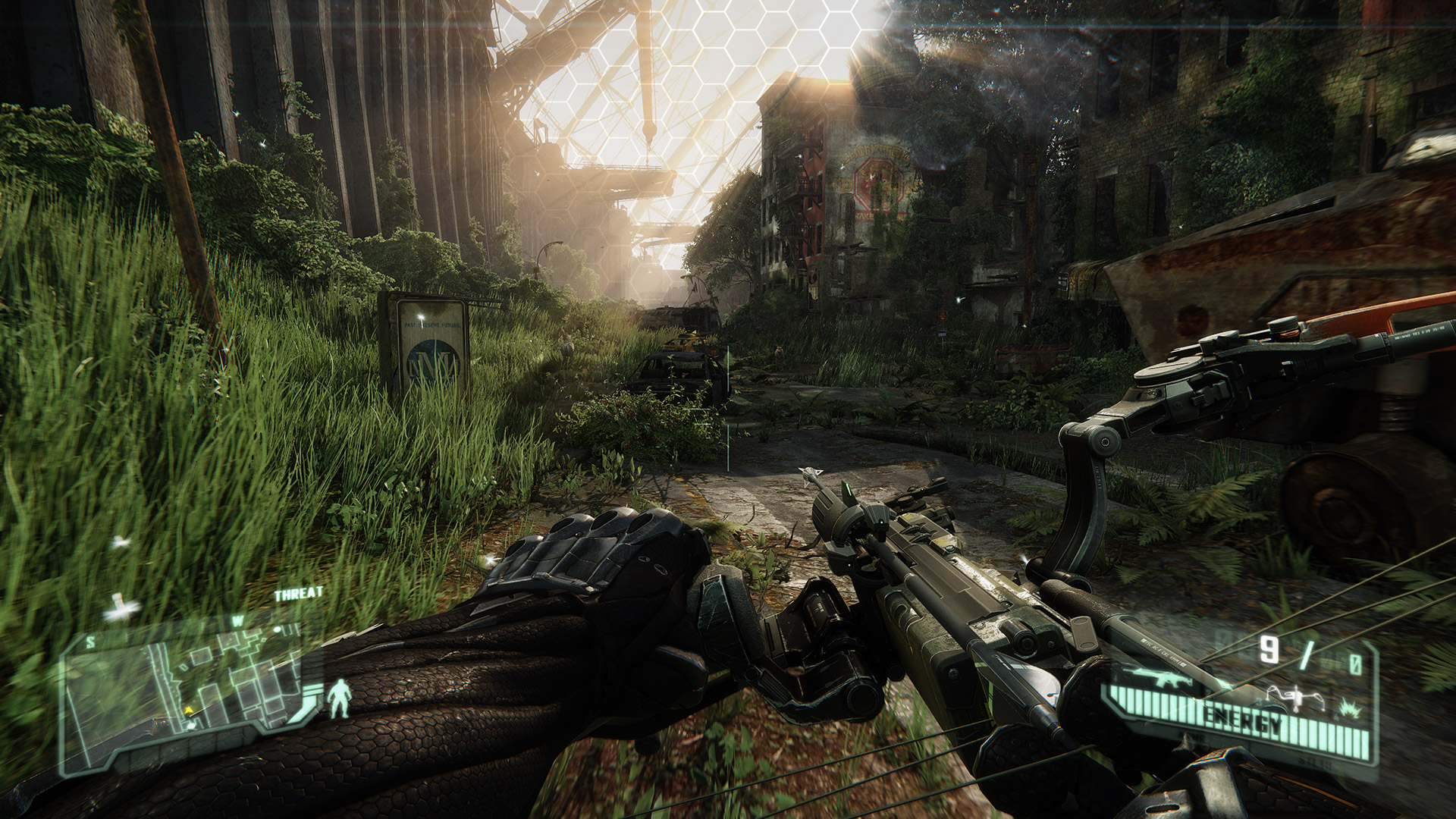
The urban environments of Crysis 2's New York have been overgrown by rampant vegetation, turning the city into a concrete-laden rainforest contained under a glass canopy. This Liberty Dome is a setting with a lot of promise, though Crysis 3 never manages to do much more with it than cross off the disaster-porn checklist. Landmark submerged by a swamp? Check. Ruined library? Check. Planet of the Apes reference? And how!

Crysis 3's New York is a concrete-laden jungle underneath a glass canopy
Review-screen-1

The less said about the story, the better. The interesting ideas of humanity and free will, capitalism and war profiteering from Crysis 2 are buried beneath one of the dumber skeletons of genre contrivances I can remember. Crysis 3 pays lip service to those aforementioned themes here and there, but it's more content to telegraph obvious story twists and to contort events to awkwardly fit the plot like it was following through on a dare. It would be a little bit offensive if it weren't all so stupid.

It's also easy to get lost enough in Crysis 3's visuals and soundtrack to ignore most of the more egregious narrative missteps. Sure, the script is dumb, but the human character models are so fantastically well-rendered that it's hard to pay attention to what's coming out of their mouths. And the story in the Crysis games has never been great. The graphics have done some heavy lifting, but the majority of the weight has always been carried by their mechanics.

The same basic foundation established in Crysis and rebuilt in Crysis 2 is still present in Crysis 3. Weapons are modular tools that can be reconfigured on the fly to suit your play style — each weapon has a variety of sights, grips, attachments and fire modes. The basic gunplay is quick and responsive, and weapons have a great sense of heft and volume. But guns aren't what sets Crysis 3 apart.
Crysis-3-review-tall

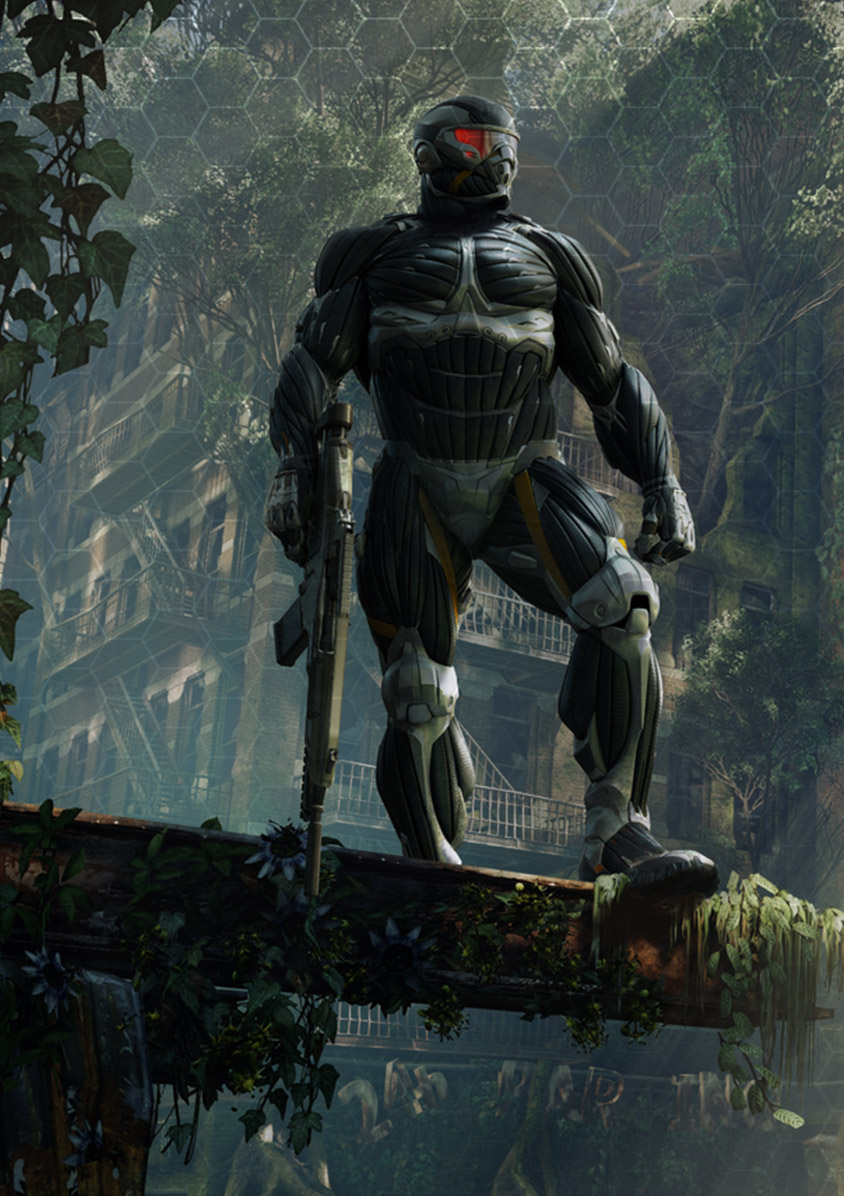
The series-defining Nanosuit remains the game's driving force. The Nanosuit offers a sense of raw physicality unlike any other first-person game out there. There's something fundamentally satisfying about sprinting toward an impossible jump and just making it, your avatar grabbing at the ledge and hurling itself up and over, only to cloak and sneak forward to play the part of silent killer. In turn, activating the Nanosuit's armor mode, basking in invulnerability and laying into a group of Cell agents or alien Ceph with an M60 is rewarding in its own way.

Crysis 3's bow destabilizes the entire Nanosuit power dynamic

Previously, Crytek made using the Nanosuit's laughably overpowered arsenal rewarding by limiting how far it could be pushed. Despite the Nanosuit's finite but slowly regenerating reservoir of power, Crysis has always lived and died by the quality of the playground in front of you. The first game presented a wide-open tropical jungle to navigate that forced players to juggle conservation with power usage. Crysis 2 encouraged more vertical thinking. The series has always shined the most when each new area served as an escalating test, forcing you to intelligently juggle your various abilities to succeed. And in that regard, Crysis 3 suffers deeply from a very simplified playground. In some ways, it seems to take the worst parts of its predecessors.

Multiplayer

Crysis 3 covers its bases with all the multiplayer modes you'd expect from a modern shooter. Nanosuit abilities set it apart from the pack, obviously, and the physicality present in Crysis 3's single-player campaign translates fairly well to competitive play. There's something pretty special about watching a bunch of superheroes cloaking and leaping and generally wrecking each other, though the standard experience level trappings courtesy of Call of Duty feel depressingly by-the-numbers.

However, it's Hunter mode that stands the best chance of finding a following. Hunter mode designates a pair of players as, er, Hunters, who are outfitted with Nanosuits and bows. All other players are normal human soldiers, sans superpowers but packing much heavier firepower.

In my time with Hunter mode, I was struck by how much more fun I had as one of the hunted — it was a nice change of pace from the specific Crysis power fantasy to have to run and hide and play smart, rather than operate like some kind of movie monster.

As in the original Crysis, many combat areas are huge, flat and under-populated, patrolled by enemies that are woefully underequipped to present any sort of challenge or force you to strategize on your feet. Other sections are comparatively enclosed spaces with a few sparse levels of varying altitude that serve mainly to obscure any view of the atrocities you're wreaking on the poor saps who were assigned to the "lobby" area.

But the most destabilizing element in Crysis 3's level design is the seemingly innocuous — and initially awesome — bow.

Previously, using any weapon save for a knife in service of a stealth kill would break you out of your cloaked state and deplete your energy stores. You could get around this by briefly uncloaking, firing and then recloaking, but that whole process required skill and timing, and pulling off a long-distance headshot on an enemy in this way was incredibly satisfying for that very reason. Eagle-eyed enemies had a good chance of seeing you in that split second of visibility. It was another risk-reward situation, and granted, this requirement is still present in Crysis 3 — if you fire a shot while cloaked, you're boned.

Crysis 3's bow does away with that necessity entirely — you can fire the bow without uncloaking, and it's nearly always a one-hit kill. I found this immensely satisfying at first. As a Crysis veteran, I had been given what felt like the right hand of a vengeful deity. But the removal of the stealth/weapon use dynamic nearly breaks the game.

There's almost never a good reason not to use cloaking and the bow. You can only carry nine standard arrows, sure, but walking over a corpse conveniently picks that arrow back up, none the worse for wear. Over the course of Crysis 3's 6- to 7-hour campaign, I killed 362 enemies. 213 of them were with the bow, and I retrieved 183 of those arrows.

The bow would likely be less of a balance destroyer were it not for the shockingly stupid AI that plagues Crysis 3. Almost every combat encounter involved a variation of the following: shoot enemy with bow; wait for enemy to investigate body; shoot investigator; repeat. It didn't matter whether I was fighting humans or Ceph. Just about everyone under the Liberty Dome is suicidally curious. It makes each new area more like a to-do list than anything else.

Even without the bow, enemies are too easy to fool, and it's trivial to use the upgrade points you find to focus exclusively on increasing your cloaking abilities and energy reserves. Occasionally, Crysis 3 finds its footing and returns to form, particularly in the latter half of the game, when Crytek contrives reasons to use your other suit abilities and non-arrow-powered equipment.

It's frustrating, because later battles only serve to underline how much wasted opportunity is present in Crysis 3. There are moments of greatness, particularly when a clever environmental layout is paired with capable enemies, which forced me to really consider my options rather than skulk around like some kind of serial murderer. It would have been even nicer to see some of the more powerful enemies paired up with larger numbers of infantry units, as the game rarely turns the odds against you.

Wrap Up:

Crysis 3 has a strong foundation, but never seems to ask for much from the player

That might be the thing that stands out the most to me about my time with Crysis 3. I enjoyed myself despite how much of a step backward the entire game feels from its predecessors. It's a beautiful game with jaw-dropping production values. But it took me a few hours to realize how empty Crysis 3 feels. The best thing I can manage to say about it is this: It didn't get in my way. But I would have had more fun if Crysis 3 had put up a fight.

Crysis 3 was reviewed using pre-release PC code provided by Electronic Arts. You can read more about Polygon's ethics policy here.

About Polygon's Reviews
19 Feb 21:37

thatsonofamitch: Everyone go home, stop making music, stop...


thatsonofamitch:

Everyone go home, stop making music, stop whatever you’re doing.
This guys wins

19 Feb 21:36

itscolossal: Behold the 3Doodler, the world’s first pen that...

firehose

yeeaaaaah


itscolossal:

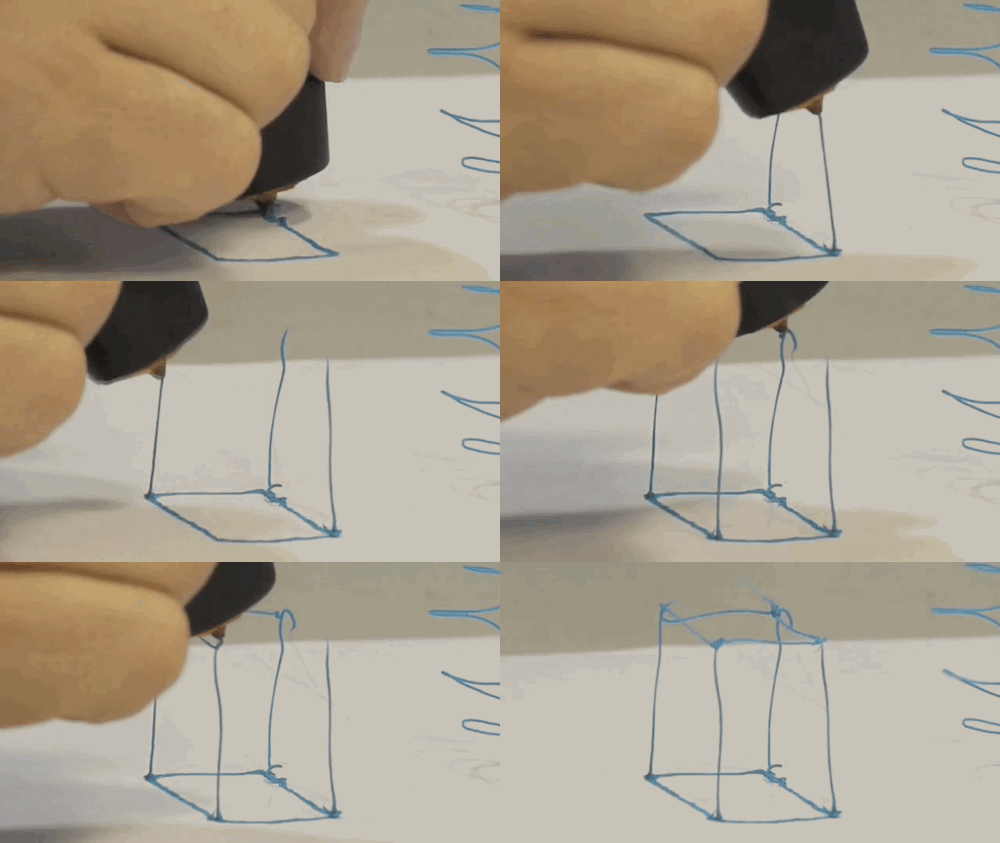
Behold the 3Doodler, the world’s first pen that lets you draw 3D sculptures in real time.

19 Feb 21:34

Firefox finally gets in-browser PDF viewer with latest browser update

by Chris Welch
firehose

fuck your acrobat

Firefox has finally gained a built-in PDF viewer, after Mozilla today updated the stable build of its popular web browser with the new feature. The rollout comes after the company's PDF viewer — which utilizes HTML5 and JavaScript rather than requiring users to install a standalone plugin — was previewed in beta form last week. "Not only do most PDFs load and render quickly, they run securely and have an interface that feels at home in the browser," the company wrote on its blog today. Official in-browser support for PDFs has been a long time coming; though it was just added to Firefox's feature set, competing browsers Chrome and Apple's Safari have been supporting the file type for years now. Nonetheless, if you're tired of relying on third-party solutions to display PDF content, you can download the latest version of Firefox below.

19 Feb 21:34

David Cross feature film 'It's a Disaster' launching on Vine this afternoon

by Adi Robertson

Oscilloscope Labs, the independent film company founded by now-deceased Beastie Boy Adam Yauch, will release one of its films in 6-second pieces on Vine this afternoon. At around 4:30pm EST the company will start uploading segments from It's A Disaster, a generally well-received piece that's not set to be officially released online until March 5th, to its Twitter feed. We're not sure the entire movie will be posted — and since it'll need to be filmed secondhand from a phone, quality won't be great — but this is being touted as a "feature film release," so we're optimistic.

In a tongue-in-cheek press release, Oscilloscope's Bruce Farnsworth said that "From the moment it launched just three short weeks ago, it was so clear to us that six-second loops of video, edited in-phone, and posted in real time was and will be the future of film distribution." We could end up seeing straightforward clips from It's A Disaster, which stars Julia Stiles and Arrested Development's David Cross as a couple caught in an apocalyptic attack during a brunch with friends, but Vine's editing features could make for some interesting remixes. While likely a far cry from the weird, tiny Vine movies of Adam Goldberg, it's an enjoyable experiment in its own right.

19 Feb 21:33

knusprig-titten-hitler: “A vocal minority was offended by this...


knusprig-titten-hitler:

“A vocal minority was offended by this mural and the city caved. Hope they like the results.”

19 Feb 21:33

gree: Fundamentals of concurrent programming WAT.

19 Feb 21:33

fartgallery: These guys don’t know each other. They literally...


fartgallery:

These guys don’t know each other. They literally sat together just because they were both wearing stripes.

The blue guy walked in and stopped and was like “Yo! Stripes!” And the red guy started nodding and was like “striiiiiiiiiipes

19 Feb 21:33

Dog Quickly Bares Teeth on Command

by Rusty Blazenhoff

The dog in this Russian video has been trained to quickly bare its teeth on command.

video via kamaz222

via Tastefully Offensive

19 Feb 21:32

Kittens On The Beat, A Music Video by Corridor Digital Featuring the Song “Wildstyle” by Savant

by Justin Page

Kittens On The Beat” is an awesome music video by Corridor Digital that shows two sleeping kittens who wake and do their best to scare off a group of miniature sock thieves. It features the song “Wildstyle” by Norwegian dubstep artist Aleksander Vinter (aka “Savant“).

The gray kitten is Roto, and the black one is Bowie!

videos via Corridor Digital

via Daily Dot

19 Feb 21:28

Jeep the latest official Twitter account to fall victim to hackers

by Nathan Ingraham
firehose

all my favorite brands brands brands brands

Just a day after Burger King's Twitter account fell victim to hackers, it appears the same group has similarly dismantled Jeep's official Twitter account. The page now says that Jeep was purchased by Cadillac, much like Burger King's page said the company had been purchased by McDonalds. The "content" of the tweets being posted is largely the same, as well. It's the latest black eye for Twitter, a service that has grown significantly in popularity as it has positioned itself as an ideal social network for brands to reach out and directly communicate with interested consumers. The service's lack of security could throw a major wrench into things going forward — while getting hacked may be an unfortunate risk of being online, brands that spend money on maintaining a Twitter presence are certainly right to question why the company isn't taking security more seriously.

19 Feb 20:51

Comedy: Great Job, Internet!: This photo of Kanye West with Aziz Ansari's parents is fantastic

by Josh Modell

We recently ran an interview with comedian Aziz Ansari about the difficulty of finding true love in the modern age, and he spoke a bit about his parents. Well, here's a picture that's been floating around the web today of Mama and Papa Ansari, along with Kanye West and Aziz. There's so much to love in the photo itself—Aziz's mug, Kanye's hard stare, Mr. Ansari's confusion—that perhaps we can put the pursuit of romantic love on hold for at least one more day. [h/t to Uproxx]

Read more
19 Feb 20:51

Music: Newswire: Morrissey gets the Staples Center to go completely vegetarian

by Sean O'Neal

It was only yesterday that Morrissey was forced to cancel yet more shows, due to what he termed the “slightly embarrassing absence of blood” brought about by his bothersome bleeding ulcer—a condition that continues to disappoint fans yet delight blogs who can use “Still Ill” in their headline. But as the vibrant, typical wryness of his apology suggested, Morrissey still has enough blood to angry up when it comes to matters of meat-eating, hence the announcement that, for the first time ever, Los Angeles’ Staples Center will go completely vegetarian if and when a fully recovered Morrissey plays there on March 1.

In what Morrissey calls “a victory for the animals,” the venue has agreed to ban all sales of “flesh for food” within its walls (flesh for fantasy is still okay), while promoters will also donate a portion of ticket sales to PETA. The first six rows will ...

Read more
19 Feb 20:51

Why Netflix’s all-at-once strategy for House of Cards was a mistake

by Christopher Mims
firehose

graphs that look like Batman beat

As Frank Underwood will tell you, to get people's attention you need to make them hungry.

Netflix’s attempt to draw customers away from cable TV networks like HBO by making its own TV shows has been performing splendidly so far, says the company. One in ten of Netflix’s 25 million streaming subscribers has watched its new, exclusive show House of Cards, and on average they’ve watched 6 of the 13 episodes released so far. (These numbers come from a survey conducted by Netflix itself, so we can’t vouch for their accuracy.)

Perhaps the most distinctive thing about House of Cards isn’t its storyline (about the machinations of a US Congressman, Frank Underwood, played by Kevin Spacey) but the fact that Netflix decided to make the show’s entire first season available at once. The logic was: Now that people have the choice, a lot of them like to binge-watch their favorite shows whole seasons at a time, rather than on an episode-by-episode weekly drip.

But that was probably a mistake, and here’s why: By giving up the level of constant social media chatter that accrues to shows that are released episodically, Netflix missed out on the kind of sustained conversations that help a show find its widest possible audience.

This sort of thing is difficult to prove, but here are some preliminary data on it from Google Trends, which tracks how many times people are searching for a term on Google. It’s a reasonable proxy for overall interest in a subject.

The volume of Google searches for the shows “Game of Thrones,” “Downton Abbey,” and “House of Cards” over the past two years. Google Trends

When comparing House of Cards to two recent blockbuster shows, Downtown Abbey and Game of Thrones, the trends are clear: Interest in a show spikes when its season begins (for GoT, that’s April 2011 and April 2012) and builds to an even bigger crescendo around the season finale. Throughout the season, search volume is sustained at a high level. By giving people time to discover a show and/or be cajoled into watching it by their own fear of missing out, episodic TV inherently meshes with viral and social marketing.

Downton Abbey shows a similar pattern to Game of Thrones, just with a smaller audience. House of Cards, meanwhile, has a relatively low search volume at its launch, which is to be expected for a new show. The question is: will that volume increase and be sustained in a pattern resembling that of other shows? And why would it, given that all the show’s surprises have been revealed, and there is no opportunity to commune with millions of other viewers as new episodes air?

As media critic David Carr points out, one of the things that sustains shows like Game of Thrones and Homeland is the social dimension: People tweet along with the show as its broadcast, share their feelings on recent episodes on Facebook, and read episode recaps when they miss the show.

By making it a little too easy for viewers to access all of House of Cards at once, Netflix has missed out on the multiplicative effect that happens when the conversation around a show is concentrated in time. It’s too early to tell if this will reduce the show’s potential long-term audience, but it certainly can’t help.


19 Feb 20:50

lickypickystickyme: A French artist says coastguards are...


lickypickystickyme:

A French artist says coastguards are constantly trying to ‘save’ him whenever he takes his boat out.

Julien Berthier has created ‘Love Love’ a boat which permanently looks like it is sinking and sticking out of the water.

The 35-year-old from Paris took a wrecked boat which he found in Normandy, cut it in half and sealed the end with fibre-glass before fitting two electric motors.

It’s said the result is a ‘surprisingly stable’ craft, where the sailor sits in an upside down seat.

[Of course the problem is, no-one will ever know if he is in real trouble.]

19 Feb 19:58

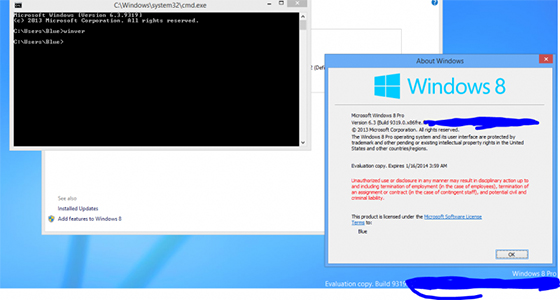
Windows Blue screenshots leak, reveal NT kernel change to version 6.3

by Tom Warren

Microsoft is busying preparing a host of Blue updates to its software and services and the first screenshots are starting to emerge. Winaero and Win8china have both posted screenshots of two builds that are known internally as Windows Blue. The Verge is unable to confirm the exact build numbers, but we understand that Microsoft bumped its NT kernel to 6.3 in the last few weeks.

Windowsblue

The screenshots do not show what type of features Windows Blue will include, but the NT kernel change is notable. Windows Vista adopted NT kernel 6.0, while Windows 7 jumped to 6.1, and Windows 8 to 6.2. A switch to 6.3 with Windows Blue suggests this is a major revision to Windows, but one that will be delivered much sooner than a traditional Windows cycle. Sources tell us there is no "Windows 9" project inside Microsoft, and that Blue is the next major update to Windows.

We're told that Windows Blue is designed for a new wave of hardware, particularly the 7- and 8-inch tablet form factors. Microsoft will introduce its operating system update to Windows 8 users at a low-cost to ensure users upgrade in preparation for regular yearly updates. Windows Blue is expected to debut later this year.

19 Feb 19:56

Oxford Temporarily Blocks Google Docs To Fight Phishing

by timothy
netbuzz writes "Fed up with phishers using Google Forms to commandeer campus email accounts as spam engines, Oxford University recently blocked access to Google Docs for two-and-a-half hours in what it called an 'extreme action' designed to get the attention of both its users and Google. 'Seeing multiple such incidents the other afternoon tipped things over the edge,' Oxford explains in a blog post. 'We considered these to be exceptional circumstances and felt that the impact on legitimate University business by temporarily suspending access to Google Docs was outweighed by the risks to University business by not taking such action.' The move generated widespread complaints from those affected, as well as criticism from outside network professionals."

Share on Google+

Read more of this story at Slashdot.


19 Feb 19:56

TV: Great Job, Internet!: Read This: Here’s a long history of the Cosby Sweater, finally  

by Kyle Ryan

Collectors Weekly has a surprisingly lengthy history of the Cosby Sweater, the gaudy, occasionally hideous, but always eye-catching knits Billy Cosby wore throughout the run of The Cosby Show. Writer Hunter Oatman-Stanford talks to the show’s costume designer, Sarah Lemire, Koos Van Den Akker (the Dutch designer who created some of Cosby’s signature threads), and even a few mostly dismissive quotes from Cos himself. (Asked about the resurgence of the Cosby Sweater, he says, “I have no idea, and I’m not going make up anything. But I think youthful people have a long time to live, so they can waste some time on something like that.”)

Most interesting in the story, though, is how sweaters were a practical necessity for how The Cosby Show was shot:

The show often relied on close-up shots of Cosby to capture such moments of improvised humor. However, tight shots like these ...

Read more
19 Feb 19:52

Apple says it was attacked by hackers, will issue malware removal tool today

by T.C. Sottek

Reuters reports that hackers infected a "small number" of Apple's computers, and that it was targeted by hackers who also attacked Facebook and other companies — though no data appears to have been stolen. The breach is highly unusual for Apple, and Reuters says Apple is working with law enforcement to locate the hackers. An Apple spokesperson told Reuters that "there was no evidence that any data left Apple," and no user information is said to have been compromised.

Reuters says Apple plans to release a software tool today to protect customers against malware used in the attack against it and Facebook. It's not clear yet why the attack on Apple's network warrants a security update is necessary for consumers.

We've asked Apple to confirm the story and will update as new information becomes available.

Developing...

19 Feb 19:52

Apple computers 'hacked' in breach - BBC News


BBC News

Apple computers 'hacked' in breach
BBC News
The iPhone-maker said a small number of its machines were affected, but added there was "no evidence" of data theft. Last week Facebook said it had traced a cyber attack back to China which had infiltrated employees' laptops. Apple said it would release a ...
Apple admits it has been hackedIrish Independent
Apple hit by hacker attackGMA News

all 276 news articles »
19 Feb 19:51

Will Twitter file a secret IPO?

by Zachary M. Seward
firehose

great

Indians feed birds from a boat on the River of Yamuna as it is enveloped by winter morning fog in New Delhi, India.

Twitter is expected to file for an initial public offering in late 2013 or early 2014. That much is widely known. Less attention has been paid to whether Twitter will make a normal IPO filing or if, as new rules allow, the company will try to go public in secret.

The Jumpstart Our Business Startups (JOBS) Act, signed into US law last year, lets firms with less than $1 billion in annual revenue keep their IPO filings confidential up until three weeks before they start marketing shares to investors in a “road show.” It was largely proposed and pushed by venture capitalists in Silicon Valley, who said it would stem a decline in US IPOs by reducing the burdens of going public felt by smaller firms. Ordinarily, a company has to make public a lengthy discussion of its financials, strategy, and risks months before an IPO, giving investors—and competitors—more of a chance to evaluate the stock.

In the first nine months since the JOBS Act went into effect, 59% of eligible companies availed themselves of the option to keep their IPO filings secret, according to an Ernst & Young study reported today by the Wall Street Journal. Twitter is likely to be eligible: It made $350 million in revenue last year, and it’s not expected to hit $1 billion until 2014.

Keeping its IPO filing secret until the last minute could help Twitter avoid the overheated anticipation that Facebook had to deal with ahead of its disastrous IPO. It could keep its financial details away from rivals for a few extra months, as it grows a mobile advertising business that might compete with Facebook’s or LinkedIn’s. And if Twitter would rather keep some of its early history under wraps, it could avoid an outside audit and submit just two years of financial statements, as opposed to the customary five.

Of course, the move could also backfire spectacularly, adding to the intrigue when investors are still skeptical of tech IPOs after Facebook, Zynga, and others fell short of heightened expectations. And though the JOBS Act is coming up on its first anniversary, the harshly criticized law isn’t well known, and Twitter’s involvement could draw it some negative attention.

The law’s other controversial provisions include allowing hedge funds to advertise publicly and letting private companies raise money from ordinary investors in the style of “crowdfunding.” Invoking the JOBS Act might also rebound badly on Twitter, which with roughly 1,000 employees is not exactly the poster child for a law meant to help small startups.

So far, the most prominent company to make a confidential IPO filing under the JOBS Act is arguably Xoom, a provider of international money transfers, which started trading last week. Another highly anticipated IPO, from cloud storage company Dropbox, will likely come to market before Twitter and could also qualify for the JOBS Act’s laxer regulations. Twitter hasn’t discussed when it might go public, let alone the mechanics of how it might do so. A spokesman for the company told me today, “We don’t comment on speculation.”


19 Feb 19:51

UAE becomes the first non-NATO nation to fly an American Reaper drone

by Tim Fernholz
A MQ-9 Reaper, armed with GBU-12 Paveway II laser guided munitions and AGM-114 Hellfire missiles, piloted by Col. Lex Turner during a combat mission over southern Afghanistan.

At a weapons bazaar in Abu Dhabi on Feb. 18, defense officials for the United Arab Emirates announced the purchase of $1.4 billion in American military hardware, including $197 million in drones built by General Atomics Aeronautics, which supplies the US military with its Predator and Reaper drones.

While armed forces in the United Kingdom and Italy have purchased and fielded drones that include mounting points for missiles, the aircraft GAA will sell to the UAE will be only be capable of “intelligence, surveillance, and reconnaissance.” The UAE’s air force will have a good view—but not a view to a kill.

The deal comes amid increased interest in the Middle East and Africa for remotely piloted vehicles, which in the hands of the US military have changed warfare and counter-terrorism, providing reconnaissance for soldiers and spies but also delivering deadly remote strikes against terrorists and nearby civillians under questionable legal authority.

But drones, like any technology, are tools in human hands. The UAE won’t likely use the aircraft to make war but for border control and internal intelligence. The UAE’s kingdoms already monitor and censor communications and have pushed back against pro-democracy activists. The US State Department approves all sales of US military hardware abroad, including drones.

While other companies around the world manufacture drones, including Denel, a division of South Africa’s state military contractor, companies like Israel Aerospace Industry and Elbit Systems Ltd. in Israel, which began using drones in the seventies, remain the biggest competitors for GAA and other American firms. Still, the US military’s high demand (some 7,000 drones have been bought by the US military) and usage rate (some 2 million hours of flight time, according to GAA) give the American company greater experience than many competitors.

While drone manufacturers are still largely focused on government contracts, whether military or for border control and scientific research, more countries are allowing commercial use of drones or preparing air space regulations to enable it. In 2015, the US will open its skies to commercial drones.


19 Feb 19:50

Q&A With Amy Stewart, Author of The Drunken Botanist

algonquin press, drunken botanist, amy stewart Photo courtesy of Algonquin Press

Wicked Plants and Wicked Bugs author Amy Stewart has crafted an artful and informative new book: The Drunken Botanist: The Plants That Create The World's Great Drinks. Due for release March 19, 2013 (but available in bookstores any day now), this personable volume offers history, anecdotes, advice and cocktail recipes, all revolving around plants used either to make booze or to flavor your favorite tipple.

Want to know more about the plants that go into tequila, sake, vermouth, beer or authentic tonic water? Or, if you're more plant-oriented: what drinks are composed with sugar cane, oak, rice, agave, barley, strawberry tree, sundew, monkey puzzle tree, violet, birch, cinnamon, grapefruit or hazelnut?

The Drunken Botanist addresses these plants, drinks and more in 160 jaunty yet meticulously-researched mini-essays on the plants that comprise your favorite boozy beverages.

A neat (no pun intended) part of the story of this book is that the idea was conceived in Portland, Oregon, when Stewart was visiting here a few years back. Gazing around a liquor store, she and a friend realized "there wasn't a bottle in the store that we couldn't assign a genus and species to." A few cocktails later, the outlines of the book took shape. A few years of painstaking research (and no doubt giddy drinking sprees) later, a book was born.

amy stewart, the drunken botanist, cocktails, booze, drinks, alcohol Photo courtesy of Amy Stewart

After her recent media book launch in Portland, I had a chance to quiz Amy about the fascinating process of researching her latest book...

KB: This sounds like a pretty fabulous job, traveling to distilleries, wineries, breweries, and cocktail bars with nothing to do but travel, drink, talk with interesting people, and then write about it. Artisinal distillers mail you bottles of their best booze, hoping you'll take a shine to it. So what's the downside to all this?

There is absolutely no downside to writing a book about booze and plants... It gave me access to a little bit of everything I love — amazing travel, interesting people, weird science, botanical history, and great bars and distilleries that I was obligated to visit for professional reasons.  The irony is that nobody mailed me free bottles of their best booze!  That only started after word about the book got out.

It's not a downside, exactly, but one thing about this book that might not be immediately obvious is the insane amount of research that went into it. It's meant to be sort of a lighthearted, gifty book — it has a beautiful design and really fun art and it's the kind of book that you can just pick up and put down... But in fact, I am a freak about research. If I read in someone else's book that a German chemist said something 150 years ago, I don't take their word for it — I track down the original source, in the original German, and hire a translator to give me a new translation of it. I tracked down the botanists who knew more about a plant than anyone else in the world, so I was on the phone with the world's leading experts in barley, grapes, apples, gentian root, whatever.

And the booze world is full of all kinds of crazy mythology about the origins of certain spirits. I fact-checked all of that stuff.  Sometimes I would spend days trying to prove or disprove some odd fact, only to find out that it wasn't true, which meant that I either wasn't going to include it in the book at all, or I would just have a line that said, "this is a popular myth about that plant, but in fact that's not true and this is what's true instead."  I spent six weeks on my chapter on agave, which is the first plant in the book, and I realized that if I kept going at that rate it would take me ten years to write this thing. So there were times when I had to cut my losses and move on.

Because we were trying to keep the book to 400 pages, I was unable to include an extensive bibliography and chapter notes. So I promised in the book that I would post that online.  I have a little over 300 sources here, which people can also find by going to DrunkenBotanist.com and doing a search for the word bibliography. [Ed. note: serious cocktail nerds should know there will likely be more research notes, organized by chapter, available on The Drunken Botanist website. Check back.]

KB: Any great or funny stories connected with the writing of the book?

All the best stories come from traveling around Europe and going to these distilleries that have been in operation for hundreds of years. I was so excited about going to the Chartreuse monastery to see them make Chartreuse. I knew it was a highly secretive recipe and that I wouldn't get to see much. I was used to that – a lot of distilleries operate that way. They let you see certain parts of the process, but not everything. The people who make Chartreuse brags that it contains 130 ingredients known only to a few monks.

But still, I was expecting to learn something. We got there and it turned out to be a very Disneyfied experience — a little movie to watch, exhibits to walk through, a huge (and wonderful) gift shop, and a tour through the distillery that was visually wonderful but didn't tell me much I couldn't have already guessed.

I had made an appointment to visit another distillery later that day a few hours away. This distillery also made a similar green and yellow herbal liqueur. It turns out that these liqueurs are very common across northern Spain, southern France, and Italy. Chartreuse is just one of many distilleries making liqueurs in that style. So we get to this other distillery, and because they are so much smaller and more off-the-beaten-path, they weren't nearly as concerned with keeping their secrets. We walked past a bin full of a mixture of dried herbs and spices, and the guy said, "those are our ingredients" and kind of laughed about it. I don't know if he thought I wouldn't be able to figure out what they were, but being a plant person, it was pretty easy to look into the bin and pick out lemon verbena, chamomile, etc. I snapped a picture and got a pretty good sense of what the ingredients were.

Among distillers, legends and secrecy are such a big part of their marketing strategy. It's kind of laughable in a way. I mean, it's obviously mostly bull----, but everyone plays along.

KB: Who were some of the most interesting characters you met while researching the book?

I have to say that the botanists were more interesting to me than the distillers. The distillers were all great, but they're kind of used to being public figures. They have a story to tell, and they get asked to tell it pretty often. But you strike up a conversation with the botanist who has devoted her life to studying the medical properties of gentian, or the guy in Scotland who is trying to breed a better strain of barley for whiskey, or the scientist at Cornell who is going around state-by-state to try to get the ban on black currant lifted (it was banned because it is a vector for white pine blister rust... but we have better science that argues in favor of lifting the ban) and persuade farmers to plant it and make cassis, or the woman at the University of Michigan who is an authority on cherry trees, or the people at the University of Minnesota who are figuring out how to make wine from native American grapevines and were finally able to explain to me why native grapevines make such poor wine – these are the people who were really interesting. They don't have a product to sell, so they're not out in front of the public as much as a distiller might be.  And they're really eager to talk about their work and get the word out, because they know it's important.

KB: Thanks, Amy! See you back in Portland at your reading at Powell's (Burnside location) on March 27, 2013 at 7:30 pm. (That reading includes a special appearance by House Spirits Distillery's Christian Krogstad, who will talk about the botanical nature of Aviation Gin.

* Post a comment in the comments field briefly describing the most memorable fermented drink you ever drank. Good, bad, foreign, local or just downright bizarre! Contest ends at midnight on Saturday February 23rd. I'll randomly pick one of the comments and our friends at Algonquin Press will send a copy of The Drunken Botanist to the winner! *

NOTE: Congratulations, Laura Lea - your name was randomly selected by a blindfolded person picking a random name out of hat (although, what a fabulous story - among many great stories!) Thanks to all for your contributions and Laura, please drop me a note asap so Algonquin can mail you a copy of your book!

For more home and garden ideas and inspiration, sign up for our weekly At Home newsletter, subscribe to our RSS Feed, and visit our Home & Design page.


19 Feb 19:50

Changing Car Tires While in Drive

by Brad
Car-tire

This badass stunt driving team from Saudi Arabia demonstrates how to change the tires while driving on two wheels, you know, just in case you ever find yourself in a do-or-die situation on the road.

19 Feb 18:14

Anti-piracy groups want Google to allow even more takedown requests per day

by Adi Robertson

Google's takedown system for Search — which lets entities submit requests to remove URLs with copyright-infringing material — has come under fire by anti-piracy groups who say they want to remove more than the system allows. Last week, Dutch organization BREIN told Nu.nl that it hopes Google will raise its current 10,000-URL limit on how many links a group can request each day. "We expect to go to a limit of 40,000 URLs per day soon, and eventually we hope to be able to report URLs without any limitations," said director Tim Kuik (translation courtesy of TorrentFreak.)

The RIAA has made similar past statements, claiming that "Google has the resources to allow take downs that would more meaningfully address the piracy problem it recognizes... Yet this limitation remains despite requests to remove it" and saying that it's also limited to a "minuscule" number of daily queries. Despite this, the number of total takedown requests has skyrocketed: in December, Google reported that it received 2.5 million removal requests a week, ten times the number six months earlier.

The RIAA has accused Google of setting "minuscule" limits for takedown queries

Google spokesman Mark Jansen has told Nu.nl that the daily limit is in place to prevent unexpected peaks or technical problems, making it sound like BREIN's hope is unlikely to be realized. Nonetheless, we've reached out for confirmation and will update with any response.

19 Feb 18:14

explore-blog: A female soldier in a combat zone is more likely...


explore-blog:

A female soldier in a combat zone is more likely to be raped by a fellow soldier than killed by enemy fire. By official estimates from The Department of Defense, 19,000 violent sexual crimes occurred in the military in 2011 alone. Sexual assault is grossly under-reported in the military. In 2011, 3,191 assaults were reported when its likely that somewhere between 19,000 and 22,000 assaults occurred.

Silent No More – women in the military speak out against rape in a groundbreaking investigative documentary, all the more stirring and important as we celebrate the 50th anniversary of The Feminine Mystique

19 Feb 18:14

Is Google the new Apple? GOOG shares top $800

by Simone Foxman

Google Apple GOOG AAPL share priceShares of Internet search giant Google topped $800 today, continuing their steady climb higher in recent weeks. Interest in Google has appeared almost simultaneously with disillusionment in Apple which, until recently, was the world’s largest company by market capitalization. Although Google and Apple briefly traded in tandem, the companies have been on opposite trajectories since the fall.


That said, Google would still have a long way to go to challenge Apple’s size. Once approximately equivalent in market cap, Apple remains the far bigger company:

AAPL GOOG Apple Google market cap


19 Feb 17:39

Ubuntu Touch Preview coming to Nexus tablets this Thursday with Windows 8-like multitasking

by Aaron Souppouris
firehose

welp

After unveiling its phone OS last month, Canonical is today launching its new tablet-ready Ubuntu interface. Like the phone experience, Ubuntu for tablets is optimized for touch, relying on edge gestures for navigation — there are no physical buttons required. If you've seen our hands-on with Ubuntu for phones, everything will look fairly familiar: the main interface itself is similar to the phone OS, with the same focus on a universal hub for search, apps, and content, while the notification center utilizes sideways swipes to give you quick access to things like settings, mail, and tweets. The tablet UI is based on the same OS and code — albeit optimized for ARM chips — as the regular and phone versions of Ubuntu, which Canonical says enables "true device convergence." That means if you plug your phone or tablet into a TV, you’ll have access to either the PC or TV Ubuntu interface and apps.

Although it shares most of its code with the desktop Ubuntu, Canonical has added a new multitasking mode for tablets that seems heavily influenced by Windows 8. "Side Stage" lets users run apps in phone mode in a side window, just like Windows’ Snap View feature. Tablets will also have voice control through Ubuntu’s HUD interface, which it introduced last year.

Embargo_ubuntu_560

Just as with its phone interface, Canonical isn’t ready to announce any hardware partners or devices just yet. The company says its tablet interface will be available on devices ranging from 6 to 20 inches, and its Touch Developer Preview will support tablets. The new preview will run on Google’s Nexus 7 and Nexus 10 tablets, in addition to the Nexus 4 and Galaxy Nexus smartphones that are already confirmed developer devices. You'll be able to download it from February 21st on the Ubuntu Developer site.

19 Feb 17:39

Google isn't teaming up with credit card companies to block pirates' funding, sources say

by Adi Robertson

Accusations of abetting piracy have plagued Google for years, whether because of illicit Android apps, search results for "free movie," or ads placed on sites that may distribute copyrighted content without permission. In response, it's done things like downrank pirate sites, but The Telegraph thinks that stricter action is on the way. "Google is in discussions with payment companies including Visa, MasterCard, and PayPal to put illegal download websites out of existence by cutting off their funding," Katherine Rushton reports. "The plans, still in discussion, would also block funding to websites that do not respond to legal challenges, for example because they are offshore."

Partnering with payment companies to block funding would be a direct and aggressive move for Google — but is it actually happening? Sources tell us that Google has no such plans in the works. Instead, it's holding to its current practice of informally urging companies to squeeze funding. In a July 2012 blog post, UK policy manager Theo Bertram suggested that payment processors, credit card companies, and advertisers work together on voluntary frameworks that would cut off payment or ad placement to sites that infringe copyright.

"Governments should construct coalitions with reputable advertising networks, payment processors, and rightsholders."

"Instead of imposing blocks or filters that might damage fundamental freedoms, governments should construct coalitions with reputable advertising networks, payment processors, and rightsholders," he wrote at that time. If governments and companies set up these frameworks, the results could be dramatic — and depending on how they're set up, they could form a repressive politically- or commercially-motivated blockade like the one employed against WikiLeaks in years past. But for the time being, Google at least appears to be steering clear of direct action.

19 Feb 17:39

Cocoa to HTML

Intel has a tool that “helps mobile application developers to port native iOS* code into HTML5, by automatically translating portions of the original code into HTML5.”

I don’t know why.